STOCHASTIC SCHEDULING OPTIMIZATION FOR SOLVING PATIENT NO-SHOW AND APPOINTMENT CANCELLATION PROBLEMS IN OUTPATIENT CLINICS
A Dissertation
Submitted to the Graduate Faculty of the
North Dakota State University of Agriculture and Applied Science
By Yidong Peng
In Partial Fulfillment of the Requirements for the Degree of
DOCTOR OF PHILOSOPHY
Major Program:
Industrial and Manufacturing Engineering
May 2015
North Dakota State University
Graduate School
Title
STOCHASTIC SCHEDULING OPTIMIZATION FOR SOLVING PATIENT NO-SHOW AND APPOINTMENT CANCELLATION
PROBLEMS IN OUTPATIENT CLINICS
By Yidong Peng
The Supervisory Committee certifies that this disquisition complies with North Dakota State University’s regulations and meets the accepted standards for the degree of
DOCTOR OF PHILOSOPHY SUPERVISORY COMMITTEE: Dr. Jing Shi Chair Dr. Kambiz Farahmand Dr. Xiuli Qu Dr. Joseph Szmerekovsky Approved: 07/29/2015 Dr. Om Prakash Yadav
iii ABSTRACT
Patient non-attendance is the major challenge that reduces practice efficiency, resource utilization, and clinic accessibility, and leads to increased cost and diminished quality of care, while the clinic scheduling system is known as a determining factor for clinic efficiency, resource utilization and the accessibility of patients to healthcare facilities. A suitable and
optimized scheduling system is one of the most important components for efficient care delivery to address the major challenges in the healthcare industry. Hence, reducing the adverse effect of patient no-shows and short-notice appointment notifications through the appointment scheduling approach is a strategically important matter for any healthcare systems.
In this research, three patient scheduling models are proposed to address the patient non-attendance problem in the outpatient clinics. The first model is a two-stage mixed stochastic programming model, which can be used to optimize the overbooking decisions: (1) How many appointment slots should be overbooking; (2) Which appointment slot should be overbooking. In addition, this model also considers the cooperation between providers and patients’ choice. The second model is a Markov Decision Process (MDP) model, which can be used to optimize the walk-in patient admission policy in clinics with single physician by answering the four vital questions: (1) When the walk-in patient admission decisions should be made; (2) At each decision point, how many walk-in patients should be admitted; (3) Which provider should serve the admitted walk-in patients; (4) When the admitted walk-in patient should be served. By using this MDP model, heuristic optimal walk-in patient admission rules have been found for the single physician systems. For systems with more physicians, a more advanced two-stage mixed stochastic programming model (the third model) is proposed in order to make the optimal real time walk-in patient admission decisions. At last, it worthwhile to mention that novel solution
iv
approach has also been developed in order to solve these models in the efficient and effective manner.
v
ACKNOWLEDGMENTS
I would like to express the deepest appreciation to my advisor and committee chair, Dr. Jing Shi, who has the attitude and the substance of a genius; he continually and convincingly conveyed a spirit of adventure in regard to research and scholarship, and an excitement in regard of teach. Without his guidance and persistent help this thesis would not have been possible.
I would like to thank my committee members, Dr. Kambiz Farahmand, Dr. Xiuli Qu, and Dr. Joseph Szmerekovsky, for offering time and individual expertise to support and guide me though this exciting and painstaking journey.
I would also like to thank my colleague Dr. Ergin Erdem, who is a loyal friend and provides me a lot of help and knowledge during the study.
Last and most importantly, I want to thank my family for their selfless love and consistent support.
vi TABLE OF CONTENTS ABSTRACT ... iii ACKNOWLEDGMENTS ... v LIST OF TABLES ... ix LIST OF FIGURES ... xi 1. INTRODUCTION ... 1 1.1. Background ... 1 1.2. Problem statement ... 4 2. LITERATURE REVIEW ... 10
2.1. Patient no-shows and short-notice appointment cancellations ... 10
2.2. Clinic appointment scheduling optimization... 14
2.3. Open access scheduling ... 15
2.4. Overbooking ... 18
2.5. Walk-in patient admission ... 20
3. TWO-STAGE STOCHASTIC PATIENT OVERBOOKING OPTIMIZATION MODEL . 23 3.1. Introduction ... 23
3.2. Terminology and problem formulation ... 24
3.2.1. Terminology ... 24
3.2.2. Problem formulation ... 26
3.3. Solution approach ... 32
3.4. Model verification ... 34
3.5. Numerical analysis ... 40
3.5.1. Data collection and study design ... 40
vii
3.5.3. Adverse effect of patient no-show and appointment cancellation ... 50
3.5.4. Effect of non-homogenous rate of patient no-show rate and appointment cancellation rate ... 51 3.6. Model extension ... 53 3.6.1. Problem description ... 53 3.6.2. Terminology ... 53 3.6.3. Formulation ... 55 3.6.4. Numerical analysis ... 59
4. SINGLE-PROVIDER WALK-IN PATIENT ADMISSION OPTIMIZATION MODEL ... 64
4.1. Problem definition ... 64
4.2. MDP model ... 67
4.2.1. States and actions... 67
4.2.2. State transitions... 71
4.2.3. Rewards and costs ... 72
4.3. Properties of the MDP model ... 74
4.4. Optimal and heuristic rules for walk-in patient admission ... 76
4.5. Comparison of heuristic walk-in patient admission rules ... 80
4.5.1. Data collection and numerical scenarios ... 81
4.5.2. Overbooking policies and walk-in patient admission policies ... 83
4.5.3. Reward and cost coefficients ... 85
4.5.4. Comparison of walk-in patient admission policies... 87
4.5.5. Discussion ... 91
5. MULTI-PROVIDER WALK-IN PATIENT ADMISSION OPTIMIZATION MODEL ... 93
5.1. Introduction ... 93
viii
5.2.1. Terminology ... 95
5.2.2. Problem formulation ... 97
5.3. Solution approach ... 103
5.4. Numerical analysis ... 107
5.4.1. Data collection and experiment design ... 107
5.4.2. Numerical analysis results ... 115
5.4.3. Heuristic rule ... 125
6. CONCLUSIONS AND FUTURE RESEARCH ... 127
6.1. Conclusions ... 127
6.2. Future research ... 130
REFERENCES ... 133
ix
LIST OF TABLES
Table Page
3.1: Comparison result for scenarios 1 – 5 ... 35
3.2: Comparison result for scenarios 6 – 10 ... 36
3.3: Comparison result for scenarios 11 – 15 ... 38
3.4: Comparison result for scenarios 16 – 20 ... 39
3.5: Parameters used for the base case ... 44
3.6: Parameter adjustments for Cases 1-8 compared with Base case ... 45
3.7: Optimal overbooking strategy for Cases 0 – 8 ... 45
3.8: Summary of descriptive performance statistics for Cases 0 – 8 ... 47
3.9: Optimal double-booking strategies ... 52
3.10: Optimal overbooking strategy for Case 0 – 8 ... 59
3.11: Summary of descriptive performance statistics for Cases 0 - 8 ... 63
4.1: Indices and parameters in the MDP model ... 69
4.2: States, actions, random variables and rewards in the MDP model ... 70
4.3: Optimal and heuristic admission rules for the states smS satisfying wm = 0 ... 77
4.4: Optimal and heuristic admission rules for the states smS satisfying wm > 0 ... 80
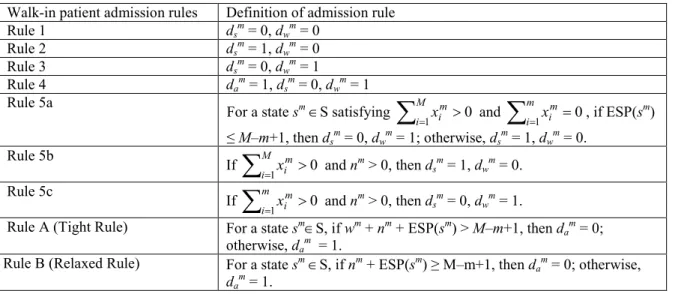
4.5: Summary of the optimal and heuristic rules for walk-in patient admission ... 81
4.6: Patient arrival pattern in the clinic motivating this study ... 83
4.7: Patient arrival patterns for the comparison of the heuristic rules ... 84
4.8: Overbooking policies and walk-in patient admission policies ... 85
4.9: Cost coefficients in the immediate net reward ... 87
x
5.1: Patient non-attendance rates for numerical analysis ... 113
5.2: Patient arrival patterns for numerical analysis ... 114
5.3: Patient service time distributions for numerical analysis ... 114
5.4: Cost coefficients for numerical analysis ... 114
5.5: Parameters used for the base case ... 115
5.6: Parameter adjustments for Cases 1-8 compared with base case ... 115
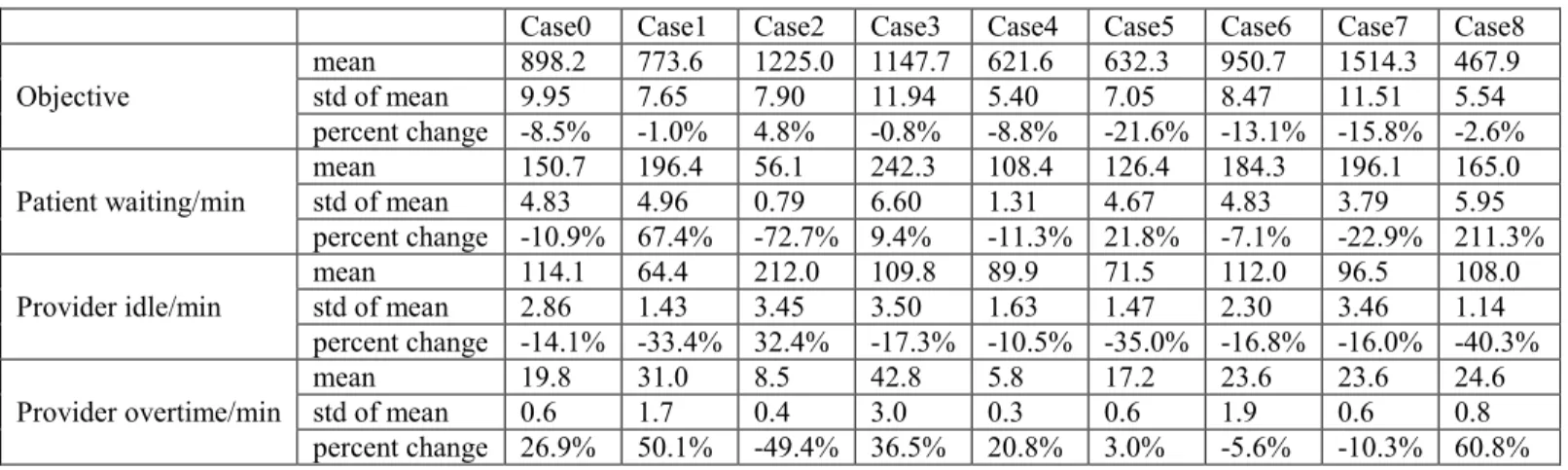
5.7: Summary of descriptive performance statistics for Cases 0- 8 (current rate) ... 120
xi
LIST OF FIGURES
Figure Page
1.1: Adverse effect of patient non-attendance ... 2
3.1: Average patient waiting time – double-booked slots vs. single booked slots ... 48
3.2: Average waiting time over appointment slots ... 49
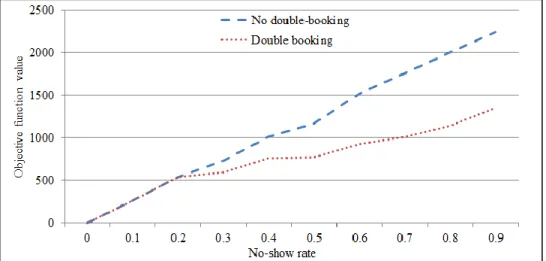
3.3: Effect of no-show rate on the objective function value ... 51
3.4: Effect of no-show rate on the double-booking rate ... 51
4.1: Patient flow and walk-in patient admission decisions in a clinic ... 65
4.2: Patient arrival process and walk-in patient admission process in a clinic session ... 65
4.3: Performance of the admission policies A2 – A8 under overbooking policy O1 ... 88
4.4: Performance of the admission policies A2 – A8 under overbooking policy O2 ... 88
4.5: Performance of the admission policies A2 – A8 under overbooking policy O3 ... 89
4.6: Performance of the admission policies A1, A2, and A6 under overbooking policies O1 – O3 ... 90
5.1: Comparison of optimal objective values between walk-in admission strategy and double booking strategy ... 117
5.2: Comparison of patient waiting times between walk-in patients and patients with appointments ... 117
5.3: Comparison of provider idle times under different walk-in patient arrival rates ... 118
5.4: Comparison of provider overtimes under different walk-in patient arrival rates ... 118
5.5: Impact of patient attendance rate on the number of walk-in admissions ... 121
5.6: Impact of patient arrival lead time on the number of walk-in patient admissions ... 122
5.7: Impact of patient service time on the number of walk-in admissions ... 122
5.8: Impact of cost coefficient ratio on the number of walk-in admissions ... 123
xii
1
1. INTRODUCTION
1.1. Background
In the United States, the national healthcare expenditure amounted to $2.7 trillion in 2011, which accounted for 17.9% of its GDP. This figure is more than all healthcare
expenditures in other countries combined (WHO, 2011). However, low clinic efficiency and poor patient accessibility to care still remain the major challenges for most outpatient clinics in the United States. It is estimated by the Institute of Medicine that the U.S. healthcare systems wasted $190 billion annually on inefficient delivery of care (Campbell, 2012). Among the inefficiencies, patient non-attendance which includes the patient no-shows and short-notice appointment cancellations (usually defined as cancellations prior to less than 48 hours of the clinic appointment date/time) is the major contributor in primary care clinics. It is also believed that patient non-attendance is the major challenge that reduces practice efficiency, resource utilization, and clinic accessibility, and leads to increased cost and diminished quality of care, as summarized in Fig.1.1. On the other hand, the clinic scheduling system is known as a
determining factor for clinic efficiency, resource utilization and the accessibility of patients to healthcare facilities. A suitable and optimized scheduling system is one of the most important components for efficient care delivery to address the major challenges in the healthcare industry. Hence, reducing the adverse effect of patient no-shows and short-notice appointment
notifications through the appointment scheduling approach is a strategically important matter for any healthcare systems.
Under the setting of traditional appointment scheduling, patients make appointments weeks or months earlier by calling the clinic or right after their current visits. Usually, the appointments are not available in near term, since most clinics operate at their capacity. As a
2
result, the patients need to wait several weeks or months for their clinic visits. In case of an urgent appointment, the patients may have to use the emergency department. It leads to a disruption of care continuity because they are not able to see their own providers in time. It also dramatically increases the care cost in an unnecessary way since the cost of emergency
department visits is much higher than that of primary clinic visits. Meanwhile, patient no-show rate and short-notice appointment cancellation rate are likely to increase due to the long waiting list for appointments. It is well-known that patient no-shows and short-notice appointment cancellations increase the volatility to the standard clinic process, which would eventually increase the healthcare expenditure and decrease clinic efficiency and patient accessibility.
Patient no-shows and short-notice cancellations Reduced practice efficiency Reduced resource utilization Reduced patient access to care Increased cost and diminished quality of care
Fig. 1.1: Adverse effect of patient non-attendance
Due the disadvantages of the traditional appointment scheduling system, open access scheduling (or advanced access scheduling) was proposed in 1990s, which promotes timely access to care, and improve patient satisfaction. The key concept of open access scheduling is to “do today’s work today”. Under this concept, a portion of clinic slots are reserved for the patients who need same-day appointments, while the non-reserved slots are scheduled in advance for
3
patient with non-acute illness. In order to optimize the appointment schedule template under the open access concept, clinics need to find out the optimal number and sequence of the reserved appointments according to their clinic setting and patient attendance characteristic.
Besides the open access scheduling approach, overbooking is also a well-known practice for mitigating the adverse effects of patient no-show and short-notice appointment cancellation. Generally, by using the overbooking strategy, clinics can book two or more (normally two) patients in the same appointment slots. In case of one patient being no-show or cancelling the appointment with short-notice, the provider can still see other patients in the same appointment slot. However, in case of more than one patients showing up for the same appointment, it can be expected that the patient waiting time will increase dramatically. Hence, the common problem with overbooking practice is to determine the number of overbooking slots and which
appointment slots should be overbooked.
Besides the above mentioned practice, it is also believed that clinics can also reduce the adverse effects of patient no-show and short-notice appointment cancellation by admitting walk-in patients (Moore et al., 2001; Liu et al., 2010). The key concept is uswalk-ing walk-walk-in patients to fill the empty appointment slots due to patient no-shows and short-notice appointment cancellations. In order to achieve the maximum profit and patient satisfaction, the clinics need to optimize their walk-in patient admission policy, since too many walk-in patient admissions will lead to reduced patient satisfaction, while too few admissions can result in the loss of profit. Hence, it is
worthwhile to develop optimization models/methods that can find the optimal walk-in patient admission policy where the optimal number of walk-in patients can be admitted at the right time.
4 1.2. Problem statement
It can be shown that open access scheduling optimization problem and overbooking scheduling optimization problem belong to the category of static appointment scheduling problem, in which all decisions are made before the clinic session starts. The static appointment scheduling determines the scheduling template of providers, i.e., how many patients to be booked in each appointment slot. On the other hand, walk-in admission optimization problem is in the category of dynamic appointment scheduling problem, where the walk-in admission decisions are made during the clinic session. To be more specific, the walk-in admission optimization problem uses the schedule template as the input, and determines which walk-in patient should be admitted. Note that for both type of problems, we want to mitigate the adverse effect raised by patient no-show and short-notice appointment cancellation. With this
understanding, the work of this dissertation can be divided into two different tasks, as shown in Fig 1.1. In the first task, we solve the static appointment scheduling problem, which finds the best overbooking strategy to deal with patient no-show and short-notice appointment
cancellation. In the second task, we solve the dynamic appointment scheduling problem, which optimizes the walk-in patient admission decisions.
In the existing literature, the patient overbooking problem has drawn a lot of attention. The basic questions in the patient overbooking problems are:
1) How many appointment slots should be overbooked? 2) Which appointment slot should be overbooked?
The number of appointment slots to be overbooked is of vital importance for the patient overbooking problem, since inappropriate decisions may lead to long patient waiting time (if too many overbooking) or long provider idle time (if too few overbooking). Intuitively, the number
5
of overbooked slots can be estimated by the total number of appointment slots times the non-attendance rate. However, many studies have shown that this kind of estimation may not provide the optimal solution. Hence, advanced techniques are needed to find the optimal solution to this problem.
Besides, the number of appointment slots to be overbooked (i.e., the second question) is also of vital importance for patient overbooking problem. Note that the optimal number of overbooked appointment slots alone does not guarantee the optimal solution to the overbooking problem. For example, assume we know that only 1 appointment slot should be overbooked, we need further decide which appointment slot should be overbooked. To answer this question, we need to consider the patient non-attendance rate, patient service time distribution, patient arrival patterns, and etc. Hence, this is a complex problem that requires advanced modeling tools and solution approach.
As for the first task of this study, we will formulate this complex patient overbooking problem, which considers patients’ choice, into a two-stage stochastic programming model, where the objective is the weighted sum of patient waiting time, provider idle time and provider overtime. Note that, to some extent, the patient waiting time, provider idle time and provider overtime can indicate the operation efficiency, resource utilization and access to care,
respectively. By comparing the existing overbooking studies, our study contributes to the literature in the following aspects: (1) Our study is the first one that applied the two-stage stochastic programming model to investigate the patient overbooking problem; (2) Our study does not have restriction on patient service time distribution (some studies assume constant service time) and patient arrival patterns (some studies assume punctual arrival). (3) Our study considers a clinic system with multiple providers.
6
As for the second task of this dissertation, it will be shown in the literature review that limited attention has been paid to the walk-in patient admission optimization problem. In such clinics, admitting some walk-in patients is usually adopted to reduce the negative impact of patient no-shows and short-notice cancellations and improve the operations efficiency, resource utilization and patients’ accessibility to the clinics. To solve walk-in patient admission
optimization problem, we need to give answers to the following four questions one by one: 1) When should the walk-in patient admission decisions be made?
2) At each decision point, how many walk-in patients should be admitted? 3) Which provider should serve the admitted walk-in patients?
4) When should the admitted walk-in patients be served?
An intuitive answer to the first question is making the admission decision upon the arrival of the walk-in patients. However, this will pose great difficulty in mathematically modeling the problem, since the random arrival pattern of walk-in patient will bring uncertainty to the decision time point. Hence, clinics could choose to make the decision at fixed time points (e.g., the
beginning of each appointment slot), in order to simply the walk-in patient admission optimization problem. It should be noted that both scenarios are examined in this study.
The answer to the second question is of critical importance to the walk-in patient
admission optimization problem, since it directly affects the objective function value. As we can imagine, excess walk-in admissions could increase the patient waiting time and provider
overtime, while insufficient walk-in admissions could increase the provider idle time, given the high patient no-show rate and short-notice appointment cancellation rate. Much information has to be considered in order to make this decision, such as the number of previous admitted walk-in patients and number of providers in the clinics. In addition, the randomness of patient no-show
7
and short-notice appointment cancellation, as well as the random service introduce more difficulties in answering this question.
The answers to the third and fourth question are also important to the walk-in patient admission optimization problem, since the arrangement of the admitted walk-in patients can also affect the objective function value. For example, assume we have the optimal answer for the second question, which provides the optimal number of admitted walk-in patients, a bad
arrangement of those patient can easily increase patient waiting time, provider idle time as well as the provider overtime. Hence, to find best answers for question 3 and 4, we might need to apply the techniques, which have been tested for solving job shop scheduling problem.
As we can see, none of four questions can be easily addressed. When they are combined together, there is no doubt that both advanced modeling skills and leading solution approaches should be adopted to find the right answer. The existing modeling approach for clinic scheduling optimization might not be applicable or hard to be applied to the walk-in patient admission optimization problem. In this sense, it is in urgent need of developing models and tools that could be used to make optimal walk-in patient admission decisions. As a result, this study will also develop models and solution approaches for solving the proposed walk-in admission optimization problem, which will fill the gap between the existing studies and the needs from clinics.
At last, it should be indicated that the contributions of this study will be as follows: 1) Our study will be the first quantitative research investigating the dynamic walk-in patient admission optimization problem in regards of mitigating the negative impacts of patient no-shows and short-notice appointment cancellations. Hence, this study can fill the gap between the existing study and needs from clinics.
8
2) Two different types of modeling approaches, i.e., Markov Decision Process (MDP) and Stochastic Mixed Integer Programming (SMIP) will be piloted on modeling the walk-in patient admission optimization problem. Although both modeling approaches have been studies and applied by many researches, there is no general framework which can be used to model the newly proposed problem. Hence, our models will be the first MDP model and SMIP model for the dynamic walk-in patient admission optimization problem.
3) Advanced solution approaches will be developed to solve the newly proposed problem. For the MDP model, the large size of state space can hinder the efficiency of solution procedure. To make it worse, it might be impossible to locate the optimal solution for some large size problems. In addition, there is no standard solution procedure for MDP models, i.e., the MDP models in the existing literature all have their own dedicate solution procedures. Hence, as one major contribution of this study, we propose a simulation based genetic algorithm to find the heuristic optimal walk-in patient admission policy.
For the SMIP model, since the walk-in patient admission decision need to be made in real time or within short time (less than 1 minute), it can be expected that the solution approaches should be quite efficient. As it is well known, the stochastic characteristic and the integer decision variables can make the SMIP problems very difficult to solve. Our developed solution approach, which is based on the sample average approximation (SAA) method, will overcome these challenges and provide the optimal admission decision for clinics.
4) It is reported that the number of walk-in clinics is expected to increase from 1400 in 2012 to 2800 in 2015 with a saving of $800 million per year for the entire healthcare industry in the U.S. (Sussman, 2013). With our developed models and solution approaches, the results of this study can be applied to any clinics which provide services to walk-in patients. It can be
9
expected that our study can help these clinics to make the best walk-in patient admission decision, make sure that the admitted walk-in patients are served at the right time and thus lead to the substantial cost savings.
10
2. LITERATURE REVIEW
2.1. Patient no-shows and short-notice appointment cancellations
Many studies have identified patient no-shows as one of the most challenging problems associated with the healthcare industry in terms of operational planning (Cayirli and Veral, 2003; Gupta and Denton, 2008). It is claimed that clinic no-show rate varies among clinical
departments, regions, and nations, with the range being between 5%-60% (Woodcock, 2003; Zeng et al; 2013). In addition, it can be shown that patient non-attendance disrupts the clinical flow operations in multiple ways. Not only it causes waste and disrupts clinical flows, but also it limits clinic access of other patient. This in turn leads to poor health outcomes, reduced revenues and lower clinical staff productivity (Zeng et al., 2013).
With the understanding of the side effect of patient no-shows, tremendous research has been conducted to discover the factors that affect patient no-show behavior. Among these studies, Lehmann et al. (2007) indicate that patients who have higher no-show risks are younger, born earlier in the year, and belonging to the ethnicity other than European. In addition, the authors indicate that follow-up patients are likely to be no-shows as compared to the new
patients. The findings of the increased tendency of the patients belonging to the minority groups are also confirmed by Cohen et al. (2008). The authors divide the existing data in two groups (i.e., adults and children). The study indicates that among the group pertaining the children group, ethnicity and geographic considerations are significant. Additionally, the parents’ perceptions on the physician also play a role in the determination of the no-show risk among this group. Among the adult group, it is indicated that gender, geographic consideration, time of the appointment, and the amount of time elapsed between the date of scheduling the appointment and actual appointment all play significant roles. The role of ethnicity is also confirmed by the study of
11
Dreiher et al. (2008). In addition, the authors indicate that the ethnic origin and time of the year might play a role in determining the no-show risk. The effect of the time of the year (i.e., seasons) might be linked with the weather conditions. Since the higher rate of no-show risks is associated with spring and winter, it might be indicated that weather conditions might also play a role in determining the no-show risk. In addition, González-Arévalo et al. (2009) point out that the patients who live far away from the hospital and the patients who have poor healthcare conditions and deteriorated mental status are more likely to become no-shows. Meanwhile, forgetting appointment time/date, hospitalization or death of the patient, not being notified about the appointment, or the change of appointment date/time are the main factors for the patients to miss the appointments. Ciechanowski et al. (2006) demonstrate that among the diabetes patients, the fearful and secure type of attachment in a non-depressed patient less likely leads to a no-show compared with that in a depressed patient. Similarly, Norris et al. (2014) indicate that among the main factors that affect the no-show rates, prior attendance history, age, and distance play the most significant role. Another interesting finding is that the clinical practices that aim to increase the utilization contribute to the increase of no-show rate.
Among the common factors mentioned above, patient forgetfulness, patient
dissatisfaction due to extensive delays in accessing to the healthcare services, time conflicts, transportation related issues, patient’s emotions, patient’s perceptions regarding the merits of the healthcare system can all be considered to be the factors that contribute to the no-show rates (Goldman et al., 1982; Bean and Talaga, 1992; Garuda et al., 1998; Lacy et al., 2004; Zeng et al., 2013).
With the understanding of the significant factors related to patient no-show behaviors, various non-scheduling (as compare to the scheduling approaches mentioned above) intervention
12
strategies such as sending out reminders, providing the transportation service, or charging the no-show fee are offered in the literature. For example, Woods (2010) indicates that the telephone reminders decrease the no-show rate by 50% (from 8% to 4%). Similarly, the notification letters as a form of intervention also decreases the no-show risks for the patient by 29%. These types of interventions can reduce the no-show problem to some extent (Macharia et al. 1992, Guy et al.
2012), but the elimination of patient no-shows through implementing these interventions is unlikely. Some clinics still report high non-attendance rates after implementing those measures, which are as much as 20% or even higher (Hashim et al. 2001, Geraghty et al. 2007; Liu et al.,
2013). In addition, Henry et al. (2012) in a study conducted in the VA hospital setting, indicate that intervention methods based for decreasing the no-show risk might work for some patient groups, while they might not be effective in some other. To cite an instance, the authors indicate that patients, who are not homeless, not in depression, and had five or more appointments in the last 6 months are associated with lower risk of no-show risk based on the automatic telephone reminder intervention. However, for the patients not having those attributes, the no-show risk is not affected by the notification schemes based on telephone reminder.
In addition to patient no-shows, short notice appointment cancelations also should be considered as impediments of clinic efficiency and patient accessibility to care. Usually short-notice appointment cancellations disrupt the clinic operations flow. Given the short time short-notice, it would be difficult to notify another patient about opening of the time slot of the cancelled appointment, and in most of the cases, the short notice appointment cancellations are somehow equivalent to patient no-shows with regard to the associated outcomes.
13
There are some studies in the literature that consider the appointment cancellation. Although the number is not as high as the no-show studies, they deserve special attention. As previously discussed, appointment cancellations especially with the short notice might disrupt the operations and lead to wastes and inefficiencies. In that regard, Olson et al. (1994) indicate that higher body mass index might be associated with the higher appointment cancellation among the female population. Additionally, Buckley et al. (2009) discuss the role of approaches that might be followed by the radiologist to reduce the appointment cancellation rates. The patients when referred to radiology department might fear for embarrassing situation. Parikh et al.
(2010) indicate that live telephone reminders initiated by the staff members or auto reminders might help with decreasing the appointment cancellation risk.
To sum up, patient no-shows and short-notice appointment cancellations have significant adverse effect on the clinic efficiency and patient accessibility to care. They can disrupt the clinic flows, increase operation cost and decease the patient satisfaction and quality of care. Although non-scheduling intervention can reduce the no-show rate and appointment cancellation rate to some extent, it is unlikely that patient no-show and appointment cancellations could be completely eliminated. Hence, it is of great importance to apply scheduling interventions with the combination of non-scheduling intervention to further reduce the adverse effect of patient non-attendance. Note that the scheduling interventions are usually adopted through the appointment scheduling optimization process. In the following, we will review the existing literatures on the appointment scheduling optimization problems and the corresponding scheduling interventions.
14 2.2. Clinic appointment scheduling optimization
Appointment scheduling was introduced in outpatient clinics in the 1950s to reduce patient waiting time in clinics (Bailey 1952, Welch and Bailey 1952). Currently, most outpatient clinics in the U.S. use this approach to control the access to care services that they provide. The downside is that appointment scheduling may result in long lead time and long waiting lists for appointments (Murray and Tantau 1999, Pinto et al. 2002). The long lead time for appointments leads to more patient no-shows and late cancellations (Bean and Talaga 1995, Lacy et al. 2004, Lee et al. 2005), which waste clinical resources and thus increase healthcare costs. Meanwhile, several studies show that the long waiting lists for appointments prevent patients in acute conditions from seeing their own physicians in a timely manner, which undermines the
accessibility to healthcare (Pinto et al. 2002, Murray and Berwick 2003). It should be noted that the U.S. is not alone in this regard – similar problems on appointment scheduling exist in the healthcare systems of other developed countries such as England (Kerssens et al. 2004; Schoen et al. 2004). Hence, the appointment scheduling optimization problem has receiving consistently attention from researchers and practitioners.
Queuing theory and simulation are the major quantitative methods used to evaluate and optimize appointment schedules. Among the two, simulation is more relevant to our work so we will survey the relevant studies in details. In early studies, simulation is primarily used to compare alternative appointment scheduling templates (or more commonly referred to as ASRs in the operations research literature) in outpatient clinics with respect to key system performance measures such as patient waiting time and provider idle time (Bailey, 1952; Fetter and
Thompson, 1966; Vissers, 1979). In more recent studies, simulation experiments are conducted to help identify the most appropriate ASR with various environmental characteristics (Klassen
15
and Rohleder, 1996; Rohleder and Klassen, 2000; Ho and Lau, 1992; Ho and Lau, 1999; Cayirli, Veral and Rosen, 2006). For example, Klassen and Rohleder (1996 and 2000) compare various ASRs under different distributions of patient service time, and illustrate that the optimal ASR depends on the mean and variance of the service time. Ho and Lau (1992 and 1996) compare various ASRs with different specifications of patient service time as well as no-show rate and the length of clinic sessions. Cayirli et al. (2006) further incorporate patient heterogeneity into the assessment of ASRs. Overall, these papers show that ASRs have significant effect on operational performance and that patient characteristics are important compounding factors, including walk-in rate, no-show rate, and arrival punctuality.
In recent years, optimization models have been developed for designing optimal ASRs in outpatient appointment scheduling. For example, Vanden Bosch et al. (1999) propose an
efficient heuristic search algorithm to design an optimal ASR under the assumptions of independent service times following the identical Erlang distribution and punctual patient arrivals. Bosch and Dietz (2000 and 2001) extend the model by considering general phase-type distributed service times as well as patient no-shows. Kaandorp and Koole (2007) propose a stochastic optimization model with a multimodular objective function and presented a local search method based on the multimodularity of the objective function. Rohleder and Klassen (2000) apply simulation optimization for optimal ASR design with more flexible clinical settings. It is worth noting that most of the recent studies incorporate patient no-show uncertainty in their models.
2.3. Open access scheduling
In the past two decades, open access scheduling has been extensively studied. Murray and Tanau (1999) first propose the concept of open access scheduling to overcome the problem
16
of high no-show rates in outpatient clinics. In the study, a successful case of open access
scheduling in a clinic in the U.S. is demonstrated. Gupta et al. (2006) conduct an empirical study of clinics within Minneapolis metropolitan area that applies open access scheduling. It is pointed out that the factors, which include different practice styles of doctors, differences in panel
compositions, and patient preferences, could hinder the successful sustaining of supply-demand balance. Several performance measures are proposed to help management for monitoring and evaluating the implementation of open access scheduling. There are also other publications that report the successful implementations of open access scheduling, which all indicate that open access scheduling is capable of reducing healthcare cost while improving the access to care, clinic resource utilization and patient satisfaction (Kennedy and Hsu, 2003; Murray et al., 2003; O’Hare and Corlett, 2004; Mallard et al., 2004; Bundy et al., 2005; Parente et al., 2005;
O’Connor et al., 2006; Cameron S et al., 2010). In addition, Rose et al. (2011) conduct a systematic review on the performance of open access scheduling, which shows the benefits of reducing patient waiting time and no-show rate as well. Generally, the critical parameters for open access scheduling systems are determined based on experts’ experiences rather than analytical methods. For instance, the percentage of open access appointments may range from 30% to 80% depending on the scheduler’s experience (Herriott, 1999; Kennedy and Hsu, 2003; Murray and Tantau, 2000).
Besides the empirical studies, mathematical modeling approaches have also been widely applied to analyze the open access scheduling systems. Green et al. (2007) study the relationship between the panel size and the probability of “working overtime” or “extra work” for a provider in an open access clinic. The “extra work” is measured by the expected number of extra patients that a provider has to see in the open access clinic. Kopach et al. (2007) conduct a simulation
17
study to evaluate the effects of open access scheduling on the continuity of care. It is concluded that the increasing fraction of open access patients have an adverse effect on the continuity of care, but the adverse effect could be mitigated by providers working as a team. Qu et al. (2007) develop a closed-form approach to quantitatively determine the optimal percentage of open access appointments to match daily provider capacity to demand. It shows that the optimal percentage of open access appointments mainly depends on the ratio of average demand for open access appointments to provider capacity and the ratio of the show-up rates for traditional and open access appointments. Liu et al. (2010) propose a dynamic programming model to study the heuristic policies of patient appointment scheduling by taking patient no-shows and cancellations into account. The results suggest that open access scheduling works best when the patient load is relatively low. Robinson et al. (2010) conduct a comparison study between traditional patient scheduling methods and open access scheduling. It is claimed that open access scheduling is significantly better than traditional methods in terms of patient waiting, provider idle and provider overtime. Lee and Yih (2010) conduct a simulation study to investigate the impact of open access configuration considering clinic setting conditions including demand variability, no-show rate, and the percentage of same-day appointments. The performance of different open access configurations is analyzed in terms of patient waiting time, patient rejection rate, and clinic utilization. Furthermore, Dobson et al. (2011) develop a stochastic model to evaluate the performance of open access scheduling in a primary care practice. It is found that encouraging routing patients to call for same-day appointment is a key element for the success of open access scheduling. Qu et al. (2011) propose a hybrid policy for open access scheduling, which consider two time horizons instead of one for the short-notice appointments. It is shown that the hybrid policy is no worse than the single time horizon policy in terms of the expectation and variance of
18
the number of patients seen. Balasubramanian et al. (2012) propose a two stage stochastic integer programming model to maximize timely access and patient-physician continuity simultaneously for open access clinics. Qu et al. (2012) propose a mean-variance model to optimize the ratio of traditional versus open access appointments for open access scheduling systems. In addition, Patrick (2012) proposes a Markov decision model for determining optimal outpatient scheduling. In his study, open access scheduling is compared to the short booking window concept, and the latter appears to be more effective in term of cost minimization.
2.4. Overbooking
The overbooking strategy has long been studied in appointment scheduling optimization problems with the consideration of patient no-show and/or appointment cancellation. One outstanding study conducted by LaGanga and Lawrence (2007) examines the patient no-show problem and proposes overbooking strategy as the way to reduce the adverse effect of patient no-shows. In this study, a new utility function is developed, which can characterize the trade-offs between benefits and cost. The authors show that overbooking can increase patient access and productivity of providers, while increasing the patient waiting time and provider overtime significantly. The authors also show that the relative values that a clinic assigns to serving additional patients, minimizing patient waiting time, and minimizing provider overtime will determine whether overbooking is warranted. At last, it is concluded in the study that the
overbooking strategy produce more utility for clinics with a larger patient population size, higher patient no-show rate, and lower service time variability. LaGanga and Lawrence (2012) extend their previous work and propose the flexible appointment scheduling model, which can mitigate the negative effect of patient no-show by overbooking policy. Their results show that the near-optimal overbooking appointment scheduling, which balances the extra benefits obtained from
19
serving additional patient and the resulted cost associated with the possible patient waiting time and provider overtime, can be searched with a fast and effective solution procedure.
In addition, Daggy et al. (2010), based on a VA hospital setting, compare the
performance of two scheduling approaches. The first approach does not consider the no-shows, while the second approach employs overbooking in the presence of no-shows. The results
indicate that incorporating no-show probabilities in the clinic booking improves the patient flows and clinic efficiency. More recently, Samorani and LaGanga (2013) suggest a data mining approach to capture the no-show probability of individual patients and develop the optimal overbooking policy based on appointment characteristics on the appointment day. Furthermore, Giachetti (2008) conducts a simulation study, which suggests double book the habitual no-show patients whenever they make appointments, while Kros et al. (2009) conduct empirical study, which claims a saving of 95,000$ per semester after implementing the overbooking process instructed by a novel overbooking model.
To add more, Kim and Giachetti (2006) develop a stochastic mathematical appointment overbooking model (SMOM) to optimize the number of appointment that should be accept in regard to maximize the expected total profit. The SMOM approach is then compared with two other approaches, namely “no overbooking” and “naive statistical overbooking approach” (NSOA). The NSOA simply adds the mean number of no-shows minus the mean number of walk-ins to the number of appointment to accept. Their result shows that by comparing to the “no overbooking” approach, the SMOM can increase the expected total profit by 43.72%, while the NSOA can increase the corresponding profit by 29.66%. Similarly, Muthuraman and Lawley (2008) develop a stochastic overbooking model for an outpatient clinic with patient no-shows with the consideration of patient waiting time, provider overtime and the revenue collected from
20
patients. In addition, Zeng et al. (2010) also propose a clinic scheduling model, which applies overbooking to compensate the negative impact of patient no-shows, in order to maximize the expected profit including revenue from patients and cost related with the patient waiting times and provider idle time. It is proved that the objective function, which is the expected profit, has different characteristics for patients with heterogeneous no-show probabilities and patients with homogeneous no-show probabilities. To be more specific, the objective function is multimodular for patients with homogeneous no-show probabilities. However, this property does not apply when patients hold different no-show probabilities. To extend the existing work, Huang and Zuniga (2012) develop a dynamic overbooking scheduling policy with the consideration of predicted no-show probability for individual patients. This policy is targeting at improving the patient access to care as well as reducing the patient waiting, while minimizing the clinic’s cost. Their results show that the proposed dynamic overbooking scheduling policy outperforms the naive overbooking strategy, which overbook patients evenly throughout a clinic session. 2.5. Walk-in patient admission
Generally, the walk-in patients are referred to the patients who come to clinics and request for medical service without an appointment. It is shown that people persist in presenting to clinic and requesting immediate healthcare service, although there is no indication that a walk-in service is available walk-in the clwalk-inic (Crismani and Galletly, 2011). However, the walk-walk-in patients do not receive much attention from the researchers and healthcare practioners for the following reasons: 1) clinics do not want to admit walk-ins if they are running at their full capacity (i.e., sufficient patients with appointment); 2) providers do not feel the obligations to serve walk-in patients, since they do not have an appointment; 3) in the primary care clinic setting, it is speculated that the quality of care might be reduced, if the providers are not familiar with the
21
walk-in patients (i.e., a provider is not the primary care physician whom the walk-in patients usually see). Among the limited literature related to walk-in patients, a few empirical studies show that the in patients make an important piece of the entire patient population and walk-in patient friendly clwalk-inics are preferred by many consumers (Crismani and Galletly, 2011; Chmiel et al., 2011; Gail, 2007; Su and Shih, 2003;). With this prevision of walk-in patients, it can be concluded that quantitative methods will in urgent need for the scheduling optimization problem with the consideration of the walk-in patient admissions.
Although quantitative methods have been applied to analyzing and optimizing appointment scheduling systems (Cayirli and Veral, 2003; Gupta and Denton, 2008), most studies focus on outpatient clinics that do not accept walk-in patients. Only a few recent studies consider the appointment scheduling systems of the clinics accepting walk-in patients (Kim and Giachetti, 2006; LaGanga and Lawrence, 2008; Cayirli et al., 2012). For example, Kim and Giachetti (2006) develop a stochastic mathematical overbooking model with the consideration of probability distributions of patient no-shows and walk-ins. Their model determines the optimal number of appointments to be scheduled in order to maximize the total expected profits.
LaGanga and Lawrence (2008) extend their heuristic algorithm in (LaGanga and Lawrence, 2012) to optimize appointment schedules in clinics accepting walk-in patients. Their results show that a modest number of scheduled appointments can significantly improve service quality and clinic performance compared to an all-walk-in clinic. Cayirli et al. (2012) propose a “Dome”
appointment rule in which the disruptive effects of no-shows and walk-ins are considered. In the “Dome” appointment rule, appointment times are determined based on the mean and standard deviation of service times that are adjusted by the no-show rate and the walk-in rate. In these studies considering walk-in patients, it is assumed that a clinic admits all walk-in patients, and
22
the same cost structure is assumed for scheduled patients and walk-in patients. However, in reality, many clinics actually have the flexibility of admitting walk-in patients selectively. For instance, a few primary care clinics that we worked with have the policy of seeing walk-in patients if possible, and their 5-month statistics show that 20% – 50% of walk-in patients were seen.
In addition, studies have shown that there are sufficient service requests (demands) from walk-in patients. For example, Howard et al. (2008) show that about one quarter of patients with their own primary care physician use the walk-in patient service in a six month period. For another example, a study in VA hospital reports that the investigated primary care clinic in a medical center encounters 45-72 walk-in patients per day on average (Phatak et al. 2011). Similarly, Huarng (2003) conducts a study, which shows that the ratio of walk-in patients could be as high as 55% in some outpatient clinic. Hence, admitting all arrived walk-in patients can make clinics running over capacity, which can dramatically increase the operation cost and lower the quality of care. In such clinics, a policy is needed to determine whether to admit a walk-in patient or not and in which slot a walk-in patient should be seen. This need motivates us to investigate walk-in patient admission policies in outpatient clinics.
23
3. TWO-STAGE STOCHASTIC PATIENT OVERBOOKING OPTIMIZATION
MODEL 3.1. Introduction
Faced with the challenges of increased cost, limited capacity, and expanding demands for healthcare services, the outpatient clinics are running at dual objectives including stabilizing revenue and improving the healthcare access. It is the clear that the access is mostly determined by the appointment scheduling system. Traditionally, a patient, who needs an appointment, would call the clinic and be immediately booked with an appointment in a few days, weeks or months later, which is often referred as the lead time for an appointment. When there is sufficient patient demand, the clinics are most likely to operation at or close to their full capacity, which often means that no appointment is available in the near feature, i.e. the appointment lead time is long. However, ill patients usually cannot wait such a long time for an appointment. They will either enter the clinic as without an appointment or use the expensive Emergency Department. In addition, long lead time can cause the serious patient no-show problem, since the patient may have recovered, moved, forgot, or even died during this period. It is well-known that
overbooking is an effective strategy for improving clinic accessibility and stabilizing revenue when a significant portion of patients choose not to show up for their appointments. In order to find the optimal overbooking strategy, a clinic needs to determine, given the stochastic
characteristic of patient arrival pattern, patient non-attendance rate, and service time, (1) the optimal number of appointment slot to be overbooked; (2) where the overbooked appointment slots should be located.
In this study, we develop a two-stage mix-integer stochastic programming model to solve the clinic scheduling and overbooking optimization problem, which determines the optimal
24
strategy for assigning appointment seeking patients to a fixed number of appointment slots with fixed length (typically 15, or 30 minutes). The model will also optimize the service start time of each patient show-up for their appointment, given different scenarios, which are subject to the stochastic patient arrival pattern, patient non-attendance rate, and patient service time. The objective is to minimize the operational cost, which is measured in terms of patient waiting time, provider idle time and provider overtime. Note that without overbooking, the resource of clinic will be under-utilized due to patient no-show, i.e., high provider idle time. However, too much overbooking can easily lead to the overloading problem, which causes high patient waiting time and provider overtime. Hence it is important to only overbook a moderate number of the
appointment slot. More importantly, clinics need to overbook the right appointment slot, given the optimal number appointments to be overbooked. A wrong decision may reduce patient no-show but worsen the overloading problem, i.e., further decrease provider idle time and increase patient waiting time. For example, a clinic overbooks the first appointment, while only the patient in the last appointment is expected to be no-show. Clearly, by doing this, it will delay the process of all patients starting from the second appointment, if both patients in the first slot show up for their appointment.
3.2. Terminology and problem formulation 3.2.1. Terminology
Index:
i: Index of patients with appointment.
j: Index of providers.
25 Patients with appointment:
} , , , , , , { 1 1 1 1 1 1 1 1 N ij C ij W ij L ij E ij S ij A ij ij t t t t t I I
p : Denote the first patient scheduled in the ith appointment slot of provider j. } , , , , , { 2 2 2 2 2 2 2 2 N ij C ij W ij L ij E ij S ij A ij ij t t t t t I I
p : Denote the second patient scheduled in the ith
appointment slot of provider j. Parameters: 1 C ij I , C2 ij
I : The cancellation indicator of the corresponding patient, with “1” indicating
cancellation.
1
N ij
I , IijN2: The show indicator of the corresponding patient, with “1” indicating no-show.
S ij
T : The expected starting time of the ith appointment of provider j. E
j
T : The expected service ending time of provider j.
1 _ A ij t dummy , _ A2 ij t
dummy : Dummy arrival time of the corresponding patient, which is
generated from given arrival time distribution.
1 _ L ij t dummy , _ L2 ij t
dummy : Dummy service length of the corresponding patient, which is
generated from a given service length distribution. Wait
c : The cost coefficient related to patient waiting time. Idle
c : The cost coefficient related to provider idle time. Overtime
c : The cost coefficient related to provide over time. Variables:
1
A ij
26
1
S ij
t , tijS2: The service starting time of the corresponding patient.
1
E ij
t , E2
ij
t : The service ending time of the corresponding patient. 1
L ij
t , L2
ij
t : The service length of the corresponding patient. 1
W ij
t , W2
ij
t : The waiting time of the corresponding patient.
A ij
I : Appointment indicator; A1 ij
I , if at least 1 patient is scheduled in the ith appointment
slot of provider j . D
ij
I : Double-booking indicator; D1 ij
I , if the ith appointment slot of provider j is
double-booked. I j
t : The idle time of provider j.
O j
t : The overtime of provider j.
3.2.2. Problem formulation
For the purpose of solving the clinical overbooking optimization problem, we develop a two-stage stochastic mixed-integer programming (SMIP) model. For an introduction to
stochastic integer programming, we refer to Birge and Louveaux (2001). In order to develop this SMIP model, we make the following assumptions.
1) Each clinical session is evenly divided into appointment slots. One or two patient appointment can be scheduled in one appointment slot. If two patients are booked in the same appointment slot, it will be referred as double-booking or overbooking.
2) Once an appointment is made, it cannot be modified unless it is cancelled by the patient.
3) Providers only see their own patients, i.e. patients scheduled for “provider A” will not be served by other providers in the clinic.
27
4) All patients with an appointment, who are not no-show or do not cancel their appointments, must be served by their corresponding provider within the clinic session, even if the provider has to work overtime.
5) Patients with earlier appointments, who are not no-show or do not cancel their appointments, will not be served later than patients with later appointments.
6) Providers do not serve any patients before the expected start time of the first appointment, i.e., the starting point of the clinic session.
Note that all the above assumptions are very basic and commonly made in the outpatient appointment scheduling literature (Cayirli and Veral, 2003, Gupta and Denton, 2008). More assumptions other assumes made in the existing literature on clinic overbooking optimization. For example, Kim and Giachetti (2006) propose a stochastic mathematical overbooking model (SMOM), which can determine the optimal number of appointment to be scheduled in advance to maximize the total expected profit. However, the model does not address the appointment allocation problem, i.e., which appointment slots should be used for the overbooking. In addition, the model requires a small variance for the service time distribution, in order to approximate the total service time as the mean service time of each appointment multiplied by the total number of appointment. For another example, Zacharia and Pinedo (2014) develop an appointment scheduling model with consideration of no-shows and overbooking. Their study investigates the single provider system and assumes punctual arrivals of patients at the start point of the appointment. In addition, Muthuraman and Lawley (2008) develop a stochastic
overbooking model for outpatient clinical scheduling with no-shows. Their model only considers the single provider system. In addition, they assume that the service times follow the exponential distribution and patient arrives at the beginning of each appointment, i.e., the possibility of
28
patient arrivals in the middle of appointment slot is ignored. To add more, LaGanga and Lawrence (2012) construct a flexible appointment scheduling model to mitigate the adverse effect of patient no-shows through overbooking strategy. Their study assumes the constant service time and punctual patient arrivals, if not no-show, at the starting point of the corresponding appointment.
By comparing with the existing clinic overbooking literature, our model has no
constraints for patient arrival patterns. Hence, the patient arrival time can be assumed to follow any distributions that generate meaningful (non-negative) arrival time and service length, while some of the existing clinic overbooking studies assume the patients have to arrive punctually if they are not no-show or do not cancel their appointment (Zacharia and Pinedo, 2014;
Muthuraman and Lawley, 2008; LaGanga and Lawrence, 2012 ). In addition, there are also no limitations about the service time distribution in our model. Hence, the model can be used for clinics with various service time distributions. Note that, some of the existing clinic overbooking studies rely on a specific service time distribution, or assume constant service time, which is often not realistic (Kim and Giachetti, 2006; Muthuraman and Lawley, 2008; LaGanga and Lawrence, 2012). Furthermore, our model does not have restrictions on the service start times of patients, except for the first one (see assumption No. 6), while some of the existing studies assume that provides don’t see patient before the expected appointment start time (LaGanga and Lawrence, 2009). Therefore, our model have much less restrictions on the patient arrival
patterns, service length distribution, as well as the service start time, as compared to the existing outpatient appointment overbooking studies. Meanwhile, our model contributes to the literature in the following ways. First, our model simultaneously can determine the optimal number of patients to be scheduled in the each appointment slot, and the patient sequence including the
29
service starting time and ending time, in presence of patient arrivals on the day of service. Instead of finding a heuristic solution using simulation models, our model can derive the optimal solution or near optimal solution with tight optimality gaps. Secondly, unlike the queueing and dynamic programming models, our model requires no specific assumptions regarding the distributions of service time, no-show probability, appointment cancellation probability, the patient arrival time, or other model parameters. Third, our model addresses the problem with consideration with multiple providers, while most of the existing studies only consider overbooking problem with single provider.
The objective of the problem is to minimize the expectation of the weighted sum of patient waiting time, provider idle time and provider overtime in a clinic session, as shown in Eq. 3.1 (Cayirli and Veral, 2003). The patient waiting time is measured as the time difference
between the actual appointment start time and expected appointments start time. In case that the actual appointment starts before the scheduled expected appointment start time, the waiting time will be defined as zero. The provider overtime is the time that provider worked after scheduled working hour. As for the provider idle time, it is defined as the amount of time that a provider is not seeing any patient during the scheduled working hour.
Min
j I j Idle O j Overtime j i W ij W ij Wait t t c t c t c 1 2 (3.1) S.T.
_ 1
1 1
1 1
, , . 1 dummy t I I I i j t N ij C ij A ij L ij L ij (3.2)
_ 2
1 2
1 2
, , . 2 dummy t I I I i j t N ij C ij D ij L ij L ij (3.3)
_ 1
1 1
1 1
, , . 1 dummy t I I I i j t N ij C ij A ij A ij A ij (3.4)30