Interactive Machine Learning for Assistive Robots
Koert, Dorothea(2020)
DOI (TUprints): https://doi.org/10.25534/tuprints-00014184 Lizenz:
CC-BY-SA 4.0 International - Creative Commons, Namensnennung, Weitergabe un-ter gleichen Bedingungen
Publikationstyp: Dissertation
Fachbereich: 20 Fachbereich Informatik
Fachbereich Informatik Intelligente Autonome Systeme
Interactive Machine Learning
for Assistive Robots
Interaktives Maschinelles Lernen für Assistenzroboter
Zur Erlangung des akademischen Grades Doktor-Ingenieur (Dr.-Ing.) Genehmigte Dissertation von Dorothea Carola Koert aus Hanau
Tag der Einreichung: 06. Januar 2020, Tag der Prüfung: 11. Februar 2020 1. Gutachten: Prof. Dr. Jan Peters
2. Gutachten: Prof. Dr. Heni Ben Amor Darmstadt – D 17
Interactive Machine Learning for Assistive Robots Interaktives Maschinelles Lernen für Assistenzroboter Genehmigte Dissertation von Dorothea Carola Koert 1. Gutachten: Prof. Dr. Jan Peters
2. Gutachten: Prof. Dr. Heni Ben Amor Tag der Einreichung: 06. Januar 2020 Tag der Prüfung: 11. Februar 2020 Darmstadt – D 17
Bitte zitieren Sie dieses Dokument als: URN: urn:nbn:de:tuda-tuprints-141845
URL: http://tuprints.ulb.tu-darmstadt.de/14184
Dieses Dokument wird bereitgestellt von tuprints, E-Publishing-Service der TU Darmstadt
http://tuprints.ulb.tu-darmstadt.de
Die Veröffentlichung steht unter folgender Creative Commons Lizenz:
Namensnennung – Weitergabe unter gleichen Bedingungen 4.0 International http://creativecommons.org/licenses/by-sa/4.0/deed.de
In memory of my grandfather -a true engineer until the end
Erklärung zur Dissertation
Hiermit versichere ich, die vorliegende Dissertation ohne Hilfe Dritter und nur mit den angegebenen Quellen und Hilfsmitteln angefertigt zu haben. Alle Stellen, die aus Quellen entnommen wurden, sind als solche kenntlich gemacht. Diese Arbeit hat in gleicher oder ähnlicher Form noch keiner Prüfungsbehörde vorgelegen. In der abgegebenen Thesis stimmen die schriftliche und elektronische Fassung überein.
Darmstadt, 01.Dezember 2020
Abstract
Intelligent assistive robots can potentially support elderly persons and caregivers in their everyday lives and facilitate a closer man and machine collaboration as an essential part of the yet to come 5-th industrial revolution. In contrast to classical robotic applications where robots were mostly designed for repetitive tasks, assistive robots will face a variety of different tasks in close contact with everyday users. In particular, it is difficult to foresee the variety of applications beforehand since they depend on a person’s individual needs and preferences. This renders preprogramming of all tasks for assistive robots difficult and gives need to explore methods of how robots can learn new tasks at hand during deployment time. Learning from and during direct interaction with humans provides hereby a potentially powerful tool for an assistive robot to acquire new skills and incorporate prior human knowledge during the exploration of novel tasks. Such an interactive learning process can not only help the robot to acquire new skills or profit from human prior knowledge but also facilitates the participation of inexperienced users or coworkers which can lead to a higher acceptance of the robot. However, while on the one hand human presence and assistance can be beneficial during the learning process, on the other hand, close contact with inexperienced users also imposes challenges. In shared workspaces or in close contact with everyday users a robot should be able to adapt learned skills to achieve as little disturbance of humans as possible. It becomes also important to evaluate human preferences about such adaptation strategies, their understanding of interactive learning processes and different ways for human input into learning. To come closer to the goal of intelligent assistive robots is therefore important to develop novel interactive learning methods and evaluate them in different robotic applications.
This thesis focusses on three main challenges related to the development of assistive intelligent robots and their interaction with everyday users. The different parts of the thesis contribute not only novel theoretical methods but additionally also evaluations on different robotic tasks with users, that had zero or only little prior experience with robots.
open-ended stream of human demonstrations in an incremental fashion. While learning new skills from human demonstrations has already been exploited in the literature it remains challenging to learn skill libraries from incrementally incoming demonstrations and when the total number of skills is not known beforehand. Therefore, in the first part of the thesis, we introduce an approach for online and incremental learning of a library for collaborative skills. Here, we follow a Mixture of Experts based approach and incrementally learn a library of collaborative skills and a gating model from coupled human-robot trajectories. Once trained, the gating model can decide which skill to choose as an appropriate response to a human motion, based on prior demonstrations and activate the corresponding robot skill. In contrast to existing batch learning methods, our method does not require the total number of skills to be known a priori and can learn new skills as well as update existing skills from multiple human demonstrations. The cooperative skills are represented as Probabilistic Interaction Primitives which can capture variance and inherent correlations in the demonstrations. We evaluate our method with different human subjects in a task where a robot assists the subjects in making a salad. We also evaluate hereby how learned skills transfer between different subjects.
Second, intelligent assistive robots should be able to adapt learned skills to humans when working in close contact or shared workspaces. For Probabilistic Movement Primitives (ProMPs), which were chosen as a skill representation in this thesis, such methods for online adaptation were missing in the literature so far. Hereby, it is in particular important to also evaluate the perceived level of safety and comfort of humans according to different adaptation strategies. To this end, we present two methods for online adaptation of learned skills in a shared workspace setting. Here, we introduce two novel online adaptation methods for ProMPs, namely spatial deformation and temporal scaling. Spatial deformation avoids collisions by dynamically changing the shape of the movement primitive, while at the same time staying close to the demonstrated motions. In temporal scaling, we adapt the ProMP’s velocity profile to avoid time-dependent collisions. To achieve intention aware adaptation in shared workspaces we combine both methods with a goal-directed prediction model for human motions. This prediction model can also be learned online from human motions. We conducted experiments for both novel adaptation methods in comparison to non-adaptive behavior with inexperienced users and evaluated influences on task performance as well as subjective metrics such as comfort and perceived level of safety.
The third challenge that we consider in this thesis is how a library of learned skills can be used in practice to solve sequential robotic tasks. While hereby reinforcement
learning offers a powerful tool for reward-driven learning and self-improvement, in real robotic applications it often suffers from costly and time-consuming sample collection. Here, human input might be beneficial to speed up and guide the learning. Therefore, it is important to enable and compare different ways how human input can be incorporated in reinforcement learning algorithms. In this thesis, we present an approach, which incorporates multiple forms of human input into reinforcement learning for sequential tasks. Since depending on the task human input might not always be correct, we additionally introduce the concept of self-confidence for the robot, such that it becomes able to question human input. We evaluate which input channels humans prefer during interaction and how well they accept suggestions or rejections of the robot if the robot becomes confident in its own decisions.
To summarize, the different parts of the thesis contribute to the development of intelligent assistive robots that can learn from imitating humans, adapt the learned skills dynamically to humans in shared workspaces and profit and learn from human input during self-driven learning of how to sequence skills into more complex tasks. The three main contributions to the state of the art are hereby: First, a novel approach to incrementally learn a library for collaborative skills when the total number of skills is not known a priori. Second, two novel methods for online adaptation of ProMPs and their combination with a goal-directed prediction model to enable intention aware online adaptation in shared workspaces. And third, an approach that combines multiple forms of human input with a reinforcement learning algorithm and a novel concept of self-confidence to learn and improve the sequencing of skills into more complex tasks.
Zusammenfassung
Intelligente Assistenzroboter können potentiell ältere Menschen und Pflegeperso-nal in ihrem Alltag unterstützen sowie eine engere Zusammenarbeit von Mensch und Maschinen als wesentlicher Bestandteil der noch bevorstehenden 5. industriel-len Revolution ermöglichen. Im Gegensatz zu klassischen Anwendungsbereichen, in denen Roboter meist für rein repetitive Aufgaben konzipiert wurden, werden Assistenzroboter eine Vielzahl von unterschiedlichen Aufgaben in engem Kontakt mit den alltäglichen Nutzern bewältigen müssen. Insbesondere ist es schwierig, die Vielfalt der Anwendungen im Voraus zu kennen, da sie von den individuellen Bedürfnissen und Vorlieben eines Menschen abhängen. Dies erschwert die Vor-programmierung aller Aufgaben für Assistenzroboter und macht es notwendig, Methoden zu erforschen, wie Roboter während der Einsatzzeit neue Aufgaben erlernen können. Das Lernen von und während der direkten Interaktion mit Men-schen stellt dabei ein potentiell mächtiges Werkzeug für einen Assistenzroboter dar, um neue Fähigkeiten zu erwerben und menschliches Vorwissen bei der Erfor-schung neuer Aufgaben einzubeziehen. Ein solcher interaktiver Lernprozess kann Robotern nicht nur helfen, sich neue Fähigkeiten anzueignen oder von menschli-chem Vorwissen zu profitieren, sondern erleichtert auch die Inklusion unerfahrener Benutzer oder Mitarbeiter in den Lernprozess, was zu einer höheren Akzeptanz des Roboters führen kann. Doch während einerseits die menschliche Anwesen-heit und Unterstützung während des Lernprozesses von Vorteil sein kann, stellt der enge Kontakt mit unerfahrenen Benutzern auch eine Herausforderung dar. In gemeinsamen Arbeitsbereichen oder in engem Kontakt mit alltäglichen Nutzern sollte ein Roboter in der Lage sein, gelernte Fähigkeiten so anzupassen, dass der Mensch möglichst wenig gestört wird. Es ist dabei wichtig, die Präferenzen von Menschen bezüglich solcher Anpassungsstrategien, ihr Verständnis interaktiver Lernprozesse und verschiedene Möglichkeiten für menschlichen Input zum Lernen zu evaluieren. Um dem Ziel intelligenter Assistenzroboter näher zu kommen, müs-sen daher, neuartige interaktive Lernmethoden entwickelt und in verschiedenen Roboteranwendungen getestet werden.
Ent-wicklung von assistiven intelligenten Robotern und deren Interaktion mit alltägli-chen Nutzern zusammenhängen. Die verschiedenen Teile der Arbeit tragen nicht nur neue theoretische Methoden bei, sondern zusätzlich auch Experimente zu verschiedenen Roboteraufgaben mit Nutzern, die keine oder nur wenig Erfahrung mit Robotern hatten.
Die erste Herausforderung besteht darin, Roboter in die Lage zu versetzen, koope-rative Fähigkeiten aus menschlichen Demonstrationen auf inkrementelle Weise zu erlernen. Während das Erlernen neuer Fähigkeiten aus menschlichen Demonstra-tionen in der Literatur bereits ausgenutzt wurde, bleibt es eine Herausforderung, Fähigkeitsbibliotheken aus inkrementell eingehenden Demonstrationen zu lernen, wenn die Gesamtzahl der Fähigkeiten vorher nicht bekannt ist. Daher stellen wir im ersten Teil dieser Thesis einen Ansatz für das online- und inkrementelle Lernen einer Bibliothek für kollaborative Fähigkeiten vor. Hier folgen wir einem Mixture-of-Experts basierten Ansatz und lernen inkrementell eine Bibliothek für kollaborative Fähigkeiten und ein Gating-Modell aus gekoppelten Mensch-Roboter-Trajektorien. Einmal trainiert, kann das Gating-Modell anhand vorheriger Demonstrationen entscheiden, welche Fähigkeit als angemessene Reaktion auf eine menschliche Bewegung gewählt werden soll und die entsprechende Roboterfähigkeit aktivieren. Im Gegensatz zu bestehenden Batch-Lernmethoden erfordert unsere Methode nicht, dass die Gesamtzahl der Fertigkeiten a priori bekannt ist und kann sowohl neue Fertigkeiten erlernen als auch bestehende Fertigkeiten aus mehreren mensch-lichen Demonstrationen aktualisieren. Die kooperativen Fähigkeiten werden als Probabilistische Interaktionsprimitive dargestellt, die Varianz und inhärente Zu-sammenhänge in den Demonstrationen erfassen können. Wir evaluieren unsere Methode mit verschiedenen menschlichen Probanden in einer Aufgabe, bei der ein Roboter den Probanden bei der Zubereitung eines Salats assistiert. Wir untersu-chen hierbei auch, inwieweit die erlernten Fähigkeiten zwisuntersu-chen verschiedenen Menschen übertragen werden können.
Zweitens, sollten intelligente Assistenzroboter in der Lage sein, gelernte Fähigkeiten an den Menschen anzupassen, wenn sie in engem Kontakt oder in gemeinsamen Arbeitsbereichen arbeiten. Für Probabilistische Bewegungsprimitive (Probabili-stic Movement Primitives, ProMPs), die in dieser Arbeit als Fertigkeitsdarstellung gewählt wurden, fehlten solche Methoden zur Online-Anpassung bisher in der Literatur. Dabei ist es insbesondere wichtig, auch das wahrgenommene Sicherheits-und Komfortniveau des Menschen nach verschiedenen Anpassungsstrategien zu bewerten. Zu diesem Zweck stellen wir zwei Methoden zur Online-Adaption von gelernten Fähigkeiten in einem gemeinsamen Arbeitsumfeld vor. Hier stellen wir zwei neuartige Online-Anpassungsmethoden für ProMPs vor, nämlich die räumliche
Deformation und die zeitliche Skalierung. Die räumliche Deformation vermeidet Kollisionen, indem sie die Form des Bewegungsprimitivs dynamisch verändert, während sie gleichzeitig nahe an den demonstrierten Bewegungen bleibt. Bei der zeitlichen Skalierung passen wir das Geschwindigkeitsprofil des ProMPs an, um zeitabhängige Kollisionen zu vermeiden. Um eine intentionale Anpassung in ge-meinsamen Arbeitsräumen zu erreichen, kombinieren wir beide Methoden mit einem zielgerichteten Vorhersagemodell für menschliche Bewegungen. Dieses Vorhersagemodell kann auch online aus menschlichen Bewegungen gelernt wer-den. Wir führen dabei Experimente für beide neuartigen Adaptionsmethoden im Vergleich zu nicht-adaptivem Verhalten mit unerfahrenen Benutzern durch und evaluieren Einflüsse auf die Aufgabenausführung sowie subjektive Metriken wie Komfort und wahrgenommenes Sicherheitsniveau.
Die dritte Herausforderung, die wir in dieser Arbeit betrachten, ist, wie eine Biblio-thek gelernter Fähigkeiten in der Praxis zur Lösung sequentieller Roboteraufgaben eingesetzt werden kann. Während hierbei Reinforcement Learning ein mächti-ges Werkzeug für belohnungsorientiertes Lernen und Selbstverbesserung bietet, leidet es in realen Roboteranwendungen oft unter einer kostspieligen und zeit-aufwendigen Probensammlung. Hier kann menschlicher Input von Vorteil sein, um das Lernen zu beschleunigen und zu leiten. Daher ist es wichtig, verschiedene Möglichkeiten zu ermöglichen und zu vergleichen, wie menschliche Eingaben in Reinforcement Learning-Algorithmen integriert werden können. In dieser Arbeit stellen wir einen Ansatz vor, der verschiedene Formen des menschlichen Inputs in das Reinforcement Learning für sequentielle Aufgaben einbezieht. Da der mensch-liche Input je nach Aufgabenstellung nicht immer korrekt sein kann, führen wir zusätzlich das Konzept des Selbstvertrauens des Roboters ein, so dass er in der Lage ist, den menschlichen Input zu hinterfragen. Wir untersuchen, welche Eingabe-kanäle Menschen während der Interaktion bevorzugen und wie gut sie Vorschläge oder Ablehnungen des Roboters akzeptieren, wenn der Roboter selbstbewusst in seinen eigenen Entscheidungen wird.
Zusammengefasst tragen die verschiedenen Teile der Arbeit zur Entwicklung intel-ligenter Assistenzroboter bei, die durch Nachahmung von Menschen lernen können, die gelernten Fähigkeiten in gemeinsamen Arbeitsbereichen dynamisch an den Menschen anpassen und beim selbstgesteuerten Lernen von der Abfolge der Fähig-keiten zu komplexeren Aufgaben und von menschlichem Input profitieren können. Die drei wichtigsten Beiträge zum Stand der Technik sind hiermit: Erstens, ein neuartiger Ansatz zum inkrementellen Lernen einer Bibliothek für kollaborative Fä-higkeiten, wenn die Gesamtzahl der Fähigkeiten nicht a priori bekannt ist. Zweitens, zwei neue Methoden zur Online-Adaption von ProMPs und deren Kombination mit
einem zielgerichteten Bewegungs Vorhersagemodell, um eine intentionsbasierte Online-Adaption in gemeinsamen Arbeitsbereichen zu ermöglichen. Und drittens, ein Ansatz, der mehrere Formen menschlichen Inputs mit einem Reinforcement Learning-Algorithmus und einem neuartigen Konzept von Selbstvertrauen des Roboters kombiniert, die Abfolge von Fähigkeiten in komplexeren Aufgaben zu erlernen und zu verbessern.
Acknowledgments
During the work on this thesis, I have received a lot of support and I am very grateful to everyone, who helped me to achieve this goal. In particular, I want to thank
• my supervisor Prof. Jan Peters, for giving me valuable input and advice in the right moments and enough freedom to work on my own ideas and topics throughout this thesis,
• Prof. Heni Ben Amor, for being my external committee member and Prof. Oskar von Stryk, Prof. Frank Jäkel and Prof. Carsten Binnig for becoming members of my committee,
• all colleagues, collaborators, and students I had the pleasure to meet and work with during my Ph.D., in particular, Joni, Guilherme, Marco, Rudi, Filipe, Oleg, Daniel, Svenja, Gregor, Samuele, Michael, Stefan, Nour, Yi, Albert, Janine, Susi, Vildan and Carlo,
• all the great people I met before my Ph.D. during my time at Team Hector -all the things I learned in this time started my passion for robots and made me the roboticist that I am,
• Guilherme, for his support, guidance and great tips for writing during my Mas-ter’s thesis and at the beginning of my Ph.D. and Prof. Constantin Rothkopf for valuable discussions and scientific advice to the second part of this thesis, • Joni, for all the helpful discussions, scientific and personal advice throughout the last years, for his great sense of humor and for helping me not to stop believing in myself and research in the hardest times,
• Dirk, for continuously providing encouragement, motivation, support and valuable ideas during my work for the KoBo project and for being an inspira-tion in his working attitude and personality,
• Susi, for being the best colleague and teammate I could have wished for, for making sure I get enough food, light, and air in the basement, for having sometimes more faith in me than I have in myself and for motivating and supporting me when I needed it the most.
Finally, I am also very grateful for my friends, parents, grandparents and my brother and sister who are always there for me, helped me to reach this point in life and provided the most valuable counterpart to work in the last years. Most of all I deeply thank Valerij for beeing my light at the end of all the long lab sessions, for always giving me strength, love, and support in good and bad times and for reminding me about what’s important in life at the end of the day - and the lion baby inside me and its strength to live through the last months together with me. Research in this thesis was supported by the German Federal Ministry of Educa-tion and Research (BMBF) project 16SV7984 (KOBO34).
Contents
1. Introduction 3 1.1. Motivation . . . 3 1.1.1. Learning to Imitate . . . 6 1.1.2. Learning to Adapt . . . 7 1.1.3. Learning to Improve . . . 9 1.1.4. Research Questions . . . 10 1.2. Main Contributions . . . 111.2.1. Incremental Learning of an Open-Ended Collaborative Skill Library . . . 12
1.2.2. Learning Intention Aware Online Adaptation of Movement Primitives . . . 12
1.2.3. Multi-Channel Interactive Reinforcement Learning for Se-quential Tasks . . . 13
1.3. Necessary Background . . . 14
1.3.1. Definition for Skills and Tasks . . . 14
1.3.2. Probabilistic Movement Primitives . . . 15
1.4. Outline . . . 17
2. Incremental Learning of an Open-Ended Collaborative Skill Library 19 2.1. Related Work . . . 21
2.2. Incremental Interaction Primitives . . . 23
2.2.1. Batch Learning for Mixture of Interaction ProMPs . . . 23
2.2.2. Online Open-Ended Mixture of Interaction ProMPs . . . 24
2.2.3. A Skill Library for Collaborative Tasks . . . 29
2.3. Experimental Evaluation . . . 30
2.3.1. 2D trajectory data . . . 30
2.3.2. Learning a Cooperative Skills with a Robotic Arm . . . 33
2.3.3. Limitations . . . 44
3. Learning Intention Aware Online Adaptation of Movement Primitives 47
3.1. Related Work . . . 49
3.2. Intention Aware Online ProMP Adaptation . . . 51
3.2.1. Online Spatial Deformation of ProMPs . . . 51
3.2.2. Online Temporal Scaling of ProMPs . . . 53
3.2.3. Probabilistic Model for Human Trajectory Prediction . . . . 55
3.3. Experimental Evaluation . . . 60
3.3.1. Experimental Setup . . . 60
3.3.2. Learning Motion Goals . . . 60
3.3.3. Intention Aware Online Adaptation of ProMPs . . . 62
3.3.4. Limitations . . . 66
3.4. Conclusion . . . 67
4. Multi-Channel Interactive Reinforcement Learning for Sequential Tasks 69 4.1. Related Work . . . 71
4.2. Multi-Channel Interactive Reinforcement Learning . . . 73
4.2.1. Human Input Channels . . . 74
4.2.2. Reinforcement Learning Module . . . 77
4.2.3. Human-Advice-Module . . . 77
4.2.4. Action Selection . . . 78
4.2.5. Self-Confidence . . . 78
4.2.6. Component Implementation . . . 79
4.3. Experimental Evaluation . . . 84
4.3.1. Robotic Kitchen Task . . . 84
4.3.2. Robotic Sorting Task . . . 95
4.3.3. Discussion . . . 103 4.4. Conclusion . . . 104 5. Conclusion 107 5.1. Summary . . . 107 5.2. Future Work . . . 109 A. Publication List 113 A.1. Journal Articles . . . 113
A.2. Articles in Conference Proceedings . . . 113
A.3. Workshop Papers . . . 114
Bibliography 119
Notation
This table includes the basic notation used in this thesis. Due to the vast amount of variables, symbols are defined in the specific section where they are used. If a symbol is overloaded across chapters, the correct meaning should be apparent from the context.
Notation Description
x Scalar value
ẋ Time derivative
x= [x0, .., xi, ..., xN] Vector of elementsxi
xi Elementiof vectorx
X MatrixXwith elementsXij
X−1 Inverse of the matrixX
[]T Transposition
I Identity matrix
p(x) Distribution over x
p(x|y) Distribution over x given y
Abbreviations
Acronym Description
EM Expectation Maximization
DMP Dynamic Movement Primitive
GMM Gaussian Mixture Models
HRI Human Robot Interaction
KL Kullback-Leibler
LfD Learning from Demonstration
MDP Markov Decision Process
ProMP Probabilistic Movement Primitive
RL Reinforcement Learning
1. Introduction
The computer is incredibly fast, accurate, and stupid. Man is unbelievably slow, inaccurate, and brilliant. The marriage of the two is a force beyond calculation. (L. Cherne)
1.1. Motivation
Intelligent assistive robots have the potential to become one of the core technologies of industrial applications as well as helpful and assistive partners in everyday life. While robots have been used in the car manufacturing industry already since the 1960s, only in the last decades robotic technology has reached out to a larger variety of industrial fields such as logistics, medical and food industries. In particular, the future use of more cooperative robots and bringing back the human factor into the industrial automation processes will be one of the facilitated key points in the future industry 5.0 revolution (Nahavandi, 2019; Østergaard, 2018). Hereby, intelligent assistive robot-coworkers should enable close cooperation between humans and robots and synergetic utilization of the workforce of humans and machines.
Besides the need for intelligent robot assistants in the industrial sector, another promising application area for assistive robots is in the healthcare sector. In the last years many job offers for elderly care and nursing positions could not be filled in Germany (Bundesagentur für Arbeit, 2019), while Germany (Allmendinger and Ebner, 2006) and Europe (Doblhammer and Ziegler, 2006) are facing a strong demographic change resulting in more elderly people who require assistance in the next years and less young people to fill the open positions. Intelligent assistive robots can hereby potentially assist caregivers as well as elderly people in their everyday life activities. In elderly homes, such assistive robots can potentially reduce the load of repetitive tasks for nursing staff, and as personal assistants for the elderly, they could facilitate a longer independent living.
However, despite their great potential, which is summarized in Figure 1.1, intelli-gent assistive robots still need further development to reach the stage of being a
1st 2nd 3rd 4th 5th Mechanization, water power, steam power Mass production, Assembly line, electricity Computer and
Automation Cyber PhysicalSystems
Co-working of Man and Machines
Industrial Revolutions
(a) (b)
Figure 1.1.: Intelligent assistive robots can potentially be beneficial in the indus-trial and the healthcare sector. (a) The 5-th indusindus-trial revolution will include closer human-machine collaboration and facilitates to bring the human factor back into the industrial manufacturing process (Na-havandi, 2019). Hereby, intelligent robotic coworkers can potentially enable synergetic collaboration between man and machines in shared workspaces. (b) In Germany and all over Europe the demographic change results in an increasingly elderly population while at the same time there is a lack of caregivers and nursing staff. Intelligent assis-tive robots provide a potential solution to this challenge and could
assist caregivers and elderly persons in everyday life activities.1
real benefit in such challenging tasks in shared human-robot environments (Hayes and Scassellati, 2013; Tsarouchi et al., 2016). Although in recent years robotic solutions have been used in more and more application areas, the applications often focus on tasks where the robots do not face the challenges of close interaction with everyday users. Additionally, their development and deployment are commonly still restricted to the expertise of roboticists and programming experts.
While on the one hand close contact with humans provides challenges in terms of adaptation to and prediction of human behaviors and intentions, on the other hand, humans can also be actually helpful to the robots. In particular, if robots become able to continuously learn and profit from the broad knowledge and skills of humans this can be a big chance for them to continuously learn and enlarge their capabilities. However, to enable robots to quickly adapt to new tasks at hand and to work in close contact with humans new methods are needed that allow also inexperienced users to teach new tasks to a robotic assistant. Additionally, assistive robots need to be able to adapt learned tasks to humans when working in shared
1Kobo serving snacks scenario of the BMBF project 16SV7984 (KOBO34), Illustration from Tamara
Observed Human Motion
Probabilistic Gating Model for Cooperative Tasks
?
New Interaction Pattern
Standup Board Tomato Bowl Dressing Incremental
Learning from Human Demonstrations Improving through Human Feedback and Advice Adaptation in Shared Workspaces Intelligent Assistive Robots
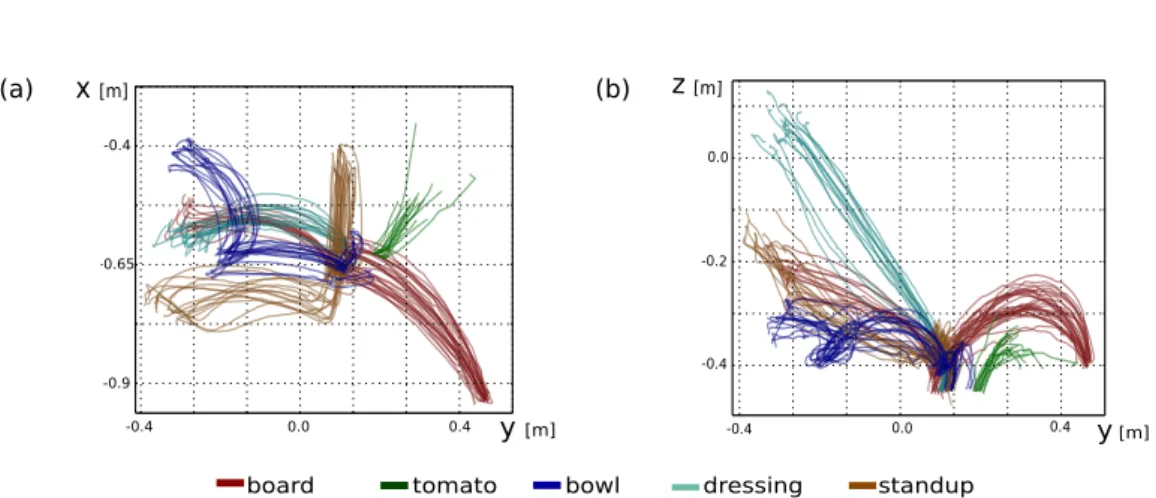
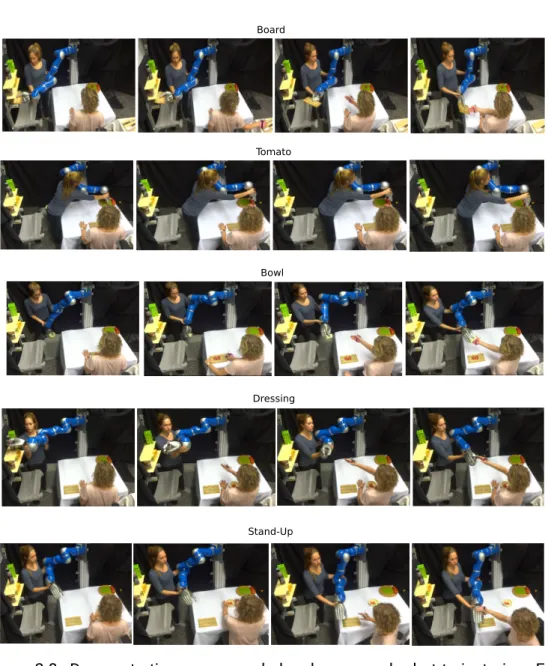
Figure 1.2.: This thesis contributes to the development of intelligent assistive robots in three main areas: First, incremental skill learning from hu-man demonstrations can enable also non-expert users to teach new tasks to a robot. Second, the ability to adapt learned skills to a human can improve coworking in workspaces shared by humans and robots. And third, by incorporating human feedback and advice in Reinforce-ment Learning a robot can learn and self-improve in sequencing al-ready learned skills to achieve more complex tasks.
workspaces as well as the ability to improve their behavior based on human input. Incorporating human demonstrations, feedback, and advice into training and improvement of robotic tasks can also help to reduce the initially required amount of training data since, in robotics, such a reduced amount of training data is usually crucial to enable practice transfer of Machine Learning methods.
This thesis contributes hereby in particular to the topics incremental skill learning from human demonstrations, online adaptation of skills in shared workspaces and interactive Reinforcement Learning for sequential robotic tasks as visualized in Figure 1.2. We believe that the contributions of the thesis can hereby help to get closer to the goal of intelligent assistive robots that should be able to learn new skills from human demonstrations, adapt their learned skills to human co-workers
and leverage human feedback and advice to learn and improve the sequencing of single skills. The following sections present a short summary of prior works from the related research fields, namelyLearning to Imitatein Section 1.1.1,Learning to Adaptin Section 1.1.2 andLearning to Improvein Section 1.1.3. Subsequently, Section 1.1.4 states the particular research questions of this thesis.
1.1.1. Learning to Imitate
Learning new tasks by imitating a demonstrator offers a way for a robot to quickly reduce the search space for an optimal solution of an unknown task (Atkeson and Schaal, 1997; Billard et al., 2008; Schaal, 1999; Hussein et al., 2017; Osa et al., 2018) and at the same time is a natural and bioinspired teaching mechanism for humans (Meltzoff and Moore, 1977). The first concepts for imitation learning and programming by demonstration date back to the 1980s (Lozano-Perez, 1983; Levas and Selfridge, 1984). In these early approaches often demonstrations were acquired from teleoperated control of the robots which is nowadays often replaced by more user-friendly means such as direct guidance of the robot, namely kines-thetic teaching (Inamura et al., 2006; Weiss et al., 2009; Akgun and Subramanian, 2011) or learning from external observations using vision and motion capturing sys-tems (Kuniyoshi, 1989; Jenkins and Mataric, 2002; Ijspeert et al., 2002; Chernova and Thomaz, 2014). Considering how demonstrations are recorded and how the embodiment of the learner matches the body of the teacher, a categorization into record mapping and embodiment mapping of imitation learning approaches has been proposed in Argall et al. (2009). The record mapping refers hereby to the way how the demonstrations are recorded and what particular information (e.g. joint or task space trajectories) is provided to the learner. The embodiment mapping refers to the concept of how to map the body of the teacher to the embodiment of the learner. The teacher can hereby, either demonstrate desired behavior directly on the learner, e.g. through teleoperation or kinesthetic teaching of the robot, or the robot can observe motions of the teacher which give need to also tackle to correspondence problem.
While Learning from Demonstrations (LfD) offers an often intuitive way also for non-expert users to teach new tasks to a robot, it is also often prone to the assump-tions of good demonstraassump-tions, thus depends on the demonstration abilities of the demonstrator. Another challenge can hereby also be to learn from demonstrations of potentially different demonstrators, that might vary in their concrete task execu-tion. Moreover, pure imitation, thus only ’replay’ of the observed motions is often problematic as soon as the task setting or the environment change slightly between
Human Demonstrations
Kinesthetic Teaching
External Observations
Task & Joint space trajectories Movement Primitives
Grasp Positions
Imitated Robot Motions Motion
Representation
Figure 1.3.: Learning by imitating human demonstrations offers the possibility for assistive robots to learn new tasks from non-robotic experts. The demonstrations can hereby be given in different forms e.g. by di-rect guidance (i.e. kinesthetic teaching) or over external observations from e.g. cameras of motion tracking systems. Movement primitives offer hereby a beneficial and modular representation of such human demonstrations.
training and execution time. The concept of learning movement primitives (Ijspeert et al., 2013; Calinon et al., 2007; Paraschos et al., 2018) offers hereby a modular representation of the demonstrations for imitation learning of robot skills. Figure 1.3 visualizes an exemplary procedure on how to get from human demonstrations to imitating robot motions.
However, given that future assistive robots will most likely face a large variety of different tasks, it is desirable to not only learn movement primitives in a batch-wise fashion, but to be able to incrementally build a skill library over time from multiple human demonstrations.
1.1.2. Learning to Adapt
As mentioned in Section 1.1.1, pure reproduction of demonstrated behavior is often not sufficient. In particular, changing environmental conditions or varying object locations give need for generalization capabilities of learned motions after training time. To this end, the use of Machine Learning to extract repetitive movement patterns and skills from demonstrations was already suggested in 1994 by Muench et al. (1994). The more recent concept of motion primitives(Ijspeert et al., 2013; Calinon et al., 2007; Paraschos et al., 2018) provides a decomposable task structure as well as possibilities for temporal modulation and adaptation of robot motions
(a) (b)
Figure 1.4.: Future assistive robots require the ability to adapt learned skills to hu-mans (a) In cooperative tasks robots need to adapt their motions to match the human counterpart (Koert et al., 2018) (b) When perform-ing independent tasks in shared workspaces with humans, robots should adapt their motions to achieve little disturbance of their hu-man co-workers (Koert et al., 2019a).
to changing goal locations or via points (Paraschos et al., 2018). The main idea of motion primitives is hereby to learn generalizable task representations from only a few human demonstrated trajectories. The modular structure of the motion primitives enables thereby also composition and transfer of subtasks to different robot behaviors. The most commonly used trajectory-based representation are hereby Dynamic Movement Primitives (DMPs), which represents a dynamical system that can be modulated by a non-linear forcing function (Ijspeert et al., 2003, 2013). An extension of DMPs to support sequencing was also proposed in (Kulvicius et al., 2011). Probabilistic representations for movement primitives that also consider variance in the demonstrations have been introduced in the literature to handle and represent variance in the demonstrations (Paraschos et al., 2018; Calinon et al., 2007).
While movement primitives already provide beneficial adaptation capabilities to static changes in the environment or object states, shared workspaces between robots and humans give additional rise to tackle challenges in adaptation of robot skills to humans (Vasic and Billard, 2013; Kulić and Croft, 2005; Lasota and Shah, 2015; Koppenborg et al., 2017; Dragan et al., 2013). Hereby, safe coexistence in shared workspaces (Vasic and Billard, 2013; Kulić and Croft, 2005) as well as predictability and legibility (Dragan et al., 2013) of robot motions should be objectives to the adaptation. Two types of situations that require such adaptation of learned skills to humans, that should be in particular highlighted here, are cooperative tasks, such as handovers, and independent tasks with workspace overlap. Figure 1.4 shows examples for such situations. While in cooperative tasks,
as depicted in Figure 1.4 (a) it is crucial that a robot can adapt its motions to match the human counterpart, during independent motions, as shown in Figure 1.4 (b), in shared workspaces it should mainly be achieved that the robot’s task execution does not disturb or hinder the humans task execution. In order to enable robots with the ability of such dynamic adaptation of their skills to human co-workers, additionally means for prediction of human motion patterns and intentions need to be considered (Ikeda et al., 2013; Ravichandar and Dani, 2015; Bai et al., 2015; Luo et al., 2018; Dermy et al., 2017; Mainprice et al., 2015).
1.1.3. Learning to Improve
While there are a number of tasks where robots can directly imitate human demon-strations to achieve sufficient task performance, in more complex tasks a robot might not be able to directly learn only from human demonstrations. In partic-ular, if a robot has already learned a library of single skills it is still challenging how to sequence the skills correctly to achieve more complex tasks. Means for self-improvement and the ability to learn complex tasks from the combination of basic skills are therefore highly desirable for assistive robots. Hereby, the con-cept of Reinforcement Learning (Sutton et al., 1998) provides a powerful tool for self-improvement of robotic agents. In Reinforcement Learning (RL), an agent interacts with the environment and learns independently with the goal of maxi-mizing received rewards (Sutton and Barto, 2018). Such experience-based and reward-driven learning has also been studied with infants (Hämmerer and Ep-pinger, 2012) and in the past years has found more and more applications also in robotics (Kober et al., 2013; Kormushev et al., 2013).
However, while Reinforcement Learning has achieved in particular impressive results in simulated environments (Mnih et al., 2013, 2015) in real robotic ap-plications Reinforcement Learning is often challenging due to the high sample complexity and the time and hardware costs of collecting them. Incorporating human feedback and advice into Reinforcement Learning systems offers hereby opportunities to speed up the learning process. Human input can in particular help to reduce the state space (Suay and Chernova, 2011), guide the exploration (Kuhlmann et al., 2004; Moreno et al., 2004) or provide a more informative reward structure (Thomaz et al., 2005; Knox and Stone, 2008).
However, such an interactive learning process, as illustrated in Figure 1.5, which involves human users rises new challenges regarding the design of novel interactive Reinforcement Learning algorithms and the best means of intuitive and optimal forms for human input from a human-centered point of view (Knox and Stone,
Feedback & Advice Environment Agent (Robot) Human Observations Reward Action
Classical Reinforcement Learning Interactive
Reinforcement Learning
Figure 1.5.: In classical Reinforcement Learning an agent learns from its expe-riences in the environment and associated rewards. Interactive Re-inforcement Learning includes human feedback and advice, in order to guide the agent’s exploration and speed up the learning process, which is, in particular, beneficial for robotic applications.
2011; Loftin et al., 2014; Argall et al., 2008; Griffith et al., 2013; Abel et al., 2017; Grizou et al., 2013). In particular, human feedback and advice may often differ from assumptions of the classic RL-setting since input during the learning process may be subject to a positive bias (Thomaz and Breazeal, 2008; Knox and Stone, 2012), strongly vary between people or also simply be wrong sometimes (Amershi et al., 2014). It was also reported in the literature that humans do not only want to give positive or negative feedback but also actively propose actions (Kaochar et al., 2011; Thomaz and Breazeal, 2008), which motivates interactive Reinforcement Learning approaches that offer multiple input channels to users (Abel et al., 2017). Since many of such interactive Reinforcement Learning algorithms are only evaluated in simulated environments and with sometimes also only simulated human input it is thereby an important research direction to evaluate the use of human input in Reinforcement Learning in experiments with users on real robotic applications.
1.1.4. Research Questions
In order to contribute to the development of assistive robots which should be able to learn from human demonstrations, adapt learned skills to humans and improve themselves through human feedback, this thesis investigates the following research questions.
Incremental Learning of a Library for Cooperative Skills
supposed to learn a variety of different skills from a potentially open-ended stream of unlabeled human demonstrations. Hereby, we aim to answer
• How can an assistive robot learn and incrementally update a cooperative skill-library from human demonstrations, in an unsupervised setting? • How do the learned cooperative skills transfer between different humans?
Adaptation to Humans in Shared-Workspaces
In shared workspaces, there is a need for online adaptation of learned skills to human-coworkers. Important related research questions are hereby
• How can an assistive robot adapt its learned skills to human co-workers in a shared human-robot workspace?
• How do humans perceive different ways of robot skill adaptation in such situations and what kind of adaptation do they prefer?
Interactive Reinforcement Learning for Sequencing of Skills
Even if a skill library is available to an assistive robot, there is still the need to learn how to sequence single skills to achieve complex tasks. While Reinforcement Learning provides a tool for independent learning and self-improvement in such situations, it is desirable to incorporate human input to accelerate and guide the learning process. Important research questions to answer are hereby
• How can an assistive robot include multiple forms of human feedback and advice during learning of sequential tasks and which types of input are preferred by users?
• Can the robot recognize if users give potentially wrong input, and how do humans react when the robot starts to question their input?
1.2. Main Contributions
This section summarizes the main contributions of the thesis. In particular, this thesis contributes to the areas of learning collaborative skill libraries from unlabeled human demonstrations, learning intention aware adaptation of robot skills in shared workspaces and including human feedback and advice in reinforcement learning for sequential tasks.
1.2.1. Incremental Learning of an Open-Ended Collaborative Skill Library
Intelligent assistive robots can potentially contribute to maintaining an elderly person’s independence by supporting everyday life activities. However, the number of different and personalized activities to be supported renders pre-programming of all respective robot behaviors prohibitively difficult. Instead, to cope with a con-tinuous and potentially open-ended stream of cooperative tasks, new collaborative robot behaviors need to be continuously learned and updated from demonstrations. To this end, in Chapter 3 we introduce an online learning method to incrementally build a cooperative skill library of probabilistic interaction primitives. The resulting model chooses a corresponding robot response to a human movement where the human intention is extracted from previously demonstrated movements. While existing batch learning methods for movement primitives usually learn such skill libraries only once for a pre-defined number of different skills, our approach enables extending the skill library in an open-ended and online fashion from new incom-ing demonstrations. The proposed approach is evaluated on a low-dimensional benchmark task and in a collaborative scenario with a 7DoF robot, where we also investigate the generalization of learned skills between different subjects.
1.2.2. Learning Intention Aware Online Adaptation of Movement Primitives
In order to operate close to non-experts, future robots require both an intuitive form of instruction accessible to laymen and the ability to react appropriately to a human co-worker. Instruction by imitation learning with Probabilistic Movement Primitives (ProMPs) allows capturing tasks by learning robot trajectories from demonstrations including the motion variability. However, appropriate responses to human co-workers during the execution of the learned movements are crucial for fluent task execution, perceived safety, and subjective comfort. To facilitate such appropriate responsive behaviors in human- robot interaction, the robot needs to be able to react to its human workspace co-inhabitant online during the execution of the ProMPs. In Chapter 4 we, therefore, introduce an approach for learning of intention aware adaptation of movement primitives. Hereby, we learn a goal-based intention prediction model from human motions. Using this probabilistic model, we introduce intention-aware online adaptation to ProMPs. We compare two different novel approaches: First, online spatial deformation, which avoids collisions by changing the shape of the ProMP trajectories dynamically during execution while
staying close to the demonstrated motions and second, online temporal scaling, which adapts the velocity profile of a ProMP to avoid time-dependent collisions. We evaluate both approaches in experiments with non-expert users. The subjects reported a higher level of perceived safety and felt less disturbed during intention aware adaptation, in particular during spatial deformation, compared to a non-adaptive behavior of the robot.
1.2.3. Multi-Channel Interactive Reinforcement Learning for Sequential Tasks
The ability to learn new tasks by sequencing already known skills is an important requirement for future robots. Hereby, reinforcement learning offers a powerful tool to learn and self-improve how to combine skills for sequential tasks. However, in real robotic applications, the cost of sample collection and exploration prevent the application of reinforcement learning for a variety of tasks. To overcome these limitations, human input during reinforcement can be beneficial to speed up the learning, guide the exploration and prevent the choice of disastrous actions. Nevertheless, there is a lack of experimental evaluations of multi-channel interactive reinforcement learning systems on robotic tasks with inexperienced human users, in particular for cases where human input might partially be wrong.
Therefore, in Chapter 5, we present an approach that incorporates multiple human input channels for interactive reinforcement learning in an unified framework and evaluate it on two robotic tasks with 20 inexperienced human subjects. To enable the robot to also handle potentially incorrect human input we incorporate a novel concept for self-confidence, which allows the robot to question human input after an initial learning phase. The second robotic task is hereby specifically designed to investigate if this self-confidence can enable the robot to achieve learning progress even if the human input is partially incorrect. Hereby, we additionally evaluate how humans react to suggestions of the robot, once the robot notices human input might be wrong.
Our experimental evaluations show that our approach can successfully incorporate human input to accelerate the learning process in both robotic tasks even if it is partially wrong in the second task. However, not all humans were willing to accept the robot’s suggestions or rejections of their input by the robot, in particular when they did not fully understand the learning process and the reasons behind the robot’s suggestions. We believe findings from this experimental evaluation can be in particular beneficial for the future design of algorithms and interfaces for interactive reinforcement learning applications with inexperienced users.
Task
‘Give the glass to the human’
Skill 1
‘Go-to-glass’ motion ‘Grasp the glass’Skill 2
Skill 3
‘ProMP for handover’
Figure 1.6.: We define a hierarchical structure where a more complex behavior, i.e. a task, is composed out of different skills. Skills can hereby be either preprogrammed basic motions of the robot or learned e.g from human demonstrations.
1.3. Necessary Background
In this section, we provide definitions for the terms skill and task to clarify how these terms will be used throughout the thesis. Additionally, we give a short summary of the foundations of Probabilistic Movement Primitives, which will be used as a skill representation in this thesis.
1.3.1. Definition for Skills and Tasks
Since there is no unified definition of the terms skill for a robot in the literature we consider it important to clarify how we will use this term throught the thesis. Following similar hierarchical concepts for task definition in the literature (Zoliner et al., 2005; Konidaris et al., 2012), we define askill as a basic part of a more complex behavior. One main property of a skill is hereby that it is a modular building block for a complex behavior and might be reusable across different tasks. In order to achieve a more complex behavior, that we will refer to astask there is the need to combine the available skills. Figure 1.6 illustrates an example of a task and the decomposed skill structure. We assume that skills can either be preprogrammed such as go-to-point motions, fixed gripper or hand positions, or can be learned e.g. from human demonstrations. In this thesis learned skills are represented by movement primitives. Probabilistic Movement Primitives as a representation for learning skills from demnstrations are discussed in the next section.
1.3.2. Probabilistic Movement Primitives
Probabilistic Movement Primitives (ProMPs) (Paraschos et al., 2018) represent demonstrated movements in the form of distributions over trajectories. In order to obtain this distribution, each trajectory τ is first approximated by a linear combination of basis functionsϕ. Hereby, it is assumed that the trajectories are
sampled from the conditional distribution
p(τ|w) =∏︂
t
N(τt|ϕTtw,Σo), (1.1)
wherewdenotes the weight vector andΣothe observation noise.
More precisely, a joint or task space positionτtat time steptcan be represented as
τt=ϕTtw+σo, (1.2)
whereϕt contains N basis functions ϕevaluated at time step t, w is a weight
vector,σois a zero-mean Gaussian noise and[]Tdenotes transposition of the vector. The choice of basis functionsϕdepends on the type of demonstrated movements.
Throughout this thesis we use radial basis functions. The weight vectorwfor each demonstrated trajectory is computed with Ridge Regression
w= (ΦΦT+λI)−1Φτ, (1.3)
where Φ = [ϕ0, ...,ϕt, ...,ϕT] contains all basis functions at at the respective
timesteps, λis a small factor e.g. 1e-6 and I denotes an identity matrix. For multiple recorded demonstrated trajectories, and their respective weight vector, a distribution over the weight vectorsp(w)can then be obtained with Maximum Likelihood Estimation. Since the number N of basis functions is usually much
lower than the number of time steps of recorded trajectories, the distributionp(w) can be seen as a compact representation of the demonstrated movements, which accounts for variability in the execution. By choosingp(w)to be a Gaussian,
p(w) =N(µw,Σw) (1.4)
we ensure the distribution over trajectories can be computed in closed form by integrating out the weight vectors w. This probabilistic representation offers a number of convenient properties. In particular, ProMPs offer a representation that allows for operations from probability theory to specify goal or via-points, correlate different degrees of freedom via conditioning and combine different primitives through blending (Paraschos et al., 2018).
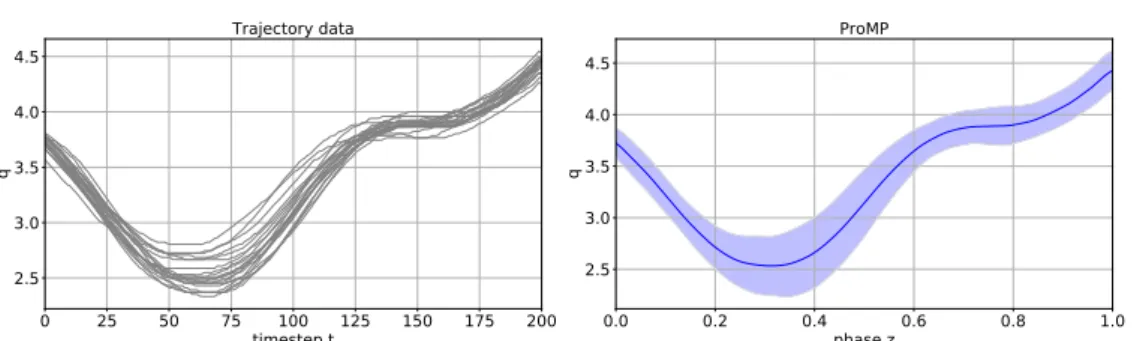
Figure 1.7.: ProMPs offer a probabilistic representation for distributions over tra-jectories. (a) shows multiple example demonstrated trajectories, (b) shows the resulting ProMP with the mean and two times standard deviation plotted over the phase of execution.
Figure 1.7 shows an example distribution over trajectories on the left and the obtained ProMP on the right. Hereby, it should be noted that while the trajectory data is plotted over the number of timesteps, the ProMP is visualized over the phase, that is a concept of normalized time.
1.4. Outline
Subsequent to the introduction this thesis is structured in five main chapters. Figure 1.8 visualizes this structure of the thesis. The presented research has hereby led to a number of publications. Here, we provide an overview of the content of the following chapters and how they are linked to the different publications.
Chapter 2introduces our approach for incremental learning of a skill library for
collaborative tasks. Hereby, we use Incremental Gaussian Mixture Models to learn cooperative skills, from unlabeled demonstrations in an open-ended fashion. The chapter is based on Koert et al. (2018, 2019b).
InChapter 3, we present two novel methods for online adaptation of
Proba-bilistic Movement Primitives to human co-workers. In particular, our approach incorporates a goal-directed model to predict human motions and evaluates the two proposed adaptation strategies in experiments with human subjects. The content of the chapter is hereby based on Koert et al. (2019a).
Chapter 4introduces our approach to learn sequential tasks using interactive
reinforcement learning. Hereby, we investigate the benefits of different input channels for human users and a novel concept for self-confidience that enables the robot to question human input if it controdicts the robots learned policy after an initial training time. The content of this chapter is based on Koert et al. (2020).
Chapter 5provides a summary and conclusion of the thesis. Additionally, the
chapter gives an outlook on potentially interesting future research directions that emerge out of the topics of this thesis, namely skill transfer, preference based adaptation, predicting human behavior and intentions, multimodal communication and interaction channels, explainability and transperency and experiments with assistive robots in the wild.
Chapter 1
Chapter 5 Introduction, Motivation, Research Questions and Foundations
Conclusion and Future Work
“Learning to Imitate”
Incremental learning of an open-ended
skill library for collaborative tasks
“Learning to Adapt”
Learning intention aware adaptation of movement primitives in
shared workspaces
“Learning to Improve”
Incorporating human feedback and advice in Reinforcement Learning for sequential tasks
Chapter 3 Chapter 4
Chapter 6
2. Incremental Learning of an
Open-Ended Collaborative Skill
Library
The expected demographic change is an urgent and prevailing challenge for society. An increasing number of elderly people need assistance in their daily lives while only few caregivers are available (Linz and Stula, 2010). In order to address this challenge, the development of technical solutions for elderly assistance is essential. In particular, assistive robots can potentially support elderly people in their daily lives and thus help to maintain their personal independence. Such cooperative robot assistants need the ability to support multiple different tasks and additionally should be able to individually adapt to a user’s needs. This disqualifies pre-programming of all possible tasks. Instead, an intuitive way to teach multiple personalized skills to a robot is needed, which can be realized by Learning from Demonstrations (LfD) (Schaal, 1999).
Since human motions exhibit a high variability (Rosenbaum, 2009), a probabilistic approach for cooperative skill learning from demonstrations is required, which takes variations in human motions during demonstrations and during execution time into account. In addition, to be able to learn cooperative skills from multiple human demonstrations and representing them probabilistically, it is not just crucial to detect multiple different skills but particularly to update an existing skill library with completely new cooperative skills and refining the existing skills with new demonstrations.
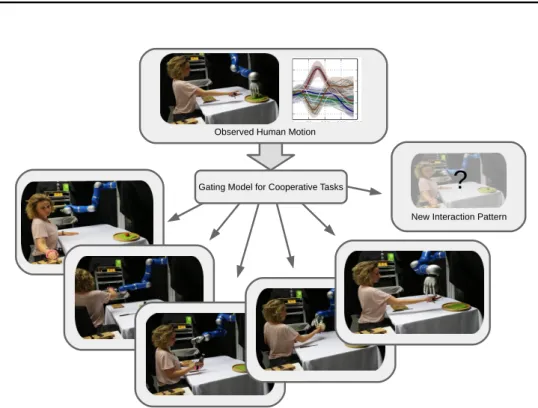
This chapter presents a novel online learning method for building a collaborative skill library, which enables open-ended learning of new skills and refinement of existing skills. Figure 2.1 summarizes the approach. An incremental mixture model of Probabilistic Movement Primitives is proposed for online learning of collabora-tive skills from demonstrations. Cooperacollabora-tive skills are represented as Interaction ProMPs (Amor et al., 2014; Maeda et al., 2014) which capture correlations between human and robot movements as well as the inherent variance.
Observed Human Motion
Gating Model for Cooperative Tasks
?
New Interaction PatternFigure 2.1.: Intelligent robot assistants should learn multiple personalized co-operative skills from a continuous and open-ended stream of new demonstrations. To this end, we propose a novel approach for online and open-ended learning of a mixture model of Probabilistic Interac-tion Primitives. In particular, our approach updates existing cooper-ative skills from new demonstrations and extends the collaborcooper-ative skill library for new skills when needed. Hereby, our model chooses a robot response to an observed human motion based on prior demon-strations while considering variance in the demondemon-strations as well as coupling between human and robot motions.
Although these movement primitives have already been used for learning multi-ple different cooperative skills (Ewerton et al., 2015), to the best of our knowledge, none of the present approaches is able to iteratively learn multiple Interaction ProMPs online and in an open-ended way. However, for personalized robot assis-tants it is crucial to open-endedly learn new tasks and continuously update existing cooperative skills with new demonstrations. In particular, in such an open-ended scenario the total number of cooperative skills cannot be known beforehand and
thus needs to be extended during the learning process.
In contrast to prior work on learning a Mixture of Interaction primitives (Ewerton et al., 2015), our new approach does not rely solely on demonstrations which are available at the first training time but can integrate new demonstrations and skills over multiple training sessions. In addition to the experimental validation with single subjects, we evaluate our method on learning a library across multiple subjects. To enable successful incremental learning of a skill library on data of multiple subjects we introduce aging out and consolidation of model components and an automated normalization routine based on personal workspace and start position of the subjects’ motions.
The rest of this chapter is structured as follows: Section 2.1 discusses related work. Section 2.2 provides an overview on the existing approach of Batch Learning for a Mixture of Interaction Primitives and introduces our novel approach for Online Open-Ended Learning of a Mixture of Interaction Primitives. In Section 2.3, we evaluate this new approach on 2D trajectory data of hand written letters and in a collaborative robotic scenario. In the robotic scenario, we additionally investigate how the learned skills transfer between different subjects. Finally, we conclude with Section 2.4 and discuss ideas for future work.
2.1. Related Work
Learning cooperative tasks between humans and robots from demonstration is a popular approach as it enables also non-expert users to teach personalized skills to robots (Argall et al., 2009; Billard et al., 2008; Pastor et al., 2009; Vogt et al., 2017; Maeda et al., 2017b). While a number of existing learning from demonstration literature focusses on task representation for a single agent for collaborative tasks it is also desirable to address coupled skill representations e.g. for human and robot motions (Amor et al., 2013; Vogt et al., 2015; Nikolaidis et al., 2015). In particular, the concept of movement primitives offers hereby a lower dimensional represen-tation of trajectories and a modular framework that does not only reproduce demonstrated behaviors but potentially also generalizes to new situations (Ijspeert et al., 2013; Calinon et al., 2007; Paraschos et al., 2018; Vogt et al., 2017; Amor et al., 2013; Huang et al., 2019) To capture also variability in non-deterministic human motion demonstrations it is desirable to not only model demonstrations with single trajectories (Ijspeert et al., 2013) but to also capture the variability using a probabilistic approach and distributions over trajectories (Calinon et al., 2007; Paraschos et al., 2018; Vogt et al., 2017). Probabilistic Interaction Movement
Primitives (Interaction ProMPs) (Amor et al., 2014; Maeda et al., 2014, 2017b) offer hereby a probabilistic representation to model inherent correlations in the movements of two actors, such as human and robot, from coupled demonstrated trajectories while showing beneficial interpolation capabilities compared to other movement primitive approaches (Paraschos et al., 2018).
However, to achieve a personalized cooperative robot it is desirable to learn multiple cooperative tasks and decide on their activation depending on the context or on the human intention (Pérez-D’Arpino and Shah, 2015; Lee et al., 2010; Konidaris et al., 2012). To this end, an approach that deploys Gaussian Mixture Models (GMMs) and Expectation Maximization to learn multiple Interaction ProMPs from unla-beled demonstrations has been introduced (Ewerton et al., 2015). This approach considers batch data, i.e. assuming the availability of all data during training. This limits its application to settings where the number of tasks does not change after training and no new demonstration trajectories need to be integrated. Moreover, such batch learning prevents scalability as computation time and memory require-ments become infeasible for large skill libraries or datasets (Calinon and Billard, 2007). Various approaches outside the Human-Robot Interaction (HRI) scope have addressed these problems.
Initially, the machine learning communities have proposed incremental learning approaches for Gaussian Mixture Models. Some approaches propose updating a GMM with complete new model component datasets (Ahmed and Xing, 2008) or assume the incoming data points to be time-coherent (Arandjelovic and Cipolla, 2006). Incremental Gaussian Mixture Model learning introduced a way to continu-ously learn a GMM from an incoming data stream while not fixing the number of total components beforehand (Engel and Heinen, 2010; Pinto and Engel, 2015). Another two-level approach introduces methods for splitting and merging of GMM components (Declercq and Piater, 2008). Updating of robotic movement represen-tations online from new demonstrations has also been used for incremental learning of extensions of GMMs for gesture imitation (Calinon and Billard, 2007), updating Gaussian Processes from demonstrations and thereby reducing the movement vari-ance (Maeda et al., 2017a) or incremental updating of task-parameterized Gaussian Mixture Models (Hoyos et al., 2016). While all these works focus on updating mul-tiple existing movement representations, in a long-term setting adding new tasks is also important. Approaches that also add new components when needed have been proposed in the context of online updating of task-parameterized semi-tied hidden semi-Markov models for manipulation tasks (Havoutis et al., 2016), learn-ing full-body movements (Kulić et al., 2012), a bootstrapplearn-ing cycle for automatic extraction of primitives from complex trajectories (Lemme et al., 2014) or robot
table tennis (Muelling et al., 2010). However, while we draw inspiration from the aforementioned related work, in an HRI scenario it is additionally desirable to consider the inherent coupling and variance in human and robot motions in the demonstrations.
2.2. Incremental Interaction Primitives
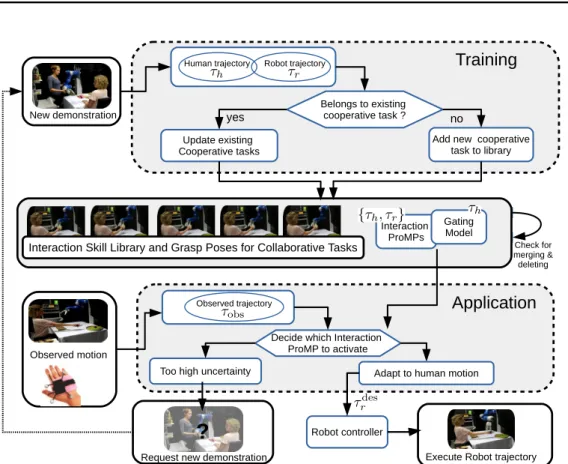
In this section, we present our approach to continuously learn and update multiple cooperative skills from demonstrations. Here, demonstrations are given in the form of coupled human and robot trajectoriesdn={τhn,τrn}, whereτhncan e.g. be a sequence of human wrist positions and τrn can e.g. be a sequence of robot joint positions. To learn multiple cooperative skills from these demonstrations in an online open-ended fashion we introduce a model that is inspired by the Mixture of Experts architecture (Jacobs et al., 1991) and consists of two intertwined parts. On the one hand, we use the human trajectories from the demonstrations to train and update a gating model, which will later be used to decide between different cooperative skills. In addition, we train probabilistic models to generate appropriate robot response trajectories. We deploy Interaction ProMPs (Amor et al., 2014; Maeda et al., 2014), as they are able to capture the inherent correlation in robot and human motions from the demonstrations. Figure 2.2 summarizes our approach to train this mixture model in an online and open-ended fashion.
In the following, we briefly describe the previously proposed batch-based, stationary Mixture of Interaction ProMPs in Section 2.2.1. Next, we present our novel approach to learn a mixture model of Probabilistic Movement Primitives in an online and open-ended fashion in Section 2.2.2. Finally, in Section 2.2.3 we show how the obtained library of multiple Interaction ProMPs and the corresponding gating model can be deployed in an HRI scenario.
2.2.1. Batch Learning for Mixture of Interaction ProMPs
An Interaction ProMP (Amor et al., 2014; Maeda et al., 2014) is a ProMP that uses a distribution over the trajectories of at least two interacting agents. The demonstrations are now given in the form of a stacked vector for the observed and the controlled agentq= [qo,qc]T, whereqodenotes the demonstrated trajectories for the observed agent andqcdenotes the demonstrated trajectories of the con-trolled agent. Respectively, the weight vector is also represented in an augmented formw¯ = [wTo,wcT]T. Given a set of demonstrations, a distribution over multiple
stacked weight vectors can be obtained just as previously described such that
p(w¯) =N(µw¯,Σw¯). (2.1)
Given a sequence D of positions of the observed agent (e.g. human),
Interac-tion ProMPs (Amor et al., 2014; Maeda et al., 2014) provide methods to infer a corresponding (most likely) trajectory of the controlled agent (robot).
The previously proposed batch learning for Mixture of Interaction ProMPs (Ewer-ton et al., 2015) is an extension to Interaction ProMPs that allows to learn several different interaction patterns from unlabeled demonstrations by applying Gaussian Mixture Models (GMMs), where each mixture component represents one interac-tion pattern. The Mixture of Interacinterac-tion Primitives is hereby learned from batch data and the number of components needs to be fixed beforehand. In the case of
K different interaction patterns, the distribution over the weight vectorsw¯ is
p(w¯) = K ∑︂ k=1 p(k)p(w¯|k) = K ∑︂ k=1 αk N(w¯|µk,Σk), (2.2)
whereαkis thek-th mixture weight that can be prior (if not learned) or posterior (if
learned from given data),µkis the mean andΣkthe covariance matrix of thek-th
component. The parameters of the GMM are hereby learned in the weight space using the Expectation Maximization (EM) algorithm. Since this approach assumes that all data is available at the learning time the number of componentsKremains
fixed after learning and the model cannot easily integrate new demonstrations. This means that if new demonstrations come in the GMM can not be updated without the need for full recomputation nor can new interaction patterns be included in the model if they occur.
2.2.2. Online Open-Ended Mixture of Interaction ProMPs
We propose a new method to achieve online learning of cooperative skills in an open-ended fashion. Hereby, demonstrations are given in the form of robot and human trajectories{τr,τh}. First, we compute a corresponding representation
with weight vectors as introduced in Section 2.2.1. Here, we consider that the human trajectory is of dimensionsDh×T whereDh is the degree of freedom of
Update existing Cooperative tasks
Add new cooperative task to library Belongs to existing
cooperative task ?
Decide which Interaction ProMP to activate
Application Training
Observed motion
New demonstration yes no
Too high uncertainty
Execute Robot trajectory Request new demonstration
?
Adapt to human motion
Interaction Skill Library and Grasp Poses for Collaborative Tasks Robot trajectory Human trajectory Interaction ProMPs Gating Model Observed trajectory Check for merging & deleting Robot controller
Figure 2.2.: We introduce a novel approach for online and open-ended learning of a mixture model for cooperative skills. During training, demonstra-tions are given in the form of trajectories of a human demonstrator
τhand corresponding trajectories of a robot armτr, that are obtained
via motion capturing and kinesthetic teaching. From these demon-strations, we update or extend the skill library that consists of a gat-ing model and multiple correspondgat-ing Interaction ProMPs. Durgat-ing runtime, the gating model decides on the activation of particular In-teraction ProMPs that we subsequently adapt to the variance in the observed motion. If the gating model is too uncertain about the acti-vation of Interaction ProMPs the robot can request more demonstra-tions.

![Figure 2.3.: Learning ProMPs of hand-drawn letter trajectories. All trajectory data is normalized to range of [0,10]](https://thumb-us.123doks.com/thumbv2/123dok_us/10182634.2920743/50.892.151.731.191.353/figure-learning-promps-drawn-letter-trajectories-trajectory-normalized.webp)