Politecnico di Torino
Porto Institutional Repository
[Proceeding] FishAPP: A mobile App to detect fish falsification through image
processing and machine learning techniques
Original Citation:
Rossi, Francesco; Benso, Alfredo; Di Carlo, Stefano; Politano, Gianfranco; Savino, Alessandro;
Acutis, Pier Luigi (2016).
FishAPP: A mobile App to detect fish falsification through image
processing and machine learning techniques.
In:
20th IEEE International Conference on
Automation, Quality and Testing, Robotics, AQTR 2016, Cluj-Napoca, RO, 19-21 May 2016. pp.
1-6
Availability:
This version is available at :
http://porto.polito.it/2649750/
since: September 2016
Publisher:
Institute of Electrical and Electronics Engineers Inc
Published version:
DOI:
10.1109/AQTR.2016.7501348
Terms of use:
This article is made available under terms and conditions applicable to Open Access Policy Article
("Public - All rights reserved") , as described at
http://porto.polito.it/terms_and_conditions.
html
Porto, the institutional repository of the Politecnico di Torino, is provided by the University Library
and the IT-Services. The aim is to enable open access to all the world. Please
share with us
how
this access benefits you. Your story matters.
FishAPP: a Mobile App to Detect Fish Falsification
through Image Processing and Machine Learning Techniques
Francesco Rossi
⇤, Alfredo Benso
⇤, Stefano Di Carlo
⇤,
Gianfranco Politano
⇤, Alessandro Savino
⇤and Pier Luigi Acutis
†⇤Politecnico di Torino, Control and Comp. Engineering Department, Torino, Italy
E-mail: [email protected]
Systems Biology Group - Web Page: http://www.sysbio.polito.it
†Istituto Zooprofilattico Sperimentale del Piemonte Liguria e Valle dAosta, Torino, Italy
E-mail: [email protected]
Abstract—Food forgery is one of the most articulated socio-economic concerns, which contributed to increase people awareness on what they eat. Identification of species represents a key aspect to expose commercial frauds implemented by substitution of valuable species with others of lower value. Fish species identification is mainly performed by morphological identification of gross anatomical features of the whole fish. However, the increasing presence on markets of new little-known species makes morphological identification of species difficult. In this paper we present FishAPP, a cloud-based infrastructure for fish species recognition. FishAPP is com-posed of a mobile application developed for the Android and the iOS mobile operating system enabling the user to shot pictures of a whole fish and submit them for remote analysis and a remote cloud-based processing system that implements a complex image processing pipeline and a neural network machine learning system able to analyze the obtained images and to perform classification into predefined fish classes. Pre-liminary results obtained from the available dataset provided encouraged results.
1. Introduction
Food forgery is one of the most articulated socio-economic concerns, which contributed to increase people awareness on what they eat. Identification of species repre-sents a key aspect to expose commercial frauds implemented by substitution of valuable species with others of lower value.
Fish species identification is mainly performed by mor-phological identification of gross anatomical features of the whole fish. However, the increasing presence on markets of new little-known species makes morphological identification of species difficult or impossible to carry out [1]. In this con-text it appears of utmost importance to dispose of analytical methods able to perform a correct and fast identification of fish species, thus supporting health inspectors analysis but also guarantying to end consumers the origin and safety of the eaten fish foodstuffs.
In recent decades, many new and promising techniques for the identification of fishes have emerged. The FAO re-view on fish identification tools for biodiversity and fisheries assessments has analyzed a large set of current practices in fish species identification [2]. They include traditional, long-trusted and tested tools, such as the use of trained taxonomists, reference collections or field guides based on dichotomous keys, as well as more recently developed and automated tools, e.g., image recognition systems (IRSs), interactive electronic keys, computer-based morphometric identification (IPez) and genetic methods. However, with few exceptions, such automatic methods have not yet been translated into user-friendly applications for non-specialists and still require further investments to mature into globally applicable tools.
When looking at different species recognition systems to prevent fish falsification several decision criteria must be considered. This includes: response time, accuracy, resolu-tion, type and resources [2]. The response time defines how quickly a result can be obtained and sets whether it can be applied in field or in specialized labs. Accuracy sets the error rate of the recognition system, whereas the resolution de-fines how specific should be the information obtained (e.g., whether it is sufficient to pinpoint the order or family of a specimen, or it is necessary to also determine the species or population). This is mainly related to the field of application of the identification methods, e.g., health inspectors or end customers. The type defines whether the identification must be performed through examination of a fresh and whole specimen or it can be also performed based on frozen or otherwise processed organisms or parts of their bodies or on photographs of variable quality. Finally, resources (costs, expertises) define what funds, qualified staff and equipment are required for the activity. Resources available for species identification can range from very low, i.e., one or a few unskilled operators and no equipment other than a book, to very high, i.e., a research vessel fully equipped with a variety of devices, state-of-the art computer facilities, a scientific laboratory and highly specialized scientific and technical operators.
Among the different automatic species recognition
tem genomic approaches [3] are those guaranteeing highest accuracy and resolution. They however suffer from high costs because they require complex instruments and well trained staff. They require time to produce results, thus limiting their application to specialized labs accessible to health inspectors. On the other side, image recognition sys-tems coupled with machine learning techniques are gaining attention due to their good accuracy, fast response time and, more importantly, low demand in terms of resources.
Nevertheless, although the literature is rich of ap-proaches for image processing and machine learning tech-niques applied to fish species recognition, their development still remains at an academic level and further investments is required to transfer this technology to the end users [4] [5] [6] [7] [8] [9] [10] [11] [12] [13].
In this context, the widespread diffusion of mobile de-vices such as smartphones and tablets coupled with cloud computer resources represent a unique tool to cover this gap. Mobile devices represent a low-cost and widespread sensor system enabling million of users to collect reason-able high-quality pictures of fishes and to transfer them through the Internet to high-end computational system lo-cated in the Cloud. Moreover Cloud computing offers an ideal infrastructure to implement the computational intensive algorithms required to process the received images and to classify them into target species through machine learning techniques. Eventually, the results of the computation can be easily sent back to the user in a user friendly format as well as saved on the cloud for further and more complex analysis.
This combination of mobile applications and cloud com-puting represents a unique instrument to provide end users a valuable service to identify fish falsification, and a powerful acquisition system to collect thousands of pictures from the field that can be potentially used to train the machine learn-ing algorithms and to increase their capability of recognizlearn-ing different species.
In this paper we present FishAPP, a cloud-based infras-tructure for fish species recognition. FishAPP is basically composed of a mobile application and a remote cloud. The mobile application, developed for the Android and the iOS mobile operating system, allow to the user to shot pictures of a whole fish and submit them for remote analysis. A remote cloud-based processing system then implements a complex image processing pipeline and a neural network machine learning system is able to analyze the obtained images and to perform classification into predefined fish classes. The FishAPP software architecture is in a late stage development and preliminary results obtained from its application on a small set of images are already available and will be presented in this paper.
2. Experimental Section
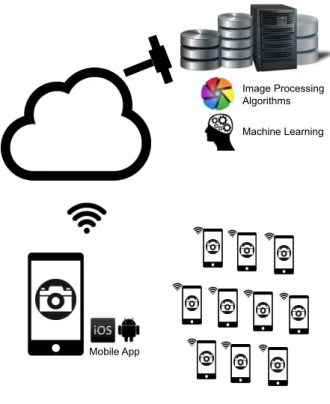
Figure 1 shows a high level view of the FishAPP soft-ware architecture. FishAPP provides a lightweight mobile app designed for the two most widespread mobile platforms
(i.e., iOS and Android). The application exploits the smart-phone camera as a sensor to capture an image of the fish to be analyzed. The multi-touch interface available on these operating systems is also exploited to let the user inter-acting with the recognition system during the analysis by providing useful information that both increases the quality and accuracy of the analysis. FishAPP mobile application is connected to a remote cloud server that implements the actual computational analysis. The remote server imple-ments an image processing pipeline able to extract relevant information from the image provided by the users, and a machine learning infrastructure to process this information based on training data. A storage system is also implemented in the Cloud to record all analyzed images and data that can be used to continuously improve the recognition capabilities of the system.
Details regarding FishAPP mobile app and remote server will be provided in the following subsections.
Image Processing Algorithms Machine Learning
Mobile App
Figure 1. FishAPP software architecture
2.1. Mobile App and Remote Server Interaction
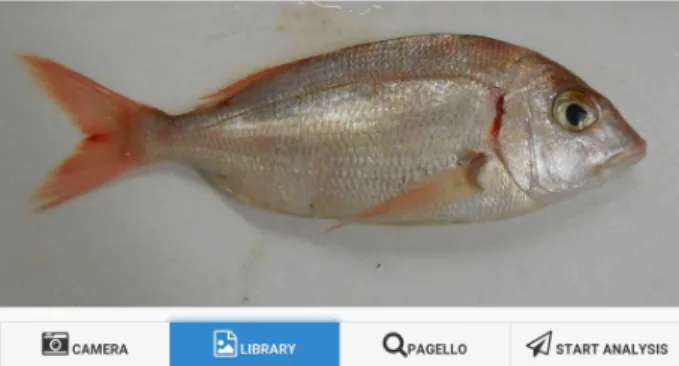
The FishAPP mobile application software enables smart-phones and tablets to capture the photo of a fish, or to select one from the local device photo library, and to connect with the FishAPP remote server. FishAPP mobile software hasbeen developed with PhoneGap, a free and open source framework that allows to create mobile apps using a set of standardized web APIs for the desired platforms [14]. The photo must include the full fish and it needs to respect the following guidelines:
• The fish must be photographed sideway;
• The caudal fin must be arranged in the relaxed
anatomical way;
• Other fins should be set in a close-fitting manner.
Since lifeless fishes cannot keep the fins completely visible we opted to consider only the caudal fin as an anatomical discriminative feature (Figure 2).
Figure 2. Example of fish picture taken from smartphone local storage library and FishAPP GUI
Once the fish photo is obtained, it is possible to select the supposed fish species name from a menu and then send the labelled image to the cloud server. Instead of querying the server for all the available fish species we look for a specific user selected species. This characteristic is very useful from a classification point of view since the fish identification is limited to a specific (or supposed to be) fish family. This feature resembles the way the health inspectors perform during controls when they look at the label exhibited in the sale points.
The remote server receives the picture with the assigned fish species label and store it for future elaboration in a remote database.
Simultaneously the server side image processing unit starts analyzing the fish picture to compute a set of points marking some meaningful anatomical features. These points can be confirmed by the user via the user interface. The user can further refine this selection by dragging and then the remote server computes the feature extraction and perform the final classification. Finally, obtained results are sent to the FishAPP mobile application and the fish species identification is concluded.
The entire image processing pipeline, the key-points steps for the feature extraction process and the classification procedure are next analyzed into separated subsections.
2.1.1. Image Processing Unit. The picture of the fish
is processed to perform the features extraction used for
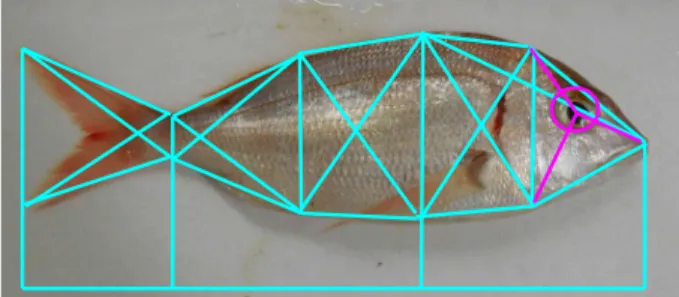
the classification. In this work we have implemented 27 geometrical features that describe some fishes anatomical characteristic. Features are calculated starting from a set of 12 anatomical points automatically detected as shown in Figure 3.
Figure 3. Example of anatomical set points proposed by FishAPP image processing unit
The image process unit has been developed in C++ language using OpenCV free and cross-platform computer vision library [15]. Figure 4 outlines the main steps imple-mented to find the fish border mask, from which it is then possible to detect the above-mentioned points.
First, after the noise reduction using the Bilateral Filter, a very approximative fish border is computed in two main different steps, applying the adaptive threshold (AT) filter to the original gray scale image in combination with the canny-edges filter followed by the laplacian filter (CE+L). We found that this filters sequence is able in its entirety to identify complementary useful fish border since the shadow and reflection of the fish (which is often wet) and the shadow projection make difficult the image segmentation. In particular, using the same kernel size, the AT is able to compensate the color gradient non homogeneity concerning the shadow intensity while the CE+L makes more evident the difference between the background and the fish. The second main image processing unit is a rough fish mask body detection, by merging together the previous founded borders. Here some dilation, erosion and filling hole mask are used to better estimate the whole fish body.
Last, but most important, we make use of the GrabCut filter, that is an image segmentation method based on graph cuts iterative steps [16]. We apply the GrabCut filter by setting as a foreground mask the estimated fish body found in the prior step and a fitting region of interest (ROI) of the fish body as a foreground limit, together running over the bilateral filtered original image. It is important to mention that, at this step, to make the entire process faster but nonetheless accurate, a downsampling of the image is applied (scale factor = 2) before the grabcut process, and then the obtained output is upscaled as before. At this stage the very high quality fish segmentation takes part, the fore-ground fish body is selected and shadow effects and possible background non homogeneity are filtered. Obviously the
more the contrast exists between the fish and the background the faster and accurate is the final segmentation. Eventually the final mask is then skeletonized and the resulting image is passed to the next key-points step.
This image process unit has demonstrate to be effective in a real setup where the fishes have been photographed over a homogeneous background without other objects.
Fish Photo Bilateral Filter Grayscale Adaptive Threshold Canny Edges Laplacian Blend Laplacian Contour FloodFilled ROI Fish GrabCut Skeletonize Fish Border A P P R O X IM A T E D F IS H B O R D E R R O U G H F IS H M A S K F IN A L F IS H S K E L E T O N
Figure 4. Summarized FishApp image processing unit
2.1.2. Key-Points Step and Features Extraction.Once the
fish border is detected, the image is passed to a set of ad hoc C++ class functions that find 12 key-points of the fish. In particular the fish eye detector point class needs some other image processing techniques. Taking into account the only fish part between the central body portion and the mouth, we mainly used the following filters:
• Mean Shift filter,
• Contrast Limited Adaptive Histogram Equalization
(CLAHE) filter;
• Hough Circles filter [17].
The desired result is an eye-centered circle with the same eye-diameter. Because of possible light reflection, blood stain presence in the cornea and due to intra-family color difference and fish scales patterns variability, this point is
sometimes less accurate than the other ones. Some improve-ments at this stage are still under study. Anyway, if there is some millimetric gap with respect to the the fish-eye pattern, the user can easily modify the center and the diameter and then confirm all the detected key-points before performing the feature extraction.
At this point the remote server analysis is now able to find 27 features and save them into a comma separated value file (.csv) concerning morphological characteristic of the fish, as shows in Figure 5.
Essentially we are able to find the caudal fin position and its dimension, the center and the diameter of the eye, the mouth position and the physical border of the fish. Then we used these points to extract some information about the shape of the fish; its lengths-height ration, the proportion between the fin and the body dimensions, the position of the eye in the head, and so on. Since in the pictures there are not markers and it is not possible to detect the real size of the fish, all the geometrical features have been normalized with respect to its length.
Figure 5. FishAPP feature extracted. Blue and pink lines represent the morphological dimensions of the fish.
2.1.3. Artificial Neural Networks Classifiers. Artificial
neural networks (ANNs) are a family of machine learn-ing models inspired by biological neural networks and are widely used to solve pattern recognition problems [18]. In this study we trained two different type of ANNs thus dividing the classification in two different step: the first one is the fish family clusterization and the second one is the fish species recognition. The fish family clusterization is performed with ANNs trained as a One-Class classifier (OC) while the fish species identification are achieved with ANNs trained as Multi-Class classifier (MC) [19] as reported in the Figure 6.
When the user takes a picture of a fish and makes a request to identify the species by the FishAPP server he will also select the species name from a list. The selected name species is hereafter associated to the fish picture and firstly employed in the OC classification step. If the fish family is corrected then the MC-ANNs species identification is finally effected in the second classification step. Otherwise if the OC discards the fish, the user can change the fish name and try with another query to the FishAPP server.
Eventually the final result of the MC is a list of intra-family species membership confidence scores.
One-Class ANN Inter-family Multi-Class ANN Inter-species FISH POINTS FEATURES SPECIES NAME
+
LIST NO YES F ig ur e 2 F ig ur e 4 F ig ur e 5Figure 6. Classification Pipeline
2.2. Training Dataset
The available dataset has been collected in separate sessions at the Turin (Italy) wholesale fish market. We were able to photograph 339 fish samples (reported with the corresponding binomial nomenclature and number of photos):
• European Anchovy,Engraulis Encrasicolus(125); • European Pilchard,Sardina Pilchardu(107); • Common Pandora,Pagellus Erythrinus(20); • Atlantic Mackerel,Scomber Scombrus(18); • Gilt-Head Bream,Sparus Aurata(22); • European Hake,Merluccius Merluccius(19); • Striped Red Mullet or Surmullet,Mullus Surmuletus
(28).
We were able to train one OC-ANN with a target class composed of European Anchovies and European Pilchards against the rest of the dataset (232 vs 339). The corre-sponding MC-ANN was then trained considering this two classes: European Anchovies and European Pilchards (125 vs 107). A sample photo with an European Anchovies and an European Pilchards is reported in the Figure 7.
The entirely dataset has been processed with the FishAPP image processing unit and the feature extraction
pipeline. At the key-points confirmation step some adjust-ment to the points position have been done, by dragging the incorrect points as reported in the previous section. In fact, since the fish segmentation is not always precise, some of the key-points could be consequently wrong but they can be corrected by the user via the user interface.
Figure 7. An European Pilchards at the top and a European Anchovies at the bottom.
2.3. Results
To test the accuracy of the FishAPP species identification we implemented a leave-one-out cross validation (LOO-cv) model and we performed an ’in-field’ and ’real time’ fish market field validation.
The LOO-cv result final accuracy was 100% (339/339). More precisely all the European Anchovies (125/125) and European Pilchards (107/107) were correctly identified for their family and species membership (OC and MC classi-fiers), whereas all the other fishes were filtered in the first OC-ANN classifier (232/232). In particular in the MC-ANN the European Anchovies and the European Pilchards were perfectly recognized as shown in the following Figure 8. Here it is possible to underline how the two neuron output layer values were able to separate exactly the two different classes without false positive.
Results obtained during two different ’in-field’ valida-tions have confirmed the same accuracy results.
3. Conclusion
In this paper we proposed ’FishAPP’, a mobile ap-plication software able to detect fish falsification through image processing and ANNs classification procedure. We implemented an automatic image processing and computer vision procedure to analyze fish photos and we designed an automatic feature extraction pipeline. We tested the available dataset with cross validation and we performed an in-field validation.
Preliminary results obtained from the available dataset were encouraging.
Figure 8. Neuron 1 and Neuron 2 output layer value. In red circles European Anchovies, in blue circles European Pilchards.
The collection of additional data is still being organized in order to provide results on a wider and more complete dataset, with a greater number of fish families and species.
Acknowledgments
The research has received funding from the European Unions Seventh Framework Programme for research, tech-nological development and demonstration under grant agree-ment No. 613688 “Ensuring the Integrity of the European food chain” (FoodIntegrity).
References
[1] M. Kochzius, C. Seidel, A. Antoniou, S. K. Botla, D. Campo, A. Cariani, E. G. Vazquez, J. Hauschild, C. Hervet, S. Hjrleifsdottir, G. Hreggvidsson, K. Kappel, M. Landi, A. Magoulas, V. Marteinsson, M. Nlte, S. Planes, F. Tinti, C. Turan, M. N. Venugopal, H. Weber, and D. Blohm, “Identifying fishes through dna barcodes and microarrays,” PLoS ONE, vol. 5, p. e12620, 09 2010.
[2] J. Fischer, Fish identification tools for biodiversity and fisheries assessments: review and guidance for decision-makers. Food and Agriculture Organization of the United Nations, 2013.
[3] A. D. Pinto, P. Marchetti, A. Mottola, G. Bozzo, E. Bonerba, E. Ceci, M. Bottaro, and G. Tantillo, “Species identification in fish fillet products using DNA barcoding,”Fisheries Research, vol. 170, pp. 9– 13, oct 2015.
[4] B. Zion, A. Shklyar, and I. Karplus, “Sorting fish by computer vision,” Computers and Electronics in Agriculture, vol. 23, pp. 175–187, sep 1999.
[5] B. Zion, A. Shklyar, and I. Karplus, “In-vivo fish sorting by computer vision,”Aquacultural Engineering, vol. 22, pp. 165–179, jun 2000. [6] F. Storbeck and B. Daan, “Fish species recognition using computer
vision and a neural network,”Fisheries Research, vol. 51, pp. 11–15, apr 2001.
[7] J. Palma and J. Andrade, “Morphological study of diplodus sargus, diplodus puntazzo, and lithognathus mormyrus (sparidae) in the eastern atlantic and mediterranean sea,”Fisheries Research, vol. 57, pp. 1–8, jul 2002.
[8] D. White, C. Svellingen, and N. Strachan, “Automated measurement of species and length of fish by computer vision,”Fisheries Research, vol. 80, pp. 203–210, sep 2006.
[9] B. Zion, V. Alchanatis, V. Ostrovsky, A. Barki, and I. Karplus, “Real-time underwater sorting of edible fish species,”Computers and Electronics in Agriculture, vol. 56, pp. 34–45, mar 2007.
[10] Alsmadi, “Fish classification based on robust features extraction from color signature using back-propagation classifier,”Journal of Computer Science, vol. 7, pp. 52–58, jan 2011.
[11] J. Hu, D. Li, Q. Duan, Y. Han, G. Chen, and X. Si, “Fish species classification by color, texture and multi-class support vector machine using computer vision,”Computers and Electronics in Agriculture, vol. 88, pp. 133–140, oct 2012.
[12] M. M. M. Fouad, H. M. Zawbaa, N. El-Bendary, and A. E. Hassanien, “Automatic nile tilapia fish classification approach using machine learning techniques,” in 13th International Conference on Hybrid Intelligent Systems (HIS 2013), Institute of Electrical & Electronics Engineers (IEEE), dec 2013.
[13] L. Li and J. Hong, “Identification of fish species based on image pro-cessing and statistical analysis research,” in2014 IEEE International Conference on Mechatronics and Automation, Institute of Electrical & Electronics Engineers (IEEE), aug 2014.
[14] J. M. Wargo,PhoneGap Essentials: Building Cross-Platform Mobile Apps. Addison-Wesley Professional, 1st ed., 2012.
[15] G. Bradski, “The OpenCV Library,”Dr. Dobb’s Journal of Software Tools, 2000.
[16] C. Rother, V. Kolmogorov, and A. Blake, “”GrabCut”,”TOG, vol. 23, p. 309, aug 2004.
[17] R. O. Duda and P. E. Hart, “Use of the hough transformation to detect lines and curves in pictures,”Communications of the ACM, vol. 15, pp. 11–15, jan 1972.
[18] C. Bishop, “Neural networks,” inHandbook of Neural Computation, Informa UK Limited, jan 1996.
[19] C. M. Bishop,Pattern Recognition and Machine Learning (Informa-tion Science and Statistics). Secaucus, NJ, USA: Springer-Verlag New York, Inc., 2006.