Decision-theoretic harmony: A first step
Liangrong Yi
*, Judy Goldsmith
Department of Computer Science, University of Kentucky, Lexington, KY 40506, United States
a r t i c l e
i n f o
Article history: Received 18 March 2008
Received in revised form 5 June 2009 Accepted 22 June 2009
Available online 8 July 2009 Keywords:
Decision-theoretic planning Markov decision processes Harmony generation
a b s t r a c t
This paper presents a novel harmony generation method based on decision-theoretic plan-ning. We are the first to model music generation using Markov decision processes (MDPs). We give a proof of concept for this approach by using MDP planning to generate four-part harmony, given the melody or soprano line. Our initial results show feasibility, and show the variance possible, depending on the choice of reward functions.
Ó2009 Elsevier Inc. All rights reserved.
1. Introduction
A Markov decision process (MDP) is a mathematical model of stochastic system: the system status at a specific time is represented as a state; the execution of an action induces the system to change from one state to another probabilistically; different rewards or costs are given for different states. MDP planning finds an optimal or near optimal policy (a policy is a mapping from states to actions) that maximizes the longterm expected reward. MDPs are widely used to model uncertain environments.
We have begun a research program of modeling music generation as controlled stochastic systems. Our first application is four-part harmony generation. The goal is to fill in the other three voices of the four-part harmony, when one voice is already known. We model the harmony generation process as a stochastic system and create algorithms to generate harmony automatically.
We first give an overview of harmony knowledge and related research in Section2. In Section3, we describe how to mod-el harmony generation by MDPs. The algorithm design and experimental results are presented in Section4. We end with a brief discussion of the implications of this work in Section5.
2. Harmony generation
We start with a brief introduction to harmony. We describe our harmony representation, and then discuss existing work on automatic harmony generation.
2.1. Harmony basics
Monophonic music consists of individual melodies without accompaniment. Harmony is a group of notes which sound at the same time. The use of harmony makes music rich and colorful.
0888-613X/$ - see front matterÓ2009 Elsevier Inc. All rights reserved. doi:10.1016/j.ijar.2009.06.014
*Corresponding author.
E-mail addresses:[email protected](L. Yi),[email protected](J. Goldsmith).
Contents lists available atScienceDirect
International Journal of Approximate Reasoning
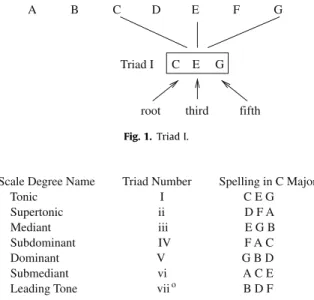
Triads are the basic and most often used elements in Western harmony. A triad is a three-note chord built on thirds[1]. The lowest note is the root.Fig. 1shows the tonic triad in C Major. Conventionally, pitches are named with the first seven letters of the English alphabet, A B C D E F G. Triads are named by the root notes.Fig. 2(see also in[1]) illustrates the triads in C Major. Major triads are represented by Roman numerals in uppercase and minor triads are represented by Roman numer-als in lowercase. We will demonstrate how we use triads to build four-part harmony.
A triad can appear in three different positions. In a root position triad, the lowest note is known as theroot, above which are thethirdandfifth. If the third or fifth of the triad is the lowest note, then the triad is ininversion. A triad is infirst inversion
if the third is the lowest note; a triad is insecond inversionif the fifth is the lowest note. Thus, knowing the composing notes of the triad does not mean that we know exactly how the triad appears in the music.
The elementary study of harmony is about chord progression. A chord progression is a series of chords played in order. When writing harmony, we need to consider the connection between chords. Cadences are also very important for making good music. The cadence, in music, is the place which gives the feeling of a temporary stop or a full stop[1]. The cadence usually consists of two successive chords. The two types of cadences are authentic cadences, which use tonic and dominant chords (V–I, I–V) and plagal cadences, which use tonic and subdominant chords (IV–I, I–IV).
Our research is now focused on four-part harmony, also known as four-voice texture. One of the most familiar examples is choir music (soprano, alto, tenor, bass). In four-part harmony writing, we need to consider the appropriate range of each voice, vertical spacing among four voices (voicing), and horizontal movement within the voice (voice leading)[2]. Given one voice (for instance, soprano), the goal is to automatically generate the other three voices. For our work, the generated music should follow classical Western harmony theory. Furthermore, we want the users to interact in the music generation process. Their preferences about the music can be reflected in the harmonies that are generated.
2.2. Music representation
To use computers to generate music, we first need a representation of music which is computer readable and operable. In our research, we useabcnotation[3]. The abc notation represents music inASCIIformat. It was originally designed to record folk and traditional Western European tunes. In abc notation, the Middle C is notated as C, the D immediately above middle C is notated as D, and so on up the scale. The next C in the higher octave is notated in lowercase as c. The next octave up is shown by an apostrophe immediately after the note name, for example, c0. The octave immediately below middle C is rep-resented by a comma immediately following the note name, e.g. B. Here is the four octaves in abc notation:
C;D;E;F;G;A;B; CDEFGABcdefgabc0d0e0f0
g0a0b0
The abc notation can be further extended by adding more commas (for lower octaves) or apostrophes (for higher octaves). The abc notation can also express rhythm, though a little bit complicatedly. In our current research, we only consider one note per beat.
The abc notated music is readable by both computers and humans. With a little practice, musicians can play a tune di-rectly from the abc notation without having to convert it to sheet music. There are many software packages that can read and process abc notation and produce traditional sheet music. Some tools can even play music directly from the abc notation. All this makes abc notation a good choice for our research. We can easily format inputs for the planner, compare the results, and play the resultant music or let the computer play it.
A B C D E F G
root third fifth C E G Triad I Fig. 1.Triad I. o Tonic I C E G Supertonic ii D F A Mediant iii E G B Subdominant IV F A C Dominant V G B D Submediant vi A C E Leading Tone vii B D F Scale Degree Name Triad Number Spelling in C Major
2.3. Existing work on automatic harmony generation
We do not attempt to survey algorithms for automatic music generation, an idea that can trace its philosophic roots to the aleatoric music of Johannes Ockeghem in the 15th Century[4].
Classical harmony generation is a popular programming topic, perhaps due to the algorithmic manner in which it is taught. Many classical music theory courses ask students to harmonize Bach’s chorales. The automatic harmony generation problem has been approached via constraint solvers[5], expert systems[6], genetic algorithms[7–9]and stochastic pro-cesses[10].
The most straightforward approach to harmony generation is via local optimization and backtracking. One of the earlier harmony generators, CHORAL, was a rule-based expert system built on BSL (Backtracking Specification Language)[6], for harmonizing chorales in the style of Bach. The expert knowledge is represented by production rules, constraints and heuris-tics. A production rule generates a possible assignment.
CHORAL maintains several views (solution arrays). The chord skeleton view observes the chorale as a sequence of rhythm-less chords and fermatas. The chord skeleton view is the master view. The master view generates one element (exe-cutes one step) of the solution array via the production rules. There are also some subordinate views, such as the fill-in view, the time-slice view, the melodic string view, and the Schenkerian view. The subordinate views do not have production rules. They can advance by zero, one, or more steps while the master view executes one step. The constraints and the heuristics of the subordinate views and the master view decide whether to accept the current tentative assignment or not.
CHORAL was tested on over 70 chorale melodies. The author claimed that the competence approaches that of a talented student of music who has studied the Bach chorales. We have not yet achieved that level of success. However, we believe that the underlying methodology we use provides a much more flexible approach to harmony generation. Rather than repro-gram an entire expert system, we need only adjust the reward function to generate a new style of harmony. Our represen-tation of ‘‘rules” in terms of preferences lends itself to harmony learning in a variety of learning paradigms. We are currently investigating apprenticeship learning[11]in this context.
Machine learning methods may also be used in harmony generation. The most popular technique seems to be genetic algorithms (GAs). Horner and Ayres[7]were among the earliest to use GAs to generate four-part harmony. They solved a simpler problem than we do: harmonize chord progression, given the chords. Phon-Amnuaisuk et al.[8,12]used GAs to gen-erate the A/T/B lines from a given soprano line. However, because it is hard to incorporate enough knowledge into GAs, so their music is far from ideal.
EVOC[9]is another application of GAs to generate music. A music line is given and an accompaniment line is wanted. EVOC generates music in species I counterpoint. In species I counterpoint, the rhythmic relationship between the added voices and the original one is note against note. EVOC generates the bass line. That is different from our program, because we add three voices and EVOC only adds one.
We are not the only ones to model harmony generation as a stochastic process. Moray Allan[13]used Hidden Markov Models (HMMs) for harmony progression. A hidden Markov model is a Markov process (not a decision process) with hidden states. The visible states represent melody notes and the hidden states are chords. Then they sample the posterior to find the most likely harmonisation. They used a second HMM to generate ornamentations. Their training and test data are also from Bach’s chorales. Voicing is not considered in their model. One effect of that design decision is that individual lines in their generated harmonies suffer from big jumps. Moreover, the harmonies are generated based strictly on what was learned from the data. There was no room in their generator for user preferences.
Recently, a group at Microsoft has produced an automatic accompaniment generator called MySong[10]. MySong also uses a Hidden Markov Model (HMM). The possible chord at each measure is the hidden state. The observation data is the sung pitch. The model that was demonstrated at AAAI’08 had been trained on a database of 300 lead sheets, apparently for pop music. For each measure, the program chooses a chord to maximizeP(notesjchord) andP(chords). Users can adjust several parameters to vary the style of the accompaniment. The version of MySong that we saw did not include voicing and voice leading, features that we will be considering in our ongoing work.
Paiement et al.[14]proposed to use graphical model to capture the global dependencies in chord progressions. They showed a graphical model to predict root note progressions given melodies. They represent each chord by a root note com-ponent and six structural comcom-ponents. They also described a graphical model to predict chord progressions given root note progressions and melodies. Their method can capture the global dependences with a tree structure. However, Paiement et al. showed that their method did not generate much better results than the local model method (HMM) by comparing negative log-likelihoods, especially when the root notes progressions are provided.
Geem and Choi[15]proposed what they call the Harmony Search (HS) algorithm. This method is intended to mimic the behaviors of music players. The music is generated in three phases. In the first phase, a value in the (musical) range is chosen stochastically. Then a value is chosen from recently-remembered pitches. Finally, the ‘‘musician” listens to neighboring pitches and adjusts, so as not to violate set rules about what sounds good together. They applied HS to organum composition. Organum is an early form of polyphonic music, with a melody and at least one added voice. According to their paper, the results are satisfactory. However, organum is a very simple music genre, usually only including two very similar parts.
Others have used constraint solvers to generate harmonies. Pachet and Roy provided a good survey on this[5]. Constraint techniques can produce harmonies offline, but not in real time, as our policies can. The big difference between our work and that of the constraint solvers, for instance, is that our harmony policies are myopic. We use a few notes or a few phrases of
melody line to generate the policy, but the application of the policy looks only at a small window on the melody and one previous chord. Thus, the same policy can be applied in any online setting, whether in improvisation or in straightforward accompaniment.
The stochasticity of our models allows us to create variations, both between repetitions of phrases in one rendition of the music, and between renditions. We feel strongly that music is not a stationary thing. This stochasticity is expressed in human variation in pitch, timing, and chording. Our system, unlike other automatic music generating systems, includes at least one aspect of this variability, namely in the choice of chord inversions.
There has been some very interesting work on musical improvisation[16–18]and we expect that our methods will add to that canon. Meanwhile, we describe a proof-of-concept system for generating harmony, given a simple melody line. We show, with the work presented here, that it is possible to model music generation as a Markov decision process.
3. Harmony generation using planning
We use decision-theoretic planning techniques to automate the generation of harmony. The structure and the existing methods of decision-theoretic planning assure the optimality of the solution relative to the given reward function. This method also provides flexibility to the users. It will be easy to modify their reward function to get different harmonies. We used MDP solvers to generate the harmonies.
We will first give a brief technical overview of Markov decision processes and then talk about our model.
3.1. Markov decision processes
A Markov decision process is a five tuplehS;A;Pr;R;Ci.Sis a finite state space, which contains all possible states. A states
is a description of the system at a particular time.Ais a finite action space. At each discrete time pointtof the process and each states, the agent has a set of available actions. After the agent takes an action, the system may change from one state to another. The state-transition functionPrdescribes how the next state depends on the current state and action.Pris a map-ping fromSASto a real number in½0;1, wherePrðjji;aÞis the probability that the system moves from stateito statejby taking the actiona. The reward functionR:S!Rassigns a reward to a states. The cost functionC:SA!Rdescribes the cost of taking an action at a state. The reward is added to the value of the state and the cost is subtracted from the state’s value. In our research of harmony generation, we only consider the reward of the states. So there will be no cost for taking an action. A policy is a mapping from a state to an action. In MDP planning, the goal is to find an optimal policy, one which maximizes the expected value of each state.
MDPs can be represented either explicitly or intensionally[19]. We use an intensional representation, also called a fac-tored representation. Instead of enumerating states explicitly, a facfac-tored representation defines a set of attributes that are sufficient to describe the states. The factored representation is usually preferred when the state space is large. We choose to use the factored MDP due to the four voices in harmony. It is convenient to use different state variables to represent the four different voices.
In factored MDPs, the transition function is described bydynamic Bayesian networks(DBNs). ABayesian network[20]is a representational framework for compactly representing a probability distribution in factored form. Formally, a Bayesian net-work is a directed acyclic graph in which vertices correspond to random variables and an edge between two variables indi-cates a direct probabilistic dependency between them. Each variable is associated with aconditional probability table(CPT) which specifies its probability conditioned on all possible values of its immediate parents in the graph. Atwo-stage temporal Bayes net(2TBN), a particular type of DBN, can be used to describe the state-transition probabilities of an action in an MDP. Please refer to[19]for more details.
3.2. From harmony to MDPs
MDPs are powerful in modeling stochastic systems where the execution of an action may change the system status non-deterministically. Consider one beat in four-part harmony. The notes from four voices partially describe a state. Given the next soprano note and the previous chords, we pick a chord to fill in the other three voices. Then we have a new state. Be-cause we have not yet specified the inversion (as described later in this section), we are not certain about the exact notes of each of the voices. Thus, chord progression can be viewed as a stochastic process. The choice of a chord is similar to the choice of an action in MDP planning. We want to generate good harmony. We give high rewards to good harmonies and low rewards to bad harmonies. Therefore we can use the expected rewards to decide the quality of the harmony. In other words, we want to pick a sequence of chords which can maximize the total expected rewards. We use MDP-based planning techniques to automate harmony generation.
We use a few assumptions to make the problem domain simple. We only consider the melodic notes at each beat. To maintain a small action set, we only use triads to build harmony. At present, all the examples are in 4/4 and C Major.
At each beat, there are four notes, one from each of the four different parts. They are modeled as variables of a state. One is known (the soprano), the other three are what we are trying to generate. Since we add one chord per beat, we don’t need to worry about the duration of the notes.
In our model, a state is made up of ten variablesS1;A1;T1;B1;S2;A2;T2;B2;S3;P. The first nine variables correspond to
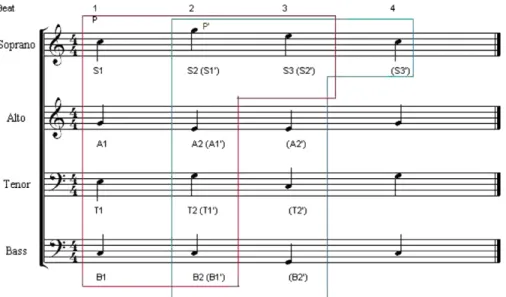
mu-sical notes, represented in abc notation. To make it human-parseable, we useS,A,T,Bto distinguish the notes from soprano, alto, tenor and bass, respectively. The subscript tells whether the note comes from the first chord or the second chord.P re-cords the position (beat) of the first chord in this state. InFig. 3, two consecutive states are framed.
In order to have a manageably small MDP for our tests, we focus on only two successive chords at a time. By encoding two chords in one state, we can tell how good the chords’ connection is by computing the utilities of that state.1
An action is defined as the choice of a chord, i.e., the chord number. The focus on triads leads to a fairly small action space. We usually build a triad using only notes found within the scale. There are seven triads in the major scale, as shown inFig. 2. There are more triads in the minor scale because there are three types of minor scales: natural, harmonic, and melodic. The 13 triads in the minor scale arei;ii
;ii;bIII;bIIIþ
;i
v
;IV;v
;V;bVI;v
i;bVII, and
v
ii, whereþrepresents augmented and rep-resents diminished. In MDPs, the uncertainty exists in state-action transitions. Here, picking a triad gives us a clue to which notes will appear on the next beat, but the possible inversions of the triad leaves the next state undetermined.A triad can appear in the root position, the first inversion or the second inversion. Since we only generate triads and the music is made up of four parts, it is common to double one or more of the notes in a triad (e.g. CEGc). It is also possible to omit a note (e.g. CGcc). We can define those probabilities in advance. If we want to generate music in a certain style, we can learn the probabilities from a corpus of music. Currently, we define the probabilities ourselves. We assume that the root of the triad is more likely (.6) to appear in the bass, with equal probability (.2) to appear in the other two parts. Similarly, the third is more likely to appear in the tenor (.6) and the fifth is more likely to appear in the alto (.6). We have made the sim-plifying assumption that individual voices’ notes are chosen independently, given the choice of chord. For instance, if the chosen triad is I (CEG), then the highest probabilities are that we have C on Bass, E on Tenor and G on Alto. However, we could, for instance, have all three voices on E – with very small probability!
At each state, to choose the best action, the reward must be computed. A reward function can be defined according to classical harmony theory or learned from a specific collection of music if we want to generate harmony in that musical style. We give a penalty when breaking a rule. That is done by giving negative rewards. We define positive rewards for desired features of the harmony.
We start our experiments with music in C Major. There are seven commonly used triads for a major scale, i.e., I, ii, iii, IV, V, vi, vii°, which are already shown inFig. 2. Those triads are numbered by their corresponding triad numbers. Based on the pre-vious chordðS1;A1;T1;B1Þ, the next soprano noteðS2Þand the position of the chords (P), a triad will be picked to maximize the
expected reward. Once an action is decided, the values of the variablesA2;T2;B2are limited to the notes in the chosen triad.
The two-stage temporal Bayes network of the model is shown inFig. 4. More specifically, it is the dynamic Bayes network for actionI, i.e., choosing triadI(CEG). A primed variable,
v
0, represents the variablev
at the next stage (or beat). A condi-tional probability table (CPT) is associated with each primed variable, which describes the transition function. InFig. 4, we give the CPT for variableA02, represented by a decision diagram. A chord appears in two consecutive states. Due to
redun-dancy, the values ofS0 1;A 0 1;T 0 1;B 0 1;S 0
2are the same asS2;A2;T2;B2;S3. Therefore, the transitions fromS2toS01;A2toA01;T2to
T0
1;B2toB01andS3toS02are deterministic. Also,P0¼Pþ1. However, the transitions of other variables are nondeterministic
Fig. 3.An example state in the harmony model.
1
Most rules of harmony consider longer sequences of chords. We will take into account longer sequences as soon as we have planners that can handle such models.
because the inversion is not determined by the choice of chord. They are chosen stochastically, based on the probabilities discussed in previous part of this section.
We use a vectorðs1a1t1b1s2a2t2b2s3pÞto represent a state. For example, the current state inFig. 3isðcGE;C;gEG;C;e1Þ. If
the policy specifies action I (triad I), then the next state is ðs0 1a01t01b
0 1s02a02t02b
0
2s03p0Þ. We know that s01¼s2;a01¼a2;t01¼
t2;b01¼b2;s02¼s3. The melody determiness03. Because the first triad of this state is at the second beat of the whole music,
p0¼2. The values ofA0 2;T
0 2;B
0
2are restricted to C/E/G (here we assume that all notes are in one octave). Uncertainty still
ex-ists. The chord can appear:
in root position:a0 2¼Gt02¼Eb 0 2¼C, or in first inversion:a0 2¼Ct 0 2¼Gb 0 2¼E, or in second inversion:a0 2¼Et02¼Cb 0 2¼G, or with doubling:a0 2¼Ct02¼Eb 0 2¼C, or other combinations.
Once we have the model ready, the next question is what kind of harmony do we want to generate? The reward function should reflect and enforce our preferences. Loui and Wessel[21]studied people’s expectation on harmonies for given specific melodies. Some chord progressions are highly expected, others highly unexpected. We can define reward functions accord-ing to people’s expectations, and use those rewards to guide plannaccord-ing. For example, we have used the followaccord-ing rules as re-ward functions.
(1) We prefer consonance (the melodic note is in the added chord) to dissonance (the melodic note is not in the added chord) by giving every consonance a reward. This is a compound rule, described by a sum of ADDs representing each individual one. We need to specify each case. For instance, ifS2is C, thenB2;A2;T2can be C, E, G with reward +100.
1 1 2 2 2 2 3 1 1 1 2 2 2 2 1 S A B S A T B S P T 1 1 3 A’ T’ B’ S’ A’ T’ B’ S’ P’ 0.2 0.2 0.6 0.0 A’ 2 S’ C E G A/B/D/F
(2) We prefer authentic cadences, but we also accept plagal cadences. This is done by giving higher rewards to authentic cadences and lower rewards to plagal cadences. The cadence is defined as the last two notes in each phrase. Thus it is position dependent.
(3) Parallel fifths should be avoided, so we give them a negative reward.
We can extract other rules from classical music theory, that have been formalized by musicians in the last few centuries. Those rules can be represented as reward functions. We can also ask the users to specify their own preferences and create the harmonies they like.
4. Experiments
To generate harmony, we run the planners and simulate the execution of the optimal plan. The design of the planners and the simulator are explained. Outputs of our planners and simulator are given later in this section.
4.1. Planner design
In our experiments, two different planning algorithms were used: a value iteration planner and a receding horizon planner.
4.1.1. The value iteration planner
Value iteration is a basic method to solve MDPs. It starts with a greedy policy – choose an action for each state with the highest immediate reward – and improves the value function iteratively until an optimal policy is found (which corresponds to the highest value function). We will describe the value iteration, but first we will talk about the data structures we use. In factored MDPs, decision diagrams can be used to provide a compact representation of MDPs.
Abinary decision diagram(BDD) is a directed acyclic graph with a single root[22]. A non-terminal vertex in a BDD is la-beled with a variable and has two children. One edge from the non-terminal vertex to one of its children is lala-beled with TRUE; the other edge is labeled withFALSE. A terminal vertex (leaf) is labeled with a Boolean value and has no children. A BDD mapsnBoolean variables to a Boolean value, which is specified by the terminal vertex.Algebraic decision diagrams
(ADDs) generalize BDDs by allowing real number values at terminal vertices.
Hoey et al.[23]developed a value iteration algorithm for factored MDPs, using algebraic decision diagrams to represent value functions and conditional probability tables (CPTs). A CPT in ADD format is presented inFig. 4. They called their algo-rithm SPUDD, forstochastic planning using decision diagrams. The use of ADDs and the associated off-the-shelf optimization software was a huge step forward in factored MDP planning. With the ability to capture regularities in the CPTs, ADDs fully take advantage of the efficiency of factored MDPs. In factored MDP planning, we usually use ADDs to represent states and policies. In apolicy ADD, the non-terminal vertices are state variables and the terminal vertices are labeled with actions. Therefore a policy ADD represents a mapping from a set of states to a set of actions.
We built a value iteration planner based on SPUDD, with a few modifications according to our specific domain. Our model is a finite MDP. The horizon of this MDP is the total number of beats given by the musical phrase. In planning with a finite horizon, theith iteration in the value iteration algorithm represents the value function for the states which areisteps away from the end of the execution. In the value iteration algorithm, to get the optimal value function, the value iteration proceeds to construct a series ofn-step-to-govalue functionsVn:
Vn ðsÞ ¼RðsÞ þmax a
c
X s02S Prðs0js;aÞÞVn1 ðs0Þ " # ;where
c
2 ð0;1is the discounting rate, which puts diminishing value on future rewards. For a finite horizon MDP, we do not need discounting, so we setc
¼1 in our domain. From those value functions, we extract the optimal policy for the states at different stages.When more music rules are added, the ADD representing the reward function grows. Operations on large ADDs strongly affect the planning algorithm’s time and space complexity; the straightforward planner we used could not handle complex reward functions. We are working on efficient planning algorithm design, including heuristic algorithms and near-optimal policy approximations. We are also looking at developing a more efficient ADD operation package.
4.1.2. The receding horizon planner
The reward function guides MDP planning. The reward function defines the quality of the generated harmony. To make the harmony more musical, we need to consider many aspects of harmony writing. The more rules we want to include, the more complicated the reward function becomes.
The complexity of the reward function affects the tractability of planning. In the value iteration planner, updates are per-formed on values stored as ADDs. At each step, a value function ADD for all the states is computed. A complicated reward function leads to a large value function ADD. The value iteration based planner fails when the reward function includes too many rules. The limited ability of our planner affects the quality of the generated harmony.
Taking advantage of reachability, we built a receding horizon planner[24]. It starts from an initial state, representing the current situation, and expands the state space to states that are reachable intsteps from the initial one. The output is a par-tial policy for the inipar-tial state and the expanded states. The receding horizon planner does a specified number of iterations. Each iteration includes two phases: expanding the state space, and updating the value functions. The state space expansion subroutine enlarges the state space a little bit at each step. The value function update subroutine computes the values for the states included in the state space. By considering only reachable states, the state space and the value function ADD are held to an acceptable size. The newly expanded states have 0 steps to go, and their values are their immediate rewards. The values of states from the previous steps are updated, using the values of the new states that they can reach.
The receding horizon planner is more efficient than the value iteration planner. Therefore we can use more complicated reward functions to generate harmonies.
4.2. Simulation
We worked with Beethoven’sOde to Joy, using the two planners. The music was divided into small phrases. Each phrase consisted of two measures, i.e., eight beats, and the cadence was at the end. The planner handled the phrases separately; the policy that was produced simply glued the two phrase policies together. (The choice of eight-beat phrases was based on the fact that the complexity of planning depends on the time horizon, i.e., the number of beats considered. With better planners, we can consider longer phrases.)
Within each phrase, we filled in the first two chords by hand to provide the initial state. We then ran the value iteration planner and the receding horizon planner. The planners each produced an optimal policy, given the initial state. The policy assigned a triad to each beat.
The optimal policy creates a chord progression. We then need to generate the exact notes for the three voices. We created a program to simulate the execution of the policy. The simulator chooses actions according to the optimal policy. As we dis-cussed in Section3.2, actions are described by dynamic Bayesian networks. The values ofS0
1,A 0 1;T 0 1;B 0 1;S 0
2in the next state is
the same asS2;A2;T2;B2;S3in the current state;S03is given by the melody;P
0increases one at each step. After taking the action, the values forA02;T02;B02are decided by the conditional probability tables of the respective variables. The CPTs give
us the probabilities of the values. In each simulation, the program randomly chooses the next state according to the transi-tion probabilities. If we run the simulator multiple times, we may getslightly different music each time. The harmonies are made up of the same series of chords, but the individual voices will be different. Those different harmonies can be considered different views of the policy. Human users have the option of choosing the harmony they prefer.
4.3. Results
Experiments were carried out using the two planners. We first used the value iteration planner. Due to the limited power of the planner, we could only use very simple rules. We used two preferences.
(1) The melodic note is preferred to appear in the corresponding chord. (2) Authentic cadences are preferred to plagal cadences.
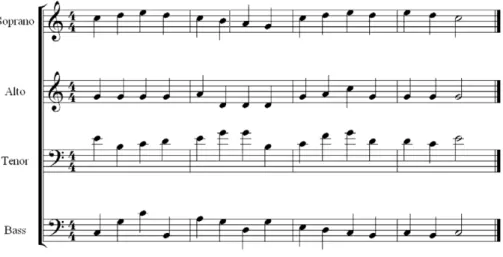
We generated harmonies for the given soprano part. Two of them are shown inFig. 5 and 6. They have the same series of chords (I–I–ii–V/V–ii–I–ii/I–I–vii°–I/V–I–I–I) but slightly different musical effects. For instance, consider the first two mea-sures in the tenor and bass lines.
The generated music is highly dependent on the definition of the reward function, in other words, the music rules we use. For example, we added a preference that the harmony include the melodic notes when the melodic note is C, E, or G. But for other melodic notes, we do not have this requirement. The generated music (seeFig. 7) sounds discordant in some places, particular the third beat in the first measure.
The value iteration planner failed to generate harmony when we tried to add more rules to the system. The limited knowledge encoded by the reward function affected the quality of the generated harmony. By taking advantage of reachabil-ity and online planning, the receding horizon planner handled more complicated reward functions. We added a third rule: Parallel fifths are not preferred. A negative reward is assigned when a parallel fifth is discovered. The harmony generated by the receding horizon planner using the two rules and three rules are shown inFigs. 8 and 9, respectively.
We also tried other melodies. The generated harmony of Bach’s choral MMW25.6 by the value iteration planner is dis-played inFig. 10.
The initial evaluation of the generated music was by the authors, who thought it sounded good, albeit unsophisticated. There are several places where the same note is played by two adjacent parts, which leads to a less full sound. InFig. 5, the soprano and the tenor sing exactly the same notes in the adjacent octaves for three beats in the second measure. We also encounter big jumps within a part, which leads to more difficult individual parts, for instance, in the second measure of Fig. 5for the bass. Those defects are because our current model only incorporated a few simple rules. In classical four-part harmony, many factors need to be considered.
We then recruited 10 other people to help us evaluate the music. We asked them to listen to the harmony (the one in Fig. 10, which is randomly selected from computer generated harmonies) and then answer the following questions:
(1) Does this sound musical to you? (Yes or No.)
(2) Does this sound like it has followed basic classical rules of harmony? (Yes or No.)
(3) Which of these two short harmonies sounds better to you? (The first one, the second one, or hard to say.) Fig. 5.Harmony generated by the value iteration planner.
Fig. 6.Harmony generated by the value iteration planner.
(4) If you know why you preferred one harmony, please tell us.
In the third survey question, the first piece is generated by computer and the second is Bach’s original piece (with only the first note on each beat left), which is shown inFig. 11.
Fig. 10.The choral harmonized by the value iteration planner. Fig. 8.Harmony generated by the receding horizon planner.
The survey webpage ishttp://csr.uky.edu:8080/evaluation.html.
For the first question, 9 of the 10 respondents said that the harmony sounded musical to them. That means we reached our first goal. Our research proved that it is feasible to use decision-theoretic planning in harmony generation. The program can generate harmony that sounds musical.
For the second question, 9 out of 10 respondents said that the generated harmony sounded like it obeyed the basic rules of classical (Western) harmony.
Half the respondents found it hard to compare the generated harmony to the scaled-down version of Bach’s harmony; three preferred our generated harmony. One respondent, who preferred Bach’s version, commented, ‘‘The quality of the chords in the second example were more varied compared to the first and the voices moved in a more understandable line.” The other who preferred Bach’s version found it to be somewhat richer than the computer generated one.
Our generator uses very simple rules. There are plenty of musical issues that we have not addressed with the reward func-tion described in this paper. What’s more, the rules we used were followed rigidly, without any alterafunc-tion. Bach’s works are well structured, but he did not follow rules mechanically. There is room for much more sophisticated choice and enforce-ment of rules of harmony. We have, however, demonstrated the feasibility of generating harmony decision-theoretically.
The potential users of a harmony generation tool would be amateur music lovers. Music can be translated into abc nota-tion by hand or by existing software. With the input in abc notanota-tion, the automatic harmony generator will output a number of four-part harmony pieces with the same melody. The users can then listen to those pieces on the computer or play the pieces themselves. They can pick whichever they like best.
Our method allows lots of user interaction. Since we use the reward functions to guide the planning, we can give users the ability to define the reward functions. The easiest way is to provide a few already coded rules and let users pick the rules they want to use. They can change the combination of the rules and get different harmonies. The users can manipulate the soft-ware and generate the music they really like. Moreover, the softsoft-ware would not have to learn: Just enter your preferences and push thegenerate harmonybutton! And perhaps the user will learn – about the rules of harmony, or just about their own musical preferences.
5. Conclusions
The Markov decision process formulation of the harmony generation problem does not lead to computational efficiency. However, it does open up the possibility, with better planners – which are being developed – for much finer control of har-monies, through sophisticated reward functions. It also allows us tovarythe harmonies through small changes in those re-ward functions. Finally, by separating the policy computation from the harmony generation, it allows a single policy to produce multiple voicings, leading to subtle differences from instance to instance of the same harmony.
We have not – yet – given a definitive stochastic model of harmony generation. What we have presented here is a proof of concept: MDPs can be used to model uncertainty about chord arrangements. There are other music generation instances that can be modeled stochastically, such as the future movement of voices in harmonic improvisation.
Given a melody, our four-part harmony generator can produce reasonable music. The current harmonies that are pro-duced are not very sophisticated. With improved computational power, extra memory, and an optimized multi-value deci-sion diagram package[25], we will be able to produce decent harmonies.
To get better performance, we will keep improving the planners so that we can apply those sophisticated reward func-tions and different combinafunc-tions of rules. As we integrate more rules into the model and improve the performance of the planner, we expect that the generated music will be even better.
We are also considering applying learning methods to learn the reward function from a musician’s work instead of defin-ing it based on the theory. Then we can generate music in different styles.
Acknowledgement
This work is partially supported by NSF Grant ITR-0325063. References
[1] Robert Ottman, Elementary Harmony, Prentice-Hall, 1970.
[2] Robert Gauldin, Harmonic Practice in Tonal Music, W. W. Norton & Company, 1996. [3] Chris Walshaw, abc Music Notation, 2007.<http://www.walshaw.plus.com/abc/>. [4] Howard Mayer Brown, Louise K. Stein, Music in the Renaissance, Prentice-Hall, 1996.
[5] Francois Pachet, Pierre Roy, Musical harmonization with constraints: a survey, Constraints Journal 6 (1) (2001) 7–19. [6] Kemal Ebcioglu, An expert system for harmonizing four-part chorales, Computer Music Journal 12 (3) (1998) 43–51.
[7] Andrew Horner, Lydia Ayers, Harmonisation of musical progression with genetic algorithms, in: Proceedings of the 1995 International Computer Music Conference (ICMC-95), 1995, pp. 483–484.
[8] Somnuk Phon-Amnuaisuk, Andrew Tuson, Geraint Wiggins, Evolving musical harmonisation, in: Proceedings of the Fourth International Conference on Artificial Neural Networks and Genetic Algorithms (ICANNGA-99), 1999.
[9] Timothy Weale, Jennifer Seitzer, EVOC: a music generating system using genetic algorithms, in: Proceedings of the International Joint Conference on Artificial Intelligence (IJCAI-03), 2003, pp. 1383–1384.
[10] Dan Morris, Ian Simon, Sumit Basu, Exposing parameters of a trained dynamic model for interactive music creation, in: Proceedings of the Twenty-Third Conference on Artificial Intelligence (AAAI-08), 2008.
[11] Pieter Abbeel, Andrew Y. Ng, Apprenticeship learning via inverse reinforcement learning, in: Proceedings of the Twenty-Fifth International Conference on Machine learning (ICML-04), 2004.
[12] Somnuk Phon-Amnuaisuk, Geraint Wiggins, The four part harmonisation problem: a comparison between genetic algorithms and a rule-based system, in: Proceedings of the AISB’99 Symposium on Musical Creativity, 1999.
[13] Moray Allan, Christopher K.I. Williams, Harmonising chorales by probabilistic inference, Advances in Neural Information Processing Systems 17 (2005).
[14] Jean-François Paiement, Douglas Eck, Samy Bengio, Probabilistic melodic harmonization, in: Proceedings of the 19th Canadian Conference on Artificial Intelligence, 2006.
[15] Zong Woo Geem, Jeong-Yoon Choi, Music composition using harmony search algorithm, Applications of Evolutionary Computing (2007) 593–600. [16] William F. Walker, A Computer Participant in Musical Improvisation, CHI 97 Electronic Publications, 1997.
[17] Belinda Thom, Bob: an interactive improvisational music companion, in: Proceedings of the Fourth International Conference on Autonomous Agents, 2000, pp. 309–316.
[18] Robert Keller, David Morrison, A grammatical approach to automatic improvisation, in: Proceedings of the Fourth Sound and Music Conference, 2007. [19] Craig Boutilier, Thomas Dean, Steve Hanks, Decision-theoretic planning: structural assumptions and computational leverage, Journal of AI Research 11
(1999) 1–94.
[20] Judea Pearl, Probabilistic Reasoning in Intelligent Systems: Networks of Plausible Inference, Morgan Kaufmann, San Mateo, 1988.
[21] Psyche Loui, Tineke Grent-’t-Jong, Dana Torpey, Marty Woldorff, Effects of attention on the neural processing of harmonic syntax in Western music, Cognitive Brain Research 25 (2005) 678–687.
[22] Randal E. Bryant, Graph-based algorithms for boolean function manipulation, IEEE Transactions on Computers 8 (C-35) (1986) 677–691.
[23] Jesse Hoey, Robert St-Aubin, Alan Hu, Craig Boutilier, SPUDD: stochastic planning using decision diagrams, in: Proceedings of the Fifteenth Conference on Uncertainty in Articial Intelligence (UAI-99), 1999, pp. 279–288.
[24] Liangrong Yi, Raphael Finkel, Judy Goldsmith, Planning for welfare to work, in: Proceedings of the 21st Internationl FLAIRS Conference (FLAIRS-21), 2008.