T R U S T I N I N T E R D E P E N D E N T A N D TA S K - O R I E N T E D H U M A N – C O M P U T E R C O O P E R AT I O N
p h i l i p p k u l m s
A dissertation submitted to Bielefeld University in partial fulfillment of the requirements for the degree of
Philipp Kulms
Social Cognitive Systems Group Faculty of Technology
Bielefeld University
t h e s i s c o m m i t t e e:
Prof. Dr.-Ing. Stefan Kopp (Bielefeld University)
Prof. Dr. Catherine Pelachaud (French National Centre for Scientific Research, Paris)
Prof. Dr.-Ing. Britta Wrede (Bielefeld University) Dr. phil. Matthias Hartung (Bielefeld University)
d at e o f s u b m i s s i o n: January11,2018
d at e o f d e f e n s e: September14,2018
The paper used in this publication meets the requirements for perma-nence of paper for documents as specified in ISO9706.
And, you know, I never wanted to be a singer
A B S T R A C T
This thesis presents a new paradigm for the modeling of cooperative human–computer interaction in order to evaluate the antecedents, for-mation, and regulation of human–computer trust. Human–computer trust is the degree to which human users trust computers to help them achieve their goals, and functions as powerful psychological variable that governs user behavior. The modeling framework pre-sented in this thesis aims to extend predominant methods for the study of trust and cooperation by building on competent problem-solving and equal goal contributions by users and computers. Specif-ically, the framework permits users to participate in interactive and interdependent decision-making games with autonomous computer agents. The main task is to solve a two-dimensional puzzle, similar to the popular game Tetris. The games derived from this framework include cooperative interaction factors known from interpersonal co-operation: the duality of competence and selfishness, anthropomor-phism, task advice, and social blame.
One validation study (68 participants) and four experiments (318
participants) investigate how these cooperative interaction factors in-fluence human–computer trust. In particular, the results show how trust in computers is mediated by warmth as universal dimension of social cognition, how anthropomorphism of computers influences trust formation over time, and how expressive anthropomorphic cues can be used to regulate trust. We explain how these findings can be applied to design trustworthy computer agents for successful cooper-ation.
P U B L I C AT I O N S
Some results, figures, and tables have appeared previously in the fol-lowing publications:
Buchholz, V., Kulms, P. & Kopp, S. (2017). It’s (not) your fault! Blame and trust repair in human-agent cooperation. In:Proceedings of the 2017Workshop on Cognitive Systems. München.
Kulms, P. & Kopp, S. (2016). The effect of embodiment and compe-tence on trust and cooperation in human–agent interaction. In: Intelligent Virtual Agents. Springer. Berlin, Heidelberg,75–84. — (2018). A social cognition perspective on human–computer trust:
The effect of perceived warmth and competence on trust in decision-making with computers.Frontiers in Digital Humanities,5,14. Kulms, P., Welbergen, H. van & Kopp, S. (2014). Prototyping von
in-tuitiven und interaktiven Benutzerschnittstellen: Schnelles und einfaches Design von Anwendungen mit virtuellen Agenten [Pro-totyping of intuitive and interactive interfaces: Easily designing virtual agent applications]. In: Technische Unterstützungssysteme, die die Menschen wirklich wollen. Ed. by W. Robert & R. Tobias. Hamburg: Helmut-Schmidt-Universität,30–38.
Kulms, P., Mattar, N. & Kopp, S. (2015). Modeling decision-making in cognitive systems for social cooperation games. In:Proceedings of the2015Workshop on Cognitive Systems. Bielefeld.
— (2016). Can’t do or won’t do? Social attributions in human–agent cooperation. In: Proceedings of the2016International Conference on Autonomous Agents & Multiagent Systems. International Founda-tion for Autonomous Agents and Multiagent Systems,1341–1342. Kulms, P., Welbergen, H. van & Kopp, S. (2018). MultiPro:
Prototyp-ing Multimodal UI with Anthropomorphic Agents. In: Mensch
und Computer2018- Tagungsband. Ed. by R. Dachselt & G. Weber. Bonn: Gesellschaft für Informatik e.V.,23–32.
Mattar, N., Welbergen, H. van, Kulms, P. & Kopp, S. (2015). Prototyp-ing user interfaces for investigatPrototyp-ing the role of virtual agents in human–machine interaction. In:Intelligent Virtual Agents. Springer. Berlin, Heidelberg,356–360.
A C K N O W L E D G M E N T S A N D F U N D I N G
This work would not have been possible without the support from my colleagues of the Social Cognitive Systems Group.
I owe special thanks to Nikita Mattar for helping me with vari-ous crucial tasks, including developing a bigger idea behind a simple puzzle game, setting up the framework, planning and discussing the experiments, and searching for students to continue my work with.
I am deeply grateful to my supervisor, Stefan Kopp, who helped me through this journey with patience, trust, and his trademark sense of humor.
Thank you, Nicole and Jonathan, for helping me with my first steps in the human–computer interaction field.
Over the past seven years, I learned to appreciate the discussions with other members of the Intelligent Virtual Agents community, in particular, Peter Khooshabeh.
Finally, I wish to thank my students, Victoria Buchholz and Markus Gaffke, with whom I could discuss novel ideas and approaches and for working with me on the framework.
This thesis was supported by the German Federal Ministry of Ed-ucation and Research (BMBF) within the Leading-Edge Cluster ’it’s OWL’ which was managed by the Project Management Agency Karl-sruhe (PTKA), as well as by the Deutsche Forschungsgemeinschaft (DFG) within the Center of Excellence277’Cognitive Interaction Tech-nology’ (CITEC).
C O N T E N T S 1 i n t r o d u c t i o n 1 1.1 Motivation . . . 1 1.2 Contributions . . . 4 1.3 Thesis outline . . . 5 2 t r u s t: t h e o r e t i c a l b a c k g r o u n d 7 2.1 The general concept . . . 7
2.2 Antecedents of trust . . . 11
2.3 Behavioral implications . . . 13
2.4 Trust regulation . . . 15
2.5 The role of warmth and competence . . . 17
2.6 Summary . . . 19
3 t r u s t i n h u m a n–c o m p u t e r i n t e r a c t i o n 21 3.1 Factors of human–computer trust . . . 21
3.2 Anthropomorphic agents . . . 26
3.3 Methodological advances . . . 28
3.4 Explaining the social influence of technology . . . 31
3.5 Summary . . . 34
4 t h e i n t e r a c t i v e c o o p e r at i o n g a m e pa r a d i g m 35 4.1 Motivation . . . 35
4.2 Task: Cooperative gameplay . . . 37
4.3 The cooperation concept . . . 38
4.4 Interaction factors . . . 39
4.4.1 Puzzle competence and selfishness . . . 39
4.4.2 Task advice . . . 39 4.4.3 Anthropomorphism . . . 40 4.4.4 Blame . . . 41 4.5 Validation study . . . 41 4.5.1 Overview . . . 42 4.5.2 Method . . . 43 4.5.3 Results . . . 45 4.5.4 Discussion . . . 47 4.5.5 Lessons learned . . . 48 4.6 Overview of experiments . . . 49 5 e x p e r i m e n t 1: t r u s t a n t e c e d e n t s 51 5.1 Overview . . . 51 5.2 Method . . . 52 5.3 Results . . . 54 5.4 Discussion . . . 57 6 e x p e r i m e n t 2: t r u s t f o r m at i o n 61 6.1 Overview . . . 62 6.2 Method . . . 62 6.3 Results . . . 64 xi
6.4 Discussion . . . 67 7 e x p e r i m e n t 3: t r u s t f o r m at i o n (e x t e n d e d) 71 7.1 Overview . . . 71 7.2 Method . . . 71 7.3 Results . . . 75 7.4 Discussion . . . 81 8 e x p e r i m e n t 4: t r u s t r e g u l at i o n 85 8.1 Overview of the two studies . . . 86
8.2 Preliminary study . . . 87
8.2.1 Method . . . 87
8.2.2 Results . . . 88
8.2.3 Discussion . . . 90
8.3 Overview of the main study . . . 92
8.4 Main study . . . 92 8.4.1 Method . . . 92 8.4.2 Results . . . 97 8.4.3 Discussion . . . 102 9 g e n e r a l d i s c u s s i o n 105 9.1 Summary . . . 105 9.2 Empirical contributions . . . 106
9.2.1 The role of warmth and competence . . . 106
9.2.2 Human–computer trust . . . 111
9.3 Methodological contributions . . . 113
9.4 Designing for trust and trustworthiness . . . 116
9.5 Future research directions . . . 120
9.6 Limitations . . . 123 9.7 Concluding remarks . . . 124 a a p p e n d i x 125 a.1 Experiment1 . . . 125 a.2 Experiment2 . . . 126 a.3 Experiment3 . . . 127 b i b l i o g r a p h y 129
L I S T O F F I G U R E S
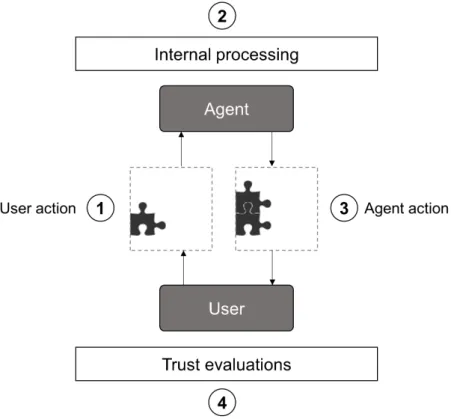
Figure1 Schematic view of human–computer cooperation 2
Figure2 The Mayer et al. (1995) trust model . . . 8
Figure3 Interacting with anthropomorphic agents . . . 27
Figure4 Anthropomorphic agents in empirical studies on trust and cooperation . . . 30
Figure5 Naturalistic cooperative environments . . . 36
Figure6 Conceptual components in the paradigm . . . 38
Figure7 Validation study: Game interface . . . 43
Figure8 Validation study: Coordination heatmaps . . . 46
Figure9 Experiment 1: Warmth and competence of the agent . . . 56
Figure10 Experiment 1: Behavioral trust and trustwor-thiness of the agent . . . 57
Figure11 Experiment1: Mediation analysis . . . 58
Figure12 Experiment2: Game interface . . . 63
Figure13 Experiment2: Requested advice . . . 66
Figure14 Experiment2: Adopted advice . . . 66
Figure15 Experiment3: Game interface . . . 72
Figure16 Experiment3: Advice in the puzzle game . . . 73
Figure17 Experiment3: Agents used in the experiment . 74 Figure18 Experiment3: Warmth and competence means 76 Figure19 Experiment3: Requested advice . . . 78
Figure20 Experiment3: Adopted advice . . . 78
Figure21 Experiment3: Self-reported trust and perceived trustworthiness . . . 79
Figure22 Experiment3: Round number and advice qual-ity interaction effect . . . 80
Figure23 Experiment3: Team performance (R1) and trust-worthiness . . . 81
Figure24 Experiment4: Responsibility attributions in the pre-study . . . 89
Figure25 Experiment4: Overview . . . 92
Figure26 Experiment4: Self-blaming behavior (a) . . . . 93
Figure27 Experiment4: Self-blaming behavior (b) . . . . 94
Figure28 Experiment4: Self-blaming behavior (c) . . . . 95
Figure29 Experiment4: Participant-blaming behavior (a) 95 Figure30 Experiment4: Participant-blaming behavior (b) 96 Figure31 Experiment4: Participant-blaming behavior (c) 96 Figure32 Experiment4: Responsibility attributions in the main study . . . 99
Figure34 The relation between warmth, competence, and
trust-related outcomes . . . 108
Figure35 Interaction factors in the paradigm . . . 113
Figure36 Combined empirical and methodological con-tributions . . . 119
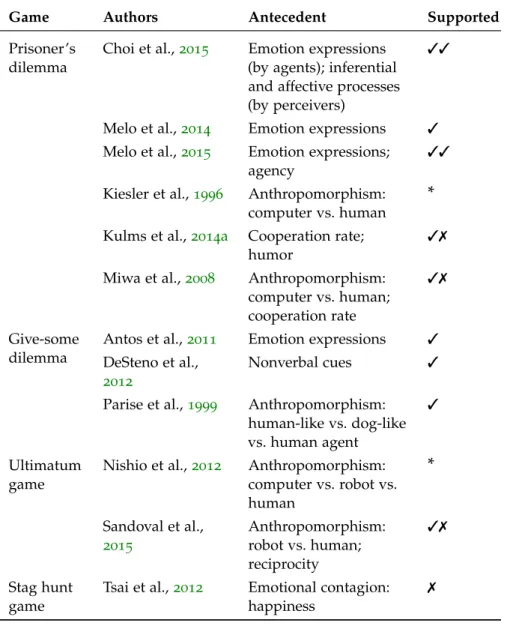
L I S T O F TA B L E S Table1 Antecedents of trusting or cooperative human decisions in social dilemmas with computers . 31 Table2 Interaction factors . . . 42
Table3 Validation study: Social attributions . . . 47
Table4 Experiment1: Principal component analysis of the social perception scale . . . 55
Table5 Experiment2: Team performance . . . 65
Table6 Experiment 2: Relationship between trustwor-thiness and behavioral measures . . . 67
Table7 Experiment3: Team performance . . . 75
Table8 Experiment3: Principal component analysis of the social perception scale . . . 77
Table9 Experiment3: Relationship between self-reported and behavioral measures . . . 80
Table10 Experiment 4: Emotional reactions in the pre-study . . . 90
Table11 Experiment4: Perceived emotional reactions in the main study . . . 98
Table12 Experiment4: Emotional reactions in the main study . . . 99
Table13 Experiment3: Emotional reactions of the agent and participants’ emotional reactions . . . 101
Table14 Experiment1: Warmth and competence . . . . 125
Table15 Experiment 1: Behavioral trust and trustwor-thiness . . . 125
Table16 Experiment2: Requested advice . . . 126
Table17 Experiment2: Adopted advice . . . 126
Table18 Experiment3: Requested advice . . . 127
Table19 Experiment3: Adopted advice . . . 127
1
I N T R O D U C T I O N1.1 m o t i vat i o n
Of all our social relationships, we prefer individuals we can trust. Trust, “the attitude that an agent will help achieve an individual’s goals in a situation characterized by uncertainty and vulnerability” (Lee & See, 2004, p. 54), is one of the most powerful psychologi-cal tools at our disposal. The possibility to separate friend from foe makes trust inseparable from social interactions. Likewise, trust has grown to become a key psychological variable in human–computer interaction (HCI) that is just as important as computer reliability for successful human–computer teams (Dzindolet et al.,2003).
Today, people’s activities often rely on intelligent computer agents, from smart devices and digital assistants to early social robots. Those technologies are increasingly endowed with the requirements neces-sary for complex cooperative interactions, such as problem-solving performance and autonomy. Performance-based capabilities are a cru-cial source of information based on which users trust agents (Han-cock et al.,2011; Lee & See,2004). Other essential capabilities relate to
an agent’s interface that was engineered for the users to interact with. Social robots and3D virtual agents have expressive anthropomorphic interfaces, enabling them to mimic human appearance and/or behav-ior in order to make the interaction feel natural to users and influence them in profound social ways.
Can the mechanisms behind trust be utilized to develop technol-ogy that people can work together with, similar to how they cooper-ate with other humans? Computers are no longer used as mere tools. Rather, humans and computers increasingly cooperate toward com-plex interaction goals through a series of competent goal-directed ac-tions (see Fig.1). In the future, both users and agents could be equally
equipped to contribute to the goal, decreasing functional differences between the actors, yet increasing the need to understand how users trust such agents.
Designing for trust is an ambitious task. This thesis focuses on the psychological problem of appropriate trust, that is, a match between perceived and actual technology capabilities (Lee & See, 2004). This
perspective needs to encompass human-centered experiential and be-havioral factors of trust as well as significant developments of intel-ligent computer agents. Computer agents are ubiquitous, occupy a wide range of roles, efficiently align to user needs, provide
Figure1: Schematic view of human–computer cooperation.
mendations, and permit natural communication. This has major im-plications for appropriate trust:
1. Technology is increasingly endowed with anthropomorphic char-acteristics: Speech-based interfaces enable interactions based on natural dialog and embodied agents such as social robots and virtual agents have deliberate human-like appearance. This en-ables designers to implement seemingly social behaviors which influence user responses in meaningful ways. It is, however, still mostly unclear if users trust anthropomorphic technologies like they trust other humans.
2. Cooperative computer agents allow for more open interactions toward complex goals, exceeding classic interaction metaphors such as the desktop paradigm. Future systems can engage in collaborative interactions that involve shared problem-solving and users being no longer fully in charge of the task. As users pass responsibility to agents, they need to be able to assess the agent’s competencies and intentions to contribute to the goal, leading to a higher need for trust.
These two developments suggest users now can (or must) resort to previously unavailable cues to develop trust as HCI gradually evolves toward cooperative interaction. The following characteristics describe novel challenges users are faced with in cooperative interaction:
1.1 m o t i vat i o n 3
• Complexity: The interaction involves a myriad of degrees of
freedom. Single actions or events not necessarily follow a script or pattern.
• Interdependency:The actions of the involved agents depend on
each other. In order for them to be mutually supportive, task-related coordination and communication is required.
• Goal-directedness:The actions are geared toward a specific and
observable or measurable outcome.
• Continued interaction: In order to achieve goals, repeated
ac-tions over an extended period of time are necessary. The trust-ing relationship is dynamic, it develops and changes.
• Decision-making: Complex decisions require the coping with
uncertainty and risk, and trust is one of the most powerful mechanisms users have at their disposal to handle this issue. Additionally, social decision-making involves decisions made by users and other seemingly social agents.
On the one hand, the above considerations make appropriate trust all the more important. Untrustworthy agents pose various obsta-cles and risks. Much like untrustworthy web services, they can have malevolent intentions and try to exploit users. They can also be too incompetent to engage with or too incompetent to separate credi-ble from incredicredi-ble information, which poses a threat to the interac-tion goal. Both inteninterac-tion- and competence-related issues imply non-cooperativeness, yet their relative importance depends on whether the cooperative framing involves strategic elements and may thus of-fer exploitation. Extreme examples of the need for appropriate trust (and pitfalls of modern-day HCI) often contain reports of unfortu-nate and fatal transportation catastrophes caused by inappropriate reliance.1
On the other hand, it becomes more and more difficult to estab-lish appropriate trust in the first place. State-of-the-art algorithms for learning and user modeling make it seem as if computersreallyknow their users, although in the social sense, they certainly do not. Cog-nitive biases distort expectations and authority attributions toward computers (Parasuraman & Manzey, 2010). Interface designers use
simple but effective techniques to persuade and motivate users in or-der to evoke specific behavioral reactions and influence their attitudes and emotions (Fogg, 2003). Research on nonverbal and multimodal
behavior takes another step forward by demonstrating how robust trustworthiness cues can be identified and mapped onto anthropo-morphic agents (DeSteno et al., 2012; Lee et al., 2013; Lucas et al., 2016).
The implications of intelligent agents that approach cooperative problems in a human-like manner are still largely unknown, in partic-ular, how people perceive, trust, and interact with them. Although the literature suggests that users form trust in computers (i.e., human– computer trust) differently than in other humans (e.g., Lee & See,
2004; Madhavan & Wiegmann, 2007), little is known about how
an-thropomorphic characteristics and cooperative interactions affect trust. Recent studies maintain that anthropomorphic agents could provide cues that help users to develop trust in them, but they viewed agents as rather passive decision support and enabled users to remain fully in charge of the cooperative task (Visser et al.,2016; Visser et al.,2017).
In order to achieve trusting human–computer cooperation, the HCI community is in need for cooperative frameworks addressing such limitations.
1.2 c o n t r i b u t i o n s
This thesis adds to our understanding of human–computer trust and aims to show how cooperation with computers can be achieved. The approach behind this work is to design trustworthy computer agents that facilitate appropriate trust for cooperation. If an agent’s inten-tions are dubious or its competencies are inadequate, user overtrust should be avoided. Likewise, if the agent’s competencies are ade-quate, user distrust may cause an overall suboptimal output.
The underlying working hypothesis is that in order to establish perceived trustworthiness, agents must be perceived and understood by the user to be willing to cooperate and to have the competencies necessary to achieve cooperation. An extensive body of work at the in-tersection of HCI and decision-making research addresses this issue by adopting behavioral game theory as theoretical foundation and cooperation framework. This work demonstrated that the human ten-dency to trust and cooperate with computers is modulated by contex-tual cues such as anthropomorphism, but it is grounded in simplistic assumptions about cooperation that ignore task competence.
The methodologicalgoalof this thesis is to extend decision-making scenarios known from behavioral game theory toward more interac-tive problem-solving, which requires competent action on both sides. The central element is a newly developed interaction framework that has humans and agents contribute equally to the goal. Based on this, the empirical goal is to analyze how contextual and trustworthiness factors such as anthropomorphism and competence relate to human– computer trust. Three research questions will be investigated in the empirical part:
1. Trust antecedents: How are fundamental dimensions of social cognition related to trust in computer agents?
1.3 t h e s i s o u t l i n e 5
2. Trust formation: What is the effect of anthropomorphism on the formation of trust in computer agents?
3. Trust regulation: Are anthropomorphic cues suitable for the reg-ulation of trust?
The underlying interaction paradigm of the present work is cooper-ation. Cooperative relations are based on effective communication, co-ordinated efforts, division of tasks, mutual agreements regarding con-flicting interests, and positive (cooperative) attitudes (Deutsch,2011).
In HCI, these factors are often largely approximated. Endowing com-puters with an understanding of naturalistic cooperation is a major ongoing challenge. Cooperation is often conceptualized using coop-erative games such as the one-shot or repeated prisoner’s dilemma, which give access to low complexity and standardized interaction frameworks. The contribution of the present approach is an interac-tion paradigm to investigate trust in more naturalistic cooperainterac-tion.
Severalexperimentswere carried out to analyze trust within the co-operative paradigm. The first experiment focuses on trust antecedents in strategic cooperation. It attempts to evoke universal perceptions of social cognition by modeling two dimensions of strategic decision-making. These perceptions are then used to predict trust in the agent. The second and third experiment investigate trust formation in an-thropomorphic versus non-anan-thropomorphic collaborators using an advice adoption scenario. Advice adoption is an important issue in HCI because people are increasingly challenged with establishing trust in computer-generated recommendations.
Since trust is a desirable albeit dynamic state of mind, people have developed mechanisms for its regulation in interpersonal relations. The fourth and final experiment aims at implementing social regu-lative behavior into an anthropomorphic agent in order to influence trust after a critical incident. Incidents such as joint goal failure are a threat to both trust and continued cooperation. Exploring mecha-nisms to regulate trust permits feasible cooperative solutions as op-posed to discontinued interaction.
1.3 t h e s i s o u t l i n e
A short overview of the structure of this thesis is given below.
Chapter2: Trust: Theoretical background.This chapter explains the
trust phenomenon, key factors of trust such as social risk and uncer-tainty, antecedents and specific implications for behavior.
Chapter3: Trust in human–computer interaction.This chapter turns
to the concept of human–computer trust. It explains the progress behind anthropomorphic technology and current methodological
ad-vances regarding the study of trust and cooperation in HCI. To put human–computer trust into perspective, models and frameworks that explain how technology socially influences users are explained.
Chapter4: An interactive cooperation game paradigm for the
inves-tigation of trust in human–agent interaction.This chapter describes
the present thesis’ understanding of cooperation and explains how it extends predominant methodology. These considerations provide the motivation to develop a novel paradigm for the investigation of trust. The paradigm consists of a task as well as key interaction elements that are based on cooperative principles.
Chapter5: Experiment1.The first empirical chapter investigates the
question if fundamental dimensions of social cognition are also re-lated to trust in computer agents.
Chapter6 and7: Experiment2and3.The following empirical
chap-ters approach the potential effect of anthropomorphism on trust for-mation over time.
Chapter 8: Experiment4. The last empirical chapter investigates the
ability of an anthropomorphic agent to regulate trust.
Chapter 9: General discussion. The final chapter summarizes the
main findings and discusses their implications for the relation be-tween social cognition and trust, human–computer trust, requirements for human–computer cooperation, and design of trustworthy com-puter agents. The chapter discusses future research directions and limitations regarding the paradigm and experiments.
2
T R U S T : T H E O R E T I C A L B A C K G R O U N DTrust has captured deep interest of various scientific disciplines, in-cluding sociology, social and applied psychology, HCI, economics, and game theory (Camerer, 2003; Corritore et al., 2003; Fukuyama, 1995; Gambetta, 1990; Lee & See, 2004; Mayer et al., 1995). One
rea-son why trust is such a well-studied phenomenon is that trust is an indicator of how well interpersonal relationships work. We desire re-lationships to be of trusting nature because mutual trust makes social exchanges significantly easier. Students need trust in their teachers, patients in doctors, buyers in sellers, clients in lawyers, passengers in drivers, children in their parents.
This chapter outlines the nature (Section2.1), antecedents (Section 2.2), behavioral consequences (Section2.3), and regulating factors of
trust (Section 2.4). The role of fundamental dimensions of social
cog-nition – warmth and competence – for trust is introduced in Section
2.5. By focusing on the psychological perspective of trust, one goal
of this chapter is to describe how close the relationship between stan-dard trust models and recent theorizing on social cognition is.
2.1 t h e g e n e r a l c o n c e p t
Trust, “the attitude that an agent will help achieve an individual’s goals in a situation characterized by uncertainty and vulnerability” (Lee & See, 2004, p. 54), has broad and significant implications for the human social life. Trust is a defining characteristic of interper-sonal behaviors such as assistance, care, cooperation, avoidance, as well as different types of relationships, including personal, profes-sional, romantic, and human–computer relationships. Trust is rele-vant in nearly every, if not all types of social interaction along dif-ferent degrees of immediacy, intimacy, and individual importance (Couch & Jones,1997). It is based on cognitive and affective processes
(McAllister,1995), evolves over the course of a relationship (Rempel et
al., 1985), and relies on specific interpersonal trait evaluations (Jones
& George, 1998). The social sciences have brought forth several
per-spectives of trust, each with its own conceptualizations. The original branches focus on trust as general expectation or belief that is rooted deeply in personality, as institutional phenomenon, or as character-istic of economic and social exchange relationships (for an overview see Lewicki, 2006). Adding to this, more recent developments treat
trust as a quantifiable variable in strategic decision-making (Berg et al., 1995; Camerer, 2003) or as factor that governs user behavior in
human–computer interaction (Hoffman et al., 2013; Lee & See, 2004;
Muir,1987).
The question why exactly people trust each other in the first place is explained in one of the most popular trust models by introducing an-other relevant concept: trustworthiness (see Fig.2). According to this
model, trust results from the assessment of the target agent’s (i.e., the trustee) trustworthiness and the evaluating agent’s (i.e., the trustor) general propensity to trust others (Mayer et al., 1995).
Trustworthi-ness is an interpersonal quality which signals that the trustee can in fact be trusted. It is the combination of the perceived abilities and character (i.e., benevolence, integrity) of the trustee. Ability refers to a “can-do” and character to a “will-do” dimension of trustworthiness (Colquitt et al.,2007). In other words, in order to be trustworthy, the
trustee must be able to act in an appropriate and competent manner, and she or he must be willing to do so.
Figure2: The Mayer et al. (1995) trust model. Trust is the outcome of an in-terplay of the trustee’s perceived trustworthiness and the trustor’s general propensity to trust others.
Current approaches view trustworthiness as the trustee’s likelihood of influencing the trustor’s goals, given an underlying conflict of in-terests (Balliet & Van Lange, 2013; Lewicki, 2006). Similarly, Hardin
describes trust as encapsulated interest: “[...] I trust you because your interest encapsulates mine, which is to say that you have an inter-est in fulfilling my trust” (Hardin, 2002, p. 4). Since one can never be fully certain about the actual outcome of trusting relationships, the trustor voluntarily enters a state of risk and vulnerability by de-pending on the trustee (Lee & See,2004; Mayer et al.,1995). Without
uncertainty and the corresponding risk, trust is irrelevant and not necessary (Gambetta, 1990; McAllister,1995).
Before turning to other characteristics, it is helpful to review the constructs that have been used interchangeably with trust (see
Cor-2.1 t h e g e n e r a l c o n c e p t 9
ritore et al., 2003; Hardin, 2002; Lewis & Weigert, 1985; Mayer et al., 1995).
• Trustworthiness: Trustworthiness is an aggregate of personal
characteristics. The characteristics describe the commitment of fulfilling another’s trust and thus, trustworthiness begets trust (Hardin,2002). This commitment is determined by the trustee’s
ability, benevolence, and integrity with respect to the trustor’s goals (Mayer et al., 1995). Moreover, the commitment can be
reinforced by internal (e.g., moral obligations, benevolence) and external forces (e.g., norms, contracts) (Hardin,2002).
• Predictability: Predictability is different from trust because
be-ing able to predict another agent’s behavior does not imply one would accept being vulnerable and trust that agent (Mayer et al.,1995). Trust goes beyond predictability because trust entails
positive assumptions that the agent is likely to act in one’s favor. This is not the case for predictability.
• Cooperation:Trust and cooperation share a rather close
connec-tion which led to some conceptual confusion in the past. Co-operation does not necessarily require trust. People can read-ily cooperate without trust since cooperation does not always involve risk (Mayer et al., 1995). Today, there is little dispute
over the fact that trust and cooperation are two different con-cepts: Cooperation involves the behaviors necessary to achieve a specific goal, whereas trust is an attitude toward social agents. Section2.3gives more details on trust and cooperation.
• Credibility: Credibility and trust also often appear together in
the literature. However, credibility is synonymous with believ-ability, according to Fogg and Tseng (1999). They side with the
seminal Yale studies and view credibility as the resulting out-come of trustworthiness and expertise (Hovland et al., 1953).
Thus, credibility is an individual characteristic.
In organizational settings, trust is a cognitive response elicited by an appraisal of reliable and dependable behavior shown by the tar-get, or an affective response elicited by benevolence attributions of the target (McAllister, 1995). McAllister showed that cognition-based
trust promotes affective trust, and he demonstrated behavioral conse-quences of affective trust. Specifically, affective trust led to the moni-toring of others’ needs and prosocial behavior.
The model by Lewicki addresses the multifaceted nature of profes-sional and personal social relationships (Lewicki, 2006). Professional
relationships, he argues, are mainly task-oriented. In contrast, the main focus in personal relationships is the social and emotional rela-tionship itself as well as the individuals in the relarela-tionship. The model
distinguishes between calculus-based (CBT) and identification-based trust (IBT). First, CBT reflects the need to ensure consistent behavior and is enforced by basic economic calculations of rewards related to fulfilled expectations, and fears stemming from the possible punish-ment of trust violations. To gain CBT, people perform actions to prove their trustworthiness and systematically test each others’ trust. This type of trust constitutes an early stage toward personal relationships. Second, as people begin to mutually identify with each others’ de-sires and intentions, IBT is built. Lewicki describes this higher level of trust as a harmonious and synchronized state of profound inter-personal identification.
In another model on the qualities of close interpersonal relation-ships, trust evolves along with the maturing of the relationship (Rem-pel et al., 1985). In early stages, predictability, the extent to which
behavior can be anticipated, is most relevant for trust. Predictability judgments are somewhat similar to ability/competence attributions (Lee & See, 2004) because perceived predictability is based on
con-sistency evaluations over repeated observations and hardly requires intention inferences (Rempel et al.,1985). Instead, the accuracy of
pre-dictability judgments is proportional to the amount of past observa-tions. Predictability is followed by dependability (reliability, honesty, integrity) attributions that focus on the target as an individual with certain qualities and characteristics. Here, evidence of predictability provides a foundation of dependability attributions. In the final stage, faith in the other facilitates trust in that it transcends the necessity of any past experience and permits the enduring of uncertainty and risk. This model is compatible with the view that trust is no static, sta-ble, or single-point phenomenon. Rather, trust can be seen as phase-specific variable that changes over time and traverses several stages such as building, stability, and dissolution (Rousseau et al.,1998).
According to Jones and George (1998), the interpersonal
interac-tion of values, attitudes, and moods/emointerac-tions is important for trust. These traits differentially influence the trust experience. Values deter-mine the dimensions other social agents are evaluated on (e.g., pre-dictability, reliability, competence, integrity) and individually affect trust by emphasizing certain qualities over others. Attitudes, the eval-uative knowledge regarding specific objects that govern behavioral responses to the objects (Olson & Zanna, 1993), influence trust as
they contain trustworthiness judgments. Moods and emotions are an integral part of the trust experience itself (see also Lee & See, 2004).
As people sometimes engage in introspection to observe their own affective response to others, leading to initial trust or distrust, moods and emotions are also antecedents of trust. In contrast to values and attitudes, moods and emotions are less stable as they accompany changes in the trust experience.
2.2 a n t e c e d e n t s o f t r u s t 11
• Trust is a way of handling imperfect knowledge in the context of interpersonal behavior and relations
• Trust can have cognitive and affective sources
• From a psychological point of view, trust can only be put in social agents capable of benevolent and malevolent intentions • Trust is conceptualized along a single dimension ranging from
high trust to high distrust (but see Lewicki,2006)
• A crucial perceived quality that makes people accept the uncer-tainty and vulnerability associated with the trust put in others is trustworthiness
2.2 a n t e c e d e n t s o f t r u s t
In order to trust a social agent to perform a specific action, one must assume the agent has the competence and intention to perform it (Deutsch, 1962). People are naturally motivated to categorize others
as friend or foe based on their intentions (Fiske et al.,2007). In doing
so, they generate an information base for deciding whom to approach or avoid, and in which cases cooperation may be a smart choice. This is important for understanding the meaning of trustworthiness for trust. Trustworthiness is essentially a decision aid: “[...] we cogni-tively choose whom we will trust in which respects and under which circumstances, and we base the choice on what we take to be ’good reasons,’ constituting evidence of trustworthiness” (Lewis & Weigert,
1985, p.970). Trustworthiness, the “willingness to be conditionally co-operative” (Boone & Buck,2003, p.165), is a quality one is ascribed by others and explains why agents are trusted (Mayer et al.,1995). Some
argue that trust and trustworthiness are inseparable. Trust encapsu-lates trustworthiness evaluations, and trusting someone who is not trustworthy is maladaptive in the context of social relations (Hardin,
2002). Perceiving social agents as trustworthy leads to trust and
emo-tional attachment (Colquitt et al.,2007).
Trustworthiness is promoted by behavioral factors and anthropo-morphic cues. Goal-oriented behavioral factors that contribute to trust-worthiness are perceived ability, benevolence, and integrity (Mayer et al., 1995). Ability refers to the skills, competencies, and
characteris-tics allowing an agent to exert influence in a specific domain. Benev-olence describes the degree to which the trustee wants to do good to the trustor and suggests some sort of attachment between the two agents. Integrity is the extent to which both agents’ principles and moral attitudes are aligned. Ability is argued to be a cognitive cue of trust, benevolence and integrity are emotional cues (Dunn, 2000).
Overall, an agent worth trusting shows reliable and predictable task performance, has a positive orientation to others’ problems as well
as goals by complying with the goal-oriented purpose its competen-cies are attributed with, and adheres to integrity expectations arising throughout the problem-solving process (Lee & See, 2004). These
re-quirements underline that in contrast to trust in mere actions, trust in agents grows if the trustor attributes trustworthy qualities to the trustee.
Anthropomorphic cues play an important role for trustworthiness. In particular, facial appearance (Oosterhof & Todorov,2008; Todorov, 2008; Winston et al.,2002), nonverbal behavior (DeSteno et al.,2012),
male facial width (Stirrat & Perrett,2010), and facial emotion displays
(Boone & Buck,2003) were shown to be involved in the formation of
trustworthiness. Judging the trustworthiness of neutral faces is a va-lence evaluation, that is, facial trustworthiness describes how positive or negative target faces are perceived. This is important for inferring the target’s intentions because it enables the efficient identification of approach/avoidance signals in the form of happiness and anger features (Todorov,2008). Researchers uncovered the relation between
facial features and trustworthiness using a facial computer model that permits the exaggeration of facial dominance and trustworthiness (Oosterhof & Todorov,2008). In the first step, open descriptions of
hu-man faces were collected and condensed into specific traits, including attractiveness, unhappiness, and sociability. Another group of partic-ipants then rated the faces on those traits. Principal component anal-yses revealed two underlying dimensions of face evaluation: valence, describing attractive and non-aggressive faces, and dominance, de-scribing dominant, aggressive, and confident faces. Trustworthiness judgments correlated highly and reliably with the valence dimension. Finally, the authors constructed a computational model of how faces vary on dominance and trustworthiness, and randomly generated300
emotionally neutral faces. It was found that linearly extrapolating the facial shapes along the previously uncovered trustworthiness dimen-sion induced a shift from perceived anger (low trustworthiness) to happiness (high trustworthiness) among participant ratings (Ooster-hof & Todorov,2008).
Expressing one’s desires and intentions through emotion in an ac-curate fashion is a trait known as emotional expressivity. With this ability, social agents communicate their trustworthiness and willing-ness to cooperate (Boone & Buck, 2003). Accordingly, people rely
heavily on the judgment of facial expressions to judge honesty in face-to-face negotiation (Lucas et al.,2016). This suggests that the
en-coding and deen-coding of trustworthiness is an emotional process go-ing beyond the mere signalgo-ing of approach and avoidance (Boone & Buck,2003) as, indeed, the decoding involves brain regions dedicated
to processing emotions (Winston et al.,2002). Moreover, the ability to
decode even subtle facial cues is advantageous in situations that re-quire trust decisions (Krumhuber et al., 2007). In a similar way, the
2.3 b e h av i o r a l i m p l i c at i o n s 13
combination of certain nonverbal behaviors related to approach and avoidance intentions (e.g., leaning away from the counterpart, cross-ing arms) were found to predict trustworthiness judgments (DeSteno et al., 2012). It is necessary to recognize the context-free
environ-ment of some of these studies (for exceptions see DeSteno et al.,2012;
Krumhuber et al., 2007; Lucas et al., 2016), implying that behavioral
responses underlie the context-dependent activation of evaluative di-mensions (Oosterhof & Todorov,2008).
In a survey study, researchers analyzed the role of liking for trust in the relationship between buyers and sales reps (Nicholson et al.,
2001). Liking is seen as affective trust antecedent that creates personal
attachments. The attachment or bond is driven by common interests, a shared outlook, and frequency of interactions. However, over time these factors become less important for trust as the attachment itself, once established, is now the primary antecedent. The results show that liking mediates the effect of cognitive antecedents on trust, that is, value similarity and frequency of interactions. Moreover, they in-dicate that trust can indeed become more affect-based over time.
To summarize, liking and trustworthiness are key elements to un-derstand how trust is formed. From an evolutionary point of view, individuals adapting to identify benevolent (trustworthy) and mali-cious (untrustworthy) intentions in others over the course of a social categorization process hold a crucial advantage and can adjust their behavior accordingly, including the decision to trust or not (Fiske et al., 2007). Going beyond this, emotion expressions which are
hy-pothesized to signal trustworthiness increase trust and cooperation in social dilemmas (Krumhuber et al., 2007; Melo et al.,2014).
Impor-tantly, both the behavioral and anthropomorphic dimension highlight trustworthiness as an interpersonal quality.
2.3 b e h av i o r a l i m p l i c at i o n s o f t r u s t: r i s k ta k i n g, c o o p -e r at i o n, r e l i a n c e
Like other psychological constructs, trust is a bridge between beliefs and behavior (Lee & See, 2004). The influence of trust on social
be-havior is explained by the notion of risk, the perceived probability of loss (Chiles & McMackin, 1996). Trust permits people to cope with
the risk of being uncertain regarding the intentions and actions of others (Mayer et al., 1995; Rousseau et al., 1998). Risk taking, then,
is making oneself vulnerable by the willingness to depend on others (Mayer et al.,1995), or by the willingness to accept non-reciprocated
social investments in social exchanges (Shore et al., 2006). There is a
reciprocal relationship between trust and risk taking: risk may lead to trust, which creates risk taking (Rousseau et al.,1998). Taken together,
manifes-tation of risk taking takes many forms, and the amount of risk one is willing to take depends on the amount of trust (Mayer et al.,1995).
As explained earlier (see Section2.1), the close connection between
trust and cooperation has led to some conceptual confusion in the past. Today, researchers have established the important difference be-tween both constructs: while trust is a psychological state, coopera-tion is some form of interpersonal interaccoopera-tion that may rely on trust but can also have more elementary foundations. Among those, ini-tial cooperation between individuals followed by strict reciprocity has been shown to be fairly robust (Axelrod, 1984). Moreover, on
this account, it is possible to explain cooperation as an evolutionary key mechanism between biological organisms (Brosnan et al., 2010;
Trivers, 1971). These considerations aside, broad evidence suggests
that cooperation is facilitated by trust, a finding that is well-studied in the context of social dilemmas (Balliet & Van Lange,2013; Dawes, 1980). Social dilemmas are defined as a conflict between
immedi-ate self-interest and long-term collective interest (Van Lange et al.,
2013). The underlying idea of social dilemmas is that one is better
of with defecting, irrespective of the other individuals’ choice, but taken together, all individuals would benefit from collective cooper-ation (Dawes,1980). Under these conditions, the importance of trust
for cooperation is amplified by the magnitude of conflicting interests between the individuals (Balliet & Van Lange,2013). The link between
trust and cooperation is also well-established in the context of organi-zations (Jones & George,1998; Mayer et al.,1995; McAllister,1995). In
the organizational context, cooperation is usually understood as help, assistance, or teamwork. Jones and George suggest the form of co-operation depends on whether trust is conditional or unconditional (Jones & George, 1998). Conditional trust represents the minimum
level of trust to facilitate social and economic exchanges toward a common goal, based on the prospect of future beneficial interactions. Unconditional trust, on the other hand, follows from shared values and confidence in the involved co-workers’ trustworthiness. The lat-ter foslat-ters a type of cooperation characlat-terized by high personal costs and self-sacrifice.
The relation between trust and cooperation is more complex than it may seem at first glance. For instance, it was found that people en-gage in unconditional cooperation to signal trustworthiness (Jordan et al., 2016). In economic decision-making, the degree to which
par-ticipants cooperate unconditionally with a hypothetical target is in-creased if participants knew they would be observed. Unconditional cooperation occurred either if participants refused to take the chance to learn about the associated costs of cooperation, or quickly decided to cooperate after the cost was revealed. In the next phase, partici-pants played the trust game with those who observed their earlier decision. If the previous decision was known to observers and if
2.4 t r u s t r e g u l at i o n 15
participants cooperated unconditionally before, the observers trusted participants more by sending them more money. Finally, participants that cooperated unconditionally actually were more trustworthy than those who did not as they also returned more money to the observers in the same trust game. This suggests that reputation building is a central underlying motivation behind the relation between trust and cooperation. The researchers could also demonstrate that uncondi-tional decisions serve the purpose of signaling trustworthiness for future cooperation and are not caused by the desirability of uncondi-tional decisions in general. Furthermore, it was shown that coopera-tion is both consequence and antecedent of trust.
Trust is not only important in interpersonal interactions, it has im-plications for HCI as well. A well-established notion is that trust gov-erns, but not completely determines reliance in computers. Lee and See developed a conceptual model to describe why people often rely on computers they trust and reject those they do not trust (2004).
According to their model, the intention to rely on computers is influ-enced by human workload, self-confidence, perceived risk, and effort to engage. If the intention is formed, time constraints and configura-tion errors affect actual reliance. Lee and See identified a bidirecconfigura-tional relation between trust and reliance to the extent that reliance often determines trust. If a computer is not used, that is, relied on, trust is harder to grow because information regarding its capabilities remain limited.
2.4 t r u s t r e g u l at i o n
Establishing trustworthiness and building trust do not occur in iso-lation but in the context of dynamic and complex social interactions. Trust processes can be regulated actively with the goal in mind to continue the interpersonal relationship. Lewicki explains how people typically regulate the different forms of trust he and his colleagues proposed (Lewicki,2006). To manage calculus-based trust (CBT), the
type of trust based on punishment, reward, and the associated fears and hopes, a mutual agreement among the involved parties regulates the functioning of the social exchange by negotiating shared expec-tations and monitoring each other’s actions. In contrast, high-level forms such as identification-based trust (IBT) are managed by pro-moting a shared identity based on similar group memberships, in-terests, goals, values, and reactions to familiar situations. People are motivated to balance self-protection in the face of vulnerability on the one hand and the attainment of mutual goals on the other. A key for achieving this is to build sufficient CBT such that the handling of clear behavioral expectations is facilitated, and to acknowledge mat-ters of distrust in order to define solutions prior to the emergence of conflict. Differentiating between basic exchange-based and higher
levels of trust hence suggests that disagreements pertaining to beliefs or personal values which stand in the way of IBT be separated from the foundation of calculus-based interactions (Lewicki,2006).
A critical component of the dynamics of trust are trust violations. Trust violations impede the maintaining of trust in human–human (Lewicki & Bunker,1996) and human–computer interactions (Muir &
Moray,1996). Both expectations, trusting (e.g., high competence) and
distrusting (e.g., low competence) behavior, can be violated, although the former kind usually is more significant (Lewicki, 2006). Trust in
computers typically diminishes when the system produces obvious, detectable errors. Errors contradict assumptions of trustworthiness, reliability, and accuracy and since they are better remembered, vio-late trust (Dzindolet et al., 2003). This process is seen as an affective
response to violations or confirmations of implicit expectations (Lee & See, 2004). Muir and Moray found that trust is affected by both
the magnitude and variability of a computer’s competence (Muir & Moray,1996). Their results also indicate that trust does not
necessar-ily decline gradually with increased errors. They observed a steep decline at the beginning and a moderate decline later on. Moreover, a loss of trust is not always tied to degraded system performance but, being a fragile construct, may occur even if an error only mo-mentarily affects performance, without an effect on overall system performance. However, evidence suggests the loss of trust after trust violations by computers can be regulated. For instance, rather than displaying erroneous output, providing users with continuous feed-back regarding computer performance, or giving them a reason why it may produce an error increases the willingness to trust (Dzindolet et al.,2003). The ongoing development of trust may depend on initial
assessments (Muir & Moray, 1996). Furthermore, distrust appears to
be more resilient than trust (Muir & Moray,1996; Muir,1994).
There are explicit repair techniques to overcome trust impairments following from trust violations. In interpersonal relationships, apolo-gies can help rebuilding trust, especially when they are carried out sincerely and the nature of the past relationship provides reasons to overcome strong violations with reconciliation (Tomlinson et al.,
2004). The effectiveness of an apology versus denial is affected by the
violation. Fine-tuned apologies are effective if mistrusted individu-als apologize for competence-based violations but deny responsibil-ity for integrresponsibil-ity-based violations, and apologize before evidence of actual guilt is revealed but deny responsibility before they are found innocent (Kim et al., 2004). Aside from apologies, trust repair may
require an extended period of time in order to permit the reassur-ance of reliability, hence explicitly addressing matters of distrust may provide short-term solutions, for instance by temporarily minimizing vulnerability (Lewicki, 2006). There are few studies that investigated
2.5 t h e r o l e o f wa r m t h a n d c o m p e t e n c e 17
people accept the notion of computer apologies and that they may be beneficial regarding users’ moods and the interaction experience (Akgun et al.,2010; Tzeng,2004). Robots that blame themselves for
er-rors or the human–robot team are more likable than those that blame the user (Groom et al., 2010; Kaniarasu & Steinfeld, 2014). However,
with respect to trust as outcome variable, the only study being avail-able found no differences between a self-blaming, user-blaming, and team-blaming robot (Kaniarasu & Steinfeld,2014).
2.5 t h e r o l e o f f u n d a m e n ta l d i m e n s i o n s o f s o c i a l c o g -n i t i o -n: wa r m t h a n d c o m p e t e n c e
People often lack the time and cognitive resources to make thorough judgments in complex and dynamic social decision situations. Con-verging evidence shows that a large fraction of interpersonal judg-ments is located on two universally prevalent dimensions of social perception: warmth and competence (Fiske et al., 2007; Judd et al., 2005; Wojciszke,2005). Warmth is associated with perceived
trustwor-thiness, friendliness, empathy, and kindness, and competence is re-lated to perceived intelligence, power, efficacy, and skill (Cuddy et al.,
2011). In the past, the understanding of warmth conceptually
approx-imated to trustworthiness (Campbell et al., 2001; Fletcher et al.,1999)
or morality (Wojciszke,1994), yet the underlying meaning remained
the same. Specifically, warmth attributions reflect perceptions of the behavioral intentions of a social agent, while competence attributions pertain to perceived behavioral effectiveness (Fiske et al.,2007).
More-over, warmth judgments are based on perceived motives (Reeder et al., 2002) and they affect trust and doubt in others’ motives (Cuddy
et al.,2011). Unveiling the role of the warmth and competence
frame-work for social cognition was particularly fruitful for research on be-havior construal (Wojciszke, 1994), impression formation (Wojciszke
et al., 1998), and stereotypes (Cuddy et al.,2008; Cuddy et al., 2007;
Judd et al.,2005).
In a series of experiments involving impression formation based on vignettes and other textual materials, Wojciszke and colleagues demonstrated how warmth judgments shape social perception (Wo-jciszke et al., 1998). Warmth traits were more accessible than
com-petence traits, more relevant for impressions in terms of prediction accuracy and weight, and the dominance of warmth traits was more pronounced for females. Competence attributions are easier to estab-lish and maintain, but warmth attributions carry a potentially higher risk because the consequence of misinterpreting bad intentions can be severe (Cuddy et al., 2011). Warmth and competence are central
un-derlying factors of stereotypes across cultures (Cuddy et al., 2008).
com-petence judgments determines emotional responses towards targets, such as admiration, contempt, envy, and pity (Cuddy et al.,2007).
What is the relation between those omnipresent judgments and trust? The psychological function of warmth and competence judg-ments is to explore one’s own behavioral options. There is no dispute over the impact of warmth and competence on approach–avoidance behaviors, yet empirical findings as to how these judgments influ-ence interpersonal behavior across different situations are mostly re-stricted to survey- and vignette-based studies (Asch,1946; Cuddy et
al., 2007; Wojciszke et al., 1998). For instance, warmth-based
stereo-types are associated with active behaviors such as facilitation (high warmth) and harm (low warmth) (Cuddy et al., 2007). One of the
common approximations of warmth in the literature is centered on trustworthiness and feelings of trust (Campbell et al., 2001; Fiske et
al., 2007; Fletcher et al., 1999; Williams & Bargh, 2008). Recall that
trustworthiness provides an information base to decide if one can trust another agent (see Section 2.2). Indeed, trustworthiness traits
such as benevolence and integrity are congruent with traits occupy-ing the warmth label, includoccupy-ing fair, generous, helpful, honest, under-standing (Wojciszke et al.,1998). In their review, Fiske and colleagues
do not explicitly discuss the empirical evidence of the relation be-tween perceived warmth, trustworthiness, and trust, but noted: “al-though one could quibble over separating or combining trust and warmth, there is a core linkage between the two features, with trust and warmth consistently appearing together in the social domain” (Fiske et al.,2007, p.77). Trustworthiness is essentially seen as warmth trait, and perceived intent is the underlying psychological meaning of the combined traits, that is, “friendliness, helpfulness, sincerity, trustworthiness, and morality” (Fiske et al.,2007, p.77). Conceptually, both warmth and competence as well as trustworthiness attributions are means for people to categorize perceived intentions and abilities. Importantly, trustworthiness captures both perceived intentions and abilities, not just perceived intentions. Based on this, reducing trust-worthiness to warmth falls short of capturing performance-related abilities needed to actually achieve tasks toward cooperative goals. Consistent with the view that warmth and competence together in-volve perceived intentions and abilities, one possible solution toward theoretical integration is to understand trustworthiness as one of the outcomesof warmth and competence attributions. Given a lack of em-pirical evidence, this remains a proposition.
In sum, a better understanding of the relation between warmth and competence on the one hand and trust variables on the other hand could help explaining how people distinguish trustworthy from untrustworthy social agents and how this affects behavior. Specifi-cally, this open question could show links between the implications of warmth and competence and the antecedents of trust and
trust-2.6 s u m m a r y 19
worthiness, and achieving this is practically relevant for understand-ing interpersonal interactions. For instance, people are more willunderstand-ing to cooperate with trustworthy agents in social dilemmas (Boone & Buck, 2003; DeSteno et al.,2012; Krumhuber et al.,2007) which is
es-pecially relevant in one-shot interactions that do not offer punishment (Janssen,2008). Moreover, the capability to detect untrustworthy
indi-viduals is supported by perceptual and cognitive processes, but this mechanism appeared to be mitigated by how competence (i.e., status) affects warmth (i.e., attractiveness) (Mealey et al.,1996).
2.6 s u m m a r y
Trust works like a social compass in a complex world filled with risky choices. Trust allows people to take risks and engage in co-operation with others. The issue of whom to trust is essentially a decision-making problem that is governed by cognitive and affective processes. In this process, trustworthiness is a trust antecedent. Peo-ple evaluate the perceived abilities and intentions of others to infer their trustworthiness based on which trust develops. From a social cognition perspective, trustworthiness formation is similar to the eval-uation of warmth and competence, although there is little empirical evidence of the precise relationship between warmth, competence, and trustworthiness. Anthropomorphic cues such as facial features play an important role for social cognition because the underlying di-mensions of face evaluation, valence/trustworthiness and dominance, enable intention inferences. Since trust evolves over time and some-times rapidly changes, there are mechanisms for its regulation in or-der to prevent the decline of trust and relationships altogether.
3
T R U S T I N H U M A N – C O M P U T E R I N T E R A C T I O NPeople’s lives are pervaded by technology. Automated machines, com-puter agents, and service robots help us achieve our goals in a myriad of ways. Digital assistants that are always within our reach recom-mend directions, travel targets, movies, new friends, and shopping products. Computers incrementally interpret, correct, and complete human input. Conversational agents chat with us in virtual environ-ments and solve complex issues such as self-service and customer support. Industrial robots and assistance systems for manufacturing enable the supervision, maintenance, and control of large-scale in-dustrial facilities, even from a distance. On top of that, autonomous vehicles could soon revolutionize public and private transportation.
Technology closely adapts to our needs, occupies entirely new roles, and performs complex cognitive tasks related to perception, planning, and problem-solving. Although the statement may not be true in the rational sense, computers are clearly perceived to be more than mere tools.
Human–computer trust is a special form of trust. Early on, trust has been recognized as a central human factor in HCI, but the advent of technological devices with intelligent problem-solving capabilities and human-like characteristics such as facial animation and natural language communication raises important questions as to how people develop trust in computer agents.
This second chapter on trust gives an overview of key aspects of human–computer trust research and pursues a central underlying question:What are the characteristics of human–computer trust?
Section3.1describes the relevant factors of human–computer trust.
Section3.2describes how anthropomorphism fundamentally changes
or understanding of HCI. Section 3.3is devoted to current advances
of human–computer interaction studies on trust and cooperation. Tech-nology influences people’s affective, cognitive, and behavioral pro-cesses in many ways. Section 3.4 shows how different theories,
mod-els, and frameworks explain the social influence of technology on human users.
3.1 f a c t o r s o f h u m a n–c o m p u t e r t r u s t
The history of HCI is also a story of who is in charge, the computer or the human user. For instance, the progress behind decision support systems between the 1960s and 80s was appraised as a move away from the control of expert systems over users, toward users taking
over decision authority and responsibility (Muir, 1987). In retrospect
it became obvious that computers had been viewed predominantly as mere tools because gradually, remarkable contrasts to this earlier view emerged. Computers took on a host of important roles across different domains at the workplace, became increasingly indispens-able, and communicated with humans in novel ways. This fundamen-tally changed the way people interacted with them (Hoc, 2000; Nass
et al.,1996). As a consequence, researchers began to systematically
in-vestigate if people treat computers in unanticipated ways. Indeed, it was revealed that users applied social norms to computers and show social responses such as gender-stereotyping (Nass et al.,1994).
Today, with the heterogeneous range of human–computer applica-tions such as negotiation (Lin & Kraus, 2010), supervisory machine
control (Sheridan & Parasuraman,2005), long-term relationships
(Bick-more & Picard, 2005), and cooperative teamwork (Bradshaw et al., 2012; Wissen et al., 2012), trust remains as a consistently important
factor in HCI. Appropriate forms of trust prevent maladaptive human behaviors caused by distrust and overtrust (Lee & See, 2004). Trust
regulation techniques are helpful in overcoming trust violations such as errors (Visser et al., 2016), allowing for feasible adjustments like
trust calibration in contrast to more costly solutions like technology disregard. The idea of calibrated trust is a key element of automation research, a scientific branch concerned with how people use auto-mated agents to achieve their goals. According to this view, calibrated trust is a match between user trust and actual technology capabilities and involves evaluations of trustworthiness and competence (Muir,
1987). Notably, automation research predicts that human–computer
trust deviates from interpersonal trust and highlights the unique hu-man responses to technology (Lee & See,2004).
What are the key factors of human–computer trust? The literature suggests that the specific characteristics revolve around a number of concepts:
1. Trust antecedents
2. Focus and modes of trust
3. Trust dynamics and the processual character of trust
4. The relation between human–computer and interpersonal trust 5. Idiosyncrasies of the technology and nature of interaction This list could be extended to include factors such as the organiza-tional and cultural context of trust, or how information is processed in the context of trust formation, but for the sake of brevity we focus on the essential elements above.
3.1 f a c t o r s o f h u m a n–c o m p u t e r t r u s t 23
i) t r u s t a n t e c e d e n t s. A trust antecedent is information that in-forms a trustor about a trustee’s competence to achieve the trustor’s goals (Lee & See,2004). In an effort to unify dimensions of trust, Lee
and Moray proposed three general antecedents of trust: performance, process, and purpose (Lee & Moray,1992). The performance
dimen-sion refers to expectations regarding the automation’s reliability, pre-dictability, and ability. Process denotes if the automation’s character-istics are beneficial to the intent’s and goals of the operator, and is similar to character traits or integrity. Purpose describes underlying motives or intents of the automation, making it similar to benevo-lence. These three types of goal-oriented information determine ap-propriate trust, that is, a level of trust that matches the degree to which the trustee (an automation device or a social agent) will help achieve the trustor’s goals.
i i) f o c u s a n d m o d e s o f t r u s t. The focus of trust refers to what exactly is to be trusted (Lee & See,2004). The focus is defined
by the level of detail, ranging from more general trust in an overall system to trust in particular functions and states of computer agents. Trust in computers also has different modes (Hoffman et al., 2013).
Based on the limited experience with a technology and the difficulty to predict its behavior in novel situations, people resort to the spe-cific modes of trust. For instance, default trust occurs in the absence of deliberative thought as to whether a computer can or cannot be trusted. Instead, default trust is used as a shortcut and potential con-cerns are ignored. Negative trust occurs as the general attitude that at some point, most technology will be faulty and complicate one’s work. In contrast, absolute trust is a completely unconditional, yet context-dependent mode of trust. Absolute trust, as Hoffman and colleagues note, is more common between people. In HCI, the only example of absolute trust is negative trust. Usually, trust in technol-ogy is conditional upon tasks and contexts. It appears that people’s tendency to resort to such different modes of trust is another mani-festation of the need to handle complexity (Lee & See,2004).
Further-more, over- and undertrust can be traced back to some of the modes of trust.
i i i) t r u s t d y na m i c s a n d i t s p r o c e s s ua l c h a r a c t e r. Trust is no static or monotonically developing variable. To trust and at-tribute trustworthiness are dynamic processes, depending on context and goals, with unclear start and end points (Hoffman et al., 2013).
Like interpersonal trust, trust in computers can be described along de-velopmental dimensions such as formation and violation. Muir (1987)
argued that trust in computers can be formed in a manner similar to the stages of interpersonal trust development identified by Rempel et al. (1985). However, the opposite pattern was also observed
experi-mentally: faith predicted trust in the beginning, followed by depend-ability, and then by predictability in the final stage (Muir & Moray,
1996). Thus the dynamics of trust also depend on information
regard-ing the purpose of a system that is provided before the interaction, as well as documentation and training (Lee & See, 2004). Comparing
how people form trust in computers versus other people, specifically, how trust in people builds on experiences gained over time, leads to an important caveat: trust in computers is developed in a rather un-natural fashion if people are forced into the interaction (Lee & See,
2004).
i v) t h e r e l at i o n t o i n t e r p e r s o na l(h u m a n–h u m a n) t r u s t. Interpersonal trust is determined by combined attributions of com-petence, benevolence, and integrity (Mayer et al.,1995). Research has
shown that these factors are also relevant for trust in computer agents (Lee & Moray, 1992). Furthermore, trust-related HCI studies often
build on trust definitions and models established in psychology and sociology (e.g., Barber, 1983; Mayer et al., 1995; Rempel et al., 1985;
Rousseau et al., 1998). Going beyond this, research by Reeves and
Nass suggests that human–computer interaction is similar to inter-personal communication as people respond to computer agents as if they were humans and apply social norms, self-/other-distinctions, and gender stereotypes to computers, even though people are aware of the fact that those reactions are inappropriate: “These social re-sponses are not a function of deficiency, or of sociological or psycho-logical dysfunction, but rather are natural responses to social situa-tions” (Nass et al.,1994, p.77). Because this rule applies to the social influence of computers in general, it can be deduced that interper-sonal and human–computer trust are, in theory, similar.
In contrast, other HCI research provides evidence that people’s be-havior in human–computer interactions cannot be explained using in-terpersonal trust mechanisms (Hoffman et al., 2013; Lee & See,2004;
Visser et al.,2016). This applies to general expectations of expertise as
well as behavioral responses: computer advice is assumed to be more objective and rational than human advice (Dijkstra et al., 1998), and
people tend to have difficulties with bringing reliance on computer output into accordance with the output’s actual reliability (Dzindolet et al., 2003). The mismatch between perceived and actual reliability
is a key issue in HCI. If the human user finds a level of trust that is in line with system capabilities, his trust is well calibrated, but this is often not the case (Lee & See, 2004). One reason is that human–
computer interactions are characterized by specific heuristics such as automation bias that people apply exclusively to computers. Accord-ing to this phenomenon, people ascribe greater power and authority to computer-generated decision aids than other advice sources in or-der to reduce monitoring efforts (Parasuraman & Manzey,2010).