Promoting Students’ Learning in Student-Centered Classrooms: Positive Teaching Experiences of Middle Years Teachers in China and Canada
A Thesis Submitted to the College of Graduate Studies and Research in Partial Fulfillment of the Requirements for the Degree of Doctor of Philosophy
in the Department of Educational Administration University of Saskatchewan
By Meng Li January, 2015
PERMISSION TO USE
In presenting this thesis in partial fulfillment of the requirements for a postgraduate degree from the University of Saskatchewan, I agree that the Libraries of this University may make it freely available for inspection. I further agree that permission for copying of this thesis in any manner, in whole or in part, for scholarly
purposes may be granted by the professor or professors who supervised my thesis, work or, in their absence, by the Head of the Department of the Dean of the College in which my thesis work was done. It is understood that any copying or publication or use of this thesis or parts thereof for financial gain shall not be allowed without my written permission. It is also understood that due recognition shall be given to me and to the University of Saskatchewan in any scholarly use which may be made of any material in my thesis.
Requests for permission to copy or to make other uses of materials in this thesis in whole or part should be addressed to:
Head of the Department of Educational Administration University of Saskatchewan
Saskatoon, Saskatchewan S7N 5A8 Canada
ABSTRACT
The purpose of this study was to explore the selected middle years teachers’ positive experiences of promoting student learning in student-centered classrooms, and how these recalled experiences might affect their own future teaching and assist other teachers to promote student learning. Based on social constructivism as the epistemological foundation, I chose Appreciative Inquiry (AI) as the research methodology. AI values people’s positive experiences and emphasizes the importance of the positive core of change (Cooperrider & Whitney, 2000). In total, there were 53 middle years teachers in China and Canada who responded to an online survey. Four Chinese education experts were interviewed online, and 12 Canadian education experts
participated in an interpretation panel.
The findings showed that both Chinese and Canadian participants believed that engaging students in their learning was the core of creating student-centered classrooms. They regarded group study as the most popular instructional strategy that was used to promote student-centered learning. Most participants stated that they had changed or planned to change their teaching practices because they had positive teaching experiences in student-centered classrooms. Chinese participants stated that they had shared their positive teaching
experiences with other teachers at three levels: school divisions/districts, schools, or grades/subjects. The main activities for communication among Chinese teachers included group discussion, collective lesson planning, and classroom visits. Canadian participants reported that they usually shared their educational ideas and teaching experiences with other teachers in both formal and informal ways, such as chatting with each other during breaks, developing learning projects together, and communicating with each other through school networking websites. In addition, findings also showed that most Chinese middle years teachers teach a single subject, but many Canadian middle years teachers teach multiple subjects.
Based on this research, I suggested that teachers should apply multiple instructional strategies in their classrooms, serve students, and collaborate with parents/families. School boards and schools should make more efforts to encourage their teachers to communicate with each other, formally and regularly by providing policy,
technical, and financial supports for relevant programs and activities. Teachers should choose either a single subject or multiple subjects to teach according to their own willingness and abilities. Future researchers may benefit by using Appreciative Inquiry to explore people’s positive experiences in education, and should be more open-minded by conducting cross-cultural and inter-cultural research to facilitate educators to communicate with each other and learn from each other.
ACKNOWLEDGEMENTS
It was a meaningful, but challenging journey for me. I would never have been able to complete my dissertation without the support from the following people. I would like to express my deepest gratitude to my doctoral supervisor, Dr. Sheila Carr-Stewart, and my co-supervisor, Dr. Edwin Ralph, for their continuous support during the process of my research, especially during the time when I was pregnant. Their knowledge, interest, and experience of my research area helped me go deeper with my topic. I would also like to thank Dr. Keith Walker, Dr. Tim Molnar, and Dr. Paul Newton for their advice on the research methodology and
educational theories. Special thanks go to my external examiner Dr. Heather Duncan from Brandon University for asking me meaningful questions and providing me with valuable suggestions. In addition, I would also like to thank my chairs, Dr. David Burgess, and Dr. Isobel Findlay for their participation on my final defense committee.
In addition, I would like to thank all the participants of my research during the last few years. Their great classroom stories and wonderful teaching ideas inspired me. Without their sharing, I could not write this dissertation.
Finally, I would like to thank my parents and my parents-in-law. They were always encouraging me with their best wishes. Special thanks go to my husband and my lovely son. My husband was always there cheering me up and standing besides me through good and bad times. My son was doing great while I was working on my dissertation and attending my final oral defense.
LIST OF FIGURES
Figure Page
1.01. Schools and middle years students in the province of Saskatchewan ………....12
2.01. Professional and educational background of middle years teachers in China………...…..36
4.01. Gender and age of the Chinese participants ………...60
4.02. Chinese participants’ years of teaching experience and teaching grades ………..…...…..61
4.03. Subjects taught by Chinese participants ……….…... 61
4.04. Chinese participants’ views of key valuable factors in a student-centered classroom ……….. 68
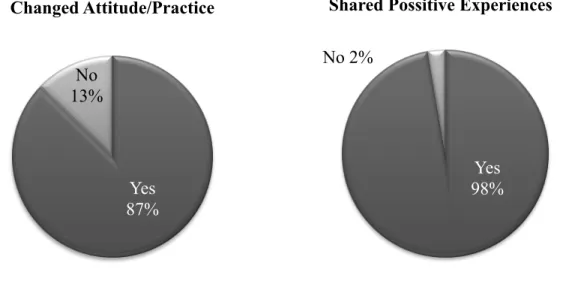
4.05. Chinese teachers’ attitudes toward changing their practice ……….…...73
4.06. Chinese teachers’ attitudes toward sharing their positive experiences ……….…..75
4.07. Chinese teachers’ changed attitude/practice toward student-centered learning and shared positive experience in the larger learning community ……….…..77
4.08. Chinese teachers’ main activities for communication ……….…...79
5.01. Gender and age of the Canadian participants ……….……88
5.02. Canadian participants’ years of teaching experience ………...89
5.03. Subjects taught by Canadian participants ……….………..89
5.04. Canadian participants’ views of key factors in a student-centered classroom……….92
TABLE OF CONTENTS
Page
PERMISSION TO USE ………....…i
ABSTRACT………...……..ii
ACKNOWLEDGEMENTS……….……..iv
LIST OF FIGURES……….………v
CHAPTER ONE: BACKGROUND AND INTRODUCTION……….……...1
Personal Experiences Related to Proposed Research………....………3
Background to the Study………...7
Education in China………...8
Education in Canada ………10
Purpose of the Study………..………...…13
Research Problems and Questions………13
Significance of the Study………..………....14
Definition of Terms ...………..……….15
Delimitations of the Study………..………..16
Limitations of the Study………...………....16
Outline of the Dissertation………..….17
CHAPTER TWO: LITERATURE REVIEW………..…..18
General Positive Experiences of Promoting Student Learning..………..…....20
Teachers’ Professional Preparation and Development ……….….23
Instructional Strategies and Classroom Management ...………...24
Social Skills and Relationships ………..27
Promoting Middle Years Student Learning ……….31
Creating Student-Centered Classrooms………33
The Expectations of Middle Years Teachers in China ……….35
The Expectations of Middle Years Teachers in Saskatchewan ………40
Summary of Chapter Two ………...… 44
CHAPTER THREE: RESEARCH DESIGN AND METHODOLOGY.………....46
Philosophical Foundation of the Study ……….46
Appreciative Inquiry as the Methodology ………47
Participants………...51
Data Collection and Analysis ………52
1. Survey of Selected Middle Years Teachers……….52
2. Interview of Chinese Junior Secondary School Educators ……….54
3. The Canadian Middle Years Education Expert Panel ……….54
Data Reporting ………..55
Trustworthiness………..…55
Ethical Considerations………..……….55
Criteria for Quality in Qualitative Research ……….56
Summary of Chapter Three ………...58
Chinese Middle Years Teachers’ Experiences ………....60
Discovery Phase: Teachers’ Positive Experiences in the Student-Centered Classrooms …...61
Dream Phase: An Ideal Student-Centered Classroom from Teachers’ Perspectives …………..68
1. Students’ Independent Thinking ………...69
2. Students’ Participation ………..70
3. Teachers’ Supportive Role ………70
4. Collaboration among Students ………..71
5. Students’ Hands-on Practice ……….71
6. Students’ Life-Long Learning, Friendly Learning Environment, and Students’ Confidence ……….72
Design Phase: Changing Practice in Classrooms toward Promoting Student-Centered Learning ………...72
Destiny Phase: Sharing Positive Experience in the Professional Learning Community ……… 76
Chinese Educational Experts’ Perspectives ………...80
Definition of Student-centered Learning ……….81
Key Values of Student-Centered Learning ………...83
The Teacher’s Role ………..84
Teachers’ Communication ………...…84
Single Subject vs. Multiple Subjects ………...86
Summary of Chapter Four …………...………...87
CHAPTER FIVE: TEACHER VOICE: CANADA……….……….………..….88
Canadian Middle Years Teachers’ Experiences ………....88
Discovery Phase: Teachers’ Positive Experiences in the Student-Centered Classrooms ………90
Dream Phase: An Ideal Student-Centered Classroom from Teachers’ Perspectives ………...…92
1. Students’ Real Life Experience ………..93
2. Students’ Learning Interests ………....93
3. Students’ Learning Responsibilities ………...93
Design Phase: Changing Practice in Classrooms toward Promoting Student-Centered Learning ………94
Destiny Phase: Sharing Positive Experience in the Professional Learning Community ……..…95
Canadian Educational Experts’ Perspectives ………..97
Definition of Student-centered Learning ………..98
Key Values of Student-Centered Learning ………..99
The Teacher’s Role ………...101
Teachers’ Communication ………..…103
Single Subject vs. Multiple Subjects ………..105
Summary of Chapter Five …………...………...106
CHAPTER SIX: COCLUSION AND DISCUSSION……….………...…108
Review of the Research Process………...108
Responses to the Research Questions………...109
Responses to Research Question 1………...110
Responses to Research Question 2 ………..111
Responses to Research Question 3 …………...………...111
Discussion ………....112 vii
Implications and Relevant Recommendations for Educational Theory………. 112
Implications and Relevant Recommendations for Current Classroom Practice ………115
Implications and Relevant Recommendations for Current Educational Policy…………..……118
Implications and Relevant Recommendations for Future Research………...122
Summary of Chapter Six ………....124
REFERENCES………...126
APPENDIX 1: SURVEY QUESTIONS……….……….………..135
APPENDIX 2: INVITATION LETTER TO SCHOOL BOARDS/ SCHOOL PRINCIPALS ………139
APPENDIX 3: INVITATION LETTER TO TEACHERS ………...………....141
APPENDIX 4: INVITATION LETTER FOR THE INTERPRETATION PANEL……….143
APPENDIX 5: CONSENT FORM FOR THE INTERPRETATION PANEL ……….145
Chapter One
Background and Introduction
Two thousand years ago in ancient China, Confucius advocated that education should meet the needs of society. He stated that moral education should be the main focus of education and teachers should be models of moral persons. He further emphasized that a good teacher should teach with patience and high expectations, and should teach according to students’ abilities and without discrimination. He believed that both teachers and
students could benefit from the process of teaching and learning. Confucius, himself, promoted student learning by sharing his own learning experiences and by modeling lifelong learning. He encouraged students to ask questions, not only to him, but also to anybody else from whom students could learn. He communicated with students
individually, and taught them how to draw inferences about other cases from one example (Zhang & Jin, 2001; Sun, 2000).
Almost at the same time in ancient Greece, about 470 BC to 399 BC, Socrates claimed that the only thing he knew was that he knew nothing; therefore, he taught his students to question everything, which scholars later referred to as “critical thought” (Stokes, 2002). Socrates also preferred to challenge his students by asking them questions, which was later termed the dialectic method of inquiry or Socratic questioning. That is, instead of asking only one question, Socrates “continued to ask guiding questions that would help his students discover the answers for themselves” (Hargrove, 2005, p.31).
As teachers, Confucius and Socrates tended to promote student learning in different ways. Confucius created a model for his students and was happy to answer students’ various questions. Socrates was a guide for his students and taught them through asking a series of questions. Today, both Confucius and Socrates are regarded not only great philosophers, but also as great educators (Hargrove, 2005; Zhang & Jin, 2001; Sun, 2000). They have influenced on modern education in both the eastern and western world. What is interesting was that neither
Confucius nor Socrates, wrote about their educational philosophy and teaching practices. It was their students who recorded their stories and spread their ideas, indicating that both Confucius and Socrates strongly affected their students. Stronge (2007) stated that effective teachers have a long-lasting positive impact on students’ learning and
lives. Although not every teacher is like Confucius or Socrates, most teachers successfully promote students’ learning and/or positively influence their lives.
In this study, I focused on Chinese and Canadian middle years teachers’ successful stories in their teaching career, and explored their positive experiences of promoting student-centered learning. Seifert and Hoffnung (1994) contended that middle years refer to students from 6 to 13 years old. Pendergast and Bahr (2005) classified middle years students as being 10 to 15 years old. In my research, I defined middle years teachers as teachers who taught Grades 7 to 9. Students in these grades are usually 12 to 15 years old.
This research is not a comparative or a cross-cultural study, because the two groups of participants were selected from two cities, Beijing and Saskatoon, that are not comparable. Beijing is the capital city of China and has a large population, while Saskatoon is a prairie city with a smaller population located in Saskatchewan, Canada. Schools in these two cities are guided by different educational policies and have different curriculum and
evaluation systems. I conducted this study because I believed it would be valuable not only for Chinese and Canadian teachers, but also that it would signify to educators worldwide that such communication may promote cross-cultural understanding and mutual learning.
According to Statistics Canada (2014), the number of international students enrolled in Canadian universities has significantly increased since 1998, and more than 50 percent of the international students were from Asia. The Canadian Bureau for International Education (2014) reported that, international student enrolment grew from 136,000 in 2001 to over 265,000 in 2012, a 94% increase. The top three countries of origin were China, India, and Korea. Since 2001, the number of Chinese students in Canada has increased 296%, from 20,371 to 80,627, which was more than 30% of all international students.
China Education Online (2014) also reported that, from 1978 to 2012, there were totally more than
2,644,700 Chinese students who studied abroad. From 2007 to 2011, the number of students who studied abroad increased 20% every year. Although the United States was still the first choice for most Chinese students to study, Canada has become more popular in recent years. In 2011 - 2012, 15% more Chinese students chose Canadian
schools in which to study. In addition, various educational exchange programs and training programs between Canada and China have emerged.
I believed that these statistics revealed a potential communicating space between China and Canada in the field of education; and that there was a need for Chinese and Canadian educators to learn more about each other and learn more from each other. As an educational researcher, I have teaching and learning experiences in both countries and I am familiar with educational policies and practices in Beijing and Saskatoon. I have interests and unique background knowledge to conduct this research and connect middle years teachers in both cities. I hope this research is an opportunity for both Chinese and Canadian teachers to learn from the positive experiences of each other in order to enhance student learning.
In the following sections, I share some of my personal teaching and learning experiences in both China and Canada, which impacted my educational philosophy, and I describe the general background of Chinese and Canadian education. I introduce the purpose and significance of the study, define several terms, and identify the delimitations and limitations of the study.
Personal Experiences Related to Research
My personal experiences as a teacher have played an important role in this research. According to Lincoln (1995), it is important for researchers to consider their positions during the process of conducting research, because researchers play multiple roles in their lives. I was born in China where I completed my 16-year formal education from elementary school to university. After graduating from CapitalNormal University with a bachelor’s degree majoring in Chinese language and literature education, I became a middle years teacher in Beijing. Four years of teaching experience increased my interest in education, and inspired me to move to Canada to continue my study in the field of education. From 2004 to 2006, I completed a Master Degree of Education and a TESL certificate in Canada. Presently, I am a Ph.D. candidate at the University of Saskatchewan.
Emigrating from China to central Canada and subsequently to the Western Canada, from teaching in Chinese to English, and adapting from teaching young children to instructing adult learners, I have experienced professional and personal changes. Change becomes an important part of my life. Whenever I face change, I believe I acquire
more energy to face new opportunities. During my learning and teaching journey, I have met many excellent teachers who promoted my learning and changed my life, and as a teacher I have tried sincerely to promote my students’ learning and positively influence their lives. The following examples regarding educational experiences have helped to develop my passion for teaching.
When I was eleven years old, I met my drama teacher, Mr. Zhang in the Children’s Palace of Beijing, and I began to learn from him how to respect and protect each student. In my memory, Mr. Zhang was always smiling at us, and I interpreted his smile as a sign of caring, fairness, and tolerance. Since many extra-curricular activities are not provided by public schools, but offered at Children’s Palaces in China, there are few opportunities for students to participate in such activities. If students want to enrol in programs such as drama, they must pass a special interview process. The following story about Mr. Zhang and the interview is one I will never forget.
It was a busy interview day, but Mr. Zhang did not say one word about being tired. As a senior student, I was chosen to help him organize the interview applicants. I still remember that among many children, there was a little girl who was too shy and nervous to say anything during her interview. I was sure that this girl had no chance to pass the interview at all. In fact, there were many children waiting outside the classroom to be interviewed. I thought that it was not necessary to waste time on this girl. However, Mr. Zhang did not disrupt her, on the contrary, he encouraged her to finish what she had prepared and concluded by giving her a warm smile. I could sense that the girl was motivated because she began to relax. Mr. Zhang told me later that “each child should have an equal opportunity in the interview because each of them has prepared for a long time. Although we do not have enough opportunities to offer, we still should protect every child’s self-confidence and interest in drama” (personal communication, 1989). Mr. Zhang’s words were so meaningful for me. From this experience, I learned that
students’ confidence and interest are significant in promoting their learning.
Another memorable educational experience occurred when I was sixteen. I went to a small high school in Beijing, which was not an effective high school in many people’s eyes. For me, it was my history teacher in this school who motivated me deeply to pursue history. When I reflected on this experience from a teacher’s
provided many opportunities for us to explore knowledge by ourselves. For example, she always encouraged us to borrow history books from the library and to study them by ourselves. She taught us how to make reading notes and draw a history timeline chart. She was quite satisfied with my work and encouraged me to share my learning and reading experiences in class on several occasions. In 1996, my school district held a history competition, and my history teacher and classmates recommended me to participate in the competition. I felt honoured but nervous, because I knew it would be very competitive. My history teacher told me, “Do not worry too much. Just focus on your own material. I trust you” (personal communication, 1996). Ten days later, when I went to school as usual, she ran to me and said: “You won! You won!” Unexpectedly to me, I had been selected as the champion of the history competition. Based on this positive learning experience, history became one of my favourite subjects.
When I worked in a junior secondary school in Beijing, I was a homeroom teacher in charge of more than 50 students. I tried conscientiously to promote student learning in my class. I remember particularly that among my middle years students there was one boy noted for his poor behaviours. He never finished homework on time, was often late for class, seldom participated in extracurricular activities, and sometimes failed his examinations. He had no friends in class. My colleagues were concerned about him, and were worried about me, because I was his homeroom teacher. One of my colleagues suggested that I should let this boy transfer to another school or retain him in the same grade the following year. However, I did give up on him. I tried to discover what his interests and strengths were and how to encourage and support him to learn. I observed him and talked to him and his parents. I discovered that he loved reading books about traditional Chinese literature, and that he was good at painting. One day, I invited him to join my reading club and provided him with an opportunity to share his recent reading experiences. I noticed that he behaved so differently that day. On one occasion, he brought to school a book about traditional Chinese poems and read a poem to the other students in the club and also shared a beautiful picture he had drawn based on the poem. At the conclusion of his presentation, the students spontaneously applauded him. It was one of the most touching moments that I had experienced to that point in my teaching career in China. From then on, he began to care about the class activities. He wrote several articles for our class journal, and drew
pictures for class posters. He talked with me frequently, made several good friends in the class, and was eventually enrolled in a college program to study fine arts.
Years later, my graduates told me how important my encouragement and support were for them as adolescents, and how they appreciated the opportunities I provided them during their school years. I think that positive learning experiences might be the key to promoting student learning, and a student-centered classroom might be a good place where positive learning experiences could happen.
Recently, I have taught Chinese as a second or additional language in Canada. Although I have faced different kinds of challenges in Canadian classrooms, I still believe that good teaching happens when students are engaged in their learning. Therefore, I spent time to carefully learn about my students, and subsequently adjusted my teaching to adapt to their needs and interests. Four years ago, I was teaching kindergarten students in a Chinese language school in Saskatoon. I had never taught children of that age before. The students did not pay attention to me, did not keep quiet and were not orderly. They did not speak any Chinese, nor could they read or write English. I did not know what to do. I was perplexed as to how best to connect with them and meet their learning needs. I began to observe their behaviours in and out of the classroom, and I started talking with them informally. I noticed that many of them liked bringing their new toys to the classroom, and sometimes they exchanged their toys with each other in class. When I asked them about their toys, they were excited and talkative. I found during these conversations that they were fond of animals, colors, food, and music. I decided to change my lesson plans and teaching strategies: I began to use flash cards, toys, and puppets in my classes. I helped them learn the Chinese language by singing songs, drawing pictures, playing games, and watching cartoon movies. Gradually, I witnessed that my students began to enjoy the Chinese language class. They had learned many Chinese words and
expressions by the end of the term. Their confidence in speaking Chinese grew.
Based on my own experiences, I realized that the best teaching and learning happens when learners are actively engaged in their learning. In fact, nowadays, both China and Canada have experienced and are
experiencing a transition from an industrial society to a post-industrial society. Accordingly, many educators in China and Canada have been paying more attention to the quality of education than to the efficiency of education.
That is, they are tending to focus on how and how well students are learning, as well as on how much and how fast students learn.
Background to the Study
The world of the 21st century is becoming more globalized and is appearing smaller because of rapid development in telecommunications, the influence of the international economy, and new discoveries in natural and social sciences (MacGillivray, 2006). Information is shared by various organizations and institutions all over the world every day (Cheng & Mao, 2002). Creative ideas, new theories, and innovative initiatives help people to achieve new goals by breaking through conventional and traditional ideologies, thoughts, and customs (Altbach & Knight, 2007). Bell (1999) contended that human civilization experienced progressive periods from “pre-industrial” (p. lxxxvii) to “industrial” (p. lxxxvii) to “post-industrial societies” (p. lxxxvii).
Bell (1999) argued that industrial societies were established by the development of the natural sciences and new technologies, in which the elements of productivity, effectiveness, efficiency, function, and order were emphasized and valued. Later sociological development within modern societies, post-industrial perspectives influenced people to become more creative and broad- minded in their ideologies. Current societies may possess the characteristics of both industrial and post-industrial societies.
However, in today’s education, as Lillard (2005) argued, most of our schools are still modeled on factories, with their priority of efficient operation. In these schools, teachers are workers and students are products. Every 40 to 50 minutes, students move from one classroom to another, the learning topics are shifted when the bell rings, not when teachers and children are at a meaningful transition point. Gardner (2004b) also noted that, many schools were designed to facilitate students’ memorization of important texts and meeting the requirements of standardized tests.
In teacher education, constructivism has been widely promoted; however, there are few teachers who are actually able to practice constructivism in actual classrooms, because physical classrooms are still designed for traditional lecturing, which is often based on a banking of knowledge view or a students as deficient view. Therefore, in such a transitional period, schools and teachers face new challenges, new missions, and new
opportunities, as well. How can education policies meet current society’s needs? How can schools prepare students for the futures? How can teachers promote student learning in the classroom? These questions are important for all educators to consider, whether they work in China, Canada, or elsewhere.
Education in China
According to the Universal Declaration of Human Rights (1948) everyone in the world has the right to receive an education. Many countries enact laws that require children to receive formal education, which in many cases is compulsory. Across the nations, periods of time when children receive compulsory education are different. With respect to formal education, People’s Republic of China (PRC) has the largest student population in the world. The Chinese government requires that children from 7 to 16 years of age must receive formal education in
elementary and junior secondary schools, which is known as the policy of Nine-Year Compulsory Education (Ministry of Education of the People’s Republic of China, 2014; Li, 2008; Cheng & Mao, 2002).
According to the Education Law of the People’s Republic of China established by the Ministry of Education of the PRC in 1995, all citizens, regardless of ethnic group, race, sex, occupation, property status or religious belief, shall enjoy equal opportunities for education. People’s governments at all levels shall take various measures to guarantee school-age children and adolescents access to education. Parents or other guardians of school-age children and adolescents as well as social organizations and individuals concerned shall have the obligation to ensure that school-age children and adolescents receive and complete compulsory education (Ministry of Education of the People’s Republic of China, 2014).
The present education system in China has developed during the last one hundred years and has been shaped by both Chinese and western educational concepts. On the one hand, education in China has been founded based on the Chinese traditional education system. On the other hand, in the past one hundred years, schools and education in China have been also deeply influenced by some foreign countries, especially the United States, the former Soviet Union, and Japan (Sun, 2000). In the Chinese public school system, the Grade 7 to Grade 9 grouping is called junior secondary school, which is separated from elementary school (Grade 1 to Grade 6). Junior
Education Statistical Data 2012 issued by the Ministry of Education of the PRC (2013), there were 53,216 public junior secondary schools and 47,630,607 junior secondary school/Grade 7 to 9 students in China by the end of 2012. Among these middle years students, there were 25,200,142 (52.9%) boys and 22,430,465 (47.1%) girls. The required areas of study at the middle level, Grades 7 to 9, were Chinese language arts, mathematics, political science/virtue education, foreign language (English, Japanese or Russian), physics, biology, chemistry, history, geography, physical education, music, fine arts, information technique, and skills teaching. In some schools, teachers teach comprehensive curriculum, such as science, history and society, and arts. The promotion rate of junior secondary school graduates in 2012 was 88.4%. The promotion rate of junior secondary school graduates is the ratio of total number of new intakes admitted to high schools to the total number of graduates of junior
secondary schools of the current year.
The Ministry of Education of the PRC (2013) also reported that in 2012, there were 3,504,363 full-time junior secondary school teachers and 3,939,088 other junior secondary school educators in the public school system in China. The average junior secondary student- educator ratio across the county was 13.59 students per educator. In Beijing, this number was 9.83. However, educators included not only full-time classroom teachers, but also other support staff. Therefore, the average middle years classroom size in China was still big. According to a statistical report of the Organisation for Economic Co-operation and Development (OECD) in 2012, the number of students per middle years classroom in China was more than 50 (OECD, 2012). Li (2008) and Mao (2002) also stated that the typical class-size of junior secondary school in china was 40 to 50 students.
At present, China is experiencing a transition from an industrial society to a post-industrial society (Bell, 1999; Li, 2008). On the one hand, education in China reflects industrial characteristics, which emphasize the
measurement of quantifiable results and efficiency in schools. A major influence on this efficiency emphasis is that China has developed a centralized education system. From the Ministry of Education of the People’s Republic of China at the national level to provincial education bureaus, to municipal education bureaus, to local school divisions, the education system and schooling structure in China reflect a functionalist administrative style (Li, 2008; Cheng & Mao, 2002; Zhang & Jin, 2001; Sun, 2000). In addition,
education in China still follows its traditional form. Standard textbooks, teacher-centered classes, and standardized examinations at municipal, provincial, and national levels all play important roles in schooling (Li, 2008; Cheng & Mao, 2002; Zhang & Jin, 2001).
On the other hand, some post-industrial characteristics are also appearing in the field of education in China by the influences of the natural and applied sciences, the developing technologies, and the global economy. Chinese government officials, educators, and parents today pay attention to the quality of education and schools. Important educational reforms in terms of curriculum, teaching strategies, and student evaluation have recently been initiated and supported by the Chinese government. The traditional examination system is becoming more decentralized. The National College Entrance Examination is no longer designed by the Ministry of Education, but by different provincial educational governments. For example, many well-known universities in China, such as Tsinghua University, Fudan University, Shanghai Jiao Tong University, and University of Science and Technology of China, now independently enrol their students. Interviews are now used as additional technique to select post-secondary student candidates in China (Shanghai Jiao Tong University, 2009; Northeast Education Website, 2006).
Furthermore, the student-centered model is gradually being actualized in schools across the country. More critical and creative ideas, new teaching pedagogies, and innovative teaching strategies and methods are being integrated into everyday teaching and learning in the classroom. In many urban elementary and secondary schools in China, multi-media facilities and computers are widely used; experiments and observations are being conducted in physics, chemistry, and biology classes; small group discussions, presentations, role-plays, and pair-ups are increasingly integrated into Chinese, English, and mathematics classes (Li, 2008;Cheng & Mao, 2002; Zhang & Jin, 2001; Sun, 2000).
Education in Canada
Canada has also experienced a transition from an industrial to a post-industrial period; however, Canada has a much smaller population than China. In Canada, the governance of education is a provincial responsibility as defined in the constitution (Barabett & Cleghorn, 2008; Ghosh & Ray, 1987). Canada does not have a federal department of education, but instead, has ten provincial education systems and three Northern territorial
jurisdictions. Each province/ territory has its own ministry of education that establishes its own requirements, regulations, and teacher-evaluation systems (Young, Levin, & Wallin, 2007).
In Canada, children are usually required to attend school from 5 to 16 years of age (Ghosh & Ray, 1987). Canadian schools are the major institutions that take responsibilities for “the formal socialization of youths” (Livingstone & Hart, 1987, p. 3), as is the case for most industrialized societies. Canadian supporters of public education emphasize two basic themes: (a) “formal schooling” (p. 3) to enhance the Canadian labour force to ensure “economic prosperity” (p. 3); and (b) “the capacity of schooling to promote upward social mobility among the disadvantaged” (p. 3).
Recent trends of globalization and internationalization have also impacted education in Canada. Fullan, Hill, and Crevola (2006) stated, “As societies have confronted the challenges brought about by globalization and
technology, especially information technologies, the critical importance of education has become obvious to all” (p. 1). Further, they commented that “political leaders have taken an unprecedented interest in public education and in charting a new mission for school systems” (p. 1). In the 20th century, Canadian educators supported basic
education as well as post-secondary education. With the importance of education in modern Canadian society, Canadian educators have proposed a “new mission- to get all students to meet high standards of education and to provide them with a lifelong education that does not have the built-in obsolescence of so much old-style
curriculum but that equips them to be lifelong learners” (Fullan, Hill, & Crevola, 2006, p. 1). The benefits from public education would enable graduates to achieve their full potential.
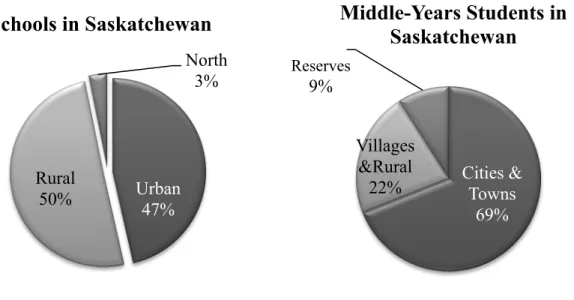
In Saskatchewan, both public and independent school systems provide education from kindergarten to Grade 12. The middle years segment includes grade 6 to 9. According to Saskatchewan Education Indicators Report (Saskatchewan Ministry of Education, 2010), there were total 719 schools across the province, which including 586 public schools, 120 separate schools, and 13 conseils scolaires. As Figure 1.01 shows, among these 719 schools, 334 (47%) schools were located in urban areas; 362 (50%) schools were located in rural areas; and 23 (3%) schools were located in the north areas. There were 39,036 (69%) middle years, 11-14 years old students lived in cities and towns; 12,402 (22%) middle years students lived in villages and rural municipalities; and 5,150
(9%) middle years students lived in reserves. In addition, there were 11,500 (20%) middle years students who self-declared as aboriginal students in the province of Saskatchewan.
Figure 1.01. Schools and middle years students in the province of Saskatchewan.
The Saskatchewan Education Indicators Report (Saskatchewan Ministry of Education, 2010) also indicated that there were 9,609 classroom teachers, 3,404 teacher assistants, and 1,615 other full-time staff in Saskatchewan schools. Other full-time staff included student support services teachers, English as an additional language teachers, counsellors, social workers and so on. “In 2009-10, Saskatchewan’s student-educator ratio was 13.8 students per educator” (p.114). Educators included not only classroom teachers, but also other full-time staff, such as principals, teacher-librarians, counsellors, and so on. In 2009-10, the provincial average classroom size was 20.8 students. “The average classroom size for northern classrooms was about three students less than that of urban classrooms” (p.116).
According to the Saskatchewan Ministry of Education (2011), the required areas of study within the core curriculum at the middle level, Grades 6 to 9 in the province, were language arts, mathematics, science, social studies, health education, arts education, physical education, and career education. The common essential learning within the core curriculum were: communication, numeracy, critical and creative thinking, technological literacy, personal and social development, and independent learning.
Urban 47% Rural 50% North 3%
Schools in Saskatchewan
Cities & Towns 69% Villages &Rural 22% Reserves 9%Middle-Years Students in
Saskatchewan
In order to meet the variety of students’ needs, flexibility is required within the school program to enable schools and teachers to adapt instructional materials, methods, and environment to provide the most
appropriate educational opportunities for students. The adaptive dimension is used to help students achieve curriculum outcomes, maximize student learning and independence, promote a positive self-image and feeling of belonging, and promote a willingness to become involved in learning. These purposes address a primary function of the school, that of helping students to maximize their potentials as independent learners (Ministry of Education, 2011, p.4).
Purpose of the Study
The purpose of this study was to explore the selected middle years teachers’ positive experiences of promoting student learning in student-centered classrooms, and how these recalled experiences might affect their own future teaching and assist other teachers to promote student learning. The reason why I focused on positive experiences was that I believed that one can understand how to achieve success by learning from positive and successful experiences more than by learning from failures and problems (Cooperrider & Whitney, 2005).
Research Problems and Questions
During the last twenty years, classroom teachers in many countries have increasingly applied theories of student-centered learning. In both China and Canada, the student-centered model is gradually being actualized in schools to improve quality of teaching and learning. Therefore, it is important to examine how student-centered classroom function by reflecting on teachers’ positive experience of promoting student learning and to publicly share these findings so that other teachers/educators can learn from these experiences. In addition, the trends of globalization and internationalization have also impacted education in both Canada and China. To help teachers from both places discuss their respective teaching stories will not only benefit them, but will enrich the global picture of what effective teaching means.
The major research questions were:
1. What were the selected middle years teachers’ positive experiences of promoting student learning in student- centered classrooms?
2. After reflecting on these positive teaching experiences in student-centered classrooms, did these teachers change their teaching attitude and practices toward student-centered learning? And if so, in what ways? 3. How might these teachers’ experiences assist other teachers in promoting student learning?
Significance of the Study
The study is significant in the following four aspects. First, it provides examples of positive experiences regarding promotion of students’ learning at the middle-year level. I applied appreciative inquiry in this study, which focused on participants’ positive experiences. Total of 53 middle years teachers and 16 middle years educational experts who shared their positive teaching stories through online surveys, online interviews, or expert panels. Many of these stories are detailed, typical, and meaningful.
Second, the study provides practicing teachers and other educational personnel with insights and suggestions regarding creating student-centered classrooms that promote student learning. Participants not only made
comments about their own classroom practice, but they also offered relevant suggestions to school boards, schools, and middle years teachers in both Canada and China.
Third, this research may initiate an interest for increasing international communication and collaboration in the area of the professional development of middle years teachers. This study was not designed as a comparative study, but it may make a contribution to international education. Nowadays, more and more Chinese students are choosing to study in Canada. There are also more and more international educational programs that are being developed between China and Canada. Therefore, both Chinese and Canadian educators need to learn more about each other. This research may provide helpful information about middle years education in China and Canada, and guide the work of educational researchers and practitioners. The implications and recommendations that emerged from this study may also give educators in both counties insights for future collaboration.
Fourth, the study contributes to further application of Appreciative Inquiry (AI) in educational research. AI is a positive experience-oriented approach, which may help participants benefit from their past experiences. Applying AI in educational research may help participating practitioners and researchers focus on what has happened in classrooms that works. This study is an example of using AI in educational research.
Definitions of Terms
The definitions of terms I used in this study are presented below.
Appreciate inquiry (AI): AI is a research model that investigates organizational and individual change and development that focuses on organizational or individual positive and successful experiences and stories (Cooperrider & Whitney, 2005).
The 4-D model: This model is utilized in Appreciative Inquiry, and consists of four stages regarding
organizational and individual change and development: discovery, dream, design, and destiny (Cooperrider & Whitney, 2005).
Inclusive education: Teachers are responsible for meeting the needs of the wide variety of students in their classrooms. It is “the perspective that individuals are entitled to an education that includes full participation with their peers and an educational process that allows access to the same resources as other students” (Jordan, 2007, p.249).
Interpretation panel: The interpretation panel is a form of collaborative research and a type of group analysis. It helps researchers deepen their understanding of research data or results. There are usually six to eight experts in the related field invited in a panel. The experts provide researchers with individual or group insight regarding the topic by interpreting the research data and results (Noonan, 2002).
Teacher education: Teacher education is a program that prepares teacher candidates to teach, by providing them with instruction in education policies, procedures, and practices, so that they acquire relevant knowledge, skills, and attitudes with respect to facilitating students’ learning in schools. Teacher education includes the cultivation of teacher candidates’ knowledge, the preparation of prospective teachers, the professional development of teachers, and the promotion of teacher leaders (Li, 2008).
Instructional strategies: This variety of teaching methods and approaches is implemented to help students achieve learning objectives. Direct instructional strategies that are highly teacher-directed, and indirect instructional
strategies which are mainly student-centered, are two major categories (Burden & Byrd, 2010; Saskatchewan Learning, 1991).
Classroom management: Classroom management involves teacher actions to create a positive learning environment, such as “establishing and enforcing rules and procedures, carrying out disciplinary actions,
maintaining effective teacher and student relationships, and maintaining an appropriate mental set for management” (Marzano, 2003, pp.88-89).
Multiple intelligences (MI): The theory of multiple intelligences redefined the concept of intelligence in 1983. Multiple intelligences included eight intelligences: linguistic intelligence or word smart, logical-mathematical intelligence or number smart, spatial intelligence or picture smart, bodily-kinesthetic intelligence or body smart, musical intelligence or music smart, interpersonal intelligence or people smart, intrapersonal intelligence or self smart, and naturalist intelligence or nature smart (Gardner, 2004a; Armstrong, 2009; Lazear,1999).
Professional learning community (PLC): A PLC is a group of educators who consistently focus on enhancing student learning by collaborating with each other and continuing their own learning (Hord & Sommers, 2008).
Delimitations of the Study
I identify the delimitations to this study.
1. I delimited this study to explore teachers’ positive experiences concerning promoting student learning in student-centered classrooms.
2. I delimited this study by using Appreciative Inquiry (AI) as the research methodology in the “AI 4-D Cycle” model with four key phases: discovery, dream, design, and destiny (Cooperrider & Whitney, 2005).
3. In this study, I delimited the participants in this research to Grade 7 to Grade 8 teachers in Beijing, China, and Grade 6 and Grade 8 teachers in Saskatoon, Canada. Their years of teaching experiences would be at least 1 year.
Limitations of the Study
I enumerate the limitations of the study.
1. Due to Chinese participants’ varying levels of English language proficiency, the interview questions were provided in both Chinese and English and participants responded in the language of their choice. If participants chose to answer the questions in Chinese, I translated from Chinese to English verbatim. Because of the
differences between the two languages, the translation from Chinese to English might affect the data accuracy. To help counteract this problem, I asked another graduate student who was fluent in Mandarin and English to audit my translation of the transcripts and to make sure my translations were valid.
2. Because the open-ended questionnaire, document analysis, and previous research are the only research sources used, triangulation of the data maybe limited, which may affect data trustworthiness.
Outline of the Dissertation
The dissertation is comprised of six chapters: the background and introduction, a literature review, the
research design and methodology, the Chinese teachers’ voice, the Canadian teachers’ voice, and the conclusion. In Chapter 1, I introduced my personal experiences, the background to this study, the purpose of the study, the significance of the study, key definitions of the terms used in the study, the delimitations to the study, and the limitations to the study.
In Chapter 2, I provided a review of the literature related to teachers’ positive experiences of promoting student learning, with a particular focus on creating student-centered classrooms. I also introduced the expectations of middle years teachers in both China and Canada.
In Chapter 3, I described the philosophical foundations to the study, and Appreciative Inquiry (AI) as the research methodology. I introduced the selection of participants in China and Canada and how I proposed to conduct the research. I also discussed the trustworthiness of the data in the study and the ethical considerations I addressed.
In Chapter 4, I analyzed the major findings of the Chinese teachers’ survey data and presented Chinese educational experts’ point of view of the survey findings.
In Chapter 5, I analyzed the major findings of Canadian teachers’ survey data and presented Canadian educational experts’ point of view of the survey findings.
In Chapter 6, I presented concluding thoughts regarding the study, discussed implications of the findings, and provided relevant recommendations regarding how middle years teachers might create student-centered classrooms to promote student learning and enhance student achievement.
Chapter Two Literature Review
Teaching and learning are the core activities in schools, the quality of which is important for schools. Taylor (2009) stated that effective teaching is a key to school effectiveness and improvement. Marzano (2003) identified that effective schools excel at promoting student learning and enhancing student achievement. He further explained that there are several factors at three levels affecting school effectiveness: school-level factors, teacher-level factors, and student-level factors. Among these three, the teacher level factors play the most important role: “The impact of decisions made by individual teachers is far greater than the impact of decisions made at the school level” (p.71). Teachers who excel at promoting student learning and enhancing student achievement make significant
contributions to school effectiveness.
Hattie (2009), based on his research involving 50,000 studies and more than 30 million pupils, suggested that what works best for students is what works best for teachers; and that “teaching and learning are visible in the classrooms of the successful teacher and students” (p.25). He stated,
Visible teaching and learning occurs when learning is the explicit goal, when it is appropriately challenging, when the teacher and student both seek to ascertain whether and to what degree the challenging goal is attained, when there is deliberate practice aimed at attaining mastery of the goal, when there is feedback given and sought, and when there are active, passionate and engaging people participating in the act of learning. It is teachers seeing learning through the eyes of students, and students seeing teaching as the key to their ongoing learning. The remarkable feature of the evidence is that the biggest effects on student learning occur when teachers become learners of their own teaching, and when students become their own teachers. (p. 22)
Therefore, “the more the student becomes the teacher and the more the teacher becomes the learner, then the more successful are the outcomes” (p.25).
Hattie (2012) argued, “learning is a very personal journey” (p.18). He believed that “students are eager to be challenged into learning”. Hattie (2009) also defined the three levels of student achievement: “surface knowledge
of the physical world, the thinking strategies and deeper understanding of the subjective world, and the ways in which students construct knowledge and reality for themselves” (p.26). He stated, “the task of teaching and learning best comes together when we attend to all three levels: ideas, thinking, and constructing” (p.26). According to Jonassen and Land (2012), during the 1990s, the rise of constructivism in psychology and education “represented a paradigm shift for educators to a view of learning that is necessarily more social, conversational, and constructive than traditional transmissive views of learning”(p.vii). These new theories of learning and thinking have influenced classroom teaching and learning in many ways. In the previous decade, conceptions of student-centered learning environments matured. Here are some typical student-centered learning environments: “problem-based, project-based inquiry-oriented pedagogies in the forms of open-ended learning environments, cognitive apprenticeships, constructivist learning environment, goal-based scenarios, social-mediated communication, and so on (Jonassen & Land, 2012, p. x). They further stated, “learning is not a transmissive process. Rather learning is willful, intentional, active, conscious, constructive practice that includes reciprocal intention-action-reflection activities” (p.ix.)
In a student-centered classroom, student engagement is the key to promoting learning. That is, learning improves when students are inquisitive, interested, or inspired. Here are a few ways in which student engagement may be addressed in schools: Intellectual engagement, emotional engagement, behavioural engagement, physical engagement, social engagement, and cultural engagement. Intellectual engagement means that teachers engage students by providing students with more choices of assignments or projects that appeal to student’s interest or curiosity. Emotional engagement means that teachers may promote positive emotions in students that will facilitate the learning process. Behavioural engagement means that teachers may establish classroom routines and students roles that foster behaviours more conducive to learning. Physical engagement means that teachers should use physical activities to stimulate students’ learning interest. Social engagement means that teachers may use a variety of strategies to stimulate engagement through social interactions. Cultural engagement means that schools should make students from diverse cultural backgrounds feel safe, welcomed and valued (Hidden Curriculum, 2014).
In this chapter, I reviewed literature regarding teachers’ positive experiences of promoting student learning. I also highlighted the characteristics of middle years learners and how middle years teachers should promote
learning, especially in student-centered classrooms. Then I introduced the expectations for middle years teachers based on the literature and on relevant policies and documents in both China and Canada.
General Positive Experiences of Promoting Student Learning
In order to promote student learning and enhance student achievement, many researchers have conducted studies from different perspectives and listed various characteristics of teaching effectiveness based on qualified teachers’ experiences. Ellison (2009) stated that teacher quality had a significant impact on student learning in the classroom. The most effective way of cultivating quality teachers was to identify and determine the characteristics of teacher effectiveness. Through the identification of characteristics of teacher quality, teachers are encouraged to clarify their strengths and weaknesses and further improve their teaching strategies.
Hattie (2012) argued, “what does matter is teachers having a mind frame in which they see it as their role to evaluate their effect on learning” (p.18). He stated, “teachers’ beliefs and commitments are the greatest influence on student achievement” (p.25). Hattie (2009) also identified 20 influences on student learning and achievement. Four of these influences were about teachers: micro teaching, teacher clarity, teacher-student relationship, and teachers’ professional development. Eight of them were about teaching: providing formative evaluation,
comprehensive interventions for learning disabled students, reciprocal teaching, feedback, spaced vs. mass practice, meta-cognitive strategies, self-questioning, and problem-solving teaching. He listed the following teacher
contributions to student learning:
• the quality of teaching; • teacher expectations;
• teachers’ conceptions of teaching, learning, assessment, and the students; • teacher openness;
• classroom climate;
• the fostering of effort;
• the engagement of all students (p.34).
Hattie (2009) furthered provided the following six signposts towards excellence in education, all of which were related to teachers.
1. Teachers are among the most powerful influences in learning.
2. Teachers need to be directive, influential, caring, and actively engaged in the passion of teaching and learning.
3. Teachers need to be aware of what each and every student is thinking and knowing, to construct meaning and meaningful experiences in light of this knowledge, and have proficient knowledge and understanding of their content to provide meaningful and appropriate feedback such that each student moves progressively through the curriculum levels.
4. Teachers need to know the learning intentions and success criteria of their lessons, know how well they are attaining these criteria for all students, and know where to go next in light of the gap between students’ current knowledge and understanding and the success criteria of: “Where are you going?” “How are you going?” and “Where to next?”
5. Teachers need to move from the single idea to multiple ideas, and to relate and then extend these ideas such that learners construct and then reconstruct knowledge and ideas. It is not the knowledge or ideas, but the learner’s construction of this knowledge and these ideas that is critical.
6. School leaders and teachers need to create school, staffroom, and classroom environments where error is welcomed as a learning opportunity, where discarding incorrect knowledge and understandings is
welcomed, and where participants can feel safe to learn, re-learn, and explore knowledge and understanding. (pp.238-239)
Darling-Hammond and Baratz- Snowden (2005) indicated that effective teachers do much more than stand at the front of classrooms and deliver textbook content to students; they use a repertoire of strategies and methods to help students improve their learning. Marzano (2003) argued that instructional strategies, classroom management,
and classroom curriculum design are three main teacher-level factors that influence school effectiveness. In the book, Qualities of Effective Teachers, Stronge (2007) evaluated effective teachers from six perspectives:
prerequisites for effective teaching, the teacher as a person, classroom management and organization, planning and organizing for instruction, implementing instruction, and monitoring student progress and potential. Kawell (2008) explored successful teachers’ characteristics in a K-12 school in Southern California. The major findings indicated that teachers did a better job when they:
(a) believed all students can learn and had high expectations for their students, (b) emphasized vocabulary and the use of academic language, and (c) relationally connected with their students and offered extra help to students outside of class. Other findings showed that most students described effective teachers
simultaneously as strict, fun, and caring. (pp. 4-5)
Burden and Byrd (2010) listed the following elements of effective teaching: preparing for instruction, presenting instruction, organizing and managing instruction, considering learner’s instructional needs, evaluating student performance, and working with parents. Taylor (2009) identified that preparedness, caring, collaboration, and reflective teaching were key characteristics of teaching effectiveness. Novak (2009) examined three teacher characteristics that had been demonstrated to affect student academic achievement: “teacher expectancy, teacher efficacy, and teacher curriculum choice” (p. iv). Dieckmann (2009) confirmed that effective teaching practices led to overall teacher effectiveness. The key constructs were: “behaviour management, instructional supports,
formative assessment, intellectual challenge, and the use of discipline-specific practices in their teaching” (p. v). He further stated that effective teachers elicited students’ ideas, communicated with students to enable them to review school work, monitored students’ learning, adjusted their lessons to assist students in clarifying
misunderstandings, and highlighted students’ potential learning obstacles. Most importantly, they were responsive to individual student’s learning needs in the classroom.
In the following section, I summarized the general ideas of promoting student learning from three perspectives: teachers’ professional preparation and development, instructional strategies and classroom management, and social skills and relationships.
Teachers’ Professional Preparation and Development
To promote student learning effectively, teachers should first prepare and continually develop themselves as qualified teachers beyond the minimum teacher certificate requirement for applying for a teaching position
(Stronge, 2007). According to Darling-Hammond and Baratz-Snowden (2005), teachers are prepared in three areas of knowledge before starting to teach: knowledge regarding the subject, knowledge regarding teaching, and
knowledge regarding students. Burden and Byrd (2010) emphasized the importance of professional knowledge, pedagogical knowledge, and pedagogical content knowledge for effective teachers. Stronge (2007) stated that to promote teaching effectiveness, teacher training programs should emphasize the importance of content knowledge and pedagogical knowledge. Qualified teachers must have received formal and adequate preparation for classroom teaching. Taylor (2009) suggested that pre-service teacher candidates should receive additional mentoring from experienced teachers who are reputed to be effective teachers.
Professional knowledge includes “information about the historical, economic, sociological, philosophical, and psychological understanding of schooling and education” (Burden & Byrd, 2010, p. 3). Content knowledge includes understanding concepts, and structures concerning the concepts being taught (Murphy, Delli, & Edwards, 2004; Shulman, 1987). Wenglinsky (2000) stated that teachers who take courses related to the subjects they teach positively influence students’ academic achievements compared to teachers who do not possess the content knowledge.
Teachers should also acquire pedagogical knowledge that helps them recognize students’ learning needs (Stronge, 2007). According to Burden and Byrd (2010), pedagogical knowledge “includes the general concepts, theories, and research about effective teaching” (p.3). Especially in the subjects of mathematics and science, teachers who have had formal preparation of teaching strategies in these subjects do positively influence students’ learning outcomes (Monk, 1994). Pedagogical knowledge refers to skills for guiding, managing, helping, and communicating with students regarding the subject being learned (Murphy, Delli, & Edwards, 2004). Specifically, pedagogical knowledge can help teachers use a variety of instructional strategies according to students needs; use appropriate questioning techniques; monitor student progress; engage active student participation; motivate
students for learning; give students relevant assignments and provide prompt feedback; and re-teach as needed (Anfara, Jr., & Schmid, 2007).
A teacher’s verbal ability further influences teaching effectiveness. According to Moore (2005) and McEwan (2002), communication is an essential skill for teachers. “Students taught by teachers with greater verbal ability learn more than those taught by teachers with lower verbal ability” (Stronge, 2007, p. 4). Reese (2009) stated that students wanted worthwhile communications with their teachers. Students believed that through clear
communication, teachers are able to understand their progress and help them address their weaknesses in specific areas. Smith (2009) also found that effective teachers know how to break down a complex concept, formula, or idea and clearly explain it to students. Students regarded teachers’ explanation abilities as an asset in everyday teaching and learning.
In addition, in order to promote student learning, having background knowledge regarding students and their learning process (Darling-Hammond & Baratz- Snowden, 2005) is helpful for teachers. Furthermore, Douglas (2009) argued that understanding what students actually do in the classroom is the key to improve student learning. He found that teachers generally possess adequate knowledge of what constitutes effective teaching, but that they do not consistently put the knowledge of effective teaching into practice. Therefore, Ayers (1993) stated that “outstanding teaching is built on a base of knowledge about students” (p. 75). Stronge (2007) also suggested that teachers should understand “how students learn and what they need to be taught” (p. 5).
Moreover, teachers should continue to develop their teaching skills as life-long learners and participate in various professional learning activities, such as workshops, conferences, retreats, academic courses. Teacher professional development activities positively impact their students’ learning attitudes and academic achievements (Stronge, 2007). Taylor (2009) suggested that teachers collaborate with professional learning communities to continually improve and perfect their teaching practices.
Instructional Strategies and Classroom Management
The process of teaching and learning is at the core of education. In order to positively affect student learning and make effective decisions that help students learn, teachers should be good instructional planners and carefully