Guided Data Repair
∗Mohamed Yakout1,2 Ahmed K. Elmagarmid2 Jennifer Neville1 Mourad Ouzzani1 Ihab F. Ilyas2,3 1Purdue University 2Qatar Computing Research Institute 3University of Waterloo
Qatar Foundation
1{myakout, neville, mourad}@cs.purdue.edu 2[email protected] 3[email protected]
ABSTRACT
In this paper we present GDR, a Guided Data Repair frame-work that incorporates user feedback in the cleaning process to enhance and accelerate existing automatic repair tech-niques while minimizing user involvement. GDR consults the user on the updates that are most likely to be beneficial in improving data quality. GDR also uses machine learning methods to identify and apply the correct updates directly to the database without the actual involvement of the user on these specific updates. To rank potential updates for consul-tation by the user, we first group these repairs and quantify the utility of each group using the decision-theory concept of value of information (VOI). We then apply active learning to order updates within a group based on their ability to improve the learned model. User feedback is used to repair the database and to adaptively refine the training set for the model. We empirically evaluate GDR on a real-world dataset and show significant improvement in data quality using our user guided repairing process. We also, assess the trade-off between the user efforts and the resulting data quality.
1.
INTRODUCTION
Poor data quality is a fact of life for most organizations and can have serious implications on their effectiveness [1]. An example critical application domain is healthcare, where incorrect information about patients in an Electronic Health Record (EHR) may lead to wrong treatments and prescrip-tions that may cause severe medical problems.
A recent approach for repairing dirty databases is to use data quality rules in the form of database constraints to iden-tify tuples with errors and inconsistencies and then use these rules to derive updates to these tuples. Most of the exist-ing data repair approaches (e.g., [2, 6, 7, 16]) focus on pro-viding fully automated solutions using different heuristics to select updates that would introduce minimal changes to the data, which could be risky especially for critical data. To guarantee that the best desired quality updates are ap-plied to the database, users (domain experts) should be in-volved to confirm updates. This highlights the increasing
∗This research was supported by QCRI, and by NSF Grant
Numbers IIS 0916614 and IIS 0811954, and by the Purdue Cyber Center.
Permission to make digital or hard copies of all or part of this work for personal or classroom use is granted without fee provided that copies are not made or distributed for profit or commercial advantage and that copies bear this notice and the full citation on the first page. To copy otherwise, to republish, to post on servers or to redistribute to lists, requires prior specific permission and/or a fee. Articles from this volume were invited to present their results at The 37th International Conference on Very Large Data Bases, August 29th - September 3rd 2011, Seattle, Washington.
Proceedings of the VLDB Endowment,Vol. 4, No. 5
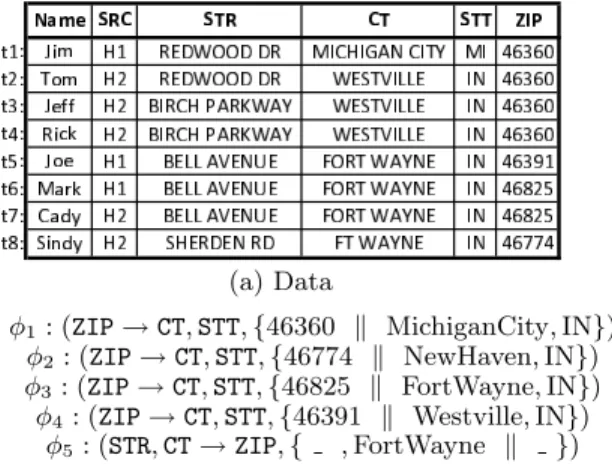
Copyright 2011 VLDB Endowment 2150-8097/11/02...$10.00. (a) Data φ1: (ZIP→CT,STT,{46360 k MichiganCity,IN}) φ2 : (ZIP→CT,STT,{46774 k NewHaven,IN}) φ3: (ZIP→CT,STT,{46825 k FortWayne,IN}) φ4: (ZIP→CT,STT,{46391 k Westville,IN}) φ5: (STR,CT→ZIP,{ ,FortWayne k }) (b) CFD Rules
Figure 1: Example data and rules
need for a framework that combines the best of both worlds. The framework will automatically suggest updates while ef-ficiently involve users to guide the cleaning process.
1.1
Motivation
Consider the following example. Let Relation
Customer(Name, SRC, STR, CT, STT, ZIP) specifies per-sonal address information Street (STR), City (CT), State (STT) and (ZIP), in addition to the source (SRC) of the data or the data entry operator. An instance of this relation is shown in Figure 1.
Data quality rules can be defined in the form of Condi-tional FuncCondi-tional Dependencies (CFDs) as described in Fig-ure 1(b). A CFD is a pair consisting of a standard Functional Dependency (FD) and a pattern tableau that specifies the applicability of the FD on parts of the data. For example,
φ1 −φ4 state that the FD ZIP → CT,STT (i.e., zip codes
uniquely identify city and state) holds in thecontext where theZIPis 46360, 46774, 46825 or 46391. Moreover, the pat-tern tableau enforces bindings between the attribute values,
e.g., if ZIP= 46360, then CT= ‘Michigan City’. φ5 states
that the FD STR,CT → ZIP holds in the context where CT
= ‘Fort Wayne’, i.e., street names uniquely identify the zip codes whenever the city is ‘Fort Wayne’. Note that all the tuples in Figure 1 have violations.
Typically, a repairing algorithm will use the rules and the current database instance to find the best possible repair
operations or updates. For example, t5 violates φ4 and a
possible update would be to either replaceCTby ‘Westville’
or replace ZIP by 46825, which would make t5 fall in the
context ofφ3andφ5but without violations. To decide which
update to apply, different heuristics can be used [2, 16]. However, automatic changes to data can be risky
espe-cially if the data is critical, e.g., choosing the wrong value among the possible updates. On the other hand, involving the user can be very expensive because of the large number of possibilities to be verified. Since automated methods for data repair produce far more updates than one can expect the user to handle, techniques for selecting the most useful updates for presentation to the user become very important. Moreover, to efficiently involve the user in guiding the cleaning process, it is helpful if the suggested updates are presented in groups that share some contextual information. This will make it easier for the user to provide feedback. For example, the user can quickly inspect a group of tuples where the value ‘Michigan City’ is suggested for theCT attribute. Similar grouping ideas have been explored in [19].
In the example in Figure 1, let us assume that a clean-ing algorithm suggested two groups of updates. In the first
group, the updates suggest replacing the attributeCTwith
the value ‘Michigan City’ fort2, t3, andt4 while in the
sec-ond group they suggest replacing the attributeZIPwith the value 46825 for t5 and t8. Let us assume further that we
were able to obtain the user feedback on the correct values for these tuples; namely that the user has confirmed ‘Michi-gan City’ as a correct value ofCTfort2, t3, but as incorrect
fort4, and 46825 as the correct value of ZIPfort5, but as
incorrect fort8. In this case, consulting the user on the first
group, which has more correct updates, is better and would allow for faster convergence to a cleaner database instance as desired by the user. The second group will not lead for such fast convergence.
Finally in our example, we could recognize correlations between the attribute values in a tuple and the correct
up-dates. For example, when SRC = ‘H2’, theCT attribute is
incorrect most of the time, while theZIP attribute is cor-rect. This is an example of recurrent mistakes that exist in real data. Patterns like that with correlations between the original tuple and the correct updates, if captured by a machine learning algorithm, can reduce user involvement.
The key challenge in involving users is to determinehow
and inwhatorder suggested updates should be presented to
them. This requires developing a set of principled measures to estimate the improvement in quality to reason about the selection process of possible updates as well as investigating machine learning techniques to minimize user effort. The goal is to achieve a good trade-off between high quality data and minimal user involvement.
In this paper, we propose to tackle the problem of data cleaning from a more realistic and pragmatic viewpoint. We present GDR, a framework for guided data repair, that in-teractively involves the user in guiding the cleaning process alongside existing automatic cleaning techniques. The goal is to effectively involve users in a way to achieve better data quality as quickly as possible. The basic intuition is to con-tinuously consult the user for updates that are most benefi-cial in improving the data quality as we go.
We use CFDs [3] as the data quality rules to derive candi-date upcandi-dates. CFDs have proved to be very useful for data quality and triggered several efforts e.g., [9, 13], for their au-tomatic discovery as well as making them a practical choice for data repair techniques.
1.2
Problem Definition
We consider a database instance D with a relational
schemaS. Each relation R∈S is defined over a set of at-tributesattr(R) and the domain of an attributeA∈attr(R) is denoted bydom(A). We also consider a set of data qual-ity rules Σ that represent data integrqual-ity semantics. In this paper, we consider rules in the form of CFDs.
A CFDφ overR can be represented byφ: (X →Y, tp),
where{X∪Y} ⊆attr(R),X →Y is a standard FD andtp
is a tuple pattern for all attributes in X and Y. For each
A ∈ (X ∪Y), the value of the attribute A for the tuple
patterntp,tp[A], is either a constant ’a’∈dom(A), or ’−’
representing a variable value. We denoteXasLHS(φ) (left
hand side) and Y as RHS(φ) (right hand side). Examples
of CFD rules are provided in Figure 1.
We assume that CFDs are provided in the normal form [7]. If φ : (X → Y, tp) and Y = {A1, A2, . . .}, then the
normal form is to splitφinto φ1: (X →A1, tp), φ2 : (X → A2, tp), . . .. A CFDφ: (X →A, tp) is said to beconstant, if tp[A]6=’−’. Otherwise, φis a variable CFD. Constant rule
can be violated by a single tuple, while variable ones (similar to FDs) are violated by multiple tuples. For example in Figure 1,φ1 is a constant CFD, whileφ5 is a variable CFD.
We address the following problems:
• The use of the data quality rules Σ to generate candi-date upcandi-dates for the tuples that are violating Σ. The rules can be either given or discovered by an automatic discovery technique (e.g., [9, 13]). Usually, the auto-matic discovery techniques employ thresholds on the confidence of the discovered rules. In this setting, the user is the one to guide the repairing process and we assume that user decisions are consistent with Σ.
• Deciding upon the best groups of updates—as
men-tioned in Section 1.1— to be presented to the user during an interactive process for faster convergence and higher data quality.
• Applying active learning to learn user feedback and use the learned models to decide upon the correctness of the suggested updates without user’s involvement.
1.3
Summary of Contributions
We summarize our contributions as follows:
• We introduce GDR, a framework for data repair, that
selectively acquire user feedback on suggested updates. User feedback is used to train the GDR machine learn-ing component that can take over the task of decidlearn-ing the correctness of these updates. (Section 2)
• We propose a novel ranking mechanism for suggested
updates that applies a combination of decision theory and active learning in the context of data quality to reason about such task in a principled manner. (Sec-tion 4)
• We use the concept of value-of-information (VOI) [18]
from decision theory to develop a mechanism to esti-mate the update benefit from consulting the user on a group of updates. We quantify the data quality loss by the degree of violations to the rules. The benefit of a group of updates can be then computed by the dif-ference between the data quality loss before and after user feedback. Since we do not know the user feedback beforehand, we develop a set of approximations that allow efficient estimations. (Section 4.1)
• We apply active learning to order the updates within
a group such that the updates that can strengthen the prediction capabilities of the learned model the most come first. To this end, we assign to each suggested update an uncertainty score that quantifies the bene-fit to the prediction model, learning benebene-fit, when the update is labeled. (Section 4.2)
We conduct an extensive experimental evaluation on real datasets that shows the effectiveness of GDR in allowing fast convergence to a better quality database with minimal user intervention. (Section 5)
(a) GDR Framework..
Algorithm 1GDR Process(Ddirty database, Σ DQRs) 1:Identify dirty tuples inDusing Σ and generate and store initial
suggested updates inP ossibleU pdateslist.
2:Group the candidate updates appropriately.
3:whileUser is available and dirty tuples existdo
4: Rank groups of updates such that the most beneficial come first.
5: The user selects groupcfrom the top.
6: updates incare labeled by learner predictions and the user interactively gives feedback on the suggested updates, until the user is satisfied with the learner predictions or has verified all the updates withinc.
7: User feedback and learner decisions are applied to the database.
8: Remove rejected updates fromP ossibleU pdatesand replace as needed.
9: Check for new dirty tuples and generate updates.
10:end while
(b) GDR Process.
Figure 2: GDR framework and process.
2.
SOLUTION OVERVIEW
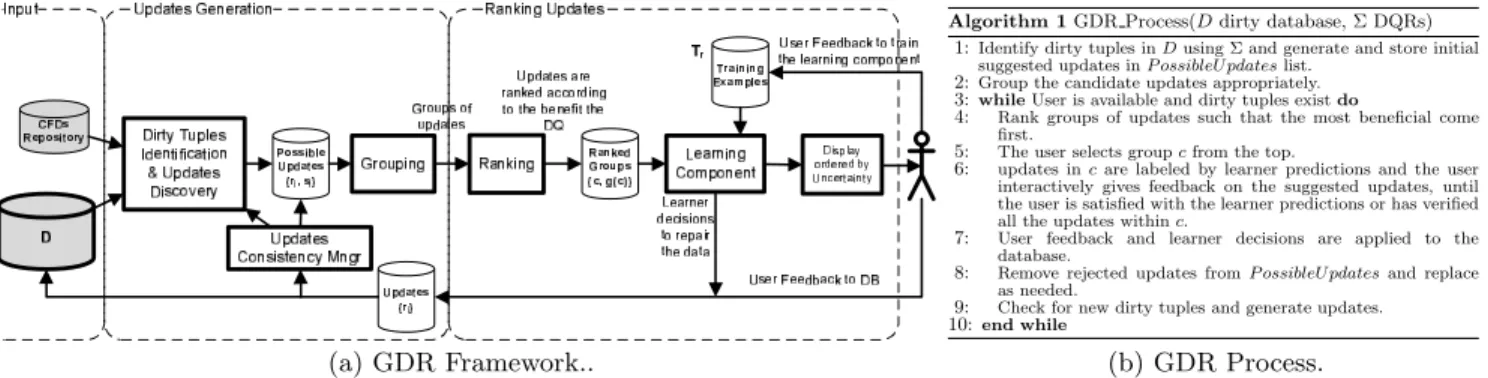
Figure 2(a) shows the GDR framework and the cleaning process is outlined in Procedure 2(b).
GDRguidesthe user to focus her efforts on providing feed-back on the updates that would improve quality faster, while the userguides the system to automatically identify and ap-ply updates on the data. This continuous feedback process, illustrated in steps 3-10 (Procedure 1), runs while there are dirty tuples and the user is available to give feedback.
In Step 1, all dirty tuples that violate the rules are identi-fied and a repairing algorithm is used to generate candidate updates. In step 2, we group the updates for the user in a way that makes it easier for a batch inspection.
The interactive loop in steps 3-10 starts with ranking the groups of updates such that groups that are more likely to move the database to a cleaner state faster come first. The user will then pick one of the top groups (c) in the list and provide feedback through an interactive active learning ses-sion (step 6). (The ranking mechanism and active learning are discussed in Section 4.)
In step 7, all decisions on suggested updates, either made by the user or the learner, are applied to the database. In step 8, the list of candidate updates is modified by replacing rejected updates and generating new ones for emerging dirty tuples because of the applied updates.
After getting the user feedback, the violations are recom-puted by the consistency manager and new updates may be proposed. The assumption is that if the user verifies all the database cells then the final database instance is consistent with the rules. This guarantees that we are always making progress toward the final consistent database and the process will terminate.
3.
GENERATING CANDIDATE UPDATES
In this section, we outline the different steps involved in suggesting updates, maintaining their consistency when ap-plied to the database, and grouping them for the user. More details of this section are given in Appendix A.
Dirty tuples identification and updates discovery:
Once a set Σ of CFDs is defined,dirtytuples can be identified through violations of Σ and stored in aDirtyT upleslist. A tupletis considered dirty if∃φ∈Σ such thatt6|=φ, i.e.,t
violates ruleφ.
We implemented anon demand update discovery process
based on the mechanism described in [7] for resolving CFDs violations and generating candidate updates. This process is triggered to suggest an update fort[A], the value of attribute
A in tuple t. Initially, the process is called for all dirty tuples and their attributes. Later during the interactions with the user, it is triggered by the consistency manager as a consequence of receiving user feedback.
The generated updates are tuples in the form rj =
ht, A, v, sjistored in theP ossibleU pdateslist, wherevis the
suggested value int[A] andsjis theupdate score. sj∈[0..1]
is assigned to each updaterj by anupdate evaluation
func-tionto reflect the certainty of the repairing technique about the suggested update. The evaluation function used in [2, 7] is the closeness in distance between the original and sug-gested values using some domain distance function.
Updates Consistency Manager: Once an updater=
ht, A, v, si is confirmed to be correct, either by the user or the learning component, it is immediately applied to the database resulting into a new database instance. Conse-quently, (i) new violations may arise and hence the on de-mand update discovery process needs to be triggered for the new dirty tuples, and (ii) some of the already suggested up-dates that are not verified yet may become inconsistent since they were generated according to a different database in-stance. For example, in Figure 1, two updates are proposed:
r1 replaces t6[ZIP] = 46391 and r2 replaces t6[CT] = ”FT
Wayne”. If a feedback is received confirming r1, then r2
is not consistent with the new database instance and the rules anymore sincet6 will fall in the context ofφ4. The on
demand process can then find a consistent update r0
2 that
corresponds to replacingt6[CT] by ’Westville’, andr2will be
discarded in favor ofr0
2.
Since GDR is meant for repairing online databases, the consistency manager will need to be informed (e.g., through database triggers) with any newly added or modified tuples so it can maintain the consistency of the suggested updates. In fact, GDR can be used inmonitoringdata entries and im-mediately suggesting updates during the data entry process. We do not discuss this issue further due to space limitation.
Grouping Updates: There are two reasons for the grouping: (i) Providing auseful-looking set of updates with some common contextual information will be easier for the user to handle and process. (ii) Providing a machine learning algorithm with a group of training examples that have some correlations due to the grouping will increase the prediction accuracy compared with just providing random, unrelated examples. Similar grouping ideas have been explored in [19]. We use a grouping function where the tuples with the same update value in a given attribute are grouped together.
4.
RANKING
AND
DISPLAYING
SUG-GESTED UPDATES
In this section, we introduce the key concepts of GDR, namely the ranking and learning components (Figure 2(a)), which describe how GDR interacts with the user to get feed-back on suggested updates. The task of these components is to devise how to best present the updates to the user, in
a way that will provide the most benefit for improving the
quality of the data. To this end, we apply the concept of value of information (VOI) [18] from decision theory, com-bined with an active learning approach, to choose a ranking in a principled manner.
4.1
VOI-based Ranking
At any iteration of the process outlined in Procedure 2(b), there will be several possible suggested updates to forward to the user. As discussed in the previous section, these updates are grouped into groups{c1, c2. . .}.
VOI is a mean of quantifying the potential benefit of de-termining the true value of some unknown. At the core of VOI is aloss (or utility) function that quantifies the desir-ability of a given level of database quality. To make a deci-sion on which group to forward first to the user, we compare data quality lossbefore and after the user works on a group of updates. More specifically, we devise adata quality loss function,L, based on the quantified violations to the rules Σ. Since the exact loss in quality cannot be measured, as we do not know the correctness of the data, we develop a set of approximations that allow for efficient estimation of this quality loss. Before we proceed, we need first to introduce the notion of database violations.
Definition 1. Given a databaseDand a CFDφ, we
de-fine the tupletviolation w.r.tφ, denotedvio(t,{φ}), as fol-lows: vio(t,{φ}) = 1 , ifφis a constant CFD. Number of tuplest0
that violateφwitht , ifφis a variable CFD. Consequently, the total violations for D with respect toΣ is: vio(D,Σ) =X φ∈Σ X t∈D vio(t,{φ}).
The definition for the variable CFDs is equivalent to the pairwise counting of violations discussed in [7]. The violation can be scaled further using a weight attached to the tuple denoting its importance for the business to be clean.
Update Benefit: Given a database instance D and a groupc = {r1, . . . , rJ}. If the system receives a feedback
from the user onrj, there are two possible cases: either the
user confirmsrjto be applied or not. We denote the two
cor-responding database instances asDrj andDr¯j, respectively.
Assuming that the user will confirmrjwith a probabilitypj,
then the expected data quality loss after consulting the user onrj can be expressed by: pj L(Drj) + (1−pj)L(Dr¯j). If
we further assume that all the updates within the groupc
are independent then the update benefitg (or data quality
gain) of acquiring user feedback for the entire groupc can be expressed as:
g(c) =L(D|c)−X rj∈c
[pjL(Drj) + (1−pj)L(Dr¯j) ] (1)
whereL(D|c) is the current loss in data quality given that
cis suggested. To simplify our analysis, we assumed that
these updates are independent. Taking into account these dependencies would require to model the full joint probabil-ities of the updates, which will lead to a formulation that is computationally infeasible due to the exponential number of possibilities.
Data Quality Loss (L): We define quality loss as in-versely proportional to the degree of satisfaction of the spec-ified rules Σ. To computeL(D|c), we first need to measure the quality loss with respect to φ ∈ Σ, namely ql(D|c, φ).
Assuming thatDopt is the clean database instance desired
by the user, we can expressqlby:
ql(D|c, φ) = 1− |D|=φ| |Dopt|=φ|=
|Dopt|=φ| − |D|=φ| |Dopt|=φ| (2)
where |D |= φ| and |Dopt |= φ| are the numbers of tuples
satisfying the ruleφin the current database instanceDand
Dopt, respectively. Consequently, the data quality loss, given c, can be computed for Eq. 1 as follows:
L(D|c) = X
φi∈Σ
wi×ql(D|c, φi). (3)
wherewi is a user defined weight forφi. These weights are
user defined parameters. In our experiments, we used the valueswi = |D(φ|D|i)|, where |D(φi)|is the number of tuples
that fall in the context of the ruleφi. The intuition is that
the more tuples fall in the context of a rule, the more im-portant it is to satisfy this rule. to express the business or domain value of satisfying the ruleφi.
To use this gain formulation, we are faced with two prac-tical challenges: (1) we do not know the probabilitiespjfor
Eq. 1, since we do not know the correctness of the update
rj beforehand, and (2) we do not know the desired clean
databaseDoptfor computing Eq. 2, since that is the goal of
the cleaning process in the first place.
User Model: To approximate pj, we learn and model
the user as we obtain his/her feedback for the suggested updates. pj is approximated by the prediction probability,
˜
pj, of havingrjcorrect (learning user feedback is discussed in
Section 4.2). Since initially there is no feedback, we assignsj
to ˜pj, wheresj∈[0,1] is a score that represents the repairing
algorithm certainty about the suggested updaterj.
Estimating Update Benefit: To compute the overall quality lossL in Eq. 3, we need to first compute the qual-ity loss with respect to a particular rule φ, i.e., ql(D|c, φ) in Eq. 2. To this end, we approximate the numerator and denominator separately. The numerator expression, which represents the difference between the numbers of tuples sat-isfyingφinDoptandD, respectively, is approximated using D’s violations with respect toφ. Thus, we use the expression
vio(D,{φ}) (cf. Definition 1) as the numerator in Eq. 2. The main approximation we made is to assume that the
updates within a groupcare independent. Hence to
approx-imate the denominator of Eq. 2, we assume further that there is only one suggested updaterjinc. The effect of this
last assumption is that we consider two possible clean de-sired databases—one in whichrjis correct, denoted byDrj,
and another one in whichrj is incorrect, denoted by Dr¯j.
Consequently, there are two possibilities for the denominator of Eq. 2, each with a respective probabilitypj and (1−pj).
Our evaluations show that despite our approximations, our approach produces a good ranking of the groups of updates. We apply this approximation independently for eachrj∈c
and estimate the quality lossqlas follows:
E[ql(D|c, φ)] = X rj∈c [˜pj· vio(D,{φ}) |Drj |=φ| + (1−p˜j) vio(D,{φ}) |Dr¯j |=φ| ] (4)
where we approximatepjwith ˜pj.
The expected loss in data quality for the databaseD, given the suggested group of updatesc, can be then approximated
based on Eq. 3 by replacing ql with E[ql] obtained from
Eq. 4: E[L(D|c)] = X φi∈Σ wi X rj∈c ˜ pj vio(D,{φ}) |Drj |=φ| + (1−p˜j) vio(D,{φ}) |Dr¯j |=φ| (5)
We can also compute the expected loss for Drj and Dr¯j
using Eq. 3 and Eq. 5 as follows: E[L(Drj)] = P
φi∈Σwi· vio(Drj,{φi})
|Drj|=φi| where we use ˜pj= 1 since inD
rj we know that rjis correct andE[L(Dr¯j)] =Pφi∈Σwi·
vio(Drj¯,{φi})
|Drj¯|=φi| where
Finally, using Eq. 1 and substituting L(D|c) with
E[L(D|c)] from Eq. 5, we compute an estimate for the data quality gain of acquiring feedback for the groupcas follows:
E[g(c)] =E[L(D|c)]−X rj∈c ˜ pjE[L(Drj)] + (1−p˜j)E[L(Dr¯j)] = X φi∈Σ wi X rj∈c ˜ pj vio(D,{φi}) |Drj |=φ i| + (1−p˜j) vio(D,{φi}) |Dr¯j |=φ i| −X rj∈c ˜pj X φi∈Σ wi vio(Drj,{φ i}) |Drj|=φ i| + (1−p˜j) X φi∈Σ wi vio(Dr¯j,{φ i}) |Dr¯j |=φ i|
Note that vio(D,{φi})−vio(Dr¯j,{φi}) = 0 since Dr¯j is
the database resulting from rejecting the suggested update
rj which will not modify the database. Therefore, Dr¯j is
the same as D with the same violations. After a simple
rearrangement, we obtain the final formula to compute the estimated gain forc:
E[g(c)] = X φi∈Σ wi X rj∈c ˜ pj vio(D,{φi})−vio(Drj,{φi}) |Drj |=φ i| (6)
The final formula in Eq. 6 is intuitive by itself and can be justified by the following. The main objective to improve the quality is to reduce the number of violations in the database. Therefore, the difference in the amount of database viola-tions as defined in Definition 1, before and after applyingrj,
is a major component to compute the update benefit. This component is computed, under the first summation, for ev-ery ruleφias a fraction of the number of tuples that would
be satisfying φi, if rj is applied. Since the correctness of
the repairrj is unkown, we cannot use the term under the
first summation as a final benefit score. Instead, we compute
the expected update benefit by approximating ourcertainty
about the benefit by the prediction probability ˜pj.
Example: For the example in Figure 1, assume that the repairing algorithm generated 3 updates to replace the value of theCTattribute by ‘Michigan City’ int2, t3andt4.
Assume also that the probabilities, ˜pj, for each of them are
0.9, 0.6, and 0.6, respectively. The weightswi for each φi, i = 1, . . . ,5 are {4 8, 1 8, 2 8, 1 8, 3
8}. Due to this modifications
only φ1 will have their violations affected. Then for this
group of updates, the estimated benefit can be computed as follow using Eq. 6: 4
8×(0.9× 4−3 1 + 0.6× 4−3 1 + 0.6× 4−3 1 ) = 1.05.
4.2
Active Learning Ordering
One way to reduce the cost of acquiring user feedback for verifying each update is to relegate the task of provid-ing feedback to a machine learnprovid-ing algorithm. The use of a learning component in GDR is motivated by the existence of correlations between the original data and the correct up-dates. If these correlations can be identified and represented in a classification model, then the model can be trained to predict the correctness of a suggested update and hence re-place the user for similar (future) situations.
As stated earlier, GDR provides groups of updates to the user for feedback. Here, we discuss how the updates within a group will be ordered and displayed to the user, such that user feedback for the top updates would strengthen the learn-ing component’s capability to replace the user for predictlearn-ing the correctness for the rest of the updates.
Interactive Active Learning Session: After ranking the groups of updates, the user will pick a groupcthat has a high scoreE[g(c)]. The learner orders these updates such
that those that would most benefit, i.e., improve the model prediction accuracy, from labeling come first. The updates are displayed to the user along with their learner predic-tions for the correctness of the update. The user will then give feedback on the topnsupdates, that she is sure about,
and inherently correct any mistakes made by the learner.
The newly labeled examples in ns are added to the learner
training datasetTr and the active learner is retrained. The
learner then provides new predictions and reorder the cur-rently displayed updates based on the training examples ob-tained so far. If the user is not satisfied with the learner predictions, the user will then give feedback on another ns
updates fromc. This interactive process continues until the user is either satisfied with the learner predictions, and thus delegates the remaining decisions on the suggested updates
in c to the learned model, or the updates withinc are all
labeled, i.e., verified, by the user.
Active Learning: In the learning component, there is a machine learning algorithm that constructs a classification model. Ideally, we would like to learn a model to automati-cally identify correct updates without user intervention. Ac-tive learning is an approach to learning models in such situ-ations where unlabeled examples (i.e. suggested updates) is plentiful but there is a cost to labeling examples (acquiring user feedback) for training.
By delegating some decisions on suggested updates to the learned models, GDR is allowing for “automatic” repairing. However, there is a guarantee to correctly repair the data that is inherently provided by the active learning process to learn accurate classifiers to predict the correctness of the updates. The user is the one to decide whether the classifiers are accurate while inspecting the suggestions.
Learning User Feedback: The learning component predicts for a suggested updater=ht, A, v, sione of the fol-lowing predictions, which corresponds to the expected user feedback. (i)confirm, the value oft[A] should bev. (ii) re-ject, vis not a valid value fort[A] and GDR needs to find another update. (iii)retain,t[A] is a correct value and there is no need to generate more updates for it. The user may also suggest new valuev0 fort[A] and GDR will consider it as a confirm feedback for the repairr0=ht, A, v0,1i.
In the learning component, we learn a set of classifica-tion models {MA1, . . . , MAn}, one for each attribute Ai ∈ attr(R). Given a suggested update fort[Ai], model MAi is
consulted to predict user feedback. The models are trained
by examples acquired incrementally from the user. We
present here our choices for data representation (input to the classifier), classification model, andlearning benefitscores.
Data Representation: For a given update r =
ht, Ai, v, siand user feedbackF ∈ {confirm, reject, retain},
we construct a training example for modelMAi in the form ht[A1], . . . , t[An], v,R(t[Ai], v),F i. Here,t[A1], . . . , t[An] are
the original attributes’ values of tuple tand R(t[Ai], v)1 is
a function that quantifies the relationship betweent[Ai] and
its suggested valuev.
Including the original dirty tuple along with the suggested update value enables the classifier to model associations be-tween original attribute values and suggested values. In-cluding the relationship function,R, enables the classifier to model associations based on similarities that do not depend solely on the values in the original database instance and the suggested updates.
Active Learning Using Model Uncertainty: Active learning starts with a preliminary classifier learned from a small set of labeled training examples. The classifier is ap-plied to the unlabeled examples and a scoring mechanism is used to estimate the most valuable example to label next
and add to the training set. Many criteria have been pro-posed to determine the most valuable examples for labeling (e.g, [20, 23]) by focusing on selecting the examples whose predictions have the largestuncertainty.
One way to derive the uncertainty of an example is by measuring the disagreement amongst the predictions it gets from a committee ofkclassifiers [19]. The committee is built so that thekclassifiers are slightly different from each other, yet they all have similar accuracy on the training data. For an updaterto be classified by labelF ∈ {confirm, reject, re-tain}, it would get the same predictionF from all members. The uncertain ones will get different labels from the commit-tee and by adding them in the training set the disagreement amongst the members will be lowered.
In our implementation, each modelMAiis a random forest
which is anensembleof decision trees [5] that are built in a similar way to construct a committee of classifiers. Random forest learns a set ofkdecision trees. Let the number of in-stances in the training set beNand the number of attributes
in the examples beM. Each of the k trees are learned as
follows: randomly sample with replacement a setS of size
N0 < N from the original data, then learn a decision tree with the setS. The random forest algorithm uses a standard decision-tree learning algorithm with the exception that at each attribute split, the algorithm selects the best attribute
from a random subsample ofM0 < M attributes. We used
the WEKA2 random forest implementation withk= 10 and
default values forN0andM0.
Computing Learning Benefit Score: To classify an updater=ht, Ai, v, siwith the learned random forestMAi,
each tree in the ensemble is applied separately to obtain the predictions F1, . . . ,Fk for r, then the majority prediction
from the set of trees is used as the output classification for
r. The learning benefit or the uncertainty of predictions of a committee can be quantified by the entropy on the fraction of committee members that predicted each of the class labels.
Example. Assume thatr1, r2 are two candidate updates
to change theCTattribute to ‘Michigan City’ in tuplest2, t3.
The model of theCTattribute,MCT, is a random forest with k= 5. By consulting the forest MCT, we obtain forr1, the
predictions{confirm, confirm, confirm, reject, retain}, and forr2, the predictions{confirm, reject, reject, reject, reject}.
In this case, the final prediction forr1 is ‘confirm’ with an
uncertainty score of 0.86 (= −3 5 ×log3 3 5 − 1 5 ×log3 1 5 − 1 5×log3 1
5) and forr2the final prediction is ’reject’ with an
uncertainty score of 0.45. In this case,r1will appear to the
user beforer2because it has higher uncertainty.
5.
EXPERIMENTS
In this section, we present a thorough evaluation of the GDR framework, which has already been demonstrated in [22]. Specifically, we show that the proposed ranking mech-anism converges quickly to a better data quality state. More-over, we assess the trade-off between the user efforts and the resulting data quality in Appendix B.
We used in the experiments two real-world datasets re-ferred to as Dataset 1 and 2, each with about 20,000 records. Appendix B provides details on the datasets, ground truth and the quality rules.
User interaction simulation. We simulated user feed-back to suggested updates by providing answers as deter-mined by the ground truth.
Data quality state metric. We report the improvement in data quality through computing the loss (Eq. 3). We consider the ground truth as the desired clean databaseDopt.
2http://www.cs.waikato.ac.nz/ml/weka/ ! "! #! $! %! &!! ! "! #! $! %! &!! !" # "$ % &" ' (#)$*+,-. / 0+01 # '(()*+*,-./01(2.(3342516 !"#$%&'()*+,+-!*((./ #)+.&0 (a) Dataset 1. ! "! #! $! %! &!! ! "! #! $! %! &!! !" # " $ % &"'(#)$*+,-. / 0+01 # '(()*+,-./01(2.(3342516 !"#$%&'()*+,+-!*((./ #)+.&0 (b) Dataset 2.
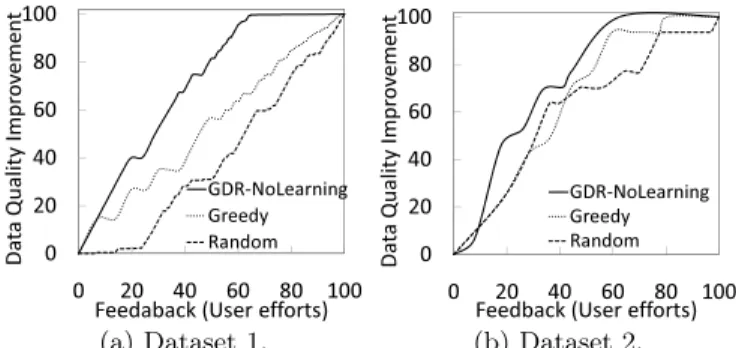
Figure 3: Comparing VOI-based ranking in GDR (GDR-NoLearning) to other strategies against the amount of feedback. Feedback is reported as the percentage of the maximum number of verified up-dates required by an approach. Our application of the VOI concept shows superior performance com-pared to other na¨ıve ranking strategies.
5.1
VOI Ranking Evaluation
The objective here is to evaluate the effectiveness and quality of the VOI-based ranking mechanism described in Section 4.1. In this experiment, we did not use the learning component to replace the user; the user will need to evalu-ate each suggested updevalu-ate. Recall that the grouping provides the user with related tuples and their corresponding updates that could help in a quick batch inspection by the user.
We compare in this experiment the following techniques:
• GDR-NoLearning: The GDR framework of Figure 2(a) without the learning component.
• Greedy: Here, we rank the groups according to their sizes. The rationale behind this strategy is that groups that cover larger numbers of updates may have high impact on the quality if most of the suggestions within them are correct.
• Random: The na¨ıve strategy where we randomly order the groups; all update groups are equally important. In Figure 3, we show the progress in improving the quality against the number of verified updates (i.e., the amount of feedback). The feedback is reported as a percentage of the total number of suggested updates through the interaction process to reach the desired clean database.
The ultimate objective of GDR is to minimize user ef-fort while reaching better quality quickly. In Figure 3, the slope of the curves in the first of iterations with the user is the key component to the curve: the steeper the curve the better the ranking. As illustrated for both datasets, the GDR-NoLearning approach performs well compared to the Greedy andRandom approaches. This is because the GDR-NoLearningapproach perfectly identifies the most beneficial groups that are more likely to have correct updates. While theGreedy approach improves the quality, most of the con-tent of the groups is sometimes incorrect updates leading to
wasted user efforts. TheRandomapproach showed the worst
performance in Dataset 1, while for Dataset 2, it was
compa-rable with the Greedy approach especially in the beginning
of the curves. This is because in Dataset 2, most of the sizes
of the groups were close to each others making theRandom
and Greedy approaches behave almost identically, while in Dataset 1 the groups sizes varies widely making the random choices ineffective. Finally, we notice thatGDR-NoLearning is much better for Dataset 1 than for Dataset 2, because of two reasons related to the nature of the Dataset 2: (i) most of the initially suggested updates for Dataset 2 are correct, and (ii) the sizes of the groups in Dataset 2 are close to each other. The consequence is that any ranking strategy for Dataset 2 will not be far from the optimal.
The results reported above justify clearly the importance
and effectiveness of the GDR ranking component. The
GDR-NoLearningapproach is well suited for repairing “very” crit-ical data, where every suggested update has to be verified before applying it to the database.
5.2
GDR Overall Evaluation
Here, we evaluate GDR’s performance when using the learning component to reduce user efforts. More precisely, we evaluate the VOI-based ranking when combined with the active learning ordering. For this experiment, we evaluate the following approaches:
• GDR: is the approach proposed in this paper. In each interactive session, the user provides feedback for the top ranked updates. The required amount of feedback per group is inversely proportional to the benefit score of the group (Eq. 6)—the higher the benefit the less effort from the user is needed, since most likely the updates are correct and there are very few uncertain updates for the learned model that would require user involvement. As such, we require that the user verifies di updates for a group ci, di = E×
1− g(ci) gmax
, where E is the initial number of
dirty tuples andgmax= max∀cj{g(cj)}.
• GDR-S-Learning: Here, we eliminate the active learn-ing from the system—the updates are grouped and then ranked using VOI-based scoring alone. User is solicited for a random selection of updates within each group, instead of being ordered by uncertainty. However, all of the user feedback is used to train the learning component, which then replaces the user on deciding for the remaining up-dates in the group. GDR-S-Learning is included to assess the benefit of the active learning aspect of our framework, compared with traditional passive learning.
• Active-Learning: In this approach, we eliminate the grouping and their ranking from the GDR framework. In other words, we neither group the updates nor use VOI-based scores for ranking. We only solicit user feedback for updates ordered with the learner uncertainty scores. The user is required to provide feedback for the top update and then the learning component is updated to reorder the updates for the user in an iterative fashion. The resulting learned model is applied for predicting the remaining sug-gested updates and the database is updated accordingly. We report the quality improvement for different amount of feedbacks. This approach is included to assess the benefit of the grouping and the VOI-based ranking mechanisms compared with using only an active learning approach.
• GDR-NoLearning: This approach is the one described in the previous experiment; It provides a baseline to assess the utility of machine learning aspect for GDR.
• Automatic-Heuristic: The BatchRepair method described in [7] for automatic data repair using CFDs.
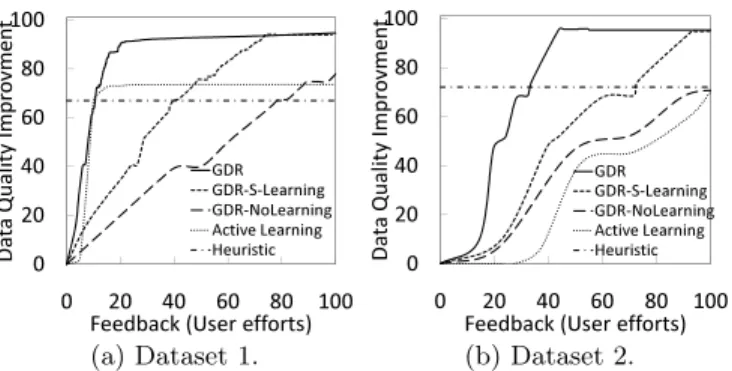
In Figure 4, we report the improvement in data quality as the amount of feedback increases. Assuming that the user can afford verifying at most a number of updates equal to the number of initially identified dirty tuples (6000 for Dataset 1 and 3000 for Dataset 2), we report the amount of feedbacks as a percentage of this number. The results show
thatGDRachieves superior performance compared with the
other approaches; For Dataset 1, GDR gain about 90% im-provement with 20% efforts or verifying about 1000 updates. For Dataset 2, about 94% quality improvement was gained with 30% efforts or verifying about 1000 updates.
In Dataset 1,Active Learningis comparable toGDRonly
in the beginning of the curve until reaching about 70%
qual-ity improvement. GDR-S-Learningstarts to outperform
Ac-tive Learning after about 45% user effort. The Heuristic
! "! #! $! %! &!! ! "! #! $! %! &!! !" # "$ % &" ' (#)$*+,-. /+01 # '(()*+,-./01(2.(3342516 !"# !"#$%$&'()*+*, !"#$-.&'()*+*, /01+2'3&'()*+*, 4'5)+61+0 (a) Dataset 1. ! "! #! $! %! &!! ! "! #! $! %! &!! !" # "$ % &" ' (#)$*+,-. /+01 # '(()*+,-./01(2.(3342516 !"# !"#$%$&'()*+*, !"#$-.&'()*+*, /01+2'3&'()*+*, 4'5)+61+0 (b) Dataset 2.
Figure 4: Overall evaluation of GDR compared with other techniques. The combination of the VOI-based ranking with the active learning was very successful in efficiently involving the user. The user feedback is reported as a percentage of the initial number of the identified dirty tuples.
approach repairs the database without user feedback, there-fore, it produces a constant result. Note that the quality
improvement achieved by theHeuristicapproach is attained
byGDRwith about 10% user effort, i.e., giving feedback for updates numbering about 10% of the initial set of dirty
tu-ples in the database. TheGDR-NoLearning approach does
improve the quality of the database, but not as quickly as any of the approaches that use learning methods. In
compar-ison to Figure 3, the final performance ofGDR-NoLearning
is 100%, assuming all required feedback were obtained. GDR
involves learning which allows for automatic updates to be applied and hence opens the door for some mistakes to occur. Thus, the 100% accuracy may not be reached.
For Dataset 2, similar results were achieved. However, the Active Learning approach was not as successful as for Dataset 1. This is due to the randomness nature of the errors in this dataset, which resulted in fewer correlations between these errors that could be learned by the model. Due to the wider array of real-world dependencies in Dataset 1, the machine learning methods were more successful and achieved better performance. For example, some hospitals located on the boundary between two zip codes have their zip attributes dirty; this is most likely due to a data entry confusion on where they are really located.
The superior performance ofGDR is justified by the fol-lowing: for a single group of updates, using the learner uncertainty to select updates can effectively strengthen the learned model predictions as these “uncertain” updates are
more important for the model. In GDR-S-Learning,
ran-domly inspecting updates from the groups provided by the VOI-based ranking does enhance the learned model. How-ever, more user effort is wasted in verifying less important
updates according to the learning benefit. For the Active
Learningapproach, it is apparent that having the user spend more effort does not help the learned model due to the model
over fitting problem. This problem is avoided in bothGDR
and GDR-S-Learning approaches because of the grouping provided by the GDR framework. The grouping provides the learned model a mechanism to adapt locally to the cur-rent group, which in turn provides the necessary guidance for the model tostronglylearn the associations for a highly beneficial group rather than just weakly learning the asso-ciations for a wide variety of cases. This is also the reason
that theGDR-S-Learning eventually outperforms theActive
Learning with an increase in user effort.
This experiment demonstrates the importance of the learning component for achieving a faster convergence to a better quality. The results support our initial hypothesis about the existence of correlations between the dirty and correct versions of the tuples in real-world data. Also, the
combination of VOI-based ranking with active learning im-proves over the traditional active learning mechanism.
6.
RELATED WORK
Existing data repair techniques have mostly focused on automatically repairing data by finding another database that is consistent and minimally different from the original database (e.g., [2, 7, 16]).
The updates generation in GDR is somehow similar to the repair approach of [7], which consults the user to either introduce a new CFD in the repairing algorithm or to man-ually update the data, and no machine learning is included to help in the cleaning process itself. GDR goes well beyond that by interactively generating and then grouping updates for the sake of efficiently involving the user.
The initial step to suggest updates for all dirty tuples is a time consuming process. Therefore, we discuss and evaluate in a workshop paper [21] a mechanism for ranking the rules such that smaller subsets of the dirty tuples are processed to find their suggested updates in each user interactive session. A recent work to repair critical data with quality guarantee was introduced in [11]. While addressing a similar problem as GDR, the setting is different. In [11] it is assumed that a reference correct data exists and the user is required to spec-ify certain attributes to be correct across the entire dataset. Moreover, the proposed solution relies on a pre-specified set of editing rules. This is not the case for GDR. GDR requires only a set of data quality rules.
Most existing systems for data cleaning provide tools for data exploration and transformation without taking advan-tage of recent efforts on automatic data repair. Usually, the repair actions are “explicitly specified by the user”. For ex-ample, AJAX [12] proposes a declarative language to elimi-nate duplicates during data transformations. Potter’s Wheel [17] combines data transformations with the detection of er-rors in the form of irregularities. None of these systems effi-ciently leverage user feedback, like GDR, by either ranking or using learning mechanisms, and moreover, the user does not necessarily have to explicitly specify updates.
Previous work on soliciting user feedback to improve data quality focuses on identifying correctly matched references in a large scale integrated data (e.g., [14, 19]). In [14], a de-cision theoretic framework similar to ours has been proposed to rank candidate reference matches to improve the quality of query responses in dataspaces, but it cannot be applied in a constrained repair framework for relational database. [19] introduced an active-learning based approach to build a generic matching function for identifying duplicate records.
Another closely related area is to solicit user feedback to improve the prediction quality of a learning model by tak-ing into account data acquisition costs, for example selective supervision [15], which combines decision theory with active learning for the learned model benefit.
The uniqueness of our work resides in combining (i) the certainty of a update, which is derived from an automatic re-pairing algorithm using the repair evaluation function, and (ii) the uncertainty of a learner to accurately predict the correctness of a update, in a ranking mechanism that uni-formly and judiciously balances between them with the goal of improving the data quality as quickly as possible.
7.
CONCLUSION AND FUTURE WORK
We presented GDR, a framework that combines
constraint-based repair techniques with user feedback through an interactive process. The main novelty of GDR is to solicit user feedback for the most useful updates using a novel decision-theoretic mechanism combined with active learning. The aim is to move the quality of the database to a better state as far as the data quality rules are concerned.
Our experiments show very promising results in moving the data quality forward with minimal user involvement.
Our future work includes extending GDR to support more types of data quality rules other than CFDs like CINDs [4], Matching dependencies [8], and Matching Rules [10]. More research challenges may emerge from supporting var-ious kinds of rules and their interactions to produce good updates. Moreover, we are investigating approach for the guided discovery of the rules from dirty data.
8.
REFERENCES
[1] C. Batini and M. Scannapieco.Data Quality: Concepts, Methodologies and Techniques. Addison-Wesley, 2006. [2] P. Bohannon, W. Fan, M. Flaster, and R. Rastogi. A
cost-based model and effective heuristic for repairing constraints by value modification. InACM SIGMOD, pages 143–154, 2005.
[3] P. Bohannon, W. Fan, F. Geerts, X. Jia, and
A. Kementsietsidis. Conditional functional dependencies for data cleaning. InICDE, pages 746–755, 2007.
[4] L. Bravo, W. Fan, and S. Ma. Extending dependencies with conditions. InVLDB, pages 243–254, 2007.
[5] L. Breiman. Random forests.Mach. Learn., 45:5–32, 2001. [6] J. Chomicki and J. Marcinkowski. Minimal-change integrity
maintenance using tuple deletions. InInformation and Computation, pages 90–121, 2005.
[7] G. Cong, W. Fan, F. Geerts, X. Jia, and S. Ma. Improving data quality: consistency and accuracy. InVLDB, pages 315–326, 2007.
[8] W. Fan. Dependencies revisited for improving data quality. InPODS, 2008.
[9] W. Fan, F. Geerts, L. V. Lakshmanan, and M. Xiong. Discovering conditional functional dependencies. InICDE, pages 1231 – 1234, 2009.
[10] W. Fan, X. Jia, J. Li, and S. Ma. Reasoning about record matching rules. InVLDB, pages 407–418, 2009.
[11] W. Fan, J. Li, S. Ma, and W. Yu. Towards certain fixes with editing rules and master data. InVLDB, pages 173–184, 2010.
[12] H. Galhardas, D. Florescu, D. Shasha, and E. Simon. Ajax: an extensible data cleaning tool. InSIGMOD, page 590, 2001.
[13] L. Golab, H. Karloff, F. Korn, D. Srivastava, and B. Yu. On generating nearoptimal tableaux for conditional functional dependencies. InVLDB, pages 376–390, 2008.
[14] S. R. Jeffery, M. J. Franklin, and A. Y. Halevy.
Pay-as-you-go user feedback for dataspace systems. InACM SIGMOD, pages 847–860, 2008.
[15] A. Kapoor, E. Horvitz, and S. Basu. Selective supervision: Guiding supervised learning with decision-theoretic active learning. InIJCAI, pages 877–882, 2007.
[16] A. Lopatenko and L. Bravo. Efficient approximation algorithms for repairing inconsistent databases. InICDE, pages 216 – 225, 2007.
[17] V. Raman and J. M. Hellerstein. Potter’s wheel: An interactive data cleaning system. InVLDB, pages 381–390, 2001.
[18] S. Russell and P. Norvig.Artificial Intelligence: A Modern Approach. Addison-Wesley, 2003.
[19] S. Sarawagi and A. Bhamidipaty. Interactive deduplication using active learning. InACM SIGKDD, pages 269–278, 2002.
[20] S. Tong and D. Koller. Support vector machine active learning with applications to text classification. InThe Journal of Machine Learning Research, pages 45–66, 2002. [21] M. Yakout, A. K. Elmagarmid, and J. Neville. Ranking for data repairs. InIn DBRank workshop of ICDE, pages 23 – 28, 2010.
[22] M. Yakout, A. K. Elmagarmid, J. Neville, and M. Ouzzani. Gdr: a system for guided data repair. InSIGMOD system demo, pages 1223–1226, 2010.
[23] B. Zadrozny and C. Elkan. Learning and making decisions when costs and probabilities are both unknown. In SIGKDD, pages 204–213, 2001.
APPENDIX
A.
UPDATES GENERATION
IMPLEMEN-TATION
A.1
CFD: Overview
A CFDφ overR can be represented byφ: (X →Y, tp),
whereX andY ∈attr(R),X →Y is a standard functional
dependency (FD), referred to as FD embedded in φ, and
tp is a tuplepattern containing all attributes in X andY.
For eachA∈(X∪Y), the value of the attributeA for the tuple pattern tp, tp[A], is either a constant ’a’ ∈ dom(A),
or ’−’ which represents a variable value. We denote X as
LHS(φ) (left hand side) andY asRHS(φ) (right hand side). Examples for CFD rules are provided in Figure 1.
To denote that a tuplet∈Dmatches a particular pattern
tp, the symbolis defined on data values and ’−’. We write t[X]tp[X] iff for eachA∈X, eithert[A] =tp[A] ortp[A]
= ’−’. For example, (Sherden RD, Fort Wayne, IN)(−,
Fort Wayne,−). We assume that CFDs are provided in the
normal form [7], i.e.,φ: (X →A, tp),A∈attr(R) andtpis
a single pattern tuple.
A CFD φ : (X → A, tp) is said to be constant, if
tp[A] 6=’−’. Otherwise, φ is a variable CFD. For example
in Figure 1, φ1 is a constant CFD, while φ5 is a variable
CFD.
A database instance D satisfies the constant CFD φ =
(X →A, tp), denoted by D |= φ, iff for each tuple t∈ D,
if t[X] tp[X] then t[A] = tp[A]. If φ is a variable
CFD, then D |= φ iff for each pair of tuples t1, t2 ∈ D,
ift1[X] =t2[X]tp[X] then t1[A] = t2[A] tp[A]. This
means that ift1[X] andt2[X] are equal and match the
pat-terntp[X], thent1[A] andt2[A] must also be equal to each
other. CFDs address a single relation only. However, the repairing algorithm that uses CFDs is applicable to general relational schemas by simply repairing each relation in iso-lation.
A.2
Resolving CFD Violations
A dirty tupletmay violate a CFDφ = (R:X →A, tp)
in Σ following two possible cases [7]:
• Case 1: φis a constant CFD (i.e.,tp[A] =a, whereais
a constant) andt[X]tp[X] butt[A]6=a.
• Case 2: φis a variable CFD,t[X]tp[X], and∃t0such
thatt0[X] =t[X]t
p[X] butt[A]6=t0[A].
The latter case is similar to the violation of a standard FD. Accordingly, given a set Σ of CFDs, the dirty tuples can be immediately identified and stored in theDirtyT upleslist.
To resolve a violation of a CFD φ = (R : X → A, tp)
by a tuple t, we proceed as follows: For case 1, we either modify theRHS(φ) attribute such thatt[A] =tp[A] or we
change some of the attributes inLHS(φ) such thatt[X]6 tp[X]. For case 2, we either modify t[A] (resp. t0[A]) such
thatt[A] =t0[A] or we change someLHS(φ) attributest[X] (resp. t0[X]) such that t[X]6=t0[X] ort[X]6tp[X] (resp. t0[X]6t
p[X]).
Example: In Figure 1, the normal form ofφ1 : (ZIP →
CT,STT,{46360 k M ichiganCity, IN}) would be φ1,1 :
(ZIP→CT,{46360 k M ichiganCity}) andφ1,2 : (ZIP →
STT,{46360 k IN}).
t2 violatesφ1,1 : (ZIP→CT,{46360 k M ichiganCity})
following case 1. Thus, a suggested update by changing RHS(φ1,1) is to replace ‘Westville’ by ‘Michigan City’ in t2[CT], while another update by changing LHS(φ1,1) is to
replace ‘46360’ by ‘46391’ in t2[ZIP], for example. t5, t6
both violateφ5 following case 2. A possible update is to
change RHS(φ5) by modifyingt5[ZIP] to be ’46825’ instead
of ’46391’. Yet, another possible update is to make a change in LHS(φ5). For example, by changingt5[STR] ort5[CT] to
another value.
A.3
Update Evaluation Function
Since there may be many possible ways to clean a dirty tuple, we need an evaluation function to select the “best” updates. We follow the same evaluation approach used in [2]
and [7]. Given an update r to modify t[A] =v such that
t[A] =v0, we compute the update evaluation scoresas the similarity betweenvandv0. This can be done based on the edit distance functiondistA(v, v0) as follows
s(r) =sim(v, v0) = 1− distA(v, v
0)
max(|v|,|v0|). (7)
where |v|,|v0| denote the size of v, v0, respectively. The intuition here is that, the more accuratev0, the more it is close tov. s(r) is in the range [0..1] and any domain specific similarity function can be used for this purpose. Finally, the update can be composed in the tuple formr=ht, A, v0, s(r)i.
A.4
Generating Updates
We now show how to use CFDs to generate updates for each potentially dirty attributeB int∈DirtyT uples. The generated updates are tuples in the formht, B, v, si, where
v is the suggested repair value fort[B] and s is the repair evaluation score from Eq. 7.
The suggested updates correspond to attribute value mod-ifications, which are enough for CFDs violations [7]. For each dirty tuple t, we store the list of violated rules in
t.vioRuleList. Furthermore, for each pair ht, Bi, we keep a list of values ht, Bi.preventedList, which contains values fort[B] that are confirmed as wrong. Thus, when searching a new suggestion fort[B], the values inht, Bi.preventedList
are discarded. Also, we keep a flag ht, Bi.Changeablethat
is set to False when the value in t[B] was confirmed to be correct.
Initially, we assume that each attribute value is
incor-rect for all t ∈ DirtyT uples and proceed by searching for
the best update value that provides the best score accord-ing to Eq. 7. This can be performed by callaccord-ing Algorithm 1,U pdateAttributeT uple(t, B) for allt∈DirtyT uplesand
B∈attr(R).
U pdateAttributeT upledescribed in Algorithm 1 finds the best update value for t[B] by exploring three possible sce-narios:
1. B =A for some violated CFD φ = (X → A, tp) and
tp[A]6=’−’ (i.e.,φis a constant CFD): This corresponds
to case 1 of rule violations where t[X] tp[X] and t[A]6tp[A]. In this scenario, a valuev=ais suggested
(lines 4-6).
2. B =A for some violated CFD φ = (X → A, tp) and
tp[A] =’−’ (i.e.,φis a variable CFD): This corresponds
to case 2 of rule violations where t[X] tp[X] and t[A]tp[A] and there exists another tuplet0 that
vi-olatesφ witht, i.e.,t0[X]t[X] but t0[A]6t[A]. In this scenario, a valuev=t0[A] is suggested (lines 7-9). 3. B∈LHS(φ) for some violated CFDφ= (X →A, tp):
This corresponds to either case 1 or case 2 of rule viola-tions. In this scenario, we look for a valuevthat max-imizes the repair evaluation scoresim(t[B], v) (Eq. 7.) The aim is to select semantically related values by first using the values in the CFDs, then searching in the tuples identified by the patternt[X∪A− {B}] (lines 11-13).
In each of the above scenarios, the value v 6∈ ht, Bi.preventedList. Finally, a repair tuple is composed
ht, B, v, siand inserted intoP ossibleU pdatesin line 14
Example: In Figure 1,t5 violatesφ4 and when repairing
the attribute CT ∈ RHS(φ4), a suggested update
accord-ing to Scenario 1 will be ‘Westville’. Also, t5 violates φ5
and when repairing the attribute ZIP ∈ RHS(φ5), a
sug-gested update will be 46825 according to Scenario 2. When repairing the attributeSTR ∈ LHS(φ5), a suggested value
from the domaindom(STR) can be ‘Sherden RD’ according
to Scenario 3.
Analysis: We assume that a tuple is violating
|t.vioT upleList| rules. From Definition 1 , we know that if a tuplet is violating a variable CFDφ, thenvio(t, φ) is the number of tuples that violateφwitht. Each of the sce-narios in Algorithm 1 can be analyzed as follows: Scenario
1 requires O(1) operations to suggest updates from each
constant CFD violation. Scenario 2 requiresO(vio(t, φ)) to suggest a value from each set of tuples violating a variable rule φ with t. Scenario 3 requires searching the values in the rules and in the domain of attributeA, i.e., the worst case is O(|dom(A)|+ Σ). Then, the best case of running UpdateAttributeTuple isO(|t.vioT upleList|) and the worst case isO(|t.vioT upleList| × (|dom(A)|+ Σ)).
Algorithm 1UpdateAttributeTuple (Tuplet, AttributeB) 1: if ht, Bi.Changeable= falsethen return;
2: best s = 0 ;v=null
3: for allφ= (X→A, tp)∈t.vioRuleListdo
4: if B=A ∧ tp[A]6=’−’then
5: cur s =sim(t[A], tp[A]) {scenario 1}
6: if cur s>best sthen{best s = cur s; v=tp[A] }
7: else if B=A ∧ t[A] =’−’then
8: hbest s, vi = getValueForRHS(φ, A, t, best s)
{scenario 2}
9: end if
10: end for
11: if ∃φ= (X→A, tp)∈t.vioRuleLists.t. B∈X then
12: hbest s, vi = getValueForLHS(A, t, best s){scenario 3}
13: end if
14: if v6=nullthen
15: P ossibleU pdates = P ossibleU pdates∪ {ht, B, v, s =
sim(t[B], v)i}
16: end if
A.5
Updates Consistency Manager
Once a repairr =ht, B, v, si is confirmed to be correct, either by the user or the learning component, it is applied immediately to the database to get a new database instance. Consequently, some of the already suggested updates may become inconsistent since they were generated according to a different database instance.
The consistency manager needs to maintain two
invari-ants: (i) There is no tuple t ∈ D such that t 6|= φ for
any φ∈ Σ, and t6∈ DirtyT uples. (ii) There is no update
r ∈ P ossibleU pdates such that r depends on data values that have been modified in the database. In the following, we provide the detailed steps of the consistency manager procedure that we implemented in GDR. Given an update
r =ht, B, v, si along with the feedback ∈ {confirm, reject, retain}:
1. If the feedback is to retain the current valuet[B], then
we set ht, Bi.Changeable = false to stop looking for
updates fort[B].
2. If the feedback is to reject the update, i.e., t[B]
can-not be v, then v is added immediately to the list
ht, Bi.P reventedList. This is followed by a call to
U pdateAttributeT uple(t, B) to find another update for
t[B].
3. If the feedback confirms that t[B] must be v, then the update is applied to the database immediately
and we stop generating updates for t[B] by setting
ht, Bi.Changeable= false. Afterward, we go through
the rules that involve the attributeB and update the
necessary data structures to reflect the removed viola-tions as well as new emerging violaviola-tions. Particularly, for eachφ : (X →A, tp) ∈Σ whereB ∈(X∪A), we
do the following:
(a) Ift6|=φ, then we consider two cases:
i. φ is a constant CFD: If ht, Ci.Changeable =
false, ∀C ∈ X, i.e., all attributes in LHS(φ) have been confirmed as correct and are not changeable values, then RHS(φ) should be ap-plied; we apply t[A] = tp[A] to the database
directly, setht, Ai.Changeable= false, and re-move φ from t.vioRuleList. If some of the LHS(φ) attribute values are changeable in t,
then ∀ C ∈ ({X ∪A} 6 B) we add ht, Ci to
RevisitList. φ is added to t.vioRuleList, if it is not already there, and t is added to the
DirtyT uplesas well.
ii. φis a variable CFD: We addφtot.vioRuleList
and then identify the tuples t0 that violate
φ with t. Then for each t0, we add φ to
t0.vioRuleListand addt0 to theDirtyT yples. Also, we addht0, Cito theRevisitList,∀C∈
{X∪A}because thisφmay be a new emerging
violation fort0and all the attributes are candi-dates to be wrong fort0.
(b) If t |= φ while φ ∈ t.vioRuleList, then φ origi-nally was violated bytbefore applying this update.
Therefore, we remove φ from t.vioRuleList. If φ
is a constant CFD, no further action is required.
However, ifφis a variable CFD, we need to check
the other tuplest0, which were involved withtin vi-olatingφ, and eventually update theirvioRuleList. We removeφ from t0.vioRuleList as long as@ t00 s.t. t0, t006|=φ, i.e.,t0 is not involved in violatingφ with another tuplet00.
4. Remove update r = ht, C, v, si from the
P ossibleU pdates, if ht, Ci ∈ RevisitedList or
ht, Ci.Changeable = false.
5. For every element ht, Ci ∈ RevisitedList, we call
U pdateAttributeT uple(t, C) to find another repair for
t[C].
6. RemovetfromDirtyT uples, ift.vioRuleListis empty. Note that the first update consistency invariant is main-tained because of the following: A tupletmay become dirty if it is modified or another tuple t0 is modified so that t, t0
violates some variable CFDφ∈Σ. For a tupletand a CFD
ruleφ, assuming that due to a database updatet6|=φ, then
tmust be inDirtyT uplesafter applying Step 3a.
If φ is a constant CFD, then step 3(a)i should have
been applied. If t continues to violate φ it should be in
DirtyT uples. Ifφis a variable CFD, then step 3(a)ii should have been applied. There are two cases to consider: First, if tis the tuple being repaired andt6|=φ, then it is added to DirtyT uples, if not already there. Second, if t6|=φ be-cause another tuplet0 was repaired (or modified), then step