UNIVERSITY OF VAASA
FACULTY OF TECHNOLOGY
INDUSTRIAL MANAGEMENT
Valtteri Vuorenpää
TIME –DRIVEN ACTIVITY BASED COSTING IN MANUFACTURING PROCESSES
Master’s thesis in Industrial Management
TABLE OF CONTENTS
ABBREVIATIONS 3
TABLE OF FIGURES 3
LIST OF TABLES 4
1. INTRODUCTION 7
1.1. Background and objective of the study 7
1.2. Research problem and research questions of the study 8
1.3. Research methods 10
1.4. Structure of the study 12
2. MANAGEMENT ACCOUNTING 14
2.1. Cost Management 16
2.2. Cost Management in Lean organizations 17
2.3. Cost Accounting 17
2.4. Activity-Based Costing 20
2.5. Time -driven activity based costing 26
2.6. Capacity cost rates 27
2.7. Cost hierarchy 28
2.8. Activity Analysis 30
2.9. Differences between activity- based costing and traditional costing methods 31
2.10. Activity-Based Management 33
2.11. Possible drawbacks encountered with ABC systems 34
2.12. Value chain analysis as a cost reduction tool 37
2.13. Kaizen costing 39
3. INTRODUCTION TO THE CASE COMPANY 41
3.2. Current costing practices in the case company 43
3.3. Product groups 44
In this subchapter the product groups of the case company are presented. 44
3.3.1. Button Bits 44
3.3.2. Ground Drilling 45
3.3.3. Shank adapters 46
3.3.4. Rods 47
3.3.5. Couplings 48
4. TIME –DRIVEN ACTIVITY BASED COSTING IN MANUFACTURING
ACTIVITIES 49
4.1. Introduction to model building premises 50
4.2. Preparations 51
4.3. Data definition & analysis 52
4.3.1. Collecting costs data 52
4.3.2. Collecting activity time data 54
4.3.3. Collecting production data 54
4.4. Calculating capacity cost rates 56
4.5. Describing the manufacturing processes 60
4.6. Building the pilot model 63
5. COST REDUCTION AND IDENTIFYING POTENTIAL SAVINGS IN THE
MANUFACTURING PROCESSES 67
5.1. Batch size analysis 69
6. DISCUSSION & CONCLUSIONS 71
6.1. Discussion 71
6.2. Conclusions 75
REFERENCES 78
ABBREVIATIONS
ABC = Activity-Based Costing. Referred in this thesis by “ABC” or “activity based costing”. ABM = Activity-Based Management.
TDABC = Time-Driven Activity Based Costing MTO = Make-To-Order. A production philosophy.
TABLE OF FIGURES
Figure 1. Theoretical framework of the study.
Figure 2. Differentiation and typical characteristics between qualitative and quantitative research methods.
Figure 3. Traditional cost accounting system. Figure 4. Activity –Based Costing model.
Figure 5. Choosing the optimal amount of drivers and activities. Figure 6. Development of case company net sales 2004-2014
Figure 7. Value chain of the case company in the construction business. Figure 8. Button bit offering.
Figure 9. Ground drilling tools. Figure 10. Shank adapters. Figure 11. Drilling rods. Figure 12. Couplings.
Figure 13. Case company value chain for competitive edge. Figure 14. Manufacturing process of the button bit line.
LIST OF TABLES
Table 1. Different ways to conduct empirical research.
Table 2. Differences between financial and management accounting. Table 3. Capacity cost rates for induction buttoning line.
Table 4. Practical capacity of labor resources supplied per year per employee. Table 5. Case company TDABC –model example.
UNIVERSITY OF VAASA Faculty of Technology
Author: Valtteri Vuorenpää
Topic of the Master’s Thesis: Time-driven activity based costing in manufacturing processes
Instructor: Päivi Haapalainen
Degree: Master of Science in Economics and Business
Administration
Major: Industrial Management
Year of Entering the University: 2010
Year of Completing the Master’s Thesis: 2016 Pages: 88 ABSTRACT:
This study was made as an assignment for an industrial case company. The research problem of this study was that the case company did not have an activity based costing –study done before, and were interested about its possibilities to further analyze the cost structure and what different things done in the company cost.
The theoretical framework of the study consisted of different costing theories and methods, such as cost accounting, strategic cost management, traditional activity based costing, time driven activity based costing and kaizen costing. This built a framework for the empirical part of the study by defining what cost accounting is and how differently it can be approached with distinct methods.
The research material was collected by various methods, including interviews of key persons and production employees, record keeping of activity time consumption, cost data of the case company and timing of individual activities. Some of the interviews were participatory, and the information gathered from them was analyzed qualitatively.
On the basis of the data collected, the time driven activity based costing model for manufacturing processes was developed. With the model, the cost and capacity structure of the manufacturing processes could be viewed and analyzed in more detail than previously. With the data provided by the model, numerous areas of improvement were spotted and given suggestions in regard of potential cost reductions and activity enhancements.
KEY WORDS: Cost Accounting, Cost Management, Activity Based Costing, Time-driven Activity Based Costing, Manufacturing Process
VAASAN YLIOPISTO Teknillinen tiedekunta
Tekijä: Valtteri Vuorenpää
Tutkielman nimi: Time –driven activity based costing in manufacturing processes
Ohjaajan nimi: Päivi Haapalainen
Tutkinto: Kauppatieteiden maisteri
Ohjelma: Tuotantotalouden maisterikoulutusohjelma
Pääaine: Tuotantotalous
Opintojen aloitusvuosi: 2010
Tutkielman valmistumisvuosi: 2016 Sivumäärä: 88 TIIVISTELMÄ:
Tämä tutkielma tehtiin toimeksiantona teollisuudessa toimivalle yritykselle. Tutkimusongelmana oli yrityksen puute mallintaa yrityksen kustannuksia toimintojen näkökulmasta, jonka vuoksi päätettiin pilotoida toimintolaskentamenetelmää yrityksen tuotannon toiminnoissa. Yritys oli kiinnostunut toimintolaskennan tarjoamista mahdollisuuksista analysoida kustannusrakennetta tarkemmin.
Tutkielman teoreettinen viitekehys koostui erilaisten toimintolaskentaan liittyvien teorioiden ja menetelmien esittelystä ja analysoinnista, kuten kustannuslaskennasta, strategisesta kustannuslaskennasta, perinteisestä kustannuslaskennasta, aikaperusteisesta kustannuslaskennasta ja kaizen –laskennasta. Tästä rakennettiin viitekehys tutkielman empiiriselle osuudelle määrittelemällä mitä on kustannuslaskenta ja kuinka eri tavoin sitä voidaan lähestyä erilaisilla menetelmillä.
Tutkimusmateriaali kerättiin erilaisilla menetelmillä, kuten avainhenkilöiden ja tuotannon haastatteluilla, toimintojen keston kirjaamisella, yrityksen kustannusdatasta ja toimintojen ajankulutuksen kellottamisella. Jotkut haastattelut ja havainnot olivat osallistavia, ja kerätty tieto analysoitiin laadullisesti.
Datan perusteella luotiin aikaperusteinen toimintolaskentamalli tuotannon toiminnoista. Mallin avulla kustannus- ja kapasiteettirakennetta pystyttiin analysoimaan tarkemmin kuin aiemmin. Mallin avulla tunnistettiin useita kustannustehokkuuden parantamisen kohteita. AVAINSANAT: Kustannuslaskenta, Aikaperusteinen toimintolaskenta,
1.
INTRODUCTION
In this chapter the theoretical background of the study will be introduced, followed up by a brief view of the research problem, research questions, objective of the study and finally an overview of the structure of the study.
1.1.Background and objective of the study
Cost management and cost accounting are very important parts of modern corporate management. In the construction and mining business it is even more crucial because of its incredibly competitive nature. New Asian manufacturers and service providers are eroding the market shares traditionally controlled by corporations from Europe and the rest of the western world. The main advantage of the new competition is smaller operating costs and thus cheaper prices. In order to thrive, established companies have to excel in being better than the competition; offer better service, superior reliability and quality and more value overall. Its value creation mechanisms, innovation management, process management and awareness of their cost structure must be of high quality since these companies can’t compete with extraordinarily low product prices.
Companies need information about costs for financial and management accounting. Financial accounting is guided by different requirements and legislation, which are composed for instance by the Tax Administration. Management accounting is guided by the needs of the management of a company. The management might need information about the costs of products, services, customers and internal processes, to name a few. On the basis of this information, the management can make deliberate strategic decisions and improve daily operations of a company. (Kaplan & Cooper 1998: 2.)
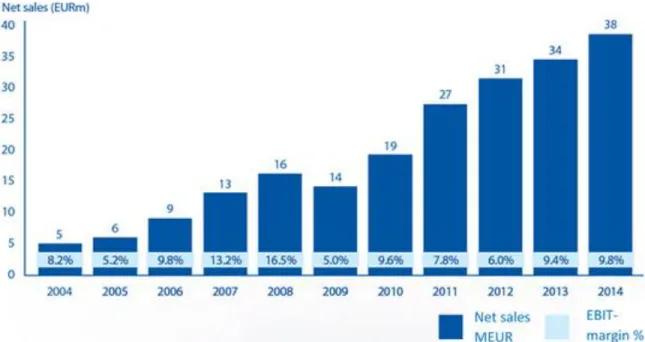
Product- and activity costs have not been assessed very specifically in the case company. This must not be interpreted that managing costs is not regarded important in the case company. In fact, overall cost monitoring has been a key factor in its pursuit for competitive advantage, albeit it has been conducted on broader reporting levels. The company has achieved a profitable revenue growth over the last ten years, and growth targets have been
prioritized over other possible business targets. Over the span of these years, company management has educated themselves in different cost management techniques and methods and that’s where the interest towards this pilot project stems from. The project is aimed to research better cost assessment practices in activities and improve process management in their daily activities that create value. This would help recognizing opportunities to lower costs.
1.2.Research problem and research questions of the study
The motive of this thesis is to deepen the knowledge of the case company’s cost structure in their three main product lines: Product line A, product line B and product line C, which generate over 80 per cent of in house –manufactured products’ revenue. A time-driven activity based costing model was developed for each one of these product lines.
Figure 1. Theoretical framework of the study.
The theoretical framework of the study is illustrated in the figure above. This picture will act as the core of the study, showing how the study will progress from the literature review to the empirical analysis of the case company’s activities.
The research questions of the study can be capsulized as the following:
1. How to pilot an activity based costing model in a company that has no previous experience of it?
2. What kind of cost information can the costing system provide about the activities of the case company?
The answer to the first question will act as a framework to the other questions. The costing model built will be analyzed thoroughly and from this analysis questions 2 and 3 can be answered.
1.3.Research methods
This master’s thesis was conducted as a qualitative case study based on the operations, interviews and data of a company in the construction and mining industry.
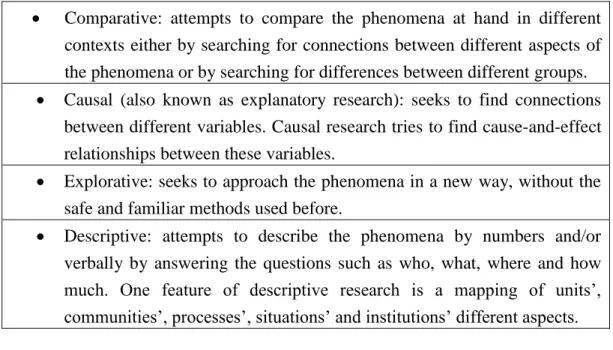
Table 1. Different ways to conduct empirical research (Soininen 1995: 15-16). Comparative: attempts to compare the phenomena at hand in different
contexts either by searching for connections between different aspects of the phenomena or by searching for differences between different groups. Causal (also known as explanatory research): seeks to find connections
between different variables. Causal research tries to find cause-and-effect relationships between these variables.
Explorative: seeks to approach the phenomena in a new way, without the safe and familiar methods used before.
Descriptive: attempts to describe the phenomena by numbers and/or verbally by answering the questions such as who, what, where and how much. One feature of descriptive research is a mapping of units’, communities’, processes’, situations’ and institutions’ different aspects.
Hirsjärvi, Remes & Sajavaara (2014: 137) describe quantitative methods having the following aspects:
conclusions from earlier research and theories presenting a hypothesis
attempt to define concepts presented
Hirsjärvi et al. (2014: 161, 165) have also pointed out some of the main features of qualitative research:
a comprehensive approach to gathering data careful evaluation of the object of research
The research plan takes its form as the research progresses. Plans change if circumstances change
Qualitative research uses inductive analysis. The aim of the research is to find and reveal unexpected phenomena and results. The research does not try to test a theory or hypothesis. The starting point is in detailed and versatile examination of materials. The research is treated as a unique case and the data is interpreted as unique data
To conclude, the aim of qualitative research is to find or reveal facts, not verifying existing hypothesis or theories.
The nature of this study is qualitative research with quantitative features. The data used is collected mainly from interviews and discussions of the case company’s management and key personnel. The study also uses some numerical data, collected from interim reports, income statements, balance sheets and previously conducted costing analyses. This study has some descriptive and explanatory features with the emphasis on describing and explaining the current state of cost structure and value chain activities in the case company. This study used also participatory techniques in data gathering, as the researcher participated in some of the activities studied to get a better understanding of how the process researched functioned. According to Kiviniemi (2001:68), qualitative research has some distinct features: the data is usually collected by observing and by choosing a carefully selected sample of the data instead of random sampling. Kiviniemi (2001:68) adds that in qualitative research the material is interpreted in relation to its context, and that it is a holistic approach to handling data.
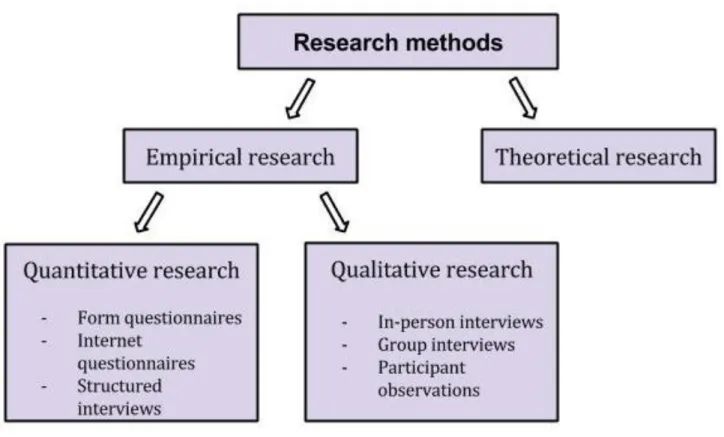
In figure 2 below are the typical characteristics of qualitative and quantitative research methods:
Figure 2. Differentiation and typical characteristics between qualitative and quantitative research methods. (Heikkilä 2001: 3-4)
1.4.Structure of the study
This study was kicked off in the May 2015 and it was finished in January 2016. The beginning of the study project was mainly used as gathering scientific literature and deepening knowledge about the topic. Data gathering for the empirical part started taking into account the timetable of the case company and the researcher. This was done to prepare for the empirical part of the research, as well as to build the theoretical framework of the topic. The study is divided into theoretical and empirical parts. In the second chapter, the theoretical framework of the study is presented by introducing concepts of cost management and cost
accounting as well as different methods to conduct costing systems. In the third chapter, the case company is introduced. Chapter 4 consists of the costing system created for the case company. The chapter describes how the costing system was built. Chapter 5 presents findings, analyses the cost structure of the case company and presents suggestions for potential cost reduction targets. Chapter 6 concludes the study by arguing its successfulness and the concept of costing systems in general.
2. MANAGEMENT ACCOUNTING
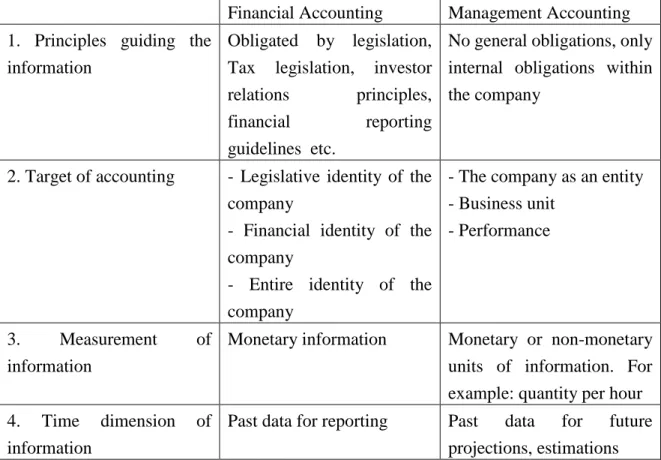
Management accounting as a term might be confused with cost accounting. Horngren, Datar & Foster (2006:2) states that the line is not very clear; the main purpose to conduct cost accounting is to make better management decisions, and in some literature these terms might be interchangeable. The definition of cost accounting will be processed later in this chapter. Distinguishing management accounting from financial accounting can be confusing for the unversed person, but they have profound differences which are easy to learn and comprehend. The main differences are listed in the table below:
Table 2. General differences of financial and management accounting paraphrasing Neilimo & Uusi-Rauva (2005:35).
Financial Accounting Management Accounting 1. Principles guiding the
information
Obligated by legislation, Tax legislation, investor relations principles, financial reporting guidelines etc.
No general obligations, only internal obligations within the company
2. Target of accounting - Legislative identity of the company
- Financial identity of the company
- Entire identity of the company
- The company as an entity - Business unit
- Performance
3. Measurement of information
Monetary information Monetary or non-monetary units of information. For example: quantity per hour 4. Time dimension of
information
Past data for reporting Past data for future projections, estimations
As with many other concepts, there is no clear definition to what management accounting is and it can be described from many different angles. Atkinson, Kaplan, Matsumura & Young (2012: 26) describe management accounting as “the process of supplying the managers and employees in an organization with relevant information, both financial and nonfinancial, for making decisions, allocation resources, and monitoring, evaluating, and rewarding performance. The reported expense of an operating department, such as the assembly department of an automobile plant or an electronics company, is one example of management
accounting information.“
The Institute of Management Accountants (2008) has defined management accounting with the following words: “Management accounting is a profession that involves partnering in
management decision making, devising planning and performance management systems, and providing expertise in financial reporting and control to assist management in the formulation and implementation of an organization’s strategy.” Similar definitions have been stated to describe Strategic Management Accounting (SMA): “A form of management
accounting in which emphasis is placed on information which relates to factors to the firm, as well as non-financial information and internally generated information” (Chartered Institute of Management Accountants in the UK 2000: 50). Marketing Management and Management Accounting insights mixed with the framework of Strategic Management have contributed to the birth of the concept of SMA (Roslender & Hart 2003). SMA is also very orientated towards the future whereas traditional management accounting can be geared towards history coupled with a focus on singe decisions, single periods and single entities (Horngren, Bhimani, Datar & Foster 2005: 790).
Puolamäki (2007: 21-23, 60) states that management accounting supports management’s long-term decision making, producing information about the structure of the business, competitive positioning and resource allocation, and also takes into account the subjective interpretations of information outside of the company. Näsi (2006: 60) approaches the subject from a need of change in financial administration. The role of financial management personnel has changed from a “historians playing with numerical data” to “modern
controllers, who often belong to the board of directors and who play an important role providing financial advisement and frequently act as change agents.”
Cost traceability to specific cost objects has tremendous benefits in various decision-making roles of an organization. For instance product costs, personnel hiring, production setup and
logistics contract negotiations all produce cost data that is crucial in the decision-making process. (Olsen 1998.)
2.1. Cost Management
Tanaka et al. (1993: 13) have said that for cost management to work, managers need to comprehend the concepts of cost, have basic knowledge of the factors which affect and drive costs and understand how their decisions change costs. Understanding these basic principles help initiating and making decisions which will improve the performance of the cost-effectiveness of an organization. Other implemented principles that successful cost management requires are continuous and integrated activity throughout the entire product and service life cycles of an organization and cost management policy integrated into the organization. These principles can result in growth, stability and strength to an organization. This demands a reliable flow of relevant cost information, which is presented to the relevant persons in a clear and useful fashion. (Tanaka et al. 1993: 13.)
Cost management can also be seen as a management philosophy; continuous cost control and reduction accompanied with careful consideration of customer needs adds up to a holistic management approach. Cost management influences all levels of the organization, implementing constant cost-awareness and consciousness to these levels. (Tanaka, Yoshikawa, Innes & Mitchell 1993; Horngren et al. 2006: 4.)
Cost management as a concept can be presented in many ways. Anderson (2005) argues that cost management has become a synonym to cost cutting in the media, which is usually initiated after disappointing financial reports and when sustainable profits are in danger to decline.
Sticky costs mean that management is not able to reduce costs when uncertainty remains in the business activities. Managers have to recognize the need of adjusting committed resources to changes in activity-based demands for those resources. Sticky costs behavior can reveal management’s competence to execute deliberate decision making when assessing the economic consequences of their actions. (Anderson, Banker & Janakiraman 2003, Noreen
and Soderstrom 1997.) Anderson et al. (2003) conclude: “costs decrease less with the
declines in activity than the increase in activity.”
2.2. Cost Management in Lean organizations
As companies are more and more focused on their core competencies, they outsource a higher percentage of the total cost of their products and more substantial items that do not rely upon their core competencies (Gilley & Raheed 2000). There are many reasons why a company chooses to use an external supplier for these items. Nishiguchi (1994) names a few: supplier’s superior cost efficiency, functionality and quality, and their ability to implement new technologies in a faster, more efficient way. Albeit many outsourcing decisions are made based on the factors above, there are more variables that stir the equation. Not all items that a company decides to outsource are products or process commodities. Many companies decide to outsource because they want to utilize knowledge that is proprietary to the supplier or the buyer (Cooper & Slagmulder, 1999).
It is often stated that the best opportunity for cost reduction and thus cost management is at the product development phase. Lean organizations have a great challenge in cost management in products since these organizations might have outsourced the majority of the value added in their product and most of the support activities. Lean organizations have developed cost management systems according to their own needs which help them to control cost-reduction activities through the whole life cycle of products. High dependence upon the suppliers have pushed the development efforts for cost reduction in interorganizational cost management programs (IOCM). (Cooper & Slagmulder 1998, 1999).
2.3. Cost Accounting
Horngren, Datar & Foster (2006: 2) describe cost accounting as a term used to describe a series of functions that measure, analyses, and reports financial and non-financial information relating to the costs of acquiring or using resources in an organization.
The evolution of cost accounting has been heavily influenced by the size, strategy, competition, organizational structure, market demand and agents of change (Boyns & Edwards 2006).These factors continue to be very important drivers in the modern world as well.
Traditional cost accounting has been a useful and easy-to-use cost accounting tool because it has been based on calculating the variable costs and thus has provided relevant information for short term decision-making (Lukka & Granlund 1996). The problem with traditional cost accounting has been that the costs are allocated solely on variable costs such as working hours, which might not be the right indicator to describe costs (Cooper & Kaplan 1988). Gupta & Galloway (2003) add that traditional cost accounting has to find different methods how to understand and classify costs so that the cost accounting model is as accurate as possible. Cooper & Kaplan (1988) predicted this already in 1988, when they wrote that traditional cost accounting models have to be adjusted because they do not give an accurate description of the costs of products and services.
As the figure on the next page illustrates, direct material and direct labor costs are allocated straight to the product costs, whereas overhead costs have to be allocated by cost pools in relation to the variable costs.
Overhead costs are costs that can’t be allocated directly to the cost objects. For example rent costs and administration costs are overhead costs. Hence they have to be organized into cost pools so that the costs can be allocated to the end products.
Cost pools are groups of individual cost items. Cost pools can range from small to very large in sizes, for example from big manufacturing plant costs to small operative metal-cutting machines. Cost-allocation bases are usually organized jointly with cost pools. It can be argued that cost pools are to traditional costing what activities are to activity -based costing; the costs in the cost pools are further allocated to the cost drivers to estimate how costs are accumulated. (Horngren et al. 2006: 98; Dyson 2007: 320).
Figure 3. Traditional cost accounting system paraphrasing Alhola & Lauslahti (2000:213).
Cost allocation is a reference to assigning costs to a cost object. Cost-allocation bases tries to answer a simple question: How should an organization allocate costs to operate, for example metal cutting machines, collected in a single cost pool among different products? One option would be to allocate the costs on the basis of the number of machine –hours used to produce the different products. The cost-allocation base links in a systematic way an indirect cost or group of indirect costs .A cost-allocation base can be nonfinancial (such as the number of machine-hours), or financial (such as direct labour costs). Cost -allocation bases are the link that an organization uses to connect the overhead costs to the cost object (for example products and services). Organizations tend to use the cost driver of indirect costs as the cost allocation base. This is because cause-and-effect link between changes in
the level of the cost driver and the changes in the indirect costs. (Horngren et al. 2006: 98; Caplan 2007).
2.4. Activity-Based Costing
Activity- based costing (ABC) is a method developed in the late 1980’s to tackle problems that traditional product cost analysis couldn’t solve. Traditional cost analysis was seen as an outdated method, which wasn’t able to target overhead costs fairly to a certain product. Activity- based cost analysis can produce a lot of useful information of a co mpany’s functions and costs. It also offers options to improve the performance of a company. Activity- based management (ABM) has emerged as a management method from ABC, and it focuses on process analysis and improvement based on activity- based costing (Neilimo & Uusi-Rauva 2005: 144). Since its inception, it has been a popular topic and in the interest of many business schools, consultants and business media. It has been able to dodge and wiggle its way through criticism by constantly changing its features and core arguments (Innes & Mitchell 1998; Jones & Dugdale 2002).
ABC can be defined as a system of: “calculating the costs of individual activities and
assigning those costs to cost objects such as products and services on the basis of the
activities undertaken to produce each product or service.” (Horngren et al. 2006: 145.) The
core of ABC is the revealment of the business’s true costs. For instance, suppose that 20 per cent of a particular firm’s total sales volume is coming from an international retailer with whom the firm does business. In addition, the firm does business with a local retailer that contributes about 3 per cent of the total sales volume. Because of the bigger sales volume of the international retailer, it may look like the big international customer is more valuable than the smaller local one. This is not the whole truth. When the costs of doing business with each company are compared to the actual revenues earned by each company, the smaller retailer actually provides a higher total profitability of an account. Why does the smaller firm provide more comparable profit than the larger firm? It is because individual activities that are required in doing business with the smaller firm are less expensive than those needed for the larger firm. (Gooley 1995; Lin, Collins & Su 2001.)
Most of the articles about activity –based costing has been published in the 1980’s and 1990’s, and it has been a very popular research topic from different angels and from international and national aspects.
Activity-based costing went from theory to corporate practices faster than any other method before in the history of accounting. ABC has always been under the critical eye of potential improvements. One reason for this is that several academics and users of ABC have criticized the system to be too expensive, complicated, heavy and difficult to adjust to companies’ unique needs. ABC critics have also pinpointed the problem of the amount of cost drivers. This might lead into useless and unproductive analyses (Wegman 2009). Dyson (2007:306) has claimed that ABC’s methods of indirect cost management in product costs involves some pretty questionable procedures and there is much controversy within accounting academics whether these methods are useful or reliable. He concludes that the assessment of the usefulness of these methods should not be left to the accountants, and managers who take into account the results of these methods should voice their opinion of the methods for the best of organization. (Dyson 2007: 306.)
Activity-Based Costing sheds light to the operations in an organization and makes its activities more understandable. One can create a map of an organizations operations and simplify its processes. Once the activities have been mapped, operative and upper management have often stated that it’s the first time they are given an understandable insight of what is going on in the organization. On top of that, with Activity-Based Costing one can see how much operations cost and what kind of activities and resources products, services and customers consume. (Lumijärvi, Kiiskinen & Särkilahti 1995: 20.)
In their book The Rise and Fall of Management Accounting, Thomas Johnson and Robert Kaplan (1991:12) discussed the problems management accounting faced: the information that it provides is too often too late, too unorganized and lacking focus to be informative and helpful for management decision making. This information was tied to universal accounting regime. Partially because of these problems, activity- based costing stated for its purpose gain ground and develop into a fully functioning operative management tool. (Johnson & Kaplan 1991: 12.)
One main reason why companies have moved from traditional cost accounting systems to activity-based costing is the over- and undercosting problem that comes with the broad
averaging -principle. Activity-Based Costing is one of the best tools to refine the costing system. It offers better measurement of the costs of indirect resources used by different cost objects-regardless of how differently the different cost objects use indirect resources. (Horngren et al 2006: 143.)
The popularity of activity –based costing was high in the 1990’s. A big reason for that was the automation of production, which caused direct labor costs to decline and indirect labor costs to increase. This has also caused an increase in relative marketing and sales costs. Activity –based costing is particularly applicable in analyzing invariable indirect costs, which are what for instance marketing and sales costs generally are. (Srindhi 1992: 199; Jyrkkiö & Riistama 2004: 176.)
Horngren et al. (2006: 143-144) describe four principal reasons why companies usually need to refine their costing systems:
1. Increase in product diversity. Customized products are in higher demand in order to differentiate themselves from the competitors. Thus product portfolios have also expanded. Different products make different demands on the resources needed to produce them because of differences in volume, complexity and processes. The resources demanded by these different products need a more sophisticated costing system which is able to give more accurate cost measurements than a simple costing system. Indirect costs must be allocated to different products, and the straightforward approach of for example direct manufacturing labor hours as cost drivers will result in inaccurate and misleading product costs. (Horngren et al. 2006 :144.)
2. Increase in indirect costs. Process and product technology advancements have increased the indirect costs companies face nowadays. This is particularly true in formerly labor intensive manufacturing, where plant automation has decreased the need for human labor. The complicated technology in automated processes and diverse product ranges requires need committed resources for support functions, such as production scheduling and process engineering. Because direct manufacturing labour is not a cost driver of these costs, allocating indirect costs on the basis of direct manufacturing labour doesn’t measure how resources are being used by different products accurately. (Horngren 2006: 144.)
3. Advances in information technology. Costing system refinements require more data gathering and analysis, which leads to the costing system to be more detailed. Advancements in IT and the simultaneous decline in data tracking costs has made cost –effective cost systems available. (Horngren 2006: 144.)
4. Competition in product markets. Ever increasing competition in the markets, more accurate cost data helps managers to make strategic decisions, for example in pricing and in the product portfolio. This is very important in competitive markets where competitors capitalize on a company’s mistakes. (Horngren 2006: 144.)
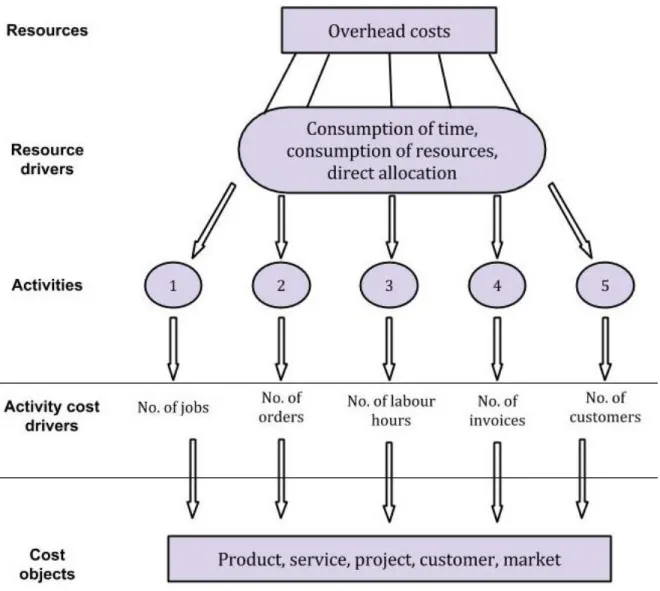
As Figure 4 above illustrates, there are various concepts that are important in ABC:
Resources. In order to succeed in their business, companies need different resources, such as personnel, machines, premises and equipment. Resources are factors of production which make business activities possible. Resources are basically an indicator of how much cash has been used for each activity. (Alhola 1998: 46.) Resource drivers. Cost drivers are a crucial part of understanding activity-based
costing. A cost driver is a factor that allocates the overall costs to activities and cost objects. Generally speaking one can divide cost drivers into two categories: resource drivers and activity cost drivers. Resource drivers allocate resources to activities. (Alhola 1998:46).
Activity cost drivers. Activity cost drivers allocate resources from activities to cost objects. A cost driver can disclose what resources are used by certain activities and it is also a concept which is used to allocate costs. (Alhola 1998: 46, Alhola et al. 2000:214). Michael Porter (2008: 63) describes cost drivers in his classic book
Competitive Advantage as “the structural determinants of the cost of an activity,
reflecting any linkages or interrelationships that affect it".
The difference between a cost driver and cost allocation bases that were described in the previous chapter is that a cost driver is an economic concept that relates to the economic reality of the business. A change in the cost driver (for instance the number of labor hours) changes the total cost of a related cost object. A cost allocation base is more abstract; it is an accounting choice made by managers and accountants. Many times the best option for a cost allocation base is a cost driver. (Caplan 2007).
Every organization that faces any complexity in their business knows that accurate cost assessment of outputs is close to a utopia. An approach based on activities provides means of associating resource consumption with products which is more vigorous and fine-tuned than the conventional methods of standard costing and broad averaging. Activity-Based Costing provides extra detail and visibility of output costs, which can lead to give managers an enhanced vision of costs and behavior. It also gives an opportunity to exploit a wide range of cost management possibilities. Management has to take into account that ABC is a defensible method and studies have shown that when comparing manufacturing and service
organizations it produces very different results which can raise a variety of issues for management. (Hopper, Northcott & Scapens 2007: 126.)
In addition to revealing a company’s internal costs of activities, ABC can help in figuring out the true costs of doing business with a particular customer, supplier or distributor by comparing the revenues earned to the cost caused by each particular entity. One of the most influential factors of ABC awareness comes from the change in the nature of costs. In recent decades, manufacturing has transformed substantially and overhead costs have increased measurably. (Lin et al. 2001; Develin 1999.)
The essence of activity -based costing is finding a logical connection between products and costs. A good question to ask is: what does the product truly cost and what costs should be allocated to this particular product? By observing the subject from the needs of resources and resource utilization point of view, one can approach costs from a more accurate perspective. Activities have a crucial role in this. As a natural continuation from ABC is utilizing cost information for active management of costs and ultimately increasing the competitiveness of the organization. (Neilimo & Uusi-Rauva 2014: 144). As stated before, active cost tracing and analysis can give significant advantage to decision-making. This is particularly true in ABC, where one can trace cost directly to the cost objects utilizing the activities.
Studies have been conducted about the benefits of activity -based costing. One of the studies researched the benefits of ABC in manufacturing companies. All of the companies that participated in the study had benefited from implementing ABC. These companies also used ABC information heavily in management decision making. (Swenson 1995: 167-180.) Shields (1995: 148-166) stated that 75 per cent of the 143 companies participated in his study had benefited from implementing ABC. Kennedy & Affleck (2001) made a study comparing the market value of British companies which had used an ABC model for three years to those without an ABC model. The market value of companies with an ABC model was 27 per cent higher to those without one. Over 800 companies participated in the study.
2.5. Time -driven activity based costing
Time -driven activity based costing (TDABC) is a slightly modified version of the traditional ABC described in the previous chapter. It was created by Robert Kaplan and Steven Anderson. Robert Kaplan was one of the pioneers of creating the traditional ABC as well, so he has had a strong influence in creating both methods.
Wegmann (2008) has argued that traditional ABC is a complicated and expensive system that is hard to implement, which leads to small to medium sized enterprises to abandon it as their costing system. Collecting data for the cost drivers is time consuming and the amount of drivers can grow easily, resulting in increasing implementation and maintenance costs. From these disadvantages springs TDABC. There are only two estimates needed to start building a TDABC model. These are the cost per time unit of supplying resource capacity and the unit times of consumption of resource capacity by products, services and customers. (Kaplan & Anderson 2004.)
Time driven activity based costing eliminates the laborious and vague task of defining resource and cost drivers. In essence, there is only one driver which is time. This democratizes the cost driver selection process from traditional ABC; all activities have the same driver. There are a few exceptions to this, for instance the cost of warehouse space taken by a product is difficult to model through time. Complexity in processes and activities can be captured by creating time equations. (Kaplan & Anderson 2004.)
For instance, if the time to perform an order entering activity is 2 minutes with an old customer and 5 minutes with a new customer, and an additional 4 minutes if the product ordered is a special product, the TDABC model can form an equation such as the following:
𝑋 = 2𝑦 + 5𝑧 + 4𝑟 Where:
x= total time required for performing the activity
z= quantity of new customer orders handled (if old customer, value is 0) r= quantity of special products ordered (if not special product, value is 0)
The time consumed by an activity is almost the only cost driver needed in TDABC. The assessment of the times consumed can be done either by interviewing employees or observing and timing the activity time. An activity is a work phase in a process needed to be completed in order to complete the process. The equation illustrated above is a process, where order handling, with a new or old customer, is an activity.
2.6. Capacity cost rates
One time unit’s resource cost consists of all possible costs, which have been divided by the time available to perform an activity. By doing this, the cost of one time unit will be €/min, if the time unit chosen is minute. The TDABC analysis can be done on a monthly basis, or even on a yearly basis. Much depends on the nature of the business of the company. If there is a lot of volatility between quarters, a more frequent analysis may be beneficial. A big advantage of the TDABC model is the ease of doing modifications. The analysis can be done based on budgeted costs or on closed accounts, depending on the purpose. (Kaplan & Anderson 2004.)
The equation below describes the capacity cost rate equation:
𝐶𝑎𝑝𝑎𝑐𝑖𝑡𝑦 𝑐𝑜𝑠𝑡 𝑟𝑎𝑡𝑒 = 𝐶𝑜𝑠𝑡 𝑜𝑓 𝑐𝑎𝑝𝑎𝑐𝑖𝑡𝑦 𝑠𝑢𝑝𝑝𝑙𝑖𝑒𝑑
𝑃𝑟𝑎𝑐𝑡𝑖𝑐𝑎𝑙 𝑐𝑎𝑝𝑎𝑐𝑖𝑡𝑦 𝑜𝑓 𝑟𝑒𝑠𝑜𝑢𝑟𝑐𝑒𝑠 𝑠𝑢𝑝𝑝𝑙𝑖𝑒𝑑
The practical capacity of resources supplied is meant to reflect the actual capacity that a resource is available for productive work. Kaplan & Anderson (2004) suggest using a figure representing 80-85 per cent of the time spent at work, if more accurate calculations are not made. In this study, more detailed calculations were made and can be found in chapter 4. For machine resources, Kaplan & Anderson suggest using 85 per cent of the theoretical
maximum capacity. More accurate machine resource calculations were also made for this study and can be found also in chapter 4.
The cost of the capacity supplied consists of all costs that the resource uses during the observation period. It is important to note that if the resources in a process observed are not similar, i.e. the cost of capacity supplied or practical capacity of resources supplied differ from each other, separate capacity cost rates must be calculated. For example, if completing a process or activity needs labor from both humans and machines, they must be calculated with separate capacity cost rates. The cost calculation formation of this study can be found in chapter 4 (Öker & Adiguzel 2010.)
Traditional ABC does not take into account the excessive capacity that process or activity might have very accurately. One reason is that TDABC uses practical capacity instead of theoretical capacity, which traditional ABC does not. Traditional ABC is usually completed in a survey based approach, which leads overestimation of the costs of performing activities, thus resulting in less accurate representation of capacity usage. For example, usually employees have to estimate how much time they spend on a list of activities, which have to result in 100 per cent. By doing that cost driver rates are calculated assuming that resource capacities are fully used, when in reality some part of their time is unproductive or idle. (Stout & Propri 2010; Öker & Adiguzel 2010)
2.7. Cost hierarchy
An important aspect to remember in activity –based costing is cost hierarchy. As common sense gestures, not all cost information is equal or as important as others. The differences between various cost types must be taken into account when forming a activity –based costing system. The cost accounting researchers have quite widely agreed on four different levels of activity cost pools. They can be found in virtually every company, defining cause-and-effect relationships and in different degrees of difficulty. (Horngren et al. 2006: 147; Ittner, Larcker & Randall 1997; Kaplan 1990.)
Unit-level costs are costs of activities performed on each individual unit of a product or a service, i.e. activities performed in proportion to the volume of units produced. Costs increase
when the product is produced in growing quantities. Machine working hours are categorized as unit –level costs. (Horngren 2006: 147; Ittner et al. 1997.)
Batch -level costs are costs that occur when activities are performed in proportion to batches, independent to the number of units produced in the batch. Quality inspection costs and machine setup costs are examples of batch -level costs. (Horngren et al. 2006: 147; Ittner et al. 1997.)
Product sustaining costs are the costs of activities performed to support individual products or services regardless of the number of the number of units or batches in which the units are produced. These costs are usually part of the product portfolio, for example design costs and marketing costs fall into this category. Design costs do not increase or decrease if the product manufacturing quantity changes. Horngren et al: 2006: 148; Ittner et al. 1997.)
Facility –sustaining costs are costs that cannot be assigned to any other category, because they affect the whole organization. These costs include facility rent costs and top management compensation fees, for instance. It can be hard to find a reasonable effect relationship between these costs and the cost-allocation base. This lack of cause-and-effect results in companies reluctant to assign these cost to products, and instead simply deduct them separately from the operating income. (Horngren et al. 2006: 148; Ittner et al. 1997.)
These four levels are paramount in ABC by providing a framework for understanding cost behavior and hence forms a basis to understand product profitability and other cost implications. ABC trail blazers Cooper & Kaplan (1991: 271) have argued that costs should be assigned to different hierarchy levels so that managers can identify what costs are essential for different types of decision making. The idea behind hierarchical costs is that by segregating costs like this the activity-based costing system will only take relevant costs into consideration. (Ittner et al. 1997.)
2.8. Activity Analysis
Before resources and costs can be allocated to activities and further down to cost objects, the activities must be defined. This can be done by conducting an activity analysis. In an activity analysis, all of an organizations actions and processes are divided down to activities. As a result of the analysis one can discover an organizations current protocols in addition to the resources needed for different activities and how much these activities consume resources. In short, the activity analysis tells what is happening in the organization and how are the resources being utilized. (Alhola et al. 2000: 215.)
Activity analysis is a useful tool to map which activities consume the most resources. This is usually not the main objective in activity analysis, but often a resource consumption mapping can give the organization valuable information of its activities. For instance, if an organization emphasizes customer-orientation in its culture, one can evaluate how many of its most resource-hungry activities are directly related to the customer. It is surprisingly common that an organization which has such an emphasis does not have a single customer-driven activity in its top resource consumers. Most of the resources are consumed by internal processes and activities. Often an activity analysis gives upper management their first real overview of what is truly going on in the organization and how the activities are linked to each other. (Alhola et al. 2000: 215; Lumijärvi et al. 1995: 32.)
Activity analysis consists of different phases that most implementation methods use. First one must describe the activities and activity chains. After this, costs for these activities are calculated. As a final phase, activities are classified by their importance. Very often activities and activity chains are mapped by interviewing an organizations key personnel and management. A crucial part of a successful activity analysis is proper documentation of the different phases. Without this, the project becomes very difficult to manage.
The amount of activities included in the analysis depends entirely on what is wanted from the analysis. There is little point in including 150 or more activities, if the purpose of the analysis is to figure out whether the cost objects are profitable or not. In this case it could be sufficient to include “sales and sales analysis” into one activity instead of breaking it down to several, almost task-level activities. (Lumijärvi et al. 1995: 39.) There has also emerged some evidence that the activity analysis is actually the most beneficial part of activity based
costing because of its relative simplicity to conduct and everyday operations information it provides to management (Rautesalo 2002: 57).
2.9. Differences between activity- based costing and traditional costing methods
Traditional costing methods are premised on calculating costs of products. This means that indirect costs are divided into cost pools and further on to products by using allocation factors based on volumes such as machine hours, labor hours and direct materials. However, volume based allocation creates inaccuracies to the calculations if the costs are not measured by volume based metrics in the activities. Activity- based costing focuses on allocating indirect costs more accurately. By allocating the costs to separate activities, an organization is able to manage the activities and factors that cause the majority of the costs in a more effective way. The basic idea behind traditional cost methods and activity-based costing is the same; both consist of a cost allocation process of two phases, but the allocation philosophy is different. (Brimson 1992: 24-25, Maynard & Zandin 2001: 354-256.)
Activity-based costing emphasizes the deep understanding of the activities of an organization, processes and sources of costs it provides over the costing method itself and its techniques. An activity- based costing system does not reveal anything else than what possible problem occurs in an organization. Its success is heavily influenced by the utilization of the information provided. (Brimson 1992: 46.)
Horngren et al. (2006:156) have listed signs that can indicate whether an organization can gain advantages and reap the most benefits from implementing ABC. Usually management decides the level of detail of the costing system by contemplating the costs of the costing system versus the expected benefits of making better decisions based on information produced by the costing system. Below are some these signs:
Significant amounts of indirect costs are allocated into only a few cost pools.
The personnel in charge of operations do not agree with the accounting personnel about the cost structure of manufacturing, marketing, products and other important activities.
Most of the indirect costs in an organization are identified as output unit-level costs. This means that few indirect costs are described as batch-level costs, facility-preserving costs or product-sustaining costs.
Disproportionate profits in different product groups: products that a company is well suited to produce seems to be making small profits, and less suited products are making big products.
Products make different demands on resources because of differences in process steps, size of batches, complexity and volume. (Horngren et al 2006: 156.)
Compared to ABC, there are two profound disadvantages in traditional costing methods: The inability to provide accurate cost information about individual products, processes and customers, and the insufficient information it produces to support upper management decision-making. (SAS Institute 2007: 3-4.) This is because of the negligence standard costing methods have towards the cause and effect -principle of cost accounting, which results in a blurred understanding of product-based costs and profitability. (Neilimo & Uusi-Rauva: 2014: 144.)
What usually causes the inaccurate cost information of traditional costing methods is the over-simplified way overhead costs are allocated to products, especially in relation to direct labor costs, paid salaries or hours worked. However, many overhead costs do not have a direct cause and effect –connection. In cases like these the cause and effect –principle might have been overlooked which can result in a distorted picture of product costs and profitability. This is particularly true in companies producing many different products. The situation might be even worse in companies where direct labor costs might have decreased in relation to other costs, for example when labor has been transferred from people to machines. This change has increased the overhead costs. Some of the products might be subsidizing others in the costing system. What is more, a company might have used cost centers that are too broad. This could have happened if the cost centers were defined for supervising responsibility areas, not for following product costs. This kind of wrong implementation of cost management tools might have led to arbitrary allocation of overhead costs. (Neilimo & Uusi-Rauva 2012: 144.)
A natural starting point to start allocating company costs to activities and products is the premise of products being the root of all costs in a company. From this basis one can consider the best way to calculate costs with respect to the cause and effect –principle. A lot costs are
divided into fixed and variable costs, mainly because of the old principle in income statement publishing. This might be a deceptive point of view because fixed costs change with the time span of observation. For example rental costs and interest rates change over time. (Neilimo & Uusi-Rauva 2014: 144.)
2.10. Activity-Based Management
Activity-Based Management (ABM) is often the next natural step for an organization after implementing Activity-Based Costing. In fact, many academics argue that these concepts are intertwined so that one can’t live without the other. ABC provides the information and data for ABM to prosper. From a practical point of view, the relationship between ABC and ABM quite very similar to other ways that management philosophies and their auxiliary principles’ relationships, such as Total Quality Management (TQM) and the PDCA – cycle (Plan, Do, Check, Act). The PDCA –cycle and ABC both serve a bigger purpose than their own output of information; they are tools for decision making processes which value and utilize a certain type of information. Obviously there are a myriad of other factors that management has to consider besides activity costs and process quality which affect the decision making in many ways.
Horngren et al. (2005: 791) have mentioned that external factors relating to the customer, technological advances and the market have given rise to several new management accounting innovations such as Activity-Based Management and it can be categorized as a dimension of Strategic Management Accounting.
According to Laitinen (2001: 12-13), Activity-based costing is not useful for an organization before it is implemented as a part of an organization’s decision making. Activity -based Management is essentially making use of the cost information extracted from Activity -based Costing. ABM is a systematic approach of managing activities as a part of the business process (Cokins & Capsusneanu 2011).
Activity –based management has been seen as having problems in improving its value measurement features; it hasn’t been able to measure value-added from the customer’s perspective. A change in this would change the focus of ABM from costly activities to the
activities that create the most value. Costly activities aren’t always the easiest to improve, either. ABM has been seen as a way for cost minimization, not value maximization. For it to thrive, emphasis for value maximization should be on value-added activities, and search for cost minimization from activities that do not add value. (Ashton, Hopper & Scapens 1995: 105.)
What is very worthwhile noting is that it is entirely possible to apply ABM practices without an activity –based product costing system, and indeed many companies do that. This does however require identification and cost management of activities in the company, but activity cost pools are not linked to individual product lines. These companies often identify the related cost drivers for activity cost pools in order to achieve a better understanding of their overhead cost behavior. This type of activity -based information is the basis of the cost management system which ideally leads to classification of activities, where real surprises and valuable information of activity resource consumption is often found. (Ashton et al 1995: 128-129.)
2.11. Possible drawbacks encountered with ABC systems
When considering different theories and methods of doing things, it is important to present the possible disadvantages of the particular method used. Without careful analysis of strengths, weaknesses, opportunities and threats one can’t make an informed decision of usable methods. Activity –based costing has some managerial and operational implications that need to be addressed properly.
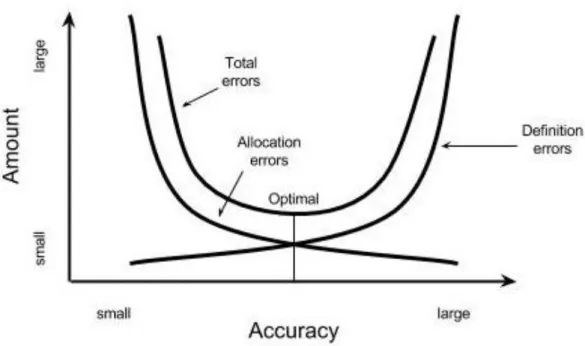
According to numerous surveys and studies the biggest stepping stone in ABC implementation is its excessive complexity. Over-complicating the system should be avoided with great determination. When designing and implementing the system one must always choose between model accuracy and model complexity. After a certain stage increasing accuracy does not provide additional value to decision making. Common sense is a virtue also in activity –based costing. (Lumijärvi et al. 1995: 60.)
Datar & Gupta (1994) have come to a conclusion that increasing activities, cost pools or cost drivers does not increase result accuracy. It is apparent to them that direct allocation and activity definition errors increase in correlation with the model complexity. Also Cooper (1990) has had similar statements, and adds that one must have enough activities and cost object to analyze, but every target must be well justified.
Figure 5. Choosing the optimal amount of drivers and activities paraphrasing Cooper (1998: 217.)
Rautesalo (2002) surveyed a large number of Finnish companies in his master’s thesis
”Researching management accounting: case activity -based costing” in order to look into
the state of activity –based costing systems in these companies. He argued that the two biggest reasons for ABC systems to fail are excessive emphasis on its technical aspects and project initiatives coming outside the organization. Focusing on technical aspects easily overshadows organizational factors in cost system implementation. This can be a significant issue, since international literature and research suggests that organizational factors play a bigger role in ABC implementation success than technical factors. This is tightly bound to the other big failure reason of outside initiatives; if the willingness and commitment within the organization is not in place, outside consultants have a thin chance to succeed. The best
chances for the ABC project to succeed and add value to decision making is often when the old cost accounting system used in the organization is not able to answer questions that need to be answered. Without this internal driver, useful results were scarce. (Rautesalo 2002; Shields 1995; Nicholls 1992.)
A lot of disappointments encountered with ABC are results of ill-advised project planning and poor preparation for the costing system. Below are some of the most common mistakes and shortcomings that management teams across the world have often overlooked working with activity –based costing.
1. Lack of perfect cost data
Every cost accounting system has its flaws, and ABC is not an exception. Imperfect data is a major contributor to inaccurate results. It is virtually impossible to track and attach every thinkable resource cost to a particular activity. Depending on the company, hundreds or even thousands of activities happen every day. Some activities might not be measured or even identified without significant efforts. Therefore it may not be worthwhile to calculate the costs for such activities. Nevertheless, conducting ABC analysis with the largest resource – hungry activities does help to reveal true costs. The lack of prefect cost data can discourage management from using costing systems, but more important should be to acknowledge this flaw rather than let the disadvantages overpower the advantages in decision-making. (Harrison & Sullivan 1995; Lin et al. 2001.)
2. Loss of customer focus
Focusing on cost management can deter the concentration of management from other important aspects of business, such as customer focus. For example, the whole output of logistics is customer service. The cost information that ABC provides should be geared towards customer service as much as profit potential improvement. There have been studies concluding that management might focus too much on costs at the expense of customer service. (Harrison & Sullivan 1995; Develin 1999: Lin et al. 2001.)
Activity –based costing and cost management methods in general shed light into the very activities that employees perform each day, thus giving answers to questions regarding a company’s overall performance. These answers may not be beneficial or received well by everybody in the company. Employees might start to fear for their jobs or the loss of customers. Change resistance can be a big issue if drastic re-organization of day-to-day operations is necessary. Detailed plan of action once the cost information is provided by the costing system is important for successful implementation. (Morton 1997a, 1997b; Develin 1999; Lin et al 2001.)
A worthwhile note about the problems of ABC is from Ashton et al. (1995: 135): many problems associated with ABC are problems with costing systems in general. For instance lack of staff time, scarce IT –resources and resistance of personnel reflect the more general issues of making any changes to the management accounting system. (Ashton et al. 1995: 135.)
2.12. Value chain analysis as a cost reduction tool
Kaplan and Cooper (1998) have stated that: “ABC information can be used across the entire value chain, to reduce the total costs of production and support, not just the obvious costs of direct materials, labor, and machining.”
Govindarajan & Shank (1992: 180) have described the essence of value chain analysis in the strategic management accounting context as follows: “The chain of activities that runs from basic raw materials to end-use customers into strategically relevant segments in order to understand the behavior of costs and the sources of differentiation”. Value chain analysis is also seen as an important part of supply chain relationships. It is particularly useful in optimizing, coordinating and analyzing linkages between activities in the value chain. This is done by focusing on the interdependence that can be found between these activities. In general, an organization can gain competitive advantage by either keeping value produced constant while reducing costs, or by increasing value produced while keeping costs constant. (Porter 2008; Govindarajan & Shank 1993).
A value chain perspective to cost management requires the organization to recognize their product in the value chain activities, expanding from suppliers to end customers. The accounting information produced must enable improvement of internal cost management performance. It is important to acknowledge that the emphasis is not solely on competition, but also on the interaction that organizations have with their suppliers. (Govindarajan & Shank 1993.)
What traditional accounting systems lack from the perspective of strategic value chain analysis planning has been discussed by Hergert & Morris (1989): Traditional accounting systems do not focus on critical activities but on responsibility centers. Also, they are not well suited for giving a good reflection of the economics of performing an activity and they are unable to give out data about important cost drivers. Lastly, traditional accounting systems are poor in assessing the interdependence of subunits (which for example activities are). This is a flaw in the systems because the performance and cost of one subunit is very often dependent of the performance and cost of other subunits. (Hergert & Morris 1989.) The issues that were mentioned in the chapter above can be addressed with management accounting practices, such as strategic cost management and activity-based costing. Strategic cost management was developed for embedding accounting information into companies’ strategies and its further development. As research in the area developed, strategic cost management was introduced under the umbrella of strategic management accounting, which consists of key strategic dimensions in competitor analysis, strategic positioning analysis and analysis of the value chain in which an organization operates. Strategic cost management has introduced methods where management accounting information can be of use to give support for decisions related to these different strategic dimensions. The exploitation of linkages with buyers and suppliers can be addressed by performing a value chain analysis, and this a crucial component of strategic management accounting. Activity-based costing has offered a solution for some of the issues of performing a company -internal value chain analysis because of its nature of allocating costs to activities and identifies the specific drivers of those costs. (Shank 1989; Govindarajan & Shank 1992, 1993; Lord 1996; Dekker 2002).