Title: Shareholder votes on directors’ remuneration
IA No: BIS 0341
Lead department or agency: BIS
Other departments or agencies:
Impact Assessment (IA)
Date:09/05/2012
Stage: Final
Source of intervention: Domestic
Type of measure: Primary legislation
Contact for enquiries: Gemma Peck 020 7215 1984
Summary: Intervention and Options
RPC Opinion: RPC Opinion StatusCost of Preferred (or more likely) Option Total Net Present
Value
Business Net Present Value
Net cost to business per year (EANCBon 2009 prices)
In scope of One-In, One-Out?
Measure qualifies as
£m £m £m Yes IN
What is the problem under consideration? Why is government intervention necessary?
Over the last decade, CEO pay in the UK’s largest listed companies has quadrupled, with little evidence that this is a result of improved performance or in any way connected to shareholder returns. Pay policies which do not
appropriately link pay to company strategy and performance have an economic cost through diminished shareholder returns, weakened corporate governance and reduced confidence in the corporate sector. This calls into question whether the ‘principals’ (i.e. shareholders, the owners of companies) have the right mechanisms and sufficient
information to influence and control the ‘agents’ (directors) appointed to run the company on their behalf. Shareholders have told us that companies’ remuneration reports are complex and opaque and the existing advisory vote on
directors’ pay does not sufficiently incentivise companies to act on shareholder views. Government has a role to address these regulatory failures in the corporate governance framework around directors’ pay. This IA is particularly focused on encouraging improved shareholder engagement and corporate accountability through a strengthened model of shareholder voting on directors’ remuneration.
What are the policy objectives and the intended effects?
The policy objective is to address failures in the governance of directors’ pay by equipping shareholders with the enhanced tools they need to challenge companies. Shareholder empowerment lies at the heart of the UK’s corporate governance framework and these reforms are consistent with that approach. They will enable shareholders to promote a stronger, clearer link between pay and performance and to challenge companies on rewards for mediocrity or failure, while still allowing for exceptional performance to be rewarded.
What policy options have been considered, including any alternatives to regulation?
(1) Give shareholders a binding vote on future pay policy and an advisory vote on how policy has been implemented in the previous year, plus a binding vote on exit payments
(2) Give shareholders a single binding vote on all pay and remuneration issues. (3) Requiring a higher level of shareholder support on pay-related resolutions. (4) Status quo
The preferred option (1) will give shareholders real tools to challenge on directors’ pay and prevent rewards for failure, while minimising administrative costs and legal risks.
Options 1,2 and 3 are regulatory but in all cases, Government would work with companies and investors on non-regulatory measures to improve the quality and usefulness of company remuneration reports and to promote good practice, including simplification of pay.
Will the policy be reviewed? It will be reviewed. If applicable, set review date: 10/2015
Does implementation go beyond minimum EU requirements? Yes Are any of these organisations in scope? If Micros not
exempted set out reason in Evidence Base.
Micro No < 20 No Small No Medium Yes/No Large Yes/No What is the CO2 equivalent change in greenhouse gas emissions?
(Million tonnes CO2 equivalent)
Traded:
Non-traded:
I have read the Impact Assessment and I am satisfied that, given the available evidence, it represents a reasonable view of the likely costs, benefits and impact of the leading options.
Signed by the responsible SELECT SIGNATORY: Date:
Summary: Analysis & Evidence
Policy Option 1
Description: A binding shareholder vote on future pay policy, advisory vote on how pay policy has been implemented and binding vote on exit payments.FULL ECONOMIC ASSESSMENT
Net Benefit (Present Value (PV)) (£m) Price Base
Year
PV Base Year
Time Period
Years Low: Optional High: Optional Best Estimate:
COSTS (£m) Total Transition
(Constant Price) Years
Average Annual
(excl. Transition) (Constant Price)
Total Cost
(Present Value)
Low Optional Optional Optional
High Optional Optional Optional
Best Estimate
Description and scale of key monetised costs by ‘main affected groups’
We have discussed this further with stakeholders during the consultation and do not believe that these reforms to shareholder voting will lead directly to any costs that can be monetised for the purpose of this IA.
Other key non-monetised costs by ‘main affected groups’
There may be some costs in relation to increased shareholder engagement and the time companies spend on updating their policy towards directors’ remuneration but these depend very much on the circumstances of the individual company and its shareholders and the behavioural response of both groups to the proposed changes.
There is a potential cost of holding an additional General Meeting to vote on revised pay proposals (where the original proposals were voted down), but consultation responses indicate that companies will take action to avoid such an outcome.
BENEFITS (£m) Total Transition
(Constant Price) Years
Average Annual
(excl. Transition) (Constant Price)
Total Benefit
(Present Value)
Low Optional Optional Optional
High Optional Optional Optional
Best Estimate
Description and scale of key monetised benefits by ‘main affected groups’
Benefits to business and shareholders as a result of pay schemes being better designed and more closely aligned with performance could be significant; but this is difficult to monetise as very much depends on the behavioural response of individual companies and managers, wider economic circumstances and the evolving regulatory environment.
Other key non-monetised benefits by ‘main affected groups’
Better engagement between shareholders and companies at the point pay is being designed should help to reduce the number of occasions where payouts are out-of-synch with performance; which will subsequently reduce engagement costs.
Better-designed pay has the potential to create more appropriate incentives for directors to promote the long-term value of companies, which will benefit shareholders.
Could also lead to more efficient allocation of resources (i.e. more paid in dividends to shareholders instead of ‘excessive’ reward to directors).
Ultimately we would expect a more engaged and empowered shareholder base to lead to better corporate governance in UK companies which is associated with lower costs of capital. These measures are widely supported by a range of business and investor stakeholders (see section 2 below)
Key assumptions/sensitivities/risks Discount rate (%)
Additional votes at AGM have a marginal cost close to zero (confirmed via discussions with registrars).
The impacts of this policy intervention depend on the ability and resource of shareholders to use the strengthened voting mechanism as leverage with company management; and willingness of companies to respond.
Effectiveness of the proposed policy will depend also on the complementary policy measures being
implemented in relation to transparency of directors’ pay and best practice with regard to the structure of pay.
BUSINESS ASSESSMENT (Option 1)
Direct impact on business (Equivalent Annual) £m: In scope of OIOO? Measure qualifies as
Costs: Benefits: Net: Yes IN
3
Evidence Base (for summary sheets)
This proposal fulfils a Coalition commitment to removing obstacles to growth whilst ensuring responsible corporate behaviour. The UK is widely seen as a leader on corporate
governance1 and this is important for making the UK an attractive place to invest and do business.
Summary
This IA sets out the argument and evidence to support the government’s preferred option for improving the UK shareholder voting regime with respect to executive remuneration in quoted companies. This follows further formal and informal consultation with stakeholders after the consultation stage IA. Proposals with respect to transparency around executive pay are covered in a separate IA (BIS 0355).
The IA sets out the background to the current regulatory regime in relation to executive
remuneration in quoted companies including the voting and reporting framework. It goes on to identify concerns that have been raised by shareholders in recent years. These include: poorly structured remuneration reports that fail to demonstrate a link between pay and performance, a lack of transparency by companies in reporting their remuneration packages, the limited impact of the current advisory shareholder vote on remuneration reports and excessive exit payments for departing directors.
Evidence is presented demonstrating the lack of a link between executive remuneration and company performance, changes in the level and structure of executive remuneration over the last decade, possible explanations for this rise in remuneration and the impact of the current advisory shareholder vote.
The IA makes clear that the proposals with respect to the shareholder voting regime are only one part of a broader package of measures to tackle the issues raised. Other measures include those to improve transparency on executive remuneration for shareholders and non-regulatory measures to improve best practice amongst remuneration committees and shareholders. The rationale for further policy intervention in this area reflects the failure of the current regime to correct fully the underlying market failure. This arises when shareholders delegate the day to day responsibility of managing the company to corporate managers, which gives rise to
information asymmetries that executive remuneration policies are designed to correct. The objectives of the proposed policy intervention therefore include greater leverage for
shareholders over executive remuneration policy, better engagement between companies and shareholders, and ultimately an improved link between executive remuneration and company performance.
Responses to the previous consultations and informal stakeholder engagement are reflected fully in the IA to illustrate the way in which the policy has developed and to emphasise the level of support amongst the business and investor community for additional measures in this policy area.
Finally, the IA sets out in more detail the four key policy options considered in relation to the shareholder voting regime and their associated costs and benefits. The preferred option would give shareholders binding votes in relation to future pay policy and exit payments and a
standalone advisory vote on the implementation of policy in previous years (where a binding 1
4
vote could be problematic in practical terms for companies). The preferred option has been amended slightly since the consultation stage IA to reflect stakeholder concerns and provide more flexibility for companies in reporting their pay policy to shareholders. The other options set out here and in the earlier consultation IA did not achieve sufficient stakeholder support and are not being taken forward.
Following feedback from the RPC and others the IA now includes a more detailed discussion of the likely behavioural impacts following the implementation of the preferred policy option.
The costs and benefits of all four options remain unmonetised but a further explanation of the reasons for this has been added reflecting the difficulty of measuring likely benefits in advance of policy implementation and the disproportionate effort needed to identify relatively marginal increases in potential costs to companies and shareholders. The IA however concludes that the potential additional costs for the 1200 UK quoted companies within scope are likely to be
significantly outweighed by the improved company performance that can result from better aligned executive remuneration.
For One In One Out purposes the measure qualifies as an “in” reflecting the regulatory tightening proposed and the lack of monetised costs and benefits.
I. Problem under consideration
Background1. The case for regulation of directors’ remuneration arises because of a well established market failure at the heart of the corporate governance regime. Classic agency theory suggests a relationship where the owners of companies (shareholders) delegate management of the company to their agents (directors). This separation of ownership from control leads to information asymmetries2 and leaves room for directors to act in their own self-interest to the detriment of the owner. Within the classic principal-agent theory3 literature, directors’ pay is a key mechanism for helping to minimise agency costs in order to align the incentives of
managers with the interests of shareholders. It follows that where shareholders do not maintain control over directors’ pay there is a strong theoretical likelihood that directors will exhibit rent-seeking behaviour or pursue a strategy which rewards them personally but does not contribute to the long term value of the company4.
2. It is responding to this market failure that has driven the UK to regulate the processes of setting and reporting on directors’ remuneration for over eighty years. During this time disquiet about directors’ ability to reward themselves with excessive pay packages has surfaced
periodically, leading to a number of legislative and non-legislative changes in the corporate governance framework. That disquiet has become more acute in recent years in the context of the economic downturn and the continued growth in directors’ pay, especially amongst FTSE 350 companies. Over the last 12 months there has emerged a consensus that the present system is in need of reform.
Current regulatory framework for directors’ pay
3. The last major change to the regulatory framework surrounding directors’ pay came into effect in 2003. In line with the traditional model of UK corporate governance, the regulatory
2
Where managers are better informed about their levels of effort and its impact on company performance than shareholders. 3
Theory explaining how principals and agents interact and in particular how principals ensure that agents (in this case corporate managers) act in the interests of shareholders in a situation where managers always have more and better information.
4
5
framework is complemented by market rules5, ‘comply or explain’ guidance in the UK Corporate Governance Code6 and good practice principles issued by investors.7
4. Specifically, all quoted companies (i.e. those incorporated in the UK and listed on a main stock exchange in the UK, US or an EEA state – currently around 1,200 companies) are required by the Companies Act 20068 to produce a Directors’ Remuneration Report (DRR) as part of the annual reporting cycle. The contents of the report are prescribed by regulations9 and it must contain details of:
The company’s policy on remuneration
Salary, bonus and share-based compensation of each individual director
Pension arrangements
Performance conditions for any share-based schemes
Policy on notice periods and termination payments
5. Companies must put this report to shareholders for a vote at the Annual General Meeting (AGM) by means of an ordinary resolution. This resolution invites shareholders to approve the directors’ remuneration report (DRR). It does not ask shareholders to approve the payments made to individual directors. As section 439(5) of the Companies Act 2006 states, “no
entitlement of a person to remuneration is made conditional on the resolution being passed”. The effect of this is to make the vote ‘advisory’ in nature. It sends a signal to the company but the company is not bound by law to take any action in response to the vote.
6. The Companies Act 2006 also requires shareholder approval of payments for loss of office made over and above that which the company is legally obliged to pay. This vote does have legal effect and the company may not make any such payment without shareholder approval. However, the reality is that shareholder approval for payments for loss of office is never sought because payments made to departing directors are invariably pursuant to the terms of the individual’s service contract and other legal agreements, or discretions created through those agreements.
7. In addition to the requirements in company law, market Listing Rules require all UK listed companies to comply with (or explain why they do not) the UK Corporate Governance Code. This includes provisions on the make-up and role of remuneration committees, the pay setting process and the structure of pay. The Listing Rules also require shareholders to approve any new share-based reward schemes, for all employees and not just directors. Companies
typically seek approval every five to ten years for the broad structure of these schemes, but not the detail. This is done by means of a binding shareholder resolution at the AGM.
The growth in directors’ pay
8. Well-structured directors’ remuneration, which is clearly linked to the strategic objectives of a company, can promote business stability and growth. However, over the last decade,
directors’ pay in quoted companies has increased substantially whilst overall company
performance has been poor and thus the link between remuneration and company performance has been hard to discern. Academic research has pointed out that, despite directors’ pay
typically being viewed as an instrument of corporate governance used for addressing agency problems, the design of directors’ pay can be subject to substantial managerial influence, 5
UK Listing Rules www.fsa.gov.uk/pubs/other/listing_rules.pdf 6
UK Corporate Governance Code
www.frc.org.uk/documents/pagemanager/corporate_governance/uk%20corp%20gov%20code%20june%202010.pdf 7
For example, Association of British Insurers’ Principles of Remuneration 2011 www.ivis.co.uk/ExecutiveRemuneration.aspx 8
Sections 420-422, 439 Companies Act 2006 9
thereby becoming inherently part of the agency problem itself.10 Consequently, the intended relationship between pay and performance can break down if the design of pay packages is more reflective of managerial rent-seeking than the establishment of efficient incentives which lead management to maximise shareholder value.11
Various academics have studied the link between directors’ pay and long term company performance. Main and Smith (2011)12 found little evidence of a correlation between pay and performance in the UK, with executives presiding over a destruction of shareholder value receiving almost as much as those who created shareholder value.13 Furthermore, the
sensitivity of pay to performance is higher for value creators than for value destroyers. This is consistent with the findings of Gregg et al. (2010)14 and van Reenan (2011)15 who also
document an asymmetric relationship between pay and performance in the UK. Over time, a relatively weak downward sensitivity of pay can lead to a “ratchet effect”, with pay increasing during high performance periods but not falling when performance is poor or stagnant.
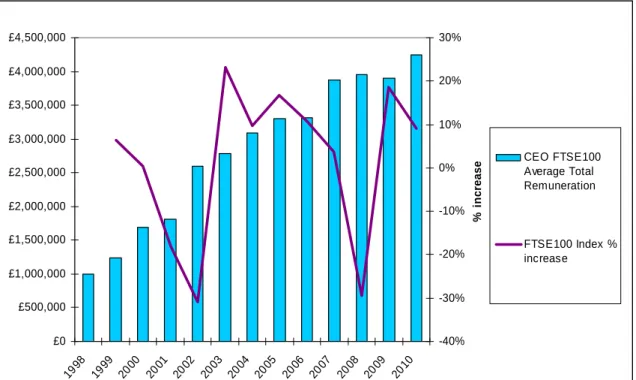
Figure 1: Comparison of FTSE100 CEO average total remuneration and FTSE100 performance 1998-201016
£0 £500,000 £1,000,000 £1,500,000 £2,000,000 £2,500,000 £3,000,000 £3,500,000 £4,000,000 £4,500,000 1998 1999 2000 2001 2002 2003 2004 2005 2006 2007 2008 2009 2010 -40% -30% -20% -10% 0% 10% 20% 30% % i n crease CEO FTSE100 Average Total Remuneration FTSE100 Index % increase 10
Bebchuk, Lucian Arye and Jesse M. Fried (2003), “Executive Compensation as an Agency Problem”, Journal of Economic Perspectives, 17(3), pp. 71-92.
11
A number of authors have noted that certain aspects of pay design are more reflective of managerial rent-seeking than efficient incentive design:
Blanchard, Olivier Jean, Florencio Lopez-de-Silanes and Andrei Shleifer (1994), “What do Firms do with Cash Windfalls?”, Journal of Financial Economics, 36(3), pp. 337-60.
Yermack, David (1997), “Good Timing: CEO Stock Option Awards and Company News Announcements”, Journal of Finance, June, 52, pp. 449-76.
Bertrand, Marianne and Sendhil Mullainathan (2001), “Are CEOs rewarded for luck? The Ones Without Principals Are”, Quarterly Journal of Economics, August, 16(3), pp. 901-32.
12
University of Edinburgh Business School submission to the Kay Review. 13
The upper quartile of value destroyers in their sample received £2.4m versus the median value creating executive’s total of £2.1m. 14
Gregg, Paul, Sarah Jewell and Ian Tonks (2010), Executive Pay and Performance in the UK, LSE. Available at http://www2.lse.ac.uk/fmg/workingPapers/discussionPapers/DP657_2010_ExecutivePayandPerformanceintheUK.pdf. 15
Brian Bell and John van Reenan (2011), Firm Performance and Wages: Evidence from Across the Corporate Hierarchy, LSE. Available at http://cep.lse.ac.uk/conference_papers/04_11_2011/BellVReenen_FirmPerformanceandWages.pdf.
6 16
7
9. The average total remuneration of FTSE100 CEOs has risen from an average of £1m to £4.2m (13.6% a year) for the period 1998-2010. This represents over a four fold increase(See figure 1 above) .17 This is faster than the increase in the FTSE100 index, retail prices or
average remuneration levels across all employees which have risen 4.7% for the same period. By comparison to the growth in pay for executive directors, employees have seen much slower growth in earnings.18
10. Executive remuneration in FTSE250 companies has also risen fast, albeit at a slower rate, while growth in average CEO salaries in Small Cap and AIM companies has been more
modest.19
11. Research looking at the reasons for the growth in pay has reached different conclusions, with many studies pointing to the difficulty of identifying causal effects. As a result, no single, clear reason has emerged and the trend is most likely to be a combination of factors.20 In a BIS discussion paper21 issued in September last year, we explored these issues further.
12. Company size and complexity can explain some of the increase in directors’ pay, with one study finding that the increase in CEO pay in the United States could be directly linked to the market capitalisation of large companies during the same period.22 This may help to explain some of the faster growth in pay seen in the FTSE100 relative to smaller quoted companies but not the prolonged rise we have seen in the face of poor equity returns.
13. One of the most frequently cited reasons for high levels of pay is the impact of the
international market for CEOs and the need to pay above average to attract the very best talent and mitigate against a flow of UK executives to other countries. However, the evidence to support this is limited and the proportion of non-UK directors in UK companies has remained relatively stable over time. Increasing globalisation should have increased the number of potential candidates for director level posts, which arguably should have helped depress pay - but we have seen no evidence of this happening. International comparisons of pay are difficult to make given the complexity of the packages in place and limited disclosure in some countries, but studies tend to find that executive pay is highest in the US (reflecting a more significant reliance on equity based rewards23) with the UK some way behind and most other European countries at a slightly lower level than the UK.
The structure of remuneration
14. The structure of remuneration has changed significantly over the past two decades as an attempt to address the principal–agent problem and improve the pay-performance link, so that most companies now pay a much larger proportion of remuneration in the form of variable and deferred pay. Most directors’ pay packages contain the following elements:
17
This figure includes salary, bonus, deferred bonus, other benefits, long-term incentives, share options and pensions. Taken from: Manifest/ MM&K, The Executive Director Total Remuneration Survey 2011, May 2011. Available at: http://blog.manifest.co.uk
18
We are well aware of the issues involved in looking at the average instead of the median when the distribution is skewed, but have chosen to use mean figures for data availability reasons. Furthermore, the picture does not materially change when the median is used. According to IDS data, median lead executive earnings for the FTSE 100 has tripled over 2000-2011, which clearly represents a significant upward trend (see
Graph 1.1 of the IDS Directors' Pay Report 2011/12). .
19
Hutton Review of Fair Pay in the public sector, Interim Report, December 2010. Available at: http://www.hm-treasury.gov.uk/d/hutton_interim_report.pdf
20
Frydman, C & Jenter, D., CEO Compensation, Rock Center for Corporate Governance at Stanford, November 2010. University Working Paper No. 77
21
http://www.bis.gov.uk/assets/biscore/business-law/docs/e/11-1287-executive-remuneration-discussion-paper.pdf 22
Gabaix, X. & Landier, A ., Why has CEO pay increased so much? April 2007. Quarterly Journal of Economics 23
For evidence that adjusting for the equity component of pay is important in explaining the US pay premium, see the study by Fernandes et al. (2011), “Are US CEOs Paid More? New International Evidence”, SSRN Working Paper.
Base Salary: usually determined through benchmarking, based on general industry salary surveys supplemented by detailed analyses of selected industry or market peers.
Annual Bonus/Incentive Plans: Typically bonuses pay out an award based on the
performance of the company over no more than one year, usually the previous financial year. The payments may be made in cash or shares or a combination.
Deferred Bonus Plans: annual bonus plans which incorporate an element of deferral.
Long-Term Incentive Plans (LTIPs): LTIPs typically involve the granting of shares to directors after a three year period upon the achievement of performance criteria, and must include some qualifying conditions with respect to service or performance that cannot be fulfilled within a single financial year.
Share Option Plans: Share option plans are contracts giving directors the right to buy shares at a pre-specified price for a pre-specified period of time, which usually starts three years after the agreement of the plan and ends no later than ten years after it. Share option plans are non-tradable and are often forfeited if the executive leaves the firm before they become exercisable.
Retirement Plans: Top executives routinely participate in supplementary retirement plans in addition to the company-wide pension plan.
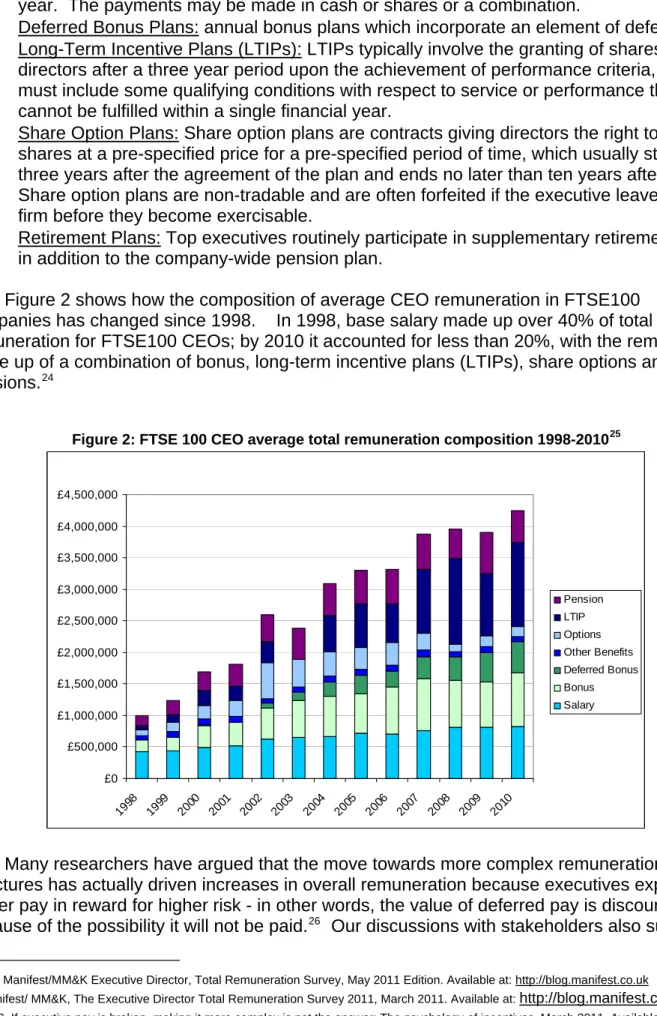
15. Figure 2 shows how the composition of average CEO remuneration in FTSE100 companies has changed since 1998. In 1998, base salary made up over 40% of total
remuneration for FTSE100 CEOs; by 2010 it accounted for less than 20%, with the remainder made up of a combination of bonus, long-term incentive plans (LTIPs), share options and pensions.24
Figure 2: FTSE 100 CEO average total remuneration composition 1998-201025
£0 £500,000 £1,000,000 £1,500,000 £2,000,000 £2,500,000 £3,000,000 £3,500,000 £4,000,000 £4,500,000 199 8 199 9 200 0 200 1 200 2 200 3 200 4 200 5 200 6 200 7 200 8 200 9 201 0 Pension LTIP Options Other Benefits Deferred Bonus Bonus Salary
16. Many researchers have argued that the move towards more complex remuneration structures has actually driven increases in overall remuneration because executives expect higher pay in reward for higher risk - in other words, the value of deferred pay is discounted because of the possibility it will not be paid.26 Our discussions with stakeholders also suggest
24
The Manifest/MM&K Executive Director, Total Remuneration Survey, May 2011 Edition. Available at: http://blog.manifest.co.uk 25
Manifest/ MM&K, The Executive Director Total Remuneration Survey 2011, March 2011. Available at: http://blog.manifest.co.uk
8 26
PwC, If executive pay is broken, making it more complex is not the answer: The psychology of incentives, March 2011, Available at: http://www.pwc.co.uk/eng/publications/if-executive-pay-is-broken-making-it-more-complex-is-not-the-answer.html
9
that the complex structure of pay makes it hard to disentangle what executives are actually earning and for shareholders to judge whether this is appropriate. Furthermore, inadequate or obtuse linkage between pay and performance has the potential to provide incentives for
directors which are badly aligned with those of shareholders and consequently lead to the potential for rent extraction as well as affecting the quality of the directors’ relationship with wider stakeholders, including employees.
17. A PwC review of executive remuneration27 summarises the problem:
The increase in pay has mainly been in the form of higher annual bonuses and long-term incentive (LTI) awards, which are nearly always performance-related. As our previous research has shown, the outcome has left almost everyone dissatisfied:
Generally management feel that incentives have become too complex and prescriptive, and are not aligned to the business strategy or within their control. As a result, they do not believe incentives drive performance or change behaviours and many perceive incentives simply to be a lottery.
Many institutional shareholders believe there is a tenuous link between pay and performance.
Few really believe that complex long-term incentives retain executives; they just make it more expensive for a new employer to buy-out the executive with golden hellos and guarantees.
The public, particularly since the banking crisis, see executive pay as nothing other than a gravy train – pay regardless of performance rather than pay for performance.
Complexity of reporting on pay
18. There have been various private sector28 and regulator reviews29 of the quality of UK companies’ narrative reporting/business reviews (covering mainly quoted companies) over the last ten years. In general these reviews have found that the quality of narrative reporting is improving but that there is still considerable variation and room for improvement between the best and worst performers. There are also concerns with the increasing length and complexity of company reports. That is why BIS has recently consulted on changes to the regime for company narrative reporting and will shortly bring forward final proposals for improving the reporting regime.30
19. There is also a particular concern amongst stakeholders that substantial lack of transparency surrounding directors’ pay results in asymmetry of information and moral hazard31. Despite companies already being required to give very full disclosure of remuneration under the Directors’ Remuneration Report Regulations, companies are not required to give a clear figure for total remuneration for each individual director; and many do not provide a clear line of sight between levels and structure of remuneration and directors’ performance in meeting the
company‘s strategic objectives. This view is supported by recent research looking at the remuneration reports of FTSE150 companies, which found that only around a third clearly disclosed how remuneration is dependent on performance;32 and also by feedback on our earlier consultation on company reporting:
27
http://www.pwc.co.uk/en_UK/uk/assets/pdf/executive-compensation-review-of-the-year-2009-pwc.pdf 28
For example, “Swimming in Words” Deloitte survey of narrative reporting in annual reports (October 2010) and “A Snapshot of FTSE 350 reporting” PWC (2009).
29
Financial Reporting Council (FRC) reports “Louder then Words” (2009) “Cutting Clutter” (April 2011).
30
http://www.bis.gov.uk/Consultations/future-of-narrative-reporting-further-consultation 31
Moralhazard is a situation where there is a tendency for managers to take undue risks because the performance costs are borne by shareholders. This situation often arises because information asymmetries mean it is difficult for shareholders to judge the performance of their managers and the decisions they make.
10
“We need more transparency. We need more coherent and pared down remuneration reports, which do not blind shareholders with the science. Good regulation should require companies to make remuneration reports less dense and less confusing. […] We agree that it would be helpful to have disclosure of a single figure of the total non-pensionable remuneration for each director.” - Railpen Investments
“When directors’ rewards are significantly more generous than those given to other employees, there must [be] a clear and solid explanation about the link between pay and performance; and, furthermore, there should be no reward for failure. Complex bonus structures and the lack of transparency around boardroom pay are part of the problem. If we are to make progress on executive remuneration, it is critical that boardrooms explain clearly how rewards are linked to performance and how that impacts shareholder value.” - NAPF
“Improved transparency would also help underpin our robust system. Changes should include disclosure of a single aggregate figure for directors’ taxable remuneration, explanation of the nature of performance measures and additional disclosure relating to remuneration consultants.” - CBI
Limited impact of the advisory vote on the Directors’ Remuneration Report
20. The advisory vote on the Directors Remuneration Report, which came into effect in 2003, was designed to empower shareholders and give them an effective and more focused way in which to influence directors’ pay. It encouraged shareholders to become more engaged in corporate governance and to develop relationships with the companies they invest in.33 21. A number of high profile cases in the early years cemented the importance of the remuneration report and shareholder vote. For example there are cases of companies that have conducted full reviews of executive pay following major shareholder revolts, such as GlaxoSmithKline in response to an advisory vote against its policy in 2003.34 The proportion of dissenting votes reduced to around 3% in 2008 but the financial crisis predictably led to an increase in shareholder activism and in 2009, around one fifth of FTSE100 companies had more than 20% of their shareholders withhold support for their remuneration reports.35 The frequency of such significant votes against has since declined, but individual cases continue to attract a great deal of attention.36
22. Whereas most company resolutions at AGMs receive near unanimous shareholder support, resolutions on remuneration see on average 10% of voting shareholders voting against. Academic studies37 have also found that this level of dissent is higher than against other company resolutions and that companies with the highest paid CEOs have seen higher levels of dissent.
23. In the vast majority of cases, remuneration reports are passed by a substantial majority and this is often reflective of sustained and effective shareholder engagement over the course of the year and particularly in the run-up to the vote. However, the average figures disguise a small but significant number of cases where a large proportion of shareholders withhold support
33
PIRC and Railpen Investments, Say on Pay: Six Years on: Lessons from the UK Experience, September 2009. Available at: http://www.pirc.co.uk/sites/default/files/documents/SayonPay.pdf
34 PIRC and Railpen Investments, Say on Pay: Six Years on: Lessons from the UK Experience, September 2009. Available at:
http://www.pirc.co.uk/sites/default/files/documents/SayonPay.pdf
35
PwC, Executive Compensation: Review of the Year, 2009. Available at:
http://www.pwc.co.uk/eng/publications/executive_compensation_review_of_the_year_2009.html 36
Barclays stung by shareholder pay revolt, http://www.bbc.co.uk/news/business-17860232 37
Conyon, Martin and Graham Sandler (2010), “Shareholder Voting and Directors’ Remuneration Report Legislation: Say on Pay in the UK”, Corporate Governance: An International Review, 18(4), pp. 296-312.
11
for remuneration proposals. In the 2007-2011 period there were 68 examples of remuneration reports which received in excess of 30% of shareholder votes against – three times the average level of dissent. More worryingly historical voting records, feedback from shareholders and anecdotal evidence suggests that in many of these cases, companies are not responding adequately to shareholder concerns. The public statements made by companies following relatively high votes against remuneration reports demonstrate the different attitudes towards responding to the existing advisory vote:
“We have noted the disquiet expressed by some of our shareholders and have recorded it for future reference” – FTSE250 firm’s response to 40% of shareholders withholding support for the remuneration report
"The vote on the report was carried by a very substantial majority of shareholders, who recognise that the group needs to retain its world class talent by running an effective remuneration policy. We will continue a dialogue with our shareholders on this important issue." – FTSE250 company’s response to 29% votes cast against the remuneration report
“This strikes me as being a matter of excessive micro managing.” - FTSE100 CEO response to 42% votes cast against the remuneration report
24. Under current rules, the shareholder vote is advisory and based on the entirety of the remuneration report, covering both retrospective and future pay policy. Companies are not obliged to take any action based on the outcome of the advisory vote, as a result of which shareholders have little leverage. We have heard from a range of major institutional shareholders who are frustrated that there are a number of companies seeing significant shareholder dissent year-on-year. For example:
“Under the current system where there is no formal sanction for a high level of shareholder opposition companies can be rather disingenuous in the manner they interpret such feedback. Also because points of contention are normally associated with awards already granted, companies often disregard such shareholder opposition as ex post. For this reason, it is all too common for there to be a lack of tangible reforms or even extended dialogue in response to such votes.”38
25. At present, there exists no guidance on how companies should respond to shareholder dissent on remuneration votes and in the responses to our earlier discussion paper,
shareholders expressed their frustration that some companies fail to respond when a significant number of shareholders vote against remuneration proposals. Shareholders typically consider 'high' dissent to constitute 20% or more shareholders voting against (twice the average level of dissent for pay reports in the FTSE350). The evidence shows that within the FTSE100 alone there are four companies that have seen more than 20% of their shareholders voting against their remuneration report four times in the nine years that the vote has been in force,
demonstrating that the advisory vote in its current form has limited effect.39
26. In many cases shareholders choose to 'abstain' on the vote on the remuneration report to signal their discontent without going so far as to vote against management. This figure is not always apparent but is important as can represent a large number of shareholders refusing to back the remuneration report. Between 2007 and 2011, there were 11 companies in the FTSE All-Share Index that saw 50% of votes cast going against the remuneration report. But
including abstentions shows that 19 companies actually failed to get a simple majority of all 38
Co-operative Asset Management, response to Executive Remuneration Discussion Paper 39
12
shareholders. In one FTSE250 example, the company ostensibly received 97% support for its remuneration report at the 2011 AGM. However, a closer look at the figures shows that a substantial number of shareholders abstained and taking this into account, almost a third of shareholders failed to back the report.40
27. It is worth noting that the UK shareholder base has become more fragmented and
internationalised over the past 10 years. In the UK the proportion of shares owned by domestic institutional investors (insurance companies and pension funds) who have traditionally devoted significant resources to corporate governance issues, have declined significantly (from over 50% in 1990 to around 15% today). However, within the overall figures, there is strong evidence of shareholder activism on pay, including among the largest institutional shareholders. This is confirmed by data from a leading proxy adviser which shows that major investors are more likely to vote against remuneration reports than other company resolutions and that some of the largest UK investors voted against over 50% of remuneration reports on which they had a vote in 2010 - suggesting a significant level of concern41.
Limited levers to prevent rewards for failure
28. Individual cases of directors who have left companies with substantial exit packages have attracted widespread criticism from shareholders and the public who see this as ‘payment for failure’. Given the significant rewards that directors typically accrue over the course of their career, including sizeable pensions, the Government sees no clear case for them to receive exit payments that represent an extremely generous package in comparison to other employees’ termination packages; in particular where their performance has been poor.
29. Nonetheless, the practice of paying large exit payments to departing directors has become embedded in corporate practice. Shareholders currently have limited leverage on this issue because they have no direct role in negotiating or agreeing directors’ service contracts and other arrangements, and it is these documents which make provision for such payments to be made.
30. Over the last ten years, best practice on corporate governance has evolved to address this issue. The Companies Act 2006 requires that compensation payments to directors for loss of office (other than those paid as part of an existing legal obligation) should be put to a
shareholder vote. It also requires such approval for contracts of more than two years in length (five years in length under predecessor legislation). Reporting regulations require that details of service contracts and notice periods of directors be included in the Directors’ Remuneration Report, and in the most recent revision of the UK Corporate Governance Code (2010),
companies are advised to adopt one year contracts for directors. Institutional shareholders have also issued good practice guidance on this issue, stating that:
"It is unacceptable that poor performance by senior executives, which detracts from the value of an enterprise and threatens the livelihood of employees, can result in
excessive payments to departing directors. Boards have a responsibility to ensure that this does not occur."
31. The trend towards shorter contractual notice periods has been a positive step and the Government recognises the work of shareholders and companies to move to one year notice periods as the standard. Although almost all companies now adopt one year rolling contracts and all are required to disclose the severance terms of these contracts within their remuneration
40
http://www.investegate.co.uk/article.aspx?id=201101271446042105A 41
13
reports, there continue to be examples of egregious exit payments for outgoing directors. 32. The existing mandatory shareholder vote on compensation payments applies only to payments made over and above that which the director is contractually entitled to. It therefore excludes payment in lieu of notice made as part of the director’s contract (or damages paid for breach of contract). It also excludes payments which arise pursuant to discretions in bonus or LTIP plans. As a result, companies have a great deal of latitude over what is paid out before triggering the need for shareholder approval.
33. Owing to the complexity of directors’ remuneration, compensation arrangements on termination can be correspondingly complex. They can include any bonus that would have been earned that year and long-term incentives that are within their performance cycle. In some cases, performance-related elements of pay are automatically forfeited when a director’s contract is terminated early, in others they are pro-rated for performance and service; or they may be paid out at the level the director could have expected had they remained in post. The level of discretion available to the remuneration committee when determining overall
compensation arrangements typically gives committees a high degree of flexibility to differentiate between ‘good’ and ‘bad’ leavers. How this discretion is used is of particular concern to investors.
34. In response to the Government’s discussion paper on executive pay, major investors noted that:
“The levels of discretion non-executive directors have in determining whether an executive is a good-leaver or otherwise can be problematic...There is arguably an insurance policy (in some cases) for directors to take on disproportionate levels of risks to meet highly charged bonus targets, all the while knowing that if things go wrong their personal wealth is insured if their contract is terminated… Given many awards of this nature are contractual…the most effective and consistent way of enabling greater scrutiny and accountability of such arrangements is for contractual terms to face shareholder approval.”Co-operative Asset Management
“(we) see continuing use of "contractual entitlements" as an excuse for payment for failure as no longer acceptable. Instead, companies should take a more robust line against such payments when they occur and ensure that when negotiating contracts provisions allow sufficient flexibility in times of failure.” Aviva Investors
“We believe that remuneration committees should report explicitly on all potential severance payments to executive directors, including contractual entitlements and entitlements under the incentive plans (including change of control provisions). At the moment, such entitlements are often obscure and disclosure varies significantly among companies.” F&C Asset Management
35. Existing legislation governing compensation for directors does little to limit payment for failure. Both shareholders and business leaders have called for the existing framework to be updated to provide for greater scrutiny of contractual terms and other arrangements, and for more transparency around exactly how much directors could receive in the event of early termination of their contract.
14
II. Rationale for intervention
36. Pay policies which do not appropriately link directors; pay to company strategy and performance have an economic cost through diminished shareholder returns, weakened corporate governance and reduced confidence in the corporate sector.
37. In response to a series of consultations on this and related issues, and in our discussions with business leaders, business representatives, investors and leading academics, there has emerged a consensus that there is a problem of rising directors’ pay which is not linked to performance. For example, a survey42 of 20 UK-based investors in late 2011 found strong support amongst interviewees for the notion that remuneration is disproportionately high relative to performance. When asked whether pay has "become disproportionate to company profits and should [...] be reduced when the performance of the business does not meet expectations", out of the 17 respondents, 16 said "yes" while 1 said that the issue required a case-by-case
approach. Key stakeholders have also made their views known:
“What is unacceptable is soft targets delivering high returns.” Roger Carr, President of
the CBI, June 2011
"One, we need business to show greater transparency – the public need to see [pay] figures that they understand. Two, companies need to demonstrate that rewards are for stellar performance, not for just doing the day job."John Cridland, Director General of the CBI, Nov 2011
“The simple truth is that remuneration schemes have become too complex and, in some cases, too generous and out-of-line with the interests of investors.” Dominic Rossi, chief investment officer of equities at Fidelity, Jan 2012
38. While this is primarily an issue for companies and their shareholders, there is a strong argument that - given the existence of a well-established market failure in this area43 - Government has a role to play in increasing transparency and improving leverage for shareholders on pay matters. As such, the Prime Minister and Business Secretary have committed to doing more to empower shareholders.
39. The Government is therefore proposing a package of measures to address these failings which includes:
(i) Greater transparency on pay reports including splitting the report in two parts: - proposed future policy and potential payouts
- how policy has been implemented in the previous year and actual payouts (ii) Empowering shareholders with stronger voting rights including:
- a binding vote on future pay policy
- advisory vote on implementation of pay policy - a binding vote on termination payments
(iii) Encouraging employees to be more engaged by exercising their existing right to Information and Consultation arrangements
(iv) Promoting more diverse remuneration committees through more diverse board membership
(v) Investor and business best practice on the setting and oversight of pay
40. This package has been widely supported by business organisations such as the IoD, and investor organisations such as the ABI and NAPF as well as individual investors like Fidelity and L&G.
42
Corporate Governance Survey, The Share Centre, Nov 2011, prepared by Richard Davies Investor Relations Limited.
43
See Jensen, Michael and Meckling, William, (1976) “Theory of the Firm: Managerial Behaviour, agency costs, and ownership structures”, ,Journal of Financial Economics vol 3, 305-360 and La Porta, R., Lopez-de-Silanes, F., Shleifer, A and Vishny, R., (2000) “Investor Protection and Corporate Governance” Journal of Financial Economics vol 58 pp 3-27.
15
“These changes will make a difference and we support them wholeheartedly. Shareholders and the Government are on the right track to fix this. High performing executives delivering excellent results are good for all of us and should continue to be rewarded. But the days of gold-plated payouts for failed leaders are coming to an end. We have the chance to agree a new set of rules focused on greater simplicity, greater transparency and genuine reward for performance. It is an opportunity we must take.”
Otto Thoresen, Director General ABI, 10 April 2012
“The IIC fully supports BIS’s aims of encouraging more engagement between companies and shareholders, and creating a strong link between incentives and performance…. It is essential that great companies are created and preserved for the benefit of shareholders and appropriate incentives form an important part of this. We support boards in achieving this success but will also hold them to account on this and their remuneration through active engagement and voting.” Douglas Ferrans,
Chairman of the Institutional Investor Committee, March 2012
“The level of executive pay at the UK’s largest companies has become unjustifiable over the last decade and it’s right that the Government recognises that it is
shareholders who have the power to control it.” Simon Walker, Director General of the IoD, March 2012
Policy objectives
41. Together, we believe that these legislative and non-legislative proposals will give shareholders real leverage on directors’ pay. Shareholder empowerment lies at the heart of the UK’s corporate governance framework and these reforms are consistent with that approach. Empowering shareholders with stronger voting rights will enable them to promote a stronger, clearer link between pay and performance and to clamp down on rewards for mediocrity or failure, while still allowing for exceptional performance to be rewarded. Companies will be encouraged to be proactive in designing pay policy which is acceptable to shareholders and to respond appropriately to shareholder challenge.
42. A successful outcome for the reform to shareholder voting rights would be better quality engagement between companies and shareholders and an improved link between pay and performance. Ultimately, this should free up shareholders’ time to focus on more material issues such as company strategy. We will measure this through company and shareholder feedback and surveys on engagement, levels of shareholder voting for and against
remuneration reports and monitoring the quality of remuneration reports and the relationship between pay and performance.
43. There is no prior assumption that these measures will directly reduce the overall quantum of directors’ pay, although a result of a stronger link between pay and performance could be that average pay levels fall or cease to rise as quickly as they have in the last decade.
Coverage of this Impact Assessment
44. This impact assessment covers part (ii) of the package outlined above: empowering shareholders with stronger voting rights. Changes to transparency of pay reports were subject to a consultation stage IA: BIS 0284 (Narrative Reporting). A final stage IA (BIS 0355) in relation to these elements will be submitted to the RPC along with this IA. All other elements of the package are non-regulatory.
16
III. Consultation process to date
45. In October 2010, the Department published A Long Term Focus for Corporate Britain,
which responded to concerns about corporate short-termism and included questions about how directors’ pay motivates and rewards people running major public companies.44
46. In response to debate stimulated by this paper and ever increasing concern amongst investors and the public about issues surrounding directors’ pay, the Department issued a further discussion paper in September 2011. This explored the issues in more detail; focusing specifically on why the link between pay and performance has weakened and what could be done by government, business, investors and others to strengthen it. The paper looked at the role of investors and remuneration committees in the pay setting process as well as the
structure of pay and how this has developed. The Department invited comments in all of these areas, on potential measures to improve the pay - performance link.
47. The paper attracted a high volume of responses45 and kick-started a high-profile public debate of the issues and potential solutions. In late 2011, the independent High Pay
Commission published its own review and list of recommendations.46
48. Having analysed the responses to the discussion paper and discussed the issues in person with a wide range of businesses, investors and other stakeholders, the Government announced a package of reforms in January. This package recognised that whilst it is not for Government to micromanage how pay is set, it does have a role to create the right governance framework and to ensure shareholders have the right information and tools to hold companies to account. The responses to the discussion paper were clear that better engagement between companies and shareholders should be encouraged and that ultimate responsibility for pay setting must continue to rest with the board and reforms should not compromise this. A major element of the reforms is therefore focused on promoting shareholder engagement through strengthened voting rights.
49. These reforms will require primary legislation and so on 14 March the Department set out more detailed proposals on how a new model of shareholder voting could work and invited views. This has allowed the Department to further test the costs and benefits of reforms as well as the likely behavioural impact and practical details.
50. Over 170 formal written responses were received and this complements the evidence gathered through consultation events, working groups, roundtable discussions and other meetings with investors, companies, lawyers and other professional advisors. The main findings were:
A binding vote on long-term remuneration policy will promote engagement with shareholders and encourage companies to set out a longer-term approach to pay linked to company strategy.
Companies should have flexibility to decide whether the pay policy put to shareholders should apply for the current financial year or commence in the subsequent financial year.
Reforms must avoid blurring the responsibility of boards and shareholders; boards should retain delegated authority and remain responsible for setting pay.
Companies need flexibility to respond to events, changing strategy or the economic environment and so remuneration committees must retain a degree of discretion. 44 http://www.bis.gov.uk/Consultations/a-long-term-focus-for-corporate-britain 45 http://www.bis.gov.uk/Consultations/executive-remuneration-discussion-paper 46 www.highpaycommission.co.uk
17
A case-by-case vote on all exit payments would be complex and could slow down the process of moving directors on.
Requiring more than a simple majority of shareholders to approve pay proposals places undue importance on the issue of remuneration.
To the extent that it is possible, voting procedures should be defined in guidance or evolve through good practice, rather than being defined in primary legislation. 51. This has informed a further refinement of the proposals which is reflected in this updated impact assessment. The preferred option, option 1, has been adapted in response to feedback, namely by:
Allowing companies to propose a long-term strategy for directors’ remuneration, and to return to shareholders only when making material changes to the policy, or
shareholders have expressed concern with the existing policy.
Allowing companies to decide which financial year(s) the policy should apply to.
Enabling companies to agree, within the policy, an approach towards recruitment which provides for the necessary degree of flexibility.
Providing for shareholders to agree an approach to exit payments in advance.
Opting not to increase the voting threshold at this stage.
52. The discussion of costs, benefits and behavioural impacts has also been expanded to reflect feedback gathered through the consultation process.
18
IV. Description of options considered (including do nothing);
Option 1 (Preferred option): Significant strengthening of shareholder rights including: binding vote on future pay policy (potential payouts)
advisory vote on implementation of policy in previous year (actual payouts) binding vote on exit payments
Binding vote on future pay policy
53. The proposed changes to reporting on directors’ remuneration (i.e. splitting the remuneration report into: (a) future policy (potential payouts); and (b) how policy has been implemented in the previous year and actual payouts) make way for a new voting model. This will involve giving shareholders a binding vote on future policy, enabling them to approve the proposed structure of executive pay, how it will be determined in line with performance and what the overall quantum could be under different scenarios.
54. Companies will have flexibility over whether to put the policy to shareholders for annual approval, or secure approval for a longer-term pay policy (3 years maximum). In the intervening years, companies will need to report in brief on key elements of the pay policy and any (minor) changes made to it but there will be no need to put the policy to another binding vote until it expires. Companies will have to put their pay policy to a binding vote at the next AGM if: they want to make major changes to their existing pay policy; or where more than 50% of
shareholders voted against how the policy was implemented in the previous year. Advisory vote on implementation of policy in previous year
55. Shareholders will retain an annual advisory vote on the backwards looking section of the report. This is similar to the vote shareholders currently have but would be focused on actual payments made in the previous year (rather than being a mixture of this and future pay policy, which is the case at present). This will allow them to signal more explicitly than now whether they are content with how the previously approved policy has been implemented; particularly where the remuneration committee has used its discretion. Where a company has approved a three year pay policy, it is important that shareholders continue to have a means of expressing whether they are content with how the policy is operating each year. If a majority of voting shareholders vote against this, the company will be required to return to shareholders the following year with a revised policy (subject to the binding vote described above).
56. In the event that more than a quarter of voting shareholders vote against in either the advisory vote on actual payments made that year, or the binding vote on future pay policy, companies will be required to publish a statement within 60 days disclosing: the number and proportion of votes cast for, against and withheld; the main shareholder concerns, to the extent they are known; and how the company proposes to engage with shareholders on these issues. Binding vote on exit payments
57. Companies will have to seek shareholder approval for their approach to exit payments as part of the binding vote on remuneration policy. Any actual payments made to departing directors will have to be disclosed at the point a director leaves and explained in the backwards-looking section of the next remuneration report.
Option 2: Give shareholders a single binding vote on the remuneration report as a whole (future policy and actual payouts)
19
58. This is ostensibly a simpler structure, requiring fewer changes to the existing legal framework. The current advisory vote on the remuneration report would be replaced with a binding one. This would cover both future pay policy and actual payouts. Shareholders would therefore have the power to approve or disapprove, actual payments to directors. Companies would have to act if a majority (over 50%) of voting shareholders voted against the report.
Option 3: Requiring a higher level of shareholder support on pay-related resolutions
59. This could be applied to any of the models of voting described in this IA. For matters that are less routine or of particular importance, such as changes to the articles of a company, disapplying pre-emption rights on the issue of shares or a switch from being a private to a public company, companies are required to put a 'special resolution' to shareholders. To be passed, this type of resolution must be supported by 75% of those votes cast. Shareholder votes on remuneration could be subject to a special resolution, or if this is deemed too high, require support of some level between 50% and 75%.
Option 4: Status Quo
60. This would represent the current position where shareholders have an advisory vote on the remuneration report, covering both future pay policy and actual payments made in the previous year; and a binding vote on exit payments which go beyond contractual
20
V. Analysis of options: costs and benefits
The behavioural impact of reforms61. The Government has ruled out legislating on the quantum or structure of pay because it is for the owners of companies to decide on what it appropriate. As such, the proposed reforms are focused on empowering these owners. New voting powers and better quality information will enable shareholders to drive change on directors’ pay.
62. The extent to which change occurs will therefore depend largely on the behaviour of shareholders and companies and rely to some extent on a cultural shift taking place. This cannot be achieved through legislation alone. This reaffirms the importance of Government working with investors and business on promoting guidance, best practice and other non-legislative measures alongside legislative reform. In the discussion of the costs and benefits which follows, and in later analysis of the risks and assumptions, we have offered a description of the intended behavioural shift but also the potential alternative behaviours and unintended consequences that may emerge.
63. This analysis is based on extensive discussion with stakeholders and the responses to the Department’s most recent consultation, but it is clearly impossible to predict with absolute certainty, how behaviour will actually change. External factors such as the volatile economic climate, changing nature of the shareholder base, domestic and international
regulatory developments and landmark case studies47 will all shape how behaviour in this area evolves. As such, it is not deemed proportionate to try and to quantify the costs and benefits in this impact assessment, although there is an extensive discussion of what these costs and benefits could be.
Option 1 (Preferred option): Significant strengthening of shareholder rights including: binding vote on future pay policy (potential payouts)
advisory vote on implementation of policy in previous year (actual payouts) binding vote on exit payments
Binding vote on future pay policy
Benefits
64. A binding vote on future pay policy would give shareholders more power to influence the design of remuneration within companies from an early stage and enable them to agree the framework for actual payouts; including how this will be determined in line with performance and what the overall quantum could be under different scenarios.
65. This will allow shareholders to better hold companies to account and ensure a stronger link between pay and performance. It is possible that better aligned remuneration packages could lead to lower levels of pay on average relative to the counterfactual (a company benefit) but this cannot be assumed and will very much depend on the outcome of individual company
negotiations with shareholders and is therefore not quantifiable at an aggregate level. To the extent that executive pay is reduced as a result of these changes this “cost” will be offset by an equal gain to the company to be reinvested or paid out as dividends to shareholders.
47
For example, the 51% vote against the directors’ remuneration report at GSK in 2003 was a landmark case in demonstrating the potential impact shareholders could have by using their voting powers.