Healthy, Intelligent and Resilient
Buildings and Urban Environments
Proceedings
Prediction of the long-term performance of vacuum insulation panel
installed in real building environments
Hideya Yamamoto1*, 2, Daisuke Ogura2
1Asahi Fiber Glass Co., Ltd. Kanagawa, Japan
2Department of Architecture and Architectural Engineering, Kyoto University, Kyoto, Japan *Corresponding email: [email protected]
ABSTRACT
Vacuum insulation panels (VIPs) are high-performance insulating materials constructed by covering a core and adsorbent with an envelope and evacuating the air from the inside. VIPs have used to enhance the energy efficiency of devices including refrigerators, vending machines, and cooler boxes. In order to apply VIPs as heat-insulation materials in buildings and houses, it is necessary to predict the long-term performance of the VIPs and verify the accuracy of the prediction using actual measurements. VIPs using glass fiber as a core material are spreading in Japan, and VIPs using glass fiber core material as the core is also likely to be the mainstream in building applications. Therefore, in this paper, we report the comparison of the measurement results of the long-term performance in the building environment of VIPs using glass fiber and the calculation result. We also describe the calculation method of long-term performance prediction.
KEYWORDS
Vacuum insulation, Thermal conductivity, Long-term performance, 1. Introduction
Vacuum insulation panels (VIPs) are high-performance insulating materials constructed by covering a core and adsorbent with an envelope and evacuating the air from the inside. The VIP core is composed of glass fiber core or fumed silica core and covered by a laminated film. Upon evacuating the air from the VIPs, the gas thermal conductivity can be reduced to near zero, resulting in good thermal performance. Because it has high insulation performance, it is expected to be able to reduce wall thickness and enhance energy-saving when used for building applications. However, in many studies, long-term performance of VIPs under a constant environment had been discussed, but the long-term performance of VIPs itself in the building environment was not measured. Since there is no actual measurement data, accuracy of long-term performance prediction in the building environment cannot be confirmed. In addition, most of these studies are fumed silica core, and there are few studies on glass fiber core [1-6]. In order to solve this problem, we have been started to measure the thermal conductivity of VIPs that installed under the raised floor of a building. Glass fiber was used as the core material. VIPs was taken out from under the raised floor once every three months and measured the thermal conductivity by heat flow meter method. Furthermore, we measured the temperature and humidity of the front and back of VIPs, and examined the influence of environmental condition on long-term performance of VIPs.
2. Aging model[7-10]
The parallel model is widely used to predict thermal conductivity. Heat transfer in the core material can be expressed as the conduction through solid and through gas in case of its presence and radiation:
Where is the thermal conductivity of the center of panel, is the thermal conductivity of the solid skeleton, is the radiative thermal conductivity, and is the thermal conductivity of the gas within the pores. The units for all variables are provided in the Symbols section at the end of the paper.The thermal conductivities of the solid and gaseous components of the VIP are affected by the internal pressure and adsorption of water vapor on the core material.
2.1. Thermal conductivity of the VIP with desiccant
The thermal conductivity of the VIP containing desiccant can be expressed as,
= , + ( , )= , + . (2)
2.2. Permeability of dry air
Based on the mass-balance equation for air permeation into the VIPs and the state equation of an ideal gas (PiVeff = mi/MiRT), the change in internal pressure resulting from the
permeation of dry air can be expressed b
= ・
・ ・ = , ・ , − (3)
= , − , − ( ) − , (4)
2.3. Relation of dry air pressure and thermal conductivity
Since the thermal conductivity of the VIPs relate to the internal pressure of VIPs, it can be expressed as follows using the Eq.(2)and (4).
= , + = , + , + / (5) = , + , + / + ′ , ・ (6) 2.4. Thermal conductivity owing to difference in dimensions (metallized film)
Unlike the aluminum foil VIPs, considering the transmittance from the surface, the transmittance of the metallized VIPs is expressed as
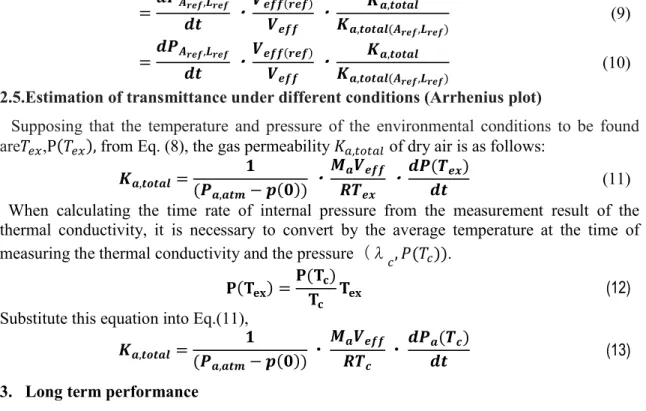
From the time rate of the internal pressure, the relation of time rate of thermal conductivity can be obtained. Based on the measured value at a certain dimension, for asurface area and perimeter length , the change in internal pressure is expressed as
, ≅ , − ( ) , ( ) ( ) (8) , ≅ , − ( ) , ・ ( ) ・ ( )・ , , ( , ) = + + , (1) , = , ・ + , ・ (7)
= , ・ ( )・ ,
, ( , ) (9)
= , ・ ( )・ ,
, ( , ) (10)
2.5.Estimation of transmittance under different conditions (Arrhenius plot)
Supposing that the temperature and pressure of the environmental conditions to be found are ,P( ), from Eq. (8), the gas permeability , of dry air is as follows:
, =(
, − ( ))・ ・
( )
(11) When calculating the time rate of internal pressure from the measurement result of the thermal conductivity, it is necessary to convert by the average temperature at the time of measuring the thermal conductivity and the pressure(λ , ( )).
( ) = ( ) (12)
Substitute this equation into Eq.(11), , =(
, − ( ))・ ・
( )
(13)
3. Long term performance
In order to confirm the gas permeability ( _ ) of the dependence of temperature and humidity, we carried out the aging test with thermostatic chamber. The Arrhenius plot was obtained based on Eq. (13). The details of the experimental VIPs are shown in Table 1. The Arrhenius plot does not consider the gas absorbed by the getter material.
3.1. Long-term performance in a thermostatic chamber
The VIPs was removed from the thermostatic chamber and cured at room temperature. The thermal conductivity was then measured using a heat flow meter (HC074 600, EKO instruments), and the results are shown in Fig. 3. The results of Arrhenius plot obtained from Eq.13 and experimental results are shown in Fig.4. The Arrhenius plot confirmed the temperature dependence of the VIPs air permeability under the tested aging conditions (23°C50% RH and 50°C). The comparison of the aging conditions of 50°C and 50°C with 70% RH confirmed that the gas permeability increased by approximately 6% shown in table2. The transmittance of dry air increased with relative humidity, which may be influenced by the material of the film. The metallized film is provided with a vapor deposited layer based on Ethylene vinyl alcohol (EVOH), probably because the barrier property of the EVOH layer decreased under high temperature and high humidity. When estimating the transmittance using Arrhenius plot, it is also necessary to consider film properties of EVOH.
Table 1. Details of the VIPs and aging condition
VIP Size ① t10 x 495 x 495 *1
Core Glass fiber
Film Hybrid Type*2
Desiccant Calcium Oxide 20g
Getter Zeolite type 5g
Protection Covered by polyvinyl chloride(PVC) 75µm film Aging
condition
1) 23°C, 50% RH 2) 35°C, 80% RH 3) 50°C4) 50°C, 70% RH
*1: The four corners of the VIP contain 90-mm cutouts
Table2. Overall air permeability (Kair_total) of the VIP aged under different conditions Temperature
(T; °C) Relative Humidity (RH; %) 1/T [×10–12g/dayKair_total ・Pa]
23 50 0.00337 14.3
35 80 0.00325 21.0
50 - 0.00309 35.8
50 70 0.00309 37.7
Fig.3: Long-term performance of the VIP under different static conditions Fig.4: Arrhenius plot of the VIP
3.2. Long-term performance in a building condition
The VIPs were constructed on the concrete slab under the raised floor of a new building, the details of VIPs are shown in Table3. The VIPs were removed from under the floor every three months, and thermal conductivities were measured before reinstallation (Fig.5). The construction period and measurement period are shown in Table4. Thermo-hygrometers were installed on the front and back of each VIP to measure the temperature and humidity (Fig.7 and 8). Half of the VIPs installed in Room 2 (VIP01) was placed in the reverse of the front and back, and the effect of the orientation of the MF surface on the long-term VIPs performance was evaluated. First of all, we obtained the total gas permeability ( _ ) based on the values of internal pressure which is calculated from measurement value of thermal conductivity. Secondly, Table5 shows a comparison of the internal pressure obtained from the time rate of thermal conductivity “ ” and the time rate of temperature data “ ”. was obtained total gas transmittance on site conditions which is calculated from Arrhenius plot and average temperature every 2 hours.As the result of calculating the among obtained using the temperatures on the upper and lower surfaces of the VIPs in the room2, the error from the measured value was smaller in the result calculated by referring to the temperature on the metallized film’s side than the aluminum foil’s side. This is attributed to the higher temperature dependence of the transmittance of dry air on the metallized film compared to that on the aluminum foil. However, the error of this result should also consider that the exposure environment during the measurement period is ambiguous. In order to prevent errors, for example, it can be solved if pressure of inside the VIPs can be directly measured at the real building environment.
Table3. Characteristics of VIPs used in the test of building condition
VIP Size ① t10 × 495 × 495 *1 in table1
② t10 × 372 × 385 ③ t10 × 372 × 385
Core ① Glass fiber 1
② Glass fiber 2
③ Glass fiber 1
Film Hybrid Type
Desiccant Calcium Oxide
Getter Zeolite type
Protection Covered by PVC 75-µm film
Table4. Installation periods of the different VIPs used in the test of building condition
Table5. Comparison of measured and calculated values of internal pressure for each room
Fig.5. Long-term performance of the VIPs in different rooms and comparison of inside out *VIP No/room No/Metallized film side
Fig.6. Comparison of measured value and calculated values of internal pressure (room2) *VIP No/room No/Metallized film side/measured value or calculated value
Fig.7.Temperature and relative humidity measured in room 1 on and under the VIPs Fig.8.Temperature and relative humidity measured in room 2 on and under the VIPs
4. Summary
We constructed a VIPs under the raised floor of the building and periodically measured the thermal conductivity and the weight increase and the environmental conditions. We compared
Day installed Day removed Days after product was manufactured
VIP① 333 48 381
VIP② 331 58 389
VIP③ 333 48 381
Place Metallized film side
Reference temperature Internal pressure (measured, ΔPm) Internal pressure (calculated, ΔPcal) Error (%) day 244 381 244 381 244 381 Room1 (interior side) Upside Upside 10.3 13.8 9.98 17.42 9.80 26.2 Lower 9.94 17.16 9.70 24.4 Room2 (slab side) Lower Upside 8.18 12.9 10.3 17.73 40.0 37.4 Lower 8.73 15.98 11.5 23.9 Room2 Upside (interior side) Upside 10.74 14.5 10.3 17.73 7.3 22.3 Lower 8.73 15.98 -14.9 10.0 0 10 20 30 40 50 60 70 80 90 0 10 20 30 40 2017/3/31 2017/8/28 2018/1/25 R el at iv e h um id it y( % ) T em per et ur e( ℃ ) day
Tempereture under the VIP Tempereture on the VIP Relative humidity under the VIP
Relative humidity on the VIP 0
10 20 30 40 50 60 70 80 90 0 10 20 30 40 2017/3/31 2017/8/28 2018/1/25 R el at iv e hu m idi ty ( % ) T em epe re tu re (℃ ) day Tempereture under the VIP Tempereture on the VIP Relative humidity on the VIP Relative humidity under the VIP
the time change of internal pressure which was calculated by the relationship of thermal conductivity and internal pressure (Eq.6) using measurement result of thermal conductivity with calculated data which was obtained by temperature of environmental condition and Arrhenius plot (Eq.13). The results were roughly in agreement with the calculation results, but the prediction result of about 10% error as a whole at 227days increased further by 10% or more at 381 days (Fig.6). We consider the following three reasons why errors occurred. (1) It is necessary to separate the gas permeation of surface and edge.
(2) Since the actual measurement range of Arrhenius plot is 23℃to50℃, it is necessary to confirm the accuracy at 23 ° C. or less.
(3)The influence of humidity in the actual measurement environment is expected to be low from the Arrhenius plot, but in order to make more accurate prediction it is necessary to consider the influence of humidity.
5. Future work
We will continue to measure and continue to verify whether long-term performance can be predicted from the measurement of environmental conditions. Meanwhile, we plan to develop a method that can be measured while it is being constructed on site. Specifically, we will consider improving the accuracy of prediction of durability by comparing it with the result of thermal conductivity measurement using VIPs equipped with micro pressure sensor. We will discuss the relation between external environment and internal pressure. And we will also study the influence of getter material, folded edges on gas permeability calculation, time rate of transmittance due to material deterioration, and another size of VIPs.
Acknowledgements
This study was performed in cooperation with everyone at the TODA CORPORATION RESEARCH and DEVELOPMENT CENTER. The authors express their sincere thanks.
References
[1]S.Brunner, H.Simmler, In situ performance assessment of vacuum insulation panels in a flat roof construction(2007)
[2]P.Mukhopadhyaya, D.Maclean, J.Korn, D.van Reenen, S.Molleti, Building application and thermal performance of vacuum insulation panels(VIPs) in Canadian subarctic climate (2014)
[3]Par Johansson, Bijian Adl-Zarrabi, Angela Sasic Kalagasidis, Evaluation of 5 years’ performance of VIPs in a retrofitted building acade (2015)
[4]D.Maclean, P.Mukhopadhyaya, J.Korn, S.Mooney, Design details and long-term performance of VIPs in Canada’s North(2016)
[5]H.Simmler, S.Brunner, Vacuum insulation panels for building application Basic properties, aging mechanism and service life(2005)
[6]E.Wegger, B.Petter.Jelle, E.Seipe, S.Grynning, A.Gustavsen, R.baetens, J.V.Thue, Agingeffects on thermal properties and service life of vacuum insulation panels(2011)
[7]H.Simmler, S.Brunner, Vacuum insulation panels for building application Basic properties, aging mechanisms and servie life(2005)
[8]HiPTI-High Performance Thermal Insulation IEA/ECBCS Annex 39, Vacuum Insulation Panels Study on VIP-components and Panels for Service Life Prediction of VIP in Building Applications (Subtask A), (2005)
[9] Daniel QUENARD, Hébert SALLEE:Micro-nano porous materials for high performance thermal insulation, 2ndInternational Symposium on NANOTECHNOLOGY in CONSTRUCTION BILBAO-13-16(2005)
[10]D.Ogura, A.Iwamae, T,Tasaka, K.Mabuchi Y.Senda, K.Kugimiya, Predsiction on long-term performance of vacuum insulation panels(VIP) using glass fiber core considering differences in hygrothermal environment and size of VIP and influence desiccant (2017)
Symbols : thermal conductivity at the center of the panel [W/mK]; : initial thermal conductivity[W/mK], : solid thermal conductivity [W/mK]; : gaseous thermal conductivity [W/mK]; : radiative thermal conductivity [W/mK]; Mi: Avogadro’s constant [kg/mol]; Veff: volume of VIP [m3];
R: gas constant [J/Kmol]; Ki: mass transfer coefficient [g/h・Pa]; Pi,atm: partial pressure of gas under atmospheric pressure [Pa]; Pi: pressure inside the VIP [Pa]; Pwv: water vapor pressure inside the VIP [Pa];
, : overall transmittance (i = a, v) [g/day・Pa]; , : transmittance per unit area [g/m2・day・Pa]; , :