Utah State University Utah State University
DigitalCommons@USU
DigitalCommons@USU
All Graduate Theses and Dissertations Graduate Studies
5-2020
Teacher Questions in the Classroom: The Effects of Using a Low-
Teacher Questions in the Classroom: The Effects of Using a Low-
to High-Level Questioning Sequence on the Text-Based Reading
to High-Level Questioning Sequence on the Text-Based Reading
Comprehension Outcomes of Low-Performing Students
Comprehension Outcomes of Low-Performing Students
Shannon Harris Brown Utah State University
Follow this and additional works at: https://digitalcommons.usu.edu/etd Part of the Special Education and Teaching Commons
Recommended Citation Recommended Citation
Harris Brown, Shannon, "Teacher Questions in the Classroom: The Effects of Using a Low- to High-Level Questioning Sequence on the Text-Based Reading Comprehension Outcomes of Low-Performing Students" (2020). All Graduate Theses and Dissertations. 7766.
https://digitalcommons.usu.edu/etd/7766
This Dissertation is brought to you for free and open access by the Graduate Studies at
DigitalCommons@USU. It has been accepted for inclusion in All Graduate Theses and Dissertations by an authorized administrator of DigitalCommons@USU. For more information, please contact
TEACHER QUESTIONS IN THE CLASSROOM: THE EFFECTS OF USING A LOW- TO HIGH-LEVEL QUESTIONING SEQUENCE ON THE TEXT-BASED READING
COMPREHENSION OUTCOMES OF LOW-PERFORMING STUDENTS
by
Shannon Harris Brown
A dissertation submitted in partial fulfillment of the requirements for the degree
of DOCTOR OF PHILOSOPHY in Disability Disciplines Approved: _____________________________ _____________________________ Benjamin Lignugaris/Kraft, Ph.D. Charles L. Salzberg, Ph.D.
Major Professor Committee Member
_____________________________ _____________________________ Timothy A. Slocum, Ph.D. Cindy Jones, Ph.D.
Committee Member Committee Member
_____________________________ _____________________________ Ray Reutzel, Ph.D. Richard S. Inouye, Ph.D.
Committee Member Vice Provost for Graduate Studies
UTAH STATE UNIVERSITY Logan, Utah
ii
Copyright © Shannon Harris Brown 2020 All Rights Reserved
iii
ABSTRACT
Teacher Questions in the Classroom: The Effects of Using a Low- to High-level Questioning Sequence on the Text-based Reading Comprehension Outcomes of
Low-Performing Students
by
Shannon Harris Brown, Doctor of Philosophy Utah State University, 2020
Major Professor: Dr. Benjamin Lignugaris/Kraft, Ph.D. Department: Special Education and Rehabilitation
Teacher questioning may be an effective instructional procedure for building students’ reading comprehension. Strategically asking questions at two different levels, low-level (text explicit) and high-level (text implicit), may be needed to assist students to
engage in higher order thinking skills.
The purpose of this study was to evaluate the effectiveness of a low- to high-level questioning sequence without or with linking prompts on the text-based reading
comprehension outcomes of fifth-grade students who evidenced poor reading
comprehension. A secondary analysis was used to determine whether the questioning sequence was effective regardless of students’ interest in the narrative stories used in the reading lessons.
Eleven fifth-grade students across three groups participated in this repeated measures study that consisted of two reading comprehension measures: response quantity
iv
and comprehension accuracy. In addition, a multiple baseline design was applied across the lowest-performing students (n = 5). Groups of students engaged in reading lessons
where one condition consisted of the low- to high-level questioning sequence and the other condition consisted of high-level questions only. Student outcomes for both reading comprehension measures were assessed immediately following each reading lesson. All students completed a student interest survey to identify their preference for the narrative stories.
Students increased the quantity and accuracy of their responses when the
questioning sequence with linking prompts was implemented. This result was also found
for four of the five lowest-performing students. Further, the questioning intervention was effective for increasing students’ performance on both reading comprehension measures regardless of student interest in the narrative stories. Students preferred the high-level questions only condition but indicated that the low- to high-level questioning sequences helped them remember the stories better. Students also reported that they were better readers and liked reading the stories out loud in small groups, but had mixed ratings about leaving their classrooms to participate in the study.
Potential confounds and limitations of the study are discussed, specifically regarding the elements of the low- to high-level questioning sequences and study procedures as well as the need to further develop reading comprehension measures and student interest measures. Considerations for future investigations are also discussed.
v
PUBLIC ABSTRACT
Teacher Questions in the Classroom: The Effects of Using a Low- to High-level Questioning Sequence on the Text-based Reading Comprehension Outcomes of
Low-Performing Students Shannon Harris Brown
Teacher questioning may be an effective instructional procedure for building students’ reading comprehension. Strategically asking questions at two different levels, low-level (text explicit) and high-level (text implicit), may be needed to assist students to
engage in higher order thinking skills.
The purpose of this study was to evaluate the effectiveness of a low- to high-level questioning sequence without or with linking prompts on the text-based reading
comprehension outcomes of fifth-grade students who evidenced poor reading
comprehension. A secondary analysis was used to determine whether the questioning sequence was effective regardless of students’ interest in the narrative stories used in the reading lessons.
Eleven fifth-grade students across three groups participated in this repeated measures study that consisted of two reading comprehension measures: response quantity and comprehension accuracy. In addition, a multiple baseline design was applied across the lowest-performing students (n = 5). Groups of students engaged in reading lessons
where one condition consisted of the low- to high-level questioning sequence and the other condition consisted of high-level questions only. Student outcomes for both reading comprehension measures were assessed immediately following each reading lesson. All
vi
students completed a student interest survey to identify their preference for the narrative stories.
Students increased the quantity and accuracy of their responses when the
questioning sequence with linking prompts was implemented. This result was also found
for four of the five lowest-performing students. Further, the questioning intervention was effective for increasing students’ performance on both reading comprehension measures regardless of student interest in the narrative stories. Students preferred the high-level questions only condition but indicated that the low- to high-level questioning sequences helped them remember the stories better. Students also reported that they were better readers and liked reading the stories out loud in small groups, but had mixed ratings about leaving their classrooms to participate in the study.
Potential confounds and limitations of the study are discussed, specifically regarding the elements of the low- to high-level questioning sequences and study procedures as well as the need to further develop reading comprehension measures and student interest measures. Considerations for future investigations are also discussed.
vii
ACKNOWLEDGMENTS
The privilege for me to further my education has first and foremost shaped me as a person, which I value greatly. I recognize that every success, setback, resource,
opportunity, and relationship in my educational path have influenced who am I striving to become, as well as the direction and purposes for my life. To complete my doctoral degree and this dissertation fills me with gratitude and acknowledgement for many people. To my major professor, Dr. Benjamin Lignugaris/Kraft, you inspired me to continue my path at the beginning of it all, back in my undergraduate years, and I thank you for being an excellent mentor, teacher, and colleague. Thank you for your guidance through two pilot studies and this dissertation. I have never taken your investment in my behalf for granted and appreciate every session of feedback, shaping, and time you have given. I am also indebted to Dr. Timothy Slocum, Dr. Charles Salzberg, and Dr. David Forbush for whom I could always count on for wisdom, instruction, and encouragement.
I would like to specifically thank department staff members Cosette Brunner, Tammy Soto, Teresa Simonsen, Kris Wengreen, Becky Morgan, and Darcie Peterson for their advisement and happy friendship throughout my years at Utah State University.
To Monica Lewis—what an honor to conduct research with you! This study would not have happened without your talent and support. To Anne Desjardins—one of the most inspiring women I have ever known, thank you for your passion, your
dedication to teaching children, and for believing in me. To John Copenhaver—your support has meant so much and you have inspired me to continue in this important work. To my doctoral colleagues—it was a pleasure to work alongside you and I celebrate your successes and accomplishments!
viii
I cannot possibly put in writing how incredible my parents are and the many details of how they have always supported me. To Mom—thank you for believing in me and giving me room to experiment and discover. Thank you for instilling in me a love of reading, from library trips in my youth to your example of life-long learning today as you continue to devour books and learn new things. The confidence I have to try new things and to create comes from you. I cherish all of your one-arm fist pumps and cheerful shouts of celebration these many years in school. I love you. To Dad—thank you for your consistency. You were always there to listen, mentor, and encourage. It has meant
everything to have your support and trust for the decisions I’ve made in my life. I’ll never stop implementing the lessons you’ve taught me about “attacking with enthusiasm” and “showing up” and I daily look to you as my greatest example. I love you.
I feel blessed beyond measure for my family. To Jason, my husband, thank you for your steady support at the finish line. It means everything that you believe in me and trusted my process. I lovingly dedicate this dissertation to you. To Rhett, my son, you have renewed my dreams and ambitions—I hope to make you proud!
Finally, I want to acknowledge God in my life and in all that I do.
ix CONTENTS Page ABSTRACT ... iii PUBLIC ABSTRACT ...v ACKNOWLEDGMENTS ... vii LIST OF TABLES ... xi
LIST OF FIGURES ... xiii
CHAPTER I. INTRODUCTION ...1
Teacher Questioning as an Instructional Tool ...2
Levels of Processing for Comprehension ...4
Question Levels ...6
Questioning Strategies ...9
Student Interest ...13
Purpose & Research Questions ...15
II. LITERATURE REVIEW ...17
Reviews on Teacher Questioning ...19
Search and Selection Criteria ...23
Methodological Quality ...59 Discussion ...66 III. METHODS ...71 Participants ...71 Settings ...77 Materials ...78
Measures: Dependent Variables ...85
Treatment: Independent Variable ...91
Experimental Design ...92
Procedures ...95
Reliability ...98
x
IV. RESULTS ...103
Response Quantity Results ...103
Comprehension Accuracy Results ...105
Response Quantity & Comprehension Accuracy Results: Lowest Performers ...106
Student Interest Results...113
Social Validity Results ...124
V. DISCUSSION ...127
Potential Confounds and Limitations...128
Future Research ...135
REFERENCES ...138
APPENDICES ...149
Appendix A: Quality Indicators Coding Sheet: Correlational Studies ...150
Appendix B: Quality Indicators Coding Sheet: Experimental Studies ...153
Appendix C: Letter of Informed Consent ...156
Appendix D: Sample Reading Lesson Materials ...161
Appendix E: Scoring Rubric for Reading Comprehension Measures ...173
Appendix F: Social Validity Questionnaire ...188
Appendix G: Example: Comprehension Assessment with Scripted Directions ..194
Appendix H: Student Interest Survey ...196
Appendix I: Treatment Fidelity Checklist ...201
Appendix J: Student Interest Analysis ...203
Appendix K: Opportunities to Respond: Lowest Performing Students ...205
xi
LIST OF TABLES
Table Page
1. Demographics: Correlational Studies ...29
2. Interventions, Measures, and Outcomes: Correlational Studies ...32
3. Demographics: Experimental Studies ...38
4. Interventions, Measures, and Outcomes: Experimental Studies ...44
5. Ratings for Essential Quality Indicators: Correlational Studies ...60
6. Ratings for Essential Quality Indicators: Experimental Studies ...61
7. Literature Review: Overall Evidence Ratings ...65
8. Year-end Proficiency Lexile® Ranges ...73
9. Assessment Scores of Student Participants...74
10. Title, Lexile®, and Word Count for Narrative Stories ...79
11. Question Packages: High-level Questions Only & Low- to High-level Question Sequence ...82
12. High-level Questions: Percentage of Question Type per Narrative Story ...83
13. Properties for High-level Questions Only and Low- to High-level Questions ...84
14. Character/Trait, Event, and Idea References for Assessment Questions ...87
15. Question Packages for Treatment Conditions...92
16. Lesson Schedule Across Groups of Students...94
17. IOA Results for Response Quantity and Comprehension Accuracy ...100
18. Students Outcomes: Response Quantity and Comprehension Accuracy ...105
19. Interest Survey Results for each Student ...115
xii
21. Response Quantity and Comprehension Accuracy Means and
Standard Deviations for High-interest Stories ...118
22. Percentage of Low-interest Stories per Condition for each Student ...121
23. Response Quantity and Comprehension Accuracy Means and Standard Deviations for Low-interest Stories ...122
24. Social Validity Questionnaire Results ...125
25. Student Interest Analysis: Recentness Effects Across All Students ...204
xiii
LIST OF FIGURES
Figures Page
1. Questioning in the Classroom: 3-Part Questioning Sequence ...3 2. Overview of the Construction-Integration (CI) Model of Text Comprehension ...6 3. Ranges for Student Lexile® Scores and Text Lexile® Scores ...80 4. Example of Assessment Questions with Corresponding Student
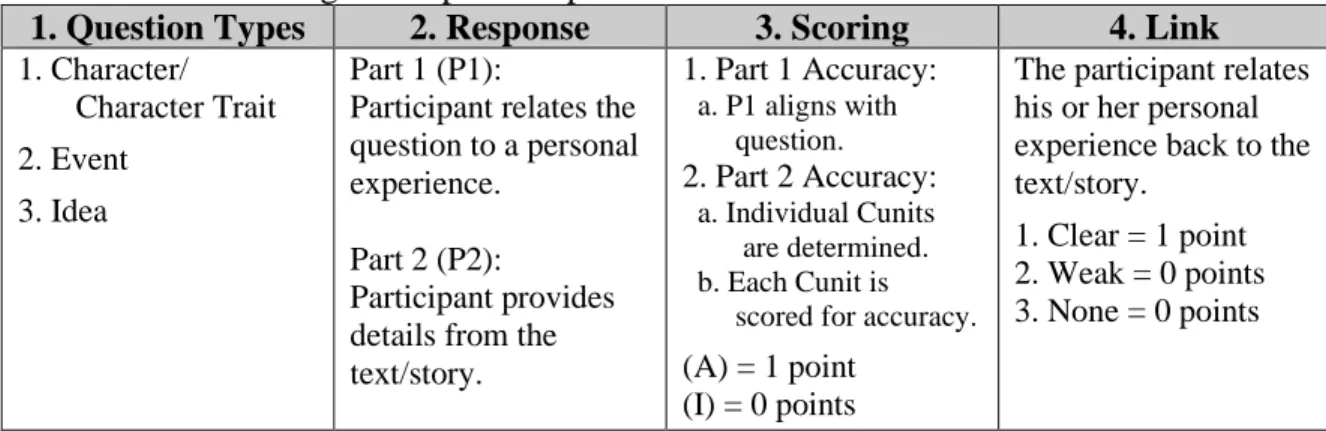
Response: Part 1 (P1) and Part 2 (P2) ...88 5. Response Quantity: Lowest-performing Students ...108 6. Comprehension Accuracy: Lowest-performing Students ...108
CHAPTER I INTRODUCTION
Reading ability is critical for one’s success in school and throughout life. For some, learning to read seems effortless and rapid, yet, for others, it is a difficult and frustrating process. The Research and Development (RAND) Reading Study Group (RRSG, 2002) determined that developing reading comprehension skills is one of the most pressing issues in literacy and emphasized that understanding how to improve reading comprehension outcomes for all students, especially low performers, is critical for future literacy research (Snow, 2002).
Students face increasing academic challenges for comprehending complex text as they advance through grade levels, making the task for teachers to increase text-based reading comprehension outcomes even more essential and ongoing. The RRSG (2002) determined that good instruction is the most powerful means of fostering the
development of proficient comprehenders as well as preventing reading comprehension problems. To promote increases in students’ reading outcomes, teachers must deliver evidence-based comprehension instruction.
The National Reading Panel (NRP)(2000) identified question answering (defined as “readers answer questions posed by teachers”) as one of seven scientifically based reading comprehension instructional strategies. When reading in the classroom, teachers frequently ask students questions during ongoing verbal discussions to help students build their understanding of reading material (Borich, 1980; NRP, 2000; Wasserman, 1991). Used in this manner, teacher questions function primarily as an instructional tool to teach new content and secondarily as an assessment tool to monitor student learning
2
during a lesson. Throughout this process, teachers may clarify ideas, redirect students to the text, and confirm understanding. Moreover, teacher questions may also serve
primarily as an assessment tool and secondarily as an instructional tool. Following the lesson, teachers may ask students to remember information and demonstrate
understanding. This process allows teachers to confirm what students have learned as well as to highlight lesson material that may need additional instruction.
Teacher questions are essential to engage learners, foster critical thinking skills, deliver feedback, and monitor understanding (Caram & Davis, 2005). However, some teachers may not have proficiency in, or even access to, questioning procedures that help students engage in higher order thinking skills for answering complex questions
(Bulgren, Marquis, Lenz, Deshler, & Schumaker, 2011; Raudenbush, Rowan, & Cheong, 1993). As a result, these teachers are not adequately prepared to strategically lead
classroom discourse for building students’ text-based reading comprehension (i.e.,
questioning as an instructional tool) or to determine what students have learned as a result of instruction (i.e., questioning as an assessment tool).
Teacher Questioning as an Instructional Tool
Both teachers and students stand to benefit from thoughtful questioning in the classroom. For teachers, questions provide opportunities for students to respond, promote higher student engagement, and deliver feedback (Gall, 1970; Levin & Nolan, 2004). For students, questions set the stage for continuous discourse, reinforce new learning, and promote high levels of critical thinking (Caram & Davis, 2005; Gall, 1970). When teachers thoughtfully deliver questions, the likelihood increases that students will focus
3
their attention on learning and monitor their own understanding (Rosenshine, Meister, & Chapman, 1996).
Sinclair and Coulthard (1975) defined instructional questioning in the classroom as a three-part sequence where “a typical exchange in the classroom consists of an
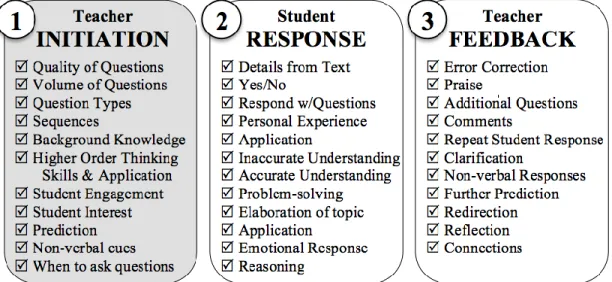
initiation by the teacher, followed by a response from the pupil, followed by feedback to the pupil’s response from the teacher” (p. 21). This exchange can also be described as “the teacher asks a question, the learner gives an answer, and the teacher makes a comment” (Lynch, 1991, p. 201). Each element of the three-part sequence is important for general classroom learning, but the questions teachers initiate for building reading comprehension are especially critical, as they need to be strategically constructed and integrated into classroom discourse to increase student-centered learning (Dillon, 1981; Ellis, 1993; Roth, 1996). Figure 1 illustrates what teachers might think about when approaching classroom discourse via the three-part questioning sequence, with specific focus on what to prepare for when implementing the first step.
Figure 1. Questioning in the Classroom: 3-part Sequence.
4
Levels of Processing for Comprehension
Comprehension processes (e.g., creating mental images, making inferences) are important for understanding how to build reading comprehension and how to make the task of improving text-based reading comprehension easier (Pressley, 2001; Reutzel, Smith, & Fawson, 2005; Reutzel, 2014). These processes may be described using schemas. A schema is a cognitive framework that helps organize and interpret information (Cherry, 2019). However, some schemas may lead to the exclusion of pertinent information and only confirm pre-existing ideas. According to Piaget (1952), a schema is both the category of knowledge as well as the process of acquiring that
knowledge (Anderson & Pearson, 1984). In schema theory, all knowledge is organized into units and is hierarchically categorized and connected into complex relationships (Piaget, 1952). The critical units that aid comprehension include the reader’s knowledge about language, text, and the world around them. Schema theory is a conceptual system and helps teachers understand how knowledge is represented and how it is used. The fundamental element in the relationship of schema theory and reading comprehension is the assumption that written text does not carry meaning by itself, only the direction for readers to retrieve or construct meaning using their background knowledge (Seymour, 2017). Thus, schema theory provides an initial understanding of how readers’
background knowledge is a critical element in the process of comprehending text as packages of knowledge stored in long-term memory and how it can be retrieved to aid in the comprehension of text (Reutzel, 2014). However, schema theory does not account for the role of text in the process of comprehension.
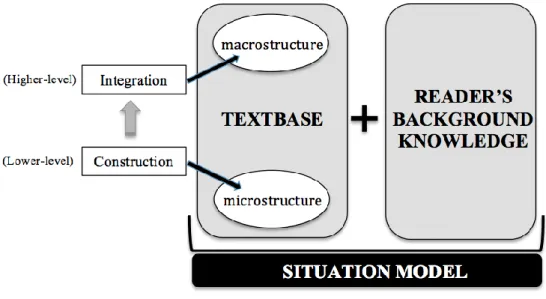
5 Kintsch’s (1988; 1998; 2004; 2013; 2018) Construction-Integration (CI) Model of Text Comprehension provides the most fully-developed explanation of how background knowledge as well as other processes support text comprehension (Duke, Pearson, Strachan, & Billman, 2011; Graesser, 2007; NRP, 2000; Reutzel & Cooter, 2012; Reutzel, 2014; W. Kintsch, 2013; Wilkinson & Son, 2010). Kintsch (1988) asserts that text-based comprehension is a multi-leveled process. The CI model provides a framework for how teachers can support comprehension in text-based discourse in the classroom (See Figure 2). In this model, there are two major comprehension processes, construction
and integration. The construction phase (lower-level processes) is the initial stage of reading comprehension in which ideas and concepts activate the reader’s associations and simple inferences with the text, creating a microstructure, which represents the literal
meaning of the text. The integration phase (higher-level processes) is when readers arrive
at the final meaning of a text by strengthening relevant associations and dismissing non-relevant ones, creating a macrostructure, which is the global organization of these ideas
into higher order units. The microstructure and macrostructure form the textbase, where
the meaning of the text is represented as a network of concepts. When the textbase
elements are combined with readers’ background knowledge, the situation model is
produced. Situation models are a form of inference where the reader essentially interprets what the text means (Reutzel, 2014). Within the situation model, students demonstrate that they can engage in low-level processing (e.g., recalling information) and then engage in high-level processing in order to evaluate and apply their knowledge (Almasi, 2003). The situation model that readers construct depends on their goals in reading the text as well as the amount of background knowledge they have.
6
Figure 2. Overview of the Construction-Integration (CI) Model of Text Comprehension.
Reutzel (2014) identified several advantages of the CI model. First, the CI model emphasizes that text-based comprehension is a multi-leveled process. Second, the CI model positions text at the center of comprehension instruction rather than the reader’s background knowledge. Finally, the CI model might be used to design instructional approaches that address the multiple levels of comprehension processes.
Question Levels
When using questioning as an instructional tool for building reading comprehension, teachers need to analyze questions at varying levels. Cognitive
hierarchies are one of the most common ways to classify levels of questions. Gall (1970) estimated that there were at least eleven classification systems used to categorize
questions as well as different category descriptions (e.g., recall, analytic thinking, creative thinking) used for analysis. In their classification system, Tienken, Goldberg, &
7
DiRocco (2009) used the terms reproductive and productive for low- and high-level
questions, respectively. They found that teachers used reproductive questions (i.e., those that focus on low-level processes) 76% of the time and productive questions (i.e., those that focus on high-level integrative processes) 24% of the time.
In 1956, Bloom and Krathwohl developed a hierarchal system of ordering thinking skills known as Bloom’s Taxonomy. This classification system is useful for discriminating between questions that focus on low-level processes and questions that focus on high-level processes. The focus of this classification system includes six major categories: Knowledge, Comprehension, Application, Analysis, Synthesis, and
Evaluation. According to Kintsch’s theory of discourse processing, students express
micro-level and macro-level comprehension when responding to Knowledge and
Comprehension questions (the first two categories of Bloom’s Taxonomy). The
remaining levels—Application, Analysis, Synthesis, and Evaluation—require high-level
processing where students to engage in deeper levels of thinking, and demonstrate comprehension at the situation level. That is, students show how text relates to personal
experiences and events. This is especially important when students must apply their knowledge for solving problems or judging the surrounding world (E. Kintsch, 2005; Kintsch, 2004).
In a study utilizing three different cognitive classification systems, Mills, Rice, Berliner, & Rosseau (1980) analyzed 54 typed transcripts to determine the percent of correspondence between the cognitive level of teacher questions and the cognitive level of student responses. The transcripts were coded based on the following classification systems: Bloom’s Taxonomy, Aschner-Gallagher, and Smith and Meux. In their analysis,
8
percent of correspondence was based on the number of student responses that were coded in the same cognitive category as the teacher questions that elicited the responses (Mills et al., 1980). Mills et al. coded up to 3,483 episodes of correspondence between teacher questions and student responses and found that the Aschner-Gallagher classification system yielded the highest level of correspondence (56.1%) followed by Smith and Meux (51.4%), and Bloom’s Taxonomy (51.3%). Even though the Aschner-Gallagher system yielded the greatest correspondence between teacher questions and student responses, Bloom’s Taxonomy was the most useful for discriminating between low- and high-level teacher questions and low- and high-level students responses.
Raphael and Pearson (1985) described a questioning taxonomy directly linked to the text and the reader’s schemata or background knowledge. Like Bloom’s taxonomy, Raphael and Pearson describe question levels to support readers’ comprehension before, during, and after reading. Text explicit questions (low-level) are “right there” questions
often using who, what, where, and when prompts (What did Sally do when she heard the thunder?)). Text implicit questions (moving from low- to high-level) require inference
based on story details, often using why or how prompts (Why did she do that?).
Importantly, these questions cannot be answered without the text, but they also cannot be answered by using exact words from the text. Script implicit questions (high-level) require an answer based upon the reader’s background knowledge and experience with the topic (Why do you think people forget to plan for bad weather?). This is where text and background knowledge come together, promoting higher-order thinking (i.e., situation model) (Raphael & Pearson, 1985; Kintsch, 1988; 1998; 2004; 2013; 2018). This taxonomy considers the active role of the learner for understanding the processes
9
involved in answering questions. The processes, particularly for determining questioning levels, can in turn inform teachers’ instructional approach for using questioning to improve student’s reading comprehension.
Questioning Strategies
The definition of instructional questioning by Sinclair and Coulthard (1975) provides a basic understanding for how to think about questioning discourse in the
classroom. Additional research for promoting deeper comprehension through strategies of linking questions is needed, especially for helping teachers to discriminate between and to strategically engage student’s low- and high-level processes. Strategies that guide learning, support problem solving and reasoning, and refine comprehension through discourse are essential for actively building reading comprehension (E. Kintsch, 2005; Gholson & Craig, 2006; Pressley et al., 1992). Gallagher and Aschner (1963) found that the kind of thinking students engage in depends upon the kind of questions teachers ask. Thus, teachers who discriminate proficiently among question types and questioning strategies can help students understand what is read as well as make personal connections to the text in order to engage in higher-order thinking skills (Craig, Sullins, Witherspoon, & Gholson, 2006; Mangano & Benton, 1984; Redfield & Rousseau, 1981; Taboada & Guthrie, 2006; Wilen, 1991; Wimer, Ridenour, Thomas, & Place, 2001). Further,
students may benefit from questioning strategies because they are designed to support the retention and transfer of information (Campbell & Mayer, 2009).
Different kinds of texts place different demands on learners and teachers must understand the critical differences between expository (informational, non-fiction) and
10
narrative text (stories and novels) when delivering reading comprehension instruction (NRP, 2000). This is important for teachers to know how to ask text explicit, text implicit,
and script implicit questions for both texts because they differ in vocabulary use,
organizational features, and analytic structures (e.g., comparisons and contrasts) (NRP, 2000).
Another factor that may influence comprehension of both narrative and expository text is student interest. Interest is defined as “a psychological state of having an affective reaction to and a focused attention for particular content” (Renninger & Hidi, 2002, p. 174). Student interest may influence how well they comprehend the text but not necessarily govern their reading comprehension overall.
Strategic Application of Questioning
Understanding how to move from text explicit to text and script implicit questions
can be an effective strategy when instructing large or small groups of students (Goodwin, Sharp, Cloutier, Diamond, & Dalgaard, 1983). Further, Moyer and Milewiez (2002) concluded that teachers who question at various levels are more adept at assessing the range and depth of students’ thinking. Many students need support identifying salient story details (text explicit information), building accurate background knowledge
(schemata), and then applying it appropriately (text and script implicit) (Schirmer &
Woolsley, 1997).
The ability to identify and label questioning patterns may help teachers evaluate students’ understanding, determine students’ instructional levels, and develop strategies for promoting critical thinking (Buschman, 2001; Moyer & Milewiez, 2002; Ellis & Worthington, 1994; Sindelar, Bursuck, & Halle, 1986; Stronge, 2010). These skills are
11
essential for individualizing instruction to meet the needs of diverse groups of students (e.g., high-achieving, low-achieving, students with specific learning disabilities). Two types of questioning sequences teachers may use include (1) moving from high- to low-level questions or (2) moving from low- to high-low-level questions.
High- to low-level questions. In a high- to low-level questioning sequence, teachers start with a text or script implicit (high-level) question and move toward text
explicit (low-level) questions contingent on students’ responses. That is, high-level
questions may be followed by low-level questions if students require more text explicit
facts or details to establish their answer. Teachers may also use this sequence to prompt students to support or defend their answer or to understand how students arrived at the answer, similar to showing one’s work for solving a math problem. The goal of this approach is to determine if students can engage in higher order situational thinking when first responding to what they read. Gall et al. (1978) conducted a study to determine the effects on student learning when asking questions in a high- to low-level sequence. Teachers asked students sixteen questions (eight high- and eight low-level questions) using a high- to low-level questioning pattern. The authors reported that teachers’ use of this questioning strategy did not facilitate knowledge acquisition or improve responding to high-level questions as measured by the Comprehensive Test of Basic Skills. In a
second study, the researchers varied the percentage of teachers’ high-level questioning. Sixteen questions were included with each recitation; however different percentages of high-level questions (25%, 50%, and 75%) were in each treatment. In general, students who received only 25% high-level questions (and 75% low-level questions) outperformed students in the 75% and 50% high-level questions treatments. The findings from this
12
study suggest that questioning patterns that include text explicit or low-level questions
lead to higher student achievement for responding to script implicit or high-level
questions more than questioning patterns that emphasize high-level questions only.
Low- to high-level questions. A low- to high- level questioning sequence is an approach where teachers begin by asking text explicit (low-level) questions and move
toward text or script implicit (high-level) questioning contingent on student responding.
This direction ensures that students have the foundation knowledge needed to establish their answer. The goal of this approach is to reduce student errors and increase
instructional and behavioral momentum. In essence, after ensuring that students have acquired essential text explicit knowledge, teachers can increase the demand placed on
students to apply, synthesize, and evaluate what they have learned.
In a series of studies, Bulgren et al. (2009; 2011; 2013) utilized a Question Exploration Routine (QER) to support seventh-grade students’ ability to respond to high-level questions. The use of the QER was compared to the traditional lecture-discussion method to determine if asking low- to high-level questions supported student
achievement in reading comprehension. Students in the lecture-discussion method simply copied notes from the information a teacher provided using an overhead projector and students using the QER method sequenced low- to high-level information as part of the QER graphic organizer and strategic questioning. On assessments that varied with multiple choice, short-answer, and matching items, the QER condition resulted in students performing 26 points higher when compared to students participating in the traditional lecture-discussion format (QER, M = 71.7; Lecture, M = 45.9) (Bulgren, 2011). This suggests that teachers who focus on text explicit (low-level) questions prior to
13
text or script implicit (high-level) questions may effectively increase student reading
comprehension outcomes.
Student Interest
Some researchers suggest that student interest plays a critical role in students’ comprehension (Belloni & Jongsma, 1978; Haggard, 1986; Stevens 1980; Worthy, 2002). Methods for building reading comprehension may be more effective when high-interest materials are used (Belloni & Jongsma, 1978; Schiefele, 1996; Schiefele & Krapp, 1996; Stevens, 1980; O’Flynn, 2016). While the literature base on the relationship between student interest and comprehension is generally descriptive (Alexander & Jetton, 1996; Sauer, 2012; Subramaniam, 2009; Wigfield, Guthrie, Tonks, & Perencevich, 2004), researchers suggest that student interest correlates with deep understanding of text in contrast to a surface-level understanding. That is, students who are interested in a text tend to grasp details and can more readily apply, analyze, synthesize, and evaluate information, thus creating a strong situation model for the reader’s comprehension (see Figure 2) (Almasi, 2003; Baldwin, Peleg-Bruckner, & McClintock, 1985; Sauer, 2012; Schiefle, 1996; Schiefele & Krapp, 1996; Taboada & Guthrie, 2006; Kintsch 1988; 1998; 2004; 2013; 2018). Importantly, student interest in a text may influence how well
students comprehend, but it does not govern comprehension.
Within the literature base, interest is often addressed in its relationship with
motivation but these terms should not be used synonymously. Rather, interest is a subset,
or component of motivation, and the majority of available literature focuses on how motivation plays a critical role in overall learning (Alexander & Jetton, 1996; Gambrell,
14
2011; Hidi, 2006; Subramaniam, 2009; Wigfield & Guthrie, 1997; Wigfield, Guthrie, Tonks, & Perencevich, 2004). For example, Guthrie et al. (2006) proposed that reading engagement involves interactions with text that are motivated and strategic, concluding that motivation predicts how much a child reads (which is a predictor of reading
comprehension). Further, Gambrell (1996) conducted an exploratory study to determine student’s motivation to read using a Motivation to Read Profile (MRP) for gathering questionnaire and interview data, determining four key motivation factors for reading: access, choice, familiarity, and social interaction.
There are few experimental studies that specifically examine how students interest in a topic effects reading comprehension outcomes. Belloni and Jongsma (1978)
conducted an experimental study to examine the relationship between reading interest and reading comprehension with low-performing students. Taking readability into account, students were tasked to read titles and abstracts of stories and select those they would most like to read and those they would least like to read. After reading stories, students completed a cloze test. The researchers found that students comprehended the high-interest stories better than they comprehended the low-interest stories. Several years later, Stevens (1980) assessed the interest of 25 topics using a verbal inventory
questionnaire with fifth- and sixth-grade students. Reading passages were taken from a basal reader aligned with topics from the questionnaire and students completed a multiple-choice test after reading each story. Stevens found that students read significantly better under the high-interest condition than under the low-interest condition.
15
While the available research suggests that interest may impact student
comprehension, there is little evidence of how student interest for the text interacts with teachers’ application of comprehension strategies and its affect on text-based
comprehension. Thus, it is important to gain an understanding of the general impact that a reading comprehension strategy (e.g., teacher questioning) might have on student
learning, regardless of students’ interest in the text material.
Purpose and Research Questions
Given the importance of questions in the classroom, researchers need to
empirically investigate how student achievement might be effected as a result of specific approaches to teacher questioning. The current study extends the basic definitions of questioning provided by Sinclair and Coulthard (1975) and Lynch (1991) and examines the effects of integrating a system of linking questions or question sequences into
classroom discourse. The strategic implementation of text explicit, text implicit, and script
implicit questioning sequences during classroom discourse may improve students’
reading comprehension (Raphael & Pearson, 1985). This approach may also help students engage in higher-order thinking skills when given assessment probes after the lesson.
The investigations for the current study are two-fold. First, as part of our primary analysis, we aim to reject the null hypothesis and propose that low- to high-level question sequences that are integrated into classroom discourse have an effect on students’ text-based reading comprehension. We chose this sequence to ensure that student participants had text explicit knowledge (low-level) before responding to script implicit (high-level)
16
questions. Second, as part of our secondary analysis, we aim to explore how student interest may be a contributing factor in building reading comprehension, which is important for teachers to design instruction and help students comprehend text.
The purpose of this study was to evaluate the effectiveness of a low- to high-level questioning sequence without or with linking prompts on the reading comprehension
outcomes of fifth-grade students who evidenced poor reading comprehension. Further, a secondary analysis was used to determine whether the low- to high-level questioning sequence was effective regardless of students’ interest in the narrative story content.
The research questions addressed in this study were:
1. To what extent do low- to high-level questioning sequences increase fifth-grade students’ response quantity and comprehension accuracy on a post-reading curriculum-based post-reading comprehension measure?
a. With low-performing students, to what extent do low- to high-level questioning sequences without or with linking prompts increase response quantity and comprehension accuracy on a post-reading curriculum-based reading comprehension assessment?
b. Given either high-interest or low-interest stories, to what extent do low- to high-level questioning sequences increase fifth-grade students’ response quantity and comprehension accuracy?
2. To what extent do student participants rate their overall experience in the study and its impact on their learning and reading ability?
17
CHAPTER II LITERATURE REVIEW
This literature review provides an examination of investigations on teacher questioning and its relationship to student achievement. Summaries included in this review highlight the current empirical research base on teacher questioning that align with the CI Model of Text Comprehension (Kintsch, 1988; 1998; 2004; 2013; 2018) as well as Raphael and Pearson’s (1985) text explicit, text implicit, and script implicit
taxonomy for the purpose of determining the best available evidence for implementing questioning strategies. Definitions for question levels and an overview of initial
investigations of teacher questioning are provided below. The research question for this synthesis is: What are the effects of low- and/or high-level questions on the academic outcomes of students in Grades 4-12?
Definition: Low- and High-level Questions
Low-level or text explicit questions are those where the teacher is seeking literal,
direct answers of factual information. These questions engage readers in the initial stage of reading comprehension, the construction phase, where the readers learn the literal
meaning of the text (microstructure) (Raphael & Pearson, 1985; Kintsch, 1988; 1998;
2004; 2013; 2018). Questions at this level are usually either “right or wrong” and essentially involve recall of specific facts that are located directly in the text. For
example, if a teacher asked the question, “What did Chandler hide in his sleeping bag?”, there is only one acceptable answer based on the story (his stuffed dog). For low-level questions, there are a limited number of acceptable answers for teachers to anticipate. For
18 example, a teacher might ask, “Where did the family put the old kitchen table?” where the anticipated response would not vary far from the limited correct answers, “in the living room,” “in another room,” or “in the corner.”
High-level, or text or script implicit questions require students to engage in
higher-level processes of reading comprehension, the integration phase, where readers
organize ideas in order to evaluate and apply their knowledge (Raphael & Pearson, 1985; Kintsch, 1988; 1998; 2004; 2013; 2018). High-level questions also require inference based on story details and background knowledge. The teacher is seeking more indirect and evaluative responses from students and there are many acceptable answers teachers may not anticipate. An example of a high-level question might be, “Why do you think some people cherish furniture so much?” where students must use their background knowledge to formulate a response. Another example of a high-level question might be, “How can objects, like jewelry, dream catchers, and toys, help give people courage to face their fears?” where students must engage in evaluative thinking that draw upon inference skills.
Teachers’ strategic use of low- and high-level questions assist readers in creating a textbase (microstructure and macrostructure). Importantly, when combined with a
textbase, readers’ background knowledge plays an important role in building reading
comprehension, allowing readers to recall information and evaluate and apply their knowledge (situation model) (Raphael & Pearson, 1985; Kintsch, 1988; 1998; 2004;
19
Reviews on Teacher Questioning
Systematic investigations of classroom dialogue began in the 1960s where it was determined that teachers did the majority of the talking in the classroom and did not ask many high-level questions to promote critical thinking; rather, the questions teachers emphasized focused on facts from the text (i.e., low-level knowledge) (Alexander, 2004; Gall, 1970; Topping & Trickey, 2007). One of the first researchers to empirically
investigate teacher questioning based on Bloom’s Taxonomy was Hunkins (1968), who found that asking high-level questions lead to higher student achievement for responding to high-level questions. In her review of teacher questioning, Gall (1970) proposed that educators need to first identify learning objectives and to determine which types of questions to ask (i.e., engage in didactic training) and then should consider how to use effective questioning strategies (i.e., prescribed sequences) that help students meet those objectives.
Winne (1979) completed a critical narrative review of 18 experimental and quasi-experimental studies conducted in the 1960s and 1970s to determine the effects of teacher questioning on student achievement. Higher cognitive questions (i.e., text or script
implicit or divergent questions) were defined as those requiring that students manipulate
previously learned information to create an answer with logically reasoned evidence, creating a textbase. Lower cognitive questions (i.e., text explicit or convergent questions)
were defined as those calling for verbatim recall or recognition of factual information previously read or presented by a teacher.
Findings from this meta-analysis were inconclusive due to issues with
20
about the independent and dependent variables, problems with data collection for student achievement, and discrepancies between the definitions of low- and high-level questions. Winne determined that it was difficult to compare conclusions across studies because of the wide variation in dependent variables and the lack of information reported in many studies. Moreover, Winne concluded that the predominant use of either low-level or high-level questions made little or no difference on student achievement.
Several years later, Redfield and Rousseau (1981) conducted a meta-analysis of experimental research findings on the effects of teacher questioning on student
achievement. Like Winne (1979), they used the same categories for qualifying studies (Training and Skills) as well as Campbell, Stanley, and Gage’s (1966) criteria for internal
validity. Of the 20 experimental and quasi-experimental studies that qualified, 18 were taken from Winne’s (1979) narrative analysis. Redfield and Rousseau examined effect sizes for all studies. The researchers contacted the original authors for more data where possible and only 14 of the 20 studies provided the data necessary for establishing effect sizes.
Redfield and Rousseau concluded that there was a positive effect size on student achievement across studies (+.7292) when teachers’ predominantly used high-level questions (text or script implicit questions) in the classroom. The effect size for Training
studies was +.2245 and no effect size could be calculated for Skills studies due to issues
with sample size, which the researchers acknowledged in their analysis. This finding supported those of Gall (1970) that teachers’ use of high-level questions does lead to gains in student achievement, so long as teachers are trained in questioning skills and the implementation of instruction is accurate.
21
In contrast to Winne, the studies that Redfield and Rousseau (1981) reviewed had to include a standardized measure of student achievement. Moreover, they only examined one measure, a student achievement measure, from each of the qualifying studies.
Winne’s (1979) procedure inflated the findings from each study (as more than one dependent measure was used in many of the studies) and therefore produced more
comparisons and findings overall than Redfield and Rousseau (1981), who determined only one finding from each qualifying study.
Importantly, Redfield and Rousseau’s (1981) review was more extensive and detailed than Winne’s review. Redfield and Rousseau provided effect sizes, analysis of experimental validity, and coding of question types. However, their conclusion that asking more high-level questions produces greater student outcomes is limited because they did not separate high- and low-performing students in their analysis, so it is not clear if the predominant use of level questions is effective across low- and
high-performing students. For example, Ellis (1993) suggests that low-level questioning is critical for improved achievement with low-performing students.
In 1987, Samson, Strykowski, Weinstein, and Walberg conducted a quantitative synthesis of the effects of teacher questioning levels on student achievement. Forty-four study variables (e.g., grade level, reliability) were coded for the 14 Training and Skills
studies included in Redfield and Rousseau’s analysis, particularly for whether researchers used low- and/or high-level questioning practices. A one-way analysis of variance
(ANOVA) was conducted for each study variable and only 18 (41%) reached the .05 level of significance (subjects, dependent measure, treatment characteristics, and design factors). Further, some studies did not provide adequate information to code the study
22
variables. Samson et al. concluded that teachers’ predominant use of high-level questions had a small effect on student achievement (mean effect size = .26) in contrast to Redfield and Rousseau’s results (mean effect size = .73). Further, Samson et al. found that the treatments and conditions for producing large effects were unclear and that researchers were not able to produce large replicable effects. Based on the small effect size from their analysis, Samson et al. did not agree with Redfield and Rousseau’s (1981) estimate of questioning effects.
Samson et al.’s (1987) review mainly scrutinized high-level questions and their effect on student achievement. Although high-level questions are essential for helping students engage in the critical thinking skills needed for deeper comprehension (Redfield & Rousseau, 1981; Samson et al., 1987; Topping & Trickey, 2007), findings on the combined effects of low-level and high-level questions were not reported. Further, these reviews did not provide a distinctive analysis where they separated students’ performance based on their ability levels. For example, Redfield and Rousseau’s (1981) findings favored the predominate use of high-level questions for building reading comprehension, but did not discuss how low-level questions might be needed for low performers (see Gall, 1970; Ellis, 1993). Further, there is limited understanding of how low- and high-level questions might be utilized together in various questioning sequences to scaffold students’ high-level comprehension (Bulgren et al., 2011; Dantionio & Beisenherz, 2001; Graesser, Person, & Hu, 2002; Wilen & Clegg, 1986).
The National Reading Panel (NRP) (2000) conducted a review of the research on comprehension instruction from the years 1980-2000, finalizing a total of 203 qualifying studies published in scientific journals. Importantly, studies were required to have an
23
experiment that involved at least one treatment and a control group. The NRP classified and grouped studies into 16 kinds of instruction used (e.g., mental imagery, prior knowledge, mnemonic, story structure) and established two categories for student-lead questioning: question answering (for readers to improve skills for answering questions)
and question generation (for readers to learn to generate and answer inferential questions
during reading). Unfortunately, no studies were reviewed where the treatment involved teacher-lead questioning. Reliability, replication, and generality were the main criteria used when evaluating each strategy. Effect sizes could not be calculated for almost all of the studies and only two researchers reported effect size data.
The Panel concluded that “more information is needed on the effective ways to teach teachers how to use proven strategies for instruction in text comprehension” (NRP, 2000, p. 4-52). Teachers who implement strategies (e.g., strategic use of low- and high-level questions) that build text comprehension during reading can help increase student comprehension outcomes (NRP, 2000). The following scientific review examines teacher-lead questioning strategies and their relationship to student achievement.
Search and Selection Criteria
Since Samson et al.’s (1987) quantitative synthesis, a number of intervention studies examining levels of questioning in the classroom have been published. This review examines the research base for teacher questioning studies that have been
published since 1988. Qualifying studies were identified through an electronic search of the EBSCO Host database and Academic Search Premier, ERIC, and PsycINFO
24
combinations of the following descriptors were used: independent variable descriptors (question* techniques, teacher question*, instructor question*, educator question*,
question* behavior, convergent question*, divergent question*, low-level question*,
high-level question*, question* levels, level of question, cognitive question*,
intervention); dependent variable descriptors (academic achiev*, student outcomes); and
population descriptors (LD, learning disab*, special education, student* with disab*).
This initial searchresulted in 542 articles. After conducting abstract screenings and removing duplicates, 55 potential articles were retained. This total was then narrowed down to 15 potential articles, from which citation searches were conducted, resulting in only one additional article. Articles that met the following selection criteria were included in this review:
1. The study was published in a peer-reviewed English language journal between January 1988 (after the Samson et al. (1987) review) to August 2016.
2. At least one dependent variable addressed student academic achievement or student outcomes.
3. The independent variable or intervention addressed question levels delivered by teachers or researchers to students (i.e., no student self-questioning strategies were included).
4. Participants included general education students or students with disabilities in Grades 4-12.
5. The study was experimental, quasi-experimental, correlational, or a single-subject design; Treatment-comparison studies needed to include a control or comparison group. Correlational designs were included as intriguing results could lead to an experimental study for future research.
The majority of articles were eliminated because they were descriptive studies, did not include student performance measures, or included interventions that focused on self-questioning strategies for students. Only eight studies in which researchers examined
25
the relationship between teacher questioning levels and student outcomes qualified for this research synthesis, resulting in six experimental designs and two correlational designs. Wolf, Crosson, and Resnick (2005) did not specify the n for each grade (1-8),
but this study was retained because it still included participants in Grades 4-8. No studies were identified in which researchers used a single-subject experimental design.
Coding
Coding protocols were developed to determine the methodological quality of the available research, the study and intervention characteristics, and the overall strength of the available evidence. A coding document was developed and used to organize essential information about each type of study (see Appendices A & B). Methodological quality across studies was measured using indicators for the following: (a) student participant information, (b) teacher participant information, (c) language of instruction, (d) study design information, (e) summaries of the dependent and independent variables, (f) description of treatment and measures, (g) interobserver agreement and fidelity, (h) outcome measures, (i) data analysis, and (j) results and findings (indicators adapted from Gersten et al., 2005; Horner et al., 2005; Jitendra, Burgress, & Gajria, 2011; Thompson, Diamond, McWilliam, Snyder, & Snyder, 2005). There were 22 indicators for
correlational studies and 18 indicators for experimental studies. Similar indicators for both correlational and experimental studies included sufficient information for the student and teacher participant selection, a plausible rationale and/or research questions for the study, clearly defined measures, and reports of attrition rates and reliability blinding. Descriptions of measure reliability and statistically significant findings were also
26
evaluated for each research design. Finally, indicators that addressed statistical power and limitations of the study were used for indicator coding.
Indicators specifically for correlational research included reporting of score reliability coefficients, one or more effect sizes, and confidence intervals. Details
regarding potential analysis errors that were unique to a particular statistical method were also essential for determining methodological quality (see Appendix A for correlational design coding sheet). For experimental designs, indicators focused on equivalence across groups and whether there was a description of the control condition as well as the
treatment condition. Also, indicators addressed whether researchers collected fidelity of implementation information and the timeline for capturing the effects of the treatment (see Appendix B for experimental design coding sheet).
For each study, a methodological quality percentage score was calculated based on whether research indicators were present or not present for both study designs (e.g., statistical significance, measure of fidelity). After coding each article and evaluating methodological quality, a separate evidence rating was determined. Ratings of compelling
(There is little debate about the truthfulness or value of this evidence), suggestive (The
truthfulness or value of the study is open to debate on some points), debatable (The
truthfulness or value can be debated on many points; experts might come to different conclusions) or weak (The truthfulness or value is not empirically sound; many instances
of variability exists) were used for both correlational and experimental designs (Jitendra et al., 2010; Kratochwill et al., 2010). The criterion for determining the evidence rating involved two main areas of focus. First, coders examined the methodological quality percentage score. Second, coders examined the findings of each study to establish an
27
overall evidence rating, especially considering the effect size outcomes for experimental studies (based on the distribution of effect sizes for educational outcomes, Hattie (2009) suggests that an effect size of d = 0.6 or greater is large, d = 0.4 to 0.59 is medium, and d
= 0.2 to 0.39 is small) (see also Lipsey et al., 2012). Studies with methodological quality
scores of 85-100 percent and large effect sizes were considered compelling. Studies with
methodological quality scores of 69-84 percent and medium to large effect sizes were considered suggestive, and studies with methodological quality scores 69-84 percent with
small or no effect sizes were considered debatable. Studies with methodological scores of
67 percent or below, regardless of effect sizes, were considered weak, indicating serious
methodological problems in the research.
Inter-rater Reliability
The researcher and a doctoral student who had experience conducting reviews and carrying out experimental research completed all coding. The researcher independently read each article and coded the methodological quality indicators. The doctoral student also followed this procedure for 38 percent of the articles. Interobserver agreement was established comparing scores from each coder to calculate the percentage of agreement (i.e., agreements divided by agreements plus disagreements). Mean percentage agreement was 87% (range = 80-93%).
Findings: Correlational Studies
The demographics of the correlational studies are presented in Table 1.
28
design, participants, grade level, duration of study, person(s) implementing the intervention, and setting. Studies are organized in ascending order by year.
The two correlational studies included a total of 447 students (males = 200; females = 247), no students with specific learning disabilities, and four students with profound hearing loss. Sample sizes ranged from 6 to 441. Scoring reliability was reported in both studies. Schirmer & Woolsey (1997) reported IOA results of 97.7% on their researcher-developed comprehension questions assessment, but failed to report IOA for their researcher-developed cloze test. Wolf, Crosson, & Resnick (2005) reported IOA results for one standardized measure (76%), as well as results for reliability coefficients (Cronbach’s alpha, Spearman’s). The duration of these two studies ranged from 21 to 32 sessions, lasting between 30 to 50 min each. The persons implementing treatment consisted of classroom teachers and one teaching-certified researcher.
29
Table 1
Demographics: Correlational Studies
Study Study Design Participants Duration Implementation
1. Schirmer & Woolsey (1997)
Reliability:
Point-by-point IOA
Answers to high-level questions = 97.7% (range = NR) Cloze test = NR Fidelity: NR Correlational N = 6 males = 2 females = 4 4 students had profound hearing loss; 2 used speech and signing. Age and/or Grade: Ages 10.9-12.5 Daily: 30-45 min Weeks: 9 Sessions: 32 First author (N = 1) Setting: Small reading groups outside the general education classroom
2. Wolf, Crosson, & Resnick (2005)
Reliability:
Point-by-point IOA
Academic Rigor = 76% (range = NR) Cronbach’s alpha = .93
Spearman’s = .88 (p < .00 at = .05) Accountable Talk = NR (range = 57-67%) Cronbach’s alpha = .74 to .92 Spearman’s=.62 to .83 (p < .00 at = .05) Fidelity: NR Correlational N = 441 males = 198 females = 243 (SWD = NR) (GE = NR)
Age and/or Grade: Grades 1-8: n = NR Daily: 45-50 min Weeks: -- Sessions: 21 (1 session per teacher) Classroom Teachers from 10 schools (N = 21) Setting: General Education Classrooms
30
Characteristics of the correlational studies are presented in Table 2 and include descriptions of the intervention and comparison conditions, dependent variables, and outcomes for student performance.
Both correlational studies examined the relationship between the use of teacher
text or script implicit (high-level questions) and student comprehension outcomes.
However, Wolf et al. (2005) reported procedures in which teachers used text explicit
(low-level) questions to help clarify high-level student responses. The teachers engaged students in low-level responding by asking them yes/no questions or directing them to look back to the text to find factual information. For the purpose of investigating
classroom talk for their study, Wolf et al. were primarily interested in the degree to which
text or script implicit questions only helped students engage in higher order thinking
skills as opposed to identifying basic information in and outside the text. Therefore, the finding that teachers asked low-level questions and provided low-level content
knowledge when students needed support for responding to the high-level questions was noteworthy. In essence, the teachers naturally engaged in a high- to low-level questioning sequence when prompting students to think more critically.
The first dependent variable for students in this study was academic rigor, the
degree to which students had opportunities for high-level thinking and active use of knowledge. This measure determined the degree to which the teacher talk (i.e., how the teacher facilitated discussion) assisted students in deepening their comprehension of text (rather than by recalling facts via low-level questions). A correlation between academic
rigor and teacher talk was found (0.79; significant at = .01), suggesting that there is a strong relationship between question type and the degree of rigor of the reading
31
comprehension lesson. The researchers concluded that students’ responses to text or
script implicit questions required a thorough understanding of the text via text explicit, or
low-level knowledge.
The second dependent variable for students was [student] accountable talk, or
how students communicated their knowledge. A strong correlation between how teachers asked for knowledge and how students provided knowledge was found (.90; significant at
= .01). The researchers concluded that teachers they observed mostly initiated
discussion via high-level questions and that students expressed how they arrived at their high-level response through low-level details. Wolf et al. (2005) concluded that there is a relationship between student responses and the types of questions asked by teachers and that it is more likely that students will communicate what they know contingent on how teachers prompt a response.
32
Table 2
Interventions, Measures, and Outcomes: Correlational Studies
Independent Variable (Teacher questioning) Direction (Questions) Dependent Variables (Student outcomes)
Findings from Study 1. Schirmer & Woolsey (1997)
Purpose: To examine the effect of high-level questions on reading
comprehension of deaf children, with the hypothesis that their ability to respond to the high-level questions did not need to be supported by answering low-level questions.
T:Using fables, folk tales, or stories written by authors of children’s books, the investigator taught a mini-lesson using a modified Directed Reading Thinking Activity, which included: 1. Introduction of sight words,
vocabulary, idioms, and characters in the story.
2. Teacher-directed questions for students to make predictions and discuss them together.
3. Students read story silently (in segments).
4. After each segment, the investigator asked high-level comprehension questions.
5. After reading and discussing story, students completed a cloze test.
Implicit, high-level questions only Standardized: None Researcher Developed: 1. Responses to high-level questions: Scored as correct or incorrect when compared to model answers. 2. Cloze test: Required students to provide story details. Other Measures: None
No statistical tests used for each measure; only data for descriptive statistics provided.
Calculations determined by author. Responses to high-level questions:
No statistical significance M = 79.1, SD = 8.83
For the first 3 lessons, students responded correctly more than 87% of the time; during the last 4 lessons, students decreased this performance to 69% (when reading stories above reading level).
Cloze test:
No statistical significance M = 85.6, SD = 7.42
For the first 3 lessons, students responded correctly at least 93% of the time; during the last 4
lessons, students decreased this performance to 82% (when reading stories above reading level). Finding: No correlation coefficient was reported for correct responses to high-level questions and to story cloze for each child. Therefore, the authors collapsed the data of both measures across the 6 students, resulting in statistical significance.
Correlation Results Statistical significance = .817