and Pedagogical Content Knowledge in a
Professional Learning Community
Jeanette Marchant
Student number: 7538106
Supervisor: Professor Karin BrodieA research report submitted to the Faculty of Education, University of the Witwatersrand, Johannesburg, in partial fulfillment of requirements for the degree of Master of Education by coursework and research report.
Johannesburg February 2015
I declare that this research report is my own unaided work. It is being submitted for the degree of Master of Education by coursework and research report at the University of the Witwatersrand, Johannesburg.
It has not been submitted before for any degree or examination in any other university, nor has it been prepared under the aegis or with the assistance of any other body or organisation outside of the University of the Witwatersrand, Johannesburg. All help received with the preparation and/or presentation of this thesis has been clearly acknowledged on the next page.
__________________________ Jeanette Marchant
I would like to thank the following people for the part they played in this work:
• My supervisor Prof. Karin Brodie for her rich experience, deep insights and the way in which she always stayed so close to my work. I also thank her for the role she played in setting up the Data Informed Practice Improvement Project (DIPIP) and for organising my access to the data. Finally, I thank her for having more confidence in me than I had in myself.
• My colleague Nico Molefe for always being so willing to share his knowledge of, and insights into, the Data Informed Practice Improvement Programme.
• The participants in the professional learning community under study for allowing me to analyse the recordings of the PLC meetings in which they participated.
• Adrian Carolan of Sportstec for his support with the software used in the data analysis. • Malehlohonolo Ramoseme of DIPIP for her assistance in accessing the DIPIP data. • My daughter and son for their support and confidence in me.
This study investigates teacher knowledge conversations in one professional learning community which is part of the Data Informed Practice Improvement Project. Conversations where teachers speak about and with their content knowledge and pedagogical content knowledge are analysed. Data are in the form of video and audio recordings of the professional learning community meetings over one year. The study showed that both content knowledge conversations and pedagogical content knowledge conversations did take place, with more time being spent on pedagogical content knowledge conversations than on content knowledge conversations. Furthermore, the type and extent of the teacher knowledge conversations was shown to be related to the design of the project. In terms of level, most of the teacher knowledge conversations took place at level three on a four-level rating scale. Pedagogical content knowledge conversations triggered pedagogical content knowledge conversations, suggesting a close relationship between the two.
Key words
Content knowledge
Pedagogical content knowledge Professional learning community
Declaration ... ii
Acknowledgements ... iii
Abstract ... iv
List of Tables ... vi
List of Figures ... vii
Appendix ... vii Chapter 1: Introduction ... 1 1.1 Introduction ... 1 1.3 Research Questions ... 3 1.4 Teacher knowledge ... 3
1.5 Professional Learning Communities ... 4
1.6 DIPIP Professional Learning Communities ... 4
1.7 Structure of the Report ... 5
Chapter 2: Theoretical Framework and Literature Review ... 6
2.1 Introduction ... 6
2.2 Teacher knowledge ... 6
2.2.1 Content Knowledge ... 7
2.2.2 Pedagogical Knowledge ... 9
2.2.3 Pedagogical Content Knowledge ... 9
2.2.4 Relationship between content knowledge and pedagogical content knowledge ... 14
2.3 Data Informed Practice Improvement Project (DIPIP) ... 15
2.4 Professional learning communities (PLCs) ... 19
2.5 Summary ... 21
Chapter 3: Research Design and Methodology ... 22
3.1 Research approach ... 22
3.2 Participants ... 22
3.3 Data ... 24
3.4.1 Analytic framework ... 25
3.4.2 PCK and CK rubrics ... 27
3.4.3 The coding process... 31
3.5 Limitations ... 33
3.6 Ensuring rigour in my research ... 33
3.7 Ethical considerations ... 34
Chapter 4: Results and findings ... 35
4.1 Introduction ... 35
4.2 CK and PCK in the conversations ... 35
4.2.1 CK, PCK and activity types ... 37
4.2.2 Examples of teacher knowledge conversations ... 39
4.3 The relationship between Content Knowledge and Pedagogical Content Knowledge ... 44
4.4 Elaborating PCK ... 50
4.5 Levels of CK and PCK conversation ... 53
4.5.1 Changes in levels of conversations over the course of the year 54 4.6. Conclusion ... 56
Chapter 5: Conclusions, Implications and Recommendations... 58
5.1 Summary of findings ... 58
5.2 Answering my research question: ... 60
5.3 Limitations of my study ... 61
5.4 Implications and Recommendations ... 61
5.5 Final conclusion ... 62
References ... 63
Appendix ... 66
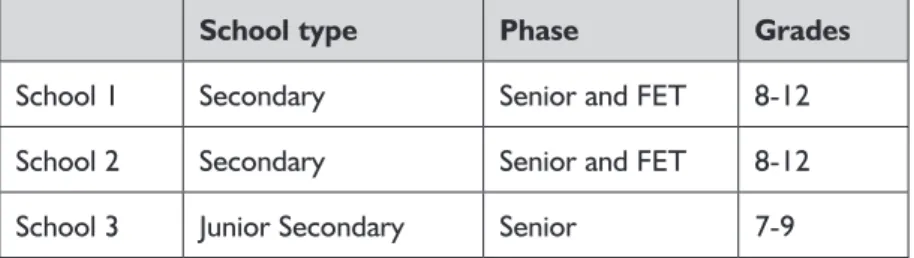
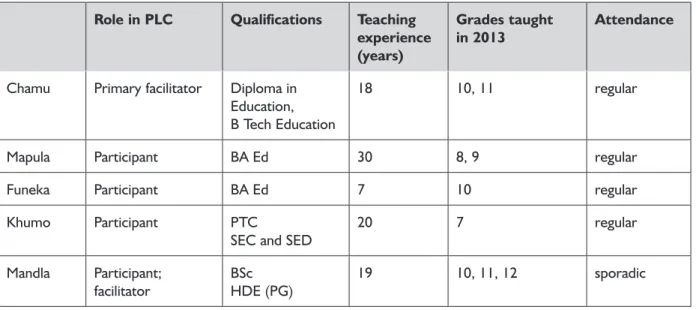
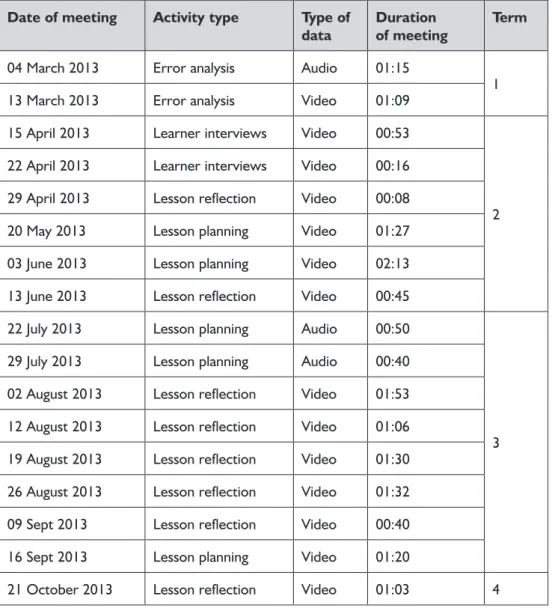
Table 3.1: Schools in the professional learning community under study Table 3.2: Participants in professional learning community under study Table 3.3: Summary of data used in study
Table 3.4: Analytic framework
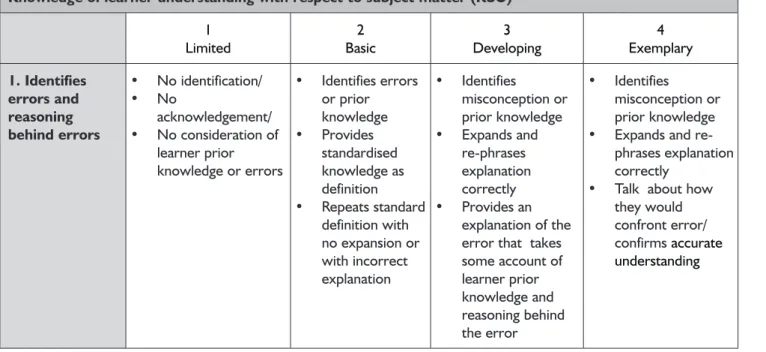
Table 3.5: PCK rubric
Table 3.6: CK rubric
Table 4.1: Count of CK and PCK conversations Table 4.2: Time spent on CK and PCK conversations Table 4.3: Conversation time for each activity Table 4.4: CK conversation time by activity type Table 4.5: PCK conversation time by activity type
Table 4.6 Transcription of 4 March error analysis professional learning community meeting Table 4.7: Summary of transcriptions of all 17 PLC meetings
Table 4.8: KSU and KISR in professional learning community conversations Table 4.9: Time spent on each category of KSU conversations
Table 4.10: Time spent on each category of KISR conversation
Table 4.11: KSU conversations as a percentage of PCK in each activity type Table 4.12: KISR conversations as a percentage of PCK in each activity type
Table 4.13: Levels from CK-PCK rubric
Table 4.14: Levels of CK and PCK conversations
Table 4.15: Number of each type of DIPIP professional learning community activity across the four terms
Table 4.16: Percentage of CK conversation time on Levels 1–4 Table 4.17: Percentage of PCK conversation time on Levels 1–4
Figure 2.1: Shulman’s framework of teacher knowledge (1986a) Figure 2.2: Shulman’s knowledge base for teachers (1987)
Figure 2.3: Park’s pentagonal model of PCK for science teaching (Park 2007, p. 745)
Figure 2.4: Components of pedagogical content knowledge from different conceptualisations (Park 2007, p. 744)
Figure 3.1: Code window
Figure 3.2: A CK and PCK count and time code report
Figure 4.1 Transcription of 4 March error analysis professional learning community meeting
Appendix
1.1 Introduction
South African learners achieve poorly in mathematics in both national and international assessments. The two main national assessments in South Africa are the Annual National Assessment (ANA1) and National Senior Certificate (NSC2). ANA results for 2014 have showed a general upward trend year-on-year in learner performance in mathematics in Grades 1–6 since the implementation of ANA in 2012. However, learner performance in ANA in Grade 9 mathematics remains dismally poor. According to the Report of the Annual National Assessment of 2014 (p. 9), the average percentage achieved by learners for Grade 9 Mathematics in 2012, 2103 and 2014 was 13, 14 and 11% respectively. Averages achieved by learners in the NSC examinations in mathematics have been low for decades. In 1995, 1999 and 2003 South Africa participated in the Third International Mathematics and Science Study (TIMSS) and the TIMSS-Repeat. Howie (2001) reported that in the 1999 TIMMS study only the most proficient learners in South Africa approached the average of Singapore, the top achieving country, while Reddy (2006) stated that South African learners did not compare well with learners in other African countries.
A result of poor learner performance has been that much time and money has been invested in teacher professional development, under the assumption that such investment of time and money will lead to an improvement in learner performance in mathematics. There is a widespread opinion in South Africa that the main reason for learners’ poor performance is teachers’ weak content knowledge and so many teacher development programmes focus on giving teachers workshops on content knowledge and aspects of the new curriculum.
A different approach is that of professional learning communities which are seen internationally as a long-term, generative means for teacher professional development and are gaining traction locally (Brodie, 2011). The Data Informed Practice Improvement Project (DIPIP) works with teachers in
1 ANA is the acronym for Annual National Assessment, Department of Basic Education initiative to measure learner achievement in selected grades and subjects, of which mathematics is one.
2 NSC is the acronym for National Senior Certificate, which is the school leaving certificate written at the end of Grade 12 (matric),
professional learning communities to analyse possible reasons for learners’ poor performance, to identify the reasons behind learners’ poor performance and to build new knowledge, their own and their learners’, on an understanding of learner thinking (Brodie, 2013).
In this research study, I explore teacher development in one professional learning community through the lens of Shulman’s construct of pedagogical content knowledge (PCK), (1986a and b). Shulman (1986a, p. 9) described PCK as comprising ‘the most useful ways of representing and formulating the subject that make it comprehensible to others’. I describe the extent to which the teachers in one professional learning community talk about content knowledge and pedagogical content knowledge and how such conversation is related to the teacher development project of which the professional learning community is a part. In addition, I investigate the relationships between CK conversations and PCK conversations3 in the professional learning community under study. In this study I use the term “teacher knowledge conversation” to refer to conversations where teachers talk about their knowledge, or use their knowledge to analyse an aspect of their practice3.
1.2 Background
Over the past thirty five years I have been involved in both pre-service and in-service teacher education, with a focus on mathematics. In recent years I have become increasingly involved in educational research across all phases of the school system and, through this work, have become aware not only of the need for teacher professional development, but also of the frustration of teachers regarding professional growth, or the lack thereof, experienced in the current workshop approach to teacher professional development. I agree with Wickham and Versveld (1998) that an incremental view of change is more appropriate than expecting a ‘workshop conversion’.
An assignment to monitor and evaluate the work being done by the Data Informed Practice Improvement Project (DIPIP) based at the University of the Witwatersrand brought the role that professional learning communities can play in teacher development to my attention. This work, in conjunction with findings in my own field research, prompted me to find out more about the growth of teacher knowledge, particularly in the form of content knowledge and pedagogical content knowledge, in one professional learning community so as to get a better understanding of why professional learning communities are ‘increasingly seen as a sustainable and generative method of professional development in mathematics education’ (Brodie 2011, p,1).4
Added to this is the fact that little research has been done on how teachers develop knowledge. The findings of a study conducted by Ceresto (in preparation) showed that very little of the teacher conversation in professional learning communities was devoted to content knowledge. Another study
3 It should be noted that while content knowledge conversations and pedagogical content knowledge conversations per se do not imply the development of teacher knowledge, they do provide opportunities for learning this knowledge.
4 I note here that my role as project evaluator ended in December 2013 and my work on this study started in February 2014 so there is no conflict of interest.
(Chauraya, 2013), which looked at mathematics teacher change and identity in a professional learning community, it was found that ‘the opportunities for learning which arose in the conversations were distinguishable in terms of focus on a particular domain of the teachers’ professional knowledge’ (Chauraya, 2013, p.77). This study aims to add to this literature by extending knowledge and understanding of how teacher knowledge in the form of content knowledge and pedagogical content knowledge can be developed in professional learning communities. My research was done in one DIPIP professional learning community. I have been particularly excited about my study because, while other aspects of the DIPIP programme have been the subject of in-depth research, the development of content knowledge and pedagogical content knowledge in DIPIP professional learning communities has not been specifically researched to-date. It is my wish that my research will contribute towards a better understanding of the DIPIP PLC programme of teacher development, and to knowledge of teacher development more generally.
1.3 Research Questions
The main questions framing my study are:
1 To what extent does the professional learning community talk about content knowledge and pedagogical content knowledge and how is this related to the design of the Data Informed Practice Improvement Project?
2 What are the relationships, if any, between content knowledge conversations and pedagogical content knowledge conversations in the professional learning community?
1.4 Teacher knowledge
Since Shulman first spoke of the construct of pedagogical content knowledge, describing it as a ‘distinct body of knowledge that differentiates teachers from content specialists’ (Shulman (1987, p.15), there has been much debate as to the exact nature of pedagogical content knowledge. Although there is ‘no agreed-upon definition of pedagogical content knowledge’ (Park, Jang, Chen, 2010), it is recognised that pedagogical content knowledge is ‘a crucial element of accomplished teaching’ (Park, et al., 2010, p. 246).
As both content knowledge and pedagogical content knowledge are regarded as being important components of a teacher’s knowledge repertoire, any programme to develop teacher knowledge should take the development of content knowledge and pedagogical content knowledge into account. My two research questions should help me to better understand two relationships: first, the relationship between content knowledge and pedagogical content knowledge and second, the relationship between these two aspects of teacher knowledge and the design of the DIPIP programme. Brodie (2013, p. 15) argues that professional learning communities (which are fundamental in the DIPIP programme) ‘can be sites where deep and powerful learning takes place’. Combining the view that content knowledge and pedagogical content knowledge are important components of teacher knowledge and the goal of
DIPIP to bring about teacher learning, I look at the content knowledge conversations and pedagogical content knowledge conversations in one DIPIP professional learning community in order to gain a deeper understanding of the development of teacher knowledge in a professional learning community. Conceptions of the knowledge required by teachers in order to make knowledge accessible to their learners are not only varied, but have also changed over time. My study focuses on two forms of teacher knowledge, namely content knowledge and pedagogical content knowledge. In my study, I have operationalised content knowledge as what Shulman (1986b) described as subject matter content knowledge. Furthermore, I have operationalised pedagogical content knowledge in terms of the description provided by Rollnick et al., (2008, p. 1367):
Pedagogical content knowledge can be described as how teachers teach their subject by accessing what they know about the subject, the learners they are teaching, the curriculum with which they are working, and what they believe counts as good teaching in their context.
My justification for using these descriptions of content knowledge and pedagogical content knowledge in my operationalisation is discussed in detail in Chapter 2. In my study, pedagogical content knowledge is not viewed as a subset of content knowledge, although I do acknowledge that the two constructs are closely interrelated.
1.5 Professional Learning Communities
Professional learning communities (PLCs) comprise a group of professionals “engaged in learning for the benefits of their ‘clients’” (Hargreaves 2008). In my study the professionals in the learning community are teachers, their ‘clients’ are learners and the professional learning community is part of DIPIP. According to Brodie (2013) collaboration, rigorous enquiry, trust, care and a clear focus are crucial elements of a successful professional learning community.
1.6 DIPIP Professional Learning Communities
In the Data Informed Practice Improvement Programme the focus in the professional learning communities is on learner errors (discussed in more detail in Chapter 2). This focus on learner errors provides the opportunity for the community to identify learners’ learning needs which, in turn, informs teachers’ learning needs (Katz, et al., 2009, Brodie 2013).
The DIPIP project started in 2008 with teachers from various schools meeting at Wits University and working in small groups. From 2011 (with a pilot in 2010, see Chauraya, 2013) the project began to work with professional learning communities located in schools. The DIPIP project consists of a number of activities: test analysis, learner interviews, curriculum mapping; concept identification; readings and discussions; lesson planning and lesson reflections (Brodie, Shalem, Sapire, & Manson, 2010; Brodie and Shalem, 2011; Molefe, Brodie, Sapire, & Shalem, 2010). Each professional learning community is led by a school-based facilitator, supported by a university-based facilitator. Learner
errors are the central focus of the activities, as teachers analyse, design, present and reflect on lessons. The DIPIP project leaders prepared to hand over leadership of the programme to teachers in the schools, a process which was completed in 2014. It is hoped that the communities will continue with Wits playing a supportive role going forward.
1.7 Structure of the Report
In Chapter 2, I describe the two main theories that frame my research study. I will explain why I use these theories and draw on literature to help me understand why these theories are important for my study. I will present the literature that I draw on to make links to my research questions regarding the extent of content knowledge and pedagogical content knowledge conversations and the relationship between content knowledge and pedagogical content knowledge conversations and the design of the Data Informed Practice Improvement Project.
Chapter 3 focuses on my research design. My research approach is largely qualitative and I explain what makes it qualitative and why I use this approach. I describe participants in the professional learning community being studied and the sources of data, as well as the methods used to collect the data and a justification of the use of these data collection methods. Furthermore, I provide the analytic framework for my study. Since my research focus is primarily on the conversations of teachers in different DIPIP activities, I provide an overview of the DIPIP meeting types, as determined by the different activities planned by DIPIP project team. I provide a detailed description of the content knowledge and pedagogical content knowledge rubrics that I developed and the coding process that I used to analyse teachers’ conversations. Chapter 3 also deals with the limitations of my study and the measures I took to ensure rigour and the reliability and validity of the results of my study.
Chapter 4 provides the data analysis that will answer my research questions. I use the data from the coding process described in Chapter 3 as the basis for a detailed analysis of the teacher conversations. My analysis provides details of, and possible explanations for, the relationships between the content knowledge and pedagogical content knowledge conversations and the design of the DIPIP. I refer to the literature described in Chapter 2 to help me make links between content knowledge, pedagogical content knowledge and the DIPIP programme.
I conclude this research report with Chapter 5, where I provide an overview of what I have found in the study with the aim of answering my research questions. I also look at how my research study helped me to understand teacher professional development in professional learning communities and how this can be used to assist others with an interest in teacher professional development in professional learning communities. I will also make recommendations and suggest methods by which the teacher professional development practices that I have analysed in this research study can be disseminated to other teachers, teacher educators and researchers.
Theoretical Framework
and Literature Review
2.1 Introduction
Conceptions of the knowledge required by teachers in order to make knowledge accessible to their learners are not only varied, but have also changed over time. As my study focuses on two forms of teacher knowledge, namely content knowledge (CK) and pedagogical content knowledge (PCK), a review of the literature on teacher knowledge, and content knowledge and pedagogical content knowledge in particular, is required. This review of the literature forms the background against which the development of content knowledge and pedagogical content knowledge in one professional learning community is explored. Because my focus is on a professional learning community, a review of the literature on professional learning communities is included. The professional learning community under study is part of DIPIP, so a review of the literature on DIPIP is also provided.
2.2 Teacher knowledge
It was Shulman’s interest in conceptions of teacher knowledge and knowledge growth in teaching (1986a; 1986b) that brought the construct of teacher knowledge to the fore in the educational research community about 25 years ago (Shulman, 1987). In order to throw light on conceptions of teacher knowledge, Shulman investigated the contents of teacher tests in terms of teacher competence and pedagogical skills in the United States of America as far back as 1875, and even earlier in European Universities. This historical review of teacher knowledge showed that during these early times there was a heavy emphasis (90–95%) ‘on the content, the subject matter’ and that ‘a knowledge of the theories and methods of teaching’ played a decidedly secondary role (Shulman 1986a, p. 10). According to Shulman, the pendulum swung away from the heavy emphasis on content knowledge to a heavy emphasis on ‘the capacity to teach’ (Shulman 1986a, p. 10) in most states in the USA in the 1980s – a situation which prompted Shulman to ask: ‘Where did the subject matter go?’ (1986a, p. 10).
Having traced changes in conceptions from a heavy emphasis on content knowledge to a heavy emphasis on pedagogy, Shulman became the first researcher to speak of the construct of pedagogical content knowledge, which he saw as being at the intersection of content knowledge and pedagogical knowledge.
The literature on these three forms of teacher knowledge, namely content (or subject) knowledge, pedagogical knowledge and pedagogical content knowledge is reviewed in more detail below.
2.2.1 Content Knowledge
Knowledge of subject matter has been variously referred to as Content Knowledge (CK), Subject Knowledge (SK) or Subject Matter Knowledge (SMK), with researchers naming and describing their interpretation of content knowledge slightly differently. Although researchers use slightly different terminology, all list some form of content knowledge as an important component of teacher knowledge. In my study I have used the term content knowledge to describe what Shulman referred to as subject matter content knowledge. Mavhunga (2012) included the concept of topic specific content knowledge.
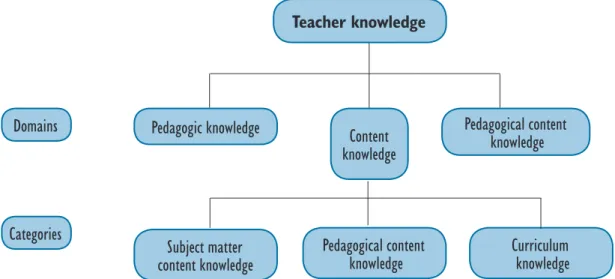
Shulman’s framework for teacher knowledge (1986a) is presented in Figure 2.1 below. Shulman used the construct of content knowledge in a broader sense than I have used it in my study, defining content knowledge as the ‘amount and organisation of knowledge per se in the mind of the teacher’ (1986b, p. 6). Having listed content knowledge as one of the three general domains of teacher knowledge, the other two domains being pedagogical knowledge and pedagogical content knowledge, Shulman went further to suggest that the content knowledge domain can be categorised as subject matter content knowledge, pedagogical content knowledge5 and curricular knowledge, adding that the subject matter content understanding of the teacher requires that the teacher ‘need not only understand that something is so; the teacher must further understand why it is so’ (1986b, p. 9). Shulman saw the construct of content knowledge as encompassing subject matter content knowledge, pedagogical content knowledge and curricular knowledge. I have not operationalised pedagogical content knowledge as a subset of content knowledge.
5 There is an apparent contradiction here, with Shulman listing pedagogical content knowledge as both a domain of teacher knowledge and a category of content knowledge.
Curriculum knowledge Content knowledge Pedagogical content knowledge
Figure 2.1: Shulman’s framework of teacher knowledge (1986a) Teacher knowledge
Domains Pedagogic knowledge
Subject matter
content knowledge Pedagogical content knowledge Categories
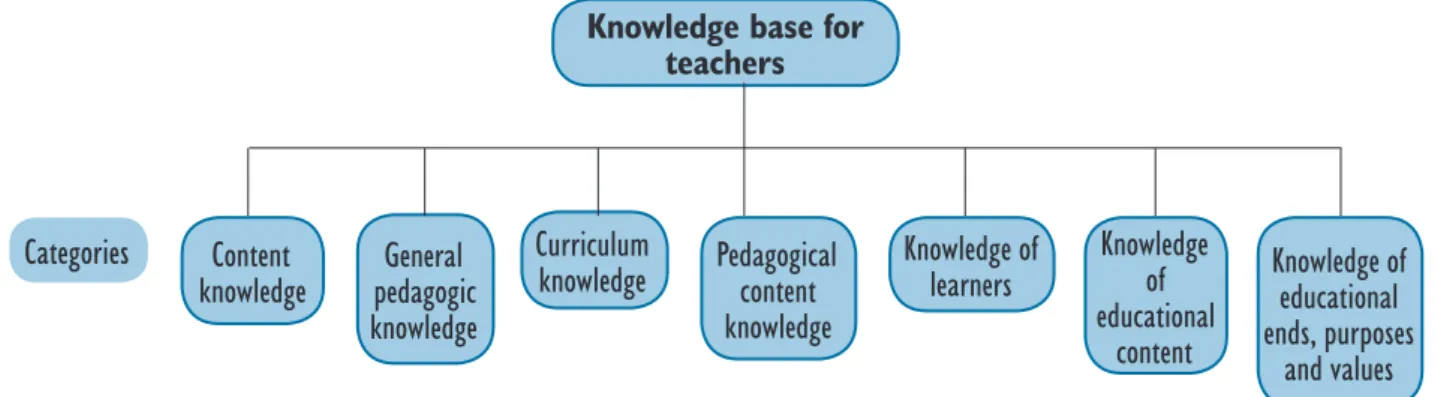
In addition to presenting a framework for teacher knowledge (1986a), Shulman (1987) presented a framework of the knowledge base for teachers. The knowledge base for teachers consisted of seven categories of knowledge6. Shulman’s knowledge base for teachers (1987) is presented in Figure 2.2 below. Shulman’s seven categories of the knowledge base for teachers are: content knowledge (or knowledge of the subject matter), pedagogical knowledge, pedagogical content knowledge, curriculum knowledge, knowledge of learners and their characteristics, knowledge of educational contexts and knowledge of educational ends, purpose and values. In his seven category classification of the knowledge base for teachers Shulman positioned content knowledge and pedagogical content knowledge slightly differently from the categorisation of teacher knowledge into three domains as shown in Figure 2.1, in that content knowledge and pedagogical content knowledge are presented as two separate categories, rather than pedagogical content knowledge being presented as a type of content knowledge. This separation of content knowledge and pedagogical content knowledge is how most researchers in the field use the constructs and is closely aligned with the way in which I have operationalised the two constructs in my study. The two categories of teacher knowledge which are pertinent to my study are content knowledge and pedagogical content knowledge and are the two categories which are discussed in depth in this review of the literature.
Following Shulman’s categorisation of subject matter content knowledge, various other scholars, for example Marks (1990); Ball and Cohen (1999); and Ball, Thames, and Phelps (2008) added to the debates around teacher knowledge by representing Shulman’s categories slightly differently, or by adding new categories. In their framework of content knowledge for teaching, Ball et al., (Ball, Thames & Phelps, 2008, p. 389) describe four domains, namely common content knowledge, specialised content knowledge, knowledge of content and students and knowledge of content and teaching. Of these four domains, it is only the first domain, common content knowledge, that would fit into the way in which I have operationalised content knowledge. By common content knowledge, Ball et al.
Knowledge base for teachers
Categories Content
knowledge pedagogicGeneral knowledge
Curriculum
knowledge Pedagogicalcontent knowledge Knowledge of learners Knowledge of educational content Knowledge of educational ends, purposes and values
Figure 2.2: Shulman’s knowledge base for teachers (1987, p.8)
6 Shulman differentiated between teacher knowledge (which was further sub-divided into domains and categories, and which was presented in Shulman (1986a), and the knowledge base for teachers (which was categorised into seven components and which was presented in Shulman (1987). Content knowledge and pedagogical content knowledge are included in both of these frameworks.
meant generic subject knowledge required by everyone (teachers and non teachers alike) who works with the subject. Ball et al’s. common content knowledge includes knowledge of concepts and skills; what is right and wrong; the ability to use terms and notations correctly; and the ability to identify inaccuracies in learning materials (p.399). The other three domains of Ball et al’s. content knowledge for teaching are more closely aligned with the way in which I have operationalised pedagogical content knowledge and are discussed under the section on pedagogical content knowledge.
2.2.2 Pedagogical Knowledge
Although an in-depth review of the literature on pedagogical knowledge is not required for the purposes of this study, a brief overview of the construct is provided for the sake of completeness as pedagogical knowledge is listed by Shulman (1986a) as one of three domains of teacher knowledge – the other two domains being content knowledge and pedagogical content knowledge. Pedagogical knowledge is also relevant as Shulman places pedagogical content knowledge at the intersection of pedagogy (pedagogical knowledge) and content (1987, p15). In Shulman’s seven-point categorisation of the knowledge base required by teachers, general pedagogical knowledge is afforded its own category and is described as the ‘broad principles and strategies of classroom management and organisation that appear to transcend subject matter (1987, p. 8). In a similar vein, Koehler, M. and Mishra, P. (2011) speak of pedagogical knowledge as a generic form of knowledge ‘about the processes and practices or methods of teaching and learning and how it encompasses overall educational purposes, values and aims.’ Pedagogical knowledge can be seen as being specific to teaching but generic across subjects whereas, as will be discussed in more detail below, pedagogical content knowledge is specific to teaching and specific to subjects.
2.2.3 Pedagogical Content Knowledge
In order to address my research question regarding the extent to which teachers in the professional learning community talk about content knowledge and pedagogical content knowledge, as well as the question regarding the nature of the relationship between content knowledge and pedagogical content knowledge, I reviewed the literature on pedagogical content knowledge. In this review of the literature on pedagogical content knowledge. I start with an outline of the construct as described by Shulman and then move on to discuss some of the contributions and elaborations of other scholars. Shulman is regarded as the father of pedagogical content knowledge. According to Nelson (1992, p. 32) ‘in his 1985 presidential address, Lee Shulman tossed off the phrase pedagogical content knowledge and sparked a small cottage industry devoted to the construct’. Shulman (1986a, p. 13 and 1986b, p. 9) categorised pedagogical content knowledge (or subject-matter pedagogical knowledge) as one of three types of content knowledge. Shulman defined the concept of pedagogical content knowledge as a ‘distinct body of knowledge that differentiates teachers from content specialists’ (1987, p. 15). Shulman (1987) went further to say that ‘comprehended ideas must be transformed in some manner if they are to be taught’ and to describe pedagogical content knowledge as ‘the capacity
of a teacher to transform the content knowledge he or she possesses into forms that are pedagogically powerful.’
Following Shulman’s descriptions of pedagogical content knowledge, there has been on-going debate as to the exact meaning of the construct: according to Kind (2009, p. 171), ‘researchers are still arguing about what pedagogical content knowledge is’. The construct of pedagogical content knowledge is still being defined and explored (Abell 2007), and there is ‘no agreed-upon definition of pedagogical content knowledge’ (Park, Jang, Chen & Jung, 2010). Ball (2008, p. 390) speaks of the meaning of pedagogical content knowledge being ‘underspecified’, adding that this lack of definition and empirical foundation has limited its usefulness. However, it should be noted that the current debates revolve more around the relationship between content knowledge and pedagogical content knowledge than trying to pinpoint exactly what constitutes what pedagogical content knowledge is and that there is general agreement that pedagogical content knowledge is an important aspect of an effective teacher’s repertoire of knowledge. There is, therefore, sufficient clarity to operationalise the construct. Although many scholars have tried to refine Shulman’s concept of pedagogical content knowledge, the notion that ‘the transformation of subject matter knowledge for the purposes of teaching is the heart of pedagogical content knowledge’ (Park et al., 2010, p. 248) is common to the work of most scholars. Bucat (2005, p. 2), amongst others, states that there is a vast difference between content knowledge and pedagogical content knowledge, describing pedagogical content knowledge as consisting of knowledge about the teaching and learning of a topic.
Much of my work is framed on the work of Soonhye Park which, in turn, was structured around the work of Shulman. Although Park focused on pedagogical content knowledge in science teaching, and my study focuses on content knowledge and pedagogical content knowledge in mathematics teaching, I found her work on pedagogical content knowledge sufficiently broad to extrapolate it to frame my study. For this reason, I include a review of the literature on pedagogical content knowledge as presented by Park.
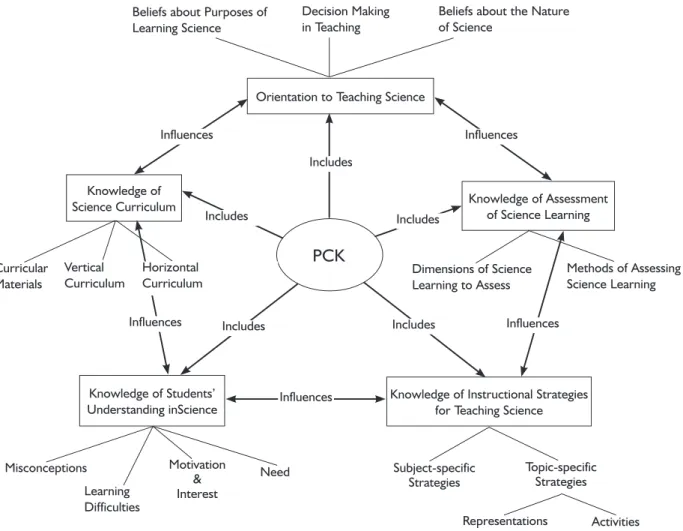
Park (2007, p. 745) presented a pentagonal model of pedagogical content knowledge. Her selection of the five components of pedagogical content knowledge in her model was based on an in-depth literature study in which the components of pedagogical content knowledge from different conceptualisations were identified. While the identification of the components that were deemed most important was nothing new, Park’s presentation in a pentagonal shape, the emphasis on the interaction between the components of pedagogical content knowledge and her conclusion that the total pedagogical content knowledge is greater than the sum of the parts (Park, 2014, personal communication) brought new ideas into the pedagogical content knowledge arena.
Figure 2.3 below shows the five integrated components of pedagogical content knowledge presented by Park (2007): (1) orientation to teaching science, (2) knowledge of student understanding; (3) knowledge of the science curriculum (both horizontal and vertical); (4) knowledge of instructional strategies and representations; and (5) knowledge of assessment of science learning. Although Park’s pentagonal model is silent with regard to content knowledge, the placement of pedagogical content knowledge at the centre, with the implication that the ‘development of one component may simultaneously encourage the development of others [components], and ultimately enhance pedagogical content knowledge’ (Park, 2007, p. 745) aligns with the DIPIP approach that development of pedagogical content knowledge can lead to the development of other components of teacher knowledge, of which content knowledge is one.
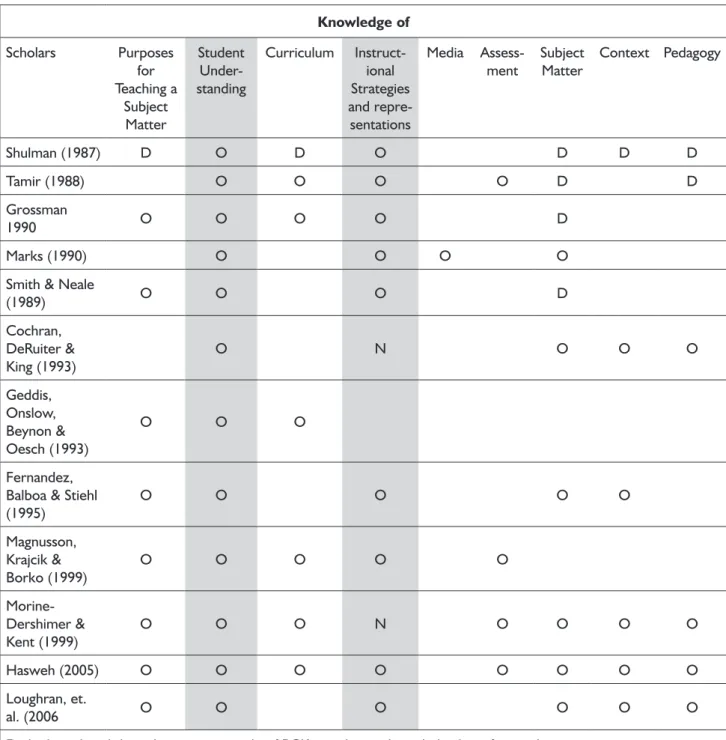
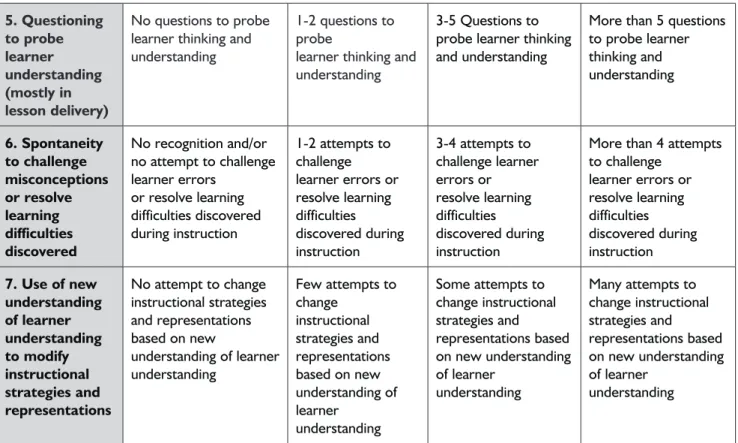
Park (2007) reviewed the components of pedagogical content knowledge listed as key by 13 scholars. Figure 2.4 on the next page summarises the results of this review. Of Park’s five components of pedagogical content knowledge, knowledge of student understanding (KSU) and knowledge of instructional strategies and representations of subject matter (KISR) are the two components included as key components of pedagogical content knowledge by all 13 scholars. These two components of pedagogical content knowledge are afforded prominence in my study also. KSU and KISR are
Misconceptions Learning Difficulties Motivation & Interest Need Topic-specific Strategies Activities Representations Subject-specific Strategies Dimensions of Science Learning to Assess Methods of Assessing Science Learning Vertical Curriculum Curricular Materials
Orientation to Teaching Science
Knowledge of
Science Curriculum Knowledge of Assessment of Science Learning
Knowledge of Instructional Strategies for Teaching Science Knowledge of Students’
Understanding inScience
PCK
Beliefs about the Nature of Science
Decision Making in Teaching Beliefs about Purposes of
Learning Science Influences Includes Influences Includes Includes
Influences Includes Includes Influences
Influences
Figure 2.3 Park’s pentagonal model of PCK for science teaching (Park 2007, p. 745) Horizontal
the two components of the pedagogical content knowledge rubric developed by Park et al., (2010). The pedagogical content knowledge rubric which I developed to analyse the teacher conversations in my study is based on the Park et al., (2010) rubric. As Park is silent on content knowledge in both her pentagonal model and her pedagogical content knowledge rubric, I needed to develop a
content knowledge rubric in order to answer my research questions regarding the extent to which the professional learning community talks about content knowledge and pedagogical content knowledge, as well as the relationship between content knowledge conversations and pedagogical content knowledge conversations. Knowledge of Scholars Purposes for Teaching a Subject Matter Student Under-standing Curriculum Instruct-ional Strategies and repre-sentations Media
Assess-ment Subject Matter Context Pedagogy
Shulman (1987) D O D O D D D
Tamir (1988) O O O O D D
Grossman
1990 O O O O D
Marks (1990) O O O O
Smith & Neale
(1989) O O O D Cochran, DeRuiter & King (1993) O N O O O Geddis, Onslow, Beynon & Oesch (1993) O O O Fernandez, Balboa & Stiehl
(1995) O O O O O Magnusson, Krajcik & Borko (1999) O O O O O Morine-Dershimer & Kent (1999) O O O N O O O O Hasweh (2005) O O O O O O O O Loughran, et. al. (2006 O O O O O O
D: Author placed this subcategory outside of PCK as a distinct knowledge base for teaching. N: Author did not discuss the subcategory explicitly (Equivalent to blank but used for emphasis) O: Author included this subcategory as a compnoent of PCK
Figure 2.4: Components of pedagogical content knowledge from different conceptualisations (Park 2007, p. 744)
In the same way that Park elaborated on pedagogical content knowledge by identifying the components of pedagogical content knowledge, many other researchers have done the same. Grossman (1990), identified four central components of pedagogical content knowledge, namely the teacher’s knowledge of and beliefs about: (1) the purpose of teaching a subject; (2) learners’ understanding, conceptions and misconceptions; (3) the curriculum and instructional strategies; and (4) representations for teaching. As discussed above, Park and Oliver (2008a, 2008b) added a fifth component of pedagogical content knowledge, namely teacher’s knowledge of assessment of learner understanding. Mavhunga and Rollnick (2013), building on work done by Grossman (1990) and Davidowitz and Rollnick (2011), identify the influence of four teacher knowledge domains on the development of pedagogical content knowledge. These domains are the teacher’s knowledge of context, students, subject matter knowledge and pedagogic knowledge. Mavhunga and Rollnick (2013) refer to ‘knowing what makes a topic difficult’ as being a component of pedagogical content knowledge, thus agreeing with Park et al., (2010, p. 249) that a knowledge of what concepts learners are likely to experience difficulty with is a component of pedagogical content knowledge.
Geddis (1993) and Geddis and Wood (1997) spoke of the construct of subject matter knowledge. I include their list of the components of subject matter knowledge in this section on pedagogical content knowledge because, in my opinion, their conceptualisation of subject matter knowledge aligns closely with the way in which I have operationalised pedagogical content knowledge. They identified the particular aspects of subject matter knowledge that are relevant to its teachability as ‘(i) Students’ prior knowledge including misconceptions, (ii) Curricular saliency, (iii) What makes a topic easy or difficult to understand, (iv) Representations including analogies and (v) Conceptual teaching strategies’.
Kind (2009, p.171) speaks of pedagogical content knowledge being elusive in nature and as being a ‘hidden concept’ in two ways. First, pedagogical content knowledge is often tacit and is not used consciously by most teachers. Second, ‘pedagogical content knowledge is largely hidden from a professional teacher’s view.’ However, Mavhunga and Rollnick (2013) are making the concept of pedagogical content knowledge more explicit and include the construct in the training of pre-service science teachers.
In an attempt to frame the ‘conceptualisation of the mathematical knowledge and skill required by teachers’, Ball et al., (2008, p. 389) built on Shulman’s (1986) construct of pedagogical content knowledge. They identified two sub-domains of pedagogical content knowledge, namely knowledge of content and students and knowledge of content and teaching, but hypothesise that there is a third, less recognised domain of content knowledge for teaching, namely specialised content knowledge. Ball et al. do not view specialised content knowledge as a subdomain of pedagogical content knowledge, but rather as a subdomain of ‘pure’ content knowledge. In Ball et al’s. framework of the knowledge needed by teachers, specialised content knowledge is different from the common content knowledge needed by both teachers and non teachers. Ball et al’s. specialised content knowledge includes subject knowledge that is unique to teaching; it is knowledge that goes ‘beyond that taught to students’
(2008, p. 400); is used by the teacher to unpack the mathematics for the learner and involves ‘making features of particular content visible to and learnable by students’ (2008, p. 400). In this study, these aspects of teachers’ knowledge are included in pedagogical content knowledge.
Ball et al.’s knowledge of content and students combines knowledge of students and knowledge of mathematics. Ball et al. hold that teachers need knowledge of the ‘common conceptions and misconceptions that students bring to the classroom or develop as they learn the subject’ (2008, p. 394). This involves teachers being able to anticipate what students are likely to think and what they will find confusing; understand learners’ thinking and use of language to express their emerging understanding of mathematical concepts (2008, p. 401). Teachers being able to anticipate what students are likely to think and what they will find confusing are aspects which align closely with the DIPIP focus on error analysis. Ball et al.’s knowledge of content and teaching, combines knowing about teaching and knowing about mathematics. As with specialised content knowledge and knowledge of content and students, knowledge of content and teaching is specific to teaching. It involves knowledge of how to sequence content, select examples and select representations to teach content (2008, p. 401). Knowledge of content and teaching aligns with the way in which I have operationalised pedagogical content knowledge in my study.
In conclusion, this review of the literature on pedagogical content knowledge reveals that a knowledge of learners’ understandings, conceptions and misconceptions and knowledge of instructional strategies and representations are the two components of pedagogical content knowledge mentioned by all researchers. In addition, it can be said that, although the construct of pedagogical content knowledge still lacks clear definition, there is general agreement that it represents a ‘move away from the notion of pedagogy as a content-free skill’ (Rollnick et al., 2008, p.1365). My view of pedagogical content knowledge is that the whole is greater than the sum of the parts, that is, I see pedagogical content knowledge as being more than the sum of pedagogic knowledge and content knowledge. This differs from Schulman’s view that pedagogical content knowledge is located at the intersection of content knowledge and pedagogic knowledge.
2.2.4 Relationship between content knowledge and pedagogical content knowledge There is on-going debate as to whether subject matter knowledge (content knowledge in my study) and pedagogical content knowledge are separate knowledge components or are merged (Kind 2009, p. 180). In integrative models, pedagogical content knowledge is not recognised as a separate knowledge component, whereas in transformative models pedagogical content knowledge is described as ‘new knowledge arising from the act of transforming subject matter, pedagogical and contextual knowledge for the purposes of instructing students’ (Kind 2009, p. 180). According to Shulman (1986, 1987) pedagogical content knowledge lies at the intersection of content knowledge and pedagogical knowledge.
According to Rollnick, Bennett, Rhemtula, Dharsey and Ndlovu (2008), subject matter knowledge (or content knowledge) is a pre-requisite for the development of pedagogical content knowledge.
However other researchers, for example Brodie and Sanni (2014) contest the stance that developing subject matter knowledge (or content knowledge) is necessarily primary and that the development of all other forms of teacher knowledge has to be founded on content knowledge. While not disagreeing that the development of teachers’ content knowledge is important, Brodie and Sanni argue that ‘the relationships between teachers’ content knowledge and pedagogical content knowledge are more nuanced.’ Brodie and Sanni (2014, p. 3) speak of a two-way relationship between content knowledge and pedagogical content knowledge which they regard as being ‘mutually constitutive’. The view that content knowledge is not always primary supports Park’s assertion that the development of one component of teacher knowledge may ‘simultaneously encourage the development of others, and ultimately enhance pedagogical content knowledge.’ (Park 2007, p. 745).
Geddes (1993) pointed out that developing teachers need to transform their subject matter knowledge (or content knowledge) into a version that is suitable for use in teaching learners. I argue that this is part of the process of developing pedagogical content knowledge. Ball et al., (2008) hold that the content-specific components of mathematics are found in the specialised content knowledge of the subject. Marks (1990), who based his pedagogical content knowledge model on data collected from primary mathematics teachers, included subject matter knowledge in the definition of pedagogical content knowledge, adding that ‘subject matter knowledge and pedagogical content knowledge were not clearly distinguished knowledge components’.
Following this review of the literature on teacher knowledge, it can be concluded that some form of teacher knowledge beyond content knowledge is essential if teachers are to make knowledge accessible to their learners. I agree with Marks’ assertion that subject matter knowledge (content knowledge) and pedagogical content knowledge are not easily distinguishable. Although I have separated content knowledge and pedagogical content knowledge in my study of teacher knowledge conversations in one DIPIP professional learning community in order to make the analysis more manageable, I remain cogniscent of the fact that the separation is not always clear cut. Data need to be (and have been) analysed with this in mind. Having discussed teacher knowledge, I now move on to discuss the Data Informed Practice Improvement Project, an initiative in which content knowledge is seen to develop in tandem with the development of pedagogical content knowledge.
2.3 Data Informed Practice Improvement Project (DIPIP)
The professional learning community under study is a part of DIPIP. A brief outline of DIPIP, particularly DIPIP Phase 3, is provided to enable the reader to understand the context of the study. DIPIP is a project which focuses on the development of mathematics teachers in professional learning communities - which are discussed in more depth in Section 2.4 below. The main aim of DIPIP is to improve teachers’ practices through developing pedagogical content knowledge and some content knowledge. This is done by creating a platform for professional conversations in which mathematics teachers, together with university academics or teachers as facilitators, discuss what information test data provide which can be used to think about reasons for learner errors and how these might be
addressed through collaborative lesson planning, teaching and reflection. The project aims build and sustain professional learning communities in which teachers engage with data from a range of sources and work together to better understand the nature of learners’ errors and how they might respond to them’ (Brodie, 2013, p.7).
DIPIP was planned from the outset to be a long-term project, based on research which showed that short-term, fragmented seminars and workshops do not work (Borko 2004; Brodie and Shalem 2011). Having distilled the work of several researchers (Borko 2004; Jaworski 2008; Katz, Earl & Ben Jafaar 2009; Kazemi & Hubbard 2008), Brodie (2013) identified six key characteristics of successful teacher development programmes. According to Brodie (2013), DIPIP takes all six of these characteristics into account. The six key characteristics are: ‘they are long term and developmental; they focus on artifacts of practice such as student thinking, tasks and instructional practices; they use actual classroom data; they encourage design and reflection on the part of teachers; they are job-embedded (school-based) and therefore blur the boundaries between teaching and learning about teaching; and they promote the development of professional learning communities’ (Brodie 2014, p. 5).
According to Brodie (2013) the DIPIP facilitators7 and team put a lot of time and effort into ensuring that the professional learning communities are sustainable, not only during the set-up phase, but also during the on-going roll-out of the DIPIP programme. This is achieved by respecting the participants’ time and knowledge and acknowledging their expertise regarding their schools and learners (Brodie, 2014). In DIPIP, teacher professional development is achieved by supporting teachers to participate in a sequence of activities in which they analyse learners’ errors in different teaching contexts. It is the teacher conversations within these planned project activities that form the basic unit of analysis of the development of content knowledge and pedagogical content knowledge in this study.
In light of the fact that the focus of DIPIP is on teachers learning to work with learner errors and consequently the bulk of the teacher conversations under study focuses on learner errors, a review of the DIPIP stance regarding learner errors is provided. Based on the extensive research literature on errors and misconceptions in mathematics, DIPIP regards errors as systematic, persistent and pervasive mistakes performed by learners across a range of contexts (Brodie, 2013, Brodie & Berger, 2010, p. 169). Brodie (2011) goes further to say that, in terms of error analysis, the DIPIP focus is on the reasoning behind the learner errors as the reasoning is often valid. In this way, errors are used as a route to learner thinking (Brodie, 2015, personal communication). This aligns with the view of Borasi (1994) that errors are evidence of reasonable and interesting thinking on the part of the learner. The project distinguishes errors from slips (Olivier 1996) and recognises that ‘since errors are systematic and persistent, they are not necessarily responsive to easy correction or re-explanation of concepts’ (Brodie 2013, p. 8). In terms of working with learner errors, the DIPIP stance is to encourage teachers to embrace errors, to value learner thinking and to seek to find ways of understanding why learners
7 Two types of facilitators play a role in the DIPIP programme. Both university-based facilitators (part of the project team) and school-based facilitators (teachers) are involved in leading the communities.
have made errors. Brodie (2013, p. 9) describes the DIPIP approach to errors as being one in which teachers are encouraged not to shy away from errors, but rather to ‘search for ways to understand why learners may have made errors’ and to find ways to engage their current knowledge in order to create new knowledge’, particularly in the light of the DIPIP stance that errors are not a sign of a teaching and/ or learning deficit and are a normal part of learning mathematics.
Since I will argue that the design of the project and, in particular the design of the project activities, plays an important role in the extent to which the professional learning community talks about pedagogical content knowledge and content knowledge, a description of the professional learning community activities in Phase 3 in 2013 is provided. Although nine activity types are specified in the DIPIP framework, only four activity types are pertinent to this study because not all the DIPIP activity types occurred in 20138. The four activity types are error analysis, learner interviews, lesson planning and lesson reflection. During error analysis activities, teachers discuss learners’ answers to test items, focusing on common errors and learner thinking behind errors. During the learner interview activities, teachers select and discuss errors which they plan to probe in one-on-one interviews with learners. During lesson planning meetings, teachers work collaboratively to plan and prepare lessons on topics selected by the professional learning community. During lesson reflection activities, teachers reflect on lessons they have taught and which have been video recorded, in order to understand their strengths and challenges in dealing with learner errors in class.
To conclude this section on the Data Informed Practice Improvement Project, I discuss the DIPIP view of pedagogical content knowledge and content knowledge and the way in which the development of these components of teacher knowledge is approached. A clear understanding of the DIPIP approach to the development of pedagogical content knowledge and content knowledge is fundamental to three aspects of my study, namely the ways in which the professional learning community talks about pedagogical content knowledge and content knowledge, the relationship between the way in which the professional learning community talks about pedagogical content knowledge and content knowledge and the design of the DIPIP project, and the relationships between pedagogical content knowledge conversations and content knowledge conversations in the professional learning community.
According to Brodie and Sanni (2014, p. 1) ‘much of the work on teacher knowledge suggests that content knowledge shapes pedagogical content knowledge, and in fact is primary in the relationship between the two forms of knowledge’. Brodie and Sanni (2014) challenge this view and contend that ‘building teachers’ practices and their pedagogical content knowledge can build their content knowledge’ (Brodie & Sanni 2014, p. 2). Drawing on evidence from teacher development projects in South Africa and in Nigeria, Brodie and Sanni (2014), argue that constraints arising from teachers’ regular practice and pedagogical content knowledge can ‘be overcome in professional development programmes designed to take such knowledge relationships into account and that in these contexts
8 In 2013, the year of study, the teachers in this professional learning community had participated in the project for two years and often chose to priortise activities they preferred.
engagement with pedagogical content knowledge can lead to improvement of content knowledge’ (Brodie and Sanni, 2014, pp. 4–5). Based on their arguments and examples, I align with the view of Brodie and Sanni (2014) that pedagogical content knowledge affects content knowledge – that is, that the development of content knowledge does not necessarily have to precede the development of pedagogical content knowledge.
The DIPIP approach to the development of content knowledge and pedagogical content knowledge is that teachers think about what they do in the classroom, that is their practice, first and that the best way of developing teachers’ content knowledge is via pedagogical content knowledge. The DIPIP activities are structured in such a way as to promote pedagogical content knowledge conversations, and my study will show that this is, indeed, achieved. Moreover, pedagogical content knowledge conversations often lead to content knowledge conversations. According to Brodie (2012, 2103), the fact that content knowledge is discussed and learned in relation to pedagogical content knowledge makes it more powerful.
Contrary to many other teacher development programmes which start with content knowledge, the DIPIP approach to the development of teacher knowledge is to start with pedagogical content knowledge. The rationale behind this approach is that teachers are most focused on what happens in the classroom and that pedagogical content knowledge is foregrounded in teachers’ thinking, and thus the most efficient way of developing teacher knowledge in the form of content knowledge is to access teacher thinking via their pedagogical content knowledge, and their existing knowledge of errors in particular.
The following statement by Brodie (2013, p. 15) encapsulates the DIPIP approach using learner errors as the context for developing content knowledge and pedagogical content knowledge: ‘One of the key principles of the DIPIP project is that in coming to understand learner needs, teachers can come to understand their own learning needs: what mathematics they need to learn and how to use this new knowledge to improve their practice’. This statement emphasises the fact that the DIPIP approach is to use learners’ errors as a method of bringing teachers’ needs to the fore. Once teachers become aware of their needs, a situation which is conducive to the development of content knowledge and pedagogical content knowledge is created. DIPIP activities are designed to support teachers as they learn more about learner errors and learner thinking and, in so doing, develop their content knowledge and pedagogical content knowledge. In addition to creating opportunities for the development teacher knowledge, the focus on learner errors and, in particular, the reasoning behind learner errors creates the opportunity for teachers to use their content knowledge and pedagogical content knowledge in the classroom and thus improve their practices. In terms of the selection of topics for discussion during DIPIP PLC meetings, teachers, under the guidance of the facilitators (school and university), chose the content topics for discussion and lesson plans. In 2013, after a detailed analysis of learner errors in the 2012 Grade 9 ANA, the teachers chose to focus on exponents. Teachers in the PLC discussed the topic, drawing each others’ attention to different content and teaching practices that may be required
in different grades. The discussions focused on errors commonly made by learners with regard to exponents. Teachers worked together to plan lessons on the topic of exponents.
According to Brodie (2013), working in professional learning communities is one of the three key strands of DIPIP. A brief review of professional learning communities in general and the DIPIP approach to professional learning communities in particular, is provided in the next section.
2.4 Professional learning communities (PLCs)
A professional learning community is, or should be, what the name suggests – a group of professionals (in the case of DIPIP the professionals are teachers), who interact collectively (as suggested by the term community) in order to bring about learning. Researchers, including Clarke and Borko (2004), Jaworski (2008) and Brodie (2011, 2012, 2013), view professional learning communities as an effective, lasting and sustainable method of professional development in mathematics education. Brodie (2013, p. 15) holds that ‘professional learning communities can be sites where deep and powerful learning among teachers takes place’ but cautions that the creation of powerful professional learning communities requires a lot of thought and commitment, from all stakeholders – the teachers involved, professional learning community leaders, principals and departmental officials.
Several researchers have worked to identify features of professional learning communities. Drawing from existing literature, as well as her own research into teacher development programmes, Borko (2004) identified several features of professional learning communities. These features include that a professional learning community should develop a group identity and norms for interaction, a sense of communal responsibility for the regulation of norms and behaviour, and that professional learning community members should show a willingness to assume responsibility for the growth and development of other members of the community. Borko (2004) and Brodie (2011, 2013) emphasise the importance of the collective nature of professional learning communities as they provide a platform for teachers to ‘collaborate and learn together about how their learners’ needs can influence and improve their practice’ (Brodie 2011). Brodie also argues that collectivity extends beyond collaboration because the DIPIP aim of achieving shifts in teacher practice can be achieved through collective shifts of practice. Katz, Earl and Ben Jafaar (2009) identify four key characteristics that a professional learning community needs to exhibit if it is to be successful and, in my opinion sustainable (which is an important element of success). Brodie represents Katz et al.’s four key characteristics of successful professional learning communities as follows: ‘(1) the professional learning community has a challenging focus; (2) the participants create productive relationships; (3) the participants collaborate; and (4) the participants engage through rigorous enquiry’ (Brodie, 2013, p. 6).
I now review each characteristic systematically, with particular reference to the way in which the characteristic is dealt with in DIPIP professional learning communities. I start by discussing the focus of professional learning communities in general and DIPIP professional learning communities
in particular. According to Katz et al., (2009, p. 23) it is essential that a ‘clear, defensible focus’ is established in order for a professional learning community to be successful, and that the focus is ‘right, shared and understood’ (Katz et al., 2009, p. 47). Katz et al. go further to say that the professional learning community focus should have high leverage in enhancing learners’ learning and should be concrete, useful, challenging and shared by members of the community and should be appropriate for the context of the community. The professional learning community focus in DIPIP is learner errors from which learners’ needs are established, and it is through the process of coming to understand learners’ needs that ‘teachers can come to understand their own learning needs’ (Brodie 2013, p. 13), both in the form of content knowledge and pedagogical content knowledge.
Participants creating successful relationships through trust is the second of the four key characteristics identified by Katz et al., (2009). For Katz et al., professional conflict is encouraged so as to promote rigorous enquiry and growth. However, care must be taken to ensure that professional conflict does not become personal, and DIPIP facilitators go to great measures to ensure that ‘we challenge the concept, not the person’ (DIPIP facilitator during professional learning community meeting). The DIPIP facilitators ‘set an example for building trust and care in the communities’ (Brodie 2013, p. 8). Much has been written about Katz et al.’s third and fourth key characteristics of successful professional learning communities, namely that participants collaborate and that they engage through rigorous enquiry. Jaworski (2006) also proposed enquiry as an important principle of teacher professional development and emphasised the importance of having communities of enquiry in which teachers and researchers work collaboratively on topics identified by the teachers. Brodie (2014, p. 226) contends that the DIPIP facilitators aim to achieve this by positioning teachers in two different ways. Firstly, teachers are recognised as experts – having knowledge of their own schools, classrooms, learners, current teaching practices and some learner errors. Secondly, teachers are recognised as learners with the potential for learning about how to engage with learner errors and the thinking behind learner errors and, in so doing, to improve their practice. Brodie (2013) argues that an aspect of the collaborative nature of the professional learning communities is that they should be supported by departments, schools and principals. Facilitators, in conjunction with the DIPIP project leader, also collaborate with each other in DIPIP. In her discussions of research involving several teacher development programmes in the United States of America, Borko (2004) speaks of the way in which teacher collaboration and mathematical conversations in professional learning communities foster teacher development.
In addition to Katz et al,’s four key characteristics of successful professional learning communities, Jaworski (2006) includes alignment as an essential feature of working in a professional learning community. Jaworski describes alignment as a critical process in which individual members of the learning community align themselves with the conditions and characteristics of the group. In DIPIP,
the alignment which Jaworski speaks of is achieved, at least in part, by the fact that the teachers in each professional learning community either teach at the same school or, as in the case of the learning community under study, teach at schools that are closely located geographically. In DIPIP, the entire project team works hard to achieve alignment by negotiating with stakeholders and setting up the professional learning communities in such a way as to achieve maximum buy-in; ensuring that every session has a meaningful, learner error-aligned focus; preparing activities carefully; showing respect for teachers’ time, knowledge and working conditions; ensuring that all meetings start and finish on time; and that planned meetings that are missed for any reason are made up.
2.5 Summary
Currently, learner performance in mathematics is poor at all levels in the school system. Resulting from this, there has been a proliferation of intervention programmes aimed at improving learner performance. I concur with the view that professional development programmes that focus on long-term teacher learning of content knowledge and pedagogical content knowledge have the potential to bring about lasting changes in teaching practices (Borko 2004; Kazemi & Hubbard 2008). For this reason, my study focuses on understanding the conversations of teachers in one professional learning community, with particular emphasis on development of teacher knowledge in the form of content knowledge and pedagogical content knowledge.
The review of the literature shows that pedagogical content knowledge is broadly accepted as an important component of the knowledge that teachers require in order to make knowledge accessible to their learners. Although there are differing views regarding the positioning of content knowledge in relation to pedagogical content knowledge, the importance of content knowledge in the repertoire of teacher knowledge is acknowledged by most researchers. In addition, evidence provided in the literature provides support for the claim that professional learning communities provide an effective platform for the development of teacher knowledge and that error analysis provides an entry into both learner and teacher learning needs, which can ultimately lead to shifts in teacher practice. The aim of this study is to explore the extent to which the professional learning community talks about content knowledge and how these teacher knowledge conversations are related to the design of the DIPIP project, as well to understand the relationships between content knowledge conversations and pedagogical content knowledge conversations in the DIPIP professional learning community.
In Chapter 3 I discuss my research design and methodology. I discuss my research approach, data collection processes, analytic framework, PCK’and CK rubric and the use of software to code the data in preparation for analysis, rigour and validity and ethical issues considered in the analysis of the data.