1
DEVELOPING EXTENSIVE READING PROJECT BASED LEARNING TO IMPROVE STUDENTS’ READING COMPREHENSION IN EFL CLASS
Juni Hartiwi, AG. Bambang Setiyadi, Hery Yufrizal
FKIP Universitas Lampung, Jl. Prof. Dr. Sumantri Brojonegoro No. 1 E-mail: [email protected]; Telp. 085228836390
Abstract: The research aimed to estimate Extensive Reading Project Based Learning (PjBL) can improve students' reading and to examine whether Extensive Reading PjBL can improve students' activities. Population was second-semester students of English study program of STKIP PGRI Bandar Lampung. A test and observation checklist were to measure students’ reading and activities. The result revealed Extensive Reading PjBL can improve the students’ reading. Moreover, Extensive Reading PjBL can increase the students’ activities. In conclusion, Extensive Reading PjBL provided chances for students to cooperate and to interact each other. Those facts made students successfully promoting their reading through Extensive Reading PjBL. Therefore, the writer recommends English teacher to apply this technique promoting the students’ reading. Further researchers are suggested to design a similar area of research with something new by considering the learners' condition and characteristics.
Keyword: Extensive Reading, Project Based Learning, reading comprehension
Abstrak: Penelitian ini bertujuan memperkirakan Extensive Reading Project Based Learning (PjBL) dapat memperbaiki kemampuan membaca dan untuk memeriksa apakah Extensive Reading PjBL dapat memperbaiki aktifitas mahasiswa. Populasi penelitian adalah mahasiswa semester dua program studi Bahasa Inggris STKIP PGRI Bandar Lampung yang terdiri dari 30 mahasiswa. Test diberikan untuk mengukur kemampuan membaca, dan observation checklist dipakai mencatat progress aktifitas. Hasil menunjukkan Extensive Reading PjBL dapat memperbaiki kemampuan membaca dan aktifitas mahasiswa. Kesimpulannya, Extensive Reading PjBL memberikan kesempatan bekerja sama dan berinteraksi. Fakta tersebut berhasil memperbaiki kemampuan membaca mereka. Penulis merekomendasikan teknik ini untuk meningkatkan kemampuan membaca. Peneliti yang akan datang disarankan mendesain penelitian serupa dengan sesuatu yang baru dengan mempertimbangkan kondisi dan karakteristik mereka.
skills which is very crucial during the learning process. It gives an opportunity for second language development in second language learners (Day & Bamford, 1998) which is particularly true in EFL classrooms where materials input are quite limited. The process of comprehension becomes difficult for EFL learners (Hayashi, 1999). The students usually tend to spend much time finding the meaning of the difficult words in the reading text. In fact, reading English text is considered to be difficult for most Indonesian students. This is supported by some researches that show the ability of Indonesian students in reading text was very low (Hamra & Syatriana, 2010). By staying in this condition, learning reading in class would bring them such boredom. Therefore this condition will be worse and will influence the reading development.
A pre-observation done by the researcher showed EFL students in STKIP PGRI Bandar Lampung had a lack of motivation to read. They tended to be less interested in reading for assignments, as a group, or for leisure. Therefore, the lecturer should have a special treatment to stimulate students to read more.
It is extensive reading which is called to be pleasure reading, an approach to language teaching, in which learners read a lot of easy material in the new language. Krashen (1995, p.164) says pleasure reading is one kind of reading that concern on reading for pleasure. It is completely voluntary. It means that the students choose their own
A reward would come to students who read a great deal in the new language. Research studies show they become a better and more confident reader. Bamford (as cited in Pino & Silva, 2006) outlines that a good number of extensive reading programs use simplified books or in other words grade readers as the basic reading materials. In relation to Bamford's idea, preparing such a well-prepared reading program seems to be a necessary thing. There is no denying that the scene of education is changing briskly and significantly. Educators are trying to keep up with new developments which results in the change.
Krashen (1995, pp.21) states that we acquire language by ‘going for meaning’ first, and ‘learn to read by reading’. It means to acquire a language someone should attain the meaning for whatever he deals with and be connected first by contextual condition and activities. And that was the starting point in which extensive reading approach was developed and has been widely applauded.
Although there have been a large number of studies done on extensive reading, only a few experimental studies of EFL extensive reading exists (Wu, 2012). Moreover, there were only a few comprehensible methods done for extensive reading. In addition, in her research Meng (2009) also mentions some new techniques should be explored to be used in the extensive reading program. It means that as teachers it is their responsibility to find an appropriate and available technique
3
to explore extensive reading. Project Based Learning (PjBL) offers a way to engage students and give them ownership over their own learning. This technique of instruction allows students to choose and create own authentic assignments to demonstrate their knowledge of a topic. This is clearly stated by Bell (2010) that Project Based Learning engages the literacy skills of students, from reading, writing, speaking and synthesis of information. By giving students ownership over their learning and having them choose a
way to demonstrate their
understanding, they are more motivated to complete a given task. In relation to the goals of the research; to estimate whether Extensive Reading Project Based Learning (PjBL) can improve students' reading achievement and to students' activities.
METHOD
This quantitative research was conducted based on the quasi-experiment method applied one-group time series design modified from the idea suggested by Setiyadi (2006). The population was second-semester students of English study program of STKIP PGRI Bandar Lampung 2015/2016 academic year consisted of 30 students as the subject of the research. The subjects of the research were given the treatment of extensive reading for two months. The pre-test was administered before the treatment was implemented, to see the
students’ basic reading
comprehension. Then, the treatment was implemented. The post-test was administrated afterward, to analyze
the improvement of the students’ reading comprehension. The test included five aspects of reading
comprehension including
determining the main idea, comprehending the main idea, distinguishing between the main idea and supporting details, making inferences, making references,
understanding vocabulary.
Meanwhile, the progress of students’ activities was recorded on an observation checklist. They were measured by rubric of assessment in a rating scale from point 1 to 4.
RESULTS
The Application of Extensive Reading Project Based Learning (PjBL)
Started from the seventh meeting until the twelfth meeting, the researcher who acted as the lecturer implemented the learning process of reading through Extensive Reading PjBL. The steps were starting with the essential question, designing planning for the project, creating a schedule, monitoring students’ and project’s progress, assessing the outcome, and evaluating the experience. The reading material that the students worked with was chosen based on their interest. Besides doing reading activity in the classroom with group, the students were also given a chance to do reading at home for any kinds of reading materials independently in their leisure time.
During the process of teaching learning of reading, all students’ activities in group were observed and noted on observation checklist which included participation, leadership, listening to discussion, cooperation and time management.
The Improvement of the Students’ Reading Comprehension Ability
The test was administrated four times in which test 1 and test 2 were given as the measurement for reading achievement after the conventional technique, test 3 and test 4 were given as the measurement for reading achievement after applying Extensive Reading PjBL. The result of students' reading comprehension test insignificantly improved. There are only 26% of students in test 1 get the score between 61-70. Whereas, in test 2 there are 20% of students get the score between 61-70. It can be concluded that there is no improvement of students' reading comprehension both in test 1 and test 2.
There are 30% of students in test 3 got the score between 61-70. Whereas, in test 4 there are 43% of students get the score between 61-70 and 14 % of the students got the score between 81-100. Based on the data, the students who achieved a moderate level in test 3 are 30%, the good level are 23%, and a very good level are 0%. And test 4 showed the students who achieved moderate level are 43%, the good level are 43%, and a very good level are 14%. It can be concluded that there is an improvement of students' reading comprehension both in test 3 and test 4 after being taught by Extensive Reading Project Based Learning.
After having conventional teaching technique, the students' mean of the test 1 is 53.25 and increased to 53.60 in test 2. Additionally, the total mean of the students' reading comprehension scores after being
taught by conventional teaching technique is 53.42.
After being taught by Extensive Reading PjBL, the students' mean of test 3 was increased to 64.93, but it is then increased again to 73.91 in test 4. Additionally, the total mean of the students' reading scores after Extensive Reading PjBL has increased 16 points from 53.42 (in test 1 and test 2) to 69.42 (in test 3 and test 4). To be clear, it can be seen by following graphic.
The graphic shows that Extensive Reading PjBL activities improve the students’ reading comprehension. Furthermore, to see whether there is a significant improvement in the students' score in term of reading comprehension, the Paired Sample Test was used. Based on the result of the Paired Sample Test, the value of two-tailed significance of the tests was less than 0.05. In this case, the value of two-tailed significance was 0.00. It can be concluded that H0 was
rejected and H1 was accepted in the
first hypothesis. In other words, Extensive Reading PjBL can improve the students’ reading comprehension achievement better
than conventional teaching
technique. 0 20 40 60 80
Test 1 Test 2 Test 3 Test 4
5
The improvement of Students’ Activities in Extensive Reading PjBL
Considering the process which
combined between Extensive
Reading and Project Based Learning (PjBL), the researcher employed the group work in such a big class. This was done as suggested in PjBL principle which includes the group to do a project and it was also to make the process easily be controlled.
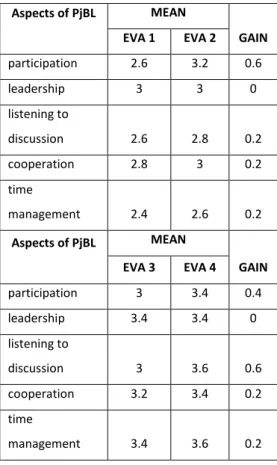
There are six steps in PjBL, they are essential question, plan, schedule, monitor, assess and evaluate. The researcher analyzed and identified the gain of the five aspects of activities in PjBL to know which aspect of activities in Extensive Reading PjBL mostly influenced the students reading achievement. The result is stated undergo.
Table 1. The Mean of Students’ Activities
Aspects of PjBL MEAN GAIN EVA 1 EVA 2 participation 2.6 3.2 0.6 leadership 3 3 0 listening to discussion 2.6 2.8 0.2 cooperation 2.8 3 0.2 time management 2.4 2.6 0.2 Aspects of PjBL MEAN GAIN EVA 3 EVA 4 participation 3 3.4 0.4 leadership 3.4 3.4 0 listening to discussion 3 3.6 0.6 cooperation 3.2 3.4 0.2 time management 3.4 3.6 0.2 Participation
The mean score from participation aspect in evaluation 1 was 2.6. In evaluation 2, it increased to 3.2. While in valuation 3 and 4, the mean scores were 3 and 3.4 which mean the students kept to be more active in the group work.
Leadership
The data of leadership aspect showed that in evaluation 1 and 2 the mean score was 3. In evaluation 3 and 4 showed a mean score of 3.4. It means that they more often involved in leading the work.
Listening to the discussion
The data of listening to discussion aspect from evaluation 1 and 2 showed the mean score were 2.6 and 2.8. While in evaluation 3 and 4, the mean score increased to3 and 3.6 which means that they were more often and tended to always listen to the group discussion.
Cooperation
Based on the data in evaluation 1 and 2, the mean scores were 2.8 and 3. While evaluation 3 and 4 showed the increase to 3.2 and 3.4. It means they often tended to always cooperate with the group in doing the work.
Time management
The evaluation 1 and 2 in time management were 2.4 and 2.6. While evaluation 3 and 4 indicated the increase to 3.4 and 3.6, it means that they could finish the work on time.
DISCUSSIONS
However, before discussing the result above, the researcher would
compare the result of the current research with some previous related research. First, the research which used Extensive Reading was conducted by Sheu (2004). He applied the research in the second year students at I-Jea Junior High School in Kaohsiung County, Taiwan. This experimental study found that the degree of significance in reading achievement is better, while the students’ attitudes toward learning English and reading after the experiment became significantly positive. Second, Siao (2012) did research which investigates the impact of authentic materials as the main source of extensive reading. This quantitative study results indicated a strong relationship between extensive reading and vocabulary development. Students thought that extensive reading also enhanced their overall English ability and knowledge. Meanwhile Al-Rawahi and Al-Mekhlafi (2015) investigated the effect of online collaborative project-based learning on the language performance and attitudes of intermediate level students at the College of Applied Sciences in Oman. The study revealed that the main positive effect of online collaborative project-based learning was clear on students' writing skill in the post-test (i.e. students in the experimental group outperformed students in the control group).
However, among those studies, several differences were recognized; firstly, the design of the research; secondly, the variables which were investigated; thirdly, modification of the technique. In the current research, the researcher employed one group time series design. It
means, this research was conducted without using control class since the purpose of this research is to investigate whether there is a significant effect of Extensive Reading PjBL on the students' reading comprehension achievement after the treatments. Further, it can be said that the design is totally different from the previous research. Then, the variables investigated in the previous research were reading and writing skill while the current research investigates reading comprehension achievement and the aspects of Extensive Reading PjBL that influence the students’ reading achievement.
Lastly, the modification of the technique. The current research was strongly different from the previous research which applied the original Extensive Reading and PjBL technique separately. In this research, the researcher applied Extensive Reading through activities of Project Based Learning technique. She incorporates the project work based on the implementation of Extensive Reading technique. It became a new innovation in teaching technique especially in the place where this research conducted. Besides, it is expected that this technique can be used to promote the students' reading comprehension achievement in the other institution which has supported facilities.
As stated previously in the background of the research, Extensive Reading PjBL was the combination of Extensive Reading principles with the technique of Project Based Learning. The researcher incorporated Project
7
implementation of Extensive Reading. She designed the teaching steps in Reading 2 lecture. It was designed by utilizing some reading materials which were taken based on the students' interest; short stories and novels. Thus, the materials were more interesting since the students felt like work in their world. Additionally, the reading process which ran in the classroom was continued outside the class. It possibly made the teacher applied this kind of teaching technique.
During the teaching-learning process, the students were active and enthusiastic in following the lesson. It could be seen from their effort and activities in the class. The researcher saw that employing PjBL in this Extensive Reading made the students easily comprehend the reading materials they worked with. Besides, even though they have never been treated with Extensive Reading PjBL, they were able to receive the treatments well.
Moreover, students were more free in delivering their ideas and their difficulties in the learning process. The stages of Extensive Reading PjBL provided a lot of chances for students to work together in their group and interact directly among the members. Subconsciously, they enjoyed the process and positive atmosphere was created, then. Besides, they were helping each other among the members and they were really interactive. Eventually, those facts above made the students success in promoting their reading comprehension achievement through Extensive Reading PjBL technique.
The discussions above were in line with the statements from Bell (2010) that Project Based Learning engages the literacy skills of students, from reading, writing, speaking and synthesis of information. By giving students ownership over their learning and having them choose a
way to demonstrate their
understanding, they are more motivated to complete a given task. Therefore teachers need to take part in facilitating students with an appropriate atmosphere where a reading class would be their own. Students are free to find a way to show up their understanding of knowledge.
Based on the statement, it can be assumed that to facilitate the students with the appropriate atmosphere the teachers are free to modify or incorporate certain media into certain technique based on the condition of the students. The researcher claimed that one of the good ways to facilitate the students an interesting learning situation is Extensive Reading which is combined with Project Based Learning, thus the researcher incorporated those two techniques into her reading teaching technique. It turned out, then, by incorporating the PjBL into the Extensive Reading technique employed in this research, the students’ reading comprehension achievement was different between pre-test and post-test. In short, the students’ ability in reading comprehension improved positively.
CONCLUSIONS
The result of the research reveals that there is a difference between students reading comprehension
achievement before and after being treated by an Extensive Reading PjBL technique. In short, it can be said that Extensive Reading PjBL technique can be used to promote the students’ reading comprehension achievement. Whereas, the students’ activity which included participation, leadership, listening to the discussion, cooperation, and time management aspect shows the increased score from evaluation 1 up to evaluation 4. Thus, the researcher concludes that the aspects of PjBL have the influence to promote the students’ ability in reading comprehension achievement.
SUGGESTIONS
For English Teacher
Based on the result of research, the writer suggests the English teacher or lecturer of the reading subject who still have not used this technique for teaching reading to apply this technique in reading class for its advantages. This is because the stages of Extensive Reading PjBL provided a lot of chances for students to work together in their group and interact directly among the members. Subconsciously, they enjoyed the process and positive atmosphere was created, then. Besides, they were helping each other among the members and they were really interactive. Eventually, those facts above made the students success in
promoting their reading
comprehension achievement through Extensive Reading PjBL technique
In applying this technique, teachers should concern in improving each aspect in Project Based Learning especially those which are difficult
for students to master. For example, in the recent research the slowest aspect increase was leadership. Therefore, lecturer/teacher should seek strategy to stimulate students’ leadership aspect in doing the group work. By focusing on each aspect in Project Based Learning technique, hopefully the increase of each aspect will be balance.
For Further Researcher
The further researcher is suggested to develop the similar area of research with something new for students by considering the learners' condition and characteristics. So that the teaching technique in the education field, especially for university level, is developed following the development of the science and technology field.
9
REFERENCES
Al-Mekhlafi and Al-Rawahi. (2015).
The Effect of Online
Collaborative Project-Based Learning on English as a Foreign Language Learners' Language Performance and Attitudes. Learning and
Teaching in Higher Education:
Gulf Perspectives, 12(2). http://lthe.zu.ac.ae.
Bamford, Julian and Richard R. Day. (1998). Extensive Reading
Activities for Teaching
Language. Cambridge.
Cambridge University Press.
Bell.(2010). Project Base Learning for the 21st Century: Skills for the Future. Clearing House, 83(2), 39-43.
Hamra, A, and Syatriana, E. (2010).
Developing a Model of
Teaching Reading
Comprehension for EFL
Students. Vol. 21(1). TEFLIN
Journal.
Hayashi, Keiko. (1999). Reading Strategies and Extensive Reading in EFL Classes. RELC
Journal; Vol. 30, No. 2. Page
114-132.
Krashen, Stephen D. (1995).
Principles and Practice in
Second Language Acquisition.
Great Britain: Prentice Hall International.
Meng, Anshao. (2009). Developing Students' Reading Ability through Extensive Reading. Vol.2, no. 2 page 132-1337. www.ccsenet.org/journal.html
Pino, Juan and Silva. (2006). Extensive Reading through the Internet: Is it worth the while?.
The Reading Matrix Vol. 6, No.
1, April 2006.
Setiyadi, AG. Bambang. (2006).
Metode Penelitian untuk
Pengajaran Bahasa Asing.
Yogyakarta: Penerbit Graha Ilmu.
Sheu, Samuel P-H. (2014). Reading Ability Development. Journal of National Taipei Teachers
College, Vol 17, No. 2,
pp.214-227
Siao-cing Guo. (2012). Using Authentic Materials for Extensive Reading to Promote English Proficiency. English
Language Teaching; Vol. 5, No.
8; 2012.
Wu, Jiaying. (2012). The Influence of Extensive Reading on Junior High School Students’ Reading
Motivation and Reading
Performance in Taiwan
(Master’s thesis). Colorado: Colorado State University.