Service Learning Support for Academic Learning
and Skills Development
M. Salam, D.N.F. Awang Iskandar
and
D.H. Abang Ibrahim
Faculty of Computer Science and Information Technology, Universiti Malaysia Sarawak (UNIMAS). [email protected]
Abstract—The change in higher education policies internationally and nationally is requiring institutes of higher learning to adopt experiential learning practices worldwide. The purpose of this study is to investigate the student’s perspectives on service learning support for academic learning and skills development. As a case study, an online questionnaire survey was conducted for the third year undergraduate students in the Faculty of Computer Science and Information Technology, Universiti Malaysia Sarawak (UNIMAS) who enrolled in service learning program and participated in community service. The collected data was analysed using the second generation structural equation modelling (PLS-SEM).The findings of this study show that the service learning support positively influences academic learning and skills development. Moreover, the findings specify that critical service learning program provides an opportunity for students to enhance their academic learning as well as assists them to develop various skills. These findings offer new insights towards better understanding of service learning benefits for undergraduate students.
Index Terms—Service Learning; Experiential Learning;
Skills Development and Academic Learning. I. INTRODUCTION
Service Learning is a type of experiential learning. It is defined as an effective pedagogical strategy for teaching and learning which attempts to engage students in academically linked community service [1]. It provides an opportunity for students to enhance their understanding of course contents, which they learnt in classroom as well as contribute to the community’s development.
The concept of Service Learning became popular in 1990’s when it was widely used in United States [2] education system. In educational sectors, it is adopted in all levels such as in schools, high schools and community colleges. Various articles reported that many universities also provide academically linked service learning opportunities for degree students [3–6]. Moreover, instructors design their service learning course with community service which ensures that students and community partners are act as learners, co-educators and co-generator of knowledge [7]. Therefore, service learning course designers must ensure the equal portion of service and learning.
Service Learning has positive effects on all participants such as; community who are on the receiving side benefited in economic and social development [7–9]; students who are on the providing side have benefit academically and socially [10, 11]; and finally, educational institution who hosted the service learning program have improved curriculum offerings and also achieved institutional goals [13]. Despite the growing interest of universities to integrate service learning in their undergraduate programs, it is still in its infancy stage
for developing countries higher educational institutes such as in Malaysia. Therefore, to support experiential learning in Malaysian universities, Universiti Malaysia Sarawak (UNIMAS) have taken the initiative to introduce Service Learning in Faculty of Computer Science and Information Technology. This was done by integrating service learning to one of the third-year core course, namely Technopreneurship.
Various scholars have reported on the outcomes of service learning for students [11, 13], community [8, 9, 11] and institutes [12, 14, 15]. Furthermore, many academicians recognize the power of service learning and experienced it has long term impact on their personal and professional skills [17]. Earlier studies defined the factors related to the success of service learning programs [2, 18]. In these programs community engagement activities are designed to affect students learning in powerful and transformative ways.
There is mounting evidence that service learning integration in higher education enable students to apply their classroom learning in real life situation by working with community partners. In this context, various scholars found service learning as practical support for students to apply their course concepts in real-world environment by addressing community needs and solving real life problems. Moreover, Maloyed [19] reported that service learning based students directed projects provide support for participants to develop their understanding about civic engagement and self-efficacy. Likewise, Marshall et al. (2015) described that service learning support students in various ways such as deeper understanding of course concepts, sense of civic responsibility, ethno-culture empathy and civic leadership. Nevertheless, it is still unclear the undergraduate student’s perspective on service learning program in terms of service learning support for academic learning and skills development. By definition service learning support can be define as a service learning component intentionally integrated into course curriculum by academicians to engage their students in community service. It will further help students to enhance their understanding of course content as well as enable them to make a significant contribution to their communities.
There is a need for considering the student’s perspective in service learning course, particularly how service learning support for student’s academic learning and skills development.
Particularly, in the case of academic development some researchers have suggested that there is a need for rigorous testing to determine the actual effects of service learning on students. A recent study by Hebert and Hauf [21] reported that students have greater improvement in academic development, civic responsibility and interpersonal skills however there is no difference in final examination marks.
These findings show the need of an empirical study which helps to assess the impact of service learning support on students’ academic learning and skills development.
Therefore, this study explores the student’s academic learning and skills development that resulted from participation in the Technopreneurship course, which integrates service learning in Faculty of Computer Science and Information Technology at Universiti Malaysia Sarawak (UNIMAS). The purpose of this study was to investigate the student’s perspective on service learning support for academic learning and skills development.
In this course, students embarked and facilitated a positive change in practicing IT product development and IT service delivery in local communities. To maximize the undergraduate student’s civic engagement, it is vital to understand the influence of service learning support on students’ academic learning and skills development. Service learning integration in Technopreneurship course develop an engagement between higher education institutes and local communities in Sarawak Malaysia, which offer unique opportunity for students to learn in practical environment, outside the traditional classroom. Moreover, service learning projects provide an opportunity for undergraduate students to engage with local community and understand their civic responsibility.
II. LITERATURE REVIEW
In the literature, Service Learning practitioners defined it as pedagogy that integrate academic learning and community service. However, the most cited definition of service learning is as follows:
“Course-based, credit-bearing educational experience in which students (a) participate in an organized service activity that meets identified community needs and (b) reflect on the service activity in such a way as to gain further understanding of course content, a broader appreciation of the discipline, and an enhanced sense of civic responsibility” [22, p. 112]
Service learning is based on the work of 20th century
scholars who contributed in human learning and development theories. They believe that experience play a central role in human learning and development. Prior studies acknowledged that service learning has strong theoretical link with John Dewey’s work of experiential learning [23, 24]. Further, David Kolb contributed in John Dewey’s work and developed an experiential learning cycle [25]. Later on this experiential learning cycle used by various scholars as theoretical framework for service learning programs [26], [27]. Some researchers claimed that social cognitive theory [28, 29], constructivism theory [30] and cultural historical activity theory [31] also provide theoretical foundation for service learning. Furthermore, literature review revealed that various studies have presented the subject-oriented frameworks for implementing service learning in different academic disciplines. In order to include service in the mission of higher educational institutes scholars have developed the comprehensive action plan for service learning institutionalization [32]. This further helps to investigate the factors connected with service learning institutionalization.
Service learning has dual aim; one is learning and second is service. It provides opportunities for educators to empower
youngsters through experiential education and self-confidence to contribute to their communities. Although, the merits of service learning is common in other form of experiential learning (e.g., internship, field work, pre-professional training) the reciprocal learning and reflection are the significant features of this pedagogy [7]. Service learning programs proved that it has great impact on student academic learning, but this is only one of the several outcomes that can result from integrating service into curriculum.
A recent study have described the positive impact of service learning on all participants [12]. Moreover, various studies have shown positive effect of service learning on students’ academic learning as compare to traditional classroom learning [5, 13, 20]. In some articles the outcomes of service learning experiences have been related to students, academic learning [34]; awareness of social issues [18]; understanding of organizational culture [35, 36]; enhanced learning of course material with experience [37] and motivation for volunteering [38].
Additionally, more specific to the skills development numerous scholars found service learning as helper in developing skills among students such as problem solving [39], critical thinking [40], writing skills [41], confidence [42], real life application of course concepts [43] and organizational skills [44]. Moreover, Rutti et al. [12] noted that service learning also support students in enhancing communication skills, leadership skills and self-efficacy [45] which further assist them to function effectively in their future working environment. In addition to the academic performance, many scholars have found improvement in the course grades and marks of those students who participated in service learning while the other who did not [21, 40, 46, 47].
In teacher education, scholars have described that service learning helps to develop future teachers by enhancing civic attitude skills and self-efficacy [45]. Likewise, another study noted that critical service learning programs provide an opportunity for pre-service teachers to understand diversity in society [48]. Moreover, few scholars found that service learning programs have long term impact on students’ lives after five to ten years of graduation [43]. They have suggested the students who engaged in service learning program during graduation are more likely to participate in community service after graduation. In contrast, another study informed that students motivation to participate in future service learning program is not only depend on the mandatory service in a service learning program [5]. They claimed that the student’s motivations to participate in community service is effected by other factors such as; the contextualization of engagement opportunity.
Based on the few scholars work of culture competence, service learning program in nursing education has significantly increased the cultural knowledge and cultural competence among students who participated in community service [4]. A recent study found that service learning integration in Citizenship and Service Practicum course provide an opportunity for students to raise awareness about homelessness, endorsed positive civic attitude and dispersed negative thoughts [49]. Similarly, another study confirmed that service learning integration in online courses contribute to the development of civic engagement and social justice among geographically distributed students [50]. Moreover, some intergenerational service learning programs offer an
opportunity to reduce generation gap between adults and youngsters [51, 52].
Several studies have documented the significance of service learning for university students [53-55]. Casile et al. [56] stated that service learning projects offer support for student’s development and help to achieve socially valuable outcomes. Yorio and Ye [14] found service learning superior to a traditional learning environment to support student’s cognitive development, clearer understanding of social issues and improvement in personal skills. Furthermore, some research studies highlight the student’s self-reports which showed that they believed they had a deeper understanding of course concepts and enriched ability to apply these concepts in real-world situations [43, 57]. Furthermore, students also reported that service learning not only have potential for academic development it also beneficial for their personal growth (e.g., verbal communication, leadership and confidence) and skills development (e.g., research skills, problem-solving skills and critical skills).
Service learning has proven as an effective pedagogy, philosophy or experience, which provide opportunities for students to work in practical environment with communities. On the academic side, various scholars highlighted the importance of service learning for students learning and academic performance. Cooper [58] asserted that service learning support students by offering various ways of learning to a broader and diverse scope. However, in the case of academic development some researchers have suggested that there is a need for rigorous testing to determine the actual effects of service learning on students.
III. METHOD
A. The Service Learning Project in Present Study Prior to conducting this project, the service learning coordinators obtained an approval from university’s institutional review board. The Sarawak local area of Kota Samarahan and Kuching were selected to be the area where the service learning activities will be conducted and delivered. All third year students who enrolled in Technopreneurship course were selected for this project. There were no eliminations on the basis of gender, age, race or ethnicity. Moreover, during designing service learning course two factors were considered. The first is the course content and second is the community’s needs and requirements. Five activities were undertaken by students during the Technopreneurship course: (a) class assignments (b) service delivery to community (IT training and professional services or product development) (c) presentations related to community service (d) project reports and (e) reflection. To ensure a smooth start, the service learning coordinators conducted the orientation session in the first week of Technopreneurship course.
B. Participants
The total number of students enrolled for the Technopreneurship course was 378. Students were grouped to serve different places and each group consist of 10 members. The total number of local communities involved was 40 which is from two groups
—
schools and villages. Students have to perform different type of projects such as product development (Database, Website etc.), IT training and professional services, which is based on local community’s needs and requirements. Students were requiredto visit selectedcommunities three times at least during this project under supervision.
C. Procedures
In this survey study all students provided information about their service experience and its impact on academic learning and skills development. It can also be considered as a pre-analysis study and data was collected through online questionnaire. The online questionnaire was divided into two sections, the first section represents the demographic information and the second section contain information about previous service learning experience as well as the current service learning project. The questionnaire was designed based on the service learning benefit (SELEB) scale proposed by Toncar et al. [59]. Original SELEB scale consist of 27 items to assess the benefits of service learning in four different categories that included citizenship, practical skills, interpersonal skills and personal responsibility. For this research, six items were adopted from SELEB scale for academic learning and six items were adopted for skills development. Moreover, for measuring service learning support (SLS) two items were derived from literature review [43, 60].
Previous studies reported that the long term and short term impact of service learning on students academic learning and carrier development [34, 43, 48]. Likewise, a recent meta-analysis by scholars described that service learning programs demonstrate significant effect on cognitive development [14], attitude toward learning, social skills and civic engagement [2].
Literature review indicates that previous studies on service learning impact suffer from discrepancy of the measurement scale that were used for data collection. Various prior studies [10, 43, 61, 62] have collected qualitative data through informal interviews, instead of using a structured questionnaire. To fill this gap we decided to use the SELEB scale for measuring the benefits of service learning program. A 7-point Likert scale is used to record the student’s response from 1 (being not at all) to 7 (being very much so). Moreover, examine how service learning support computer science and information technology undergraduate students in their academic learning and skills development.
There are two main hypotheses that were analysed in this study, which are as the following:
H1: Service Learning Support have a positive impact on students’ academic learning; and
H2: Service learning support have a positive impact on overall students’ skill development.
Service learning programs serve as source of assistance for higher educational institutes to promote experiential learning and develop civic engagement attitude among students. This study investigate the influence of service learning support on student’s individual academic learning and skills development.
As mention, earlier two items were derived from literature review to measure the service learning support (SLS). Various studies reported that service learning programs have positive impact on student’s academic performance and cognitive development [2, 36, 61]. Thus, we argue that service learning programs provides strong support for students’ academic performance and other skills development.
SLS-1: I have received adequate support during my service learning project.
SLS-2: Up to what extent you are satisfied with the support you received for your service learning project.
This study particularly focus on the relationship between service learning support and student’s academic learning, therefore we test the H1. Six items from SELEB scale were adopted for measuring student’s academic learning [59].
The survey instrument in this study comprised of a block of questions designed to measure the level of service learning support for students’ academic learning during service learning program. Students were asked how service learning project will help you to improve academic learning through: “deep understanding of course contents”; “Applying knowledge to the real world”; “problem analysis and critical thinking”; “social self-confidence”; “ability to work with other” and “ability to make a difference in the community”. A 7-point Likert scale is used to record the student’s response from 1 (being not at all) to 7 (being very much so).
In hypothesis 2 we claimed that service learning support have positive impact on overall student’s skills development. Thus, to measure student’s skills development we have selected six items from SELEB scale [59]. For this hypothesis, students were asked how service learning project will help you in following skills development: “work place skills”; “leadership skills”; “communication skills”; “organization skills”; “social responsibility” and “citizenship skills”. A 7-point Likert scale is used to record the student’s response from 1 (being not at all) to 7 (being very much so).
IV. FINDINGS A. Demographic Analysis
The demographic of students in the sample group is presented in Table 1. There is 61.90% (234) female and 38.09% (144) male students. Majority of them were third year students 98.6% (373) and some were from first, second and fourth year students. Moreover, students were asked in questionnaire about their previous service learning experience. As presented in Table 1, majority of third year undergraduate students 89% have no previous service learning experience; only 10.05% have six-month experience; and 1% have one-year experience. Majority of the students have no previous service learning experience because they have not undergone industrial training.
Table 1
The Technopreneurship course Demographic Characteristics
N Mean % SD Age 378 21.01 4.16 Gender Female 234 61.90% Male 144 38.09% Year of study First Year 2 0.53% Second Year 1 0.26% Third Year 373 98.6% Fourth Year 2 0.53% Student previous service learning experience
No experience 335 89% Six month experience 38 10.05% One year experience 4 1% More than one year 1
B. Hypothesis Testing
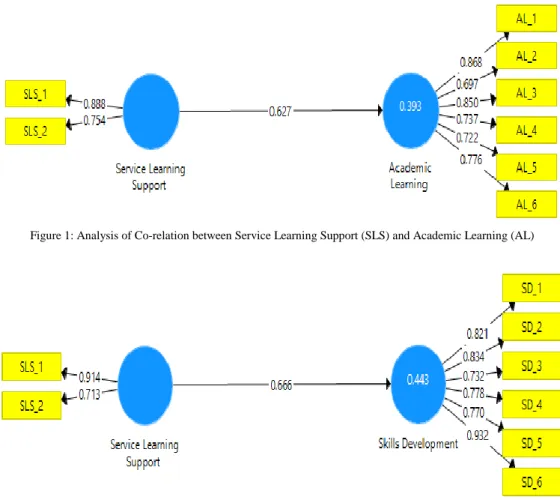
To find out the relationship between service learning support (SLS) and Academic Learning (AL) the co-relation test was performed through Smart-PLS-3.2.3. Hypothesized relation between service learning support (SLS) and academic learning (AL) was found to be fairly significant and positive (β = 0.627; t-value = 7.28) which provides support for H1 (SLS → AL) at p<0.01 significance level. A graphical representation of relationship between service learning support (SLS) and Academic Learning (AL) is presented in Figure 1.
Furthermore, similar level of support was found for second hypothesis H2 (SLS→SD), which shows a significant and positive relationship (β = 0.666; t-value = 8.31) between service learning (SLS) support and skills development (SD). According to Hair et al. [63] guidelines the empirical t-values should be greater the critical t-values which are 2.57, 1.96 and 1.65 for significant level of 1%, 5%, and 10%. For the ease of readers, a graphical representation of relationship between service learning support (SLS) and skills development (SD) is presented in Figure 2. Moreover, a summarized view of both hypotheses testing is also presented in Table 2.
The mean and standard deviation of the all constructs (each construct has 6 items) were presented in Table 3 for descriptive statistics. Therefore, in this study we have used the bootstrapping procedure in second generation structural equation modelling (PLS-SEM).
Table 2 Hypothesis Testing Hypothesis Standard
Beta T Statistics Decision H1 SLS → AL 0.627 7.288* Supported H2 SLS → SD 0.666 8.312* Supported
Note: * p<0.01; ** p<0.05 Table 3
Summary of Statistics Values
Constructs and items Mean Standard Deviation Service Learning Support (SLS) SLS-1 SLS-2 4.90 2.95 1.33 1.17 Academic Learning (AL) AL-1 AL-2 AL-3 AL-4 AL-5 AL-6 Skills Development (SD) SD-1 SD-2 SD-3 SD-4 SD-5 SD-6 5.00 4.52 4.77 4.50 4.87 4.80 4.57 5.20 4.77 4.92 5.07 5.95 1.64 1.41 1.63 1.65 1.58 1.50 1.53 1.26 1.36 1.50 1.49 1.11
Figure 1: Analysis of Co-relation between Service Learning Support (SLS) and Academic Learning (AL)
Figure 2: Analysis of Co-relation between Service Learning Support (SLS) and Skills Development (SD) V. DISCUSSION
Path coefficient values and t-values suggest significant level of support for hypothesized relations proposed by this study. Hypothesized relation between service learning support (SLS) and academic learning (AL) was found to be fairly significant and positive (β = 0.627; t-value = 7.288) which provides support for H1 (SLS → AL) at p<0.01 significance level. A similar level of support was found for H2 (SLS → SD), describing a significant and positive relationship (β = 0.666; t-value = 8.312) between service learning support and skills development.
Findings of this study are subject to some limitations; first that this study is limited to the role of service learning support therefore its implications are also limited in this specific context. Secondly due to limited scope and objective of this study a multi-group analysis (MGA) was not performed. Future researchers can conduct a multi-group analysis to assess the difference of social support required for distinct ethnic groups (e.g. Malaysian, Chinese and Indian etc.). Moreover, due to time constraints this study was conducted within a specified time-frame; however, a longitudinal study can be conducted to overcome this limitation. Such kind of longitudinal studies can greatly contribute to strengthening the generalizability and validity of this study.
VI. CONCLUSION AND FUTURE WORK
This study explored the impact of service learning support on academic learning and skills development of students. Findings of this study suggest that perceived service learning support is a highly influential element for academic learning and skills development in students. Findings of this study
contribute to the better understanding of service learning support and its influence on student’s academic learning and skills development. Moreover, these findings offer a new insight for understanding the impact of service learning support on IT students. Findings of this study have empirically demonstrated that in the presence of perceived service learning support have a direct and significant impact on academic learning and skills development. These findings can be taken; as relevant input for service learning policy makers and academicians interested in encouraging academic learning and skills development in IT students.
Moreover, like all other studies this study also have some limitations. Which are discussed here, to open up new horizon for future work in the field of service learning. First of all, due to limited resources and time constraints multi-group analysis was not possible. It is suggested that future studies may conduct a multi-group analysis so that a cross-cultural comparison can be made. Furthermore, scope of our study was limited to the findings of a service learning course, which had a pre-defined duration. In this regard, it is suggested that future scholars to assess the long-term impact and outcomes of service learning courses may also conduct a longitudinal study.
APPENDIX
________________________________________________ Rate your level of agreeableness with following statements (1 = Not Agree, 7 = Strongly Agree)
SLS-1 I have received adequate support during my service learning project.
SLS-2 Up to what extant you are satisfied with the support you received for your service learning project.
7 6 5 4 3 2 1 ________________________________________________ SELEB Scale
Please indicate that how well your service learning project has provided you support for your academic learning, rate your level (1 being not at all and 7 being very much so) ______________________________________________________
My service learning project will help me to improve academic learning through:
AL-1 Deep Understanding of Course Contents
7 6 5 4 3 2 1 AL-2 Applying Knowledge to the “Real World”
7 6 5 4 3 2 1 AL-3 Problem Analysis and Critical Thinking
7 6 5 4 3 2 1 AL-4 Social Self Confidence
7 6 5 4 3 2 1 AL-5 Ability to Work with Other
7 6 5 4 3 2 1 AL-6 Ability to Make a Difference in the Community
7 6 5 4 3 2 1 ______________________________________________________
Please indicate that how well your service learning project has provided you support for your skills development, rate your level (1 being not at all and 7 being very much so)
______________________________________________________
My service learning project will help me in following skills development:
SD-1 Work Place Skills 7 6 5 4 3 2 1 SD-2 Leadership Skills 7 6 5 4 3 2 1 SD-3 Communication Skills 7 6 5 4 3 2 1 SD-4 Organization Skills 7 6 5 4 3 2 1 SD-5 Social Responsibility 7 6 5 4 3 2 1 SD-6 Citizenship Skills 7 6 5 4 3 2 1 ______________________________________________________ ACKNOWLEDGMENT
This research was supported by Universiti Malaysia Sarawak through the Internal Research Grant (F08/SpFRGS/1532/2017).
REFERENCES
[1] N. J. Rhodes and J. M. Davis, “Using Service Learning To Get Positive Reactions in the Library,” Comput. Libr., vol. 21, no. 1, pp. 32–35, 2001.
[2] C. I. Celio, J. Durlak, and A. Dymnicki, “A Meta-analysis of the Impact of Service-Learning on Students,” J. Exp. Educ., vol. 34, no. 2, pp. 164–181, Jan. 2011.
[3] M. Barth, M. Adomßent, D. Fischer, S. Richter, and M. Rieckmann, “Learning to change universities from within: a service-learning perspective on promoting sustainable consumption in higher education,” J. Clean. Prod., vol. 62, pp. 72–81, Jan. 2014.
[4] H.-C. Chen, D. McAdams-Jones, D. L. Tay, and J. M. Packer, “The impact of service–learning on students’ cultural competence,” Teach.
Learn. Nurs., vol. 7, no. 2, pp. 67–73, Apr. 2012.
[5] C. Dienhart et al., “The impacts of mandatory service on students in service-learning classes,” J. Soc. Psychol., vol. 156, no. 3, pp. 305–309, May 2016.
[6] C. R. O’Grady, Integrating Service Learning and Multicultural
Education in Colleges and Universities. Routledge, 2014.
[7] R. G. Bringle and P. H. Clayton, “Civic Education through Service Learning: What, How, and Why?,” in Higher Education and Civic
Engagement, L. McIlrath, A. Lyons, and R. Munck, Eds. Palgrave
Macmillan US, 2012, pp. 101–124.
[8] A. Bowie and F. Cassim, “Linking classroom and community: A theoretical alignment of service learning and a human-centered design methodology in contemporary communication design education,”
Educ. Change, vol. 1, no. 1, pp. 1–23, 2016.
[9] J. D. Geller, N. Zuckerman, and A. Seidel, “Service-Learning as a Catalyst for Community Development How Do Community Partners Benefit From Service-Learning?,” Educ. Urban Soc., vol. 48, no. 2, pp. 151–175, Feb. 2016.
[10] S. A. Henness, A. L. Ball, and M. Moncheski, “A community development approach to service-learning: Building social capital between rural youth and adults,” New Dir. Youth Dev., vol. 2013, no. 138, pp. 75–95, Jun. 2013.
[11] C. L. Meyer, M. Harned, A. Schaad, K. Sunder, J. Palmer, and C. Tinch, “Inmate Education as a Service Learning Opportunity for Students: Preparation, Benefits, and Lessons Learned,” Teach.
Psychol., vol. 43, no. 2, pp. 120–125, Apr. 2016.
[12] R. M. Rutti, J. LaBonte, M. M. Helms, A. A. Hervani, and S. Sarkarat, “The service learning projects: stakeholder benefits and potential class topics,” Educ. Train., vol. 58, no. 4, pp. 422–438, Apr. 2016. [13] H. O. Ali, A. A. Rahman, and W. Z. Abidin, “Service Learning: An
Investigation into its Viability as a Strategy to Achieve Institutional Goals,” Procedia - Soc. Behav. Sci., vol. 56, pp. 388–395, Oct. 2012. [14] P. L. Yorio and F. Ye, “A Meta-Analysis on the Effects of
Service-Learning on the Social, Personal, and Cognitive Outcomes of Learning,” Acad. Manag. Learn. Educ., vol. 11, no. 1, pp. 9–27, Mar. 2012.
[15] O. A. Adejumo, J. M. Frantz, and H. Julie, “Cracking the nut of service-learning in nursing at a higher educational institution,” Curationis, vol. 38, no. 1, pp. 1–9, 2015.
[16] Y. Z. Hill, T. Renner, F. Acoba, K. Hiser, and R. W. Franco, “Service-Learning’s Role in Achieving Institutional Outcomes: Engagement, Learning, and Achievement,” in Service-Learning at the American
Community College, A. E. Traver and Z. P. Katz, Eds. Palgrave
Macmillan US, 2014, pp. 169–182.
[17] A. Darby and G. Newman, “Exploring Faculty Members’ Motivation and Persistence in Academic Service-Learning Pedagogy,” J. High.
Educ. Outreach Engagem., vol. 18, no. 2, pp. 91–120, 2014.
[18] C. Cronley, E. Madden, J. Davis, and K. Preble, “Factors Influencing Service-Learning Utilization in Social Work: Results from an Online Survey of Faculty,” J. Teach. Soc. Work, vol. 34, no. 2, pp. 147–166, Mar. 2014.
[19] C. L. Maloyed, “Actionable Data Projects: Social Science and Service-Learning in General Education Courses,” J. Polit. Sci. Educ., vol. 12, no. 2, pp. 115–127, Apr. 2016.
[20] J. H. Marshall, E. C. Lawrence, J. Lee Williams, and J. Peugh, “Mentoring as service-learning: The relationship between perceived peer support and outcomes for college women mentors,” Stud. Educ.
Eval., vol. 47, pp. 38–46, Dec. 2015.
[21] A. Hebert and P. Hauf, “Student learning through service learning: Effects on academic development, civic responsibility, interpersonal skills and practical skills,” 16, vol. 1, pp. 37–49, 2015.
[22] R. G. Bringle and J. A. Hatcher, “A service-learning curriculum for faculty,” Mich. J. Community Serv. Learn., no. 2, pp. 112–122, 1995. [23] D. Giles and J. Eyler, “The Theoretical Roots of Service-Learning in
John Dewey: Toward a Theory of Service-Learning,” Mich. J.
Community Serv. Learn., pp. 7–85, Oct. 1994.
[24] R. L. Carver, “Theoretical underpinnings of service learning,” Theory
Pract., vol. 36, no. 3, pp. 143–149, Jun. 1997.
[25] D. A. Kolb, Experiential Learning: Experience as the Source of
Learning and Development. Englewood Cliffs: New Jersey: Prentice
Hall, 1984.
[26] S. L. Roakes and D. Norris-Tirrell, “Community Service Learning in Planning Education A Framework for Course Development,” J. Plan.
Educ. Res., vol. 20, no. 1, pp. 100–110, Sep. 2000.
[27] E. Petkus, “A Theoretical and Practical Framework for Service-Learning in Marketing: Kolb’s Experiential Service-Learning Cycle,” J. Mark.
Educ., vol. 22, no. 1, pp. 64–70, Apr. 2000.
[28] C. M. Cervantes and K. S. Meaney, “Examining Service-Learning Literature in Physical Education Teacher Education: Recommendations for Practice and Research,” Quest, vol. 65, no. 3, pp. 332–353, Jul. 2013.
[29] R. L. Carson and A. L. Raguse, “Systematic Review of Service-Learning in Youth Physical Activity Settings,” Quest, vol. 66, no. 1, pp. 57–95, Jan. 2014.
[30] C. Galvan and M. Parker, “Investigating the reciprocal nature of service-learning in physical education teacher education,” J. Exp.
Educ., vol. 34, no. 1, pp. 55–70, 2011.
[31] A. Taylor, “Community service-learning and cultural-historical activity theory,” Can. J. High. Educ., vol. 44, no. 1, pp. 95–107, 2014. [32] R. G. Bringle and J. A. Hatcher, “Institutionalization of Service Learning in Higher Education,” J. High. Educ., vol. 71, no. 3, pp. 273– 290, 2000.
[33] J. C. Olberding and W. Hacker, “Does the ‘Service’ in Service Learning Go Beyond the Academic Session? Assessing Longer Term Impacts of Nonprofit Classes on Community Partners,” J. Nonprofit
Educ. Leadersh., vol. 6, no. 1, p. n/a, 2015.
[34] J. L. Warren, “Does Service-Learning Increase Student Learning?: A Meta-Analysis,” Mich. J. Community Serv. Learn., vol. 18, no. 2, pp. 56–61, 2012.
[35] L. Dush, “Building the Capacity of Organizations for Rhetorical Action with New Media: An Approach to Service Learning,” Comput.
Compos., vol. 34, pp. 11–22, Dec. 2014.
[36] S. Young and T. Karme, “Service learning in an Indigenous not-for-profit organization,” Educ. Train., vol. 57, no. 7, pp. 774–790, Sep. 2015.
[37] C. Carracelas-Juncal, “When Service-Learning Is Not a ‘Border-crossing’ Experience: Outcomes of a Graduate Spanish Online Course,” Hispania, vol. 96, no. 2, pp. 295–309, 2013.
[38] L. McIlrath and M. G. Healy, “The impact of service-learning on voluntary and community organizations in the west of Ireland,”
AISHE-J Irel. J. Teach. Learn. High. Educ., 2014.
[39] F. Guo, M. Yao, C. Wang, W. Yan, and X. Zong, “The Effects of Service Learning on Student Problem Solving: The Mediating Role of Classroom Engagement,” Teach. Psychol., vol. 43, no. 1, pp. 16–21, Jan. 2016.
[40] C. A. Sedlak, M. O. Doheny, N. Panthofer, and E. Anaya, “Critical Thinking in Students’ Service-Learning Experiences,” Coll. Teach., vol. 51, no. 3, pp. 99–104, Aug. 2003.
[41] C. Stevens, “The Community Grant Writing Project: A Flexible Service-Learning Model for Writing-Intensive Courses,” J. High.
Educ. Outreach Engagem., vol. 18, no. 2, pp. 261–280, Jun. 2014.
[42] P. L. K. Tee and C. S. Kalidas, “Positive Impacts of Service Learning on Students’ Personal Outcome and Social Outcome,” in Assessment
for Learning Within and Beyond the Classroom, Springer, Singapore,
2016, pp. 211–223.
[43] A. Fullerton, V. L. Reitenauer, and S. M. Kerrigan, “A Grateful Recollecting: A Qualitative Study of the Long-Term Impact of Service-Learning on Graduates,” J. High. Educ. Outreach Engagem., vol. 19, no. 2, pp. 65–92, Jun. 2015.
[44] R. Iyer, S. Carrington, L. Mercer, and G. Selva, “Critical service-learning: promoting values orientation and enterprise skills in pre-service teacher programmes,” Asia-Pac. J. Teach. Educ., pp. 1–15, Jul. 2016.
[45] A. S. Rusu, I. A. Copaci, and A. Soos, “The Impact of Service-Learning on Improving Students’ Teacher Training: Testing the Efficiency of a Tutoring Program in Increasing Future Teachers’ Civic Attitudes, Skills and Self-Efficacy,” Procedia - Soc. Behav. Sci., vol. 203, pp. 75– 83, Aug. 2015.
[46] J. E. Rife, “The effects of service-learning courses and traditional lecture courses on students’ academic achievement and level of course engagement,” LIBERTY UNIVERSITY, 2015.
[47] D. Weiss, E. R. Hajjar, C. Giordano, and A. S. Joseph, “Student perception of academic and professional development during an introductory service-learning experience,” Curr. Pharm. Teach. Learn.
[48] S. Carrington, K. L. Mercer, R. Iyer, and G. Selva, “The impact of transformative learning in a critical service-learning program on teacher development: building a foundation for inclusive teaching,”
Reflective Pract., vol. 16, no. 1, pp. 61–72, Jan. 2015.
[49] K. Buch and S. Harden, “The impact of a service-learning project on student awareness of homelessness, civic attitudes, and stereotypes toward the homeless,” J. High. Educ. Outreach Engagem., vol. 15, no. 3, pp. 45–61, 2011.
[50] K. L. Guthrie and H. McCracken, “Making a difference online: Facilitating service-learning through distance education,” Internet
High. Educ., vol. 13, no. 3, pp. 153–157, Jun. 2010.
[51] J. M. Penick, M. Fallshore, and A. M. Spencer, “Using Intergenerational Service Learning to Promote Positive Perceptions about Older Adults and Community Service in College Students,” J.
Intergenerational Relatsh., vol. 12, no. 1, pp. 25–39, Jan. 2014.
[52] C. D. Fair and E. Delaplane, “‘It is Good to Spend Time with Older Adults. You Can Teach Them, They Can Teach You’: Second Grade Students Reflect on Intergenerational Service Learning,” Early Child.
Educ. J., vol. 43, no. 1, pp. 19–26, Jan. 2015.
[53] J. Mcdonald and L. A. Dominguez, “Developing university and community partnerships: A critical piece of successful service learning,” J. Coll. Sci. Teach., vol. 44, no. 3, pp. 52–56, 2015. [54] A. Phillips, S. R. Bolduc, and M. Gallo, “Curricular placement of
academic service-learning in higher education,” J. High. Educ.
Outreach Engagem., vol. 17, no. 4, pp. 75–96, 2013.
[55] L. Weiler, S. Haddock, T. S. Zimmerman, J. Krafchick, K. Henry, and S. Rudisill, “Benefits Derived by College Students from Mentoring At-Risk Youth in a Service-Learning Course,” Am. J. Community
Psychol., vol. 52, no. 3–4, pp. 236–248, Dec. 2013.
[56] M. Casile, K. F. Hoover, and D. A. O’Neil, “Both‐and, not either‐or: knowledge and service‐learning,” Educ. Train., vol. 53, no. 2/3, pp. 129–139, Mar. 2011.
[57] J. Laks, L. A. Wilson, C. Khandelwal, E. Footman, M. Jamison, and E. Roberts, “Service-Learning in Communities of Elders (SLICE): Development and Evaluation of an Introductory Geriatrics Course for Medical Students,” Teach. Learn. Med., vol. 28, no. 2, pp. 210–218, Apr. 2016.
[58] L. Z. Cooper, “Student Reflections on an LIS Internship from a Service Learning Perspective Supporting Multiple Learning Theories,” J.
Educ. Libr. Inf. Sci., vol. 54, no. 4, pp. 286–298, Oct. 2013.
[59] M. Toncar, J. Reid, D. Burns, C. Anderson, and H. Nguyen, “Uniform Assessment of the Benefits of Service Learning: The Development, Evaluation, and Implementation of the Seleb Scale,” J. Mark. Theory
Pract., vol. 14, no. 3, pp. 223–238, Jun. 2006.
[60] C. A. Cooke and M. E. Kemeny, “Student Perspectives on the Impact of Service Learning on the Educational Experience,” Sch. J. Leis. Stud.
Recreat. Educ., vol. 29, no. 1, pp. 102–111, 2014.
[61] R. S. Snell, M. Y. L. Chan, C. H. K. Ma, and C. K. M. Chan, “Developing civic-mindedness in undergraduate business students through service-learning projects for civic engagement and service leadership practices for civic improvement,” Asian J. Bus. Ethics, vol. 4, no. 1, pp. 73–99, Jun. 2015.
[62] J. L. Newman, J. Dantzler, and A. N. Coleman, “Science in Action: How Middle School Students Are Changing Their World Through STEM Service-Learning Projects,” Theory Pract., vol. 54, no. 1, pp. 47–54, Jan. 2015.
[63] J. F. Hair, C. . Hollingsworth, A. . Randolph, and A. Y. L. Chong, “An updated and expanded assessment of PLS-SEM in information systems research,” Ind. Manag. Data Syst., vol. 117, no. 1, 2017.