THE BROKERAGE INSTITUTIONS AND SMALLHOLDER MARKET
LINKAGES IN MARKETING OF HORTICULTURAL CROPS IN
FOGERA WOREDA, SOUTH GONDAR, AMHARA NATIONAL
REGIONAL STATE
M.Sc. Thesis
SIMEGNEW TAMIR ENDALEW
OCTOBER 2012
THE BROKERAGE INSTITUTIONS AND SMALLHOLDER MARKET
LINKAGES IN MARKETING OF HORTICULTURAL CROPS IN
FOGERA WOREDA, SOUTH GONDAR, AMHARA NATIONAL
REGIONAL STATE
A Thesis Submitted to the Department of Agricultural Economics,
School of Graduate Studies
HARAMAYA UNIVERSITY
In Partial Fulfillment of the Requirements for the Degree of
MASTER OF SCIENCE IN AGRICULTURE
(AGRICULTURAL ECONOMICS)
By
SIMEGNEW TAMIR ENDALEW
OCTOBER 2012
APROVAL SHEET
SCHOOL OF GRADUATE STUDIES HARAMAYA UNIVERSITY
As thesis research advisors, we hereby certify that we have read this thesis prepared under our direction, by Simegnew Tamir, entitled “The Brokerage Institutions and Smallholder Market Linkages in the Marketing of Horticultural Crops in Fogera Woreda, South Gondar, Amhara National Regional State” and recommend that it be accepted as fulfilling the thesis requirement.
--- --- --- Name of Thesis Major-Advisor Signature Date
--- --- --- Name of Thesis Co-Advisor Signature Date
As members of examining Board of the Final M.Sc. Open Defense, we certify that we have read and evaluated the thesis prepared by Simegnew Tamir and recommended that it be accepted as fulfilling the thesis requirement for the degree of Master of Science in Agriculture (Agricultural Economics). --- --- ---
Name of Chairman Signature Date
--- --- --- Name of Internal Examiner Signature Date
--- --- --- Name of External Examiner Signature Date
Final approval and acceptance of the thesis is contingent upon the submission of the final copy of the thesis to the Council of Graduate Studies (CGS) through the Department of Graduate Committee (DGC) of the candidate’s major department.
DEDICATION
STATEMENT OF THE AUTHOR
I hereby declare that this thesis is my work and that all sources of materials used for this thesis have been duly acknowledged. This thesis has been submitted in partial fulfillment of the requirements for M.Sc. degree at Haramaya University and is deposited at the University Library to be made available to borrowers under the rules of the library. I solemnly declare that this thesis is not submitted to any other institution anywhere for the award of any academic degree, diploma, or certificate.
Brief quotations from this thesis are allowable without special permission provided that accurate acknowledgement of source is made. Requests for permission for extended quotation from or reproduction of this manuscript in whole or in part may be granted by the Department of Agricultural Economics or the Dean of the School of Graduate Studies, Haramaya University, when in his judgment the proposed use of the material is in the interests of scholarship. In all other instances, however, permission must be obtained from the author.
Name: --- Signature: --- Place: Haramaya University, Haramaya
BIOGRAPHICAL SKETCH
The author was born on August 21, 1984 in Motta, East Gojjam Zone of Amhara Region. He attended his Elementary School at Aba Motta Elementary School and his Junior Secondary School at Agew Gemja Bet Junior Secondary School. He completed his high school education at Ankasha Guagussa Senior Secondary School at Agew Gemja Bet.
The author joined Debub/ Hawassa University, College of Agriculture in 2002 and graduated with B.Sc. degree in Agricultural Resource Economics and Management on July 2006. Right after graduation, he was employed in Amhara Regional Agricultural Research Institute as a Socio-Economic Researcher and Program Coordinator at Andassa Livestock Research Center. After four years of service in the Research Center he becomes Assistant Researcher I and worked as Researcher until he joined Haramaya University, School of Graduate Studies in October 2010 for his M.Sc. degree in Agricultural Economics.
ACKNOWLEDGEMENTS
First and foremost let me praise and honor my GOD for giving me the opportunity and capacity to accomplish my thesis and for his unreserved gift.
I would like to express my deep gratitude to my major research advisor, Dr. Kinde Getenet, IWMI and co-advisor, Dr. Jema Haji, Haramaya University, for giving me time from their tight schedule for their continuous advice, intellectual stimulation, professional guidance and encouragement in undertaking this study, as well as for their friendly supervision. IWMI has to be appreciated for giving me financial support for the study.
My particular appreciation and deepest gratitude goes to my mother Ayehu Tegegne who has devoted her life in nursing me with affection and love which plays great role in the success of my life. My brothers, Adugna, Manaye, Yebeltal, Zemenu, Abrham and Adisu and my only sister Tinebeb deserve appreciation for their love in the family and motivation in undertaking the entire work. My heartfelt appreciation and great thanks goes to Ato Keralem Ejigu, Center Director of Andassa Livestock Research Center, for providing me the necessary materials such as field car and technical assistances to undertake my field works in the Fogera Woreda. Moreover, I would also like to offer my sincere appreciation to all the Researchers, Technical Assistants (Demelash Dagnaw,Yohanes Menberu, Worku Sendek, Eyasu Lakew and Kegne Yismaw), Driver (Dereje) and administrative staff of Andassa Livestock Research Center who supported me in the course of the study.
I feel deep sense of gratitude for my friend Leoulsegged Kassa, Researcher, for helping me in briefing the propensity score matching model and providing the commands. I would also like to extend my appreciation to Fogera Woreda office of agriculture and rural development workers, trade and transport staffs and development agents of study areas for their support in data collection. Finally, I would like to thank the people of the study villages, brokers and wholesalers (Baye, Mengstu, Sete, Gizat and Huno) who extended their warm hospitality and generously shared their views and made this work possible.
LIST OF ABRIVATIONS AND ACRONYMS
ADLI Agriculture Development Led Industrialization ANRS Amhara National Regional State
BoFED Bureau of Finance and Economic Development CSA Central Statistics Authority
CSE Conservation Strategy of Ethiopia ECX Ethiopian Commodity Exchange
FEDRE Federal Democratic Republic of Ethiopia FIML Full Information Maximum Likelihood GDP Gross Domestic Product
GTP Growth and Transformation Plan ILRI International Livestock Research Center
IPMS Improving Productivity and Market Success of Ethiopian Farmers Kms Kilometers
MoARD Ministry of Agriculture and Rural Development MSF Ministry of State Farm
MSI Ministry of State Industry NIE New Institutional Economics NGOs Non Government Organizations OLS Ordinary Least Squares
PADETS Participatory Agricultural Demonstration, Extension and Training System PASDEP Plan for Accelerated and Sustainable Development to End Poverty
PRSP Poverty Reduction Strategy Paper PSM Propensity Score Matching RMA Rapid Market Appraisal
SDPRP Sustainable Development and Poverty Reduction Program
TABLE OF CONTENTS
STATEMENT OF THE AUTHOR iv
BIOGRAPHICAL SKETCH v
ACKNOWLEDGEMENTS vi
LIST OF ABRIVATIONS AND ACRONYMS vii
TABLE OF CONTENTS viii
LIST OF TABLES xi
LIST OF FIGURES xii
LIST OF APPENDIX TABLES xiii
ABSTRACT xiv
1. INTRODUCTION 1
1.1. Background of the Study 1
1.2. Problem Statement 3
1.3. Objectives of the Study 6
1.4. Significance of the Study 7
1.5. Scope and Limitations of the Study 7
1.6. Organization of the Thesis 8
2. LITERATURE REVIEW 9
2.1. Definitions of Related Terms 9
2.2. Major Policy Reforms in Ethiopia Related to Market Institutions 11
2.3. Commodity Exchange 12
2.3.1. What is commodity exchange? 12 2.3.2. The rationale behind the establishment of Ethiopian commodity exchange 13 2.3.3. Ethiopian commodity exchange current status 14 2.4. The New Institutional Economics Approach 15
2.4.1. Transaction costs 15
2.4.2. Institutions to facilitate exchange 16
2.4.3. Social capital 17
2.5. Market Imperfection and the Brokerage Institutions in Ethiopia 17 2.6. Properties of Horticultural Production and Marketing 18 2.6.1. General properties of horticultural products 18
2.6.2. Overview of Horticultural Crops production and Marketing in Ethiopia 20 2.6.3. Horticultural Crop Production and Marketing in Fogera Woreda 21
2.6.3.1. Production problems 22
2.6.3.2. Marketing problems 22
2.6.3.3. Production opportunities 23
2.7. Impact Evaluation Methods 23
2.7.1. Experimental methods 24
2.7.2. Quasi and non-experimental methods 24
2.8. Propensity Score Matching 27
2.9. Empirical Studies on Horticultural Marketing Systems and the Role of Brokerage Institutions in Developing Countries and Ethiopia 29
3. RESEARCH METHDOLOGY 34
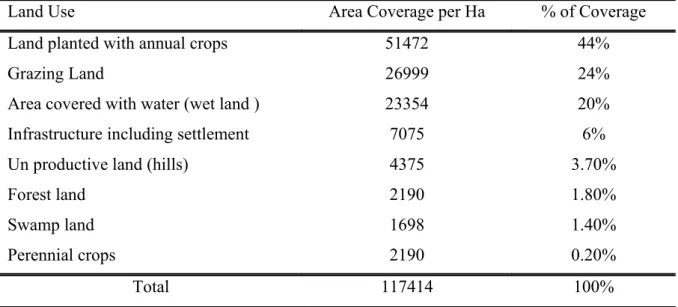
3.1. Description of the Study Area 34 3.1.1. Land use pattern and population of Fogera Woreda 34
3.1.2. Priority farming systems 36
3.2. Methods of Data Collection 38
3.3. Sampling Procedures 38
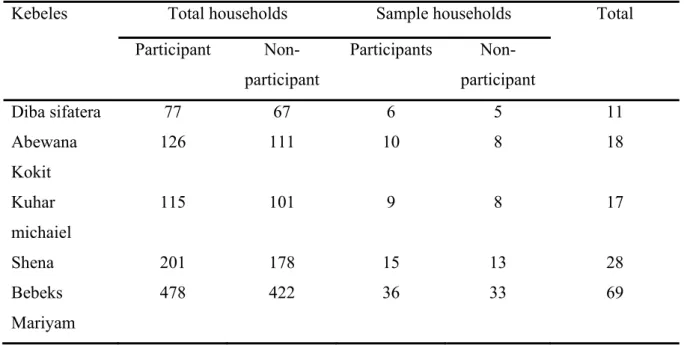
3.3.1. Farmers sampling 39
3.3.2. Brokers, rural assemblers and wholesalers sampling 39
3.3.3. Retailers sampling 40
3.4. Methods of Data Analysis 41
3.4.1. Descriptive statistics 41
3.4.2. Econometric models 41
3.4.2.1. Propensity score matching model 41 3.4.2.2. The Ordinary Least Square (OLS) regression 53
4. RESULTS AND DISCUSSION 60
4.1. The Brokerage Institutions 60
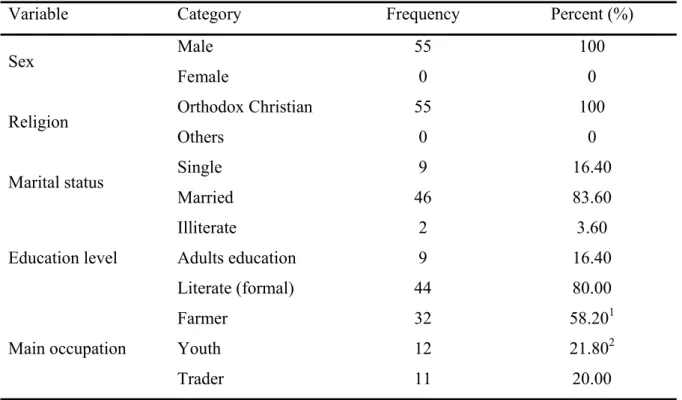
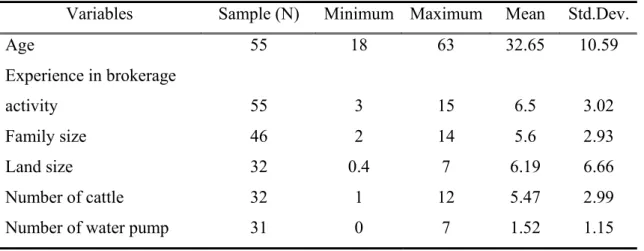
4.1.1. Socioeconomic profile of brokerage institutions 60 4.1.2. Which horticultural products have significant brokerage activity in the area? 62 4.1.3. Characteristics and economic role of brokerage institutions 62 4.1.5. The rationale behind the emergence of farmer brokers 70
4.1.6. Market outlets or target markets of brokerage institutions 72 4.1.7. Producer’s perception of brokerage institutions 72 4.1.8. Night transaction and loading 72 4.1.9. Constraints of brokerage institutions 73 4.1.10. Opportunities to the brokers 74 4.2. Brokerage Institutions and Smallholder Market Linkages 74
4.2.1. Descriptive statistics 74
4.2.1.1. Demographic characteristics of sample households 74 4.2.1.2. Socio-economic characteristics of sample households 76 4.2.1.3. Institutional and organizational aspects 77
4.2.1.4. Social capital 78
4.2.2. Propensity score matching model 78 4.2.2.1. Estimation of propensity scores 79 4.2.2.2. Common support condition 83 4.2.2.3. Matching of participant and non-participant households 86 4.3. Impacts of the Brokerage Institutions 88 4.3. 1. Impact on net return from onion production 89 4.3. 2. Impact on percentage of marketed surplus 89 4.3. 3. Impact on Amount of Onion Produced and Land Allocated to Onion Production 90
4.3.4. Sensitivity Analysis 91
4.4. Brokerage Institutions and Wholesaler Market Linkages 92 4.4.1. Demographic profiles of the wholesalers 92 4.4.2. Socio-economic characteristics and assets of wholesalers 94 4.4.3. Institutional and organizational aspects 94 4.4.4. Wholesaler’s perceptions of brokerage institutions 95 4.4.5. Determinants of share (percentage) of brokered transactions 96 5. SUMMARY, CONCLUSIONS AND RECOMMANDATIONS 99
5.1. Summary 99
5.2. Conclusions and Recommendations 102
6. REFERENCES 105
LIST OF TABLES
Table Page
1. Land use pattern of Fogera Woreda………..35
2. Farming system by ecological zone in Fogera Woreda………..…..36
3. Sampling frame and the sample size………...………..39
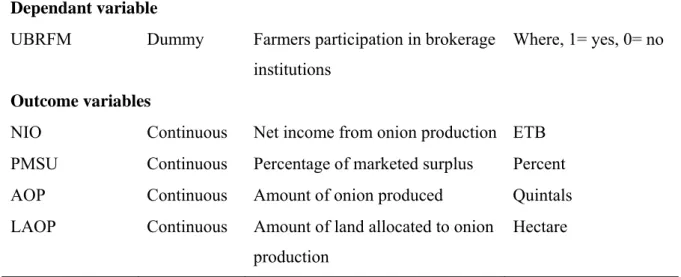
4. Variable definition and measurements for PSM………...………52
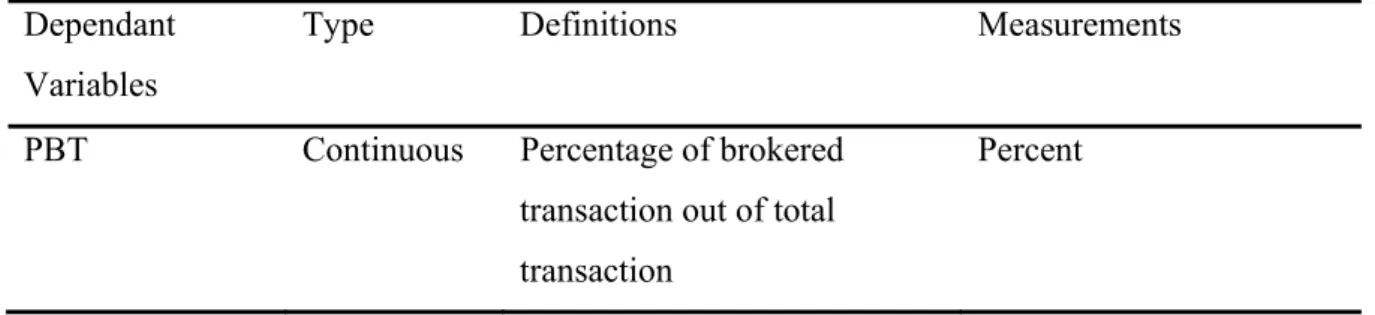
5. Variable definition and measurements for Heckman two stage model……….59
6. Frequency distributions of brokerage institutions……….………60
7. Descriptive statistics for continuous variables………..……62
8. Descriptive statistics of some variables………67
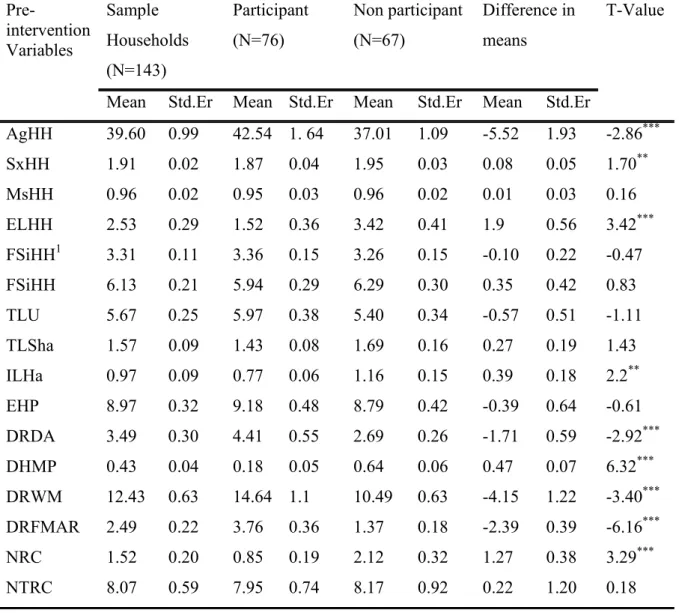
9. Descriptive statistics of sample households on pre-intervention characteristics…………..75
10. Descriptive statistics of sample households (for dummy variables)……….…..……78
11. Logit results of households’ brokerage institution participation………80
12. Balancing test of matched sample……….…..87
13. Performance of matching estimators under the three criteria……….88
14. Impact of brokerage institutions………...…..89
15. Result of sensitivity analysis using Rosenbaum bounding approach……….91
16. Descriptive statistics of sample wholesalers (for continuous variables)………...……..…93
17. Descriptive statistics of sample wholesalers (for dummy variables)……….…….95
18. Results of Ordinary Least Square (OLS) estimation ……….96
LIST OF FIGURES
Figure Page
1. Map of the study area………37
2. Broker’s chain and flow of transactions using brokerage institutions………..68
3. Kernel density of propensity scores before matching………...84
4. Kernel density estimates of participants before and after common support……….…85
5. Kernel density estimate of propensity scores of non-participants households before and after common support………..……….86
LIST OF APPENDIX TABLES
Appendix Table Page
1. Multicollinearity test for explanatory variables in PSM………...……..112
2. Multicollinearity test for explanatory variables in OLS………...……….….113
3. Conversion factor used to calculate TLU………113
4. Labor supply conversion factor (person day equivalent)………....114
THE BROKERAGE INSTITUTIONS AND SMALLHOLDER MARKET LINKAGES IN MARKETING OF HORTICULTURAL CROPS IN FOGERA WOREDA, SOUTH
GONDAR, AMHARA NATIONAL REGIONAL STATE
SIMEGNEW TAMIR
Major Advisor: Kinde Getnet (PhD) Co-Advisor: Jema Haji (PhD)
ABSTRACT
The main objective of this study was to analyze the economic roles played by the brokerage institutions in smallholder market linkages to the wholesalers in vegetable marketing and determinants of decisions on whether to use brokerage institutions or not under imperfect market condition in Fogera Woreda, North Western Amhara Region particularly focusing on onion and tomato. Both secondary and primary data were collected for the study. Primary data were collected from a very wide number of respondents at all stages of the market channel where brokers are expected to play role. Two stage sampling techniques were used to select the sample farmers.Descriptive and econometric statistical models were employed for data analysis using STATA software. The study implemented the propensity score matching and Ordinary Least Square (OLS) estimation. The result of the study showed that the brokerage institutions are characterized as urban, peri-urban and farmer brokers. There is significant brokerage activity only for onion marketing and in the case of tomato marketing the brokers act as rural assemblers. Most of the horticultural trading in the area is undertaken by credit and thrust based. Logistic regression estimation of Propensity Score Matching revealed that Age, education level, distance of residence from development agent office, distance of residence from Woreta market, distance of residence from main asphalt road, access to cell phone (mobile phone) and number of regular wholesaler customers significantly affected the participation decisions of the smallholders in the brokerage institutions services. Kernel Matching with band width of 0.25 was found to be the best matching algorithm. The result of the study also revealed that, smallholder farmers using brokerage institutions have got 4393.62 ETB higher net income and 13.55% of greater marketed surplus than those smallholders who do not use. The OLS regression estimation showed that distance of residence of wholesaler, experience in trading, number of regular broker customers, number of regular farmer customers and number of regular wholesaler buyer customers found in other areas and cost of not using brokers significantly affected the intensity of use of brokerage institutions. Generally, the brokerage institutions are playing significant and important role in forming market linkages between smallholders and wholesalers under imperfect market conditions with their limitations. Therefore, the study highly recommends the formalization of the brokerage institutions through licensing, training and continuous follow up in the Woreda considering the experience of ECX.
1. INTRODUCTION
1.1. Background of the Study
The primary development goal of the Ethiopian government is to achieve food security and sustain high economic and export growth levels with the aim to eradicate poverty. The current Growth and Transformation Plan (GTP) agricultural investment areas are divided into implementation directions: scaling up model farmers’ practices to all farmers, improving agricultural water use and expanding irrigation development, proper utilization of agricultural land, extensive use of labor, linking specialization with diversification, efficient agricultural marketing and increasing the production of high value agricultural commodities using medium and small scale irrigation systems to enable at least double production. Thus, the commercialization aspect is to be assisted through well organized market linkages so that what is produced can be marketed and this needs organizational set up among farmers and development of infrastructure, market information and market institutions (MoARD, 2010).
Ethiopia has highly-diversified agro-ecological conditions which are suitable for the production of various types of fruit and vegetables. However, the contribution of horticultural crops both to the diet and income of Ethiopians is insignificant. With the aim of enhancing agricultural development, the Government considers various projects, including small-scale irrigation mainly through rainfall harvesting and home gardening, to be of crucial importance. As a result, vegetable and fruit production is being more widely adopted, primarily to ensure food security and promote production of high-value crops for the market and improving the living conditions of smallholders (Abebe, 2008).
In Amhara Region, agriculture contributed to about 55.8 % of the total regional GDP and accounted for an employment of 87.4 percent of the total population (BOFED, 2011). Crop production in the region is rain fed, supported by very little irrigation mainly for vegetables. According to CSA (2012) the total cultivated land size of ANRS by the year 2011/12 was estimated to be 4.287 million ha from which, horticulture covered about 88.98 thousands of
ha and produced over 5.8 million quintal through employing over 3.5 million small-holders. Onion covered 12,174.60 and tomato covered 892.72 ha of land.
Fogera Woreda, where the study focused, is endowed with diverse natural resource, with the capacity to grow different annual and perennial crops. Two major rivers are of great importance to the Woreda, Gumara and Rib. They are used for irrigation during the dry season for the production of horticultural crops mainly vegetables. Major types of vegetable crops grown in the area include potato, onion, tomato, garlic, green peppers and some leafy vegetables. Owing to its production potential (seasonal irrigation and rainfed-based, low cost, and organic agriculture) and easily accessible road transport to reach local markets (Abay, 2007), the area is experiencing an emerging commercial horticulture production by smallholders in recent years.
According to the Fogera district Bureau of Agriculture and Rural Development, there was an estimated 19,774ha of land cultivated under horticulture crops in 2010, from which a total of 203,063tons of vegetables is produced. The respective figures increased to 20,635ha and 270,484tons in 2011. A considerable number of farmers in the district are involved in commercial production of vegetables, mainly onion and tomato, using both irrigated and rain-fed agriculture. Such growing participation of farmers in commercial vegetable production is contributing to a changing farming system (especially in the livestock farming system) and to new livelihood strategies in the vegetable producing areas of the district. Smallholders in the Woreda participate in commercial agriculture by producing and marketing horticulture crops for local and national markets using the services of the brokerage institution. The marketing channel of tomato and onion crops is through the interconnection of different actors namely producing farmers, rural assemblers, wholesalers, retailers, consumers, transporters and brokers. Wholesalers and brokers control the whole channel (because of asymmetric market information) resulted in an exploitative market behavior in onion market.
1.2. Problem Statement
Strong assumptions like large number of buyers and sellers, complete information, perfect mobility of resources, free entry and exit and price taken by all economic agents (price is determined by the market) are the characteristics of perfect competition (MasCollel et al., 1995). This ideal situation, however, does not exist in the real rural agricultural market like Fogera Woreda. When market participants do not have equal information on prices, quality and quantities of the product under transaction and on the number of trading agents in the market, there is an incentive for better informed agents to uphold information and maximize their private benefits (Cramton, 1984). Incomplete information increases transaction costs and leads to bargaining inefficiency.
The dynamics of horticultural marketing has a great influence on farmer’s response in terms of production and market participation which in turn influences the level of income and poverty situation among smallholder farmers. Four ingredients that determine the acceptance of vegetables through a marketing system are quality of the product, volume of high quality produce, continuity of both volume and quality, and price the grower expect to receive (Nonneck, 1989). Moreover, the marketing system is influenced by a number of production, product and market characteristics like perishabity , price and quantity risks, seasonality, product bulkiness, and geographic specialization (Kohls and Uhl, 1985).
Despite policy support as one of the mechanisms for creating investment opportunities in the horticulture sector for production, transportation, grading, exporting and financing the venture there is great problem of horticultural marketing in Ethiopia. Moti (2007) investigated the role of markets in the smallholder farmers’ resource allocation for subsistence food crops and commercial cash crop production. The results revealed that limited marketing outlets and lack of price information were the major factors that hindered the move from subsistence farming to cash crop production. Furthermore, Bezabih and Hadera (2007) described lack of local markets to absorb supply, low produce prices, plethora of intermediaries, and lack of marketing institutions and coordination among farmers as the major constraints on the marketing of horticultural crops in Ethiopia. They argue that poor product handling and
packing, imperfect pricing systems, and lack of transparency in market information are also among the impediments in the marketing of horticultural crops in Ethiopia.
Efficient coordination in traditional markets is a prerequisite for a successful smallholder commercialization towards rural transformation, poverty reduction and agrarian change in the developing countries. However, it is often staggered by the problem of market imperfection and institutional underdevelopment that increase transaction cost and risk faced by smallholders. In addition, well organized market linkage needs organizational set up among farmers and development of infrastructure, market information and market institutions.
Of all the institutions that might contribute to enhance the operation of markets, several studies (eg. Jema, 2008; Shiferaw et al., 2009; Lokanathan and De Silva, 2010; Quattri et al.,
2011) have documented the crucial role played by brokers. These studies outline the benefits farmers and wholesalers derive from engaging in the services of brokers such as technical support, finance, risk sharing and information. However, very few contributions have investigated the variables influencing the decision of economic agents to use brokers ( Eleni, 2001; Jabbar et al., 2008; Quattri et al., 2011) and only Eleni (2001) and Quattri et al. (2011)
has attempted to explain the actual decision processes followed by traders in the use of brokers. When it comes to farmers, to our best knowledge, no attempt has been made to explain the determinants of farmers’ decisions to use brokers and their impacts on smallholder farmers. Yet, it is increasingly recognized that the formulation of market-enhancing policy and intervention programs require a clearer understanding of transaction costs, institutional marketing arrangements, and microeconomic trader behavior (Dercon 1996).
There are no producer organizations, such as cooperatives to coordinate horticultural marketing purpose in Fogera on behalf of farmers, against a growing demand for the products in different parts of the country. Although multipurpose cooperatives had been established in the district a few years back, they remain inefficient to effectively coordinate the marketing activities and to successfully link farmers to markets. Because of this, success in horticulture crop production as high value crops is not necessarily translated into a market success in the area. Such institutional bottlenecks against an emerging horticultural market have created a
fertile ground for a strong presence of brokers in the horticultural market of Fogera. Though road infrastructure and use of mobile telephones among farmers for market access and information exchange is reasonable, direct linkage of farmers to the wholesale market (the major market for the horticulture crops produced) is very limited. As a result, the majority of smallholders opt to use brokers to sell their products to wholesalers, who distribute products to different consumer and seasonally deficit producer markets in the country.
Given the large volume of horticulture products in the area, combined with seasonal glut and high perishability, efficient market coordination and logistics are necessary to link Fogera horticulture farmers with the wholesale markets and to enable them generate sufficient economic incentives. In rural areas where producer organizations are absent and market institutions are underdeveloped, posing a challenge for smallholder market linkage, brokers could fill the coordination gaps and logistical constraints to facilitate exchange. Fogera provides a useful case in this regard where the brokerage institution, which dominantly exists informally, plays an important role in coordinating the horticultural marketing activities, starting from the farm. According to Amhara Regional Agricultural Research Institute and Amhara Regional Bereau of Agriculture (2008) participatory rural appraisal report, one of the priority research problems in horticultural marketing in the Woreda was the role and functions of informal brokerage activity in the area.
However, the brokers at Fogera horticulture market (who play a market coordination role by constituting an important element of the “invisible hand”), are not closely studied, known, and described in terms of their profile, functions and roles, organizational setup, impacts, and limitations and constraints to improve the performance, efficiency, and impact of the brokerage institution as an important intermediary in the horticultural supply chain of the area. Perhaps, this is a result of the less recognition the brokerage institution receives. This paper is intended to contribute to filling this knowledge gap in the area by addressing research questions like:
• What are the socioeconomic profiles and economic roles of brokerage institutions?
• What are the major constraints and opportunities of the brokerage institution in the marketing of horticultural crops?
• How do brokerage institutions act in the market linkages between farmers and wholesalers?
• Are brokers trusted institutions fulfilling desirable economic roles?
• Which of the variables significantly impact on farmers decisions on whether to use brokers or not and determinants of intensity brokerage use by wholesalers?
• What are the impacts of brokerage institutions for smallholder farmers 1.3. Objectives of the Study
The general objective of the study was:
• To assess the economic roles played by the brokerage institution in smallholder market linkages and identify determinants of decisions on whether to use brokers or not under imperfect market condition in the study area.
The specific objectives of the study were:
• To assess the socioeconomic profile, economic roles, constraints and opportunities of the brokerage institutions
• To identify the determinants of farmers decision whether to use brokerage institutions or not as a means of market linkage to wholesalers
• To measure the impact of brokerage activities on percentage of marketed surplus and income generation capacity; and
• To identify the determinants of wholesalers decisions on the extent of brokerage intuitions usage under imperfect market condition of horticultural marketing.
1.4. Significance of the Study
Horticultural marketing in Ethiopia and Fogera Woreda in particular is constrained by number of factors such as seasonality of production, perishable nature of the product, bulkiness, imperfect market information and market power by traders. Many studies indicated that the dynamics of horticultural marketing have great interaction with farmer’s participation and production response in developing countries and Ethiopia. Recent studies in developing countries indicated that the brokerage institutions play great role by solving market imperfection by providing market information, finance, technical support and risk sharing. Therefore, study of the brokerage institutions and smallholder market linkages in the horticultural marketing of Fogera district is very crucial to identify and inform Government and other development partners with possible strategies that would support horticulture marketing to improve the economy of the Region and more specifically the income of poor farmers which in turn helps farmers coming out of poverty.
1.5. Scope and Limitations of the Study
The research concentrated on the Fogera District, South Gondar horticultural production area to major market centers (Gondar and Bahir Dar cities). The type of crop was limited to onion for its proportion in production and marketing in the area. Other vegetable crop types are not considered because their production is limited and have little proportion in marketing activities and no report of strong brokerage activities. Along the marketing chain the consumers were not considered because of the expectation of no brokerage activity between the retailers and consumers. The study has also considered only samples of the market actors along the horticultural market chains and detail investigations in relation to production and consumption studies were not undertaken. The other one is the limitations associated with the Propensity Score Matching Model. It needs large sample size, group overlap and hidden bias because matching only controls for observed variables. The research used different techniques such as increasing sample size, common support conditions and sensitivity analysis in order to reduce these limitations.
1.6. Organization of the Thesis
Excluding the introduction, the next part of this thesis is organized in to four parts. The literature review includes the concepts of market, polices related to market, brokerage institutions, the new institutional economic theory, horticultural marketing, methodologies used in impact evaluation and empirical studies on the roles of brokerage institutions. The methodology part includes description of the study area, methods of data collection and data analysis. The result and discussion section presents the descriptive and econometric results and discussesthe research outcomes. The final section of the Thesis presents summary of the findings of thestudy, conclusion and implications of the research.
2. LITERATURE REVIEW
2.1. Definitions of Related Terms
Market: Kohls and Uhl (1985) define market as an “an area for organizing and facilitating business activities and for answering the basic economic questions: what to produce, how much to produce, how to produce, and how to distribute production.”
Marketing: It is about flow of goods and services from their point of production to consumption (Abbott and Makeham, 1981; Kohls and Uhl, 1985). For Mendoza (1995), marketing is a ‘‘system’’, which comprises several and usually stable and interrelated structures that along with production, distribution and consumption, strengthen the economic process. Usually, the marketing of agricultural products begins at the farm when the farmer plans his production to meet specific demand and market prospects (Abbott and Makeham, 1981; Kohls and Uhl, 1985).
Market chain: It is the term used to describe the various links that connect all the actors and transactions involved in the movement of agricultural goods from the producer to the consumer. Commodity chain is the chain that connects smallholder farmers to technologies that they need on one side of the chain and to the product markets of the commodity on the other side.
Marketable and marketed surplus: Marketable surplus is the quantity of the produce left out after meeting the farmers’ consumption and utilization requirements for kind payments and other obligations such as gifts, donation, charity, etc. Thus, marketable surplus shows the quantity left out for sale in the market. The marketed surplus shows the quantity actually sold after accounting for losses and retention by the farmers, if any and adding the previous stock left out for sale. Thus, marketed surplus may be equal to marketable surplus, it may be less if the entire marketable surplus is not sold out and the farmers retain some stock and if losses are incurred at the farm or during transit (Thakur et al., 1997).
The importance of marketed and marketable surplus has greatly increased owing to the recent changes in agricultural technology as well as social pattern. In order to maintain the balance between demand for and supply of agricultural commodities with rapid increase in demand due to higher growth in population, urbanization, industrialization and overall economic development, accurate knowledge on marketed/marketable surplus is essential in the process of proper planning for the procurement, distribution, export and import of agricultural products (Malik et al., 1993).
Competitive market: In a competitive market, each agent makes inter temporal choices in a stochastic environment. Their attitudes toward risk, the production possibility set, and the set of available trades determine the equilibrium quantities and prices of assets that are traded. In an "idealized" representation agents are assumed to have costless contractual enforcement and perfect knowledge of future states and their likelihood. With a complete set of state contingent claims (also known as Arrow–Debreu securities) agents can trade these securities to hedge against undesirable or bad outcomes. When a market is incomplete, it typically fails to make the optimal allocation of assets.
Information Asymmetry: In economics and contract theory, information asymmetry deals with the study of decisions in transactions where one party has more or better information than the other. This creates an imbalance of power in transactions which can sometimes cause the transactions to go awry, a kind of market failure in the worst case.
Market linkages: It is a process where an organized community validates and consolidates its production in new markets in a sustainable way.
Broker: A broker is an individual or party (brokerage firm) that arranges transactions between a buyer and a seller, and gets a commission when the deal is executed. brokers are referred to as individuals (or organizations) who facilitate product distribution by bringing buyers and sellers together but do not take title to goods (Crawford, 1997).Brokers earn income from the commission paid to them by their clients (buyers and sellers) for the services they offered. It is also possible that a broker acts as a seller or as a buyer (becoming a
principal party in the business transaction) or, in some cases, acts on behalf of a principal (in both cases by taking title to goods). When they act as agents, they represent either the seller or the buyer, but not both at the same time.
Opportunity cost: It is the cost of any activity measured in terms of the value of the next best alternative foregone (that is not chosen). It is the sacrifice related to the second best choice available to someone, or group, who has picked among several mutually exclusive choices. The opportunity cost is also the cost of the foregone products after making a choice. Opportunity cost is a key concept in economics, and has been described as expressing "the basic relationship between scarcity and choice". The notion of opportunity cost plays a crucial part in ensuring that scarce resources are used efficiently. Thus, opportunity costs are not restricted to monetary or financial costs: the real cost of output foregone, lost time, pleasure or any other benefit that provides utility should also be considered opportunity costs.
Contract theory: In economics, contract theory studies how economic actors can and do construct contractual arrangements, generally in the presence of asymmetric information. Because of its connections with both agency and incentives, contract theory is often categorized within a field known as Law and economics. One prominent application of it is the design of optimal schemes of managerial compensation. In the field of economics, the first formal treatment of this topic was given by Kenneth Arrow in the 1960s.
2.2. Major Policy Reforms in Ethiopia Related to Market Institutions
Major policy reforms were undertaken in Ethiopia in the early Nineties in order to substitute the centrally-planned and controlled socialist economy, in place since 1974, with a free market system. These reforms were based on the idea that eliminating distortionary economic interventions by the state was a precondition for “getting prices right”, which was itself necessary for spurring private investment and economic growth (Timmer, 1986).
However studies indicated that liberalization succeeded in enhancing price transmission between the main regional markets (Jayne et al., 1998). According to the study made by
Barrett and Mutambatsere (2005) the withdrawal of parastatals from core input marketing activities created a void that the private sector often failed to fill due to underdeveloped physical communications, power and transport infrastructure, credit constraints and continued bureaucratic impediments that increased transaction costs for input suppliers. To address the challenges posed by failing and incomplete markets, the Ethiopian Government has implemented a number of post-structural market reforms focused instead on “getting institutions right” (Barrett and Mutambatsere, 2005) and “getting markets right” (World Bank, 2004).
2.3. Commodity Exchange
2.3.1. What is commodity exchange?
To many, a commodity exchange connotes a highly sophisticated market system, with an electronic-based, highly evolved system of trading in future commodity positions, exemplified by markets such as the Chicago Board of Trade, the Tokyo Grain Exchange, or the London Metal Exchange, among others. To many, a commodity exchange is an advanced market mechanism for use in industrialized countries, out of the reach or inappropriate to low-income countries.
However, at its heart, a commodity exchange is simply a central place where sellers and buyers meet to transact in an organized fashion, with certain clearly specified and transparent “rules of the game.” In its wider sense, a commodity exchange is any organized market place where trade, with or without the physical commodities, is funneled through a single mechanism, allowing for maximum effective competition among buyers and among sellers. The fact of having a single market mechanism to bring together the myriad buyers and sellers at any point in time effectively results in the greatest concentration of trading for a given good. This market mechanism, such as a price bidding system or an auction system, results in what is known as “price discovery,” that is, the emergence of the true market-clearing price for a good at a particular point in time due to the highest possible concentration and competition among buyers and among sellers.
The difference between a commodity exchange and a typical wholesale or terminal market is that an exchange creates a mechanism for price discovery to occur in an organized manner, through a system of price bidding and through a set of rules governing the products brought to the market, the market actors, and the contracts between buyers and sellers.
2.3.2. The rationale behind the establishment of Ethiopian commodity exchange
Prices of food staples in Ethiopia are highly volatile, due to erratic supplies and weakly integrated markets, reflected in high transport and transaction costs, which limit opportunities for smoothing prices through arbitrage across space (transport) and time (storage). Price volatility undermines both food security for consumers and incentives for food producers. Under the Derg regime, food trading was tightly controlled through the Agriculture Marketing Corporation (AMC); however, like many other African countries, Ethiopia underwent rapid market liberalisation in the 1990s, where prices controls were eliminated and the AMC was „downsized‟. These reforms did not reduce food price volatility and have arguably exacerbated it (Eleni, 2001). Market actors react sluggishly to signals of changes in food supply or demand, leaving producers highly vulnerable to food price collapses and consumers equally vulnerable to food price inflation. Following bumper harvests in 2001 and 2002, for instance, grain prices collapsed by 80%, which undermined smallholder incomes and left 300,000 tonnes of grain rotting in the fields because it was not profitable to harvest (Eleni and Goggin, 2005; Jopson, 2007).
In an innovative attempt to address these high transaction costs, the Ethiopian government is work with the International Food Policy Research Institute (IFPRI) and established Ethiopian Commodity Exchange (ECEX) covering six crops: coffee, sesame, haricot beans, maize, teff and wheat and livestock products. A commodity exchange performs three basic functions: (1)
price transparency: enabling access for everyone to a neutral reference price; (2) price discovery: ensuring that demand and supply developments are easily reflected in price levels;
(3) reduced transaction costs: making it easier to find buyers or suppliers through a
centralised market-place. Commodity exchanges can also reduce price risk by trading in futures contracts, and the ECEX will aim to do this in the near future (Gabre-Madhin, 2006).
The Ethiopian Commodity Exchange is expected to reduce transaction costs by: (1) facilitating contact between buyers and sellers, (2) enabling centralised grading of products, (3) ensuring that contracts are enforceable, (4) providing a mechanism for price discovery, (5) simplifying transactions with standard contracts, and (6) transmitting information about prices and volumes which will be enabled through the installation of price tickers at 200 rural sites, giving farmers independent access to price information from the exchange in Addis Ababa.
The reduction of transaction costs will enable various market actors, including smallholders, to benefit from a higher share of the final price. Increased information about market prices will also increase the bargaining power of smallholder farmers and enable them to make better investment decisions. This in turn, would generate incentives for increased production. Moreover, if the exchange is linked to a negotiable warehouse receipts system, this can also increase liquidity for farmers by facilitating access to credit borrowed against the receipt. At least on paper, the ECEX appears to be an excellent example of an intervention that has the potential to achieve both social protection and agricultural growth (i.e. livelihood protection plus livelihood promotion) in a single instrument.
2.3.3. Ethiopian commodity exchange current status
The Ethiopia Commodity Exchange (ECX) is a commodities exchange established April 2008 in Ethiopia. In Proclamation 2007-551, which created the ECX, its stated objective was "to ensure the development of an efficient modern trading system" that would "protect the rights and benefits of sellers, buyers, intermediaries, and the general public". The ECX is set up as a private company owned by a partnership of the market actors, members of the exchange, and the Ethiopian government, led by Dr. Eleni Gebre Medhin a former economist for the World Bank. As of July 2011, the physical presence of the ECX consists of 55 warehouses in 17 regional locations. It has grown from trading 138,000 ton in its first year to 508,000 tons in its third year, with nearly equal shares of coffee and oilseeds and pulses. The value of the ECX rose 368 percent between 2010 and 2011 to reach US$1.1 billion.
As of November 2010, the trading floor in Addis Ababa, handled 200 spot contracts in such commodities as Coffee, sesame, haricot beans, maize and wheat. It was assessed in July 2011 that total membership equaled 243 with total clients, who trade through members, numbered about 7,800. Farmer Cooperatives represented 2.4 millions smallholder farmers, which make up 12 percent of the membership. Currently, the ECX is the only stock or commodity exchange in Africa to have streamlined payment transfers down to "T+1" (Next day payment after a trade) from its clearinghouse to its partner commercial banks. Market data reach is expansive. "Push" price date is transmitted in real time to outdoor electronic ticker boards in 32 rural sites, to the ECX website, 256,000 mobile subscribers via instant messaging, the radio, TV and print media. "Pull" market data is available through a toll-free phone-in service. The service received more than 1 million calls in September 2011, 70 percent coming from rural callers.
2.4. The New Institutional Economics Approach
2.4.1. Transaction costs
According to the New Institutional Economics (NIE) approach, the unit of analysis is the transaction rather than the price. Exchange itself is costly. Transaction costs, which are distinct from physical marketing costs such as those for transport and storage, arise from the coordination of exchange among market actors. They include the costs of obtaining and processing market information (Hoff and Stiglitz, 1990), negotiating contracts (Williamson, 1985), monitoring agents (Bardhan, 1989), and enforcing contracts (Fafchamps, 1996). Transaction costs are unique to each market participant, implying that economic actors are not interchangeable. The presence of transaction costs, which are specific to each market actor, implies that there is no single effective market price at which exchange occurs (Sadoulet and de Janvry, 1995). Each agent in the market conducts transactions on the basis of his or her specific transaction costs. The implications of transaction costs are that markets are thin or fail if prohibitively high costs prevent exchange.
2.4.2. Institutions to facilitate exchange
Institutions are defined as the “rules of the game,” both formal rules and informal constraints such as norms, conventions, and codes of conduct that provide the structure for human interaction (North, 1990). Institutions emerge to minimize these transaction costs and to facilitate market exchange. The evolution from personalized exchange to impersonal or anonymous exchange, supported by legal systems that enforce contracts, is central to the process of growth and development (North and Thomas, 1973).
However, following Polanyi (1957), it is widely recognized that market transactions, particularly in developing countries, are often embedded in long-term, personalized relationships (Geertz, 1968). Personalized exchange emerges in response to commitment failure, in which the risk of breach of contract or opportunism is high, resulting from the lack of market information, inadequate regulation, and the absence of legal enforcement mechanisms. Institutions build trust and promote reputation and social capital, such as trade associations, solidarity networks, and groups that enhance ethnic or religious ties, emerge to circumvent commitment failure (Greif, 1993; Fafchamps, 1996).
Historically, institutions have emerged in various contexts to facilitate anonymous trade. Historical institutional analysis of pre modern trade in medieval Europe by Milgrom et al.
(1990) showed that an institution known as the Law Merchant enabled impersonal exchange to occur in 12th and 13th century Champagne fairs. The Law Merchant enabled trade through a
reputation mechanism that stored information about traders’ past behavior and sanctioned violators of the commercial code. Greif (1993) views the Maghribi traders’ coalition formed in the 11th century as a means of overcoming the commitment problem intrinsic to long-distance trade. The coalitions of long-long-distance traders in 19th-century Mexican California promoted honest exchange through information sharing and punishing of cheaters. In contrast, Platteau (1994) argues that decentralized arrangements based on reputation are not sufficient to ensure honest behavior and that private and public-order institutions are necessary to create the social conditions necessary for markets to operate. The dominant contract enforcement mechanism in liberalized grain markets in Madagascar is trust-based relationships, where trust
is established primarily by repeated interaction. The incidence of theft and breach of contract is low, and recourse to the legal system is rare.
2.4.3. Social capital
Although social scientists have long recognized the role of interpersonal relationships in human interaction (Coleman, 1988), the concept of social capital has been little used in economics (Barr, 1997). There are two possible meanings of social capital. The first definition sees social capital as a “stock” of trust and an emotional attachment to a group or society that facilitates the provision of public goods (Fukuyama, 1995). The second views social capital as an individual asset that provides private benefits to a single individual or firm (Aoki, 1984).
2.5. Market Imperfection and the Brokerage Institutions in Ethiopia
In perfect market situation, it is believed that there is perfect information, knowledge, no barrier to entry and exit, price determined by supply and demand and perfect mobility of resources. However this is ideal and the Ethiopian agricultural marketing is characterized by imperfect market conditions which is a deviation from perfect market condition. Market imperfection leads to high transaction costs and poor allocation of resources. Ethiopian agricultural traders face three major constraints that increase their transaction costs of participating in the grain market. First, traders do not benefit from a system of agricultural product standardization and inspection that would enable them to place orders with long distance partners for guaranteed qualities and quantities of grain. Instead they must be physically present at the time of transaction in order to visually inspect the grain that is being exchanged. Second, agricultural traders have very limited recourse to legal means for enforcing contracts.
Thus, they trade only with partners whom they know well and trust in order to avoid the high costs of payment delinquency or reneging on the terms of the contract. Third, traders do not have access to a public market information system that enables them to know prices and flows in markets outside of their own. This limits traders’ ability to deliver agricultural product to
unknown markets or to set contracts to go into effect at a future point in time, thus limiting their scope of spatial or temporal arbitrage. These market constraints result in high transaction costs for partner search, information, and enforcement for Ethiopian traders. In order to reduce these costs, traders engage the services of brokers, known as delala, who act as intermediaries on their behalf (Eleni, 2001).
The study also indicated that the majority of Ethiopia’s grain traders, 85 percent, regularly use these intermediaries to conduct their long-distance transactions. Brokers, operating as commission agents, provide the service of matching regional buyers and sellers, as well as handling and inspecting shipments of grain and providing market information to their clients. Brokers have a distinct identity in the market because they do not take market positions themselves, but only act on behalf of traders. There are approximately 40 established brokers in the central market of Addis Ababa, compared to a total of 2,500 wholesalers in the country. These brokers handle roughly 16 percent of the total marketed surplus. Due to their central position, brokers are keenly aware of prices and flows in the market, and their presence enables the Addis Ababa market to function as a clearinghouse for grain in Ethiopia.
2.6. Properties of Horticultural Production and Marketing
2.6.1. General properties of horticultural products
Horticultural marketing is influenced by a number of factors that can be attributed to production, product, and market characteristics. Kohl and Uhl (1985) identified these attributes as:
Perishability: horticultural crops are highly perishable; they start to lose their quality right after harvest and continued throughout the process until it is consumed. For this purpose elaborated and extensive marketing channels, facilities and equipments are vital. This behavior of horticultural crops exposed the commodity not to be held for long periods and fresh produce from one area is often sent to distant markets without a firm buyer or price. Prices may be negotiated while the commodities are en route, and they are frequently diverted
from their original destination of a better price can be found. Sellers might have little market power in determining a price. As a result, a great deal of trust and informal agreements are involved in marketing fresh vegetables. There could not always be time to write everything down and negotiate the fine details of a trade. The urgent, informal marketing processes often leads to disputes between buyers and sellers of fresh horticultural crops. Producers are normally price takers and are frequently exposed for cheating by any intermediary.
Price /Quantity risks: Due to perishable nature and biological nature of production process there is a difficulty of scheduling the supply of horticultural crops to market demand. The crops are subjected to high price and quantity risks with changing consumer demands and production conditions. Unusual production or harvesting weather or a major crop disease can influence badly the marketing system. While food-marketing system demands stable price and supply, a number of marketing arrangements like contract farming provide stability.
Seasonality: horticultures have seasonal production directly influencing their marketing. Normally they have limited period of harvest and more or less a year round demand. In fact, in some cases the cultural and religious set up of the society also matter demand to be seasonal. This seasonality also worsened by lack of facilities to store.
Alternative product forms and markets: While different varieties and qualities could be grown for the fresh and processed markets, there could also be often alternative markets. These include form markets (fresh, frozen, dried, and canned), time markets (winter, summer) and place markets (different towns, foreign market).
Product bulkiness: Since water is the major components of the product, it makes them bulky and low value per unit that is expensive to transport in fresh form every time. This, therefore, exposed farmers to lose large amount of product in the farm unsold.
2.6.2. Overview of Horticultural Crops production and Marketing in Ethiopia
The potential for irrigation in Ethiopia is estimated to be about two million hectares. Due to limited experience in water management and control, limited capital available for investment and the diverse climate and disease vectors characteristics of the lowland areas (where most irrigation potential is located), irrigated agriculture is far below its potential. Thus production is heavily dependent on rainfall and uses little capital and technology. Consequently, the average productivity of both land and labor is extremely low and variable from season to season. Despite these favorable resource endowments, agricultural production has remained mostly close to subsistence level.
Horticultural crops are rich in vitamins, carbohydrates and other nutrients that contribute to a major portion to an Ethiopian daily dish mix. Some nutritional deficiencies like vitamin A and C, and iron can be corrected by use of selected vegetable and root crops as well as fruits. In some areas of the country, root crops particularly potatoes and sweet potatoes are used as staple food for considerable portion of the population. Root crops in general and sweet potato in particular are drought resistant and serve as security food crops in drought prone areas. Furthermore, vegetables and root crops generate foreign currency earnings in the country.
Horticultural crops play a significant role in developing country like Ethiopia, both in income and social spheres for improving income and nutrition status. In addition, it helps in maintaining ecological balance since horticultural crops species are so diverse. Further, it provides employment opportunities as their management being labor intensive, production of these commodities should be encouraged in labor abundant and capital scarce countries like Ethiopia. Ethiopia is a country with great variety of climate and soil types that can grow diversity of horticultural crops for home consumption and foreign markets. Currently, the majority of the horticultural crops product comes from the peasant smallholder farms. However, their areas of production and their contribution to the country’s total agricultural output were not known much. Based on the survey per capital consumption of the annual fresh production assorted vegetables is about 2.86 million tons. From the total volume of horticultural products 95% is fresh vegetable production. There is no processing of vegetables
in the peasant smallholder farm. Production of canned and bottled vegetables is mainly in the Ministry of State Industry (MSI) and Ministry of State Farm (MSF).
The success of the horticultural sector is largely based on the efficiency and flexibility of the marketing system. Though grown widely for subsistence purpose, most horticultural products contribute to the generation of income at household and country level. A bulk share of the potential demand of horticultural products is in urban areas and in foreign markets. This underscores the importance of efficient marketing strategies for various commodities. According to Ethiopian Export Promotion Agency, the current distribution chain of horticultural commodities in Ethiopia varies depending on the commodity and its level of commercialization (Sisay, 2004).
Most of the fruits and vegetables produced in Ethiopia are consumed locally and are produced by smallholder farmers. After harvest, they are transported to rural market centers for local consumers or are bought at the farm by neighbors. Others are transported to bigger market centers where many producers utilize the open-air markets that are patronized occasionally, once or twice a week. Limited post harvest improvement is done for locally consumed fruits and vegetables. However, fruits like banana, orange, lemon, pineapples and avocadoes exported to Europe and Middle East are graded and packaged appropriately. Recently vegetables are also exported to Djibouti. Fruits, vegetables and flowers export consists of 1.27 % of the total export in Ethiopia in 2002 (Moti, 2007).
2.6.3. Horticultural Crop Production and Marketing in Fogera Woreda
Vegetables are produced in both rice based and cereal based farming systems. The major vegetables in the rice system are onion, pepper and tomatoes are important. In the Cereal/livestock system, pepper tomatoes and onions are important crops. Production problems related to vegetables are lack of knowledge, marketing problem and high risk due to poor shelf life. In addition, there are a number of diseases and pests that are affecting the productivity of these vegetables. Water management issue due to silting up of shallow wells is also a problem because it requires annual digging of these shallow wells (IPMS, 2005).
2.6.3.1. Production problems
According to Abay (2007) the horticultural crop production in Fogera Woreda is constrained by number of problems like absence of appropriate post harvest handling practice such as onion farm field watering one or two days prior uprooting/harvesting in order to increase weight during selling was the usual practice that resulted in poor quality, easily damageable onion and eventually low price. The other problems are problem of pest and disease like root rot in the case of onion/ shallot and problem of African ball warm, cutworm, and fruit disease in the case of tomato and surface water shortage. In addition there is a problem related to poor production and marketing extension support and unorganized input delivery. Farmers used to get seeds from open market. There were no certification, quality test, and failure guarantees. As a result, in 2005 about 7.6 quintals of onion seed after distributed to farmers and sown, failed to grow and a large number of farmers lost. There is also a problem related to poor agronomic practices such as tillage, application of chemical fertilizer, watering and weeding in the production of horticultural crops in the area.
2.6.3.2. Marketing problems
The Fogera Woreda horticultural crop is characterized by imperfect information which gives the opportunity for the presence of brokerage institutions. The imperfect information creates problems in the bargaining inefficiency in which informed market actors increase their own benefit while those actors who do not have information are marginalized. Since most of the farmers produce the same type of horticultural products at the same time, the supply of the product is in glut during the season compared to the demand leading to lower producer price associated with product bulkiness, perishablity and seasonality in the production. Moreover, there is no grading and standardization of the product, weight cheating is a common practice and market power is taken by the brokers and traders. The fail of cooperatives to coordinate farmers in marketing of horticultural crops such as onion leads to farmers price takers than makers. Lack of adequate marketing research information in the area is also another problem which hinders the government to take decisions in improving the market channel and the hole system.
2.6.3.3. Production opportunities
The major opportunities for Fogera are the emergence of commercial agriculture with respect to horticultural crop production due the presence of high irrigation potentials in the area by the rivers Rib and Gumara. There are also natural spring water sources which are used for irrigation. The Fogera farmers have a comparative advantage of producing horticultural crops due to the cheap labor and no application of chemical fertilizer as the plain is filled with soil of the highland areas. Experience (learning effect) and neighborhood effect are much more important in technology adoption and production. The start of on farm onion seed production is also one of the opportunities for production increment as there is no problem of supply improved horticulture seed. The infrastructural facility such as road and telecommunication also plays vital role in marketing by attracting wholesalers from different parts of Ethiopia. The presence of farmers training centers and development agents in each kebeles also play great role in the production and improving farmer’s management practices of horticultural crops.
2.7. Impact Evaluation Methods
To know the effect of a program on a participating individual, we must compare the observed outcome with the outcome that would have resulted had that individual not been participating in the program. The "with" data can be collected without great difficulty. But, the "without" data’s are fundamentally unobserved since an individual cannot be both a participant and a non participant of the program. Thus, the fundamental problem in any social program evaluation is the missing data problem (Ravallion, 2005).
Estimating impact of a program requires separating its effect from intervening factors which may be correlated with the outcomes, but not caused by the program. This task of “netting out” the effect of the program from other factors is facilitated if control groups are introduced. “Control groups” consist of a comparator group of individuals or households who did not receive the intervention, but have similar characteristics as those receiving the intervention, called the “treatment groups”. In social sciences, choice of a particular approach depends,
among other things, on data availability, cost, and ethics to experiment (Ezemenari et al.,
1999). In what follows, brief descriptions of the main impact evaluation methods are presented.
2.7.1. Experimental methods
In the experimental methods, the design involves gathering a set of individuals (or other unit of analysis) equally eligible and willing to participate in the program and randomly dividing them into two groups: those who receive the intervention (treatment group) and those from whom the intervention is withheld (control group). This allows the researcher to determine program impact by comparing means of outcome variable for the two groups (Regalia, 1999). A random assignment of individuals to treatment and non-treatment groups ensures that on average any difference in outcomes of the two groups after the intervention can be attributed to the intervention. The main advantage of a randomized experiment is its ability to avoid problem of selection bias, which arises when participation in the program by individuals is related to their unobservable or unmeasured characteristics (like motivation and confidence), which in turn determine the program outcome. Obviously, randomization must take place before the program begins. Experimental or randomized designs are generally considered as the most robust of the evaluation methodologies. The other benefit of this technique is the simplicity in interpreting results-the program impact on the outcome is the difference between the means of the samples of the treatment group and the control group. The random assignment does not remove the selection bias but instead balances the bias between the participant (treatment) and non-participant (control) groups, so that it cancels out when calculating the mean impact estimate (Ezemenari et al., 1999; Jalan and Ravallion, 1999).
2.7.2. Quasi and non-experimental methods
Quasi-experimental design involves matching program participants with a comparable group of individuals who did not participate in the program. This simulates randomization but need not take place prior to the intervention. A quasi-experimental method is the only alternative
when neither a baseline survey nor randomizations with other methods are feasible options (Jalan and Ravallion, 2003). This evaluation design can be used when it is not possible to randomly select a control group, identify a suitable comparison group through matching methods or use reflexive comparisons. In such situations, program participants can be compared to non-participants using statistical methods to account for differences between the two groups (Ezemenari et al., 1999).
A non-experimental approach is used in cases where program placement is intentionally located. There are two broad categories of non-experimental approach; before and after estimator and cross-sectional estimator. The essential idea of the before and after estimator is to compare the outcome variable for a group of individuals after participating in a program with the same group or a broadly equivalent group before participation and to view the difference as the estimate of average treatment effect on the treated. Cross-section estimators use non-participants to derive the counterfactual for participants in which case it becomes quasi-experimental method (Jalan and Ravallion, 2003).
The most widely used type of quasi-experimental method is propensity score matching, in which the comparison group is matched to the treatment group by using the propensity score (predicted probability of participation given observed characteristics). A good comparison group comes from the same economic environment and is administered the same questionnaire as the treatment group. It is challenged since the unobservable characteristics may influence the outcome and it needs expertise knowledge (Jalan and Ravallion, 1999). Considering the advantages and drawbacks of each of the impact assessment methodologies, propensity score matching is selected for this study.
Reflexive comparison is a quasi-experimental design, which is particularly useful in evaluations of full-coverage interventions such as nationwide policies and programs in which the entire population participate and there is no scope for a control group. This methodology is used, whereby the direct beneficiaries of the project were asked to assess its impact on their performance. The subjective nature of "self-evaluations" is of the shortfalls of the approach. In addition, the situation of program participants before and after the intervention may change