University of Central Florida University of Central Florida
STARS
STARS
Electronic Theses and Dissertations, 2004-20192016
Wounded Warrior or War Hero? Or Maybe, Neither?: Resisting
Wounded Warrior or War Hero? Or Maybe, Neither?: Resisting
Common Tropes of the Veteran and Developing Digital Literacy
Common Tropes of the Veteran and Developing Digital Literacy
Practices via Narrative Building and Identity Presentation in Social
Practices via Narrative Building and Identity Presentation in Social
Networking Spaces
Networking Spaces
Cassandra BranhamUniversity of Central Florida
Part of the Military and Veterans Studies Commons, and the Social Media Commons
Find similar works at: https://stars.library.ucf.edu/etd University of Central Florida Libraries http://library.ucf.edu
This Doctoral Dissertation (Open Access) is brought to you for free and open access by STARS. It has been accepted for inclusion in Electronic Theses and Dissertations, 2004-2019 by an authorized administrator of STARS. For more information, please contact [email protected].
STARS Citation STARS Citation
Branham, Cassandra, "Wounded Warrior or War Hero? Or Maybe, Neither?: Resisting Common Tropes of the Veteran and Developing Digital Literacy Practices via Narrative Building and Identity Presentation in Social Networking Spaces" (2016). Electronic Theses and Dissertations, 2004-2019. 5109.
WOUNDED WARRIOR OR WAR HERO? OR MAYBE, NEITHER?:
RESISTING COMMON TROPES OF THE VETERAN AND DEVELOPING DIGITAL LITERACY PRACTICES VIA NARRATIVE BUILDING AND IDENTITY PRESENTATION
IN SOCIAL NETWORKING SPACES
by
CASSANDRA ANN BRANHAM B.A. University of South Florida, 2010 M.A. University of South Florida, 2012
A dissertation submitted in partial fulfillment of the requirements for the degree of Doctor of Philosophy
in the College of Arts and Humanities at the University of Central Florida
Orlando, Florida
Summer Term 2016
ii
iii
ABSTRACT
This project reports on the results of a study that investigated the social networking use of student and non-student veterans, with a particular focus on the narrative building and identity presentation practices involved in this use. In this dissertation, I argue that stereotypical and exclusionary tropes of the veteran, such as the veteran as war hero and the veteran as wounded warrior, are damaging to our veterans and to others, in both the society and the classroom. However, through the detailed analysis of survey data and data collected from an interview and social networking profile tour with one student veteran participant, I highlight the exclusionary nature of these tropes and argue that the complex digital narratives crafted in social networking spaces can offer resistance to popular tropes of the veteran. The complexity of my participants’ digital narratives also offers support for the argument that elements of one’s social networking profiles, when viewed independently and decontextualized, can lead to invalid and unfair assumptions about the users’ identity. Additionally, I argue that, for my participants, many of whom demonstrated a nuanced and critical understanding of audience, decisions to self-identify as military personnel in social networking spaces are intertwined with perceptions of privacy. Finally, this project culminates in the identification of a number of digital literacy practices present in my participants’ social networking use, as well as a set of pedagogical and programmatic recommendations for writing teachers and writing program administrators interested in aiding student veterans in the process of transition and reintegration.
iv
ACKNOWLEDGMENTS
Throughout the research and writing process of this project, I have been lucky enough to have been supported and guided by a group of brilliant, strong, and caring women, both inside of academia and out. I would like to thank these women, as well as a few men, here.
Above all, thank you to my dissertation chair, Dr. Stephanie Vie, and the members of my dissertation committee, Dr. Mariana Grohowski, Dr. Angela Rounsaville, and Dr. Anastasia Salter. Each of you have inspired me as a scholar and provided excellent examples of female success in the academy. Dr. Vie, thank you for showing an interest in my work when I was your student. Thank you for guiding me through this project from the ground up, and most
importantly, thank you for giving me the confidence I needed to complete this project. Dr. Grohowski, thank you for introducing yourself to me at CCCC 2015 in Tampa, FL. I am so privileged not only to have been introduced to your brilliant mind and vast knowledge of the field of veterans studies, but also to know that you see value in my work. Dr. Rounsaville, thank you for supporting my research since my first semester in my doctoral program. Thank you for helping me to develop my confidence as a research, as well as my voice. And Dr. Salter, thank you for joining my committee a bit later in the process and for being so willing to provide your feedback and expertise. Without you four extraordinary women, my dissertation project would surely not be the project that it is today.
I certainly couldn’t have completed this project without my research participants, so thank you. A special thank you here goes to Jethro, who has gone above and beyond the
commitments of a research participant. Without Jethro’s feedback and willingness to clarify and elucidate topics for me well after the initial stages of data collection, my analysis would have surely suffered.
v
I also owe my thanks to some of my amazing colleagues, both at UCF and USF. Danielle Farrar, Megan McIntyre, and Clayton Benjamin, thank you for not only being my friends, but also for letting me talk through various stages of this project with each of you. Your academic and emotional support has helped me immensely. Robert Alexander, thanks for being the world’s best office mate, covering for me at events and meetings, and answering my endless questions about word choice and syntax. Noah Pearlstone, Wendy Dupree, Sandra Carpenter, and Ernest Buck, thank you for your valuable services as writing consultants—each of you enabled me to make important connections that I would not have seen without your help.
Finally, I am filled with gratitude to my friends and family, all of whom have helped me to navigate this process in some way, though some have been instrumental to my success. Lori Feller, thank you for always being there for me no matter what, and thank you for helping me to take things as they come! You’ve been there for pretty much every life-changing event I’ve experienced in the last few years, and I wouldn’t have it any other way. Most importantly, thank you so much for your support toward the end of this process. I really couldn’t have done all of this without you.
And last but certainly not least, a huge thank you to my mom, who instilled in me a love for language, literature, and education at an early age. I love you, and I am continually inspired by you.
vi
TABLE OF CONTENTS
LIST OF FIGURES ... xi
LIST OF TABLES ... xvi
CHAPTER 1: DIGITAL LITERACIES, SOCIAL NETWORKING TECHNOLOGIES, AND TROPES OF THE VETERAN ... 1
Introduction ... 1
Tropes of the Veteran... 7
Veteran as Hero Trope ... 10
Trope of the Wounded Warrior ... 12
Student Veterans in the College Writing Classroom ... 15
Defining Digital Literacy ... 22
Digital Literacies and Social Networking Technologies ... 26
Social Networking Technologies, Identity, and Narrative... 29
U.S. Military and Social Networking Technologies ... 32
Organizational Use... 32
Personal Use... 36
Conclusion ... 40
CHAPTER 2: METHODS AND METHODOLOGIES ... 44
Introduction ... 44
vii
Qualitative Methods ... 45
Critical Research Methods ... 52
Ethical Concerns in Digital Writing Research ... 56
Public versus Private ... 57
Author versus Person ... 59
Casuistic-Heuristic Approach ... 62 My Positionality ... 64 Research Methods ... 69 Research Questions ... 69 Study Design ... 76 Participant Selection ... 78 Survey Design ... 85 Survey Methods ... 86
Interviews and Profile Tours ... 90
Measurement Instruments ... 92
Conclusion ... 94
CHAPTER 3: STAYING IN TOUCH, MAINTAINING PRIVACY, AND UNDERSTANDING AUDIENCE: PRESENTING DIGITAL IDENTITIES ... 95
Introduction ... 95
viii
Understanding Identity in Digital Spaces ... 103
Participant Demographics ... 109
Social Networking Use and Perceptions of Privacy ... 110
Prior to Military Service ... 111
During Military Service ... 113
After Military Service/Present Day ... 115
Identity Presentation Strategies in Social Networking Spaces ... 116
Conclusion ... 126
CHAPTER 4: CRAFTING DIGITAL IDENTITIES: ONE STUDENT VETERAN’S DIGITAL NARRATIVES ... 128
Introduction ... 128
Building Narrative with Social Networking Technologies ... 129
Participants’ Purposes for Using Social Networking Technologies ... 132
Prior to Military Service ... 133
During Military Service ... 138
Post Military Service/Present Day ... 146
Participation in Online Communities of/for Military Personnel... 150
Reasons for Seeking Online Communities of/for Military Personnel ... 151
ix
Reasons for Not Seeking For or Interacting in Online Communities of/for Military
Personnel ... 158
Two Digital Narratives: The Digital Identities of One Student Veteran ... 159
Jethro ... 160
Jethro’s Instagram Identity ... 162
Jethro’s Facebook Identity ... 193
CHAPTER 5: RESISTING VETERAN TROPES: PEDAGOGICAL AND PROGRAMMATIC RECOMMENDATIONS ... 219
Introduction ... 219
Research Questions ... 221
Pedagogical Recommendations ... 236
Resisting Common Tropes in the Writing Classroom ... 236
Resisting Forced Self-Identification of Veterans in the Writing Classroom ... 237
Clearly Define an Audience for all Writing Assignments ... 241
Clearly Articulate Purpose(s) of Use and Expectations for Communication when Using Social Networking Technologies in the Writing Classroom ... 242
Programmatic Recommendations ... 243
Make Resources Known ... 243
Partner with Existing Services or Programs for Student Veterans on Campus ... 245
Consider Positioning Professional and Technical Communication Courses as Transitional Spaces for Student Veterans Entering the Academy ... 245
x
Limitations of the Study... 247
Recommendations for Future Research ... 251
APPENDIX A: SURVEY QUESTIONS... 253
APPENDIX B: INTERVIEW QUESTIONS... 262
APPENDIX C: PROFILE TOUR PROMPT ... 264
APPENDIX D: IRB APPROVAL OF HUMAN RESEARCH ... 266
xi
LIST OF FIGURES
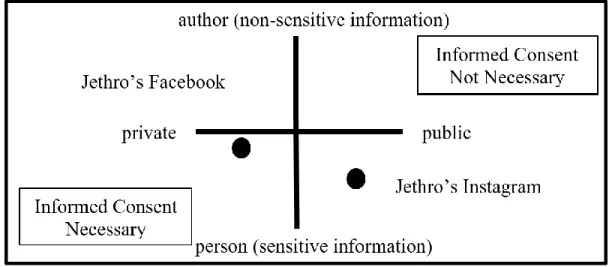
Figure 1. McKee and Porter’s (2008) grid to determine necessity for informed consent in digital
writing research. ... 62
Figure 2. McKee and Porter’s (2008) grid for ethical decision making in digital writing research with sample scenarios. ... 62
Figure 3. Call for research participants via Facebook. ... 87
Figure 4. Call for research participants via Twitter. ... 87
Figure 5. Jethro’s inaugural Instagram post. ... 163
Figure 6. Comments associated with Jethro’s inaugural Instagram post, shown in Figure 5. .... 164
Figure 7. Jethro and a female friend. ... 165
Figure 8. Comments associated with the image of Jethro and a friend, shown in Figure 7. ... 165
Figure 9. Jethro and his nephew. ... 166
Figure 10. Comments associated with the image of Jethro and his nephew, shown in Figure 9.166 Figure 11. Jethro in a tank top. ... 167
Figure 12. Comments associated with the image of Jethro in a tank top, shown in Figure 11. .. 167
Figure 13. Comments associated with the image of Jethro in a tank top, shown in Figure 11, continued. ... 167
Figure 14. Whale cartoon. ... 169
Figure 15. Comments associated with the whale cartoon, shown in Figure 14. ... 169
Figure 16. Jethro and a male friend after drinking. ... 170
Figure 17. Comments associated with the image of Jethro and a male friend after drinking, shown in Figure 16... 170
xii
Figure 18. Comments associated with the image of Jethro and a male friend after drinking, shown in Figure 16, continued. ... 171 Figure 19. Comments associated with the image of Jethro and a male friend after drinking, shown in Figure 16, continued 2. ... 171 Figure 20. Jethro and a group of friends. ... 172 Figure 21. Comments associated with the image of Jethro and a group of friends, shown in Figure 20. ... 172 Figure 22. Jethro and a sleeping friend. ... 173 Figure 23. Comments associated with the image of Jethro and a sleeping friend, shown in Figure 22... 173 Figure 24. Jethro and The Flash do EDM. ... 174 Figure 25. Comments associated with the image of Jethro and The Flash do EDM, shown in Figure 24. ... 175 Figure 26. Jethro in a banana costume. ... 176 Figure 27. Comments associated with the image of Jethro in a banana costume, shown in Figure 26... 176 Figure 28: Comments associated with the image of Jethro in a banana costume, continued. .... 177 Figure 29. View of Electric Daisy Carnival (EDC), Orlando. ... 177 Figure 30. Comments associated with the image of a view of EDC Orlando, shown in Figure 28. ... 178 Figure 31. Comments associated with the image of a view of EDC Orlando, continued. ... 178 Figure 32. Glowstick collector. ... 179
xiii
Figure 33. Comments associated with the image of the glowstick collector, shown in Figure 32.
... 179
Figure 34. MDMAzing bracelet. ... 180
Figure 35. Comments associated with the image of the MDMAzing bracelet, shown in Figure 34. ... 181
Figure 36. Comments associated with the image of the MDMAzing bracelet, continued. ... 181
Figure 37. Jethro at a medical conference: Day one. ... 182
Figure 38. Comments associated with the image of Jethro at a medical conference: Day one, shown in Figure 37... 183
Figure 39. Comments associated with the image of Jethro at a medical conference: day one, continued. ... 183
Figure 40. Bourbon Street. ... 184
Figure 41. Comments associated with the image of Bourbon Street, shown in Figure 40. ... 184
Figure 42. Jethro at a medical conference: Day two. ... 185
Figure 43. Comments associated with the image of Jethro at a medical conference: Day two, shown in Figure 42... 185
Figure 44. Jethro's classmates. ... 186
Figure 45. Comments associated with the image of Jethro's classmates, shown in Figure 44. .. 187
Figure 46. Jethro's class notes. ... 187
Figure 47. Comments associated with the image of Jethro's class notes, shown in Figure 46. .. 188
Figure 48. Jethro in uniform. ... 189
Figure 49. Comments associated with the image of Jethro in uniform, shown in Figure 48. .... 189
xiv
Figure 51. Jethro's Facebook "About Me." ... 195
Figure 52. Inaugural post on Jethro's Facebook wall. ... 199
Figure 53. Jethro on a motorcycle... 199
Figure 54. Architecture in Germany. ... 200
Figure 55. Celebrities versus veterans repost. ... 202
Figure 56. Contracting companies in Iraq... 203
Figure 57. Contracting companies in Iraq, continued. ... 203
Figure 58. Contracting companies in Iraq, continued 2. ... 203
Figure 59. Sociology test. ... 206
Figure 60. 4.0 semester. ... 206
Figure 61. 4.0 semester continued. ... 207
Figure 62. 4.0 semester continued 2. ... 207
Figure 63. 4.0 semester continued 3. ... 207
Figure 64. Jethro and “C” in uniform. ... 208
Figure 65. Happy Veteran’s Day. ... 209
Figure 66. To be a veteran. ... 209
Figure 67. To be a veteran, continued. ... 209
Figure 68. Thank you for your service. ... 210
Figure 69. Thank you for your service, continued. ... 210
Figure 70. A Veteran is someone who. ... 211
Figure 71. A Veteran is someone who, continued. ... 211
Figure 72. A Veteran is someone who, continued 2. ... 211
xv
Figure 74. To my military family, continued. ... 212
Figure 75. To my military familiy, continued 2... 212
Figure 76. To my military family, continued 3. ... 213
Figure 77. To my military family, continued 4. ... 213
Figure 78. To my military familiy, continued 5... 214
Figure 79. My brother, the veteran, and more. ... 214
Figure 80. My brother, the veteran, and more, continued... 215
Figure 81. My brother, the veteran, and more, continued 2... 215
Figure 82. My brother, the veteran, and more, continued 3... 216
Figure 83. My brother, the veteran, and more, continued 4... 216
xvi
LIST OF TABLES
Table 1: Rossman and Rallis' (1998) Four Uses of Qualitative Research ... 49
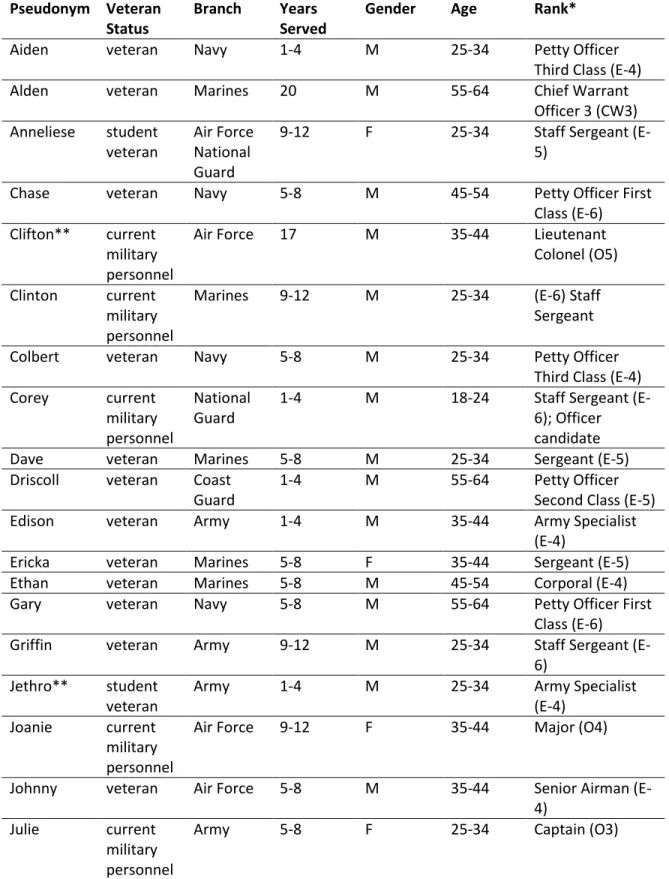
Table 2: Military specific demographics of participants. ... 81
Table 3: Participant demographics... 82
Table 4: Participant pseudonyms and individual demographics... 83
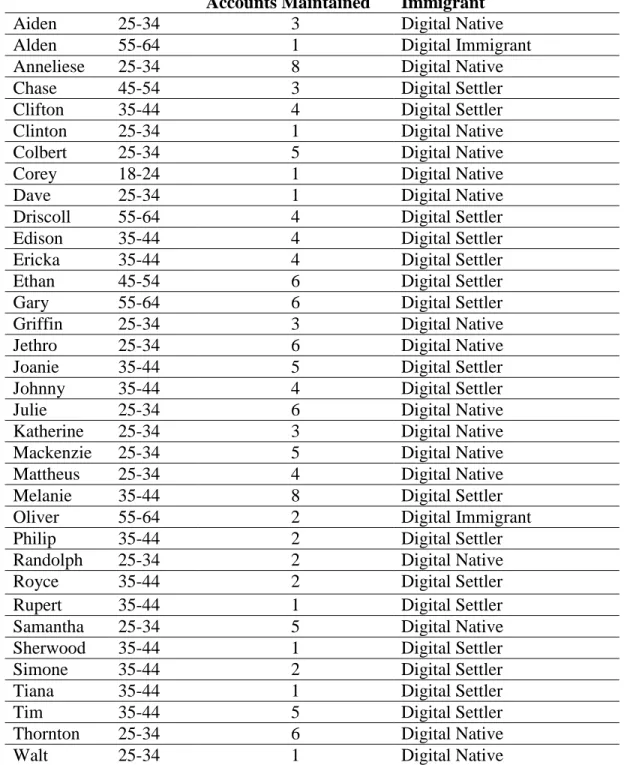
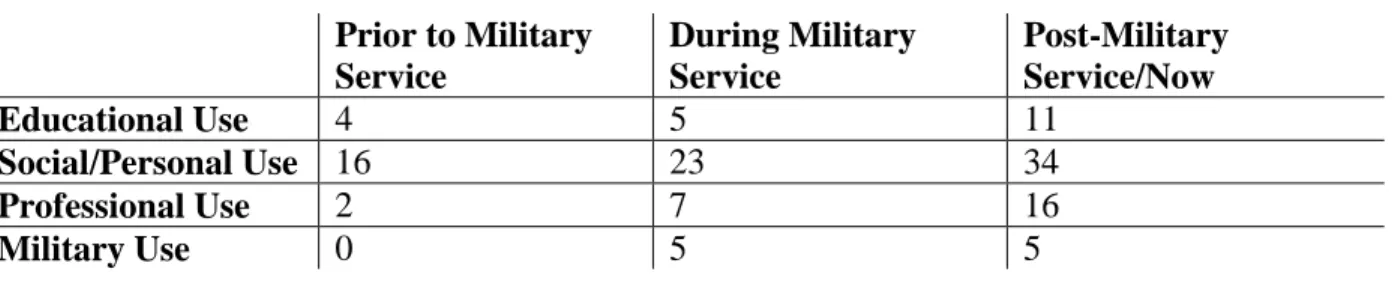
Table 5: Classification of participants as digital natives, digital settlers, or digital immigrants. 106 Table 6: Use of social networking technologies pre-, during, and post-service. ... 112
Table 7: Reasons for not using social networking technologies prior to and during service. .... 112
Table 8: Self-identification as military personnel within social networking spaces. ... 117
Table 9: For what purposes did/do you use social networking technologies? ... 133
Table 10: Are social networking technologies more useful for personal or professional purposes? ... 135
1
CHAPTER 1: DIGITAL LITERACIES, SOCIAL NETWORKING
TECHNOLOGIES, AND TROPES OF THE VETERAN
Introduction
Portrayals of veterans returning from war are prevalent in American popular culture, with the film American Sniper and the Showtime series Homeland serving as two of the most recent popular depictions of veterans who experience difficulty readjusting to civilian life. Representing the two most common tropes of the veteran, those of war hero and wounded warrior, both
American Sniper and Homeland featured lead characters who were depicted as post-9/11 male war heroes who experienced difficulty reintegrating into civilian life. Although depictions of veterans are important components of popular culture, and while some veterans do identify as heroes and many veterans do experience a range of disabilities from their service experiences, neither of these tropes accurately describe the lived experience of the majority of post-9/11 veterans. However, popular tropes of the veteran in the media can encourage viewers to see veterans as a homogenous group and, as a result, many veterans are left out of the traditionally constructed narrative of the veteran as either heroic or damaged, or maybe both, but rarely anything else, and almost always male and deployed.
Although portrayals of student veterans are not as common in popular culture, the comic strip Doonesbury does include a student veteran in its cast of characters. Leo Deluca, often called by his nickname Toggle, is a wounded Iraq war veteran, and the strip chronicles not only
Toggle’s wartime experiences, but also chronicles his difficulties readjusting to civilian life and in dealing effectively with his service-related disabilities (Trudeau). In addition to losing the sight in one of his eyes, Toggle suffers from Traumatic Brain Injury (TBI), known as the
2
signature wound of conflicts in Iraq and Afghanistan. TBI can result in various symptoms or disabilities, and Toggle suffers from expressive aphasia, which is characterized by difficulty producing language. Doonesbury chronicles the successes and difficulties that Toggle
experiences with reintegration, with story lines often centered on his relationship and eventual marriage to Alex Doonesbury. However, in addition to maintaining his relationship with Alex, healing from his service-related wounds, and working as an engineer in a recording studio, Toggle is also a student veteran, pursuing a degree in music studies.
Running since 1970, Doonesbury is well-known for its political content. Although Toggle is the only student veteran in the ongoing strip, Doonesbury does feature other veterans, including B.D., Toggle’s former commanding officer, reservist, and veteran of Vietnam and both Gulf Wars who lost a leg in Iraq; Ray Hightower, an African-American Gulf War veteran who suffers from Post-Traumatic Stress Disorder (PTSD); and Elias, a Puerto Rican Vietnam veteran who serves as a counselor to veterans suffering with PTSD. Doonesbury does offer some
diversity with the inclusion of Elias and Ray’s characters, and while the comic importantly addresses issues such as PTSD and TBI, all of Doonesbury’s male veterans, with the exception of Elias, are positioned as wounded warriors. Toggle is both physically and mental wounded, as he suffers from blindness in one eye and expressive aphasia as a result of TBI. B.D. is physically wounded, having lost his leg in Iraq, and Ray, although physically wounded during the war, now suffers from PTSD. It is important to represent veterans in popular culture, as well as to address important topics such as PTSD and TBI, but it is also important to recognize the ways in which many of these representations play on the popular tropes of veteran as war hero or wounded warrior.
3
However, this is not to undercut the important work that Doonesbury does in addressing the difficulties many veterans have when transitioning from military service and reintegrating into society, difficulties that are often compounded by service-related disabilities such as PTSD and TBI. Additionally, Doonesbury works to highlight the difficulties faced by women in the military, through the stories of Mel and Roz. Melissa Wheeler, often called Mel, is a survivor of military sexual assault, and the strip chronicles not only Mel’s healing process after her rape, but also her return to the military as an officer. Roz, an Army specialist, is an out lesbian, who was able to come out as a result of the repeal of Don’t Ask Don’t Tell in 2011. By telling the stories of Roz, Mel, Toggle, B.D., Ray, and Elias, Doonesbury does present a diverse cast of characters and does bring attention to important issues affecting U.S. veterans and military personnel.
Not only do tropes of the veteran as hero or wounded warrior pervade popular culture, they pervade academia as well. In her Master’s thesis, Rhetoric and Composition Constructs ‘The Veteran’: An Examination of the Student Veteran Identity as Found in CCC and TETYC Since September 11, 2001, Linda Gail Smith (2012) performed close textual analysis on a corpus of nineteen published scholarly essays that included a direct reference to student veterans.
Through this analysis, Smith identified six predominant student veteran tropes in rhetoric and composition research, five of which rely on the trope of the wounded warrior:
student veteran as psychologically damaged (p. 23);
student veteran as “other,” as someone who is fundamentally different from traditional students and who does not belong in the classroom (p. 26);
4
veterans as possessing homogenous and conservative political beliefs that “can be changed through access to proper education, transforming student veterans into educated citizens” (p. 27);
student veteran as contextualized rhetorically against “sociologically negative examples” (p. 46) that reinforce stereotypical views of veterans as “unstable, uneducated, minority, conservative, manipulated, [and] forced into uniformity,” among others (p. 42); and
student veteran as writing about traumatic experiences (27).1
While L.G. Smith noted that “without a doubt, a percentage of military members and veterans encounter certain experiences of military life,” she argued, “skewing our thinking—and teaching practice—toward that percentage does a disservice to the remaining veterans who do not share that same experience” (p. 52). As college writing instructors, we do, and will continue to, encounter student veterans in our college writing classrooms. Now, in fact, because of the increasing numbers of veterans pursuing higher education as a result of the post-9/11 GI Bill, “it is probable that veterans will substantially transform postsecondary classroom dynamics,
relationships across campus and in the community, and our understanding of the kinds of literacies students bring to our courses” (Doe & Langstraat, 2014, loc. 110 Kindle). In order to better serve this population of students, we must resist the tendency to view veterans as a homogenous group (Doe & Langstraat, 2014; Hart & Thompson, 2013a; Hart & Thompson, 2013b), and we must resist the tendency to stereotype our student veterans.
1 The final trope identified by L.G. Smith is that of the veteran as historical anachronism, as evidenced by multiple references to the original GI Bill, but few references to the Post-9-11 GI Bill. This is the only trope identified by L.G. Smith that does not rely on the wounded warrior trope to function, but none of the tropes identified by Smith rely on the trope of the war hero.
5
However, in order to better understand the student veterans that are and will be enrolled in our writing classes, I argue that it is important to investigate the ways in which student veterans communicate, share and craft their own narratives, and present their identities. In order to focus on the digital communication practices of student veterans, I chose to locate my research within social networking technologies.2 Not only are social networking technologies important within the U.S. military for both organizational and personal use, research on social networking technologies is also of interest to college writing instructors and researchers in the fields of rhetoric and composition and professional and technical communication. Recent research in the field of rhetoric and composition, which I will discuss at length later in this chapter, has begun to connect the use of social networking technologies to digital literacy practices, noting the
importance of digital literacy practices for the narrative building and identity presentation that is characteristic of social networking technologies. Additionally, recent research in the field of professional and technical communication has examined the ways in which social networking technologies have altered the development and presentation of both individual professional identities and organizational identities, as well as the way in which social networking
technologies support the development of community literacies. In light of these connections, in addition to investigating the ways in which student veterans use social networking technologies for communication purposes, narrative building, and identity presentation, this dissertation
2While my research in this dissertation focuses specifically on social networking technologies, some of the literature I consult is focused on social media more broadly. I am not equating the terms social media and social networking technologies; rather, social networking technologies are understood as a particular type of social media.
6
explores the digital literacy practices that are in play during this use, in an attempt to build upon and connect these lines of inquiry.
In this dissertation, I analyze the results of a survey I designed to learn more about the social networking use of student veterans. Thirty-six participants completed the survey in full, and 18 of my survey participants agreed to be contacted for a follow-up interview. I was able to arrange and conduct interviews with three participants, and each participant who granted me an interview also participated in a profile tour, during which my participants led me on a guided tour of their social networking profile captured using screencasting software. Conducting both a survey and follow-up interviews allowed me to collect both quantitative and qualitative data about the digital literacy practices of student veterans in the context of social networking sites, and my examination of these practices is guided by the following questions:
In what ways do post-9/11 era student veterans use social networking technologies for personal, professional, and academic purposes?
How are digital literacy practices being employed by student veterans during these uses of social networking technologies?
In what ways do post-9/11 era student veterans use social networking technologies to negotiate their veteran identities in online spaces? In what ways do these digital narratives of student veterans support or resist traditional veteran narratives?
For what purposes do post-9/11 era student veterans use social networking technologies to seek out online communities of other veterans or communities that offer support to veterans?
7
How did post-9/11 student veterans use social networking technologies during previous service and prior to service? What are the similarities and differences in how post-9/11 era student veterans currently use social networking technologies in comparison with how they used social networking technologies while serving in the U.S. military? In the remainder of this chapter, I first establish the need to resist the tendency to stereotype or homogenize student veterans in the college writing classroom. From there, I provide an extended literature review on the topic of digital literacy and its role in social networking technologies before moving on to review the literature on identity and narrative in social networking technologies. My literature review concludes with a discussion of literature on personal and organizational uses of social media in the U.S. military. The chapter concludes with an overview of the remaining chapters in the dissertation.
Tropes of the Veteran
As discussed above, the two most common tropes of the veteran are the veteran as war hero and wounded warrior. While some veterans do fit into one, or sometimes both, of these categories, many do not fit in either of these categories. However, the portrayal of these tropes pervades popular culture and, in turn, influences citizens’ perceptions of what it means to be a veteran. In her dissertation, A Few Good Men and Women: The Rhetorical Constitution of Military Personnel Identity, Ashly Bender Smith (2015) argued
despite the fact that films, reality television, and even news reporting are carefully structured and edited, and many viewers are aware that the “reality” is superficial, these popular media representations make a powerful impression on the public understanding of the military generally and personnel particularly. (p. 29)
8
A. B. Smith noted that many depictions of post-9/11 era U.S. military personnel were positive, depicting “contemporary service members ... as physically and morally strong; committed and loyal to each other and their duty; ... innately qualified for the jobs they perform, [and] as elite members of our society” (p. 60). However,
when military characters are negatively marked in these films, we are encouraged to see them as either damaged by their service—such as in The Hurt Locker or The Valley of Elah—or as aberrations within the identity, the kind of person who was not a true member of the group, such as the corrupted officer who partners with the villains in A-Team. (A. B. Smith, 2015, pp. 60-61)
In an attempt to respond to the misinformation that results from the widespread popular culture depictions of military personnel, and with the intent to change the inaccurate depictions of veterans in film and television, U.S. Army Veteran Chris Martin founded “Got Your 6,” an organization dedicated to “normaliz[ing] the depictions of veterans on film and television to dispel common myths about the veteran population” (“Got Your 6,” n.d., About section, para. 5). Martin noted, “the public can have skewed views of veterans based on what’s seen in film or on television,” because these depictions position veterans as “heroes on one end of the spectrum or broken veterans on the other end of the spectrum” (as cited in Hamedy, 2015, para. 4). Although this largely remains true, depictions of military personnel in film are more diverse now than in the past. A. B. Smith (2015) argued that this diversity is, in part, the media’s attempt to humanize military personnel “by characterizing personnel as a diverse group whose members have a
variety of interests and associations beyond their military service,” offering a “counter-balance to the framing of service members as elite” (p. 56). In her discussion, A.B. Smith noted two films,
9
Windtalkers (2002) and Red Tails (2012), both set during WWII, in which race is a driving feature of the plot—Windtalkers tells a story of two white U.S. Marines “assigned to protect Navajo Marines who use their native language as an unbreakable radio cypher” (“Windtalkers,” n.d.), while Redtails focuses on the narrative of a “crew of African American pilots in the Tuskegee training program” (“Redtails,” n.d.). Martin Barker (2011) noted a similar increase in diversity, particularly in the representation of Latinos as U.S. military personnel. However, while Barker concluded that the increased depiction of Latinos in war films resulted in the
development of a new character type, the Latino Grunt, who is “villain, victim, and hero all in one” (p. 148), A.B. Smith (2015) concluded that these humanizing efforts allow even negative perceptions of military personnel in post-9/11 films to “encourage the public to sympathize and support personnel” (p. 58).
Furthermore, in his analysis of Iraq war films, Barker (2011) demonstrated that although diverse depictions of military personnel in films are more common today, the depiction of U.S. military personnel in film has a complex history. Barker chronicled the development of several representations of military personnel in film, arguing that today’s societal perception of the war hero was influenced in large part by John Wayne’s portrayals of war heroes in WWII films— portrayals that were endorsed by the U.S. military itself in an effort to enhance public perception of the military. In these films, Wayne, who “encapsulated a certain image of American
masculinity,” encouraged the American public to associate the same qualities they associated with Wayne—courage, morality, and physical fitness—with American military personnel as well (Barker, 2011, p. 51). Over time, however, additional characters came to influence America’s perception of military personnel: Rambo came to be associated with the image of soldier as
10
mercenary, while Vietnam films often featured Grunts, “ordinary soldiers, whose stories may be worth telling, but who do not have ideas or commitments beyond their situation” (Barker, 2011, p. 66). It is easy to see evidence of these character types in the predominant tropes of the veteran: we can easily imagine why the Grunt, the ordinary soldier who blindly follows orders, might have trouble reintegrating into society, thus characterizing the wounded warrior trope, while the veteran as war hero certainly evokes imagery one might associate with John Wayne, as discussed earlier. It is also easy to imagine a war hero as Rambo, relentlessly firing at the enemy and creating a wake of destruction in an attempt to protect his fellow soldiers and, by extension, America herself. While these characters are certainly attractive in film, they do not represent the many-faceted lives and lived experiences of the heterogeneous population that makes up the U.S. military. It is increasingly important for us, as both academics and citizens, to not only be aware of, but to offer critique and resistance to these tropes as well because, as boyd (2014) reminds us, “for better or worse, media narratives also help construct broader narratives for how public life works” (pp. 18-19).
Veteran as Hero Trope
The veteran as hero trope is enacted not only in popular culture, but also in mundane activities. One example of this, discussed by Mike Stajura (2014), veteran of the U.S. Army (1995-2002), as well as A. B. Smith (2015) occurs when, at large events, veterans are asked to stand and be recognized by the crowd for their heroism. Stajura (2014) explained that, while there are certainly veterans who are heroes, most veterans do not identify themselves as heroes, an idea echoed by William Astore (2010), retired lieutenant colonel of the U.S. Air Force, who argued that “the act of joining the military does not make you a hero, nor does the act of serving
11
in combat. Whether in the military or in civilian life, heroes are rare—indeed, all-too-rare. Heck, that’s the reason we celebrate them. They’re the very best of us, which means they can’t be all of us” (para. 7). In fact, as David Vacchi (2012) noted, in part because the word “veteran is a legal term with multiple definitions depending on the source, such as federal or state government agencies” (p. 16, emphasis in original), some former military personnel may not even identify as veterans, let alone as heroes. Vacchi’s conclusion is further supported by the California Research Bureau’s 2012 report of California’s Women Veterans, which found that “women who have served in the military do not consistently identify themselves as veterans” (p. 15), thus pointing to the sometimes exclusionary nature of terms like “hero” and “veteran” when applied
homogeneously to describe all former military personnel.
Astore (2010) argued, not only is the positioning of military service as inherently heroic problematic for the many military personnel who do not view themselves as heroes or their service as heroic, but the military service as heroic narrative is also culturally damaging. Positioning military personnel as heroes encourages us, as a culture, to “blind ourselves to evidence of their destructive, sometimes atrocious, behavior” (para. 11),a perspective that also encourages us to “prolong our wars” (para. 12). Stajura (2014) also addressed the role of heroism in the military as a damaging narrative, arguing that “heroism is not a goal for any
servicemember, nor should it be. Point blank, heroism is for war movies” (para. 9). The hero acts on the spur of the moment, is driven by emotion, and “recklessly endangers himself” (Stajura, 2014, para. 10), while soldiers “train, plan, and fight in a way that takes heroism out of the equation” (Stajura, 2014, para. 9). The culture of ethics in the military is rooted in operational success and protection of the unit. Thus, there is only room for heroic action in the context of
12
war when the plan has, in some way, failed. This is why, as Stajura (2014) noted, members of the military are “grateful for their heroes,” but are “uncomfortable when the word ‘hero’ is used loosely” (para. 13). For military personnel, Stajura (2014) asserted, “true heroes have qualities [they] aspire to but hope [they] will never have to emulate” (para. 13).
In addition to the apparent contradiction between the qualities associated with a hero and the qualities associated with military service, the hero narrative also excludes, among others, those veterans who served during peacetime, those who served during wartime but were not deployed, and those who, although deployed to combat areas, filled positions in which they were never required to leave the base and, as a result, were never exposed to combat. This is not to suggest that we should not honor our veterans, but to bring awareness to the idea that veterans are not a homogenous group, and that current (and long-standing) tropes of the veteran inhibit our ability to understand veterans as a diverse population.
Trope of the Wounded Warrior
Recognition of the veteran as hero trope and the trope of the wounded warrior are equally important in the writing classroom. Identifying a student veteran as a hero in the classroom might cause the student veteran to be uncomfortable, and this identification can also lead to the
potential for the student veteran to be perceived as a representative of the military-industrial complex as a whole. Just as we, as writing instructors, would not expect a female student to speak on behalf of all females, we can also not expect the student veterans in our classrooms to act as representatives of the U.S. military. While some student veterans will choose to share their experiences and thoughts, acting as a type of cultural informant for both classmates and
13
instructor, these decisions to share must be the student veteran’s choice, and must be recognized as the views and beliefs of an individual, rather than of an entire population.
The trope of the wounded warrior is of equal concern in the classroom. Viewing our student veterans through this lens encourages a perception of student veterans as less capable of receiving critique than our non-veteran students. However, “most student veterans crave clear directions and candid feedback from someone they trust” (Doe & Langstraat, 2014, p. 43). Thus, withholding feedback out of concern for student veterans, particularly if that concern is steeped in the perception of veterans as wounded, might damage our student veterans’ relationships with the academy, rather than foster them. Doe and Langstraat (2014) argued, “student veterans, like other adult learners, have generally been away from the classroom for several years but possess often-unacknowledged workplace knowledge” (p. 13). Seeing student veterans as damaged has the potential to encourage us, as writing instructors, to continue to allow the literacy practices our student veterans bring to the classroom to go unacknowledged. Hart and Thompson (2013) noted the problematic nature of focusing only on the difficulties student veterans may bring to the classroom, arguing that, although the difficulties faced by student veterans are certainly important, the deficit model provides a limited and restricted view of student veterans, again positioning student veterans as a homogenous group.
Interestingly, the trope of the wounded warrior, which views all veterans as “potentially disabled and in need of civilian care” gained popularity at the end of the Civil War (Casey, 2014, p. 124). As members of the Union military began to return home, citizens began to worry that “soldiers might fail to adjust to peacetime life” (p. 124). Several months after the war, though, when these fears were unrealized, concerns that the reintegration of veterans would “be
14
disruptive to [the nation’s] social well-being” (p. 124) were replaced with the narrative of the wounded warrior, a narrative that persists today. However, with a rise in awareness of the psychological wounds of war, the trope of the wounded warrior is now most commonly
associated with severe cases of Post-Traumatic Stress Disorder (PTSD), a disability that Weigel and Detweiler (2011) argued is “negatively identified through the military’s rhetoric, which privileges the able body” and mind (p. 30). As evidence for this claim, Weigel and Detweiler point to Leskin’s presentation from the United States Department of Veterans Affairs, which identified “resilient people” as less likely to develop PTSD (p. 30). Leskin, who is an employee of the National Center for PTSD, implied that “veterans with PTSD may not be successful, and if veterans were more resilient, they would be less likely to experience PTSD. In short, this
language assumes that the veteran with PTSD is inadequate and, therefore, incapable” (Weigel & Detweiler, 2011, p. 30).
Weigel and Detweiler argued that military personnel are often reluctant to acknowledge the effects of PTSD in part because of a feeling of responsibility to uphold the persistent narrative of veteran as war hero (p. 31). This feeling of responsibility is also reinforced by the media, who often position stories of veterans suffering from PTSD as “hero becomes villain” narratives (p. 32), as depicted in the television series Homeland. The first several seasons of this Showtime series centered around the narrative of Nicholas Brody, a U.S. Marine who was rescued during a raid on a terrorist compound after being missing-in-action since 2003, and CIA agent Carrie Mathison, who believed that Brody had been turned by al-Qaeda during his time as a prisoner-of-war. Brody’s role in the series, which ended with his death at the end of season 3, was characterized by the conflict between the U.S. government and the general population’s
15
opinion of him as a war hero, his own struggles with PTSD, and Mathison’s perception of him as dangerous, perhaps even a terrorist himself. Thus, Brody’s character, throughout the series, encompassed several stereotypical tropes: that of war hero, wounded warrior, and hero becomes villain.
One Time magazine cover story attempted to dispel the “hero becomes villain” narrative by instead positioning the veteran as victimized by PTSD (Thompson & Gibbs, 2012).
Thompson and Gibbs noted that “more U.S. military personnel have died by suicide since the war in Afghanistan began than have died fighting there” (para. 8), with 18-24 year olds more likely to commit suicide than older groups of military personnel. Often, these suicides are the result of PTSD. Because student veterans, 58% of whom will fall into the 18-24 year old
demographic (Department of Veterans Affairs, 2015, p. ii), will continue to enroll in our college writing classrooms, it is important that we, as college writing instructors, are aware that while student veterans may experience PTSD, others may not, and that each student veteran who does experience PTSD will have a unique experience with the disability. We should not assume that all of the student veterans in our classes will have PTSD, but we should recognize that it is a possibility and be prepared to guide student veterans to appropriate resources when necessary.
Student Veterans in the College Writing Classroom
In her 2010 address to the Conference on College Composition and Communication, Valentino discussed the “ethical obligation” college writing programs and instructors have to “react responsibly” to veterans in the classroom. Valentino located this “ethical obligation” within the first-year writing classroom because not only do most universities require at least one semester of first-year writing, ensuring that student veterans will enroll in these courses, but also
16
because, in many cases, students enroll in first-year composition during their first semester at the university. Hart and Thompson (2013a) echoed Valentino’s call in their piece, “‘An Ethical Obligation’: Promising Practices for Student Veterans in College Writing Classrooms,” arguing that writing instructors may, in many cases, be the “first point of contact for veteran students” (p. 3). Additionally, the writing classroom is often a place in which a student’s veteran status is disclosed. In the composition classroom, the popularity of the personal essay “likely facilitates, whether wittingly or not, disclosure of veteran status” (p. 4). In the professional and technical writing classroom, the ubiquity of the employment project, which typically asks students to compose (among other deliverables) a résumé and a cover letter, can result in disclosure of veteran status as well. As a result of the smaller class size characteristic of writing classrooms and the increased engagement between writing instructors and students, as well as between students in a writing classroom, student veterans are more likely to find themselves in situations in which they feel pressured to disclose their status as veteran. In order to avoid this, and to ensure that disclosure of status is the student’s choice, Hart and Thompson contended that “instructors [should] consider a veteran audience when crafting assignments … much like an instructor might be sensitive to differences in race, gender, and religious background” (p. 12).
Valentino’s (2010) call was, in part, a response to the growing number of veterans returning to the college classroom as a result of the War in Afghanistan, part of the Global War on Terror, which began in 2001 and continues today. As a result of the length of this conflict, many veterans have returned to civilian life and, in turn, are using their educational benefits from their GI Bill in institutions of higher learning. The post-9/11 GI Bill benefits, which are available to current and former servicemembers who have served “90 days of aggregated active duty
17
service post September 10, 2011,” provide “up to 36 months of education benefits, generally payable for 15 years following [the servicemember’s] release from active duty” (“Post-9/11”). GI Bill benefits cover full tuition and fees at public schools while offering qualified student veterans a maximum of $20,235.02 per academic year to attend private institutions. In addition to tuition and fee waivers, the post-9/11 GI Bill also offers, to qualified veterans and active-duty servicemembers, a monthly housing allowance, an annual stipend for books and supplies, and a one-time rural benefit payment for those who are relocating from highly rural areas.
A number of student veterans are taking advantage of these benefits, with an average of 108,568 veterans annually enrolled in full-time education programs between 2009-2012, and another 17,021 (on average) enrolled in part-time programs, according to the Department of Veterans Affairs “2015 Veteran Economic Opportunity Report” (p. 10). Some veterans (8% on average from 2009-2012) were also taking advantage of the post-9/11 GI Bill’s “Transfer of Entitlement” option, which allows servicemembers who have served, or agree to serve, a minimum of ten years in the armed forces to transfer some or all of their educational benefits from the post-9/11 GI Bill to their spouses and/or dependent children.
According to the U.S. Department of Veterans Affairs, “between August 1, 2009 and January 23, 2013, approximately 1,143,105 veterans attended institutions of higher education in the United States, and the number of veterans, spouses, and dependents using post-9/11 GI Bill benefits grew 84 percent from the first to the second year of the benefit” (APSCU, 2013, p. 3). Further, “those enrollments promise to continue to increase or, at the very least, remain close to current levels for the coming decade as more veterans return from deployments and more veterans’ family members use the transferable GI Bill benefits” (Hart & Thompson, 2013a, p. 3).
18
Not only will we continue to see student veterans in our writing classrooms at both the university and community college level, we are also likely to see an increase in veterans’ spouses and children using the transferable GI Bill benefits. Additionally, the majority of degree-completing student veterans who received GI Bill benefits “earned degrees at the associate level or higher,” suggesting that we are likely to see student veterans in our upper-division writing classes as well as our lower division service courses (Cate, 2014, p. 2). As such, it is important for college writing instructors to understand how modern warfare might affect our veterans and their families, and how higher education might be more attentive to the needs of this particular population without viewing veterans as a homogenous group.
Additionally, it is important to recognize that the experiences of post-9/11 veterans are, in some ways, different than those of veterans from previous eras, so as not to perceive veterans as historical anachronisms, as L.G. Smith identified in her textual analysis of articles in the field of rhetoric and composition. Today, in part because of the elimination of the draft, less than .05% of the population serves in the U.S. armed forces (Pew Research Center, 2011a, para. 7), while 12% of the population served during World War II (Doe & Doe, 2013). Of course, the draft was in effect during the Vietnam War, with 9.7% of the population serving (Hanson & Beaton, n.d.); however, public dissent toward the war, emerging in 1967 and heightening until the war’s end in 1973 (Lunch and Sperlich, 1979, p. 23), marked the beginnings of what is now termed the “military-civilian gap,” which continued to increase as volunteer enrollment remained low during Operation Iraqi Freedom and Operation Enduring Freedom. Today, according to the Pew Research Center (2011), 77% of those “Americans [who] have family members who once served or are currently serving” (Pew Research Center, 2011b, para. 2) are over 50 years old, while only
19
33% of Americans ages 18-29 have a family member who is current or former military
personnel, adding to the perceived distance between military personnel and civilians. Further, the absence of a draft during the extended Global War on Terror has resulted “in multiple
deployments for those who have served,” with many post-9/11 veterans deploying “a half dozen times or more” (Doe & Doe, 2013, para. 13). While the familiarity of current military personnel with the rigors, stress, and demands of deployment contributes to the “specialized and
professionalized nature of today’s military service” (Doe & Doe, 2013, para. 13), these
experiences, in combination with the ever-changing nature of modern warfare technologies and communications technologies (Paquette & Warren, 2010), also resulted in the development of a veteran identity much different than those of previous eras, further separating the veteran from his or her previous life as a civilian. However, in spite of this increased gap between military and civilian identities, cultural reception of military personnel is much more tolerant and accepting now than post-Vietnam, evidenced in part by the earlier discussion of the frequency with which we as Americans honor our current and former military personnel at public events. Additionally, the Pew Research Center (2013) determined that public acceptance of the U.S. military remained high, with 78% of U.S. adults “saying that members of the armed services contribute ‘a lot’ to society’s well-being,” a slight decline from an 84% acceptance rate in 2009 (para. 1). Perhaps even more telling, of the 10 categories the poll asked respondents to rate in terms of contribution to the well-being of society, the military received the highest rate of acceptance, with teachers coming in second place at 72% in 2013 and 77% in 2009 (para. 2).
Thus, we are left with the question of how to attend to a population of student veterans who might feel very different from their civilian classmates, but who belong in the writing
20
classroom and deserve to be taught by instructors who recognize them as individuals, while also attending to their needs as a heterogeneous population with varying, yet also similar, lived experiences. One way for writing instructors to begin to better understand the needs of our student veterans is through exploring issues of identity and representation as they pertain to student veterans. In her dissertation, At War with Words, Grohowski’s (2015) study of 299 current and/or former military service personnel revealed that, in online environments, only 26% of her participants always identified as veterans or military service personnel, with 15% never identifying as current or former military, and 45% revealing their decision to disclose their military status as contextual. While a number of scholars have identified digital composing as a popular way for military service personnel to explore and share their military experiences
(Burden, 2006; Edwards & Hart, 2010a, 2010b; Hart, 2011; Robbins, 2007), Grohowski’s (2015) research indicated that this may not be the case. Instead, her research suggested that veterans use digital composing tools, such as social networking technologies, to distance themselves from their veteran identities, only disclosing their veteran status in particular contexts. In fact, her data revealed that “many [veterans and current military service personnel] are looking to move
beyond identifying themselves by their military status,” which Grohowski attributed “in large part to the stigma they experience in civilian society because of their military experience and veteran status” (p. 82). In addition to this stigma, in part as a result of stereotypical depictions of military service personnel, veterans also often experience what Meehan (2012), retired U.S. Army Captain and co-author of the memoir Beyond Duty, referred to as an “identity crisis,” arguing that veterans “need intensive help in rebuilding their identities” (para. 13) because, after leaving military service, “their identity is ripped away” (para. 6). DiRamio and Jarvis (2011)
21
identified the communal identity that is valued in the military, in which “individual identity becomes secondary to the identity of the group,” as a contributing factor of the identity crisis that many student veterans face as they attempt to transition between their former identities as
military personnel, and their current identities as veterans, students, and citizens (p. 53).
DiRamio and Jarvis noted that, while a number of college students negotiate multiple identities, such as those of
parent, worker, and caregiver, the status of student veteran adds yet another layer to the complexity of intersecting identities. In addition to the social identities of race, culture, sexual orientation, and gender, other preentry variables, such as first-generation status, officer or enlisted rank, socioeconomic status, and disability all differentially affect the veteran as he or she enters the academy. (p. 56)
Therefore, although the negotiation of multiple identities is a common practice for college students, identity negotiation may be more complex for student veterans, particularly in light of the military-civilian gap which, as noted above, continues to widen as smaller percentages of the U.S. population serve or are directly connected to someone who serves or has served in the U.S. military.
College writing classrooms have the potential to assist student veterans in negotiating their identities, whether that identity is associated with their veteran status or not. For example, first-year composition courses can assist student veterans in negotiating their new identities as students as well as their identities as citizens, while courses in professional and technical writing can help student veterans negotiate their professional identities. The act of writing has long been tied to the concept of identity, and a number of theorists have conducted research on the
22
connection between the two. In part as a result of writing’s close connection to identity, Hadlock and Doe (2014) concluded that the “first-year composition course can be an important site for transition and reintegration” and argued that we should “continue to explore the literacy habits of student veterans and develop a richer understanding of them” (pp. 92-93).
In this dissertation I argue that, in order for transition and reintegration to be successful, we must provide student veterans with the opportunity to develop their identities as both writers and citizens, and to do this, we must understand in what ways student veterans are already doing this work in online spaces and, more specifically, through social networking technologies. Social networking technologies are an interesting research site because they allow users to combine elements of text, images, and video to present a version of themselves to the world, and as such, it is important to understand how users communicate through and within these sites. Research on student veterans is popular, as is research on social networking technologies, but research that combines the two is lacking. This dissertation fills this gap by examining the ways in which student veterans use social networking technologies and by identifying the digital literacy practices employed in this use.
Defining Digital Literacy
Rather than attempting to define a discrete set of skills or tasks that make up the toolbox of digital literacy, it is Lankshear and Knobel’s (2008) conception of digital literacies as a “myriad [of] social practices and conceptions” (p. 17) that I find valuable for this dissertation project. Lankshear and Knobel (2008) argued for a conception of digital literacies,which should be understood as “shorthand for the myriad social practices and conceptions of engaging in meaning making mediated by texts that are produced, received, distributed, exchanged etc., via
23
digital codification” (p. 17). I do not think that it is useful to attempt to identify a list of valuable digital literacy skills because each individual uses new media technologies for different purposes and with different goals in mind. Technology use is rhetorically, socially, and culturally situated (Selber, 2004; Selfe, 2009a, 2009b) and, as such, there is no one-size-fits-all list of digital literacy skills that everyone should possess. Further, the population of student veterans is not a homogenous group and, as such, there is no one set of digital literacies that would work across the board for this population, either for personal communicative purposes or in the college writing classroom.
For the purposes of this dissertation and in communicating my interests in studying digital literacy to my research participants, I describe digital literacy practices as the social, communicative, and information gathering practices that take place in digital spaces and involve digital texts. However, while digital spaces are networked sites that can be accessed via the Internet, such as social networking sites, websites, or content-sharing platforms, this dissertation is only concerned with the digital literacy practices that take place within social networking sites. I am locating my research in social networking sites because I hope to contribute to the
developing body of literature arguing for the importance of social networking technologies as a space in which users engage in complex communicative acts and in which many digital literacy practices are employed (Balzhiser et al., 2011; Buck, 2012; Davies, 2012; Fife, 2010; Kimme Hea, 2014; Shepherd, 2015; Shih, 2011; Vie, 2008).
Further, I am working with danah boyd and Nicole Ellison’s (2013) updated definition of a social network site (their preferred term) as
24
a networked communication platform in which participants 1) have uniquely identifiable profiles that consist of user-supplied content, content provided by other users, and/or system-provided data; 2) can publicly articulate connections that can be viewed and traversed by others; and 3) can consume, produce, and/or interact with streams of user generated content provided by their connections on the site. (“Sociality” 157, emphasis in original)
Boyd and Ellison’s (2013) current definition evolved from their earlier (2007) definition of social network sites as
web-based services that allow individuals to (1) construct a public or semi-public profile within a bounded system, (2) articulate a list of other users with whom they share a connection, and (3) view and traverse their list of connections and those made by others within the system (“Sociality,” p. 151)
a definition that, while useful, “does not accurately describe the landscape of SNSs today” (“Sociality,” p. 157). Boyd and Ellison’s (2013) updated definition maintains the existing components of their initial definition, yet expands to include an awareness of the role of user-generated content for creating meaning within social networking technologies. In her
dissertation, Engaging Others in Online Social Networking Sites: Rhetorical Practices in MySpace and Facebook, Vie (2007) added to boyd and Ellison’s (2007) definition, arguing that “online social networking sites must also provide privacy policies and tools for users to protect their personal privacy in these spaces” (p. 16). Examples of digital literacies thus include the activities that users engage in when visiting these spaces, such as locating the site, constructing and maintaining a profile within the site, navigating the site to attain desired information,
25
communicating within the site, using the site to create knowledge or content, making and navigating connections within the site, and using the site’s privacy settings (or purposefully choosing not to use them).
I chose to define digital literacies in this way for several reasons. First, as I noted above, I argue that it is important to conceive of digital literacies as a set of practices rather than a set of discrete skills, because while practices are rhetorically situated and can be altered and transferred for use in other contexts and for other purposes, skills are discrete, contextually-bounded
activities that are often specific to a particular technology. Further, Wysocki and Johnson-Eilola (1999) argued against the conception of literacy as skills-based, concluding that “when we speak then of ‘literacy’ as though it were a basic, neutral, contextless set of skills, the word keeps us hoping—in the face of lives and arguments to the contrary—that there could be an easy cure for economic and social and political pain, that only a lack of literacy keeps people poor or
oppressed” (p. 355). I also choose to define digital literacies as plural because, in the vein of literacy scholars such as Collins and Blot (2003), I find a singular definition of digital literacy to be exclusionary. While a focus on literacy often results in dichotomies (literate vs. illiterate; educated vs. uneducated), a focus on literacies allows for a relational conception of literacies as “intrinsically diverse, historically and culturally variable, practices with texts” (Collins & Blot, 2003, p. 4). Thus, a focus on digital literacies, rather than on digital literacy as a single,
monolithic thing that is the same for everyone, allows for a diversity of practices, specific to the individual and suited to his or her individual purposes.
I focus on the role of social, communicative, and information gathering activities in my definition of digital literacies because of the context that many people associate with the term
26
literacy. Digital literacies certainly involve the practices of writing and reading, but I do not associate digital literacies with only the act of reading or writing texts. This narrow conception of literacy as only associated with reading and writing practices leaves out a significant amount of literacy practices, such as those that occur in social networking sites, including crafting and maintaining an identity within the site, as well as creating a digital narrative to support that identity. Again, although reading and writing are significant components of digital literacies, other practices, such as navigating the web, searching for information, and signing in to and setting up accounts with social networking sites, to name only a few, are also significant digital literacy practices, but are not typically thought of as reading or writing practices. To provide another example, Donoso and Verdoodt (n. d.) pointed to the need for “increased ‘social media literacy’, i.e. the specific set of technical, cognitive and emotional competencies that are required to take full advantage of social media” (p. 11), arguing for the importance of understanding terms of service and privacy policies as important social media literacy practices. By defining digital literacies in this way for my research population, I was able to track a wide range of digital literacy practices among my participants—digital literacy practices that fall outside the purview of the reading and writing practices typically associated with print-based literacy.
Digital Literacies and Social Networking Technologies
While it is becoming increasingly common for college writing instructors to integrate social networking technologies into the classroom, sometimes the pedagogical benefits of social networking technologies can be outweighed if instructors fail to recognize, or fail to teach students to recognize, the importance of digital literacy practices to social networking technologies. Royce Kimmons (2014), in his discussion of the connection between digital
27
literacies and identity in social networking spaces, argued “we need to better understand issues of identity and literacy within social networking sites” (p. 93), but also warned instructors and administrators to “be very careful in any attempt to coopt such technologies for educational purposes, because they bring with them an entire host of embedded values and expectations that may likely be problematic and even contrary to meaningful learning and professionalism” (p. 97). Thus, it is important for instructors who incorporate social networking technologies in the classroom to do so in a critical way, choosing the social networking platform whose context best fits the desired classroom purpose and invites the types of digital literacy practices that the instructor wants students to develop.
Although an interest in digital literacy is well established in the field of rhetoric and composition, with theorists urging the field to pay attention to the digital literacy practices of our students (Selfe, 2009a, 2009b), researchers have recently begun to explore the digital literacy practices at play in social networking spaces (Balzhiser, 2011; Buck, 2012; Davies, 2012; Fife, 2010; Kimme Hea, 2014; Shepherd, 2015; Shih, 2011; Vie, 2008). Additionally, researchers have investigated students’ critical digital literacies (Gurak, 2001; Kress, 2003; Selfe, 2009a, 2009b; Vie, 2008; Wysocki & Johnson-Eilola, 1999) and urged college writing instructors to value digital literacies in the writing classroom (Balzhiser, 2011; Fife, 2010; Shih, 2011; Reid, 2010; Vie, 2008).
Of the theorists who have explored the role of digital literacy in social networking spaces, several have identified specific digital literacy practices that users engage in when using social networking technologies. Vie (2008), who supported the pedagogical uses of social networking technologies in the composition classroom, indicated that students use social networking