Technological University Dublin Technological University Dublin
ARROW@TU Dublin
ARROW@TU Dublin
Practitioner Research Projects LTTC Programme Outputs
2018-11-01
A Generic Integrated and Interactive Framework (GIIF) for
A Generic Integrated and Interactive Framework (GIIF) for
Developing Information Literacy Skills in Higher Education
Developing Information Literacy Skills in Higher Education
Aoife DonnellyTechnological University Dublin, [email protected] Maria Chiara Leva
Technological University Dublin, [email protected] Ayman Tobail
Technological University Dublin, [email protected] Nikolaos Valantasis Kanellos
Technological University Dublin, [email protected] Follow this and additional works at: https://arrow.tudublin.ie/ltcpgdprp
Part of the Higher Education and Teaching Commons, and the Scholarship of Teaching and Learning Commons
Recommended Citation Recommended Citation
Donnelly, A., Leva, M. C., Tobail, A., Kanellos, N. V. (2018) A Generic Integrated and Interactive Framework (GIIF) for developing information literacy skills in higher education. PG Diploma in Practitioner Research Projects, DIT, 2018.
This Report is brought to you for free and open access by the LTTC Programme Outputs at ARROW@TU Dublin. It has been accepted for inclusion in Practitioner Research Projects by an authorized administrator of ARROW@TU Dublin. For more information, please contact
[email protected], [email protected], [email protected].
This work is licensed under a Creative Commons Attribution-Noncommercial-Share Alike 3.0 License
1
A Generic Integrated and Interactive Framework (GIIF) for developing
information literacy skills in higher education
Aoife Donnelly, Maria Chiara Leva, Ayman Tobail, Nikolaos Valantasis-Kanellos Dublin Institute of Technology (www.dit.ie)
Introduction and Rationale
Information literacy (IL) is defined as “the set of integrated abilities encompassing the reflective discovery of information, the understanding of how information is produced and valued, and the use of information in creating new knowledge and participating ethically in communities of learning” (ACRL 2015, p.3). The term IL was originally confined to library and IT skills (Behrens, 1994; Johnston & Webber, 2003) but has since received increasing international interest. It is considered as an important 21st century skill in combination with critical thinking (Kong, 2014), and is perceived as basic human right within the digital world (UNESCO, 2008). The importance of IL within the contemporary information society has been acknowledged due to its relevance to lifelong learning (Bruce, 1999; Johnston & Webber, 2003; Podgornik, Dolničar, Šorgo, & Bartol, 2016). Appendix A.1 contains a review of evolving definitions.
The IL competency of higher education students is significantly increased by the integration of IL elements in the classroom (e.g. Cochrane, 2006; Kennedy & Monty, 2008; Price, Becker, Clark & Collins, 2011; Kong 2014; Sandercock 2016). However, IL skills of students are often limited to beginner levels (Henkel, Grafmüller, & Gros 2018). The U.S. Association of College and Research Libraries (ACRL) argues that in the contemporary information society, students are invariably expected to create new knowledge by understanding and using (ethically) ever-evolving sources of information. Teachers should design “curricula and assignments that foster enhanced engagement with the core ideas about information and scholarship within their disciplines”, and librarians should collaborate extensively with teachers to facilitate the development of an integrated curriculum for IL (ACRL 2015, p.2). Faculty and librarians need to develop a shared understanding of the IL skills and competencies graduates should possess (Sandercock, 2016).
In Ireland, the Working Group on Information Literacy (WGIL) was set up to focus on collaborative ways in which IL education can be further developed (O’Brien & Russell, 2012). Thus in this context (and driven by the calls for the development of integrated curricula for IL) we attempt to develop a Generic, Integrated and Interactive Framework (GIIF) for developing IL skills in higher education, with learning and teaching methods informed by the principles of gamification. The following research objectives were identified:
1. Review the state of the art for IL and IL skills frameworks
2. Embed educational dimensions and interactive activities in an integrated framework 3. Propose implementation practices of the proposed framework
2
The proposed GIIF will strengthen the IL skills of DIT graduates, develop their disciplinary expertise and judgment and facilitate them in advancing existing knowledge through innovation (aligned with the Graduate attributes described in Appendix A.5).
Literature Review
GIIF is based on a review of existing best practices briefly summarised in the following paragraphs.
A review of IL frameworks
The Australian and New Zealand Information Literacy Framework (ANZIL) standards (endorsed by the Consortium of National and University Libraries (CONUL)) are intended to inform a curriculum whereby IL learning outcomes, assessments and delivery are constructively aligned (Bundy, 2004). They are based on four overarching principles and six core standards outlined in Appendix A.2. The standards are expressed as a set of statements defining the activities and behaviour of the information literate person and as such can be embedded into the learning outcomes of existing modules. IL is acknowledged as a subset of independent learning, which in turn is a subset of lifelong learning.
The SCONUL model outlines 7 pillars that define an information literate person (Appendix A.2) (Bent & Stubbings, 2011). Within the model each pillar is related to a set of competencies and attitudes/understandings (Bent & Stubbings, 2011). The Scottish information literacy project (SILIP) used the existing Scottish Qualification Authority (SQA) core skills framework, the SCONUL seven pillars model, and the IL skills as defined by CILIP (The Scottish Information literacy project, nd). See Appendix A2.
Secker & Coonan (2011) developed a new curriculum for information literacy (ANCIL) consisting of ten thematic strands which fall into five broad learning categories (Secker & Coonan, 2012) (Appendix A.2). Secker & Coonan (2011) outline that the aim for IL is that undergraduate learners develop a high-level, reflective understanding of information contexts so that they can evaluate, analyse and assimilate information through their skill set, an aim that is clearly linked to reaching higher orders of Bloom’s taxonomy (Bloom, Engelhart, Hill, Furst, & Krathwhol, 1956). They consider that IL should not be a library owned product and should be embedded in the academic curriculum. Their assertion that students should view IL as a coherent whole is well founded and appropriate taught modules in which to embed activities that promote the desired IL skills should be identified (Karnad, 2013). Framework implementation examples
Induction sessions provided at the start of the academic year are not effective for developing IL and it is better broken down into individual, successive components so that students can progressively advance their skills (Bell, Moon, & Secker, 2012; Secker & Coonan, 2011). Who the change agent is, is a key consideration and lecturers must support implementation. Several case studies from the London School of Economics illustrate a model whereby an academic support librarian delivers a series of workshops on academic writing, literature searching and using databases across several core modules (Bell et al., 2012). The CASCADE project worked with a combination of postgraduate’s and faculty to develop their use of digital technologies (Karnad, 2013). They created an interactive map of Bloom’s taxonomy
3
that links an outcome type to a digital activity (University of Exeter, 2011b) (Appendix A.2). Maynooth University have based their IL framework on ANCIL (Secker & Coonan, 2011) and ACRL (ACRL, 2015) (Appendix A.2). The resulting framework is founded on the idea that IL skills should be embedded in module content.
The use of serious games and interactive technology for IL teaching and learning
Practical skill development for future careers requires innovative, blended learning techniques (Abykanova, Nugumanova, Yelezhanova, Kabylkhamit, & Sabirova, 2016). In light of their daily use of technology, the current generation call for interactive, visual and problem-based approaches (Pasin & Giroux, 2011). Simulation tools (which help to develop analytical and problem-solving skills) assist in the explanation of complex subjects and there exists wide scope for their use to aid IL skill development. Successful adoption for simulation is highlighted in health (Wattanasoontorn, Boada, García, & Sbert, 2013), engineering (Koltai, Lozano, Uzonyi-Kecskés, & Moreno, 2017; Ross, Fitzgerald, & Rhodes, 2014), medical (Khalaila, 2014), and economics (van Wyk, 2013).
Serious games use characteristics of video/computer games to create immersive and engaging learning experiences (Freitas & Neumann, 2009). The aim is to improve learner’s ability to identify and combine various sources of information to create solutions and evaluate their impact on the game flows (Bu & Mitchell, 2009). Players can practice at their own individual rate, use peer-learning, examine scenarios and make errors in a low-stakes environment while receiving feedback (Fleming, Bavin, & Stasiak, 2017). For a serious games framework to be effective, there should be integration between educational and entertainment dimensions (Aleven, Myers, Easterday, & Ogan, 2010). The educational component specifies learning objectives (Dillenbourg & Jermann, 2010) while the entertainment component determines what gaming elements will be used and their connection to the learning elements (Schell, 2011). Serious games are considered to be an efficient learning tool within the proposed framework.
Studies have shown positive response to interactive and game-like tutorials in IL teaching (Armstrong & Georgas, 2006). For example BiblioBouts games have helped students practice library searches (Markey, Leeder, & Young Rieh, 2012). A web-based IL quiz was used in classroom to encourage students to evaluate information about scholarly topics (Markey, Swanson, et al., 2012). Quality Counts game was used to improve students’ skills in finding and evaluating information on the Internet (Smale, 2012).
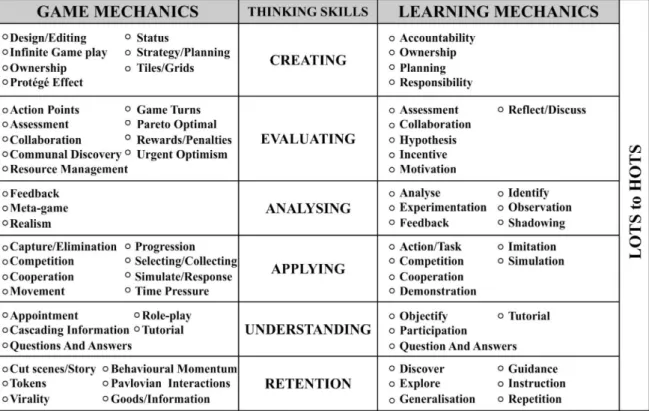
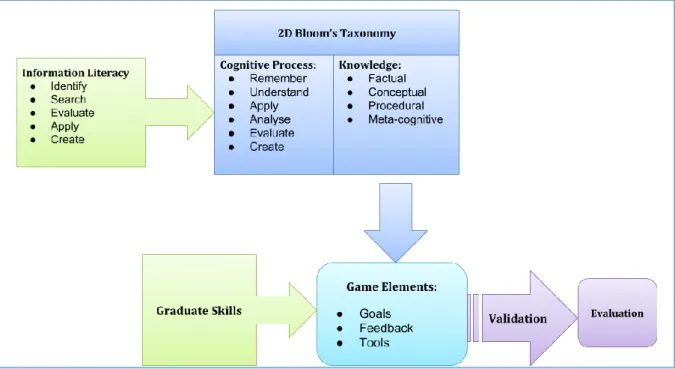
Entertainment and challenge were discussed by Gumulak and Webber (2011) as a motivation to play the games. This study successfully mapped the SCONUL model to the game elements (Table 2). Arnab et al (n.d.) successfully mapped the game mechanism to Bloom’s learning framework (Table 3). While Wang, Li, & Tzeng (2015) proposed the KCR framework to use the game elements such as tools, goals, and feedback to realise the 2D Bloom’s model modified by Anderson et al. (2001) (Figure 1). Game elements help in achieving a higher order cognitive process. These studies were considered in embedding gamification in our proposed framework.
4
Table 2 Source SCONUL, 1999
5
Figure 1 Source: Anderson and Krathwohl (2001)
The Framework Design and Implementation
Serious games as learning, teaching and assessment methods for IL: GIIF proposed constructive alignment
To improve the efficacy of strategies and pedagogies for IL teaching and learning the framework proposes to draw upon game-based learning to achieve learning outcomes and increase student engagement and motivation. Game-based instruction can take many forms: table-top exercises (card games), on-line games, adapted existing games or designing class sessions using gaming principles (gamification). The ultimate goal is to create opportunities for students to meaningfully engage with classmates and instructors, to participate in student-centred activities and to build on their pre-existing knowledge base (Angell & Tewell 2015).
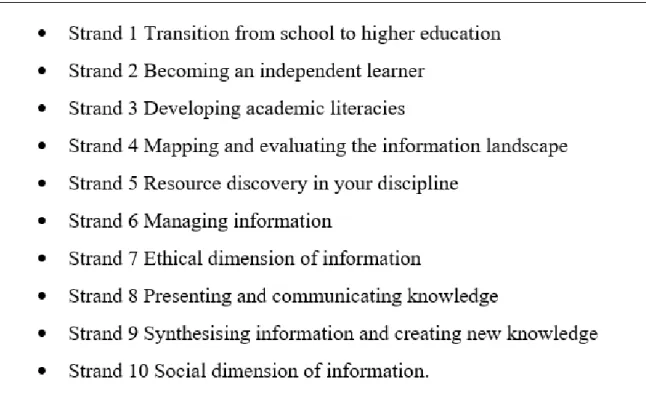
In our approach we embedded the serious games as teaching, learning and assessment methods aligned with the learning outcomes. We have adapted the ANCIL framework which proposes ten intertwined thematic strands covering the facets comprised in IL (Secker & Coonan, 2012) that also underpin some of the DIT graduate attributes:
6
Figure 2: ANCIL Framework Strands (Secker & Coonan, 2012)
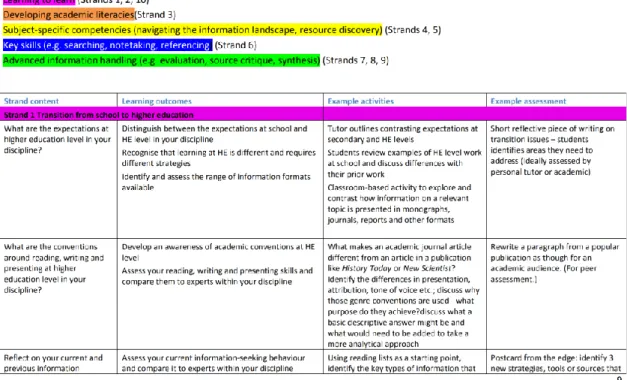
In our adaptation we have aligned learning outcomes from each strand with Bloom’s taxonomy and then, to possible activities suggested as serious games (following the review outlined in the previous section). Assessment was also considered and the resulting constructive alignment table for the framework is reported in Appendix A.3.
IL assessment for the framework
While considerable literature focuses on defining and characterising IL, the same wealth on the evaluation of IL is not present (Scharf, Elliot, Huey, Briller & Joshi, 2007). Standardized multiple-choice tests are a predominant means of assessment but they are not well-suited to the task of evaluating higher-order skills (Walsh 2009). As of yet there is no consensus on how the measurement of this multifaceted concept should be approached (Rosman, Mayer & Krampen 2015).
Three conceptions of IL assessment can be identified: achievement tests (multiple choice pre-test/post-test), information search tasks (open-ended questions completed using common search tools/engines) and self-assessments (Rosman, Mayer & Krampen 2015). An example of a search task is: find all meta-analyses published after 2006 investigating “risk factors” for the development of a “Post-traumatic stress disorder” (Leichner, Peter, Mayer, & Krampen, 2014). Such tasks are suitable for evaluation of appropriate information retrieval, identification and evaluation. Self-assessment methods empower students to reflect on their abilities and strategies, and to monitor their learning progress (Boud 1995). Vygotsky (1962) suggests that self-assessment can have the effect of increasing a conscious control over learning and the metacognitive awareness of own knowledge and thought.
7
Our intention is to use a combination of achievement tests and self-assessment to assess the students pre and post the interactive learning as a way of achieving assessment for learning and assessment for validation (Black & Wiliam, 1998).
Framework Description
GIIF integrates various components to achieve the IL learning outcomes and skills development required in higher education students. As depicted in Figure 3, the adapted learning outcomes from ANCIL framework are mapped to the cognitive dimension of the 2D modified Bloom’s taxonomy (realised through the game elements, goals, tools, and feedback). During the playing process, students will construct the required knowledge, which is the second dimension of the 2D Bloom’s framework. Game elements also help students to engage and evaluate existing knowledge, being consistent with DITs graduate attributes (see Appendix A.5).
IL assessment for the framework
While considerable literature focuses on defining and characterising IL, the same wealth on the evaluation of IL is not present (Scharf, Elliot, Huey, Briller & Joshi, 2007). Standardized multiple-choice tests are a predominant means of assessment but they are not well-suited to the task of evaluating higher-order skills (Walsh 2009). As of yet there is no consensus on how the measurement of this multifaceted concept should be approached (Rosman, Mayer & Krampen 2015).
Three conceptions of IL assessment can be identified: achievement tests (multiple choice pre-test/post-test), information search tasks (open-ended questions completed using common search tools/engines) and self-assessments (Rosman, Mayer & Krampen 2015). An example of a search task is: find all meta-analyses published after 2006 investigating “risk factors” for the development of a “Post-traumatic stress disorder” (Leichner, Peter, Mayer, & Krampen, 2014). Such tasks are suitable for evaluation of appropriate information retrieval, identification and evaluation. Self-assessment methods empower students to reflect on their abilities and strategies, and to monitor their learning progress (Boud 1995). Vygotsky (1962) suggests that self-assessment can have the effect of increasing a conscious control over learning and the metacognitive awareness of own knowledge and thought.
Our intention is to use a combination of achievement tests and self-assessment to assess the students pre and post the interactive learning as a way of achieving assessment for learning and assessment for validation (Black & Wiliam, 1998).
Framework Description
GIIF integrates various components to achieve the IL learning outcomes and skills development required in higher education students. As depicted in Figure 3, the adapted learning outcomes from ANCIL framework are mapped to the cognitive dimension of the 2D modified Bloom’s taxonomy (realised through the game elements, goals, tools, and feedback). During the playing process, students will construct the required knowledge, which is the second dimension of the 2D Bloom’s framework. Game elements also help students to engage and evaluate existing knowledge, being consistent with DITs graduate attributes (see Appendix A.5).
8
Figure 3 The GIIF
Artefact (web page)
The designed poster for GIIF is available at the following link:
https://informationliteracyframeworkgiif.weebly.com/
Way forward
Implementation strategy
To implement GIIF effectively, it is necessary that educational goals align with the development of the curriculum and that academics and librarians in DIT foster understanding and acceptance of IL education (Bundy, 2004). Any new IL framework must account for the multicultural setting in which modern third level education finds itself (Hicks & Lloyd, 2016). It is clear from the literature that IL is not a standalone part of the curriculum, rather it should be part of a bigger academic skills agenda (CONUL, nd; Howard, 2012). While providing IL training as an optional workshop that only students who need the training are required to attend may seem desirable, it is often the case that undergraduates will not seek out such support and will not attend unless there is formative assessment of some sort (Bell et al., 2012). This was also found by Hegarty and Carbery (2010) who implemented a pilot IL programme for nursing students in WIT but reported low attendance in non-compulsory classes. A sequential development of IL skills is best achieved within a discipline specific context and a good starting point for integrating IL into the curriculum is by mapping IL skills over an entire programme (CONUL, nd).
A previous initiative in DIT, Get Smart, recommended embedding IL skills into all first-year modules (O'Rawe, 2011). The initiative developed and delivered three IL sessions for first year students connected to two academic modules (O'Rawe, 2011). IL learning outcomes should
9
be included in assessment criteria for certain activities so that students can clearly see what is required of them and be more likely to attend workshops provided (CONUL, nd).
There must be constructive alignment of the curriculum, its intended outcomes, assessment teaching and learning activities (Biggs, 1996). Gamification allows us to embed simple rubrics such as “Use of Information” or “Critical evaluation of literature” to assess various areas of IL. It also aligns closely with teaching strategies such as problem-based learning (PBL) whereby students are required to source their own information to complete a task (Dodd, 2007). As part of this research, an amended set of learning outcomes has been developed for module TFME3002 in which IL is embedded (Appendix A.4). The activities proposed in GIIF could be delivered as a joint effort between librarians and academic staff.
Evaluation strategy
Angell and Tewell (2015) assessed whether introduction of games into undergraduate IL instruction increased retention of course content for the students. Participants were divided into two groups (with and without use of serious games for IL instruction). Results revealed a statistically significant difference between scores on pre-tests and post-tests for the experimental (serious games) condition, but no significant difference was present for the control group. We envisage evaluating GIIF in a similar way following implementation but also integrating the use of qualitative data from self-assessment and feedback surveys (Newton 1998; Harvey 1998). Testing should verify students’ awareness of needs for IL, provide feedback on learning and teaching methods and assessment for learning/validation (Black & Wiliam, 1998).
Conclusions and future research
In summary, the framework proposed will require further development with regards to embedding learning outcomes into existing programs. It must be implemented as joint effort between programme chairs, lecturers and librarians in DIT and must be part of a bigger academic skills agenda brought about through student engagement (CONUL, nd; Howard, 2012). Serious games approaches were selected as a useful means to deliver teaching, learning and assessment in this area-taking note of the current generation’s use of technology. The GIIF framework will be further developed into a website providing an interactive map of Bloom’s taxonomy that links each desired learning outcome to suggested serious games/ or interactive digital activities that can be easily implanted in the classroom.
10
References
Abykanova, B, Nugumanova, S., Yelezhanova, S., Kabylkhamit, Z. & Sabirova, Z. (2016). The Use of Interactive Learning Technology in Institutions of Higher Learning. International Journal of Environmental & Science Education, 11(18). Retrieved from
https://eric.ed.gov/?id=EJ1124626
Aleven, V., Myers, E., Easterday, M., & Ogan, A. (2010). Toward a framework for the analysis and design of educational games. In 2010 Third IEEE International Conference on Digital Game and Intelligent Toy Enhanced Learning (pp. 69–76). Ieee.
http://doi.org/10.1109/DIGITEL.2010.55
Anderson, L. W., Krathwohl, D. R., Airasian, P., Cruikshank, K., Mayer, R., Pintrich, P., & Wittrock, M. C. (2001). A taxonomy for learning, teaching, and assessing: A revision of Bloom’s taxonomy of educational objectives (Complete Edition). New York Longman. Retrieved from http://www.citeulike.org/user/mapto/article/961573
Angell, K., & Tewell, E. C. (2015). Measuring Our Information Literacy Footprint-Assessing Game-Based Learning in Library Instruction. Retrieved from
http://www.ala.org/acrl/sites/ala.org.acrl/files/content/conferences/confsandpreco nfs/2015/Angell_Tewell.pdf
Armstrong, A., & Georgas, H. (2006). Reference Services Review Using interactive technology to teach information literacy concepts to undergraduate students. Reference Services Review, 34(4), 491–497. http://doi.org/10.1108/00907320610716396
Arnab, S., Lim, T., Carvalho, M. B., Bellotti, F., De Freitas, S., Louchart, S., & De Gloria, A. (n.d.). Mapping Learning and Game Mechanics for Serious Games Analysis. British Journal of Educational Technology, 46, 391–411. http://doi.org/10.1111/bjet.12113
Association of College and Research Libraries. (2015). Framework for Information Literacy for Higher Education. Retrieved from http://www.ala.org/acrl/standards/ilframework Association of College and Research Libraries. (2015). Framework for Information Literacy for
Higher Education. Retrieved from http://www.ala.org/acrl/standards/ilframework Behrens, S.J. (1994). A conceptual analysis and historical overview of information literacy.
College & Research Libraries, 55(4), 309-322.
Bell, M., Moon, D., & Secker, J. (2012). Undergraduate support at LSE: the ANCIL report. London: London School of Economics. Retrieved from http://eprints.lse.ac.uk/48058/
Bent, M., & Stubbings, R. (2011). The SCONUL Seven Pillars of Information Literacy. Core model for higher education. The SCONUL Working Group on Information Literacy. Retrieved from https://www.sconul.ac.uk/page/seven-pillars-of-information-literacy
Biggs, J. (1996). Enhancing teaching through constructive alignment. Higher Education, 32(3), 347-364.
Black, P. & Wiliam, D. (1998) Inside the black box: raising standards through classroom assessment, Phi Delta Kappan, 80(2), 139–144.
Bloom, B. S., Engelhart, M. D., Hill, H., Furst, E., & Krathwhol, D. (1956). Taxonomy of Educational Objectives. The Classification of Educational Goals, Handbook I: Cognitive Domain. New York: David McKay.
Bloom, B. S., Englehard, M. D., Furst, E. J., Hill, W. H., Krathwohl, D. R., & Committee of College and University Examiners. (1956). Taxonomy of educational objectives: The classification of educational goals: Handbook I, cognitive domain. Retrieved from
http://doi.org/10.1300/J104v03n01_03
11
Bruce, C.S. (1999). Workplace experiences of information literacy. International Journal of Information Management, 19(1), 33-47.
Bu, N., & Mitchell, B. C. (2009). Student performance and perceptions in a web-based competitive computer simulation. Interdisciplinary Journal of E-Learning and Learning Objects, 5.
Bundy, A. (2004). Australian and New Zealand information literacy framework. Principles, Standards and Practice, 2.
Cochrane, C. (2006). Embedding information literacy in an undergraduate management degree: lecturers' and students' perspectives. Education for Information, 24(2-3), 97-123.
CONUL. (nd). Integrating Information Literacy into the Curriculum. Retrieved from
http://www.conul.ie/media/Complete-Guide.pdf
Dillenbourg, P., & Jermann, P. (2010). Technology for classroom orchestration. In New Science of Learning (pp. 525–552). New York: Springer Science.
DIT (2018). Background to the Graduate Attributes. Retrieved from
http://www.dit.ie/teaching/graduateattributes/backgroundtothegraduateattributes/ Dodd, L. (2007). The impact of problem-based learning on the information behavior and
literacy of veterinary medicine students at University College Dublin. The Journal of Academic Librarianship, 33(2), 206-216.
Dubicki, E. (2013). Faculty perceptions of students' information literacy skills competencies. Journal of Information Literacy, 7(2), 97-125.
Dunne, E., Zandstra, R., Brown, T., & Nurser, T. (2011). Students as Change Agents: New Ways of Engaging with Learning and Teaching in Higher Education. Bristol: ESCALATE. Fleming, T., Bavin, L., & Stasiak, K. (2017). Serious Games and Gamification for Mental Health:
Current Status and Promising Directions. Retrieved from
http://oro.open.ac.uk/48125/
Freitas, S. De, & Neumann, T. (2009). The use of “exploratory learning” for supporting immersive learning in virtual environments. Computers & Education, 52(2), 343–352. Gumulak, S., & Webber, S. (2011). Aslib Proceedings Playing video games: learning and
information literacy. Aslib Proceedings Library Review, 63(3), 241–255.
Hegarty, N., & Carbery, A. (2010). Piloting a dedicated information literacy programme for nursing students at Waterford Institute of Technology libraries. Library Review, 59(8), 606-614.
Henkel, M., Grafmüller, S. & Gros, D. (2018). Comparing Information Literacy Levels of Canadian and German University Students. In International Conference on Information (pp. 464-475). Cham: Springer.
Hicks, A., & Lloyd, A. (2016). It takes a community to build a framework: Information literacy within intercultural settings. Journal of Information Science, 42(3), 334-343.
Howard, H. (2012). Looking to the future: Developing an academic skills strategy to ensure information literacy survives in a changing higher education world. Journal of information literacy, 6(1), 72-81.
Jackson, B., MacMillan, M. & Sinotte, M. (2014). Great expectations: results from a faculty survey of students’ information literacy proficiency. Presented at 34th International. Association of Scientific and Technological University Libraries Conference, Helsinki June 2014.
Johnston, B., & Webber, S. (2003) Information Literacy in Higher Education: a review and case study. Studies In Higher Education, 28(3), 335-352.
12
Karnad, A. (2013). Embedding Digital and Information Literacy into Undergraduate Teaching.
Retrived from
http://eprints.lse.ac.uk/51221/1/__libfile_REPOSITORY_Content_Centre%20for%20L earning%20Technology_Embedding%20digital%20information%20literacy.pdf Kenedy, R., & Monty, V. (2008). Dynamic purposeful learning in information literacy. New
Directions for Teaching and Learning, 2008(114), 89-99.
Khalaila, R. (2014). Simulation in nursing education: an evaluation of students’ outcomes at their first clinical practice combined with simulations. Nurse Education Today, 34(2), 252–8.
Koltai, T., Lozano, S., Uzonyi-Kecskés, J., & Moreno, P. (2017). Evaluation of the results of a production simulation game using a dynamic DEA approach. Computers & Industrial Engineering, 105, 1–11.
Kong, S.C. (2014). Developing information literacy and critical thinking skills through domain knowledge learning in digital classrooms: An experience of practicing flipped classroom strategy. Computers & Education, 78, 160-173.
Leichner, N., Peter, J., Mayer, A., & Krampen, G. (2014). Assessing information literacy programmes using information search tasks. Journal of Information Literacy, 8(1), 3-20.
Markey, K., Leeder, C., & Young Rieh, S. (2012). Library Hi Tech Digital games in academic libraries: a review of games and suggested best practices; Through a game darkly: student experiences with the technology of the library research process. Library Hi Tech Iss Reference Services Review, 30(1), 12–34. Retrieved from
https://doi.org/10.1108/07378831211213193681
Markey, K., Swanson, F., Jenkins, A., Jennings, B. J., Jean, B. S., Rosenberg, V., … Frost, R. L. (2012). Library Hi Tech Designing and testing a web-based board game for teaching information literacy skills and concepts; Digital games in academic libraries: a review of games and suggested best practices; Library Hi Tech Aslib Proceedings Reference
Services Review, 26(1), 663–681. Retrieved from
https://doi.org/10.1108/07378830810920978
Maynooth University. (n.d.) Maynooth University Library: Information Literacy Strategy
Framework. Retrieved from
https://www.maynoothuniversity.ie/sites/default/files/assets/document//MU%20In formation%20Literacy%20strategy%20%282016%29.pdf
Newton, R. (1998). Pre and post testing. LTDI Evaluation Cookbook, Learning Technology Dissemination Initiative. Retrieved from http://www.icbl.hw.ac.uk/ltdi
O’Brien, T., & Russell, P. (2012). The Irish Working Group on Information Literacy–Edging towards a national policy. The International Information & Library Review, 44(1), 1-7. O'Rawe, M. (2011). Get Smart! An Evaluation of an Initiative in Personal and Professional Development among First Year Undergraduates. Teaching Fellowships. 9. Retrieved from
https://arrow.dit.ie/fellow/9
Pasin, F., & Giroux, H. (2011). The impact of a simulation game on operations management education. Computers & Education, 57(1), 1240–1254.
Podgornik, B., Dolničar, D., Šorgo, A. & Bartol, T. (2016). Development, testing, and validation of an information literacy test (ILT) for higher education. Journal of the Association for Information Science and Technology, 67(10), 2420-2436.
13
Price, R., Becker, K., Clark, L., & Collins, S. (2011). Embedding information literacy in a first-year business undergraduate course. Studies in Higher Education, 36(6), 705-718. Rosman, T., Mayer, A. K., & Krampen, G. (2015). Combining self-assessments and
achievement tests in information literacy assessment: empirical results and recommendations for practice. Assessment & Evaluation in Higher Education, 40(5), 740-754.
Ross, A. M., Fitzgerald, M. E., & Rhodes, D. H. (2014). Game-based learning for systems engineering concepts. Procedia Computer Science, 28, 430–440. Retrived from
http://doi.org/10.1016/j.procs.2014.03.053
Russell, P., McGuinness, C., Burns, J., Carey, B., Crump, M., Young, K., Ryan, K. & Toibin, M. (2015). The Library Association of Ireland Task Force on Information Literacy: An Overview of Objectives and Progress. Retrieved from
http://edepositireland.ie/bitstream/handle/2262/74539/The_Library_Association_of _Ireland_Task_Force_on_Information_Literacy.pdf?sequence=1&isAllowed=y Sandercock, P. (2016). Instructor perceptions of student information literacy: comparing
international IL models to reality. Journal Of Information Literacy, 10(1), 3-29.
Saunders, L. (2012). Faculty perspectives on information literacy as a student learning outcome. Journal of Academic Librarianship, 38(4), 226–236.
Scharf, D., Elliot, N., Huey, H., Briller, V. and Joshi, K. (2007). Direct Assessment of Information Literacy Using Writing Portfolios. Journal of Academic Librarianship, 33(4), 462–78. Schell, J. (2011). The Art of Game Design. San Francisco: Morgan Kaufmann.
SCONUL. (nd). SCONUL 7 Pillars Through a Digital Literacy Lens. Retrieved from
https://www.sconul.ac.uk/publication/digital-literacy-lens-on-the-sconul-seven-pillars-of-information-literacy
Secker, J., & Coonan, E. (2011). A New Curriculum for Information Literacy (ANCIL): curriculum and supporting documents. Retrieved from https://newcurriculum.wordpress.com/ Secker, J., & Coonan, E. (2012). Rethinking Information Literacy: a practical framework for
supporting learning. London: Facet.
Smale, M. A. (2012). Get in the game: developing an information literacy classroom game. Journal of Library Innovation, 3(1), 126-147.
The Scottish Information Literacy Project. (nd). The Right Information - Information skills for a 21st Century Scotland. Retrieved from http://www.therightinformation.org/temp-overview/
UNESCO. (2008). Information for All Programme (IFAP). Towards Information Literacy Indicators. Paris: UNESCO.
University of Exeter. (2011a). Digital Planning Checklist. Retrieved from
http://as.exeter.ac.uk/media/universityofexeter/academicservices/educationenhanc ement/cascade/Developing_digital_scholarship_in_the_curriculum.pdf
University of Exeter. (2011b). Interactive Digital Bloom’s Taxonomy. Retrieved from
http://as.exeter.ac.uk/cascade/digital-curriculum/teaching-resources/interactivedigitalbloom/
van Wyk, M. M. (2013). The use of economics games as a participative teaching strategy to enhance student learning. Journal of Social Science, 35(2), 125–133.
Vygotsky, L. S. (1962). Thought and Language. Cambridge, MA: MIT Press.
Walsh, A. (2009). Information literacy assessment: where do we start?. Journal of Librarianship and Information Science, 41(1), 19-28.
14
Wang, C.-S., Li, Y.-C., & Tzeng, Y.-R. (2015). How to replicate the cognitive process in computer game-based learning units. Information Technology & People, 28(2), 327–343.
http://doi.org/10.1108/ITP-03-2013-0053
Wattanasoontorn, V., Boada, I., García, R., & Sbert, M. (2013). Serious games for health.
Entertainment Computing, 4(4), 231–247.
15
Appendices
A1. A review of emerging and evolving definitions of information literacy A2. Summary of existing models and frameworks for IL
A3. Constructive alignment for adapted learning outcomes in the proposed framework A4. Example of amended module descriptor incorporating IL
16
A1. A review of emerging and evolving definitions of information literacy
IL Definition Source
To be information literate requires a new set of skills. These include how to locate and use information needed for problem-solving and decision-making efficiently and effectively.
(Burchinal 1976, as cited in Behren 1994)
To be information literate, a person must be able to recognise when information is needed and have the ability to locate, evaluate, and use effectively the needed information.
American Library Association (ALA) Presidential Committee on Information Literacy (1989, p.1)
IL is the ability to recognise information needs and to identify, evaluate and use information effectively.
(Bruce 1999) Information literacy is the adoption of appropriate information
behaviour to obtain, through whatever channel or medium, information well fitted to information needs, together with critical awareness of the importance of wise and ethical use of
information in society.
(Johnston & Webber 2003, p.336)
IL is an umbrella term which encompasses concepts such as digital, visual and media literacies, academic literacy, information
handling, information skills, data curation and data management. Information literate people will demonstrate an awareness of how they gather, use, manage, synthesise and create information and data in an ethical manner and will have the information skills to do so effectively.
(SCONUL 2011)
Information literacy (IL) refers to the mastery of necessary knowledge of gathering, synthesizing, analysing, interpreting and evaluating information; and the proper attitudes for information processing with an understanding of the rationale behind using information
Kong 2014 based on (Kong,2007; Price, Becker, Clark, & Collins, 2011)
17
A2 Summary of existing models and frameworks for IL
ANZIL
18 SCONUL
19
20 National Information Literacy Framework (Scotland)
21 ANCIL Framework
22
23
Evaluating
Sample 'digital' activities to help learners meet outcomes of the type. Click on an activity for ideas on implementation:
Share solutions to a problem online: review and comment on other people's contributions
o Commenting function in googledocs (private)
o Review or comment function in social media sites (private) o Annotation of pdfs
Explore the implications of using a particular technology, or using digital technology to address a particular research, study or professional issue
o Any
Evaluate a range of online resources and produce a summary of the topic with links to validated sources
o Google, google scholar and other search engines
o Scholarly databases and catalogues with search facilities o Open repositories and data archives with search facilities o Wiki post or other digital medium for reporting findings Moderate a discussion
o Text based conferencing o Video conferencing
o Collaboration environment e.g. collaborate Draw conclusions linked to evidence
o Blog post or wiki page with links (internal or external)
o Spreadsheet or database application with graphical outputs used as evidence
Edit a presentation/article from a range of contributions o Wikispaces or wiki site
o Presentation software
o Collaborative authoring software e.g. googledocs, buzzword o Storify
o Social referencing tool e.g. mendeley or shared bookmarking e.g. delicious Describe and apply a method for reaching a decision, including criteria used
o Decision-analysis software o Mapping software
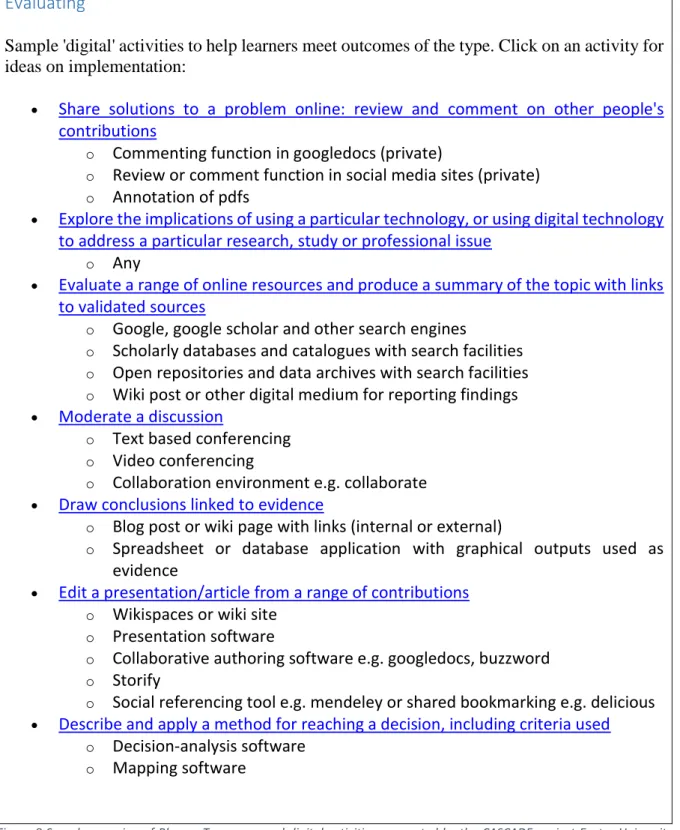
Figure 8 Sample mapping of Blooms Taxonomy and digital activities as created by the CASCADE project Exeter University (http://as.exeter.ac.uk/cascade/digital-curriculum/teaching-resources/interactivedigitalbloom/#ExploreANew)
24
Figure 9 Digital planning checklist as developed by Exeter University for the CASCADE project (University of Exeter, 2011a)
25
A3. Constructive alignment for adapted learning outcomes in the proposed framework
Table 2 Constructive alignment for adapted learning outcomes in the proposed framework
Bloom’s taxonomy Level
Learning outcome (revised from ANCIL framework)
Teaching and learning methods
Assessment
Understand Identify the IL needs for Higher Education level in your discipline (Learning to Learn Strand 1) Serious games providing list of desirable learner features in his/her profile Priority given to different skills and attributes selected as important for IL when compared with ANCIL model
Understand Identify key sources and finding aids in your discipline ‐ e.g.
catalogues, full‐text databases, abstract and indexing services (Developing academic literacies Strand 3)
Serious games providing options on different sources and support with costs implication: student has to decide where to spend his limited resources
Scoring assigned on the basis of merit assigned to array of sources and aids identified and selected
Understand Identify key words and searching mechanism on the resources (Key Skills Strand 6)
Serious games asking student to identify and test possible keywords for searching of relevant papers grading them from more general to more specific
Scoring assigned on the basis of array of keywords identified from more general to more specific levels
Understand Identify the steps you can take to avoid plagiarism, deliberate or inadvertent
Use correct academic practices in quoting, citing and
Paraphrasing ( Ethical dimension and citing Strand 7)
Serious games can require students to select best way to cite/ quote work from others and or paraphrasing
Scoring on correct citation method, and quoting
Understand Select source material through techniques of skimming and scanning &
Identify the strengths and weaknesses of selected source material (Developing academic literacies Strand 3)
Serious game can ask the student to fill his bag with relevant source material in a limited time frame. After the user is asked to sort through the material in the bag around strength and weaknesses for each paper (again in a limited time frame).
Scoring assigned on the basis of quantity and relevance of the selected material. Negative scoring assigned if selected material is not relevant
26
Bloom’s taxonomy Level
Learning outcome (revised from ANCIL framework)
Teaching and learning
methods
Assessment
Apply Develop an awareness of
the epistemological
structure and values in your discipline (Subject specific competencies Strand 4)
Game requires student to Assess and compare the quality of 3 short pieces of writing in the discipline and rank them according to criteria. The student establish weights of criteria too
Ranking results
benchmarked against set values and other students results
Apply Organise your files (including naming and organising folders)
Decide on an appropriate information management technique suitable for your discipline (Managing information Strand 6)
Serious games to provide scatter resources and ask the student the best way to organise them in folders and or in a taxonomy/tree structure within a time limit. Using a mind/map technique Scoring on thematic analysis structure identified to organise papers amount of papers organised
Analyse Use language
appropriately in your academic writing
Analyse competing
arguments and the use of evidence
to justify a position
(presenting and
communicating knowledge Strand 8)
Serious games to ask debate pro and against selected arguments: student will be required to Comment critically on the views of the authors identified‐ working in
pairs, their work is judged by the peers
Scoring assigned on the basis of peers votes selected for each debating team
Analyse Organise strategies for
assimilating new
knowledge
Identify your learning style and preferences, including specific learning needs (Strand 2 Becoming an independent learner)
Students will be asked to identify their needs for each level of the Bloom’s taxonomy. The game consists in arranging verbs from Bloom’s Taxonomy on a scale into higher‐ and lower‐order skills and mark own needs against each
Self-reflection activity and criteria comparison. Scoring also assigned on the basis of self-correction against the
actual Bloom’s
taxonomy scale
Evaluate Evaluate bibliography and reference management tools and strategies in the light of your own workflow
(Strand 6 Managing
information)
Assign the task of produce a comparison and exploration of
different reference
management software.
Students will be asked to write a review and discuss pros and cons of each;
Students will be
evaluate don’t he basis of a timed assessment in of an appropriately formatted bibliography from a reference list
supplied using a
selected tool
Evaluate Use information sources appropriately to develop or support your argument (
Subject specific
competencies Strand 4)
Students can propose/choose a thesis to validate and a choice of material to support the argument. He will select and prioritise it
Relevance and weight for material chosen scored assigned on the basis of peer voting
27
Bloom’s taxonomy
Level
Learning outcome
(revised from ANCIL framework)
Teaching and learning methods
Assessment
Create Use chosen information
sources to articulate
and analyse new
problems in your field (Strand 9 Synthesising
information and
creating new
knowledge)
Students will be given a new thesis to verify and a choice of material to support the argument. He will select and prioritise it
Relevance and weight for material chosen scored assigned on the basis of peer voting
Create Transfer the skills of finding, critically
evaluating, and
deploying information for decision making in the workplace (Strand 10 Social dimension of information)
The students may be asked to work in group
and search for
information to answer a specific query without using any subscription resources, then carry out the same search to
compare the
information they can find using paid for resources.
Provide a case study on
change management
scenario. The activity is to be used as a formative assessment and be completed in a given time.
28
A4. Example of amended module descriptor incorporating IL
As an example to show how information literacy skills can be embedded into existing modules in DIT, we have rewritten the learning outcomes for TFME3002 which is a 3rd year undergraduate module on the BSC in environmental health (DT491). IL skills are particularly relevant for a module such as this one as it deals with cutting edge research and constantly changing technologies in the field of environmental management and energy generation. As such students must be able to formulate arguments which are founded on relevant and reliable studies and must be able to synthesise information and show innovation in management approaches.
30
A5. Graduate attributes
Table 3 DIT Graduate Attributes, source: DIT 2018
Graduate Attributes Description
Engaged: Civically engaged, socially responsible graduates
with an international outlook who contribute meaningfully and positively in their professional, community and social environments.
Enterprising: Graduates who have the skills, knowledge and
attributes needed to apply creative ideas and innovations and to find practical solutions.
Enquiry based: Graduates with a spirit of curiosity and a desire to
learn, motivated to draw upon existing knowledge, generating new ideas, seeking out learning opportunities, exploring the application of theory to practice and actively creating new knowledge
Effective: Effective, highly skilled and confident graduates
with the capacity to achieve desired results, believing that they can make a positive difference.
Expert in chosen subject discipline: Graduates with the professional knowledge and
capacity independently to practice, reflect, review and build upon disciplinary expertise and judgment.