University of Nebraska - Lincoln
University of Nebraska - Lincoln
DigitalCommons@University of Nebraska - Lincoln
DigitalCommons@University of Nebraska - Lincoln
Library Philosophy and Practice (e-journal)
Libraries at University of Nebraska-Lincoln
November 2012
Influence of SUBEB Libraries in Developing the Reading Skills of
Influence of SUBEB Libraries in Developing the Reading Skills of
Primary School Pupils in Selected Public Primary Schools in Oyo
Primary School Pupils in Selected Public Primary Schools in Oyo
State
State
Razaq Oyewo
Oyo State College of Agriculture
Follow this and additional works at: https://digitalcommons.unl.edu/libphilprac
Part of the Library and Information Science Commons
Oyewo, Razaq, "Influence of SUBEB Libraries in Developing the Reading Skills of Primary School Pupils in Selected Public Primary Schools in Oyo State" (2012). Library Philosophy and Practice (e-journal). 828.
Library Philosophy and Practice
http://digitalcommons.unl.edu/libphilprac/
ISSN 1522-0222
Influence of SUBEB Libraries in Developing
the Reading Skills of Primary School Pupils
in Selected Public Primary Schools in Oyo
State
Razaq Oyewo
Librarian II
Oyo State College of Agriculture
Igbo Ora, Oyo State
Abstract
This study has presented findings on the influence of SUBEB Libraries on the development of reading skills of primary school pupils in Oyo State, Nigeria. The study was conducted on SUBEB libraries located in Local Government Areas in Ibadan Township, which is the headquarter of Oyo State. A total number of 135 copies of questionnaire were administered on the respondents out of which only 133 were found useful for the study.
The major findings of the study revealed the inadequacy of reading promotion programmes in the SUBEB libraries selected for the study (113 or 91.1%). Even though the study revealed regular use of the library (74 or 60.2%), the attitude of the pupils towards reading were found to be negative (82 or 66.7%) which may be due to the fact that there were no interesting and relevant books that can attract the pupils to reading. The lack of other reading
promotion programmes such as story hours and readers’ club may also be responsible for the negative attitude of the pupils towards reading. The findings further revealed textbooks as the only library material that the pupils use most whenever they visit the library which may mean that they go to the library only to do assignments relating to their class work.
Introduction
The library is seen as the nerve centre of all educational institutions and a crucial factor in the educational
development of men at all levels. It is associated with all forms of education, formal, informal and non-formal. The library is an institution responsible for the collection, processing and storage of recorded knowledge for the purpose of reading study and consultation. It is a social institution established to provide for information, education, recreation and historical needs of the society and associated with all forms of education; formal, informal and non-formal. The library contributes to education by encouraging reading, expanding learning resources, development of learning skills, developing critical thought, developing values, altitudes and assisting with developmental tasks among others. Owing to its wealth of materials and learning opportunities it offers, the library can be seen to be ideally suited to the task of making education more relevant to current circumstances and more meaningful to
students. Dike (2001) identified the different types of libraries available to users to include, academic, special, public, national and school.
Adequate provision of information materials, staff, infrastructural facilities, accommodation is essential for school libraries to perform its role effectively. School libraries are established to support the educational curriculum of schools, which could only be achieved through various means such as the provision of relevant library resources, which are relevant with the school curricula, provision of various information services ranging from technical to readers services (Markless and Streafield, 2004). The school library collection should be a balanced one which must include printed and non-printed materials, electronic materials and audio-visuals. The balanced collection should also include materials for leisure purposes such as novels, music, computer games, video cassettes, video laser discs and magazines etc. These kinds of materials may be selected in cooperation with the students to ensure it reflects their interests and culture without crossing reasonable limits of ethnical standards. The library also serves as a place where users can develop their minds through reading.
Reading is important to everybody so as to be able to cope with new knowledge in this changing world and this can be done with the aid of a school library resources, students grow with a wealth of knowledge academically, socially and emotionally and this makes them become confident in themselves and they become useful to the society they belong. The overall objective of the school library project is to improve the reading habits of our pupils and make reading more pleasurable. (Adediran, 2003). This forms the basis of a life long project of using reading to acquire knowledge.
A variety of resources are acquired in the school library which include serials such as magazine’s newspapers, periodicals and reference books such as dictionaries, encyclopedia, atlases, maps, also non-reference materials like story books, textbooks, complementary books, monographs and non-printed materials like graphics, audio-visuals, motion picture’s projectors, television, computers and transparencies so that secondary school students can appreciate books and adapt to the habit of reading. Reading is recognized as an art that is capable of transforming man’s life and his entire society. Derrajah and Gray (1999) described reading as an art of interpreting printed and written words, the most effective process of conscious learning which influences the extent and accuracy of judgment and action of readers.
Reading makes way for a better understanding of one’s own experience and it can be an exciting voyage to one’s self discovery as it is a very important issue which is not only about enjoyment but a necessity; the basic tool of education (Mokatsi, 2005). However, the world children report revealed that about one billion people entered the 21st century unable to read a book or unable to write (UNICEF, 1999).
“Reading habit” as a term, refers to the behaviour that experiences the likeness of reading of individual types for reading and taste of reading. It is seen to be a pattern with which an individual organizes his or her reading. It is a fact that reading is important for everybody so as to be able to cope with new knowledge in this changing world. Nevertheless, the heart of self education and life long learning ones ability to make use of the library to read yet, reading culture among secondary school students in Nigeria as a whole is not encouraging, we prefer to be listening and chatting rather than settling down to read or make use of library resources to boost our reading ego.
In primary school today, the reading habit of children is warning because of poor reading culture and less knowledge of the effects of school library resources and other notable factors like non-availability of reading materials, yet reading habit is best formed at a young impressionable age in school but once it is formed, it can last forever. One of the primary objectives of the school library is to provide adequate collection for student’s reading development (Udofia, 2001). The use of library resources at an early age can facilitate reading habit promotion just as schools seem to pay more attention to the cultural education of their students than they used to do. An appropriate reading skill is required in development the reading habit.
School library resources should promote students’ reading habit. In order to achieve this, school libraries need to be redefined and move away from traditional emphasis on book and telling but rather encourage a good reading habit by providing sufficient reading materials and other library resources for students and also encouraging the library. Reading habit plays a crucial role in enabling pupils to achieve practical efficiency.
The introduction of the Universal Basic Education (UBE) programmes is aimed at reforming specifically, the basic education sector and the Nigerian Education sector in general. One of the objectives of the blueprint for the resuscitation of the basic education sector according to Adediran (2003) is “enhancing and energizing the curricular and its delivery. At the State level, it is referred to as State Universal Basic Education Board (SUBEB). The Board is put in place to help the federal government to implement the objectives of the Universal Basic Education (UBE) at State level.
For successful implementation of the programme at the local government level, the government established through appropriate legislation the Local Government Universal Basic Educationn Authority (LGUBEA). The LGUBEA roles in the implementation of the UBE programme include coordinating controlling, supervising, monitoring and directing the basic education of the Nigerian citizens at the grassroot level libraries are established to promote reading culture in Nigeria schools as well as enhance and energize the curricula and its delivery. They are to be able to adequately provide library and information resources and services that will meet the needs of pupils and teachers as well as support school curricula. According to Adeoye (2004) SUBEB libraries are designed to serve as model school libraries and bench mark for school libraries development in Nigeria.
IFLA/UNESCO (2000) also emphasized that school libraries should as part of its programme focus on improving the reading skills of pupils as well as helping them to develop a love for books as appitude for reading to enable them to learn to read critically. This study, therefore intends to assess the influence of the Oyo State Basic Education Board (SUBEB) libraries project in developing the reading skills of pupils in primary schools.
Statement of the Problem
School libraries lay the foundation of the reading habit and imparting reading skills at the formative stage of the pupils’ education. A major objective of school libraries all over the world is to promote reading. The role of school libraries in countries like Nigeria, where most children in public schools have their first contact with books and reading in school and have limited access to at home, and in the community. Libraries are means to stimulate and develop the reading interest.
However, there is a general consensus that there is a low or inadequate reading habit among pupils in our schools which may be due to lack of appropriate reading skills. The inability of the library to develop in pupils, positive attitude towards reading could be responsible for this. But no empirical evidence exists to prove this assertion. The State Universal Basic Education Board (SUBEB) libraries are very relevant in developing pupils reading skills. They may not have been performing this role. Thus, this study intends to determine the influence of SUBEB libraries project in developing the reading skills of public primary school pupils in Oyo State, Nigeria.
Objectives of the Study
The specific objectives of this study are to:
1. determine the adequacy of SUBEB libraries resources in developing the reading skills of pupils. 2. determine the pattern of the SUBEB libraries by public primary school pupils in Oyo state. 3. determine the prevailing attitude of the public primary school pupils towards reading. 4. identify the reading promotion programme available in SUBEB library.
5. identify the measures that can be used by SUBEB to develop pupils’ reading skills.
Research Questions
i. How adequate are SUBEB library resources in developing the reading skills of public primary school pupils in Oyo state?
ii. How often do public primary schools make use of SUBEB library for reading skills development activities? iii. What is the attitude of the public primary school pupils towards reading?
iv. What learning resources do the pupils prefer to read in the library?
v. What reading promotion programmes are organised in SUBEB library/LRCs?
The role of reading in education cannot be overemphasized as most formal learning taken place through reading. Okojie (2002) also emphasized that reading is a basic tool in education, and one of the most important skills in everyday life, through which we acquire new ideas, obtain needed information, seek support for our ideas, add to our personal pleasure and broaden our interests.
Reading involves understanding written language and most importantly bringing background knowledge to play while reading James (2000). Therefore through reading what an author has written, the reader sets out to understand and respond to the author’s message. According to Alegbeleye (2008) reading the written text is a skill that must be learnt because to be literate or well educated and informed in any society of the world, one must learner and be able to read. Apart from the fact that reading exposes the reader to a wealth of knowledge that cannot be acquired through any other means, it also librates the mind from ignorance and makes an individual literate. Much importance is attached to teaching every child to read and write because it has been said that the leading nations are reading nations (Apeji, 2009).
Reading, even at primary education level, is important because a child’s performance at his level can be used to predict its future performance in all other areas of life. So, reading is best taught at the primary school level, it if is to be accorded any importance at all.
In Nigeria, the culture is not favourable to reading. Oyegade (2003) laments that as important as books are, it is an irony of life that most Nigerians have not fully embraced reading and exploited its potential. Reading can provide something unique in that books, education and literacy are prerequisite to Nigerian development (Alegbeleye 2008). Thus, children should be introduced to books and other learning resources early in life so as to make them interested, develop them and to nurture the reading habit in them.
Reading is a mechanical and thoughtful process requiring the reader to understand what the author is endeavoring to communicate and to contribute his own experience and thoughts to the problem of understanding (Kargbo, 2010). The reader not only recognizes the essential facts or ideas presented, but also reflects on their significance, evaluates them critically, discovers relationships between them, and classifies his understanding of ideas apprehended. Reading makes the reader to understand and contemplate, his emotions are stirred; his attitudes and purposes are modified.
Reading in perceived as a programme social phenomenon in that it is a means of implementing the tank of continuing education and raising pupils skills and drawing people into a more creative life (Amucheazi, 2001). Helping pupils to read should be general concern to teachers. In modern society, literacy is essential; hence pupils must learn to read; as reading will develop into a life-long habit. Thus, a great deal of attention should be founded in school curriculum towards the promotion of children’s interest in books. School libraries must also ensure the supply, deployment and classification of books, guidance in selection of appropriate books as well as training in study skills and provision of time in which to read (Kargbo, 2010). Reading in schools in Nigeria is embedded in the curriculum, and is recognized in school, as an important studying skill. Reading and comprehension is a study skill that enables pupils to read to learn for self-enhancement, experience sharing and recreation.
The school library may promote reading habits, skills and culture but the extent to which this promotion is successful is dependent largely on the school curriculum and on what materials are available to be read (Apeji, 2009). Kargbo (2010) corroborated Apeji (2009) views by emphasizing that children are complex individual growing up in a rapidly changing world where books and literacy important for early development and life-long learning. Access to books that bring wealth of learning are critical. The role of libraries is however paramount in supporting the child’s reading and access to information, ensuring equitable access to all, regardless of age, gender, race, wealth, physical or intellectual ability or geographical location is crucial for the future.
The school library is a major ground for promoting readership and reading skill development among students. Dike (2001) sees school library as offering crucial help to the attainment of basic literacy and the creation of voluntary readers who will turn to books and reading for information and pleasure throughout a lifetime. Libraries are means to stimulate and develop the reading skills and reading interest of pupils. This implies that the school library is a good place to help students and pupils in developing good reading habits.
The school library helps students to develop the ability for critical thinking, become independent readers and form good reading habits. This view was supported by Dike (1998) when she avers that through the school library, children are introduced to the bread uses of reading for information, for pleasures, of personal growth over a lifetime. Children imbibe good characters during their formative years, which fall within the time a child is in primary school and transits to secondary school. Availability of school libraries during the years goes a long way to inculcate good reading habits in these young scholars.
Dike (2001) identified provision of access to book; developing reading interests of pupils; guidance’ and generating resources for literacy as major roles of the library in promoting reading. The school libraries lay the foundation of the reading habit and impart reading skills at the formative stage of the pupils education. It takes a lot of reading to become a fluent reader and as Krashen (2000) notes “you can only learn to read by reading’.
Moreover, the promotion of reading habits and development of reading skills can also be done by introducing pleasurable experience with books and literature through story telling, reading together, reading clubs and literary events. Floyd (2001) emphasized that reading clubs bring children together to share books and book experiences. They can have regular story hour for young children where children are introduced to books stories. They can also encourage parents who bring their children into the library to register their children as members of the library, if they are not register members. Libraries should also stock picture books with not writing so that parents who are can read there books to their children. These books can play an important role in helping children develop emerging literacy skill such as timing pages and visual literacy. According to Wells (2000) libraries can develop lists of recommended books and distribute the lists to schools in the area. The schools can encourage the children to read the books and at the end of six months, the library could run a quiz on the books with the schools sending teams to compete.
It is observable that certain factors or reasons affect or determine why a reader reads at the level he reads. Reading may be for pleasure; to prepare what to teach, to deliver a speech; for awareness for intellectual advancement; to prepare for an examination and for other purposes. It is therefore not a gain saying that reading habit is determined by what is to be achieved through the exercise.
The importance of school libraries in developing reading interests of children cannot be overemphasized. However, it has been observed that most school libraries have insufficient stock to play this role. Fayose (1995) held the skeletal fiction collection and restrictions placed on the use of school library by children as responsible for their lack of voluntary reading. The importance of access is emphasized. Dike (1998) emphasized story telling, reading together, reading clubs and literacy events as major activities/methods that can be used to develop the reading interest of children.
Apeji (2009) of the opinion that there should be definite programmes like story-hour or book-talk that could help children develop the habit of reading for entertainment and for enjoyment. She further highlighted the advantages of developing this habit in children to include; increasing the fluency rate and powers of comprehension; exposing the children to a range of experiences which could be used as means of testing social and interpersonal situations which the children may meet in the future; making the habit of reading for enjoyment remain for life as one of the most creative ways of using leisure time
Historical Development of the State Universal Basic Education Board (SUBEB) Libraries
The Universal Basic Education was introduced by the Obasanjo administration in September 1999 in Sokoto. However the UBE bill was signed into law on 26th of May 2004 following its passage by the National Assembly. According to Tahir (2005) the UBE Act makes primary and junior secondary education free and compulsory for all children within the target population and also guarantees regular funding from the Federal government for the programme. The Act also provides for the establishment of the state Universal Basic Education Boards (SUBEBs). The scope of UBE programme emphasizes that the school library will provide services to five categories of users viz: the pre-school children, primary school children, students in the mass literacy non-formal education sector and the nomads, depending on the location of the school library
The state Universal Basic Education Board (SUBEBs) school library development programme which is school based is designed to ensure that “recognized and measurable learning outcomes” are achieved in public primary schools, through the following components of the programme; School Library Resource Centre, the school Mobile Library Services (SMLS), training of Teacher – Librarians and Library Assistants and, community Library
Committees (CLC) (Adediran, 2003).The SUBEB school library programme has major objectives of developing in users, good reading skills and encourage long term learning habits through listening, reading, and viewing a wide variety of learning resource materials; supporting and enriching the school curricula; developing the innate creativity of our pupils and; equipping teachers and pupils with modern information technology (Obanya, 2001)
Minimum Standards for School Libraries
School libraries have evolved over the years in how they are used and their functions in the educational setting. At one time school libraries were totally book oriented, but the school library media centres of today use all types of media instructions; they are automated and they utilize the internet for information gathering. The school library at both primary and secondary levels has been aptly described as the heart of the school around which all school programme revolve. Traditionally, school library serve as a veritable medium for the attainment of the broad objectives of education. Despite their inestimable importance, school libraries in Nigeria are still clearly in their embryonic stage of development, displaying inadequacies in funding, staffing, collections, accommodation, furniture/equipment and service provision.
Dike (2001) emphasized that accommodation for school library should have conditions favourable to the maintenance of the collection, such as good ventilation, enough light but protection from direct sunlight, temperature and humidity controls as far as possible, a reasonably quiet location. In addition to the structure, collection needs include shelving for books and journals, display racks for magazines, filing cabinets for pamphlets and clipping files, storage for large graphic media, audiovisual resources and equipment etc. there is also the need for space for viewing and listening to certain media: large tables for maps, computer stations, carrels, chairs etc.
Elaturoti (2000) writing on accommodation standards emphasized that a model school library media centre should provide space for the following activities; display area, reading area, work-room, audio-visual unit, multi-purpose room and toilet facilities among others. Dike (2001) corroborated Elaturoti (2000) views by highlighting reading room, workroom, multi-purpose room, audiovisual room and classroom libraries as minimum accommodation standards for school library.
Kolade (1998) highlighted the personnel requirement for a school library media centre. The school library media centre should have adequate and efficient staff because the effectiveness and success of the school library media centre’s programme depends not only on the physical facilities but on the competency of the staff. The
recommended staff required in the 21st century school library media centre, according to Elaturoti (2001) include: the School librarian/teacher librarian/Media specialists, technical staff in the areas of audiovisual resources and media production, Library assistant/clerk, Secretarial staff, Cleaners and Messengers.
\
On school library information resources, Elaturoti (2000) highlighted the school library media centre resources to include, books, periodical, newspaper, pamphlets, brochures, handbills, and ephemeral notices, audio materials (disc, phonographic records, audio-tapes on reels and cassettes), film materials (slides, film-strips, motion picture films as well as other forms of photographic film), graphics, video materials (video-tapes on reels, cassettes and cartridges as well as video disc), Realia (toys, games, model and actual specimens) and microforms (microfilm, microfiche and microcard).
The Committee on Minimum Standard for school libraries in Nigeria was inaugurated in 1992 by Professor Babs Fafunwa, the then Minister of Education and youth development to carry out an exhaustive survey of all the existing standards for school libraries both locally and internationally with a view to adopting a practical and affordable formal for the nation and to work out an acceptable minimum library standards for use at the varying levels of education throughout the federation, especially at the primary and secondary school levels including staff and staffing. The standards can be used as an assessment and evaluation of any library can best be made when such assessment or evaluation is made against standards.
Research Methodology
The survey research design method was adopted for this study while questionnaire was also adopted as the major instrument of data collection. The population for this study comprises of all the pupils in the schools in which the school library resources centres (SLRCs) are situated in the five local government areas in Ibadan Township. The pupils in these schools were purposively selected because of their nearness to the SLRCs and the fact that they would have easy access to the schools. Also, only pupils in higher classes, Primary 4 and Primary 5 were selected for this study. This category of pupils was selected because it is assumed that they have more knowledge about the use of library than other categories of students in the lower grades.
The five local government areas chosen include: Ibadan North; Ibadan North West, Ibadan North-East; Ibadan South-West and Ibadan South-East LGAs. In all, there are 1, 801 primary schools pupils in the higher classes (Primary 4 and Primary 5) in the selected schools. It is also believe that that the emphasis on reading in the curriculum was more pronounced at these higher classes than at the junior classes.
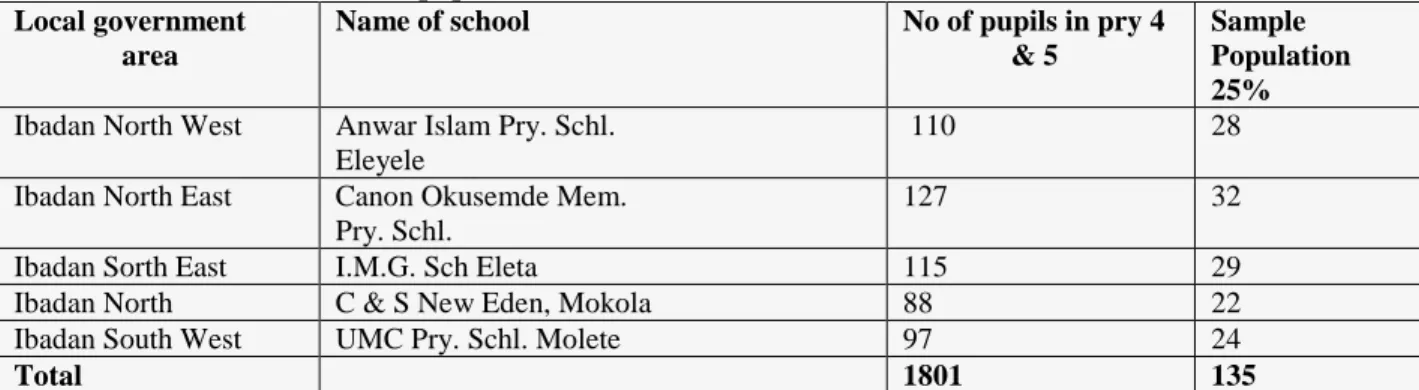
Thus, due to the large population only twenty five percent (25%) of the pupils in the higher classes in the selected primary schools were chosen for the study. Also, the sample for the population consisted of only pupils that were purposively selected due to the fact that they were found to be using the regular user of the library and hence would be able to give relevant information as far as the reading promotion activities of the library is concerned. Table 1 presents the distribution and sample population of the pupils selected for the study.
Table 1:Distribution of selected pupils Local government
area
Name of school No of pupils in pry 4
& 5
Sample Population 25%
Ibadan North West Anwar Islam Pry. Schl. Eleyele
110 28
Ibadan North East Canon Okusemde Mem. Pry. Schl.
127 32
Ibadan Sorth East I.M.G. Sch Eleta 115 29 Ibadan North C & S New Eden, Mokola 88 22 Ibadan South West UMC Pry. Schl. Molete 97 24
Total 1801 135
Data Analysis and Discussion
Library Use and Reading Skills Development
Research question 1: How adequate are SUBEB reading promotion activities in developing the reading skills of primary school pupils in Oyo state?
Table 2 revealed that majority of the pupils (113 or 91.9%) attested to the inadequacy of SUBEB library reading promotion activities in the promotion of the reading skills of the pupils. It may be deduced from the response that the reading promotion activities available in SUBEB library are not adequate in the area of promoting the reading skills of pupils, This may be due to the unavailability of programmes as well resources that may have direct influence on the development of reading skills of the pupils.
Table 2: Pupils’ opinion on adequacy of SUBEB library reading promotion activities?
Response Frequency Percentage (%)
Adequate - -
Inadequate 113 91.9
I don’t know 10 8.1
Table 3: Pupils opinion on the frequency of use of SUBEB library
Response Frequency Percentage (%)
Daily 22 17.9 Twice a week 70 56.9 Weekly 17 13.8 Occasionally 8 6.5 Never 6 4.9 Total 30 100.0
The data from table 3 revealed that the majority of the pupils make regular use of SUBEB library with a response rate of 92 or 74.8%. This implies that the pupils make regular use of SUBEB library.
Research question 3: What is the attitude of the pupils toward reading?
The information on the prevailing attitude of pupils toward reading is presented in table 4 and it showed that majority of the pupils attested to the fact that they found reading stressful and that they are unwilling to read with a response rate of 74 or 60.2% and 66 or 53.6% respectively. This implies that the pupils have a negative attitude toward reading.
Table 4: Pupils opinion on their attitude to reading
Pupils attitude Frequency Percentage (%)
I am unwilling to read 66 53.6
I found reading stressful 74 60.2 I enjoy reading at home /school 26 21.1 I am always disturbed to read - -
Research question 4: What learning resources do the pupils prefer to read in the library?
Pupils’ opinion on their preference for learning resources as presented in Table 5 above showed that textbooks (80 or 65.0%) as the only learning resources preferred by the pupils for use whenever they visit SUBEB library. This may not be unconnected with the fact that textbooks are being used to support the academic activities of the pupils.
Table 5: Pupils’ opinion on their preference for learning resources
Learning resources Frequency Percentage (%)
Textbooks 80 65.0 Magazines 10 8.1 Newspapers - - Comics - - Poetry 30 24.4 Dictionary - - Novels - - Storybooks - - Music books 13 10.6
Research question 5: What reading promotion programmes are available in SUBEB library/ Libraries Resources Centres
Table 6 presents pupils’ opinion on reading promotion activity available in SUBEB library/LRCs and it showed that majority of the pupils affirmed to the availability of literary and debate and display and exhibition as major reading promotion programme available in SUBEB library with 82 or 66.7% and 69 or 56.1% response rate respectively.
This implies that the pupils attested to the availability of literary and debate society as well as display and exhibition as major reading promotion activities available in SUBEB library.
Table 6: Pupils’ opinion on reading promotion programmes available in SUBEB library/ Libraries Resources Centres
Reading promotion activity Frequency Percentage (%)
Story telling 20 16.3
Readers’ club 34 27.6
Literary and Debate 82 66.7
Display and Exhibition 69 56.1
Discussion of Findings
The findings of the study revealed the inadequacy of the SUBEB library reading promoting activities to the
development of the reading skills of the pupils. This may be due to the unavailability of relevant resources as well as relevant reading promotion activities that can help in the development of the reading skills of the pupils. The unavailability of other reading promotion activities such as story telling and readers’ club may be responsible for the response of the pupils that the reading promorion activities of SUBEB are inadequate for them. This corroborated the view of Apeji (2009) that reading promotion activities in most schools have become moribund just as most schools do not have what can be referred to as library at all.
Moreover, the study further affirmed the regular use of SUBEB library/LRCs by the pupils. The regular use of the SUBEB library may be due to the recent library development project of the state government that emphasized the establishment of libraries and provision of learning resources in the library. Also, the regular use of the library may be due to the fact that the teachers encourage the pupils to make use of the library by giving them assignments which they are directed to do in the library. The fact that that the pupils attested to the regular use of only textbooks revealed that the students only go to the library to do assignment and not for reading
On the prevailing attitude of the pupils toward library use, the findings from the study revealed that the pupils have a negative attitude toward the use of the library. This is in support of Oyegade (2009) view which emphasized that most Nigerians pupils have not fully embraced reading and exploited its potential. This may be due to the fact that the pupils have many other activities catching their attention other than going to the library to read. It may also be due to the fact that they do not enjoy their stay in the library which may be as a result of the uninteresting
environment of the library.
Moreover, the study revealed that textbooks as the only learning resource that the pupils prefered to read. This may be due to the fact that this category of learning resource is related to the school work of the pupils. Also, the study affirmed the relevance of learning resources to school work of the pupils and it established the usefulness of the resources to make the pupils understand their school subjects as major reasons for pupils’ preference for textbooks as part of learning resources they used in the school.
On the reading promotion programmes available in SUBEB library/LRCs, the study revealed display and exhibition as the major reading promotion programmes available in SUBEB library. This may be due to the fact the SUBEB library make a display and exhibition of materials to make the pupils to be aware of the learning resources and stimulate their interest in the reading of the books. The findings of the study further revealed the provision of interesting books in the SUBEB library as a major measure for promoting reading among the pupils. This
corroborates Oyegade (2009) opinion that children should be introduced to books and other learning resources early in life by parents and teachers so as to make them interested in reading and develop them and nurture the reading habit in them.
Conclusion
The type of resources available in a collection, the adequacy of such resources to pupils need and the adequacy of the reading promotion programme are major elements that determines the success of SUBEB library in the process of developing the reading skills of pupils. This study has confirmed the inadequacy of the SUBEB library resources
and reading promotion programmes in the development of the reading skills of the public primary pupils in Oyo state. Reading promotion programme such as literary and debate and readers’ club are very relevant and important to the development of reading skills among pupils as these programmes attract the attention of the pupils and sustain their interest more that what display and exhibition can do. Exhibition only stimulate their interest which may not be effective enough, the use of literary and debate as well as readers’ club alongside exhibition make the programme more effective. The use of appropriate reading promotion progranmme will also change the negative attitude of the pupils to a positive one.
Recommendations
Government and library management should ensure holistic approach to collection development in SUBEB libraries to ensure that the collection can take care of education, information, recreation and cultural needs of the pupils. The library should be made more interesting so that pupils will se an environment that is different from classroom anytime they visit the library. This will sustain their interest in coming and making use of the library.
Reading promotion activities such as readers’ club and literary and debate should be should be mounted in SUBEB library to encourage the pupils’ use of the library. This will further facilitate the pupils’ use of SUBEB library and encourage discourse that can challenge pupils to want to read to know more. There may also be the need for reading hour on the time table of every class. The reading period should be used in promoting reading among the pupils. Pupils can be taken to the library where the library is within the school premises or the library can come to the school with books (in form of mobile or outreach service).
Parents are also encouraged to buy books for their children and encourage them to read it. It may be necessary that the parents would take time to read with the pupils until the pupils develop the habit of reading on their own. Also, there may be need to extend the opening hours of the libraries to give pupils the opportunity of using the library. Teachers can encourage the pupils to use the library by giving them assignments that will take them to the library on a regular basis. Pupils too should be allowed to recommend books that attract their interest for the library to buy. There is also the need to employ a reading specialist that can be able to diagnose the reading difficulties of pupils and help them out of it. Lastly, there should be proper evaluation of the activities of SUBEB libraries on a regular basis to ensure that the purpose for which the libraries/LRCs are established is not defeated.
References
Adediran, S.A. 2003. Oyo government library development policy in primary schools. Symphony of Service: The Oyo SPEB Years. H. Salam and D. Saseyi. Eds. Ibadan: Green Dome Nigeria Ltd., 187-193.
Adeoye, M. 2004. Library service for basic education in Nigeria. Ibadan: ORIS Publishers.
Amucheazi, O.N. 2001. The need for community oriented school library services for the effective Implementation of the Universal Basic Education Programme. Nigeria School Library Journal. 4. 1 & 2: 39-44.
Apeji, E.A. 2009. Developing reading habits and skills in schools. Library Herald, 47. (1), 15-22
Derrajah,G. 1999. Reading interest of secondary school students. In: Gray, S. (Eds.) User approach to information in libraries. New Delhi: ESS Publishers,
Dike, V.W. 2001. School Library facilities required for successful implementation of the UBE programme In Nigeria. Nigerian school Library Journal. 4. 1&2: 5-13
Fayose, P.O. 1995. School library resource centres for educational excellence. Ibadan:AENL Publishers.
Floyd, R. 2001. Reading researchers in search of common ground. Newark, Delwarre: International Reading Association Inc. 23 -38
IFLA/UNESCO. 2000. The school libraries and learning for all: IFLA/UNESCO school manifesto. IFLA/ UNESCO school library manifesto. IFLANET, P3
James, S. 2000. Language habits and the early introduction to literature. Ibadan: African University Press.
Kargbo, A. 2010. Promoting reading in schools in Sierra Leone. Retrieved from http://ezinearticles.com
Kolade, H.K. 2008. Information Literacy Skill Development For Teachers. A paper presented at the 23rdAnnual Conference of the Nigerian School Library Association held at Ibadan, 27-31, October.
Krashan, S. 2000. The power of reading: Insights from the research. Englewood, Colorado: Libraries Unlimited.
Markless, S., & Streatfield, D. 2004. Improve your library: A self-evaluation process for secondary school libraries and learning resources centres. Nottingham: DES publications.
Mokatsi, R. 2005. Sharing resources: How library networks can help reach education goals. East African Books Development Association.
Okojie, V. 2004. Promoting reading through efficient and effective use of the library. Keynote Addressed presented delivered at the Workshop for Teacher Librarians in Public Primary Schools in Oyo State. Research and Development, 1 (1&2): 40-47
Oyegade, E. A. 2003. Reading promotion campaign activities of the Oyo State Library Board Ibadan in reader development and reading promotion. International Network for the Availability of Scientific publications (INASP).
Wells, G. 2000. The meaning makers: Children learning language and using language to learn. London: Hodder & Stoughton.