Using Metamodels in Service Interoperability
Andreas Winter
Jürgen Ebert
Institute for Software Technology
University of Koblenz
D-56070 Koblenz
Universitätsstraÿe 1
www.uni-koblenz.de/~winter/
(winter|ebert)@uni-koblenz.de
Abstract
Interoperability in service oriented environments is heavily inuenced by the view that the cooperating ser-vices have on their data.
Using the term service for the abstract contract concluded between a service requester and a service provider, three dierent data schemas have to be iden-tied, namely the requester's schema, the provider's schema and the reference schema introduced by the ser-vice specication.
Metamodeling and schema transformation ap-proaches from the area of model driven architecture can be used to dene these schemas and their mappings as well as the appropriate transformations that have to be applied to the data.
This paper explains an approach towards metamodel-based service interoperability along an extended exam-ple of providing visualization services for the Bauhaus re-architecting tool.
1 Motivation and Related Work
Interoperability is the challenge of enabling software tools from dierent suppliers to share their functional-ity. Coupling dierent, but interoperable tools allows to form integrated collaborative tool suites without re-inventing or re-implementing already existing software components.
The issue of tool integration has already been ad-dressed in the ECMA Reference Model [9], where data integration, control integration, presentation integra-tion, process integraintegra-tion, and framework integration have been recognized as dierent and important as-pects. Process integration and framework integration
focus on providing reasonable infrastructure for devel-oping, integrating and using interoperable components and presentation integration emphasizes similarity of user interfaces for these components. The direct inter-action between interoperable components is addressed by data and control integration.
Interacting components are usually based on espe-cially tailored data structures, which allow the most ecient execution of provided services. Thus, coupling those components requires to synchronize the data be-tween participating software systems [29,26]. This in-cludes the direct data exchange by standardized data interchange languages as well as common access to (vir-tually) joined data repositories by appropriate inter-faces.
Service Oriented Architecture [8] is the current ab-stract approach to build software systems formed by components that provide certain functionality and components that use this functionality. Theses compo-nents are loosely coupled at runtime via network tech-nologies. In service oriented architectures services sub-sume coherent functionality. They supply their func-tionality by published interfaces encapsulating data and control information.
In service oriented architectures, data synchroniza-tion between collaborating services is viewed as an au-tomatic process at run time. Service interfaces act as contracts between service provider and requester. Ex-isting systems usually have not been developed in a ser-vice oriented manner, but all more or less open systems oer import and export facilities according to their own internal data structures. For making those tools col-laborate, they also have to agree on common service contracts. Each reasonable service has to be identied and the data required for providing the services has to be specied. To avoid coupling tools and components
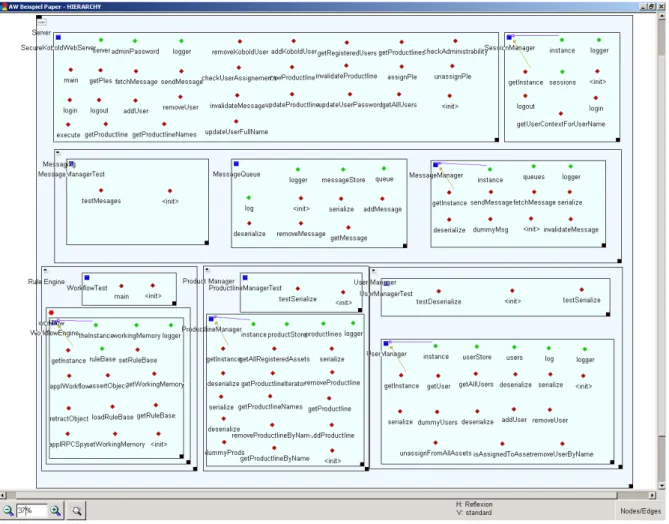
Figure 1: Decomposition View in Bauhaus based on ad-hoc data structures and converters, a more
general specication of the service and its interfaces is required.
This paper focuses on the use of metamodels as medi-ators to synchronize data between interoperable tools. Metamodels are used to dene data shared between collaborating tools and found the base for transform-ing data between tool specic structures. Maktransform-ing these metamodels explicit and providing appropriate lters to convert data matching the metamodel to the indi-vidually used data structures of service providing tools, enables existing tools to be embedded in service ori-ented architectures. Furthermore, these metamodels serve as data structures for implementing new services. A similar approach, based on grammars, is pre-sented in [13]. Grammars specify document structures of interoperable tools. Pattern based association gram-mars act as an intermediary to synchronize these struc-tures. That paper also addresses a standardized way to share individually structured data by intermediate structures. While their approach originates in
corre-lating annotated text based grammars, the approach presented here is oriented towards reference modeling in a model driven environment.
An ontology based approach towards tool interop-erability is presented in [15]. This approach provides a general infrastructure to relate concepts of collabo-rating tools. The use of metamodels in service inter-operability, presented here, completes this approach by showing how to realize data mappings.
Service Interoperability refers to sharing data and control between interacting services. Web services [3] form the most widespread infrastructure to enable com-ponents to collaborate dynamically. XML-based nota-tions provide mechanisms to dene standardized data exchange notations. The approach on using meta mod-eling technologies to enable service interoperability on data level is independent from the technological space used for service interaction. Thus, the approach is pre-sented in terminology of web services and XML, but it should also hold for other middleware frameworks like CORBA [23].
Example: Visualizing Software-Architecture In the following, service interoperability of soft-ware re-engineering tools is used as an example. Starting from the source code of a legacy software system, the Bauhaus re-architecting tool [7, 10] extracts a (possible) software architecture. The decomposition view [5] of software architectures shows its structure in terms of components and subcomponents. The decomposition of an object oriented software system into packages, classes, at-tributes, and methods using the Bauhaus built-in visualization is presented in Figure1.
The decomposition view of the server subsystem of the Kobold system for visualizing and main-taining product lines [16] contains two classes (SecureKoboldWebServer, SessionManager) and four subpackages (Messaging, RuleEngine, Pro-ductManager, UserManager) which are subdivided into further packages and/or classes depicted as nested boxes. Each class is composed of members and methods, presented by dierently colored di-amonds.
The following sections of this paper will show, how the introduction of metamodel-driven service in-teroperability supports visualizing this architecture by means of UML class-diagrams using IBM Ra-tional Software Modeler [25] (Software Modeler for short), a commercial of-the-shelf UML modeling tool, as a visualization service. 2 Section2will introduce services and components and their major elements, which provide the base for ser-vice interoperability. The metamodel-based approach on service-interoperability is explained in section3 us-ing the example just introduced.
2 Services and Components
The shift from developing large monolithic systems towards service oriented architectures, including the potential of web service-based implementations, leads to new chances and challenges in software development. Instead of thinking of coupling concrete software com-ponents, interoperability is viewed as providing and us-ing abstract services.
2.1
Services
Services form the interface to access functionality provided by certain implementations. They hide imple-mentation details enabling service invocation regard-less of specic hard- and software environments [19].
According to [28] services are viewed as abstract descriptions of coherent functions with public inter-faces that are realized by concrete software compo-nents. They provide all information required to use the functions they describe.
The functionality specied by services usually con-tains a set of operations. Each operation is specied by its signature dening input and output data. Interact-ing with services also requires to agree on the data used by the service to perform its functionality. E.g. web service descriptions (cf. the abstract part of WSDL [2]) contain types describing data structures that are shared between interacting services and operations together with their signature to access the service's functional-ity.
From a more general perspective, service requesters have to supply the input data and receive the output data in specic forms specied by the service denition. Its data structure is specied by a reference schema, which is a common metamodel of the shared data. The service user has to provide these data and the service implementation has to ensure its use.
2.2
Components
Services are implemented by components which form service providers in web services. There may be several alternative components implementing the same service. Appropriate descriptions of components com-plement the web service description by imcom-plementation details like bindings, communication protocols, or ad-dress information. Service providers realize the service interface with all its specied operations and reference schemas.
Internal data structures of components, also spec-ied by schemas, have to comply with the structure dened by the service's reference schema. Depending on the implementation of the provided operations, dif-ferent service providers may use dierent internal im-plementations of specialized data structures optimized for ecient calculation.
Here, service reference schemas are viewed as an on-tology which species a shared conceptualization be-tween the service and its components [11]. It also serves as data part of the contract between the ser-vice requester, who has to deliver data according to the reference schemas, and the service provider, who implements the service according to this schema. Example: Visualizing Software-Architecture
In the re-architecting example, the Bauhaus tool represents software architectures in resource ow graphs [7,10], and Software Modeler uses a vari-ant of the UML 2 superstructure metamodel [24].
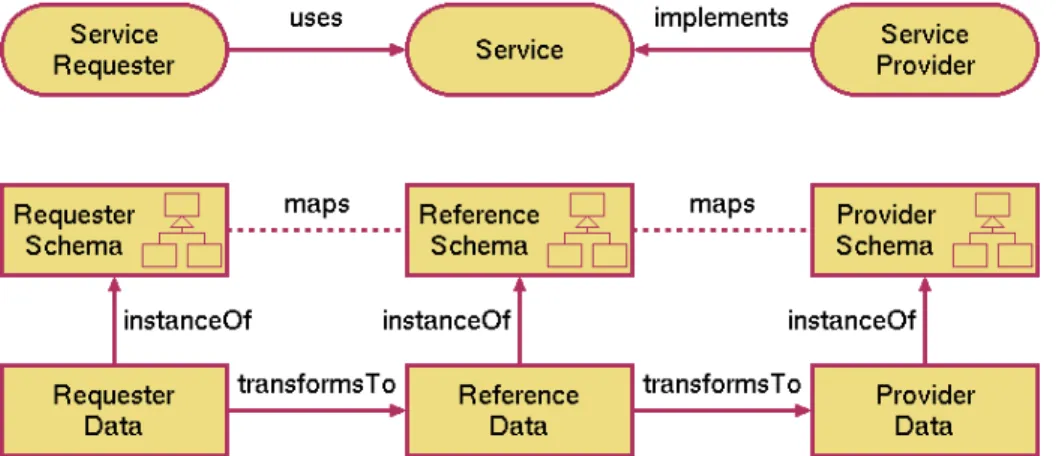
Figure 2: Metamodel-driven approach to Service Interoperability Here, Bauhaus supplies the re-architecting service
and the Software Modeler delivers (among others) the visualization service.
To make Bauhaus and Software Modeler interop-erable, these structures have to be synchronized according to the requirements of the service de-nition.
2
3 Metamodel-based Service
Interoper-ability
Interoperability requires a contract between collab-orating partners on the operations supplied by the provider and on the data structures shared between the collaborators. This contract contains a specication of the functionality dened by the service and a set of reference schemas dening the data to be shared.
Service implementations usually employ internal data structures, that are optimized towards eciency. Hence, collaborating components mostly do not use identical data structures and synchronization of data is required. The following sections show how data synchronization is realized by using the service refer-ence schema as a shared conceptualization and schema transformation as ltering support.
3.1
Metamodel based approach to synchronize
data
Interoperable agents have to agree upon exchanged data. Common reference schemas supply means to ac-commodate client data to the data required by service provider, and vice versa. Service interoperability neces-sitates powerful and adaptable mechanisms to dene, transform, and synchronize such data.
Metamodeling and metamodel based transformation provide such mechanisms. Metamodels dene the structure of data to be exchanged. The reference schema, dening the services data, and the schemas used by the service requester and the service provider oer the formal base to assign metamodel based trans-formations. Figure 2sketches this approach.
Data exchange in service oriented environments fol-lows a stepwise approach:
1. Dene schemas
(a) Dene reference schemas
The reference schemas of the service serve as domain ontologies reecting the shared con-cepts among the collaborating components. They are mediators between interoperable partners.
(b) Dene service requester and service provider schemas
Collaborating partners work on their individ-ual own data structures. These have to made explicit [14] to form the base of data export and import.
2. Specify data transformations
Data according to the participating schemas have to be mapped to each other. Mappings from the service requester's data via the reference schema to the service provider's data have to be specied. These mappings express a common understand-ing of the semantics of the participatunderstand-ing schemas. Concepts and structures of dierent schemas den-ing the same content have to be related. Here, dierent terminology and modeling style has to be normalized according to the services reference schema.
3. Share data
Data provided by the service requester has to be available to the service provider and data calcu-lated by the service provider has to be available to the requester.
Sharing this data can be done either by encap-sulating the synchronization within functional in-terfaces or by physically exchanging the data by a standard exchange form, which conforms to the reference schemas. Since dierent services use dif-ferent reference schemas, data has to be exchanged together with its corresponding schema informa-tion.
The dened schemas establish a base for both, data transformation and data exchange. Section 3.2 shows the schemas involved in realizing a software architec-ture visualization service, with Bauhaus and Software Modeler as collaborating components.
3.2
Example: Visualizing Software-Architectures
Using a COTS-UML tool for visualizing software-architectures recovered by Bauhaus requires to make Bauhaus data accessable to the UML tool. The re-quired synchronization is done here according to a spe-cic architectural view (e. g. [5]). Architectural views serve as reference schemas for services visualizing cer-tain aspects of software architecture [30]. A refer-ence schema for representing a decomposition view and the appropriate variants in the collaborating tools are sketched in Section 3.2.1. Schema based transforma-tion and data exchange is described in Sectransforma-tion 3.2.2 and3.2.3.
3.2.1 Dene Schemas
A service for visualizing the decomposition view of ob-ject oriented software architectures requires to agree on the data to be displayed.
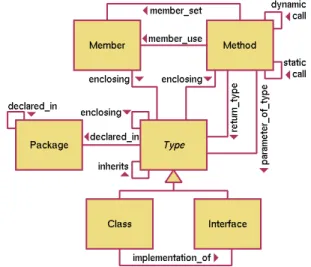
Figure 3 denes a possible decomposition of object oriented software systems. Packages contain further packages and/or classes. Classes contain methods and attributes.
Figure 3: Reference Schema
Together with the signatures of the provided opera-tions the reference schema in Figure3denes a contract each service provider for visualizing software architec-tures according to the decomposition view has to fulll. A requester calling that service, can be certain, that the data is rendered correctly by a service conformant provider.
Figure 4: Bauhaus Schema
Using services requires to map the data used by the service requester to the reference schema. The data structure used by the Bauhaus re-architecting tool is shown in Figure 4 [7, 10]. Packages declare classes and interfaces. Both consist of members and methods. Bauhaus also represents further relationships between components of software architectures which are not considered by our decomposition view visualization ser-vice.
Figure 5: UML Metaschema (extract)
Modern UML tools usually found on the UML 2 superstructure metamodel [24]. Figure5shows an ex-tract of the UML metamodel representing the relevant
Bauhaus Schema Reference Schema UML Metaschema p,q : Package p,q : Package p,q : Package
c : Class c : Class c : Class
a : Member a : Attribute a : Property m : Method m : Method m : Operation p←declared_inq p→containsq p.ownedMember3q p←declared_inc p→containsc p.ownedMember3c c→∗
inherits←enclosing a c→hasAsAttributea p.ownedAttribute3a c→∗
inherits←enclosingm c→hasAsM ethodm p.ownedOperation3m Figure 6: Mapping between corresponding concepts and relations
concepts for visualizing the decomposition view. Here classes contain properties and operations. Packages and classes are subsumed to Packageable Elements which can be substructured into further packages and classes. Software Modeler provides import facilities for data according to this schema, based on XMI [20].
Apparently, all three schemas are capable to de-scribe the decomposition of a software system into packages, classes, attributes, and methods. But, they use dierent terminology and modeling styles. The internal schemas of the collaborators are allowed to represent further data. So, e. g. the Bauhaus schema also supports inheritance and call relationships and the (complete) UML schema supports all other UML no-tations.
The reference schema serves as a mediator normal-izing these structures. It constitutes a consistent ter-minology and denes a common conceptualization re-quired for sharing re-architecting and visualization fa-cilities between the collaborators.
3.2.2 Specify Data Transformations
To enable sharing data between collaborating tools, the data exported by the service requester has to be adapted to the specic import format required by the selected service provider and vice versa. The com-mon conceptualization of both tools is specied in the service reference schema. Thus, in both direc-tions two transformadirec-tions are required: one trans-forms the requester's data to data according to the reference schema, the second transformation trans-lates data according to the reference schema into the provider's notation. If data has to be returned to the requester, proper inverse transformations are needed, which might be realized in a similar way.
Model transformations are a core constituent of model-driven architectures [22]. Model transformation is viewed as the process of converting models into other
models. Those transformations are specied in terms of mappings between the corresponding metamodels. Various metamodel based approaches to model trans-formation are currently under development to enable specication and execution of metamodel based trans-formations [21].
The required mappings between the Bauhaus schema (cf. Figure 4), the reference schema (cf. Figure3), and the UML metaschema (cf. Figure5) are sketched in Figure 6. The mappings dene the correspondence between the participating concepts and their relationships.
The Bauhaus schema, the reference schema, and the UML metaschema follow dierent modeling styles. Associations are oriented and named in the Bauhaus schema and in the reference schema, whereas the UML metaschema uses a more implementation oriented ap-proach, utilizing role dened associations. The map-ping in Figure 6 considers these dierent modeling styles by notating the constraints for the Bauhaus and the reference schema using regular path expressions and stating the constraints for the UML metaschema in OCL predicates.
Interoperation scenarios with very diverse metaschemas might require much more complicated constraints specifying the mapping.
A general and widely applicable reference schema for visualizing decomposition structures should also sup-port generalization of classes. Generalization is ignored in Figure3to present an example for a precision loos-ing model transformation. Generalization of classes in an architecture recovered by Bauhaus has thus to be attened into a structure according to the reference schema. To preserve as much semantics as possible dur-ing transformation, attributes and methods of super-classes are directly associated to all subsuper-classes. Thus, the transformed architecture, visualized according to the UML schema does not contain the generalization information, though the UML 2 superstructure
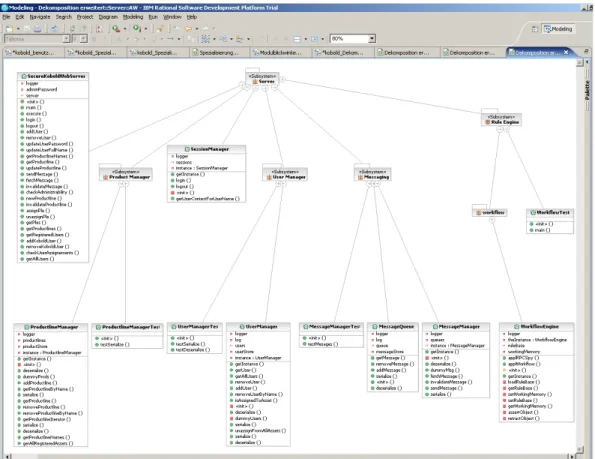
meta-Figure 7: Decomposition View visualized with Software Modeler model [24] also supports generalization and Software
Modeler is capable of visualizing these structures. This demonstrates the importance of dening a preferably universal schema for services. But, since nobody can anticipate all features or modeling styles used in existing or future services implementations, it is impossible to dene these general schemas. Thus, coupling services has always to be aware of loosing pre-cision. Loss of precision is discussed e. g. in [6]. But, dening and comparing reference schemas and tool spe-cic schemas allows to make the loss of information within the collaboration of concrete tools explicit.
The transformations described here were imple-mented in a case study [30] by XSLT scripts, since Bauhaus and Software Modeler provide XML based import and export facilities. XSLT works rather eciently on huge amounts of data, which occur in in-teroperable reengineering environments. Furthermore, metamodels and their mappings do not inuence the XSLT transformation explicitly. Only the source model appears in patterns, the target model is only implicit. Thus, more ecient and powerful declarative metamodel-driven approaches are needed for model transformation. More promissing approaches for
metamodel-based transformation might be BOTL [4], MDI [17], or ATL [1].
3.2.3 Share Data
GXL (Graph eXchange Language) [12] is an XML-based standard exchange format for sharing graph data between tools. GXL comes with a metamodeling ap-proach, such that graph-based data can be exchanged together with its corresponding schema information. In contrast to other XML-based metamodeling ap-proaches, GXL is homogeneously graph-based on all meta-levels, leading to one single and simple notation for instance data, schemas and metaschemas.
In the example, the Bauhaus schema as well as the reference schema were dened by GXL schemas, i. e. they could be exchanged as graphs corresponding to the GXL metaschema. Thus, the mapping between Bauhaus data and the reference schema was directly done by exchanging and transferring GXL documents. Since Software Modeler only supports XMI, a sepa-rate lter was written. Data according to the reference schema were transformed into the XMI imported by the Software Modeler.
Figure 7 shows the resulting UML visualization of the decomposition view from Figure 1 from the running example. The UML class diagramm shows the server subsystem of Kobold with its two classes (SecureKoboldWebServer, SessionManager) and four substructured subpackages (Messaging, RuleEngine,ProductManager, UserManager). Member variables and methods of classes are depicted in the usual class compartments.
4 Conclusion
This paper introduced the use of metamodeling tech-nology for service interoperability. Interoperability be-tween service provider and service requester is viewed as fullling a contract dened by the service. Instead of coupling concrete software components individually, service interoperability views tool integration on an ab-stract level. Services specify the oered functionality and a set of reference schemas. Collaborating partners have to agree on this service specication.
Within this framework, sharing data among collab-orators plays an important role. Due to dierent inter-nal data structures, transformations between interact-ing tools are required. Data exchange and the transfor-mations are realized according to the explicit schemas used by the tools and to the reference schema of the services which dene a common conceptualization.
Coupling (already existing) tools by providing and using certain functionality in a service oriented setting, requires to dene the services schema by a reference schema. To provide a wide spectrum of possible im-plementations the reference schema denition should be done according to the general needs of the intended service and independently of probably existing imple-mentations.
Realizing this service by new components can be done directly on this structure. Using already existing tools or components requires to discover the individual schema of the service provider. Theses schemas usually dier from the reference schema, and transformators have to be provided for data exchange. Using this ser-vice, requires to provide data according to the reference schema. Again, transformators are needed for mapping the service requesters data to the reference schema. These transformators are based on schema transfor-mation between the requesters individual schema and the reference schema.
Standardizing the services interface by a reference schema, dening the individual data structures of re-quester and provider, and dening schema based trans-formations facilitates the coupling of already existing software systems in a service oriented environment as
well as the realization and use of new service imple-mentations.
The presented approach is independent of concrete realization strategies and technologies. It can be ap-plied to requests to web services as well as to using encapsulated functionality of monolithic components oering export and import facilities. Similarly, the ap-plied meta modeling approach is not restricted to GXL only. But, it becomes important to adopt powerful metamodel based transformation techniques.
Visualizing a recovered software architecture and presenting the results in an UML tool was done with monolithic tools oering export and import facilities and some additional scripts. In the case study coupling of the functionality of two commercial, monolithic of-the-shelf tools was not yet implemented in a strong ser-vice oriented architecture. But, both tools oer export and import facilities. Bauhaus exports software archi-tectures as GXL graphs and Software Modeler imports XMI streams. The GXL graph generated by Bauhaus was transferred into an GXL graph matching the ref-erence schema. This graph was transferred by another transformator into an XMI. The transformators were realized by XSLT and were based on various reference schemas of the software architecture visualization ser-vices and the published metamodels of Bauhaus and Software Modeler.
The current implementation provides reference schemas and tranformators for the decomposition view, the specialization view, uses view, implementation view, and module view. Based on the specication of visualization services the Bauhaus re-architecting tool was successfully applied to use Sofware Modeler to ren-der software architectures.Further activities deal with applying model driven transformation approaches for more elegant and (hopefully) more performant trans-formation.
Currently approaches on migrating systems towards service oriented architectures (e. g. [18]) are being de-veloped. Enabling data interoperability between com-municating components is a prerequisite to service in-teroperability. The discovery of services in legacy sys-tems, their denition with reference schemas and sup-plying appropriate tranformators will also provide a generic means to service oriented interoperability of legacy systems.
Acknowledgments: This proposal has beneted from various discussions with our students. We thank Kerstin Falkowski, Alexander Kaczmarek, and Julia Wol for their collaboration, insights and suggestions.
References
[1] ATL: Atlas Transformation Language, User Manual. http://dev.eclipse.org/viewcvs/ indextech.cgi/gmt-home/subprojects/ATL/ doc/ATL_User_Manual%5Bv00.09%5D.pdf, Au-gust 2005.
[2] Web Services Description Language (WSDL) Ver-sion 2.0 Part 0: Primer. W3C Working Draft, W3C, http://www.w3.org/TR/wsdl20-primer/ wsdl20-primer.pdf, 3. August 2005.
[3] G. Alonso, F. Casati, H. Kuno, and V. Machiraju. Web Services, Concepts, Architectures and Appli-cations. Springer, Berlin, 2004.
[4] P. Braun and F. Marschall. Transforming Object Oriented Models with BOTL. Electronic Notes in Theoretical Computer Science, 72(3):115, 2003. [5] P. Clements, F. Bachmann, L. Bass, D. Garlan,
J. Ivers, R. Little, R. Nord, and J. Staord. Doc-umenting Software Architectures, Views and Be-yond. Addison Wesley, Boston, 2003.
[6] J. R. Cordy and D. Jin. Factbase Filtering Issues in an Ontology-Based Reverse Engineering Tool Integration System. J.-M. Favre, M. Godfrey, A. Winter (eds.): Integrating Reverse Engineering and Model Driven Engineering, 2nd International Workshop on Meta-Models and Schemas for Re-verse Engineering. Electronic Notes in Theoretical Computer Science, 137(3):6575, September 2005. [7] J. Czeranski, T. Eisenbarth, H. Kienle, R. Koschke, and D. Simon. Analyzing xg Using the Bauhaus Tool. In 7th Working Con-ference on Reverse Engineering. IEEE Computer Society, Los Alamitos, pages 197199. 2000. [8] W. Dostal, M. Jeckle, I. Melzer, and B.
Zen-gler. Service-orientierte Architekturen mit Web Services, Konzepte, Standards, Praxis. Elsevier, München, 2005.
[9] ECMA. Reference Model for Frameworks of Software Engineering Environments, Version 2.6. Technical Report ECMA TR/55, European Com-puter Manufacturers Association, National Insti-tute of Standards and Technology, US Department of Commerce, 1993.
[10] Thomas Eisenbarth, R. Koschke, and S. Bellon. Bauhaus Software Technologies, Language Guide 5.1.4. Documentation, 28. April 2005.
[11] W. Hesse. Ontologie(n). Informatik Spektrum, 16(6):477480, Dezember 2002.
[12] R. C. Holt, A. Schürr, S. Elliott Sim, and A. Win-ter. GXL: A Graph-Based Standard Exchange Format for Reengineering. Science of Computer Programming, 60(2):149170, April 2006.
[13] I. Ivkovic and K. Kontogiannis. Interoperabil-ity and Integration of Enterprise Applications through Grammar-Based Model Synchronization. In Y. Zou, M. di Penta: Pre-Proceedings IEEE In-ternational Worhshop on Software Technology and Engineering Practice (STEP 2005), pages 244 247. 2005.
[14] D. Jin, J. R. Cordy, and T. R. Dean. Where's the Schema? A Taxonomy of Patterns for Soft-ware Exchange. In 10th International Workshop on Program comprehension. IEEE, Los Alamitos, pages 6574. 2002.
[15] D. Jin and J. R. Cordy. A Service Sharing Ap-proach to Integrating Program Comprehension Tools. Proceedings of the European Software En-gineering Conference and ACM SIGSOFT Sym-posium on the Foundations of Software Engineer-ing (ESEC/FSE 2003), Workshop on Tool Integra-tion in System Development (TIS 2003), 7378, September 2003.
[16] Werkbold Team, University of Stuttgart: Kobold Productline-Manager. http://kobold.berlios. de/index.html.
[17] A. Koenigs and A. Schuerr. Multi-Domain Integration with MOF and ex-tended Triple Graph Grammars, http: //drops.dagstuhl.de/opus/volltexte/2005/ 22/pdf/04101.KoenigsAlexander1.Paper.pdf. In J. Bezivin and R. Heckel (eds.) Language Engi-neering for Model-Driven Software Development, Dagstuhl Seminar Proceedings 04101. Interna-tionales Begegnungs- und Forschungszentrum (IBFI), Schloss Dagstuhl, Germany, 2005.
[18] K. Kontogiannis and Y. Zou. Reengineering Legacy Systems Towards Web Environments. In K. M. Khan, Y. Zheng (eds.): Managing Corpo-rate Information Systems Evolution and Mainte-nance, Idea Group Publishing, Hershey, PA, USA, pages 138146. 2004.
[19] H. Kreger. Web Services, Conceptual Architec-ture (WSCA 1.0). http://www-306.ibm.com/ software/solutions/webservices/pdf/WSCA. pdf, IBM Software Group, May 2001.
[20] OMG XML Metadata Interchange (XMI) Specication. http://www.w3.org/TR/2000/ REC-xml-20001006.pdf, January 2002.
[21] Request for Proposal: MOF 2.0 Query/Views/Transformations RFP. http: //www.omg.org/docs/ad/02-04-10.pdf, Octo-ber 2002.
[22] MDA Guide. http://www.omg.org/docs/omg/ 03-06-01.pdf, June 2003.
[23] Common Object Request Broker Architecture: Core Specication. http://www.omg.org/docs/ formal/04-03-01.pdf, March 2004.
[24] UML 2.0 Superstructure Specication. http:// www.omg.org/docs/ptc/04-10-02.pdf, October 2004.
[25] IBM Rational Software Modeler. http: //www-306.ibm.com/software/awdtools/ modeler/swmodeler/.
[26] S. E. Sim. Next Generation Data Interchange, Tool-to-Tool Application Program Interfaces. In 7th Working Conference on Reverse Engineering. IEEE Computer Society, Los Alamitos, pages 278 280. 2000.
[27] Extensible Markup Language (XML) 1.0 (Third Edition). W3C Recommendation, W3C XML Working Group, http://www.w3.org/TR/2004/ REC-xml-20040204, February 2004.
[28] Web Services Architecture. W3C Working Group Note, W3C Web Services Architecture Working Group http://www.w3.org/TR/2004/ NOTE-ws-arch-20040211/wsa.pdf, 11 February 2004.
[29] P. Wegner. Interoperability. ACM Computing Sur-vey, 28(1):285287, 1996.
[30] J. Wol and A. Winter. Blickwinkelgesteu-erte Transformation von Bauhaus-Graphen nach UML. Softwaretechnik-Trends, 25(2):3334, May 2005.