Miron, Luciana, Talebi, Saeed, Koskela, Lauri and Tezel, Algan Evaluation of Continuous Improvement Programmes
Original Citation
Miron, Luciana, Talebi, Saeed, Koskela, Lauri and Tezel, Algan (2016) Evaluation of Continuous Improvement Programmes. In: 24th Annual Conference of the International Group for Lean Construction, 18th - 24th July 2016, Boston, USA.
This version is available at http://eprints.hud.ac.uk/29072/
The University Repository is a digital collection of the research output of the University, available on Open Access. Copyright and Moral Rights for the items on this site are retained by the individual author and/or other copyright owners. Users may access full items free of charge; copies of full text items generally can be reproduced, displayed or performed and given to third parties in any format or medium for personal research or study, educational or not-for-profit purposes without prior permission or charge, provided:
• The authors, title and full bibliographic details is credited in any copy;
• A hyperlink and/or URL is included for the original metadata page; and
• The content is not changed in any way.
For more information, including our policy and submission procedure, please contact the Repository Team at: [email protected].
Miron, L., Talebi, S., Koskela, L., and Tezel, A. (2016). “Evaluation of Continuous Improvement Programmes.” In: Proc. 24thAnn. Conf. of the Int’l. Group for Lean Construction, Boston, MA, USA, sect.
1pp. 23–32. Available at: <www.iglc.net>.
EVALUATION OF CONTINUOUS
IMPROVEMENT PROGRAMMES
Miron, L.1, Talebi, S.2, Koskela, L.3, and Tezel, A.4
ABSTRACT
The study began with the problem posed by an organisation for a group of researchers in the UK. There was a need to carry out an in-depth study to evaluate the continuous improvement programmes in the context of Lean Construction, and the following question emerged: How to evaluate the continuous improvement programme? This paper aims to understand how the literature on continuous improvement, including quality circles (QCs), small group activities (SGAs), and continuous improvement cells (CICs), can help to conduct the evaluation of continuous improvement programmes. The paper includes a literature review to gain an understanding of the problem from a theoretical perspective. Continuous improvement techniques are assessed in the framework of the TFV theory, with the main focus on the flow and the waste concepts. A logic model framework is used to synthesize the literature review findings and to establish an initial proposal for the evaluation of continuous improvement programmes in the Lean Construction context. This paper does not include any empirical study or actual measure and cannot ascertain the definitive benefits of continuous improvement techniques. Also, the paper does not propose any definitive procedure on how to evaluate continuous improvement techniques.
KEYWORDS
Quality Circle, Small Group Activities, Continuous Improvement Cells, Evaluation.
INTRODUCTION
The study began with the problem posed by an organisation for a group of researchers in the UK. Within a Lean Construction culture, CICs have been deployed in various parts of the organisation since the early 2014. The purpose of this deployment was to improve productivity and to create time savings. Therefore, it is necessary to carry out an in-depth study to evaluate the mentioned continuous improvement programme. From this context of a practical problem, the following question emerged: how to evaluate continuous improvement programmes?
CICs are a continuous improvement technique originated from the concept of QCs, and their derivative methods SGAs. To throw light on the continuous improvement
1 Associate Professor, Federal University of Rio Grande do Sul, Brazil, Email: [email protected] 2 PhD Candidate, University of Huddersfield, UK, Email: [email protected]
3 Professor, University of Huddersfield, UK, Email: [email protected] 4 Research Fellow, University of Salford, UK, Email: [email protected]
programmes in the Lean Construction context, it is useful to identify the knowledge, challenges and implications in relation to QCs, SGAs and the CIC technique. Thus, this study uses a literature review to understand how the findings on continuous improvement (QCs, SGAs and CICs) and Lean Construction can help to conduct the evaluation of continuous improvement programmes. A logic model framework is proposed to synthesize the literature review findings and to establish an initial plan for the evaluation of continuous improvement techniques such as CICs from the Lean Construction perspective. This research does not include any empirical field study and does not propose any definitive procedure on how to evaluate continuous improvement techniques.
EMERGENCE OF QUALITY CIRCLES
First QCs were registered with the Union of Japanese Scientists and Engineers (JUSE) in May 1962 (King and Tan 1986) based on organisational research initially formulated in the United States (Dale 1984). JUSE established a special organisation to promote and coordinate the activities related to QCs (King and Tan 1986). QC is a form of employee involvement and can be defined as a group of between three to twelve workers who do the same or similar work and meet regularly under the leadership of their own supervisor in order to identify work related problems, analyse solutions, and where possible, implement the solutions to solve the problems (Dale 1984; Hutchins 1985).
QCs were successfully used in Japan and recognised as a significant contributor to the
country’s economic growth after the Second World War (Hunt 1984). QCs were
primarily developed to improve the quality of the product, process, or service that the group provides (Hutchins 1985), to educate the workforce in the period of labour shortage, and to enhance the productivity (Wood et al. 1983). The ultimate goal of QC in Japan was perfection, which means it is always possible for organisations to continuously improve their performance (Hutchins 1985).
In regard to definition of quality in Western Countries, Quality Control is about establishment of sophisticated measures to plan and inspect the activities, while Japanese highly emphasise on involvement of people to train them and develop their skills. The practical outcome of the latter definition reflects in co-ordinated activities of QCs (Hutchins, 1985, p. 14) and recently CICs, which all come under the concept of SGAs.
In response to the falling productivity in the US in the 1970s, QCs were exported to the US and were primarily deployed by large corporations such as Lockheed Missile and Space Company (Ebrahimpour and Ansari 1988). After their deployment, QCs in the US were modified in many ways because countries have different concerns for SGAs. The western version of QCs has moved towards the improvement of human relations, interpersonal communications and quality of workplace (Hodson et al. 1990). The problem with the western version is that it may result in an overemphasis on the anthropological aspects and neglect the Quality Control capabilities of SGAs (Wood et al. 1983).
QCs were registered in the UK around 1977 by a few companies, including Rolls-Royce, Mullards and ITT. The interest in QC grew very fast; in 1982, an organisation, the
Evaluation of Continuous Improvement Programmes
National Society of QCs (NSQC), was formed and it flourished for few years with the aim of promoting the QCs in the UK (Dale and Hayward 1984).
In spite of the number of books, journals, conference papers, and reports published on the QC concept in the 1980s and early 1990s, the enthusiasm for this subject gradually diminished and there is little evidence on this topic that shows this technique is still deployed. The NSQC organisation in the UK also could not survive after few years due to financial problems.
CIC is a technique that has recently emerged in the UK, especially in the context of Lean Construction, and it is a developed form of SGAs and QCs. Virtually all continuous improvement methods, techniques and practices from SGAs and QCs are adoptable to CICs. It is very important to use the existing knowledge to disseminate these techniques to more organisations.
IMPLICATIONS OF QUALITY CIRCLES
QC was claimed to be the most effective technique for productivity improvement, cost savings, and work quality improvement (Wood et al. 1983). It provides a platform to enable an organisation to take advantage of the creative intelligence of their employees (Rafaeli 1985). It is important to determine objectives and expected benefits prior to the deployment of QCs and similar SGAs and plan the evaluation programme based on them (Sherwood et al. 1985).
The most frequently stated objectives of QCs in literature are as follow: (a) reduce errors and enhance quality of products, (b) inspire more effective teamwork and job involvement, (c) improve company communication, (d) promote a problem solving capability, (e) create an attitude of "right first- time" and problem prevention, (f) develop effective relationships between management and workers (Hunt 1984), and (g) increase employee motivation (Rafaeli 1985).
Several benefits have been listed for QCs, including greater output, lower cost, improved communication and harmony in the work environment (Hunt 1984), higher work moral, motivation, reduction in conflict (Wood et al. 1983), financial survival and growth, confidence and certainty among employees that their organisation will be successful, and increased level of quality consciousness amongst employees (Dale and Lees 1987).
Regarding the quantitative benefits, Hutchins (1985) claims that QCs in Japan contribute 16% of the total profit of manufacturing companies, and that they are responsible for 25% of the profits in one large company. Hence, QCs have a great potential in cost savings and require greater attention. However, the author does not explain the methodology by which he could measure those benefits and he also does not determine in what stage of the deployment QCs could contribute to profit margins of companies. Indeed, according to Howard (1986), the benefits of SGAs are neither quantifiable nor certain.
All these expected benefits from QCs are based on following assumptions: (1) groups outperform individual members in performing tasks, identifying problems, and finding solutions, (2) teamwork and participation improve the productivity of organisations, (3)
Western employees prefer workplace participation (Ferris and Wagner 1985), and (4) goal setting, feedback, and communication of skills are integral parts of performance improvement (Wood et al. 1983). Table 1 explains these assumptions further.
Table 1: Techniques and benefits of QCs
Factors Description
Job Enrichment QCs have the potential to enrich the work group environment by: (1) training
employees, and (2) involving the workers in decision making processes (Rafaeli 1985). Job enrichment is reflected in indicators of high skill variety, task identity, and task significance (Wood et al. 1983 ). Increasing the role of employees in planning provides workers with greater autonomy (Rafaeli 1985) and the opportunity to work on more meaningful tasks (Wood et al. 1983)
Problem-Solving Skills
Development of problem-solving techniques among employees enables the members to properly identify and define the errors and often is one of the main sources of cost-savings (Wood et al. 1983)
Goal Setting and Feedback
Circles need to set their goals because in this way members are motivated to increase their performance. Members can then get feedback constantly on their performance outcome because their performance level must be regularly presented in graphs or tables. Performance problems can be identified in discussions with the members and level of task understanding increases (Wood et al. 1983).
Participation and Teamwork
Greater involvement in the work and management are the rewards to the employees after the deployment of QC which intrinsically enhances the motivation among the employees (Hunt 1984; Rafaeli 1985) and enables the employees to be involved in decision making process in areas where they are more knowledgeable than others (Rafaeli 1985).
Organisation Level
Communications
QCs increase the interaction between the members of each circle by group discussion and team work (Rafaeli 1985). This aspect of QC provides opportunity for group members to utilise their latent skills and increases their perceived level of expertise (Wood et al.1983) by communicating and exchanging their skills.
EVALUATION OF QUALITY CIRCLES
Proof of the effectiveness of QCs requires a planned and systematic evaluation. The outcome of such a systematic evaluation programme will be hard proof for the benefits of QCs for senior managers in order to make decision about the introduction, organising, continuation, expansion, or discontinuation of deployed programmes. Academics also will benefit from the results to bridge the existing gaps by: (1) providing credible evidence on effectiveness of QCs, and (2) obtaining knowledge on circumstances in which QCs succeed or fail (Sherwood et al. 1985).
Evaluation of the full benefits of SGAs is impossible, due to the complex characteristics of human beings, and effectiveness of such programmes can be measured only partially and in long term (Sherwood et al. 1985). Cox (1981) goes further and argues that the emphasis on objective measurements must be replaced with subjective
Evaluation of Continuous Improvement Programmes
measurements by using more intangible criteria such as changes in attitudes on the shop floor and in the rest of the organisation (Cox 1981).
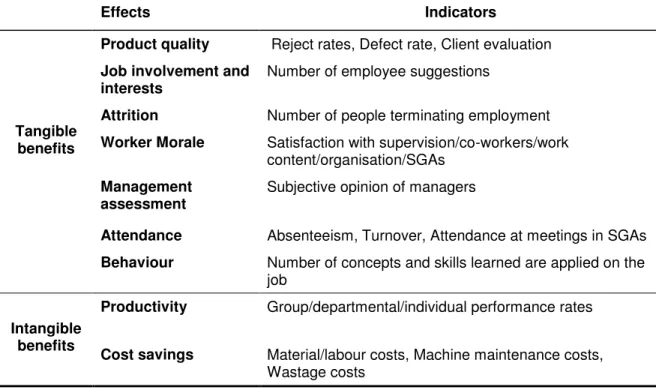
In order to avoid faddism, a proper evaluation mechanism must be built for programmes related to SGAs (Wood et al. 1983). A consistent evaluation from the beginning of the implementation helps managers to modify existing programmes, to convince managers to deploy and continue such programmes (Wood et al. 1983), to convince workers to continue such programmes, and to justify funds from senior managers (Sherwood et al. 1985). Overall, the impacts of SGAs can be measured on the basis of tangible and intangible effects. Table 2 and 3 present a non-exhaustive list of those effects and their related indicators.
Table 2: Tangible and intangible benefits (adapted from Wood et al. 1983; Hunt 1984)
Effects Indicators
Tangible benefits
Product quality Reject rates, Defect rate, Client evaluation
Job involvement and interests
Number of employee suggestions
Attrition Number of people terminating employment
Worker Morale Satisfaction with supervision/co-workers/work content/organisation/SGAs
Management assessment
Subjective opinion of managers
Attendance Absenteeism, Turnover, Attendance at meetings in SGAs
Behaviour Number of concepts and skills learned are applied on the job
Intangible benefits
Productivity Group/departmental/individual performance rates
Cost savings Material/labour costs, Machine maintenance costs, Wastage costs
CHALLENGES IN EVALUATION OF QUALITY CIRCLES
New management techniques or concepts are always exposed to faddism, particularly if they are originally imported. To avoid this situation, organisations must be aware of the underlying reasons, which may cause or contribute to failure (Dale and Hayward 1984). From the literature review, the challenges in evaluation of QCs are compiled in Table 3.
CONTINUOUS IMPROVEMENT AND LEAN CONSTRUCTION
Continuous improvement (Kaizen) has a strong influence on Lean Construction. Since the initial efforts of the International Group for Lean Construction (IGLC), founded in 1993, the continuous improvement concept is present as principles and approaches. In
many of the eleven principles proposed were realised in the framework of continuous improvement. Particularly, the ninth principle states: “build continuous improvement into
the process” (Koskela 1992). According to the author, the effort to reduce waste and to
increase value is an internal, incremental, and iterative activity that can and must be carried out continuously in an organisation (Koskela 1992).
Table 3: Challenges in evaluation of Quality Circles
Factors Description
Necessity of Quantitative Evaluations
Originally, the SGAs were not measures to save costs but they intended to develop the human resources. It was believed that monetary (tangible) benefits would follow. However, over time, it became apparent that ideology and philosophy are not sufficient to guarantee the vitality of SGAs and it is essential to examine the cost-effectiveness of such
programmes (Turban and Kamin 1984). Mechanism for
Evaluation and Feedback
Lack of a proper mechanism for evaluation and feedback may result in failure of SMGs. It is important to know the savings-to cost ratios, before-and-after comparisons on employee turnover and attitudes, and how the programme is functioning (Dale and Hayward 1984) Programme
Justification
The continuation or expansion of SGAs needs evaluation to be justified. Especially, if head manager is financially supporting the programme, and he is initially less committed to it (Dale and Hayward 1984)
Individual Performance vs Group Performance
Personnel may think that their performance cannot be measured as they work in groups and they may reduce their level of performance, which is likely to reduce aggregate performance. So evaluation of member performance is also important (Ferris and Wagner 1985)
Return on Investment Over The Time
New programmes initially may lead to a spurt in moral and performance. Once the programme becomes institutionalised, the longer run contribution may gradually diminish and it may even become cost ineffective in some periods (Wood et al. 1983) . Contrary, SGAs may not be cost effective in early times which may result in disbanding the programme. Wood et al. (1983) believe that before-and-after measures of multiple indicators and comparison with groups not deploying SGAs are essential to reach valid conclusions.
Short-Term vs Long-Term Benefits
Managers often tend to receive monetary benefits in short-term. The tendency of “short-run pay back myopia” may reduce the ability to develop human resources (Steel and Shane 1986).
The Context of the SGAs
When evaluating the effects of SGAs, it is difficult to distinguish between improvements caused by SGAs and other changes in the organisation (Sherwood et al. 1985). The
Responsible for Evaluation
There are two types of evaluators on the basis of their value stance: the " technician-employee" evaluator and "scholar-scientist" evaluator. Technician-employee is one of the members and it is very likely that he would be under pressure to produce a favourable evaluation and avoid any radical assessment of the situation. The scholar-scientist is often from outside the organisation and tries to be as objective as possible. However, if he
wouldn’t fully understand the scope and purpose of evaluation, he may not be able to produce results that groups and organisations need to make decisions (Joyce 1980). Thus,
it is needed “to define a role for the evaluators which is midway between that of scholar-scientist and technician-employee.”
Emphasises on Type of
Evaluation
Evaluator must have an open mind to decide on what research strategies are most appropriate to be selected for the programme in question. The primary concern should not be on methodological issues such as quantitative versus qualitative approaches or experimental design versus systems analysis (Joyce 1980).
Evaluation of Continuous Improvement Programmes
Additionally, that publication describes some approaches for institutionalising continuous
improvement (Koskela, 1992): “(1) Measuring and monitoring improvement; (2) Setting
stretch targets (e.g. for inventory elimination or cycle time reduction), by means of which problems are unearthed and their solutions are stimulated; (3) Giving responsibility for improvement to all employees; a steady improvement from every organisational unit should be required and rewarded; (4) Using sta ndard procedures as hypotheses of best practice, to be constantly challenged by better ways; (5) Linking improvement to control: improvement should be aimed at the current control constraints and problems of the process. The goal is to eliminate the root of problems rather than to cope with their
effects.”
In the TFV (Transformation, Flow, Value) theory (Koskela 2000), continuous improvement is discussed mainly within the field of flow management. The focus is on variability elimination and perfection, which is the construct used in this study. The improvement is supported by performance measurement focusing on various types of waste. In this way, the studies on workflow measurement (Kalsaas 2013; Kalsaas et al. 2014) and performance measuring benchmarking (Alarcon and Serpell 1996; Ramirez et al. 2003) have been developed.
The CIC mechanism continues the way QCs perform emphasizing the visual management, flow and waste concepts (from TFV theory). CICs use a board acting as a nucleus for organisations, which enables visual management to establish a common ground between work groups, managers, and stakeholders. It seeks continuous improvement by measuring, monitoring and reviewing team performance.
EVALUATION OF CONTINUOUS IMPROVEMENT
PROGRAMMES
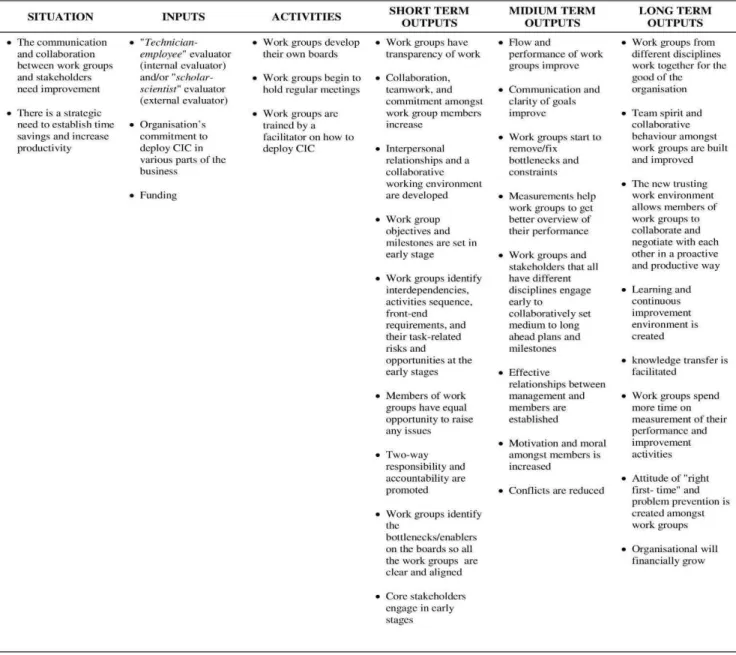
A summary of some concepts around CIC including required activities to deploy them and the outputs is illustrated in a logic model (Table 4). In fact, every proposed evaluation should start with the logic model (Frechtling, 2002). A logic model is a systematic and visual way to (1) explain the current situation, and (2) present the understanding of the relationships between the inputs, which are to operate the programme, the planned activities, and outputs, which are to be achieved in short, medium and long term (Kellogg Foundation 2004).
Table 4: Logic Model for the deployment of CIC
Evaluation programmes can be defined as a systematic operation of varying complexity, which involve data collection and analysis. They eventually lead to an effective judgment using the entirety, or some of the components of the programme being evaluated (Mizikaci 2006). In evaluation of programmes, it is crucial to define the baseline and determine to what extent (short, medium and long term) improved outcomes are important in comparison to the baseline.
The logic model can be considered as an initial common ground for stakeholders. It describes the sequence of related events for the evaluation of continuous improvement programmes within the Lean Construction context. It is important to adjust approaches in a logic model as the programme moves forward and the plans are developed (Kellogg
Evaluation of Continuous Improvement Programmes
Foundation 2004). These characteristics make the logical model lined up to continuous improvement approaches. Thus, the logical model is a suitable method for the evaluation of programmes consisting of SGAs, QCs and CICs.
CONCLUSIONS
Continuous improvement has had a strong influence on many of the Lean Construction
principles. The Lean community’s efforts on continuous improvement have been focused
on the management of flows and reducing waste. However, there is still a knowledge gap on the improvement concept and the evaluation of continuous improvement programmes.
CIC is a continuous improvement technique originated from the concept of SGAs and QCs. The QC, SGA and CIC techniques present challenges for their evaluation such as: (1) necessity of quantitative evaluations; (2) mechanism for evaluation and feedback; (3) programme justification; (4) individual performance versus group performance; (5) return on investment over time; (6) short-term versus long-term benefits; (7) the context of SGAs or CICs; (8) choice of the responsible party for evaluation; (9) choice of the type of evaluation. Additionally, the tangible and intangible benefits of QCs indicate some measurements that can be used in continuous improvement programmes.
In this situation, the logic model framework of evaluation seems to be suitable for continuous improvement programmes (including CICs, SGAs and QCs). The logic model establishes an initial roadmap for stakeholders and researchers to carry out the evaluation of continuous improvement programmes. Indeed, a logic model was used to synthesise the literature review findings and to establish an initial proposal for the evaluation of continuous improvement programmes of an organisation within the Lean Construction context. All in all, research on continuous improvement evaluation promises scientific and practical knowledge worth pursuing.
REFERENCES
Alarcón, L.F. and Serpell, A. (1996). Performance Measuring Benchmarking, and Modelling
of Construction Projects. 4th Annual Conference of the IGLC. Birmingham, UK.
Cox, J. (1981). Introducing Quality Circles - Training's Key Role. Journal of European
Industrial Training, 5(7), 17-22.
Dale, B., and Hayward, S. (1984). Some of the reasons for quality circle failure: Part I.
Leadership & Organization Development Journal, 5(1), 11-16.
Dale, B. G. (1984). Quality circles—Are they working in British factories? Long Range
Planning, 17(6), 50-65.
Dale, B. G., & Lees, J. (1987). Quality circles: From introduction to integration. Long Range
Planning, 20(1), 78-83.
Ebrahimpour, M., and Ansari, A. (1988). Technical Paper: Measuring the Effectiveness of
Quality Control Circles: A Goal Programming Approach. International Journal of
Operations and Production Management, 8(2), 59.
Ferris, G. R., and Wagner, J. A. (1985). Quality circles in the United States: A conceptual
reevaluation. The Journal of applied behavioral science, 21(2), 155-167.
Hodson, R., Cole, R. E., Lillrank, P., and Kano, N. (1990). Quality Circles: Are They America's Future? : JSTOR.
Howard, J. E. (1986). A study of quality circle development. University of Nottingham.
Hunt, B. (1984). Quality circles: Square deal for productivity. Engineering Management
International, 2(4), 271-278.
Hutchins, D. (1985). Quality circles handbook. London: Pitman.
Joyce, L. (1980). Developments in Evaluation Research. Journal of Occupational Behaviour,
1(3), 181-190.
Kalsaas, B.T. (2013). Measuring Waste and Workflow in Construction. 21th Annual Conference of the IGLC. Fortaleza, Brazil, 31-2 Aug 2013. pp 33-42
Kalsaas, B.T. , Gundersen, M. and Berge, T.O. (2014). To Measure Workflow and Waste. A Concept for Continuous Improvement. 22nd Annual Conference of the IGLC. Oslo, Norway, 25-27 Jun 2014. pp 835-846
Kellogg, W. (2004). Logic model development guide. Michigan: WK Kellogg Foundation.
King, J. R., and Tan, K. H. (1986). Quality circles. Omega, 14(4), 307-315.
Koskela, L. (1992). Application of the new production philosophy to construction. Technical
Report, Stanford University.
Koskela, L. (2000). An exploration towards a production theory and its application to
construction, PhD Thesis, VTT Technical Research Centre of Finland.
Mccawley, P. (2001). The Logic Model for Program Planning and Evaluation. Technical
Report, University of Idaho Extension.
Mizikaci, F. (2006). A systems approach to program evaluation model for quality in higher
education. Quality Assurance in Education. 14(1), 37-53.
Rafaeli, A. (1985). Quality Circles and employee attitudes. Personnel Psychology, 38(3),
603-615.
Ramirez R., R. , Alarcon C., L.F. and Knights, P. (2003). Benchmarking Management Practices in the Construction Industry. In: 11th Annual Conference of the International Group for Lean Construction. Virginia, USA, 1-.
Sherwood, K. F., Guerrier, Y., and Dale, B. G. (1985). Quality Circles - Can We Evaluate
Them? Personnel Review, 14(1), 26-31.
Steel, R. P., and Shane, G. S. (1986). Evaluation research on quality circles: Technical and
analytical implications. Human Relations, 39(5), 449-466.
Turban, E., and Kamin, J. Y. (1984). Cost-benefit analysis of quality circles. Engineering Costs and Production Economics, 8(3), 199-209.
Wood, R., Hull, F., and Azumi, K. (1983). Evaluating Quality Circles: The American