IMPROVED GRAVITATIONAL SEARCH ALGORITHM FOR PROPORTIONAL INTEGRAL DERIVATIVE CONTROLLER TUNING IN
PROCESS CONTROL SYSTEM
MOHAMAD SAIFUL ISLAM BIN AZIZ
A thesis submitted in fulfilment of the requirements for the award of the degree of
Master of Engineering (Electrical)
Faculty of Electrical Engineering Universiti Teknologi Malaysia
Specially dedicated to Aziz B. Lebai Hashim and Azizah Bt. Ali, my only sister Ummu Syahidah Bt. Aziz,
ACKNOWLEDGEMENT
In the name of Allah, the Most Beneficent and The Most Merciful. It is the deepest sense of gratitude of the Almighty that gives me strength and ability to complete this final project report.
First of all, I would like to express my gratitude to my supervisor, Dr. Sophan Wahyudi Bin Nawawi, my co-supervisor Dr. Shahdan Bin Sudin and Associate Prof. Ir. Dr. Norhaliza Bt. Abd. Wahab for their valuable guidance and support throughout the four semesters until this project completes successfully.
My outmost thanks also go to my family, my dad Mr. Aziz and my mother Mrs. Azizah for their support and love. For my sister Ummu Syahidah, thanks for her moral support and advice. Not to forget my other family and friends.
I would also like to express my gratitude to Kementerian Pengajian Tinggi (KPT) for their sponsorship during my entire studies to complete my Masters degree.
ABSTRACT
Proportional-Integral-Derivative (PID) controller is one of the most used controllers in the industry due to the reliability and simplicity of its structure. However, despite its simple structure controller, the tuning process of PID controller for nonlinear, high-order and complex plant is difficult and faces lots of challenges. Conventional method such as Ziegler-Nichols are still being used for PID tuning process despite its lack of tuning accuracy. Nowadays researchers around the world shift their attention from conventional method to optimisation-based methods. For the last five years, optimisation techniques become one of the most popular methods used for tuning process of PID controller. Optimisation techniques such as Genetic Algorithm (GA), Particle Swarm Optimisation (PSO) as well as Gravitational Search Algorithm (GSA) are widely used for the PID controller application. Despite the effectiveness of GSA for PID controller tuning process compared to the GA and PSO technique, there is still a room for improvement of GSA performance for PID controller tuning process. This research represents the additional characters in GSA to enhance the PID controller parameter tuning performance which are Linear Weight Summation (LWS) and alpha parameter range tuning. Performance of optimisation-based PID controllers are measured optimisation-based on the transient response performance specification (i.e. rise time, settling time, and percentage overshoot). By implementing these two approaches, results show that Improved Gravitational Search Algorithm (IGSA) based PID controller produced 20% to 30% faster rise and settling time and 25% to 35% smaller percentage overshoot compared to GA-PID and PSO-PID. For real implementation analysis, IGSA based PID controller also produced faster settling time and lower percentage overshoot than other optimisation-based PID controller. A good controller viewed as a controller that produced a stable dynamic system. Therefore, by producing a good transient response, IGSA based PID controller is able to provide a stable dynamic system performance compared to other controllers.
ABSTRAK
Pengawal Perkadaran-Kamiran-Pembezaan (PID) adalah salah satu pengawal yang paling banyak digunakan di dalam industri kerana kebolehpercayaan dan strukturnya yang ringkas. Walaupun mempunyai struktur pengawal yang ringkas, proses penalaan pengawal PID untuk sistem tertib tinggi, tak lelurus dan kompleks adalah sukar dan menghadapi banyak cabaran. Kaedah konvensional seperti Ziegler-Nichols masih digunakan untuk proses penalaan PID meskipun mempunyai ketepatan penalaan yang rendah. Kini, penyelidik di seluruh dunia mengalih perhatian mereka dari kaedah konvensional kepada kaedah berasaskan pengoptimuman. Sejak lima tahun yang lalu, teknik pengoptimuman menjadi salah satu kaedah yang paling popular yang digunakan untuk proses penalaan pengawal PID. Teknik pengoptimunan seperti Algoritma Genetik (GA), Pengoptimunan Zarah Kerumunan (PSO) dan juga Algoritma Pencarian Graviti (GSA) digunakan secara meluas didalam penggunaan pengawal PID. Walaupun GSA berkesan didalam proses penalaan pengawal PID berbanding teknik GA dan PSO, masih ada ruang untuk penambahbaikan prestasi GSA untuk proses penalaan pengawal PID. Penyelidikan ini memperincikan ciri-ciri tambahan dalam GSA untuk meningkatkan prestasi proses penalaan pengawal PID iaitu Penjumlahan Berat Linear (LWS) dan penalaan parameter alfa yang pelbagai. Prestasi pengawal PID berasaskan pengoptimunan diukur berdasarkan prestasi sambutan fana (masa naik, masa menetap, dan peratusan terlajak). Dengan melaksanakan kedua-dua pendekatan, keputusan menunjukkan bahawa pengawal PID berasaskan GSA Terpilih (IGSA) menghasilkan 20% hingga 30% lebih cepat untuk masa meningkat dan masa penetapan dan 25% hingga 35% lebih kecil untuk peratusan terlajak berbanding GA-PID dan PSO-PID. Untuk analisis pelaksanaan masa sebenar, pengawal PID berasakan IGSA juga menghasilkan masa penetapan yang lebih cepat dan peratusan terlajak yang lebih rendah daripada pengawal PID berasaskan pengoptimuman yang lain. Pengawal yang baik boleh ditafsirkan sebagai pengawal yang menghasilkan satu sistem dinamik yang stabil. Oleh itu, dengan menghasilkan sambutan fana yang baik, pengawal berasas IGSA PID mampu memberikan prestasi sistem dinamik yang stabil berbanding dengan pengawal lain.
TABLE OF CONTENTS
CHAPTER TITLE PAGE
DECLARATION ii ACKNOWLEDGEMENT vii ABSTRACT viii ABSTRAK ix TABLE OF CONTENTS xi LIST OF TABLES xv
LIST OF FIGURES xvii
LIST OF ABBREVIATIONS xxi
LIST OF SYMBOLS xxiv
1 INTRODUCTION 1 1.1 Introduction 1 1.2 Problem Statement 3 1.3 Research Objectives 3 1.4 Research Scopes 4 1.5 Research Contribution 4 1.6 Thesis Outline 5 2 LITERATURE REVIEW 6 2.1 Introduction 6
2.2 Proportional-Integral-Derivative (PID) Controller 6 2.2.1 Characteristic of P, I and D in PID Controller 7
2.3 Conventional Tuning Method for PID Controller 9 2.3.1 Ziegler-Nichols (Z-N) Method 9 2.3.2 Cohen and Coon Method 11 2.4 Optimisation Technique Approaches 13 2.4.1 Selection of Stochastic Optimisation Approach
16 2.4.2 Studies on Genetic Algorithm (GA) 17 2.4.3 Studies on Particle Swarm Optimisation (PSO)
19 2.4.4 Studies on Gravitational Search Algorithm (GSA)
22 2.4.5 Studies on PID application on ASP and VVS-400 system 29 2.5 Summary 32 3 RESEARCH METHODOLOGY 33 3.1 Introduction 33 3.2 Research Methodology 33
3.3 Optimisation-based PID Controller Development 36 3.3.1 Development of GA-PID Controller 37 3.3.2 Development of PSO-PID Controller 39 3.3.3 Development of basic GSA-PID Controller 41 3.4 Additional Characters in Improved Gravitational Search Algorithm (IGSA)
44 3.4.1 Linear Weight Summation (LWS) Approach 45 3.4.3 Alpha Parameter Range Tuning Approach 45 3.4.3 Development of IGSA-PID Controller 49
3.5 Process Control System 49
3.5.1 Activated Sludge Process (ASP) 50 3.5.2 VVS-400 Heat and Ventilation System 53 3.5.3 Control Strategies on ASP and VVS-400 58
3.6 Summary 59
4 RESULT AND DISCUSSION 60
4.1 Introduction 60
4.2 Linear Weight Summation Analysis 60 4.2.1 Linear Weight Summation Analysis on ASP Simulation System
62 4.2.1.1 Transient Performance Analysis for Substrate Concentration using LWS
62 4.2.1.2 Transient Performance Analysis for Dissolved Oxygen Concentration using LWS
66 4.2.1.3 Discussion on LWS Approach Integration in ASP Simulation System
70 4.2.2 Linear Weight Summation Analysis on VVS-400 Simulation System
71 4.2.2.1 Discussion on LWS Approach Integration Results in VVS-400 Simulation System
75 4.3 Range of Alpha Value Tuning Analysis 75 4.3.1 Convergence Curve Studies on Alpha Range Parameter Approach
76 4.3.2 Range of Alpha Tuning Analysis on ASP Simulation System
81 4.3.2.1 Transient Performance of Substrate Concentration
82 4.3.2.2 Transient Performance of Dissolved Oxygen Concentration
86 4.3.3 Range of Alpha Tuning Analysis in VVS-400 Simulation System
90 4.3.4 Discussion on Range of Alpha Tuning Results on ASP and VVS-400 Simulation
95 4.4 Transient Performance Comparison Between GA-PID, PSO-GA-PID, GSA-PID and Improved GSA-PID
97 4.4.1 Transient Performance Comparison in ASP and VVS-400 Simulation Systems
97 4.4.2 Real-time Verification on VVS-400 Pilot Scale Plant
4.5 Conclusion 114
5 CONCLUSION AND FUTURE WORKS 115
5.1 Introduction 115
5.2 Conclusion 5.3 Future Works
117
LIST OF TABLES
TABLE NO. TITLE PAGE
2.1 Effect of 𝐾𝑃, 𝐾𝐼. 𝐾𝐷 on performances 8
2.2 Ziegler-Nichols tuning table 10
2.3 Cohen-Coon tuning table for PID controller 13
3.1 Initial condition value 53
3.2 Kinetic parameter value 53
3.3 Input voltage versus output temperature 55
4.1 Description of each case for LWS analysis 61
4.2 Weight selection for each cases 61
4.3 Result of substrate concentration transient performance for all cases
65 4.4 Result of dissolved oxygen concentration transient
performance for all cases
69
4.5 PID controller parameter values for all cases involved in ASP
70
4.6 Result of temperature control transient performance for all cases
74
4.7 PID controller parameter values for all cases involved in temperature control analysis
75
4.8 Selection of ranges for alpha values 76
4.9 Unimodal test functions benchmark 77
4.10 Convergence curve comparison for test function F1 77 4.11 Convergence curve comparison for test function F7 79
4.12 Result of substrate concentration transient performance for all ranges
85 4.13 Result of dissolved oxygen concentration transient
performance for all ranges
89 4.14 PID controller parameter values for all ranges involved in
ASP
90
4.15 Result of temperature control transient performance for all ranges
94
4.16 PID controller parameter values for all ranges involved in temperature control analysis
94
4.17 Result of substrate concentration transient performance for all controllers
101
4.18 Result of dissolved oxygen concentration transient performance for all controllers
105 4.19 PID controller parameter values for all controllers
involved in ASP
105
4.20 Result of temperature control transient performance for all controllers
109 4.21 Result of real-time temperature control transient
performance for all controllers
LIST OF FIGURES
FIGURE NO. TITLE PAGE
1.1 Schematic diagram of general control system 1
2.1 Example of PID controller block diagram 7
2.2 Example of system tuning using Ziegler-Nichols closed-loop tuning
10 2.3 Parameter determination for Cohen-Coon tuning method 12 2.4 Structure of stochastic optimisation approaches for PID
controller tuning
14
2.5 Selection of optimisation techniques 15
2.6 Selection of metra-heuristic algorithm for optimisation problem solving
16
2.7 GSA working principle flowchart 24
3.1 Methodology flowchart of the whole research 34 3.2 Diagram of PID controller with optimisation techniques 36
3.3 GA-PID working principle flowchart 39
3.4 PSO-PID working principle flowchart 41
3.5 Block diagram of GSA-PID controller 42
3.6 GSA-PID working principle flowchart 43
3.7 Improved GSA-PID working principle flowchart 48
3.8 Overview of Wasteawter Treatment Process (WWTP) 50
3.10 Schematic diagram of VVS-400 heat and ventilation scale system
54
3.11 Three dimension diagram of VVS-400 heat and ventilation pilot scale system
54
3.12 Local panel located on VVS-400 plant 55
3.13 Temperature and voltage relationship graph 57 4.1 Transient performance of substrate concentration for
Case 1
62
4.2 Transient performance of substrate concentration for Case 2
63 4.3 Transient performance of substrate concentration for
Case 3
63
4.4 Transient performance of substrate concentration for Case 4
64
4.5 Transient performance of substrate concentration for Case 5
64
4.6 Transient performance of substrate concentration for all cases
65
4.7 Transient performance of dissolved oxygen concentration for Case 1
66
4.8 Transient performance of dissolved oxygen concentration for Case 2
67
4.9 Transient performance of dissolved oxygen concentration for Case 3
67
4.10 Transient performance of dissolved oxygen concentration for Case 4
68
4.11 Transient performance of dissolved oxygen concentration for Case 5
68 4.12 Transient performance of dissolved oxygen
concentration for all cases
69 4.13 Transient performance of temperature control for Case
1
4.14 Transient performance of temperature control for Case 2
72
4.15 Transient performance of temperature control for Case 3
72
4.16 Transient performance of temperature control for Case 4
73
4.17 Transient performance of temperature control for Case 5
73
4.18 Transient performance of substrate concentration for Range 1
82
4.19 Transient performance of substrate concentration for Range 2
83
4.20 Transient performance of substrate concentration for Range 3
83
4.21 Transient performance of substrate concentration for Range 4
84
4.22 Transient performance of substrate concentration for Range 5
84
4.23 Transient performance of substrate concentration for all ranges
85
4.24 Transient performance of dissolved oxygen concentration for Range 1
86
4.25 Transient performance of dissolved oxygen concentration for Range 2
87
4.26 Transient performance of dissolved oxygen concentration for Range 3
87
4.27 Transient performance of dissolved oxygen concentration for Range 4
88
4.28 Transient performance of dissolved oxygen concentration for Range 5
88
4.29 Transient performance of dissolved oxygen concentration for all range
4.30 Transient performance of temperature control for Range 1
91
4.31 Transient performance of temperature control for Range 2
91
4.32 Transient performance of temperature control for Range 3
92
4.33 Transient performance of temperature control for Range 4
92
4.34 Transient performance of temperature control for Range 5
93
4.35 Transient performance of temperature control for all range
93
4.36 Working principle of Improved GSA-PID controller with LWS and alpha range tuning approach
98
4.37 Transient performance of substrate concentration for GA-PID
99
4.38 Transient performance of substrate concentration for PSO-PID
99
4.39 Transient performance of substrate concentration for GSA-PID
100
4.40 Transient performance of substrate concentration for IGSA-PID
100
4.41 Transient performance of substrate concentration for all controller involved
101
4.42 Transient performance of dissolved oxygen concentration for GA-PID
102
4.43 Transient performance of dissolved oxygen concentration for PSO-PID
103
4.44 Transient performance of dissolved oxygen concentration for GSA-PID
103
4.45 Transient performance of dissolved oxygen concentration for IGSA-PID
4.46 Transient performance of dissolved oxygen concentration for all controller involved
104
4.47 Transient performance of temperature control for GA-PID
106
4.48 Transient performance of temperature control for PSO-PID
107
4.49 Transient performance of temperature control for GSA-PID
107
4.50 Transient performance of temperature control for IGSA-PID
108
4.51 Transient performance of temperature control for all controller involved
108
4.52 Simulation block diagram for real time implementation on VVS-400 plant
110
4.53 Transient performance of real-time temperature control for GA-PID
111
4.54 Transient performance of real-time temperature control for PSO-PID
111
4.55 Transient performance of real-time temperature control for GSA-PID
112
4.56 Transient performance of real-time temperature control for IGSA-PID
LIST OF ABBREVIATION
WWTP - Wastewater treatment plant ASP - Activated sludge process HV - Heat and Ventilation
PID - Proportional-integral-derivative SISO - Single input single output MIMO - Multiple input multiple output GA - Genetic Algorithm
PSO - Particle swarm optimisation GSA - Gravitational search algorithm
IGSA Improved gravitational search algorithm RTWT - Real time window target
DAQ - Data acquisition
TRIAC - Trinode of alternate current RTD - Resistive temperature detector PC - Personal computer
NI - National instrument HV - Heating and ventilation
MRAC - Model reference adaptive control MPC - Model predictive control
SA - Simulated annealing
AGSA - Adaptive gravitational search algorithm DE - Differential evolution
EA - Evoluntionaty algorithm ACO - Ant colony optimisation
FA - Firefly algorithm CS - Cuckoo search
VEGSA - Vector evaluated gravitational search algorithm ESS - Steady state error
NP - Number of population LWS - Linear weight summation SITO - Single input two output
LIST OF SYMBOLS
X(t) - Biomass concentration S(t) - Substrate concentration
Xr(t) - Recycled biomass concentration C(t) - Dissolved oxygen concentration D - Dilution rate
W - Air flow rate KS - Affinity constant KC - Saturation constant µmax - Maximum growth rate KP - Proportional gain KI - Integral gain KD - Derivative gain Pc - Crossover rate Pm - Mutation rate pbest - Best particle gbest - Global best Ω - Inertia weight
G(t) - Gravitational constant
G(t0) - Initial value of gravitational constant Α - Alpha
Iter - Current iteration itermax - Maximum iteration
σj - Random generated number re1 - Ratio of exploration re2 - Ratio of explanation
CHAPTER 1
INTRODUCTION
1.1 Introduction
Control engineering foundation consists of feedback theory and linear system analysis, where control engineering is not limited to electrical engineering discipline only but applicable to other field such as chemical, mechanical, aeronautical, and civil engineering. The main idea of control engineering is to improve, or enable the system performance by adding sensors, control processor and actuator (Boyd and Barratt, 1991).
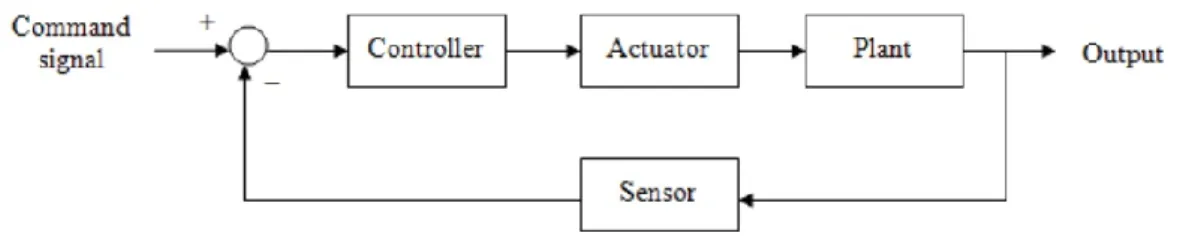
In (Boyd and Barratt, 1991), control system is defined as an interconnected components that forms a system configuration that will provide a desired system response. Basic control system includes sensors, control processors and actuator. The schematic diagram of a general control system is shown in Figure 1.1.
In Figure 1.1, the function of a sensor is to sense and measure various signals in the system, a controller processes the sensed signal and drives the actuator, which affect the behavior of the plant. Since the sensor signal may affect the system which is to be controlled, the control system shown in Figure 1.1 above is called a feedback or closed-loop control system. The feedback term is refered to the signal loop that circulated clockwise in the figure above. In contrast, a control system without sensors which generates the actuator signal from the command signals alone is called an open-loop system.
In control design process, the most critical element is the process of adjusting the controller parameter where this process is widely known as controller tuning process. This process must be done to ensure the controller to provide the desired performance of the system. There are lots of controllers available in the market from the simple controllers such as Proportional-Integral-Derivative (PID) and optimal controllers likes Linear-Quadratic Regulator (LQR) and Linear Quadratic Gaussian (LQG). The complexity of a controller is based on the controller parameters that need to be tuned, where the more controller parameters needed to be tuned, the more complex is the controller. In this research, the priority is to find the optimal approach for optimising the performance of PID controller.
Despite the popularity of the controller employed with its simple structure, the tuning process difficulty of the PID controller mainly depends on the behavior of the plant itself (Astrom et al., 1993). The elements that contribute to the difficulties in tuning process are the nonlinearity of the system itself, unstable open-loop system, under-actuation and the order of the system (Atherton and Zhuang, 1992). Thus, this research tries to propose an algorithm that automatically give the user the optimised PID controller parameters for the objectives likes settling time, percentage overshoot and steady-state error in the system.
1.2 Problem Statement
Despite the popularity of PID controller as the most practical controller in control engineering, there were still drawbacks reported. Around 30 % of the installed PID controllers in industrial are still operating in manual mode and around 65 % of automatic PID controllers are poorly tuned (Rani, 2012). On the other hand, a study from Van Overschee in 1997 shows that more than 75 % of total PID controllers installed are badly tuned and over than 20 % of the total PID controllers are set under default setting, which means that the controllers are not tuned at all. These situations shows that the tuning process of PID controllers are the most critical criteria in tuning operators in which the existing tuning methods are not well compatible for the tuning problems in industry.
Hence this research tries to produce an alternative approach of tuning the PID controllers. It is believed that the developed algorithm in this research will provide the users or designers with the automatic optimized PID controller with less complex tuning process.
1.3 Research Objectives
The aim of this research is to develop a new variance of optimization algorithm for the tuning process of PID controller. The objectives are:
1) To study the process system flow in Activated Sludge Process (ASP) and VVS-400 heat and ventilation system
2) To apply Gravitational Search Algorithm (GSA) optimisation techniques as main tuning mechanism of PID controller
3) To analyze the closed loop performance of both systems using GSA-PID and other optimisation algorithms such as Genetic Algorithm (GA) and Particle Swarm Optimisation (PSO) via simulation analysis
4) Develop a variance of GSA that can enhancing the performance of PID controller for simulation and hardware analysis of both ASP and VVS-400 process system
1.4 Research Scopes
This research consists of a few focus works in order to achieve its objectives. 1) Developing an enhancement optimisation algorithm to optimally tune the
PID controller performances like settling time, steady state error and percentage overshoot.
2) Analysing the performance of enhancement optimisation algorithm involved based on the output transient responses produced and comparing to well-known algorithms.
3) Applying all the optimisation-based PID controllers to the VVS-400 pilot for controller’s validation process in real time implementation.
1.5 Research Contribution
The main contributions from this research is introduction of a variants of GSA called Improved Gravitational Search Algorithm that able to enhance the PID controller performances by producing better transient responses than other optimisation-based PID controller which are GSA-PID, PSO-PID and GA-PID.
1.6 Thesis Structure
This thesis basically divided into five chapters. Chapter 2 presents the review on previous works that was conducted on Wastewater Treatment Plant (WWTP) especially in Activated Sludge Process (ASP) plant and heat ventilation system especially on VVS-400 plant related to the controller implementations. PID controller
tuning methods also been covered involving both conventional and alternatives approaches.
Chapter 3 presents the flow and methodology on the development of Improved GSA-PID controller. The implementation of GSA and other optimisation methods such as PSO and GA which define the tuning parameters of PID controller are also will be explained in this chapter..
Chapter 4 provides the results of the transient performances by using Improved GSA-PID controller and other optimisation-based PID controller such as GA-PID and PSO-PID. The thorough analysis on all optimisation-based PID controllers will be discussed in this chapter. This chapter also shows the transient performance of all optimisation-based PID controllers in real time application system. All the works involved in this chapter were done in simulation system of ASP and VVS-400 as well real plant of VVS-400 using MATLAB Simulink platform.
Chapter 5 consists of conclusion based on the overall results and analysis that was done. The improvement and future works relates to this project are also included in this chapter.
REFERENCES
Abdalla, T.Y. and Abdulkareem, A.A. (2012). PSO-based Optimum Design of PID Controller for Mobile Robot Trajectory Tracking. International Journal of Computer Applications, 47(23), pp.30–35.
Ali, M.O., Koh S. P., Chong K. H., and Obaid, Zeyad Assi. (2009). Genetic Algorithm Tuning Based PID Controller for Liquid-Level Tank System. Proceedings of the International Conference on Man-Machine Systems (ICoMMS). Pulau Pinang, Malaysia. pp. 11–13.
Allaoua, B., Gasbaoui, B. and Mebarki, B. (2009). Setting Up PID DC Motor Speed Control Alteration Parameters Using Particle Swarm Optimization Strategy. Leonardo Electronic Journal of Practices and Technologies, (14), pp.19–32. Aly, A.A. (2011). PID Parameters Optimization Using Genetic Algorithm Technique
for Electrohydraulic Servo Control System. Intelligent Control and Automation, 2(May), pp.69–76.
Astrom, K.J., Hagglund, T., Hang, C. C., and Ho, W. K. (1993). Automatic Tuning and Adaption for PID Controllers - A Survey. Control Engineering Practice, 1(4), pp.699–714.
Atherton, D.P. and Zhuang, M. (1992). Automatic Tuning of Optimum PID Controllers. IEEE Proceedings in Control Theory and Applications, 140(3), pp.216–224.
Bhaskaran, S., Varma, R. and Ghosh, J. (2013). A Comparative Study of GA , PSO and APSO : Feed Point Optimization of a Patch Antenna. International Journal of Scientific and Research Publications, 3(5), pp.1–5.
Bhattacharya, A., Datta, S., and Basu, Meheli. (2012). Gravitational Search Algorithm Optimization for Short-term Hydrothermal Scheduling. 2012 International Conference on Emerging Trends in Electrical Engineering and Energy Management (ICETEEEM), pp.216-231.
Bhattacharya, A. and Roy, P.K. (2012). Solution of Multi-Objective Optimal Power Flow using Gravitational Search Algorithm. IET Generation, Transmission & Distribution, 6(8), p.751.
Blum, C. and Roli, A. (2003). Metaheuristics in Combinatorial Optimization : Overview and Conceptual Comparison. ACM Computing Surveys, 35(3), pp.268–308.
Boyd, S. and Barratt, C. (1991). Linear Controller Design : Limits of Performance, Prentice-Hall.
Ceylan, O., Ozdemir, A. and Dag, H. (2010). Gravitational Search Algorithm for Post-Outage Bus Voltage Magnitude Calculations. In 45th International Universities Power Engineering Conference (UPEC). Cardiff, United Kingdom. pp. 1–6. Che Razali, M., Abdul Wahab, Norhaliza. and Samsuddin, S.I. (2014). Multivariable
PID Using Singularly Perturbed System. Jurnal Teknologi, 5, pp.63–69.
Chen, H. and Chang, S. (2006). Genetic Algorithms Based Optimization Design of a PID Controller for an Active Magnetic Bearing. IJCSNS International Journal of Computer Science and Network Security, 6(12), pp.95–99.
Choo, H.P., Shalan, Shafisuhaza, Eek, Ricky T. P., and Abdul Wahab, Norhaliza. (2013). Self-tuning PID Controller for Activated Sludge System. IEEE 8th Conference on Industrial Electronics and Applications (ICIEA). pp. 16–21. Duman, S., Sonmez, Y., Guvenc, U. and Yorukeren, N. (2011). Application of
Gravitational Search Algorithm for Optimal Reactive Power Dispatch Problem. 2011 International Symposium on Innovations in Intelligent Systems and Applications, pp.519–523.
Duman, S., Güvenç, U. and Yörükeren, N. (2010). Gravitational Search Algorithm for Economic Dispatch with Valve-Point Effects. International Review of Electrical Engineering (I.R.E.E.), 5(December), pp.2890–2895.
Duman, S., Maden, D. and Güvenç, U. (2011). Determination of the PID Controller Parameters for Speed and Position Control of DC Motor using Gravitational Search Algorithm. 7th International Conference on Electrical and Electronics Engineering (ELECO). pp. 225–229.
Fan, L. and Joo, E.M. (2009). Design for Auto-tuning PID Controller Based on Genetic Algorithms. 2009 4th IEEE Conference on Industrial Electronics and Applications. Xia'an, China. pp. 1924–1928.
Feng, Y., Long, T., Guo, J., Zhao, H., and Zhang, X. (2003). Robust Fuzzy PID Control for ASP Wastewater Treatment System. Fourth International Conference on Control and Automation (ICCA’03). Montreal, Canada. pp. 10– 12.
Gaing, Z.-L. (2004). A Particle Swarm Optimization Approach for Optimum Design of PID Controller in AVR System. IEEE Transactions on Energy Conversion, 19(2), pp.384–391.
Gaya, M.S., Abdul Wahab, N., M. Sam, Y., and Samsuddin, S. I. (2013). ANFIS Inverse Control of Dissolved Oxygen in an Activated Sludge Process. 2013 IEEE 9th International Colloquium on Signal Processing and its Applications, Kuala Lumpur, Malaysia. pp.146–150.
Gaya, M.S., Abdul Wahab, N., Md. Sam, Y., Che Razali, M., and Samsuddin, S. I. (2012). Neuro-fuzzy Modelling of Wastewater Treatment System. 2012 IEEE International Conference on Control System, Computing and Engineering. Pulau Pinang, Malaysia. pp. 250–253.
Geem, Z.W., Kim, J.H. and Loganathan, G. (2001). A New Heuristic Optimization Algorithm: Harmony Search. Simulation, 76:2, pp.60–68.
PID. International Journal of Computer Science, 10(2), pp.462–471.
Girirajkumar, S.M., Kumar, A.A. and Anantharaman, N. (2010). Tuning of a PID Controller for a Real Time Industrial Process using Particle Swarm Optimization. IJCA Special Issue on “Evolutionary Computation for Optimization Techniques”, pp.35–40.
Glover, F. (1990). Tabu Search: A Tutorial. Interfaces, 20, pp.74–94.
Griffin, I. (2003). On-line PID Controller Tuning using Genetic Algorithms. Master’s Thesis, Dublin City University.
Halliday, D., Resnick, R. and Walker, J. (1993). Fundamental of Physics, John Wiley & Sons.
Holenda, B., Domokos, E., Redey, A., and Fazakas, J. (2008). Dissolved Oxygen Control of the Activated Sludge Wastewater Treatment Process using Model Predictive Control. Computers & Chemical Engineering, 32(6), pp.1270–1278. Hussien, S.Y.S., jaafar, H., Selamat, N. A., Daud, F. S., and Abidin, A. F. Z., (2014).
PID Control Tuning via Particle Swarm Optimization for Coupled Tank System. International Journal of Soft Computing and Engineering (IJSCE), 4(2), pp.202– 206.
Hussin, Nurul Nabihah. (2010). Modelling and Control Design of Temperature Ventilation Rig. Degree Thesis, Universiti Teknologi Malaysia, Skudai.
Ibrahim, Z., Muhammad, B., Ghazali, K. H., Lim, K. S., Nawawi, S. W., and Md. Yusof, Z. (2012). Vector Evaluated Gravitational Search Algorithm (VEGSA) for Multi-objective Optimization Problems. 2012 Fourth International Conference on Computational Intelligence, Modelling and Simulation. Pahang, Malaysia. pp.13–17.
Jaafar, H.I., Abdullah, A. R., Mohamed, Z., Jamian, J. J., Kassim, A. A., Aras, M. S. M., Nasir, M. N. M., and Sulaima, M. F. (2013). Analysis of Optimal Performance for Nonlinear Gantry Crane System using MOPSO with Linear Weight Summation Approach. Proceedings of Malaysian Technical Universities Conference on Engineering & Technology (MUCET). pp. 1–6.
Jaen-Cuellar, A.Y., Morales-Velazquez, L. and Osornio-rios, R.A. (2013). PID-Controller Tuning Optimization with Genetic Algorithms in Servo Systems. International Journal of Advanced Robotic Systems, 10(324), pp.1–14.
Jalilvand, A., Kimiyaghalam, A., Ashouri, A., and Kord, H. (2011). Optimal Tuning of PID Controller Parameters on a DC Motor Based on Advanced Particle Swarm Optimization Algorithm. International Journal on Technical and Physical Problems of Engineering, 3(December), pp.10–17.
Jayachitra, A. and Vinodha, R. (2014). Genetic Algorithm Based PID Controller Tuning Approach for Continuous Stirred Tank Reactor. Advanced in Artificial Intelligent, 2014, pp.1–8.
Kalaichelvi, D., Ramesh Kumar, S. and Ganapathy, S. (2014). Gravitational Search Algorithm Based Optimal Pitch Controller Design for an Isolated Wind-diesel Hybrid Power System. International Journal of Development Research, 4(3), pp.532–536.
Kasilingam, G. (2014). Particle Swarm Optimization Based PID Power System Stabilizer for a Synchronous Machine. International Journal of Electrical, Computer, Energetic, Electronic and Communiation Engineering, 8(1), pp.111– 116.
Kennedy, J., Poli, R. and Blackwell, T. (1995). Particle Swarm Optimization. Swarm Intelligence, 1(1), pp.33–57.
Kim, T., Maruta, I. and Sugie, T. (2007). Particle Swarm Optimization based Robust PID Controller Tuning Scheme. Proceedings of the 46th IEEE Conference on Decision and Control. pp. 200–205.
Kirkpatrick, S., Gelatt, C.D. and Vecchi, M.P. (1983). Optimization by Simulated Annealing. Science, 220(4598), pp.671–680.
Kumar, A. and Gupta, R. (2013). Compare the results of Tuning of PID controller by using PSO and GA Technique for AVR system. International Journal of Advanced Research in Computer Engineering and Technology, 2(6), pp.2130– 2138.
Kumar, A. and Shankar, G. (2015). Priority Based Optimization of PID Controller for Automatic Voltage Regulator System using Gravitational Search Algorithm. International Conference on Recent Developments in Control, Automation and Power Engineering. Noida U. P., India. pp. 292–297.
Kumar, B. and Dhiman, R. (2011). Optimization of PID Controller for Liquid Level Tank System using Intelligent Techniques. Canadian Journal on Electrical and Electronics Engineering, 2(11), pp.531–535.
Lin, G. and Liu, G. (2010). Tuning PID controller using adaptive genetic algorithms. In 2010 5th International Conference on Computer Science & Education. Hefei, China. pp. 519–523.
Liu, D. et al. (2009). Fuzzy Immune PID Temperature Control of HVAC System. Advance in Neural Network - ISNN 2009. pp. 1138–1144.
Malik, S. et al. (2014). Parameter Estimation of a PID Controller using Particle Swarm Optimization Algorithm. International Journal of Advanced Research in Computer and Communication Engineering, 3(3), pp.5827–5830.
Mantri, G. and Kulkarni, N.R. (2013). Design and Optimization of PID Controller using Genetic Algorithm. International Journal of Research in Engineering and Technology, 2(6), pp.926–930.
Mirjalili, S. and Hashim, S.Z.M. (2010). A New Hybrid PSOGSA Algorithm for Function Optimization. 2010 International Conference on Computer and Information Application. Tianjin, China. pp. 374–377.
Moghadds, M., Dastranj, M., Changizi, N., and Rouhani, M. (2010). PID Control of DC Motor using Particle Swarm Optimization (PSO) Algorithm. Journal of Mathematics and Computer Science, 1(4), pp.386–391.
Mohamed Ibrahim, S. (2005). The PID Controller Design Using Genetic Algorithm. Degree’s Thesis, University of Queensland.
Mohd Subha, Nurul Adilla. (2010). Modeling and Controller Design for The VVS-400 Pilot-Scale Heating And Ventilation System. Master Thesis, Universiti Teknologi
Malaysia.
Mooney, R.P. and Dwyer, A.O. (2006). A Case Study in Modeling and Process Control : the Control of a Pilot Scale Heating and Ventilation System. Proceedings of 23rd International Manufacturing Conference. Washington, D. C., USA. pp. 123–130.
Munoz, R. and Encina, P.G. (2000). Chapter 4 : Activated Sludge Modelling. Available: www. academia. edu.
Nayak, A. and Singh, M. (2015). Study of Tuning of PID Controller By Using Particle Swarm Optimization. International Journal of Advanced Engineering Research and Studies, IV(Jan.-March), pp.346–350.
Ou, C. and Lin, W. (2006). Comparison between PSO and GA for Parameters Optimization of PID Controller. 2006 International Conference on Mechatronics and Automation. pp. 2471–2475.
Rahmat, M. F., Samsudin, S. I., Wahab, N. A., Sy Salim, S. N., and Gaya, M. S. (2011). Control Strategies of Wastewater Treatment Plants. Australian Journal of Basic and Applied Sciences, 5(8), pp.446–455.
Rahmat, Mohd Fuaad. et al. (2009). Modelling and Controller Desing for the VVS-400 Pilot Scale Heating and Ventilation System. International Journal on Smart Sensing and Inteligent System, 2(4), pp.579–601.
Rani, Mohd Raihani. (2012). Multi-objective Optimization of PID Controller Parameters using Genetic Algorithm. Master Thesis, Universiti Teknologi Malaysia, Skudai.
Rashedi, E., Nezamabadi-pour, H. and Saryazdi, S. (2009). BGSA: Binary Gravitational Search Algorithm. Natural Computing, 9(3), pp.727–745.
Rashedi, E., Nezamabadi-pour, H. and Saryazdi, S. (2009). GSA: A Gravitational Search Algorithm. Information Sciences, 179(13), pp.2232–2248.
Rojas, D., Alfaro, M. and Vilanova, R. (2011). Control of an Activated Sludge Process using the Virtual Reference Approach. Proceedings of the International MultiConference of Engineers and Computer Scientists. Hong Kong. pp. 1–6. Saad, M.S., Jamaluddin, H. and Darus, I.Z.M. (2012). PID Controller Tuning Using
Evolutionary Algorithms. WSEAS Transaction on System and Control, 7(4), pp.139–149.
Sahu, R.K., Panda, S. and Padhan, S. (2014). Optimal Gravitational Search Algorithm for Automatic Generation Control of Interconnected Power Systems. Ain Shams Engineering Journal, 5(3), pp.721–733.
Sanchez, A. and Katebi, M.R. (2003). Predictive Control of Dissolved Oxygen in an Activated Sludge Wastewater Treatment Plant. Proceeding of the European Control Conference ECC. Cambridge, United Kingdom. pp. 1–6.
Selamat, Nur Asmiza. (2013). Multivariable PID Control Tuning Based On Optimization Technique for Wastewater Treatment Plant. Master Thesis, Universiti Teknologi Malaysia, Skudai.
Rahim, M. A., and Khalil, K. (2012). A Fast Discrete Gravitational Search Algorithm. 2012 Fourth International Conference on Computational Intelligence, Modelling and Simulation. pp. 24–28.
Socha, K. and Blum, C. (2006). Ant Colony Optimization. Operations Research/Computer Science Interfaces Series Volume 36. pp. 153–180.
Solihin, M.I., Tack, L.F. and Kean, M.L. (2011). Tuning of PID Controller Using Particle Swarm Optimization (PSO). Proceeding of the International Conference on Advanced Science, Engineering and Information Technology. pp. 458–461. Sombra, A., Valdez, F., Melin, F., and Castillo, O. (2013). A New Gravitational
Search Algorithm Using Fuzzy Logic to Parameter Adaptation. IEEE Congress on Evolutionary Computation. pp. 1068–1074.
Subha, N.A.M., Rahmat, M.F. and Ishaq, K.M. (2011). Controller Design for a Pilot-scale Heating and Ventilation System Using Fuzzy Logic Approach. Jurnal Teknologi, 54(Jan. 2011), pp.123–139.
Suresh, R. et al. (2013). Application of Gravitational Search Algorithm for Real Power Loss and Voltage Deviation Optimization. International Journal of Engineering Science and Innovative Technology (IJESIT), 2(1), pp.283–291.
Tarique, A. and Gabbar, H.A. (2013). Particle Swarm Optimization (PSO) Based Turbine Control. Intelligent Control and Automation, 2013(May), pp.126–137. Thomas, N. and Poongodi, P. (2009). Position Control of DC Motor Using Genetic
Algorithm Based PID Controller. Proceeding of the World Congress on Engineering. pp. 1–5.
Tzoneva, R. (2007). Method For Real Time Optimal Control of the Activated Sludge Process. 2007 Mediterranean Conference on Control and Automation. pp.1-6. Tzoneva, R. (2007). Optimal PID Control of the Dissolved Oxygen Concentration in
the Wastewater Treatment Plant. Africon 2007. pp. 1–7.
Urade, H.S. and Patel, R. (2011). Study and Analysis of Particle Swarm Optimization : A Review. 2nd National Conference on Information and Communication Technology (NCICT). pp. 1–5.
Vladu, E.E. and Dragomir, T.L. (2004). Controller Tuning Using Genetic Algorithms. Proceedings of 1st Romanian-Hungarian Joint Symposium on Applied Computational Intelligence. Budapest, Hungary. pp. 1–10.
Voss, Stefan. (2001). Meta-heuristics: The State of the Art. Local Search for Planning and Scheduling. pp. 1–10.
Wahab, Norhaliza, Katebi, M.R. and Balderud, J. (2007). Multivariable PID Control Design for Wastewater Systems. 2007 Mediterranean Conference on Control & Automation. Athens, Greece. pp. 1–6.
Xing-hong, Q., Fei, L. and Yu-ge, X. (2015). Robust PID Control for a Wastewater Treatment Based on Genetic Algorithm and Small-gain Approach. Proceedings of the 34th Chinese Control Conference. Hangzhou, China. pp. 2967–2972. Yang, D. (2011). PID Fuzzy Control of Activated Sludge System. International
China. pp. 1573–1576.
Yang, X.S. (2010). Firefly algorithm, Lévy flights and global optimization. Research and Development in Intelligent Systems XXVI: Incorporating Applications and Innovations in Intelligent Systems XVII. pp. 209–218.
Yang, X.S. and Deb, S. (2010). Cuckoo Search via Levy Flights. Proceedings of World Congress on Nature and Biologically Inspired Computing (NaBIC 2009). pp. 210–214.
Ziegler, J.G. and Nichols, N.B. (1942). Optimum Settings for Automatic Controllers. Transactions of the A.S.M.E., pp.759–765.