May 2007
Torbjørn Skramstad, IDI
Carl Christensen, BEKK Consulting AS
Master of Science in Computer Science
Submission date:
Supervisor:
Co-supervisor:
Norwegian University of Science and Technology
Department of Computer and Information Science
Services
The use of Web Services has grown rapidly the last years. Integrating existing systems and building many small systems that collaborate through Web Services to form a larger system, is becoming more and more important in the software industry. Unfortunately the focus of the earliest Web Service standards was on functionality and not security. This has, however, improved lately with the release of several security standards to support e.g. confidentiality and integrity. The master thesis «Adding Security to Web Services» by Brekken and Åsprang, proposed different approaches for creating secure Web Services. Input Validation of SOAP envelopes was realized with XML Schemas. This project will build upon the experiences and results found in that thesis to develop a framework for input validation in Web Services.
The goals of this project are:
* Define and develop a framework for using, developing and maintaining Web Service input validation policies in a structured, distributable and reusable manner.
* Demonstrate how to utilize and integrate the framework with existing SOAP frameworks.
Assignment given: 19. January 2007 Supervisor: Torbjørn Skramstad, IDI
especially important for web applications since they usually are exposed to the Internet. Web Services offer application to application connectivity using the SOAP protocol. Web Services are quite often built as an extension to already existing applications to provide business to business communication. Since it is often necessary to expose critical business functions through the Web Services, e.g., ordering an item or sending an invoice, security in Web Services are vital for a company’s daily operations.
In this project we have created an input validation framework for Web Services, to aid developers in creating more secure Web Services in an easier and more reusable manner. We have focused on creating a lightweight policy configuration based on XML, and a set of highly configurable and extendable validators. The framework is implemented in Java and is not dependent on a specific SOAP framework. To keep the framework general and compatible with multiple SOAP frameworks, we have developed a set of interceptors to support the two most common open source SOAP frameworks, Codehaus XFire and Apache Axis2.
This report first presents theory and rationale behind the need for a new way of performing input validation. Further the implementation of the framework is documented together with an example application, which demonstrates an example use of the framework.
This master’s thesis documents the work done by Henning Jensen from January to June 2007. It is the final work on a Master of Technology degree from the Department of Computer Science and Information Science (IDI) at the Norwegian University of Science and Technology (NTNU). The assignment was initiated by Bekk Consulting AS (BEKK) as a part of their involvement in the open source community.
I would like to thank Professor Torbjørn Skramstad at IDI/NTNU and Carl C. Christensen at Bekk Consulting AS for all their guidance and valuable feedback during the project. I really appreciate their time and efforts.
June 1, 2007
Henning Jensen
List of Figures xi
List of Tables xii
List of Listings xiii
List of Abbreviations xiv
1 Introduction 1 Motivation . . . 2 Problem Definition . . . 2 Project Context . . . 3 Report Outline . . . 3 2 Theoretical Background 5 2.1 XML . . . 6 2.2 Web Services . . . 11 2.3 SOAP Frameworks . . . 17
2.4 Security in Web Services . . . 21
3 Own Contribution 25 3.1 Input Validation with WSDL-documents . . . 26
3.2 Requirements . . . 27
3.3 Implementation . . . 29
3.4 Example Application - Book Service . . . 34
4 Evaluation and Conlusion 39 4.1 Discussion and Evaluation . . . 40
4.2 Conclusion . . . 42
4.3 Further Work . . . 43
Bibliography 45
A Policy Configuration DTD 51
B Source code - WSPV Core 53
B.1 Source Code -no.fjas.wspv.ServiceConfig . . . 53
B.2 Source Code -no.fjas.wspv.Validator . . . 54
B.3 Source Code -no.fjas.wspv.ConfigParser . . . 55
B.4 Source Code -no.fjas.wspv.ValidatorSupport. . . 60
C Source Code - WSPV XFire Handler 63
2.1 Web Services Overview . . . 11
2.2 SOAP Envelope Structure . . . 12
2.3 SOAP Frameworks Overview . . . 17
2.4 Axis2 Component Architecture . . . 18
2.5 Axis2 Processing Model . . . 19
2.6 XFire Component Architecture . . . 19
2.7 Web Application Firewall . . . 23
3.1 WS Payload Validator - Parts Overview . . . 29
3.2 WS Payload Validator Core - UML Class Diagram . . . 30
3.3 XFire Handler - UML Sequence Diagram . . . 33
2.1 Web Service Extension Standards . . . 13
2.2 Web Services Security Threats . . . 22
3.1 WS Payload Validator - Provided Standard Validators . . . 32
3.2 Example Application - Validation Policy proposal . . . 37
2.1 Document-centric XML . . . 6
2.2 Data-centric XML . . . 6
2.3 Namespaces in XML . . . 7
2.4 XML Schema - Document Example . . . 7
2.5 XML Schema - Schema Example . . . 8
2.6 XML Schema - Corresponding DTD . . . 9
2.7 SOAP Request Envelope . . . 12
2.8 SOAP Response Envelope . . . 12
2.9 WSDL Document - Type definitions . . . 14
2.10 WSDL Document - Message definitions . . . 16
2.11 WSDL Document - Port Type definitions . . . 16
3.1 WS Payload Validator - Configuration Policy Example . . . 31
3.2 Example Application - BookService.java . . . 34
3.3 Example Application - BookServiceImpl.java . . . 34
3.4 Example Application - XFire configuration, services.xml . . . 36
3.5 Example Application - XFire configuration with validation, services.xml 36 3.6 Example Application - WS Payload Validator configuration . . . 37
A.1 WSPV Policy Configuration DTD . . . 51
B.1 Source Code - no.fjas.wspv.ServiceConfig . . . 53
B.2 Source Code - no.fjas.wspv.Validator . . . 54
B.3 Source Code - no.fjas.wspv.ConfigParser . . . 55
B.4 Source Code - no.fjas.wspv.ValidatorSupport . . . 60
C.1 Source Code - no.fjas.wspv.xfire.XFireValidatorHandler . . . 63
D.1 Source Code - no.fjas.wspv.Axis2.WSPVHandler . . . 65
API Application Programming Interface
AXIOM AXis Object Model
DTD Document Type Definition
REST REpresentational State Transfer
SOAP Simple Object Access Protocol
StAX Streaming API for XML
TDD Test Driven Development
UDDI Universal Description Discovery & Integration
URL Uniform Resource Locator
XML Extensible Markup Language
W3C World Wide Web Consortium
WSDL Web Services Description Language
WSPV Web Service Payload Validator
XP eXtreme Programming
Chapter
1
Introduction
This chapter presents the motivational background and the problem definition, including the goals, for the project. We then introduce the project context and the report outline.
Motivation
Input validation is one of the most important aspects in web application security. Being able to trust your users’ input is important in order to allow them accessing critical business systems.
Web applications are a bit different than regular desktop software. They are harder to keep secure since they are accessible to anyone with a connection to the Internet. A web application encourages user mobility, but at the same time it is exposed and accessible to anyone with Internet access.
Symantec’s Internet Security Threat Report [1] is published every six months. In volume XI, covering the period between July 1 and December 31 2006, 66 percent of the reported vulnerabilities affected web applications. The second most common cause of data breaches was insecure policies, which made up 28 percent of all incidents. These numbers emphasize the importance of properly secured Web Services.
The growing number of web applications and the need for interoperability laid the foundation for Web Services (SOAP) [2]. Web Services allow for systems to interact with XML over HTTP. Applications can exchange data between themselves independently of platform and programming language. Since data is going in and out of the system boundaries, input validation is needed to keep the system secure. Input validation in Web Services has, however, not been very easy to comprehend. The developers have usually been left alone with the security issues without much help from the SOAP frameworks. A framework that aids the developer performing input validation in a structured and reusable manner, could contribute to making Web Services more secure.
Problem Definition
The master thesisAdding Security to Web Services[3] proposed different approaches for creating secure Web Services. Input Validation of SOAP envelopes was realized with XML Schemas. This project will build upon the experiences and results found in that thesis to develop a framework for input validation in Web Services.
The goals of this project are:
• Define and develop a framework for using, developing and maintaining Web Service input validation policies in a structured, distributable and reusable manner.
• Demonstrate how to utilize and integrate the framework with existing SOAP frameworks.
Project Context
This project is a master’s thesis carried out at the Software Engineering Group which is a part of the Department of Computer and Information Science at the Norwegian University of Science and Technology (NTNU) in Trondheim. The project is also carried out in cooperation with Bekk Consulting AS (BEKK), which is a leading Norwegian business consulting and technology service company.
Report Outline
The report has been split into four major chapters. Each chapter is briefly introduced below.
Introduction: Gives a brief overview of the work, the problem definition, its motivational background, the project context and this report outline.
Theoretical Background: Contains the necessary literature study performed in the earlier stages of the project. This forms the basis for the requirements and choices made later in the project. This chapter covers four major topics: XML, Web Services, SOAP frameworks and security in Web Services.
Contribution: This chapter contains the contribution work for this thesis. We will present the issues we have found with today’s most common method on performing input validation, before we move on with the requirements and architecture of our input validation framework. Then we will cover the details of the implementation. The last section contains an example application, which is used to demonstrate the usage of the framework.
Evaluation and Conlusion: Contains a discussion and evaluation of the project together with the conclusion. At the end there is a section about further work and suggestions for the framework.
Chapter
2
Theoretical Background
This chapter presents background information around the topics of Web Services. A brief introduction to XML will be given, and a more thorough explanation of the concept of Web Services. We will also present an overview of the two most common frameworks used to create Web Services in Java. Security concerns in Web Services will be covered in the last section of the chapter.
2.1
XML
This section will give a brief introduction to XML. For a more thorough introduction we recommend [4, 5].
Extensible Markup Language (XML) [6] was introduced by the World Wide Web Consortium (W3C) in 1998. Two kinds of XML exists, document-centric and data-centric. Document-centric XML origins from SGML and has been used to represent semi structured documents such as technical manuals and product catalogs. The key factor in these documents is the semi structured mark-up text [4].
<h1>Product details for Samsung Syncmaster 225BW</h1> <p>LCD-screen details:</p> <list> <item>Size: 22’</item> <item>Latency: 5ms</item> <item>Contrast: 700:1</item> </list> Listing 2.1: Document-centric XML
Listing 2.1 shows an example of document-centric XML. Document-centric XML is very human-friendly since the document structure is similar to a top-down plain text document. The document begins with a header, then a paragraph and ends with a list of properties. The markup does not interfere with the structure of the document. Data-centric XML is used to create highly structured information, i.e. textual representation of relational data from databases, financial transaction information or programming language data structures. Data-centric XML is often generated by machines and meant for machine consumption [4], even though it usually is quite readable for humans also. Listing 2.2 shows an example of data-centric XML.
<links>
<category name="Newspapers">
<link title="The New York Times">http://nytimes.com/</link>
<link title="International Herald Tribune">http://www.iht.com/</link> </category>
<category name="Personal">
<link title="John’s Homepage">http://myspace.com/johndoe</link> </category>
</links>
Listing 2.2: Data-centric XML
The structure of an XML document is quite simple since it just contains one type of logical structures: Elements. An element can contain other elements or it can hold a concrete value. Elements can also have attributes assigned to them. Attributes are name-value pairs that belong to a certain element and is often used to provide uniqueness, type constraints or setting default values.
2.1.1 Namespaces
An important property of XML documents is their ability to form large documents composed by several small documents. This makes it possible to reuse XML, but at the same time this creates a new problem: name collisions. If two elements with the same name from two different XML documents are joined together to form a single document, you will not have any way of uniquely identifying the two elements. This is why the Namespace in XMLstandard [7] was created. This standard defines how to enable different namespaces for different parts of an XML document. The namespace helps creating a unique identifier for all elements, making it possible to correctly process a document without having to worry about name collisions. Listing 2.3 shows an example of the use of namespaces. The name edi refers to a unique namespace that makes the price element unique for the rest of the document.
<edi:price xmlns:edi="http://ecommerce.example.org/schema" units="Euro"> 32.18
</edi:price>
Listing 2.3: Namespaces in XML
Namespaces are widely used in Web Services and more complex XML structures. In small and simple XML documents you rarely have to worry about namespaces.
2.1.2 XML Schema
The predecessor of XML Schema is Document Type Definition (DTD)[6]. DTDs has only support for specifying the most simple part of an XML document, the structure. It lacks support for namespace integration, modular vocabulary design and flexible content models. To address these issues the W3C came up with the XML Schema standard [8]. XML Schema is a standard on how to validate the structure and content of an XML document. The schema contains information about which elements a document can contain and their constraints.
Listing 2.4 shows an example of an XML document. The corresponding XML schema is shown in Listing 2.5. Examples from [9].
<purchaseOrder orderDate="1999-10-20"> <shipTo country="US">
<name>Alice Smith</name>
<street>123 Maple Street</street> <city>Mill Valley</city> <state>CA</state> <zip>90952</zip> </shipTo> <billTo country="US"> <name>Robert Smith</name> <street>8 Oak Avenue</street> <city>Old Town</city>
<zip>95819</zip> </billTo>
<comment>Hurry, my lawn is going wild</comment> <items>
<item partNum="872-AA">
<productName>Lawnmower</productName> <quantity>1</quantity>
<USPrice>148.95</USPrice>
<comment>Confirm this is electric</comment> </item> <item partNum="926-AA"> <productName>Baby Monitor</productName> <quantity>1</quantity> <USPrice>39.98</USPrice> <shipDate>1999-05-21</shipDate> </item> </items> </purchaseOrder>
Listing 2.4: XML Schema - Document Example
<xsd:schema xmlns:xsd="http://www.w3.org/2001/XMLSchema">
<xsd:element name="purchaseOrder" type="PurchaseOrderType"/>
<xsd:element name="comment" type="xsd:string"/>
<xsd:complexType name="PurchaseOrderType"> <xsd:sequence>
<xsd:element name="shipTo" type="USAddress"/> <xsd:element name="billTo" type="USAddress"/> <xsd:element ref="comment" minOccurs="0"/> <xsd:element name="items" type="Items"/> </xsd:sequence>
<xsd:attribute name="orderDate" type="xsd:date"/> </xsd:complexType>
<xsd:complexType name="USAddress"> <xsd:sequence>
<xsd:element name="name" type="xsd:string"/> <xsd:element name="street" type="xsd:string"/> <xsd:element name="city" type="xsd:string"/> <xsd:element name="state" type="xsd:string"/> <xsd:element name="zip" type="xsd:decimal"/> </xsd:sequence>
<xsd:attribute name="country" type="xsd:NMTOKEN" fixed="US"/>
</xsd:complexType>
<xsd:complexType name="Items"> <xsd:sequence>
<xsd:element name="item" minOccurs="0" maxOccurs="unbounded"> <xsd:complexType>
<xsd:sequence>
<xsd:element name="productName" type="xsd:string"/> <xsd:element name="quantity"> <xsd:simpleType> <xsd:restriction base="xsd:positiveInteger"> <xsd:maxExclusive value="100"/> </xsd:restriction> </xsd:simpleType> </xsd:element>
<xsd:element name="USPrice" type="xsd:decimal"/> <xsd:element ref="comment" minOccurs="0"/>
<xsd:element name="shipDate" type="xsd:date" minOccurs="0"/> </xsd:sequence>
<xsd:attribute name="partNum" type="SKU" use="required"/> </xsd:complexType>
</xsd:element> </xsd:sequence> </xsd:complexType>
<!-- Stock Keeping Unit, a code for identifying products --> <xsd:simpleType name="SKU"> <xsd:restriction base="xsd:string"> <xsd:pattern value="\d{3}-[A-Z]{2}"/> </xsd:restriction> </xsd:simpleType> </xsd:schema>
Listing 2.5: XML Schema - Schema Example
We can see that the schema language is strong. It can handle complex data structures, e.g. objects with other objects as properties, simple data types e.g.xsd:string,xsd:date,
xsd:positiveInteger, and various restrictions e.g. patterns, minOccurs, nillable. All of these properties makes the XML Schema language powerful, even though it is quite verbose. If we were to write the same definition using DTD we would have a smaller but also less powerful validation schema. Listing 2.6 shows an example of the same schema written in DTD.
<?xml version="1.0" encoding="UTF-8"?>
<!ELEMENT purchaseOrder (shipTo,billTo,comment,items)> <!ATTLIST purchaseOrder
orderDate CDATA #REQUIRED
>
<!ELEMENT shipTo (name,street,city,state,zip)> <!ATTLIST shipTo
country CDATA #REQUIRED
>
<!ELEMENT billTo (name,street,city,state,zip)> <!ATTLIST billTo
country CDATA #REQUIRED
>
<!ELEMENT name (#PCDATA)> <!ELEMENT street (#PCDATA)> <!ELEMENT city (#PCDATA)> <!ELEMENT state (#PCDATA)> <!ELEMENT zip (#PCDATA)> <!ELEMENT comment (#PCDATA)> <!ELEMENT items (item+)>
<!ELEMENT item (productName,quantity,USPrice,shipDate?,comment?)> <!ATTLIST item
partNum CDATA #REQUIRED
>
<!ELEMENT productName (#PCDATA)> <!ELEMENT quantity (#PCDATA)> <!ELEMENT USPrice (#PCDATA)> <!ELEMENT shipDate (#PCDATA)> <!ELEMENT comment (#PCDATA)>
DTDs does not have data types, and this is probably one of the most common reasons why developers are moving from DTD to XML Schema.
[10] investigated the use of XML Schemas versus DTD. They found that 73% of their collected XML Schemas used the simple type restrictions. The rest of the functionality was practically unused. If this is due to the complexity or immaturity of the language is hard to figure out, but it indicates that XML Schemas might be a bit complex for the average developer.
In fact both [10, 11] concludes that most of the XML Schemas could have been written in DTD from the structure point of view. This is an important factor as we will introduce Web Services, where XML Schemas are the primary tool for performing input validation.
2.2
Web Services
A Web Service is a software system designed to support interoperable machine-to-machine interaction over a network. It has an interface described in a machine-processable format (specifically WSDL). Other systems interact with the Web Service in a manner prescribed by its description using SOAP messages, typically conveyed using HTTP with an XML serialization in conjunction with other Web-related standards. (World Wide Web Consortium)
[12]
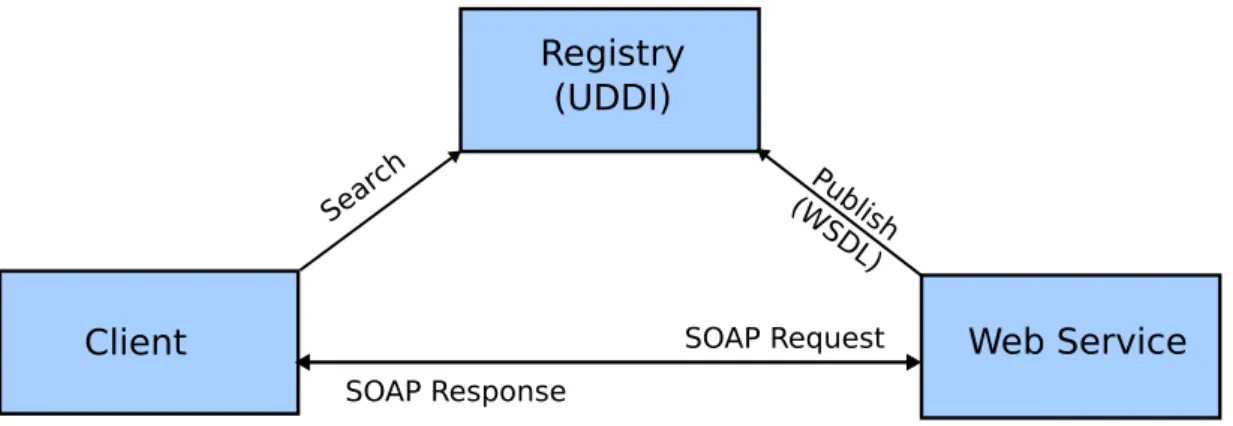
Figure 2.1: Web Services Overview
Web Services is based on normal client-server architecture. Figure 2.1 shows a conceptual overview of how clients interact with a Web Service. The client and server communicate by sending SOAP messages (XML) directly between themselves. Before this communication takes place the client needs to be aware of what services are offered, and how they can be utilized. This is done through a Web Services Description Language (WSDL) document. This document can be published directly to the client or looked up via a registry service called Universal Description Discovery & Integration (UDDI). In the next sections we will give an introduction to the SOAP protocol and WSDL-documents.
2.2.1 Simple Object Access Protocol (SOAP)
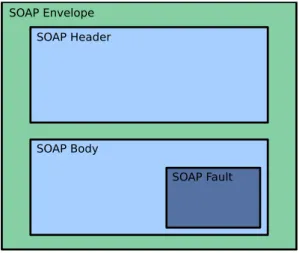
A Web Service is normally invoked by sending a request to a HTTP url (note that other transportation mechanisms than HTTP can be used, e.g. SMTP). SOAP is the message protocol used for communicating with Web Services. This protocol is based on XML, and a message is often referred to as an envelope. This envelope consists of a header and a body element. Figure 2.2 illustrates the structure of a SOAP envelope. The envelope body must contain an element with the name of the operation (method) to invoke. All arguments to the operation call must reside inside this element. This content of the envelope body is often referred to as thepayloadof the envelope, as it is the actual message from the client to the server.
Figure 2.2: SOAP Envelope Structure
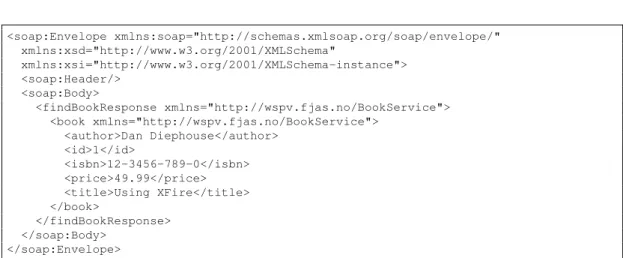
An example of a SOAP request and response envelope is shown in Listings 2.7 and 2.8 respectively. Note that namespaces (2.1.1) to the elements inside the envelope body have been removed to increase readability. In this exmple the client is sending a request to thefindBookoperation with an isbn number as a parameter. The server then generates a response containing aBookobject.
<soap:Envelope xmlns:soap="http://schemas.xmlsoap.org/soap/envelope/" xmlns:xsd="http://www.w3.org/2001/XMLSchema" xmlns:xsi="http://www.w3.org/2001/XMLSchema-instance"> <soap:Header/> <soap:Body> <findBook xmlns="http://wspv.fjas.no/BookService"> <isbn> 12-3456-789-0 </isbn> </findBook> </soap:Body> </soap:Envelope>
<soap:Envelope xmlns:soap="http://schemas.xmlsoap.org/soap/envelope/" xmlns:xsd="http://www.w3.org/2001/XMLSchema" xmlns:xsi="http://www.w3.org/2001/XMLSchema-instance"> <soap:Header/> <soap:Body> <findBookResponse xmlns="http://wspv.fjas.no/BookService"> <book xmlns="http://wspv.fjas.no/BookService"> <author>Dan Diephouse</author> <id>1</id> <isbn>12-3456-789-0</isbn> <price>49.99</price> <title>Using XFire</title> </book> </findBookResponse> </soap:Body> </soap:Envelope>
Listing 2.8: SOAP Response Envelope
The SOAP protocol allows extensions through the use of the header element. The header can contain extra information that is processed by the receiver. Many Web Service extension standards have been released, the most prominent security standards are listed in Table 2.2.1.
Name Purpose
WS-Addressing Enables messaging systems to support message trans-mission through networks that include processing nodes such as endpoint managers, firewalls, and gateways in a transport-neutral manner. [13]
WS-Policy Defines a base set of constructs that can be used and extended by other Web Services specifications to describe a broad range of service requirements and capabilities. [14] WS-Security Provides SOAP message integrity and confidentiality. Can be use to accommodate a wide variety of security models and encryption technologies. [15]
WS-SecurityPolicy Policy assertions for use with WS-Policy which apply to WSS: SOAP Message Security, Trust and WS-SecureConversation. [16]
WS-Reliability Protocol for exchanging SOAP messages with guaranteed delivery, no duplicates, and guaranteed message ordering. [17]
Table 2.1: Web Service Extension Standards
Even though there are several published security extensions like WS-Security [15] and WS-SecurityPolicy [16], none of them can be said to directly handle issues with proper validation of input data. This is usually handled indirectly by the WSDL document, which we will cover in Section 2.2.2.
SOAP Faults are a special element in the SOAP protocol [2]. A SOAP Fault can carry error information and is returned to the client if a server side error occurs during
processing of a request. It can carry several special elements inside, likecode,reason,
nodeanddetail, to give detailed information to the client. This is, however, something that should be used with precaution. Giving out too much error information can be a huge security risk [18]. The SOAP Fault should therefore be used with caution, and be as minimalistic and non-informative as possible when used in a production system.
2.2.2 Web Services Description Language (WSDL)
WSDL is used, as the abbreviation indicates, to describe a Web Service. In order for a client to be able to use a Web Service, it needs to know how to use it. Which operations are available and what kind of arguments each operation requires is vital information, and this is what the WSDL-document describes.
Web Services are described using six major elements (from the WSDL specification [19]):
• types, which provides data type definitions used to describe the messages exchanged.
• message, which represents an abstract definition of the data being transmitted. A message consists of logical parts, each of which is associated with a definition within the type system.
• portType, which is a set of abstract operations. Each operation refers to an input message and output message.
• binding, which specifies concrete protocol and data format specifications for the operations and messages defined by a particular portType.
• port, which specifies an address for a binding, thus defining a single communi-cation endpoint.
• service, which is used to aggregate a set of related ports.
In order to explain WSDL further we will look closer at an example WSDL document that describes the findBook-operation invoked in the previous SOAP envelope example in Listing 2.7. Listing 2.9 shows thetypesdefinition needed for thefindBook
operation which the SOAP envelopes in Listing 2.7 and 2.8 interact with.
<wsdl:types>
<xsd:schema targetNamespace="http://wspv.fjas.no/BookService" elementFormDefault= "qualified" attributeFormDefault="qualified">
<!-- define book object --> <xsd:complexType name="Book">
<xsd:sequence>
<xsd:element name="author" type="xsd:string" minOccurs="0" nillable="true" />
<xsd:element name="id" type="xsd:int" minOccurs="0" />
<xsd:element name="isbn" type="xsd:string" minOccurs="0" nillable="true" /> <xsd:element name="price" type="xsd:double" minOccurs="0" />
<xsd:element name="title" type="xsd:string" minOccurs="0" nillable="true" / >
</xsd:complexType>
<!-- define book exception -->
<xsd:complexType name="BookExceptionDetail"> <xsd:sequence>
<xsd:element name="code" type="xsd:string" minOccurs="0" nillable="true" /> <xsd:element name="detailMessage" type="xsd:string" minOccurs="0" nillable=
"true" /> </xsd:sequence> </xsd:complexType> </xsd:schema>
<xsd:schema targetNamespace="http://wspv.fjas.no/BookService" elementFormDefault= "qualified" attributeFormDefault="qualified">
<!-- define findBook method --> <xsd:element name="findBook">
<xsd:complexType> <xsd:sequence>
<xsd:element name="isbn" type="xsd:string" nillable="true" minOccurs="1" maxOccurs="1" />
</xsd:sequence> </xsd:complexType> </xsd:element>
<!-- define the findBook response --> <xsd:element name="findBookResponse">
<xsd:complexType> <xsd:sequence>
<xsd:element name="book" type="ns1:Book" nillable="true" minOccurs="1" maxOccurs="1" />
</xsd:sequence> </xsd:complexType> </xsd:element> </xsd:schema>
<xsd:schema targetNamespace="http://wspv.fjas.no/BookService" elementFormDefault= "qualified" attributeFormDefault="qualified">
<xsd:element name="BookFault" type="ns1:BookExceptionDetail" /> </xsd:schema>
</wsdl:types>
Listing 2.9: WSDL Document - Type definitions
Thistypesdefinition is a good example of the verbosity of the WSDL-document. To properly define thefindBookrequest with an isbn number and the response returning a book object with five properties, a total of 38 lines of xml is needed. The important thing to notice here is that thetypesdefinitions is built up by using XML Schema (see 2.1.2). This means that the datatypes to be sent in and out of a Web Service can be constrained according to the XML Schema standard [8]. Note that you can not trust the data unless you are 100% sure that the SOAP framework supports and enforces all specified constraints.
Moving on with themessagedefinition in the WSDL document, shown in listing 2.10, we can see that it defines three types of messages: findBookRequest, findBookResponse
andBookFault. Each message contain apartelement which points back to the elements in thetypesdefinitions we saw in the Listing 2.9.
<wsdl:message name="findBookRequest">
<wsdl:part element="tns:findBook" name="parameters" /> </wsdl:message>,
<wsdl:message name="findBookResponse">
<wsdl:part element="tns:findBookResponse" name="parameters" /> </wsdl:message>
<wsdl:message name="BookFault">
<wsdl:part element="ns2:BookFault" name="BookFault" /> </wsdl:message>
Listing 2.10: WSDL Document - Message definitions
Aport type refer to a complete operation including input message, output message and a potential fault message. Listing 2.11 defines the findBook operation which consists of all of the three messages defined in the previous Listing, 2.10.
<wsdl:portType name="BookServicePortType"> <wsdl:operation name="findBook">
<wsdl:input message="tns:findBookRequest" name="findBookRequest" /> <wsdl:output message="tns:findBookResponse" name="findBookResponse" /> <wsdl:fault message="tns:BookFault" name="BookFault" />
</wsdl:operation> </wsdl:portType>
Listing 2.11: WSDL Document - Port Type definitions
The last element, the binding definition, refers to the protocol and data format of all of the messages. Messages can be encoded in various ways to support different communication methods. SOAP is not necessary only transported over HTTP, it can also be sent with SMTP and other protocols, but HTTP transport is the most common.
2.2.3 Universal Description Discovery & Integration (UDDI)
UDDI is used for automatic discovery and publishing of WSDL documents. The rationale behind the development of UDDI was to enable clients to automatically look up Web Services in a central registry, just like the yellow pages in the phone book. A client can browse through the registry and find a suitable service. In the registry lies technical information about the service and its interfaces (WSDL-document) for the client to use.
Since we are focusing on input validation and security, UDDI is out of scope for this project. We recommend [20] for more information about UDDI.
2.3
SOAP Frameworks
In Java we need an application server or servlet container when running a web application. To run Web Services as well, we need a SOAP framework. The SOAP framework is responsible for receiving and sending SOAP messages to the client.
Figure 2.3: SOAP Frameworks Overview
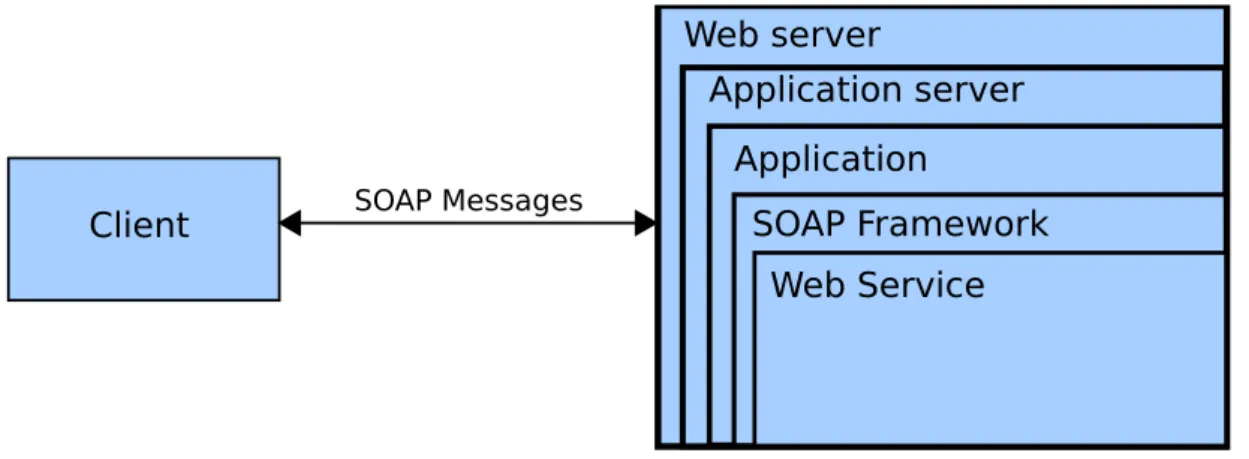
Figure 2.3 shows where SOAP frameworks operate. The SOAP framework is integrated within the running application and intercepts all SOAP requests that are sent to the application. This is done by reserving an Uniform Resource Locator (URL) for SOAP requests only, e.g. /services/*. This URL serves as a basis endpoint for all Web Services. For the SOAP framework to identify which service the client can use, each service is assigned an unique identifier. E.g., if we have a BookService with a
findBookoperation that allows a client to search for books, the address for this service could behttp://www.example.com/services/BookService
When the SOAP envelope is intercepted, the headers are inspected and various operations are performed before the correct internal service in the application receives the request. The SOAP envelope headers can contain authentication tokens, encryption information and other information that the SOAP framework needs to take care of before the envelope is forwarded. Most frameworks also support XML binding, which means it transforms the payload1of the SOAP envelopes into objects, that are suitable for interacting with underlying services within the application. Two popular open source SOAP frameworks areApache Axis 2andXFire. Their key features and architecture will be presented in the next sections.
2.3.1 Apache Axis2
Axis2 is an implementation of the W3C SOAP Recommendation [2]. The project is a follow-up on the original Apache SOAP project [21], which started up in june 2000. The Axis project has been one of the most successful open source SOAP frameworks with its large user community, and the wide range of applications using it.
Some of the key features in Axis2 are [22]:
• Streaming API for XML (StAX) - Fast API for XML Processing • AXis Object Model (AXIOM) - Light-weight XML object model • Hot Deployment - Runtime deployment of new services
• Component-oriented Deployment - Plugin processing handlers • WSDL 1.1 and 2.0 support
• REpresentational State Transfer (REST) support [23]
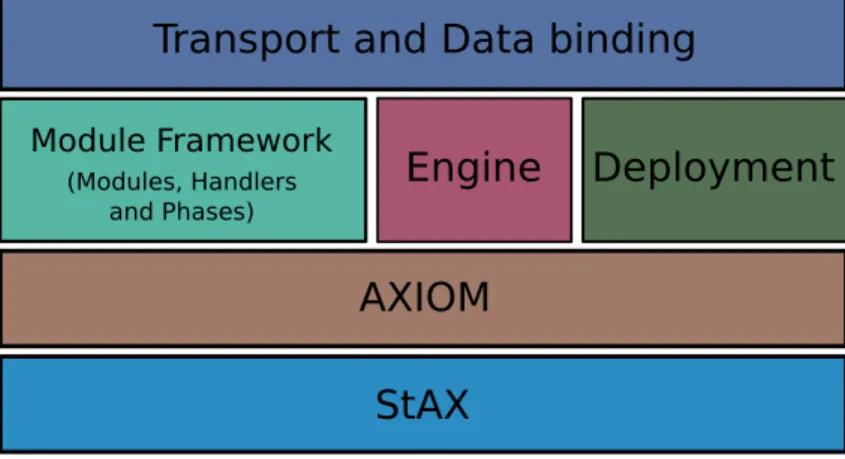
Axis2s architecture is built with flexibility and modularity in mind. The core engine is minimalistic and extra features are supported by pluggable modules. Figure 2.4 shows the general component architecture of Axis2. The foundation of Axis2 is the StAX and AXIOM API. On top of this is the core with the pluggable modules and the deployment functionality. Axis2 supports hot deployment which allows you to deploy new services at runtime. The top layer is dedicated to transport and data binding2.
Figure 2.4: Axis2 Component Architecture
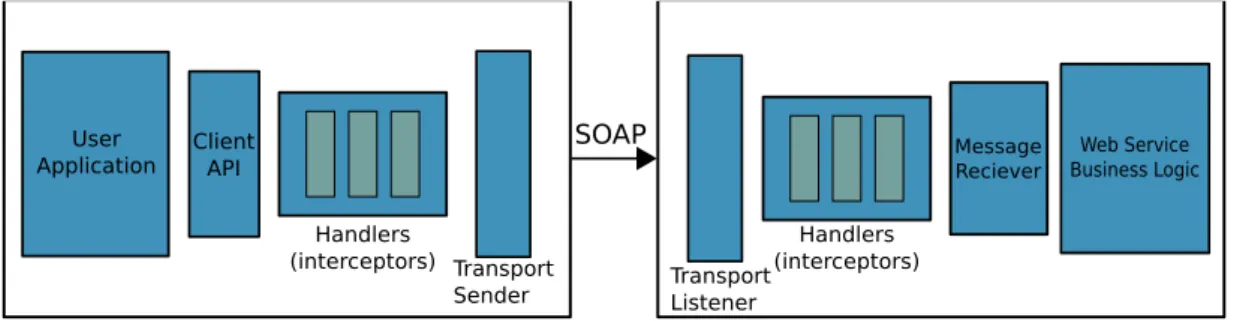
The Axis2 processing model is shown in Figure 2.5. Through its client API the user application can utilize a Web Service. The Axis2 client API supports Handlers for common processing needs. The transportation sender then can send the request as a SOAP envelope to the server side. Like the client side, Axis2 also haveHandlers
that the envelope can be processed through. This is where the WS-*3functionality is
2XML data binding refers to the process of representing the information in an XML document as an
object in computer memory.
implemented. Through a chain of processing handlers, different requirements can be enforced transparently for the user application and the Web Server business logic.
Figure 2.5: Axis2 Processing Model
2.3.2 XFire
XFire is a relatively new framework comparing to the Apache Axis project. It started in 2004 and one of its primary goals has been to create an embeddable and intuitive API. XFire uses the Spring Framework4 internally which has a strong focus onlow
coupling and high cohesion[24] through theInversion of Controlpattern [25]. Some of the key features in XFire are [26]:
• WSDL 1.1 Support
• StAX - Fast API for XML Processing
• Pluggable bindings - POJOs, XMLBeans, JAXB 1.1, JAXB 2.0, and Castor support • JSR 181 API (Annotations) [27] to configure services
• Container support: Spring, Pico, Plexus, and Loom
Figure 2.6: XFire Component Architecture
The component architecture of XFire is shown in Figure 2.6, and has some of the same elements as Axis2. Through its central service registry it looks up services and then invokes the set ofHandlersassociated with that service. When the handlers are finished processing, the request is forwarded to aTransportcomponent that handles transportation of the message to the client.
2.4
Security in Web Services
With the growing popularity of Web Services, comes the increased security threat against business systems. A Web Service creates additional entry points in an application. The more entry points an application has, the more entry points need to be secured by the development team.
Chapter 5 in [28] presents a comprehensive information security framework. It has six essential foundation elements. If any one of them is omitted, information security is deficient in protecting information owners. The foundation elements are:
• Availability • Utility • Integrity • Authenticity • Confidentiality • Possession
Input validation mainly concerns theIntegrityandAuthenticityelements, according to [28]. Integrity is defined as completeness, wholeness and readability of information, and quality being unchanged from a previous state. Authenticity relate to validity, conformance and genuineness of information. Proper input validation is therefore one instrument to aid in keeping the integrity and authenticity of a system.
There are many strategies that can be used when validating user input. The two most common strategies are blacklisting and whitelisting [29]. Blacklisting filters data according to a list of forbidden elements. Whitelisting identifies allowed elements and removes everything else. Whitelisting is recommended because it is easier to identify a set of safe input, than it is to identify all possible bad input.
Chapter 3.2 in [29] presents a list of suggestions for good input validation practise. One of the suggestions is to automate the input validation process. Automatic input validation based on a set of policies will encourage developers to create more secure applications. Good automation procedures and an easy to use policy language is more appealing to a developer, than having to code input validation “manually”.
2.4.1 Security Threats
[18] divides Web Service into four different layers, with the purpose of grouping security threats. These layers are:
In transit: The SOAP envelope is created at a client and is (usually) transported over the Internet to a web server, this distance is called In transit. This is a very difficult layer to control and a lot of security issues regarding confidentiality, message integrity and trust are raised when handling thein transitlayer.
Engine: The engine layer consists of the web server and/or web application server. These components receive and processes the SOAP envelope. They are usually vendor controlled and can have generic vulnerabilities. The end user normally does not have any control over this layer and have to trust their vendor regarding security threats in this layer.
Deployment: The deployment layer is controlled by the users deploying the Web Services. These threats are oriented around the deployment and configuration of the Web Service such as cryptography, authentication and customized errors. User code: This area has the largest number of threats since this is where the envelope and its payload is finally processed and used. Sloppy coding practices open doors for attackers.
Chapter 4 in [18] has also listed the most common threats for each layer. They are repeated here in Table 2.2. The threats listed for layer 1 and 2 are out of the scope of this project, and is omitted since we primarily are focusing on input validation.
Web Services Layer Attacks and & Threats
Layer 3 1. Fault code leaks
Web Services Deployment 2. Permissions & Access issues 3. Poor policies
4. Customized error leakage 5. Authentication and Certification
Layer 4 1. Parameter tampering
Web Services User code 2. WSDL probing
3. SQL/LDAP/XPATH/OS command injection 4. Virus/Spyware/Malware injection
5. Bruteforce
6. Data type mismatch 7. Content spoofing 8. Session tampering 9. Format string
10. Information leakage 11. Authorization
Table 2.2: Web Services Security Threats
The most prominent threats from an input validation point of view are:
• Fault Code Leaks: Sensitive information about the system revealed through fault codes as a response to malformed requests sent by an attacker.
• Parameter Tampering: An attacker modifies parameters to disclose sensitive information.
• SQL/LDAP/XPATH/OS Command Injection:This is an extension of Parameter Tampering, where the use of special meta characters can modify underlying operations in a subsystem used by the business logic.
• Data Type Mismatch:Developer coding errors or attackers deliberately chang-ing data types of input, and possibly cause malfunctions in the business logic. End result is a possible exposure of sensitive internal information.
All of these threats can be drastically reduced, by validating all input before it reaches the Web Service business logic. Upon receiving malformed or invalid requests, a non-informative response should be generated [29].
2.4.2 Web Application Firewalls
[30] defines the term web application firewall: An intermediary device, sitting between a web-client and a web server, analyzing OSI Layer-7 messages for violations in the programmed security policy. A web application firewall is used as a security device protecting the web server from attack.
Figure 2.7: Web Application Firewall (from [31])
Figure 2.7 shows how the application firewall is added to the request chain when a client is sending a request to a web server. Web Services usually uses HTTP as the transport protocol. HTTP uses port 80 for all communication, and therefore the network firewall need to be open for all traffic on port 80. A normal packet firewall does not have the ability to inspect the content of a HTTP request. This is where the Web Application Firewall can be used. Since it is operating on the Layer 7 (Application Layer) of the OSI-model [32], it can inspect and block potentially dangerous input sent in HTTP requests.
Since the firewall is not a part of the applications it is protecting, it can be hard for a developer to test it. He might not even have the possibility to change the configuration or know how it is configured at all. Not knowing if the firewall is active or not, can be a huge security risk. Also the consequences if the firewall goes down, and the applications behind is left open can be devastating.
It does, however, provide centralized protection for all applications behind it. For preventing general attacks they can be great, but they have been shown to be cumbersome to tailor to a specific application [31]. A web application firewall is therefore not asilver bullet[33] to all input validation issues.
Chapter
3
Own Contribution
This chapter presents this master’s thesis contribution work. With basis in the theory presented in Chapter 2, we have developed a Web Service input validation framework: WSPV - Web Service Payload Validator.
We will first discuss some issues regarding input validation with WSDL-documents. These issues form the background for the framework requirements. Then the implementation details of the project will be presented, followed by an example application that demonstrates an example use of the framework.
3.1
Input Validation with WSDL-documents
XML Schema types definitions in the WSDL-document, is the primary method of doing input validation in today’s Web Services. Most SOAP frameworks support the basics of XML Schema types, but the basics are often not enough to be able to trust the data. Depending on the SOAP framework used on the client and server side, sent and received input does not necessarily comply with the constraints defined in the WSDL.
The two most common open source SOAP frameworks Axis2 [22] and XFire [26] does not come with “out of the box”1WSDL validation. With XML data binding extensions WSDL validation can be performed, but this process is different in every framework and may or may not be easy to activate.
Another issue with SOAP frameworks is their ability to accept custom WSDL schema types. Most frameworks provide automatic creation of WSDL documents based on the defined services. Some frameworks provide mechanisms that require few and simple steps for using custom schema types, others can be a bit more troublesome to configure.
The verboseness of WSDL documents is perhaps one of the key problems with WSDL validation. In Section 2.1.2 about XML Schemas, we showed in Listing 2.9 that a small type definition with only a few parameters, required a total of 38 lines of XML. Normally you would use some of the existing WSDL generator tools to create the basis for these schemas. This saves the developer for a lot of tedious and error prone work, but at the end most schemas require quite a bit of manual intervention to create a solid and restrictive schema. For example, most generators translate a JavaStringas anxsd:stringtype, even though it might represent a license plate number or a social security number that has more restrictions. In most cases a developer would therefore be required to manually edit the WSDL document, since it most likely is not restrictive enough from a security perspective.
To summarize, there are quite a few issues related to input validation via WSDL-documents. The most prominent issues are listed below.
• XML Schemas in itself are complex.
• Its complexity makes it a time consuming operation to manually write schema definitions.
• The support for XML Schema validation are limited and varying between each SOAP framework.
• WSDL documents are often published to third parties, and changes in the XML Schema types would then have to be republished to all involved parties.
1Out of the box features are those features that do not require any additional actions from the
3.2
Requirements
In this project we have used eXtreme Programming (XP) as the development method-ology, and Test Driven Development (TDD) as the development technique. The rationale for using XP and TDD is that the project is quite small, and when we started we only knew a couple of the features that we wanted. We knew that we most likely would find new requirements during the development phase, and therefore a development methodology with short cycles and continuous feedback would be great. Next we will give a short introduction to XP and TDD before the requirements themselves is presented.
eXtreme Programming (XP) is a relatively new software development methodology. It was created by Kent Beck in the middle of the 1990s, as an alternative to the linear waterfall model [34]. XP emphasizes customer involvement and short development cycles that result in early, concrete and continuous feedback [35]. XP uses user stories to gather requirements. User Stories are short descriptions of functionality visible to the user. “A user story is the smallest amount of information (a step) necessary to allow the customer to define a path through the system” [35].
Test Driven Development (TDD) is an agile software development technique [36] where you write the tests first and write the code afterwards. This means that the requirements are translated into tests and then the tests specify how the code should behave. The large amount of tests written also increases the chance of discovering errors during development.
The user stories were mainly acquired through talks with our supervisor Carl C. Christensen at BEKK Consulting AS and their experiences with security issues in Web Services. The overall goals with the framework was to satisfy the security issues discussed in Section 3.1.
3.2.1 User Stories
These are the user stories used as development requirements for the WSPV frame-work. All user stories are prefixed with US-X and numbered so they can be referred to later.
US-1 Automatic validation of SOAP envelope payloads
A SOAP request is received and the payload is automatically validated based on a set of policies.
US-2 Configure validation policies
The user can configure validation policies for each service at one central location. All services within the same application is configured from the same location.
US-3 Validate single elements
Each element in the payload can be configured with its own validation policy. US-4 Validate complex objects
Complex objects consisting of other objects can be configured with its own validation policy.
US-5 Standard validators
The user can choose between a set of standard validator to validate common datatypes such as integer, double, string, date, email and URL.
US-6 Create custom validators
A developer can create custom validators for custom datatypes. US-7 No SOAP framework dependencies
The core of the framework should not have any dependencies to any SOAP frame-work.
US-8 XFire support
The framework should support the XFire SOAP framework through their handler interface.
US-9 Require validation of all elements
A developer should be able to force validation of all elements present in an envelope, and a fault should be returned if the envelope contains elements without any validation policies.
US-10 Apache Axis2 support
The framework should support the Apache Axis2 SOAP framework through their handler interface.
3.3
Implementation
This section describes the implementation of the WSPV framework. Regular class diagrams and other appropriate UML diagrams are used to present the details of the framework.
When we designed the architecture we tried to use common known architectural patterns to help achieve the wanted qualities of the framework. Especially US-6, US-7, US-8 and US-10 have influenced the choice ofLow coupling[24, 16.8] andHigh cohesion
[24, 16.9] as architectural patterns.
Figure 3.1: WS Payload Validator - Parts Overview
The framework has been split into two separate parts, core and handlers. This is illustrated in Figure 3.1. To support US-7, US-8 and US-10, we need to keep the core separated in order to provide clean interfaces for other SOAP frameworks. For a SOAP framework to utilize WSPV, a handler must be created to hook into the core of the framework. By separating it like this we can support multiple SOAP frameworks just by developing a new handler for each SOAP framework and keep the core consistent.
3.3.1 WS Payload Validator - Core
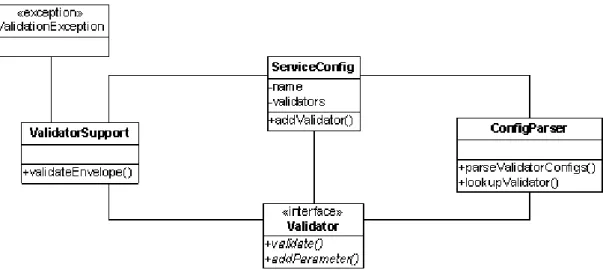
The core of the WSPV framework is simple but powerful. Figure 3.2 shows the core components of the framework in a UML class diagram.
Figure 3.2: WS Payload Validator Core - UML Class Diagram
We will give a brief introduction to the purpose and functionality of the different components in the following sub sections.
no.fjas.wspv.ServiceConfig (class)
TheServiceConfigclass holds the policy configuration for all Web Services within the same application. Based on the policies that have been configured, the correct and fully configured validator can be extracted from the ServiceConfig and validate the XML element.
The source code for theServiceConfigclass is listed in appendix B.1.
no.fjas.wspv.Validator (interface)
TheValidatorinterface must be implemented by all validators. A validator can verify the content of an XML element and has two methods,validate()andaddParameter(). The validate() method is used to perform validation on an XML element and the
addParameter()method configures the validator with extra parameters to tailor it to a specific element. E.g. an integer validator may have a minimum and maximum value, these values are configured in the policy file and injected into the validator at application startup through theaddParametermethod.
no.fjas.wspv.ConfigParser (class)
The ConfigParser helps parsing the policy configuration file and builds ServiceConfig objects. The ServiceConfig are then used for looking up Web Service endpoints2, and returns the appropriate validator during the validation procedures.
The source code for theConfigParserclass is listed in appendix B.3.
no.fjas.wspv.ValidatorSupport (class)
ValidatorSupport is, as the name implies, a helper class for performing validation of SOAP envelopes. It can read SOAP envelopes and perform validation on all elements based on the current ServiceConfig. This class should be called by a SOAP framework handler when a new SOAP envelope request is received. If the validation policy fails, it will throw a ValidationException and abort the current request.
The source code for theValidatorSupportclass is listed in appendix B.4.
3.3.2 WS Payload Validator - Policy Configuration
Policy configuration in WSPV is based on XML. The configuration syntax is very minimalistic and the a DTD for the policy configuration is attached in appendix A. A sample configuration file is shown in Listing 3.1. The configuration file is oriented around available services and their operations. Aservicecan have multiple operations available. Each operation can take one or more parts as arguments. With eachpart
there is an attribute calledtype. Thetypeattribute tells WSPV which validator class to use when validation is performed. In addition to thetypeattribute, apartelement can take several parameters to customize a standard validator.
<validation>
<service name="BookService"> <operation name="findBook">
<part name="isbn" type="regex"> <param name="expression"> (?=.{13}$)\d{1,5}([- ])\d{1,7}\1\d{1,6}\1(\d|X)$ </param> </part> </operation> </service> </validation
Listing 3.1: WS Payload Validator - Configuration Policy Example
In Listing 3.1 we configure the findBookoperation of the BookService. This operation takes a single argument,isbn, which is of the typeregex. This is a regular expression validator that accepts a regular expression as a parameter.
2An endpoint indicates a specific location for accessing a Web Service using a specific protocol and
With the WSPV framework we have developed a set of standard validators. These validators can be used to perform validation of the most basic standard data types. All validators must implement theValidatorinterface introduced in Section 3.3.1. The standard validators provided with WSPV are listed in Table 3.3.2.
Class name Type name Validates
DateRangeValidator date Dates
DoubleRangeValidator double Double numbers EmailValidator email Email addresses EnumValidator enum Enumeration values IntRangeValidator int Integer numbers MultiPartValidator multipart Objects
RegexValidator regex Regular expressions StringLengthValidator string Strings
URLValidator url HTTP URLs
Table 3.1: WS Payload Validator - Provided Standard Validators
3.3.3 WS Payload Validator - XFire Handler
To demonstrate the use of WSPV, we need a connector to another SOAP framework. We decided to first start of with the Codehaus XFire framework [26] and built a customized handler that intercepts SOAP envelopes and uses WSPV for payload validation.
Figure 3.3 shows the UML sequence diagram of how the XFire handler communicates with the WS Payload Validator.
The handler itself is really simple. By hooking into XFire’s chain of handlers, we are able to retrieve the SOAP envelope from the client, fetch the payload (SOAP body) and run validation against the policies defined in WSPV. All this is done transparently for both the client and the developer of the business logic. In case of validation failure a SOAP Fault will be generated and returned to the client. Upon successful validation, the handler will not interfere, and the request will be processed normally.
The source code for the XFire handler is included in appendix C.
3.3.4 WS Payload Validator - Axis2 Handler
We have also developed a handler for the Apache Axis2 [22] SOAP framework. This utilizes WSPV in the same way as XFire, but since the context and API is a bit different from XFire we had to develop a customized handler for Axis2. No sequence diagram has been created as it would be a duplicate of Figure 3.3.
3.4
Example Application - Book Service
One of the goals of this project is to demonstrate the use of the framework. We have fulfilled this goal by creating an example application, a book service.
Our example is a Java web application that holds information about a collection of books. We wish to expose a set of services, so the rest of the world can make use of our book collection. We want to make the following operations available through a Web Service:
• getBooks - retrieves a list of all books • findBook - lookup a book by isbn number • getBook - lookup a book by id number
• findBooksByMaxPrice - retrieves a list of books satisfying a given price range • addBook - adds a book to the collection
3.4.1 Web Service Implementation
The book service is exposed through theBookServiceinterface shown in listing 3.2.
public interface BookService {
public Book[] getBooks();
public Book findBook(String isbn) throws BookException;
public Book getBook(int id) throws BookException;
public Book[] findBooksByMaxPrice(double price);
public void addBook(Book book); }
Listing 3.2: Example Application - BookService.java
For theBookService interface to be usable we need an implementation class. Listing 3.3 shows the BookServiceImpl class. This is a simplified implementation class and there are no database lookups or any other advanced data management here. In an ordinary application this class would often forward requests to a service layer [37].
public class BookServiceImpl implements BookService {
private Map<String, Book> bookList = new HashMap<String, Book>();
public BookServiceImpl() { Book book1 = new Book(); book1.setId(1);
book1.setAuthor("Dan Diephouse"); book1.setTitle("Using XFire"); book1.setIsbn("12-3456-789-0"); book1.setPrice(49.99);
Book book2 = new Book(); book2.setId(2);
book2.setAuthor("J. K. Rowling");
book2.setTitle("Harry Potter and the Deathly Hallows "); book2.setIsbn("0545010225");
book2.setPrice(34.99);
bookList.put(book1.getIsbn(), book1); bookList.put(book2.getIsbn(), book2); }
public Book[] getBooks() {
Collection<Book> books = bookList.values();
return (Book[]) books.toArray(new Book[books.size()]); }
public Book findBook(String isbn) throws BookException { Book result = bookList.get(isbn);
if (result != null)
return result;
else
throw new BookException("Book does not exists",
new BookExceptionDetail("NOT_EXIST", "Can’t find book"));
}
public Book getBook(int id) throws BookException {
Iterator<Book> iter = bookList.values().iterator();
while (iter.hasNext()) {
Book book = iter.next();
if (book.getId() == id)
return book; }
throw new BookException("Book does not exists",
new BookExceptionDetail("NOT_EXIST", "Can’t find book "));
}
public Book[] findBooksByMaxPrice(double price) {
Collection<Book> bookCollection = bookList.values(); Iterator<Book> iter = bookCollection.iterator(); Book[] books = new Book[bookCollection.size()];
int counter = 0;
while (iter.hasNext()) {
Book book = iter.next();
if (book.getPrice() >= price) books[counter++] = book; }
return books; }
public void addBook(Book book) {
bookList.put(book.getIsbn(), book); }
}
Listing 3.3: Example Application - BookServiceImpl.java
The Web Service is created using the XFire SOAP framework [26]. To expose a Web Service we need to configure the SOAP framework, and with XFire this is done
through an XML configuration file. The configuration file must reside in the directory
META-INF/xfireand namedservices.xml. Configuration for our book service example is shown in Listing 3.4. <beans xmlns="http://xfire.codehaus.org/config/1.0"> <service> <name>BookService</name> <namespace>http://wspv.fjas.no/BookService</namespace> <serviceClass>no.fjas.wspv.examples.xfire.BookService</serviceClass> <implementationClass> no.fjas.wspv.examples.xfire.BookServiceImpl </implementationClass> </service> </beans>
Listing 3.4: Example Application - XFire configuration, services.xml
We have now completed our Web Service. We can start the service and clients can communicate with our book service. AfindBookrequest and response to the presented service would now look exactly like those referred to in 2.2.1, Listing 2.7 and 2.8.
3.4.2 Adding Input Validation
We now want to add input validation to our Web Service. Adding input validation requires two steps. Create a connection to our WS Payload Validator framework and create validation policies.
Connecting the book service with WS Payload Validator is done with the XFireValida-torHandler presented in Section 3.3.3. This requires a few additional lines to the XFire configuration fileservices.xml. Listing 3.5 shows the complete configuration including line 13-18 required for connecting the book service to the validation handler.
1 <beans xmlns="http://xfire.codehaus.org/config/1.0"> 2 <service> 3 <name>BookService</name> 4 <namespace> 5 http://wspv.fjas.no/BookService 6 </namespace> 7 <serviceClass> 8 no.fjas.wspv.examples.xfire.BookService 9 </serviceClass> 10 <implementationClass> 11 no.fjas.wspv.examples.xfire.BookServiceImpl 12 </implementationClass> 13 <inHandlers> 14 <handler 15 handlerClass="org.codehaus.xfire.util.dom.DOMInHandler"/> 16 <handler 17 handlerClass="no.fjas.wspv.xfire.WSPVHandler"/> 18 </inHandlers> 19 </service> 20 </beans>
Next step is to add validation policies. Recall the BookService interface and the available methods listed in Listing 3.2. The method getBooks does not need any validation policy since it does not accept any arguments. The rest, however, need to be taken care of. We have listed a policy proposal in Table 3.2.
Method Arguments Policy
findBook isbn (string) regular expression
getBook id (int) int>0
findBookByMaxPrice price (double) double>0.0 addBook book (object)
author (string) max length = 255 id (int) int>0 isbn (string) regular expression price (double) double>0.0
title (string) max length = 255 Table 3.2: Example Application - Validation Policy proposal
We will explain these policies briefly. The isbn number is quite complex and is built up by a sequence of numbers and dashes. We will validate this using a regular expression 3. We also want all of the integer and double values to be positive, and the strings must not exceed a max length of 255.
We need to translate these policies into a understandable form for the WSPV framework. All the policies must be defined in the validation.xmlfile in the META-INF/wspvdirectory. The policy configuration for the book service is listed in 3.6.
<validation>
<service name="BookService"> <operation name="findBook">
<part name="isbn" type="regex"> <param name="expression"> (?=.{13}$)\d{1,5}([- ])\d{1,7}\1\d{1,6}\1(\d|X)$ </param> </part> </operation> <operation name="getBook"> <part name="in0" type="int">
<param name="minExclusive">0</param> </part>
</operation>
<operation name="findBooksByMaxPrice"> <part name="in0" type="double">
<param name="minExclusive">0</param> </part>
</operation>
<operation name="addBook">
3More about regular expressions: http://java.sun.com/j2se/1.5.0/docs/api/java/util/
<part name="in0" type="multipart"> <part name="author" type="string">
<param name="maxLength">255</param> </part>
<part name="id" type="int">
<param name="minExclusive">0</param> </part>
<part name="isbn" type="regex"> <param name="expression">
(?=.{13}$)\d{1,5}([- ])\d{1,7}\1\d{1,6}\1(\d|X)$ </param>
</part>
<part name="price" type="double"> <param name="minExclusive">0.0</param> </part>
<part name="title" type="string"> <param name="maxLength">255</param> </part> </part> </operation> </service> </validation>
Listing 3.6: Example Application - WS Payload Validator configuration This was all that was needed to secure this Web Service. The WSPV Handler will now be invoked automatically each time aBookServiceoperation is request by a client. If the client request data does not conform with the given policy, the request is aborted and a SOAP fault will be returned to the client.
Chapter
4
Evaluation and Conlusion
This chapter contains a discussion where we focus on what we have accomplished during this project. We will evaluate the Web Service Payload Validator framework we have implemented, with respect to the specified requirements and goals of the project.
Further on we will present the conclusion of the project and summarize our achieve-ments. The last section covers further work and suggestions for a possible follow up project.

![Figure 2.7: Web Application Firewall (from [31])](https://thumb-us.123doks.com/thumbv2/123dok_us/10989989.2986709/37.892.202.621.490.643/figure-web-application-firewall-from.webp)