Senior High School (SHS) Social Studies Teachers' Formative
Assessment Conceptions and Beliefs: Inferences from Ghana
Mohammed Adam* Samuel Ofori Bekoe Samuel Poatob
Department of Social Studies Education. University of Education, Winneba, Ghana Abstract
The study investigated Senior High School (SHS) Social Studies Teachers' Formative Assessment Conceptions and Beliefs. A sample of sixty (60) SHS Social Studies teachers from eleven (11) Senior High Schools from the Tamale and Cape Coast Metropolis and West Mamprusi and Senya districts. Using explanatory sequential mixed methods design under the mixed methods research approach, questionnaire and semi-structured interview were adopted for data collection on the teachers’ conception and beliefs of formative assessment. Analysing the data sequentially, the quantitative data was analysed using descriptive statistics generated through the use of SPSS with correlation analysis conducted. The semi-structured interview data, was analysed through detailed narrative description. Drawing largely on data from both instruments, the results from the questionnaire phase revealed generally thatSHS Social Studies teachers have adequate understanding of what formative assessment is and for that matter perceive and used it appropriately for its ideal purpose. A correlation analysis of the variables (conceptions and beliefs of formative assessment) revealed that there is a statistically, positive correlation between the SHS Social Studies teachers’ conceptions and beliefs of formative assessment. The study among others revealed that SHS Social Studies teachers theoretically understand what formative assessment is especially in the questionnaire data. The questionnaire data was to a large extent, inconsistent with the interview findings. Based on the findings, the study recommends among others that efforts need to be taken to help improve SHS Social Studies teachers’ formative assessment knowledge and understanding of formative assessment for purposes of improving both teaching and learning.
Keywords: Successcriteria, Formative feedback, Descriptive feedback, Self-assessment, Peer-assessment. DOI: 10.7176/RHSS/9-16-01
Publication date: August 31st 2019
INTRODUCTION
Student assessment is an overarching component of effective teaching and learning that has the potential to propel the realisation of better learner outcomes by enhancing teachers’ pedagogy and students’ learning (Black & Wiliam, 1998a; Crooks, 2001). Similarly, contemporary models of teaching and learning include formative assessment as a crucial element of effective and relevant instruction (Shepard, Hammerness, Darling-Hammond, Rust, Snowden, Gordon, Gutierrez & Pacheco, 2005) and an all-important activity that every teacher need to know and do. This is because formative assessment in particular and assessment in general, teaching and learning are indistinguishable (Young & Bush, 2009). This goes to confirm the valuable role teachers’ conceptions and perceptions of assessment play in their instructional practices which cannot be underestimated. Nonetheless, this all-important aspect in instruction has not always gained this height of recognition and regard (Black & Wiliam, 1998a; Sadler, 1998). Brooks (2001: 2), among others, have condemned the situation arguing that “in teaching, assessment has been neglected, poorly understood and often despised by teachers”.
The Organisation for Economic Co-operation and Development (OECD) (2008) has established in a study that teachers who understand and use formative assessment are able to frequently interact with students in a conducive socio-cultural setting. Such an interaction enables teachers to identify students’ learning needs, and in effect, adjust their teaching appropriately to address such needs. Social Studies teachers who effectively use formative assessment techniques or approaches are better prepared to meet the diverse learning demands of their students (Myres, 2004). Additionally, Opre (2015), postulates that when teachers conceive assessment as a useful method of obtaining the information needed to make critical learning and teaching-related decisions, while teaching and learning is occurring (formative); they will always use the assessment tools that are complementary to the process of teaching and learning; and teachers who view assessment as charging students with responsibility for their own learning will favour the formal, summative assessment methods.
Notwithstanding the tangible benefits of formative assessment to both teaching and learning as different researchers have established, appropriate integration of assessment in the teaching and learning (formative) of Social Studies has been misconstrued both in theory and in practice by many teachers across countries (Myres, 2004) including SHS Social Studies teachers in Ghana. The inability of Social Studies teachers in Ghana to come closer to the vision of training responsible citizens who are well-informed, concerned, reflective, participatory and sensible in the roles and responsibilities they face (Selwyn, 2010) arguably, is partly blamable for the Social Studies teachers’ inadequate or lack of knowledge and understanding of the nuances of formative assessment, its principles, techniques and tools, and how all these can be used to attain the desired goals of learning in general
and the goal of Social Studies in particular. This situation, through our observation and experience, is a challenge to many Social Studies teachers. This is a concern similarly shared by Ankomah and Oduro (2004). Informed by the rationale and goals of Social Studies and the assumptions afore-established, including what available researches reveal on formative assessment, this is a methodological paper that draws some lessons and inferences from Senior High School (SHS) Social Studies teachers in the Central, Northern and North East regions of Ghana.
With regard to the situation above, what is mind-boggling at this stage is the basis or factors contributing to the current state of affairs in the SHS Social Studies classroom, and in relation to the implementation of formative assessment strategies. This provided the justification for the study. The purpose of the study was to examine and understand SHS Social Studies teachers' formative assessment practices (perceptions, conceptions, and use/implementation) in Ghana, specifically in the Central, Northern, and North East regions as cases, as well as the value and impact it has on their teaching quality which may consequently inform practice, policy, and professional development. The study was guided by the following formulated objectives: to assess the extent of SHS Social Studies teachers’ knowledge (conceptions) of formative assessment; in Ghana and to explore SHS Social Studies teachers’ perception of formative assessment in Ghana.
Understanding Formative Assessment
Assessment in education is the process of gathering, interpreting, recording, and using information about pupils’ responses to an educational task (Harlen, Gipps, Broadfoot, Nuttal, 1992; cited in Teach (2010). Assessment is a powerful and strong process that can optimize or inhibit learning depending on how it is implemented. This explains why assessment, teaching and learning are said to be inextricably linked as each informs the others. The New Zealand’s Ministry of Education asserts that formative and summative assessments are interconnected. They seldom stand alone in construction or effect. Furthermore, they contend that values and attitudes about assessment include the following: teachers value and believe in students; sharing learning goals with the students; involving students in self-assessment; providing feedback that helps students recognize their next steps and how to take them; being confident that every student can improve and providing students with examples of what is expected from them.
Summative assessment on one hand is described as a tool used after instruction to measure student achievement which provides evidence of student competence or program effectiveness (Teach, 2010). According to Clarke (2006), summative assessment is all about summarizing students‟ progress at a particular point in time for the purpose of reporting, motivating and evaluation of their standards and progress. Clarke (2006), thus makes a point that this kind of assessment emphasises on the teacher “sitting with the learner”- that is a thing that the teacher does with and for the learner. Summative assessment also hammers on assessment for the purpose of accountability so as to determine students’ performance level on a specific task or at the conclusion of a unit of teaching and learning (Black & Wiliam, 1998b; Clarke, 2006; Harlen, 2006). Deducing from these, it can be said that such an assessment takes place after teaching and learning and can also be labeled as an end-of-key-stage leveling assessment process (Clarke, 2006).
In furtherance, formative assessment refers to the process used by teachers and students during instruction that provides feedback to adjust ongoing teaching and learning to aid students improve their achievement of intended instructional outcomes (Heritage, 2010; Heritage, 2011). Similarly, the Council of Chief State School; Officers (CCSSO) (2008) defines formative assessment as a process used by teachers and students during instruction that provides feedback to adjust ongoing teaching and learning to improve students’ achievements of intended instructional outcomes. Despite the varying definitions of formative assessment given by experts in the field, there exist certain common traits that run across these different definitions. Assessment Reform Groups (ARG) (2002)), and implemented by states, Formative assessment (Black and William, 1998; Clark, 2011; Heritage, 2010) as cited in Madison-Harris, Muoneke and Times (2012), has certain unique elements. Such elements common in these definitions are that, formative assessment: is a systematic, continuous process used during instruction by teachers; evaluates learning while it is developing; is indivisible with instruction and integrated with teaching and learning; actively involves both teacher and student; provides a feedback loop to adjust ongoing instruction and close gaps in learning; involves self- and peer-assessment; and informs and supports instruction while learning is taking place (Madison-Harris, Muoneke and Times, (2012: 2).
Inversely, formative assessment is not a single or one-shot event or measurement instrument but an ongoing (minute-by-minute, day-to-day) (Leahy, et al., 2005), planned practice that allows teachers to assess learning after teaching. Similarly, Popham (2006) and Chappuis and Chappuis (2007/2008), espouses that formative assessment is an ongoing, dynamic process involving far more than frequent testing and measurement of student learning. It also allows teachers to predict and make adjustments regarding their teaching and standardized judgments about student performance toward state content standards (Heritage, 2010; Clark, 2011). For the purpose that it serves, Herman, Osmundson, and Dietel (2010): Madison-Harris, Muoneke and Times, (2012) again remarked strongly that formative assessment information is mainly for teacher and classroom use. They
however, point out that formative assessment can serve different purposes in local educational agencies. It may also be used by schools at the local, districts and regions to make databased decisions at different levels of the system. Formative assessment is part of the progeny of assessments, and therefore, its purposes can sometimes overlap with interim / benchmark and summative assessments.
Neesom (2000) cited in Maclellan (2001); Hill (2000) and Torrance and Pryor (1998) cited in Dixon and Williams (2003) bemoans that most high school teachers cannot differentiate between summative and formative assessments clearly. Brown (2003) and Ankomah and Oduro (2004) contend that teachers seldom practice formative assessment probably because they do not understand what it is or because of the standardised nature of our assessment system. Despite this, it is important to dichotomise these different assessments as they obviously serve uniquely different purposes (Black & William, 1998; Davidson & Frohbieter, 2011) as cited in Madison-Harris, Muoneke and Times, (2012), and the quality of information provided differs. Thus, in Madison-Madison-Harris, Muoneke and Times, (2012), Gallagher & Worth (2008) advanced a point that the purposes of formative assessment are to help teachers target instruction that meets specific learning goals, support student learning, check for progress and determine learning gains, diagnose strengths and weaknesses, check for misconceptions following instruction, differentiate instruction, evaluate the effectiveness of instructional methods or programs, and transform curriculums.
Roskos and Neuman (2012), explain that the key features of formative assessment encompass identifying gaps between where students are and where they need to go in their learning development; creating feedback loops that generate information about changes in performance gaps; involving students in meaningful, productive self-assessment; and charting from point A to point B to shape, mould, form and develop understanding in the desired direction. Similarly, the CCSSO (2008) states that there are five attributes that have been identified from a cross-section of literature as critical features of effective formative assessment. The compilers of the document emphasize that no one of such attributes should be regarded as a sine qua non, that is, an attribute without which the assessment would not be formative. These attributes are: learning progressions, identifying learning goals and criteria for success, descriptive feedback, self- and seer-assessment and Collaboration (CCSSO, 2008). These are corroborated by the FCPS (2012) and Heritage (2010) who refer to such characteristics as the “drivers of formative assessment” (Heritage, 2010: 37).
Formative and Summative Assessments in Contention
Outlined clearly in Rudner and Schafer (2002), McMillan (2001) presents eleven fundamental principles to guide the assessment training of both teachers and administrators in light of current assessment demands and contemporary theories of learning and motivation. The third of such principles as in Rudner & Schafer (2002: 7) is that, “assessment decision-making is influenced by a series of tensions”. Explaining this particular principle, it is contended in Rudner & Schafer (2002) that competing purposes, uses, and pressures result in tension for teachers and administrators as they take assessment-related decisions. For instance, good teaching is characterized by assessments that motivate and engage students in ways that are in consonance with their philosophies of teaching and learning and with theories of development, learning and motivation. Assessment for formative and summative reasons facilitates the different assessment purposes. For instance, whereas the ARG (1999/2002); Black, et al., 2004; Black & Wiliam (1998a) reported that, teachers conceive summative assessment takes into account judging students’ performance against national standards (norm-referenced).
Many authors and educators have seen both formative and summative assessments to be competing; thus, in a sort of conflict. For instance, some argue that just like formative assessment does, summative assessments can also generate critical information about students' overall learning as well as an indication of the quality of classroom instruction. This is especially evident when the summative assessments are accompanied by other sources of information and are used to inform practice rather than used in rewarding or sanctioning learners. Notwithstanding this educational role summative assessment plays, formative assessment according to Black and Wiliam (1998a); Leahy, et al. (2005); Marzano (2006) and Heritage (2010) is the most instructionally sensitive type of assessment and is considered an ongoing activity or process. For this reason, Heritage (2010), and Marzano (2006) conclude that formative assessment is an effective way to plan and apply instructional interventions to teaching and learning-related challenges (close the gap) than summative assessments.
Research questions
The following formulated research questions facilitated the attainment of the study’s purpose and objectives. 1. What are SHS Social Studies teachers’ conceptions of formative assessment in the Central, Northern
and North East Regions?
2. How do SHS Social Studies teachers in the Central, Northern and North East Regions perceive formative assessment?
METHODOLOGY
Taking into account the nature of the problem investigated, the exploratory sequential mixed methods design under the mixed methods research approach was deemed appropriate for the study. This was because, looking at the variables embedded in the study, mixed methods research approach takes advantage of using multiple ways to examine or explore a research problem according to Tashakkori and Teddlie (1998); Creswell (2003); Morgan (2007); and Greene (2008). The approach is also wide-ranging and inclusive in nature to look at the research problem in question ‘inside-out’. In an exploratory sequential design, quantitative phase of the research is conducted and a separate qualitative phase or vice versa. The analysis is done in a similar fashion. It is worth noting that, the rationale for the exploratory sequential mixed methods design is that the quantitative data analysis provides the main focus of the results.
The study targeted SHS Social Studies teachers in Ghana but thematically, focused on Central, Northern and North East regions. We conveniently chose the three regions on the grounds of proximity and familiarity. As a result, it was realised that sampling schools from these three regions could bring variety to the study, where well-informed inferences could be made in the end. A sample of sixty (60) SHS Social Studies teachers from eleven (11) Senior High Schools within the Tamale and Cape Coast metropolises in the Northern and Central regions, West Mamprusi Municipality and Awutu Senya District from the North East and Central regions respectively were selected. This was done with the assumption of getting an average of three respondents from each school (one from each class- SHS 1, SHS 2 and SHS 3).
Questionnaire and face-to-face interview were used to collect data. The questionnaire helped gather data on the teachers’ conceptions/knowledge and beliefs of classroom assessment and was administered to the 60 SHS Social Studies teachers in the three regions. Semi-structured interviews were used separately from the questionnaire on a different to gather from six (6) of the teachers who agreed to be interviewed, their knowledge and understanding, beliefs or perceptions and practices of formative assessment. Ethically, the teachers were informed that the interviews were to be recorded with a voice recorder before they could be transcribed. Babbie (2007); Wisker (2008) and Yin (2009) all agree that most of the questions used in semi-structured interviews characteristically tend to be open-ended so that interviewees at their own will decide how they will respond to questions, both in relation to the words they use and the length of response they give. This affords the interviewee the opportunity to give richer and more insightful responses to the open-ended questions asked in that instance.
Sequentially, quantitative presentation and discussion was done, followed by a qualitative presentation and discussion of interview results. The questionnaire data was analysed, presented and discussed via simple descriptive statistics generated through the use of SPSS software with correlation analysis conducted. The semi-structured interview data however, was analysed through detailed narrative description. All data gathered were presented and discussed in line with the formulated research questions and with regard to the two categories of instruments used in collecting the data. For ethical reasons, pseudonyms were used to represent the interviewees instead of their real/actual names.
In order to establish the trustworthiness of the findings, results from both data sources were triangulated. Bryman (2004) states that triangulation is one of the several rationales for mixed methods research. He maintains that even though triangulation has many types, it can be argued that there are good reasons for reserving the term triangulation for those specific occasions in which researchers seek to check the validity of their findings by cross-checking them with another method. Triangulation in this study was used for the purpose of assuring the validity of the research results through the use of a variety of research methods and approaches. Hence, the questionnaire findings were triangulated with recourse to data from the interviews and literature reviewed. FINDINGS AND DISCUSSION
SHS Social Studies Teachers’ Conceptions of Formative Assessment
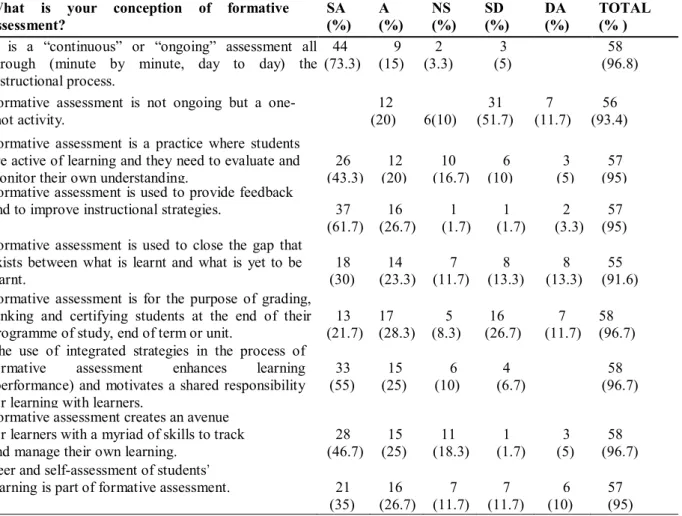
Generally, the questionnaire results as depicted in Table 1 revealed that SHS Social Studies teachers in the Central, Northern and North East regions possess a good grasp of what formative assessment is all about and for that matter perceive and use it as elaborated in the literature. In other words, many of the teachers understood the meaning of the concept formative assessment.
Findings in Table 1 for example, suggest that a large number of the teachers (53) (91.4%) out of 58 respondents understand formative assessment to be continuous, that is a cumulative frequency of respondents responded to agree and strongly agree. Having conceived formative assessment to be continuous and not a one-shot-activity by this cumulative number (53) of teachers, 12 teachers (21.4%) also agreed or strongly agreed that formative assessment is a one-shot-activity, a conception that is contrary to the latter. The findings also revealed that most of the teachers conceive their students as active stakeholders of their own learning who need to evaluate and monitor their own learning process. For instance, 26 (45.6 valid percentage) of them said they strongly agree and 12 (21.1 valid percentage) respondents responded agree both giving percentage sum of 66.7. That notwithstanding, 6 respondents (10.5%) disagree with the item and 10 respondents were also not sure.
Three (3) systems out of the entire sample of sixty (60) were missing.
Also, an overwhelming number of 37(64.9 valid percentage) respondents replied that they strongly agreed and 16 respondents (28.1%) also agreed to the fact that formative assessment is used to provide feedback and to improve their instructional strategies. These two responses if computed, give a cumulative 93.0%. Respondents also conceive formative assessment as being used to close the gap that exists between what is learnt and yet to be learnt. Hence 18 (32.7%) and 14 (25.5%) respondents revealed that they ‘strongly agree’ and ‘agree’ respectively to this particular statement. Despite that 33 (58.2), a sum of 23 responses out of the total responses of 55 with a cumulative percentage of 41.7 also cut across not sure (7 (12.7%), disagree (8(14.5%) and strongly disagree (8(14.5%).
Respondents were however almost divided along two different lines of conceptions when they had to consider the statement “formative assessment is for the purpose of grading, ranking and certifying students at the end of their programme of study, end of term or unit”. Whereas, 13 (22.4%) 17 (29.3%) strongly agree and agree respectively to the statement, 16 (27.6%) and 7 (11.7%) strongly disagreed and disagreed. Five (5) (8.6%) respondents were not sure. Regarding the statement (conceptions) “the use of integrated strategies (formative assessment) enhances learning (performance) and motivates a shared responsibility for learning among learners”, 33 (56.9%) out of 58 (96.7) responses attested to that they strongly agree to the item and 15 (25.9%) said they agree making an aggregate of 38, thus a cumulative percentage of 82.8.
Yet still on the teachers’ conceptions formative assessment, a greater number of teachers, thus (28) (48.3%) and 15 (25.9%) out of 58 respondents respectively ticked strongly agree and agree, concurring their understanding of formative as the item stated on the questionnaire “formative assessment creates an avenue for learners with a myriad of skills to track and manage their own learning development”. Finally, on the conceptions, 21 (36.8%) responses did strongly agree and 16 (28.1%) responses did agree, that is a total of 37(64.9%) did confirm that Peer and self-assessment of students’ learning is part of formative assessment. Table 1: SHS Social Studies Teachers’ Conceptions of formative assessment
What is your conception of formative assessment? SA (%) A (%) NS (%) SD (%) DA (%) TOTAL (% ) It is a “continuous” or “ongoing” assessment all
through (minute by minute, day to day) the instructional process. 44 (73.3) 9 (15) 2 (3.3) 3 (5) 58 (96.8) Formative assessment is not ongoing but a
one-shot activity. 12 (20) 6(10) 31 (51.7) 7 (11.7) 56 (93.4) Formative assessment is a practice where students
are active of learning and they need to evaluate and monitor their own understanding.
26 (43.3) 12 (20) 10 (16.7) 6 (10) 3 (5) 57 (95) Formative assessment is used to provide feedback
and to improve instructional strategies. 37 (61.7) 16 (26.7) 1 (1.7) 1 (1.7) 2 (3.3) 57 (95) Formative assessment is used to close the gap that
exists between what is learnt and what is yet to be learnt. 18 (30) 14 (23.3) 7 (11.7) 8 (13.3) 8 (13.3) 55 (91.6) Formative assessment is for the purpose of grading,
ranking and certifying students at the end of their programme of study, end of term or unit.
13 (21.7) 17 (28.3) 5 (8.3) 16 (26.7) 7 (11.7) 58 (96.7) The use of integrated strategies in the process of
formative assessment enhances learning (performance) and motivates a shared responsibility for learning with learners.
33 (55) 15 (25) 6 (10) 4 (6.7) 58 (96.7) Formative assessment creates an avenue
for learners with a myriad of skills to track and manage their own learning.
28 (46.7) 15 (25) 11 (18.3) 1 (1.7) 3 (5) 58 (96.7) Peer and self-assessment of students’
learning is part of formative assessment. 21 (35) 16 (26.7) 7 (11.7) 7 (11.7) 6 (10) 57 (95) Source: Field data (2019)
Similarly, just as it is revealed in the quantitative phase of this study, most of the participants in the qualitative phase understood the meaning of the concept “formative assessment”. When interviewed, some of the respondents found it uneasy describing formative assessment or tell its features. Even though majority of them understood the differences as the questionnaire analysis reveals. Only three (3), out of the six (6) interviewees
for instance, were able to differentiate between formative and summative assessments. For instance, Ms. Dumoh indicated that:
Formative assessment is an ongoing assessment throughout the teaching and learning process. Through this, the teacher can tell how learning is going on and the direction of his or her instruction [sic].
This is confirmed by the interview responses of the three teachers as narrated earlier. Even though a few of researches in the literature have identified a fundamental tension in teachers’ understanding related to the nature and purpose of formative assessment, the teachers’ responses as the statistics indicate are a confirmation of what Hill (2000) and Torrance and Pryor (1998) cited in Dixon and Williams (2003) gathered in separate studies that it is encouraging to note that teachers in the present study had a much clearer understanding of formative assessment than previous research would indicate. With regard to the difference between formative and summative assessment, all six teachers seemed to have a clear knowledge. Following is a transcribed excerpt of a participant’s response:
Formative assessment is continuous. That is to say, it is inherent in the entire teaching and learning process whereas summative assessment is done once, either as end lesson or end of term (Mr. Ewuntomah) [sic].
Similarly, Black et al. (2004) and Harlen (2005) articulate teachers’ understanding of the existing difference between formative and summative assessments. The rest of the participants shared similar views. Three of the interviewees gave practical examples to further dilate on the differences that really exist between these two. Precisely, Mr. Chentiwunni indicated in his submission that:
Formative assessment entails the use of a variety of formative assessment strategies. For example, disclosing and sharing of learning outcomes with students, asking both oral and written questions, integrating self and peer-assessment procedures and giving feedback that is useful to students’ learning immediately. But in summative assessment, the sharing of learning outcomes is not necessary and immediate feedback is not given to students [sic].
It can therefore be deduced from these two sources that a number of teachers in the study understand formative assessment to be ongoing that in the process sees students as active participants in the teaching and learning, gather and interprets evidence regarding students’ learning state as well as accordingly provide feedback for adjustments in instructional strategies. In short, these teachers’ conceptions of the term is in line with what expert put up, except with the issue of a significant number of the respondents agreeing that it is for the purpose of grading, ranking and certifying students (especially in Table 1). This exception only confirms the assertions of Myres (2004) and Harlen (2006) when both agree that teachers’ understanding of assessment has primarily, been used in the context of education in deciding, collecting and making judgements.
Having found out from these teachers about the meaning of formative assessment, they were further quizzed to tell how it looks like by further elaborating on the concept. This was to just give the us the opportunity to compare their questionnaire responses that entailed features of the concept with what they would have given after the interviews. This was what two of them, Bryan and Centiwuni had to say:
It requires the use of evidence about lesson progress or otherwise and from certain key decisions can be taken by the teacher and his students.
Formative assessment demands students being told of the lesson purpose or objectives and to bridge a gap that may exist between what students already know or learnt and what they are yet to know or learn. The reason for telling students the lesson goal is to afford them the opportunity to also monitor their own learning and sometimes the teachers’ teaching (Ms. Awaafu).
Research in this area presented in the literature review shows that assessment for formative and summative reasons facilitate the different assessment purposes. For instance, whereas the ARG (1999/2002); Black, et al., 2004; Black and Wiliam (1998a) among others reported that teachers said that summative assessment takes into account judging students’ performance against national standards (norm-referenced). Popham (2006) and Chappuis & Chappuis (2007/2008) strongly maintain that formative assessment is an ongoing, dynamic process involving far more than frequent testing and measurement of student learning.
SHS Social Studies Teachers’ Formative Assessment Beliefs
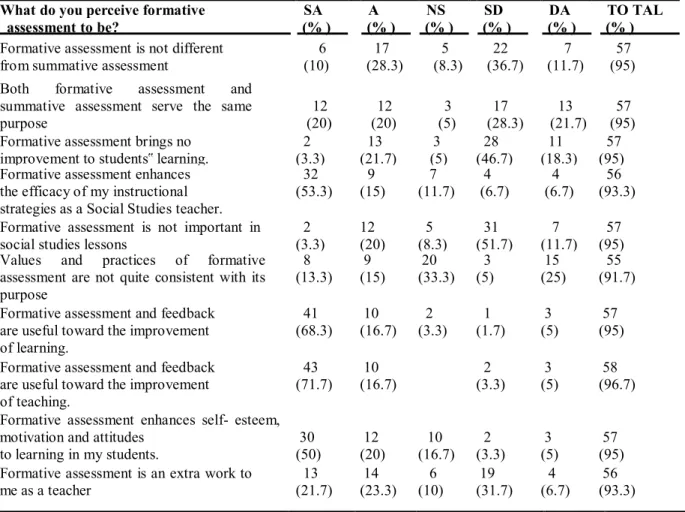
In answering the second research question, “How do SHS social studies teachers in the Central, Northern and North East regions perceive formative assessment?”, the questionnaire data revealed that a good number of SHS Social Studies teachers perceive formative assessment to be different from summative assessment. This is on the grounds that about 22 representing 36.7% responses out of 57 valid responses were against the item that formative assessment is not different from summative assessment. More so, 7 (11.7%) disagreed with the statement. Six (6) (10%) and 17 (28.3%) of the respondents however, strongly agreed and agreed respectively to the said perception in the questionnaire with 5 (8.3%) respondents indicating that they were not sure. This revelation was not different from their perception on the purpose formative and summative assessments serve as
17 (28.3%) and 13 (21.7%) of strongly disagreed and agreed respectively to the perception. Similarly, a cumulative 24 (40%) of them strongly agreed and agreed that both formative and summative assessment serve the same purpose.
A sizeable number of SHS Social Studies teachers who responded to the questionnaire do not agree that formative assessment brings no improvement to students’ learning. Hence, 39 (65%) cumulative responses strongly disagree and disagree with the statement. Fifteen (15) (25%) replied that they do not see formative assessment as bringing improvement to students’ learning. Furthermore, the statistics reveal that 32 (53.3%) of the respondents strongly agreed that through formative assessment the efficacy of their instructional strategies is enhanced. Nine 9 (15%) respondents also agreed. Similarly, An overwhelming majority (38) (63.4%) of respondents also disagreed/disagreed that formative assessment is not important in social studies lessons although a cumulative 24.6% responded strongly agree and agree. Responding to the perception “values and practices of formative assessment are not quite consistent with its purpose”, 20 (36.4%) respondents out of a total of 55 said they were not sure. Also, cumulative 32.8% said they strongly disagreed and disagreed to the stated perception. The remaining cumulative 30.9% of the teachers strongly agreed and agreed.
Most of the SHS Social Studies teachers believe that formative assessment and feedback to be useful to the improvement of students learning since 41 (71.9%) said they strongly agree and 10 (17.5%) agree with the statement making a cumulative 89.5%. Just as the teachers as perceive formative assessment and feedback to be useful toward the improvement of learning, a sizeable cumulative number (53) of respondents perceive formative assessment and feedback to be useful toward the improvement of teaching too. That is 43 respondents strongly agree and 10 agree to the usefulness of formative assessment and feedback to teaching out of 58 respondents. A total of forty three (42) (70%) out of 57 respondents perceive formative assessment to be enhancing self- esteem, motivation and attitudes to learning among their students. In respect of this, 30 (52.6%) strongly agree and 12 (21.1%) agree. Despite that, 10 (17.5%) of the respondents are not sure of this particular purpose that formative assessment serves, whereas 3 disagreed and 2 strongly disagreed. Interestingly however, a substantial number (27) of responses reflected the teachers’ perceptions that formative assessment is an extra work to them even though 23 (38.4%) respondents also disagreed/ strongly disagreed with the statement. The statistics can be seen as presentenced in Table 2 as follows:
Table 2: SHS Social Studies Teachers’ Formative Assessment Beliefs What do you perceive formative
assessment to be? SA (% ) A (% ) NS (% ) SD (% ) DA (% ) TO TAL (% ) Formative assessment is not different
from summative assessment
6 (10) 17 (28.3) 5 (8.3) 22 (36.7) 7 (11.7) 57 (95) Both formative assessment and
summative assessment serve the same purpose 12 (20) 12 (20) 3 (5) 17 (28.3) 13 (21.7) 57 (95) Formative assessment brings no
improvement to students‟ learning.
2 (3.3) 13 (21.7) 3 (5) 28 (46.7) 11 (18.3) 57 (95)
Formative assessment enhances the efficacy of my instructional strategies as a Social Studies teacher.
32 (53.3) 9 (15) 7 (11.7) 4 (6.7) 4 (6.7) 56 (93.3) Formative assessment is not important in
social studies lessons
2 (3.3) 12 (20) 5 (8.3) 31 (51.7) 7 (11.7) 57 (95) Values and practices of formative
assessment are not quite consistent with its purpose 8 (13.3) 9 (15) 20 (33.3) 3 (5) 15 (25) 55 (91.7) Formative assessment and feedback
are useful toward the improvement of learning. 41 (68.3) 10 (16.7) 2 (3.3) 1 (1.7) 3 (5) 57 (95) Formative assessment and feedback
are useful toward the improvement of teaching. 43 (71.7) 10 (16.7) 2 (3.3) 3 (5) 58 (96.7) Formative assessment enhances self- esteem,
motivation and attitudes to learning in my students. 30 (50) 12 (20) 10 (16.7) 2 (3.3) 3 (5) 57 (95) Formative assessment is an extra work to
me as a teacher 13 (21.7) 14 (23.3) 6 (10) 19 (31.7) 4 (6.7) 56 (93.3) Source: Field Data (2019)
The quantitative analysis largely confirms that many teachers believe formative assessment to be important in Social Studies lessons. It is also evident that many teachers believe formative assessment not to be different from summative assessment and this belief is commensurate to their misunderstanding that both summative assessment and formative assessment perform the same purpose. Similarly, interview responses of teachers’ beliefs about formative assessment buttress the quantitative findings. This is because four out of six respondents think formative assessment is more important than summative assessment when interviewed. This really presupposes that formative assessment is important in Social Studies lessons. For instance, this interviewee perceived formative assessment to be more important than summative assessment as she explained that:
The use of formative assessment makes learning meaningful since the teacher through this can make important corrections regarding his or her use of instructional techniques which can even propel the fortunes of summative assessment’s purpose fulfillment. This is unfortunate when we talk of summative assessment (Ms. Awaafu).
In this these responses, they were also quick enough to give reasons to back their positions. This is confirmed by Neesom (2000) and the report on UK’s teachers’ perception that most teachers in high schools according to their study could not differentiate between summative and formative assessments clearly (Maclellan, 2001). Both the questionnaire results and interview findings here again, largely indicate that SHS Social Studies teachers perceive formative assessment to have a significant impact on students’ learning and the adjusting of teachers’ teaching strategies. This is corroborated by the findings of different studies conducted by Black and Wiliam (1998b); Maclellan (2001); Harlen (2005); CCSSO (2008) and Heritage (2011) when they all agree that the ultimate purpose of formative assessment is to promote teaching and learning. It can be deducted on one hand from the questionnaire results and on the other hand inducted from the interview findings that SHS Social Studies teachers perceive formative assessment as important in the Social Studies classroom. Nonetheless, the descriptive statistics (findings) also show that formative assessment is perceived by SHS Social Studies teachers to be an extra work to them as similarly shared by high school head teachers in the UK regarding the reports they received from their teachers (Neesom, 2000). Interestingly however, one of the two teachers who purported the perception that formative assessment is less important compared to summative when interviewed, thought that:
Summative assessment is more important. This is because nationally for one to really say that he or she has a certificate, she or he has to be assessed summatively. Where do we go with formative assessment? It will only remain in the classroom. That is why majority of us teach what we expect to come in their final WASSCE exams (Ms. Felicity).
The position of the two teachers from the interview findings supports the views of 14 (23.3%), who strongly agree/agree that summative assessment is more important than formative assessment. This parallels the beliefs of teachers also in studies conducted by Brown (2003) in New Zealand and Ankomah and Oduro (2004) in Ghana. In both studies, respondents agreed that because of the standardised nature of our assessment system, they (teachers) seldom practice formative assessment. Talking about the teachers’ beliefs about the formative assessment process, almost all the respondents found it difficult telling the interviewer what it encapsulates. It was only Mr. Bryan who could give a few of the characteristics of formative assessment. He stated that “formative assessment as a process begins with the clarification of learning objectives to learners, monitoring of students learning progress and giving of feedback to learners. The feedback is also useful to the teacher” (Mr. Bryan).
The questionnaire findings are similar to the many of the interview responses regarding perception on the benefits of formative assessment to both the teacher and the learner given by some of the participants. For instance, Mr. Bryan posited:
To me as a Social Studies teacher, formative assessment is beneficial because it helps me gather evidence in the classroom which creates an avenue for change of methods and techniques to meet students learning demands. But with the learners they can also recognize how they are progressing and the way forward whiles teaching and learning is going on.
Similar to the beliefs as the questionnaire findings revealed and that of Mr. Bryan and Mr. Ewuntomah, Bell and Cowie (2001); Harlen (2005); OECD (2005); Chappuis and Chappuis (2007/ 2008) Young and Kim (2010) and Heritage (2010) posit that formative assessment informs both the teacher and students about any adjustments that should be made in the teaching and learning process to improve students’ understandings and achievements. It has to be quickly added that the last sub-question under the teachers’ perceptions, questionnaire findings indicate that even though formative assessment is important to both teaching and learning, a good number (27) of them thought that it is an extra work. Stiggins (2002) and Heritage, (2007) corroborate this as they also bemoan that, in a profession that already feels burdened by the quantity of assessment on the grounds that students have to be assessed by teachers for state and public accountability. The looming danger they both agree is that teachers will see the practice of formative assessment as yet another extra requirement that draws time away from teaching.
It can be inferred from this that, the teachers exhibited that they understand what the concept “formative assessment” is (especially, as they responded to research questions 1 and 2). The interview responses however, reveal the slim knowledge that the teachers have on formative assessment as about half or more could not outline the formative assessment processes clearly or relate some of the processes to their classroom activities.
A correlation analysis of the variables (conceptions and beliefs of formative assessment) revealed that there is a statistically, positive correlation between the belief: “formative assessment enhances the efficacy of my instructional strategies as a Social Studies teacher and the practice “I integrate formative assessment strategies into instruction” (r = 0.47, p < .001). This suggests that SHS Social Studies teachers who understand that formative assessment is a practice where students are active participants of learning and they need to evaluate and monitor their own understanding equally encourage students to do self-assessment during lessons in practice.
Under perceptions exclusively, there is a positive relationship between “formative assessment is not different from summative assessment” and “both formative assessment and summative assessment serve the same purpose” (r = 0.51, p < .001) as well as between “formative assessment is not important in Social Studies lessons and “values and practices of formative assessment are not quite consistent with its purpose. Again, there exists positive relationship between “formative assessment is not different from summative assessment” and “formative assessment is an extra work to me as a teacher” (r = 0.410, p < .002) as well as “both formative assessment and summative assessment serve the same purpose and “formative assessment is an extra work to me as a teacher” (r = 0.353, p < .008). Thus, teachers who believe that formative assessment is not different from summative assessment also believe both assessment forms to be serving the same purpose. Those with the belief that both formative and summative assessments serve the same purpose see the practice of formative assessment to be an extra work to them. In a nut shell, these analyses imply that the conceptions of the teachers influence their perceptions and this certainly in turn may influence their practices.
CONCLUSIONS, RECOMMENDATIONS AND POLICY IMPLICATIONS
Based on the results obtained from the study, the following conclusions have been reached:
To begin with, the study revealed that SHS Social Studies teachers theoretically understand what formative assessment. This is on the grounds that the questionnaire responses and part of the interview responses reveal that teachers showed clear and positive conceptions and beliefs in the questionnaire findings. This is because in the questionnaire findings, it was revealed that the teachers saw their formative assessment practices as crucial to adjusting pedagogy. However, this the interview data revealed otherwise. In other words, when interviewed, the teachers unlike in the questionnaire did not show clear understanding of formative assessment. The teachers also did realise the role of formative assessment to be crucial. During the interviews, four of the teachers showed their discontent in relation to the current assessment practices (end-of- term exams, mid-term-exams) predominant in Ghana and how they negatively influence their assessment beliefs. The four teachers acknowledged that the current School Based Assessment and “continuous assessment” systems, and the purpose for they are primarily conducted (that is accretion of learning and accumulation of scores) make them as teachers become oblivious of using assessment for the purpose of improving teaching and learning in Ghanaian SHS. This notwithstanding, many of the teachers still exhibited an awareness of the value of formative assessment to teaching. Furthermore, it is also evident in the study that, SHS Social Studies teachers’ current assessment practices primarily include quizzes, mid-term exams, homeworks, and classroom discussions indicating the existence of an informed practice of formative assessment in the Social Studies classroom. Four out of the six of the Social Studies were not aware that these techniques of assessment (end-of-lesson/week/term quizzes and exams, and even the scores generated) largely used to generate grades of students could be used for formative purposes (to motivate students to consolidate their understanding during teaching and learning). This implies that the teachers seldom worked towards balancing their assessment activities to meet educational, administrative and political demands as Kelly (2009) asserts.
Another important revelation in the study was that, the three SHS Social Studies teachers interviewed in the Central region seemed to have exhibited a better understanding which reflected in their beliefs than the other three of their counterparts interviewed in the Northern and North East regions.
Lastly, for SHS Social Studies teachers’ formative assessment knowledge, beliefs and practices to be transformed or enhanced, their knowledge and understanding about assessment should be the target of improvement together with current demands in our school curricula. This presupposes that as a nation, Ghana ought to have a clear assessment policy that should direct assessment training and practices of teachers. The National Council on Curriculum and Assessment (NaCCA) which is responsible for developing curricula for Ghanaian schools, policy makers, administrators and SHS Social Studies teachers come to understand assessment and its role cum purposes mainly formative or assessment for, in and as learning as indicated in the literature. These institutions concerned should also realise the positive impact that formative assessment can contribute to improving the quality of the teachers’ instructional practices and learning, else, teachers will continue to underemphasize, underutilized formative assessment, or see it as extra work by teachers, not valued
and thereby misuse, abuse or not even use at all. In short, the inference made here is that, SHS Social Studies teachers’ assessment beliefs are inconsistent with contemporary theories, methods and principles of classroom assessment in particular and teaching and learning in general. In fact, this will continue to be a serious hiccup to realizing Sustainable Development Goal 4 (that is to: ensure inclusive and equitable quality education and promote lifelong learning opportunities for all). This means that may crosscutting issues in our education field will continue to exist thereby widening the inequality gap in the country.
From the findings, it is recommended that improvement needs to be considered for SHS Social Studies teachers’ formative assessment conceptions or knowledge for the benefit of both teaching and learning. Therefore, to enhance the understanding of SHS Social Studies teachers’ knowledge and tune their assessment beliefs to align with what time-tested research findings say about formative assessment, short-term courses, workshops, seminars and other necessary in-service training activities should be organised for SHS Social Studies teachers already in the teaching field regular basis. This is on the grounds there is still an influx of out-of-field teachers teaching the subject, because many of them have either not been trained in the area of Social Studies or have not gone through any initial teacher-training all. The Ministry of Education, especially National Council on Curriculum and Assessment, teacher training institutions and various stakeholders in education alike need to give this a positive support by ensuring that the teachers’ assessment conceptions and practices are well-developed and enhanced through professional development exercises.
Finally, Social Studies teachers and educational policy makers need to see assessment with a different lens, see it as something that ought to be used not only for improving students’ performance but also to improve teachers’ instructional practices. Similarly, Social Studies teachers specifically need to reflect on their current conception of classroom assessment and work toward changing such conceptions to a better understanding of assessment as an integral component of the teaching and learning process. This will create an opportunity for them as adult learners to do the formal assessment and at the same time integrate formative assessment strategies in lessons to gather evidence on students’ learning for purposes of ensuring not only the success of learners but their own teaching as well.
REFERENCES
Ankomah, Y. A., & Oduro, G. K. T. (2004). Improving learning through formative assessment: The lecture’s dilemma. Makerere Journal of Higher Education, 1, 131-140.
Ash, D., & Levitt, K. (2003). Working within the zone of proximal development: Formative assessment as professional development. Journal of Science Teacher Education, 14(1), 1- 13.
ARG. (2002). Testing, motivation and learning. Cambridge: University of Cambridge.
ARG. (1999). Assessment for learning: Beyond the black box. Cambridge: University of Cambridge.
Babbie, E., (2007). The practice of social research: instructor’s edition (11th ed). Belmot: Thomson Learning Inc.
Bell, B., & Cowie, B. (2001). The characteristics of formative assessment in science education. Science Education, 85, 536-553.
Black, P., & Wiliam, D. (1998a). Inside the black box: Raising the standards through classroom assessment. Retrieved from: http://www.pdkintl.org/kappan/kbla9810.html.
Black, P., & Wiliam, D. (1998b). Assessment and classroom learning. Assessment in Education, 5(1), 7-71. Brooks, V. (2001). Assessment in secondary schools. Nottingham: Open University Press.
Brown, G. T. L. (2003). Teachers’ instructional conceptions: Assessment’s relationship to learning, teaching, curriculum and teacher efficacy. A paper presented to the Joint Conference of the Australian and New Zealand Associations for Research in Education (AARE/NZARE), No. BRO03022. Auckland, New Zealand.
Bryman, A. (2004). Social research methods (2nd Ed). Oxford: Oxford University Press.
Chappuis, S., & Chappuis, J. (2007/2008). The best value for formative assessment. Retrieved from: http://www.waikato.ac.nz.
Clark, I. (2011). Formative assessment: Policy, perspectives and practice. Florida Journal of Educational Administration and Policy, 4(2), 158–180.
Clarke, S. (2006). Formative assessment in the secondary classroom. London: Holder Murray.
Council of Chief State School Officers (CCSO). (2008). Attributes of effective formative assessment. Retrieved from http://www.ccsso.org/publications/details.cfm?PublicationID=362
Creswell, J, W. (2003). Educational Research: Planning, conducting, and evaluating quantitative and qualitative research. (2nd ed.). Thousand Oaks: SAGE Publications.
Crooks, T. (2001). The validity of formative assessment. Educational Assessment Unit. University of Otago, Dunedin, New Zealand. A paper presented at the British Educational Research Association Annual Conference, University of Leeds, 13-15 September 2001.
Dixon, H. & William, R. (2003). Teachers’ understanding and use of formative assessment in literacy learning from: http://www.tki.org.nz/r/assessment/research/mainpage/research_e.php
FCPS (2012). Appendix E: Literature review on formative assessment system office of programme evaluation. Virginia: FCPS, Department of Professional Learning and Accountability, Office of Programme Evaluation. Garrison, C., & Ehringhaus, M. (2009). Formative and summative assessments in the classroom. Gale Group. Retrieved from: http://www.amle.org/portals/0/pdf/publications/Web_Exclusive/Formative_Summative_ Assessment.pdf.
Greene, J. C. (2008). Is mixed methods social inquiry a distinctive methodology? Journal of Mixed Methods Research, 2(1), 7-22.
Guskey, T. R. (2002). Professional development and teacher change. Teachers and Teaching, 8(3), 381-391. Harlen, W. (2005). Teachers’ summative practices and assessment for learning-tensions and synergies.
Curriculum Journal, 16(2), 207- 223.
Harlen, W. (2005). Teaching, learning and assessing 5-12 (4th ed.). London: Paul Chapman
Harlen, W. (2006). On the relationship between assessment for formative and summative purposes. In J. Gardner (Ed.), Assessment and learning, 103 - 117. London: SAGE.
Heritage, M. (2007). Formative assessment: What do teachers need to know and do? Phi Delta Kappan International, 89(2), 1-11.
Heritage, M. (2010). Formative assessment: Making it happen in the classroom. Thousand Oaks, California: Corwin Press Inc.
Heritage, M. (2011). Formative assessment and next-generation assessment systems: Are we losing an opportunity. New York: National Center for Research on Evaluation, Standards, and Student Testing (CRESST).
Johnson, E. S. & Jenkins, J. R. (2009). Formative and summative assessment. In Eric M. A. & H. A. Lynley (Eds). Psychology of classroom learning: An encyclopedia. Detroit: Macmillan Reference.
Leahy S., Lyon C., Thompson M., & Wiliam D., (2005). Classroom assessment: Minute by minute, day by day. Educational Leadership, 63(3), 19-24.
Maclellan, E. (2001) Assessment for learning, the different perceptions of tutors and students. Assessment and Evaluation in Higher Education, 26 (4), 307-318.
Madison-Harris, R., Muoneke, A., & Times, C. (2012). Using formative assessment to improve student achievement in the core content areas. Southeast Comprehensive Center’s (SCC) Briefing paper. 4700 Mueller Blvd: SSC at SEDL
Morgan, D. L. (2007). Paradigms lost and pragmatism regained: Methodological implications of combining qualitative and quantitative methods. Journal of Mixed Methods Research, 1(1), 48-76.
Myers, J., (2004). Assessment and Evaluation in social studies classroom, a question of balance. Toronto: OISE/UT.
Neesom, A. (2000). Report on teachers’ perception of formative assessment. Retrieved from Proquest, from: http://www.waikato.ac.nz
Organisation for Economic Co-operation and Development (OECD) (2005). Formative assessment: Improving learning in secondary classrooms. From: http://www.oecd.org/publications/Policybriefs
OECD. (2008). Assessment for learning: The case for formative assessment learning in the 21st century. Retrieved from: http://www.oecd.org/publications/Policybriefs
Popham, W. J. (2006). Phony formative assessments: Buyer beware. Educational Leadership, 64(3), 86–87. Roskos, K. & Neuman, S. B. (2012). Formative assessment: Simply, no additives. The Reading Teacher, Vol. 65
(8), 534-538.
Rudner, L., & Schafer, W. (2002). What teachers need to know about assessment. Washington, DC: National Education Association.
Sadler, R. (1998). Formative Assessment: Revisiting the territory. Assessment in Education: Principles, Policy and Practice, 5(1), 77-84.
Shavelson, R. J., Black, P., Wiliam, D., & Coffey, J. (2003). On aligning summative and formative functions in the design of large-scale assessment systems. Educational Evaluation and Policy Analyses.
Selwyn, N., (2010). Literature review in citizenship, technology and learning. London: Future Lab Series. Shepard, L. (2000). The role of assessment in a learning culture. Educational Researcher, 29(7), 4-14.
Shepard, L. A. (2005). Linking formative assessment to scaffolding. Educational Leadership Journal, 63(3), 66-70.
Shepard, L. A., Hammerness, K., Darling-Hammond, L., Rust, F., Snowden, J. B., Gordon, E., Gutierrez, C., & Pacheco, A. (2005). In L. Darling-Hammond & J. Bransford (Eds.), Preparing teachers for a changing world: What teachers should learn and be able to do (pp 275-325). San Francisco: John Wiley and Sons. Stiggins, R. (2002). Assessment crisis: The absence of assessment for learning. Retrieved from:
http://www.pdkintl.org/kappan/k0206sti.htm
Taras, M. (2008). Summative and formative assessments perceptions and realities. Active Learning in Higher Education, 9(2), 172-192.
Tashakkori, A., & Teddlie, C. (1998). Mixed methodology: Combining qualitative and quantitative approaches. Thousand Oaks, CA: Sage.
Teach, N. C. (2010). Assessment: formative and summative practices for classroom. North Carolina: North Carolina Department of Public Instruction.
Wiliam, D. (2007/2008). Changing classroom practice. Retrieved from: http://www.waikato.ac.nz Wisker, G. (2008). The postgraduate research handbook (2nd ed.). New York: Palggrave Macmilan.
Yin, R. K. (2009). Case study research: Design and methods (4th ed.). Thousand Oaks, CA: Sage. Young, K., & Bush, R. (2009). Balanced assessments. Michigan: Petoskey Plc.