Dinamika Pendidikan
http://journal.unnes.ac.id/nju/index.php/dpDevelopment Instruments Through Confirmatory Factor Analysis
(CFA) in Appropriate Intensity Assessment
Ari Saptono
DOI: 10.15294/dp.v12i1.10578
Universitas Negeri Jakarta, Indonesia
Abstract
The research aims to develop the valid and reliable measurement instruments of en-trepreneurship intention in vocational secondary school students. Multi stage ran-dom sampling was used as the technique to determine sample (300 respondents). The research method used research and development with confirmatory factor anal-ysis (CFA). Result of confirmatory factor analanal-ysis (CFA) at the second order with robust maximum likelihood method shows that valid and reliable instrument with the acquisition value of loading factor is more than 0.5 (> 0,5) and a significance value of t is more than 1,96 (> 1,96). Reliability test results shows that the value of the combined construct reliability (CR) of 0.97and a variance value extract (VE)
to 0.52 is greater than the limit of acceptance CR ≥ 0.70 and VE ≥ 0.50. The con -clusion of the measurement instruments of entrepreneurship intention with three dimensions and 31 items met the standards of validity and reliability in accordance with the instrument development process.
How to Cite
Saptono, A. (2017). Development Instruments Through Confirmatory Factor Anal-ysis (CFA) in Appropriate Intensity Assessment. Dinamika Pendidikan, 12(1), 14-20.
© 2017 Universitas Negeri Semarang History Article Received 7 April 2017 Approved 8 May 2017 Published 17 June 2017 Keywords Instrument Development of Entrepreneurship Intention Measurement; Confirmatory Factor Analysis (CFA); Con-struct Reliability (CR)
Correspondence Author:
quality of process and learning result. This is in accordance with the opinion of Djemari Mardapi (2012) that the efforts to improve the quality of education can be achieved through improving the quality of the learning process and assessment system or assessment. According to Yulista and Kusumantoro (2015), the purpose of improving the quality of human resources itself is to deliver the young generation of the nation that are able to maintain the continuation of national develop-ment in all fields so it is possible to make them the hope of the nation in order to achieve a just and prosperous society in the future. In addition, the efforts to improve the quality of education involve the development of schools those are re-ciprocal interaction of learning and professional leadership that show the complexity and non-lineair nature (Hargreaves & Fullan, 2012). But frequently the problems arise to pay attention to the real especially regarding the realization of high-quality education because of the pressure imposed by the external regulations and accoun-ting that conflict with the internal conditions de-sired by the school (Hooge & Honingh, 2014). Mardapi (2012), also explained that the learning process and the assessment system are interrela-ted, in which a good learning system will produce a good quality of learning. The quality of good learning can be seen from the assessment results. Likewise a good assessment system can encoura-ge the educators to use good learning strategies and to motivate the students to learn better.
According to Sudijono (2009), basical-ly there are two techniques of the evaluation of learning process those are test and non-test techniques. Using the test technique, the evalu-ation of learning process at school is conducted by testing the students while using the non-test technique, the evaluation is conducted without testing the students but through observation, in-terview, questionnaire, and document checking. Therefore, this research develops the assessment instruments that can measure the success of ent-repreneurship education on the students in SMK as a complement in measuring their learning achievement including the academic ability and entrepreneurship ability. Academic ability inclu-des cognitive, affective, and psychomotor aspects, while entrepreneurial ability includes attitudes, intentions, and entrepreneurial behaviors.
In the field of education, good judgment requires reliable or credible measurement. Ac-cording to Margono (2013), anything used to perform the measurement is called a measuring instrument that should first be validated before being used. The purpose of measurement through
INTRODUCTION
Vocational High School (SMK) is one of the educational levels that produce ready-to-work graduates either working in companies or other institutions or working independently as an ent-repreneur. Thus SMK must be able to produce the graduates according to the needs of the world of work that has the competence in accordance with the needs of employment, adaptability, high competitiveness and self-employment. According to Oktarina (2006), it is caused by the emergen-ce of the era of globalization that requires SMK to continuously improve the quality of human resource graduates in order to compete in the na-tional and internana-tional arena. This is in line with the increasing number of workforce in Indonesia, so the role of entrepreneurs to help the govern-ment in overcoming the increase in the number of workers who are not comparable with emplo-yment needs to be boosted strongly even more by starting to be invested in the level of SMK (Kusu-mantoro, 2007).
The quality of education itself has be-come a major issue for the governments in the developing countries, motivated by the low lev-els of educational achievement (Miller & Elman, 2013). Hung and Thuki (2010) concluded that the teachers’ high ability can improve the stu-dents’ achievement, and that the teachers’ higher qualify can produce the students’ higher achieve-ment. The quality of education by Adam (1993) is defined as a consensus based on some basic di-mensions of educational quality. The didi-mensions of qualified education include: (1) Students who are healthy, well nourished, and ready to partici-pate and learn, and supported in learning by their families and communities; (2) An environment that is healthy, safe, protective, gender-sensitive, and provides adequate resources and facilities; (3) Contents that are reflected in the curriculum and relevant materials for the acquisition of basic skills, especially in the field of literacy, numeracy and life skills, and knowledge in the areas like gender, health, nutrition, and prevention of HIV / AIDS; (4) The process of trained-teacher ap-plying the centered-teaching on children in the class and at school that is well-managed and has good assessment in order to facilitate the learning and to reduce the disparity; (5) The results that include knowledge, skills and attitudes, and that are related to the national goals for education and positive participation in the society.
One of the successful achievements of the competence of graduates is influenced by the as-sessment used, which is expected to improve the
the development of assessment instruments is not to know the students’ ability but to assess what trends that will be done by the students. In scien-tific researches, good instruments are obtained only through data and interpreted better when obtained through an objective, valid and reliable measurement process.
This research is focused on the preparation and development of entrepreneurship intention measurement instrument of the SMKN students in DKI Jakarta SMK by using assessment scale. Validation use factor analysis to analyze the in-terrelationship among the variables and explain the interconnection in the form of limited vari-able group and called factor. This research aims to produce an entrepreneurship intention assess-ment instruassess-ment on the SMK students who meet the criteria of procedure, validity, and reliability. This research needs to be conducted because the Vocational High School (SMK) students need to have entrepreneurial mentality, because in the curriculum taught in SMK there are Entrepre-neurship (KWU) subject that can form entrep-reneurial mentality, which is expected to be a motivation that after graduating from SML the students can work as an entrepreneur (Desy et al., 2015) (Prihantoro & Syamsuhadi, 2015).
The instrument plays a very important role in determining the quality of research, therefore, the development of instrument must be carried out in accordance with the criteria of both the cri-teria of procedure and of validity and reliability. Based on the opinion of experts like Cronbach (1984), Djaali and Pudji Muljono (2008), Sugiyo-no (2011), Suryabrata (2003), it can be concluded that an instrument is a tool of research in collec-ting data from natural phenomena, psychological attributes, and other research variables.
Based on the study of instrument develop-ment concept by Gable and Wolf (2012), Marda-pi (2012), Djaali and Muljono (2008), the instru-ment developinstru-ment procedure to be conducted in this research are: (1) identification of problems and needs, (2) determination of variables, (3) stu-dy of concept or theory of intent entrepreneurship (4) constructs: conceptual definition and entre-preneurship intent operational, (5) development of dimension and indicators, (6) determination of instrument type, (7) instrument grille prepara-tion, (8) first stage of instrument statement item arrangement, (9) validation of concepts by pane-lists and experts, (10) analysis of expert and pa-nelist analysis results both qualitatively and quan-titatively, (11) revisions and selection of point statements based on expert review and panelist, (12) first stage empirical test, (13) selecting points
based on validity and reliability test, (14) second stage empirical test using LISREL 8.8 applicati-on. (15) finalization of the instrument.
Specifically the developmental stages using the scoring scale as written by Henerson, Morris, and Fitz-Gibbon (1978) are as follows: (1) deter-mining the object of attitude to be examined, (2) choosing the two-polar adjective pair (3) writing words or phrases from the above attitude object and then writing the words or phrases below it randomly, (4) making a clue how to fill in and where the respondent gives a rating, and (5) cal-culating the score of respondents between 1 up to 5 or vice versa.
This validity test refers to the opinion of Aiken (1994), Gable and Wolf (2012). Construct validity in the development of this instrument is conducted through: (1) Expert study with the aim of studying how the content, accuracy, and suitability between the variables and the dimen-sion. The indicators of entrepreneurship intent are conducted by several professional experts who master the content of the variables to be me-asured. It is also reviewed by the panelists, using Aiken’s index, (2) Empirical trials in the field use factor analysis.
The instrument developed in entrepreneur-ship intent measurement is using questionnaires with rating scale. According to Hisrich, et al. (2008), entrepreneurial intentions show motiva-tional factors that influence behavior and are an indication of someone who is willing to try and how much effort he plans to implement the ent-repreneurial behavior. Entrepreneurship inten-tion is represented by four factors: desires, prefe-rences, plans, and behavior expectancies. Desire is something that someone wants to start a busi-ness. Preference is someone who wants to shows that entrepreneurship is an option that must be achieved. Plan is someone’s planning to start a business in the future. While behavior expectan-cies is a possibility for entrepreneurship followed by the target of starting a business. According to Soderlund and Ohman (2003), intentions are intention as expectations, intention as plans, and intention as desires.
Based on the concept of entrepreneurship intention that has been suggested by experts, it can be synthesized that entrepreneurship inten-tion is someone’s choice that is accompanied by the commitment to entrepreneurship as indicated by the desire to start entrepreneurship, the need for entrepreneurship, the effort to start entrepre-neurship, the preparations to start entrepreneur-ship, the possibility to start entrepreneurs, and the targets to start entrepreneurship.
Dimensions and indicators of entrepre-neurial intentions include: (1) preferences: desire to start an entrepreneurship and need for entrep-reneurship; (2) plans: effort to start entrepreneur-ship and prepare to start entrepreneurentrepreneur-ship; (3) expectations: possibility to start entrepreneurship and target to start entrepreneurship.
Chaney, Wallen, and Birch (2011) con-ducted a research on Advocacy Intention As-sessment Instrument Development in Health Education Schools. The development of this instrument is based on the Theory of Planned Behavior by using Confirmatory Factor Analysis that examines the relationship among the items of instrument to construct the theory of Planned Behavior. This research produces valid and reli-able instruments in measuring the effectiveness of advocacy training.
The next research was conducted by Burn et al. (2006), who conducted research on Instru-ment Construction for Measuring Intention for Getting AED Training. The purpose of this re-search is to develop a measuring instrument to measure the strongest factors that influence a per-son to obtain AED training. The development of instrument uses confirmatory factor analysis.
METHODS
The method used in this research is adap-ting research and development method known as Research and Development (R & D). R & D research method is used to produce a particular product and test the effectiveness of product. This research approach is appropriately used for the development of the entrepreneurship intenti-on assessment instrument because the resulting product is a valid and reliable instrument, which is conducted through a systematic and scientific procedure.
The number of samples in this research used Gable and Wolf (2012), which suggested a representative sample size of six to ten times of the number of items of the instrument. The number of samples in this research is nine times of the number of items of the instrument that is 300 respondents with multistage random samp-ling technique.
RESULT AND DISCUSSION
Development Research
The development of instruments is based on correct and scientific processes and procedu-res. Based on the instrument development pro-cedure, after the items of instrument have been
ar-ranged, the next stage is the validity of construct through qualitative study by five experts that aims to review the instruments that have been prepa-red. After the qualitative expert review, the next stage is assessment through expert panel quan-titatively. The result of panelist assessment was analyzed using Aikens Index. Based on the analy-sis using Aikens Index, it indicated that all items of entrepreneurship intention instrument have Aiken index value above 0.66, which means that all the items are appropriate or can be used wit-hout improvement.
Testing Validity and Calculating Reliability of Entrepreneurial Intention Variables
In this research, the standardization of entrepreneurship intention instrument uses con-firmatory factor analysis. The analysis factor in this research uses Confirmatory Factor Analysis (CFA) with the help of Lisrel Program 8.72 full Version. The measurement model is based on the goodness of fit criteria that is to test the fit of the theoretical model with empirical data.
Measurement Model
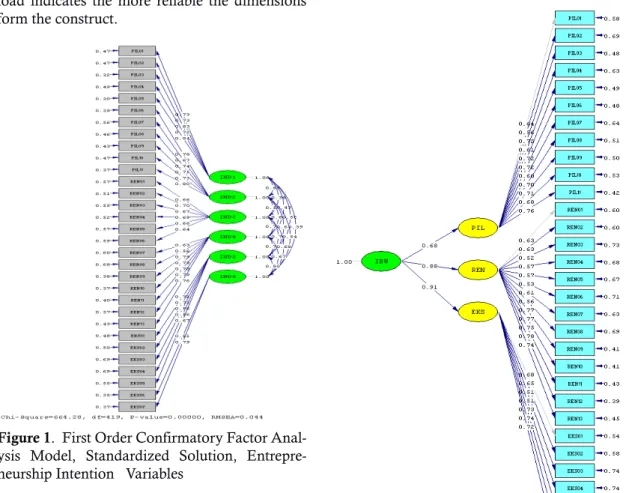
Based on the results of the measurement model analysis in Figure 1, it shows that all items of statement have a factor (λ)> 0.5, which means that the items are valid and fit to be used for data collection in accordance with the opinion of Hendryadi and Suryani (2014: 17).
Figure 2 shows that all manifest variables have a value of t> 1.96 at α = 0.05, which means that the relationship between manifest variables and factors or indicators is significant. The indi-cator of entrepreneurship intention consists of six items: desire to start, need of entrepreneur-ship, effort to start entrepreneurentrepreneur-ship, readiness to start entrepreneurship, possibility to start entre-preneurship, and target to start entrepreneurship. Measurement of Second Order Confirma-tory Factor Analysis model without indicating indicator can be shown in the Figure 3. Figure 3 shows that there is no change in which all items of the statement have a factor load of> 0.5, which means that all the statements are valid.
Structural Model
This structural model is used to determi-ne whether a construct built or shaped by di-mensions is valid or not. Figure 4 shows that the factor load on the dimensions that make up the construct is valid, with the loading factor value> 0.5. The preferred load factor dimensions are 0.68, plan dimensions 0.88, and expectations di-mension 0.91. The higher the value of the factor
load indicates the more reliable the dimensions form the construct.
Figure 1. First Order Confirmatory Factor Anal-ysis Model, Standardized Solution, Entrepre-neurship Intention Variables
Figure 2. First Order Confirmatory Factor Anal-ysis Model, t-Value, Entrepreneurship Intention Variables
Figure 3. Second Order Confirmatory Factor Analysis Model, Standardized Solution Entrepre-neurship Intention Variables
Through the value of factor loaded on the structural model of Intention Entrepreneurial Va-riable in Figure 5, the value of reliability and va-riance extract can be determined. The calculation of Construct Reliability (CR) = 0.868963 and Va-riance Extracted (VE) = 0.691782
Figure 4. Structural Model of Entrepreneurship Intention Variable
Goodness of Fit of All Models
Goodness of fit of all models is used to compare whether the model is theoretically simi-lar the empirical model. The fit model is an in-dication of the comparison between the model specified with the covariant matrix between the indicators or the observed variables. According to Latan (2014), the use of 4-5 criteria of goodness of fit is considered sufficient to assess the feasi-bility of a model, provided that each criterion of goodness of fit those are absolute fit indices, incremental fit indices, and parsimonious fit in-dices are represented. The first criterion of good-ness of fit is absolute fit indices, which consists of absolute chi-square (λ ^ 2), goodness of fit indices (GFI), root mean square of approximation (RM-SEA). The second criterion of goodness of fit is incremental fit indices, consisting of adjusted goodness of fit (AGFI), normed fit index (NFI), comparative fit index (CFI), incremental fit index (IFI), relative fit indices (RFI). The third criterion of goodness of fit is parsimony fit indices, consist-ing of akaike’s information criterion (AIC) and consistent akaike information criterion (CAIC), expected cross validation index (ECVI), parsimo-nious goodness of fit index (PGFI).
Based on the criteria of goodness of fit of the model, there are ten measurements of good-ness of fit (GOF) showing fit and each criterion of goodness of fit those are absolute fit indices, incremental fit indices, and parsimony fit indices are represented, so it can be concluded that the fit of model overall is good.
CONCLUSION
This research aims to develop the students’ entrepreneurship intention instruments, which can be concluded as follows: (1
1. The development stage of dimension and in-dicator is conducted based on the synthesis of theory and concept of entrepreneurship inten-tions to obtain the dimensions and indicators as follows: (1) preferences: the desire to start entrepreneurship and the need for neurship; (2) plans: effort to start neurship and preparation to start entrepre-neurship; (3) expectations: possibility to start entrepreneurship and target to start entrepre-neurship.
2. The validity of construct of entrepreneurship intention instrument is conducted through stages of theoretical and empirical validity. Theoretical validity is conducted by involving the experts to examine and assess the theo-retical instruments before an empirical fit test.
The review and panel of experts provide rec-ommendation of revision or improvement to the statement items that have been arranged by the researcher.
3. The empirical validity of construct of entrepre-neurship intention instrument of the students is conducted through a fit test in two stages with the respondents of SMK students in DKI Jakarta with the sample of 300 students. The validity testing is conducted using Structural Equation Model (SEM) approach with LIS-REL 8.80. The method of data analysis use confirmatory factor analysis (Confirmatory Factor Analysis). The fit test of model uses a measure of goodness of fit (GOF).
4. The reliability test results indicate that the entrepreneurship intention assessment in-strument of the students has good reliability because the calculation results show that CR is 0.87 and VE is 0.69. The value is already qualified and far exceeds the critical limit that
is Contruct Reliability (CR) ≥ 0.70 or Variance extracted (VE) ≥ 0.5.
5. The entrepreneurship intention assessment in-strument of the students consists of three di-mensions, six indicators, and 31 items, which both theoretically and empirically has met the validity and reliability standards.
Based on the conclusions and implications of the research described earlier, there are some suggestions as follows: (1) For the academics or instrument developers: the results of the develop-ment of this instrudevelop-ment can be used as a refer-ence in the development of similar instruments. In addition, these instruments still need to be tested again with larger area and sample by using various other methods and analytical techniques in order to obtain a standardized instrument; (2) For the teachers: the assessment of success of en-trepreneurship subjects cannot only be done on aspects of cognitive and psychomotor, but also the affective aspect one of them is the intention of entrepreneurship; (3) For the Headmaster: the results of entrepreneurship intention assessment can be used as a reference in determining the pol-icy in increasing the formation of entrepreneur-ship for the students.
REFERENCES
Adams, D. (1993). Defining educational quality. Improv-ing Educational Quality ProjectPublication #1: Bi-ennial Report. Arlington, VA: Institute for Inter-national Research.
Aiken, L. R. (1994). Psycological Testing and Assesment. Boston: Allyn and Bacon Inc.
Blackburn, M. L., & Waite, P. J. (2006). Instrument construction for measuring intention to obtain AED training. American Journal of Health Stud-ies, 21(3/4), 133.
Chaney, B., Wallen, M., & Birch, D. A. (2011). The de-velopment of an instrument to assess advocacy intentions for school health education. Ameri-can Journal of Health Education, 42(5), 286-295. Cronbach, L. J. (1984). Essentials of Psychological
Test-ing. New York: Harper & Row Publisher. Djaali & Muljono, P. (2008). Pengukuran dalam Bidang
Pendidikan. Jakarta: Grasindo.
Gable, R. K., & Wolf, M. B. (2012). Instrument devel-opment in the affective domain: Measuring attitudes and values in corporate and school settings (Vol. 36). Springer Science & Business Media.
Van Gelderen, M., Brand, M., van Praag, M., Bodew-es, W., Poutsma, E., & Van Gils, A. (2008). Ex-plaining entrepreneurial intentions by means of the theory of planned behaviour. Career De-velopment International, 13(6), 538-559.
Hargreaves, A., & Fullan, M. (2012). Professional capi-tal. Transforming teaching in every school. London: Taylor & Francis Ltd..
Hendryadi & Suryani. (2014). Structural Equation Mod-eling dengan Lisrel 8.8: Pedoman untuk Pemula. Yogyakarta: Kaukaba Dipantara.
Henerson, M. E., Morris, L. L. & Fitz-Gibbon, C. T. (1978). How to Measure Attitudes. California: Sage Publications, Inc.
Hisrich, R. D. (2008). Entrepreneurship. New York: Mc-Graw Hill.
Hooge, E. H., & Honingh, M. E. (2014). Are school boards aware of the educational quality of their schools? Educational Management Adminis-tration & Leadership, 42(4), 139–154.
Hungi, N. & Thuki, F. W. (2010). Differences in pupil achievement in Kenya: implications for policy and practice. International Journal of
Educational Development, 30(1), 33-43.
Kusumantoro. (2007). Beberapa Faktor Yang Mem-pengaruhi Minat Siswa SMK Koperasi Yogya-karta Untuk Berwiraswasta. Dinamika Pendidi-kan, 2(2)
Latan, H. (2013). Structural Equation Modeling: Konsep dan Aplikasi Menggunakan Program Lisrel 8.80. Bandung: Alfabeta.
Mardapi, D. (2012). Pengukuran, Penilaian dan Evaluasi Pendidikan. Yogyakarta: Nuha Medika. Margono, G. (2013). The Development of Instrument for
Measuring Attitudes toward Statistics Using Seman-tic Differential Scale, 2nd International Seminar on Quality and Affordable Education (ISQAE). Miller, G., & Elman, E. (2013). Improving the quality of education: Kenya’s next challenge. Geogra-phy, 98, 24.
Oktarina, N. (2006). Pengembangan Emotional Intelli-gence Dalam Pembelajaran Ekonomi Di SMK Untuk Mempersiapkan Peserta Didik Dalam Menghadapi Tantangan Kerja Di Era Global-isasi. Dinamika Pendidikan, 1(2)
Prihantoro & Syamsuhadi. (2015). Pengaruh Pendi-dikan Kewirausahaan, Motivasi Berwirausaha dan Lingkungan Keluarga Terhadap Sikap Mental Kewirausahaan. Economic Education Analysis Journal, 5(2).
Soderlund, M., & Ohman, N. (2003). Behavioral inten-tions in satisfaction research revisited. Journal of Consumer Satisfaction, Dissatisfaction and Com-plaining Behavior, 16, 53.
Sudijono, A. (2009). Pengantar Evaluasi Pendidikan. Ja-karta: RajaGrafindo Persada.
Sugiyono. (2011). Metode Penelitian Pendidikan: Pendeka-tan Kuantitatif, Kualitatif, dan R & D. Yogyakar-ta: Alfabeta.
Yulista & Kusumantoro. (2015). Kualitas Layanan Pendidikan di SMK Muhamadiyah Batang. Economic Education Analysis Journal, 4(1).