© 2014. P. Kiran Kumar Reddy, Vakulabharanam vijaya kumar & B. Eswara Reddy. This is a research/review paper, distributed under the terms of the Creative Commons Attribution-Noncommercial 3.0 Unported License http://creativecommons.org/ licenses/by-nc/3.0/), permitting all non-commercial use, distribution, and reproduction inany medium, provided the original work is properly cited.
Global Journal of Comuter Science and Technology:
GInterdisciplinary
Volume 14 Issue 1 Version1.0 Year2014
Type: Double Blind Peer Reviewed International Research Journal Publisher: Global Journals Inc. (USA)
Online ISSN: 0975-4172 & Print ISSN: 0975-4350
Wavelet based Shape Descriptors using Morphology for Texture
Classification
By P. Kiran Kumar Reddy, Vakulabharanam vijaya kumar & B. Eswara Reddy
RGMCET/JNTUA, India
Abstract-
The present paper is an extension of our previous paper [1]. In this paper shape descriptors are derived on binary cross diagonal texture matrix (BCDTM) after formation of morphological gradient on the wavelet domain. Morphological gradient is obtained from the difference of dilated and eroded gray level texture. A close relationship can be obtained with contour and texture pattern by evaluating morphological edge information. Morphological operations are simple and they provide topology of the texture, that is the reason the proposed morphological gradient provides abundance of texture and shape information. The proposed Wavelet based morphological gradient binary cross diagonal shape descriptors texture matrix (WMG-BCDSDTM) using wavelets is experimented on wide range of textures for classification purpose. The experimental results indicate a high classification rate.Keywords:
shape descriptors, cross-diagonal, texture elements, gradient, texture information.
GJCST-G Classification:
1.2.10
WaveletbasedShapeDescriptorsusingMorphologyforTextureClassification
Wavelet based Shape Descriptors using
Morphology for Texture Classification
P. Kiran Kumar Reddy α , Vakulabharanam Vijaya kumar σ& B. Eswara Reddy ρ
Abstract- The present paper is an extension of our previous paper [1]. In this paper shape descriptors are derived on binary cross diagonal texture matrix (BCDTM) after formation of morphological gradient on the wavelet domain. Morphological gradient is obtained from the difference of dilated and eroded gray level texture. A close relationship can be obtained with contour and texture pattern by evaluating morphological edge information. Morphological operations are simple and they provide topology of the texture, that is the reason the proposed morphological gradient provides abundance of texture and shape information. The proposed Wavelet based morphological gradient binary cross diagonal shape descriptors texture matrix (WMG-BCDSDTM) using wavelets is experimented on wide range of textures for classification purpose. The experimental results indicate a high classification rate.
Keywords: shape descriptors, cross-diagonal, texture elements, gradient, texture information.
I.
I
ntroductionhe term texture is somewhat misleading term in computer vision and there is no common or unique definition for texture. Many researchers defined textures based on their specific application. Initially the word texture is taken from textiles. In textures the term texture refers to the weave of various threads tight or loose, even or mixed [2]. The texture provides structural information based on region discrimination shape, surface orientation and spatial arrangement of the object considered [3, 4, 5, 6]. Classification refers; the way different textures or images differ with textural properties or primitives. These textural properties can be statistical, structural and combination of both. One of the oldest, popular and still considered as the bench mark method for classification of textures is the Gray Level Co-occurrence Matrix (GLCM) [7].
The GLCM computes the relative grey level frequencies among the adjacent pair of pixels. Today mostly the GLCM is combined with other methods and it is rarely used individually [8, 9, 10]. Signal processing methods based on wavelets [11, 12, 13] and curvelet transforms [14, 15] are also widely used for texture classification. The present paper derived a classification
Author α: Associate Professor,CSE Dept, RGMCET, Nandyal,A.P,India. e-mail: [email protected].
Author ρ: Dean of CSE Dept,AGI, Hyderabad, AP, India. e-mail: [email protected]
Author σ: Professor,CSE Dept, JNTUA,Anantapuram, AP,India. e-mail: [email protected]
method on the wavelet transforms using morphological gradient on the shape descriptors derived on the cross diagonal texture unit. The rest of the paper is organized as below. The section two and three describes the basic concepts of wavelets and morphology. The section four describes the proposed method. The section five and six describes the results and discussions followed by conclusions.
II.
B
asicC
oncepts ofW
aveletsToday the methods based on the Discrete wavelet transform (DWT) are efficiently and successfully used in many scientific fields such as pattern recognition, signal processing, image segmentation, image compression, computer vision, video processing, texture classification and recognition [16, 17]. Many research scholars showed significant interest in DWT transform based methods due to its ability to display image at different resolutions and to achieve higher compression ratio.
An image signal can be analyzed by passing it through an analysis filter bank followed by a decimation operation in the wavelet transforms [18, 19]. At each decomposition stage the analysis filter bank consists of a low pass and a high pass filter. When the signal goes through these filters it divides into two bands. The averaging operation is known as the low pass filter, extracts the coarse information of a signal. The detail information of the signal is achieved by the high pass filter, which corresponds to a differencing operation. The output of the filtering operations is then decimated by two [20, 21].
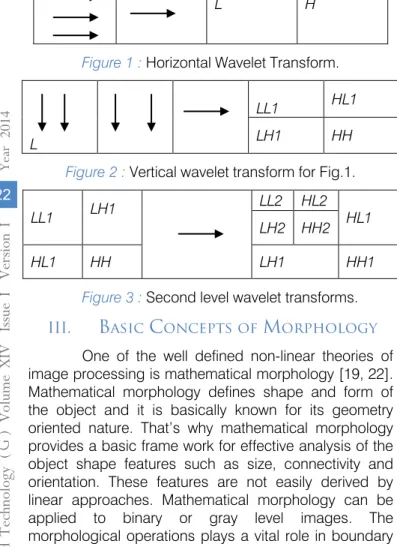
By performing two separate one-dimensional transforms one can accomplish a two-dimensional transform. For this Firstly, the image is filtered along the x-dimension using low pass and high pass analysis filters and decimated by two. On the left part of the matrix Low pass filtered coefficients are stored and on the right part of the matrix the high pass filtered coefficients are stored. Because of decimation the total size of the transformed image is same as the original image, which is shown in Fig. 1. Then, it is followed by filtering the sub image along the y-dimension and decimated by two. Finally, the image splits into four bands denoted by low-low (LL), high-low (HL), low-high (LH) and high-high (HH) after one-level decomposition as depicted in Fig. 2. Fig. 3 shows second level of
T
Global Journal of Computer Science and Technology Volume XIV Issue I Version I
21 (DDDDDDDD ) Year 2014 G
filtering. This process of filtering the image is called ‘Pyramidal decomposition’ of image.
L H
Figure 1 : Horizontal Wavelet Transform.
L
LL1 HL1
LH1 HH
Figure 2 : Vertical wavelet transform for Fig.1.
LL1 LH1 LL2 HL2 HL1
LH2 HH2
HL1 HH LH1 HH1
Figure 3 : Second level wavelet transforms.
III.
B
asicC
oncepts ofM
orphologyOne of the well defined non-linear theories of image processing is mathematical morphology [19, 22]. Mathematical morphology defines shape and form of the object and it is basically known for its geometry oriented nature. That’s why mathematical morphology provides a basic frame work for effective analysis of the object shape features such as size, connectivity and orientation. These features are not easily derived by linear approaches. Mathematical morphology can be applied to binary or gray level images. The morphological operations plays a vital role in boundary and edge detection, noise removal, image enhancement, pre-processing, segmentation, in medical image processing for finding abnormalities and size and volume of the tissues etc. The main advantage of mathematical morphology is all its operations are defined over two simple operations i.e. dilation and erosion.
The fundamental or basic step in morphology is to compare the given objects to be analyzed, classified, pre-processed etc. with an object of known shape termed as a Structuring Element (SE). The image transformation will be resulted in morphology by comparing the object under study (analogous to universe) with a defined shape or SE. The shape of the defined SE element plays a crucial role in morphological processing.
Two basic morphological operations – erosion and dilation are based on Minkowski operations as given in equation (1) and (2)
X⊝B = y ⋂∈B Xy (1)
X⊕B = y ⋃∈B Xy (2)
Where:
Xy = { x + y ∶ x∈X } (3)
B�= { b∶ −b∈B } (4) B and B ̂ are Structuring elements
Dilation in general makes objects to grow or dilate in size. Erosion makes objects to shrink. The amount and the way that they expand or shrink depend upon the selection of the structuring element. Dilating or eroding without the knowledge of structural element makes no more sense than trying to low pass filter an image without specifying the filter.
Dilation grows or dilates or closes the gaps. Erosion in general shrinks or widens the gaps. The amount and the way they expand or shrink and closes and widens gaps depends upon the selected SE. Dilating or eroding without the knowledge of SE makes no sense than trying to low-pass filter an image without specifying the filter.
Another important pair of morphological operations are closing and opening. They are defined in terms of dilation and erosion, by equations (5) and (6) respectively
X • B= ( X ⊕ B) Θ B (5) X B= ( X Θ B ) ⊕ B (6)
Dilation followed by erosion is known as closing. Closing connects the objects that are close to each other, fills up small gaps and smoothes the outline of the object by filling up narrow holes. Opening is nothing but erosion followed by dilation. Opening widens small holes and smoothes the objects. Opening operation decreases the size of bright, small details with no prominent effect on the darker gray levels.
Morphological gradient is derived in the present study by evaluating the difference between Dilation and erosion over a 3 x 3 neighborhood.
Wavelet based Shape Descriptors using Morphology for Texture Classification
Global Journal of Computer Science and Technology Volume XIV Issue I Version I
22 (DDDD ) Year 2014 G
IV.
P
roposedW
avelet basedM
orphologicalG
radientB
inaryC
rossD
iagonal S hapeD
escriptorsT
extureM
atrix (wmg-bcdsdtm)C
lassificationM
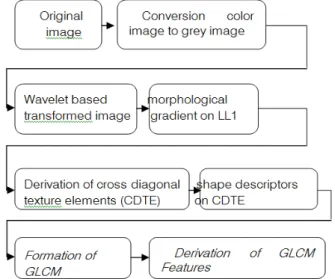
ethodologyFigure 4 :Block diagram for proposed MGSD Method The present paper converted the color is
images using RGB quantization process by using 7-bit binary code of 128 colors.
a) Derivation of Wavelet based Morphological Gradient Binary Cross Diagonal Shape Descriptors Texture Matrix (WMG-BCDSDTM)
The Texture Unit (TU) and Texture Spectrum (TS) approach was introduced by Wang and He [20]. The TU approach played a significant role in texture analysis, segmentation and classification. The frequency of occurrences of TU in an image is called Texture Spectrum (TS). Several textural features are derived using TSfor wide range of applications [4].
In the literature most of the texture analysis methods using texture units based on 3x3 neighboring pixels obtained the texture information by forming a relationship between the center pixel and neighboring pixels. One disadvantage of this approach is they lead to a huge number of texture units 0 to 38-1 if ternary values are considered otherwise 0 to 28-1 texture units if binary values are considered. To overcome this Cross Diagonal Texture Unit (CDTU) is proposed in the literature [1]. Based on the CDTU values Cross diagonal texture matrix (CDTM) is computed [1]. On the CDTM the GLCM features are evaluated for efficient classification [1]. In the CDTM approach the 8-neighboring pixels of a 3x3 window are divided into two sets called diagonal and cross Texture Unit Elements (TUE). Each TUE set contains four pixels. The typical dimension of CDTM is 80 x 80. To reduce this dimension CDTU is evaluated using binary representation instead of ternary. In this the Binary CDTM (BCDTM) contains a dimension of 16 x 16. The elements CDTM and BCDTM can be ordered into 16 different ways [1]. To overcome
Global Journal of Computer Science and Technology Volume XIV Issue I Version I
23 (DDDDDDDD ) Year 2014 G
In the present paper initially wavelet based morphological gradient image is obtained. On this binary texture unit elements (TUE) are obtained. Then the TUE’s are divided into Binary Diagonal Texture Unit Elements (BDTUE) and Cross Diagonal Texture Unit Elements (BCTUE) as shown in Fig.5. Then four elements of the BDTUE and BCTUE are organized as a 2x2 grid as shown in Fig.5. Then on the 2x2 grid shape descriptors (SD) are evaluated. From this WMG-BCDSDTM is derived as shown in Fig.5.
12 18 70
120 65 24
140 70 90
Diagonal Cross representation 3x3 neighborhood representation
0 1 1 1 0 1 0 1 0 0 1 1 0 1 1 1 Representation of Representation of BDTUE in the form BCTUE in the form
2x2.Evaluation 2x2.Evaluation of SD
Of SD Index(Triangle=4) Index (Line =2)
Figure 5 : Formation of WMG-BCDSDTM
this, shape descriptors are derived on BCDTM in the present paper in the following way.
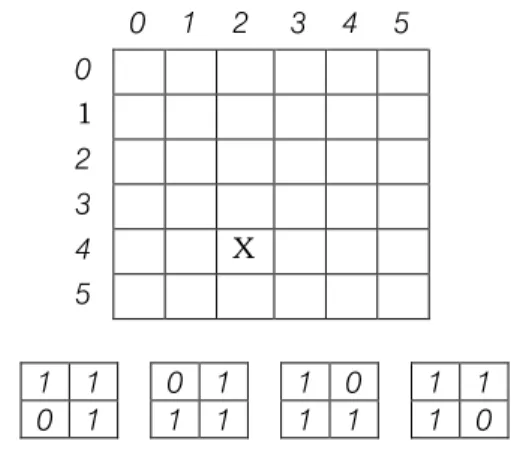
The advantage of shape descriptors is they don’t depend on relative order of texture unit weights. The TU weights can be given in any of the four forms as shown in Fig.6. The relative TU will change, but shape remains the same.
20 21 23 20 22 23 21 22 23 22 22 21 21 20 20 23
Figure 6 :Four different ways of assigningweights to TU on a 2x2 grid
b) Derivation of Shape Descriptors (SD) on a 2x2 grid
This section presents shape descriptors and also the indexes that are given to shape descriptors. In the proposed Shape Descriptors (SD) the TU weights can be taken in any order. It results the same shape.
Hole shape (Index 0): The all zero’s on a 2x2 grid represents a hole shape as shown in the Fig.7. It gives a TU as zero.
0 0
0 0
Figure7 :Hole shapeon 2x2 grid with index value 0 Dot shape (Index 1): The TU with 1, 2, 4 and 8 represents a dot shape. The dot shape will have only a single one as shown in Fig.8.
1 0 0 1 0 0 0 0
0 0 0 0 0 1 1 0
Figure 8 :The four dot shapes on a 2x2 grid with index value 1
1 1 0 1 1 0 1 1
0 1 1 1 1 1 1 0
Figure 11 :Representation of triangle shape on a 2x2 grid with index 4
Blob shape (Index 5) : All one’s in a 2x2 grid represents a blob shape with TU 15. This is shown in Fig.12.
1 1
1 1
Figure 12 :Representation of blob shape on a 2x2 grid with index 5
The detailed formation process of Wavelet based Morphological Gradient Binary Cross Diagonal Shape Descriptor Texture Matrix (WMG-BCDSDTM) is shown in Fig.5. There are only six shape descriptors (0 to 5) on a 2x2 image. Therefore the WMG-BCDSDTM dimension is reduced to 6x6. On this WMG-BCDSDTM the GLCM feature parameters like contrast, correlation, energy and homogeneity are evaluated as given in equation 11, 12, 13 and 14. 𝐸𝐸𝐸𝐸𝐸𝐸𝐸𝐸𝐸𝐸𝐸𝐸= � −𝑙𝑙𝐸𝐸( (11)𝑃𝑃𝑖𝑖𝑖𝑖)2 𝑁𝑁−1 𝑖𝑖,𝑖𝑖=0 𝐶𝐶𝐶𝐶𝐸𝐸𝐶𝐶𝐸𝐸𝐶𝐶𝐶𝐶𝐶𝐶= ∑𝑁𝑁−𝑖𝑖,𝑖𝑖=01𝑃𝑃𝑖𝑖𝑖𝑖(𝑖𝑖 − 𝑖𝑖 )2 (12)
Wavelet based Shape Descriptors using Morphology for Texture Classification
Global Journal of Computer Science and Technology Volume XIV Issue I Version I
24
(DDDD)
Year
2014
G
Horizontal or Vertical line shape (Index 2): The TU 3, 6, 9 and 12 represents a horizontal or vertical line. They contain two adjacent ones as shown in Fig.9.
1 1 0 1 0 0 1 0
0 0 0 1 1 1 1 0
Figure 9 :Representation of horizontal and vertical lines on a 2x2 grid with index 2
Diagonal Line shape (Index 3): The other two adjacent one’s with TU values 5 and 10 represents diagonal lines as shown in Fig.10.
0 1 1 0
1 0 0 1
Figure 10 :Representation of diagonal line on a 2x2 grid with index 3 0 1 2 3 4 5 0 1 2 3 4 X 5
Triangle shape (Index 4) : The three adjacent one’s with TU values 7, 11, 13 and 14 represents triangle shape as shown in Fig.11.
Ho𝑚𝑚𝐶𝐶𝐸𝐸𝐸𝐸𝐸𝐸𝑖𝑖𝐶𝐶𝐸𝐸= ∑ 𝑃𝑃𝑖𝑖𝑖𝑖
1+( 𝑖𝑖−𝑖𝑖)2
𝑁𝑁−1
𝑖𝑖,𝑖𝑖=0 (13)
𝐶𝐶𝐶𝐶𝐸𝐸𝐸𝐸𝐸𝐸𝑙𝑙𝐶𝐶𝐶𝐶𝑖𝑖𝐶𝐶𝐸𝐸= ∑𝑖𝑖𝑁𝑁−,𝑖𝑖=01 𝑃𝑃𝑖𝑖𝑖𝑖(𝑖𝑖−𝜇𝜇 𝜎𝜎)(2𝑖𝑖−𝜇𝜇) (14)
Where Pij is the pixel value of the image at position (i, j), µ is mean and σ is standard deviation.
V.
R
esults andD
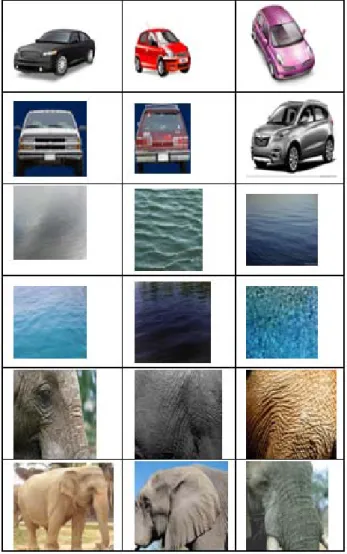
iscussionsTo test the efficiency of the proposed method the present paper evaluated above GLCM features for Water and Elephant images collected from Google database with a resolution of 256x256. The images are as shown in Fig.13.
0o, 45o, 90oand 135owith distance of one for Car, Water
The Table 1, 2 and 3 indicates the average 135o with distance of one on the WMG-BCDSDTM for value of above GLCM features for 0o, 45o, 90oand 135o
the water, car and Elephant textures respectively. Based on the values of GLCM features a classification algorithm1 is derived as shown below.
Figure 13: Car, Water and Elephant textures.
Global Journal of Computer Science and Technology Volume XIV Issue I Version I
25 (DDDDDDDD ) Year 2014 G Average
contrast correlationAverage Average energy homogenietyAverage
W_1 34821.5 -0.046 0.165 0.339 W_2 17511.5 -0.044 0.165 0.302 W_3 14834.4 0.086 0.164 0.399 W_4 27787.7 -0.056 0.167 0.304 W_5 19838.6 -0.033 0.165 0.303 W_6 40908.3 -0.046 0.165 0.329 W_7 46419.8 -0.059 0.164 0.313 W_8 23657.8 -0.059 0.166 0.302 W_9 35427.6 -0.043 0.164 0.32 W_10 24426 -0.0261 0.165 0.311
Table 1:GLCM features on WMG-BCDSDTM of Water Texture.
Average
contrast correlationAverage Average energy homogenietyAverage
El_1 16821 -0.046 0.166 0.2 El_2 15175.5 -0.080 0.167 0.201 El_3 16000.4 0.043 0.164 0.297 El_4 13833.9 0.056 0.164 0.298 El_5 13042.6 0.019 0.165 0.298 El_6 18526.6 0.026 0.164 0.26 El_7 11079.5 -0.081 0.166 0.209 El_8 13708.3 -0.011 0.164 0.297 El_9 14196.8 0.089 0.164 0.23 El_10 16015.8 0.053 0.164 0.299
Table 2 :GLCM features on WMG-BCDSDTM of Car Textures.
Average
contrast correlationAverage Average energy homogenietyAverage
C_1 76237.0 -0.047 0.165 0.433 C_2 52556.8 -0.051 0.164 0.422 C_3 107235.9 -0.038 0.166 0.462 C_4 77115.16 0.047 0.165 0.432 C_5 69522.79 -0.062 0.165 0.413 C_6 70546.15 -0.047 0.182 0.444 C_7 42989.83 -0.056 0.165 0.413 C_8 44555.19 -0.069 0.166 0.415 C_9 55080.92 -0.054 0.164 0.415 C_10 78811.38 -0.016 0.165 0.403 Table 3 :GLCM features on WMG-BCDSDTM of Elephant Textures.
Algorithm 1: Texture classification algorithm based on GLCM features on WMG-BCDSDTM.
Algorithm 1 Begin
if ( (contrast >=1000 && contrast <=17000) && homogeneity ==0.2 )
print (“ Elephant Texture”);
else if ( (contrast >17000 && contrast <=45000) && homogeneity ==0.3 )
print(“ Water Texture “);
else if ( (contrast > 45000 && contrast <=150000) && homogeneity==0.4 )
print(“ Car Texture “); End
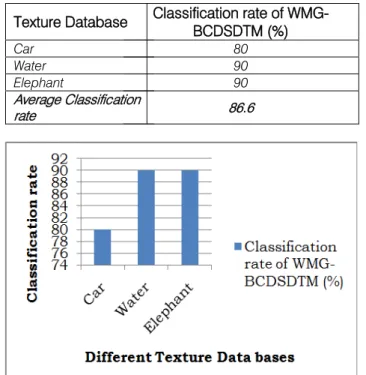
Based on the algorithm the classification rates of the above images are given in Table 4 and also represented in the form of bar graph in Fig. 14.
Wavelet based Shape Descriptors using Morphology for Texture Classification
Global Journal of Computer Science and Technology Volume XIV Issue I Version I
26 (DDDD ) Year 2014 G
Table 4 :Classification rates of WMG-BCDSDTM method. Texture Database Classification rate of WMG-BCDSDTM (%)
Car 80 Water 90 Elephant 90 Average Classification rate 86.6 VI.
C
onclusionThe proposed Wavelet based Morphological Gradient BCDSDTM is based on CDTM. It reduced the overall dimension of the proposed texture matrix from 81x81 as in the case of CDTM and 16x16 as in the case of Binary CDTM into 6x6. Thus it has reduced lot of complexity. Another disadvantage of the CDTM and BCDTM is it forms 16 different CDTM’s for the same texture. The proposed WMG-BCDSDTM overcomes this by representing the four texture elements in the form of a 2x2 grid and deriving shape descriptors on them. The morphological gradient of the present method preserves the shape and boundaries. The proposed WMG-BCDSDTM proves that the WMG-WMG-BCDSDTM can be used effectively in wavelet domain and it reduces lot of complexity. The proposed method can also be used in image retrieval system.
R
eferencesR
éférencesR
eferencias4. M. Varma. and A. Zisserman (2002), Classifying images of materials: Achieving viewpoint and illumination independence. In ECCV02, page III: 255.
5. R.Chellappa and S. Chatterjee(1985). Classification of textures using gaussian markov random fields. ASSP, 33:959-963.
6. T. K. Leung and J. Malik(2001.) Representing and recognizing the visual appearance of materials using three-dimensional textons. IJCV, 43(1):29-44. 7. R. M. Haralick, K. Shanmugam, and L. Dinstein,
(1973.). Textural Features for Image Classification, IEEE TSMC, vol. 3, pp. 610 -621.
Figure 14 :Bar graph representation of Classification rates on texture databases.
2. G. Smith and I. Burns (1997). Measuring texture classification algorithms. PRL, 18(14):1495-1501, December.
3. Fogel and D. Sagi (1989). Gabor filters as texture discriminator. BioCyber, 61:102-113.
8. Abdulrahman A1 – Janobi (2001), Performance evaluation of cross-diagonal texture matrix method of texture analysis, Pattern recognition 34 ,171-180. 9. B. Sujatha, Dr. V. VijayaKumar, M. Chandra Mohan
(2011), Rotationally Invariant Texture Classification using LRTM based on Fuzzy Approach, International Journal of Computer Applications (0975 – 8887),Volume 33– No.4.
10. Pullela. SVVSR Kumar, V.Vijaya Kumar, Rampay.Venkatarao (2014), Age Classification Based On Integrated Approach, I.J. Image, Graphics and Signal Processing,7, 50-57.
11. M.B. Othmen, M. Sayadi, and F. Fnaiech, (2008 ),Interest of the Multi-Resolution Analysis Based on the Co-occurrence Matrix for Texture Classification, IEEE MELECON, pp. 852-856.
12. Yu-Long Qiao, Chun-Yan Song, and Fu-Shan Wang, (2013),Wavelet-Based Dynamic Texture Classification Using Gumbel Distribution” Mathematical Problems in Engineering Volume 2013.
13. Y. Shang, W. Hou, R. Wu, and Z. Meng, (2008 ), Antinoise ,Rotation Invariant Texture Classification Based on LBP Features of Dominant Curvelet Subbands,IITA, pp. 365-369.
14. Julesz, B. and J.R. Bergen. 1983. Textons, the fundamental elements in preattentive vision and perception of textures, Bell System Tech. J. 62, 1619-1646.
15. Peder, Klith Bocher. and Keith, R. McCloy. (2006). The Fundamentals of Average Local Variance: Detecting Regular Patterns. IEEE Trans. on Image Processing, vol. 15, pp. 300-310.
16. Heric.D and D.Zazula,( 2007),Combined edge detection using wavelet transform and signal registration, Image and Vision Computing vol.25, no.5, pp.652-662.
17. Meyer.F, A.Averbuch, et al.( 2002), Fast adaptive wavelet packet image compression, Image Processing, IEEE Transactions on 9(5): pp.792-800. 18. Raghuveer M. Rao and Ajit S. Bopardikar,
(2006),Wavelet Transforms-Introduction to Theory 1. P. Kiran Kumar Reddy, Vakulabharanam Vijaya
Kumar, B. Eswar Reddy , Texture Classification Based on Binary Cross Diagonal Shape Descriptor Texture Matrix (BCDSDTM), GVIP , Volume 14, Issue 1, August 2014, pp. 45-51.
Global Journal of Computer Science and Technology Volume XIV Issue I Version I 27 (DDDDDDDD ) Year 2014 G
and Applications, Pearson Education, Published by Dorling Kindersley (India) Pvt. Ltd.
19. Soman K.P. and Ramachandran K.I(2006), Insight into wavelets from theory to practice, Second Edition, Prentice-Hall of India Pvt. Limited.
20. Elyasi.I and Zermchi.S(2009), Elimination of Noise by Adaptive Wavelet Threshold, World Academy of Science, Eng. and Tech., Vol.56, pp.462-465.
21. Wink.A.M and J.B.T.M.Roerdink (2004),Denoising functional MR images: a comparison of wavelet denoising and Gaussian smoothing, Medical Imaging, IEEE Transactions on 23(3): pp.374-387.
22. Lewis.A.S and G.Knowles,(1992),Image compression using the 2-D wavelet transform", Image Processing, IEEE Transactions on 1(2): pp.244-250.
This page is intentionally left blank
Global Journal of Computer Science and Technology Volume XIV Issue I Version I
28 (DDDD ) Year 2014 G
© 2014 Global Journals Inc. (US)