Institutional Knowledge at Singapore Management University
Research Collection School Of Information Systems
School of Information Systems
11-2016
An efficient and expressive ciphertext-policy
attribute-based-encryption scheme with partially
hidden access structures
Hui CUI
Singapore Management University, [email protected]
DENG, Robert H.
Singapore Management University, [email protected]
Guowei WU
Singapore Management University
Junzuo LAI
Jinan University - China
DOI:
https://doi.org/10.1007/978-3-319-47422-9_2
Follow this and additional works at:
https://ink.library.smu.edu.sg/sis_research
Part of the
Information Security Commons
This Conference Proceeding Article is brought to you for free and open access by the School of Information Systems at Institutional Knowledge at Singapore Management University. It has been accepted for inclusion in Research Collection School Of Information Systems by an authorized administrator of Institutional Knowledge at Singapore Management University. For more information, please [email protected].
Citation
CUI, Hui; DENG, Robert H.; WU, Guowei; and LAI, Junzuo. An efficient and expressive ciphertext-policy attribute-based-encryption scheme with partially hidden access structures. (2016).Provable Security: 10th International Conference, ProvSec 2016, Nanjing, China, November 10-11, Proceedings. 10005, 19-38. Research Collection School Of Information Systems.
An Efficient and Expressive Ciphertext-Policy
Attribute-Based Encryption Scheme
with Partially Hidden Access Structures
Hui Cui1(B), Robert H. Deng1, Guowei Wu1, and Junzuo Lai21 School of Information Systems,
Singapore Management University, Singapore, Singapore
{hcui,robertdeng,gwwu}@smu.edu.sg
2 Department of Computer Science, Jinan University, Guangzhou, China [email protected]
Abstract. A promising solution to protect data privacy in cloud stor-age services is known as ciphertext-policy attribute-based encryption (CP-ABE). However, in a traditional CP-ABE scheme, a ciphertext is bound with an explicit access structure, which may leak private informa-tion about the underlying plaintext in that anyone having access to the ciphertexts can tell the attributes of the privileged recipients by looking at the access structures. A notion called CP-ABE with partially hidden access structures [14,15,18,19,24] was put forth to address this problem, in which each attribute consists of an attribute name and an attribute value and the specific attribute values of an access structure are hidden in the ciphertext. However, previous CP-ABE schemes with partially hidden access structures only support access structures in AND gates, whereas a few other schemes supporting expressive access structures are computationally inefficient since they are built from bilinear pairings over the composite-order groups. In this paper, we focus on addressing this problem, and present an expressive CP-ABE scheme with partially hidden access structures in prime-order groups.
Keywords: Cloud storage
·
Ciphertext-policy attribute-based encryp-tion·
Access structures·
Data privacy·
Access control1
Introduction
With the explosive growth of information, there is an increasing demand for outsourcing data to cloud storage services due to its economical scale. However, no user would like to store documents containing sensitive information to a public cloud with no guarantee for security or privacy. A promising solution to provide data privacy while sharing data in cloud is using an encryption mechanism such that data owners upload their data in encrypted forms to the cloud and share them with users having the required credentials (or attributes). One encryption technique that meets this requirement is called ciphertext-policy attribute-based
c
Springer International Publishing AG 2016
L. Chen and J. Han (Eds.): ProvSec 2016, LNCS 10005, pp. 19–38, 2016. DOI: 10.1007/978-3-319-47422-9 2
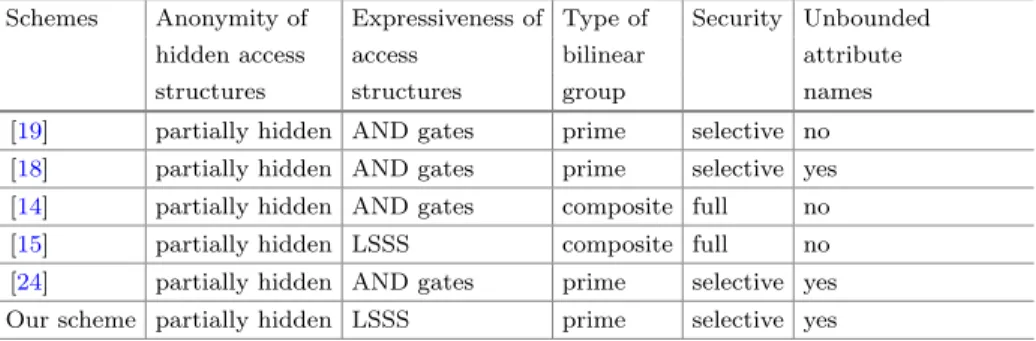
Table 1.Comparisons of CP-ABE schemes with partially hidden access structures
Schemes Anonymity of Expressiveness of Type of Security Unbounded hidden access access bilinear attribute structures structures group names [19] partially hidden AND gates prime selective no [18] partially hidden AND gates prime selective yes [14] partially hidden AND gates composite full no [15] partially hidden LSSS composite full no [24] partially hidden AND gates prime selective yes Our scheme partially hidden LSSS prime selective yes
encryption (CP-ABE) [3], in which a user’s private key issued by an attribute authority (AA) is associated with a set of attributes, a message is encrypted under an access structure (or access policy) over a set of attributes by the data owner, and a user can decrypt the ciphertext using his/her private key if and only if his/her attributes satisfy the access policy ascribed to this ciphertext.
Though a ciphertext in a traditional CP-ABE scheme (e.g., [3,7,16,23]) does not directly tell the identities of its recipients, an access structure in the cleartext is attached to the ciphertext, and thus anyone who sees a ciphertext may be able to deduce certain private information about the encrypted message or the privileged recipients of the message. Let us consider the cloud storage system, which is used by a hospital to store electrical medical records (EMRs) of patients. In this system, the hospital encrypts an EMR using CP-ABE under an access structure “(Patient: NR005289 AND Hospital: City Hospital) OR (Doctor: Cardiologist AND Hospital: General Hospital)”, and then uploads the ciphertext together with the access pol-icy to the cloud. The access polpol-icy requires that a patient identified by NR005289 at City Hospital or any Cardiologist at General Hospital can decrypt the cipher-text to obtain the EMR, from which it can be easily inferred that a person in City Hospital with a patient number NR005289 is suffering a heart problem. This infor-mation leakage is definitely not expected by the cloud users, and thus it is necessary to design CP-ABE schemes that can hide access structures.
It is known from [15] that a CP-ABE scheme with hidden access structures can be built from attribute-hiding Inner-product Predicate Encryption (IPE) [13], but this will result in an increase in the size for an arbitrary access structure in the transformation. Also, it is inefficient to implement CP-ABE schemes with fully hid-den access structure from attribute-hiding IPE [16]. With the goal of having a trade off between fully hidden access structures and efficiency of CP-ABE, partially hid-den access structures [14,15,18,19,24] were embedded in CP-ABE schemes to mit-igate the computational cost. However, the schemes in [14,18,19,24] can only be applied to access structures expressed in AND gates. The construction in [15] sup-ports expressive access structures but is built from pairings over the composite-order groups, and “a Tate pairing on a 1024-bit composite-composite-order elliptic curve is roughly 50 times slower than the same pairing on a comparable prime-order curve,
and this performance gap will only get worse at higher security levels” [9]. Though there exist several techniques [9] to convert pairing-based schemes from composite-order groups to prime-composite-order groups, there is still a significant performance degra-dation due to the required size of the special vectors [21]. Therefore, it is desirable to construct an expressive CP-ABE scheme with partially hidden access structures using pairings in the prime-order groups.
In this paper, we focus on designing an expressive CP-ABE scheme in the prime-order groups which can hide attribute values from access structures. We compare our CP-ABE scheme with partially hidden access structures to others in the literature in Table1. It is straightforward to see that our construction is comparable to the existing ones in that it allows unbounded attribute names, supports expressive access structures and is built in the prime-order groups.
1.1 Challenges and Our Contributions
In the real world, the attribute values always contain more sensitive information than the generic attribute names. For example, the attribute values “Cardiol-ogist” and “NR005289” are more sensitive than the attribute names “Doctor” and “Patient”, respectively. Due to this observation, a notion called CP-ABE with partially hidden access structures [15,19] was proposed which divides each attribute into an attribute name and an attribute value, and hides attribute val-ues associated with an access structure included in a ciphertext. That is, instead of a full access structure, a partially hidden access structure (e.g., “(Patient: * AND Hospital: *) OR (Doctor: * AND Hospital: *)”) which consists of only attribute names without attribute values is attached to a ciphertext.
We build a CP-ABE scheme with partially hidden access structures from the large universe CP-ABE scheme proposed by Rouselakis and Waters [21], which is an unbounded CP-ABE scheme supporting expressive access policies in the prime-order groups. A naive approach to construct a CP-ABE scheme with partially hidden access structures is simply removing the attribute names from the access structure in the Rouselakis-Waters scheme. However, the result-ing scheme suffers off-line dictionary attacks1. Therefore, the key challenge here is to modify the Rouselakis-Waters scheme [21] such that its access structure is partially hidden and secure against off-line dictionary attacks. Thanks to the “randomness splitting” technique [6], we build a CP-ABE scheme where the sen-sitive attribute values are hidden to a computationally bounded adversary by performing some sort of blinding through splitting each attribute value into two randomized complementary components. Thus, though the ciphertext and access structure still contain information about generic attribute names, attribute val-ues are protected from off-line dictionary attacks.
However, since an attribute name in practice may correspond to a number of attribute values, a ciphertext with hidden attribute values raises another issue: given solely attribute names associated with an access structure in a ciphertext, how could a user know he/she is a privileged recipient or not? One solution to this
problem is to also encrypt a publicly known message such as the unity element “1” in addition to the encryption of the real data, all under the same access structure [15,24], but this almost doubles the size of the original ciphertext, which is undesirable to a cloud storage system who prefers to save storage space. To reduce the storage cost of cloud services, we simply make a commitment to the encrypted message, and thus a user can know whether he/she has access to the encrypted data by checking whether the decryption result is consistent with the given commitment of the underlying message.
In a nutshell, the differences between our construction of CP-ABE with par-tially hidden access structure and the Rouselakis-Waters CP-ABE scheme are threefold. Firstly, we perform a “linear splitting” technique [6] on various por-tions of a ciphertext to overcome the off-line dictionary attacks. Secondly, we re-randomize the key components upon each attribute to make the linear split-ting methodology feasible for all attribute values appearing in the ciphertext. Thirdly, we make a commitment to the message to allow a user to check whether he/she is a privileged recipient of a ciphertext without knowing the attribute val-ues ascribed to the ciphertext.
1.2 Related Work
Sahai and Waters [22] introduced a notion called attribute-based encryption (ABE), and then Goyal et al. [11] formulated key-policy ABE (KP-ABE) and CP-ABE as two complimentary forms of ABE. In a CP-ABE system, the private keys are associated with the sets of attributes and the ciphertexts are associated with the access policies, while the situation is reversed in a KP-ABE system. Nevertheless, we believe that KP-ABE is less flexible than CP-ABE because the access policy is determined once the user’s attribute-based private key is issued. Bethencourt, Sahai and Waters [3] proposed the first CP-ABE construction, but it was secure under the generic group model. Cheung and Newport [7] presented a CP-ABE scheme that was proved to be secure under the standard model, but it only supported the AND access structures. A CP-ABE system under more advanced access structures was proposed by Goyal et al. [10] based on the number theoretic assumption. Rouselakis and Waters [21] built a large universe CP-ABE system under the prime-order groups to overcome the limitation that the size of the attribute space is polynomially bounded. The cryptographic primitive of CP-ABE with partially hidden access structures was introduced by Nishide et al. [19], but their construction only admitted admissible access structures expressed in AND gates and is selectively secure. Following the work in [19], Li et al. [18] extended the construction with an additional property as user accountability. With the aim of improving efficiency in [18,19], Zhang et al. [24] presented a methodology to reduce the computational overhead in the decryption, but their construction still did not support advanced access structures. Lai, Deng and Li [14] put forth a fully secure CP-ABE scheme with partially hidden access structures, but it only supports restricted access structures as in [18,19]. Later, Lai, Deng and Li proposed [15] a fully secure CP-ABE scheme which can partially
hide access structures of any boolean formulas, but it was built from bilinear pairings in the composite-order groups.
1.3 Organization
The remainder of this paper is organized as follows. In Sect.2, we briefly review the notions and definitions relevant to this paper. In Sect.3, after depicting the framework for CP-ABE with partially hidden access structures, we present its security model. In Sect.4, we give a concrete expressive and unbounded CP-ABE scheme with partially hidden access policies and analyze its security and performance. We conclude the paper in Sect.5.
2
Preliminaries
In this section, we review some basic cryptographic notions and definitions that are to be used in this paper.
2.1 Bilinear Pairings and Complexity Assumptions
LetGbe a group of prime orderpthat is generated fromg. We define ˆe:G×G
→G1 to be a bilinear map if it has the following properties [5]:
– Bilinear such that for allg∈G, and a,b∈Zp, we have ˆe(ga, gb) = ˆe(g, g)ab
– Non-degenerate such that ˆe(g, g)= 1.
We say thatG is a bilinear group if the group operation in Gis efficiently computable and there exists a group G1 and an efficiently computable bilinear
map ˆe:G×G→G1as above.
Decisional(q−1)Assumption[21]. The decisional (q−1) problem is that for any probabilistic polynomial-time algorithm, given −→y =
g, gμ, gai , gbj, gμ·bj, gaibj, gai/b2j ∀(i, j)∈[q, q], gai/b j ∀(i, j)∈[2q, q] with i=q+ 1, gaibj/b2j ∀(i, j, j)∈[2q, q, q] withj =j,
gμaibj/bj, gμaibj/b2j ∀(i, j, j)∈[q, q, q] withj=j,
it is difficult to distinguish (−→y, ˆe(g, g)aq+1μ) from (−→y,Z), whereg∈G,Z∈G1, a,μ, b1,...,bq ∈Zp are chosen independently and uniformly at random.
Decisional Linear Assumption [4]. The decisional linear problem is that for any probabilistic polynomial-time algorithm, given g, gx1, gx2, gx1x3, gx2x4, it
is difficult to distinguish (g, gx1, gx2, gx1x3, gx2x4, gx3+x4) from (g, gx1, gx2,
gx1x3,gx2x4,Z), whereg,Z∈G,x
1,x2,x3,x4∈Zp chosen independently and
2.2 Access Structures and Linear Secret Sharing
We review the the notions of access structures and linear secret sharing schemes [17,23] as follows.
Access Structures. Let {P1, ..., Pn} be a set of parties. A collection A ⊆
2{P1,...,Pn} is monotone if ∀B, C : if B ∈ A and B ⊆ C, then C ⊆ A. An (monotone) access structure is a (monotone) collectionAof non-empty subsets of{P1,...,Pn}, i.e.,A⊆2{P1,...,Pn}\{∅}. The sets inAare called the authorized
sets, and the sets that are not inAare called the unauthorized sets.
Linear Secret Sharing Schemes (LSSSs). LetP be a set of parties. LetM be a matrix of sizel×n. Let ρ:{1,...,l} →P be a function that maps a row to a party for labeling. A secret sharing scheme Π over a set of partiesP is a linear secret-sharing scheme overZp if
1. the shares for each party form a vector overZp;
2. there exists a matrix M which has l rows and n columns called the share-generating matrix forΠ. Forx= 1,...,l, thex-th row of matrixMis labeled by a partyρ(i), where ρ: {1,..., l} → P is a function that maps a row to a party for labeling. Considering that the column vectorv = (μ,r2,...,rn),
where μ ∈ Zp is the secret to be shared and r2, ..., rn ∈ Zp are randomly
chosen, thenMv is the vector ofl shares of the secretμaccording toΠ. The share (Mv)i belongs to partyρ(i).
It has been noted in [17] that every LSSS also enjoys the linear reconstruction property. Suppose thatΠ is an LSSS for access structureA. LetAbe an autho-rized set, and defineI ⊆ {1,...,l} as I ={i|ρ(i)∈A}. Then the vector (1, 0,
..., 0) is in the span of rows of matrixMindexed byI, and there exist constants {wi ∈Zp}i∈I such that, for any valid shares {vi} of a secret μaccording toΠ, we havei∈Iwivi =μ. These constants{wi}can be found in polynomial time
with respect to the size of the share-generating matrixM[2].
On the other hand, for an unauthorized setA, no such constants{wi}exist.
Moreover, in this case it is also true that if I = {i|ρ(i) ∈ A}, there exists a vector −→w such that its first component w1 is any non zero element in Zp and
<Mi,−→w >= 0 for alli∈I, where Mi is thei-th row ofM [21].
Boolean Formulas [17]. Access policies can also be described in terms of monotonic boolean formulas. LSSS access structures are more general, and can be derived from representations as boolean formulas. There are standard techniques to convert any monotonic boolean formula into a corresponding LSSS matrix. The boolean formula can be represented as an access tree, where the interior nodes are AND and OR gates, and the leaf nodes correspond to attributes. The number of rows in the corresponding LSSS matrix will be the same as the number of leaf nodes in the access tree.
3
System Architecture and Security Model
In this section, we describe the framework and security model of ciphertext-policy attribute-based encryption with partially hidden access structures.
3.1 Framework
A CP-ABE scheme with partially hidden access structures consists of four algo-rithms: setup algorithm Setup, attribute-based private key generation algorithm KeyGen, encryption algorithm Encrypt and decryption algorithm Decrypt.
– Setup(1λ)→(pars,msk). Taking the security parameterλas the input, this
algorithm outputs the public parameterparsand the master private keymsk
for the system. This algorithm is run by the AA.
– KeyGen(pars,msk,A)→KA. Taking the public parameterpars, the master private keymskand an attribute setAas the input, this algorithm outputs an attribute-based private keyKA over the attribute set A. This algorithm is run by the AA.
– Encrypt(pars,M, (M,ρ,{Aρ(i)}))→CT. Taking the public parameterpars,
a message M and an access structure (M, ρ, {Aρ(i)}) where the function ρassociates the rows of M to generic attribute names, and {Aρ(i)} are the
corresponding attribute values as the input. LetMbe anl×nmatrix as the input, this algorithm outputs a ciphertext CT. This algorithm is run by the data owner.
– Decrypt(pars, CT, A, KA) → M/⊥. Taking the public parameter pars, a ciphertext CT and an attribute-based private key KA associated to an attribute setA as the input, this algorithm outputs either the message M
when the private keyKA satisfies the access structure, or a symbol⊥ other-wise. This algorithm is run by the user.
We require that a CP-ABE scheme with partially hidden access structures is correct, meaning that for all messages M, all attribute sets A and access structures (M,ρ,{Aρ(i)}) with authorizedAsatisfying (M,ρ,{Aρ(i)}), if (pars, msk) ←Setup(1λ), K
A ← KeyGen(pars, msk, A), CT ← Encrypt(pars, M,
(M,ρ,{Aρ(i)})), then Decrypt(pars, CT,A,KA) = M. 3.2 Security Definitions
A CP-ABE scheme with partially hidden access structures should ensure confi-dentiality and anonymity. Below we elaborately describe the security definitions for these two requirements one by one.
Confidentiality.Assuming that the adversary makes the key generation queries adaptively, we define the security model for confidentiality by the following game between a challenger algorithm C and an adversary algorithm A, based on the security model of indistinguishability under chosen-plaintext attacks (IND-CPA) for CP-ABE [23].
– Setup. AlgorithmCruns the setup algorithm, and gives the public parameter
parsto algorithmAand keeps the master private keymsk.
– Phase 1. AlgorithmAmakes the key generation queries to algorithmC. Algo-rithmAsends an attribute set Ai to algorithmC. Algorithm C responds by
returning the corresponding keyKAi to algorithm A.
– Challenge. AlgorithmAchooses two messagesM0∗ andM1∗ of the same size,
and an access structure (M∗, ρ∗, {A∗ρ(i)}) with the constraint that the key generation queries{KAi}in Phase 1 do not satisfy the access structure (M∗,
ρ∗, {A∗ρ(i)}). The challenger chooses a random bit β ∈ {0,1}, and sends algorithmAa challenge ciphertext CT∗ which is an encryption ofMβ∗under the access structure (M∗,ρ∗,{A∗ρ(i)}).
– Phase 2. Algorithm A continues issuing the key generation queries on attribute sets Ai with the constraint that they do not satisfy the access structure in the challenge phase. AlgorithmCresponds as in Phase 1. – Guess. AlgorithmAmakes a guessβ forβ, and it wins the game ifβ=β.
Anonymity. Anonymity prevents an adversary from distinguishing a ciphertext under one access matrix associated with one attribute set from a ciphertext under the same access matrix associated with another attribute set. In the anonymity game, the adversary is given the public parameter, as well as the access to the key generation oracle, and its goal is to guess which of two attribute sets satisfying the same access matrix generates the ciphertext in the challenge phase, without being given either of the private keys associated with the two attribute sets. Below we define the the game of anonymity under chosen-plaintext attacks (ANON-CPA) between a challenger algorithmCand an adversary algorithmA. – Setup. AlgorithmCruns the setup algorithm, and gives the public parameter
parsto algorithmAand keeps the master private keymsk.
– Phase 1. AlgorithmAmakes the key generation query to algorithmC. Algo-rithmAsends an attribute set Ai to algorithmC. Algorithm C responds by returning the corresponding keyKAi to algorithm A.
– Challenge. Algorithm A chooses a message M∗ and an access matrix (M∗,
ρ∗) which can be satisfied by attribute sets {A∗ρ(i)}0 and {A∗ρ(i)}1 with the
constraint that there are no key generation queries{KAi} in Phase 1 that can satisfy (M∗,ρ∗,{A∗ρ(i)}0) and (M∗,ρ∗,{A∗ρ(i)}1). The challenger chooses
a random bitβ ∈ {0,1}, and sends algorithm Aa challenge ciphertext CT∗ which is an encryption ofM∗under the access structure (M∗,ρ∗,{A∗ρ(i)}β). – Phase 2. AlgorithmA continues issuing the key generation queries to algo-rithmC. Algorithm C responds as in Phase 1 with the constraint that the attributes of the key generation queries satisfying (M∗, ρ∗, {A∗ρ(i)}0) and
(M∗,ρ∗,{A∗ρ(i)}1) are disallowed. AlgorithmC responds as in Phase 1.
– Guess. AlgorithmAmakes a guessβ forβ, and it wins the game ifβ=β. Algorithm A’s advantage in the above two games are defined as Pr[β =
β]−1/2. We say that a CP-ABE scheme with partially hidden access struc-tures is indistinguishable (or anonymous) under the chosen-plaintext attacks if
all probabilistic polynomial time (PPT) adversaries have at most a negligible advantage in the security parameter λ. In addition, a CP-ABE scheme with partially hidden access structures is said to be selectively indistinguishable (or anonymous) if an Init stage is added before the Setup phase where algorithmA commits to the challenge access structure (M,ρ,{Aρ(i)}).
4
Ciphertext-Policy Attribute-Based Encryption Scheme
with Partially Hidden Access Structures
In this section, we give a concrete construction of a CP-ABE scheme with par-tially hidden access structures, and analyze its security and performance.
4.1 Attribute Value Guessing Attack
Below we briefly review the encryption algorithm of the CP-ABE scheme in [21], and show that there is an attribute value guessing attack to such a construction. Encrypt. This algorithm takes the public parameterpars, a messageM and an LSSS access structure (M,ρ) where the functionρassociates the rows ofMto attributes as the input. LetMbe anl×nmatrix. It randomly chooses a vector −
→v = (μ, y
2, ..., yn) ∈ Zpn. These values will be used to share the encryption
exponent μ. For i = 1 to l, it calculates vi = −→v ·Mi, where Mi is the vector corresponding to the i-th row ofM. In addition, it randomly chooses β,z1,..., zl∈Zp, and outputs a ciphertext CT =
C,D,{(Ci,Di,Ei)}i∈[1,l]
.
C= ˆe(g, g)αμ, D=gμ, Ci=wvivzi, Di=gzi, Ei= (uρ(i)h)−zi,
where g,u,h,v,w, ˆe(g, g)α belong to the public parameterpars.
Attack. Given a ciphertext CT = C, D, {(Ci, Di, Ei)}i∈[1,l]
, an adversary can easily determine whether an attribute value Ai used in the ciphertext by checking whether ˆe(Ei, g) = ˆe(uAih, D
i−1) holds. Clearly, this scheme cannot
achieve anonymity.
4.2 Construction
On the basis of the large universe CP-ABE scheme proposed in [21], we present a CP-ABE scheme which can partially hide the access structures in the prime-order groups. Let Gbe a bilinear group of a prime orderpwith a generatorg. Denote ˆe:G×G→G1by the bilinear map.
– Setup. This algorithm takes the security parameter λ as the input. It ran-domly chooses a group Gof prime orderpwith a generator g. Also, it ran-domly choosesu,h,v,w∈G,d1,d2,d3,d4,α∈Zp, and computesg1=gd1, g2 = gd2, g3 =gd3, g4 =gd4. The public parameter is pars= (H, g, u, h, w, v, g1, g2, g3, g4, ˆe(g, g)α) where H is a collision resistent hash function
that maps an element inG1to an element in{0,1}twithtbeing the security
parameter such that the concatenate elements inZpare represented intbits,
– KeyGen. This algorithm takes the public parameterpars, the master private keymskand an attribute setA2as the input. Letkbe the size ofA, andA
1, ..., Ak ∈Zp be the attribute values of A. It randomly chooses r, r, r1, ..., rk,r1,...,rk ∈Zp, and outputs the attribute-based private keyKA = (K1, K2,{Ki,1,Ki,2,Ki,3,Ki,4,Ki,5}i∈[1,k]) over a set of attributesAas
K1=gαwd1d2r+d3d4r , K2=grd1d2+r d 3d4, Ki,1= ((uAih)riv−r)d2, Ki,2= ((uAih)riv−r)d1, Ki,3=gd1d2ri+d3d4r i, Ki,4= ((uAih)r iv−r)d4, K i,5= ((uAih)r iv−r)d3.
– Encrypt. This algorithm takes the public parameterpars, a messageM ∈Zp
and an LSSS access structure (M, ρ, {Aρ(i)})3 as the input. It randomly
chooses a vector−→v = (μ,y2,...,yn)∈Zpn. These values will be used to share
the encryption exponentμ. Fori= 1 tol, it calculatesvi=−→v ·Mi, whereMi is the vector corresponding to thei-th row of M. Then, it randomly chooses
γ, si,1, ..., si,l,s1,2, ...,sl,2, z1, ..., zl∈Zp, and outputs a ciphertext CT =
(M,ρ),C,D,E,{(Ci,Di,1,Di,2,Ei,1, Ei,2,Fi)}i∈[1,l] , where C= (M||γ)⊕H(ˆe(g, g)αμ), D=gμ, E=gMhγ, Ci=wvivzi, Di,1=g1zi−si,1, Di,2=g3zi−si,2, Ei,1=g2si,1, Ei,2=g4si,2, Fi = (uAρ(i)h)−zi.
– Decrypt. This algorithm takes the public parameterpars, a ciphertext(M,
ρ),C,D,E,{(Ci,Di,1,Di,2,Ei,1,Ei,2,Fi)}i∈[1,l]
and a private keyKA for an attribute setAas the input. It calculatesIM,ρfrom (M,ρ), which is a set
of minimum subsets of attributes satisfying (M,ρ). Denote by{wi ∈Zp}i∈I
a set of constants such that if{vi} are valid shares of any secretμaccording
toM, theni∈Iwivi =μ. For anI ∈IM,ρ, it computes
ˆ e(D, K1) i∈I(ˆe(Ci, K2)ˆe(Di,1, Ki,1)ˆe(Ei,1, Ki,2)ˆe(Fi, Ki,3)ˆe(Di,2, Ki,4)ˆe(Ei,2, Ki,5))wi =eˆ(g, g) αμˆe(gμ, w)r1d1d2ˆe(gμ, w)r2d3d4 i∈I(ˆe(g, wvi)d1d2r1+d3d4r2)wi = ˆe(g, g)αμ, C H(ˆe(g, g)αμ) =M||γ.
IfgMhγ =E, it outputsM. Otherwise, it outputs⊥.
Remarks. In the above construction, the term E, computed using a commit-ment scheme [20], is added to the ciphertext such that a user can easily ascertain whether he/she is a privileged recipient by checking the decryption result via the given E. Note that according to the binding property of the commitment scheme [8], eachE can only be obtained from a unique pair ofM andγ, which
2 Note that each attribute is denoted asN
i=Ai, whereNiis the generic name of an
attribute andAiis the corresponding attribute value.
3 For the details about how to convert a boolean formula into an equivalent LSSS
guarantees the correctness of decryption, in spite of the fact that the user has no idea whether his/her attribute set satisfies the access structure ascribed the ciphertext before performing decryption.
4.3 Security Proof
Theorem 1. Assuming that the (q−1) assumption holds in G, and the deci-sional linear assumption holds in G, then the above system is selectively indis-tinguishable and anonymous.
Proof. At a hight level, the proof is reduced via a sequence of games by concluding that these games are computationally indistinguishable from each other. For suc-cinct description, we remove the access structure related elements from the cipher-text. DenoteC∗,D∗,E∗,{(Ci∗,Di,∗1,D∗i,2,Ei,∗1,Ei,∗2,Fi∗)}i∈[1,l]
by the challenge ciphertext given to the adversary during an attack in the real world. LetZ be a random element of G1, and{Zi,1},{Zi,1} be sets of random elements ofG. We
define a sequence of games Game0, Game1,..., Gamel, Gamel+1,..., Game2l+1that
differ on which challenge ciphertext is given by the challenger to the adversary, where Game0is the original game, Game1changes the termC∗toZ, and Game2
to Gamel+1change theD∗i,1term toZi,1one by one fori∈[1, l], and Gamel+2to
Game2l+1change theEi,∗1term toZi,1one by one fori∈[1, l].
– Game0: The challenge ciphertext is CT∗0 =
C∗, D∗, E∗, {(Ci∗, Di,∗1, Di,∗2,
Ei,∗1,Ei,∗2,Fi∗)}i∈[1,l]
.
– Game1: The challenge ciphertext is CT∗1=
Z,D∗,E∗,{(Ci∗,D∗i,1,D∗i,2,Ei,1, Ei,2,Fi∗)}i∈[1,l]
.
– Game2: The challenge ciphertext is CT∗2=
Z,D∗,E∗, (C1,Z1,1,D∗1,2,E1∗,1, E1∗,2,F1∗),{(Ci∗,D∗i,1,D∗i,2,Ei,∗1,Ei,∗2,Fi∗)}i∈[2,l] . – · · · ·
– Gamel+1: The challenge ciphertext is CT∗l+1 =
Z,D∗,E∗,{(Ci,Zi,1,Di,∗2, Ei,∗1,Ei,∗2,Fi∗)}i∈[1,l]
.
– Gamel+2: The challenge ciphertext is CT∗l+2 =
Z,D∗,E∗, (C1∗, Z1,1, Z1,1, E1∗,1,E1∗,2, F1∗),{(Ci∗,Zi,1,Di,∗2,Ei,∗1, Ei,∗2,Fi∗)}i∈[2,l] . – · · · ·
– Game2l+1: The challenge ciphertext is CT∗2l+1=
Z,D∗,E∗,{(Ci∗,Zi,1,Zi,1, Ei,∗1,Ei,∗2,Fi∗)}i∈[1,l]
.
To complete the proof, we will show that the games Game0, Game1,..., Game2l+1
are computationally indistinguishable.
Lemma 1. Assuming that the (q−1) assumption holds in G, then there is no adversary that distinguishes between the games Game0 and Game1.
Proof. Assume that there exists an adversary algorithm Athat can distinguish Game0from Game1. Then we can build a challenger algorithmC that solves the
– Init. Algorithm A gives algorithm C a challenge access structure (M∗, ρ∗, {ρ(i)∗})4, where M∗ is anl×nmatrix.
– Setup. AlgorithmCrandomly choosesd1,d2,d3,d4∈Zp, and computesg1= gd1,g
2=gd2,g3 =gd3,g4 =gd4. Then, it randomly chooses a hash function H:G1→ {0,1}t, ˜α, ˜u, ˜v, ˜h∈Zp, In addition, it implicitly setsα=aq+1+ ˜α,
and outputs the rest of the public parameter asg=g,w=ga,
v=g˜v· (j,j)∈[l,n] (gaj/bj)M∗j,j, u=gu˜· (j,j)∈[l,n] (gaj/bj2)M∗j,j, h=g˜h· (j,j)∈[l,n] (gaj/bj2)−ρ∗(j)M∗j,j, eˆ(g, g)α= ˆe(ga, gaq)·eˆ(g, g)α˜. – Phase 1 and Phase 2. In both phases, algorithmChas to output the private
keys for attribute setsA={A1,...,A|A|}issued by algorithmA.
Since A does not satisfy (M∗, ρ∗, {ρ(i)∗}), there exists a vector −→w = (w1, ..., wn)⊥ ∈ Zpn such that w1 = −1, (M∗i, −→w) = 0 for all i ∈ I =
{i|i ∈ [l]∧ρ(i)∗ ∈ A}. Algorithm B computes −→w using linear algebra. In addition, it randomly chooses ˜r, ˜r ∈Zp, implicitly sets
r= ˜r+w1aq+w2aq−1+...+wnaq+1−n= ˜r+ i∈[n] wiaq+1−i, r = ˜r+w1aq+w2aq−1+...+wnaq+1−n = ˜r+ i∈[n] wiaq+1−i, and computes K1=gαwd1d2r+d3d4r = (gaq+1gα˜)(ga˜r i∈[n] gwiaq+2−i)d1d2(gar˜ i∈[n] gwiaq+2−i)d3d4, K2=gd1d2r+d3d4r = (g˜r i∈[n] (gaq+1−i)wi)d1d2(gr˜ i∈[n] (gaq+1−i)wi)d3d4. Then it computes v−r=v−˜r· i∈[n] (gaq+1−i)−˜vwi · (i,j,j)∈[n,l,n] i=j gaq+1+j−i/bj−wiM ∗ j,j j∈[l] ρ(j)∈/A g(→−w·M∗j)aq+1/bj, v−r =v−˜r· i∈[n] (gaq+1−i)−˜vwi · (i,j,j)∈[n,l,n] i=j gaq+1+j−i/bj−wiM ∗ j,j j∈[l] ρ(j)∈/A g(→−w·M∗j)aq+1/bj,
4 For notation simplicity, we use{ρ(i)∗}to replace{A∗
where the last parts cannot be directly calculated, so it must be canceled by the (uAih)ri, (uAih)ri parts.
Therefore, for all i ∈ [|A|], algorithm C randomly chooses ˜ri ∈ Zp, and implicitly sets ri = ˜ri+ (˜r· i∈[l] ρ∗(i)∈/A bj Ai−ρ∗(i) + j,i∈[n,l] ρ∗(i)∈/A wjbiaq+1−j Ai−ρ∗(i) ), ri = ˜ri+ (˜r· i∈[l] ρ∗(i)∈/A bj Ai−ρ∗(i)+ j,i∈[n,l] ρ∗(i)∈/A wjbiaq+1−j Ai−ρ∗(i)). and computes gri =gr˜i· i∈[l] ρ∗(i)∈/A (gbi)Ai−r˜ρ∗(i)· (k,i)∈[n,l] ρ∗(i)∈/A (gbiaq+1−k ) wk Ai−ρ∗(i), (uAih)ri = (uAih)˜ri·(g ri g˜ri) ˜ uAi+˜h· (i,j,j)∈[l,l,n] ρ∗(i)∈/A gbiaj /bj2 ˜ r(Ai−ρ∗(j))M∗j,j Ai−ρ∗(i) · (k,i,j,j)∈[n,l,l,n] ρ∗(i)∈/A,(j=i,k=j) gbi aq+1+j−k bj2 Ai−ρ∗(j)wkM∗ j,j Ai−ρ∗(i) · j∈[l] ρ∗(j)∈/A g (−→w·M∗j)aq+1 bj , (uAih)ri = (uAih)˜ri·(g ri g˜r i )˜uAi+˜h· (i,j,j)∈[l,l,n] ρ∗(i)∈/A gbiaj /bj2 ˜ r(Ai−ρ∗(j))M∗ j,j Ai−ρ∗(i) · (k,i,j,j)∈[n,l,l,n] ρ∗(i)∈/A,(j=i,k=j) gbi aq+1+j−k bj2 Ai−ρ∗(j)wkM∗ j,j Ai−ρ∗(i) · j∈[l] ρ∗(j)∈/A g (−→w·M∗j)aq+1 bj .
Therefore, algorithm C can output the private key KA = (K1, K2, {Ki,1, Ki,2,Ki,3,Ki,4,Ki,5}i∈[1,k]) for an attribute setAas required.
– Challenge. AlgorithmAsends algorithmC a messageM∗. Algorithm C ran-domly choosesγ∈Zp, computes
Then it implicitly sets−→v = (s, sa+ ˜y2,sa2+ ˜y3,...,san−1+ ˜yn), where ˜y2, ..., ˜yn ∈Zp, and vi= j∈[n] M∗ i,jsaj−1+ n j=2 M∗ i,jy˜j= j∈[n] M∗ i,jsaj−1+ ˜vi
for each rowi∈[l].
Additionally, it implicitly setszi =−sbi, and computes
Ci∗=wvivzi=wv˜i· j∈[n] gM∗i,jsaj ·(gsbi)−v˜· (i,j)∈[l,n] g −M∗ i,jaj sbi bi =w˜vi·(gsbi)˜v· (i,j)∈[l,n] i=i (gsajbi/bi)−M∗i,j, Fi∗= (uρ∗(i)h)zi= (gsbi)−(˜uρ∗(i)+˜h)· (i,j)∈[l,n] g (ρ∗(i)−ρ∗(i))M∗ i,jaj bi2 −sbi = (gsbi)−(˜uρ∗(i)+˜h)· (i,j)∈[l,n] i=i (g sajbi bi2 )−(ρ∗(i)−ρ∗(i))M∗i,j, Di,∗1=g1zi−si,1 = (g−sbi)d1·g−d1si,1, E∗i,1=g2si,1 =gd2si,1, Di,∗2=g3zi−si,2 = (g−sbi)d3·g−d3si,2, E∗i,2=g4si,2 =gd4si,2,
wheresi,1, si,2 ∈Zp∗. Therefore, algorithm C outputs the ciphertext CT∗ =
C∗,D∗,E∗,{(Ci∗,Di,∗1,Di,∗2,Ei,∗1,Ei,∗2,Fi∗)}i∈[1,l]
as required.
– Guess. AlgorithmAoutputs a guessβ forβ to guess which game algorithm C has been playing, and algorithm C forwards β as its own answer to the (q−1) assumption.
IfZ = ˆe(g, g)sαaq+1, then algorithm A’s view of this simulation is identical
to the original game, becauseC∗= (M∗||γ)⊕H(Z·eˆ(g, gs)α˜) = (M∗||γ)⊕H(Z·
ˆ
e(g, g)αs). On the other hand, ifZis a random term ofG1, then all the
informa-tion about the messageM∗is hidden in the challenge ciphertext. Therefore the advantage of algorithm A is 0. As a result, if algorithm A distinguishes game Game0 from game Game1 with a non-negligible probability, then algorithm C
has a non-negligible advantage in breaking the (q−1) assumption.
Lemma 2. Assuming that the decisional linear assumption holds in G, then there is no adversary that distinguishes between the games Gamej+1 and Gamej
forj∈[1, l].
Proof. Assume that there exists an adversary algorithmAthat can distinguish Gamej from Gamej+1. Then we can build a challenger algorithm C that solves
• Init. Algorithm A gives algorithm C a challenge access structure (M∗, ρ∗, {ρ(i)∗}), whereM∗ is anl×nmatrix.
• Setup. AlgorithmC randomly choosesd3,d4,y, ˜w, ˜v,α∈Zp, and computes
g3 = gd3, g4 = gd4. Then, it sets d1 =x2, d2 =x1, and outputs the public
parameter aspars= (H,g,u,h,w,g1,g2,g3,g4, ˆe(g, g)α) whereH is hash
function that maps fromG1 to{0,1}t as follows.
g=g, w=gw˜, g1=gx2, g2=gx1, g3=gx3, g4=gx4, v=gv˜, u=gx2α, h=g−x2αA∗lgy, eˆ(g, g)α= ˆe(g, g)α.
• Phase 1 and Phase 2. To answer an attribute-based private key query on a set of attributes A={A1, ..., Ak}, algorithmC randomly chooses r,r,r1, ...,rk, r1,...,rk∈Zp, implicitly sets ˜ r= rα(Ai−A ∗ l) α(Ai−A∗l)x2+y , r˜ =r+ yx1r d3d4(α(Ai−A∗l)x2+y) , ri= r˜i(α(Ai−A ∗ l)x2+y)−˜vr˜ α(Ai−A∗l) , ri= ˜ri− yx1˜ri−x1r˜v˜ d3d4(α(Ai−A∗l)) , and computes K1=gαK2w˜=gαwd1d2r˜+d3d4r˜ , K2= (gx1)rgr d 3d4 =gd1d2r˜+d3d4˜r, Ki,1= (gx1)α(Ai−A ∗ l)ri = ((uAih)˜riv−˜r)d2, Ki,2= (gx2)α(Ai−A ∗ l)ri = ((uAih)˜riv−r˜)d1, Ki,4=g yx1ri−x1rv˜ d3 (uAih)d4ri(v−r)d4= ((uAih)r˜iv−r˜)d4, Ki,5=g yx1ri−x1rv˜ d4 (uAih)d3ri(v−r)d3= ((uAih)r˜iv−˜r)d3, Ki,3= (gx1)rigr id3d4=gd1d2r˜i+d3d4r˜i.
• Challenge. AlgorithmAsends algorithmC a messageM∗. Algorithm C ran-domly chooses a vector −→v = (μ, y2, ..., yn) ∈ Zpn. Also, for i ∈ [1, l] and
i=l, algorithm Crandomly chooses γ, si,1,si,2,zi∈Zp,μ∈Zp. Algorithm
C implicitly setszl=x3+x4, sl,1=x3, and computes
C∗=H(ˆe(g, g)αμ)⊕(M∗||γ), D∗=gμ, E∗=gM∗hγ, Cl∗=wvlZv˜=wvlvzl, D∗ l,1=gx2x4 =g1zl−sl,1, D∗l,2=Zd3g−d3sl,2=g3zl−sl,2, El,∗1=gx1x3 =g2sl,1, El,∗2=g4sl,2, Fl∗=Zy = (uρ(l)h)−zl, ∀i=l∈[1, l] Ci∗=wvivzi, D∗ i,1=g1zi−si,1, Ei,∗2=g4si,2, E∗i,1=g2si,1, Di,∗2=g3zi−si,2, Fi∗= (uρ(i)h)−zi,
where vl = −→v ·Ml, vi =→−v ·Mi, sl,2 ∈Zp. Therefore, algorithm C outputs
the ciphertext CT∗ =C∗, D∗, E∗, {(Ci∗, D∗i,1, D∗i,2, Ei,∗1, Ei,∗2,Fi∗)}i∈[1,l]
as required.
• Guess. AlgorithmAoutputs a guessβ forβ.
On the one hand, ifZ=gx3+x4, then algorithmA’s view of this simulation is
identical to the original game. On the other hand, ifZ is randomly chosen from
G, then algorithmA’s advantage is nil. Therefore, if algorithmAcan distinguish game Gamej from game Gamej+1 with a non-negligible probability, algorithm
Bhas a non-negligible probability in breaking the decisional linear assumption.
Lemma 3. Assuming that the decisional linear assumption holds inG, then the advantage of an adversary that can distinguish between the games Gamej+l+1 and Gamej+l forj∈[1, l] is negligible.
Proof. This proof follows almost the same as that of Lemma2, except that the simulation is done over the parametersg3and g4instead ofg1 andg2.
This completes the proof of Theorem1.
4.4 Performance Evaluation and Implementation
Denote l by the number of attributes in an access structure, k by the size of an attribute set possessed by each user, χ1 by the number of elements in IM,ρ
= {I1, ..., Iχ1}, χ2 by |I1|+...+|Iχ1|. Table2 shows the sizes of the public
parameter, the master private key, the ciphertext, the attribute-based private key (i.e., storage complexity) of our expressive CP-ABE scheme supporting partially hidden access structures, where|A|is the size of the access structure. Note that our scheme is measured in terms of the number of elements in the prime-order groups. According to the analysis in [12], in terms of the pairing-friendly elliptic curves, prime-order groups have a clear advantage in the parameter sizes over composite-order groups. Table3 gives the computational costs incurred by the encryption and decryption algorithms in the scheme proposed in this paper. Since regarding the same security level, composite-order groups are several orders of magnitude slower than the prime-order groups [21], and the performance gap will get worse with the increase of security level [9], it is not difficult to see that our expressive CP-ABE scheme with partially hidden access structures in the prime-order groups becomes very competitive.
Table 2.The storage overheads in our proposed scheme.
Public parameter Master private key Private key Ciphertext Group oder 11 5 5k+ 3 6l+ 3 +|A| prime
We implement the proposed CP-ABE scheme with partially hidden access structures in Charm [1]5, which is a framework developed to facilitate rapid 5 For the explicit information on Charm, please refer to [1]. Note that since it has been
clearly shown in [12,21] that the efficiency of schemes in composite-order groups is much worse than that of schemes in prime-order groups, we will not implement those schemes in composite-order groups (e.g., [15]).
Table 3.The computational costs in our proposed scheme, “Expo” and “Multi” denote the exponentiation and multiplication calculation, respectively.
Encrypt Decrypt
Multi Expo Pairing Multi Expo Pairing 2l+ 1 8l+ 4 0 ≤5χ2+ 2χ1 ≤χ2+ 2χ1 ≤6χ2+χ1
prototyping of cryptographic schemes and protocols. Since all Charm routines are designed under the asymmetric groups, our construction is transformed into the asymmetric setting before the implementation. That is, three groups G, ˆG
and G1 are used and the pairing ˆeis a function fromG×Gˆ toG1. Notice that
it has been stated in [21] that the assumptions and the security proofs in the symmetric groups can be converted to the asymmetric setting in a generic way. Our experiments are run on a desktop computer with Intel Core i5−3470T CPU (4 core 3.20 GHz) and 4 GB RAM running Linux Kernel 3.13.0, which is installed with Charm-0.43 and Python 3.4 for the implementation. Also, we install the PBC library of version 0.5.14 and OpenSSL library of version 1.02 for underlying cryptographic operations.
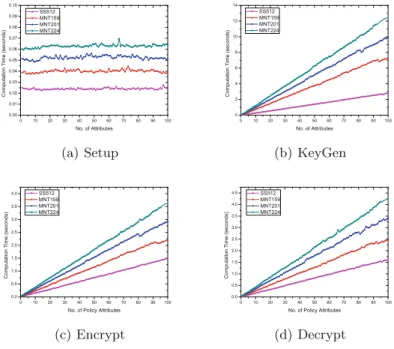
We simulate the algorithms of the proposed scheme over four elliptic curves: SS512 (a symmetric curve with a 512-bit base field), MNT159 (an asymmetric curve with a 159-bit base field), MNT201 (an asymmetric curve with a 201-bit
Fig. 1. Performance of our expressive CP-ABE scheme with partially hidden access structures
base field) and MNT224 (an asymmetric curve with a 224-bit base field), which provide security levels of 80-bit, 80-bit, 100-bit and 112-bit, respectively.
In Fig.1, the performance of the proposed CP-ABE scheme with partially access structures is shown in terms of four algorithms: the setup algorithm Setup (Fig.1-(a)), the attribute-based private key generation algorithm KeyGen (Fig.1-(b)), the encryption algorithm Encrypt (Fig.1-(c)) and the decryption algorithm Decrypt (Fig.1-(d)). It is not difficult to see from Fig.1 that SS512 has the best performance, while MNT224 has the most expensive computational cost among all four curves. For each curve, the computation time for the setup algorithm is immutable with the maximum number of attributes allowed in the system, the computation time for the key generation algorithm increases linearly with the size of attribute set, whilst the computation time for the encryption and decryption algorithms grows linearly with the complexity of the access policy. In addition, in our experiments, the computation time of decrypting a cipher-text ranges from 0.30 s to 0.80 s for a ciphercipher-text with an access policy of 20 attributes and a private key with 20 attributes, and this result is acceptable to most applications in practice.
5
Conclusions
A promising solution for preserving data privacy in cloud services is called ciphertext-policy attribute-based encryption (CP-ABE) [22], where data own-ers upload their data in encrypted forms to the cloud and share them with users with the specified credentials or attributes. In a standard CP-ABE scheme, every ciphertext is attached with an access structure in a cleartext which may leak sensitive information about the recipients and the encrypted message. To address this problem, the notion of CP-ABE with partially hidden access struc-tures [14,15,18,19,24] was introduced such that the concrete attribute values in access structures are hidden from the public view. Unfortunately, existing CP-ABE schemes with partially hidden access structures [14,15,18,19,24] either only support restricted access structures or are built in the inefficient composite-order bilinear groups. Motivated by this observation, in this paper, we presented a CP-ABE scheme with partially hidden access structures in the prime-order groups, supporting access structures in monotonic boolean formulas expressed as LSSSs. Also, we formally proved its security, and evaluated its efficiency.
Acknowledgments. This research work is supported by the Singapore National Research Foundation under the NCR Award No. NRF2014NCR-NCR001-012.
References
1. Akinyele, J.A., Garman, C., Miers, I., Pagano, M.W., Rushanan, M., Green, M., Rubin, A.D.: Charm: a framework for rapidly prototyping cryptosystems. J. Cryp-tographic Eng.3(2), 111–128 (2013)
2. Beimel, A.: Secure Schemes for Secret Sharing and Key Distribution. Ph.D. thesis, Israel Institute of Technology, Israel Institute of Technology, June 1996
3. Bethencourt, J., Sahai, A., Waters, B.: Ciphertext-policy attribute-based encryp-tion. In: 2007 IEEE Symposium on Security and Privacy (S&P 2007), 20–23, Oakland, California, USA, pp. 321–334. IEEE Computer Society, May 2007 4. Boneh, D., Boyen, X., Shacham, H.: Short group signatures. In: Franklin, M. (ed.)
CRYPTO 2004. LNCS, vol. 3152, pp. 41–55. Springer, Heidelberg (2004)
5. Boneh, D., Franklin, M.: Identity-based encryption from the weil pairing. In: Kilian, J. (ed.) CRYPTO 2001. LNCS, vol. 2139, pp. 213–229. Springer, Heidelberg (2001) 6. Boyen, X., Waters, B.: Anonymous hierarchical identity-based encryption (without
random oracles). In: Dwork, C. (ed.) CRYPTO 2006. LNCS, vol. 4117, pp. 290–307. Springer, Heidelberg (2006)
7. Cheung, L., Newport, C.C.: Provably secure ciphertext policy ABE. In: Proceed-ings of the ACM Conference on Computer and Communications Security, CCS , Alexandria, Virginia, USA, October 28–31, pp. 456–465. ACM (2007)
8. Fischlin, M., Fischlin, R.: Efficient non-malleable commitment schemes. J. Cryp-tology24(1), 203–244 (2011)
9. Freeman, D.M.: Converting pairing-based cryptosystems from composite-order groups to prime-order groups. In: Gilbert, H. (ed.) EUROCRYPT 2010. LNCS, vol. 6110, pp. 44–61. Springer, Heidelberg (2010)
10. Goyal, V., Jain, A., Pandey, O., Sahai, A.: Bounded ciphertext policy attribute based encryption. In: Aceto, L., Damg˚ard, I., Goldberg, L.A., Halld´orsson, M.M., Ing´olfsd´ottir, A., Walukiewicz, I. (eds.) ICALP 2008, Part II. LNCS, vol. 5126, pp. 579–591. Springer, Heidelberg (2008)
11. Goyal, V., Pandey, O., Sahai, A., Waters, B.: Attribute-based encryption for fine-grained access control of encrypted data. In: Proceedings of the 13th ACM Con-ference on Computer and Communications Security, CCS, Alexandria, VA, USA, October 30 - November 3, vol. 5126. LNCS, pp. 89–98. Springer (2006)
12. Guillevic, A.: Comparing the pairing efficiency over composite-order and prime-order elliptic curves. In: Jacobson, M., Locasto, M., Mohassel, P., Safavi-Naini, R. (eds.) ACNS 2013. LNCS, vol. 7954, pp. 357–372. Springer, Heidelberg (2013) 13. Katz, J., Sahai, A., Waters, B.: Predicate encryption supporting disjunctions,
poly-nomial equations, and inner products. J. Cryptology26(2), 191–224 (2013) 14. Lai, J., Deng, R.H., Li, Y.: Fully secure cipertext-policy hiding CP-ABE. In: Bao,
F., Weng, J. (eds.) ISPEC 2011. LNCS, vol. 6672, pp. 24–39. Springer, Heidelberg (2011)
15. Lai, J., Deng, R.H., Li, Y.: Expressive CP-ABE with partially hidden access struc-tures. In: 7th ACM Symposium on Information, Compuer and Communications Security, ASIACCS 2012, pp. 18–19. ACM, Seoul, Korea, May 2–4 2012
16. Lewko, A., Okamoto, T., Sahai, A., Takashima, K., Waters, B.: Fully secure functional encryption: attribute-based encryption and (hierarchical) inner prod-uct encryption. In: Gilbert, H. (ed.) EUROCRYPT 2010. LNCS, vol. 6110, pp. 62–91. Springer, Heidelberg (2010)
17. Lewko, A., Waters, B.: Decentralizing attribute-based encryption. In: Paterson, K.G. (ed.) EUROCRYPT 2011. LNCS, vol. 6632, pp. 568–588. Springer, Heidelberg (2011)
18. Li, J., Ren, K., Zhu, B., Wan, Z.: Privacy-aware attribute-based encryption with user accountability. In: Samarati, P., Yung, M., Martinelli, F., Ardagna, C.A. (eds.) ISC 2009. LNCS, vol. 5735, pp. 347–362. Springer, Heidelberg (2009)
19. Nishide, T., Yoneyama, K., Ohta, K.: Attribute-based encryption with partially hidden encryptor-specified access structures. In: Bellovin, S.M., Gennaro, R., Keromytis, A.D., Yung, M. (eds.) ACNS 2008. LNCS, vol. 5037, pp. 111–129. Springer, Heidelberg (2008)
20. Pedersen, T.P.: Non-interactive and information-theoretic secure verifiable secret sharing. In: Feigenbaum, J. (ed.) CRYPTO 1991. LNCS, vol. 576, pp. 129–140. Springer, Heidelberg (1992)
21. Rouselakis, Y., Waters, B.: Practical constructions and new proof methods for large universe attribute-based encryption. In: ACM SIGSAC Conference on Computer and Communications Security, CCS 2013, pp. 463–474. ACM, Berlin, Germany, November 4–8 2013
22. Sahai, A., Waters, B.: Fuzzy identity-based encryption. In: Cramer, R. (ed.) EURO-CRYPT 2005. LNCS, vol. 3494, pp. 457–473. Springer, Heidelberg (2005) 23. Waters, B.: Ciphertext-policy attribute-based encryption: an expressive, efficient,
and provably secure realization. In: Catalano, D., Fazio, N., Gennaro, R., Nicolosi, A. (eds.) PKC 2011. LNCS, vol. 6571, pp. 53–70. Springer, Heidelberg (2011) 24. Zhang, Y., Chen, X., Li, J., Wong, D.S., Li, H.: Anonymous attribute-based
encryp-tion supporting efficient decrypencryp-tion test. In: 8th ACM Symposium on Informaencryp-tion, Computer and Communications Security, ASIA CCS 2013, pp. 511–516. ACM, Hangzhou, China - May 08–10 2013