Thema Working Paper n°2011-14
Université de Cergy Pontoise, France
Some conjectures on the two main power indices
Fabrice Barthelemy
Mathieu Martin
Bertrand Tchantcho
Some conjectures on the two main power indices
Fabrice BARTH´
EL´
EMY
∗, Mathieu MARTIN
†and Bertrand TCHANTCHO
‡Summary The purpose of this paper is to present a structural specification of the Shapley-Shubik and Banzhaf power indices in a weighted voting rule. We compare them in term of the cardinality of the sets of power vectors (PV). This is done in different situations where the quota or the number of seats are fixed or not.
JEL classification: C7, D7.
Keywords: Shapley-Shubik, Banzhaf, power index, power vectors.
1
Introduction
A weighted voting rule is a (social, economical or political) situation where each member of a body (such as a group of shareholders, a council, a committee or a parliament) controls a fixed number of votes called his weight, and a certain number of votes (called the quota) is required to pass a proposal.
Such a rule can be represented as a sequence [q;w1, ..., wn] wheren is the number of agents or
(more generally) voters,wi is the weight (number of seats) of voteri, andqthe relative quota with
q ≤ 1. The total number of weights is denoted by ¯w, hence ∑ni=1wi = ¯w and we assume that
w1 ≥w2 ≥... ≥wn. A set of voters S is said to be winning if
∑
i∈Swi ≥qw¯. Furthermore, it is
assumed that the complement of a winning set of voters is a losing set, meaning that the relative quota is greater than 12. Particular attention is given to the well-known majority rules for which
q= 12. In this case, if the structure of weights is (w1, ..., wn), then a set of voters is winning if and
only if∑i∈Swi≥ w¯2 + 1 if ¯wis even and
∑
i∈Swi≥
¯
w+1
2 if ¯wis odd
1. The extent of control that a
voter possesses over the decision-making process due to the decision rule alone is referred to as his voting power. In other words, it is his constitutional power (see Felsenthal and Machover, 1998).
∗University of Cergy Pontoise, THEMA, F-95000 Cergy-Pontoise, FRANCE. E-mail: [email protected]
†University of Cergy Pontoise, THEMA, F-95000 Cergy-Pontoise, FRANCE. E-mail: [email protected]
‡University of Yaounde I, Ecole Normale Superieure, Cameroon, PO Box 47 Yaounde, [email protected]
1Note that the real values of the quota areq= 1
2+ 1 ¯ wif ¯wis even andq= 1 2+ 1
2 ¯w if ¯wis odd. The notationq=
1 2 is clearer and shorter.
There is an abundant literature on the a priori measure of power of each agent in such a collective decision-making procedure. A complete description of power indices can be found in Felsenthal and Machover (1998), Leech (2002) or in Laruelle and Valenciano2 (2008). Famous indices include
the Shapley-Shubik (1954) index and the (normalized and non normalized) Banzhaf index, both of which are considered by scholars to be pre-eminent by virtue of their properties and various axiomatizations3. The Shapley-Shubik index is based on the concept of the pivotal voter while the
Banzhaf index relies on the notion of the decisive voter. A voteriis said to be pivotal with respect to a ranking of voters if the set of voters obtained by considering all the voters ranked beforei is losing while adding him in that set of voters yields a winning set. On the other hand, a voteri is said to be decisive in a set of voters S if either i ∈S, S is winning and S\{i} is not winning or
i /∈S, S is not winning andS∪ {i}is winning.
These indices do however yield different power vectors even though the relative rankings of voters according to these indices coincide. Indeed, it is well known from Tomiyama (1987) (see Diffo and Moulen, 2002 for a generalization) that in a weighted voting rule, given two votersi and j, i has at least as much power asj with respect to the Shapley-Shubik index if and only if this is the case with respect to the non normalized Banzhaf index. But this induced ranking between voters could be quite different from the one observed regarding the structure of weights. For example, having a positive weight does not ensure having a positive power, different weighting structures may lead to the same voting power and so forth.
While attention has been given to the rankings of voters, nothing so far has been said neither on different power vectors achieved by these indices nor on the total number of vectors achievable. We shall illustrate this in a moment but we can note that it could be interesting to know all possible distributions of power. This can be of use in seeking the most adequate voting rule for a committee of representatives such as the European Council of Ministers, given the number of voters and a structure of weights (Laruelle and Valenciano, 2008). This could also be interesting, in respect of a comparison of both indices, to determine all achievable power vectors and so assess the probability that both indices give the same power structure.
Various methods are available to compute the Banzhaf and the Shapley-Shubik indices. See for example Leech (2002) for a description of each method and their respective interest. Direct enumeration consists of directly applying the definition of the indices. A shortcoming of this approach is the number of voters which should be less than 31. Generating functions, as suggested by Mann and Shapley (1962), make it possible to deal with higher numbers of voters (up to 200) and give an exact result. The Monte Carlo simulations presented by Mann and Shapley (1960) are an approximation
2In particular, the authors present the Shapley-Shubik power index in the classical cooperative game theory
framework and they show the difficulties of its interpretation.
3The normalized Banzhaf is referred to as the Banzhaf-Coleman index while the non normalized is referred to as
as are multilinear extensions approximation methods developed by Owen (1972, 1975) and modified by Leech (2003).
But, as far as we know, there is no formula which provides either the list of all achievable power vectors according to Shapley-Shubik and (normalized and non normalized) Banzhaf, or its cardi-nality. We present in this paper some tables with the number of achievable power vectors for a given number of voters. These numbers are computed from an enumeration we made to get all the different power vectors for the indices mentioned above.
To explain the purpose of this paper, consider the simple 2-voter case. A weighted rule can be written as a sequence [q;w1, w2], with (without loss of generality)w1≥w2. We construct a partition
of the weighted rules set such that the decisive (or pivotal) voters structure is constant within a given class. From this construction, all the weighted rules belonging to the same class, lead to a unique power vector (PV)4. Let us notice that, by construction, the classes are non empty sets, as
each weighted rule belongs to one and only one class.
In the 2-voter case, there exist only two classes. The first class is the set of all the weighted rules such that the first voter decides alone,w1 ≥qw¯ (the only winning set of voters is {1}). The
second class consists of all the weighted rules where the first voter may not decide alone,w1< qw¯
(the only winning set of voters is{1,2}, asw1≥w2). Whatever the weighted rule, it belongs to one
of these two classes, which implies that there are, at most, two different power vectors. In fact, the cardinality of the power vectors set is equal to 2, for the 2-player case5.
What happen to the cardinality of the power vectors set when there are constraints on the total number of seats ¯wand/or on the relative quota q? This is the central question that we answer in this paper.
Let us continue with the 2-voter case. If the total number of seats ¯w and the relative quota
q are fixed, there exists a finite number of weighted rules, which corresponds to the number of vectors (w1, w2) such thatw1+w2= ¯wandw1≥w2. By contrast, the number of possible weighted
rules becomes infinite when at most one of these two values is fixed. This arises because there is an infinity of vectors (w1, w2) and/or an infinity of quotas (1/2 < q ≤ 1). Hence, the number of
possible weighted rules is greater than two (as soon as ¯w ≥ 3) when both ¯w and q are fixed and infinite otherwise, while, as mentioned previously, there exists only 2 classes.
We illustrate the potential impact of constraints on the cardinality of the power vectors set, considering three situations.
4Which may be different for different indices, but for a given index, the PV remains the same.
5In the first class, the first voter has all the power, and in the second class the powers of the two voters are
First, to illustrate the case where ¯w and q are fixed, consider q= 1/2 and ¯w = 3. It is worth noting for a fixed ¯w, several distributions ofwi may exist. For instance, the vectors (3,0) and (2,1)
lead to ¯w= 3. Hence, there are two possible weighted rules, [12; 3,0] and [12; 2,1], which belong to the first class. Hence, only one PV is available. Let us remark that fixing ¯wand qdoes not imply necessarily a smaller number of PVs. Considering q = 1/2 and ¯w = 4, three weighted rules are available. Both [1
2; 4,0] and [ 1
2; 3,1] belong to the first class while [ 1
2; 2,2] belong to the second class:
the two PVs are available.
Second, to illustrate the case where ¯wis not fixed, consider q=12. For instance, [12; 3,0] belongs to the first class (where ¯w= 3) and [12; 2,2] belongs to the second class (where ¯w= 4). Hence, the two classes are non empty sets. In fact, the number of non empty classes is always equal to two6
when ¯w≥2.
Third, to illustrate the case whereqis not fixed, consider ¯w= 4. The two classes are non empty sets since for instance [23; 3,1] belongs to the first class, while [12; 2,2] belongs to the second class. In fact, the number of non empty classes is always equal7 to two when ¯w≥2.
In this paper, we study the four different situations, described in Table 1, obtained by different conditions onqand ¯w, previously illustrated with the 2-voter case. Complete answers to the main questions are given for the 2, 3 and 4 voter case. In particular, whenever the quota is fixed, the number of achieved power vectors for the Shapley-Shubik and both the non normalized and normalized Banzhaf indices coincide. Meanwhile when the quota is not fixed, in general the number of power vectors achieved by the non normalized Banzhaf index is greater than that achieved by the normalized Banzhaf index, this later being at least as large as the number of achieved power vectors via Shapley-Shubik. These quite surprising results are confirmed using a computer program for more voters.
Table 1: The four situations
Situation 1: qand ¯ware not fixed Situation 3: q is not fixed while is ¯wfixed.
Situation 2: qis fixed and is ¯wis not Situation 4: q and ¯ware fixed
The paper is organized as follows: section 2 presents some analytical results for 2, 3 and 4 voters, section 3 presents tables involving more players obtained thanks to the use of a computer.
6When ¯w= 1, there exists only one weighted rule, [1
2; 1,0], and one of the two classes is then empty.
2
The analytical case: 2, 3 and 4 voters
Throughout,nis the number of voters. Let [q;w1, ..., wn] be a weighted rule: the set of winning set
of votersS such that ∑
i∈S
wi ≥qw¯ will be referred to asW. The characteristic function of the rule
denoted byv is defined by:
v(S) = 1 ifS∈W 0 ifS /∈W
The Shapley-Shubik index (SSI) is given by the following formula8
ϕi=
∑
S⊆N
(|S| −1)!(n− |S|)!
n! [v(S)−v(S\{i})] The vector (ϕ1, ϕ2, ..., ϕn) is hereafter called the SSI power vector (PV).
The non normalized Banzhaf index (BI’) of voteriis
βi′=
∑
S⊆N[v(S)−v(S\{i})]
2n−1
The vector (β1′, β′2, ..., β′n) is called the power vector PV for BI’. The normalized Banzhaf index (BI) is
βi= ∑ S⊆N[v(S)−v(S\{i})] ∑ j∈N ∑ S⊆N[v(S)−v(S\{j})]
The vector (β1, β2, ..., βn) is the PV for BI.
We shall denote by SSI(n, q,w¯) (respectively BI(n, q,w¯) and BI′(n, q,w¯)) the set of possible Shapley-Shubik (respectively normalized and non normalized Banzhaf) power vectors when the number of voters isn, the (relative) quota isqand the total number of seats is ¯w.
If either of the parameters qand ¯wis not fixed, it will be replaced in the notation above with a point. For example, the set of Shapley-Shubik power vectors when the relative quota is not fixed is
SSI(n, .,w¯) while the set of non normalized Banzhaf power vector when ¯wis not fixed isBI′(n, q, .). It is worth noting that
SSI(n, .,w¯) = ∪ q≥1 2 SSI(n, q,w¯) BI′(n, q, .) = ∪ ¯ w≥1 BI′(n, q,w¯).
SSI(n, ., .) is simply denotedSSI(n), and similar notations forBI(n) andBI′(n). We assume in this section that nis equal to 2, 3 or 4.
In each case we show that for a fixed quota, all the three numbers coincide, that is,
|SSI(n, q, .)|=|BI′(n, q, .)|=|BI(n, q, .)|, n= 2,3,4 and
|SSI(n, q,w¯)|=|BI′(n, q,w¯)|=|BI(n, q,w¯)|, n= 2,3,4 But when the quota is not fixed, the three numbers differ as follows
|SSI(3)|=|BI(3)|<|BI′(3)| and
|SSI(4)|<|BI(4)|<|BI′(4)|
The values of |SSI(n, .,w¯)|, |BI(n, .,w¯)| and |BI′(n, .,w¯)| are given as a function of ¯w which lead to:
|SSI(3, .,w¯|=|BI′(3, .,w¯)|<|BI(3, .,w¯)|, for ¯w≥3 and
|SSI(4, .,w¯|<|BI′(4, .,w¯)|<|BI(4, .,w¯)|, for ¯w≥10
2.1
The 2-voter case
Let us start with the obvious casen= 2 and denote R2 the set of all voting rules. As seen in the
introduction, even if its cardinality is infinite, the relevant partition ofR2contains only two classes
of weighted rules, denoted,Ci(2), fori= 1,2. Forqand ¯wgiven, let us define the classes as follows:
C1(2, q,w¯) ={[q, w1, w2] :w1≥qw¯}
C2(n, q,w¯) ={[q, w1, w2] :w1< qw¯}
Then define, fori= 1,2,Ci(2) the set of all the weighted rules belonging to classi: Ci(2) = ∪ q≥1 2 ∪ ¯ w≥1 Ci(2, q,w¯)
By the definition of a partition,R2=C1(2)∪C2(2) andC1(2)∩C2(2) =∅. The constraints onw1, w2andq, the corresponding PV for the three power indices of interest and an example of weighted
rule, are reported in Table 2.
Table 2: The two different weighted rules for n= 2, with examples.
Classes of weighted rules SSI BI′ BI Examples
w1≥qw¯ ϕ1= (1,0) β1′ = (1,0) β1= (1,0) [12; 2,1] w1< qw¯ ϕ2= (12,12) β2′ = (12, 1 2) β2= ( 1 2, 1 2) [1; 2,1]
It is easy to check that ifqis fixed, when ¯wis fixed or not, then9
|SSI(n, q,w¯)|=|BI(n, q,w¯))|=|BI′(n, q,w¯)| (Situation 4) |SSI(n, q, .)|=|BI(n, q, .)|=|BI′(n, q, .)| (Situation 2)
Depending on q, we may have for example|SSI(n, q, .)|= 1 or|SSI(n, q, .)|= 2. If qis not fixed, then9
|SSI(2)|=|BI(2)|=|BI′(2)| (Situation 1) |SSI(n, .,w¯)|=|BI(n, .,w¯)|=|BI′(n, .,w¯)|(Situation 3)
2.2
The 3-voter case
In this case a weighted rule can be written as [q, w1, w2, w3], with q ≥ 21, w1 ≥ w2 ≥ w3 and w1+w2 +w3 = ¯w. Let R3 denotes the set of all weighted rules. As in the 2-voter case, its
cardinality is infinite. In order to differentiate constant structures of decisive (pivotal) voters, 5 different classes of weighted rules arise. We obtain a partition ofR3 in 5 classes denoted,Ci(3), for i= 1, . . . ,5. Their notation will depend on whetherq and ¯ware fixed or not. For a givenq and ¯w, we denote (Situation 4): C1(3, q,w¯) ={[q, w1, w2, w3] :w1≥qw¯} C2(3, q,w¯) ={[q, w1, w2, w3] :w1+w3< qw¯ andw1+w2≥qw¯} C3(3, q,w¯) ={[q, w1, w2, w3] :w2+w3≥qw¯} C4(3, q,w¯) ={[q, w1, w2, w3] :w1< qw¯,w2+w3< qw¯ andw1+w3≥qw¯} C5(3, q,w¯) ={[q, w1, w2, w3] :w1+w2< qw¯}
It is quite obvious that if a given weighted rule [q, w1, w2, w3] does not belong, for instance to
∪4
i=1Ci(3, q,w¯), then it belongs toC5(3, q,w¯). We define different sets according to the fact thatq
and ¯ware fixed or not fixed.
Fori= 1, . . . ,5, let Ci(3, q, .) = ∪ ¯ w≥1 Ci(3, q,w¯) (Situation 2) Ci(3, .,w¯) = ∪ q≥1 2 Ci(3, q,w¯) (Situation 3) Ci(3) = ∪ q≥1 2 ∪ ¯ w≥1 Ci(3, q,w¯) = ∪ q≥1 2 Ci(3, q, .) = ∪ ¯ w≥1 Ci(3, .,w¯) (Situation 1) Table 3 summarizes the results for the five classes Ci(3).
Proposition 1 Assume that n = 3. If q and w¯ are not fixed, then |SSI(3)| = |BI(3)| = 4 and |BI′(3)|= 5 (Situation 1).
Table 3: The five different weighted rules forn= 3, with examples.
Classes of weighted rules SSI BI’ BI Examples
1 w1≥qw¯ ϕ1= (1,0,0) β1′ = (1,0,0) β1= (1,0,0) [12; 2,0,0] 2 w1+w3< qw¯andw1+w2≥qw¯ ϕ2= (12,12,0) β2′ = (12, 1 2,0) β2= ( 1 2, 1 2,0) [ 1 2; 1,1,0] 3 w2+w3≥qw¯ ϕ3 = (31,13,13) β3′ = (12, 1 2, 1 2) β3= ( 1 3, 1 3, 1 3) [ 1 2; 2,2,2] 4 w1< qw¯andw2+w3< qw¯andw1+w3≥qw¯ ϕ4 = (23,16,16) β4′ = (34, 1 4, 1 4) β4= ( 3 5, 1 5, 1 5) [ 1 2; 4,2,2] 5 w1+w2< qw¯ ϕ5 = (13,13,13) β5′ = (14, 1 4, 1 4) β5= ( 1 3, 1 3, 1 3) [1; 1,1,1]
Proof: Sinceqis not fixed, we have by construction of a partition:
∀i= 1, ...,5, Ci(3)̸=∅ ∀i̸=j, Ci(3)∩ Cj(3) =∅ 5 ∪ i=1 Ci(3) =R3
All weighted rules in the same class have the same power vector with respect to any of the power indices studied herein. To show that|SSI(3)|=|BI(3)|= 4 we can remark that any rule belonging to C3(3) orC5(3) yields the power vector (13,13,13) with respect to Shapley-Shubik and normalized
Banzhaf power indices. On the other hand, it is easy to show that for each i, there exists ¯wsuch thatCi(3)̸=∅. By taking ¯w≥5, one can prove that the following weighted ruleYi, fori= 1, . . . ,5,
are such thatYi∈ Ci(n, q,w¯) (and thusCi(3)̸=∅):
Y1= [q;⌈qw¯⌉,⌈ ¯ w−⌈qw¯⌉ 2 ⌉,w¯−(⌈qw¯⌉+⌈ ¯ w−⌈qw¯⌉ 2 ⌉)] 10 Y2= [q;⌊w¯2⌋,⌊w2¯⌋,w¯−2⌊w2¯⌋] Y3= [q; ¯w−2⌊w3¯⌋,⌊w3¯⌋,⌊w3¯⌋] Y4= [q;⌈qw¯⌉ −1,w¯− ⌈qw¯⌉,1]
Y5= [q;x1, x2,w¯− ⌈qw¯⌉+ 1] withx1= ⌈qw¯2⌉−1 andx2=x1 if⌈qw¯⌉is odd, x1= ⌈
qw¯⌉
2 , x2=x1−1 if⌈qw¯⌉is even.
Since βi are pairwise distinct for i= 1,2,3,4,|BI(3)|= 4 and likewise,ϕi are pairwise distinct
fori= 1,2,3,4, |SSI(3)|= 4. On the other hand,βi′ are pairwise distinct and since Ci(3)̸=∅ for eachi,|BI′(3)|= 5.
Proposition 2 Assume thatn= 3. Ifqis not fixed andw¯is fixed withw¯≥5, then|SSI(3, .,w¯)|=
|BI(3, .,w¯)|= 4 and|BI′(3, .,w¯)|= 5(Situation 3).
Proof: Similar to the above, see also Table 3.
10For allx,⌈x⌉is the smallest integer greater than or equal toxand⌊x⌋is the greatest integer less than or equal
Note however that ¯w∈ {1,2,3,4}are marginalized cases. It is easy to check that
|SSI(3, .,4)|=|BI(3, .,4)|=|BI′(3, .,4)|= 4,
|SSI(3, .,3)|=|BI(3, .,3)|= 3, and |BI′(3, .,3)|= 4,
|SSI(3, .,2)|=|BI(3, .,2)|=|BI′(3, .,2)|= 2.
The following proposition deals with the subcase whereq is fixed.
Proposition 3 Assume that n = 3 and that q is fixed while w¯ is not. Then |SSI(3, q, .)| =
|BI(3, q, .)|=|BI′(3, q, .)|(Situation 2).
Proof: Assume thatqis fixed.
1. First we show thatC3(3, q, .)̸=∅ andC5(3, q, .)̸=∅ is impossible.
Indeed, assume thatqis fixed and thatC3(3, q, .)̸=∅ andC5(3, q, .)̸=∅.
Recall thatC3(3, q, .) = ∪ ¯ w≥1 C3(3, q,w¯) whereC3(3, q,w¯) ={[q, w1, w2, w3] :w2+w3≥qw¯}and C5(3, q, .) = ∪ ¯ w≥1 C5(3, q,w¯) withC5(3, q,w¯) ={[q, x1, x2, x3] :x1+x2< qx¯}.
Let [q, w1, w2, w3] ∈ C3(3, q, .) and [q, x1, x2, x3] ∈ C5(3, q, .) (with ¯x =x1+x2+x3). Then x1+x2 < qx¯ and w2 +w3 ≥ qw¯. But, x1+x2 < qx¯ ⇒ qx3 > (1−q)(x1+x2), thus x3 > 1−qq(x1+x2). Sincex1 ≥x2 ≥x3, it follows that x3 ≤ x1+2x2; and therefore 1−qq < 12,
that is q > 23.
On the other hand, [q, w1, w2, w3]∈ C3(3, q, .) meaning that w2+w3 ≥qw¯. This implies that w1 ≤ 1−qq(w2+w3). Thanks to w1 ≥ w2 ≥ w3, we obtain w1 ≥ w2+2w3, thus q ≤ 23 ; a
contradiction. Finally,C3(3, q, .)̸=∅ andC5(3, q, .)̸=∅ is impossible
2. Second, we see from Table 3 that for all i∈ {1,2,3,4}, ϕi, βi and βi′ are all pairwise distinct
thus, that |SSI(3, q, .)|=|BI′(3, q, .)|=|BI(3, q, .)|.
Considering the particular case of the majority rule, the number of vectors achieved by these power indices is determined as follows.
Proposition 4 Assume thatn= 3. Ifqis the majority rule, then
|SSI(3,12,w¯)|=|BI′(3,21,w¯)|=|BI(3,12,w¯)|= 2if w¯= 2 or if there existst≥1 : ¯w= 2t+ 1 3if w¯= 4 4if there exists t≥3 : ¯w= 2t
The above result feeds into situations 2 and 4, where the fixed quota is 12. This result which does not present any particular difficulty can be clearly seen in Table 3.
2.3
The 4-voter case
A weighted rule is a sequence [q, w1, w2, w3, w4], withq≥ 12,w1≥w2≥w3≥4 andw1+w2+w3+ w4= ¯w. Denote byR4 the set of all weighted rules. The partition of this set contains 14 different
classes of weighted rules,Ci(4), fori= 1, . . . ,14. For anyq and ¯w, let:
C1(4, q,w¯) ={[q, w1, w2, w3, w4] :w1≥qw¯} C2(4, q,w¯) ={[q, w1, w2, w3, w4] :w2+w3≥qw¯} C3(4, q,w¯) ={[q, w1, w2, w3, w4] :w1+w4≥qw¯,w2+w3+w4≥qw¯} C4(4, q,w¯) ={[q, w1, w2, w3, w4] :w1< qw¯,w1+w4≥qw¯,w2+w3+w4< qw¯} C5(4, q,w¯) ={[q, w1, w2, w3, w4] :w2+w3≥qw¯,w1+w4< qw¯,w2+w3< qw,¯ w2+w3+w4≥qw¯} C6(4, q,w¯) ={[q, w1, w2, w3, w4] :w2+w3≥qw, w¯ 1+w4< qw, w¯ 2+w3< qw,¯ w2+w3+w4< qw¯} C7(4, q,w¯) ={[q, w1, w2, w3, w4] :w1+w2≥qw¯,w1+w3< qw, w¯ 2+w3+w4≥qw¯} C8(4, q,w¯) ={[q, w1, w2, w3, w4] :w1+w2≥qw, w¯ 1+w3< qw, w¯ 2+w3+w4< qw¯, w1+w3+w4≥qw¯} C9(4, q,w¯) ={[q, w1, w2, w3, w4] :w1+w2≥qw, w¯ 1+w3< qw, w¯ 1+w3+w4< qw¯} C10(4, q,w¯) ={[q, w1, w2, w3, w4] :w1+w2< qw, w¯ 2+w3+w4≥qw¯} C11(4, q,w¯) ={[q, w1, w2, w3, w4] :w1+w2< qw¯, w2+w3+w4< qw¯,w1+w3+w4≥qw¯} C12(4, q,w¯) ={[q, w1, w2, w3, w4] :w1+w2< qw, w¯ 1+w3+w4< qw¯,w1+w2+w4≥qw¯} C13(4, q,w¯) ={[q, w1, w2, w3, w4] :w1+w2+w4< qw¯,w1+w2+w3≥qw¯} C14(4, q,w¯) ={[q, w1, w2, w3, w4] :w1+w2+w3< qw¯} For alli, Ci(4, .,w¯) = ∪ q≥1 2 Ci(4, q,w¯) Ci(4, q, .) = ∪ ¯ w≥1 Ci(4, q,w¯) Ci(4) = ∪ q≥1 2 ∪ ¯ w≥1 Ci(4, q,w¯) = ∪ q≥1 2 Ci(4, q, .) = ∪ ¯ w≥1 Ci(4, .,w¯) Table 4 summarizes the results for the fourteen classesCi(4).
Proposition 5 Assume thatn= 4. Ifq andw¯ are not fixed then |SSI(4)|= 11,|BI(4)|= 12and |BI′(4)|= 14(Situation 1).
Proof: Since q is not fixed, we have by construction of a partition, as we had for the 3-voter
case: ∀i= 1, ...,14,Ci(4)̸=∅ ∀i̸=j, Ci(4)∩ Cj(4) =∅ ∪14 i=1Ci(4) =R4
The different power vectors achieved by the power indices involved are given in Table 4. Recall that if [q, w1, w2, w3, w4] and [q′, x1, x2, x3, x4] belong to the same class then both rules have the same
set of winning voters and thus have the same power vector with respect to any given power index. For instance, from Table 4 we can induce that if a weighted rule belongs to the class C6(4) then ϕ6 = (23,16,16,0), β6 = (35,15,15,0) and β′6 = (34,
1 4,
1
4,0). Since ϕ11 =ϕ3, ϕ13 =ϕ2 and ϕ14 =ϕ10,
|SSI(4)|= 14−3 = 11. In the same way, asβ14=β10 andβ13=β2 we deduce that|BI(4)|= 12
and|BI′(4)|= 14 (β′ are pairwise distinct).
We likewise show the following.
Proposition 6 Assume thatn= 4. Ifqis not fixed andw¯is fixed withw¯≥10then|SSI(4, .,w¯)|= 11,|BI(4, .,w¯)|= 12and|BI′(4, .,w¯)|= 14 (Situation 3).
Proof: As we proved for n= 3, it is easy to prove that for ¯w≥8, each classCi(4, .,w¯) is non empty and we can proceed as in the case whereqis not fixed (with a non fixed ¯w) to get the results. This is summarized and can be seen in Table 5.
The proposition above implies that we have |SSI(4)| < |BI(4)| < |BI′(4)| and |SSI(4, .,w¯)| <
|BI(4, .,w¯)|<|BI′(4, .,w¯)| for ¯w ≥10. The next results deals with the case whereqis fixed.
Proposition 7 Assume thatn= 4. Ifq is fixed then|BI(4, q, .)|=|BI′(4, q, .)|and|BI(4, q,w¯)|=
|BI′(4, q,w¯)|(Situations 2 and 4).
Proof: Assume thatn= 4 and qis fixed. Let us begin with |BI(4, q, .)|=|BI′(4, q, .)|:
The difference between the cardinality ofBI(4) andBI′(4) when qis not fixed arises from the fact that β14 = β10 and β13 = β2. Hence, it is sufficient to show that when q is fixed, the two
following results:
-C2(4, q, .)̸=∅andC13(4, q, .)̸=∅, are not possible simultaneously.
-C10(4, q, .)̸=∅andC14(4, q, .)̸=∅ is also impossible.
• First, assume thatC2(4, q, .)̸=∅andC13(4, q, .)̸=∅.
C2(4, q, .) = ∪ ¯ w≥1 C2(4, q,w¯) withC2(4, q,w¯) ={[q, w1, w2, w3, w4] :w2+w3≥qw¯} C13(4, q, .) = ∪ ¯ w≥1 {[q, w1, w2, w3, w4] :w1+w2+w4< qw¯, w1+w2+w3≥qw¯}
Let [q, w1, w2, w3, w4] ∈ C13(4, q, .) and [q, x1, x2, x3, x4] ∈ C2(4, q, .) with ¯x =
∑4
i=1xi. The
T able 4: The differen t w eigh ted rules for n = 4, with examples. Classes of w eigh ted rules SSI BI’ BI Example 1 w1 ≥ q ¯ w ϕ1 = (1 , 0 , 0 , 0) β ′ 1 = (1 , 0 , 0 , 0) β1 = (1 , 0 , 0 , 0) [ 1;2 4 , 1 , 1 , 1] 2 w2 + w3 ≥ q ¯ w ϕ2 = ( 1,3 1,3 1,3 0) β ′ 2 = ( 1,2 1,2 1,2 0) β2 = ( 1,3 1,3 1,3 0) [ 1;2 2 , 2 , 2 , 1] 3 w1 + w4 ≥ q ¯ w , w2 + w3 + w4 ≥ q ¯ w ϕ3 = ( 1,2 1,6 1,6 1)6 β ′ 3 = ( 3,4 1,4 1,4 1)4 β3 = ( 1,2 1,6 1,6 1)6 [ 1;2 2 , 1 , 1 , 1] 4 w1 < q ¯ w , w1 + w4 ≥ q ¯ w , w2 + w3 + w4 < q ¯ w ϕ4 = ( 3,4 1 12 , 1 12 , 1 12 ) β ′ 4 = ( 7,8 1,8 1,8 1)8 β4 = ( 7 10 , 1 10 , 1 10 , 1 10 ) [ 1;2 4 , 2 , 1 , 1] 5 w1 + w3 ≥ q ¯ w , w1 + w4 < q ¯ w , w2 + w3 < q ¯ w , w2 + w3 + w4 ≥ q ¯ w ϕ5 = ( 5 12 , 1,4 1,4 1 12 ) β ′ 5 = ( 5,8 3,8 3,8 1)8 β5 = ( 5 12 , 1,4 1,4 1 12 ) [ 1;2 4 , 3 , 2 , 1] 6 w1 + w3 ≥ q ¯ w , w1 + w4 < q ¯ w , w2 + w3 < q ¯ w , w2 + w3 + w4 < q ¯ w ϕ6 = ( 2,3 1,6 1,6 0) β ′ 6 = ( 3,4 1,4 1,4 0) β6 = ( 3,5 1,5 1,5 0) [ 1;2 2 , 1 , 1 , 0] 7 w1 + w2 ≥ q ¯ w , w1 + w3 < q ¯ w , w2 + w3 + w4 ≥ q ¯ w ϕ7 = ( 1,3 1,3 1,6 1)6 β ′ 7 = ( 1,2 1,2 1,4 1)4 β7 = ( 1,3 1,3 1,6 1)6 [ 1;2 2 , 2 , 1 , 1] 8 w1 + w2 ≥ q ¯ w , w1 + w3 < q ¯ w , w2 + w3 + w4 < q ¯ w , w1 + w3 + w4 ≥ q ¯ w ϕ8 = ( 7 12 , 1,4 1 12 , 1 12 ) β ′ 8 = ( 5,8 3,8 1,8 1)8 β8 = ( 1,2 3 10 , 1 10 , 1 10 ) [ 7 10 ; 5 , 3 , 1 , 1] 9 w1 + w2 ≥ q ¯ w , w1 + w3 < q ¯ w , w1 + w3 + w4 < q ¯ w ϕ9 = ( 1,2 1,2 0 , 0) β ′ 9 = ( 1,2 1,2 0 , 0) β9 = ( 1,2 1,2 0 , 0) [ 1;2 2 , 2 , 0 , 0] 10 w1 + w2 < q ¯ w , w2 + w3 + w4 ≥ q ¯ w ϕ10 = ( 1,4 1,4 1,4 1)4 β ′ 10 = ( 3,8 3,8 3,8 3)8 β10 = ( 1,4 1,4 1,4 1)4 [ 1;2 1 , 1 , 1 , 1] 11 w1 + w2 < q ¯ w , w2 + w3 + w4 < q ¯ w , w1 + w3 + w4 ≥ q ¯ w ϕ11 = ( 1,2 1,6 1,6 1)6 β ′ 11 = ( 1,2 1,4 1,4 1)4 β11 = ( 2,5 1,5 1,5 1)5 [ 4;5 2 , 1 , 1 , 1] 12 w1 + w2 < q ¯ w , w1 + w3 + w4 < q ¯ w , w1 + w2 + w4 ≥ q ¯ w ϕ12 = ( 5 12 , 5 12 , 1 12 , 1 12 ) β ′ 12 = ( 3,8 3,8 1,8 1)8 β12 = ( 3,8 3,8 1,8 1)8 [ 4;5 3 , 3 , 2 , 2] 13 w1 + w2 + w4 < q ¯ w , w1 + w2 + w3 ≥ q ¯ w ϕ13 = ( 1,3 1,3 1,3 0) β ′ 13 = ( 1,4 1,4 1,4 0) β13 = ( 1,3 1,3 1,3 0) [ 6;7 2 , 2 , 2 , 1] 14 w1 + w2 + w3 < q ¯ w ϕ14 = ( 1,4 1,4 1,4 1)4 β ′ 14 = ( 1,8 1,8 1,8 1)8 β14 = ( 1,4 1,4 1,4 1)4 [1; 1 , 1 , 1 , 1]
[q, w1, w2, w3, w4]∈ C13(4, q, .) ⇒ w1+w2+w4< qw¯ andw1≥w2≥w3≥w4
⇒ q > w1+w2+w4
w1+w2+w3+w4
⇒ q > 23 since 3(w1+w2+w4)>2(w1+w2+w3+w4)
On the other hand, the implications for thexi’s are:
[q, x1, x2, x3, x4]∈ C2(4, q, .) ⇒ x2+x3≥qx¯andx1≥x2≥x3 ⇒ q≤ x2+x3 x1+x2+x3+x4,x2+x3≤2x1≤2(x1+x4) ⇒ q≤ x2+x3 x1+x2+x3+x4 and 3(x2+x3)≤2(x1+x2+x3+x4) ⇒ q≤ x2+x3 x1+x2+x3+x4 ≤ 2 3
which is in contradiction with the previous result. Therefore, ifC2(4, q, .)̸=∅thenC13(4, q, .) =∅.
•Second, assume thatC10(4, q, .)̸=∅andC14(4, q, .)≠ ∅. Let [q, w1, w2, w3, w4]∈ C14(4, q, .) and
[q, x1, x2, x3, x4]∈ C10(4, q, .).
Since w1+w2+w3 < qw¯, thenw4 > 1−qq(w1+w2+w3). Furthermore, w1 ≥w2 ≥w3 ≥w4,
thusw4≤ 13(w1+w2+w3). This implies that 13 > 1−q
q andq >
3 4.
Furthermore,x2+x3+x4≥qx¯andq > 34, thenx1< 14x¯, which contradictsw1≥w2≥w3≥w4.
From Table 4, we can see thatβ′i are pairwise distinct, for i∈ {1,2, ...,14} \ {13,14}as well asβi;
thus|BI(4, q, .)|=|BI′(4, q, .)|.
When ¯w is fixed, the result arises from noting that again βi′ are pairwise distinct as well asβi′.
|BI(4, q,w¯)|=|BI′(4, q,w¯)|.
Proposition 8 If n = 4 and q is fixed then |SSI(4, q, .)| = |BI(4, q, .)| and |SSI(4, q,w¯)| =
|BI(4, q,w¯)|(Situations 2 and 4).
Proof: Assume thatn= 4 and qis fixed. Let us begin with |SSI(4, q, .)|=|BI(4, q, .)|
Note thatϕ2=ϕ13 andβ2=β13,ϕ10=ϕ14and β10=β14. The difference between the number
of power vectors achievable bySSI andBI when qis not fixed arises from the fact that ϕ3=ϕ11
whileβ3̸=β11. It is then sufficient to show that whenq is fixed,C3(4, q, .)̸=∅ andC11(4, q, .)̸=∅
is not possible. C3(4, q, .) = ∪ ¯ w≥1 {[q, w1, w2, w3, w4] :w1+w4≥qw¯,w2+w3+w4≥qw¯} C11(4, q, .) = ∪ ¯ w≥1 {[q, w1, w2, w3, w4] :w1+w2< qw¯,w2+w3+w4< qw¯, w1+w3+w4≥qw¯}
Let [q, w1, w2, w3, w4]∈ C3(4, q, .) and [q, x1, x2, x3, x4]∈ C11(4, q, .), with ¯x=x1+x2+x3+x4.
Thanks to [q, w1, w2, w3, w4] ∈ C3(4, q, .), we have w1+w4 ≥qw¯ (1) and w2+w3+w4 ≥ qw¯
w4≤ 12(1−q) ¯w. By (2),w2+w3≥qw¯−w4. Adding (1), it follows that (1−q) ¯w≥qw¯−w4 and w4≥(2q−1) ¯w. Thus, 12(1−q) ¯w≥(2q−1) ¯w andq≤ 35.
On the other hand, [q, x1, x2, x3, x4]∈ C11(4, q, .) implies thatx1+x2 < qx¯, thus x1+x2 < 35x¯
andx3+x4> 25x¯. Byx2+x3+x4< qx¯, we have ¯x−x1< qx¯, andx1>(1−q)¯x. Thusx1> 25x¯.
Sincex1+x2< 35x¯, thenx2< 15x¯. But x3+x4>25x¯yields a contradiction with x2≥x3≥x4.
When ¯wis fixed, the proof is similar.
The two propositions above imply the following obvious corollary.
Corollary 1 Assume thatn= 4 andq is fixed. Then|SSI(4, q,w¯)|=|BI′(4, q,w¯)|=|BI(4, q,w¯)|
and|SSI(4, q, .)|=|BI′(4, q, .)|=|BI(4, q, .)| (Situations 2 and 4).
Now, we consider the particular case of the majority rule and we show below that the number of vectors achieved by these power indices is 9 if the number of seats ¯wis not fixed.
Proposition 9 Assume thatn= 4. Ifqis the majority rule, then
|SSI(4,12, .)|=|BI′(4,12, .)|=|BI(4,12, .))|= 9 (Situation 2 forq= 12).
Proof: It has already been proved that |SSI(4,12, .)| = |BI′(4,12, .)| = |BI(4,12, .)|. We will obtain (for example) |SSI(4,12, .)| by determining the cardinality of the set{ϕi, i∈ {1,2, ...,14}}
whereϕi is the Shapley-Shubik vector of any weighted rule in classi.
(a) First, we will prove thatC8(4,12, .) =∅,C11(4,12, .) =∅,C12(4,12, .) =∅.
- case 1: Let us show that C8(4,12, .) = ∅. Assume that there exists ¯w with a structure of
weights (w1, w2, w3, w4) such that [12, w1, w2, w3, w4]∈ C8(4,12,w¯): thenw1+w2≥ 12w¯,w1+w3< θ, w1+w3+w4≥θandw2+w3+w4< θwithθ= ¯ w 2 + 1 if ¯wis even ¯ w+1 2 if ¯wis odd.
Since w1+w3+w4≥θ, thenw1+w3+w4≥w2+a(1) witha= 1 if ¯wis odd anda = 2 if
¯
w is even. Since w1+w3 < θ, thenw1+w3 < w2+w4+a (2). Since w2+w3+w4 < θ, then w2+w3+w4< w1+a(3). By (2) and (3),w2+w3+w4−a < w1< w2−w3+w4+aandw3< a. Thus w3= 1 orw3= 0. Ifw3= 0, thenw4= 0 andw1+w3< θandw1+w3+w4≥θare not compatible.
Thereforew3 = 1 and ¯w is even (a= 2). Two structures of weights are possible (w1, w2,1,1) and
(w1, w2,1,0). Ifw4= 0, by (1),w1≥w2+ 1 and by (2)w1< w2+ 1, a contradiction. Thus,w4= 1.
By (3),w1> w2 and by (2)w1< w2+ 2. Therefore,w1=w2+ 1 and ¯w= 2w2+ 3, a contradiction
of ¯wis even.
- case 2: Lets show that C11(4,12, .) = ∅. Assume on the contrary that [q, w1, w2, w3, w4] ∈
C11(4,12,w¯): thenw1+w2< θ,w2+w3+w4< θ,w1+w3+w4≥θwithθ=w2¯+ 1 if ¯wis even and θ=w¯+12 if ¯wis odd.
Since w1+w2 < θ, thenw1+w2 < w3+w4+a (1) with a = 1 if ¯w is odd and a = 2 if ¯w
is even. Since w2+w3+w4 < θ, then w2+w3+w4 < w1+a (2). Since w1+w3+w4 ≥ θ,
then w1+w3+w4 ≥ w2 +a (3). By (1) and (2), w2 < a and a = 2, thus w2 = 1. Indeed, w1+w2< θ andw1+w3+w4 ≥θare not compatible if w2 = 0. Thus ¯wis even. By (1) and (3), w2−w3−w4+a≤w1<−w2+w3+w4+aandw2< w3+w4. Thereforew3=w4= 1 and w1 is
odd. By (1), we obtainw1<3 andw1= 1. It is not compatible with (2).
-case 3: Let us show that C13(4,12, .) = ∅. Assume on the contrary that [q, w1, w2, w3, w4] ∈
C13(4,12,w¯): thenw1+w2< θ,w1+w3+w4< θ,w1+w2+w4≥θwithθ=w2¯+ 1 if ¯wis even or θ=w¯+12 if ¯wis odd.
Since w1 +w2 < θ, then w1 +w2 < w3+w4 +a (1) with a = 1 if ¯w is odd and a = 2
if ¯w is even. Since w1 +w3 +w4 < θ, then w1 +w3 +w4 < w2 +a (2). By (1) and (2), w1+w3+w4−a < w2 < −w1+w3+w4+a and w1 < a. Since w1 ̸= 0, w1 = 1 and ¯w is
even. Two structures of weights are then possible: (1,1,0,0) which is not compatible with (1) and (1,1,1,1) which is not compatible with (2).
Hence,C8(4,12, .) =∅,C11(4,12, .) =∅,C12(4,12, .) =∅.
In Table 4 majority rules are proposed belonging to the sets Ci(4,12, .) ≠ ∅ for i ̸= 8,11,12. This shows that∀i̸= 8,11,12,Ci(4,12, .)̸=∅.
(b) Second, we have ϕ13 = ϕ2 and ϕ14 = ϕ10 implying that the cardinality of the set {ϕi, i ∈ {1,2, ...,14}} is at most 9. But table 8 shows that ϕi ̸= ϕj ∀i, j ∈ {1,2,3,4,5,6,7,9,10} thus |SSI(4,12, .)|= 9. More explicitly, we give below the value of|SSI(4,12,w¯)| when the quota which is fixed is the majority rule and the number of seats is fixed (see table 7).
Proposition 10 Assume thatn= 4. Ifq=1
2 (the majority rule), then
|SSI(4,12,w¯)|=|BI(4,12,w¯)|=|BI′(4,12,w¯)|= 2if w¯∈ {2,3} 3if there exists t≥2 : ¯w= 2t+ 1 4if w¯= 4 6if w¯= 6 8if w¯= 8 or there existst≥1 : ¯w= 4t+ 6 9if there exists t≥1 : ¯w= 4t+ 8
3
More voters
The purpose of this section is to confirm the 2, 3 and 4-voter cases: when the quota is not fixed, the number of PV is different with SSI, BI’ and BI, always in the same order
|SSI(n)|<|BI(n)|<|BI′(n)| (Situation 1) and
|SSI(n, .,w¯)|<|BI(n, .,w¯)|<|BI′(n, .,w¯)|(Situation 3). Furthermore, when the quota is fixed, we have
|SSI(n, q, .)|=|BI(n, q, .|=|BI′(n, q, .)|(Situation 2) and
|SSI(n, q,w¯)|=|BI(n, q,w¯)|=|BI′(n, q,w¯)|(Situation 4).
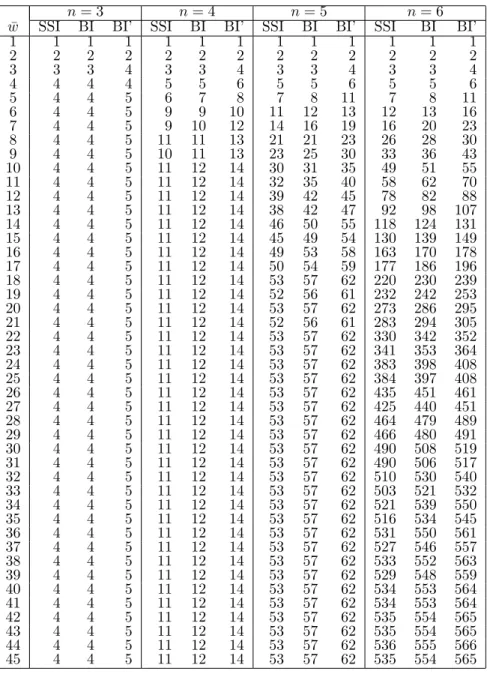
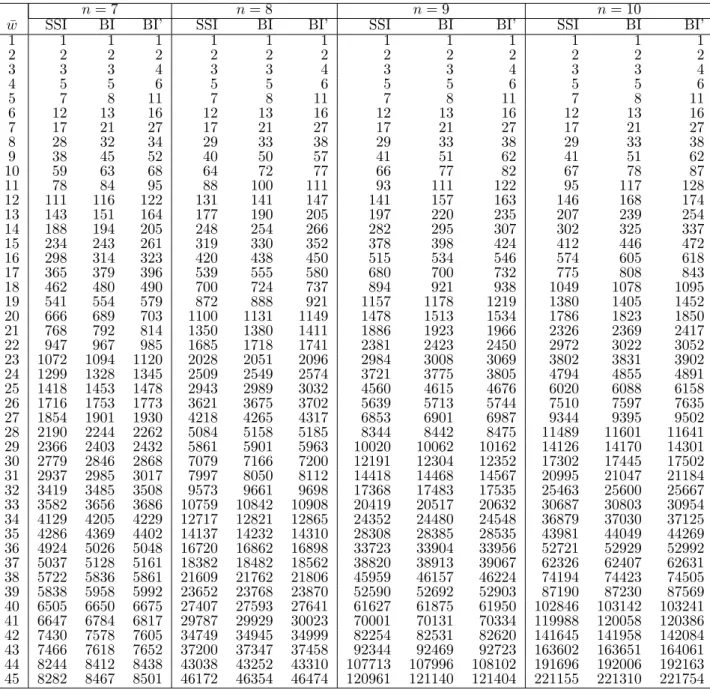
These results are obtained through systematic enumeration on a computer11. Tables 5 and 6 correspond toSituation 3: all quotas are permitted that is the quota is not fixed while the number of seats ¯wis fixed. The number of PV is given for ¯w≤45. Let us note that the number of PV is not monotonic with ¯w. For instance, there are 57 PV for SSI when ¯w= 20 andn= 5 while there are only 56 PV when ¯w= 21. Remark also that the number of PV increases quickly, which explains why the analytical approach is only used for 2, 3 and 4 voters.
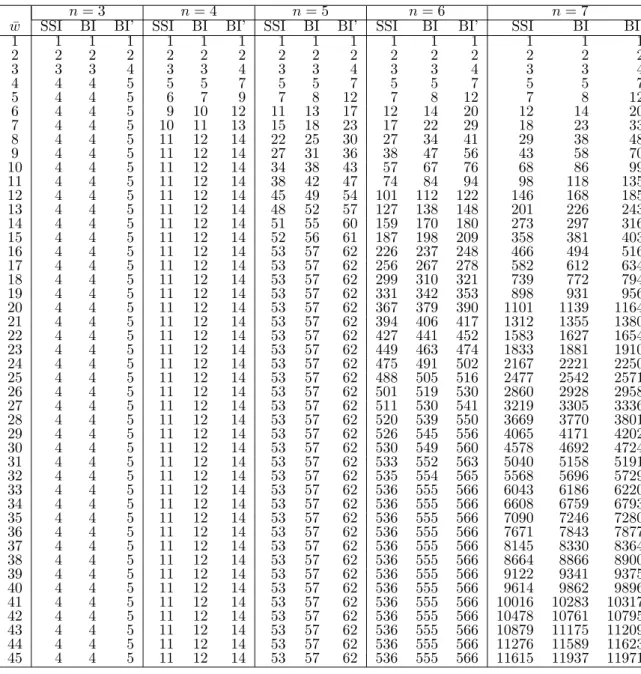
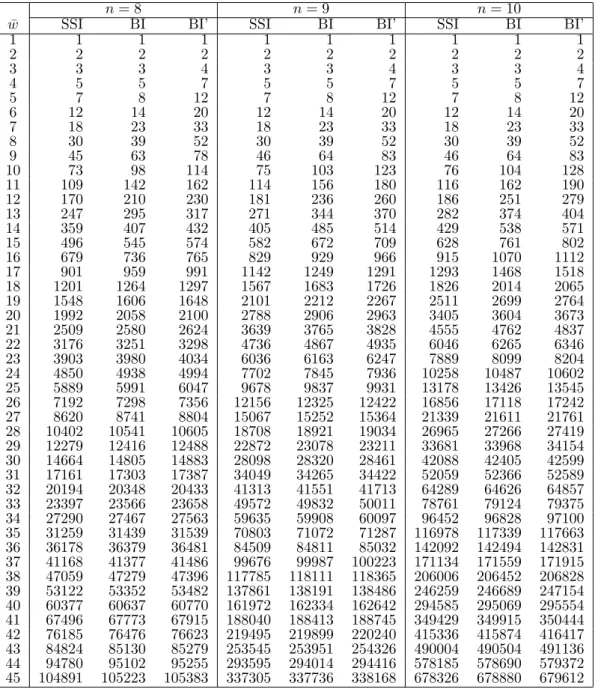
Thanks to Tables 7 and 8 we tend to Situation 1since these tables are cumulative with respect to Tables 5 and 612. However we obtain only a trend since it is not possible to obtain the sets SSI(n, .,w¯),BI(n, .,w¯), andBI′(n, .,w¯) when ¯wbecomes too high.
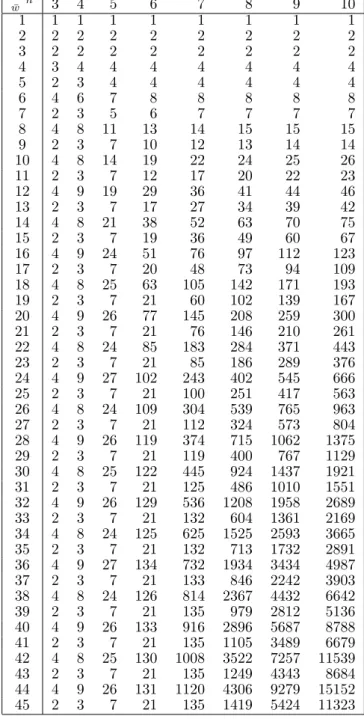
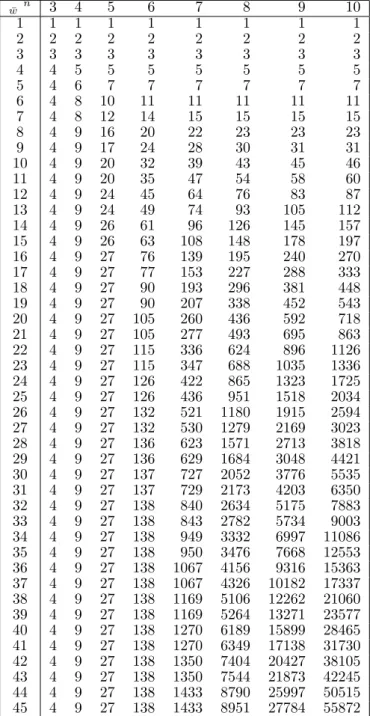
For majority rules13, Tables 9 and 10 present some results concerningSituations 2andSituations 4. Table 10 is the cumulative14 approach of Table 9. The distinction between the different power indices is not necessary since the cardinality of the sets SSI(n,12,w¯), BI′(n,12,w¯) and BI(n,12,w¯) is always the same. Thus, only one column is given in our tables.
All these tables confirm our analytical results developed in section 2 and enables us to present the four following conjectures:
Conjecture 1 |SSI(n)|<|BI(n)|<|BI′(n)| forn≥4.
Conjecture 2 |SSI(n, .,w¯)|<|BI(n, .,w¯)|<|BI′(n, .,w¯)| forn≥4 andw > x¯ , with x= 10 for
n= 4,x= 9 forn= 5andx= 5forn≥6.
Conjecture 3 |SSI(n, q, .)|=|BI(n, q, .)|=|BI′(n, q, .)|.
Conjecture 4 |SSI(n, q,w¯)|=|BI(n, q,w¯)|=|BI′(n, q,w¯)|.
11For a description of the computational method, see Barth´el´emy and Martin (2008).
12We compute| ∪ x≤w¯ SSI(n, ., x)|,| ∪ x≤w¯ BI(n, ., x)|and| ∪ x≤w¯ BI′(n, ., x)|.
13Equivalent results with different quotas were obtained but are omitted here.
14We compute| ∪ x≤w¯ SSI(n,12, x)|,| ∪ x≤w¯ BI(n,12, x)|and| ∪ x≤w¯ BI′(n,12, x)|.
4
References
Banzhaf J.F, 1964, “Weighted Voting Doesn’t Work: A Mathematical Analysis”, Rutgers Law Review, 19, 317−343.
Barth´el´emy F. and Martin M., 2006, “The Number of Possible PV of a Weighted Game”, Working paper, THEMA.
Diffo Lambo L. and Moulen J., 2002, “Ordinal Equivalence of Power Notions in Voting Games”,
Theory and Decision, 53, 313–325.
Felsenthal D. S. and Machover M., 1998, “The measurement of Voting Power. Theory and Practice, Problems and Paradoxes”, Edward Elgar Publishing, UK.
Laruelle A. and Valenciano F., 2008, “Voting and Collective Decision-Making”, Cambridge University Press.
Laruelle A. and Widgr´en M., 1998, “Is the Allocation of Voting Power among the EU States Fair?”,Public Choice, 94, 317-339.
Leech D., 2002, “Designing the Voting System for the EU Council of Ministers”, Public Choice, 113, 437-464.
Leech D., 2003, “Computing Power Indices for Large Voting Games”,Management Science, 49(6), 831-837.
Mann I. and Shapley L.S., 1960, “Values of Large Games, VI: Evaluating the Electoral College by Monte Carlo Techniques”, The RAND Corporation, Memorandum RM-2651.
Mann I. and Shapley L.S., 1962, “Values of Large Games VI: Evaluating the Electoral College Exactly”, The RAND Corporation, Memorandum RM-3158-PR.
Owen G., 1972, “Multilinear Extensions of Games”,Management Science, 18, p. 64-79.
Owen G., 1975, “Evaluation of a Presidential Election Game”,American Political Science Review, 69, 947-53.
Shapley L.S., Shubik M., 1954, “A Method for Evaluating the Distribution of Power in a Com-mittee System”,American Political Science Review, 48, 787−792.
Straffin P., 1994, “Power and Stability in Politics” in Handbook of Game Theory with Economic Application, Volume 2 (Aumann. R.J and Hart. S, eds), Elsevier Science.
Tomiyama Y., 1987, “Simple Game, Voting Representation and Ordinal Power Equivalence”,
Table 5: PVs whenqis not constrained
n= 3 n= 4 n= 5 n= 6
¯
w SSI BI BI’ SSI BI BI’ SSI BI BI’ SSI BI BI’
1 1 1 1 1 1 1 1 1 1 1 1 1 2 2 2 2 2 2 2 2 2 2 2 2 2 3 3 3 4 3 3 4 3 3 4 3 3 4 4 4 4 4 5 5 6 5 5 6 5 5 6 5 4 4 5 6 7 8 7 8 11 7 8 11 6 4 4 5 9 9 10 11 12 13 12 13 16 7 4 4 5 9 10 12 14 16 19 16 20 23 8 4 4 5 11 11 13 21 21 23 26 28 30 9 4 4 5 10 11 13 23 25 30 33 36 43 10 4 4 5 11 12 14 30 31 35 49 51 55 11 4 4 5 11 12 14 32 35 40 58 62 70 12 4 4 5 11 12 14 39 42 45 78 82 88 13 4 4 5 11 12 14 38 42 47 92 98 107 14 4 4 5 11 12 14 46 50 55 118 124 131 15 4 4 5 11 12 14 45 49 54 130 139 149 16 4 4 5 11 12 14 49 53 58 163 170 178 17 4 4 5 11 12 14 50 54 59 177 186 196 18 4 4 5 11 12 14 53 57 62 220 230 239 19 4 4 5 11 12 14 52 56 61 232 242 253 20 4 4 5 11 12 14 53 57 62 273 286 295 21 4 4 5 11 12 14 52 56 61 283 294 305 22 4 4 5 11 12 14 53 57 62 330 342 352 23 4 4 5 11 12 14 53 57 62 341 353 364 24 4 4 5 11 12 14 53 57 62 383 398 408 25 4 4 5 11 12 14 53 57 62 384 397 408 26 4 4 5 11 12 14 53 57 62 435 451 461 27 4 4 5 11 12 14 53 57 62 425 440 451 28 4 4 5 11 12 14 53 57 62 464 479 489 29 4 4 5 11 12 14 53 57 62 466 480 491 30 4 4 5 11 12 14 53 57 62 490 508 519 31 4 4 5 11 12 14 53 57 62 490 506 517 32 4 4 5 11 12 14 53 57 62 510 530 540 33 4 4 5 11 12 14 53 57 62 503 521 532 34 4 4 5 11 12 14 53 57 62 521 539 550 35 4 4 5 11 12 14 53 57 62 516 534 545 36 4 4 5 11 12 14 53 57 62 531 550 561 37 4 4 5 11 12 14 53 57 62 527 546 557 38 4 4 5 11 12 14 53 57 62 533 552 563 39 4 4 5 11 12 14 53 57 62 529 548 559 40 4 4 5 11 12 14 53 57 62 534 553 564 41 4 4 5 11 12 14 53 57 62 534 553 564 42 4 4 5 11 12 14 53 57 62 535 554 565 43 4 4 5 11 12 14 53 57 62 535 554 565 44 4 4 5 11 12 14 53 57 62 536 555 566 45 4 4 5 11 12 14 53 57 62 535 554 565
Table 6: PVs whenqis not constrained
n= 7 n= 8 n= 9 n= 10
¯
w SSI BI BI’ SSI BI BI’ SSI BI BI’ SSI BI BI’
1 1 1 1 1 1 1 1 1 1 1 1 1 2 2 2 2 2 2 2 2 2 2 2 2 2 3 3 3 4 3 3 4 3 3 4 3 3 4 4 5 5 6 5 5 6 5 5 6 5 5 6 5 7 8 11 7 8 11 7 8 11 7 8 11 6 12 13 16 12 13 16 12 13 16 12 13 16 7 17 21 27 17 21 27 17 21 27 17 21 27 8 28 32 34 29 33 38 29 33 38 29 33 38 9 38 45 52 40 50 57 41 51 62 41 51 62 10 59 63 68 64 72 77 66 77 82 67 78 87 11 78 84 95 88 100 111 93 111 122 95 117 128 12 111 116 122 131 141 147 141 157 163 146 168 174 13 143 151 164 177 190 205 197 220 235 207 239 254 14 188 194 205 248 254 266 282 295 307 302 325 337 15 234 243 261 319 330 352 378 398 424 412 446 472 16 298 314 323 420 438 450 515 534 546 574 605 618 17 365 379 396 539 555 580 680 700 732 775 808 843 18 462 480 490 700 724 737 894 921 938 1049 1078 1095 19 541 554 579 872 888 921 1157 1178 1219 1380 1405 1452 20 666 689 703 1100 1131 1149 1478 1513 1534 1786 1823 1850 21 768 792 814 1350 1380 1411 1886 1923 1966 2326 2369 2417 22 947 967 985 1685 1718 1741 2381 2423 2450 2972 3022 3052 23 1072 1094 1120 2028 2051 2096 2984 3008 3069 3802 3831 3902 24 1299 1328 1345 2509 2549 2574 3721 3775 3805 4794 4855 4891 25 1418 1453 1478 2943 2989 3032 4560 4615 4676 6020 6088 6158 26 1716 1753 1773 3621 3675 3702 5639 5713 5744 7510 7597 7635 27 1854 1901 1930 4218 4265 4317 6853 6901 6987 9344 9395 9502 28 2190 2244 2262 5084 5158 5185 8344 8442 8475 11489 11601 11641 29 2366 2403 2432 5861 5901 5963 10020 10062 10162 14126 14170 14301 30 2779 2846 2868 7079 7166 7200 12191 12304 12352 17302 17445 17502 31 2937 2985 3017 7997 8050 8112 14418 14468 14567 20995 21047 21184 32 3419 3485 3508 9573 9661 9698 17368 17483 17535 25463 25600 25667 33 3582 3656 3686 10759 10842 10908 20419 20517 20632 30687 30803 30954 34 4129 4205 4229 12717 12821 12865 24352 24480 24548 36879 37030 37125 35 4286 4369 4402 14137 14232 14310 28308 28385 28535 43981 44049 44269 36 4924 5026 5048 16720 16862 16898 33723 33904 33956 52721 52929 52992 37 5037 5128 5161 18382 18482 18562 38820 38913 39067 62326 62407 62631 38 5722 5836 5861 21609 21762 21806 45959 46157 46224 74194 74423 74505 39 5838 5958 5992 23652 23768 23870 52590 52692 52903 87190 87230 87569 40 6505 6650 6675 27407 27593 27641 61627 61875 61950 102846 103142 103241 41 6647 6784 6817 29787 29929 30023 70001 70131 70334 119988 120058 120386 42 7430 7578 7605 34749 34945 34999 82254 82531 82620 141645 141958 142084 43 7466 7618 7652 37200 37347 37458 92344 92469 92723 163602 163651 164061 44 8244 8412 8438 43038 43252 43310 107713 107996 108102 191696 192006 192163 45 8282 8467 8501 46172 46354 46474 120961 121140 121404 221155 221310 221754
Table 7: Cumulative number of PVs when q is not constrained
n= 3 n= 4 n= 5 n= 6 n= 7
¯
w SSI BI BI’ SSI BI BI’ SSI BI BI’ SSI BI BI’ SSI BI BI’
1 1 1 1 1 1 1 1 1 1 1 1 1 1 1 1 2 2 2 2 2 2 2 2 2 2 2 2 2 2 2 2 3 3 3 4 3 3 4 3 3 4 3 3 4 3 3 4 4 4 4 5 5 5 7 5 5 7 5 5 7 5 5 7 5 4 4 5 6 7 9 7 8 12 7 8 12 7 8 12 6 4 4 5 9 10 12 11 13 17 12 14 20 12 14 20 7 4 4 5 10 11 13 15 18 23 17 22 29 18 23 33 8 4 4 5 11 12 14 22 25 30 27 34 41 29 38 48 9 4 4 5 11 12 14 27 31 36 38 47 56 43 58 70 10 4 4 5 11 12 14 34 38 43 57 67 76 68 86 99 11 4 4 5 11 12 14 38 42 47 74 84 94 98 118 135 12 4 4 5 11 12 14 45 49 54 101 112 122 146 168 185 13 4 4 5 11 12 14 48 52 57 127 138 148 201 226 243 14 4 4 5 11 12 14 51 55 60 159 170 180 273 297 316 15 4 4 5 11 12 14 52 56 61 187 198 209 358 381 403 16 4 4 5 11 12 14 53 57 62 226 237 248 466 494 516 17 4 4 5 11 12 14 53 57 62 256 267 278 582 612 634 18 4 4 5 11 12 14 53 57 62 299 310 321 739 772 794 19 4 4 5 11 12 14 53 57 62 331 342 353 898 931 956 20 4 4 5 11 12 14 53 57 62 367 379 390 1101 1139 1164 21 4 4 5 11 12 14 53 57 62 394 406 417 1312 1355 1380 22 4 4 5 11 12 14 53 57 62 427 441 452 1583 1627 1654 23 4 4 5 11 12 14 53 57 62 449 463 474 1833 1881 1910 24 4 4 5 11 12 14 53 57 62 475 491 502 2167 2221 2250 25 4 4 5 11 12 14 53 57 62 488 505 516 2477 2542 2571 26 4 4 5 11 12 14 53 57 62 501 519 530 2860 2928 2958 27 4 4 5 11 12 14 53 57 62 511 530 541 3219 3305 3336 28 4 4 5 11 12 14 53 57 62 520 539 550 3669 3770 3801 29 4 4 5 11 12 14 53 57 62 526 545 556 4065 4171 4202 30 4 4 5 11 12 14 53 57 62 530 549 560 4578 4692 4724 31 4 4 5 11 12 14 53 57 62 533 552 563 5040 5158 5191 32 4 4 5 11 12 14 53 57 62 535 554 565 5568 5696 5729 33 4 4 5 11 12 14 53 57 62 536 555 566 6043 6186 6220 34 4 4 5 11 12 14 53 57 62 536 555 566 6608 6759 6793 35 4 4 5 11 12 14 53 57 62 536 555 566 7090 7246 7280 36 4 4 5 11 12 14 53 57 62 536 555 566 7671 7843 7877 37 4 4 5 11 12 14 53 57 62 536 555 566 8145 8330 8364 38 4 4 5 11 12 14 53 57 62 536 555 566 8664 8866 8900 39 4 4 5 11 12 14 53 57 62 536 555 566 9122 9341 9375 40 4 4 5 11 12 14 53 57 62 536 555 566 9614 9862 9896 41 4 4 5 11 12 14 53 57 62 536 555 566 10016 10283 10317 42 4 4 5 11 12 14 53 57 62 536 555 566 10478 10761 10795 43 4 4 5 11 12 14 53 57 62 536 555 566 10879 11175 11209 44 4 4 5 11 12 14 53 57 62 536 555 566 11276 11589 11623 45 4 4 5 11 12 14 53 57 62 536 555 566 11615 11937 11971
Table 8: Cumulative number of PVs when q is not constrained
n= 8 n= 9 n= 10
¯
w SSI BI BI’ SSI BI BI’ SSI BI BI’
1 1 1 1 1 1 1 1 1 1 2 2 2 2 2 2 2 2 2 2 3 3 3 4 3 3 4 3 3 4 4 5 5 7 5 5 7 5 5 7 5 7 8 12 7 8 12 7 8 12 6 12 14 20 12 14 20 12 14 20 7 18 23 33 18 23 33 18 23 33 8 30 39 52 30 39 52 30 39 52 9 45 63 78 46 64 83 46 64 83 10 73 98 114 75 103 123 76 104 128 11 109 142 162 114 156 180 116 162 190 12 170 210 230 181 236 260 186 251 279 13 247 295 317 271 344 370 282 374 404 14 359 407 432 405 485 514 429 538 571 15 496 545 574 582 672 709 628 761 802 16 679 736 765 829 929 966 915 1070 1112 17 901 959 991 1142 1249 1291 1293 1468 1518 18 1201 1264 1297 1567 1683 1726 1826 2014 2065 19 1548 1606 1648 2101 2212 2267 2511 2699 2764 20 1992 2058 2100 2788 2906 2963 3405 3604 3673 21 2509 2580 2624 3639 3765 3828 4555 4762 4837 22 3176 3251 3298 4736 4867 4935 6046 6265 6346 23 3903 3980 4034 6036 6163 6247 7889 8099 8204 24 4850 4938 4994 7702 7845 7936 10258 10487 10602 25 5889 5991 6047 9678 9837 9931 13178 13426 13545 26 7192 7298 7356 12156 12325 12422 16856 17118 17242 27 8620 8741 8804 15067 15252 15364 21339 21611 21761 28 10402 10541 10605 18708 18921 19034 26965 27266 27419 29 12279 12416 12488 22872 23078 23211 33681 33968 34154 30 14664 14805 14883 28098 28320 28461 42088 42405 42599 31 17161 17303 17387 34049 34265 34422 52059 52366 52589 32 20194 20348 20433 41313 41551 41713 64289 64626 64857 33 23397 23566 23658 49572 49832 50011 78761 79124 79375 34 27290 27467 27563 59635 59908 60097 96452 96828 97100 35 31259 31439 31539 70803 71072 71287 116978 117339 117663 36 36178 36379 36481 84509 84811 85032 142092 142494 142831 37 41168 41377 41486 99676 99987 100223 171134 171559 171915 38 47059 47279 47396 117785 118111 118365 206006 206452 206828 39 53122 53352 53482 137861 138191 138486 246259 246689 247154 40 60377 60637 60770 161972 162334 162642 294585 295069 295554 41 67496 67773 67915 188040 188413 188745 349429 349915 350444 42 76185 76476 76623 219495 219899 220240 415336 415874 416417 43 84824 85130 85279 253545 253951 254326 490004 490504 491136 44 94780 95102 95255 293595 294014 294416 578185 578690 579372 45 104891 105223 105383 337305 337736 338168 678326 678880 679612
Table 9: Number of PVs according tow¯ andnwith q= 1/2 ¯ w n 3 4 5 6 7 8 9 10 1 1 1 1 1 1 1 1 1 2 2 2 2 2 2 2 2 2 3 2 2 2 2 2 2 2 2 4 3 4 4 4 4 4 4 4 5 2 3 4 4 4 4 4 4 6 4 6 7 8 8 8 8 8 7 2 3 5 6 7 7 7 7 8 4 8 11 13 14 15 15 15 9 2 3 7 10 12 13 14 14 10 4 8 14 19 22 24 25 26 11 2 3 7 12 17 20 22 23 12 4 9 19 29 36 41 44 46 13 2 3 7 17 27 34 39 42 14 4 8 21 38 52 63 70 75 15 2 3 7 19 36 49 60 67 16 4 9 24 51 76 97 112 123 17 2 3 7 20 48 73 94 109 18 4 8 25 63 105 142 171 193 19 2 3 7 21 60 102 139 167 20 4 9 26 77 145 208 259 300 21 2 3 7 21 76 146 210 261 22 4 8 24 85 183 284 371 443 23 2 3 7 21 85 186 289 376 24 4 9 27 102 243 402 545 666 25 2 3 7 21 100 251 417 563 26 4 8 24 109 304 539 765 963 27 2 3 7 21 112 324 573 804 28 4 9 26 119 374 715 1062 1375 29 2 3 7 21 119 400 767 1129 30 4 8 25 122 445 924 1437 1921 31 2 3 7 21 125 486 1010 1551 32 4 9 26 129 536 1208 1958 2689 33 2 3 7 21 132 604 1361 2169 34 4 8 24 125 625 1525 2593 3665 35 2 3 7 21 132 713 1732 2891 36 4 9 27 134 732 1934 3434 4987 37 2 3 7 21 133 846 2242 3903 38 4 8 24 126 814 2367 4432 6642 39 2 3 7 21 135 979 2812 5136 40 4 9 26 133 916 2896 5687 8788 41 2 3 7 21 135 1105 3489 6679 42 4 8 25 130 1008 3522 7257 11539 43 2 3 7 21 135 1249 4343 8684 44 4 9 26 131 1120 4306 9279 15152 45 2 3 7 21 135 1419 5424 11323
Table 10: Cumulative number of PVs according to w¯ andn withq= 1/2 ¯ w n 3 4 5 6 7 8 9 10 1 1 1 1 1 1 1 1 1 2 2 2 2 2 2 2 2 2 3 3 3 3 3 3 3 3 3 4 4 5 5 5 5 5 5 5 5 4 6 7 7 7 7 7 7 6 4 8 10 11 11 11 11 11 7 4 8 12 14 15 15 15 15 8 4 9 16 20 22 23 23 23 9 4 9 17 24 28 30 31 31 10 4 9 20 32 39 43 45 46 11 4 9 20 35 47 54 58 60 12 4 9 24 45 64 76 83 87 13 4 9 24 49 74 93 105 112 14 4 9 26 61 96 126 145 157 15 4 9 26 63 108 148 178 197 16 4 9 27 76 139 195 240 270 17 4 9 27 77 153 227 288 333 18 4 9 27 90 193 296 381 448 19 4 9 27 90 207 338 452 543 20 4 9 27 105 260 436 592 718 21 4 9 27 105 277 493 695 863 22 4 9 27 115 336 624 896 1126 23 4 9 27 115 347 688 1035 1336 24 4 9 27 126 422 865 1323 1725 25 4 9 27 126 436 951 1518 2034 26 4 9 27 132 521 1180 1915 2594 27 4 9 27 132 530 1279 2169 3023 28 4 9 27 136 623 1571 2713 3818 29 4 9 27 136 629 1684 3048 4421 30 4 9 27 137 727 2052 3776 5535 31 4 9 27 137 729 2173 4203 6350 32 4 9 27 138 840 2634 5175 7883 33 4 9 27 138 843 2782 5734 9003 34 4 9 27 138 949 3332 6997 11086 35 4 9 27 138 950 3476 7668 12553 36 4 9 27 138 1067 4156 9316 15363 37 4 9 27 138 1067 4326 10182 17337 38 4 9 27 138 1169 5106 12262 21060 39 4 9 27 138 1169 5264 13271 23577 40 4 9 27 138 1270 6189 15899 28465 41 4 9 27 138 1270 6349 17138 31730 42 4 9 27 138 1350 7404 20427 38105 43 4 9 27 138 1350 7544 21873 42245 44 4 9 27 138 1433 8790 25997 50515 45 4 9 27 138 1433 8951 27784 55872