What Makes Audio Event Detection Harder than
Classification?
Huy Phan
∗†, Philipp Koch
∗, Fabrice Katzberg
∗, Marco Maass
∗, Radoslaw Mazur
∗,
Ian McLoughlin
‡and Alfred Mertins
∗∗Institute for Signal Processing, University of L¨ubeck, Germany
†Graduate School for Computing in Medicine and Life Sciences, University of L¨ubeck, Germany ‡School of Computing, University of Kent, UK
{phan, koch, katzberg, maass, mazur, mertins}@isip.uni-luebeck.de, [email protected]
Abstract—There is a common observation that audio event classification is easier to deal with than detection. So far, this observation has been accepted as a fact and we lack of a careful analysis. In this paper, we reason the rationale behind this fact and, more importantly, leverage them to benefit the audio event detection task. We present an improved detection pipeline in which a verification step is appended to augment a detection system. This step employs a high-quality event classifier to postprocess the benign event hypotheses outputted by the detection system and reject false alarms. To demonstrate the effectiveness of the proposed pipeline, we implement and pair up different event detectors based on the most common detection schemes and various event classifiers, ranging from the standard bag-of-words model to the state-of-the-art bank-of-regressors one. Experimental results on the ITC-Irst dataset show significant improvements to detection performance. More importantly, these improvements are consistent for all detector-classifier combinations.
I. INTRODUCTION
Audio event classification and detection (AEC/D) have been an active field of research in recent years [1], [2], [3]. So far, beside a majority of works focusing on the improving overall performance in terms of accuracy [2], [1], [4], [5], many other aspects have also been studied, including noise robustness [6], [7], [8], overlapping event handling [9], [10], [11], [12], early event detection [13], multi-channel fusion [14], as well as generic representation [15]. However, little attention has been paid to the important aspect of event detection systems on continuous streams: false positive reduction. False positives, i.e., event instances that are spuriously detected by a detection system, and subsequently draw attention to them, are arguably one of the most important problems faced by different ap-plications like ambient intelligence and surveillance. To the best knowledge of the authors, this is the first work explicitly addressing this problem.
Previous research on audio event detection can be roughly grouped into three different schemes. The first one is the detection-by-classification where event classification models, for example Support Vector Machines (SVMs), are learned and then applied on test audio signals in a sliding-window fashion [16], [17], [5]. The second scheme relies on automatic speech recognition (ASR) frameworks where the states of frame-wise features are modeled by Gaussian Mixture Models (GMMs) followed by Hidden Markov Models (HMMs) to model the
distributions of the feature sequences given the state sequences [18], [19], [20]. On testing, the target event is recognized by maximizing the posterior probability on a local feature vector sequence of a test audio signal. The third scheme is based on the recently proposed regression approach [4], [13]. A regressor based on random regression forests is learned for each target event category to model the relative positions of the audio segments with respect to the event onsets and offsets. On testing, the learned regressor is used to estimate the positions of the event onsets and offsets (i.e. their boundaries) in a test audio signal.
The goal of false positive reduction is obviously achiev-able by improving the overall performance towards an oracle system which makes no mistakes. This has inherently been the main focus of many works since the task was introduced. Nevertheless, our purpose is different from them in essence. We aim to reduce the false positives of detection systems given the state-of-the-art performance which is far from perfect in practice. Our proposed detection pipeline is inspired by investigating the performance gap between a detection system on continuous streams and a classification system on isolated events. More specifically, the classification task is much easier to deal with and usually enjoys higher overall accuracy than that of the event detection task. Based on this observation, instead of making hard detection decisions early on, it is reasonable to inject a verification step at the end of the detection pipeline, where a trained classifier is used to classify the detected hypotheses and reject those with mismatched labels. Unlike the common detection-by-classification scheme [16], [17], [1], this can be considered as a novel scheme to utilize a trained event classifier for the detection task.
II. THE IMPROVED DETECTION PIPELINE FOR FALSE POSITIVE REDUCTION
A. Why is audio event detection harder than classification?
There is a fact that the classification task is much easier than the detection one. For example, on the ITC-Irst dataset [2] used in this work accuracies of 98.9% and 93.1% are obtainable for the classification and detection tasks, respectively (cf. Section IV). This observation is also well-known in the CLEAR 2006 challenge [2]. This can be explained by the fundamental difference between the tasks. The reason is two-fold. First and
more obviously, the detection task needs to discriminate not only the event categories of interest (as in the classification task) but also the target event categories from highly rich background sounds. Second, for the classification task, we have access to the global context of the events while, in the detection task, we do not know in advance boundaries of the events and usually need to rely on unreliable local audio features for inference.
Furthermore, this fundamental dissimilarity results in a drawback of event detectors which are based on the com-mon detection-by-classification scheme, such as those in [17]. These detectors attempted to build strong event classification models and subsequently employ them to detect events in continuous streams with a sliding window. Since the classifiers are trained on complete events, they expect to be presented with complete events to guarantee a good performance. How-ever, due to high intra- and extra-class temporal variations of audio events, it is almost impossible to decide a good-for-all window length that exactly captures complete events. This results in mismatch between training and testing data, which significantly deteriorates the accuracy of the classification models and subsequently the accuracy of detection systems. Although one can circumvent this issue by training classifiers on equal-sized segments of the events, such as those in [5], [16], the problem remains unsolved. By dividing the events into equal-sized segments, one has increased the complexity of the data distribution. This makes the classification problem harder to solve than the original one considering the entire events as training examples. All of this, again, results in the degeneration of the classification models.
B. The improved detection pipeline with a verification step
In order to mitigate the above-discussed shortcoming and take full advantage of high-quality classification models for the detection task, we propose to employ them in a completely different manner. The idea is that we augment a detection system with a verification step where a high-quality classi-fication model will be applied to verify the detected event hypotheses as in Fig. 1. At this step, an event hypothesis with a class label cdetected outputted by the detection system will be rejected when it is classified with a mismatched label cclassif ied 6= cdetected by the classifier. Eventually, instead of making hard decisions early on, the false positive hypotheses outputted by a detection system will be rejected by the verification step. As a result, the detection precision will be enhanced, leading to improvements in overall detection performance.
The rationale behind the proposed pipeline originates from the difference between the classification and detection tasks as discussed above. Since the detection task relies on local features, the wrongly detected events are usually difficult ones whose local features are not reliable and cause wrong detections. However, after the detection step, we obtain the estimated boundary of the detected events and therefore, have access to their more or less global contexts. As a result, the mismatch between training and testing data is mitigated and
AED System Verification detected events verified events rejected events Fig. 1. The improved audio event detection pipeline with the verification step for false positive reduction.
an event classifier is expected to perform well. It should be also noted that we achieve the goal of false positive reduction by checking the consistency between the detection labels and the classification ones. Our approach, therefore, differs from that in [21] which relied on cascading classifiers.
III. THE EMPLOYED EVENT DETECTORS AND CLASSIFIERS
In order to verify the effectiveness of the proposed detection pipeline, we implement three event detection systems and five different event classifiers and study all possible combinations of them in the proposed pipeline. These detectors are typi-cal ones complying with three common detection schemes: detection-by-classification, ASR-based, and regression. The employed classifiers are chosen to be diverse enough, ranging from the standard bag-of-words model to the one recently reported state-of-the-art performance.
A. Audio event detectors
Detection-by-classification. This system conforms to the common detection-by-classification scheme. It uses a sliding window of one second and a shift of 100 ms on audio signals for detection. The detection task is accomplished by two RBF-kernel SVM classifiers: one for event/background classification and the other for subsequent event classification. For representation, each one-second segment is decomposed into 25 ms frames with an overlap of 50%. A set of 60 features as used in [16] is then extracted for a frame: 16 log-frequency filter bank coefficients, their first and second derivatives , zero-crossing rate, short time energy, four subband energies, spectral flux calculated for each subband, spectral centroid, and spectral bandwidth. In turn, a global feature vector which consists of mean and standard deviation of frame-wise feature vectors is used to represent each one-second segment. Furthermore, a median filter of size 17 is applied on the label sequences to eliminate too short silences or non-silences [16]. Finally, an event hypothesis is excluded if its length is less than the minimum length of training instances.
ASR-based. This system adheres to the ASR framework. The audio signals are divided into short 20 ms audio frames with a hop size of 10 ms as commonly used for speech. Each frame is represented by twelve Mel-Frequency Cepstral Coefficients (MFCCs). Each event is described by a three-state HMM. All of the HMMs have a left-to-right topology and use output probability densities represented by means of 128 Gaussian components with diagonal covariance matrices. HMM training was accomplished through the Baum-Welch training procedure. Finally, the optimum event sequence is obtained by the Viterbi decoding algorithm.
Mbg event Mev P(1|x)
...
F1...
Fc FC threshold 1 threshold c threshold Csequence of audio segments n n n n P(c|x) P(C|x)
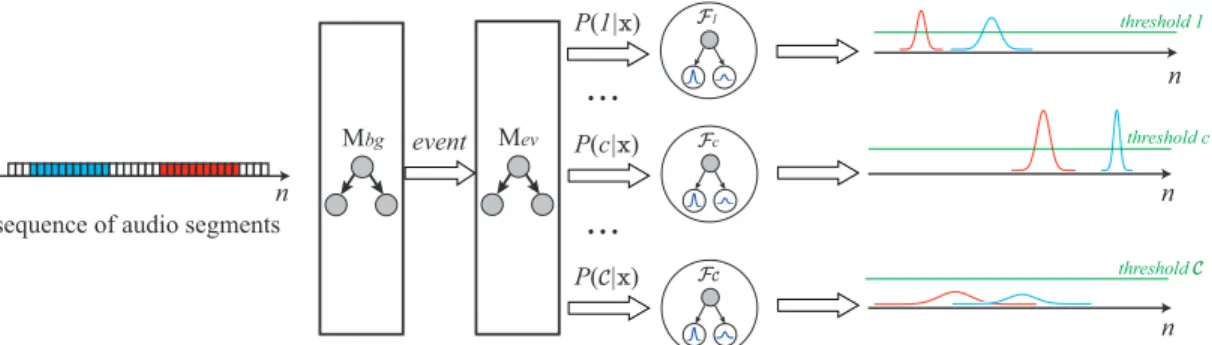
Fig. 2. The audio event detection system based on the regression approach.
Regression. This system follows the regression approach which was recently proposed for event detection and demon-strates state-of-the-art results [4], [13]. We show the system pipeline in Fig. 2 to ease the explanation not only for this detector itself but also the event classifiers (i.e. BoR and HoDW in Section III-B) which are derived from this pipeline. The audio signals are decomposed into 100 ms long segments with an overlap of 90 ms. We utilize the feature set used in the detection-by-classification scheme to represent each segment. Out of C event categories of interest, we trained a regression forest Fc for each category c ∈ {1, . . . ,C}. The binary segment-wise classifier Mbg is used for event/background classification. The event segments are subsequently classi-fied by the multi-class event classifier Mev. The segments classified as class c will then be presented to regression forests Fc for event onset and offset estimation. In addition, the estimation is weighted by the classification probabilities obtained fromMev. Class-wise detection thresholds searched by cross-validation are eventually applied to the estimation scores to determine event onset and offset positions. BothMbg andMevwere trained using random forest classification [22] with 200 trees each. The regression forests were trained with the random forest regression algorithm as in [4], [13].
B. Audio event classifiers
We implemented the following event classifiers to play the role of the verifier in the proposed detection pipeline.
Bag-of-words (BoW).BoW models have been widely used for audio event classification [23], [17]. Using this model, an audio event is represented by a histogram of codebook entries. The isolated events were divided into 50 ms long segments each of which is represented by the feature set used in the detection-by-classification detector. We used k -means for codebook learning. The entries were obtained as the cluster centroids, and codebook matching was based on Euclidean distance. We varied the codebook size in the set of {50,100, . . . ,250}. The system with the best performance was kept.
Pyramid bag-of-words (PBoW).As an improvement of the BoW models, we extracted and combined BoW descriptors on different pyramid levels [24] to encode the temporal structure of the audio events as in [17]. We exploited{2,3,4}pyramid levels and the best one was retained.
Bank-of-regressors (BoR).This system utilizes the class-specific regression forestsFc in the regression-based detector in Fig. 2 and stacks them into a bank for feature extraction as in [25]. An audio event is then transformed into a compact descriptor φ = [φ1, . . . , φC]T ∈ RC+ where φc is the mean of maximum onset and offset estimation scores outputted by the regressor Fc. Each entry φ
c was normalized to maxφc
φc,
where maxφc is the maximum value of φc in the training
events. This descriptor is compact since its dimensionality is equal to the number of target event categories. Intuitively, the descriptor measures how the audio event aligns to the temporal configurations of different event categories modeled by the regressors.
Histogram of discriminative words (HoDW).This classi-fier also utilizes a component of the regression-based detector, the event classifier Mev, in Fig. 2 for feature extraction. An event consisting of N audio segments (xn;n= 1, . . . , N) is represented by the descriptorϕ= [ϕ1, . . . , ϕC]T ∈RC+where:
ϕc = N X n=1 1 NP(c |xn,Mev). (1)
In (1),P(c|xn,Mev)is the probability that the segmentxnis classified as classcby the classifierMev. These features can be thought of being a discriminative and compact variant of the BoW models where Mev plays the role of the discriminative codebook matcher. In addition, opposed to the BoR descriptor, this one is unstructured and expected to be good for weakly structured events.
BoR+HoDW. Since BoR and HoDW are expected to be
good for event types which expose strong and weak temporal structures, respectively, it is reasonable to combine both types of descriptors to take advantage of their strengths. In addition, this is convenient since they are derived from the same pipeline in Fig. 2. We combine two descriptors using an extended Gaussian kernel [26]: K(ei, ej) = exp − X k∈{φ,ϕ} 1 AkD(e k i, ekj) . (2) whereD(ek
i, ekj)is theχ2 distance between the audio events ei andej with respect to thek-th feature channel.Ak is the mean value of theχ2 distances between the training samples
TABLE I
OVERALL CLASSIFICATION ACCURACIES(%)OBTAINED BY DIFFERENT CLASSIFICATION SYSTEMS.
BoW PBoW HoDW BoR BoR+HoDW
97.3 96.6 97.8 98.4 98.9
All final classifiers were trained using one-vs-one SVMs and the hyperparameters were tuned via 10-fold cross-validation. Theχ2kernel was used for the BoW, PBoW, BoR, and HoDW classifiers whereas the kernel defined in (2) was used for the BoR+HoDW one.
IV. EXPERIMENTS A. Experiment setup
1) Dataset: We conducted experiments on the ITC-Irst dataset [2]. It consists of twelve recording sessions with a total duration of 1.7 hours. There are 16 semantic event categories with approximately 50 events recorded for most of the categories. To be consent with the CLEAR 2006 challenge [2] and previous works [4], [13], we target twelve classes for evaluation: door knock (kn), door slam (ds), steps (st), chair moving (cm), spoon cup jingle (cl), paper wrapping (pw), key jingle (kj), keyboard typing (kt), phone ring (pr), applause (ap), cough (co), laugh (la). The rest are considered as background. We used nine recording sessions for training and three remaining sessions for testing. Only one channel named TABLE 1was used.
2) Evaluation metrics: We evaluate the performance of the detection systems usingF1-scoremetric. For completeness, we also report the performance of the employed event classifiers in terms of overall classification accuracy. Note that due to the randomness of the system in Fig. 2, the experiments related to the BoR, HoDW, and BoR+HoDW classifiers as well as the regression-based detector were repeated five times and the average performance is reported.
3) Experimental results: The classification performances achieved by different systems are summarized in Table I. Both the BoW and PBoW classifiers yield best performance with a codebook size of 200. A pyramid level of 2 is optimal for the PBoW classifier. Between the BoW and HoDW classifiers which do not take into account the temporal structure of the events, the latter one saw an absolute improvement of0.5% in classification accuracy, thanks to the discriminative codebook. Likewise for the classifiers using structural features, BoR outperforms PBoW by1.8% absolute. This result explains that the BoR descriptor appears to model the temporal information of the events more efficiently than the PBoW one. Finally, as expected, integration of both structural and unstructural descriptors, i.e. BoR and HoDW, in the BoR+HoDW system boosts the classification accuracy by0.5% absolute compared to that of the BoR classifier.
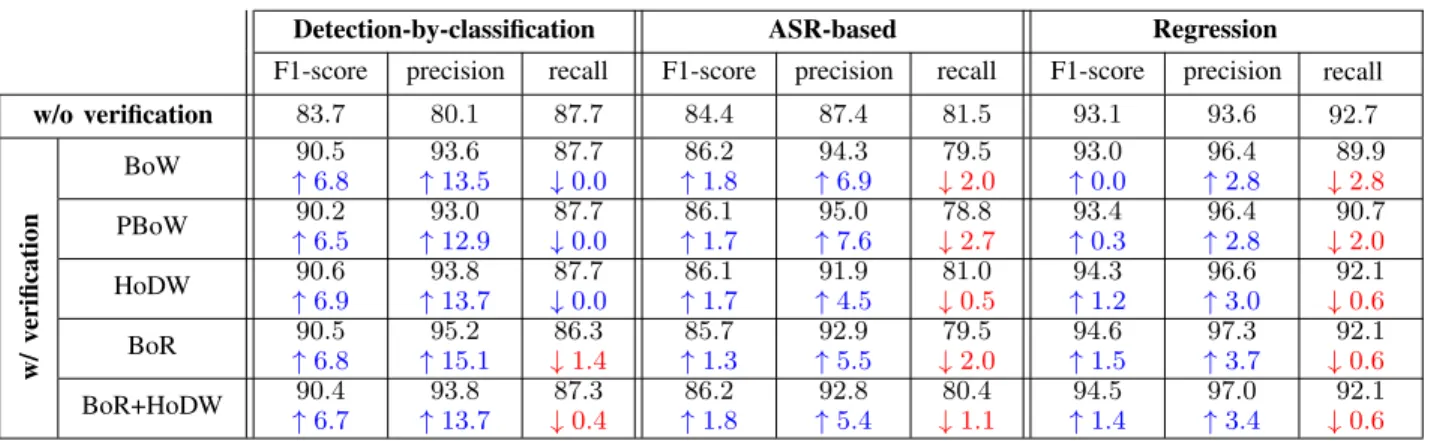
The overall detection results of the employed detection systems, both with and without verification, are shown in Table II. Without verification, the regression-based detection
system obtains93.1% in terms of F1-score which significantly outperforms the detection-by-classification and ASR-based detectors by9.4% and 8.7% absolute, respectively.
The detection results with verification demonstrate the ef-fectiveness of the proposed detection pipeline. Overall, the verification with all classifiers leads to improvements in overall detection performance for all detection systems. The average F1-score gains of6.7%,1.7%, and0.9% are seen for detection-by-classification, ASR-based, and regression detection sys-tems, respectively.The principle is that the verifiers reject the false positives, increasing the precision at the cost of decreas-ing the recall. The reduction in recall is due to accidental rejection of true positive hypotheses by the classifiers. This side effect is explainable since the classifiers are not perfect and the segmentation errors of the detected hypotheses cause a certain degree of mismatch between training and test data. However, the recall drops are sustainably smaller than the precision gains, which leads to overall improvements in F1-score. In addition, the gains are varied depending on detector-classifier combination. For the detection-by-classification and ASR-based detectors, the F1-score gains achieved by verifi-cation with all five classifiers are almost the same, i.e. the standard BoW model is as good as the best BoR+HoDW one in this sense. However, for the regression-based detector, the gains obtained by verification with the BoW and PBoW classifiers are subtle (0.0% and0.3%, respectively) while those with the HoDW, BoR, and BoR+HoDW classifiers are more significant (1.2%,1.5%, and1.4%, respectively). Furthermore, these classifiers offer a unique advantage that using them for verification purposes is much more convenient than the other two since they utilize the existing components of the regression-based detector for feature extraction.
The experimental results also help to reveal the behavior of different detection systems. The detection-by-classification system retains a lot of false positive hypotheses which are explained by its high recall (87.7%) but low precision (80.1%). In contrast, the ASR-based system is much more conservative, maintaining relatively small number of hypotheses explaining its high precision (87.4%) but low recall (81.5%). Conse-quently, the verification step is able to reject a lot more false positive hypotheses of the detection-by-classification detector to boost the precision significantly (13.8% on average over all five classifiers) whereas the precision gain of the ASR-based system is more subtle (6.0% on average over all five classifiers). Regarding the regression-based detector, even though it obtains much higher precision and recall (i.e. the retained hypotheses are of higher fidelity) than those of other two detectors, the verification step can further help to reject false alarms and yield significant gain in the precision, for example 3.7% with the BoR classifier.
V. CONCLUSIONS
In summary, we studied what make audio event detection harder than classification. We then leverage this observation to study an important aspect of audio event detection systems on continuous streams, namely false positive reduction. An
TABLE II
OVERALL DETECTION RESULTS OF DIFFERENT DETECTION SYSTEMS WITH AND WITHOUT VERIFICATION. FOR THOSE WITH VERIFICATION,THE ABSOLUTE PERFORMANCE GAINS AND LOSSES COMPARED TO THOSE WITHOUT VERIFICATION ARE HIGHLIGHTED IN BLUE AND RED,RESPECTIVELY.
Detection-by-classification ASR-based Regression
F1-score precision recall F1-score precision recall F1-score precision recall
w/o verification 83.7 80.1 87.7 84.4 87.4 81.5 93.1 93.6 92.7 BoW ↑90.5 6.8 93.6 ↑13.5 87.7 ↓0.0 86.2 ↑1.8 94.3 ↑6.9 79.5 ↓2.0 93.0 ↑0.0 96.4 ↑2.8 89.9 ↓2.8 w/ v erification PBoW ↑90.2 6.5 93.0 ↑12.9 87.7 ↓0.0 86.1 ↑1.7 95.0 ↑7.6 78.8 ↓2.7 93.4 ↑0.3 96.4 ↑2.8 90.7 ↓2.0 HoDW 90.6 ↑6.9 93.8 ↑13.7 87.7 ↓0.0 86.1 ↑1.7 91.9 ↑4.5 81.0 ↓0.5 94.3 ↑1.2 96.6 ↑3.0 92.1 ↓0.6 BoR 90.5 ↑6.8 95.2 ↑15.1 86.3 ↓1.4 85.7 ↑1.3 92.9 ↑5.5 79.5 ↓2.0 94.6 ↑1.5 97.3 ↑3.7 92.1 ↓0.6 BoR+HoDW 90.4 ↑6.7 93.8 ↑13.7 87.3 ↓0.4 86.2 ↑1.8 92.8 ↑5.4 80.4 ↓1.1 94.5 ↑1.4 97.0 ↑3.4 92.1 ↓0.6
improved detection pipeline is proposed by appending a veri-fication step to augment a detection system where an event classifier postprocesses the outputted event hypotheses and rejects the false positive ones. Three detection systems based on different detection schemes were implemented and coupled with various event classifiers which play the role of the verifier. The detection results with the verification step show consis-tent improvements on overall detection performance over all detector-classifier combinations. These results demonstrate the effectiveness of the proposed detection pipeline.
ACKNOWLEDGMENT
This work was supported by the Graduate School for Com-puting in Medicine and Life Sciences funded by Germany’s Excellence Initiative [DFG GSC 235/1].
REFERENCES
[1] D. Stowell, D. Giannoulis, E. Benetos, M. Lagrange, and M. D. Plumbley, “Detection and classification of acoustic scenes and events,”
IEEE Trans. on Multimedia, vol. 17, no. 10, pp. 1733–1746, 2015.
[2] A. Temko, R. Malkin, C. Zieger, D. Macho, C. Nadeu, and M. Omol-ogo, “CLEAR evaluation of acoustic event detection and classification systems,” Lecture Notes in Computer Science, vol. 4122, pp. 311–322, 2007.
[3] “IEEE AASP challenge: Detection and classification of acoustic scenes and events 2016 (DCASE 2016),” http://www.cs.tut.fi/sgn/arg/ dcase2016/.
[4] H. Phan, M. Maaß, R. Mazur, and A. Mertins, “Random regression forests for acoustic event detection and classification,”IEEE/ACM Trans.
on Audio, Speech, and Language Processing, vol. 23, no. 1, pp. 20–31,
2015.
[5] J. Schr¨oder, S. Goetze, and J. Anem¨uller, “Spectro-temporal gabor filterbank features for acoustic event detection,”IEEE/ACM Transactions
on Audio, Speech, and Language Processing, vol. 23, no. 12, pp. 2198–
2208, 2015.
[6] J. Dennis, H. D. Tran, and E. S. Chng, “Image feature representation of the subband power distribution for robust sound event classification,”
IEEE Trans. on Audio, Speech and Language Processing, vol. 21, no.
2, pp. 367–377, 2013.
[7] I. McLoughlin, H. Zhang, Z. Xie, Y. Song, and W. Xiao, “Robust sound event classification using deep neural networks,”IEEE/ACM Trans. on
Audio, Speech, and Language Processing, vol. 23, no. 3, pp. 540–552,
2015.
[8] H. Phan, L. Hertel, M. Maass, and A. Mertins, “Robust audio event recognition with 1-max pooling convolutional neural networks,” inProc.
INTERSPEECH, 2016, pp. 3653–3657.
[9] J. Dennis, H. D. Tran, and E. S. Chng, “Overlapping sound event recognition using local spectrogram features and the generalised hough transform,” Pattern Recognition Letters, vol. 34, no. 9, pp. 1085–1093, 2013.
[10] E. Cakir, T. Heittola, H. Huttunen, and T. T. Virtanen, “Polyphonic sound event detection using multi label deep neural networks,” inProc.
IJCNN, 2015, pp. 1–7.
[11] G. Parascandolo, H. Huttunen, and T. Virtanen, “Recurrent neural networks for polyphonic sound event detection in real life recordings,”
inProc. ICASSP, 2016, pp. 6440–6444.
[12] H. D. Tran and H. Li, “Jump Function Kolmogorov for overlapping audio event classification,” inProc. ICASSP, 2011, pp. 3696–3699. [13] H. Phan, M. Maass, R. Mazur, and A. Mertins, “Early event detection
in audio streams,” inProc. ICME, 2015, pp. 1–6.
[14] P. Giannoulis, G. Potamianos, A. Katsamanis, and P. Maragos, “Multi-microphone fusion for detection of speech and acoustic events in smart spaces,” inProc. EUSIPCO, 2014, pp. 2375–2379.
[15] H. Phan, L. Hertel, M. Maass, R. Mazur, and A. Mertins, “Learning representations for nonspeech audio events through their similarities to speech patterns,” IEEE/ACM Trans. on Audio, Speech, and Language
Processing, vol. 24, no. 4, pp. 807–822, 2016.
[16] A. Temko and C. Nadeu, “Acoustic event detection in meeting-room environments,” Pattern Recognition Letters, vol. 30, pp. 1281–1288, 2009.
[17] A. Plinge, R. Grzeszick, and G. Fink, “A bag-of-features approach to acoustic event detection,” inProc. ICASSP, 2014, pp. 3704–3708. [18] A. Mesaros, T. Heittola, A. Eronen, and T. Virtanen, “Acoustic event
detection in real life recordings,” inProc. EUSIPCO, 2010.
[19] X. Zhuang, X. Zhou, M. A. Hasegawa-Johnson, and T. S. Huang, “Real-world acoustic event detection,” Pattern Recognition Letters, vol. 31, no. 12, pp. 1543–1551, 2010.
[20] X. Zhou, X. Zhuang, M. Liu, H. Tang, M. Hasegawa-Johnson, and T. Huang, “HMM-based acoustic event detection with AdaBoost feature selection,”Lecture Notes in Computer Science, vol. 4625, pp. 345–353, 2008.
[21] J. C. Ross and P. E. Allen, “Random forest for improved analysis efficiency in passive acoustic monitoring,” Ecological Informatics, vol. 21, pp. 34–39, 2013.
[22] L. Breiman, “Random forest,” Machine Learning, vol. 45, pp. 5–32, 2001.
[23] S. Pancoast and M. Akbacak, “Softening quantization in bag-of-audio-words,” inProc. ICASSP, 2014, pp. 1370–1374.
[24] S. Lazebnik, C. Schmid, and J. Ponce, “Beyond bags of features: Spatial pyramid matching for recognizing natural scene categories,” in Proc. CVPR, 2006, vol. 2, pp. 2169–2178.
[25] H. Phan, M. Maass, L. Hertel, R. Mazur, I. McLoughlin, and A. Mertins, “Learning compact structural representations for audio events using regressor banks,” inProc. ICASSP, 2016, pp. 211–215.
[26] J. Zhang, M. Marszałek, S. Lazebnik, and C. Schmid, “Local features and kernels for classification of texture and object categories: A com-prehensive study,” International Journal of Computer Vision, vol. 73, no. 2, pp. 213–238, 2007.