Marketers, Big Data and Intuition –
Implications for Strategy and Decision‐Making
Thesis submitted in accordance with the requirements of the
University of Liverpool for the degree of
Doctor of Business Administration
By
Gopal Krishnan
Date: 08 October 2018
Dedicated to my fiercely inspiring wife and my two mildly amused daughters.
Abstract
Marketers worldwide are grappling with issues relating to effective decision‐making in context of the opportunities and challenges created by the emergence of Big Data. Marketing executives are challenged by the impact of advances in technology, measurement and Big Data in making decisions regarding delivering short‐term business results and creating a long term future. Traditional marketing analytics rely more on propositional knowledge as opposed to Big Data marketing analytics that depend more on automated procedural knowledge. It has been observed in the workplace that marketers operating in the world of Big Data are challenged with how to adapt their decision making styles to these advancements. This need for change has created some amount of confusion and lack of clarity in marketing teams as has been observed in the author’s own workplace. Rather than let the operators in “the trenches” figure a way out through trial and error, this thesis and accompanying research aim to provide an actionable framework for guiding marketers as they make critical decisions. Based on theory‐generating expert interviews with senior marketing leaders, this thesis proposes a novel application framework for decision‐makers in Marketing, which connects the cadence of strategic, operational and tactical decisions in the business with Big Data, analytics, and intuition. The application of the framework is subsequently illustrated in a workplace setting through Action Research that seeks to improve the decision‐making styles within a marketing team. The application of the framework helped the action research group to transform their quality and efficiency of insight collection, analysis and decision‐making. This research thesis demonstrates the evolution of the problem, creates a novel and actionable framework that can be used by marketers, demonstrates the efficacy of the model in a workplace action research setting and finally provides a guide to implementation of this framework in the service of marketing executives in other organizations.
Declaration of Own Work
I declare that the thesis has been composed by myself and that the work is my
own. The work has not been submitted for any other degree or professional
qualification. All quoted sources have been acknowledged.
Gopal Krishnan
Date: 03 October 2018
Contents
Abstract ... 1 Declaration of Own Work ... 3 List of Tables and Figures ... 9 Chapter 1 – Introduction ... 11 1.0.0 Introduction to the Chapter ... 11 1.1.0 Introduction to the Thesis ... 11 1.2.0 Introduction to the Research Stance of the Author ... 13 1.3.0 Impetus for Choice of Topic ... 14 1.4.0 Intended Outcomes of Research ... 15 Chapter 2 ‐ Literature Review ... 16 2.0.0 Introduction to Literature Review ... 16 2.1.0 Emergence of Big Data and its influence on business and the marketing function ... 18 2.1.1 Introduction to Big Data ... 18 2.1.2 Emerging Applications of Big Data ... 20 2.1.3 Characteristics of Big Data ... 23 2.1.4 Issues Surrounding Big Data and Decision Making ... 24 2.1.5 Application of Big Data in Research ... 29 2.1.6 Application of Big Data in Practice ... 31 2.1.7 A short note on Privacy and Big Data ... 32 2.2.0 Decision‐making processes in the Marketing organization and the Effects of Big Data ... 33 2.2.1 Application of Big Data in Marketing Decision Making ‐ Challenges ... 35 2.2.2 Big Data – Effect on Marketing Capability Development ... 38 2.3.0 Revisiting the Role of intuition and its place in decision‐making processes among Marketers .... 41 2.4.0 Evolution of the role of the Marketing Executive in the context of Big Data and Intuition ... 48 2.5.0 Potential Areas for Further Study and Application of Synthesized Frameworks... 54 2.6.0 Synthesis of multi‐dimensional literature survey to provide relevance to subject of thesis ... 57 2.7.0 Chapter Conclusion ... 60 Chapter 3 – Methods ... 62 3.0.0 Research Questions, Ontology and Epistemology ... 62 3.1.0 Research Method ... 63 3.2.0 Sampling and Execution ... 65 3.3.0 Recognition and Management of Bias ... 673.4.0 Initial Framework that Underpins the Discussion Guide ... 67 3.5.0 Expert Interview Discussion Guide ... 67 3.5.1 Process of Coding and Generation of Themes from Expert Interviews ... 68 3.6.0 Mitigation of Limitations and Potential Problems ... 69 3.7.0 Action Research Method and Implications ... 69 3.7.1 Second and Third Stages of the Study ... 71 3.8.0 Ethical Approval for the Study ... 72 Chapter 4 ‐ Theory‐Generating Expert Interviews ... 73 4.0.0 Introduction ... 73 4.1.0 Composition of Experts in Panel of Respondents ... 73 4.2.0 Big Data and Marketing Leaders – Key Themes ... 76 4.2.1 Theme #1: “Technological” Opportunities but “Human” Challenges ... 76 4.2.2 Theme #2: One‐to‐one, Moment‐of‐Truth Marketing ... 78 4.2.3 Theme #3: Hypothesis‐driven Decision‐making ... 80 4.2.4 Theme #4: Different Approaches to Long‐term vs. Short‐term Decisions ... 82 4.2.5 Theme #5: The “Art” and “Science” of Marketing ... 84 4.2.6 Theme #6: The Co‐existence of Big Data and Intuition ... 85 4.3.0 Reflection and Insights from Research about Evolution of Marketing Leadership ... 88 4.4.0 Concluding Remarks – Where do the Experts Lead to Next? ... 91 Chapter 5 ‐ Proposed Framework ... 93 5.0.0 Introduction ... 93 5.1.0 Introducing the Final Framework ... 93 5.2.0 Application of the Framework for Practitioners ... 96 5.3.0 Application of the Framework for Researchers ... 96 5.4.0 Application of the Framework in Action Research for this Thesis ... 97 Chapter 6 ‐ Action Research ... 98 6.0.0 Introduction ... 98 6.1.0 Organizational History and Context ... 98 6.2.0 Areas Identified for Improvement ... 99 6.3.0 Creating New Approaches to using Big Data for Strategic Management ... 100 6.3.1 Generating New Insights by Looking at the Same Data ‐ Differently ... 100 6.3.2 General Relationship between Rating and Length of Review ... 101 6.3.3 Effects of Country, Language and Culture of the Reviewer ... 104
6.4.0 Turning Insights into Business Actions – using the Framework ... 105 6.4.1 Strategies ... 106 6.4.2 Initiatives ... 107 6.4.3 Tactics ... 109 6.5.0 Developing and Exercising Decision‐Making Capabilities – using the Framework ... 109 6.5.1 Definition of Competencies ... 111 6.5.2 Assessment of Gaps and Development Needs ... 112 6.5.3 Training and Skill Development ... 112 6.5.4 On‐the‐Job Training and Coaching ... 113 6.6.0 Personal Reflections on Action Research... 113 6.7.0 Further Evaluation of Model as Informed by Action Research ... 117 6.8.0 Results and Concluding Thoughts on Action Research ... 118 Chapter 7 ‐ A Practical Guide for Applying the Framework ... 120 Chapter 8 ‐ Contributions to Knowledge and Opportunities for Future Research ... 124 8.0.0 Achievement of Objectives of the Study ... 124 8.1.0 Contribution to Knowledge and Practice ... 124 8.2.0 Extending the Framework ... 125 8.3.0 Extending the Action Research ... 127 8.4.0 Cross‐over Opportunities from Artificial Intelligence ... 128 Chapter 9 ‐ Conclusion ... 130 References ... 133 Appendix 1 ‐ Verbatims ... 158 Appendix 2 ‐ Ethics Approval Letter Provided by UoL ... 175
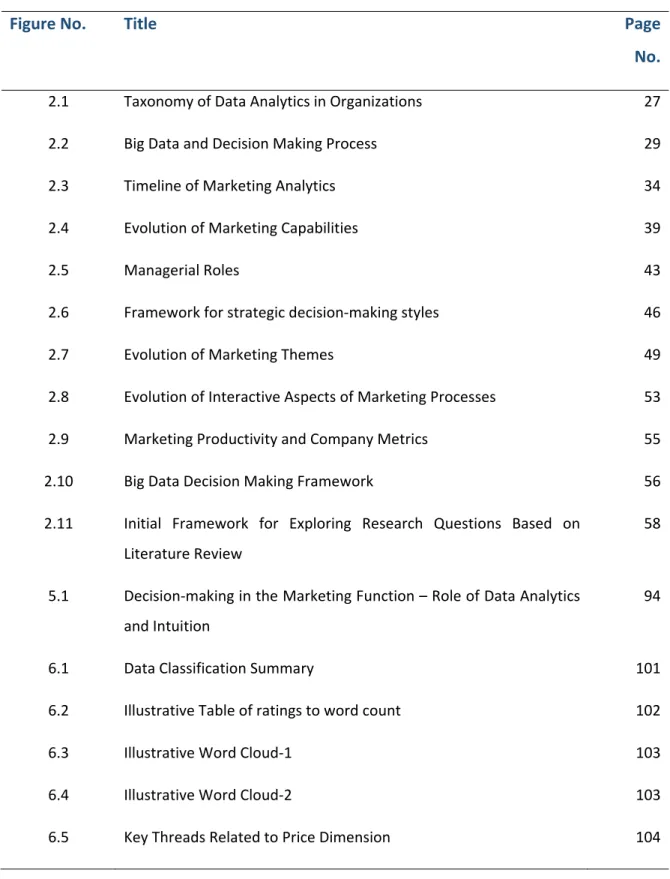
List of Tables and Figures
Figure No.
Title
Page
No.
2.1 Taxonomy of Data Analytics in Organizations 27 2.2 Big Data and Decision Making Process 29 2.3 Timeline of Marketing Analytics 34 2.4 Evolution of Marketing Capabilities 39 2.5 Managerial Roles 43 2.6 Framework for strategic decision‐making styles 46 2.7 Evolution of Marketing Themes 49 2.8 Evolution of Interactive Aspects of Marketing Processes 53 2.9 Marketing Productivity and Company Metrics 55 2.10 Big Data Decision Making Framework 562.11 Initial Framework for Exploring Research Questions Based on Literature Review 58 5.1 Decision‐making in the Marketing Function – Role of Data Analytics and Intuition 94 6.1 Data Classification Summary 101 6.2 Illustrative Table of ratings to word count 102 6.3 Illustrative Word Cloud‐1 103 6.4 Illustrative Word Cloud‐2 103 6.5 Key Threads Related to Price Dimension 104
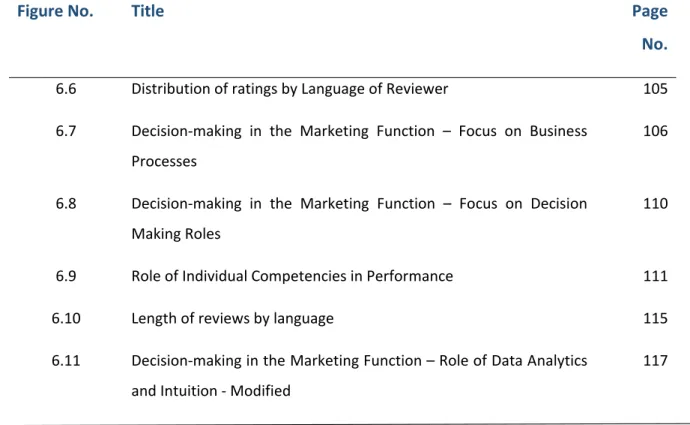
Figure No.
Title
Page
No.
6.6 Distribution of ratings by Language of Reviewer 105
6.7 Decision‐making in the Marketing Function – Focus on Business Processes
106
6.8 Decision‐making in the Marketing Function – Focus on Decision Making Roles 110 6.9 Role of Individual Competencies in Performance 111 6.10 Length of reviews by language 115 6.11 Decision‐making in the Marketing Function – Role of Data Analytics and Intuition ‐ Modified 117
Chapter 1 – Introduction
1.0.0 Introduction to the Chapter
The title of this doctoral thesis research is “Marketers, Big Data and Intuition – Implications for Strategy and Decision‐Making”. The overall objective of this study is to understand how decision‐making in the marketing profession should adapt to the evolving advancement of big data, and at the same time, how the judgment process used by a marketing professional should include aspects of big data analytics and intuition in an effective manner. The first part of this chapter is an introduction to the research. The second part is an introduction to the research stance of the author. An action researcher stands alongside the community, not as an objective outsider, but as a value‐laden participant (Berg, 2004), hence it is relevant to discuss here the values of the author especially with regard to the position of an action researcher and a practitioner.1.1.0 Introduction to the Thesis
The term “Big Data” was originally coined to represent fast growth in volume of data which made it difficult to be processed (efficiently) by traditional database methods and tools (Kaisler et al., 2013). As the power of computing grows exponentially, the definition of what constitutes Big Data also grows with time; the current definition is in the range of exabytes or 1018 units (ibid.). As Big Data makes its way into businesses and companies, decision‐makers are faced with the challenges brought by volume, velocity, variety, veracity, value and complexity of data (Gandomi and Haider, 2015; Gantz and Reinsel, 2011). This project seeks to study how practicing marketing leaders adapt to the onset of Big Data and to use this understanding to recommend best practices for the author’s department as well as other marketing theorists and practitioners to navigate these changes. During this process, issues concerning leadership styles, decision‐making processes and criteria for translating insights into action will be explored in more detail. The discipline of Marketing has undergone several mutations and adaptations in the last 80 years. The pendulum of marketing thought swings between art and science, theory and craft. In this process, Marketing has had three specific eras of adopting the mathematical sciences (1) the quantitative measurements from the mid‐1940s, (2) the statistical interpretation of market research from the 1980s(Brown, 1996) and now (3) the introduction of Big Data in the mid‐2010s. Having been a marketing executive for over two decades, the author has seen some of this evolution first‐hand, from the viewpoint of a practitioner, and this DBA thesis project extends that experience into an opportunity to look at the future through the lens of both a researcher and a practitioner. This topic has importance not only to the author and his organization, but in a broader context to all marketing leaders across industries. In a global survey of more than 750 marketing executives connected to McKinsey & Co., researchers Leeflang et al. (2014) pointed out several challenges faced by marketers working with Big Data, of which some are of specific interest to this project. Firstly, the ability to generate and leverage rich and actionable consumer insights from the data is a key issue which is complicated by high speed and volume. Secondly, creativity and breakthrough innovation can get stifled by an over‐reliance on data and hard facts. Thirdly, the inability to create undisputed attribution and the unknown factors surrounding integrity of data creates challenges in execution. Finally, on the human side, there is a significant talent gap in marketing that has the capacity to deal with the above changes (ibid). Historically, empirical studies have shown that rational processes of decision‐making alone have about a 50% rate of success in management situations (Nutt, 1999; Sinclair and Ashkanasy, 2005), that is, as reliable as tossing a coin. Intuition, used appropriately can provide a more holistic perspective on the situation (Hodgkinson et al., 2009). Intuition can be described as the preconscious recognition of either patterns or opportunities (Crossan, Lane and White, 1999) that is developed through experience, expertise and training (Khatri and Ng, 2000). This evolution can be directly related to the practical challenge faced in the author’s workplace, which has also been informally confirmed by the author’s peers who are marketing leaders in other organizations. Specifically, there is a trend for marketing teams to get more specialized and focused on mutually exclusive disciplines of expertise such as search engine optimization (SEO), search engine marketing (SEM), customer relationship management (CRM) etc. and in developing that expertise, become less accountable for or influential over the overall success factors of business such as revenue, profits, market share, customer loyalty etc. As part of the mandate of being a marketing leader in the company, the author through this thesis, aims to develop a model that will enable the marketing
organization to adapt to the new world of Big Data while proving leadership to the success of the overall business. The thesis is organized as follows. After the introduction (Chapter 1), a synthesis of extant literature has been provided (Chapter 2). As this is a multi‐disciplinary area of study, the author has sought to provide an appropriate balance and fusion of learning from diverse fields such as data analytics, marketing management, organizational development, sociology etc. The uniqueness of this review resides in this multi‐disciplinary synthesis which results in further research in general management. After the literature, a description of the research method is provided (Chapter 3), for this two‐stage study involving (1) theory‐generating expert interviews and (2) action research. Subsequent chapters lay out the expert interviews (Chapter 4) and the framework that has been created based on the extant literature review, the knowledge of experts and the researcher’s own insights (Chapter 5). After that, the journey and learning of applying this is at the workplace is described (Chapter 6). A very short explanation of how this model might be applied in an organizational setting is described (Chapter 7) followed by suggestions of areas for future research (Chapter 8) and concluding remarks (Chapter 9).
1.2.0 Introduction to the Research Stance of the Author
It is challenging that sometimes management research and practice are like two sides of a coin – facing in opposite directions and never looking at each other. What we need to become is two ends of a bridge, where traffic can freely flow between one to the other, with enriching discourses, interactions and inter‐connectivity (Starkey and Madan, 2001). Thus, the dualism of theory and practice can be very productive in research and in the workplace (Dewey, 1904). The scholar‐practitioner is defined as someone who is dedicated to generating new knowledge that is useful to practitioners (Schein, 2001). The definition is further extended by Tenkasi and Hay (2008) as someone with one foot each in the worlds ‐ that of academia and that of practice, with a focused interest in advancing the causes of theory as well as practice.Hence the scholar‐practitioner is in a unique position to leverage this duality. Experience from the world of business provides a panoramic view into the potential benefits of application of the theory. Similarly, the discipline of theorizing provides a scaffolding and structure to conduct disciplined inquiry that will help create progress in the world of practice. It all depends on how skillfully the two aspects can be made to work for each other. The university provides a context and a discipline to the process of disciplined inquiry. This is enriched by the experiences, expertise and exposure that come out of solving problems and interacting with people which is what the business executive does. The challenge then, is how to fuse the best of theory and practice into learning that will benefit future generations. Through the journey that culminates in this thesis, I have developed a research stance that seeks to meet the following goals: (1) Look for the story behind the data, (2) Turning knowledge into insights is alone not enough, the insights have to be then turned into action and (3) What I do has to help me become a better scholar and practitioner, my business a more successful business, the scholarship of management a little more enlightened, and in some small way, this world a better place for all.
1.3.0 Impetus for Choice of Topic
Bringing this back to the author’s workplace, marketing content creation is a creative discipline that leverages creativity, empathy, intuition etc. At the same time, marketing content placement (media planning) is a fast‐moving, online process where instant actions are taken based on copious data streams and often relying on programmatic machine‐based decision‐making. Such contrasts exist in other areas of the day‐to‐day functioning of every marketing leader. The purpose of this thesis is to generate insights from recognized expert practitioners that can lead to novel theory and processes that can be implemented through action research within the author’s organization first and later can be provided as a toolkit to marketing executives in the external world through the thesis publication. At this point, it would be appropriate to summarize the author’s legitimacy to work on this project andManagement, the author has worked in Fortune 500 companies and in start‐ups as a marketing executive, rising to the level of executive leadership in the last 6 years; worked in different countries, held global responsibilities and had experience in different industries ‐ both in traditional bricks‐and‐ mortar as well as in the e‐commerce space. The author has also frequently taken the time to get involved with Universities as a visiting faculty, as a mentor for their start‐up incubation programs and as a sponsor of student research programs. During this journey, the author has had the good fortune to work with or come in contact with prominent CMOs and marketing leaders as well as professors of marketing. All that the author practices today as a marketer has evolved from his lived life experiences as a marketing leader and also influenced by his interactions with these key industry leaders and through the learnings that he has absorbed from research articles that have made a contribution in this area.
1.4.0 Intended Outcomes of Research
Firstly, a broad problem has been identified, that is facing marketing practitioners across companies and industries as they adapt their decision‐making processes with the swift advent of Big Data. Research was conducted to identify the causes and solutions to the problem. This phase of research included an extensive review of multi‐disciplinary literature, followed by in‐depth expert interviews of highly reputed and senior experts holding marketing leadership positions in very internationally‐recognized companies. This phase of research concluded with the development of a novel and actionable framework for managing the problem. Then, to test the framework in a real‐life situation, the researcher focused on one specific problem faced in his workplace. The Go‐To‐Market team that manages the mobile app business in a well‐known Silicon Valley company was facing the challenge of making sub‐optimal decisions by being very restricted and functional in their use of data to take key business decisions. The action research demonstrated the efficacy of using the new framework developed by the researcher. Finally, the accumulation of learning from the literature review, the expert interviews, the original framework development and reflective insights from action research, have led to a robust contribution of actionable expertise that is generalizable to marketers in other companies and industries.Chapter 2 ‐ Literature Review
2.0.0 Introduction to Literature Review
The focus of this thesis is the effect of Big Data on decision‐making by marketing leaders, hence the approach taken here is that of understanding the breadth of cross‐functional knowledge, paying attention to the intersection of this knowledge and the discipline of marketing. The field of marketing itself is a successful integration of management science, psychology, sociology and economics. These complementary fields provide a spectrum of scientific approaches to study the issues (Chintagunta, Hanssens and Hauser, 2016). This combination can provide a better theoretical understanding as well as suggest practical approaches to solve relevant and pivotal issues in marketing, hence a cross‐disciplinary approach is taken in this literature review. The literature review also bears relevance to the workplace problem and the questions of inquiry in action research. In a consumer technology company, where the marketing team is beset by the rapid expansion of Big Data, there are stresses and strains arising as a result of over‐splintering and specialization of different branches of marketing. In the past, decisions would be made through more holistic discussion of all aspects of the marketing mix and the customer experience. However, the volume, pace and specialized nature of Big Data has created a workplace situation where the “automated” analysis of Big Data and the resulting score‐cards have started to have an over‐sized emphasis on how decisions are being taken. This is leading to sometimes ineffective decision‐making as well as a hardening of functional silos within the marketing team. The overarching research question is: RQ1: How can marketers balance Big Data and intuition to improve strategy development and decision‐ making? The following sub‐research questions provide the canvas for further investigation and translation into theory and action during this thesis project:SRQ1: How should marketers deal with the challenges of Big Data in decision making: specifically, with reference to the unique characteristics of volume, velocity, variety, veracity, value and complexity of data? SRQ2: How are marketing leaders balancing data and intuition in decision‐making situations and what improvements can be made to this process? The research question and sub‐questions originally emerged from the author’s experiences in the workplace and in the industry as a practicing senior marketing professional. While planning for an appropriate literature review, it was quite immediately apparent that the need was not for an in‐depth study of literature in one topic that would identify the limitations of academia. Instead, it was clear upon the initial reflection, that the research question requires a review of multiple fields of academic literature such as big data, decision‐making styles, marketing strategy and execution as well as some insight into the human mind’s way of making decisions using data and intuition. As has been referenced later in this chapter, the majority of early papers on big data were by academics who sought to evangelize the powers and uses of big data, and not so much on critically evaluating its usage in the workplace and its role alongside other decision‐making methods and styles. There was also a need for the literature review to span the breadth of thinking required to understand how professional can cope with and productively assimilate all the benefits that big data can offer without getting overwhelmed by some of its collateral features such as volume, velocity, variety etc. Given this context, this literature review provides a critical overview of the extant body of work relevant to the thesis topic, sequentially divided into these heads: (1) the emergence of Big Data and its influence on business and the marketing function (2) the decision‐making process in marketing and the impact of Big Data (3) a review of the relevant factors in marketing decision‐making including intuition, and (4) the evolution of the decision‐making role of the marketing manager or leader. Finally, a synthesis of gaps and key observations from this literature review is used to identify opportunities to build a novel framework as well as to improve the workplace situation. It is also realized that Big Data is a fast‐evolving field where approaches are rapidly rendered obsolete by the exponential advance of technology and processing capability. Hence, a practical decision has been
taken in this review to give representation to a few fundamental papers that anchor the origins of this topic, but then fast‐forward to publications from the last 2‐3 years. The inspiration to research this topic is borne out of an observation of evolution of the marketing function in businesses such as the author’s employer. The evolution of marketing into the world of always‐on data creates a need to quickly build talent and infrastructure in the areas of data analytics (Galbraith, 2014). The increase in speed of decision making requires that marketers re‐examine the linear, hypothesis driven “Socratic” method that has been widely prevalent in the past. Further a clash of cultures between the data specialists and the creative thinkers needs to be managed constructively in the best interests of the organization (Nadeem, 2015). Specific to the author’s workplace, it has been observed that SMEs (Subject Matter Experts) in these specific fields deal with Big Data in different ways while tending to lose the big picture of accountability for overall business success. As an organizational leader, the author seeks through this literature review and subsequent research, to create processes that help the team in making better decisions. To do justice to this action research endeavor, it is important to lay the groundwork through this literature review by examining the definition and implications of Big Data, decision making and the role of data and intuition in the service of improving decision making processes among leaders of marketing.
2.1.0 Emergence of Big Data and its influence on business and the
marketing function
2.1.1 Introduction to Big Data
This section introduces the concept of Big Data and shows how its definition has expanded following wider use of big and bigger data sets; accompanied by a discussion of the literature in this domain, that has initially been more of an evangelical nature, but recently has started to be a bit more critical. Equally, it has been observed that existing research on the topic appears to have limited explanatory power since it is largely normative and descriptive (Janssen van der Voort and Wahyudi, 2017).The field of business management is no stranger to data. The term Big Data refers to very large sets of data, typically those that require special software tools, as well as hardware processing capacity, to record, manipulate and analyze (Kaisler et al., 2013; Manyika et al., 2011). Initially the size threshold of Big Data was discussed in terabytes (1012 bytes) but was soon increased to petabytes (1015 bytes) and exobytes (1018 bytes) with advances in technology (Anderson, 2008). Despite this size indication being a moving target, there is consensus regarding the characteristics that define Big Data, such as having high volume yet being highly detailed, with high velocity or real time availability, great variety, and having “relationalability” and flexibility (Kitchin, 2014). It is recognized that this definition will continue to evolve over time and will vary by industry sector and research domain. De Mauro, Greco and Grimaldi (2016, p.128), in attempting to change the focus from size of the data set to the nature of the data set, propose a more general definition as follows: “Big Data is the information asset characterized by such a High Volume, Velocity and Variety to require specific Technology and Analytical Methods for its transformation into Value.” To overcome the move to super‐specialization and narrow span of Big Data analysis, Lietdke (2016, p.33) proposes a modified definition which reflects the reality of data input and output: “Big Data is a relatively large amount of data consisting of multiple types from multiple sources possibly arriving in real‐time of varying degrees of accuracy requiring exploratory data analysis and integrative analytical methods.” Today, Big Data is collected in fields as diverse as social media, weather, sports, economics, genomics (Frizzo‐Barker et al., 2016). It is also becoming increasingly apparent that Big Data represents a social movement (vox populi can be rapidly collected from Tweets, Facebook posts etc.) as well as a cultural shift (key consumer decisions are influenced in real time by the views of countless peers on Amazon or Yelp). The increasing fickleness of customers who are leveraging such large quantities of information, raises new challenges for businesses that need to adapt with equal speed (Grover and John, 2015). Another important aspect of Big Data is the granularity or fineness of information available regarding participants, and hence there is a camp that would describe “Big Data” instead as “Smart Data” (George Haas and Pentland, 2014). Data‐intensive explorations can follow one of two paths (1) an empirical approach, where Big Data can be used to create conclusions that are “free of theory” and (2) Big Data as
a driver that radically transforms the scientific process by creating a hybrid of abductive, inductive and deductive approaches (Kitchin, 2014).
2.1.2 Emerging Applications of Big Data
Over the past few years, the emergence of Big Data has started to change the landscape of business analytics in several ways, such as (1) providing the ability to gather data for the entire or a substantial part of the population rather than a small sample, (2) moving from significance testing to substantive measurements, (3) leveraging continuous data streams rather than point‐in‐time surveys, and very importantly (4) making it far more viable to combine data from multiple sources and forms to generate unified insights (Verhoef, Kooge and Walk, 2016). Integrated predictive modeling using multi‐source data such as segmentation, trend analysis, web analytics, social listening, and user sentiment analysis is now a practical and achievable possibility (ibid.). This has led to researchers and practitioners in diverse fields demonstrating the value of Big Data to their work, as can been seen from a few examples given below. In Public Health and Health Policy, Buckeridge et al., (2014) matched grocery store purchasing patterns from Nielsen at the household level with nutritional values published by the product manufacturers along with medical records for the residents of those zip codes, to study the effectiveness of public health education initiatives. Leveraging similar datasets of medical records, Lix et al., (2012) were able to demonstrate predictive algorithms for case ascertainment as a way of verifying manually entered disease codes. In the area of Civic Behavior, an analysis of Tweets published across 4 years were cross‐ analyzed with the Gold Standard Report, to identify specific keywords that were predictive of an insurgency event in Latin America (Korkmaz et al., 2015). This is an example of using constant data streams of social media in combination with professionally developed reports as two disparate data sets to create a unified predictive insight. In the field of Environmental Studies, Barboza, Tingley and Viens, (2014) show how heterogeneous information derived from coral reefs, tree rings, volcanic activity etc. can be combined to model the long‐term impact of climate change. In Education, a large data set of almost 3 million course evaluations over a period of 12 years were analyzed by Reese et al., (2014). By combining diverse data points in the forms of ordinal scales, free text and sentiment analysis, the authors were able to demonstrate long‐term effects of grade inflation in educational institutions. Bigselection in a materials science study proved to be more efficient than a carefully prepared design of experiment (Candès, Romberg and Tao, 2006; Franke et al., 2016). As mentioned previously, one of the major advantages of Big Data is the ability to study constant data streams rather than point‐in‐time sample sets (Zhang et al., 2016). In the area of mobile devices and networks, the power of this feature can be clearly seen. Telecom operators are able to optimize network traffic and coverage based on mobile usage data, geo‐location and event messages, and this trend will grow even more as networks around the world upgrade to 5G (Zheng et al., 2016). In the area of Retail marketing, mobile check‐out platforms for supermarket shoppers can potentially provide a much greater magnitude of data as compared to Point of Sales (POS) systems. Instead of just providing actual purchase data like POS, mobile phone check‐out platforms can also provide data regarding shopping activity at shelf, thus allowing the retailer or manufacturer to provide coupons, messages and other offers that can influence the purchase decision at the moment of truth (Aloysius, Hoehle and Venkatesh, 2016). This is of special interest to marketers because the customer journey is getting more and more fragmented and runs across multiple channels (Lemon, 2016). For example, a customer may (1) get an idea to buy something based on a friend’s Facebook post, (2) then search for category information on Google, (3) check out reviews on Yelp, (4) do comparison price shopping on several websites and (5) weigh whether to make the final purchase on an e‐tail site like Amazon or in a brick‐and‐mortars retail store like Wal‐Mart, and (6) at the final moment of purchase, decide to download and use a discount coupon from Retailmenot. Lemon (2016) introduces the concept of “real time relevant” marketing, where, based on instantaneous data, the company is able to initiate a conversation with the customer at the moment of truth. While Big Data brings various new opportunities for decision‐making in areas such as Marketing, it is important to recognize the complicated inter‐relationships and challenges, such as creating a platform for real time analytics to be conducted, distributed and reviewed (Ducange, Pecori and Mezzina, 2017). As mentioned earlier, several issues have to be considered including high volume data storage, analytics that provide real‐time dashboards, a mid‐flow process to verify the correctness of the data and the accuracy of the insights, maintenance of data privacy and protection (Liu, 2012). Content analysts
perform an important role in bridging machine learning with descriptive data, analyzing social media content for sentiment, emotion, and passion. This has to be supported by quantitative analysis of trend reports and volume and prominence of social conversations (Wang and Luo, 2013; Zeng et al., 2010; Chi et al, 2015). A comprehensive survey of 52 published studies by Ducange, Pecori and Mezzina, (2017) revealed that Big Data in social marketing has resulted in applications in four major areas. The first area is in integration of traditional market surveys with social media data streams to map trends leading to innovation pipeline, competitive strategies etc. The key challenges here relate to adaptability of new and old forms and flows of data, and issues surrounding integrated analytics versus distributed self‐ service models. The second area deals with branding, communication, advertising and promotional campaigns. In this area, emotional spikes, brain wave analysis and similar techniques can complement traditional in‐depth interviews and ethnographic studies that aim to dig deep into the attitudes and beliefs of the consumer. The third area of use is in quality and reputation monitoring, brand loyalty and net promoter scores. Here primary research methods can be supplemented by social listening, scraping online reviews etc. to provide a more timely and rich picture. The fourth area deals with CRM or customer relationship management. More frequent, less invasive and more in‐depth probing of reasons for churn, levels of engagement etc. would fall in this category. As mentioned, social media monitoring requires constant listening to online conversations and viewing user‐generated content. An organizational challenge here is how to ensure that distributed, time‐ sensitive decision‐making can be combined with more deliberative and centralized analysis. As Bowen and Bowen (2016) point out, the veracity of new single‐source information can benefit from a more reflective triangulation using other data sources or proof points, in “slow thinking”. This is easier done than in the “fast thinking” usually associated with Big Data. Similarly, such a deliberative approach also needs collaborative and collective digesting of information and decision‐making, and this goes against the image of real‐time trading by a single expert who is at the data console. This is an issue that will be further explored in the work‐place context.
2.1.3 Characteristics of Big Data
The three Vs of Volume, Velocity and Variety are used to characterize Big Data. Volume indicates the large and growing amount of data that is collected. Velocity refers to the speed of generation of the data which continues to increase with advances in sensors, communication, and the prevailing developments in the internet of things (IoT), where everyday objects such as automobiles, baby‐ monitors, smartwatches, traffic cameras, all emit always‐on and networked streams of data. Variety refers to the diversity and breadth of data that is available at a high degree of granularity. This aspect of variety continues to create challenges for the manipulation and analysis of data in different forms and formats (Phillips‐Wren et al. 2015). Proponents of the Variety aspect of Big Data push researchers to go beyond the dyadic relationship of supplier‐user and study a larger and more complex ecosystem of interconnections (Baron and Russell‐Bennett, 2016), such as bottom of the pyramid studies, transformative service paradigms and study of multi‐tiered ecosystems at micro‐level, meso‐level and macro‐level. This ability to study the effects on the ecosystem of multiple players seeking to create or destroy value makes Big Data relevant to the evolution of business (ibid.). Beyond these three Vs, researchers showing an appetite for alliteration, have proposed other characteristics such as Value, Visualization, Volatility and Veracity (DeMauro, Greco and Grimaldi, 2016). Kypri (2015) uses the term Veracity to connote the accuracy of the information, the reliability of the source of the information, and the relevance of the context in which the data was generated. This over‐ riding need for quality data can sometimes be overlooked when the speed and quantity of data becomes overwhelming. The recent controversy regarding “fake news” on social media channels is a sobering example of the damaging effects of a lack of veracity. Further, the evolution of Big Data also provides an opportunity for firms to leverage their information to create transformational innovation. Big Data‐Driven Innovation can provide a competitive advantage to the firm that chooses to invest in the technology, infrastructure and the talent to gather, analyze and exploit Big Data (Kopanakis, Vassakis and Mastorakis, 2016). With the emergence of technologies such as Hadoop and open‐source applications, advances in cloud computing and visualization, new skill sets, training and mindset are becoming equally important (Davenport and Patil, 2012).As an emergent and advancing field, it is understandable that much of the early writings about Big Data are aimed at “evangelizing” and characterizing, rather than critically examining the applicability and challenges of this discipline. It is understandable that business practitioners tend to greet such emergent disciplines with a touch of skepticism, but an understanding of this thought process can also help the academic side to build a stronger argument for the insightful and considered use of Big Data. To illustrate this, it is helpful to consider the history of a previous development, that of Customer Relationship Management (CRM) about 15 years ago. Consultants and thought leaders stirred up a lot of excitement in the executive chambers of business, touting the value of customer information and urging large investments of time and money in IT infrastructure to handle and process a massive influx of customer data. After the initial period of euphoria, business leaders came to several sobering conclusions. Firstly, large corporate IT systems created data silos that did not easily interconnect with other elements of the network, reducing the ability for frontline employees to make crucial decisions without waiting for corporate information. Secondly, the investments in IT infrastructure were made without a corresponding investment in training of the data users or in change management in the operating divisions of the companies. This led to a period of reflection and introspection before companies managed to right‐size their efforts and make a more holistic and balanced effort at eventually embracing the paradigm of CRM. This example is well described by Barton and Court (2012) and provides a great segue into a critical examination of the benefits and cautions of embracing the wave of Big Data.
2.1.4 Issues Surrounding Big Data and Decision Making
Starting with the premise that the rational human being has always utilized data and observations to make sense of the surroundings, Cukier and Mayer‐Schoenberger (2013) argue that Big Data should allow for more and better utilization of data to make even better sense of the world. The proponents of this argument say that the scarcity and expensive nature of traditional data placed restrictions that will be removed with the advent of Big Data in conjunction with the progress of computing technology. Thus, a business decision can be made based on the understanding of a million individual data points rather than of a small statistical sample.
A more controversial extrapolation of this line of thinking creates a proposal to question the necessity of building theory based on causality and instead focus only on correlations that emerge from the Big Data (Anderson, 2008). The argument is that cheaper, faster data can produce better decisions in most situations that do not need the precision and accuracy of statistical analysis (ibid.). Thus, in the “petabyte” age, sampling and modeling techniques of traditional statistics might be replaced by the brute force of advanced computers and machine learning. Instead of wondering why people behave in a certain way, adherents of Big Data would say that it is not important why they do it, but if they do it based on Big Data, then it is so. In assuming such a world view, correlations can be said to be as useful as causation, and actual behavior can be studied and forecasted without worrying about the models behind them. “All models are wrong, and increasingly you can succeed without them” is the stance of a senior officer from Google (Anderson, 2008, n.p.). It is posited that the sheer largeness and richness of the amount of data, allow for the data to speak for itself without the need for theory (ibid.). Oversimplified, the implication is that practitioners should focus on the ends and ignore the means (Cukier and Mayer‐Schoenberger, 2013). While provocative, this is also a somewhat dangerous line of reasoning and the flip side of this will be examined later in this review. A further argument is that the sheer quantity of data can balance out the need for exactness or precision in data gathering and data cleaning. (ibid.). On the other hand, several arguments have been made for exercising caution. Firstly, a massive data set by itself does not obviate the need for sampling protocols. The profile of the respondents in the data set have to be matched with the profile of respondents in the target market. For example, while Twitter feeds can provide a copious amount of data, the specific word limits and usage restrictions placed by Twitter lead to certain online behaviors that may not be replicable across other engagement channels (Japkowicz and Stefanowski, 2016). A second argument is that in‐depth observations obtained from a smaller number of qualitative research studies or ethnographic studies may provide far more robust and actionable insights than a large swathe of shallow or constrained data. Similarly, the speed and size of Big Data cannot replace the need for critical questioning of the data (ibid.) or as it is often said “What is the story behind the story?”
which speaks to the need for clarity regarding the causality. Both causality and correlation have their own place in theory and practice and this offers a possible area of further investigation in the subsequent stages of the thesis process. The choice of action based on correlation alone has to be tempered by (1) the confidence that such a coincidence will be repeatable in future and (2) by understanding the risks and rewards of acting on it. Spurious correlations with Big Data (including the oft‐repeated story of “Google Flu” and the “epic fail” of pollsters during the 2016 US Presidential Elections) are now at risk of being over‐belabored (Fan and Bifet, 2013, Lazer et al., 2014, Gandomi and Haider, 2015, Silver, 2016), so it will just be mentioned here that spurious correlations could be white noise instead of real insights and this places a greater responsibility on management to train users and analysts on how to avoid these. The intention of this thesis is not to deride the legitimacy of Big Data, but to provide a balanced view that can lead to more successful adoption. In summary, then, based on a review of Cukier and Mayer‐ Schoenberger, (2013), Anderson (2008), LaValle et al. (2011) and Dhar (2013), several challenges are apparent. Firstly, moving from “some” data to “all” data (or a lot of data) requires new thinking in terms of statistical analysis, sampling and decision‐making processes as also the role of hypothesis development and the trigger point for model creation. Decision‐makers have to develop comfort in moving from clean, curated, compact and slow data to messy, unwieldy and fast data, which places a strain on data presentation protocols and responsibilities. The push from causation to correlation also creates challenges regarding the mental models of decision making and the responsibility of the leader to find the right balance. A further challenge to evolution from Traditional Data Analytics (TMA) to Big Data analytics (BDA) is presented in Figure: 2.1 (Xu, Frankwick and Ramirez, 2016):
Figure: 2.1 Taxonomy of Data Analytics in Organizations, by Xu, Franckwick and Ramirez (2016, p.3) A firm with high BDA and High TMA is able to manage higher complexity through customized knowledge and such entities are designated as Pioneers. A firm with high BDA and low TMA is designated as an Explorer with more automated data streams that influence decision making. A firm with low BDA and high TMA is designated as Perfectionist with a greater reliance on propositional knowledge. Finally, a firm with low BDA and low TMA is labeled a Bystander. Based on this taxonomy, the authors (ibid.) argue that all companies can benefit from a fusion of both TMA and BDA. This has to be tempered with the cost of acquisition and analysis of each type of data and the likely benefit to the firm. Turning the focus to implementation, Biesdorf, Court and Wilmot (2013) make the case for a comprehensive plan that recognizes several realities of corporate decision‐making. Information within a company is collected and stored in a distributed manner, and the flow of the information often conforms to the vertical organizational governance structure or the horizontal operating teams. These data systems have often evolved differently and independently from one another, thus creating challenges for legacy systems to talk to each other. In addition, some of the important data may sit outside the firm, at the hands of vendors, customers etc. Key success factors for success of implementation are (1) having a clear need, (2) getting executive sponsorship, (3) obtaining early alignment of the IT strategy with the business plan and goals, (4) fostering a data‐driven culture, (5)
investing in a robust infrastructure, (6) employing appropriate analytic tools, combined with (7) teams having relevant analytical skills. (Riggins and Fosso Womba, 2015). In the implementation process, data management consists of a data life‐cycle for collection, cleaning, modelling, analyzing, storing, disseminating, retrieving, discovering and interpreting (Khan et al., 2014; Kopanakis, Vassakis and Mastorakis, 2016). Each of these stages can face challenges in dealing with the volume, velocity and variety of Big Data. The effective implementation of this process in an organization requires the orchestration of several roles as described by Loshin (2013) ‐ (1) The Business Evangelist understands the gaps in existing infrastructure, and through knowledge of emerging technologies, is able to persuasively communicate the value of creating a technological and infrastructural plan to meet the emerging needs of the organization. This person may also be responsible for piloting and scaling the solution. (2) The Technical Evangelist has a deeper understanding of the underlying science and technology behind the new methods and can champion an improvement of efficiencies with the existing system or enable acquisition of new systems. (3) The Business Analyst role engages with the owners of the business process to understand expectations and requirements and guide the development of a business case for new infrastructure. (4) The Application Architect is able to leverage their expertise in performance computing to optimize the design and performance of the system such that the vendor’s frameworks work within the company’s operating environment. (5) The Application Developer identifies and implements the appropriate skill set for testing applications and (6) The Program Manager plans, coordinates and oversees the implementation deadlines, budget utilization, documentation, cross‐ functional hand‐offs and migration from test phase to production. Going beyond the technical team, additional roles include (1) The marketing and management functions, responsible for identification and prioritization of business opportunities for Big‐Data‐driven decisions; (2) Data science as well as Data management that ensures the fidelity, timeliness and applicability of the data and (3) Legal and Regulatory Compliance experts to handle the serious issues surrounding security, privacy, and compliance (Wedel and Kannan, 2016). The process relationships are illustrated in Figure: 2.2 (Wang et al., 2016):
Figure: 2.2 Big Data and Decision‐Making Process, by Wang et al., (2016, p. 749) A better understanding of the complex cast of characters and the deployment process can help the end user or business owner get more fully rooted in ensuring that sustainable value is extracted from the system.
2.1.5 Application of Big Data in Research ‐ Identifying Synergy between
Modern and Traditional Approaches
While a broad and deep analysis of qualitative versus big‐data inspired quantitative techniques is beyond the scope and focus of this thesis, it is nevertheless illuminating to briefly compare and contrast an emerging method like Machine Learning with an established method like Grounded Theory. Machine Learning is defined as the process of optimization of a selected performance‐based variable using multiple datasets and computational programming (Alpaydin, 2014). The goal‐seeking nature of machine learning lies in the ability to automatically detect patterns in complex data sets, use the patterns to predict future outcomes, and continuously iterate the pattern‐detection algorithm as fresh data keeps getting added (Murphy, 2012). Grounded Theory also includes processes such as collecting and analyzing data iteratively and moving from data coding to conceptualizing theory through a deliberate process (Stumpf, Sandstrom and Sanger, 2016).There are several interesting areas of convergence between Machine Learning and Grounded Theory (Timmermans and Tavory, 2012) that can be observed. Firstly, both methods start with data, iterate with data and return to the data at the end. Secondly, both methods create a rough model and continue to repeat with additional data until the model is sufficiently robust. However, Machine Learning can be supervised or unsupervised depending on whether the iterative analysis and model building is designed to occur with human intervention or not. In the unsupervised approach, the human researcher must examine the initial data‐driven groupings and make critical decisions on which variables are important for the final outcome. The machine then takes this initial guidance and iterates unsupervised to converge on an optimized model (Dy and Brodley, 2004). In the case of the supervised approach, predictive methods such as regression or decision trees are used to iterate to achieve a standard benchmark by the involvement of the researcher. While the human iteration spans across the steps of Grounded Theory and operates in a circular fashion, in Machine Learning, there is an action/reaction sequence of interaction between the human and the computer that creates a more linear, sequential approach (Muller et al., 2016). It is worth examining how Big Data has led to smart decisions in theory and in practice. When creating theory based on Big Data, the process of Knowledge Discovery from Data (KDD) has similarities and differences in comparing with a method such as Grounded Theory (GTM) when examining the data or the theoretical construct (Charmaz, 2014; Cho and Lee, 2014; Smith, 2015). Historically, GTM uses data as the foundation upon which to build theory while recently KDD is increasingly regarded as something to be “mined and explored” in search of a theory or insight (Bryant and Raja, 2014). GTM can involve an iterative sequence of gathering data and analyzing the data such that each step informs and sharpens the other (ibid.). After the initial broad data collection, researchers in GTM can become successively more targeted and this targeting is borne out of the increasing knowledge and insights that the researcher has managed to acquire through this iterative process. While KDD undergoes a similar process of targeting a dataset based on the problem definition, a level of control has to be exercised on the breadth and quantity of keywords targeted for analysis. While the
aspect of data in KDD unlike the iterative learning aspect in GTM. In addition to deduction, the process in KDD may also involve induction or abduction. While deduction and induction are well known, abduction is defined by Charmaz (2014) as a method of reasoning where the data is first scrutinized and then all possible hypotheses are entertained, and methodically confirmed or disconfirmed until the most plausible explanation is found. Especially with the mining of Big Data, it is critical to avoid premature theories formed through induction or suffer from the stress of too much data and too many options in the case of abduction (Dalcher, 2015).
2.1.6 Application of Big Data in Practice – Some Considerations
The opportunity for business leaders to embrace Big Data is significant. “While most managers probably realize that powerful messages lie within the mess of Big Data, many don’t know that these messages can be extracted relatively easily using the right techniques” (Bendle and Wang, 2016, p.123). As is well known, social media is one of the first places where marketers have started to see the benefits of Big Data. Social media and cloud computing can help marketing researchers access a vast number of opinions in real time, and the findings can be used to quickly create and deploy marketing tactics . The tactics that have been pioneered by e‐business giants such as eBay and Amazon have shown the success of such an approach in scaling up large e‐tailer platforms to provide micro‐targeting for advertising, merchandising, pricing and marketing campaigns (Bello‐Orgaz, Jung and Camacho, 2016). As these e‐ tailers come to understand their “connected customers”, Big Data enabled fulfilment systems can provide an equalizing platform by which any company can provide the same level of customized and personalized customer service as a recognized leader in the field, such as Zappos (Taylor, 2014). As an extension of this, marketers can also transform the process of marketing at “moments of truth” at a much more universal, yet at the same time micro‐customized basis to almost signal the advent of “personalized media” (O’Neal, 2016). In addition, it provides (1) open and relatively unlimited access to social attitudes and behaviors that have not been documented in the past and (2) freedom from having to draw representative samples when it is easier to just read the entire stream of data (McFarland, Lewis and Goldberg, 2016).On the flip side, automation and algorithms that seek to organize and present Big Data to the user can create information “ghettos” as has been recently observed in the case of Facebook and other platforms serving up news that they assume each reader wants to see (Klous and Wielaard, 2016). While “datafication” has transformed the quantification of online data for tracking, the recent focus has been on ways to use data to predict future behavior (Cukier and Mayer‐Schoenberger, 2013). Thus, a line of thought goes as follows – rather than focus on the past behavior of consumers, marketers should look for ways to predict (and influence) their future behavior. This has been called “life mining” defined as a process of mining predictive insights from the “digital trails” left behind by past behavior (van Dijck, 2014). Such a “life mining” opportunity using Big Data is provided by the increasingly comprehensive capture of online activity across various channels. There is also an element of social exchange involved in this process. While using fee‐free social media platforms such as Facebook, Yelp, Twitter etc., users freely share certain aspects of their personal information and behavioral habits in exchange for receiving tailored services from companies that aggregate, measure and monetize this data stream. On the other hand, there is also a rising trend to preserve net anonymity and some users are investing in applications to protect their online privacy (ibid.). While mining this vast trove of data, companies and researchers are faced with questions about privacy, bias, historical relevance, and ethical issues of sharing, saving and manipulating data. Similarly, in the “barter” of data for services, people may be more willing to share data for research or certain social causes but not for purposes of marketing or business. This is an area where social sciences can work hand in hand with marketing and data science to create a more holistic world view of Big Data and the people behind the data (Franke et al., 2016).