ISSN 2042-2695
CEP Discussion Paper No 1129
February 2012
Agglomeration, Trade and Selection
Gianmarco I. P. Ottaviano
Abstract
This paper studies how firm heterogeneity in terms of productivity affects the balance
between agglomeration and dispersion forces in the presence of pecuniary externalities
through a selection model of monopolistic competition with variable mark-ups. It shows that
firm heterogeneity matters. However, whether it shifts the balance from agglomeration to
dispersion or the other way round depends on its specific features along the two defining
dimensions of diversity: ‘richness’ and ‘evenness’. Accordingly, the role of firm
heterogeneity in selection models of agglomeration cannot be fully understood without
paying due attention to various moments of the underlying firm productivity distribution.
Keywords: agglomeration, trade, heterogeneity, selection, economic geography
JEL ClassificationS: F12, R11, R12
This paper was produced as part of the Centre’s Globalisation Programme. The Centre for
Economic Performance is financed by the Economic and Social Research Council.
Acknowledgements
The author would like to thank Kristian Behrens, Giordano Mion and Diego Puga for helpful
interactions on the topic of this paper.
Gianmarco Ottaviano is an Associate of the Globalisation Programme, Centre for
Economic Performance and Professor of Economics, London School of Economics. He is
also Professor of Economics at Bocconi University.
Published by
Centre for Economic Performance
London School of Economics and Political Science
Houghton Street
London WC2A 2AE
All rights reserved. No part of this publication may be reproduced, stored in a retrieval
system or transmitted in any form or by any means without the prior permission in writing of
the publisher nor be issued to the public or circulated in any form other than that in which it
is published.
Requests for permission to reproduce any article or part of the Working Paper should be sent
to the editor at the above address.
1
Introduction
This paper studies how …rm heterogeneity in terms of productivity a¤ects the balance between agglomeration and dispersion forces in the presence of pecu-niary externalities through a selection model of monopolistic competition with variable mark-ups. This is achieved by introducing …rm heterogeneity à la
Melitz and Ottaviano (2008) in a core-periphery framework à la Ottaviano, Tabuchi and Thisse (2002). In so doing, the paper builds on Ottaviano (2011) but with major departures. The model in Ottaviano (2011) is a dynamic model of capital accumulation with forward-looking agents in closed economy. Dif-ferently, this paper proposes a dynamic model of migration with short-sighted agents in open economy. As in Ottaviano, Tabuchi and Thisse (2002), the econ-omy is ‘open’in terms of both goods trade and factor mobility while ‘short sight’ (due to heavy time discounting) is assumed in order to remove the possibility of self-full…lling equilibria. These would add an extra layer of complexity beyond the scope of the present paper.
In the proposed model there are two locations that are identical in terms of their exogenous attributes. There are two factors of production: high-skill labor and low-skill labor. The former is freely mobile whereas the second is spatially immobile and evenly distributed between locations. There are two sectors: a perfectly competitive sector employing only low-skill labor to produce a homoge-nous good under constant returns to scale; and a monopolistically competitive sector employing both high-skill and low-skill labor to produce varieties of a horizontally di¤erentiated good. In this sector high-skill labor is hired to de-sign blueprints for the production of varieties and low-skill labor to produce the varieties according to those blueprints. In each period, high-skill workers …rst decide in which location to reside, then the monopolistically competitive …rms decide whether and where to enter the market by hiring them. Subsequently high-skill workers engage in research and development with uncertain outcome in terms of the productivities of their blueprints. Once these productivities are revealed, …rms decide whether to use the corresponding blueprints for produc-tion or just leave the market without producing. At the end of period, blueprints fully depreciate becoming useless. This admittedly stark assumption is made to abstract from sorting and focus on selection.
In this framework, the e¤ects of heterogeneity on the balance between ag-glomeration and dispersion forces depend on which dimension of heterogeneity is a¤ected and how it is a¤ected. In particular, de…ning heterogeneity as ‘di-versity’, heterogeneity is considered along two dimensions: ‘richness’measures the ‘number’of alternative productivity levels that can be drawn; ‘evenness’is de…ned as the similarity between the probabilities with which those alternative productivity levels are drawn (Maignan, Ottaviano, Pinelli and Rullani, 2003). It is shown that, when productivity draws follow a Pareto distribution, the ef-fects of more heterogeneity di¤er depending on whether more heterogeneity is achieved through more richness or more evenness. There are two orders of rea-sons for this. First, under the Pareto distribution assumption, more richness comes with a higher chance of low productivity draws whereas more evenness
comes with a higher chance of high productivity draws. Second, under the Pareto distribution assumption, the elasticity of the success rate of entry is a¤ected by evenness but not by richness.
In terms of …ndings, the proposed model exhibits all the key feature of the model by Ottaviano, Tabuchi and Thisse (2002) and of similar models in the ‘new economic geography’ tradition. In particular, trade barriers regulate the balance between agglomeration forces (market-size and cost-of-living e¤ects) and dispersion forces (competition e¤ect): starting with high enough trade barriers, trade liberalization shifts the spatial equilibrium from dispersion to agglomera-tion. The proposed model, however, introduces …rm selection as an additional dispersion force.
A …rst implication of this additional force is that, di¤erently from Otta-viano, Tabuchi and Thisse (2002), the emergence of agglomerated equilibria is not chatastrophic with the spatial economy suddenly moving from dispersion to full agglomeration when trade barriers fall below a certain threshold. It is, instead, smooth: as trade barriers gradually fall, at some point the dispersed al-location loses stability to two stable equilibria with partial agglomeration evenly spaced around it. These are initially in a neighborhood of the dispersed alloca-tion. Then, as trade barriers keep on falling, they gradually move away from dispersion until the economy hits full agglomeration. Hence, thanks to selection among heterogeneous …rms, the model is able to generate the realistic feature of partial agglomeration as a stable equilibrium outcome provided that trade barriers are neither too high nor too low. In this equilibrium, the larger location exhibits more entrants, more sellers and thus more product variety, lower aver-age cost, lower averaver-age price, lower averaver-age markup. As all these features imply higher consumer surplus, the engineers’indi¤erence condition that sustains the equilibrium holds due lower expected pro…ts driven by a lower success rate of entry that more than o¤sets a higher average pro…t from successful entry.
A second implication concerns the impact of heterogeneity on the balance between agglomeration and dispersion forces for given trade barriers. More (cost-increasing) richness shifts the balance in favor of agglomeration forces. This happens because selection in the larger location gets weaker as worse pro-ductivity draws become possible. The impact of more (cost-decreasing) evenness is more complex. When the initial distribution of productivity draws is already rather even, more evenness shifts the balance in favor of agglomeration forces. Vice versa, when the initial distribution of productivity draws is rather uneven, more evenness shifts the balance in favor of dispersion forces. The reason for this is that, when the initial evenness is low, more evenness has a weak positive impact on the average pro…t di¤erential and a strong negative e¤ect on the entry success rate di¤erential between locations, thus fostering dispersion. Vice versa, when the initial evenness is already high, more evenness has a strong positive e¤ect on the average pro…t di¤erential and a weak negative e¤ect on the entry success rate di¤erential, thus fostering agglomeration. This is due to the fact that evenness a¤ects the elasticity of the success rate of entry to the toughness of competition. Di¤erently, more richness does not a¤ect that elasticity.
between agglomeration and dispersion forces. However, whether it shifts the balance from agglomeration to dispersion or the other way round depends on its speci…c features along both the richness and the evenness dimensions.
There are a few related models in the spatial economics literature. These di¤er among themselves in terms of whether agents’heterogeneity is assumed to be revealed before or after their location decisions. Sorting models study how
ex ante heterogenous agents self-select into locations of di¤erent sizes (Nocke, 2006; Baldwin and Okubo, 2006; Davis, 2010; Okubo, Picard and Thisse, 2010; Okubo and Picard, 2011).1 The present paper di¤ers from these models in that
it studies selection, where heterogeneity materializesex post after agents have already committed to their locations and where agents self-select in whatever economic activities are available in those locations. In this respect, the most closely related models are the ones put forth by Behrens and Robert-Nicoud (2009) and Behrens, Duranton and Robert-Nicoud (2010). The former is a se-lection model that also builds on Melitz and Ottaviano (2008) where ex ante
identical individuals decide whether or not to move from a common rural hin-terland to cities. Their heterogeneity is revealed after this decision has been made and the decision itself is assumed to be irreversible so as to rule out sort-ing. They show that larger market size increases productivity not only through a …ner division of labour driven by pecuniary externalities (richer availability of intermediates) but also through a selection process, whereas higher produc-tivity increases market size by providing incentives for rural-urban migration. Behrens, Duranton and Robert-Nicoud (2010) analyze both sorting and selection in a model in which agglomeration is driven by technological externalities. They distinguish betweenex ante heterogenity (‘talent’), known to agents before they decide where to locate, andex post heterogeneity (‘luck’), revealed to agents af-ter their location decisions have been made. Agents choose locations based on their talent and occupations in the chosen locations based on luck too. More talented agents stand a better chance of …nding more productive occupations in larger locations and this complementarity between talent and market size leads to the sorting of more talented agents into larger markets. Then, tougher se-lection in more talented locations implies more productive occupations. Higher productivity, in turn, complements the agglomeration bene…ts of larger loca-tions so that more talented markets are larger in equilibrium. Unlike Behrens, Duranton and Robert-Nicoud (2010) but just like Behrens and Robert-Nicoud (2009), the model in the present paper dispenses with ex ante heterogeneity to focus on selection. However, di¤erently from Behrens and Robert-Nicoud (2009), it allows for reversible location decisions between sites whose urban vs. rural status is endogenously determined as an outcome of those decisions. In the terminology of Behrens, Duranton and Robert-Nicoud (2010), agents with no ex ante ‘talent’ are free to move across markets knowing that their ‘luck’ may change every day no matter whether they relocate or not.2 Moreover,
1While this and other papers focus on …rm heterogeneity on the supply side in terms of productivity, the distinctive feature of Okubo and Picard (2011) is their study of heterogeneity on the demand side in terms of tastes.
di¤erently from Behrens, Duranton and Robert-Nicoud (2010), in the model of the present paper the emergence of agglomeration is driven by pecuniary rather than technological externalities. Finally, while in Behrens, Duranton and Robert-Nicoud (2010) constant markups imply that, after conditioning out sorting and agglomeration, selection becomes independent of market size, in the present paper tougher selection is associated with larger market size as in Behrens and Robert-Nicoud (2009).3
The rest of the paper is organized in three sections. Section 2 develops the model in an isolated economy to investigate how heterogeneity a¤ects the relation between market size and selection. Section 3 extends the model to a two-location spatial economy with high-skill labor mobility to examine how heterogeneity a¤ects the balance between agglomeration and dispersion forces. Section 4 concludes.
2
The Isolated Economy
There areLidentical ‘workers’, each supplying a unit of low-skill labor inelasti-cally. Accordingly,Lis both the number of workers and the economy endowment of low-skill labor. There are alsoM identical ‘engineers’, each supplying a unit of high-skill labor inelastically. Accordingly,M is both the number of engineers and the economy endowment of high-skill labor.
2.1
Preferences
Workers and engineers all share the same individual preferences captured by the following quasi-linear quadratic utility function de…ned over a homogenous good and a continuum of varieties of a horizontally di¤erentiated good
Uc =q0c+ N Z 0 qc(!)d! 2 N Z 0 (qc(!))2d! 2 0 @ N Z 0 qc(!)d! 1 A 2 (1)
of spatial frictions within a multi-location framework that allows for the joint determination of locations’ sizes, productivities, markups, wages, consumption diversity, and the number and size distribution of …rms. Their demand system is, however, di¤erent from the one in the present paper. Also di¤erent is the fact that their model always features a unique spatial equilibrium. It is, therefore, silent on the e¤ects of …rm heterogeneity on the balance between agglomeration and dispersion forces, which is the focus of the present analysis.
3Combes, Duranton, Gobillon, Puga and Roux (2011) also extend the model of Melitz and Ottaviano (2008) to allow for agglomeration economies driven by technological externalities. Their aim is to derive a parsimonious framework to test the relative importance of selection and agglomeration in determining the spatial distribution of …rm productivities. Following Melitz and Ottaviano (2008), they do not allow for labor mobility across locations. Nonetheless, in a separate on-line appendix (http://diegopuga.org/papers/selectagg_webapp.pdf ), they show how their model can be further extended to introduce worker mobility, consumption amenities, and urban crowding costs, without at the same time a¤ecting its key equilibrium equations on which their empirical analysis is based. In so doing, they restrict their attention to a situation in which there exists a unique stable spatial equilibrium with (asymmetric) dispersion. Whether heterogeneity fosters agglomeration or dispersion is, thus, beyond the scope of their paper.
withq0c,N andqc(!)respectively denoting the individual consumption level of the homogenous good, the measure (‘number’) of available varieties of the dif-ferentiated good and the individual consumption level of variety!. Parameters are all positive with measuring product di¤erentiation.
2.2
Technology
There are two sectors, one supplying the homogenous good and the other supply-ing the varieties of the di¤erentiated good. The homogenous good is produced under perfect competition employing low-skill labor as the only input. Speci…-cally, production of a unit of homogenous output requires a worker. Marginal cost pricing then implies that the price of the homogenous good equals the low-skill wage. By choosing this good as numeraire, also the low-low-skill wage is set to unity.
The di¤erentiated varieties are supplied by monopolistically competitive …rms employing both low- and high-skill labor. In particular, a …rm enters the market by hiringfE engineers to design the blueprint of a di¤erentiated variety
and the corresponding production process, whose implementation then requires hiring a number of workers proportionate to the desired scale of production.
Developing the blueprint of a variety and its production process is an activity with uncertain outcome in terms of productive e¢ ciency. Speci…cally, while en-gineers are always certain to design new varieties, the unit worker requirements of the corresponding production processes are determined by random draws from some distribution. The timing of events is as follows. Firms decide whether to enter or not. If they decide to enter, they have to competitively bid for the given stock ofM engineers. Once these have been allocated to theNE=M=fE
winning bidders, each of these entrants is assigned its unit worker requirement
cas a random draw from a common continuous di¤erentiable distribution with c.d.f. G(c)over the support[0; cM]. Based on their draws, entrants then decide
whether to produce or not. Letting denote the (endogenous) share of entrants that decide to produce (‘success rate of entry’), the mass (‘number’) of produc-ers equalsN = NE as the number of producers equals the number of varieties
available for consumption. Following Melitz and Ottaviano (2008), Behrens and Robert-Nicoud (2009) and Behrens, Duranton and Robert-Nicoud (2010), the marginal product of workers'is assumed to follow a Pareto distribution with shaper parameterk 1and support[1=cM;1]. This implies that the c.d.f. of
the unit worker requirementc= 1='is
G(c) = c
cM k
; c2[0; cM] (2)
The two parameters in (2) regulate the ‘heterogeneity’, or ’diversity’, of cost draws. This has two dimensions (Maignan, Ottaviano, Pinelli and Rullani, 2003). First,cMquanti…es ‘richness’ de…ned as the measure (‘number’) of
dif-ferent unit labor requirments that can be drawn. Larger cM leads to a rise in
possible to draw also larger unit worker requirements than the original ones. Second,kis an inverse measure of ‘evenness’de…ned as the similarity between the probabilities of those di¤erent draws to happen. When k = 1, the unit labor requirement distribution is uniform on [0; cM] with maximum evenness.
Askincreases, the unit worker requirement distribution becomes more concen-trated at higher unit worker requirements close to cM: evenness falls. As k
goes to in…nity, the distribution becomes degenerate at cM: all draws deliver
a unit worker requirementcM with probability one. Hence, smallerk leads to
a rise in heterogeneity along the evenness dimension, and this is achieved by making low unit worker requirements more likely without changing the unit worker requirements that are possible. Accordingly, more richness (largercM)
comes with higher average unit worker requirement (‘cost-increasing richness’), more evenness (smaller k) comes with lower average unit worker requirement (‘cost-decreasing evenness’).
To …nance their entry, …rms borrow from workers. These are assumed to hold identical balanced portfolios across all entrants, so they do not face any risk. Due to free entry, in equilibrium …rms have to be indi¤erent between entering or not. This implies that, through competitive bidding, the engineers’ remunerations absorb all expected pro…ts from entry. The law of large numbers then ensures that these ex ante expected pro…ts exactly match the ex post
average pro…ts of producers (themselves equal to the ex ante expected pro…t conditional on producing) times the share of entrants that decide to produce (itself equal to the ex ante probability that an entrant becomes a producer). Engineers’remunerations are, therefore, the sameex ante andex post, and both
ex ante and ex post workers’earnings on their lending are driven to zero. The corresponding budget constraints are thus
qc0+
Z N
0
p(!)qc(!)d!= 1 +qc0 (3) for a worker and
qc0+
Z N
0
p(!)qc(!)d!= e=fE+qc0 (4) for an engineer, withp(!), e and qc0 respectively denoting the price of variety
!, the average producer pro…t and an initial endowment of the numeraire good that is assumed to be the same for all individuals and large enough to ensure its positive consumption.
2.3
Consumption
Due to the quasi-linearity of (1), the fact that workers’and engineers’incomes di¤er has no bearing on their consumption of the di¤erentiated varieties: in-come di¤erences are entirely transmitted to di¤erent consumption levels of the homogenous good.4 Thus, the maximization of (1) subject to the budget
con-4For a discussion of income e¤ects in an urban context with selection among heterogeneous …rms, see Behrens, Mion, Murata and Südekum (2011).
straints (3) or (4) gives the same FOC with respect toqc(!)for all individuals, implying an inverse demand relation that is independent of income
p(!) = qc(!) Qc (5) where Qc= Z N 0 qc(!)d!
is total individual consumption of the di¤erentiated varieties.
Individual consumption can be obtained as follows. First, integrate (5) across products and solve for
Qc= N P
+ N (6)
withP =
Z N
0
p(!)d!. Hence, >pe=P=N has to hold if any consumption has to take place at all (Qc >0). In other words the average pricepemust not be
too high. Then, substituting (6) in (5) yields
qc(!) = 1 + Npe + N p(!)
Accordingly, varieties priced above the choke price
p + Npe
+ N (7)
are not bought (qc(!) = 0) while individual inverse demand of any variety with
price below the choke price can be written as
p(!) =p qc(!)
with corresponding total demand and total inverse demand respectively equal to
q(!) =qc(!) (L+M) =p p(!)(L+M)
p(!) =p
L+Mq(!) (8)
after aggregating across all workers and engineers. The associated price elasticity of demand is
dq(!) dp(!) p(!) q(!) = p p(!) 1 1 = p p L+Mq(!) 1 ! 1 (9)
This is an increasing function of own pricep(!)and a decreasing function of the choke pricep . It is also an increasing function of the number of consumers
L+M as well as a decreasing function of the quantity demanded q(!) and the extent of product di¤erentiation . Note that the impact of changingp is stronger for higherp(!). In turn, given (7), the choke price p is a decreasing function of the number of producersN as well as a decreasing function of their average pricepe. Hence, any increase (decrease) in the number of producers as well as any decrease (increase) in their average price leads to a rise (fall) in the elasticity of demand. This makes competition tougher (softer) for all …rms but disproportionately so for high price …rms.
2.4
Production
Pro…t maximization by monopolistically competitive …rms requires marginal revenue to match marginal cost. Given total inverse demand (8), the FOC for pro…t maximization by a …rm with unit worker requirementc requires output to be
q(c) =L+M
2 (p c)
This uniquely identi…es a cuto¤ unit worker requirement or, equivalently given unit wage, a cuto¤ marginal cost
c =p (10)
such that q(c ) = 0 and only …rms whose unit worker requirement satis…es
c c end up producing. Conditional on this cuto¤, the unit worker requirement distribution of producers isG(c)=G(c ) = (c=c )k so that
= cc M k N= cc M k M=fE e c= kk+1c e2=(k+1)k2(k+2)(c ) 2 (11)
Expression (10) can be used to rewrite …rm output as
q(c) = L+M
2 (c c) (12)
which can be plugged into total inverse demand (8) to obtain the corresponding price, markup, revenue and pro…t as functions of own and cuto¤ marginal costs:
p(c) = 12(c +c) (c) = 12(c c)
r(c) =L+4M h(c )2 c2i (c) =L+M
4 (c c)
2 (13)
As more productive …rms have lower marginal costc, they are bigger in terms of both output and revenues. They also quote lower prices but have higher markups. As higher markups are associated with larger output, more productive …rms generate more pro…ts. Moreover, a lower cuto¤c reduces the price, the output, the revenue and the pro…t of all …rms. By increasing the elasticity of demand, it also reduces the markup, which makesc an inverse measure of the toughness of competition.
Based on (13) and (2), average price, average markup and average output evaluate to e p= 2(2kk+1+1)c e=2(kc+1) e q=2 (L+kM+1)c (14)
whereec labels the average unit worker requirement, i.e. the mean unit worker requirement calculated for the conditional distributionG(c)=G(c ) = (c=c )k as only …rms withc c produce. Analogously, average pro…t evaluates to
e= c Z o (c)dG (c) = L+M 2 (k+ 2) (k+ 1)(c ) 2 (15)
The ‘free entry condition’, entailing that the engineers’ remunerations absorb all expected pro…ts from entry, can then be stated as
e=wfE (16)
wherewis the high-skill wage.
Finally, (10), (11) and (7) imply the ‘zero cuto¤ pro…t condition’
N= 2 (k+ 1) c
c (17)
which shows thatN >0requires > c . All the rest given, a larger number of producers (largerN) is associated with tougher competition (lowerc ).
2.5
Equilibrium
The equilibrium of the closed economy is fully characterize by …ve equations in the following …ve unknowns: , e, w, N andc . The …ve equations are: (15), (16), (17), =G(c ) andN = M=fE. These last two equations can be used
together with (15) to substitutee, andN out of (16) and (17), reducing the characterization of the equilibrium to the solution of a system of two equations in the two remaining unknownsc andw:
c cM k M=fE= 2 (k+ 1) c c (18) w= L+M 2 (cM)kfE (c )k+2 (k+ 2) (k+ 1) (19)
There exists a unique value ofc solving the ‘zero cuto¤ pro…t condition’(18): its left-hand side is increasing whereas its right-hand side is decreasing in c . Some but not all entrants decide to produce (hence, there is ‘selection’) as long as that unique value ofc falls in the interval[0; cM]. A su¢ cient condition for
this to happen is:
M > 2 (k+ 1)fE cM cM
The argument behind (20) goes as follows. The left-hand side of (18) evaluates to0atc = 0and increases inc forc >0. Its right-hand side goes to in…nity – and is thus larger that the left-hand side – in a neighborhood ofc = 0and decreases inc forc >0. Accordingly, as (20) implies that atcM the left-hand
side is larger than the right-hand side, the two sides must achieve the same value for some value ofc between0andcM. Hence, the Pareto assumption and (20)
together ensure the existence and uniqueness of an equilibrium cuto¤ marginal cost with selection.
The monotonicity properties of the left- and right-hand sides of (18) also imply that the comparative statics properties of the equilibrium cuto¤ are read-ily assessed: a larger endowment of engineers (largerM), a smaller entry costs (smaller fE), weaker product di¤erentiation (smaller ), weaker preference for
the di¤erentiated varieties with respect to the homogenous good (smaller and larger ) all lead to a smallerc and, therefore, to tougher competition. More workers have, instead, no bearing on competition. As for the impact of hetero-geneity, ifcM increases,c has also to increase to satisfy (18) and, given that
the right-hand side of this equation also adjusts, the increase inc is less that proportionate to the increase in cM. Product variety falls accordingly. Lower
k raises (c =cM)k on the left-hand side of (18) given c =cM < 1 under (20),
and reduces(k+ 1) on its right-hand side so that c has to fall to keep (18) satis…ed. Hence, when heterogeneity grows because some additional bad draws become possible, selection gets weaker. Vice versa, when heterogeneity grows because the probability of the already existing good draws increases, selection gets tougher.
Given the equilibrium cuto¤, the ‘free entry condition’(19) then uniquely determines the equilibrium high-skill wagewas an increasing function ofc :5
w= L+M 2 (cM)kfE
(c )k+2
(k+ 2) (k+ 1)
Therefore, for any given c , a larger number of consumers (larger L or larger
M), weaker product di¤erentiation (smaller ) and lower entry costs (smaller
fE) increase the engineers’ remuneration w. Three parameters, however, have
an ambiguous overall e¤ect on the high-skill wage once their parallel impact on
c is factored in. LargerM leads, on the one hand, to tougher competition and hence lower expected pro…t but, on the other hand, to a larger market, hence to larger expected …rm size and larger expected pro…t. SmallerfEleads, on the
one hand, to tougher competition and hence lower expected pro…t but, on the other hand, to fewer engineers sharing those expected pro…ts. Smaller leads, on the one hand, to tougher competition and thus lower expected pro…t but, on the other hand, to larger expected …rm size and thus larger expected pro…ts.
5Note that the logical sequence of solving for the equilibrium in the present model is opposite to the one required to solve the model by Melitz and Ottaviano (2008). There the equilibrium cuto¤ marginal cost is uniquely determined by the ‘free entry condition’ and the ’zero cuto¤ pro…t condition’ then determines the equilibrium number of producers given the equilibrium cuto¤.
Once the equilibrium cuto¤ marginal cost and the corresponding number of …rmsN=G(c )M=fEare determined, welfare can be evaluated by noticing that
the consumption choice that maximizes utility (1) yields the following indirect utility function:
Vc=Ic+ 1
2 ( c )
k+ 1
k+ 2c (21)
whereIc is consumer income (equal to either1 for workers orwfor engineers)
and Vc Ic is consumer surplus. To ensure positive demand levels for the
numeraire, one has to assume thatIc >RN
0 p(!)q
c(!)dG (!). Tougher
com-petition (smallerc ) is good for consumer surplusVc Ic, neutral for workers’
income (Ic= 1) and bad for engineers’income (Ic =w). It is good for consumer
surplus because selection leads to lower prices (due to both lower marginal costs and smaller markups ) and richer product variety. Vice versa, it is bad for engi-neers’income due to two concurring events. First, tougher competition reduces the fraction of entrants that eventually produce. Second, the average pro…t of these producers falls.
2.6
Market size, heterogeneity and competition
How do market size and heterogeneity interact in determining the intensity of competition? Consider the e¤ect of increasing market size by raising the number of engineers as these will be the mobile factor in open economy. As already argued, larger M leads to smallerc . The question then is how heterogeneity a¤ects this negative relation. Implicit di¤erentiation of (19) yields
@c @M = 2 (k+ 1) (cM)k fE (c )k+2 k( c ) + <0 @2c @M @cM = k 2 (k+ 1)fE(cM)k+1 (c )k+1 (k( c ) + )2 >0 @c @M @k = h ( (k+ 2) (k+ 1)c ) (k+ 1) ln cc M i (c )k+2 (cM)k2 fE(k+ 1)2((k+ 1) kc )2 >0
The …rst expression above con…rms that larger market size (largerM) makes competition tougher (smaller c ). Heterogeneity a¤ects the strenght of this e¤ect. According to the second expression, more cost-increasing richness (larger
cM) weakens the impact of larger market size on competition. The opposite
holds for more cost-decreasing evenness (smaller k) as the third expressions shows that is dampens the competition enhancing drive of larger market size. Hence, heterogeneity fosters the tougher competition of larger markets only if it generates a better breed of …rms.
3
The Spatial Economy
Consider now a spatial economy consisting of two locations, H and F. Each location is endowed withL=2identical workers. Workers are geographically im-mobile and, as before, each worker supplies a unit of low-skill labor inelastically so thatL=2is both the number of workers and the endowment of low-skill labor in each location. The economy is also endowed withM identical engineers each supplying a unit of high-skill labor inelastically so thatM is both the number of engineers and the economy endowment of high-skill labor. Di¤erently from workers, engineers are geographically mobile and choose to reside in the location that o¤ers them higher utility. The shares of engineers residing in locationsH
andF are called sH= andsF = 1 respectively, with 2[0;1].
3.1
Preferences and technology
Workers and engineers share the same preferences in both locations, de…ned over a homogenous good and a continuum of di¤erentiated varieties as captured by the utility function (1). They also have the same exogenous endowment
qc0 of the homogenous good. As before, this good is produced under perfect competition and constant returns to scale. Moreover, it is freely traded between locations. As a worker is needed to produce a unit of the homogenous good, choosing this good as numeraire implies that both its price and workers’wage are equalized to one across locations. The varieties of the di¤erentiated good are produced by monopolistically competitive …rms and their trade between locations is hampered by iceberg costs: > 1 units have to be shipped for a unit to reach destination. Production faces similar technological constraints as in the isolated economy. Speci…cally, …rms choose which location to enter by hiring fE local engineers in order to develop a di¤erentiated variety and
the corresponding production process. The supply of the di¤erentiated variety then requires hiring a number of workers proportionate to the desired scale of production. Accordingly, the number of entrants in the two locations is dictated by the spatial allocation of engineers: NH
E =sHM=fE andNEF =sFM=fE.
In a period the timing of events is as follows. Firms decide whether and where to enter taking the residential choices of engineers as given. If they decide to enter a location, they have to competitively bid for the stock of local engineers. Once these have been allocated to the winning bidders, in both locations each entrant is assigned its unit worker requirement c as a random draw from the common distributionG(c) with support [0; cM]. This distribution is the same
across locations and is speci…ed by (2). Based on their draws, entrants then decide whether to produce or not. In so doing, they are bound to produce in the location they have entered. This assumption is made to avoid sorting and focus on selection instead.
To …nance their entry in a given location, …rms can borrow from local workers only. These are assumed to hold riskless balanced portfolios across all entrants in their own location. Due to free entry and competitive bidding, in equilibrium …rms have to be indi¤erent between entering or not. This implies that in each
location the local engineers’remunerations absorb all expected pro…ts from entry in that location. Accordingly, theex anteexpected pro…ts from entry in location
H(F) exactly match theex postaverage pro…ts of local producerseH(eF) times the share of local entrants that decide to produce H
D ( FD). The high-skill wage
inH (F) therefore equalswH= H De
H
=fE (wF = FDe F
=fE) bothex ante and ex post, and both ex ante and ex post workers’ earnings on their lending are driven to zero.
3.2
Consumption and production
Following Ottaviano, Tabuchi and Thisse (2002), the characterization of the equilibrium of the spatial economy proceeds in two steps. The …rst chacterizes the indirect utility of engineers as a function of their spatial distribution . The second step endogenously determines the equilibrium spatial allocation of engineers as the outcome of their utility maximizing decisions.
Di¤erently from the isolated economy, in the spatial economy the number of producers in and the number of sellers to each location may di¤er from one another. This is due to the presence of trade costs that allow only …rms with low enough marginal costs to export. For parsimony, focus on location
H knowing that analogous expressions apply to locationF. LetpH denote the
price threshold for positive demand in locationH. Then (7) implies
pH= + N
H
e
pH
+ NH (22)
where NH is the total number of …rms selling to location H, consisting of
domestic producers and foreign exporters, andpeHis the average price in location
H across domestic producers and foreign exporters.
LetpHD(c)and qDH(c)represent the domestic levels of the pro…t maximizing price and quantity sold by a …rm producing in locationH with costc. This …rm may also decide to produce some outputqHX(c)to be exported at a delivered price
pH
X(c). The two local markets inH andF are assumed to be segmented, which
implies that …rms independently maximize the pro…ts earned from domestic and export sales. Then, by analogy with the closed economy, the pro…t maximizing prices and quantities are
pHD(c) =1 2 c H D+c ; pHX(c) = 2(c H X+c); qHD(c) =L=2 +s HM 2 c H D c ; qHX(c) =L=2 +s FM 2 c H X c ; (23) where cH
D = pH and cHX = pF= are the marginal cost cuto¤s above which
producers located inH are unable to sell in their domestic and export markets respectively. As trade barriers make it harder for exporters to break even relative to domestic producers, entrants with marginal cost c between 0 and cH
X serve
cHX andcHDserve only the domestic market. Entrants with marginal costcabove
cHD are not able to serve any market and exit. Prices and output levels (23) then yield the following maximized pro…ts from the domestic and export markets:
H D(c) = L=2 +sHM 4 c H D c 2 forc2[0; cHD] H X(c) = L=2 +sHM 4 c F D c 2 forc2[0; cHD= ] (24)
where the second expression exploits the fact that cH
D = pH and cHX = pF=
implycH
X=cFD= . As in the isolated economy, the cuto¤s measure the toughness
of competition and summarize all the e¤ects of market conditions relevant for …rm performance in the corresponding locations.
Expected pro…ts from entry in locationHevaluate to H De H = H De H D+ HXe H X with H
D = G(cHD) and HX = G(cHX) = G(cFD= ). Expressions (24) and the
distributional assumption (2) then yield
wH= HDeH = L=2 +s HM cH D k+2 + L=2 +sFM k cF D k+2 2 (k+ 1)(k+ 2) (cM)k
with an analogous expression holding for locationF wF = FDeF = L=2 +s FM cF D k+2 + L=2 +sHM k cH D k+2 2 (k+ 1)(k+ 2) (cM)k
The corresponding indirect utilities evaluate to
VH = 1 + 1 2 c H D k+ 1 k+ 2c H D VF = 1 + 1 2 c F D k+ 1 k+ 2c F D
for workers and
VEH = wH+ 1 2 c H D k+ 1 k+ 2c H D (25) VEF = wF+ 1 2 c F D k+ 1 k+ 2c F D
for engineers. All these expressions clearly subsume the ones of the isolated economy as a special case when trade vanishes ( ! 1).
Given that sH = and sF = 1 , the foregoing expressions show that
indirect utilities (25) are determined by three endogenous variable: the two cuto¤scHD and cFD, and the geographical distribution of engineers . However,
cHD and cFD are themselves determined by . To see this, consider two sets of relations. First, given positive masses of entrantsNEHandNEF in both locations,
there areG(cHD)NEHandG(cDF)NEF domestic producers as well asG(cHX)NEHand
G(cFX)NEF exporters satisfying G(cHD)NEH+G(cFX)NEF =NH and G(cFD)NEF +
G(cH
X)NEH =NF. Recalling (2), cHX =cDF= and cFX =cHD= as well as NEH =
sHM=f
E andNEF =sFM=fE, those relations can be rewritten as
NH = c H D cM k sHM=fE+ cHD cM k ksFM=f E (26) NF = c F D cM k sFM=fE+ cF D cM k ksHM=f E
Moreover, (22) and (2) also imply
NH = 2 (k+ 1) c H D cH D (27) NF = 2 (k+ 1) c F D cF D
For any given spatial allocation of engineers, equations (26) and (27) de…ne a system of four equations in four unknowns (cH
D, cFD, NH, NF) that implicitly
determines them as functions of only. Just like in the isolated economy, unique-ness of these mappings in granted by the opposite monotonicity properties of the relations between the number of sellers and the marginal cost cuto¤s embed-ded in (26) and (27) respectively. The system is unfortunately not amenable to analytical solutions. Exploiting uniqueness, it can nonetheless be solved numer-ically, …nding the values ofcH
D andcFD that correspond to all possible values of
, thus allowing for a numerical characterization of engineers’indirect utilities (25) as functions of their spatial allocation : VH
E( ) andVEF( ).
3.3
Spatial equilibrium
The previous section has argued that two equilibrium marginal cost cuto¤scH D
andcF
D are uniquely associated with any given distribution of engineers . In
turn, these cuto¤s determine the expected pro…ts from entry and, therefore, engineers’ incomes. They also determine their consumer surpluses and, thus, their indirect utilities in the two locations. The next step is to determine the equilibrium spatial allocation of engineers based on the fact that their location choices must be utility maximizing.
Following the de…nition in Ottaviano, Tabuchi and Thisse (2002), the dis-tribution 2[0;1]is aspatial equilibrium if and only if no engineer can achieve higher indirect utility by changing location. AsVEH andVEF are both functions of , the indirect utility di¤erential between locationsHandF is also a function of :
V( ) VEH( ) VEF( )
A spatial equilibrium then arises at 2(0;1) when
or at = 0when V(0) 0, or at = 1when V(1) 0.
In order to study the stability of a spatial equilibrium, assume that local markets adjust instantaneously when some engineers move from one region to the other. Assume also a myopic adjustment process such that the driving force in the migration process is engineers’current indirect utility di¤erential:
: d =dt= 8 < : V( ) if0< <1 minf0; V( )g if = 1 maxf0; V( )g if = 0 (28)
when t is time. Crucially, assume …nally that every period …rms have …rst to bid for engineers and then to draw their unit worker requirements. This implies that draws are not carried over from one period to the next. The reason for this assumption is to focus on spatial selection while avoiding the di¤erent issue of spatial sorting.
Clearly, a spatial equilibrium implies : = 0. If V( ) is positive, some en-gineers will move fromF to H; if it is negative, some will move in the opposite direction. A spatial equilibrium isstable for (28) if, for any marginal deviation from the equilibrium, the migration process brings the spatial allocation of engi-neers back to the original one. Therefore, the agglomerated con…guration ( = 0
or = 1) is always stable when it is an equilibrium while the dispersed con…g-uration ( 2(0;1)) is stable if and only if the slope of V( )is nonpositive in a neighborhood of this point.
3.4
Core and periphery
The forces at work in the model are the ones highlighted by Ottaviano, Tabuchi and Thisse (2002), here enriched by …rm selection à la Melitz and Ottaviano (2008). First, the immobility of workers is a dispersion force as long as there is trade between the two locations. The agglomeration force …nds its origin in a demand e¤ect generated by the preference for variety. If a larger number of …rms are located, say, in locationH, there are two e¤ects at work. First, less varieties are imported. Second, the average price of all varieties sold in H is lower due not only to lower markups but also to lower marginal costs thanks to selection. Both e¤ects, in turn, induce some consumers to migrate toward regionH. The resulting increase in the number of consumers creates a larger local demand for the di¤erentiated good, which locally raises expected pro…ts (hence, engineers’ wages) promoting more entry and this maps into a larger number of local producers. Di¤erently from Ottaviano, Tabuchi and Thisse (2002), the increase in the number of producers is less than proportionate to the increase in the number of entrants and this is due to tougher selection in the expanding market.
The hallmark of Ottaviano, Tabuchi and Thisse (2002) and similar models in the ‘new economic geography’ tradition is the fact that trade barriers reg-ulate the balance between agglomeration and dispersion forces: starting with high enough trade barriers, trade liberalization breeds agglomeration (see, e.g.,
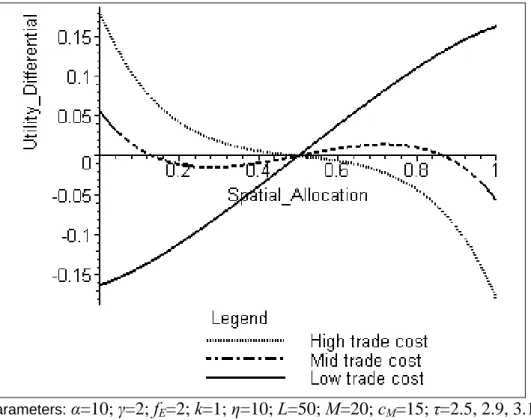
Baldwin, Forslid, Martin, Ottaviano and Robert-Nicoud, 2003). Figure 1 shows that this is true also in the present model. As in Ottaviano, Tabuchi and Thisse (2002), with high trade barriers the dispersed allocation ( = 1=2) is the only spatial equilibrium. As trade barriers fall (smaller ), this allocation be-comes unstable and agglomeration in either location emerges as the only spatial equilibrium. However, di¤erently from Ottaviano, Tabuchi and Thisse (2002) the emergence of the agglomerated equilibrium is not chatastrophic driving the economy from dispersion ( = 1=2) straigth to full agglomeration ( = 0 or
= 1). As trade barriers gradually fall, at some point the dispersed allocation loses stability to two stable equilibria with partial agglomeration (0< <1=2
or 1=2 < < 1) evenly spaced around it. These are initially in a neighbor-hood of the dispersed allocation. Then, as trade barriers keep on falling, they gradually move away from dispersion until the economy hits full agglomeration. Hence, thanks to selection among heterogeneous …rms, the model is able to generate the realistic feature of partial agglomeration as a stable equilib-rium outcome provided that trade barriers are neither too high nor too low. In this equilibrium, the larger location exhibits more entrants, more sellers and thus more product variety, lower average cost, lower average price, lower aver-age markup. As all these features imply higher consumer surplus, indi¤erence
V( ) = 0 is sustained by lower expected pro…ts (smaller w) due to a lower success rate of entry (smaller D) that more than o¤set any higher average pro…t from successful entry (largere).
Note that introducing urban costs as in Ottaviano, Tabuchi and Thisse (2002) would generate redispersion as trade barriers get very low. In the partial agglomeration equilibrium, it would also lead not only to higher average pro…ts but also to higher expected pro…ts in the larger location in order to compensate for its higher urban costs.
3.5
Agglomeration, dispersion and heterogeneity
What is the impact of heterogeneity on core-periphery patterns? The analysis of the isolated economy has shown that more cost-increasing richness (larger
cM) weakens the impact of larger market size on selection. The opposite holds
for more cost-decreasing evenness (smaller k). Therefore, heterogeneity must a¤ect the balance between dispersion and agglomeration forces in the spatial economy, and the e¤ect of heterogeneity must be di¤erent depending on whether it increases or decreases the chances of high unit worker requirement draws.
Figure 2 shows the e¤ects of more cost-increasing richness (largercM) on the
patterns depicted in Figure 1. High, mid and low heterogeneity corresponds to large, intermediate and smallcM respectively. In this case more heterogeneity
shifts the balance in favor of agglomeration forces. This happens because selec-tion in the larger locaselec-tion gets weaker as worse unit worker requirement draws become possible.
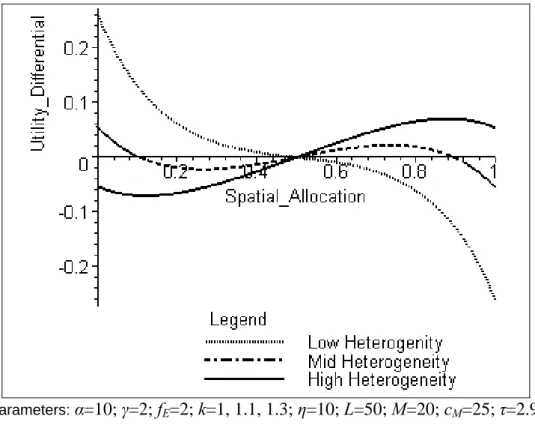
Figures 3 and 4 show the e¤ects of more cost-decreasing evenness (smaller
k). High, mid and low heterogeneity corresponds to small, intermediate and largek respectively. When the initial distribution of unit worker requirement
draws is already rather even (Figure 3), additional evenness shifts the balance in favor of agglomeration forces. Vice versa, when the initial distribution of unit worker requirement draws is rather uneven (Figure 4), additional evenness shifts the balance in favor of dispersion forces. The reason for this is that, when initial evenness is low (largek), more evenness (smaller k) has a weak positive e¤ect on the average pro…t di¤erential (eH vs. eF) and a strong negative e¤ect on the success rate di¤erential ( HD vs. FD), thus fostering dispersion. Vice versa, when the initial evenness is already high, more evenness has a strong positive e¤ect on the average pro…t di¤erential and a weak negative e¤ect on the success rate di¤erential, thus fostering agglomeration. This does not happen in the case of more richness as larger cM does not a¤ect the elasticity of the success rate
of entry to competition given thatdln H
D=dlncHD =kcHD anddln FD=dlncFD =
kcF D.
4
Conclusion
This paper has investigated how …rm heterogeneity a¤ects the balance between agglomeration and dispersion forces in the presence of pecuniary externalities in a model of monopolistic competition with variable mark-ups. In so doing, it has proposed a model that exhibits all the key features the model of Ottaviano, Tabuchi and Thisse (2002) and similar models in the ‘new economic geography’ tradition. In particular, trade barriers regulate the balance between agglomer-ation forces (market-size and cost-of-living e¤ects) and dispersion forces (com-petition e¤ect): starting with high enough trade barriers, trade liberalization shifts the spatial equilibrium from dispersion to agglomeration.
In the proposed model, however, …rm selection acts as an additional disper-sion force. A …rst implication of this additional force is that, di¤erently from Ottaviano, Tabuchi and Thisse (2002), the emergence of agglomeration is not chatastrophic, which is more realistic. A second implication is that …rm hetero-geneity matters for the balance between agglomeration and dispersion forces. However, whether it shifts the balance from agglomeration to dispersion forces or the other way round depends on its speci…c features along the two de…niting dimensions of richness and evenness. This result shows that the role of …rm heterogeneity in spatial models with selection can not be fully understood with-out paying due attention to various moments of the undelying …rm productivity distributions. A similar conclusion is reached by Okubo and Picard (2011) for a sorting model with taste heterogeneity.
References
[1] Baldwin R., R. Forslid, P. Martin, G. Ottaviano and F. Robert-Nicoud (2003)Economic Geography and Public Policy (Princeton: Princeton Uni-versity Press).
[2] Baldwin R. and T. Okubo (2006) Heterogeneous …rms, agglomeration and economic geography: Spatial selection and sorting, Journal of Economic Geography 6, 323-346.
[3] Behrens K. and F. Robert-Nicoud (2009) Survival of the …ttest in cities: Agglomeration,
selection and polarisation. CIRPÉE Discussion Paper n. 09-19.
[4] Behrens K., Duranton G. and F. Robert-Nicoud (2010) Productive cities: Sorting, selection
and agglomeration, CEPR Discussion Paper n. 7922.
[5] Behrens K., Mion G., Murata Y. and J. Südekum (2011) Spatial frictions, CEPR Discussion Paper n. 8572.
[6] Combes P.-P., Duranton G., Gobillon L., Puga D. and S. Roux (2011) The productivity advantages of large cities: Distinguishing agglomeration from …rm selection, CEPR discussion paper 7191, March 2009. Revised September 2011.
[7] Davis D. (2010) A spatial knowledge economy, Columbia University, mimeo.
[8] Maignan C., Ottaviano G., Pinelli D. and F. Rullani (2003) Bio-ecological diversity vs. socio-economic diversity: A comparison of existing measures, FEEM Nota di Lavoro n. 12.2003.
[9] Melitz M. and G. Ottaviano (2008) Market size, trade and productivity,
Review of Economic Studies 75, 295-316.
[10] Nocke V. (2006) A gap for me: Entrepreneurs and entry, Journal of the European Economic
Association 4, 929-956.
[11] Okubo T. and P. Picard (2011) Firms location under demand heterogeneity, CREA Discussion Paper Series n. 11-07.
[12] Okubo T., P. Picard and J.-F. Thisse (2010) The spatial selection of het-erogeneous …rms, Journal of International Economics 82, 230-237.
[13] Ottaviano G. (2011) Firm heterogeneity, endogenous entry, and the busi-ness cycle, NBER Working Paper n. 17433.
[14] Ottaviano G., T. Tabuchi and J.-F.Thisse (2002) Agglomeration and trade revisited, International Economic Review 43, 409-435.
Parameters:
α
=10;
γ
=2;
fE
=2;
k
=1;
η
=10;
L
=50;
M
=20;
cM
=15;
τ
=2.5, 2.9, 3.1.
Figure 1 – Core-periphery patterns with stable partial agglomeration
Parameters:
α
=10;
γ
=2;
fE
=2;
k
=1;
η
=10;
L
=50;
M
=20;
cM
=5, 15, 30;
τ
=2.9.
Figure 2 – More cost-increasing richness fosters agglomeration
Parameters:
α
=10;
γ
=2;
fE
=2;
k
=1, 1.1, 1.3;
η
=10;
L
=50;
M
=20;
cM
=25;
τ
=2.9.
Figure 3 – More cost-decreasing evenness fosters agglomeration if initial
evenness is large enough
Parameters:
α
=10;
γ
=2;
fE
=2;
k
=1.3, 2.6, 4;
η
=10;
L
=50;
M
=20;
cM
=25;
τ
=2.9.
Figure 4 – More cost-decreasing evenness fosters dispersion if initial
CENTRE FOR ECONOMIC PERFORMANCE
Recent Discussion Papers
1128
Luis Garicano
Claire Lelarge
John Van Reenen
Firm Size Distortions and the Productivity
Distribution: Evidence from France
1127
Nicholas A. Christakis
Jan-Emmanuel De Neve
James H. Fowler
Bruno S. Frey
Genes, Economics and Happiness
1126
Robert J. B. Goudie
Sach Mukherjee
Jan-Emmanuel De Neve
Andrew J. Oswald
Stephen Wu
Happiness as a Driver of Risk-Avoiding
Behavior
1125
Zack Cooper
Stephen Gibbons
Simon Jones
Alistair McGuire
Does Competition Improve Public Hospitals’
Efficiency? Evidence from a
Quasi-Experiment in the English National Health
Service
1124
Jörg Claussen
Tobias Kretschmer
Thomas Spengler
Market Leadership Through Technology -
Backward Compatibility in the U.S.
Handheld Video Game Industry
1123
Bernardo Guimaraes
Kevin D. Sheedy
A Model of Equilibrium Institutions
1122
Francesco Caselli
Tom Cunningham
Massimo Morelli
Inés Moreno de Barreda
Signalling, Incumbency Advantage, and
Optimal Reelection Rules
1121
John Van Reenen
Linda Yueh
Why Has China Grown So Fast? The Role of
International Technology Transfer
1120
Francesco Giavazzi
Michael McMahon
The Household Effects of Government
Spending
1119
Francesco Giavazzi
Michael McMahon
The Household Effects of Government
Spending
1118
Luis Araujo
Giordano Mion
Emanuel Ornelas
Institutions and Export Dynamics
1117
Emanuel Ornelas
Preferential Trade Agreements and the Labor
Market
1116
Ghazala Azmat
Nagore Iriberri
The Provision of Relative Performance
Feedback Information: An Experimental
1115
Pascal Michaillat
Fiscal Multipliers over the Business Cycle
1114
Dennis Novy
Gravity Redux: Measuring International
Trade Costs with Panel Data
1113
Chiara Criscuolo
Ralf Martin
Henry G. Overman
John Van Reenen
The Causal Effects of an Industrial Policy
1112
Alex Bryson
Richard Freeman
Claudio Lucifora
Michele Pellizzari
Virginie Perotin
Paying for Performance: Incentive Pay
Schemes and Employees’ Financial
Participation
1111
John Morrow
Michael Carter
Left, Right, Left: Income and Political
Dynamics in Transition Economies
1110
Javier Ortega
Gregory Verdugo
Assimilation in Multilingual Cities
1109
Nicholas Bloom
Christos Genakos
Rafaella Sadun
John Van Reenen
Management Practices Across Firms and
Countries
1108
Khristian Behrens
Giordano Mion
Yasusada Murata
Jens Südekum
Spatial Frictions
1107
Andrea Ariu
Giordano Mion
Service Trade and Occupational Tasks: An
Empirical Investigation
1106
Verónica Amarante
Marco Manacorda
Edward Miguel
Andrea Vigorito
Do Cash Transfers Improve Birth Outcomes?
Evidence from Matched Vital Statistics,
Social Security and Program Data
1105
Thomas Sampson
Assignment Reversals: Trade, Skill
Allocation and Wage Inequality
1104
Brian Bell
Stephen Machin
Immigrant Enclaves and Crime
1103
Swati Dhingra
Trading Away Wide Brands for Cheap
Brands
The Centre for Economic Performance Publications Unit
Tel 020 7955 7673 Fax 020 7955 7595