ALASKA’S TEACHER CERTIFICATION PROGRAMS
By Amy Vinlove
RECOMMENDED:
Dr. Peter DeCaro, Department Head, Communications
APPROVED: ___________________
Dr. Anita Hartmann, Interim Dean, College of Liberal Arts
£ _________
ALASKA’S TEACHER CERTIFICATION PROGRAMS
A
DISSERTATION
Presented to the Faculty of the University of Alaska Fairbanks in Partial Fulfillment of the Requirements
for the Degree of
DOCTOR OF PHILOSOPHY
By
Amy Louise Vinlove, M.A. Fairbanks, Alaska
August 2012
All rights reserved
INFORMATION TO ALL USERS
The quality of this reproduction is dependent upon the quality of the copy submitted. In the unlikely event that the author did not send a complete manuscript and there are missing pages, these will be noted. Also, if material had to be removed,
a note will indicate the deletion.
UMI 3534192
Published by ProQuest LLC 2012. Copyright in the Dissertation held by the Author. Microform Edition © ProQuest LLC.
All rights reserved. This w ork is protected against unauthorized copying under Title 17, United States Code.
ProQuest LLC
789 East Eisenhower Parkway P.O. Box 1346
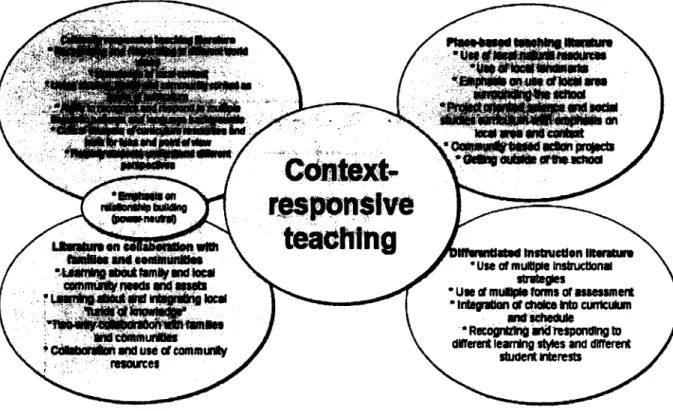
Context-responsive teaching is defined in this project as teaching that responds to individual student needs and interests, linguistic backgrounds and family characteristics, the local community and the local natural environment. Context-responsive teaching, as defined in Chapter 1 o f this dissertation, consolidates into one concept the pedagogical knowledge, skills and dispositions associated with culturally responsive teaching, place- based teaching, differentiated instruction, and purposeful collaboration with parents, families and communities. The research completed for this project examines current practices relative to preparing context-responsive teachers in Alaska’s elementary and secondary teacher certification programs. A survey examining context-responsive teacher preparation experiences was developed and distributed to practicing teachers in Alaska who received their initial teaching certification from the University o f Alaska Anchorage (UAA), the University of Alaska Fairbanks (UAF), or the University of Alaska Southeast (UAS), and who graduated in 2006,2007 or 2008. The experiences o f the graduates were juxtaposed with information on the three programs gathered through interviews with teacher educators currently working at UAA, UAF and UAS. Current practices at the three institutions are examined in relation to a literature-based framework o f “best
practices” in context-responsive teacher preparation. Following a presentation of the data gathered in this mixed-method investigation, nine research-based recommendations are offered for strengthening context-responsive teacher preparation in the state of Alaska.
Signature Page... i Title Page... ii Abstract...iii Table of Contents...iv List of Figures...viii List of Tables...viii List of Appendices...ix Dedication... x
Chapter One: Context-Responsive Teaching: A Definition...1
1.1 Researcher’s Interest in Subject Area and Chapter Overview...1
1.2 What is “Context” and What Do Teachers Need to Know About I t? ... 3
1.3 Necessary Habits of Mind for Context-Responsive Teaching...10
1.3.1 The importance of relationships...11
1.3.2 The habit of listening...13
1.3.3 Recognizing and respecting different perspectives and worldviews... 14
1.3.4 Alternative sources and forms of knowledge...15
1.3.5 Power sharing... 17
1.4 Gathering Contextual Information: Sources o f Context Based Information 18 1.4.1 Learning from students...19
1.4.2 Learning from parents... 19
1.4.3 Learning from the school community... 21
1.4.4 Learning from community members... 21
1.4.5 Learning from community organizations...22
1.4.6 Learning from local media...24
1.4.7 Getting outside... 24
1.5 Large and Small Acts of Context-Responsive Teaching... 26
1.5.2 Smaller acts of context-responsive teaching... 30
1.6 Pedagogical Approaches Aligned with Context-Responsive Teaching... 35
1.6.1 Differentiated instruction... 35
1.6.2 Choice in the classroom... 37
1.6.3 Critical analysis of resources... 38
1.6.4 Responding to linguistic differences... 39
1.6.5 Teaching for understanding... 40
1.7 Revisiting the Term “Context-Responsive Teaching” ... 43
1.8 Context-Responsive Teaching in an Age of Context-Free National Educational Mandates...47
Chapter Two: Preparation for Context-Responsive Teaching: A Literature Review...49
2.1 Professional Knowledge and Skills Needed for Context-Responsive Teaching...56
2.1.1 Learning about students, families and backgrounds... 56
2.1.2 Learning about communities and natural surroundings... 63
2.1.3 Learning the pedagogical skills aligned with context-responsive teaching 67 2.1.4 Pedagogical knowledge and skills not discussed in the literature... 71
2.2 Experiential Activities that Support Context-Responsive Teaching... 72
2.2.1 Activities to learn about kids, families, communities and places...73
2.2.2 Activities to connect context to academic content... 77
2.2.3 Activities that require the application of pedagogical strategies... 78
2.2.4 Experiential components not discussed in the literature... 81
2.3 Supporting Context-Responsive Habits of Mind in Teacher Preparation...81
2.4 Context-Responsive Teacher Preparation and the World of Teacher Preparation.. 86
2.4.1 Context-responsive teacher preparation as a part o f a comprehensive pre service program... 86
2.4.2 The role of the teacher educator in context-responsive teacher preparation... 89
Chapter Three: Methodology...92
3.1 Methodological Foundations and Justification... 92 Page
3.2 Data Collection Group...94
3.2.1 Location... 94
3.2.2 Program graduates... 96
3.2.3 Teacher educators... 97
3.3 Development and Pilot Testing of Data Collection Tools... 98
3.3.1 Development of the graduate survey instrument...99
3.3.2 Survey validity, reliability and pilot testing...101
3.3.3 Development and pilot of the teacher educator interview protocol... 106
3.4 Changes Made During the Data Collection Process... 110
3.5 Challenges in Sequencing... 111
3.6 Data Analysis... 112
3.7 Ethical Considerations... 116
Chapter Four: Presentation of Findings Part One... 119
4.1 Survey Participant Demographics...119
4.2 Survey Respondents as a Representative Sample... 120
4.3 Interviewee Demographics... 122
4.4 Graduates and Program Faculty Define Context-Responsive Teaching... 122
4.4.1 Teacher educators reflect on what to know about context... 122
4.4.2 Teacher educators reflect on pedagogical approaches aligned with context- responsive teaching... 125
4.4.3 Teacher educators reflect on dispositions associated with context-responsive teaching... 128
4.4.4 Graduates reflect on their own context-responsive practices...130
4.4.5 Graduate thoughts on what needs to be known about context responsive teaching...132
4.5 Discussion on the Alignment Between Data and the Definition o f Context- Responsive Teaching Presented in Chapter O ne... 136
Chapter Five: Presentation of Findings Part Two... 140 Page
Page 5.1 Teacher Preparation for Context-Responsive Knowledge and Skills... 141
5.1.1 Activities and materials to learn about students, families, language and
worldviews... 141 5.1.2 Activities and materials to learn about communities and places... 148 5.1.3 Activities and materials to learn about pedagogical approaches associated with context-responsive teaching...155 5.2 Experiential Components o f Context-Responsive Teacher Preparation... 159 5.2.1 Field-based experiences learning about kids, families, communities and places. 160 5.2.2 Hands-on experience with context-responsive curriculum... 165 5.2.3 Aligning academic content with the local context...168 5.3 Discussion on the Alignment Between Data and the Chapter 2 Literature Review ...170 5.4 Professional Development Activities Related to Context-Responsive Teaching..171 5.5 Competing Issues in Context-Responsive Teaching and Teacher Preparation 174 Chapter Six: Conclusions and Recommendations... 181 6.1 The Status of Context-Responsive Teacher Preparation in Alaska...181 6.1.1 Graduates reflect on context-responsive teacher preparation quality...181 6.1.2 Teacher educators reflect on context-responsive teacher preparation quality. 185 6.1.3 Preparation for context-responsive teaching in relation to the literature...187 6.2 Recommendations for Strengthening Context-Responsive Teacher Preparation.. 188 6.2.1 Recommendations for individual teacher educators...188 6.2.2 Recommendations for Program Curriculum, Experiences and Organization. 195 6.3 Limitation of this Study and Directions for Future Research... 211 References... 214
Figure 1.1: The literature base contributing to the definition of context-responsive
teaching... 44
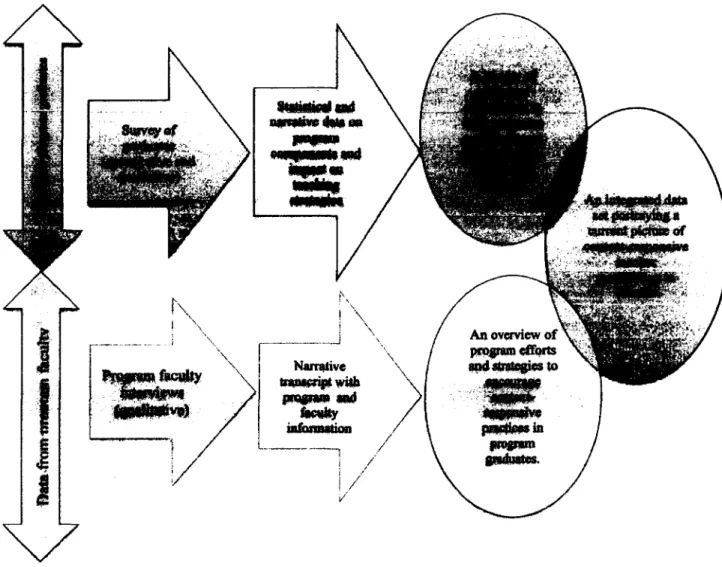
Figure 3.1: A sequential mixed-method research design...99
Figure 4.1: Context-responsive teaching practices engaged in by graduates... 131
Figure 5.1: Culturally responsive teacher preparation activities...141
Figure 5.2: Place-based teacher preparation activities... 149
Figure 5.3: Differentiated instruction teacher preparation activities...156
Figure 6.1: Summary evaluation of preparation in culturally responsive teaching 182 Figure 6.2: Summary evaluation o f preparation in place-based teaching... 182
Figure 6.3: Summary evaluation o f preparation in differentiated instruction ... 183
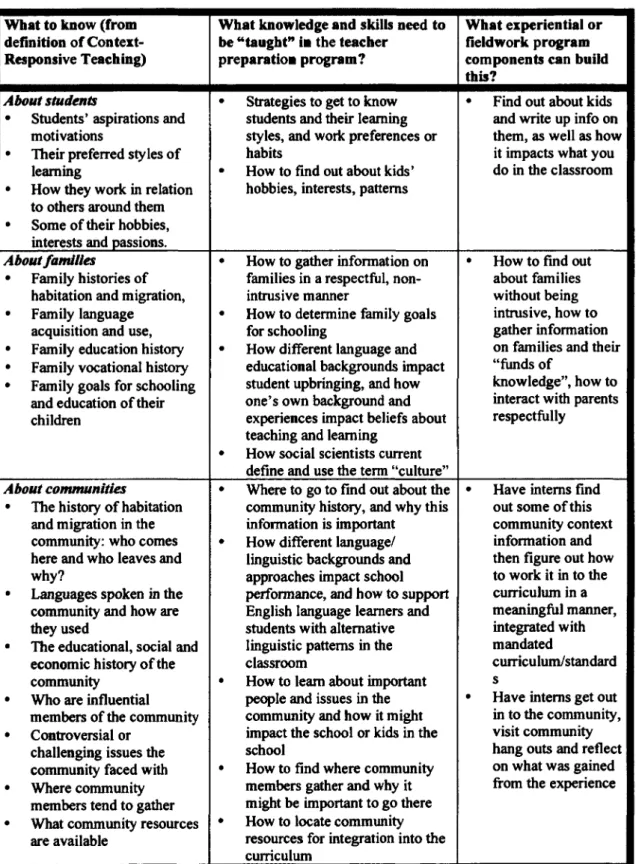
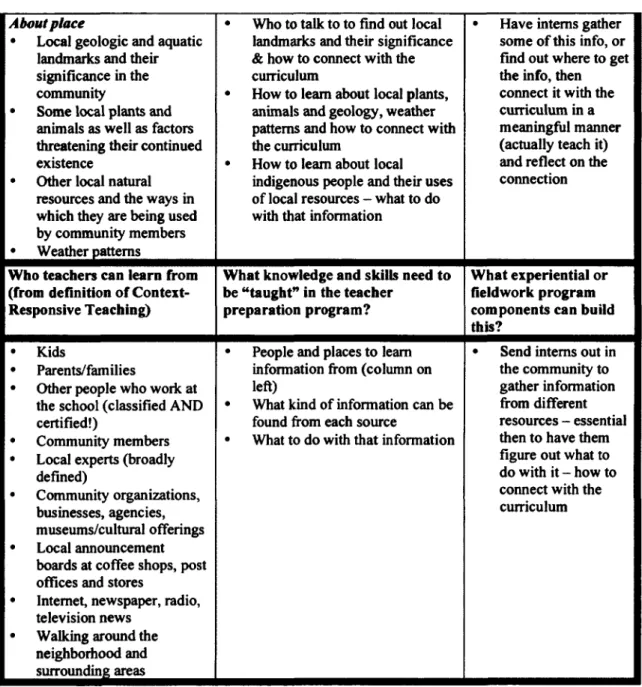
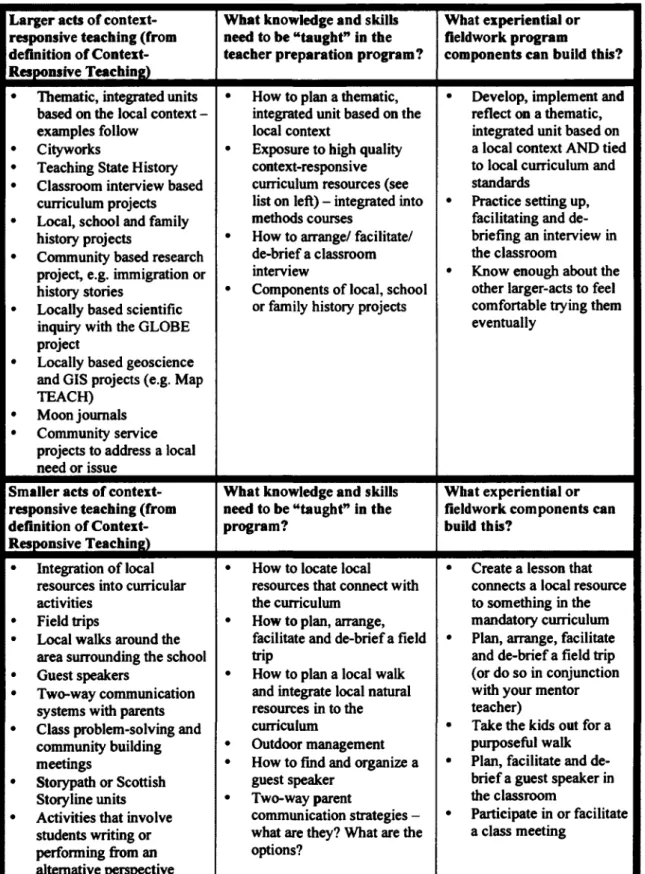
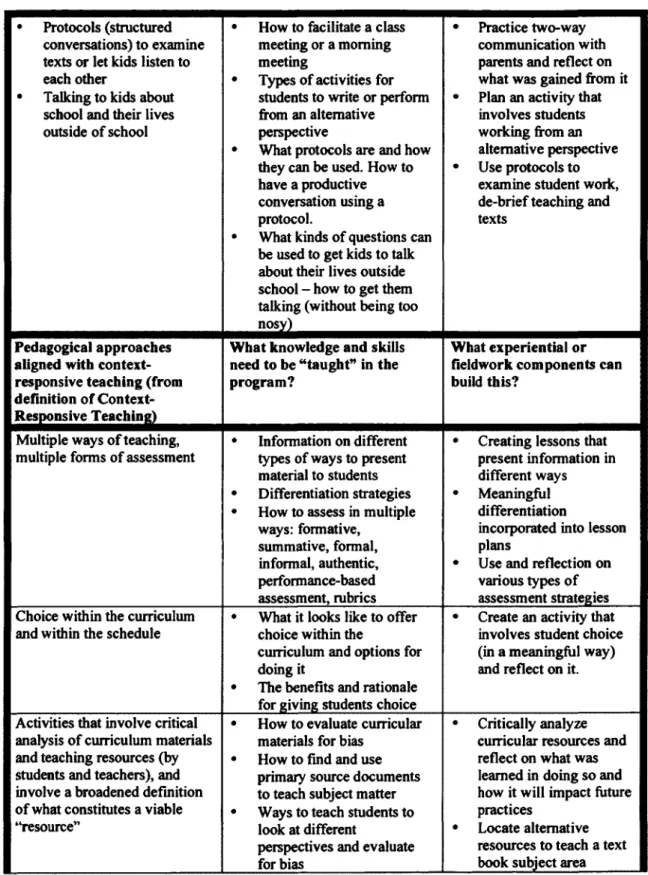
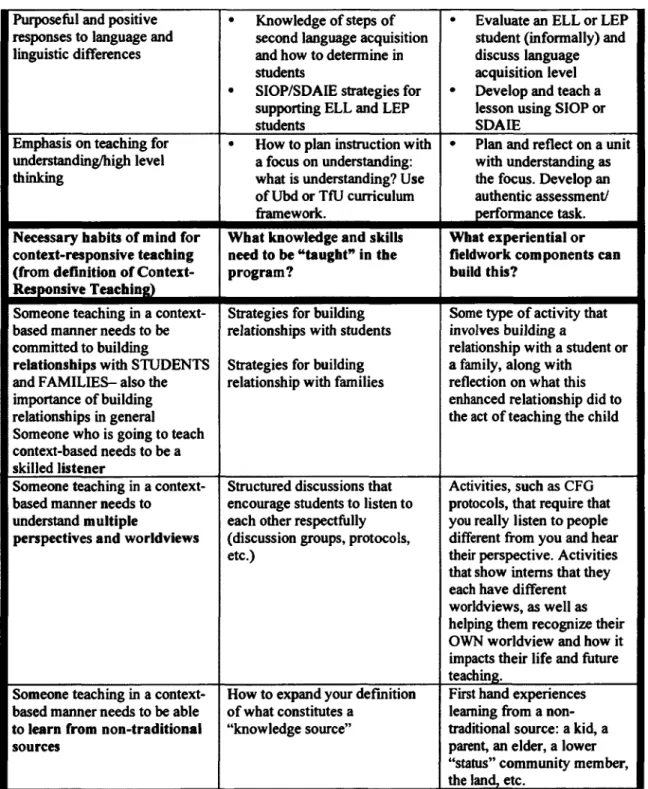
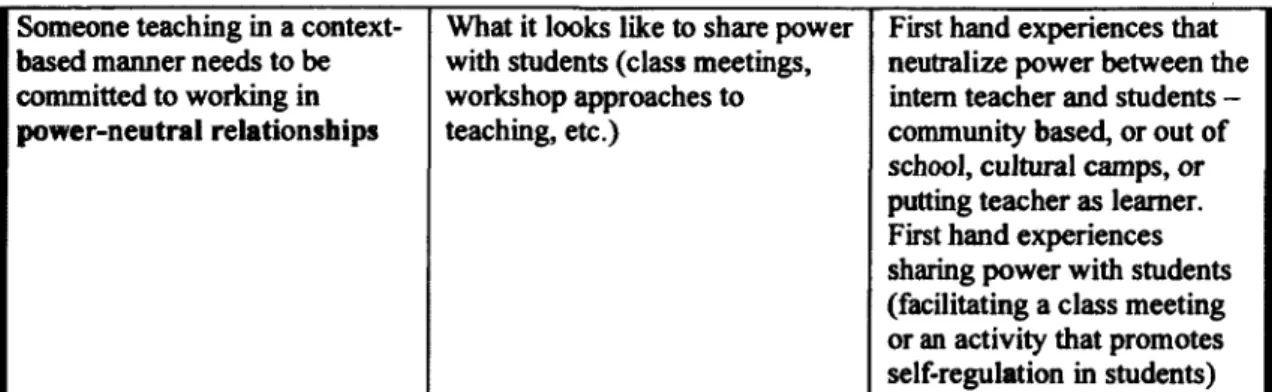
List of Tables Page Table 2.1: Implications for teacher education derived from the Chapter 1 definition of context-responsive teaching...50
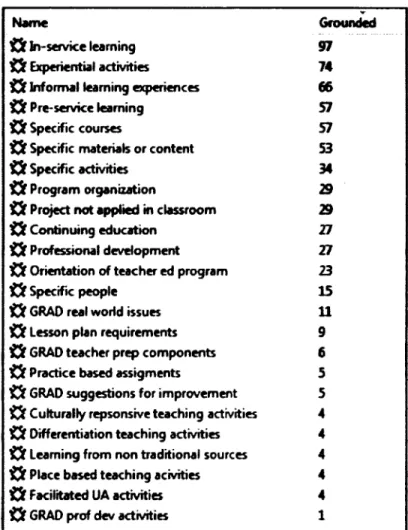
Table 3.1: Code frequency table for graduate su rv ey... 114
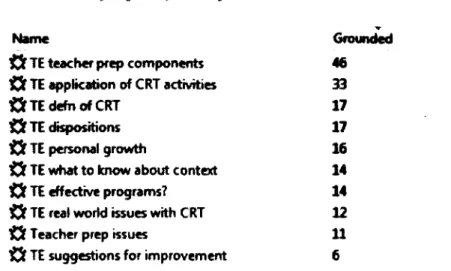
Table 3.2: Code frequency table for teacher educator interviews...115
Table 5.1: Culturally responsive knowledge and skills in teacher preparation programs ...143
Table 5.2: Place-based knowledge and skills in teacher preparation program s... 150
Table 5.3: Differentiated instruction knowledge and skills in teacher preparation programs ...158
List of Appendices
Appendix A: A definition of context-responsive teaching... 225
Appendix B: Graduate Survey Instrument... 228
Appendix C: Questions for interviewing teacher educators... 248
Chapter One: Context-Responsive Teaching: A Definition
This dissertation is on the need for teachers to teach their students in a context- responsive manner, and on the need for teacher preparation programs to teach pre-service teachers strategies to do so. It rests on the assumption that students come to school nested in multiple layers of context that need to be understood, acknowledged and integrated in to the educational process in order for them to successfully learn about new ideas and concepts. It assumes that student will be academically successful when the new
information presented in school is connected to and builds on the knowledge they bring from their lives, experiences, family backgrounds and worldviews, the communities in which they live, and the places in which they live and go to school.
1.1 Researcher’s Interest in Subject Area and Chapter Overview
As an undergraduate student of education studies and public policy at Brown University, I completed a senior project and thesis entitled Encouraging Culturally Responsive Teaching: Affecting the Head and the Heart. That project stemmed from a semester spent during my junior year at the Bank Street College of Education in New York City, participating in an “urban education semester.” A primary focus of that program and that semester was to get a small, diverse group o f participating
undergraduates to think deeply about issues of race, class and diversity and begin to discover what it meant to teach in a “culturally responsive” manner. I focused my senior research and thesis on interviewing past participants in the “Urban Education Semester” to see what impact, if any, the program had on their perceptions of race, schools and culturally responsive teaching. This project is a larger extension of that work, completed almost twenty years ago.
In the intervening years, I have worked as an elementary classroom teacher of diverse populations o f students and currently am in my fourteenth year as a teacher educator at the University of Alaska Fairbanks. In my work at UAF educating future teachers, I integrate many activities, assignments, and resources that I hope will cause the pre-service teachers I work with to eventually teach in a culturally responsive and place- based manner. In my experience as a teacher educator, I have found that I really don’t
ever know if what my colleagues and I are doing is having any long term impact on the practices o f the teachers who complete our programs. The desire to know “does what we do matter?” is another primary motivating question behind my research focus.
Additionally, the desire to learn more about the current body of research on teacher education strategies that encourage future teachers to learn about their students, families, communities and natural places, and to learn what the research says in regards to
effective practices in these areas o f teacher preparation plays a strong part in the focus of this project. What does constitute effective practice? Am I, as a teacher educator,
reflecting that consensus in my work? How can I strengthen what I do, and how can I help the program I work with strengthen its work? These were questions I had in mind as I developed and implemented this research project.
Additionally, from a larger point of view, the need for research on practices in teacher education reflects McDonald’s (2010) comment at an American Education Research Association presentation that “We need to look at not what are the traits of culturally responsive teachers, but what are their practices and what are the implications for teacher education?” A report of the Committee on the Study of Teacher Preparation Programs in the United States, commissioned by the National Research Council of the National Academies (2010) found, in attempting to examine the practices of teacher preparation programs, that “there is currently little definitive evidence that particular approaches to teacher preparation yield teachers whose students are more successful than others. Such research is badly needed” (p 174). They go on to state, in the report
summary, that “the highest priority research would be studies that examine three critical topics in relation to their ultimate effect on student learning: (including) the effectiveness of various approaches to preparing teachers in classroom management and teaching diverse learners” (p. 174). Lowenstein (2009) mirrors this need stating “although much important theoretical work has been done in multicultural education, especially around the issues of race and racial identity, the actual practice of teaching and learning about issues of diversity in teacher education is more nebulous” and “research in teacher education classrooms remains in need” (p. 178).
The first chapter o f this dissertation will present a definition o f context-responsive teaching and offer some examples of teaching strategies that put this type o f teaching into practice. The idea o f context-responsive teaching draws from and expands on the
teaching strategies and repertoires described in education literature as culturally
responsive teaching, place- and community-based teaching, differentiated or “responsive” teaching and teaching that collaborates with families and communities, as well as on my own experiences as an elementary teacher for ten years, and a pre-service teacher
educator for fourteen years. Teaching in a context-responsive manner requires that
teachers not only understand the contextual factors that influence their student’s lives, but also that they have practical strategies for learning about these factors and a range of meaningful ways to incorporate (respond to) this contextual information in their classroom practices.
In this chapter, information on what teachers need to know about their student’s lives and situated contexts will be presented, followed by ideas regarding realistic strategies teachers can use to gather this information and then ideas for enhancing the learning process by meaningfully integrating this information in to the curriculum and pedagogical approach. Included also will be information on the dispositions or “habits of mind” required of teachers who strive to be context-responsive in their teaching.
Throughout and following the description o f context-responsive teaching, the rationale for synthesizing pedagogical ideas from disparate knowledge sources into one coherent concept will be presented. The remainder of this dissertation will then turn to the issue of teacher preparation and explore how teacher preparation programs could, and are,
preparing their teachers to teach in a context-responsive manner.
1.2 What is “Context” and What Do Teachers Need to Know About It?
The contexts of student’s lives and their family situations and backgrounds in tandem with the communities and larger “places” in which they live and go to school form the foundation on which education will occur. McIntyre, Rosebery & Gonzalez (2001) write “Instruction always takes place within a context. At one level, the idea of context has to do with trying to connect learning in a discipline with children’s learning
in their everyday experiences, that is, their lives out of school. The key transformation then becomes the exploration o f how to ground their learning . . . in everyday experience, while at the same time helping them acquire academic (competence)” (p. 121). In order to effectively bridge children with the subject-matter knowledge we hope to teach them in schools, teachers must first come to learn about the students’ foundations. The lives of students reflect their own individualized approaches to the world, the worldviews of their families and those they live with, the situated experiences o f the communities in which they live, and the larger environments or “places” in which their communities and schools are located. All of this contextual information directly impacts the extent to which students can or cannot make connections to school-based subject matter and extend their academic understanding. Johnson (2002) articulates the connection between the functioning o f the human brain and the need for contextualized teaching:
(Contextualized teaching and learning) succeeds because it asks young people to act in ways that are natural to human beings. That is, it conforms to the brain’s functions, to basic human psychology, and to three principles that modem biology and physics have discovered permeating the entire universe. These principles - interdependence, differentiation, and self-organization - infuse everything that lives, including human beings.. . . When the brain manages to connect new details with familiar experiences, it keeps them. When it cannot weave new details into familiar patterns, it expels them. (p. 22)
Johnson goes on to explain the direct link between connecting learning to students situated lives and powerful learning experiences:
The brain’s ability to locate meaning by making connections explains why students who are encouraged to connect schoolwork with their present reality, with their individual, social, and cultural circumstances today, with the context of their daily lives are able to attach meaning to academic material and therefore retain what they study. Deprived of meaning, their brains jettison academic material, (p. 23)
If making connections is crucial to meaningful learning, teachers must know what it is important to connect to in their students lives.
The contextual information that is worth responding to in the classroom can best be divided into two categories: information that must be learned about each individual student and his/her family, and information about the larger community and environment in which the students live. As it is the norm for teachers to be introduced to a new group of students and families on a yearly basis, we will call this first category “yearly”
knowledge. Provided that a teacher stays in a school location for an extend period of time, we can assume that some of the community and place-based contextual information will not have to be re-leamed every year, but instead will be a body o f knowledge that a teacher accumulates over a period of time, so this category o f contextual knowledge will be referred to as “accumulated” knowledge. One motivation for this distinction is the need to mitigate the concern that a teacher needs to learn about everything every year. Practicing teachers function under severe time constraints and it would not be reasonable to propose a framework suggesting that they must find the time to learn everything about their student’s lives and contexts as part o f their yearly obligations.
So, what is the important “yearly” knowledge teachers need to discover about student’s lives and the family contexts in which they live? A place to begin is looking at individual students. Teachers need to know their students’ aspirations and motivations, their preferred styles of learning and how they work in relation to others around them, and they need to know some of their hobbies, interests and passions. As Dewey wrote in
1897, “Education must begin with a psychological insight into the child’s capacities, interests, and habits. It must be controlled at every point by references to these same considerations” (p. 427). Because this information is inherently tied to the individual lives of each student, two concepts are central to the ways in which this knowledge is gained by the teacher: (a) the establishment of meaningful, trusting relationships with students, and (b) the importance of listening carefully to children, both in terms of what they say and what they do (Schultz, 2003). The importance o f establishing relationships
and o f listening will be discussed in more detail when the issue of strategies teachers can use to learn about the contexts of their student’s lives is reviewed.
The other category of knowledge that must be obtained every year by teachers relates to knowledge about the students’ families. LePage ,Darling-Hammond, and Akar (2005) note:
There is a growing body of empirical evidence that shows that well-structured family participation in education enhances students’ academic success, improves school behavior, and reinforces stronger self-regulatory skills and work
orientation. A bond between parents and teachers and schools contributes to student learning and well as positive attitudes and behavior, (p. 338)
Families define the contexts of student’s lives, and therefore the crucial nature of the family-situated information teachers must be recognized in order to meaningfully connect school learning to students’ lives. What knowledge is important to know in regards to families in the context of students’ homes? The work on “Funds of Knowledge”
undertaken by Gonzalez, Moll and Amanti (2005) best summarizes what teachers might learn from the families of their students. The authors define family “funds of knowledge” and the process o f learning them as:
. . . understanding local households historically. This approach involves understanding the sociopolitical and economic context of the households and analyzing their social history. This history includes their origins and development and, most prominently for our purposes, the labor history of the families, which reveals some of the accumulated funds of knowledge of the households. Funds of knowledge refers to those historically developed and accumulated strategies or bodies of knowledge that are essential to a household’s functioning and well being. (p. 450)
Extending this concept, the information that could be gathered at a household level might include family histories o f habitation and migration, language acquisition and use,
education, and vocation. The relationship between this family context and the family’s goals for the education of their children should also be ascertained. Knowledge of family
histories could also shed light on the experiential foundations of the worldview(s) of family members that shape the child’s situated experiences. Foundational understanding of individual family worldviews can and should be considered in conjunction with those o f other families in the local community and the larger place, and threads between and across family histories should be recognized by, and responded to in practices by teachers.
Knowledge of the communities and places where students and teachers live and where schools are located is an area that teachers can build up over time spent at a
particular school or in a particular community and place. Many of the same strands found in family historical knowledge can and should also be learned about the larger
community: What is the history of habitation and migration in the community? Who comes here and who leaves and why? What languages and dialects are spoken in the community and how are they used? What is the educational, social and economic history o f the community, and what is the current context o f schools and work? Additional contextual information that bears understanding at a community level includes knowing who “important” members of the community are (and how “important” is defined by community members), what controversial or challenging issues the community is currently faced with, where community members tend to gather (including where
students go in the community outside of school time), and what community resources are available that could connect school learning with external resources in a meaningful manner.
An understanding of community context, however, should not stop at the level of human-based histories, challenges, resources and spaces. These human-based community elements do not exist outside of the natural environment or “place” in which the
community is located. Gruenewald (2008a) writes that “Place foregrounds a narrative of local and regional politics that is attuned to the particularities of where people actually live” (p. 308). Geertz stated “No one lives in the world in general” (as referenced in Gruenwald, 2008b, p. 145). Gruenewald extends that notion, stating “experience is “placed” in the “geography” of our everyday lives, and in the “ecology” o f the diverse
relationships that take place within and between places” (p. 145). Attuning to this notion, it follows that a context-responsive education should also respond to the context of “place.” Scollon and Scollon (1988), in describing a potential place-based curriculum, list 32 questions on a proposed final exam testing “How Well Do you Know Your Place?” (p. 86). From this list, we can learn some of the important place-based elements that create the context in which schools and communities exist. Among other things, Scollon and Scollon suggest that persons who “know” their place can identify local geologic and aquatic landmarks and their significance in the community, some local plants and animals as well as factors threatening their continued existence, local natural resources and the ways in which they are being used by community members, and primary weather patterns. Knowledge o f the physical elements inherent to individual places can enhance the learning process both through the integration o f the resources into the school-based curriculum, and in the teacher’s understanding of the ways in which the local physical world provides a foundation for the worldview of families indigenous to, or with a lengthy history in a particular location.
Knowledge o f community and place-based resources and histories can and should intersect and overlap with knowledge o f individual family histories and resources. The situation o f children within these larger contexts provides a rich and useful foundation for understanding the diverse “repertoires of practice” that children live in their daily lives and bring with them to school (Gutierrez & Rogoff, 2003). The framing o f understanding student, family, community and place-based contexts as crucial elements to which a teacher must “respond” offers an alternative to the oft-referenced frame o f “culturally” responsive teaching. A directive to teachers to teach in a “culturally responsive” manner leads inevitably to Gruenewald’s (2008b) question o f “to what in culture should
educators be responsive?” (p. 150). Gonzalez’s (2005) notion regarding the on-going challenges o f what exactly is meant by “culture” and her historic analysis of how the use of culture as a construct in education practice has both helped and hindered historically underserved populations o f students is particularly illuminating when evaluating the efficacy of asking teachers to teach in a “culturally responsive” manner. Gonzalez argues
that the education profession needs to move “beyond culture” and she writes that “once we start to peel back the layers of this (concept of culture) we find a complex history, a variety of definitions, and wide disparity in theories of culture” (p. 29). After outlining the changing definitions and uses o f the term “culture” over time, she continues saying that “as is evident, anthropologists have not moved in uniform step toward any single vision of what does or does not constitute culture. It continues to be contested terrain, with convergences, divergences, as well as exit points” (p. 37). In reference to the continually emerging nature of the term and concept, she writes that “more and more, culture is viewed as dynamic, interactional, and emergent” and that “perhaps, therefore, we can think of culture as a set of inquiries” (p. 39). She concludes, in reference to the work she and her colleagues have undertaken in regards to discovering “funds of knowledge,” “we have interrogated many o f the assumptions of a shared culture, and have chosen instead to focus on “practice,” that is, what it is that people do, and what they say about what they do” (p. 40).
This emphasis on household practices as a source of rich contextual information, as opposed to an attempt to quantify whole-group cultural practices mirrors Gutierrez and Rogoffs (2003) desire to look at cultural differences as “repertoires of practice” instead of as “individual traits.” They write “treating cultural differences as traits makes it harder to understand the relation of individual learning and the practices o f cultural community, and this in turn sometimes hinders effective assistance to student learning” (p. 19). They propose instead that “looking for cultural regularities will be more fruitful - both for research and practice - if we focus our examination of differences on cultural processes in which individuals engage with other people in dynamic cultural communities” and that “focusing on the varied ways people participate in their community’s activities, we can move away from the tendency to conflate ethnicity with culture” (p. 21). Gutierrez and Rogoff provide some suggestions to educators and researchers who embrace this approach including “To examine how aspects of participants’ community background cluster and how they change, it helps to treat them as a constellation of factors (because)
cultural research requires focus on the dynamically changing configuration o f relevant aspects of people’s lives” (p. 23).
Coming back to the idea of context-responsive teaching, as opposed to culturally- responsive teaching, we can see that the idea of responding to the individual, family, community and place-based contexts of students in teaching aligns well with the notion o f moving “beyond” culture as articulated by Gonzalez (2005) , and the focus on looking at “repertoires of practice” as proposed by Gutierrez and Rogoff (2003). Locating the student within a continually evolving context of family, community and place recognizes the fluid and constantly evolving nature of culture as opposed to asking teachers to identify and respond to fixed and assigned cultural traits that may or may not reflect the lives experiences o f students from varying backgrounds. One role o f the context-
responsive teacher, then, would be to learn to look for and attend to commonalities in the context-based backgrounds of her students and to build upon the more prevalent
“repertoires of practice” shared among those in her class.
1.3 Necessary Habits of Mind for Context-Responsive Teaching
Before the description of context-responsive teaching progresses any further, we will pause to discuss some assumptions that are being made about teacher dispositions and the ways in which knowledge is gained in a meaningful manner. This portrait of context-based teaching assumes: a teacher who is committed to building and sustaining meaningful relationships with the students, families and communities in which she works; a teacher who is skilled as an attentive listener to others; a teacher who understands and respects the fact that people operate from multiple perspectives and possess diverse worldviews; a teacher who respects and is willing to learn from non- traditional knowledge sources; and a teacher who is comfortable with and committed to sharing power over the educational process with her students, with parents and with the wider community. Needless to say, it cannot be assumed that every practicing teacher possesses these dispositions. The ability to purposefully and respectfully learn about students and their context-based lives, though, requires that teachers at least be working toward a development of these habits of mind for reasons which will be articulated
throughout the following sections. These foundational conditions must be addressed and acknowledged in this description o f context-responsive teaching, as the next chapter will consider teacher preparation for context-responsive teaching and will address strategies teacher preparation programs can take to stimulate the development o f these dispositions. Each disposition will be discussed in the following section.
1.3.1 The importance of relationships.
In order for teachers to genuinely learn about their students and the contexts of their lives, they must develop an orientation toward the world and toward others
(particularly those who are not like them, or did not grow up in contexts similar to those of the teacher) that is understanding of, and accepting of, differences. Children are not going to feel comfortable sharing information, nor are family or community members going to be willing to meaningfully collaborate with teachers if they feel as though their lives and worldviews are not valued in the teacher’s eyes. The importance of developing and sustaining meaningful relationships as a foundation for successful teaching was noted by McDermott (1977), who wrote “Trusting relations are framed by the contexts in which people are asked to relate, and where trusting relations occur, learning is a possibility. Where trusting relations are not possible, learning can only result from solitary effort” (p. 199).
The centrality of positive and reciprocal relationships in promoting meaningful learning was documented extensively by Bishop and Berryman (2006) in the research leading to the Te Kotahitanga educational reform effort in Maori education in New Zealand. The researchers interviewed Maori students and extended family members, as well as the mostly white teachers and principals at the schools the students attended. They found that the most often cited reason for limited educational success for Maori students, as reported by the students and families, was a lack of positive relationship building between the teachers and the students:
All the students identified the relationships they had with their teachers as the most influential factor in their ability to achieve in the classroom. In
importance o f teachers caring for them, having high expectations of them, knowing what students needed to learn, knowing how to lead students to this knowledge, and being able to manage classrooms in ways that supported their learning (p. 254).
In contrast, the teachers of the Maori students tended to place the blame for limited educational success on external factors, such as the home lives of the students:
The teachers as a group were less convinced that in-class relationships were of any great importance to Maori students’ educational achievement, compared with the negative influences that they understood to stem from Maori students and their homes (p. 258).
Bishop and Berryman note that the students and family members who felt that poor relationships contributed to lack of educational success:
Tend to accept responsibility for their part in the relationships, and are clear that they do have agency, because they are active and capable participants in
educational relationships. These (students and family members) also have a personal understanding that they can bring about change in the educational achievement of Maori students if more attention is give to relationships and interactions. It is significant that people who position themselves in this way are able to provide almost endless solutions to the problems, in contrast to the very limited solutions that those who position themselves (as placing blame elsewhere) (p. 260).
In summary, the authors note that “the key to solving the problems facing us all in
education lies in the quality of the relationships that are constructed between teachers and students, in day-to-day classroom activities” (p.260).
In a recent article examining community-based school partnerships, the authors found the need to build meaningful relationships similarly important for collaboration between teachers, parents and community members (Warren, Hong, Rubin, & Uy, 2009). In examining the research, the authors found that “Schools that have higher levels of relational trust among participants have been shown to have a greater capacity to reform
themselves and improve their practice” (p. 2210). The authors looked at three diverse and successful sites of collaboration between schools and community-based organizations and found that “bridging relationships between parents and teachers and other school staff provides a basis for more meaningful collaboration (and mutual accountability) so that the school and home work together for the benefit o f children” (p. 2223). They propose a “relational” approach to parent engagement that “builds relationships among parents as a basis for their collective participation” and see this relationship building as providing “the potential of schools to serve as institutional sites for social capital building” (p. 2226). In summary, the need for teachers to build positive and reciprocal relationships with students, parents, and community members and resources is well documented and will provide the foundation on which the practice of context-responsive teaching can be built.
1.3.2 The habit of listening.
Schultz (2003) articulates the importance of teachers learning to listen to their students, their classrooms, and to the larger contexts of the students’ lives, as well as listening for silences and “acts of silencing.” She promotes teaching with a listening “stance” that places the teacher as a learner who can respond to the voices of children, classrooms, and family and community contexts. O f this stance, she writes
Taking a listening stance implies entering a classroom with questions as well as answers, knowledge as well as a clear sense of the limitations o f that knowledge. Such an approach suggests that teaching is improvisational and responsive to students. It requires confidence to enter into teaching as a learner as well as a knower. (p. 5)
Indeed, if a teacher wants to teach in a manner that meaningfully responds to the context of her students and their situated lives, she must develop the ability to receptively listen to the students, their families, their communities and the places in which they live.
Authentic listening must become a habit of mind if the goal is to prepare teachers who are “committed to transforming teaching and learning by adapting their pedagogy to the
children and the contexts in which they teach” (Schultz, Jones-Walker, & Chikkatur, 2008, p. 157).
13.3 Recognizing and respecting different perspectives and worldviews.
When a teacher listens to her students, their families, and the voices o f the communities and places in which the students live, she must do so with a firm
understanding that the upbringings, cultural backgrounds, and experiences of individuals shape their perspectives and “worldviews.” A teacher must also recognize that it is essential that one’s own worldview not be held as the standard by which other worldviews should be judged. Recognizing multiple worldviews and respecting and responding to them in a non-judgmental manner is a key disposition that teachers must hold if they are to successfully incorporate the worldviews o f their students into their classroom practices. Schultz et al (2008) write
Prospective teachers enter teacher education programs with preconceived ideas about what it means to teach and to learn, and these ideas continue to evolve as they move into their own classrooms. Part o f the task of teacher preparation involves helping new teachers learn from the students they teach so that their teaching can incorporate and respond to the students’ cultural knowledge and their academic and social strengths and needs, (p. 156)
In their own teacher preparation program, they note that their pre-service students are asked to “look beyond their own understandings at the same time that they examine their own histories and cultural lenses to uncover blind spots and biases” (p. 162).
Brayboy and Maughn (2009) discuss the importance o f recognizing and respecting alternative worldviews, particularly Indigenous knowledge systems, in
teaching and in teacher education. In examining different conceptions o f knowledge, they write that in Indigenous knowledge systems
knowledge is not a commodity that can be possessed or controlled by educational institutions, but is a living process to be absorbed and understood. Again, we are struck by the fact that knowledge must be lived and is a verb. For many in Western knowledge systems, knowledge is a noun - rooted in things on the pages
of a book or possessions. It is often stagnant, maybe something so abstract as to not even be tangible. Knowledge from an Indigenous perspective is active, (p. 12) Understanding that even the concept of knowledge can have different meanings to
different people - teachers, students, parents, community members - is critical if teachers are working to incorporate knowledge from multiple contexts into their classroom
practices, although the authors note:
The ways in which knowledge systems govern our lives - from how we value particular relationships to how we conceive of and deliver instruction on plant growth - may be difficult to see, especially if we are not familiar with knowledge systems other than our own (p. 18).
Although there are challenges to understanding that multiple perspectives and
worldviews exist and must be validated in the educational process, it is necessary that teachers develop this “habit of mind” if they are to respond to contexts in an authentic maimer.
1.3.4 Alternative sources and forms of knowledge.
In order for teachers to learn from their students, from families, and from the communities and places where their students live and go to school, they must be willing to embrace an inclusive view as to what constitutes “knowledge” and how and from whom “knowledge” can be learned. As mentioned in the earlier quote from Brayboy and Maughn (2009), knowledge is not, in everyone’s worldview, fixed. It is often subject to interpretation and can come in many forms. Consequently, teachers must be open to learning about many different things from many different sources. Teachers who consider “valid” knowledge to be only that found in textbooks or school curricula will have a challenging time teaching in a context-responsive manner. A context-responsive approach to teaching requires that teachers not only look to many alternative and non- traditional to incorporate into the curriculum, but also that they have an expansive definition o f what is worth knowing and including.
Teacher educators at the University of Washington have recently been
organizations (CBOs) (prior to their classroom internships) as a possible approach to bridge the gap between teachers and the students they teach (McDonald, Tyson, Brayko, Bowman, & Shimomura, 2011). They list some o f the goals o f the community-based placements as intending to
• Give prospective teachers opportunities to develop a holistic and assets-based view of children and youth.
• Acknowledge education and learning as a process that occurs in multiple contexts.
• Place students, families, neighborhoods, and communities at the center of teaching and education, (p. 17)
The UW faculty note that “research shows that learning is enhanced when teachers bridge school knowledge with students’ “informal” knowledge” (p. 16). The preliminary
findings in the experiences of pre-service teachers participating in these partnerships suggest:
Placements in CBOs, at times, enabled preservice teachers to engage with children in ways that turned the relationship of teacher-student on its head, situating children as capable knowers, and positioning teachers as learners. The ability of teachers to see and understand children as competent individuals with knowledge and expertise, potentially enables them to reach into and across difference in ways that is central to their ability to provide high quality learning opportunities to all students, (p. 41)
The implications for teacher preparation programs related to the work at UW will be discussed further in the next chapter, as it represents a possible pathway to the
development in teachers of the ability to expand their understanding o f what constitutes knowledge and where that knowledge can come from.
Warren et al. (2009) also provide support o f the need for teachers to learn from alternative sources, in this case, parents and communities. They refer again to their proposed “relational” approach to parent engagement, stating that it “engages parents around their own interests and values and respects their contributions. In this process both
educators and parents grow and change, potentially forming a learning community together” (p. 2211). Bamhardt (2008) also advocates for the incorporation of knowledge from multiple sources, and describes the work of the Alaska Native Knowledge Network in developing the Alaska Standards for Culturally Responsive Teaching which promote teaching that:
provide(s) multiple avenues for the incorporation o f locally-recognized expertise in all actions related to the use and interpretation of local cultural knowledge and practices as the basis for learning about the larger world (p. 130).
Whether they are learning from their students, from families, from communities or from the natural environment surrounding the school, teachers must develop and maintain a willingness to recognize and validate multiple sources and forms of knowledge.
1.3.5 Power sharing.
Closely tied to the ability to respect and acknowledge different worldviews and the understanding that knowledge comes from and can take many forms is the teacher’s willingness to work towards power-neutral relationships with students, parents and the wider community. Warren et al. (2009), in examining relationships between teachers, parents, and communities, distinguish between what they refer to as “relational” power and “unilateral” power:
Relational power can be contrasted to unilateral power, which emphasizes “power over” others, the capacity to get others to do ones bidding. Educators who fear parent power are operating out of a unilateral power framework o f winners and losers. Relational power emphasizes the “power to” get things done collectively, (p. 2224)
They articulate the benefits of sharing relational power with parents, stating that such an approach “recognizes the reality of potential conflict between parents, community leaders, and educators but invites them into a collaborative process that fosters the “power to” create solutions together” (p. 2224).
Bishop and Berryman (2006) also discuss the issue o f power, and the need for teachers to establish more power-neutral relationships with their Maori students, stating
“it is important that teachers show respect for the power of the knowledge, experiences, and overall persona of Maori students in their classrooms. In other words, power-sharing relationships need to be developed” (p. 257). They note that o f the teachers interviewed who had reputations for creating high quality educational experiences for their Maori students, the ability to “teach and interact effectively with Maori students in their classrooms was closely tied to their having positive, non-judgmental relationships with Maori students; seeing Maori students as being self-determining, culturally located individuals; and seeing themselves as being an inextricable part of the learning
conversations, not as the only speaker, but as one o f the participants” (p. 268). Teachers who seek to teach in a context-responsive manner must recognize the importance of standing on equal ground with their students, students’ families, and the wider community and be comfortable on a leveled playing surface.
1.4 Gathering Contextual Information: Sources of Context Based Information
Having outlined what, in terms of context, a teacher who endeavors to teach in a context-responsive manner should come to learn, and the dispositional foundations on which a context-responsive approach to teaching must be constructed, the question of gathering information will now be addressed. Who holds the knowledge that teachers should work from if they are to respond, in teaching, to the contextual lives o f their students, and what forms does this knowledge take? It is important to return to the aforementioned question o f “what constitutes knowledge” before examining possible resources, as knowledge in this context should not be consider fixed or stagnant. The list of sources that follows is constructed to respond to the fact that information deemed relevant and accurate one day might not be relevant the next, and charges the context- responsive teacher with routinely considering the context, source and relevance o f any information gathered.
An overview o f potential sources of information, the information these resources may offer, and the contexts in which the information might be shared follows, along with ideas for meaningfully integrating context-based information into the curriculum in both large and small ways, and some pedagogical approaches that align themselves well with
context-responsive teaching. This chapter will conclude with thoughts regarding context- based teaching in an age of context-free national educational mandates.
1.4.1 Learning from students.
The first, and most easily accessed source o f information on the lives and contexts of students is naturally the students themselves. Most children, like most people, are happy to talk about themselves, their lives, and their interests if they are given the opportunity to do so in safe and non-threatening environments. It is important to
remember that information will be shared most readily if students consider themselves to have safe and egalitarian relationships with their teachers, and they are also more likely to share information when they are in spaces that are more power-neutral than the classroom or school. For these reasons, teachers will be more likely to obtain insightful information from their students if they engage in discussions with them outside of formal instructional time. At a simple level, this could involve talking to them informally over lunch, or during recess duty. As a practicing elementary teacher, I often found that the most interesting information was shared with me by my students while we were out for walks through the neighborhoods or the woods surrounding the schools where I worked. When interacting with students, in both in- and out-of-school contexts, it is also essential to remember the habit of listening, as more information will be shared if there is more conversational space to fill. As the thoughtful contributors to the student advocacy organization and website What Kids Can Do (2003) suggest, teachers must “first ask, then listen.” They note “Encouragingly, listening to students does not depend on any particular expertise. Anyone who likes young people and values their opinions can do this work” (p. 2). In addition to learning about students and their lives through conversation, much can also be learned through the careful and non-judgmental examination of their work products (written documents, projects, etc).
1.4.2 Learning from parents.
Parents and family members are an obvious source o f information about the lives and contexts of students. What are the best opportunities to listen to parents and learn about their lives, the lives of their children, and their hopes for their children’s education?
The foundational disposition of “power-sharing” discussed above is fundamental in learning from parents. As Warren et al. (2009) note “as teachers get to know parent leaders, they can develop a better understanding o f family culture and a concrete sense of how parents can be assets to, not problems for, the school” (p. 2223). The development of a mutual understanding between parents and teachers requires a power-neutral
relationship that encourages communication strategies that are “two-directional. . .
they’re not just about how teachers can get information to parents; they’re also about how teachers can hear from parents about their hopes and concerns, receiving from them their insights and wisdom” (Davis & Yang, 2005, p. 6). Davis and Yang describe many such strategies in practice, and go on to say that “the strategies also aren’t just about how teachers can get parents to support the curriculum or support classroom life; they’re about how parents’ interests, skills, and insights can infuse the curriculum and classroom life” (p. 7). The authors offer an abundance of strategies for communicating with and
incorporating parents into the classroom in a “two-directional” manner, as does Harvard’s Family Involvement Network of Educators (www.hfrp.org/family-involvement) and the Southwest Education Development Lab’s National Center for Family & Community Connections with Schools (www.sedl.org/connections/). Additional strategies for incorporating parents into the curriculum through themed interview projects will be shared below.
Another strategy to establish relationships, foster communication and learn about the contexts of students’ lives is the ethnographic home visit approach employed in the Funds of Knowledge research undertaken by Gonzalez et al. (2005) and their
collaborative group of teachers and researchers. This type of learning opportunity is characterized as different from the typical home visit made by teachers in that the participating teachers:
venture into their students’ households and communities, not as teachers
attempting to convey educational information, as valuable as that may be, but as learners, as researchers with a theoretical perspective that seeks to understand the ways in which people make sense of their everyday lives. To accomplish this
work, we relied on a mix o f guided conversations and interviews, a sort of ethnographic inquiry (p. 84).
In completing this kind o f work, the authors note that “the principal task . . . is not primarily to elicit information, but to foster a relationship of trust with the families so they can tell us about their lives and experiences” (p. xi). McIntyre, Rosebery and Gonzalez (2001) describe the specific methods used to complete an ethnographic home visit (p. 100).
1.4.3 Learning from the school community.
Although there minimal research discussing opportunities to collaborate and communicate with both certified and classified school personnel as a method o f learning about the contexts of students’ lives, employees within the school community constitute an often overlooked and undervalued rich source o f knowledge. Non-certificated
members of the school community, such as classroom aides, bilingual staff, custodians, secretaries, and other support staff are often members of the same communities that the students in the school come from, and many have long-standing ties to those communities and potential “funds of local knowledge” that could be tapped by teachers. School
employees with community ties and histories could be looked to as useful sources of information on language use within the local community, community and school history, and “inside” information on the out-of-school lives o f children and their families.
Gaining access to this information, needless to say, requires the development of trusting and respectful relationships and an understanding and willingness to learn from
alternative sources of knowledge. A crucial advantage of looking to members of the school community for context-based knowledge of students’ lives is that they are
accessible - teachers do not have to even leave the school to gain insight into the local community.
1.4.4 Learning from community members.
The Alaska Standards for Culturally Responsive Schools (1998), in its Cultural Standards for Educators includes the following recommendations:
* Educators (should) maintain a close working relationship with and make appropriate use of the cultural and professional expertise of their co-workers from the local community
• Educators (should) promote extensive community and parental interaction and involvement in their children’s education (p. 9-11).
Community members offer a wealth of resources for teachers to draw from in learning about the contexts o f their student’s lives. Critical issues in involving community members in the educational process are identifying individuals to collaborate with, contacting individuals and establishing trusting relationships with them, and determining how best to incorporate their knowledge into the classroom. Identifying potential
community sources o f information is typically a matter o f asking those around you who might know such as students, parents, or other staff members at the school. A school provides a wealth of potential points of contact to others in the community, but again, gaining this information requires the establishment of collaborative relationships with those in the school community.
Strategies for collaborating with and learning from community members abound. Community members can be used as background sources of information for in-class investigations, they can be brought to the classroom for an interview or used as a resource, or visits can be arranged to bring the class out of the classroom to learn from the community member in his/her own situation and context. Teachers can also look for community members offering formal instruction on issues of local relevance, as a way to gain information on local history, economy, geography, and natural resources. Rogovin (1998) provides excellent ideas for locating and inviting in members of the community for classroom-based interviews to enrich or even form the focus of the curriculum.
Additional strategies for incorporating community members into the curriculum as part of a theme-based inquiry project will be discussed below.
1.4.5 Learning from community organizations.
In addition to individual community members, teachers can also make good use of community organizations and businesses when considering ways to learn about and
integrate the local context. Local resources that can be tapped include (but are not limited to) community-based organizations, businesses near the school or those that serve a prominent role in the local economy, universities and colleges, governmental agencies, and museums and other attractions showcasing locally relevant information. Issues involving collaboration with local organizations are similar to those discussed in regards to collaboration with community members: identifying organizations to collaborate with, establishing relationships with them and determining how best to incorporate their community-based knowledge into the classroom. Much research exists on collaborative efforts between schools and community organizations, but there is little regarding the relationships individual teachers might make with local organizations and businesses.
One interesting example of an individual teacher’s efforts to meaningfully collaborate with local organizations and businesses can be found in the description o f a third grade “micro-society” curriculum project instigated by Sylvester (1994). In his chronicle o f the development of “Sweet Cakes Town” inside his inner-city Philadelphia public school classroom, the students, over the course of the year, developed and ran their own banks, businesses, and community services. In order to do these jobs, the students looked to local neighborhood resources for guidance:
When William asked how much a store costs, I turned this question back to the class by asking them where we might go to find the answers. In the discussion that followed, we decided that we would take a walking trip to the soul food restaurant named "Ziggie's Barbecue Pit," which was located on the same block as our school. The next day, with Ziggie forewarned o f the invasion, we set out to learn about starting a business (p. 312).
Sylvester continues that in January:
The students subsequently decided to add more businesses to Sweet Cakes Town. With each new proposal, we were propelled out of the classroom and into the neighborhood, visiting businesses and a factory, inviting visitors to be
interviewed, collecting specimens from the neighborhood pond, and doing research at the public library (p. 312).
And later, he notes that “by the time students decided that the town needed a mayor, they were already in the habit o f going to the source for their information. Philadelphia's Mayor Rendell graciously accepted the children's invitation and came to Sweet Cakes Town to be interviewed about his job” (p. 315). Sylvester’s willingness to collaborate with neighborhood businesses and organizations, and to seek local knowledge to
contribute to the curriculum represents an example of the potential o f teacher-community collaboration.
As a final note when considering community-based sources o f contextual
knowledge that could be o f use to context-responsive teachers, it is wise to remember the value of local gathering places as well as local bulletin boards. Announcements posted at local coffee shops, post offices and stores can provide an excellent window into the goings-on of the local community and a context-responsive teacher would be well served to pause and examine them when frequenting these establishments.
1.4.6 Learning from local media.
Context-relevant information that helps teachers understand the situated lives of their students can also be gathered from local media sources. Websites of local
organizations, agencies and businesses can provide useful contact information and often have links to resources that can be of great value to teachers and students when
investigating local issues and topics. Local newspapers provide a daily or weekly
overview of current issues concerning community members, as well as advertisements for local events and businesses. Local television news, radio stations and talk shows also offer insight into happenings and events in the community, as well as providing a glimpse of community-based opinions on a range o f topics (some well-considered, others not.) A context-responsive teacher would be well served to time in to these media resources as a source of both background information, and as a potential resource for theme-based investigations with her students.
1.4.7 Getting outside.
A fined source for learning about the situated lives of students is simply to get outside. Taking a walk around the neighborhood surrounding the school (provided the
students come from the neighborhood nearby) is an easy and informative way to gather information on the context o f students’ lives. As a teacher on a military base that was located more than 15 miles from my home on the other side o f town, I knew little about the daily lives of my students, 100% of whom were children of enlisted soldiers living on the base near the school. Walks around the school and base allowed me to see the
apartments and condominiums my students lived in, and nearly always afforded me the opportunity to encounter one of my students (or another child from the school) outside in their yard, on the playground equipment, or riding around on their bike. Visits to the grocery store, bowling alley and gym on the base also helped me to learn more about the daily lives of the transient military population I worked with in my classroom. When I transferred to a school in a different part of town, off the military base, but still miles away from my own house, I checked the addresses o f the students assigned to my class and walked and drove around the neighborhoods just to get a sense of where the kids were coming from and what parks and “hang outs” were nearby the school. It is a simple thing to do, yet one often overlooked by teachers new to a community.
Teachers who are committed to incorporating the local place-based context into their practices would also benefit from spending time in the more widely-defined
outdoors in their area. Time spent exploring local natural landmarks such as lakes, rivers, forests and trails can provide teachers with a wealth of first-hand experiences and
inspiration for curriculum integration. Walker-Leslie, Tallmadge and Wessels (1999) provide a succinct overview of strategies for teachers to learn about their local natural environment, both on their own and in conjunction with their students. They write “no video, no photographs, no verbal descriptions, no lectures can provide the enchantment that a few minutes out-of-doors can” (p. ii). The authors articulate strategies for learning about the outdoors through writing, nature journaling and observation, and learning to “read the landscape” and offer guidance on how to develop skills in all these areas. Context-responsive teachers can embrace opportunities to get outside, either alone or with their students, and develop their listening skills, as well as their understanding of how to learn from alternative knowledge sources (in this case, the land).
Finally, the value o f maps in helping teachers learn about local contexts should also be mentioned. The internet offers a wealth o f mapping resources, as well as off-line applications such as Google Earth. Many mapping websites allow users to superimpose different map “levels” on local areas, allowing viewers to see, for example, different land use areas, or property lines. The aerial satellite views provided by most on-line maps these days allow viewer to learn about local landmarks and points o f interest and their distance from the school. Often, historical maps o f areas can be overlaid with local streets allowing users to see the changes in local waterways and development.1 On-line maps allow teachers to learn about the local context without even leaving the school but they are best used as a source o f reference for planning in-person explorations.
1.5 Large and Small Acts of Context-Responsive Teaching
Having now looked at what it is teachers need to know about the situated contexts of their students’ lives, how they might gather relevant information, and the foundational dispositions context-responsive teachers should hold (or at least be working towards), we now turn our attention to perhaps the most crucial component of the definition of context- responsive teaching: what should teachers do with context-based information to
positively impact the quality of the education they offer? What strategies can teachers use to, as Johnson (2002) puts it “connect schoolwork with (the students’) present reality, with their individual, social, and cultural circumstances today, with the context of their daily lives (so that they) are able to attach meaning to academic material and therefore retain what they study?”(p. 23).
The challenge of meaningfully integrating context-based information into classroom curriculum, and of adopting pedagogical structures in the classroom that best support a context-responsive approach to teaching has been seen as an area o f difficulty for many pre-service teachers. Gonzalez et al. (1993), reporting on their “funds of knowledge” research state that “although all of the teachers are convinced that these
1 An example of the value of one such mapping program: When I overlaid a map o f the current area around my children’s school on a 50 year old map of the same part o f town, I discovered that a large slough had run through the area now used as a playground. The slough had since been diverted into two local gravel pits to allow the area to be developed for industrial use. The historic presence of the slough provides a perfect explanation for the lake-sized puddles that form in the playground every spring!
funds exist in abundance, extracting their potential for teaching has proven to be an intricate process . . . developing a tangible, systemic link to classroom practice has been more elusive” (p. 23). Similarly, Schultz et al. (2008) found, in their research following pre- and in-service teachers, that “It was far more challenging for teachers to understand how the assets and resources within the community and other dimensions of students’ lives were critical to shaping pedagogy and curriculum” and that “Most new teachers either overlooked these opportunities (to connect students’ live to the curriculum), or initiated them but found it difficult to follow through once they entered the classroom as full-time teachers” (p. 163).
Despite these obstacles, there exists a wealth of quality options and resources for meaningfully integrating context into the curriculum and for responding to multiple contexts in pedagogical practices. Some “larger acts” of context-responsive teaching (i.e. those that integrate context-based information in a significant manner) and “smaller acts” of context-responsive teaching will now be discussed, along with references to primary resources that support these approaches. Following that, pedagogical approaches and structures that closely align with context-responsive teaching will be described.
1.5.1 Larger acts of context-responsive teaching.
Larger acts o f context-responsive teaching are typically those that involve multi step, interdisciplinary curriculum projects that involve directly learning about or through a local context alongside ones’ students. These projects are particularly valuable to teachers in that they allow context-responsive teachers to gain information about their students’ lives, families, the local community and/or the larger physical places
surrounding the school while teaching (as opposed to outside of the teaching day), thereby allowing them to gain contextual information while teaching in a context-
responsive manner. Thematic based units use the local context as the vehicle for learning, and typically integrate many core academic skills including writing, reading, researching, conducting scientific experiments and real-world applications of mathematical concepts. This type of learning is often described in the literature on “place-based” education, such as the description provided by Knapp (2008):