If the information in this manual is not followed exactly, a fire or explosion may result causing property damage, personal injury or death. FOR YOUR SAFETY:
— Do not store or use gasoline or other flammable vapors and liquids in the vicinity of this or any other appliance.
— WHAT TO DO IF YOU SMELL GAS: • Do not try to light any appliance.
• Do not touch any electrical switch; do not use any phone in your building. • Immediately call your gas supplier from a neighbor's phone. Follow the gas
supplier's instructions.
• If you cannot reach your gas supplier, call the fire department.
— Installation and service must be performed by a qualified installer, service agency or the gas supplier.
P/N 318201775 (1104) Rev. C Note: Wiring diagram for this model is enclosed in this booklet (see page 20).
INSTALLATION AND SERVICE MUST BE PERFORMED BY A QUALIFIED INSTALLER.
IMPORTANT: SAVE FOR LOCAL ELECTRICAL INSPECTOR'S USE.
READ AND SAVE THESE INSTRUCTIONS FOR FUTURE REFERENCE.
OBSERVE ALL GOVERNING CODES AND ORDINANCES.
B. WIDTH 29 7/8" ( 75.9 cm) C. DEPTH TO FRONT OF RANGE 27 1/2" (69.9 cm) E. DEPTH WITH DOOR OPEN 45 1/2" (115.6 cm) F. HEIGHT OF COUNTERTOP 36" (91.4 cm) Standard 35 3/4" (90.8 cm) Min. G. MINIMUM CUTOUT WIDTH 30 1/16" (76.4 cm)
NOTE: 24" (61 cm) minimum clearance between the cooktop and the bottom of the cabinet when the bottom of wood or metal cabinet is protected by not less than 1/4" (0.64 cm) flame retardant millboard covered with not less than No. 28 MSG sheet metal, 0.015" (0.4 mm) stainless steel, 0.024" (0.6 mm) aluminum, or 0.020" (0.5 mm) copper.
30" (76.2 cm) minimum clearance when the cabinet is unprotected.
Do not pinch the power supply cord between the range and the wall.
Do not seal the range to the side cabinets.
13" Max. (33 cm Max.) 24" Min. (61 cm Min.) 24 1/2" Max. (62.2 cm Max.) 29 7/8" Min. (75.9 cm Min.) See note Recommended Grounded Wall Outlet Location WALL W ALL If there is a wall: 5" Min. (12.7 cm Min cm Min.) Left side 18" Min. (45.7 cm Min.)
F
G
If there is a wall: 5" Min. (12.7 cm Min.) Right side A B C D E Figure 1 Note: For appliances installed in the state of Massachusetts see page 2. Refer to your serial plate for applicable agency certification A. HEIGHT 41 5/8" (105.7 cm) Min. 42 5/8" (108.3 cm) Max. D. HEIGHT OF COOKTOP 35 3/4" (90.8 cm) Min. 36 3/4" (93.3 cm) Max.IMPORTANT SAFETY
INSTRUCTIONS
Installation of this range must conform with local codes or, in the absence of local codes, with the National Fuel Gas Code ANSI Z223.1 / NFPA 54.
This range has been design certified by CSA international. As with any appliance using gas and generating heat, there are certain safety precautions you should follow. You will find them in the Use and Care Guide, read it carefully.
• Be sure your range is installed and grounded properly by a qualified installer or service technician.
• This range must be electrically grounded in accordance with local codes or, in their absence, with the National Electrical Code ANSI/NFPA No. 70—latest edition in the United States or with CSA standard C22.1, Canadian Electrical Code, Part 1 in Canada.
• All ranges can tip. • Injury to persons could result. • Install anti-tip device packed with range. To reduce the risk of tipping of the range, the range must be secured by properly installed anti-tip bracket(s) provided with the range. To check if the bracket is installed properly, grasp the top rear edge of the range and carefully tilt it forward to make sure the range is anchored.
• Do not store items of interest to children in the cabinets above the range. Children could be seriously burned climbing on the range to reach items. • To eliminate the need to reach over the surface
units, cabinet storage space above the units should be avoided.
• Adjust surface burner flame size so it does not extend beyond the edge of the cooking utensil. Excessive flame is hazardous.
• Do not use the oven as a storage space. This creates a potentially hazardous situation.
• Never use your range for warming or heating the room. Prolonged use of the range without adequate ventilation can be dangerous.
• Do not store or use gasoline or other flammable vapors and liquids near this or any other
appliance. Explosions or fires could result.
• In the event of an electrical power outage, the surface burners can be lit manually. To light a surface burner, hold a lit match to the burner head and rapidly turn the Surface Control knob to Med. Use caution when lighting surface burners manually.
• Remove broiler pan, food and other utensils before self-cleaning the oven. Wipe up excess spillage. Follow the cleaning instructions in the Use & Care Guide.
• Unlike the standard gas range, THIS COOKTOP IS NOT REMOVABLE. Do not attempt to remove the cooktop.
Special Instructions for appliances installed in the State of Massachusetts: This appliance can only be installed in the State of Massachusetts by a Massachusetts licensed plumber or gas fitter. When using a flexible gas connector, it must not exceed 3 feet (36 inches) in length. A "T" handle type manual gas valve must be installed in the gas supply line to this appliance. • Make sure the wall coverings around the range
can withstand the heat generated by the range. • Before installing the range in an area covered
with linoleum or any other synthetic floor covering, make sure the floor covering can withstand heat at least 90°F/32°C above room temperature without shrinking, warping or discoloring. Do not install the range over carpeting unless you place an insulating pad or sheet of 1/4" (6.4 mm) thick plywood between the range and carpeting.
• Do not obstruct the flow of combustion air at the oven vent nor around the base or beneath the lower front panel of the range. Avoid touching the vent openings or nearby surfaces as they may become hot while the oven is in operation. This range requires fresh air for proper burner combustion.
Never leave children alone or unattended in the area where an appliance is in use. As children grow, teach them the proper, safe use of all appliances. Never leave the oven door open when the range is unattended.
Stepping, leaning or sitting on the door of this range can result in serious injuries and can also cause damage to the range.
Never cover any slots, holes or passages in the oven bottom or cover an entire rack with materials such as alminum foil. Doing so blocks air flow through the oven and may cause carbon monoxide poisoning. Aluminum foil linings may also trap heat, causing a fire hazard.
Important Notes to the Installer
1. Read all instructions contained in these installation instructions before installing range.
2. Remove all packing material from the oven
compartments before connecting the electrical supply to the range.
3. Observe all governing codes and ordinances.
4. Be sure to leave these instructions with the consumer. 5. Note: For operation at 2000 ft. elevations above see
level, appliance rating shall be reduced by 4 percent for each additional 1000 ft.
Important Note to the Consumer
Keep these instructions with your owner's guide for future reference.
Optional Items Available:
• A Stainless Steel Kick plate • A Black Knob kitThose kits can be ordered for purchase through an Electrolux Service Center at 1-877-4ELECTROLUX (1-877-435-3287).
1.
Model and Serial Number Location
The serial plate is located on the bottom trim and is visible when the door is open..When ordering parts for or making inquires about your oven, always be sure to include the model and serial numbers and a lot number or letter from the serial plate on your oven.
Gas Connector
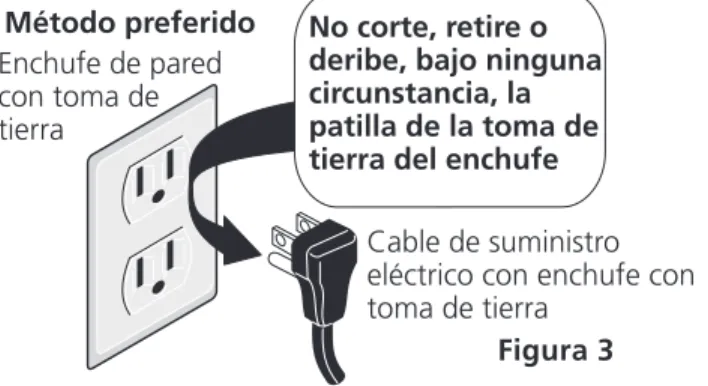
Preferred Method Grounding type wall receptacle
Do not, under any circumstances, cut, remove, or bypass the grounding prong.
Power supply cord with 3-prong grounding plug. Figure 3
Figure 2
2.
Electrical Requirements
120 volt, 60 Hertz, properly grounded dedicated circuit protected by a 15 amp circuit breaker or time delay fuse. Do not use an extension cord with this range.
Grounding Instructions
IMPORTANT Please read carefully.
For personal safety, this appliance must be properly grounded.
The power cord of this appliance is equipped with a 3-prong (grounding) plug which mates with a standard 3-prong grounding wall receptacle (see Figure 3) to minimize the possibility of electric shock hazard from the appliance.
The wall receptacle and circuit should be checked by a qualified electrician to make sure the receptacle is properly grounded.
Where a standard 2-prong wall receptacle is installed, it is the personal responsibility and obligation of the consumer to have it replaced by a properly grounded 3-prong wall receptacle.
Do not, under any circumstances, cut or remove the third (ground) prong from the power cord.
Disconnect electrical supply cord from wall receptacle before servicing range.
Shutoff Valve -Open position to appliance to gas suppl y line Figure 5
Use pipe-joint compound made for use with Natural and
LP/Propane gas to seal all gas connections. If flexible connectors are used, be certain connectors are not kinked.
The supply line must be equipped with an approved manual shutoff valve. This valve should be located in the same room as the range and should be in a location that allows ease of opening and closing. Do not block access to the shutoff valve. The valve is for turning on or shutting off gas to the appliance.
Once regulator is in place, open the shutoff valve in the gas supply line. Wait a few minutes for gas to move through the gas line.
Check for leaks. After connecting the range to the gas supply, check the system for leaks with a manometer. If a manometer is not available, turn on the gas supply and use a liquid leak detector (or soap and water) at all
joints and connections to check for leaks. Leaks will be
indicated by bubbles appearing at the connections or Assemble the flexible connector from the gas supply pipe to the pressure regulator in the following order:
1. Manual shut-off valve (not supplied) 2. 1/2" nipple (not supplied)
3. 1/2" flare union adapter (not supplied) 4. Flexible connector (not supplied) 5. 1/2" flare union adapter (not supplied) 6. 1/2" nipple (not supplied)
7. Pressure regulator (supplied)
3.
Gas Supply Installation
When shipped from the factory, this unit is designed to operate on 4"(10,16 cm) water column (1.0 kPa) Natural gas manifold pressure. A convertible pressure regulator is connected to the range manifold and MUST be connected in series with the gas supply line. The gas connector is located as shown on figure 2. It is accessible from front of the range.
For proper operation, the maximum inlet pressure to the regulator should be no more than 14"(35,56 cm) of water column pressure (3.5 kPa).
The inlet pressure to the regulator must be at least 1" (.25 kPa) greater than the regulator manifold pressure setting. The regulator is set for 4"(10,16 cm) water column (1.0 kPa) Natural gas manifold pressure; the inlet pressure must be at least 5"(12.60 cm) water column (1.25 kPa) Natural gas. For LP/Propane gas, the regulator must be set for 10"(25,4 cm) water column (2.5 kPa) manifold pressure; the inlet pressure must be at least 11"(27,9 cm) water column (2.75 kPa).
The supply line should be equipped with an approved shutoff valve (see Figure 4 and 5). This valve should be located in the same room as the range and should be in a location that allows ease of opening and closing. Do not block access to the shutoff valve. The valve is for turning on or shutting off gas to the appliance. Open the shutoff valve in the gas supply line. Wait a few minutes for gas to move through the gas line.
The gas supply between the shutoff valve and the regulator may be connected by rigid piping or by CSA-approved flexible metallic union-connected piping where local codes permit use.
The gas supply piping can be through the side wall of the right cabinet. The left side cabinet is an ideal location for the main shutoff valve, if the range is installed within cabinet storage space
Connection to Pressure Regulator
The regulator is already installed on the appliance.Do not make the connection too tight. The regulator is die cast. Overtightening may crack the regulator resulting in a gas leak and possible fire or explosion.
The gas supply line to the shutoff valve should be 1/2"(1,27 cm) or 3/4"(1.9 cm) solid pipe.
The user must know the location of the main shutoff valve and have easy access to it.
When using flexible gas conduit on the range, allow sufficient slack to pull the range outside the cutout for cleaning or servicing.
All connections must be wrench-tightened Figure 4 Flare Union Flare Union GAS FLOW Manual Shutoff Valve Pressure Regulator On
Off ConnectorFlexible Access Cap
Nipple Nipple
Do not use a flame to check for leaks from gas connections. Checking for leaks with a flame may result in a fire or explosion.
All openings in the wall or floor where the range is to be installed must be sealed.
Tighten all connections if necessary to prevent gas leakage in the cooktop or supply line.
Disconnect this range and its individual shutoff valve from the gas supply piping system during any pressure testing of the system at test pressures greater than 1/2 psig (3.5 kPa or 14"(35,56 cm) water column). Isolate the range from the gas supply piping system by closing its individual manual shutoff valve during any pressure testing of the gas supply piping system at test pressures equal to or less than 1/2 psig (3.5 kPa or 14"(35,56 cm) water column).
4.
LP/Propane Gas Conversion
This appliance can be used with Natural gas or LP/ Propane gas. It is shipped from the factory for use with natural gas.If you wish to convert your range for use with LP/ Propane gas, use the supplied fixed orifices located in a bag containing the literature marked "FOR LP/PROPANE GAS CONVERSION." Follow the instructions packaged with the orifices.
The conversion must be performed by a qualified service technician in accordance with the manufacturer's instructions and all local codes and requirements. Failure
to follow these instructions could result in serious injury
or property damage. The qualified agency performing this work assumes responsibility for the conversion.
Failure to make the appropriate
conversion can result in personal injury and property
damage.
5.
Moving the Appliance for
Servicing and Cleaning
Turn off the range line fuse or circuit breakers at the main power source, and turn off the manual gas shut-off valve. Make sure the range is cold. Open the oven door. Lift the range at the front and slide it out of the cut-out opening without creating undue strain on the flexible gas conduit. Make sure not to pinch the flexible gas conduit at the back of the range when replacing the unit into the cut-out opening. Close the door and switch on the electrical power and gas to the range.
6.
Range Placement
To eliminate the risk of burns or fire from reaching over heated surface units, cabinet storage space located above the range should be avoided. If cabinet storage space is to be provided, the risk can be reduced
by installing a range hood that projects horizontally a
minimum of 5" (12.7 cm) beyond the bottom of the cabinet.
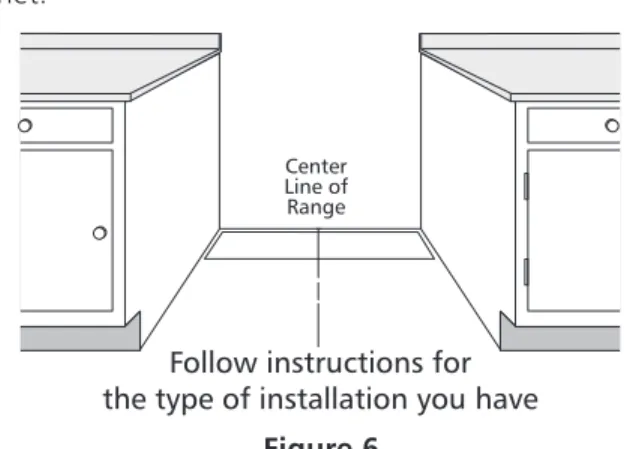
Figure 6
Follow instructions for the type of installation you have
Center Line of Range
If range will be installed with a cabinet on both sides, draw a center line on the floor between the cabinets (see figure 6). If back of range will not be flush with the wall (the location of the outlet may not allow the range to be positioned against the wall), draw a line on the floor where the back edge of the range will be. Now install anti-tip bracket (see "Anti-Tip Bracket Installation", page 9).
If range will be installed with a cabinet on one side only, move the range into final position. Draw a line on the floor along the side of the range that is not against the cabinet. If back of range will not be flush with the wall (the location of the outlet may not allow the range to be positioned against the wall), draw a line on the floor where the back edge of the range will be. Now install anti-tip bracket (see "Anti-Tip Bracket Installation", page 9).
If range will not be installed against a cabinet, move range into final position. Draw a line on the floor along both sides of the range. If back of range will not be flush with the wall (the location of the outlet may not allow the range to be positioned against the wall), draw a line on the floor where the back edge of the range will be. Now install anti-tip bracket (see "Anti-Tip Bracket Installation", page 9).
7.2
Check Operation
Refer to the Use and Care Guide and the Electronic Oven Control Guide packaged with the range for operating instructions and for care and cleaning of your range. Remove all packaging from the oven before testing. 1. Burner Bases and Burner Caps
This range is equipped with sealed burners as shown (Figure 8). All pieces are at their place. Take note where they are. Remove all packaging material located under the Dual Surface burner head. Make sure the burner is properly aligned and leveled. NOTE: There are
no burner adjustments necessary on this range.
Figure 8
2. Turn on Electrical Power and Open Main Shutoff Gas Valve
3. Check the Igniters
Operation of electric igniters should be checked after range and supply line connectors have been carefully checked for leaks and range has been connected to electric power. To check for proper lighting:
a. Push in and turn a surface burner knob to the LITE position. All electronic surface ignitors will spark at the same time. However, only the burner you are turning on will ignite.
b. The surface burner should light once the flow of gas reached the surface burner. Each burner should light within four (4) seconds in normal operation after air has been purged from supply lines. Visually check that burner has lit.
c. Once the burner lights, the control knob should be rotated out of the LITE position.
There are separate ignition devices for each burner. Try each knob separately until all burner valves have been checked.
Regular Burner Burner Cap
Fixed Burner Ring and Burner Base
Dual Surface Burner Burner Base
Fixed Burner Ring Burner Cap
7.
Range Installation
1. The back of the range may be installed directly against the wall.
2. To reduce possible scorching of vertical walls and to minimize potential fire hazards under abnormal surface unit use conditions such as high heat or no pans and to conform to Agency requirements: - A minimum of 5" (17.8 cm) spacing should be
provided on both sides of the cooktop.
Excessive Weight Hazard
• Use 2 or more people to move and install range. • Failure to follow this instruction can result in
back or other injury.
7.1
Leveling the Range
1. Install an oven rack in the center of the oven. 2. Place a level on the rack (see Figure 7). Take 2
readings with the level placed diagonally in one direction and then the other. Level the range, if
necessary, by adjusting the 4 leveling legs with a
wrench (see page 9).
3. Slide the range to its final position and double check for levelness. If the range is not level, pull unit out
and readjust leveling legs, or make sure floor is level.
A
B
5. Adjust the "LOW" Setting of the Dual Burner (see Figure 8) on the Surface Burner Valve (Figure 10):
Note: On the dual valve the low setting of each portion (rear portion of bridge burner and the center portion of
bridge burner) should be adjusted individually.
a. Push in and turn control to LITE until the rear portion of the bridge burner ignites only.
b. Quickly turn knob to LOWEST POSITION. c. If burner goes out, reset control to OFF. d. Remove the surface burner control knob.
e. The inner portion of the dual burner flame size can be increased or decreased by turning screw A (see Figure 10). Use screw B to adjust the flame size of the outer
portion of the dual burner. Turn counterclockwise the screw to increase flame size. Turn clockwise the
screw to decrease flame size. Adjust flame until you
can quickly turn knob from LITE to LOWEST POSITION without extinguishing the flame. Flame should be as small as possible without going out.
Note: Air mixture adjustment is not required on surface
burners.
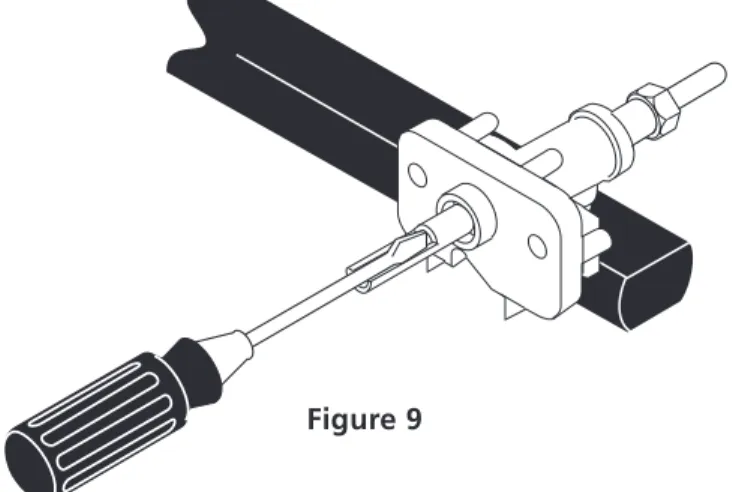
Figure 10 Figure 9
4. Adjust the "LOW" Setting of Regular Burner (see figure 8) on the Surface Burner Valves (Figure 9): a. Push in and turn control to LITE until burner ignites. b. Quickly turn knob to LOWEST POSITION.
c. If burner goes out, reset control to OFF. d. Remove the surface burner control knob and
decorative ring.
e. Insert a thin-bladed screwdriver into the hollow valve stem and engage the slotted screw inside. Flame size can be increased or decreased by turning the screw. Turn counterclockwise to increase flame size.
Turn clockwise to decrease flame size. Adjust flame
until you can quickly turn knob from LITE to LOWEST POSITION without extinguishing the flame. Flame should be as small as possible without going out. Note: Air mixture adjustment is not required on surface
When All Hookups are Complete
Make sure all controls are left in the OFF position.Before You Call for Service
Read the Before You Call for Service Checklist and operating instructions in your Use and Care Guide. It may save you time and expense. The list includes common occurrences that are not the result of defective workmanship or materials in this appliance.
Refer to your Use and Care Guide for Electrolux Service phone numbers, or call 1-877-4ELECTROLUX (1-877-435-3287).
6. Operation of Oven Burners and Oven
Adjustments
6.1 Electric Ignition Burners
Operation of electric igniters should be checked after range and supply line connectors have been carefully checked for leaks, and range has been connected to electric power.
The oven burner is equipped with an electric control system as well as an electric oven burner igniter. If your model is equipped with a waist-high broil burner igniter, it will also have an electric burner igniter. These control
systems require no adjustment. When the oven is set to
operate, current will flow to the igniter. It will "glow" similar to a light bulb. When the igniter has reached a temperature sufficient to ignite gas, the electrically controlled oven valve will open and flame will appear at the oven burner. There is a time lapse from 30 to 60 seconds after thermostat is turned ON before the flame appears at the oven burner. When the oven reaches the display setting, the glowing igniter will go off. The burner flame will go "out" in 20 to 30 seconds after igniter goes "OFF". To maintain any given oven temperature, this cycle will continue as long as the display is set to operate. After removing all packing materials and literature from the oven:
a) Set the oven to BAKE at 300°F. See Use & Care Guide for operating instructions.
b) Within 60 seconds the oven burner should ignite. Check for proper flame (see 6.2), and allow the burner to cycle
once (see cycle explanation above). Reset controls to off. c) If your model is equipped with a waist-high broiler
burner, set oven to broil. See Use & Care Guide for operating instructions.
d) Within 60 seconds the broil burner should ignite. Check
for proper flame (see 6.3). Reset controls to off.
Air Shutter Air Shutter
Waist-High Burner
Lower Oven Bottom (removable) Lower Oven Burner Baffle (removable) Figure 11
6.2 Oven Burner Flame Adjustment
The approximate oven burner flame length is 1 inch (distinct inner cone of blue flame).
To determine if the oven burner flame is proper, remove the oven bottom and burner baffle and set the oven to bake at 300°F.
To remove the oven bottom, remove oven hold down screws at rear of oven bottom. Pull up at rear, disengage front of oven bottom from oven front frame, and pull the oven bottom out of the oven. Remove burner baffle so that burner flame can be observed.
If the flame is yellow, increase air shutter opening size (see "2" in Figure 12). If the entire flame is blue, reduce the air shutter opening size.
To adjust flame loosen lock screw (see "3" in Figure 12),
reposition air shutter, and tighten lock screw. Replace oven bottom.
Oven Burner Tube
Orifice Hood Lock Screw Air Shutter
3
2
1
Figure 126.3 Broil Burner Flame Adjustment
The approximate flame length of the burner is 1 inch (distinct inner cone of blue flame). To determine if the broil burner flame is proper, set the oven to broil. If flame is yellow, increase air shutter opening size (see "2" in Figure 12 ). If the entire flame is blue, reduce the air shutter
opening size. To adjust, loosen lock screw (see "3" in
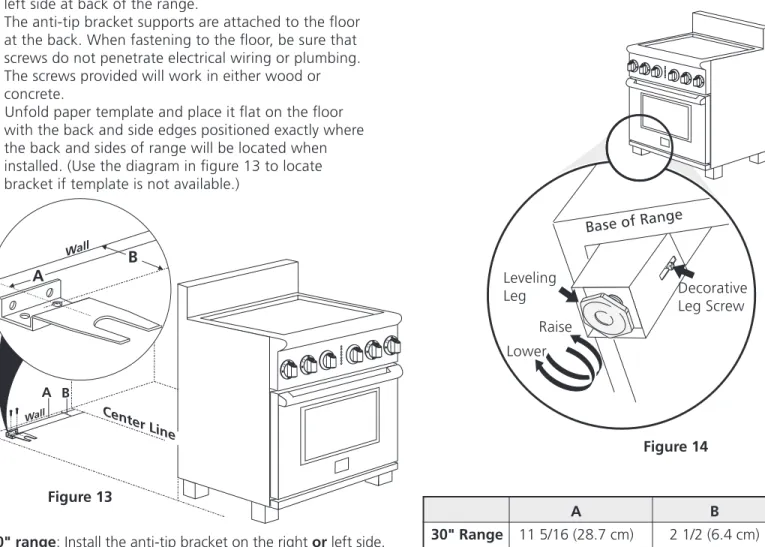
Figure 14 Base of Range Leveling Leg Lower Raise Decorative Leg Screw A Center Line Wall Wall B A B
4. Mark on the floor the location of the mounting holes shown on the template (right and left position). For easier installation, 3/16" (4.8 mm) diameter pilot holes 1/2" (1.3 cm) deep can be drilled into the floor.
5. Remove template and place bracket on floor (see figure 13). Line up holes in bracket with marks on floor and attach the bracket using the screws provided. Brackets must be secured to solid floor. If attaching to concrete floor, first drill 3/16" (4.8 mm) dia. pilot holes using a masonry drill bit.
6. Level range if necessary, by adjusting the 4 leveling legs with an adjustable wrench. Loosen the screw
which fixes the decorative leg and lift it to reach the leveling leg. Turn the leveling leg counterclockwise to raise the range or clockwise to lower the range (see Figure 14). Replace the decorative legs at your convenience.
7. Before sliding the range to its final position; take note of the serial and model numbers for future reference. Slide range into place making sure rear leg is trapped by the bracket. Range may need to be shifted slightly to one side as it is being pushed back to allow rear leg to align with bracket.
8. After installation, visually verify that the anti-tip brackets are engaged.
Important Safety Warning
To reduce the risk of tipping of the range, the range must be secured to the floor by the properly installed anti-tip bracket and screws packed with the range. These parts are located in a plastic bag in the oven. 30" Range has one bracket. Failure to install the bracket will allow the range to tip over if excessive weight is placed on
an open door or if a child climbs upon it. Serious injury
might result from spilled hot liquids or from the range itself.
Follow the instructions below to install the anti-tip bracket. If range is ever moved to a different location, the anti-tip bracket must also be moved and installed with the range. Tools Required:
5/16" (8 mm) Nut driver or Flat Head Screwdriver
Adjustable Wrench
Electric Drill
3/16" (4.8 mm) Diameter Drill Bit
3/16" (4.8 mm) Diameter Masonry Drill Bit (if installing in concrete)
Anti-Tip Bracket Installation
1. The anti-tip bracket must be install on the right or the left side at back of the range.
2. The anti-tip bracket supports are attached to the floor at the back. When fastening to the floor, be sure that screws do not penetrate electrical wiring or plumbing. The screws provided will work in either wood or concrete.
3. Unfold paper template and place it flat on the floor with the back and side edges positioned exactly where the back and sides of range will be located when installed. (Use the diagram in figure 13 to locate bracket if template is not available.)
30" range: Install the anti-tip bracket on the right or left side. Figure 13
A B
El diagrama del cableado de este modelo está incluido en esta manual (vea la pagina 28)
LA INSTALACIÓN Y EL SERVICIO DEBEN SER EFECTUADOS POR UN INSTALADOR CALIFICADO. IMPORTANTE: GUARDE ESTAS INSTRUCCIONES PARA USO DEL INSPECTOR LOCAL DE
ELECTRICIDAD. LEA Y GUARDE ESTAS INSTRUCCIONES PARA REFERENCIA FUTURA. OBSERVE CÓDIGOS GOBERNANTES Y ORDENANZAS.
Si la información contenida en este manual no es seguida exactamente, puede ocurrir un incendio o explosión causando daños materiales, lesión personal o la muerte.
PARA SU SEGURIDAD:
— No almacene ni utilice gasolina u otros vapores y líquidos inflamables en la proximidad de éste o de cualquier otro electrodoméstico.
— QUE DEBE HACER SI PERCIBE UN OLOR A GAS: • No trate de encender ningún electrodoméstico.
• No toque ningún interruptor eléctrico; no use ningún teléfono en su edificio. • Llame a su proveedor de gas desde el teléfono de un vecino. Siga las instrucciones
del proveedor de gas.
• Si no logra comunicarse con su proveedor de gas, llame al departamento de bomberos.
— La instalación y el servicio de mantenimiento deben ser efectuados por un instalador calificado, la agencia de servicio o el proveedor de gas.
Nota: Para electrodomésticos instalados en el estado de Massachussets. Vea página 11. P/N 318201775 (1104) Rev. C 13" Max. (33 cm Max.) 29 7/8" Mín. (75.9 cm Mín.) PARED PARED 18" Mín. (45.7 cm Mín.)
F
G
A B C D ENOTA: Un espacio mínimo de 24" (61 cm) entre la superficie de la estufa y el fondo del armario cuando el fondo del armario de madera o metal está protegido por no menos de 1/4" (0.64 cm) de madera resistente al fuego cubierta por una lámina metálica de MSG, número 28, 0.015" (0.4 mm) de acero inoxidable, 0.024" (0.6 mm) de aluminio, o 0.02" (0.5 mm) de cobre.
Un espacio mínimo de 30" (76.2 cm) cuando el armario no está protegido.
No pellizque el cordón eléctrico entre la estufa y la pared. No selle la estufa a los armarios laterales.
Si hay una pared:
5" Mín. (12.7 cm Mín.) lado derecho 24" Mín. (61 cm Mín.) 24 1/2" Máx. (62.2 cm Máx.) Tomacorriente de pared puesto a tierra Véa Nota
Si hay una pared:
5" Mín. (12.7 cm Mín.) lado izquierdo Figura 1 B. ANCHO 29 7/8" ( 75.9 cm) C. PROFUNDIDAD AL FRENTE DE LA ESTUFA 27 1/2" (69.9 cm) E. PROFUNDIDAD CON PUERTA ABIERTA 45 1/2" (115.6 cm) F. ALTURA DE MOSTRADOR 36" (91.4 cm) Standard 35 3/4" (90.8 cm) Min. G. ANCHO MíNIMO PARA LA ABERTURA 30 1/16" (76.4 cm) A. ALTURA 41 5/8" (105.7 cm) Min. 42 5/8" (108.3 cm) Max. D. ALTURA DE LA CUBIERTA 35 3/4" (90.8 cm) Min. 36 3/4" (93.3 cm) Max.
Nunca deje niños solos o desatendidos en un área donde un
electrodoméstico está siendo usado. A medida que los niños crecen, enséñeles el uso apropiado y seguro para todos los electrodomésticos. Nunca deje la puerta del horno abierta cuando la estufa está desatendida.
No se pare, apoye o siente en las puertas o cajones de esta estufa pues puede resultar en serias lesiones y puede también causar daño a la estufa.
• No almacene artículos que puedan interesar a los niños en los gabinetes sobre la estufa. Los niños pueden quemarse seriamente tratando de trepar a la estufa para alcanzar estos artículos.
• Los gabinetes de almacenamiento sobre la estufa deben evitarse, para eliminar la necesidad de tener que pasar sobre los elementos superiores de la estufa para llegar a ellos.
• Ajuste el tamaño de la llama de los quemadores superiores de tal manera que ésta no sobrepase el borde de los utensilios de cocinar. La llama excesiva es peligrosa.
• No use el horno como espacio de almacenaje. Esto creará una situación potencialmente peligrosa.
• Nunca use la estufa para calentar el cuarto. El uso prolongado de la estufa sin la adecuada ventilación puede resultar peligroso.
• No almacene ni utilice gasolina u otros vapores y líquidos inflamables en la proximidad de éste o de cualquier otro electrodoméstico eléctrico. Puede provocar incendio o explosión.
• En caso de una interruptión del servicio eléctrico, es posible de encender los quemadores de superficie a mano. Para encender un quemador de superficie, acerque un fósforo encendido a la cabezal del quemador, y gire rápidamente el botón de control de superficie a Med. Tenga cuidado al encender los quemadores a mano.
• Retire el sartén asador, alimentos o cualquier otro utensilio antes de ajustar un ciclo de auto-limpieza en el horno. Limpie el exceso de derrames. Siga las instrucciones en manual de Uso y Cuidado. • A diferencia de otras cubiertas a gas, ESTA
CUBIERTA no es removible. No intente remover esta cubierta.
Instrucciones especiales para los electrodomésticos instala-dos en el estado de Massachussets: Este electrodoméstico puede ser solamente instalado en el estado de Massachus-sets por un plomero calificado o instalador de gas con licencia en el estado de Massachussets. Cuando se utilice un conector flexible de gas, éste no debe de exceder 3 pies (36 pulgadas) de largo. Una válvula manual de tipo “T” debe de instalarse en la línea de alimentación de gas hacia este electrodoméstico.
• Todas las estufas pueden volcarse.
• Esto podría resultar en lesiones personales. • Instale el dispositivo antivuelco provisto con
esta estufa.
Para reducir el riesgo de que se vuelque la estufa, hay que asegurarla adecuadamente colocando Los soportes antivuelco que se proporcionan. Para comprobar si estos estan
instalados y apretados correctamente, tome el borde trasero superior de la estufa y cuidadosamente inclínela hacia adelante para asegurarse que la estufa esté anclada.
IMPORTANTES INSTRUCCIONES
DE SEGURIDAD
Instalación de esta estufa debe cumplir con todos los códigos locales, o en ausencia de códigos locales con el Código Nacional de Gas Combustible ANSI Z223.1 / NFPA 54. Esta estufa ha sido diseñada y certificada por el organismo CSA Internacional. Como en cualquier electrodoméstico donde se use gas y se genere cierto calor, existen diversas precauciones de seguridad que deben ser seguidas. Usted encontrará esta lista de precauciones en el manual de Uso y Cuidado, por favor léalas cuidadosamente.
• Asegúrese de que la estufa sea instalada y conectada a tierra en forma apropiada por un instalador calificado o por un técnico.
• Esta estufa debe ser eléctricamente puesta a tierra de acuerdo con los códigos locales, o en su ausencia, con el Código Eléctrico Nacional ANSI/ NFPA No. 70, última edición.
• Asegúrese de que el material que recubre las paredes alrededor de la estufa, pueda resistir el calor generado por la estufa.
• Antes de instalar la estufa en un área cuyo piso este recubierto con linóleo u otro tipo de piso sintético, asegúrese de que éstos puedan resistir una temperatura de por lo menos 90°F sobre la temperatura ambiental sin provocar encogimiento, deformación o decoloración. No instale la estufa sobre una alfombra al menos que coloque una plancha de material aislante de por lo menos 1/4 pulgada, entre la estufa y la alfombra. • No obstruya el flujo del aire de combustión en la
ventilación del horno ni tampoco alrededor de la base o debajo del panel inferior delantero de la estufa. Evite tocar las aberturas o áreas cercanas de la ventilación, ya que pueden estar muy calientes durante el funcionamiento del horno. La estufa requiere aire fresco para la combustión apropiada de los quemadores.
No utilice película de aluminio a la base del horno u otra parte del aparato. Sólo utilizela
Notas importantes para el Instalador
1. Lea todas las instrucciones contenidas en este manual antes de instalar la estufa.
2. Saque todo el material usado en el empaque del compartimiento del horno antes de conectar el suministro eléctrico a la estufa.
3. Observe todos los códigos y reglamentos pertinentes. 4. Deje estas instrucciones con el comprador.
5. Nota: Para el correcto funcionamiento en lugares superiores a los 2000 ft, el régimen del mecanismo debe reducirse un 4% por cada 1000 ft sobre el nivel del mar.
Nota Importante para el Consumidor
Conserve estas instrucciones y el Manual del Usuario para referencia futura.
Artículos Disponibles Opcionales:
• Una Kick plata de Acero Inoxidable. • Un empaque de perillas negro.Estos juegos se pueden ordenar para comprar mediante Service Center 1-877-4ELECTROLUX (1-877-435-3287).
1.
Ubicación del Número de Modelo y de
Serie
La placa de serie se encuentra en la parte trasera de la estufa.
Cuando haga pedidos de repuestos o solicite información con respecto a su estufa, esté siempre seguro de incluir el número de modelo y de serie y el número o letra del lote de la placa de serie de su estufa.
Conector de gas
No corte, retire o deribe, bajo ninguna circunstancia, la patilla de la toma de tierra del enchufe
Cable de suministro eléctrico con enchufe con toma de tierra Método preferido Enchufe de pared con toma de tierra Figura 3
2.
Requisitos eléctricos
120 voltio, 60 Hertzio, circuito dedicado apropiadamente puestos a tierra protegido por un circuito de amperio o fusible de demora de tiempo de 15 amp.
No utilice una extensión con esta estufa.
Instrucciones de puesta a tierra
IMPORTANTE Por favor lea con cuidado.Para la seguridad personal, este aparato debe ser puesto a tierra apropiadamente.
El cable del suministro eléctrico de esta estufa está equipado con un enchufe de tres patillas (para puesta a tierra) que coincida con un enchufe de pared estándar con puesta a tierra de tres patillas para minimizar la posibilidad que se produzcan descargas eléctricas. El cliente deberá encargar a un técnico para asegurarse de que el enchufe se encuentra debidamente conectado a tierra y polarizado.
En lugares en los que aya un enchufe de pared estándar de dos patillas, el cliente tendrá responsabilidad directa y la obligación de reemplazarlo por un enchufe de pared de tres patillas debidamente cableado a tierra.
Bajo ninguna circunstancia, corte, retire o deribe la tercera patilla (de toma de tierra) del cable del suministro de energía eléctrica.
Desenchufa el cable del suministro de energía eléctrica del enchufe de pared antes de mantener la estufa.
Figura 2 Placa de serie
Válvula de cierre -Abierta Electr odoméstico A la linea de gas Figura 5
Use un compuesto para juntas de tubería apropiado para el uso con gas natural y de LP/Propano para sellar todas las conexiones de gas. Si se usan conectores flexibles asegúrese de que no estén enroscados.
La línea del suministro se debe equipar de una válvula de cierre manual aprobada. Esta válvula se debe localizar en el mismo cuarto que la estufa y debe estar en una localización que permita el fácil acceso para abrir y cerrar. No obstruya el acceso a la válvula. La válvula abre o cierra el suministro de gas a la estufa.
Una vez que regulador está en su lugar, abra la válvula en la línea del suministro de gas. Espere algunos minutos para que el gas pase a través de la línea de gas.
Asegúrese de que no haya escapes de gas. Después de conectar la estufa al suministro de gas, compruebe el sistema con un manómetro. Si no tiene un manómetro, abra el gas y use un detector de fugas líquido en todas las juntas y conexiones para averiguar si hay escapes de gas.
3.
Instalación de la alimentación de
gas
Esta unidad ha sido ajustada de fábrica para operar con una tubería para gas natural de 4" (1.0 kPa). Un regulador de presión de conversión está conectado a la válvula distribuidora y DEBE ser conectado en serie con la tubería de suministro de gas (figura 2).
Para la operación apropiada, la máxima presión de entrada al regulador no debe exceder la presión de una tubería de agua de 14 pulgadas (3.5 kPa).
La presión de entrada al regulador debe ser por lo menos 1 pulgada más grande que la válvula distribuidora (.25 kPa). El regulador ha sido ajustado para gas natural a 4 pulgadas de presión para la válvula distribuidora (1.0 kPa). La presión de entrada debe ser por lo menos de 5 pulgadas (1.25 kPa). Para propano líquido a 10 pulgadas de presión para la válvula distribuidora (2.5 kPa) la presión de entrada debe ser por lo menos de 11 pulgadas (2.75 kPa).
La tubería deberá ser equipada con una válvula de cierre aprobada (vea Figura 4 & 5). Esta válvula debe ubicarse en la misma habitación que la estufa en un lugar que permita una una facilidad de abrir y cerrar. No bloquée el acceso a la válvula de cierre. La válvula abre o cierra es para abrir o cerrar el suministro de gas al aparato. Abra la válvula de cierre en la línea de suministro de gas. Espere unos minutos a que el gas pase por el tubo.
El suministro de gas entre la válvula de cierre y el regulador se puede conectar con tubería rígida o con tubería flexible unión metálica conectada y aprobada por la CSA donde los códigos locales permiten.
La tubería del suministro de gas puede pasar por la pared lateral del armario derecho. El armario lateral izquierda es un lugar ideal para la válvula de cierre pincipal.
Conexión del regulador
El regulador esta instalado en el electrodoméstico.
Asegurese de no apretar demasiado la conexión. El sobre apretar la conexión puede romper el regulador u generar una fuga de gas y posiblemente un incendio o explosión.
La tubería de suministro de gas debe ser de 1/2"(1,27 cm) o 3/4"(1.9 cm) D.I.
El consumidor debe saber la posición de la válvula principal de cierre y tener acceso fácil a esta.
NOTA: No permita que el conducto se pellizque entre la pared y la estufa. Para verlo, saque el cajón.
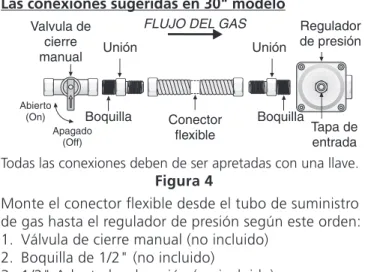
Todas las conexiones deben de ser apretadas con una llave.
Figura 4 Unión
FLUJO DEL GAS Valvula de cierre manual Regulador de presión Abierto (On) Apagado (Off) Conector
flexible Tapa deentrada
Boquilla Boquilla
Unión
Monte el conector flexible desde el tubo de suministro de gas hasta el regulador de presión según este orden: 1. Válvula de cierre manual (no incluido)
2. Boquilla de 1/2" (no incluido)
3. 1/2" Adaptador de unión (no incluido) 4. Conector flexible (no incluido)
5. 1/2" Adaptador de unión (no incluido) 6. Boquilla de 1/2" (no incluido)
7. Regulador de presión (incluido)
No use flama para verificar que no hayan pérdidas de gas. La comprobación de pérdidas de gas con una flama puede resultar en un incendio o explosión.
Se debe sellar todas las aberturas en la pared o el piso donde la estufa esté instalada.
Apriete todas las conexiones si hace falta para prevenir fugas de gas en la superficie de la estufa o en la linea de suministro.
Desconecte esta estufa y su válvula individual de cierre del sistema del siministro de gas durante cualquier prueba de presión de ese sistema a presiones mayores de 1/2 psig (3.5 kPa o 14"(35,56 cm) columna de agua). Aisle la estufa del sistema del suministro de gas cerrando su válvula manual de cierre individual durante cualquier prueba de presión del suministro del gas a presiones iguales a menos de 1/2 psig (3.5 kPa o 14"(35,56 cm) columna de agua).
4.
Conversión para uso de Propano
Líquido
Este aparato puede ser usado con gas natural o propano líquido. Ha sido ajustado en la fábrica para operar con gas natural solamente.
Si desea convertir su estufa para uso con propano líquido, use las espreas provistas ubicados en el bolso que contiene la literatura titulada "FOR LP/PROPANE GAS CONVERSION". Siga las instrucciones que vienen con las espreas.
La conversión debe efectuarse por un técnico de servicio capacitado, de acuerdo con las instrucciones del fabricante y con todos los códigos y requisitos de las autoridades correspondientes. El no seguir las instrucciones podría dar como resultado lesiones graves o daños a la propiedad. El organismo autorizado para llevar a cabo este trabajo asume la responsabilidad de la conversión.
La falta de una conversión apropiada puede resultar en lesiones graves y daños a la propiedad.
5.
La mudanza del aparato para
reparaciones o limpieza
Corte la corriente eléctrica a la estufa a la fuente de poder principal, y cierre la válvula manual de gas. Asegúrese de que la estufa esté fría. Abra la puerta del horno. Levante el frente de la estufa y deslícela fuera de la abertura sin crear tensión desmedida sobre el conducto flexible de gas. Asegúrese de no pellizcar el conducto flexible de gas detrás de la estufa al reinstalar la unidad en la abertura. Cierre la puerta y abra el gas y la corriente eléctrica a la estufa.
6.
Estufa - Colocación
Para eliminar el riesgo de quemaduras o fuego por el contacto de superficies sobrecalentadas, cualquier espacio de almacenaje en los gabinetes situados sobre la estufa debe ser evitado. Si un espacio de
almacenaje debe de ser proporcionado, el riesgo puede ser reducido instalando una campana de estufa que proyecte horizontalmente e un mínimo de el 5"(12.7 centímetros).
Figura 6
Follow instructions for the type of installation you have
Center Line of Range
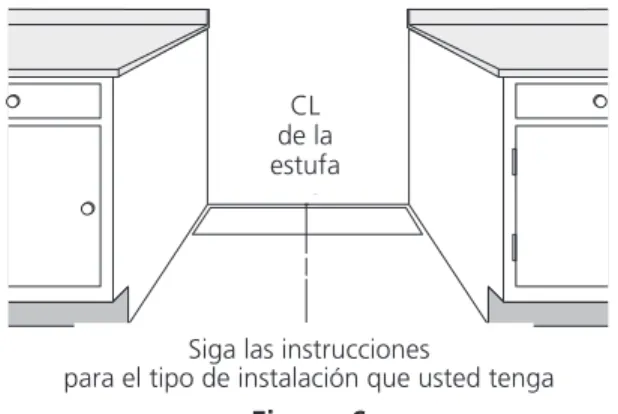
Si la estufa se va a instalar con armarios laterales, marque el centro de la abertura del armario en el piso (ver la figura 6). Si la parte trasera de la estufa no estará a ras con la pared (la ubicación del tomacorriente puede que no permita que la estufa se pegue a ras con la pared), marque el piso donde estará el border trasero de la estufa. Ponga el patrón en el piso, alineando la línea del centro del patrón con la marca en el centro de la abertura del armario. Ponga el borde trasero del patrón a ras contra la pared trasera o la línea marcada para la parte de atrás de la estufa.
Si la estufa se va a instalar con un armario en un sólo un lado, mueva la estufa a su posición final. Marque el piso por el lado de la estufa que no estará contra el armario. Si la parte trasera de la estufa no esta al ras con la pared (la ubicación del tomacorriente puede que no permita que la estufa se pegue al ras con la pared), marque el piso donde el borde trasero de la estufa estará. Ponga el patrón en el piso y alinie el lado del patrón con la línea marcada en el piso. Alinie la parte trasera del patrón con la pared trasera o la línea mar-cada para la parte de atrás de la estufa.
Si la estufa no será instalada junto a un armario, mueva la estufa a su posición final. Marque el piso por los dos lados de la estufa. Si la parte trasera de la estufa no estará a ras con la pared (la ubicación del tomacorriente puede que no permita que la estufa se pegue a ras con la pared), marque en el piso donde el borde trasero de la estufa estará. Ponga el patrón en el piso y alinie los lados del patrón con las líneas marcadas en el piso. Alinie la parte trasera del patrón con la pared trasera o la línea marcada para la parte trasera de la estufa.
Siga las instrucciones
para el tipo de instalación que usted tenga CL
de la estufa
7.2 Comprobación del Funcionamiento
Consulte el Manual del Usuario incluído con la estufa para instrucciones de operación y instrucciones para el cuidado y limpieza de su estufa.Quite todo el embarque de la unidad antes de comprobarla.
1. Bases y tapas de los quemadores.
Esta estufa esta equipada con quemadores sellados como se muestra más abajo (Figura 8).Todas las piezas están en su lugar. Tome nota en donde están. Quite todo el material de protección localizado bajo la cabeza del quemador de dual.NOTA:No hace falta ningún ajuste de quemador en esta estufa.
2. Encienda la corriente eléctrica y abra la válvula principal de alimentación.
3. Comprobación de los Encendedores
El funcionamiento de las bujías electrónicas desde ser comprobado una vez que los conectores del suministro de gas han sido verificados y no exista ningún tipo de fuga. Y el suministro de electricidad se conecte a la estufa.
Para verificar un encendido correcto:
A. Presione y gire a una perilla a la posición de LITE. Todos las bujías electrónicas chispearán al mismo tiempo. Sin embargo, solamente el quemador que usted se está girando encenderá.
B.El quemador se deberá encender en cuatro (4) segundos para un funcionamiento normal, luego de que el aire haya sido purgado de la tubería de suministro de gas. Controle visualmente que el quemador se hay encendido.
C.Luego que el quemador se haya encendido, la perilla debe ser girada fuera de la posición LITE.
Cada quemador tiene su encendedor individual. Controle las perillas separadamente hasta que todas las válvulas hayan sido controladas.
Figura 8
7.
Instalación de la estufa
1. La parte trasera de la estufa puede ser directamente instalada a ras con la pared trasera de la estructura. 2. Para reducir posibles marcas o rayas de las paredes
verticales y minimizar los riesgos de choques eléctricos en caso de condiciones de uso anormales como alto calor o no cazuelas, y para conformar a los requisitos de A.G.A:
- Para la estufa de 30", un espacio mínimo de 5" (17.8 cm) debe de ser provisto en ambos lados de la plancha de cocinar.
7.1 Nivelación de la estufa
1. Coloque una parrilla del horno en el centro del horno.
2. Ponga un nivel sobre la parrilla (figura 7). Ponga un nivel sobre la parrilla. Tome dos lecturas con el nivel puesto diagonalmente en una dirección y después en la otra. Nivele la estufa, si es necesario, ajustando las 4 patas niveladoras con una llave de tuercas (vea la página 18).
3. Deslice la estufa a su posición final y verifique dos veces la nivelación de la unidad. Si la estufa no esta nivelada, jale la unidad y reajuste las patas niveladoras, o asegúrese que su piso este nivelado.
Figura 7
Peligro de Peso Excesivo
• Use 2 personas o más para mover e instalar la estufa. • Si no cumple con esta instrucción, usted podrá
lesionarse la espalda u otra parte de su cuerpo.
Quemador regular
Tapa de quemador
Anillo fijo y base fijo de quemador Base de quemador Tapa de quemador Anillo fijo de quemador Quemador doble
A
B
4. Ajuste bajo ("LO") para la válvula de losquemado-res de superficie estandar (Figuras 8 y 9)
a. Presione y gire el control hasta la posición LITE para prender los quemadores.
b. Gire rápidamente gire la perilla a la POSICION MAS BAJA.
c. Si el quemador se apaga, reajuste el control a OFF. d. Retire la perilla y el anillo del quemador de superficie. e. Inserte un destornillador fino-aplanado en el orifico del
vástago de la válvula e inserte en el tornillo ranurado. El tamaño de la llama puede aumentarse o disminuirse dándole vuelta al tornillo. Dé vuelta en sentido opuesto a las manecillas del reloj para aumentar el tamaño de la llama. Dé vuelta en sentido a las manecillas del reloj para disminuir la llama. Ajuste la llama hasta que usted puede dar vuelta rápidamente a la perilla de la posición LITE a la POSICIÓN MÁS BAJA sin extinguir la llama. La llama debe ser tan pequeña como sea posible sin apagarse.
5. Ajuste bajo "LOW" para la válvula de quemador de superficie Dual (vea Figura 8 y 10)
Nota: En la válvula de quemador triple el ajuste «LOW» de cada porción (porción posterior del quemador puente y la porción de centro del quemador del puente) se debe ajustar individualmente.
a. Presione y gire el control a la posición LITE hasta que la porción posterior del quemador puente se encienda. b. Gire rápidamente a la perilla a la POSICIÓN MÁS BAJA. c. Si el quemador se apaga, reajuste el control a OFF. d. Retire la perilla del quemador de superficie.
e. El tamaño de la flama de la porción posterior del que-mador puente puede aumentarse o disminuirse dándo-le vuelta al tornillo A (vea Figura 14). Utilice el tornillo B para ajustar el tamaño de la llama de la porción central del quemador puente o del quemador triple. Dé vuelta en sentido opuesto de las manecillas del reloj para aumentar el tamaño de la llama. Dé vuelta en sentido a las manecillas del reloj para disminuir la llama. Ajuste la llama hasta que usted puede dar vuelta rápi-damente a la perilla de la posición LITE a la POSICIÓN MÁS BAJA sin extinguir la llama. La llama debe ser tan pequeña como sea posible sin apagarse.
Nota: El ajuste de la mezcla del aire no se requiere en los quemadores de superficie.
Figura 10 Nota: El ajuste de la mezcla del aire no se requiere en
los quemadores de superficie
6. Operación de Quemadores del Horno y
Ajustes de Horno
6.1 Quemadore de ignición eléctrica
La operación de los encendores eléctricos debe de ser revisada después de que la cocina y los conectores de la línea de suministro haya sido cuidadosamente revisada para descartar fugas y que la cocina haya sido conectada a la coriente eléctrica.
El quemador del horno está equipado con un sistema de control eléctrico así como un encendedor de quemador de horno eléctrico. Si su modelo esta equipado con un quemador de asado central superior, también contará con un encendedor de quemador eléctrico. Estos sistemas de control no requieren ajustes. Cuando el horno esta configurado para operar, la coriente fluirá hacia el encendedor y tendrá un resplandor de manera similar a una bombilla de luz. Cuando el encendedor a alcanzado una temperatura suficiente para encender el gas, la válvula del horno controlada eléctricamente se abrirá y el fuego aparecerá en el quemador del horno. hay un lapso de tiempo de 30 a 60 segundos depués de que el termostato se enciende y antes de que la llama aparezca en el quemador del horno. Cuando el horno alcanza la configuración del dial, el encendedor resplandeciente se apagará. La llama del quemador desaparecerá por 20 a 30 segundos después de que el encendedor se apage. Para mantener cualquier temperatura de horno dada, este ciclo continuará tanto como el dial (o visualizador) esté configurado para operar.
Después de retirar todos los materiales del empaque y la literatura del horno:
a) Fije el horno en hornEAr (bAKE) a 300°F. Vea la guía de Uso y Cuidado para conocer las instrucciones de funcionamiento.
b) En 60 segundos el quemador del horno se encenderá. Revise que exista un fuego adecuado (vea 6.2), y permita que el quemador cumpla su ciclo una vez. Gire los controladores hacia off (APAGADO).
c) Si su modelo esta equipado con un asador central superior, fije el horno en ASAR. Vea la Guía de Uso y Cuidado para conocer las instrucciones de funcionamiento.
d) En 60 segundos el quemador de asar debe de encenderse. Revise si exista una llama adecuada (vea 6.3). Gire los controles hacia off (APAGADO).
Si la llama es de color amarillo, aumente el tamaño de la abertura del obturador de aire (Vea el tamaño "2" en el figura 12). Si la llama es de azul claro, reduzca el tamaño de la abertura del obturador de aire, y ajuste el tornillo de cierre (Vea el tamaño "3" en el figura 12).
6.2 Obturador del Aire - Quemador del horno La longitud aproximada de la llama del quemador del horno es 1 pulgada (interior claro, llama azul). Para determinar si la llama del quemador de horno es la adecuada, retire el fondo del horno y el deflector del quemador i fije el horno en la opción hornear a 300°F. Para retirar el fondo del horno, retire los tornillos de ajuste del horno en la parte posterior del fondo del horno. jale hacia arriba, desenganche el frente del fondo del marco anterior del horno, y jale la base hacia a fuera de éste. retire el deflector del quemador de manera que la llama del quemador pueda ser observada.
Si la llama es de color amarillo, aumente el tamaño de la abertura del obturador de aire (Vea el tamaño "2" en el figura 12). Si la llama es de azul claro, reduzca el tamaño de la abertura del obturador de aire. Para ajustar un tornillo de cierre flojo (Vea el tamaño "3" en el figura 12), vuelva a colocar el obturador de aire, y ajuste el tornillo de cierre. Reemplace el fondo del horno.
6.3 Obturador de aire - Quemador de asado La longitud aproximada de la llama del quemador de asado es 1 pulgada (interior claro, llama azul). Para determinar si la llama del quemador de asado es la adecuada, poner el horno en la opción asar.
Tubos del quemador del horno
Tapa del orificio Obturador de aire Figura 12
3
2
1
Tornillos de seguridadDespués de Terminar la Instalación
Asegúrese de que todos los controles estén en la posición OFF (apagada).Antes de Llamar al Servicio
Lea la sección Lista de control de averías en su Manual del Usuario. Esto le podrá ahorrar tiempo y gastos. Esta lista incluye ocurrencias comunes que no son el resultado de defectos de materiales o fabricación de este artefacto. Refiérase a su manual de Uso y Cuidado para la lista telefónica del servicio o llame al 1-877-4ELECTROLUX (1-877-435-Obturador
de aire
Parte inferior del horno (extraíble) Quemador a la altura de la cintura Deflector inferior del horno (extraíble) Obturador de aire
Importante Advertencia de Seguridad
Para reducir el riesgo de que la estufa se vuelque, es necesario asegurarla al piso instalando los soportes antivuelco y los tornillos suministrados con la estufa. Las piezas se encuentran en un saco de plasticó en el horno. Si no se instalan los soportes antivuelco, la estufa se puede volcar si se coloca exceso de peso en una puerta abierta o si un niño se sube a ella. Se pueden ocasionar lesiones graves causadas por los líquidos calientes derramados o por la estufa misma.Siga las instrucciones que más abajo se indican para instalar los soportes antivuelco.
Si la estufa es movida a otro lugar, los soportes
antivuelco deben también ser movidos e instalados en la estufa.
Herramientas Necesarias:
Llave de tuerca de 5/16" (8 mm) o destornillador para tornillos de cabeza plana
Llave inglesa Taladro eléctrico
Broca de 3/16" (4.8 mm) de diámetro
Broca para taladro de mampostería de 3/16" (4.8 mm) de diám. (si se está instalando en concreto).
Instrucciones de Instalación del
Soporte Antivuelco
1. Estufa de 30": El soporte antivuelco debe de ser instalado en el lado derecho o izquierdo en la parte trasera de la unidad.
2. El soporte-base debe de fijarse al piso en la parte posterior. Cuando los fije al piso, asegúrese que los tornillos no toquen ningún cable eléctrico o instalaciones de plomería. Los tornillos provistos funcionaran en madera o concreto.
3. Desdoble la plantilla de papel y colóquela en el piso con la parte posterior y los bordes laterales colocados exactamente donde la parte posterior y los lados de la estufa serán localizados cuando este instalada. (utilice el diagrama en el cuadro 14 para situar el soporte si la plantilla no está disponible.)
4. Marque en el piso la localización de los agujeros de montaje demostrados en la plantilla (posición derecha y izquierda). Para una instalación más fácil, los agujeros 1/2"(1.3 centímetros) de diámetro y 3/16" (4.8 milímetros) de profundidad pueden perforarse en el piso.
5. Quite la plantilla y coloque los soportes en piso (véase figura 13). Alinee los agujeros en soporte con las marcas en piso y una el soporte usando los tornillos proporcionados. El soporte se debe asegurar al piso sólido. Si se ajusta a un piso concreto, primero taladre agujeros con un diámetro de 3/16"(4.8 milímetros) usando un taladro de la albañilería.
6. Nivele la estufa si es necesario, ajustando las 4 patas niveladoras con una llave ajustable. Afloje el tornillo que fija la pata decorativa y levántelo para alcanzar la pata de nivelación. Dé vuelta a la pata de nivelación a la izquierda para levantar la estufa o a la derecha para bajar la estufa (véase la figura 14). Reemplace las patas decorativas según su conveniencia.
7. Antes de deslizar la estufa hacia su posición final; tome la nota del número de serie y de modelo para referencia futura. Deslice la estufa a su lugar y asegúrese que las patas traseras estén ancladas en los soportes. La estufa podrá necesitar ser inclinada levemente hacia un lado mientras que se está empujando para permitir que las patas posteriores se alineen con los soportes.
8. Después de la instalación, verifique visualmente que los soportes antivuelco estén correctamente enganchados (anclados).
Base de la estufa Pata Nive-ladora Disminuir Aumentar Tornillo de la pata decorativa Figura 14
Estufa de 30": El soporte antivuelco debe de ser instalado en
A B Estufa 30" 11 5/16 (28.7 cm) 2 1/2 (6.4 cm) Estufa 36" 14 5/16 (36.4 cm) 1 5/8 (4.1 cm) A B A B Pared Línea central Pared Figura 13