NDN, Technical Report NDN-0021. http://named-data.net/techreports.html
NFD Developer’s Guide
Alexander Afanasyev
1, Junxiao Shi
2, Beichuan Zhang
2, Lixia Zhang
1, Ilya Moiseenko
1, Yingdi Yu
1,
Wentao Shang
1, Yi Huang
2, Jerald Paul Abraham
2, Steve DiBenedetto
3, Chengyu Fan
3, Christos
Papadopoulos
3, Davide Pesavento
4, Giulio Grassi
4, Giovanni Pau
4, Hang Zhang
5, Tian Song
5, Haowei
Yuan
6, Hila Ben Abraham
6, Patrick Crowley
6, Syed Obaid Amin
7, Vince Lehman
7, and Lan Wang
7 1University of California, Los Angeles
2
The University of Arizona
3Colorado State University
4
University Pierre & Marie Curie, Sorbonne University
5Beijing Institute of Technology
6
Washington University in St. Louis
7The University of Memphis
NFD Team
Abstract
NDN Forwarding Daemon (NFD) is a network forwarder that implements the Named Data Networking (NDN) protocol. NFD is designed withmodularity and extensibility in mind to enable easy experiments with new protocol features, algo-rithms, and applications for NDN. To help developers extend and improve NFD, this document explains NFD’s internals including the overall design, major modules, their implementations, and their interactions.
Revision history
Revision Revision date Description
1 July 1, 2014 Initial release
2 August 25, 2014 Updated steps in forwarding pipelines,nfd::BestRouteStrategy
is replaced with nfd::BestRouteStrategy2 that allows
client-based recovery from Interest losses
Contents
1 Introduction 4
1.1 NFD Modules . . . 4
1.2 How Packets are Processed in NFD. . . 5
1.3 How Management Interests are Processed in NFD . . . 6
2 Face System 7 2.1 Face URI . . . 7
2.2 Protocol Factory Abstraction . . . 9
2.3 Channel Abstraction . . . 9
2.4 Face Abstraction . . . 10
2.5 Extending NFD Face System . . . 11
3 Tables 12 3.1 Forwarding Information Base (FIB) . . . 12
3.1.1 Structure and Semantics. . . 12
CONTENTS CONTENTS
3.2 Content Store (CS) . . . 13
3.2.1 Semantics and Usage. . . 13
3.2.2 Implementation. . . 13
3.3 Interest Table (PIT) . . . 15
3.3.1 PIT Entry. . . 15
3.3.2 PIT . . . 16
3.4 Strategy Choice Table . . . 16
3.4.1 Structure and Semantics. . . 17
3.4.2 Usage . . . 17 3.5 Measurements Table . . . 17 3.5.1 Structure . . . 18 3.5.2 Usage . . . 18 3.6 NameTree . . . 18 3.6.1 Structure . . . 18
3.6.2 Operations and Algorithms . . . 20
3.6.3 Shortcuts . . . 21
4 Forwarding 22 4.1 Forwarding Pipelines . . . 22
4.2 Interest Processing Path . . . 22
4.2.1 Incoming Interest Pipeline. . . 23
4.2.2 Interest Loop Pipeline . . . 24
4.2.3 Outgoing Interest Pipeline. . . 24
4.2.4 Interest Reject Pipeline . . . 25
4.2.5 Interest Unsatisfied Pipeline. . . 25
4.3 Data Processing Path . . . 26
4.3.1 Incoming Data Pipeline . . . 26
4.3.2 Data Unsolicited Pipeline . . . 27
4.3.3 Outgoing Data Pipeline . . . 27
5 Forwarding Strategy 28 5.1 Strategy API . . . 28 5.1.1 Triggers . . . 28 5.1.2 Actions . . . 29 5.1.3 Storage . . . 29 5.2 Built-in Strategies . . . 29
5.2.1 Best Route Strategy . . . 30
5.2.2 Broadcast Strategy. . . 30
5.2.3 Client Control Strategy . . . 30
5.2.4 NCC Strategy . . . 30
5.3 How to Develop a New Strategy . . . 30
5.3.1 Should I Develop a New Strategy? . . . 30
5.3.2 Develop a New Built-in Strategy . . . 31
6 Management 32 6.1 Managers . . . 33
6.1.1 Face Manager. . . 33
6.1.2 FIB Manager . . . 35
6.1.3 Strategy Choice Manager . . . 36
6.1.4 Forwarder Status . . . 36
6.2 Management Support Classes . . . 36
6.2.1 Manager Base. . . 36
6.2.2 Internal Face . . . 37
6.2.3 Segment Publisher . . . 37
6.2.4 Notification Stream . . . 37
6.2.5 Command Validator . . . 37
CONTENTS CONTENTS
6.2.7 Tables Configuration File Section Parser . . . 38
7 RIB Management 39 7.1 Initializing NRD . . . 39 7.2 Communicating with NRD . . . 39 7.2.1 Registering a Route . . . 41 7.2.2 Unregistering a Route . . . 41 7.3 RIB Entry. . . 41
7.4 Prefix Registration Flags. . . 41
7.4.1 Examples . . . 42
7.4.2 Cost Inheritance . . . 42
7.5 On Request . . . 42
7.6 Termination . . . 43
7.7 Extending RIB Manager . . . 43
8 Security 44 8.1 Interface Control . . . 44 8.2 Trust Model. . . 44 8.2.1 Command Interest . . . 44 8.2.2 NFD Trust Model . . . 45 8.2.3 NRD Trust Model . . . 45 9 Common Services 46 9.1 Configuration File . . . 46 9.1.1 User Info . . . 46 9.1.2 Developer Info . . . 48 9.2 Basic Logger . . . 48 9.2.1 User Info . . . 48 9.2.2 Developer Info . . . 49
9.3 Hash Computation Routines. . . 49
9.4 DNS Resolver . . . 49
9.5 Event Emitter. . . 50
9.6 Face Status Monitoring Helper . . . 50
9.7 Global Scheduler . . . 51
9.8 Global IO Service. . . 51
1 INTRODUCTION
1
Introduction
NDN Forwarding Daemon (NFD) is a network forwarder that implements and evolves together with the Named Data
Networking (NDN) protocol [1]. This document explains the internals of NFD and is intended for developers who are
interested in extending and improving NFD. Other information about NFD, including instructions of how to compile and
run NFD, are available on NFD’s home page [2].
The main design goal of NFD is to support diverse experimentation with NDN architecture. The design emphasizes
modularity and extensibility to allow easy experiments with new protocol features, algorithms, and applications. We have not fully optimized the code for performance. The intention is that performance optimizations are one type of experiments that developers can conduct by trying out different data structures and different algorithms; over time, better implementations may emerge within the same design framework.
NFD will keep evolving in three aspects: improvement of the modularity framework, keeping up with the NDN protocol
spec, and addition of new features. We hope to keep the modular framework stable and lean, allowing researchers to
implement and experiment with various features, some of which may eventually work into the protocol specification.
1.1
NFD Modules
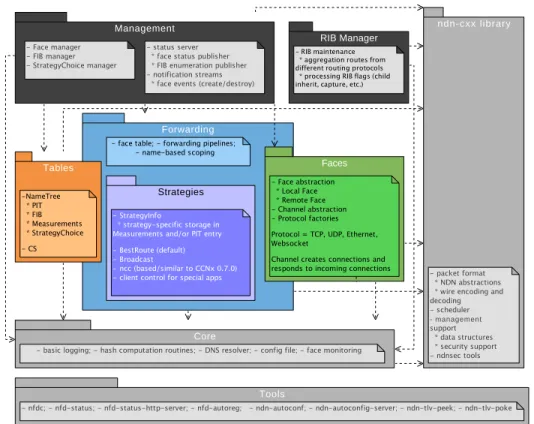
The main functionality of NFD is to forward Interest and Data packets. To do this, it abstracts lower-level network transport mechanisms into NDN Faces, maintains basic data structures like CS, PIT, and FIB, and implements the packet processing logic. In addition to basic packet forwarding, it also supports multiple forwarding strategies, and a management interface to
configure, control, and monitor NFD. As illustrated in Figure1, NFD contains the following inter-dependent modules:
• ndn-cxx Library, Core, and Tools(Section9)
Provides various common services shared between different NFD modules. These include hash computation routines, DNS resolver, config file, Face monitoring, and several other modules.
• Faces(Section2)
Implements the NDN Face abstraction on top of various lower level transport mechanisms.
• Tables(Section3) Forwarding Management Faces Tables Core Strategies RIB Manager ndn-cxx library - management Tools
1.2 How Packets are Processed in NFD 1 INTRODUCTION
Implements the Content Store (CS), the Pending Interest Table (PIT), the Forwarding Information Base (FIB), Stra-tegyChoice, Measurements, and other data structures to support forwarding of NDN Data and Interest packets.
• Forwarding(Section 4)
Implements basic packet processing pathways, which interact with Faces, Tables, and Strategies (Section5).
Strategies is a major part of the forwarding module. It implements a framework to support different forwarding
strategies in the form of forwarding pipelines, described in detail in Section4.
• Management(Section6)
Implements the NFD Management Protocol [3], which allows applications to configure NFD and set/query NFD’s
internal states. Protocol interaction is done via NDN’s Interest/Data exchange between applications and NFD.
• RIB Management (Section7)
Manages the routing information base (RIB). The RIB may be updated by different parties in different ways, including various routing protocols, application prefix registrations, and command-line manipulation by sysadmins. The RIB management module processes all these requests to generate a consistent forwarding table, and syncs it up with NFD’s FIB, which contains only the minimal information needed for forwarding decisions. Strictly speaking RIB management is part of the NFD management module, but due to its importance to the overall operations and its more complex processing, we implement it as a separate module.
The rest of this document will explain all these modules in more detail.
1.2
How Packets are Processed in NFD
To give readers a better idea on how NFD works, this section explains how a packet is processed in NFD.
Packets arrive at NFD viaFaces. “Face” is a generalization of “interface”. It can be either a physical interface (where NDN operates directly over Ethernet), or a overlay tunnel (where NDN operates as an overlay above TCP or UDP). In addition, NFD communicates with local application via a UNIX-domain socket, which is also a Face. The Face reads incoming stream or datagrams via operating system API, strips away link-layer headers if any, and delivers network layer packets (NDN-TLV Interest or Data) to the forwarding.
A network layer packet (Interest or Data) is processed by forwarding pipelines, which define series of steps that operate
on the packet. NFD’s data plane is stateful, and what NFD does to a packet depends on not only the packet itself but also the forwarding state, which is stored intables.
An incoming Interest is first inserted to the Interest table (PIT), where each entry represents a pending Interest or a
recently satisfied Interest. If the Interest is not a duplicate, a lookup is performed on theContent Store (CS), which is an
in-network cache of Data packets. If there is a matching Data packet in CS, that Data packet is returned to the requester; otherwise, the Interest needs to be forwarded.
A forwarding strategy decides how to forward an Interest. NFD allows per-namespace strategy choice; to decide which
strategy is responsible for forwarding an Interest, a longest prefix match lookup is performed on the Strategy Choice table,
which contains strategy configuration. The strategy responsible for an Interest (or, more precisely, the PIT entry) makes a decision whether, when, and where to forward the Interest. While making this decision, the strategy can take input
from theForwarding Information Base(FIB), which contains routing information that comes from local application’s prefix
registrations and routing protocols, use strategy-specific information stored in the PIT entry, and record and use data plane performance measurements in Measurements entry.
After the strategy decides to forward an Interest to a specified Face, the Interest goes through a few more steps in forwarding pipelines, and then it is passed to the Face. The Face, depending on the underlying protocol, adds link-layer header, fragments if necessary, and sends the link-layer packets as outgoing stream or datagrams via operating system API. An incoming Data is processed differently. Its first step is checking the Interest table to see if there are PIT entries that can be satisfied by this Data packet. All matched entries are then selected for further processing. If this Data can satisfy none of the PIT entries, it is unsolicited and it is dropped; as a special case, an unsolicited Data from a local application is cached in the Content Store. Otherwise, the Data is added to the Content Store. Forwarding strategy that is responsible for each of the mat PIT entries is notified. Through this notification, and another “no Data comes back” timeout, the strategy is
able to observe the reachability and performance of paths; the strategy can remember its observations in theMeasurements
table, in order to improve its future decisions. Finally, the Data is sent to all requesters, recorded in downstream records (in-records) of the PIT entries; the process of sending a Data via a Face is similar to sending an Interest.
1.3 How Management Interests are Processed in NFD 1 INTRODUCTION
1.3
How Management Interests are Processed in NFD
NFD Management protocol [3] defines three inter-process management mechanisms that are based on Interest-Data exchanges:
control commands, status datasets, and notification streams. This section gives a brief overview how these mechanisms work and what are their requirements.
A control commandis a signed (authenticated) Interest to perform a state change within NFD. Since the objective of each control command Interest is to reach the destination management module and not be satisfied from CS, each control command Interest is made unique through the use of timestamp and nonce components. For more detail refer to control command specification [4].
When NFD receives the command Interest, it directs the Interest to a special Face, called the Internal Face.1 When an
Interest is forwarded to this Face, it is dispatched internally to a designated manager (e.g., Interests under /localhost/
nfd/facesare dispatched to the Face manager, see Section6). The manager then looks at the Interest name to decide which action is requested. If the name refers to a valid control command, the manager validates the command (checks the signature and validates whether the requester is authorized to send this command), and performs the requested action if validation succeeds. The response is sent back to the requester as a Data packet, which is processed by forwarding and Face in the same way as a regular Data.
The exception from the above procedure is RIB Management (Section 7), which is implemented as a separate daemon.
All RIB Management control commands, instead of Internal Face, are forwarded toward the RIB daemon, the same way as forwarding to any local application (RIB daemon “registers” itself with NFD for the RIB management prefix when it starts). Astatus datasetis either periodically (e.g., NFD status) or on-demand (e.g., NFD Face status) generated dataset with some internal NFD status. These datasets can be requested by anybody using a simple unsigned Interest directed towards the
specific management module, as defined in the specification [3]. An Interest requesting a new version of astatus datasetis
forwarded to the internal Face and then the designated manager the same way as control commands. The manager, however, will not validate this Interest, but instead generate all segments of the requested dataset and put them into the forwarding pipeline. This way, the first segment of the dataset will directly satisfy the initial Interest, while others will satisfy the subsequent Interests through CS. In the unlikely event when subsequent segments are evicted from the CS before being fetched, the requester is responsible for restarting the fetch process from the beginning.
Notification streams are similar to status datasets (can be accessed by anybody with an unsigned Interests), but they operate slightly differently. The subscribers that want receive notification streams are still sending Interests and these Interests are still directed toward the designated manager. However, it is expected that these Interests will not be satisfied immediately, and the subscribers are expected to re-express the notification stream Interests when they expire. Whenever a notification is generated, the manager puts a Data packet into the forwarding, satisfying all outstanding notification stream Interests, and the notification is getting delivered to all subscribers.
2 FACE SYSTEM
2
Face System
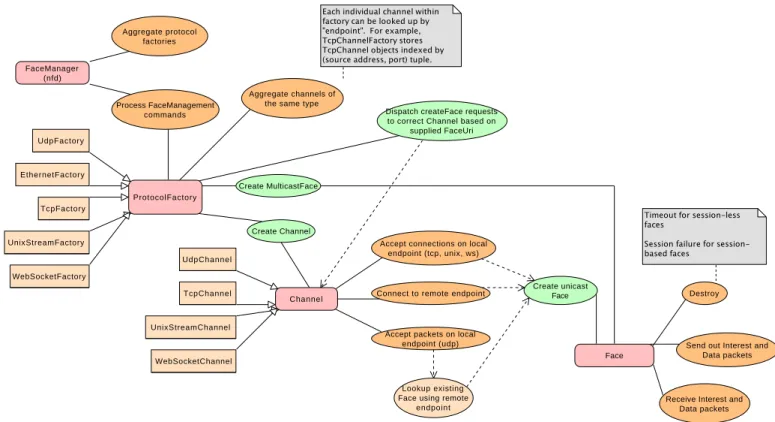
The face system in NFD is separated into three logical abstractions: protocol factories, channels, and faces. A protocol
factory create channels or faces of specific protocols (e.g., the TCP protocol factory creates TCP faces). A channel
represents NFD-side endpoint for unicast communications (i.e., “listening” socket or socket from which connection will be
established). We call this endpoint “local”, while the “remote” endpoint represents the other side of the communication (a
network node, an application, or a set of remote peers). Both endpoints in NFD are described using concept of FaceURI,
which defines protocol and protocol-specific parameters of the endpoint (see Section2.1). AFace is an abstraction which
implements communication primitives to actually send and receive Interest and Data packets. Depending on nature of communication, a Face can represent slightly different elements. For “unicast” communications (TCP, unicast UDP, UNIX
sockets, WebSocket [5]), a Face represents a connection between local and remote endpoints for the specific protocol, i.e, a
connection between NFDs on different network nodes or local NFD and local application. For multi-access communications (Ethernet, IP multicast), a Face represents a virtual connection between a local endpoint and zero or more remote peers.
The overall interaction between these abstractions is illustrated in Figure 2and each abstraction is described in detail in the following sections. In short, these interactions can be summarized as: protocol factories create channels, channels create faces, and faces are actually responsible for sending and receiving Interest and Data packets through the protocol-specific tunnel.
The current implementation is heavily based on the Boost.Asio library [6] and uses asynchronous operations as much as
possible to avoid blocking the rest of the daemon while performing potentially lengthy network operations.
FaceManager (nfd) Aggregate protocol factories Process FaceManagement commands WebSocketFactory UnixStreamFactory UdpFactory TcpFactory EthernetFactory Aggregate channels of the same type
Create Channel Create MulticastFace ProtocolFactory UnixStreamChannel WebSocketChannel UdpChannel TcpChannel Channel
Accept connections on local endpoint (tcp, unix, ws)
Connect to remote endpoint
Accept packets on local endpoint (udp)
Create unicast Face
Lookup existing Face using remote
endpoint
Face
Send out Interest and Data packets
Receive Interest and Data packets
Destroy Dispatch createFace requests
to correct Channel based on supplied FaceUri
Figure 2: Face, Channel, ProtocolFactory interactions
2.1
Face URI
A Face URI (nfd::FaceUriclass) identifies a protocol endpoint and is used in Face (for local and remote endpoints) and in
Channel (local endpoint) abstractions. The Face URI is similar as normal URI and is composed of the protocol name and other protocol-specific identifying information (e.g., IP address and port).
Note that some Face types will have different types of Face URI types for the local and remote endpoints. This depends on what exactly these endpoints represent. For example, UnixStream Face has UNIX Stream type of Face URI to represent the local endpoint, while FileDescriptor type used to identify the application connected to the UNIX socket. Another example is multicast Ethernet Face, where the local endpoint represents NFD itself (MAC address of a network interface) and the remote endpoint represents the set of remote peers connected to the network interface (network device).
2.1 Face URI 2 FACE SYSTEM
The following description shows examples of Face URI formats for the implemented protocols (see NFD Face Management
specification for more detail [3]). When developing new Face, these examples can be used for defining Face URI format for
the newly implemented protocol.
UDP: udp[4|6]://<IP-or-host>[:<port>]
• udp4://192.0.2.1:6363(canonical form)
• udp6://[2001:db8::1]:6363(canonical form)
• udp://192.0.2.1(remote-port defaults to 6363)
• udp://example.net:6363
• udp4://example.net:6363 (resolve hostname to IPv4 address only)
• udp6://example.net:6363 (resolve hostname to IPv6 address only)
• udp4://224.0.23.170:56363(multicast, canonical form)
TCP: tcp[4|6]://<IP-or-host>[:<port>]
• tcp4://192.0.2.1:6363(canonical form)
• tcp6://[2001:db8::1]:6363(canonical form)
• tcp://192.0.2.1(remote-port defaults to 6363)
• tcp://example.net:6363
• tcp4://example.net:6363 (resolve hostname to IPv4 address only)
• tcp6://example.net:6363 (resolve hostname to IPv6 address only)
UNIX stream: unix://<path>
• unix:///var/run/nfd.sock (note there are three forward-slashes after ’unix’)
File Descriptor: fd://<file-descriptor>
• fd://6
Ethernet ether://<MAC>
• ether://08:00:27:01:01:01 Network Device: dev://<ifname>
2.2 Protocol Factory Abstraction 2 FACE SYSTEM
2.2
Protocol Factory Abstraction
The protocol factory is the highest level abstraction in NFD’s face system. Each protocol factory handles a specific protocol
that is natively supported by NFD. Table1describes the current set of support protocols.
NFD currently supports the protocols described in Table1. Note that the protocols marked “listen only” are limited to
listen and accept incoming connections and cannot initiate connections to remote endpoints. Table 1: Supported protocols
Protocol Unicast Multicast Factory Class Channel Class Face Class
Unix domain stream-oriented sockets Listen only No UnixStreamFactory UnixStreamChannel UnixStreamFace
Raw Ethernet type-II frames No Yes EthernetFactory N/A EthernetFace(multicast)
TCP Yes No TcpFactory TcpChannel TcpFace,TcpLocalFace
UDP Yes Yes UdpFactory UdpChannel UdpFace,UdpMulticastFace
WebSocket [5] Listen only No WebSocketFactory WebSocketChannel WebSocketFace
The two main tasks that the protocol factory is designed to do are: (1) creation and management of channels (
cre-ateChannel), and (2) creation and management of multicast faces (createMulticastFace). Most protocol factories support both operations. However, some protocols may support only the ability to create channels (e.g., UnixStreamFactory and TcpFactory) or only the ability to create multicast faces (e.g., EthernetFactory).
The ProtocolFactory abstract class defines two basic type aliases employed throughout the face system: FaceCre-atedCallbackandFaceConnectFailedCallback. These types are just C++typedefs for function pointers used as callbacks in asynchronous operations, but they help to make the code easier to read and understand.
Moreover, ProtocolFactory requires subclasses to implement the pure virtual method createFace(const FaceUri&
uri, const FaceCreatedCallback& onCreated, const FaceConnectFailedCallback& onConnectFailed), which is a
con-venience wrapper responsible for automatically selecting a suitable channel (based on theuriparameter) and delegating the
actual face creation to it. Factories that do not support unicast faces may throw an error whencreateFace is invoked.
2.3
Channel Abstraction
The purpose of the channel abstraction is to encapsulate the functionalities needed to accept incoming connections or to start outgoing connections, and to create a face when the connection attempt is successful.
Channels are created bycreateChannel(const Endpoint& localEndpoint)method on protocol factories. This method
allocates and returns a channel that can listen and accept incoming connections on the specified local endpoint. An endpoint is a protocol-specific type that encapsulates all the information needed to uniquely identify an endpoint on a machine, for
example in the TCP case the endpoint is the pair hhost, porti. Multiple channels can be created from the same protocol
factory, but each channel must be instantiated on a different local endpoint. Also note that channels make sense only for protocols that support unicast faces; for instance, there is no Ethernet channel, because the Ethernet face is exclusively multicast.
Usually, when a channel is constructed, no resources are reserved; thus, in order to prepare it for accepting connections,
listenmust be called on the channel instance. This method takes care of allocating the necessary operating system resources
(sockets, ports, . . . ), and then starts listening for incoming connections in a non-blocking fashion. This means thatlisten
returns immediately and that incoming connection attempts are serviced from Boost.Asio’s event loop.
When channel receives an incoming connection on a specific local endpoint (e.g., an application connected to specific UNIX socket, remote NFD established TCP connection to specific IP/port, etc.), the designated callback of the channel bound to that endpoint is invoked. This callback function will create a Face for the corresponding protocol, which, in turn,
executes theFaceCreatedCallbackthat was supplied to the initiallisteninvocation, and will start handling all subsequent
communications for the connection. If any errors or timeouts are encountered during this procedure, the connection setup is
aborted andConnectFailedCallbackis executed instead.
For session-less protocols such as UDP the concept of establishing a connection obviously does not apply, therefore for
these protocols the listen method just puts the channel in an asynchronous wait for incoming packets. As soon as a
datagram is received from an unknown peer (i.e., no Face is already handling the remote endpoint), a new face is instantiated and the triggering packet is handed over to it for normal processing. Upon creation, the face binds itself to the local and remote endpoints, thus all subsequent packets from that peer will be dispatched directly to the face by the OS kernel.
The process of establishing a connection to a remote peer entails calling the methodconnect, which starts an asynchronous
connection attempt towards the specified endpoint. Non-blocking host name resolution is automatically performed if needed
(see Section 9.4). If the connection is successful, a face is instantiated and the caller-supplied FaceCreatedCallback is
2.4 Face Abstraction 2 FACE SYSTEM
Note that UDP protocol handles slightly differently Faces that are created “on-demand” (as a response of received a datagram from a remote host) and Faces that are created through explicit “connect” operation. When Face is created
on-demand, it will be automatically destroyed after the configured time interval (see Section9.1) if there was nothing has been
received or sent through this Face. The explicitly connected Faces will never be automatically destroyed and will exist until it is explicitly destroyed or some network failure happens (e.g., when system’s IP stack goes down). When connect command is issued for already created on-demand Face, the Face is simply converted to “non-demand” state and will no longer be considered for automatic destruction.
2.4
Face Abstraction
EthernetFace +~Face()
+sendInterest(interest : Interest &) : void +sendData(data : Data &) : void +close() : void
+getId() : FaceId
+setDescription(description : string &) : void +getDescription() : string &
+isLocal() : bool +isMultiAccess() : bool +isUp() : bool +isOnDemand() : bool +getCounters() : FaceCounters & +getRemoteUri() : FaceUri & +getLocalUri() : FaceUri &
+Face(remoteUri : FaceUri &, localUri : FaceUri &, isLocal : bool = false) Face AppFace DatagramFace InternalFace LocalFace MulticastUdpFace StreamFace TcpFace TcpLocalFace
UdpFace UnixStreamFace WebSocketFace
"Local" faces "Local" face
Protocol : class Protocol : class
FaceBase : class
Figure 3: NFD faces
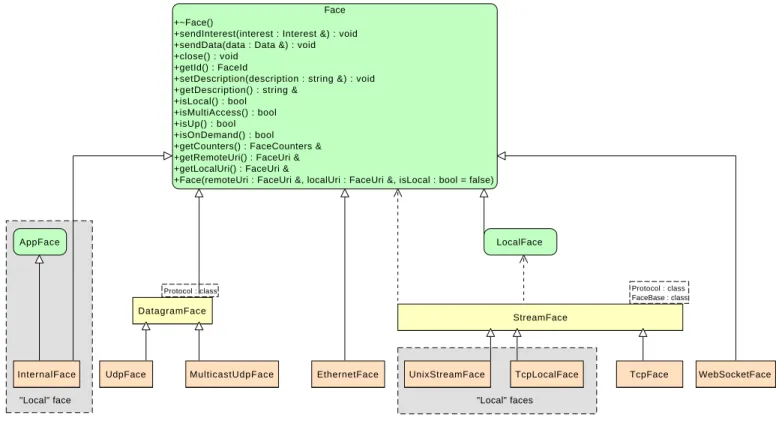
The Face abstraction contains the low-level communication primitives to send and receive Interest and Data packets. All
faces derive from the commonFace abstract base class and the various concrete subclasses can be categorized according to
different criteria. For example, we can distinguish between (Figure3):
• Local and non-local faces: the Internal, TcpLocal, and UnixStream faces are considered local, because they can
com-municate only with other programs running on the same machine (this restriction is enforced by NFD). Local faces are
the only ones that can send to and receive from the “/localhost” namespace; they can also support the
LocalCon-trolHeader [7] that is used by some special applications. All other faces are considered non-local.
• Unicast and multicast faces: unicast faces, such as TcpFace, UdpFace, and WebSocketFace, can communicate with a
single peer, i.e. packets are sent from the local endpoint to exactly one remote endpoint and vice versa. Multicast faces, on the other hand, are able to transmit a single packet to multiple remote endpoints, and receive from all of them, forming a set of intercommunicating peers that is usually called multicast group; the MulticastUdp and Ethernet faces are examples of multicast faces.
• Datagram and stream faces: this distinction is based on the same difference that exists between datagram-oriented and
stream-oriented sockets. Therefore the Udp and MulticastUdp faces aredatagram faces, while the Tcp and UnixStream
2.5 Extending NFD Face System 2 FACE SYSTEM
2.5
Extending NFD Face System
To extend NFD with a new type of Face, developers need to implement the face, channel and protocol factory abstractions. The new classes will typically inherit from the Face, Channel and ProtocolFactory base classes respectively.
The new factory class interacts directly with the face manager and is created upon startup of the daemon. The configu-ration for the new type of face is written in thenfd.conf file (see Section9.1). Developers usually need to add a new method
processSectionXYZinto FaceManager to read and process the configuration section for the new face type. After parsing the configuration, this method will create new factories and add the factories into an internal hash table. Developers can follow
the patterns in otherprocessSectionXYZ methods when implementing this function.
The factory class usually provides two interfaces: createChannel and createFace. createChannel will open a local
endpoint to wait for connections from other NFD instances. createFacewill allow NFD to connect to other NFD instances. If
the developer decides that the new face protocol will not be used for interconnections between forwarders (e.g., the WebSocket
protocol), the body of createFace should throw an exception.
The channel class manages all incoming connections. It must provide a listen method to start listening on the local
socket. In some cases the channel class may be required to perform message dispatching (e.g., demultiplexing among multiple faces on the same local endpoint), depending on how the underlying communication protocol is implemented. It also needs to handle connection close and remove that connection from the internal face table.
The face class provides the basic communication primitives such as sendInterest,sendData, close, and so on. When
implementing the receiving function, developers only need to check the length of the incoming message to make sure that the TLV wire encoding in the received packet is complete. For stream-based protocols, this means that in most cases an internal buffer must be maintained in order to collect all incoming segments, until the entire NDN-TLV packet is available and can
be parsed. Finally developers simply invokedecodeAndDispatchInput, which is inherited from the Face base class. That
method will check the type field of the incoming packet (i.e., Interest or Data) and pass the packet to NFD’s forwarding pipeline (see Section4).
3 TABLES
3
Tables
The tables module provides main data structures for NFD.
The Forwarding Information Base (FIB) (Section 3.1) is used to forward Interest packets toward potential source(s) of
matching Data. It’s almost identical to an IP FIB except it allows for a list of outgoing faces rather than a single one.
The Content Store (CS) (Section 3.2) is a cache of Data packets. Arriving Data packets are placed in this cache as long
as possible, in order to satisfy future Interests that request the same Data.
The Interest Table (PIT) (Section3.3) keeps track of Interests forwarded upstream toward content source(s), so that Data
can be sent downstream to its requester(s). It also contains recently satisfied Interests for loop detection and measurements purposes.
The Strategy Choice Table (Section 3.4) contains the forwarding strategy (Section5) chosen for each namespace.
The Measurements Table (Section 3.5) is used by forwarding strategies to store measurements information regarding a
name prefix.
FIB, PIT, Strategy Choice Table, and Measurements Table have much commonality in their index structure. To improve
performance and reduce memory usage, a common index, the Name Tree (Section3.6), is designed to be shared among these
four tables.
3.1
Forwarding Information Base (FIB)
The Forwarding Information Base (FIB) is used to forward Interest packets toward potential source(s) of matching Data [8].
For each Interest that needs to be forwarded, a longest prefix match lookup is performed on the FIB, and the list of outgoing faces stored on the found FIB entry is an important reference for forwarding.
The structure, semantics, and algorithms of FIB is outlined in Section3.1.1. How FIB is used by rest of NFD is described
in Section3.1.2. The implementation of FIB algorithms is discussed in Section3.6.
3.1.1 Structure and Semantics
Figure4 shows logical content and relationships between the FIB, FIB entries, and NextHop records.
FIB Entry Name prefix PK NextHop Face PK cost
Figure 4: FIB and related entities
FIB entry and NextHop record
A FIB entry (nfd::fib::Entry) contains a name prefix and a non-empty collection of NextHop records. A FIB entry
of a certain prefix means that given an Interest under this prefix, a potential source(s) of matching Data can be reached via the faces given by the NextHop record(s) in this FIB entry.
Each NextHop record (nfd::fib::NextHop) contains an outgoing face toward a potential content source and its routing
cost. A FIB entry can contain at most one NextHop record toward the same outgoing face. Within a FIB entry, NextHop records are ordered by ascending cost. The routing cost is relative between NextHop records; the absolute value is insignificant.
Unlike the RIB (Section 7.3), there is no inheritance between FIB entries. The NextHop records within a FIB entry are
the only “effective” nexthops for this FIB entry.
FIB
The FIB (nfd::Fib) is a collection of FIB entries, indexed by name prefix. The usual insertion, deletion, exact match
operations are supported. FIB entries can be iterated over in a forward iterator, in unspecified order.
Longest Prefix Matchalgorithm (Fib::findLongestPrefixMatch) finds a FIB entry that should be used to guide the forwarding of an Interest. It takes a name as input parameter; this name should be the name field in an Interest. The return
3.2 Content Store (CS) 3 TABLES
value is a FIB entry such that its name prefix is (1) a prefix of the parameter, and (2) the longest among those satisfying condition1; NULL is returned if no FIB entry satisfy condition1.
Fib::removeNextHopFromAllEntries is a convenient method that iterates over all FIB entries, and removes NextHop record of a certain face from every entry. Since a FIB entry must contain at least one FIB entry, if the last NextHop record is removed, the FIB entry is deleted. This is useful when a face is gone.
3.1.2 Usage
The FIB is updated only through using FIB management protocol, which on NFD sides is operated by the FIB manager
(Section6.1.2). Typically, FIB manager takes commands from RIB Daemon (Section7), which in turn receives static routes
configured manually or registered by applications, and dynamic routes from routing protocols. Since most FIB entries ultimately come from dynamic routes, the FIB is expected to contain a small number of entries, if the network has a small number of advertised prefixes.
The FIB is expected to be relatively stable. FIB updates are triggered by RIB updates, which in turn is caused by manual configuration, application startup or shutdown, and routing updates. These events are infrequent in a stable network. However, each RIB update can cause lots of FIB updates, because changes in one RIB entry may affect its descendants due to inheritance.
The longest prefix match algorithm is used by forwarding in incoming Interest pipeline (Section 4.2.1). It is called at
most once per incoming Interest.
3.2
Content Store (CS)
The Content Store (CS) is a cache of Data packets. Arriving Data packets are placed in this cache as long as possible, in
order to satisfy future Interests that request same Data. As define in NDN architecture [8] and described in more detail in
Section4, the Content Store is searched before the incoming Interest is given to the forwarding strategy for further processing. This way, the cached Data, if available, can be used to satisfy the Interest without actually forwarding the Interest anywhere else.
The following section will define the semantics and algorithms of CS, while details about the existing implementation are discussed in Section3.2.2.
3.2.1 Semantics and Usage
The Content Store (nfd::Cs) is a cache of Data packets. Data packets are inserted to the CS (Cs::insert) either in the
incoming Data pipeline (Section4.3.1) or in theData unsolicited pipeline (Section4.3.2). However, before actually inserting the Data packet, both forwarding pipelines ensure eligibility of the Data packet to be processed at all (e.g., that the Data
packet does not violate the name-based scope [9]. When the Data packet is inserted, the current timestamp is stored along
with the cached packet, so that CS could later determine if the Data packet becomes stale and cannot be used to match an Interest with the MustBeFresh selector [1].
CS is queried (Cs::find) with an incoming Interest before it’s forwarded in incoming Interest pipeline (Section 4.2.1).
The search algorithm returns the Data packet that best matches the Interest, or returns null if no Data packet matches the Interest.
CS has limited capacity, measured in number of packets. It is controlled via NFD configuration file (Section 6.2.7).
Management calls Cs::setLimitto update the capacity. CS implementation should ensure number of cached packets does
not exceed the capacity.
3.2.2 Implementation
CS performance has a big impact on the overall performance of NFD, because it stores a large number of packets, and virtually every packet accesses the CS. The choice of the underlying data structure for an efficient lookup, insertion, and deletion, and cache replacement algorithm (e.g., FIFO, LRU, LFU) is crucial for maximizing the practical benefits of in-network caching.
The current implementation of CS uses a skip list [10] as its underlying data structure. Skip lists are a probabilistic
alternative to balanced trees. Skip lists are balanced by virtue of a random number generator. Its average insertion and lookup complexity isO(log n) (Figure5). CS entries are placed in the Skip List in ascending order (by Name) [1].
The assumption behind CS design is that it operates at its maximum capacity all the time. Therefore, it must have an efficient cache replacement strategy. The current implementation evicts CS entries based on prioritized FIFO (First In
First Out) strategy. The entries that get removed first areunsolicited Data packets, which are the Data packets that got
3.2 Content Store (CS) 3 TABLES
Figure 5: Insertion of an item into a SkipList
expired freshness are removed. Last, the Data packets are removed from the Content Store on a pure FIFO basis. This cache replacement policy is currently hard-coded; we intend to make it replaceable in the future (NFD Task 1207).
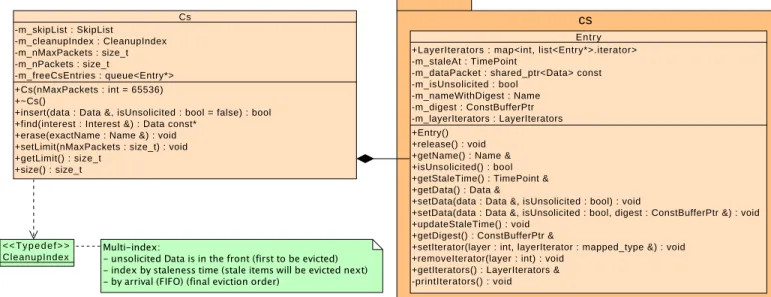
cs -m_skipList : SkipList -m_cleanupIndex : CleanupIndex -m_nMaxPackets : size_t -m_nPackets : size_t -m_freeCsEntries : queue<Entry*> +Cs(nMaxPackets : int = 65536) +~Cs()
+insert(data : Data &, isUnsolicited : bool = false) : bool +find(interest : Interest &) : Data const*
+erase(exactName : Name &) : void +setLimit(nMaxPackets : size_t) : void +getLimit() : size_t
+size() : size_t
Cs
+LayerIterators : map<int, list<Entry*>.iterator> -m_staleAt : TimePoint
-m_dataPacket : shared_ptr<Data> const -m_isUnsolicited : bool -m_nameWithDigest : Name -m_digest : ConstBufferPtr -m_layerIterators : LayerIterators +Entry() +release() : void +getName() : Name & +isUnsolicited() : bool +getStaleTime() : TimePoint & +getData() : Data &
+setData(data : Data &, isUnsolicited : bool) : void
+setData(data : Data &, isUnsolicited : bool, digest : ConstBufferPtr &) : void +updateStaleTime() : void
+getDigest() : ConstBufferPtr &
+setIterator(layer : int, layerIterator : mapped_type &) : void +removeIterator(layer : int) : void
+getIterators() : LayerIterators & -printIterators() : void
Entry
< < T y p e d e f > > CleanupIndex
Figure 6: CS data structure
The current CS implementation is illustrated in Figure6.
CS entry
The Data packet, along with other necessary fields, are stored in a CS entry.
Each entry contains:
• the Data packet
• whether the Data packet is unsolicited
• the timestamp at which the cached Data becomes stale
CS
To support the prioritized FIFO cache replacement policy, the CS maintains a multi-index container [11] in order to keep
pointers to the Data packets in a particular order. Note that this multi-index container is completely separated from the skip list container, which indexes Content Store entries by name.
3.3 Interest Table (PIT) 3 TABLES
The container (Cs::CleanupIndex) currently supports indexing of unsolicited Data packets, indexing by packet staleness
and indexing by packet arrival time. Calculation of the indexes is performed in the container during the Data packet insertion (Cs::insert) in the Content Store.
Eviction (Cs::evictItem) is performed during the insertion when the CS is full, and when the capacity is decreased by
management. We decided not to perform periodical cleanups, because its CPU overhead causes jitter in packet forwarding.
In the current version of NFD, cache replacement policy can be modified by adding different indexes in theCs::CleanupIndex
container (refer to Boost.multiIndex documentation [11]) and implementing additional logic inCs::evictItemfunction.
3.3
Interest Table (PIT)
The Interest Table (PIT) keeps track of Interests forwarded upstream toward content source(s), so that Data can be sent downstream to its requester(s) [8]. It also contains recently satisfied Interests for loop detection and measurements purposes. This data structure is called “pending Interest table” in NDN literatures; however, NFD’s PIT contains both pending Interests and recently satisfied Interests, so “Interest table” is a more accurate term, but the abbreviation “PIT” is kept.
PIT is a collection of PIT entries, used only by forwarding (Section4). The structure and semantics of PIT entry, and how
it’s used by forwarding are described in Section3.3.1. The structure and algorithms of PIT, and how it’s used by forwarding
are described in Section3.3.2. The implementation of PIT algorithms is discussed in Section3.6.
3.3.1 PIT Entry
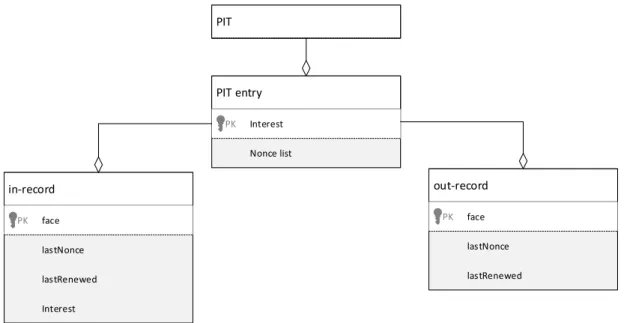
Figure7 shows the PIT, PIT entries, in-records, out-records, and their relations.
PIT PIT entry Interest PK Nonce list in-record face PK lastNonce lastRenewed out-record face PK lastNonce lastRenewed Interest
Figure 7: PIT and related entities
PIT entry
A PIT entry (nfd::pit::Entry) represents either a pending Interest or a recently satisfied Interest. Two Interest packets
aresimilar if they have same Name and same Selectors [1]. Multiple similar Interests share the same PIT entry. Each PIT entry is identified by an Interest. All fields in this Interest, except Name and Selectors, are insignificant.
Each PIT entry contains a Nonce list. The Nonce list is an unordered set of Nonces seen so far in incoming Interest
packets that match this PIT entry. Incoming Interest pipeline (Section 4.2.1) adds an incoming Interest’s Nonce to this
Nonce list, after checking whether it already exists, which indicates the incoming Interest is a duplicate.
Each PIT entry contains a collection of in-records, a collection of out-records, and two timers, described below. In addition, forwarding strategy is allowed to store arbitrary information on PIT entry, in-records, and out-records (Section5.1.3).
In record
Anin-record (nfd::pit::InRecord) represents a downstream face for the Interest. A downstream face is a requester for the content: Interest comes from downstream, and Data goes to downstream.
3.4 Strategy Choice Table 3 TABLES
• a reference to the face
• the Nonce in the last Interest packet from this face
• the timestamp on which the last Interest packet from this face arrives
• the last Interest packet
An in-record is inserted or updated by incoming Interest pipeline (Section4.2.1). All in-records are deleted byincoming
Data pipeline (Section4.3.1) when a pending Interest is satisfied.
An in-record expires when InterestLifetime has elapsed after the last Interest packet arrives. A PIT entry expires when
all in-records expire. A PIT entry is said to bepending if it contains at least one unexpired in-record.
Out record
An out-record (nfd::pit::OutRecord) represents an upstream face for the Interest. An upstream face is a potential content source: Interest is forwarded to upstream, and Data comes from upstream.
The out-record stores:
• a reference to the face
• the Nonce in the last Interest packet to this face
• the timestamp on which the last Interest packet to this face is sent
An out-record is inserted or updated byoutgoing Interest pipeline (Section4.2.3). An out-record is deleted byincoming
Data pipeline (Section4.3.1) when a pending Interest is satisfied by a Data from that face.
An out-recordexpires when InterestLifetime has elapsed after the last Interest packet is sent.
Timers
There are two timers on a PIT entry, used by forwarding pipelines (Section 4):
• unsatisfy timer fires when the PIT entry expires (Section4.2.1)
• straggler timer fires when the PIT entry can be deleted because it has been satisfied or rejected, and is no longer needed
for loop detection and measurements purposes (Section4.3.1)
3.3.2 PIT
The PIT (nfd::Pit) is a table containing PIT entries, indexed by <Name,Selectors>tuple. The usual insert and delete
operations are supported. Pit::insertmethod first looks for a PIT entry for similar Interest, and inserts one only if it does
not already exist; there is no separate method for exact match, because forwarding does not need to determine the existence of a PIT entry without inserting it. The PIT is not iterable, because this is not needed by forwarding.
Data Matchalgorithm (Pit::findAllDataMatches) finds all Interests that a Data packet can satisfy. It takes a Data packet as input parameter. The return value is a collection of PIT entries that can be satisfied by this Data packet. This algorithm does not delete any PIT entry.
3.4
Strategy Choice Table
The Strategy Choice Table contains the forwarding strategy (Section 5) chosen for each namespace. This table is a new
addition to the NDN architecture. Theoretically, forwarding strategy is a program that is supposed to be stored in FIB
entries [8]. In practice, we find that it is more convenient to save the forwarding strategy in a separate table, instead of
storing it with FIB entry, for the following reasons:
• FIB entries come from RIB entries, which are managed by NFD RIB Daemon (Section7). Storing the strategy in FIB
entries would require the RIB Daemon to create/update/remove strategies when it manipulates the FIB. This increases the RIB Daemon’s complexity.
• FIB entry is automatically deleted when the last NextHop record is removed, including when the last upstream face
fails. However, we don’t want to lose the configured strategy.
• The granularity of strategy configuration is different from the granularity of RIB entry or FIB entry. Having both in
3.5 Measurements Table 3 TABLES
The structure, semantics, and algorithms of Strategy Choice Table is outlined in Section3.4.1. How Strategy Choice Table
is used by rest of NFD is described in Section3.4.2. The implementation of Strategy Choice Table algorithms is discussed in
Section3.6.
3.4.1 Structure and Semantics Strategy Choice entry
A Strategy Choice entry (nfd::strategy choice::Entry) contains a Name prefix, and the Name of a forwarding strategy
chosen for this namespace. Currently, there is no parameters.
At runtime, a reference to the instantiation of the strategy program is also linked from the Strategy Choice entry.
Strategy Choice Table
The Strategy Choice Table (nfd::StrategyChoice) is a collection of Strategy Choice entries—associations of namespaces
with specific strategies. There could be only one strategy set per namespace, but sub-namespaces can have their own choices for the strategy.
Currently, the Strategy Choice Table also maintains a collection of the available (“installed”) strategies and is consulted
by the StrategyChoice manager (see Section 6.1.3) whenever a control command is received. Therefore, in order for any
new custom strategy to be known to NFD and be used in the namespace-strategy association, it should be “installed” using
StrategyChoice::installmethod. Note that each installed strategy should have its own unique name, otherwise an runtim error will be generated.
In order to guarantee that every namespace has a strategy, NFD always insert the root entry for / namespace to the
Strategy Choice Table during initialization. The strategy chosen for this entry, called thedefault strategy, is defined by the
hard-coded makeDefaultStrategy free function in daemon/fw/available-strategies.cpp. The default strategy can be
replaced, but the root entry in Strategy Choice Table can never be deleted.
The insertion operation (StrategyChoice::insert) inserts a Strategy Choice entry, or updates the chosen strategy on
an existing entry. The new strategy must have been installed.
The deletion operation (StrategyChoice::erase) deletes a Strategy Choice entry. The namespace covered by the deletes
would inherit the strategy defined on the parent namespace. It is disallowed to delete the root entry.
The usual exact match operation is supported. Strategy Choice entries can be iterated over in a forward iterator, in unspecified order.
Find Effective Strategy algorithm (StrategyChoice::findEffectiveStrategy) finds a strategy that should be used to forward an Interest. The effective strategy for the namespace can be defined as follows:
• If the namespace is explicitly associated with the strategy, then this is the effective strategy
• Otherwise, the first parent namespace for which strategy was explicitly set defines the effective strategy.
The find effective strategy algorithm takes a Name, a PIT entry, or a measurements entry as input parameter.2 The
return value of the algorithm is a forwarding strategy that is found by longest prefix match using the supplied name. This return value is always a valid entry, because every namespace must have a strategy.
3.4.2 Usage
The Strategy Choice Table is updated only through management protocol. Strategy Choice manager (Section6.1.3) is directly
responsible for updating the Strategy Choice Table.
The Strategy Choice is expected to be stable, as strategies are expected to be manually chosen by the local NFD operator (either user for personal computers or system administrators for the network routers).
The effective strategy search algorithm is used by forwarding in incoming Interest pipeline (Section 4.2.1), Interest
unsatisfied pipeline (Section 4.2.5), and incoming Data pipeline (Section 4.3.1). It is called at most twice per incoming packet.
3.5
Measurements Table
The Measurements Table is used by forwarding strategies to store measurements information regarding a name prefix.
Strategy can store arbitrary information in PIT and in Measurements (Section 5.1.3). The Measurements Table is indexed
by namespace, so it’s suitable to store information that is associated with a namespace, but not specific to an Interest.
2Since the strategy choices can change during the runtime, the last two parameters are necessary to ensure correctness of strategy-specific information stored in PIT and measurement. For more detail, see Section5.1.3.
3.6 NameTree 3 TABLES
The structure and algorithms of Measurements Table is outlined in Section 3.5.1. How Measurements Table is used by
rest of NFD is described in Section3.5.2. The implementation of Measurements Table algorithms is discussed in Section3.6.
3.5.1 Structure Measurements entry
A Measurements entry (nfd::measurements::Entry) contains a Name, and APIs for strategy to store and retrieve
arbitrary information (nfd::StrategyInfoHost, Section 5.1.3). It’s possible to add some standard metrics that can be
shared among strategies, such as round trip time, delay, jitter, etc. However, we feel that every strategy has its unique needs, and adding those standard metrics would become unnecessary overhead if the effective strategy is not making use of them. Therefore, currently the Measurements entry does not contain standard metrics.
Measurements Table
The Measurements Table (nfd::Measurements) is a collection of Measurements entries.
Measurements::get method finds or inserts a Measurements entry. The parameter is a Name, a FIB entry, or a PIT entry. Because of how Measurements table is implemented, it’s more efficient to pass in a FIB entry or a PIT entry, than to
use a Name. Measurements::getParentmethod finds or inserts a Measurements entry of the parent namespace.
Unlike other tables, there is no delete operation. Instead, each entry has limited lifetime, and is automatically deleted
when its lifetime is over. Strategy must callMeasurements::extendLifetimeto request extending the lifetime of an entry.
Exact match and longest prefix match lookups are supported for retrieving existing entries.
3.5.2 Usage
Measurements Table is solely used by forwarding strategy. How many entries are in the Measurements Table and how often they are accessed are determined by forwarding strategies. A well-written forwarding strategy stores no more thanO(log(N))
entries, and performs no more thanO(N) lookups, whereN is the number of incoming packets plus the number of outgoing
packets.
Measurements Accessor
Recall that NFD has per-namespace strategy choice (Section 3.4), each forwarding strategy is allowed to access the
portion of Measurements Table that are under the namespaces managed by that strategy. This restriction is enforced by a Measurements Accessor.
A Measurements Accessor (nfd::MeasurementsAccessor) is a proxy for a strategy to access the Measurements Table. Its
APIs are similar to the Measurements Table. Before returning any Measurements entry, the accessor looks up the Strategy
Choice Table (Section3.4) to confirm whether the requesting strategy owns the Measurements entry. If an access violation
is detected, null is returned instead of the entry.
3.6
NameTree
The NameTree is a common index structure for FIB (Section 3.1), PIT (Section 3.3, Strategy Choice Table (Section 3.4,
and Measurements Table (Section 3.5). It is feasible to use a common index, because there are much commonality in the
index of these four tables: FIB, StrategyChoice, and Measurements are all indexed by Name, and PIT is indexed by Name
and Selectors [1]. It is beneficial to use a common index, because lookups on these four tables are often related (eg. FIB
longest prefix match is invoked inincoming Interest pipeline (Section4.2.1) after inserting a PIT entry), and using a common index can reduce the number of index lookups during packet processing; the amount of memory used by the index(es) is also reduced.
NameTree data structure is introduced in Section 3.6.1. NameTree operations and algorithms are described in
Sec-tion3.6.2. Section3.6.3describes how NameTree can help reducing number of index lookups by adding shortcuts between tables.
3.6.1 Structure
The conceptual NameTree data structure is shown in Figure8. The NameTree is a collection of NameTree entries, indexed
3.6 NameTree 3 TABLES NameTree name_tree Node -m_hash : size_t -m_prefix : Name -m_parent : shared_ptr<Entry> -m_children : vector<shared_ptr<Entry>> -m_fibEntry : shared_ptr<Entry> -m_pitEntries : vector<shared_ptr<Entry>> -m_measurementsEntry : shared_ptr<Entry> -m_strategyChoiceEntry : shared_ptr<Entry> Entry +m_prev -m_node +m_next Pit -m_nameTree StrategyChoice -m_nameTree Fib -m_nameTree Measurements -m_nameTree
Figure 8: NameTree overview
NameTree entry
A NameTree entry (nfd::name tree::Entry) contains:
• the Name prefix
• a pointer to the parent entry
• a list of pointers to child entries
• zero or one FIB entry
• zero or more PIT entries
• zero or one Strategy Choice entry
• zero or one Measurements entry
NameTree entries form a tree structure via parent and children pointers.
NameTree hash table
In addition to the tree structure, the NameTree also has a hash table to enable faster lookups.
We decide to implement the hash table from scratch, rather than using an existing library, so that we can have better
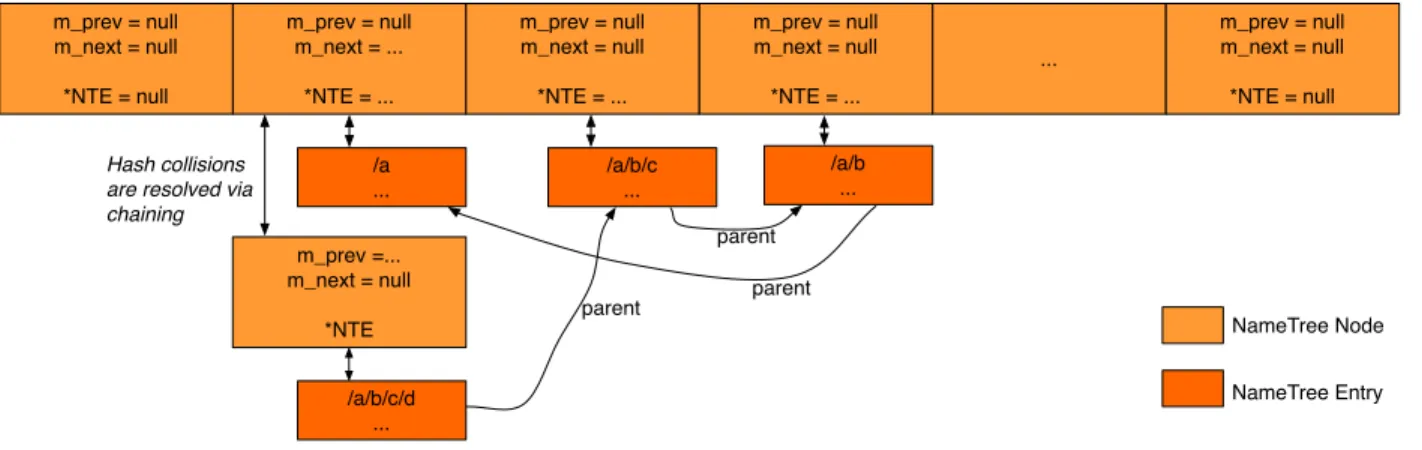
control for performance tuning. The hash table data structure is shown in Figure9.
Hash values are computed using CityHash [12]; this hash function is chosen because it is fast. For a given Name prefix,
hash is computed over the TLV representation of the Name, and the hash value is mapped to one of the buckets. Hash
collisions are resolved via chaining: if multiple Names are mapped to the same bucket, all these entries are chained in that bucket through a singly linked list.
As the number of stored NameTree entries changes, the hash table is automatically resized. During a resize operation, the new number of buckets is computed; this number is a trade-off between wasted memory of empty buckets and time overhead of chaining. Every NameTree entry is then rehashed and moved to a bucket in the new hashtable.
To reduce the overhead of resize operation, the hash value of a Name is stored in the NameTree entry. We also introduce aNameTree Nodetype. A Node is stored in the bucket, and contains a pointer to an entry, and a pointer to the next Node
3.6 NameTree 3 TABLES m_prev = null m_next = ... *NTE = ... /a ... m_prev = null m_next = null *NTE = ... /a/b/c ... m_prev = null m_next = null *NTE = ... /a/b ... ... m_prev = null m_next = null *NTE = null m_prev = null m_next = null *NTE = null m_prev =... m_next = null *NTE /a/b/c/d ... Hash collisions are resolved via chaining parent parent parent NameTree Node NameTree Entry
Figure 9: NameTree hash table data structure
in the chain. The resize operation only needs to move Nodes (which are smaller than entries), and do not need to change entries.
In Figure 9, name prefixes /a, /a/b, /a/b/c, /a/b/c/d are stored. The parent pointers shown on the figure show the
relationship between these four name prefixes. As shown in the figure, there is a hash collision between /a and /a/b/c/d, and the hash collision is resolved via chaining.
3.6.2 Operations and Algorithms Insertion and Deletion operations
Thelookup/insertionoperation (NameTree::lookup) finds or inserts an entry for a given Name. To maintain the tree structure, ancestor entries are inserted if necessary. This operation is called when a FIB/PIT/StrategyChoice/Measurements entry is being inserted.
Theconditional deletionoperation (NameTree::eraseEntryIfEmpty) deletes an entry if no FIB/PIT/StrategyChoice/ Measurements entry is stored on it, and it has no children; ancestors of the deleted entry are also deleted if they meet the same requirements. This operation is called when a FIB/PIT/StrategyChoice/Measurements entry is being deleted.
Matching algorithms
Theexact matchalgorithm (NameTree::findExactMatch) finds the entry with a specified Name, or returns null if such entry does not exist.
Thelongest prefix matchalgoritm (NameTree::findLongestPrefixMatch) finds the entry of longest prefix match of a
specified Name, filtered by an optionalEntrySelector. An EntrySelector is a predicate that decides whether an entry can be
accepted (returned). This algorithm is implemented as: start from looking up the full Name in the hash table; if no NameTree entry exists or it’s rejected by the predicate, remove the last Name component and lookup again, until an acceptable NameTree
entry is found. This algorithm is called by FIB longest prefix match algorithm (Section3.1.1), with a predicate that accepts
a NameTree entry only if it contains a FIB entry. This algorithm is called by StrategyChoice find effective strategy algorithm
(Section3.4.1), with a predicate that accepts a NameTree entry only if it contains a StrategyChoice entry.
Theall matchalgorithm (NameTree::findAllMatches) enumerates all entries that are prefixes of a given Name, filtered
by an optionalEntrySelector. This algorithm is implemented as: perform a longest prefix match first; remove the last Name
component, until reaching the root entry. This algorithm is called by PIT data match algorithm (Section3.3.2).
Enumeration algorithms
Thefull enumeration algorithm (NameTree::fullEnumerate) enumerates all entries, filtered by an optional EntrySe-lector. This algorithm is used by FIB enumeration and Strategy Choice enumeration.
The partial enumeration algorithm (NameTree::partialEnumerate) enumerates all entries under a specified Name prefix, filtered by an optionalEntrySubTreeSelector. An EntrySelector is a double-predicate that decides whether an entry can
be accepted, and whether its children shall be visited. This algorithm is used during runtime strategy change (Section5.1.3)
3.6 NameTree 3 TABLES
3.6.3 Shortcuts
One benefit of the NameTree is that it can reduce the number of index lookups during packet forwarding. To achieve this benefit, one method is to let forwarding pipelines perform a NameTree lookup explicitly, and use fields of the NameTree entry. However, this is not ideal because NameTree is introduced to improve the performance of four tables, and it should change the procedure of forwarding pipelines.
To reduce the number of index lookups, but still hide NameTree away from forwarding pipelines, we add shortcuts between tables. Each FIB/PIT/StrategyChoice/Measurements entry contains a pointer to the corresponding NameTree entry; the NameTree entry contains pointers to FIB/PIT/StrategyChoice/Measurements entries and the parent NameTree entry. Therefore, for example, given a PIT entry, one can retrieve the corresponding NameTree entry in constant time by following the pointer, and then retrieve or attach a Measurements entry via the NameTree entry, or find longest prefix match FIB entry by following pointers to parents.
NameTree entry is still exposed to forwarding if we take this approach. To also hide NameTree entry away, we introduce new overloads to table algorithms that take a relevant table entry in place of a Name. These overloads include:
• Fib::findLongestPrefixMatchcan accept PIT entry or Measurements entry in place of a Name
• StrategyChoice::findEffectiveStrategy can accept PIT entry or Measurements entry in place of a Name
• Measurements::get can accept FIB entry or PIT entry in place of a Name
An overload that takes a table entry is generally more efficient than the overload taking a Name. Forwarding can take advantage of reduced index lookups by using those overloads, but does not need to deal with NameTree entry directly.
To support these overloads, NameTree provides NameTree::getmethod, which returns the NameTree entry linked from
a FIB/PIT/StrategyChoice/Measurements entry. This method allows one table to retrieve the corresponding NameTree from an entry of another table, without knowning the internal structure of that entry. It also permits a table to depart from
NameTree in the future without breaking other code: suppose someday PIT is no longer based on NameTree,NameTree::get
could perform a lookup using Interest Name in the PIT entry;Fib::findLongestPrefixMatchcan still accept PIT entries,
4 FORWARDING
4
Forwarding
The packet processing in NFD consists of forwarding pipelines described in this section and forwarding strategies
described in Section 5. A forwarding pipeline(or just pipeline) is a series of steps that operates on a packet or a PIT
entry, which is triggered by the specific event: reception of the Interest, detecting that the received Interest was looped,
when an Interest is ready to be forwarded out of the Face, etc. A forwarding strategy (or just strategy) is a decision
maker about Interest forwarding, which is attached at the end or beginning of the pipelines. In other words, the strategy makes decisions whether, when, and where to forward an Interest, while the pipelines supply the strategy the Interests and supporting information to make these decisions.
Figure10shows the overall workflow of forwarding pipelines and strategy, where blue boxes represent pipelines and white
boxes represent decision points of the strategy.
incoming Interest incoming Data outgoing Interest outgoing Data after receive Interest Interest reject Interest unsatisfied Interest loop Data unsolicited before satisfy Interest before expire Interest unsatisfy timer straggler timer
Figure 10: Pipelines and strategy: overall workflow
4.1
Forwarding Pipelines
Pipelines operate on network layer packets (Interest or Data) and each packet is passed from one pipeline to another (in some cases through strategy decision points) until all processing is finished. Processing within pipelines uses PIT, ContentStore, FIB, and StrategyChoice tables, however for the last two pipelines have only read-only access (FIB and StrategyChoice are managed by the corresponding managers and are not directly affected by the data plane traffic). In addition to that, pipelines have read access to FaceTable (the table that keeps track all active Faces in the forwarder) and are allowed to actually send packets through Faces.
The processing of Interest and Data packets in NDN is quite different (the one serves as a request, while other satisfies
pending requests), we separate forwarding pipelines intoInterest processing pathandData processing path, described
in the following sections.
4.2
Interest Processing Path
NFD separates Interest processing into the following pipelines:
• incoming Interest: processing of incoming Interests
• Interest loop: processing incoming looped Interests
• outgoing Interest: preparation and sending out Interests
• Interest reject: processing PIT entries that are rejected by the strategy
4.2 Interest Processing Path 4 FORWARDING
4.2.1 Incoming Interest Pipeline
The incoming Interest pipeline is implemented inForwarder::onIncomingInterestmethod and is entered fromForwarder::
onInterest method, which is triggered byFace::onReceiveInterest event emitter (see Section9.5for more detail about
EventEmitter). The input parameters to the incoming interest pipeline include the newly received Interest packet and reference to the Face on which this Interest packet was received.
This pipeline includes the following steps, summarized in Figure11:
CS lookup
outgoing Data
PIT insert & straggler timercancel unsatisfy
FIB lookup dispatch to strategy Y receive Interest detect loop Interest loop Y record Nonce insert InRecord is pending? Y violates /localhost? Y (drop) set PIT unsatisfy timer Interest unsatisfied timer event set PIT straggler timer timer event PIT delete
Figure 11: Incoming Interest pipeline
• The first step after entering the incoming Interest pipeline is check for /localhost scope [9] violation. In particular, an Interest from a non-local Face is not allowed to have a name that starts with/localhostprefix, as it is reserved for localhost communication. If violation is detected, such Interest is immediately dropped and no further processing on the dropped Interest is performed. This check guards against malicious senders; a compliant forwarder will never send a /localhostInterest to a non-local Face. Note that/localhopscope is not checked here, because its scope rules do not restrict incoming Interests.
• The next step is looking up existing or creating a new PIT entry, using name and selectors specified in the Interest
packet. As of this moment, PIT entry becomes a processing subject of the incoming Interest and following pipelines. Note that NFD creates PIT entry before performing ContentStore lookup. The main reason for this decision is to reduce lookup overhead: ContentStore is most likely be significantly larger than PIT and can incur significant overhead, since, as described below, ContentStore lookup can be skipped in certain cases.
• Before the incoming Interest is processed any further, its Nonce is checked against the Nonce list in the PIT entry.
If a match is found, the incoming Interest is considered a duplicate due to loop, and is given toInterest loop pipeline
for further processing (Section 4.2.2). If a match is not found, its Nonce is added to the Nonce list and processing
continues.
• Next, theunsatisfy timer (described below) andstraggler timer (Section4.2.4) on the PIT entry are cancelled, because
a new valid Interest is arriving for the PIT entry, so that the lifetime of the PIT entry needs to be extended. The timers could get reset later in the Interest processing path, e.g., if ContentStore will be able to satisfy the Interest.
• The pipeline then tests whether the Interest is pending, i.e., the PIT entry has already another in-record from the same
or other incoming Face. Recall that NFD’s PIT entry can represent not only pending Interest but also recently satisfied
Interest (Section 3.3.1), this test is equivalent to “having a PIT entry” in CCN Node Model [8], whose PIT contains