Electoral pilot scheme evaluation
Sheffield City Council
Translations and other formats
For information on obtaining this publication in another
language or in a large-print or Braille version please contact
the Electoral Commission:
Tel: 020 7271 0500
Email: [email protected]
We are an independent body set up by the UK Parliament. Our aim is integrity and public confidence in the democratic process. We regulate party and election finance and set standards for well-run elections.
Contents
Summary
3
1
Introduction
5
2
Context
7
3 Pilot scheme description
8
4
Evaluation
12
Efficiency 12 Use of technology 14 Voting 16 Impact on counting 22 Turnout 23Security and confidence 24
Cost and value for money 27
Summary
In response to a prospectus issued to local authorities in England inviting
applications for electoral pilot schemes at the May 2007 elections, Sheffield City Council piloted the following innovations:
•
advance voting in a city centre location for a period of four days prior to the elections•
internet voting for a period of four days prior to the elections•
telephone voting for a period of four days prior to the electionsConclusions and findings
The pilot scheme facilitated and encouraged voting. By offering new voting channels, electronic voting gave electors more convenient voting options. A total of 3.43% of voters (4,621 people), or 1.23% of the eligible electorate, voted in the City Council elections using the internet and telephone voting channels. Almost four in five (80%) of those voters used the internet. Qualitative and quantitative feedback from users was generally positive; however, this should be placed in the context of a number of barriers to participation. Notably, these were the requirement to pre-register to participate in electronic voting, and the fact that the 96-hour period during which electronic voting took place ended a few days prior to polling day (3 May).
The pilot scheme facilitated the counting of votes. The technical process of performing the counting of the electronic votes was carried out efficiently, and the addition at the main count of the electronic votes to the other votes cast at the elections was administered in a straightforward manner. Had a higher proportion of the votes been cast electronically, the overall time taken to perform the count is likely to have been proportionately less, as there would have been fewer paper votes to count.
However, the Electoral Commission has some concerns surrounding the accountability and transparency of the process of counting electronic votes. Candidates and agents were unable to witness the counting of electronic votes. While the Commission understands the anxiety of the Council to maintain the secrecy of the ballot, this carries implications for the transparency of the process. The timing of the counting of electronic votes was not ideal; the decision to hold the count late on the evening of 3 May appeared to be made at very short notice, with the result that some accredited electoral observers who had planned to attend the counting of electronic votes were unable to do so.
Further, the Commission has some concerns over the method by which the electronic votes were included in the main count. Many candidates and agents were content with the procedure, the general view being that they had full confidence in the ability of the Returning Officer and his staff to ensure that the count was conducted correctly and the result appropriately declared. However,
some candidates and agents stated that it was difficult to have full confidence in the electronic results as no candidates or agents had been able to witness the count of electronic votes and the number of electronic votes cast per candidate was not made known to them.
The pilot scheme had a negligible impact on turnout. Overall turnout at the May 2007 elections in Sheffield was 36%, an increase of 1.5% on the turnout figure at the 2006 local government elections. It is difficult to link this slight increase in turnout to the pilot scheme, other than at the margins. Of the relatively small number of people who used the piloted methods of voting, a significant proportion of them indicated that they were predisposed to vote in any case.
The pilot scheme provided electronic voting services and advance voting services that were generally easy to use. The Commission’s public opinion research suggests that the majority of internet and telephone voters found voting processes easy to use. The Council’s own survey also found this to be the case in respect of internet voting. However, this finding should be placed in the context of some barriers to participation in internet and telephone voting reported by the Commission’s accessibility contractors.
The advance voting station replicated a traditional polling station and was straightforward to use for those electors who were able to access Sheffield city centre over the four-day period. Physical accessibility to the advance voting station was very good.
The pilot scheme does not appear to have led to any increase in personation or other offences or malpractice. There were no complaints to the Council or to the police regarding the pilot procedures or regarding potential fraud or security breaches.
The pilot scheme led to an increase in expenditure for the Council. However, the majority of these costs related to the supplier and were subsequently met by the Ministry of Justice. The overall cost of the pilot scheme was £760,362 when a discount for joint costs associated with another pilot scheme was applied. This can be separated into £395,000 for internet voting (or £110 per internet voter), £285,000 for telephone voting (or £425 per telephone voter) and £54,000 for advance voting (or £60 per advance voter). There were also costs of £26,000 for registration form printing.
1 Introduction
1.1 Under the Representation of the People Act (RPA) 2000, any local authority in England and Wales can submit proposals to the Secretary of State for Justice (prior to 9 May 2007, the Secretary of State for Constitutional Affairs) to carry out an electoral pilot scheme. Electoral pilot schemes can involve changes to when, where and how voting at local government elections is to take place, how the votes cast at the elections are to be counted, or candidates sending election communications free of postage charges. The Electoral Commission has a statutory duty to evaluate and report on any pilot scheme approved by the Secretary of State.
1.2 A total of 312 local authorities in England held elections in May 2007. In
October 2006, the Department for Constitutional Affairs1 and the Commission issued
a joint prospectus to local authorities inviting applications for electoral pilot schemes at the May 2007 elections. Fourteen applications were received in response to the prospectus, and in January 2007 the Secretary of State for Constitutional Affairs announced that he had approved 12 pilot schemes in a total of 13 local authority areas. A full list of all the authorities that held pilot schemes in May 2007 is available on the Commission’s website at www.electoralcommission.org.uk.
1.3 This report presents the Commission’s evaluation of the electoral pilot scheme carried out by Sheffield City Council at the elections on 3 May 2007. The evaluation includes a description of the pilot scheme and an assessment as to:
•
the scheme’s success or otherwise in facilitating voting or the counting of votes, or in encouraging voting or enabling voters to make informed choices at the elections•
whether the turnout of voters was higher than it would have been if the schemehad not applied
•
whether voters found the procedures provided for their assistance by the scheme easy to use•
whether the procedures provided for by the scheme led to any increase inpersonation or other electoral offences, or in any other malpractice in connection with elections
•
whether those procedures led to any increase in expenditure, or to any savings, by the authority1.4 In addition to these statutory requirements, the Commission’s evaluation also considers, where appropriate:
•
the extent to which the pilot scheme facilitated or otherwise encouragedparticipation among particular communities, including young people, people from minority ethnic communities and disabled people
•
overall levels of user awareness and comprehension of the voting method being tested, including an assessment of the effectiveness of any literature or other materials used in the promotion of the pilot scheme•
the attitudes and opinions of key stakeholders, including voters, with a view to determining overall levels of confidence in the voting method being tested1 Hereafter referred to as the Ministry of Justice following the machinery of government changes on
•
whether the pilot scheme resulted in measurable improvements, or had any adverse impact, with respect to the provision of more efficient and effective service delivery to voters•
whether the pilot scheme resulted in measurable improvements to, or had any adverse impact on, the existing system of electoral administration•
whether the pilot scheme represented good ‘value for money’1.5 Where appropriate, the Commission may also make recommendations as to whether changes should be made to electoral arrangements more generally through roll-out of the pilot scheme procedures.
1.6 The Commission is required to submit its evaluation report to the Secretary of State and any of the local authorities involved in the pilot scheme, and those local authorities are required to publish the evaluation report within three months of the elections. The Commission has also published this report on its website, together with a copy of the Statutory Order that allowed the pilot scheme to take place. 1.7 In preparing this report, the Commission has drawn on its own observations and assessment of the pilot scheme, as well as on the views expressed to it by a number of other stakeholders. The report also incorporates findings from work undertaken by the following contractors:
•
public opinion research carried out by ICM Research•
an evaluation of technical elements of the pilot by Actica Consulting•
an accessibility evaluation of the pilot by PA Consulting, Equal Ability CIC and Churchill, Minty & Friend Ltd1.8 Copies of the reports produced by the Commission’s contractors are available from its website, and in other formats on request.
1.9 The Commission would particularly like to thank the Returning Officer and the Electoral Services department of Sheffield City Council, together with Sheffield’s elections partner Opt2Vote, for their assistance in undertaking this evaluation and for supplying it with the information and data to support the evaluation.
2 Context
The area
2.1 Sheffield is a major city, situated in South Yorkshire. In addition to its urban core and suburbs, the City Council area contains rural and semi-rural areas, particularly to the west and north of the city.
2.2 Sheffield’s population was 520,700 according to the 2005 mid-year Office for National Statistics population estimate, a small (1.5%) increase on the population recorded at the time of the last census in 2001. The City Council area covers around 36,800 hectares, although two-thirds of this is classified as rural or semi-rural. The overall population density for the Sheffield City Council area is therefore around 14 people per hectare (around 42 people per hectare in the urban area).2
2.3 In terms of ethnicity, Sheffield has around the national average, 91%, of people who classify themselves as white British. Black and minority ethnic (BME) communities account for about 8% of Sheffield’s population (4.5% Asian, 2% black and 1.5% mixed race). Sheffield contains relatively small Polish, Slovak, Kosovar, Yemeni and Somali communities.
2.4 Compared with all local authorities across England, Sheffield is classified as a relatively deprived area, ranking 60 out of 354 council areas on a scale of deprivation (with 1 being the most deprived).3
The Council
2.5 Sheffield City Council is represented by 84 councillors, elected from a uniform pattern of 28 three-member wards. The Council holds elections by thirds, so in 2007 elections for a single Councillor were held in each of the 28 wards. At the May 2007 elections the electorate of the city was 374,328. The political composition of the Council prior to the 2007 elections was: 44 Labour, 34 Liberal Democrats, two Conservatives, two Greens and one Independent, with one vacancy.
2.6 There are three parish or town councils within the Sheffield City Council area, two of which, Stocksbridge Town Council and Ecclesfield Parish Council, held elections for all or parts of their areas on 3 May 2007. Elections to Bradfield Parish Council were uncontested. Sheffield currently returns six Members of Parliament, the city’s constituencies being Attercliffe, Brightside, Central, Hallam, Heeley and Hillsborough. Five of the six are represented by Labour Members of Parliament, with the other (Hallam) being represented by a Liberal Democrat.
2 Except where otherwise stated, all demographic information was obtained from the census carried
out in 2001 by the Office for National Statistics.
3 Office of the Deputy Prime Minister, The English Indices of Deprivation 2004 (revised) (2004),
3 Pilot scheme description
The pilot scheme application
3.1 In response to the October 2006 electoral pilot scheme prospectus, Sheffield City Council (hereafter known as ‘the Council’) submitted an application to pilot a series of innovations and changes to electoral procedures, including:
•
remote electronic voting (e-voting) using the internet and touch tone telephone for a period prior to polling day•
advance voting at one polling station located in the Town Hall for a period prior to polling day•
counting the votes cast at the elections electronically3.2 In a Written Ministerial Statement on 29 January 2007, the Secretary of State for Constitutional Affairs announced that the Government had given approval for the Council to pilot remote e-voting and advance voting.4 However, the electronic
counting proposal was not accepted. The final Pilot Order, Sheffield City Council (Electronic and Advance Voting) Pilot Order 2007, was made on 27 March 2007 and came into force on the same day.5
Pilot scheme summary
Electronic voting
3.3 The Council made remote internet and touch tone telephone voting available to its electors over a period of four days (96 hours), from 7am on 26 April until 7am on 30 April. The system employed by the Council was provided by Opt2Vote. With the benefit of experience gained from previous pilot schemes, the Council decided that e-voting should close a few days prior to 3 May in order that there would be sufficient time for the electoral registers that were to be used on that date to be suitably marked, to alert polling station staff as to who had already voted.
3.4 As with the other four e-voting pilot schemes that took place at the May 2007 local government elections (held in the local authorities of Rushmoor, Shrewsbury & Atcham, South Bucks and Swindon), all Sheffield electors wishing to vote by internet or telephone were required to register for the service in advance. Once registered, prospective e-voters were not able to use postal voting or to use the advance voting centre at the Town Hall, although they were able to vote in person at their polling station on 3 May if they had not used their e-vote.
3.5 All electors were written to by the Council during the week commencing 26 March asking if they wanted to register to vote electronically as part of the 2007 pilot scheme. If they did wish to participate, they needed to return a registration form by 18 April providing their name and address, date of birth, a six-digit passcode and a signature. Once the forms had been returned to the Council and checked against
4 Official Record (House of Lords), 29 January 2007, Column WS1.
5 The Commission’s response to all Pilot Orders can be found on the Commission website at
the electoral register, registered e-voters were subsequently sent a unique voter identification number (VIN).
3.6 Registered electors could then vote by using the website address or a
freephone telephone number provided on the secure poll card to access the voting system. Having entered their passcode, date of birth and VIN in order to obtain access to the e-voting system, electors were directed to cast their vote, confirm (or change) their selection, and then exit the system. Ballots cast using the e-voting system were stored in encrypted form. The decryption process required the
authorisation of the Returning Officer and was time-locked until the close of poll on 3 May.
3.7 As part of the pilot scheme, the Council also facilitated the use of – but did not strongly promote – seven information kiosks for internet voting. One of these kiosks was at the Town Hall, with the others being located around the City Council area. Although the Council regarded the kiosks as an aid to increasing access to the internet, it was also conscious that the locations of the kiosks were not ideal for the purpose of internet voting, primarily because of concerns relating to privacy and the secrecy of the vote and also due to physical accessibility issues.
3.8 These processes are discussed in more detail in Chapter 4, ‘Evaluation’, with further technical information available in the reports produced by the Commission’s contractors.
Advance voting
3.9 The Council proposed using its main Town Hall offices as an advance voting station. This station, designed to replicate the polling station experience, would enable electors to vote from 9am until 5pm from 26 April to 29 April inclusive. As with e-voting, this element of the pilot scheme was designed to finish a few days prior to 3 May so that the electoral registers that were to be used on that date could be suitably marked, alerting polling station staff as to who had already voted.
Objectives of the pilot scheme
3.10 In its pilot scheme application, the Council stated that the pilot scheme aimed to:
•
test the effect on turnout of providing an extended voting period and making it easier for electors to vote•
pave the way for the expansion of future e-voting innovations in Sheffield•
enable an accurate and well-documented evaluation of social impact, processes and technologies arising from the pilot scheme3.11 In commenting formally on the application,6 the Commission noted that the
Council’s application ‘provided evidence of effective project management and risk analysis’ and that the Council had:
6 Comments by the Commission on pilot scheme applications under Section 10, RPA 2000, December
previous experience of successfully delivering a complex pilot scheme… we also have confidence in their ability to manage relationships with suppliers effectively. The application provides a good mix of elements that would enable us to undertake a detailed assessment of a number of key factors, including patterns of usage and take-up, accessibility, security and confidence in electronic voting.
3.12 The background paper7 attached to the Secretary of State’s Written Ministerial
Statement announcing approval of the May 2007 pilot schemes stated that Sheffield’s pilot scheme would enable:
a detailed assessment of a number of key factors, including patterns of usage and take-up, accessibility, security and confidence in electronic voting. Sheffield’s pilot scheme will also provide evidence about the popularity and convenience of the [advance voting] facility in a diverse urban authority.
3.13 The following section outlines the key objectives of the pilot scheme, as they relate to the statutory evaluation criteria specified in Chapter 1, ‘Introduction’.
Facilitating voting and ease of use
3.14 As previously stated, it was expected that the pilot scheme evaluation would provide a detailed assessment of patterns of take-up and usage. The Council stated that it hoped it would be possible to evaluate feedback from voters on the various voting channels and options and the effect this had on their decision to vote. It also hoped that the pilot scheme would facilitate the development of a scalable and repeatable framework for addressing accessibility issues in future pilot schemes. 3.15 The pilot prospectus noted that e-voting pilot schemes provided a further opportunity to assess demand among those aged 18–24. The prospectus also identified likely learning on how barriers to accessibility might be reduced through remote e-voting and related instructions provided to electors.
3.16 The pilot scheme could also enable an assessment of the impact of pre-registration on voter take-up of e-voting channels, by comparing usage of e-voting with statistics from Sheffield’s 2003 pilot scheme and other 2007 pilot schemes.
Facilitating the counting of votes
3.17 Although not a stated objective of the pilot scheme, a relatively high take-up of e-voting would potentially reduce the time required for the manual count of paper ballots. There was no advance counting of votes cast at the advance voting station.
Turnout
3.18 The Council stated that it hoped its pilot scheme would contribute towards an increase in turnout through:
•
the choice of voting channels it offered•
the extended voting periodSecurity and confidence
3.19 As previously noted, it was expected that the pilot scheme evaluation would provide a detailed assessment of security and user confidence in relation to
e-voting. The Council acknowledged that a key aspect of the pilot scheme’s success would depend on the level of security in the voting methods being piloted and, equally importantly, confidence among the voting public and other stakeholders that the pilot scheme was secure. The pilot scheme aimed to:
•
test the impact of pre-registration on voter confidence and trust in the integrity of e-voting•
test the impact on voter trust and confidence of providing a voter receipt for the touch tone telephone and internet voting channels•
test the security and operation of remote e-voting in conjunction with pre-registration•
adapt the new postal voting security requirements to an e-voting context3.20 Other issues for consideration included the management of e-voting processes and results, the extent to which results were auditable or transparent, and any efforts to strengthen the secrecy of the remote electronic ballot.
3.21 Security was not expected to be a particular issue in relation to advance
voting, since the advance voting station was in effect only a traditional polling station that was open earlier (and for longer) than usual.
Efficiency
3.22 The Council stated that an aim of its pilot scheme was to provide a framework for the future secure, cost-effective and scalable delivery of remote ‘vote anywhere’ facilities. However, for the 2007 elections, the main impact of e-voting on the overall efficiency of the elections was expected to be the additional costs incurred through the provision of hardware, software, professional services and printing costs for the advance registration process. For this pilot scheme, the majority of these costs were met by the Ministry of Justice (MoJ).
3.23 There is also the need to consider the significant impact of involvement in the pilot scheme processes on the time required by the Returning Officer’s staff to manage and administer the remainder of the elections.
3.24 It was intended in respect of the advance voting station that efficiency would be enhanced through the use of information technology. The advance voting station was provided with a networked electoral register for the whole of Sheffield, allowing advance voting station staff to match up the voter with their correct ward before printing off the relevant ballot paper(s). The information technology (IT) was the main cost associated with the advance voting station, together with some relatively minor staffing and advertising costs. As a Council-owned building was used for the advance voting station, there were no other additional costs associated with its use. No overall impact on the efficiency of the electoral process was anticipated.
4 Evaluation
Efficiency
Project management
4.1 The Council has one of the largest electorates of all English local authorities and at an early stage recognised the need for good project management to be in place, in order not only to run the pilot scheme successfully but also to manage the elections as a whole. This was particularly important in the context of the May 2007 elections, at which substantial legislative changes introduced by the Electoral Administration Act 2006 were to come into effect.
4.2 The Council required a partner to deliver the e-voting system and provide technical expertise. To deliver technical pilot scheme services for pilot schemes in England and Wales, the MoJ had established a framework agreement following a procurement exercise of suitable suppliers to support pilots that utilised
electronic services.
4.3 The Council therefore appointed Opt2Vote, not only to deliver the e-voting and advance voting systems but also to project manage the pilot scheme and the delivery of the elections as a whole. Both the pilot and non-pilot scheme aspects of the elections were considered by the Council and Opt2Vote to form a single project. 4.4 PRINCE2 project management methodology was used to deliver the pilot scheme, and the Project Executive, which oversaw the management of the project, included the following key people:
•
Head of Corporate ICT and e-Government (the Council)•
Assistant Chief Executive, Legal and Governance (the Council)•
Electoral Services Manager (the Council)•
Deputy Electoral Services Manager (the Council)•
senior supplier representative (Opt2Vote)•
Project Manager (Opt2Vote)•
communication consultancy representative (21c)4.5 The Council delegated day-to-day operational control of the pilot scheme, including the project management of it, to Opt2Vote via the formal authority of the Project Executive, which met fortnightly from 5 February and weekly from mid-March until just after the elections. Additionally, the Opt2Vote Project Manager held regular formal meetings (weekly or more frequently as required), as well as other informal meetings, with the Electoral Services Manager, other Council election staff and subcontractors, particularly 21c.
4.6 In addition, there were regular meetings of the Electoral Services team,
including almost daily briefings for staff during the election period, particularly in the last few days before the elections. This meant that there was clear communication to all involved as to the current status of the project as well as of any outstanding actions required.
4.7 Project management documentation provided by the Opt2Vote Project Manager was of a good standard, and covered the key aspects to be expected in the delivery of such a project (e.g. management of technical risks, appropriate contingency measures, etc.). A quality review plan was developed by which means key Council staff were able to approve elements of the pilot scheme on a stage-by-stage basis.
4.8 The most important factor affecting the management of the project was the time allotted to its implementation. Once the pilot scheme had been approved by the Secretary of State and the Council had selected Opt2Vote from the framework of MoJ-approved suppliers, less than three months remained until the elections on 3 May.
4.9 While the pilot scheme was delivered without major issues arising, the short implementation timescale inevitably had an adverse effect on overall project risk. In particular, it meant that insufficient time was provided for project documentation to be produced and reviewed, for the system to be thoroughly tested, and for all of the changes identified through testing to be made.
Training
4.10 Opt2Vote provided pilot scheme-related training sessions for election and other relevant staff, including helpdesk staff, involving:
•
a presentation on the background and scope of the project•
a presentation on the use of technology•
practice on the use of technology4.11 Training was provided in the form of one-day workshops, run from a formal training script with relevant example data used and processes demonstrated. A significant element of the training was hands-on. Opt2Vote also provided some tailored training for the staff who worked at the advance voting station. Feedback from staff receiving the training was generally positive.
4.12 A briefing was also held for candidates and agents on the elections, including the pilot scheme elements of them. The Commission was invited to give a short presentation to candidates and agents as part of this briefing.
Supplier management
4.13 The key supplier relationship for the Council was with Opt2Vote, which in addition to its project management role (discussed above) provided:
•
the e-voting systems•
the electronic electoral register and the ability to print ballot papers on demand for the advance voting station•
the printing of e-voting pre-registration forms, e-voting poll cards and other communications promoting the pilot scheme4.14 The relationship between the Council and Opt2Vote appears to have been positive and effective, with regular project meetings and communication, and it demonstrated co-operative working. The contractual relationship between the two organisations was similar to previous such relationships. (Opt2Vote has worked on elections with the Council each year since 2004.)
4.15 Opt2Vote also managed 21c’s input to the pilot scheme. 21c was responsible for the Council’s communications strategy for the elections, with a particular focus on the pilot scheme. The relationships of 21c with both the Council and Opt2Vote appeared to be effective. The Council stated that any issues or problems that arose were dealt with quickly.
Use of technology
4.16 This section of the report briefly summarises the technology used to deliver the e-voting and advance voting pilot scheme and the testing and quality assurance processes undertaken prior to use. A more detailed discussion can be found in the separate report provided by the Commission’s technical contractors, Actica Consulting.
Electronic voting
4.17 Opt2Vote managed two e-voting pilot schemes at the May 2007 elections, those of Sheffield and Shrewsbury & Atcham. The two pilot schemes shared network infrastructure and interfaces to reduce costs, but maintained separate databases and were managed independently. Opt2Vote claimed that its system was capable of supporting up to 14 million electors in a single shared election. The comparatively small number of voters expected to use the system in Sheffield meant that the capacity of the system provided therefore far exceeded requirements.
4.18 Table 1 summarises the steps electors had to follow to use the internet and telephone voting interfaces.
4.19 The internet and telephone user interfaces made additional provision for the following:
•
Voters could ‘under-vote’ in contests with more than one vacancy by voting for fewer candidates than there were vacancies (this related only to parish council elections).•
Proxy voting was supported by the system, although, in the event, this facility was not used by any voters.•
The system also supported e-tendered voting, although again, in the event, this facility remained unused.•
The system permitted spoilt votes to be cast by entering invalid candidate codes, although this facility was not promoted and electors had to confirm their intent to spoil as per step 6 in Table 1.•
If an elector was eligible to e-vote in multiple contests (i.e. in both City Council and parish council elections), the system allowed them to vote in one contest, exit the system and then access it again during the e-voting period to cast their vote in the other contest.Table 1: Summary of the processes for internet and telephone voting Step Internet voting Telephone voting
1 Log on to the correct website
address: www.votesheffield.com Call freephone number provided on e-voting poll card 2 Visit ‘help’ page (optional) Listen to information on voting 3 Enter date of birth, passcode and
VIN Enter date of birth, passcode and VIN
4 Select contest (if able to vote in both City Council and parish council elections)
Select contest (if able to vote in both City Council and parish council elections)
5 Select candidates from on-screen ballot paper by entering four-digit code for each candidate
Select candidates from audio ballot paper by entering four-digit code 6 Confirm selection, or return to step 5 Confirm selection, or return to step 5 7 Repeat steps 5 and 6 for other
contest if taking place and choosing to vote
Repeat steps 5 and 6 for other contest if taking place and choosing to vote
8 Complete online survey on views on
e-voting (optional) Not applicable
4.20 It was not possible for a voter to verify who their vote was cast for and whether it was counted after confirming their choice (step 6 in Table 1).
4.21 Once the voter had cast their vote, it was encrypted and stored in a database, which held all votes until they were required for counting at the close of poll. The system encrypted ballots using the public half of an encryption key, which had been generated at the start of the e-voting period. A time lock was also in place to ensure that, even with Returning Officer-level access to the system, it would not be possible to count the votes prior to the end of the elections (i.e. prior to 10pm on 3 May). 4.22 The main count in Sheffield took place on Friday 4 May from 10am. However, the count of the internet and telephone votes was conducted shortly after the close of poll on Thursday 3 May. The procedure involved the Deputy Electoral Services Manager inputting a series of three passwords (known only to himself and the Returning Officer) to a laptop personal computer (PC) connected to the main voting server, and instigating the count. The laptop PC was then able to show the number of e-votes cast for each candidate (plus ‘spoilt’ ballots) in each contest. The results were printed out and placed in separate envelopes, which were to be opened at the main count the following morning.
4.23 Testing and quality assurance of the e-voting system was carried out by a number of organisations: by Opt2Vote; by third parties commissioned by Opt2Vote; by the Council; and by the MoJ and its contractors. A significant proportion of this consisted of security testing, which is considered alongside related issues later in this report.
4.24 As part of the quality review process, relevant Council staff had an opportunity to review and comment upon both the technical and non-technical elements of the pilot process. Council staff also conducted user acceptance testing, based on scripts prepared by Opt2Vote which were intended to test the criteria set by the Council. No major issues were raised, although it was decided that there was insufficient time to address a relatively minor issue with the telephone voting script in order to improve the clarity of the instructions provided.
Advance voting
4.25 While the advance voting station was in effect a traditional polling station that was open at an earlier time than usual, it did make some use of technology to facilitate the provision of ballot papers for a large number of contests.
4.26 The advance voting station included two laptop PCs with access to an electronic copy of the electoral register and details of each City Council and parish ward contest. The staff at the advance voting station used the laptop PCs to correctly match up electors with their relevant ward, print the ballot paper(s) for the relevant contests, and update the register with a record of advance voters. No technical issues or problems relating to advance voting were reported.
Voting
Public awareness and feedback
4.27 The Council made use of a voter engagement plan prepared by its consultants 21c. The key message from the voter engagement plan was that the pilot scheme was part of ‘twenty-first century voting’ in Sheffield and that it aimed to offer choice, accessibility and security for all electors. The techniques used to try and engage electors with the pilot scheme (and indeed with the elections as a whole) included using a brand (logo), pre-election communications (such as radio and newspaper advertising, posters and leaflets) and other forms of advertising such as ‘street teams’ approaching people in the city centre.
4.28 The e-voting element of the pilot scheme used the web address
www.votesheffield.com as the place people could log on to vote. This address had been used by the Council in its previous pilot schemes in 2002 and 2003, and was also used in the fortnight or so prior to the start of e-voting on 26 April, to supplement information provided on the elections part of the Council’s main website (www.sheffield.gov.uk).
4.29 Comparing levels of awareness of innovations being trialled in the 2007 pilot schemes in different areas of England, the e-voting areas show a considerably higher level of awareness than other pilot scheme areas. Opinion research from
ICM Research found that nearly six in 10 (58%) of Sheffield electors were aware that their local authority was piloting new electoral arrangements.
4.30 Indeed, upon prompting, more than four in five (83%) knew that new voting channels were being employed in Sheffield – a higher level than any other 2007 pilot scheme area besides Swindon. Two in three (66%) were aware that advance voting was possible, with a similar number aware of internet voting (67%), while half (50%) knew that they could vote over the telephone. Public awareness appeared mainly to be driven by the Council’s strategy, with 68% citing Council communications highlighting the arrangements – this is the highest score for this measure across all the pilot scheme areas.
4.31 The internet voting survey conducted by the Council found that more than 80% of respondents found out about the e-voting options via the pre-registration form sent out by the Council, with most others finding out via advertising and/or in the local media.
4.32 The most popular answer (45%) given by advance voters interviewed by ICM Research, when asked how they found out about the opportunity to vote in advance at the Town Hall, was when they received their polling card. This suggests that the Council’s publicity efforts were primarily concentrated on the e-voting aspects of the pilot scheme.
Impact on voting
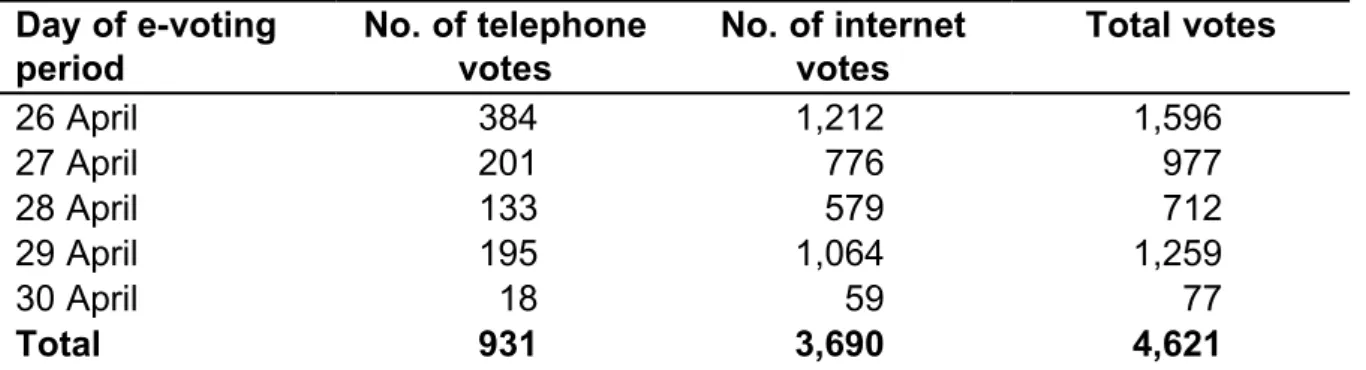
4.33 In total, 3.43% of those who voted (4,621 people) cast their ballot for a City Council contest using the telephone or the internet. Table 2 provides a breakdown of the channels used and the days on which individuals voted.
Table 2: Use of e-voting by day and by channel Day of e-voting period No. of telephone votes No. of internet votes Total votes 26 April 384 1,212 1,596 27 April 201 776 977 28 April 133 579 712 29 April 195 1,064 1,259 30 April 18 59 77 Total 931 3,690 4,621
4.34 Table 2 shows that the most popular day for e-voting was the first day it was available, Thursday 26 April, during which 35% of e-voters cast their ballot in the City Council elections. A further 27% of e-voters did so on the last full day available for them to do so (Sunday 29 April). More than half of e-voters (55%) voted during conventional office hours, between 9am and 5pm. Of the remainder, 38% voted during the evening, between 5pm and 11pm, particularly on the last evening e-voting was available (Sunday 29 April).
4.35 Internet voting was the most popular e-voting channel, with 2.74% of all votes cast in the City Council elections (excluding parish elections) cast via the internet. Nether Edge ward recorded the highest percentage of votes cast by this means (4.28%), while Darnall ward recorded the lowest percentage (1.45%).
4.36 Perhaps not surprisingly, voting via the internet was, in general terms, more popular in the relatively affluent western suburbs than in other areas, and this tended to be the case both in terms of the absolute numbers of votes and the proportion of votes cast via this method. The five wards that recorded more than 200 internet votes were Crookes, Dore & Totley, Ecclesall, Fulwood and Nether Edge. Conversely, nine wards, all in the east and north of Sheffield, each recorded fewer than 100 internet votes.
4.37 Sheffield’s internet voting survey found that around 96% of voters who
completed a questionnaire found the voting options either ‘very’ or ‘fairly’ convenient and easy to use. The same percentage thought the instructions for voting were ‘very’ or ‘fairly’ clear. ICM Research also found positive views of the pilot scheme voting experiences. All telephone voters surveyed found the registration process easy, and they registered to vote in this way either because it was convenient or because it was new and they wanted to try it out.
4.38 Despite these generally positive views, there was also some negative
feedback. The Commission heard directly from some individuals who had problems accessing the internet voting system and there were some negative views
expressed about the lack of clarity to the user if they did not wish to use all their available votes in the parish council elections.
4.39 The pattern of telephone voting was more even across the city in comparison with that for internet voting, although the overall number of people using this method of voting was low. Only 931 people voted by telephone in the City Council elections (0.69% of overall turnout) across the whole of Sheffield. Indeed, one party agent interviewed by ICM Research was even unaware of the possibility of telephone voting. The largest number of telephone votes in any one ward was 65 (Dore & Totley ward), while the lowest was 22 (in both Walkley and Woodhouse wards). 4.40 One of the key determinants of levels of usage of e-voting identified by the Council was the requirement to pre-register to participate in either internet or
telephone voting. This had not been the case in previous e-voting pilots in Sheffield in 2002 and 2003. More than 95% of respondents to the internet voting survey conducted by the Council stated that they believed more people would use internet and telephone voting if there was not a requirement to pre-register.
4.41 However, the opinion research conducted by ICM Research also shows that the majority of respondents were comfortable with the idea of pre-registration. In response to a question about how comfortable people were about giving their name and address to pre-register for e-voting, more than 87% stated that they were either ‘very’ or ‘quite’ comfortable about doing so. Unsurprisingly, more than 97% of respondents to the Council’s internet survey stated that they would prefer to vote via the internet at future elections.
4.42 A second key issue which was likely to (and did) limit participation in the e-voting aspects of the pilot scheme was the fact that, unlike in 2003, e-voting was only available for a limited period (96 hours) and this time frame finished a few days before polling day.
4.43 Given that over 13,500 people pre-registered to use e-voting and yet only around one-third of them subsequently voted electronically, it can be deduced that significant numbers of people who applied to use e-voting may not have been fully aware that the opportunity to do so finished in advance of polling day. Such people are likely not to have fully read the documentation sent to them by the Council and may well have assumed that, as in 2003, they could e-vote right up to (and including) polling day.
4.44 The report by the Commission’s technical consultants, Actica Consulting, commented that 171 people who tried to e-vote were ‘locked out’ by the system after three unsuccessful attempts (caused by entering the wrong date of birth and/or passcode and/or VIN) and 35 of these people contacted the Council and were able to have the system reset so they could e-vote. These numbers demonstrate that the vast majority of those who pre-registered to e-vote, but did not vote in that manner, did not try to do so during the relevant time frame.
4.45 Anecdotal and technical evidence suggests that very few voters who voted via the internet did so through the information kiosks. This is unsurprising given that the use of the kiosks for internet voting was not promoted by the Council. It was apparent from the Commission’s observation of advance voting at the Town Hall that the information kiosk in the Town Hall main reception area did not have any signage to indicate that people could use it to vote,8 unlike the adjacent room where advance
voting took place, which was well signed in the manner of a traditional polling station.
Advance voting
4.46 In total, 909 voters made use of the advance voting station over the course of the pilot, constituting 0.67% of those who voted in the elections overall. Table 3 provides a breakdown of the days (in April) on which individuals voted.
Table 3: Breakdown of advance voting on a daily basis
Thurs 26 Fri 27 Sat 28 Sun 29 Advance voters 308 301 219 81 4.47 Table 3 shows that the first two days of advance voting, the Thursday and Friday, were the most popular, and that the two weekend days showed lower levels of usage, particularly the Sunday. This is likely to reflect the fact that there are fewer shops open, and for fewer hours, in Sheffield city centre on Sundays than on other days and so there were fewer electors in the city centre to use the facility.
8 However, as only those people who had pre-registered to e-vote would have been able to use the
4.48 Observation and anecdotal evidence indicated that lunchtime (from around 12.30pm to 2pm) was a relatively popular time for people to use the advance voting station on business days. A suggestion made by a member of staff at the advance voting station was that it may well have received significantly greater usage if it had been open earlier in the morning (e.g. at 7.30am) and later in the evening (e.g. until 6pm) as this would have caught more city centre workers who were going to or from their place of employment.
4.49 Burngreave ward recorded the highest number of advance voters (60), while Central ward had the highest percentage of voters (1.28%) who used the advance voting station to cast their vote. Voters in relatively distant wards, such as East Ecclesfield, West Ecclesfield and Stocksbridge & Upper Don, made the least use of the advance voting station.
4.50 Three-quarters (74%) of people who voted in advance considered it to be convenient. Some voters commented that the choice of venue was excellent – being central within Sheffield, in a well-known building, and with very good disabled
access. One older voter commented that she would have had to walk up and down a fairly steep hill to get to her local polling station, so the opportunity to use the advance voting station was welcome and voting there could be combined with an already planned visit to the city centre.
4.51 ICM Research’s opinion research found that two in five (42%) of advance voters had made a specific trip to the advance voting location to vote, although most voters of this type (52%) incorporated it into a more wide-ranging trip to the city centre. Five per cent of users voted on the spur of the moment when they saw they could vote this way.9
Accessibility
4.52 The Council’s voter engagement plan, prepared by the Council’s consultants 21c, also paid particular attention to groups who were perceived as likely to benefit from the opportunity of using e-voting. These five ‘target’ groups were:
•
disabled people•
older people•
time-pressured people•
young people (18–34)•
people from BME communities4.53 An accessibility study was undertaken on behalf of the Commission by PA Consulting. They reported that the measures taken by the Council to increase accessibility during the pilot were partially successful, and accessibility aspects of the Sheffield pilot scheme were assessed as being average.
9 The base size for the Sheffield exit poll is relatively small (258 voters), as was the case in all
4.54 In terms of the five target groups mentioned above, PA Consulting stated that no evidence was found of a major impact of the pilot scheme on any particular group, although there was a level of awareness due to the history of previous pilot schemes in Sheffield. The Council was praised for engaging communities who otherwise find it difficult to vote, such as people with limited access to transport and commuters, although it was also suggested that there should have been greater involvement of particular groups, such as people from BME communities.
4.55 PA Consulting found that, as with the other pilot schemes being conducted across England at the 2007 elections, the information used to raise awareness in advance of the voting period was heavily text based and not particularly accessible for individuals who were unable to access written language. The Council’s telephone helpline was also found to not be accessible to particular groups. However, in
usability testing, telephone voting was found to be effective.
4.56 The process of logging on to the e-voting website caused difficulty for some potential voters. A major issue impinging on accessibility and usability was the requirement (apparently stipulated by the MoJ in the Sheffield Pilot Order) that the information to be provided by the voter to the Council on the application form to e-vote needed to include a password in the format of six digits.
4.57 A difficulty arose with this due to people associating the term ‘password’ (used on the pre-registration form) with letters rather than numbers; a large number of people (many thousands) had to have their forms returned to them to supply a passcode using digits, and due to the volume of mail being received by the Council’s Electoral Services department at the time, primarily due to the high volume of postal vote requests, there were inevitable delays in correspondence. 4.58 The actual voting process, while apparently easy to use for the large majority of internet voters (as per the results of the Council survey), was cumbersome and difficult for a minority. One person reported that they felt pressured to undertake the Council survey at the end of the process, believing that if they did not click on the ‘survey’ button at the end of voting their vote would not be recorded. The person suggested that receiving a confirmatory email, saying that their vote had been accepted, could have clarified things.10
4.59 The technical assessment found that the www.votesheffield.com website was generally in compliance with requirements set out in the Disability Discrimination Act 1995, and the site met Web Content Accessibility Guidelines 1.0 (WCAG 1.0) conformance level A.11 However, the MoJ’s statement of requirement for its e-voting
supplier framework required such sites to meet a higher accessibility standard, namely WCAG 1.0 conformance level Double-A.
10 Response quoted in PA Consulting report.
11 Web Content Accessibility Guidelines (WCAG) are a recognised standard in website accessibility
developed by the World Wide Web Consortium (W3C). See www.accessibility101.org.uk/index.htm for further details.
4.60 PA Consulting reported that the experience of electors around telephone voting was variable. For example, one usability tester found the experience generally straightforward and positive, reporting high audio quality and a simple-to-use system, whereas another usability tester had a poor experience and found it difficult to use due to the significant amount of numbers (passcodes etc.) they were
required to input to cast their vote.
4.61 There was some significant negative feedback about the shortened period for voting (compared with the 2003 pilot scheme). Some people were confused as to why the opportunity to e-vote ended a few days before polling day.
Campaigning
4.62 The e-voting and advance voting options appeared to have had little impact on the way in which candidates conducted their campaigns; campaigns were not greatly affected by these voting methods. If the number of people using the piloted methods of voting had been larger, this may well have been different, as larger numbers of electors would need to be engaged significantly earlier than the immediate few days before polling day. Evidence from discussions with some candidates and agents at the count indicated that, following the successful completion of the pilot, some merit could be seen in offering alternative voting methods, particularly when trying to engage younger and/or first-time voters.
4.63 Concern was raised by some candidates and agents over the availability of a marked register over the term of the advance and e-voting period. Consistent with its position on the marked register at a conventional elections, the Commission considers that this should not be available until after the close of poll.
Impact on counting
4.64 The count took place at the Ponds Forge Leisure Centre, a central location in Sheffield, and was held on Friday 4 May rather than immediately after the close of poll at 10pm on Thursday 3May. This was only the second time that the Council had held the count on a Friday (the previous occasion was in 2004). The 909 votes that had been cast at the advance voting station at the Town Hall were sorted by ward, including by parish ward, and added to the relevant count as appropriate. This part of the pilot scheme effectively had no impact on the count.
4.65 It had originally been intended that the count of e-votes would take place at the Ponds Forge Leisure Centre at the start of the main count. However, it was ultimately decided to carry it out at the Town Hall, after the close of poll on 3 May, in the presence of the Returning Officer, senior members of his Electoral Services team and Opt2Vote representatives.
4.66 No candidates, agents or observers (other than a Commission representative) were present at the count of e-votes and had not been invited to attend. It should be noted that the reason the Council gave for this was that it would be difficult to conceal the numbers of e-votes cast per candidate, potentially jeopardising ballot secrecy.
4.67 The Deputy Electoral Services Manager was required to enter a password into the laptop PC that held the e-voting results; there was also a time-lock system in place so that no results could be downloaded prior to the close of poll at 10pm on 3 May. Sheets indicating the number of votes cast per candidate, and the number of spoilt votes (if any), were printed off for each ward (including by parish ward) and sealed in individual envelopes, with the total number of votes and the ward name written on the outside.
4.68 At the main count at the Ponds Forge Leisure Centre the following morning, it appeared to be relatively straightforward for the Count Supervisor for each ward to add in the e-vote totals from the relevant envelope at the end of the manual count, before the overall result was passed to the Returning Officer to declare. Count Supervisors had been instructed not to disclose the number of e-votes cast per candidate, an approach consistent with current practice on postal, proxy and polling station votes.
4.69 Mixed views have been expressed to the Commission on the procedure for counting the e-votes. Some candidates and agents were content with the procedure, the general view being that they had confidence in the ability of the Returning
Officer and his staff to ensure that the count was conducted correctly and the result appropriately declared. Observation also suggests that at least some candidates and agents were able to estimate the totals of e-votes per candidate, having followed the counting and sorting of paper ballots for a particular contest.
4.70 However, other candidates and agents expressed the view, often strongly, that it was difficult to have full confidence in the results if no candidates or agents had been able to witness the count of e-votes and the number of e-votes cast per candidate was not known. An agent for a Liberal Democrat candidate commented that a ‘generic concern is that there is no means of challenging the figures supplied at the count… the electronic figures were fed in, without any officially-sanctioned breakdown of the different candidates’ score, and with no possibility of a recount [of the e-votes]’.
4.71 Although the overall number of complaints about how the e-votes were
counted was few, and all candidates and political parties fully accepted the election results, the issues raised are important given the priority the Commission places on the transparency of the electoral process, of which the count is a key element.
Turnout
4.72 Overall turnout at the 2007 elections in Sheffield was 36%, which was a marginal increase on the 34.5% turnout figure at the 2006 local government elections. It is difficult to undertake any further comparison with recent local
government elections in the city, since all-postal elections were held in respect of all 84 seats in 2004 and there were no City Council elections in 2005. While there was also an e-voting pilot scheme at the 2003 local government elections, which saw an overall turnout of 29.6%, a comparative analysis is hindered by the fact that the 2003 pilot scheme only covered part of the city, it did not require pre-registration, and it included a wider range of e-voting channels.
Electronic voting
4.73 As previously noted, 4,621 individuals e-voted at the City Council elections across all 28 wards. This figure represents 3.43% of all the votes cast at the elections. The percentages vary somewhat by ward – in Nether Edge ward more than 5% of all votes cast were cast electronically (5.04%), whereas in Darnall ward only just over 2% of all votes cast were via this method (2.04%). In general terms, usage of e-voting in the more affluent western wards of Sheffield was higher than in other parts of the city.
4.74 The two key factors in the relatively low overall take-up of e-voting at the Sheffield elections appear to be that (i) people were required to pre-register to e-vote, and (ii) there was a limited time period (96 hours) in which to do so, with this period closing a few days before polling day on 3 May.
Advance voting
4.75 Given the low number of people who used advance voting, it appears to have had a minimal positive impact on turnout. As previously noted, 909 voters made use of the advance voting facility in the Town Hall, which is only 0.69% of those who voted. Many, although not all, of those who used the advance voting station commented to Commission observers that they would have voted anyway on 3 May, had the advance voting station not been available to them. While electors living in wards relatively close to the city centre were more likely than average to make use of the opportunity, the highest number of advance voters as a percentage of turnout in a single ward contest was still only 1.28%.
Security and confidence
Security
4.76 Nearly all information systems that process public information are required to have a risk management and accreditation document set (RMADS), which sets out the security requirements for the system in terms of the assets to be protected, the threat to those assets, vulnerabilities and countermeasures. Opt2Vote was required by the MoJ Electronic Electoral Services Framework Statement of Requirement to produce a RMADS for the Sheffield pilot scheme, for review and acceptance by the MoJ’s Security Accreditor.
4.77 The version of the RMADS provided to the Commission by Opt2Vote was stated to be a draft and contained unverified information, and there was no evidence of either review or approval by the Security Accreditor. There was also no clear understanding of where the responsibility for security accreditation lay, as the MoJ’s sole contribution was the information security review that it commissioned. The pilot scheme therefore went ahead with a system that had not been formally accredited, with the result that a significant risk, that unidentified threats and vulnerabilities would disrupt the elections, had to be accepted.
4.78 While the analysis of the threats and risks contained in the RMADS was appropriate for standard web-based services, there did not appear to be a detailed assessment of the risks associated with an e-voting system in particular. Examples of this include risks:
•
Associated with the untrusted nature of the client PC – these could be subject to virus attacks that could modify the ballot on the client PC. While there was no specific evidence that this occurred, this is an area where innovation would be beneficial to improve the security of the system.•
To the secrecy of the votes (including the knowledge that an elector has voted, not just who they have voted for) at any stage of the election process, forexample by leaving a traceable record on the access device used to vote or the immediate network.
•
Associated with vote buying, selling, trading or coercion.•
Of wide-scale ‘denial of service’ attacks against the system.•
Associated with modification of the voting collection software (which were mitigated in part by the technical, personnel, physical and procedural measures adopted in the pilot scheme).•
Associated with attacks against the counting software (which were mitigated in part by the technical, personnel, physical and procedural measures adopted in the pilot scheme).•
Associated with poor implementation of the voting and counting software.•
Associated with poor configuration and quality management.4.79 These omissions suggest that some electoral issues were not fully considered in determining the information security risks associated with the Sheffield pilot scheme. The short timescale allowed for the pilot scheme is a major factor in this. 4.80 No physical security attacks or compromises were recorded during the election period. Electronic security was monitored using an intrusion detection system.
There was a low volume of attacks recorded during the 96 hours when e-voting was permitted; these were typical of the level of activity on the internet and it is unlikely that they represented a real attempt at reducing the availability of the voting system, and in any case the system was not vulnerable to these particular attacks. None of the activity logged required preventative or corrective action to be taken.
4.81 There were no security issues associated with the advance voting part of the pilot scheme as it replicated a traditional polling station.
4.82 The Commission has not been made aware of any allegations of fraud or malpractice arising from the pilot scheme at these elections. At present, therefore, there is no substantiated evidence to suggest that the procedures provided by the pilot scheme led to any increase in electoral offences, or in any other malpractice in connection with elections. The Commission notes that the period in which a prosecution can be launched is one year, and so such evidence may still come to light.
User confidence
4.83 ICM Research demonstrated reasonable, but not overwhelming, levels of confidence in e-voting. Overall, 50% of people in Sheffield were confident that telephone voting, for future elections, would be a secure method of voting, while 37% were not confident. Across all pilot scheme areas, those in the 18–24 age range were notably more confident (52%) about the security of telephone voting than those aged 65 and over (18%).
4.84 Slightly higher levels of confidence were expressed regarding the security of internet voting: overall in Sheffield, 56% were confident it was secure, while 29% were not confident. Across all pilot schemes, those in the 18–24 age range were notably more confident in the security of internet voting than those aged 65 and over (58% confidence versus 22% confidence). Although some concerns were expressed about the potential of being able to hack into the system, people are becoming increasingly comfortable with, for example, banking online, and can see the ability to vote online in the same vein.
4.85 Unsurprisingly, levels of confidence in the telephone and internet voting channels were higher among those who opted to use those methods to vote. For example, 83% of the respondents to the Council’s internet voting survey stated that they were either ‘very’ or ‘fairly’ confident that e-voting is at least as secure as voting at a traditional polling station (11% were ‘not very’, or ‘not at all’ confident). Over 90% of respondents stated that they would prefer to use the internet to cast their vote at future elections.
4.86 Anecdotal evidence from ICM Research’s interviews, together with responses to the Council’s internet voting survey, suggests that electors registered to vote this way either because it was convenient (they liked using modern technology and/or it was inconvenient to get to a polling station on 3 May), or because it was new and they wanted to try it out.
Stakeholder confidence
4.87 As stated earlier, all candidates and political parties fully accepted the election results, including the piloted aspects of it, and the overall number of complaints about how the e-votes were counted was few. However, the lack of transparency with the e-voting results – people having to place their trust both in the technology and in election officials to have ascertained the results correctly, with no means of scrutinising the process in the same way that paper votes can be – is a major issue with e-voting.
4.88 On the face of it, general levels of public support for e-voting in Sheffield are reasonable. According to ICM Research’s public opinion research, 57% of the public in Sheffield support the full availability of telephone voting at all elections. Support for the use of internet voting (57%) at all elections matches that of the telephone, while 14% wish to see internet voting at some elections but not others. One in four people (24%) do not think it is a good idea to have internet voting at any elections at all. As is to be expected, support among those who used e-voting as part of the pilot scheme was significantly higher.
Cost and value for money
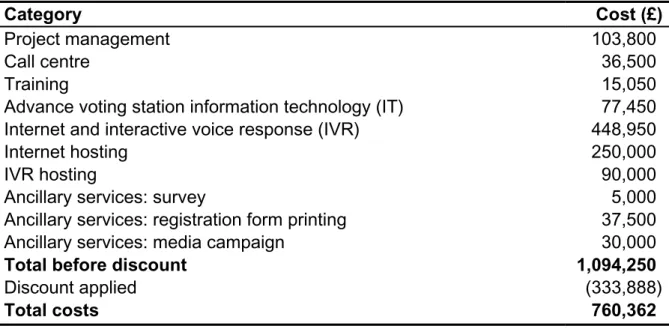
4.89 The overall cost of the Sheffield pilot scheme was approximately £760,000 after taking into account a discount applied as a result of Opt2Vote running two pilot schemes concurrently (the other was Shrewsbury & Atcham). The discount was split between the two local authorities in proportion to the size of their electorates, by mutual agreement and with the consent of the MoJ. A breakdown of the overall supplier cost is presented in Table 4.
Table 4: Pilot scheme election costs, 2007
Category Cost (£)
Project management 103,800
Call centre 36,500
Training 15,050
Advance voting station information technology (IT) 77,450 Internet and interactive voice response (IVR) 448,950
Internet hosting 250,000
IVR hosting 90,000
Ancillary services: survey 5,000
Ancillary services: registration form printing 37,500
Ancillary services: media campaign 30,000
Total before discount 1,094,250
Discount applied (333,888)
Total costs 760,362
4.90 Of these costs, and after applying the discount evenly across all cost elements, approximately £26,000 for registration form printing can be excluded from the pilot scheme costs as these forms were required in any case for postal vote registration, while around £54,000 for the advance voting station IT can be excluded as this did not directly concern the e-voting channels. Of the remaining costs, £174,000 is attributable to internet voting only (internet hosting), £63,000 is attributable to telephone voting only (IVR hosting), while the remainder, £444,000, is attributable to both voting channels.
4.91 Based on these figures, the approximate overall cost of the Sheffield e-voting pilot (internet and telephone voting channels) was £680,000, or around £1.80 per registered elector, £50 per elector who pre-registered for e-voting, and £150 per voter who actually used those channels (see Table 5). Splitting the common costs equally between the internet and telephone channels, the approximate cost for internet voting was £395,000, or £110 per internet voter who voted, while the approximate cost for telephone voting was £285,000, or £425 per telephone voter.
Table 5: Comparative unit costs of the e-voting pilot scheme Category Number of
electors/voters Cost of pilot, per elector/voter (£)
Entitled to vote 374,328 1.82
Pre-registered to e-vote 13,642 49.85
Voted via the internet/telephone 4,621 147.15
4.92 As Sheffield’s electorate is considerably larger than that of Shrewsbury & Atcham (the other pilot scheme supported by Opt2Vote), the level of discount applied was correspondingly greater. Since many of the cost elements (e.g. telephone and internet hosting) were fixed costs (i.e. were the same for both pilot schemes), this effectively represents a subsidy of the Sheffield pilot scheme at the expense of the Shrewsbury & Atcham one, and the overall costs stated above are therefore likely to understate the actual costs of running the Sheffield pilot scheme. The true overall cost of the Sheffield pilot scheme will also include additional costs incurred directly by the Council, particularly in relation to the staffing resources utilised.
4.93 The cost of the advance voting station IT (£54,000 including the discount) was, with the exception of some relatively small staffing, training and advertising costs (which are very difficult to disaggregate from the overall election costs), the only cost associated with running the advance voting element of the pilot scheme. The room within the Town Hall where the voting took place was effectively provided free of charge. It therefore cost around £60 to provide for each of the 909 voters to cast their votes early at the Town Hall over the four days that advance voting was available.
4.94 However, despite the relatively large costs per voter being incurred as described, the Commission recognises that these costs, as the ‘one-off’ costs of piloting the innovations, are higher than would normally be the case if such
innovations were in mainstream use. It is anticipated that usage of the piloted voting methods would increase, possibly substantially, if they were available every year and knowledge of their availability subsequently increased.