Sida Evaluation 04/18
The Regional Training
Programme in Design,
Installation, Administration
and Maintenance of
Network Systems (DIAMN)
Shawn Mendes
Department for Infrastructure
and Economic Cooperation
The Regional Training
Programme in Design,
Installation, Administration
and Maintenance of
Network Systems (DIAMN)
Shawn Mendes
Sida Evaluation 04/18
Department for Infrastructure
This report is part of
Sida Evaluations
, a series comprising evaluations of Swedish development
assistance. Sida’s other series concerned with evaluations,
Sida Studies in Evaluation
, concerns
methodologically oriented studies commissioned by Sida. Both series are administered by the
Department for Evaluation and Internal Audit, an independent department reporting directly
to Sida’s Board of Directors.
This publication can be downloaded/ordered from:
http://www.sida.se/publicationsAuthor: Shawn Mendes.
The views and interpretations expressed in this report are the authors’ and do not necessarily reflect those of the Swedish International Development Cooperation Agency, Sida.
Sida Evaluation 04/18
Commissioned by Sida, Department for Infrastructure and Economic Cooperation Copyright: Sida and the author
Registration No.: 2002-3052 Date of Final Report: August 2004 Printed by Edita Sverige AB, 2004 Art. no. Sida4136en
ISBN 91-586-8478-6 ISSN 1401—0402
SWEDISH INTERNATIONAL DEVELOPMENT COOPERATION AGENCY Address: SE-105 25 Stockholm, Sweden. Office: Sveavägen 20, Stockholm Telephone: +46 (0)8-698 50 00. Telefax: +46 (0)8-20 88 64
Table of contents
Preface ...3
Abbreviations ...4
Executive summary... 5
Purpose and focus of the evaluation ... 5
Summary of findings, conclusions and recommendations ... 6
1. Programme context ...7
Introduction... 7
Background ... 7
ICT programmes at Sri Lankan universities ... 9
DIAMN admission criteria and conditions ... 11
Financial overview of DIAMN ... 11
Travel costs ... 11
2. Findings ...12
Functioning of the training programme ... 13
Course evaluation forms ... 14
E-mail survey results ... 14
Organisation of the DIAMN programme ... 15
Quality of the computers ... 15
Quality of the classroom/lab ... 16
Practical experience... 16
Length of the DIAMN programme ... 16
Selection of students ... 17
3. Evaluation Methodology ...17
Data sources for DIAMN ... 19
4. Conclusions ...19
Lessons learned ... 20
DIAMN in an international perspective ... 20
Post-Sida project sustainability ... 21
Broader education goals ... 21
5. Recommendations ...21
6. References and interviews ...22
Interviews ... 23
Appendix 1 – Terms of Reference ...25
Appendix 2 – Evaluation form (end of class, in class) ...29
Appendix 3 – E-mail questionnaire (distributed by the evaluator) ...31
Appendix 4 – DIAMN Course Curriculum ...32
Preface
This project was based at the Institute of International Education at Stockholm University during the period from November 2003 to February 2004. The field research for the project research was con-ducted in Sri Lanka in November–December 2003. All costs are converted to United States Dollars at a rate of USD 1 = SEK 7.5.
I would like to thank the many people who took time to share their insights and knowledge with me. In particular I would like express my gratitude to the following people, grouped by country.
Sweden
The evaluator would like to thank Sida ICT for Development staff member Per-Einar Tröften for his guidance and feedback throughout the project. I also appreciate the time Sida staff members Afzal Sher (ICT for Development) and Lisa Hellström (International Training Programmes) made available to speak with me.
Credit is also due to Americo F. Muchanga, who agreed to provide a technical analysis of the DIAMN curriculum. Americo is a Sida/SAREC-sponsored Ph.D. student from Mozambique at the IT Univer-sity in Kista and his analysis contributed greatly to the evaluation.
Sri Lanka
First and foremost, the evaluator thanks Professor V.K. Samaranayake, M J P U Samanthilaka and Prasad Wimalaratne of the University of Colombo School of Computing. Their assistance and open-ness was greatly appreciated. I would also like to thank the DIAMN students, many of whom I met with on several occasions, for all the time they made to speak with me. The enthusiastic input and feed-back by these students from Sida partner institutions around the world was the single most important input to this report.
I would also like to thank the Swedish Embassy’s Head of Mission Ann Marie Fallenius, First Secre-tary, Åsa Heijne, and Programme Officer, K. Romeshun, for their comments and input.
Abbreviations
DIAMN Regional training programme in design, installation, administration and maintenance of network systems
ICT Information and communication technology IT Information technology
ITP International training programme JICA Japan International Cooperation Agency TCTP Third country training programme R&D Research and development
SAREC Sida department for research cooperation SEK Swedish Crown
Sida Swedish International Development and Cooperation Agency UCSC University of Colombo School of Computing
Executive summary
Sida’s department for research cooperation (SAREC) has supported the University of Colombo School of Computing (UCSC) since 1998. In 2003 the UCSC developed the regional training programme in design, installation, administration and maintenance of network systems programme (DIAMN) to train staff from other SAREC supported universities. Sida believes that the benefits of the programme are: • To provide up-to-date networking training for staff from all the SAREC supported universities; • Delivery of DIAMN builds and strengthens the capacity of the UCSC;
• Offering the programme in a developing country promotes “south-south networking,” and it can serve as a natural platform for future contacts and cooperation between the SAREC supported universities;
• The TCTP model of DIAMN is more cost effective than the donor supported International Train-ing Programme courses held in industrialized countries; and
• A course in a developing, tropical country is more relevant for participants, given similar challenges and constraints in the operating environment.
DIAMN was offered to network administrators as well as those involved with internet connectivity working at Sida/SAREC-supported universities and/or institutions. The programme provided a six-week full-time course in Sri Lanka, with the following primary objectives:
• To describe the principles of communication and networking operation of internet services; • To design the network infrastructure for sharing of resources, accessing the internet and offering
services to the internet;
• To administer, trouble shoot and maintain networks; and • To implement security and recognize new trends.
The programme is offered in English and courses consist of lectures, discussions and hands- on work on an individual and group basis. Participants who successfully complete the course are offered a certif-icate issued by the University of Colombo School of Computing. The course can accommodate up to twenty participants, who are nominated by their respective Sida/SAREC-sponsored institutions in developing countries.
The cost of training is USD 3500 per participant, excluding the cost of travel to Sri Lanka, but includ-ing tuition and course materials; accommodation; cost of livinclud-ing per diems, local transportation to at-tend classes and study tours; and medical insurance.
Purpose and focus of the evaluation
This focus of this report is to provide an evaluation of the DIAMN programme at the UCSC. To date there have been two Sida-sponsored DIAMN intakes, in August–September and November–December 2003. The programme is designed to provide participants from other Sida/SAREC-supported IT de-partments (in Bangladesh, Bolivia, Burkina Faso, Ethiopia, Laos, Mozambique, Rwanda, Sri Lanka, Tanzania, Uganda, Vietnam) with the necessary skills required to design, install, administer and
main-tain local area networks and well as internet access. Details of all participants are listed in Appendix 6 at the end of this report.
As stated in the Terms of Reference, Sida wants to shed light on both the DIAMN programme as well as Third Country Training Programmes (TCTP) for ICT in developing countries intended for other developing countries with this evaluation. This would provide a comparison between Third Country Training Programmes (TCTP) for ICT in developing countries intended for other developing countries (such as DIAMN), with the donor supported more traditional International Training Programmes for ICT most often located in the industrial countries (such as Sida’s ITP located in Sweden). The evalua-tion should therefore be useful as a tool for discussions concerning Sida’s plans for future support to such third country training programmes for ICT training.
That said, the main focus of the evaluation is the DIAMN programme and covers issues such as: objec-tives; quality; cost effectiveness; relevance of the course/s (in general as well as for the individual par-ticipants); qualifications of students entering DIAMN; student satisfaction; use of new knowledge in home countries; recommendations for Sida regarding future support for DIAMN; and feed back for UCSC to how to improve the course.
Summary of findings, conclusions and recommendations
Most participants expressed concerns about the learning environment, in particular the state of the labs, computers and lack of hands-on, practical experience. Therefore, it is recommended that future programmes place a greater emphasis on practical exercises. To facilitate this, it would be desirable to have more networking equipment available to work on in labs and more up-to-date workstations. Moreover, the DIAMN programme needs to be refined to avoid duplication and overlap and build in more practical training.
Specific, technical recommendations include the following:
1. The course should include a component with at least DNS, Mail Transport agent, Network File Service, web server application and Authentication and Authorization services.
2. The course should be more practical than theoretical.
3. The course should include Network troubleshooting sessions in which network traffic analyzers are used as tool to monitor and detect errors in the network
4. Laboratories need additional equipment in order to provide the required environment for practical sessions.
In the Terms of Reference it was stated that Sida wants to shed light on both the DIAMN programme as well as other ICT TCTPs in developing countries intended for other developing countries with this evaluation. This comparison between ICT TCTPs in developing countries (such as DIAMN) and tradi-tional donor supported Internatradi-tional Training Programmes for ICT located in the industrial countries (such as Sida’s ITPs located in Sweden) should be useful as a tool for discussions concerning Sida’s plans for future support to such third country training programmes for ICT training.
Along these lines, the evaluator recommends that Sida further explore the use of TCTPs to provide critical training for key personnel from Sida-supported institutions in developing countries. Although the DIAMN programme is not perfect, is shows promise and with modification it could serve as a cost effective means to provide training while at the same time encouraging south-south cooperation and
building capacity in a Sida partner country. Indeed, a review of ITPs in Sweden, and meetings with Sida ITP officials, confirmed that DIAMN costs are very competitive with similar programmes (i.e., ITPs) held in Sweden. The challenge is to ensure DIAMN offers a similar quality training experience to those offered by ITPs in Sweden. The evaluator is confident that with some modification DIAMN will offer a very competitive quality to cost ratio vis-à-vis ITPs in Sweden.
An important question here is how does DIAMN rate compared with the other models? Unfortunately, it is not possible to provide concrete answers to this question. It can not be said that the DIAMN TCTP training model is superior to others such as those offered through in-country training or though ITPs in Sweden. However, it is safe to conclude that DIAMN offers a higher quality experience than is available with local, in-country training in many of the countries from which the participants were drawn. Moreover, DIAMN offers training at a lower cost than ITPs in Sweden because of higher costs for things such as accommodation and food in Sweden.
Therefore, without specifically judging the specific DIAMN programme, it can be concluded that the DIAMN model is the most appropriate training model under certain circumstances. These circum-stances include situations where high-level training is either not available in-country or when there is insufficient critical mass in any one country to warrant offering such a programme. In this sense it may be that the DIAMN programme, providing somewhat generalist networking skills, may not be the opti-mal programme for the TCTP model. Consequently, the TCTP model may be even better suited to offer a more specialised, higher level programme providing training unavailable in other partner coun-tries.
1. Programme context
Introduction
The Swedish International Development and Cooperation Agency (Sida) finances IT projects in ap-proximately ten universities in developing countries. These projects support the development of IT infrastructure, establish internet connections and support IT education. The first of Sida’s IT projects was in Sri Lanka and it is the Sida partner country that has come the furthest in its IT development. In particular, the University of Colombo School of Computing (UCSC) has received significant sup-port from Sida, to the point that it has sufficient competence to provide training for staff from Sida-supported institutions in other countries. The UCSC recently started to offer the regional training pro-gramme in design, installation, administration and maintenance of network systems (DIAMN),
designed to facilitate IT development at Sida-supported universities in other developing countries.
Background
Sida has had a strategy since 1999 for integrating ICT in Development Cooperation. More recently, an internal advisory group was assigned to lead this integration connects both to Sida Departments and to Swedish Embassies in cooperating countries. The advisory group has divided its tasks into two branches: 1. ICT as a tool for development. To facilitate the use of ICT within development co-operation areas
and programs conducted by Sida’s sector departments; and
2. To promote the development of ICT in Sida partner by supporting national ICT policies, strategies and plans; Human Capacity Development and Education for ICT; and physical ICT-infrastructure.
In recent years, Sida has commissioned a series of ICT country surveys to investigate the state of infor-mation and communications technologies in Sida partner countries. The surveys focus on human re-sources, though the analysis of ICT education and training is mainly at the descriptive level. The ICT country surveys have contributed to a significant body of knowledge about the state of ICT develop-ment in several developing countries and these surveys have been followed by more elaborated analyses of the issues pertaining to raising ICT competency in Sida partner countries.1 The more detailed stud-ies inform the policy work and programs of Sida’s ICT Secretariat and staff in the field.
At the broader level, Sweden, through Sida, participates in the United Nations ICT Task Force, includ-ing the Task Force’s Workinclud-ing Group on Human Resource Development and Capacity Buildinclud-ing. Swe-den has proposed to the working group that one of the most important tasks would be to define models for the establishment of Education that promotes ICT, with special focus on education and training of ICT-personnel.2
Sida development cooperation in Sri Lanka
Sweden has been providing development assistance to Sri Lanka for almost 40 years. As with other partner countries, Sida’s work in Sri Lanka is guided by the following goals:
• Economic growth;
• Economic and social equality; • Education for all;
• Economic and political independence;
• Democratic development, with support for improved management and higher efficiency at state agencies;
• Environmental care; and • Gender equality.
The main objective of Swedish development cooperation in Sri Lanka is to promote peace and democ-racy as well as economic development that benefits the poor. Sweden has also stated that it will contrib-ute to reconstruction and rehabilitation in the areas affected by the civil war when sustainable progress is made towards long-term peace.
Moves to leverage development cooperation are important and Sida is working with other agencies to ensure better-coordinated, more effective support. Sida is also concentrating, its efforts as it moves from project- to sector-oriented support. This shift means that the Agency is moving away from one-off, ad hoc projects to more sustainable, typically larger, supports. An example of this approach could be real-ised of Sida channels much of its future ICT support in Sri Lanka through the newly developed ICT Agency (ICTA) in Sri Lanka.3
A unique role for Sida is to export Swedish policy lessons to developing countries. This is particularly relevant given Sweden’s experience with ICT training, not only for the usual post-secondary popula-tion but also for the general populapopula-tion. In this sense, the DIAMN programme represents an attempt
1 One report was partly focused on Sri Lanka, Training for ICT development in Sri Lanka and Tanzania, available at the Sida
website:http://www.sida.se/Sida/jsp/polopoly.jsp?d=1250&a=17448.
2 In this context, it is important to distinguish between training ICT personnel and the support of ICT-solutions for
educa-tion in general. This distinceduca-tion is often overlooked.
3 ICTA is an arms-length agency in Sri Lanka with a mandate to drive ICT policy and implement the e-Sri Lanka initiative.
ICTA’s vision is to harness ICT as a lever for economic and social advancement by investing in human and physical infrastructure and by creating an environment to emerge as the preferred business destination in the region.
to foster and build on Swedish expertise that has been shared through Sida’s International Training Programs (see box below), investments in Sri Lanka and sponsoring Sri Lankans’ graduate studies in the field of ICT in Sweden.4
International Training Programmes (ITP)
Sida’s International Training Programmes (ITPs) are geared to support capacity development for individuals from Sida partner countries. The programmes cover areas of strategic importance to the economic and social development of Sida partner countries and are based on identified priorities and needs. Ultimately, ITPs should contribute to institu-tional strengthening and capacity development in the cooperating countries. ITPs have a two-part structure: part one (4–6 weeks) takes place in Sweden; and part two (1–2 weeks) takes place in one of the participants’ countries. In 2004 Sida will sponsor approximately 1500 participants in 60 training programmes, usually with 20 to 30 partici-pants per course, in a wide range of areas. Participartici-pants often come from Sida partner countries and are typically middle and upper managers with a degree, or equivalent knowledge, and a high level of proficiency in English. Delivery of ITPs is delegated to private and public trainers. Sida covers participation fees (e.g., tuition, literature, study tours and insurance) and room and board for selected participants but the costs for international travel are not normally financed by Sida (Sida, 2003:7–8).
ICT programmes at Sri Lankan universities
There has been a significant demand for ICT-related courses in Sri Lanka and a number of new pro-grammes have emerged to respond to this demand. There is a new department of Information Tech-nology at the University of Morutuwa and newly created three- and four-year degree programmes in Management and IT at the University of Kelaniya. ICT programs have also been introduced at the University of Jayewardenepura and the Trincomalee Campus of the Eastern University.
The University of Colombo School of Computing (UCSC)
The leading centre of IT knowledge in Sri Lanka is the University of Colombo. It started with the Institute of Computer Technology of the University of Colombo, established in 1987 with support from Japan. In 2002 the Japan International Cooperation Agency (JICA) supported the establishment of a Centre for Advanced Media Technologies for Human Resource Development in Information Technology. Also in 2002, the UCSC was established after the merger of the Department of Compu-ter Science and Institute of CompuCompu-ter Technology. The UCSC is the University of Colombo’s first Centre of Higher Learning. It has 50 academic staff and several hundred students and offers both Bachelor and Master degrees as well as certificate programs. The School of Computing also provides a number of Third Country Training Programmes (TCTPs), which train individuals from developing countries in a developing country rather than in the donor country. Finally, the UCSC offers the inno-vative Bachelor of Information Technology.5
4 The Sida/SAREC project on IT cooperation with Sri Lanka (http://www.dsv.su.se/~kasun/sida) is sponsored is
adminis-tered under an agreement of cooperation between the Department of Computer and System Sciences at Stockholm University (www.dsv.su.se), the Royal Institute of Technology (www.ktk.se) and the University of Colombo School of Computing (www.ucsc.cmb.ac.lk). The universities of Peradeniya, Ruhuna, and Moratuwa are also involved. The coopera-tion is divided into two parts: 1) a split Ph.D. Programme where researchers from Sri Lanka spend a total of two years at a Swedish Institution and another two years in Sri Lanka in preparation for their Doctorate degree; and 2) development of an electronic infrastructure for universities in Sri Lanka including The Lanka Educational and Research Network responsi-ble for interconnecting Educational and R&D Institutions across the country.
5 The fee-based Bachelor of Information Technology (BIT) external degree (www.bit.lk) is administered by the UCSC and
leads to a Bachelors Degree in Information Technology. The programme produces qualified IT professionals in addition to traditional university output. It also gives those who could not enter university due to intense competition a chance to obtain a degree. It also gives opportunities to non-graduates already working in IT to obtain formal qualifications in IT through self-study. The BIT is also laddered, with a certificate in IT given after first year, an advanced certificate after year two, and the BIT at the end of year three. Unlike regular degree programs at Sri Lankan universities, the BIT is not free.
6 All participants come from SAREC-supported institutions except those from Bangladesh (which Sida intends to support),
The expansion of ICT programs at Sri Lankan universities continues and UCSC Professor V.K. Samaranayake estimates that the country will generate 2000 university graduates with degrees in ICT and ICT-related fields by 2004 (Samaranayake, 2003). Sida has supported several proposals in the uni-versity sector including ICT projects, primarily through UCSC, which recently received a Sida Plan-ning Grant to develop a proposal to establish an e-LearPlan-ning Centre in Sri Lanka, with the assistance of a Swedish partner university. During this planning phase several changes have been made to the BIT programme, identified as the prototype for showcasing the use of e-Learning.
DIAMN
Sida’s department for research cooperation (SAREC) has supported the University of Colombo School Of Computing since 1998 and in 2003 the UCSC developed the regional training programme in de-sign, installation, administration and maintenance of network systems programme to train staff from other Sida/SAREC supported universities. Sida believes that the benefits of the programme are: • To provide up-to-date networking training for staff from all the SAREC supported universities; • Delivery of DIAMN builds and strengthens the capacity of the UCSC;
• Offering the programme in a developing country promotes “south-south networking,” and it can serve as a natural platform for future contacts and cooperation between the SAREC supported universities;
• The TCTP model of DIAMN is more cost effective than the donor supported International Train-ing Programme courses held in industrialised countries; and
• A course in a developing, tropical country is more relevant for participants, given similar challenges and constraints in the operating environment.
The focus of this report is to provide an evaluation of the DIAMN programme at the UCSC. To date there have been two Sida-sponsored DIAMN intakes, in August–September and November–December 2003. The programme is designed to provide participants from other Sida-supported IT departments (in Bangladesh, Bolivia, Burkina Faso, Ethiopia, Laos, Mozambique, Rwanda, Sri Lanka, Tanzania, Uganda, Vietnam)6 with the necessary skills required to design, install, administer and maintain local area networks and well as internet access.
In total 35 individuals participated in the two DIAMN intakes (19 in the first intake and 16 in the sec-ond), five of whom were women and three of whom were recruited from within Sri Lanka. The age of participants ranged from 23 to 44 with an average age of just over 30 years among the 35 participants. Ultimately, the course could be offered to network administrators as well as those involved with internet connectivity working with universities or public or private agencies and business. The programme pro-vides a six-week full-time course in Sri Lanka, with the following primary objectives:
• To describe the principles of communication and networking operation of internet services; • To design the network infrastructure for sharing of resources, accessing the internet and offering
services to the internet;
• To administer, trouble shoot and maintain networks; and • To implement security and recognise new trends.
The programme is offered in English and courses consist of lectures, discussions and hands- on work on an individual and group basis. Participants who successfully complete the course are offered a certif-icate issued by the University of Colombo School of Computing. The course can accommodate up to
twenty participants, including a limited number of Sri Lankans. An overview of the course curriculum is attached as Appendix 4.
DIAMN admission criteria and conditions
Participants in DIAMN are nominated by their respective Sida/SAREC-sponsored institutions in de-veloping countries. They should either be employed or expect to be employed in the future in the field of computer communications networks. Participants should be under forty years of age, have a strong command of English and be in good physical and mental health in order to be able to complete the course. Participants are expected to attend all courses and be punctual for all classes; not have family members accompany them; return to their home country upon completion of the course; not change their travel schedules; follow instructions of their nominating institution as well as the Government of Sri Lanka; observe the rules and regulations of the UCSC; and refrain from engaging in political activ-ities, or any form of employment for profit or gain.
Financial overview of DIAMN
The cost of training is USD 3500 per participant, excluding the cost of travel to Sri Lanka, but includ-ing the followinclud-ing:
• Tuition and course materials; • Accommodation;
• Cost of living per diems;
• Local transportation to attend classes for study and study tours; and • Medical insurance.
Travel costs
One concern about holding DIAMN in Sri Lanka is the distance from many of Sida partners.
Although Sri Lanka is well located for those from Asia it is difficult, in terms of flight connections and travel time, and costly to fly to Sri Lanka from Africa and, especially, from Latin America. An analysis of the airfares for the 32 DIAMN programme participants from outside Sri Lanka revealed an average return airfare of USD 1288. There was a wide range of airfares, however, with return fares ranging from a low of USD 593 for a participant from Laos to USD 3520 for one of the participants from Bolivia.
By region, the airfares averaged from USD 943 for the ten participants from Asia, USD 1273 for the 20 participants from Africa and USD 3154 for the two participants from Latin America. Airfare costs are illustrated in Figure 1.1 below.
Figure 1.1. Average airfare for DIAMN participant by region
0 500 1000 1500 2000 2500 3000 3500
It is no surprise that the airfares from Asia are the lowest but airfares for African participants were only one-third higher than the Asian fares and, all things considered, quite reasonable. On the other hand, the airfares from Latin America reflect the great distance, and limited connections. It is worth noting here that a Sida/SAREC-supported institution in Nicaragua declined to participate in DIAMN be-cause of the high cost of air travel to Sri Lanka (in this case, estimated to be USD 4000).
2. Findings
A number of key issues are considered in this evaluation. At the broadest level, the evaluation attempts to determine whether or not the DIAMN programme met Sida’s objectives, namely to support/fund a quality, cost effective programme that is relevant at the broad level as well as for individual participants. Key questions include the following:
• Did the participants have adequate qualifications prior to course entry to benefit from the pro-gramme?
• Were participants satisfied with the programme?
• Will the participants be able to utilize their new knowledge in their home countries?
There was also a desire to develop recommendations for Sida regarding continuation of funding for the DIAMN programme as well as providing feedback for UCSC to improve the programme. It is useful to think about this type of training in terms of three approaches:
1. Local, in-country training;
2. Third country training programmes (TCTP) such as DAIMN; and 3. International training programmes (ITP).
The TCTP model represented by DIAMN is an attempt to address the limitation, in terms of resourc-es, expertise and facilitiresourc-es, of local, in-country training in a developing country. This can, in turn, build capacity and further the development process in the country offering the TCTP.
Budget Issues
The most serious budget concern was that of travel costs from the various Sida partner countries to the DIAMN sessions in Sri Lanka. However, the analysis in Section 1 above revealed that travel costs were actually quite reasonable for participants from Africa and Asia. That said, travel costs were high, and travel times long, for the few participants from Latin America and it may be practical to limit participa-tion in future programmes to those in Africa and Asia.
Other than travel costs, no serious budget issues were uncovered. The evaluator’s opinion is that funds were used wisely and DIAMN administrators worked hard to deliver the programme and associated supports (e.g., accommodation, per diems, transportation, study visits) at a reasonable cost. Indeed, it is the evaluator’s opinion that the quality to cost ratio of accommodation was outstanding. Overall, it is felt that the UCSC administrators of DIAMN used Sida funds wisely, perhaps to the point of erring on the side of spending too little on some aspects of the programme related to the labs and equipment. Finally, the evaluator is of the opinion that the organisers of DIAMN were of high integrity and truly
were committed to maximising the value of Sida’s investment. This was also reflected in the fact that the programme was significantly under budget.
Functioning of the training programme
In terms of the functioning of the DIAMN programme, the evaluator considered the facilities and equipment, organisation, institutional resources and human resources. Curricula and textbooks were also reviewed as well as instructional time, teaching methods and completion rate.
DIAMN is a six-week programme offering approximately 210 hours of training in design, installation, administration and maintenance of computer network systems. The course involves both theory as well as practical laboratory assignments designed to help the students consolidate the theory. A summary of the content of the course is provided in Appendix 4. The course covers almost every aspect of compu-ter networks, from data communication theory, transmission technology to network security.
DIAMN programme facilities, in terms of classrooms and labs, were adequate and located in the UCSC complex with significant physical and human capital in the immediate vicinity. However, the facilities could be improved with more equipment to work on, newer computers and high bandwidth for internet access. Moreover, the teaching methods may have relied too much on theoretical methods at the expense of practical exercises. The technical report presented in Appendix 5 concludes that most sessions should be half theory and half practical, which was not the case with DIAMN. Finally, as with many new, and emerging programmes, DIAMN suffered from a degree of repetition and overlap due to inadequate coordination of the various lecturers’ presentations etc.
The technical analysis concludes that there was inadequate emphasis on UNIX and that the pro-gramme could benefit from a greater emphasis on internet and network security issues. The technical analysis also concluded that DIAMN would be improved with sessions on how to use Network Moni-toring Tools that are essential for network operation, troubleshooting, and maintenance. Such tools include the use of network traffic analyser such as Ethereal, tcpdump, and MRTG tools, which would require more and better equipment in the laboratories.
The human resources dedicated to delivering DIAMN were strong, with teachers from both academia and industry. The mixed approach to teaching also provides up-to-date, real world experience, though perhaps at the expense of coordination.
Study materials were deemed to be adequate though several students expressed the desire to have texts to refer to after returning to their home countries. The evaluator also noticed that DIAMN partici-pants were purchasing books in Sri Lanka to bring with them to their home countries.
Selection of participants
The evaluator attempted to determine if actual staff from Sida/SAREC-sponsored universities partici-pated in DIAMN, rather than students from these institutions, and this was the case. Indeed all 35 par-ticipants in the two DIAMN intakes were staff, or in teaching and/or research assistant roles, at Sida/ SAREC-supported institutions. Participant profiles are listed in Appendix 6.
The main challenge in terms of selecting participants was finding students of a similar level in terms of their networking skills. Ultimately DIAMN participants ranged in their networking skills from quite basic to advanced and this made it difficult for the UCSC to design a programme that meets all needs. Consequently, DIAMN went too fast for those with limited previous skills while leaving the most ad-vanced students frequently bored. In the future more efforts should be made to select participants with similar net-working skills levels prior to entering the programme.
Course evaluation forms
A critical component of this evaluation was gained in interviews with DIAMN administrators and par-ticipants as well as through two evaluative questionnaires. This evaluation focuses on the e-mail ques-tionnaire distributed by the evaluator but also reports on the in-class evaluation forms distributed by the UCSC. The latter instrument involved the distribution to, and collection of, evaluation forms from each student at the end of the two DIAMN intakes. In total, 35 evaluation forms were collected. The forms included 17 questions rated on a 1–5 scale, three closed-end questions, and three open-end-ed questions. The evaluation form is attachopen-end-ed as Appendix 2.
As a rule, the responses to the in-class questionnaire were more positive than to the evaluator’s ques-tionnaire. Overall, satisfaction levels in the questionnaire were high, especially among the participants from DIAMN intake 1. The evaluator asked the course organisers why this might be and was told the selection for intake 1 may have been closer to optimal, with fewer levels of skills among participants. In any case, there was a somewhat lower level of satisfaction among DIAMN intake 2 participants though their satisfaction was, on aggregate, also high.
Among all participants two areas of concern appear repeatedly in the in-class questionnaire: 1) the lack of attention to, and time for, practical exercises; and 2) the degree of duplication and overlap in the course material and presentations. There were also comments about the need to group participants according to their level of networking expertise in order to develop course appropriate for the varying skills levels of participants as well as less common comments about the programme being too long and a lack of attention to UNIX.
Overall, DIAMN participants ranked the programme as “very good” on a four-point scale from Excel-lent to very good to good to poor.
E-mail survey results
The e-mail survey was distributed to 33 DIAMN participants from both the August–September session and the November–December session. It was an attempt to probe issues stemming from the in-class questionnaire and from interviews with the course organisers as well as participants. Three of the e-mail surveys were undeliverable but 19 were completed and returned yielding a response rate of 66% of those who received the questionnaire. The questionnaire was sent to all participants, including the one Sri Lankan who participated, in the DIAMN programme offered in November–December 2003. It was also sent to all foreign participants in the first DIAMN intake in August–September 2003. The e-mail questionnaire consisted of ten questions, six of which were graded on a 1–5 scale (means are generated and graphed), one on a 1–3 sale (to probe the programme length issue) and three open-ended questions (from which participant comments are interspersed throughout this report). The ques-tionnaire is attached as Appendix 3.
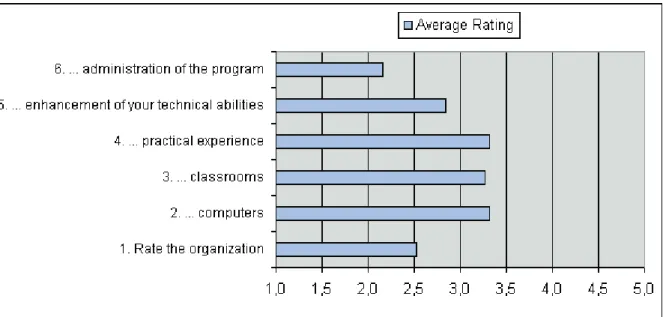
The e-mail instrument revealed similar concerns to those expressed in the in-class questionnaire. In particular, DIAMN participants expressed concerns, through lower satisfaction, with the quality of the workstations, quality of the learning environment (in terms of classrooms and labs) and the lack of practical exercises. The mean response on these factors was about 3.3 on a scale where 1 is excellent and 5 is poor. Moreover, 12 of 19 respondents believed the course was too long. Satisfaction was high-est with the organisation and administration of the DIAMN programme, with most respondents rating these areas as good to very good. Aggregated results from the “1 to 5” scale closed end e-mail survey questions are presented in Figure 2.1 below.
Figure 2.1. E-mail survey results
1–5 score where 1 is excellent, 2 is very good, 3 is good, 4 is adequate and 5 is poor.
Specific issues addressed by the survey instruments are addressed under the headings below and pro-vide further insight into the student perspective on the DIAMN programme.
Due to the tendency for some to provide “across-the-board” high ratings and the survey’s weighting towards measuring “good” scores, there are more meaningful differences when examining the data for negative outliers. For example, four of 19 respondents rated DIAMN “poor” when it comes to comput-ers, classrooms and practical experience. On the other hand, not a single respondent rated DIAMN as poor in terms of administration or general organisation. It is evident that the programme organisers did a good job
Organisation of the DIAMN programme
In the e-mail survey participants rated the organisation of the programme to be good to very good, on average. Respondents to the in-class evaluation form also ranked the overall organisation of DIAMN highly. Overall, there were no major concerns in this area though some students expressed concerns about the adequacy of the transportation from the hotel to the UCSC. The evaluator explored this issue and found no major cause for concern though there is some room for improvement (e.g., using a sufficient number of vehicles to prevent over crowding and waiting times).
Quality of the computers
In both the e-mail and in-person questionnaires, many students expressed concerns about the quality of the computers in the lab. In fact, in the e-mail questionnaire interviews the DIAMN computers were rated, on average, as 3.32 out of 5 where 1 is excellent and 5 is poor. Several students thought the computers were inadequate because of slower CPUs, too little RAM and the need to share worksta-tions. An African participant wrote, “the teaching facilities need to be improved with quality comput-ers, hubs, modem, routers and switches.”
A related area of concern was internet access. In Sri Lanka, as in many developing countries, internet bandwidth is at a premium. Consequently, bandwidth available to DIAMN students in the lab was minimal. As an alternative, many students used internet cafes in Colombo to access information and communicate. This issue was discussed at length with the course organisers and it was agreed that a dedicated DSL line could be supported for future programs. This would provide adequate bandwidth at a reasonable cost.
Overall, the evaluator’s judgement is that bandwidth availability and cost in Sri Lanka is reasonable compared with many developing countries.
Quality of the classroom/lab
This was another area of major concern, expressed by participants in both the e-mail questionnaire and in-person. A participant from Asia commented: “If Sida offers training in a third country, they should survey the facilities. Without a proper facility, the output will differ from what would occur in Sweden.” An African participant added: Organising the course in Sri Lanka negatively affected the quality of training especially for hands on due to lack of equipment in the lab.” Yet another student wrote: “We expected a better classroom and better lab facilities with better equipment and internet connection.”
On the other hand, there were some students who appreciated facing similar challenges to those faced in their home countries. One African participant wrote: “DIAMN was effective especially when the participants are being trained in the same environment as their own country rather than being trained in Europe.” Another added that “Sri Lanka was ideal because it was not far different from our coun-tries in the level of IT development. We share common problems. The examples used could easily be used in our countries.” However, another African participant wrote, “Providing training in a develop-ing country was not positive since manpower and teachdevelop-ing materials were not adequate and enough to fulfil the objectives of the course.”
Finally, on the issue of classroom and learning environment, it appears the course organisers achieved near optimal course sizes. All 35 respondents to the in-class course evaluation form rated the class size as good. Not one said there were too many or too few participants. It appears a class size of 16 to 20 is appropriate for this type of training.
Clearly, there is room for improvement in this area. It is therefore recommended that the UCSC improve the qual-ity and availabilqual-ity of the computers, hubs, routers and switches in the classroom/lab. This issue was discussed with the course leader and he agreed that his could be addressed without too much difficulty or massive investment. Thus, while the value of offering the programme in a developing country is recognised, the classrooms and laboratories need to be improved to improve the practical experience offered in the DIAMN programme. As one African participant put it: “There is too much theory versus hands on training. The lab should be better equipped to support hands on training.”
Practical experience
Along with the computers and classroom environment, this was the area of most concern as expressed by students in questionnaires and in-person interviews.
An African participant wrote: “The course had almost no practical training. Lectures should be paral-leled with practical sessions.” This situation led one Asian student to conclude, “training should be organised in Sweden because there are a lot of modern techniques related to ICT and we can have more practical training.” Another Asia participant wrote, “there were repetitions in class lecturers, the material provided was not adequate and DIAMN was too concentrated on theory.”
Indeed, there was nearly unanimous opinion among students in interviews that DIAMN does not pro-vide an adequate opportunity for practical, hands-on exercises. Therefore, it is strongly recommended that future DIAMN programmes incorporate more practical, hands-on training in quality laboratory facilities.
Length of the DIAMN programme
A majority of respondents to the e-mail survey (12 of 19, or 63%) indicated that the DIAMN pro-gramme was too long versus only and 2 of 19 (11%) who said it was too short. Five of 19 respondents
(26%) indicated that the DIAMN programme length was appropriate. Results from the in-class evalua-tion forms differed slightly with 16 of 34 (47%) of DIAMN participants indicating the programme was too long versus only 2 of 34 (6%) who said the programme was too short. One respondent to the e-mail questionnaire addressed programme length when he responded: “if the programme had more practical training it would be worth having it for six weeks but with much theory and repetition six weeks is too long.” Another responded that the length of the programme was appropriate for those with lower skills but too long for the majority of participants, most of whom had fairly advanced ICT skills.
Clearly, it is difficult to determine optimal programme length but many students thought the pro-gramme was too long given the lack of practical experience. It is therefore recommended that the DIAMN programme either be: a) shortened to four-weeks to more effectively convey the current content; or b) remain at six-weeks if a significant increase in practical exercises can be incorporated into the programme.
Selection of students
This was another area where there was nearly unanimous opinion and many DIAMN participants expressed frustration with the difficulties accommodating the wide range of networking skills in the programme. A participant from Africa wrote, “I suggest the organiser group participants according to their knowledge level. I tell you that training the course was very good to the beginners in the system administration but not for us with more advanced skills.” Another African stated that DIAMN should “group participants because some have an advanced level and it seems to be boring for them during the first 3 weeks.”
Clearly, the programme could be improved in students were either selected from a more similar skills level or were perhaps separated into sub-groups to accommodate two different skill levels
3. Evaluation Methodology
The Institute of International Education has significant experience with research into education, especially education planning and policy. However, to accomplish this mission technical expertise on networking was contracted from the “IT university” in Kista.
The evaluation was commissioned not only to gain insight into the regional training programme in Design, Installation, Administration and Maintenance of Network, but also to explore the benefits of Third Country Training Programmes for ICT in developing countries intended for other developing countries (such as DIAMN) vis-à-vis more traditional International Training Programmes for ICT most often located in the industrial countries (such as Sida’s ITP located in Sweden). Consequently, the evaluation attempts to support Sida planning for future support to such third country training pro-grammes for ICT training.
Evaluation factors and outcomes
In analysing the quality and efficiency of the regional training programme in design, installation, administration and maintenance of network systems the following factors were considered: • Syllabi and curricula;
• Structure of curricula and extra curricula activities;
• Teaching/learning methods;
• Relationship between the educational institution and the environment (e.g. ICT sector, other educa-tional institutions in both Sri Lanka and abroad, local community, cultural institutions, media); and • Quality monitoring, assessment and evaluation (mechanisms built into the programme for quality
monitoring, assessment and evaluation).
In terms of outcomes the analysis focuses on learning achievement vis-à-vis knowledge and skills; development of social, communication and life skills; opportunities created through increased skills among participants; and DIAMN as a basis for life-long learning.
Key goals of the evaluation were to assess: • whether or not Sida’s objectives were fulfilled; • quality of the programme;
• cost effectiveness;
• relevance of the course (in general as well as for the individual participants); • adequacy of student qualifications (to ensure they could benefit from the course); • student satisfaction; and
• content.
Ultimately, Sida’s goal is to confer students with new knowledge that will be useful in their home coun-tries. Therefore, the evaluation provides recommendations to Sida regarding continued support for the course, and suggestions to UCSC on how to improve DIAMN.
Methodology
The evaluation methodology revolved around participant feedback in the form of written evaluations, verbal interviews, site visits and supplementary questionnaires. The Terms of Reference for the evalua-tion called for a thorough review of DIAMN participant evaluaevalua-tions collected by UCSC during
DIAMN intakes 1 and 2. It also called for e-mail contact and phone calls with students for clarification. Finally, the TOR requested that the evaluator develop, distribute, collect and compile a separate course evaluation for the participants in the two DIAMN intakes. The TOR also stipulated that the evaluator analyse travel costs and other outlays to support DIAMN participants.
The UCSC collected written course evaluations from all the DIAMN participants, and provided the evaluator with the participants’ e-mail address in their home countries to distribute an independent questionnaire. The evaluator reviewed all the in-class course evaluation forms collected by the UCSC, identified especially relevant comments for inclusion in the report and calculated averages for the cod-ed answers.
The evaluator also created and distributed a separate e-mail questionnaire to probe students for their impression of the DIAMN programme. This was conducted from late December, 2003 through early January, 2003–04.
The evaluator also met with all participants in the second intake of the DIAMN programme on several occasions, both as a group and individually. The evaluator obtained a list of all the DIAMN partici-pants, compiled a list of the each and every air ticket cost for all the different countries participating and check to see if the programme was delivered on budget (Sida funds for DIAMN totalled SEK 1.4 million).
Data sources for DIAMN
Most of the information on the DIAMN programme was qualitative in nature and gathered from tin-class course evaluation surveys, in-person interviews and a follow-up e-mail questionnaire to all partici-pants. Interviews were also conducted with DIAMN administrators. Public reports, public documents and secondary literature sources were also reviewed to better understand the DIAMN programme and some of the issues surrounding it.
Definition of policy goals
The report was informed by an evaluation approach structured around the four broad policy goals. 1. Volume – measures the number of projects, number of participants and allocated funding and
programme spending on an aggregate and programme basis.
2. Access – measures support provided to programme applicants, organisers and participants.
3. Equity – is related to addressing barriers to participation. Key measures of equity are participation rates of women, people with disabilities, visible minorities, etc.
4. Efficiency – measures the relationship between inputs and outputs, such as cost per project and cost per participant.
4. Conclusions
DIAMN has contributed to building capacity in a Sida partner country and promoting “south/south” dialogue. Specifically, over the years the UCSC has become an effective centre for the generation and transfer of ICT knowledge, ideas and business and DIAMN reinforced this.
In terms of cost effectiveness, the DIAMN programme also proved to be less expensive than it would have been if held in Sweden as per the traditional ITP model. Indeed, the estimates detailed in the box below indicate that the cost of holding DIAMN was less than one-quarter that of holding an ITP in Sweden. It could also be argued that the TCTP model expressed in the DIAMN programme, offering training in a developing country, will reduce the loss of human capital that sometimes occurs when highly trained people from developing countries move their human capital to wealthy countries.
Cost analysis of TCTP (DIAMN) versus ITPs in Sweden
Sida often supports skills development for individuals from Sida partner countries through International Training Programmes held in Sweden. Many ITPs run for four weeks and course fees typically range from USD 5300 to USD 7300 plus accommodation, local transport and meal costs ranging from USD 3600 to 4400 for a total cost range of USD 8900 to 11,700 for a four-week ITP in Sweden. This would yield an average cost in excess of USD 15,000 for a six-week ITP in Sweden compared with the USD 3500 for the six-week DIAMN programme in Sri Lanka (i.e., over 400 per cent more than in Sri Lanka). Of course, these costs estimates do not take into account quality or efficiency and an ITP in Sweden may accomplish what DIAMN did in four weeks instead of six. However, even if an ITP could accomplish what DIAMN did in half the time (i.e., in three weeks) DIAMN costs would still be less than half those of holding a three week ITP in Sweden. (USD 1 = SEK 7.5)
DIAMN serves as a platform from which ICT professionals in developing country can build profession-al networks. In the evprofession-aluation conducted by the evprofession-aluator a participant from Asia wrote, “through DIAMN I still keep me contact with my friends and we share ideas together through the internet.” A participant from Africa wrote, “participants from different universities keep in touch with each other
and also help themselves out with the different problems encountered at work.” Even so, this positive attribute could be improved as evident in a Latin American participant’s comment that there “should be a post-course discussion forum to exchange experiences to facilitate cooperation between countries.” Therefore, although DIAMN fosters “south-south” cooperation, it could be even better, perhaps by incorporating a session at the end of the programme on networking or even by establishing a chat site for ICT technicians and professionals in developing countries.
Lessons learned
However, there are a number of improvements that could be made to make DIAMN a truly effective programme. In particular, it is concluded that the DIAMN programme needs to incorporate more practical, hands-on training in better-equipped laboratories, using more up-to-date workstations. Moreover, the programme should be better organised so that presenters do not overlap with previous and future presenters. Finally, it is felt DIAMN would be improved if selection criteria were tightened to ensure similar skill levels of participants in DIAMN. It must be noted here that the DIAMN organis-ers agree with this and would like to achieve it but point out that selection is largely determined by the nominating organisations in the Sida partner countries. Therefore, it is recommended that Sida and the UCSC very clearly communicate the level of required skills of potential participants in any future DIAMN programmes.
DIAMN in an international perspective
In the Terms of Reference it was requested that the evaluator make an attempt to compare DIAMN with similar courses in both developing and developed countries. This was a difficult task as DIAMN is an innovative model bringing together many elements of networking in an intensive, in residence, six-week, full-time TCTP. As such, there are no truly comparable programmes. There are a number of more specialised programmes offered (e.g., Cisco and Microsoft certified programmes) in many coun-tries and tuition fees typically range from USD 100 to USD 300 per week of full-time study, excluding accommodation and other costs incurred in the DIAMN model. Costs are usually much higher in de-veloped countries, except for programmes offered through heavily subsidised public post-secondary training institutions.
It would be possible to offer elements of the DIAMN programme at a lower cost through in-country training in developing countries. For example, a part-time (four hours per day) three month certificate in IT Essentials with Cisco certification in Tanzania costs USD 500. A more advanced course, in this case a part-time three month course for Microsoft Certified System Engineer in Tanzania, costs USD 1300. These programmes are similar in terms of training hours to DIAMN and are provided at a low-er cost. It must be noted the actual costs of providing the first two DIAMN programmes, excluding accommodation, food, per diems, study tours and local transport costs, are somewhat higher than the Tanzanian examples given estimated “training” costs of approximately USD 1500 per participant for the six week, full-time programme. However, DIAMN officials claim their costs can be lowered some-what now that the programme (e.g., curricula, etc.) is largely developed. Therefore, it is felt that
DIAMN training costs, though slightly higher than those in some developing countries, are competitive given the uniqueness (i.e., not an off-the-shelf programme under Cisco or Microsoft) and the need to generate course content geared to the specific clientele.
In the end, it is concluded that the synergies of the DIAMN programme (e.g., an increase of contacts between the Sida supported universities in developing countries that may lead to more south-south cooperation, strengthening UCSC capacity to offer international ICT courses, etc) produce a net bene-fit both in terms of increased relevance for the participants (as the course is held in a developing try with conditions similar to their own countries, which are different from those in developed
coun-tries) and in terms of value for money. Additional benefits include creating professional networks among DIAMN participants.
Post-Sida project sustainability
As with all development cooperation projects, post project sustainability of DIAMN must be consid-ered. Ideally Sida support can serve as a springboard for further efforts without donor support. A more realistic perspective might anticipate further action with less support, responding to demand from other universities in developing countries or even to market demand in Sri Lanka.
Regarding sustainability, it is worth noting that much of Sida’s future ICT support in Sri Lanka may be channelled through the national Information and Communication Technology Agency of Sri Lanka (ICTA). ICTA is an ambitious “project” with energetic staff and a progressive organisation but it will likely be focused on larger, national-scope projects and may not seek support for a focused programme such as DIAMN. This big picture approach may be good for Sri Lanka but could jeopardise smaller projects such as DIAMN.
When asked about the sustainability of DIAMN, Professor V.K. Samaranayake replied, “in order to be sustainable in the future, we should gradually make it open to self- or other donor-supported partici-pants as well with Sida supporting a minimum needed to make it worthwhile. Say Sida supports 15 and 5 extra places are left for other participants. This is just an idea for the future.”
Indeed, a combination of donor support through Sida and market demand could result in an optimal programme although the distribution might be better of Sida were to sponsor five or 10 in an intake of 20. Therefore, it may be that sustainability will depend on a staged approach where Sida provides some ongoing support but gradually lets DIAMN gradually moves to accommodate both the needs of international institutions as well as the market in Sri Lanka.
Broader education goals
It is concluded that DIAMN contributed positively to lifelong learning, especially as it was a early- to mid-career stream opportunity for many participants. Moreover, it is believed that DIAMN contribut-ed significantly to the development of communication and social skills, including among inter-cultural groups. This is seen as one of the primary secondary benefits of the DIAMN model where participants from so many countries get an opportunity to live and study together for an extended period of time.
5. Recommendations
As stated earlier most participants expressed concerns about the learning environment, in particular the state of the labs, computers and lack of hands-on, practical experience. Therefore, it is recommended that future programmes place a greater emphasis on practical exercises. To facilitate this, it would be desirable to have more networking equipment available to work on in labs and more up-to-date workstations. Moreover, the DIAMN programme needs to be refined to avoid duplication and overlap and build in more practical training.
Specific, technical recommendations include the following:
1. The course should include a component with at least DNS, Mail Transport agent, Network File Service, web server application and Authentication and Authorization services.
2. The course should be more practical than theoretical.
3. The course should include Network troubleshooting sessions in which network traffic analyzers are used as tool to monitor and detect errors in the network
4. Laboratories need additional equipment in order to provide the required environment for practical sessions.
In the Terms of Reference it was stated that Sida wants to shed light on both the DIAMN programme as well as other ICT TCTPs in developing countries intended for other developing countries with this evaluation. This comparison between ICT TCTPs in developing countries (such as DIAMN) and tradi-tional donor supported Internatradi-tional Training Programmes for ICT located in the industrial countries (such as Sida’s ITPs located in Sweden) should be useful as a tool for discussions concerning Sida’s plans for future support to such third country training programmes for ICT training.
Along these lines, the evaluator recommends that Sida further explore the use of TCTPs to provide critical training for key personnel from Sida-supported institutions in developing countries. Although the DIAMN programme is not per-fect, is shows promise and with modification it could serve as a cost effective means to provide training while at the same time encouraging south-south cooperation and building capacity in a Sida partner country. Indeed, a review of ITPs in Sweden, and meetings with Sida ITP officials, confirmed that DIAMN costs are very competitive with similar programmes (i.e., ITPs) held in Sweden. The challenge is to ensure DIAMN offers a similar quality training experience to those offered by ITPs in Sweden. The evaluator is confident that with some modification DIAMN will offer a very competitive quality to cost ratio vis-à-vis ITPs in Sweden.
An important question here is how does DIAMN rate compared with the other models? Unfortunately, it is not possible to provide concrete answers to this question. It can not be said that the DIAMN TCTP training model is superior to others such as those offered through in-country training or though ITPs in Sweden. However, it is safe to conclude that DIAMN offers a higher quality experience than is available with local, in-country training in many of the countries from which the participants were drawn. Moreover, DIAMN offers training at a lower cost than ITPs in Sweden because of higher costs for things such as accommodation and food in Sweden.
Therefore, without specifically judging the specific DIAMN programme, it can be concluded that the DIAMN model is the most appropriate training model under certain circumstances. These circumstanc-es include situations where high-level training is either not available in-country or when there is insuffi-cient critical mass in any one country to warrant offering such a programme. In this sense it may be that the DIAMN programme, providing somewhat generalist networking skills, may not be the optimal programme for the TCTP model. Consequently, the TCTP model may be even better suited to offer a more specialised, higher level programme providing training unavailable in other partner countries.
6. References and interviews
Sida (2003) International Training Programmes 2004, Stockholm: Human Resources Department, Sida. Sida (2003), Training for ICT development in Sri Lanka and Tanzania, by Shawn Mendes, Albert Tuijnman and Nina Young, Stockholm: Sida.
Sida (2002) Evaluation of ICT projects at universities and research organizations in Sri Lanka, Greenberg ICT Services, Stockholm: Sida.
Interviews
University of Colombo School of Computing (UCSC)
V.K. Samaranayake, Mr Samanthilaka Prasad Wimalaratne
Sida
Per Einar Tröften, ICT for Development Afzal Sher, ICT for Development
Lisa Hellström, International Training Programmes
Swedish Embassy – Sri Lanka
Ann Marie Fallenius, Head of Mission Åsa Heijne, First Secretary
K. Romeshun, Programme Officer
DIAMN participants (more details on these participants in appendix 6)
ASM Ariful Hasan Iris Pervin
Roberto Zambrana
Abdoul Karim Douani Diallo Amadou Sanon
Zacharie Koalaga
Tadewos Beyene Belaineh Bandith Ramangkoun Manoluck Bousihalath Ricardo Mario Taca
Bisanukuli Jean Francois Chantal Anil Nishantha Illangantilaka Samwel Mujinja Charles Aloyce William Rugalinda James Methew Lwali Florence Nameere Kivunike
Others
Dinesh Amarasekera, Senior Project Manager, ICT Agency of Sri Lanka (ICTA) Gihan Dias, Programme Director, ICTA
Manju Hathotuwa, CEO, ICTA
Adith P. Madurapperuma, Dean, Faculty of Information Technology, Univ of Moratuwa Americo F. Muchanga, IT University, Kista
Leonel Plazaola, Universidad Nacional de Ingeniera, Nicaragua
Thivanka Rangala, Manager, Finance and internet business, Dialog GSM Roschaali de Silva, Project Coordinator, ICTA
Appendix 1 – Terms of Reference
ICT for Development SecretariatPer Einar Tröften
Terms of reference for commissioned evaluation on the regional training programme in design, installation, administration and maintenance of network systems (DIAMN)
Introduction
Since 1999 Sida has a strategy for integrating ICT in Development Cooperation. The internal adviso-ry group assigned to lead this integration connects both to Sida Departments and to Swedish Embas-sies in cooperating countries. The advisory group has divided its main tasks in two branches:
1. ICT as a tool for development. To facilitate the use of ICT within development co-operation areas and programmes conducted by Sida’s sector departments;
2. Develop ICT in co-operating countries. To promote the development of ICT through: a. Support to national ICT policies, strategies and plans
b. Support to Human Capacity Development and Education for ICT c. Support to physical ICT-infrastructures
Background
The ICT advisory group has commissioned a series of Country ICT Surveys to illuminate the situation in co-operating countries regarding ICT. Human Resources, Education and Training has been part of these studies, but mainly on a descriptive level. There is a need for elaborated description and analysis of the issues pertaining to raising knowledge on ICT in the countries.
Sweden, through Sida, also participates in the UN ICT Task Force, among other things in the Task Force’s Working Group on Human Resource Development and Capacity Building. Sweden has pro-posed to the working group that one of the most important tasks would be to define models for the set-up of Education that promotes ICT, with special focus on education and training of ICT-personnel. (In this context it is important to distinguish this emphasis from support to ICT-solutions for education in general. This distinction is often overlooked.)
Sidas department for research cooperation (SAREC) have supported University of Colombo School of Computing (UCSC) since 1998. UCSC now invite other SAREC supported universities to send partici-pants for the DIAMN course. The benefits are many:
– all the SAREC supported universities gets updated in networking, – offering this course also strengthen the capacity at UCSC,
– it promotes “south-south networking”. DIAMN can become a natural platform for future contacts and cooperation between the SAREC supported universities,
– it is cheaper than other donor supported International Training courses held in the industrialised countries and