Lifecycle closure, lineage sorting, and hybridization revealed in a
phylogenetic analysis of European oak gallwasps
(Hymenoptera: Cynipidae: Cynipini) using mitochondrial
sequence data
Antonis Rokas,
a,b,*George Melika,
cYoshihisa Abe,
dJose-Luis Nieves-Aldrey,
eJames M. Cook,
fand Graham N. Stone
aa
Institute of Cell, Animal and Population Biology, Ashworth Laboratories, West Mains Road, KingÕs Buildings, University of Edinburgh, Edinburgh EH9 3JT, UK
bHoward Hughes Medical Institute and Laboratory of Molecular Biology, R.M. Bock Labs, University of Wisconsin-Madison, 1525 Linden Drive, Madison,WI 53706-1596, USA
cSystematic Parasitoid Laboratory, Central Plant Protection and Soil Conservation Service, Kelcz-Adelffy St. 6, K€ o
oszeg 9730, Hungary dKyoto Prefectural University, Faculty of Agriculture, Lab of Applied Entomology, Kyoto 606-8522, Japan
eMuseo Nacional de Ciencias Naturales, Departamento de Biodiversidad y Biologııa Evolutiva, Jos
eeGutieerrez Abascal, Madrid 28006, Spain fDepartment of Biological Sciences, Imperial College, Silwood Park, Ascot, Berkshire SL5 7PY, UK
Received 2 January 2002; received in revised form 3 August 2002
Abstract
Oak gallwasps are cyclically parthenogenetic insects that induce a wide diversity of highly complex species- and generation-specific galls on oaks and other Fagaceae. Phylogenetic relationships within oak gallwasps remain to be established, while sexual and par-thenogenetic generations of many species remain unpaired. Previous work on oak gallwasps has revealed substantial intra-specific variation, particularly between regions known to represent discrete Pleistocene glacial refuges. Here we use statistical phylogenetic inference methods on sequence data for a fragment of the mitochondrial cytochromebgene to reconstruct the relationships among 62 oak gallwasp species. For 16 of these we also include 23 additional cytochromebhaplotype sequences from different Pleistocene refuge areas to test the effect of intra-specific variation on inter-specific phylogeny reconstruction. The reconstructed phylogenies show good intra-generic resolution and identify several conserved clades, but fail to reconstruct either very recent or very ancient divergences. Nine of the 16 species represented by multiple haplotypes are not monophyletic. The apparent discordance between the recovered gene tree and the current taxonomic classification can be explained through: (a) collapsing of some species currently known only from either a sexual or a parthenogenetic generation into a single cyclically parthenogenetic entity; (b) sorting of ancestral polymorphism in diverging lineages, and (c) horizontal transfer of haplotypes, perhaps due to hybridization within glacial refuges. Our conclusions emphasise the need for careful intra-specific sampling when reconstructing phylogenies for radiations of closely related species and imply that for certain taxonomic groups full phylogenetic resolution (using molecular markers) may not be attainable.
Ó2002 Elsevier Science (USA). All rights reserved.
Keywords: Gallwasp; Cynipidae; Cynipini; Lineage sorting; Lifecycle; Likelihood; Bayesian inference; Cytochrome b; Hybridization; Insect systematics
1. Introduction
Gallwasps (Hymenoptera: Cynipidae) are members of the Cynipoidea, a major lineage of predominantly
parasitoid wasps within the Hymenoptera (Ronquist, 1999). Gallwasps are obligate parasites of plants, and either induce their own galls in plant tissues or develop as inquilines within the galls induced by other gallwasps (Askew, 1984; Stone et al., 2002). Each species induces a highly characteristic and often complex gall, leading to an incredible diversity of gall structures within the
Molecular Phylogenetics and Evolution 26 (2003) 36–45
www.elsevier.com/locate/ympev
PHYLOGENETICS AND
EVOLUTION
*
Corresponding author. Fax: 1-608-262-9343.
E-mail address:arokas@facstaff.wisc.edu(A. Rokas).
1055-7903/02/$ - see front matterÓ2002 Elsevier Science (USA). All rights reserved. PII: S 1 0 5 5 - 7 9 0 3 ( 0 2 ) 0 0 3 2 9 - 9
whole group (Stone and Cook, 1998). Cynipidae con-tains about 1360 described species divided into six tribes (Liljeblad and Ronquist, 1998; Nieves-Aldrey, 2001). Biogeographic and fossil evidence suggest that the Cynipidae originated at least as long ago as the mid Cretaceous (83 mya) (Ronquist, 1999).
Oak gallwasps (tribe Cynipini) comprise the most species-rich tribe of gallwasps, with around 1000 known species in 40 genera world-wide, predominantly in the Northern Hemisphere (Nieves-Aldrey, 2001; Ronquist, 1999). The major lineages of oak gallwasps are thought to have diverged in central America (Kinsey, 1936) alongside their oak hosts (Manos et al., 1999), and the greatest richness of oak gallwasps is found in the Ne-arctic with an estimated 700 species in 29 genera (Weld, 1957, 1959, 1960). The Palaearctic fauna is less species-rich (ca. 163 species in 10 genera) (Askew, 1984; Nieves-Aldrey, 1987; Nieves-Nieves-Aldrey, 2001; Stone et al., 2002), and the majority of European oak gallwasps are
con-tained in just four genera—Andricus (116 species),
Pla-giotrochus(14),Neuroterus(13), andCynips(7) (Askew, 1984; Nieves-Aldrey, 2001; Stone et al., 2002).
Despite recent advances in Cynipini phylogenetics (Cook et al., 2002; Liljeblad and Ronquist, 1998; Rokas, 2001; Rokas et al., 2002; Ronquist, 1994; Stone and Cook, 1998) little is known about relationships within the tribe. The Cynipini are cyclically parthenogenetic, with a lifecycle involving obligate alternation between a spring sexual generation and a summer/autumn par-thenogenetic generation (Stone et al., 2002). The two generations of all oak galling cynipids differ substan-tially in size, and in some cases in morphological traits used in the past to define genera. Typically the sexual generation wasps are much smaller (mass 1–2 mg) and shorter lived (a week or less) than the parthenogenetic generation wasps (mass ca. 10 mg, lifespan up to 1 month). Early gall taxonomy was also based extensively on gall structure, and the enormous differences in gall traits between the two generations of almost all oak cynipids hampered the linking of generations. As a consequence, historically the two generations of a single species have been allocated to different genera causing great taxonomic confusion. The problem is particularly severe in the Nearctic (e.g., Drown and Brown, 1998; Lyon, 1996; Melika and Abrahamson, 2000), whereas the taxonomy of Western Palaearctic genera and species is less problematic (e.g., Melika et al., 2000; Nieves-Al-drey, 2001).
Previously (Rokas et al., 2002) we assessed the utility of eight DNA sequence markers in reconstructing phy-logenetic relationships at various levels of divergence within the Cynipidae. Two mitochondrial loci
(cyto-chromeband cytochrome oxidase I) were shown to be
fast-evolving and potentially useful for lower-level phylogenetics of gallwasp taxa. We have also shown that, for a number of species, regions of Southern
Eu-rope and Asia Minor corresponding to discrete Pleis-tocene glacial refuges possess refuge-specific haplotypes (Rokas, 2001; Rokas et al., 2001; Stone et al., 2001). In addition, it has been demonstrated experimentally that closely related species can form viable hybrids (Folliot, 1964), and it is known that horizontal transfer of hapl-otypes by introgression between closely related species occurs in a range of insects (e.g., Powell, 1983; Sota et al., 2001; Thelwell et al., 2000). Taken together, these facts raise the possibility that refuge-specific haplotypes might be shared within a closely related group of hy-bridizing taxa, such that members of several species within the same refuge could be more similar in haplo-type sequence than conspecifics from different refuges.
Here we use the cytochromebsequence data from 62
species to analyze the impact of incorporating intra-specific haplotype variation in resolving relationships among oak gallwasp species. In particular, we assess monophyly of 16 geographically widespread species by including additional haplotypes, resulting in an extended dataset of 85 sequences. The haplotypes used are derived from genetically divergent Western Palaearctic refuges
(Atkinson, 2000; Rokas, 2001) for sets ofAndricus
spe-cies shown in previous analyses to be close relatives (Cook et al., 2002; Stone and Cook, 1998), in an attempt to detect lineage sorting events or intra-refugial
hybrid-ization. Furthermore, we include sequences for 28
An-dricus species currently known only from a single generation. Combination of one species of each type within a single clade with high bootstrap support would provide strong indirect evidence for their representing two halves of a single cyclically parthenogenetic lifecycle.
2. Materials and methods
2.1. Study species
The dataset analysed in this study is composed of 62 oak gallwasp species. Fifty-seven of these are from 9 genera of European gallwasps, representing more than a third of the total number of species known to exist in Europe. From these species, 28 are currently known only
from a single generation—either sexual (7 species) or
parthenogenetic (21 species). The other five species are
Japanese (Andricus kashiwaphilus,Andricus mukaigawae,
Andricus symbioticus, and Trichagalma serratae) or American (Andricus spectabilis). The dataset also
in-cludes 23 additional haplotypes from 16 species (10
An-dricusspecies, 4Cynipsspecies, 1Neuroterusspecies and 1Biorhizaspecies) sampled from distinct Pleistocene ice age refuges in Europe and Turkey. Species nomenclature follows Melika et al. (2000). No outgroup was used since the other gallwasp tribes are, according to the molecular marker employed in this study, only very distantly re-lated to Cynipini (Rokas et al., 2002).
2.2. Molecular methods
DNA was extracted by using the DNeasy Tissue kit (QIAGEN cat. 69504). A 433 bp fragment of the
mito-chondrial cytochrome b gene was amplified by PCR
using the CB1/CB2 primer combination of Jermiin and Crozier (1994) (alias CB-J-10933 and CB-N-11367 of Simon et al., 1994) and previously described conditions (Rokas et al., 2001; Stone and Cook, 1998). Sequencing was carried out using Perkin–Elmer BigDye Terminator chemistry on an ABI 377 sequencer. Both strands were sequenced to minimise PCR artefacts, ambiguities and base-calling errors. Chromatogram output was checked by eye. All sequences are deposited in GenBank (AJ131065–AJ131070,AJ228448–AJ228461,AJ228463–
AJ228472,AJ228474–AJ228479,AJ228481, AF339625,
AF395138,AF539551–AF539591,AF539795).
Four gallwasp species (Andricus aries, Andricus
the-ophrastii, Andricus tomentosus, and Neuroterus lanugi-nosus) failed direct sequencing, due to the production of
multiple cytochrome b-like PCR products. To resolve
the problem, a strategy of cloning was adopted. PCR products were cloned in a blunt-ended vector following
the manufacturerÕs instructions (Zero Blunt TOPO
Cloning kit, Invitrogen, cat. K4500-01). For each of the four species, up to 10 colonies were selected, cultured and purified (QIAprep spin miniprep kit, QIAGEN cat. 27104) for subsequent sequencing.
2.3. Phylogenetic analysis
Maximum likelihood, ML. Phylogenies were esti-mated by maximum likelihood (ML) analysis of the sequence data using PAUP* versions 4.0b8-10 (Swof-ford, 2002). The best-fit ML model for each dataset was identified using likelihood ratio tests (Huelsenbeck and Rannala, 1997) as implemented in Modeltest 3.06 (Po-sada and Crandall, 1998). Parameters allowed to vary in model-fitting were base composition, substitution rates and rate heterogeneity among sites. The best-fit model incorporated unequal base frequencies, one rate for transitions and four different rates for transversions as well as among site variation (proportion of invariable
sites¼0.29, shape parameter a of the c
distribu-tion¼0.37). The parameter values suggested by
Mod-eltest were used to search for the ML topology, using a heuristic search with TBR swapping and 10 random-taxon-addition replications. Bootstrap values were gen-erated using the same parameter values and the nearest-neighbour-interchange (NNI) search algorithm on 500 pseudoreplicate datasets.
Bayesian inference. Phylogenies were also estimated using the program MRBAYES, version 2.0 (Huelsen-beck and Ronquist, 2001). In MRBAYES, sampling of trees from the posterior probability distribution is achieved by implementation of the Metropolis-coupled
Markov chain Monte Carlo algorithm—ðMCÞ3 for
short. TheðMCÞ3 algorithm allows running of multiple
Markov chains. A run with four chains was performed for 2,000,000 generations, under a general time-revers-ible model (all six types of substitution occurring at different rates) with parameter value estimation for base frequencies, substitution matrix values and rate hetero-geneity; rate heterogeneity was estimated both by using
a c distribution for the variable sites as well as by
as-suming a certain portion of sites to be invariable. The burn-in time was 100,000 generations.
The alignment and topologies reported in this study
are available electronically from TreeBASE (http://
www.herbaria.harvard.edu/treebase/, TreeBASE Study Accession No. S793).
3. Results
3.1. Multiple cytochrome b-like fragments in four gall-wasp species
Sequencing of multiple clones for cytochromebfrom
the four gallwasp species (A. aries, A. theophrastii, A.
tomentosus, and N. lanuginosus) that failed direct
se-quencing revealed multiple cytochromeb-like fragments.
Out of the seven A. aries clones, one had the correct
length (433 bp) and reading frame (no stop codons/in-dels), whereas the other six clones had a 1 bp indel
(434 bp) and differed by 3.7% (uncorrected p distance)
from the first clone. In A. theophrastii, five clones had
the correct length and reading frame, whereas the other five although of correct length had a stop codon. The
two clone groups differed by 10.2%. In A. tomentosus,
five distinct sequences were found. Only one clone had the correct length and a full open reading frame. Five clones had the correct length but translation revealed the presence of a stop codon. One clone was 2 bp longer (435 bp), whereas the last two clones were shorter (375 and 376 bp, respectively). The lowest divergence
ob-served between these five sequences was 2.6%. In N.
lanuginosus, all four clones recovered a single sequence of correct length and reading frame. For the phyloge-netic analyses presented in this study, only the haplotype with the correct length and reading frame from each species was used.
3.2. Phylogenetic relationships among European oak gallwasps and the effect of intra-specific variation on phylogenetic patterns
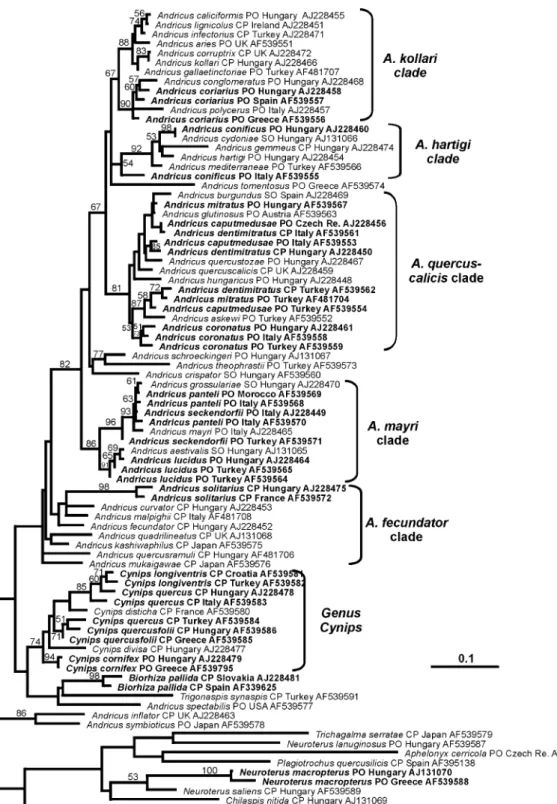
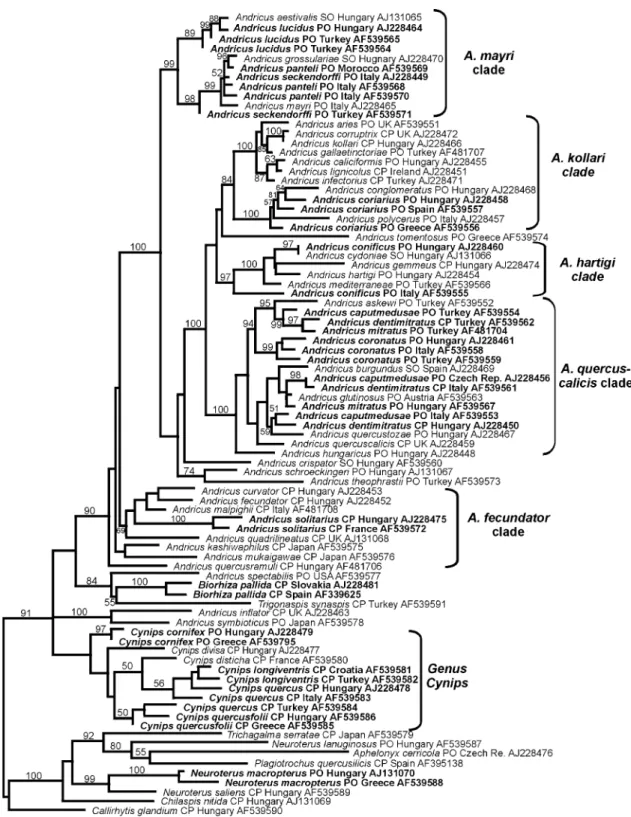
Phylogenetic reconstructions using maximum likeli-hood and Bayesian inference, and their respective bootstrap/posterior probability branch support values, are shown in Figs. 1 and 2, respectively. The most striking result is that 10 out of the 16 species for which
more than one haplotype has been included are not monophyletic, thus generating incongruence between
the cytochrome b gene tree and the current taxonomy.
To provide further support to our findings regarding
non-monophyly of these species, we calculated the posterior probability of each of the 16 species being monophyletic using the dataset generated from the
Bayesian analysis (Table 1). Assuming a cut-off p-value
Fig. 1. Phylogram representing the ML topology found using a heuristic search algorithm. The root of the tree is arbitrary and has been chosen for best visualisation. Bootstrap values from 500 pseudoreplicates are superimposed. Branches without bootstrap support values are supported by less than 50% of replicates. Species for which multiple haplotypes have been included are shown in boldface. After the species name, the generation(s) from which the species is known (SO, sexual only; PO, parthenogenetic only; CP, cyclical parthenogenetic), the country of origin and the GenBank accession number are listed.
of 0.01 (1%), monophyly is rejected for 9 of the 16 species. The only apparently non-monophyletic species for which monophyly cannot be rejected on the basis of
posterior probabilities is Cynips quercusfolii (Table 1,
Figs. 1 and 2).
Non-monophyly is particularly common within
An-dricus, where only two of the 10 species contributing
multiple haplotypes (A. coronatusandA. solitarius) had
monophyletic haplotype lineages (Figs. 1and 2, Table 1). Haplotypes from each non-monophyletic species are always grouped within the same clade (sensu Cook
et al., 2002; Stone and Cook, 1998) in the Andricus
lineage (for example, all the Andricus caputmedusae
haplotypes are placed within theAndricus quercuscalicis
Fig. 2. Fifty percent majority-rule consensus phylogram from the Bayesian analysis. The tree is mid-point rooted. Branches without posterior probability values are supported by less than 50% of the sampled trees. Species labels and information contained there-in same as in Fig. 1.
clade; Figs. 1 and 2). Non-monophyly is less
pro-nounced outside Andricus, where 5 out of 6 species
contributing multiple haplotypes are monophyletic. The
only non-monophyletic species isC. quercus(Table 1).
In summary, two general patterns of incongruence
between the cytb tree and current taxonomic
classifica-tion are present in Figs. 1 and 2:
(a) Non-monophyly. Haplotypes for several gallwasp species lie within a single clade that also includes hapl-otypes of one or more additional species. Examples
in-clude the distribution of haplotypes forAndricus lucidus
andAndricus panteliin theA. mayriclade, andAndricus coriariusin theA. kollariclade. Possible causes of such patterns are considered in detail below.
(b) Groupings of haplotypes for closely related spe-cies from the same glacial refuge. The single clear ex-ample of this phenomenon is seen within the main Andricus clade for A. caputmedusae, A. dentimitratus, and A. mitratus. Haplotypes from these three species sampled in Turkey form a clade separated by high branch support values from haplotypes for the same three species sampled in Italy/Hungary. This pattern is exactly as expected for hybridization among species within shared, genetically discrete refuges.
4. Discussion
The phylogenies reconstructed from both methods show good resolution of lineages at intermediate taxo-nomic depths, and identify several robustly supported clades, but fail to reconstruct very recent or very old
divergences. Most species for which multiple haplotypes were available are shown to be non-monophyletic. There are three main causes of discordance between gene and
species phylogenies—assuming that estimation of the
former is correct: (a) gene duplication, (b) lineage sort-ing of ancestral polymorphisms, and (c) horizontal transfer (Maddison, 1997). Our data suggest that all three processes may have occurred/are occurring in oak gallwasps.
4.1. Gene duplication: cytochrome b pseudogenes
Cloning of cytochromeb for the four oak gallwasp
species that failed direct sequencing revealed multiple
cytochrome b-like sequences. Only one sequence from
each species was found to be of the correct length and reading frame, suggesting that the other sequences found are probably nuclear mitochondrial pseudogenes (numts), as indicated by their mutational degeneration (presence of stop codons and/or indels) (Bensasson et al., 2001). Alternative explanations for the existence of additional mitochondrial-like sequences include hetero-plasmy and intra-mitochondrial duplications (Bensas-son et al., 2001; Mirol et al., 2000); rea(Bensas-sons why both of these alternatives are rather unlikely explanations in studies like this one have been discussed in detail by Mirol et al. (2000). However, even sequences with cor-rect length and reading frame are not necessarily
am-plifications of the ÔtrueÕ mitochondrial copy; evidence
from other gallwasp species suggests that, occasionally, more than one haplotype of correct length and reading frame exist (Rokas et al., in preparation). This is a po-tentially serious problem for phylogenetic reconstruc-tion, since the derived numts are essentially paralogues to the mitochondrial loci.
4.2. Reconciling discordance between the cytb tree and current oak gallwasp taxonomy
The striking feature from this analysis is the lack of monophyly for 9 of the 16 species represented by mul-tiple haplotypes (Table 1, Figs. 1 and 2). Here we con-sider in turn three probable causes for incongruence
between the cytochrome b tree and the oak gallwasp
taxonomy: (a) closure of cyclically parthenogenetic lifecycles, (b) lineage sorting, and (c) horizontal transfer through introgressive hybridization. We then discuss the implications of lineage sorting and hybridization for estimates of genetic divergence among taxa.
(a) Closure of lifecycle pairs. Although cyclical par-thenogenesis has been established in almost all of the oak gallwasps whose biology has been examined in detail (Stone et al., 2002), many European species are still known only from either a sexual or a parthenogenetic generation. The adults and galls of the two generations of a single species are so distinct morphologically that
Table 1
Posterior probability values for the monophyly of each of the 16 species of this study for which more than one haplotype was included in the analysis Species Posterior probability for species monophyly (%) Grouping status according to Figs. 1 and 2
Andricus caputmedusae 0 Non-monophyletic
Andricus conificus 0 Non-monophyletic
Andricus coriarius 0 Non-monophyletic
Andricus coronatus 99.5 Monophyletic
Andricus dentimitratus 0 Non-monophyletic
Andricus lucidus 0.1 Non-monophyletic
Andricus mitratus 0 Non-monophyletic
Andricus panteli 0.3 Non-monophyletic
Andricus seckendorfii 0 Non-monophyletic
Andricus solitarius 100 Monophyletic
Biorhiza pallida 100 Monophyletic
Cynips cornifex 96.6 Monophyletic
Cynips longiventris 48.5 Monophyletic
Cynips quercus 0 Non-monophyletic
Cynips quercusfolii 14.8 Non-monophyletic
they cannot be paired on the basis of structure alone (Ambrus, 1974; Stone et al., 1995; Stone and Cook, 1998). Until recently, the pairing of parthenogenetic and sexual generations has required caging experiments in the field and as a result this process is far from complete (Folliot, 1964; Lund et al., 1998; Wehrmaker, 1998). It is therefore possible that clades in our phylogenies that are paraphyletic because they contain one taxon known only from a sexual generation, and another known only from an parthenogenetic generation may actually be the two alternate generations of a cyclical parthenogenetic spe-cies. The phylogenies presented here suggest two
poten-tial pairings. The first case is found in theA. mayriclade;
if A. aestivalis (currently known only from its sexual
generation) is the sexual generation ofA. lucidus
(cur-rently known only from its parthenogenetic generation),
then the apparent non-monophyly ofA. lucidus
haplo-types disappears (the A. aestivalis sequence is from
Hungary and, as expected, groups with a haplotype from
the same refuge). A second case is found in theA. hartigi
clade, whereA. conificus(currently known only from its
parthenogenetic generation) may be the parthenogenetic
generation ofA. cydoniae(currently known only from its
sexual generation), although in this case the
non-mono-phyly ofA. conificusdoes not disappear. Similar pairings
may exist betweenAndricus grossulariae(sexual) andA.
panteli(parthenogenetic) in theA. mayriclade.
(b) Lineage sorting of ancestral polymorphism. Wherever polymorphism exists in a marker prior to speciation, shared ancestral polymorphisms may gener-ate incongruence between a gene tree and the species
tree. Previous work on the cytochrome b locus in
gall-wasps has shown extensive intra-specific variation, the coalescence time of which can exceed the time depth reconstructed for separation between species (Rokas et al., 2001; Stone and Cook, 1998; Stone et al., 2001). Sorting of ancestral polymorphism is thus not unex-pected in oak gallwasps, and results in non-monophyly of daughter species. Although lineage sorting and hy-bridization can be difficult or impossible to discriminate in very recent speciation events (Sota et al., 2001), the two can be discriminated by considering spatial patterns in haplotype similarity among species. By definition, the divergence of ancestral polymorphisms must predate the divergence of species (Edwards and Beerli, 2000). If stochastic sorting of ancestral polymorphism is respon-sible for similarity in haplotypes across species, there is thus no reason to expect similar haplotypes in different species to be sampled from sympatric populations. If, however, haplotype similarity across species is generated by hybridization, then these similarities should be ob-served in sympatric (and hence potentially interbreed-ing) populations of those species. A difficulty in distinguishing between these scenarios is that inadequate sampling of intra-specific variation in hybridizing taxa will lead to inference of sorting of ancestral
polymor-phism. Since the latter is probable a priori among closely related species, we take this cause as the more parsi-monious explanation for non-monophyly of intra-spe-cific haplotype diversity, and reserve hybridization as the explanation for cases with a clear correlation be-tween sequence similarity and sympatry, as described below.
Incongruities between gene and species trees associ-ated with sorting of ancestral polymorphism depend on the level of ancestral polymorphism, and the coalescence time of those polymorphisms in the phylogeny. Coa-lescence theory suggests that lineage sorting of ancestral polymorphisms will be faster for mtDNA loci because they have a population size one quarter of that for nu-clear genes (Moore, 1995; see Hoelzer, 1997, for excep-tions; Palumbi et al., 2001). Nuclear loci with high mutation rates are thus expected to bear a stronger signature of lineage sorting. A 590 base pair fragment of
the nuclear gene long-wavelength opsin (LW Rh)
showed good phylogenetic resolution for 21 species of gallwasps (Cook et al., 2002), but alleles from different phylogeographic refuges have yet to be examined. The high percentage of non-monophyletic haplotypes for a given species of oak gallwasp in the mitochondrial phylogenies presented here suggests that the species phylogeny of oak gallwasps may be difficult to resolve fully with molecular data. Similar predictions may be made for other taxonomic groups (e.g., many insects), that have experienced high speciation rates (e.g., Farrell, 1998; Kambysellis et al., 1995).
(c) Horizontal transfer of haplotypes through intro-gressive hybridization. Horizontal transfer of
mitochon-drial haplotypes is always a possibility where
reproductive barriers between lineages are not complete, and several studies have shown introgression of the nu-clear genome of one insect species by the mitochondrial genome of another through hybridization (e.g., Powell, 1983; Sota et al., 2001; Thelwell et al., 2000). Rearing experiments have shown that the closely related oak
gallwasp speciesAndricus kollariandAndricus lignicolus
can mate and produce offspring capable of back-crossing to both parents for up to three generations (Folliot, 1964). These two species are members of the same species
group (the A. kollari clade) but are not sister taxa, so
hybridization among even more closely related species is a possibility under natural conditions. We suggest that
our data for A. caputmedusae, Andricus dentimitratus,
and Andricus mitratus in the A. quercuscalicis clade provide evidence for horizontal exchange of haplotypes by introgressive hybridization, because haplotypes from different species from a given glacial refuge (Turkey) are more similar than members of the same species across refuges. As discussed above, this result is unlikely to arise through sorting of ancestral polymorphism alone. Al-though haplotypes from other refuges (Hungary and Italy) are included for this set of species, no clustering
according to geography is occurring. While this could be interpreted as lack of support for hybridization between
these species, it has been shown that cytochrome b
se-quence data do not distinguish between these two refuges in all species examined so far (Rokas et al., 2001; Stone et al., 2001) (Rokas et al., unpublished data).
Of the three Andricus species involved, only one
(A. dentimitratus) has a known sexual generation. Popu-lation genetic analyses strongly infer the presence of an
unknown sexual generation in A. caputmedusae
(At-kinson, 2000), while nothing is known of the lifecycle of A. mitratus. The inferred horizontal exchange of hapl-otypes provides further indirect evidence of sexual re-production in all three species. All three species probably have sexual generations that develop in small
spring bud galls on oaks in the sectionCerris(Atkinson,
2000; Cook et al., 1998; Cook et al., 2002). Mating in
related Andricus takes place on the surface of the gall
(Stone and Sunnucks, 1993; Stone et al., 2001), and where the galls of two or more closely related species are at high density, it is possible that hybridization could occur under natural conditions.
The discussion above raises that general point that the total divergence between two species, as measured by the average pairwise divergence between lineage tips in the two species, includes three components: (a) allelic divergence between the species that has accumulated after lineage splitting (i.e., genuine phylogenetic signal for establishing species monophyly), (b) allelic diver-gence within the common ancestral species, and (c) di-vergence in alleles exchanged through hybridization. The second and third components may introduce sig-nificant errors into estimates of intra-specific diversity
and of inter-specific genetic divergence—and hence into
other parameters (such as past population size and molecular dating of speciation events) estimated from these. For example, if a significant portion of the di-versity between the two species is ancestral, ignoring intra-specific variation in each species (as an estimate of that ancestral diversity) may lead to a gross over-esti-mation of inter-specific divergence (at least for recently diverged species) (see also Edwards, 1997). In contrast, high levels of introgression will lead to over-estimates of genetic diversity within species, and an underestimate of inter-specific divergence. Given that both errors due to lineage sorting and introgression will be more pro-nounced as the ancestral species becomes more struc-tured (Nei and Takahata, 1993), these effects should be seriously considered in phylogeny reconstruction for widespread species with refuge-specific genetic diversity.
5. Conclusion
A range of interesting and general molecular phylo-genetic questions can be addressed with oak gallwasps.
For example, the lineage sorting of ancestral polymor-phisms (a possible consequence of the genetic structure of populations due to the Pleistocene glaciation cycles) may have a serious effect on within-genus phylogenetics. Furthermore, the possibility of introgressive hybridiza-tion between species and the reality of, as yet, un-matched generations make the task of phylogenetic reconstruction even more difficult.
The phylogenetic history of a group such as oak gallwasps, where divergence times between taxa in a well-sampled data matrix differ by an order of magni-tude, is unlikely to be resolved by any single locus. A combined approach, employing several loci that show different and complementary rates (and modes) of evo-lution, is probably the only way to obtain well-sup-ported phylogenetic hypotheses (Hillis et al., 1996; Rokas and Holland, 2000; Rokas et al., 2002). Lessons learned from single-locus studies will be a most useful guide towards achieving this goals.
Acknowledgments
This work was funded from grants from the N.E.R.C. (EDGE thematic program GR9/03553 and Grant No. GR12847), the Royal Society (574006) and the British Ecological Society (Small Ecological Project Grant No. 1462) to G.N.S.A.R. was partially funded from a NERC studentship and is currently a Human Frontier Science Program long-term fellow. J.L.N.-A. was partially fun-ded from DGES (PGC, PB97-1241). J.M.C. was sup-ported by a NERC advanced fellowship. A.R. thanks the faculty, teaching assistants and students involved in
the 2001ÔWorkshop on Molecular EvolutionÕat Woods
Hole, MA and especially its Director Mike Cummings for discussion of phylogenetic issues and for provision of computational facilities. We thank Jill Lovell for excellent technical support, Rob DeSalle and two anonymous referees for extensive comments on the manuscript, and Rachel Atkinson, Richard Bailey and Gordon Brown for encouragement and help with gall collecting and rearing.
References
Ambrus, B., 1974. Cynipida–Gubacsok–Cecidia Cyniparum. Aca-demic Press, Budapest, Hungary.
Askew, R.R., 1984. The biology of gall wasps. In: Ananthakrishnan, T.N. (Ed.), The Biology of Galling Insects. Oxford and IBH Publishing Co., New Delhi, pp. 223–271.
Atkinson, R.J., 2000. The genetic analysis of natural history, repro-ductive strategy, and population structure in European oak gallwasps (Hymenoptera: Cynipidae). Ph.D. Thesis, University of Oxford, Oxford, p.286.
Bensasson, D., Zhang, D.-X., Hartl, D.L., Hewitt, G.M., 2001. Mitochondrial pseudogenes: evolutionÕs misplaced witnesses. Trends. Ecol. Evol. 16, 314–321.
Cook, J.M., Rokas, A., Pagel, M., Stone, G.N., 2002. Evolutionary shifts between host oak species and host plant organs inAndricus
gallwasps. Evolution, in press.
Cook, J.M., Stone, G.N., Rowe, A., 1998. Patterns in the evolution of gall structure and life cycles in oak gallwasps (Hymenoptera: Cynipidae). In: Csoka, G., Mattson, W.J., Stone, G.N., Price, P.W. (Eds.), The Biology of Gall-Inducing Arthropods. U.S. Depart-ment of Agriculture, Forest Service, North Central Research Station, St. Paul, Minnesota, pp. 261–279.
Drown, D.M., Brown, J.M., 1998. Molecular phylogeny of North American oak-galling Cynipini (Hymenoptera: Cynipidae) sup-ports need for generic division. In: Csoka, G., Mattson, W.J., Stone, G.N., Price, P.W. (Eds.), The Biology of Gall-Inducing Arthropods. U.S. Department of Agriculture, Forest Service, North Central Research Station, St. Paul, Minnesota, pp. 241–246. Edwards, S.V., 1997. Relevance of microevolutionary processes to higher level molecular systematics. In: Mindell, D.P. (Ed.), Avian Molecular Evolution and Systematics. Academic Press, New York, pp. 251–278.
Edwards, S.V., Beerli, P., 2000. Gene divergence, population diver-gence, and the variance in coalescence time in phylogeographic studies. Evolution 54, 1839–1854.
Farrell, B.D., 1998. ‘‘Inordinate fondness’’ explained: Why are there so many beetles? Science 281, 555–559.
Folliot, R., 1964. Contribution a lÕetude de la biologie des Cynipides gallicoles (Hymenoptera: Cynipoidea). Annals des Sciences Natur-elles, Zoologie (Paris), Series 12 6, 407–564.
Hillis, D.M., Mable, B.K., Moritz, C., 1996. Applications of molecular systematics. In: Hillis, D.M., Moritz, C., Mable, B.K. (Eds.), Molecular Systematics. Sinauer, Sunderland, MA, pp. 515–543. Hoelzer, G.A., 1997. Inferring phylogenies from mtDNA variation:
mitochondrial-gene trees versus nuclear-gene trees revisited. Evo-lution 51, 622–626.
Huelsenbeck, J.P., Rannala, B., 1997. Phylogenetic methods come of age: testing hypotheses in an evolutionary context. Science 276, 227–232.
Huelsenbeck, J.P., Ronquist, F., 2001. MRBAYES: Bayesian inference of phylogenetic trees. Bioinformatics 17, 754–755.
Jermiin, L.S., Crozier, R.H., 1994. The cytochromebregion in the mitochondrial DNA of the antTetraponera rufoniger: sequence divergence in Hymenoptera may be associated with nucleotide content. J. Mol. Evol. 38, 282–294.
Kambysellis, M.P., Ho, K.F., Craddock, E.M., Piano, F., Parisi, M., Cohen, J., 1995. Pattern of ecological shifts in the diversification of HawaiianDrosophilainferred from a molecular phylogeny. Curr. Biol. 5, 1129–1139.
Kinsey, A.C., 1936. The origin of higher categories inCynips. Ind. Univ. Publ., Sci. Ser. 4, 1–334.
Liljeblad, J., Ronquist, F., 1998. A phylogenetic analysis of higher-level gall wasp relationships (Hymenoptera: Cynipidae). Syst. Entomol. 23, 229–252.
Lund, J.N., Ott, J.R., Lyon, R.J., 1998. Heterogony inBelonocnema treatae Mayr (Hymenoptera: Cynipidae). Proc. Entomol. Soc. Wash. 100, 755–763.
Lyon, R.J., 1996. New cynipid wasps from the southwestern United States (Hymenoptera: Cynipidae). Pan-Pacific Entomol. 72, 181– 192.
Maddison, W.P., 1997. Gene trees in species trees. Syst. Biol. 46, 523– 536.
Manos, P.S., Doyle, J.J., Nixon, K.C., 1999. Phylogeny, biogeography and processes of molecular differentiation inQuercus subgenus
Quercus(Fagaceae). Mol. Phylog. Evol. 12, 333–349.
Melika, G., Abrahamson, W.G., 2000. Review of the cynipid gall wasps of the genus Loxaulus Mayr (Hymenoptera: Cynipidae) with descriptions of new species. Proc. Entomol. Soc. Wash. 102, 198–211. Melika, G., Csoka, G., Pujade-Villar, J., 2000. Check-list of oak gall wasps of Hungary, with some taxonomic notes (Hymenoptera:
Cynipidae, Cynipinae, and Cynipini). Ann. Hist.-Nat. Mus. Natl. Hung. 92, 265–296.
Mirol, P.M., Mascheretti, S., Searle, J.B., 2000. Multiple nuclear pseudogenes of mitochondrial cytochromebinCtenomys (Cavio-morpha, Rodentia) with either great similarity to or high diver-gence from the true mitochondrial sequence. Heredity 84, 538–547. Moore, W.S., 1995. Inferring phylogenies from mtDNA variation: mitochondrial-gene trees versus nuclear-gene trees. Evolution 49, 718–726.
Nei, M., Takahata, N., 1993. Effective population size, genetic diversity, and coalescence time in subdivided populations. J. Mol. Evol. 37, 240–244.
Nieves-Aldrey, J.L., 1987. Estado actual del conocimiento de la subfamilia Cynipinae (Hymenoptera, Parasitica, and Cynipidae) en la Peninsula Iberica. Eos 63, 179–195.
Nieves-Aldrey, J.-L., 2001. Hymenoptera: Cynipidae. Museo Nacional de Ciencias Naturales, CSIC, Madrid.
Palumbi, S.R., Cipriano, F., Hare, M.P., 2001. Predicting nuclear gene coalescence from mitochondrial data: the three-times rule. Evolu-tion 55, 859–868.
Posada, D., Crandall, K.A., 1998. MODELTEST: testing the model of DNA substitution. Bioinformatics 14, 817–818.
Powell, J.R., 1983. Interspecific cytoplasmic gene flow in the absence of nuclear gene flow: evidence fromDrosophila. Proc. Natl. Acad. Sci. USA 80, 492–495.
Rokas, A., 2001. Tree-thinking, molecules and gallwasps; analysing evolutionary patterns in European gallwasps using a molecular phylogenetic approach. Ph.D. Thesis, University of Edinburgh, Edinburgh, p. 255.
Rokas, A., Atkinson, R.J., Brown, G.S., West, S.A., Stone, G.N., 2001. Understanding patterns of genetic diversity in the oak gallwasp Biorhiza pallida: demographic history or a Wolbachia
selective sweep? Heredity 87, 294–304.
Rokas, A., Holland, P.W.H., 2000. Rare genomic changes as a tool for phylogenetics. Trends Ecol. Evol. 15, 454–459.
Rokas, A., Nylander, J.A.A., Ronquist, F., Stone, G.N., 2002. A maximum likelihood analysis of eight phylogenetic markers in gallwasps (Hymenoptera: Cynipidae); implications for insect phy-logenetic studies. Mol. Phylog. Evol. 22, 206–219.
Ronquist, F., 1994. Evolution of parasitism among closely related species: phylogenetic relationships and the origins of inquilism in gall wasps (Hymenoptera: Cynipidae). Evolution 48, 241–266. Ronquist, F., 1999. Phylogeny, classification and evolution of the
Cynipoidea. Zool. Scr. 28, 139–164.
Simon, C., Frati, F., Beckenbach, A., Crespi, B., Liu, H., Flook, P., 1994. Evolution, weighting, and phylogenetic utility of mitochon-drial gene sequences and a compilation of conserved polymerase chain reaction primers. Ann. Entomol. Soc. Am. 87, 651–701. Sota, T., Ishikawa, R., Ujie, M., Kusumoto, F., Vogler, A.P., 2001.
Extensive trans-species mitochondrial polymorphisms in the cara-bid beetles Carabus subgenus Ohomopterus caused by repeated introgressive hybridisation. Mol. Ecol. 10, 2833–2847.
Stone, G.N., Atkinson, R., Rokas, A., Csooka, G., Nieves-Aldrey, J.-L., 2001. Differential success in northwards range expansion between ecotypes of the marble gallwaspAndricus kollari: a tale of two lifecycles. Mol. Ecol. 10, 761–778.
Stone, G.N., Cook, J.M., 1998. The structure of cynipid oak galls: patterns in the evolution of an extended phenotype. Proc. R. Soc. Lond., Ser. B 265, 979–988.
Stone, G.N., Schoonrogge, K., Atkinson, R.J., Bellido, D., Pujade-€
Villar, J., 2002. The population biology of oak gallwasps (Hyme-noptera: Cynipidae). Annu. Rev. Entomol. 47, 633–668.
Stone, G.N., Schoonrogge, K., Crawley, M.J., Fraser, S., 1995.€
Geographic and between-generation variation in the parasitoid communities associated with an invading gallwasp, Andricus quercuscalicis (Hymenoptera: Cynipidae). Oecologia 104, 207– 217.
Stone, G.N., Sunnucks, P., 1993. Genetic consequences of an invasion through a patchy environment—the cynipid gallwasp Andricus quercuscalicis(Hymenoptera: Cynipidae). Mol. Ecol. 2, 251–268. Swofford, D.L., 2002. PAUP* Phylogenetic Analysis Using Parsimony
(*and other methods). Sinauer, Sunderland, MA.
Thelwell, N.J., Huisman, R.A., Harbach, R.E., Butlin, R.K., 2000. Evidence for mitochondrial introgression between Anopheles bwambaeandAnopheles gambiae. Insect Mol. Biol. 9, 203–210. Wehrmaker, A., 1998. On the beginnings of cecidology in 19th century
North America: BassettÕs discovery of heterogony in oak gall wasps
(Hymenoptera: Cynipidae). In: Csooka, G., Mattson, W.J., Stone,
G.N., Price, P.W. (Eds.), The Biology of Gall-inducing Arthro-pods. U.S. Department of Agriculture, Forest Service, North Central Research Station, St. Paul, Minnesota, pp. 106–110. Weld, L.H., 1957. Cynipid Galls of the Pacific Slope. Privately printed,
Ann Arbor, Michigan.
Weld, L.H., 1959. Cynipid Galls of the Eastern United States. Privately printed, Ann Arbor, Michigan.
Weld, L.H., 1960. Cynipid Galls of the Southwest. Privately printed, Ann Arbor, Michigan.