Challenges for Master Programs on Human-Computer
Interaction (HCI): experience report of the M2IHM
Marco Winckler, Philippe Palanque & David Navarre
IRIT-ICS, Université Paul Sabatier 118 route de Narbonne, 31062 Toulouse, France
{winckler, palanque}@irit.fr
ABSTRACT
There are an increasing number of undergraduate programs in Computer Science that now includes teaching of Human-Computer Interaction (HCI). The occurrence of HCI courses in undergraduate programs is essential to present concepts (e.g. usability, accessibility, User eXperience) and techniques (e.g. prototyping, user interface evaluation) necessary for designing and developing user-centered interactive systems. However, the number of hours devoted to HCI teaching in graduate levels is barely enough to make of students proper usability professionals. For this very purpose, several graduate courses devoted to HCI have been created in the last years, in particularly across the United States and Europe. In this position paper we report the experience of creation of a master 2 program on Human-Computer Interaction. We present the structure and the contents of the M2IHM and, in particular, the place that occupies the teaching of Web technology in this program. We also discuss the evolution that occurred in the last 10 years with the M2IHM in order to cope with the evolution of technology and the market. Since September 2011, the master 2 IHM is now included in a two years master program on HCI. As no information is available about its drawbacks and advantages we don’t report on this two years program here.
Categories and Subject Descriptors
K.3.2 [Computer and Information Science Education]: Computer science education, accreditation, Curriculum. H.1.2 [User/Machine Systems]: Human information processing.
General Terms
Human Factors
Keywords
Human-Computer Interaction, graduate teaching programs.
1.
INTRODUCTION
Since the advent of personal computing, the average user expertise with computers is constantly dropping. Accordingly, user interface effectiveness has become increasingly important in software development in particularly because this aspect can determine the adoption or rejection of the whole software [1].
Actually, the user interface occupies a very important part of design and development tasks in modern software development [4]. Aware of the fact that designers and developers need appropriate training to cope with users’ needs and expectations towards the user interface of interactive systems, the Association for Computing Machinery1 (ACM) and the International Federation for Information processing2 (IFIP) hold permanent working groups for promoting the education on Human-Computer Interaction (HCI).
The occurrence of HCI courses in undergraduate programs is essential to present concepts (e.g. usability, accessibility, User eXperience) and techniques (e.g. prototyping, user interface evaluation) necessary for designing user-centered interactive systems. In the last years there are an increasing number of undergraduate programs in Computer Science that propose courses of Introduction to Human-Computer Interaction (HCI) in their curriculum. However, these courses rarely exceed 40 hours, which is barely enough to prepare students to work as usability professionals. In order to cover this gap, specialized master 2 programs have been created in the last decade around the world (see the list of HCI programs provided by Gary Perlman [5]). It goes without saying that the success of graduating programs on HCI is related to an increasing demand for usability professionals. The interests of the industry can easily be measured in terms of internship and job offers. However, there is a paradox: whilst some companies look for professionals with very specific skills (e.g. usability evaluation methods, development of multimodal interaction techniques, etc.) to fill a position in development teams, others have little knowledge on HCI so that they recruit professionals to initiate a usability culture inside their organization. Moreover, graduate programs should cope with companies’ expectations in terms of required technological background (e.g. mobile, Web, multimodal interfaces, etc.) and knowledge on the idiosyncrasy of the application domains (e.g. safety-critical systems, airspace, e-government, etc.). There is no point to teach everything so that educators must find a balance between what to teach with respect to student’s jobs perspectives. In this position paper we report the experience gained through the creation of a Master 2 program on Human-Computer Interaction (M2IHM). Section 2 provides a view at glance of the organization and contents for the M2IHM and, in particular, the place that occupies the teaching of Web technology. As we shall see, Web technology has been taught since the beginnings but it is not a dominant aspect of the M2IHM. Section 3 illustrates the evolution
1
ACM Special Interest Group on Computer Human Interaction: http://www.sigchi.org/
2
IFIP Technical Committee on Human-Computer Interaction (TC13): http://csmobile.upe.ac.za/ifip
Permission to make digital or hard copies of all or part of this work for personal or classroom use is granted without fee provided that copies are not made or distributed for profit or commercial advantage and that copies bear this notice and the full citation on the first page. To copy otherwise, or republish, to post on servers or to redistribute to lists, requires prior specific permission and/or a fee.
Conference’10, Month 1–2, 2010, City, State, Country.
of master program in terms of internship offers. Then section 4 outlooks the challenges for the M2IHM.
2.
M2IHM: a view at glance
The M2IHM3 is a Master 2 program on Human-Computer Interaction that is jointly held by the University Paul Sabatier (UPS) and the National School of Civil Aviation (Ecole Nationale d’Aviation Civile - ENAC) in Toulouse, France. It is basically an option for the final year (i.e. 5th) of studies in Computer Science. The M2IHM, based in Toulouse, France, was created in September 2000 and it is the pioneer in HCI Education in France. Students should apply for one of the 25 positions available, and, despite it is not officially an international master program, >15% of the students come from abroad (e.g. Germany, Spain, China, Tunisia). The main goal of the M2IHM is to teach HCI to students that follow a prior education on Computer Sciences. After following the M2IHM courses, students should also develop skills in HCI such as be able to: i) carry on projects using a user-centered design approach; ii) understand, chose and apply ergonomic recommendations whenever it is appropriate; iii) assess the qualities and defects of a user interface.
2.1
Organization and Contents
The M2IHM program is deployed in two semesters (see Table 1). The first semesters is dedicated to courses whilst the second semesters is devoted to a group project called “chef d’œuvre” and an internship. The “chef d’œuvre” is an exploratory study during which the students can identify and assess different design option for a given interactive system, mainly proposed by industrial partners. This project is carried out by a group of 3-4 students and should cover all phases of the development process of an interactive system. It also must include a bibliographical survey. The internship occurs between 18-26 weeks and should be performed in an industrial context or with a research lab. The subject requires a prior approval from the pedagogical team. Table 1. Teaching units of the M2IHM for 2011-2012. Semester 1 (total 457 hours)
Teaching units Lessons / Contents
UE 1 : Human factors Cognitive models of human processing Software ergonomics
Task analysis and task modeling Usability evaluation methods Inquiry methods for HCI Statistics applied to HCI Accessibility and universal design
Requirement analysis for interactive systems UE 2 : Methodologies
for research in HCI
Engineering interactive systems Principles of empirical HCI research UE 3 : Information
visualization
Information representation and display 2D visualization and interaction UE 4 : Design and
development of user interfaces
Development process of interactive systems Prototyping and Agile methods
UE 5 : Interaction technics and application domains
Multimodal interaction techniques Interaction techniques for the Web Collaborative Systems
Mobile applications
3D visualization and interaction
3
Master 2 Interaction Homme-Machine: http://www.masterihm.fr
Multimedia systems UE 6 : Programming
techniques for interactive systems
Component-based software for interactive systems (COM and NetBeans)
Participatory design Web technologies UML for HCI
Advanced programming for HCI UE 7 : English and
Project Management
English (training for TOEIC/TOFFEL) Project management
Semester 2
Teaching units Lessons / Contents
“Chef d’œuvre” Exploratory project
Internship Internship in the industry or research lab
2.2
Teaching for the Web
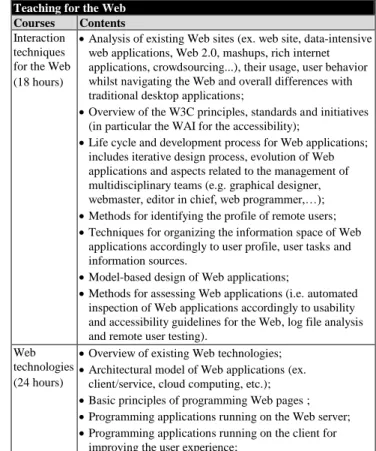
Despite the fact the Web is not a dominant discipline in the M2IHM, it represents 42 hours (~10%) of teaching that are dispensed in two courses: “Interaction Techniques for the Web” and “Web technologies”. The main goal of the courses “Interaction Techniques for the Web” is to highlight the idiosyncrasies of the Web development and to provide students with methods and tools that can be useful to build successful Web applications. The courses of “Web technologies” are aimed to teach students how to program Web applications including both client-side technologies and server-side technologies. Table 2 presents an overview of the contents taught in these courses. As we shall see some of the contents taught in these courses are a complement to other courses in the program such as
“Accessibility and Universal design”, “Development process of interactive systems”, “Usability evaluation methods” where the focus is not limited to the Web.
Table 2. Contents of courses concerning teaching for the Web. Teaching for the Web
Courses Contents Interaction
techniques for the Web (18 hours)
Analysis of existing Web sites (ex. web site, data-intensive web applications, Web 2.0, mashups, rich internet applications, crowdsourcing...), their usage, user behavior whilst navigating the Web and overall differences with traditional desktop applications;
Overview of the W3C principles, standards and initiatives (in particular the WAI for the accessibility);
Life cycle and development process for Web applications; includes iterative design process, evolution of Web applications and aspects related to the management of multidisciplinary teams (e.g. graphical designer, webmaster, editor in chief, web programmer,…); Methods for identifying the profile of remote users; Techniques for organizing the information space of Web
applications accordingly to user profile, user tasks and information sources.
Model-based design of Web applications;
Methods for assessing Web applications (i.e. automated inspection of Web applications accordingly to usability and accessibility guidelines for the Web, log file analysis and remote user testing).
Web technologies (24 hours)
Overview of existing Web technologies; Architectural model of Web applications (ex.
client/service, cloud computing, etc.); Basic principles of programming Web pages ; Programming applications running on the Web server; Programming applications running on the client for
Programming rich internet application;
Optimization of Web applications for Web browsers; Basic principles of security and privacy in Web
programming.
These courses focused on the Web also create several opportunity to discuss aspects of cross-media and cross-platform applications, as Web contents is more and more delivered through different platforms.
The teaching team has a long experience with web technologies and lectures are fed with such research experience. For instance we have been working on navigation models for the web [10], usability guidelines for web applications [7] and more recently on personalization of web interfaces [11]. Such integration of research and teaching makes it possible to efficiently support the students during their internship while encountering nonstandard problems.
2.3
Including Component Software
Technologies
Component software technologies have been taught since the beginning of the master but have significantly evolved over the years. This teaching is currently split in 3 different courses: Introduction to component software principles, the MicroSoft approach (COM) and the Java approach (NetBeans) (see Table 3). The teaching team has been involved for many years in the research activities around component software mainly around CORBA [1] which is not taught as not central to the master’s jobs target. However, since 1997 [3] research were carried out in the area of interactive components and more recently on their dependability aspects [9].
Table 3. Contents of courses dealing with component software. Teaching for the Web
Courses Contents Introduction to component software (6 hours)
Principle of component software (based on Clement Szyperski book [8] and definition);
The notion of market for component software The development process for component software
(component developer and distributor, the component integrator and software developer, the end user view on interactive components)
Microsoft COM (6 hours)
Overview of COM and its interfaces;
Visual Basic environment and its connection with COM The difference between component software and OO
programming (application to Visual Basic 6.0) Development of an interactive component and its
integration into an application JavaBeans
(9 hours)
Overview of JavaBeans; Swing library;
Development of an interactive component in JavaBeans and its integration into a Java application.
Despite the limited number of hours devoted explicitly to component software they are introduced as a recurrent concern for each of the technologies taught in the master and end up being the corner stone of the technological view on the development process.
3.
HISTORICAL VIEW
The M2IHM has passed for several chances in the last 10 years including two main phases with the reorganization required to cope with the LMD European Bologna requirements [6] (in 2004) and the harmonization of professional and academic master programs (in 2008). During this period, the contents have evolved, mainly due to job and internship opportunities for the students; courses such as “Multiagent Systems” were removed from the program giving place for new ones such as “Statistics applied to HCI”, “Inquiry methods for HCI” and “Accessibility and universal design”. Hereafter we present an analysis of the evolution in internship offers to students.
3.1
Application domains of internships
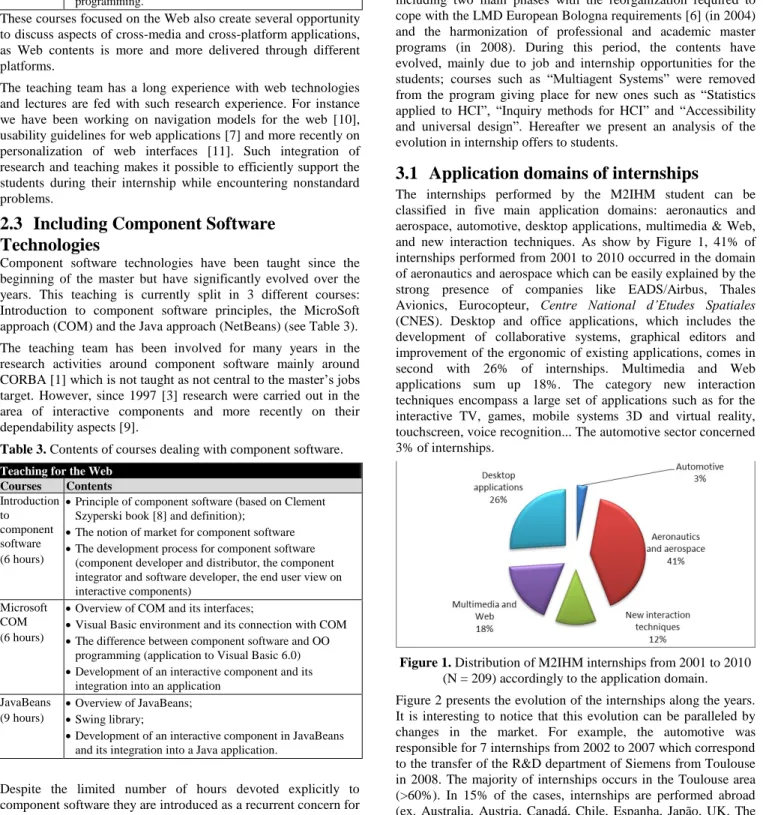
The internships performed by the M2IHM student can be classified in five main application domains: aeronautics and aerospace, automotive, desktop applications, multimedia & Web, and new interaction techniques. As show by Figure 1, 41% of internships performed from 2001 to 2010 occurred in the domain of aeronautics and aerospace which can be easily explained by the strong presence of companies like EADS/Airbus, Thales Avionics, Eurocopteur, Centre National d’Etudes Spatiales (CNES). Desktop and office applications, which includes the development of collaborative systems, graphical editors and improvement of the ergonomic of existing applications, comes in second with 26% of internships. Multimedia and Web applications sum up 18%. The category new interaction techniques encompass a large set of applications such as for the interactive TV, games, mobile systems 3D and virtual reality, touchscreen, voice recognition... The automotive sector concerned 3% of internships.
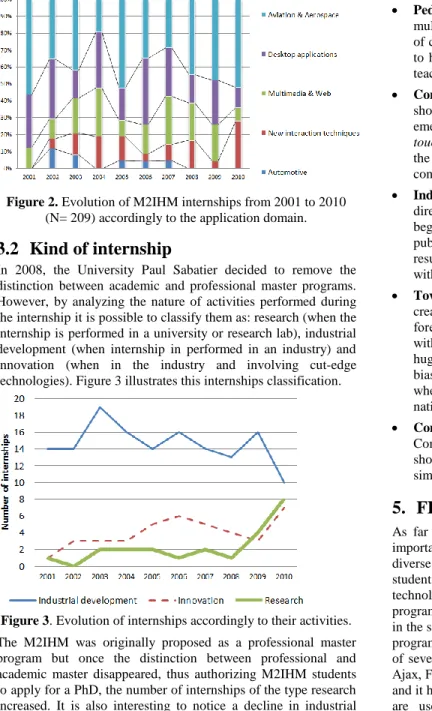
Figure 1. Distribution of M2IHM internships from 2001 to 2010 (N = 209) accordingly to the application domain. Figure 2 presents the evolution of the internships along the years. It is interesting to notice that this evolution can be paralleled by changes in the market. For example, the automotive was responsible for 7 internships from 2002 to 2007 which correspond to the transfer of the R&D department of Siemens from Toulouse in 2008. The majority of internships occurs in the Toulouse area (>60%). In 15% of the cases, internships are performed abroad (ex. Australia, Austria, Canadá, Chile, Espanha, Japão, UK. The increasing number of internship offers in the aeronautics domain can also be paralleled to the expansion of recent programs such as the A380 (see Figure 2).
There is a large set of offers for internship concerning desktop applications but these are often seen as the last choice by students who often prefer new interaction techniques. Nonetheless, offers for internships with new interaction techniques are not so
frequent. For instance, in 2010 the number of offers represented 28% (N=7, where 3 involving multitouch, 1 ambient systems/demotic, 2 games, 1 mobile applications), but looking back to previous years, the number of internships in this category was lower and it concerned different application domains (an iTV applications in 2009 and 3 virtual reality in 2008). A trend in this sector is thus difficult to assess.
Figure 2. Evolution of M2IHM internships from 2001 to 2010 (N= 209) accordingly to the application domain.
3.2
Kind of internship
In 2008, the University Paul Sabatier decided to remove the distinction between academic and professional master programs. However, by analyzing the nature of activities performed during the internship it is possible to classify them as: research (when the internship is performed in a university or research lab), industrial development (when internship in performed in an industry) and innovation (when in the industry and involving cut-edge technologies). Figure 3 illustrates this internships classification.
Figure 3. Evolution of internships accordingly to their activities. The M2IHM was originally proposed as a professional master program but once the distinction between professional and academic master disappeared, thus authorizing M2IHM students to apply for a PhD, the number of internships of the type research increased. It is also interesting to notice a decline in industrial internships focus on development. On one hand this can be explained by the continuous introduction of new technologies in the M2IHM program that qualify students for the job. On the other hand, there is an increasing interest from industrialists on the exploration of cut-edge interactive technologies for developing new products.
4.
CHALLENGES
Currently, the M2IHM is very attractive for both students (hard competition between local, French and foreigners applications) and the industry (more than 3 offers of internship tailored for the M2IHM per student and, in average, less than 2 month of unemployment after graduating). However, several challenges remain concerning:
Pedagogic team: it is difficult to create a master program on multidisciplinary fields like HCI (see Table 1 for an overview of contents covered), in particular when teachers are expected to have contribute scientifically to the disciplines where they teach.
Constant updating of contents: the evolution of contents should follow technological evolution. However, the fast emergency of new technologies in the last years (ex. Mobile,
touchscreen, iTV) has been a tricky problem, in particular as the number of hours is not extensible and any replacement of contents should be carefully analyzed.
Industrial partnership: the success of master programs is directly associated with the employability of students. In the beginnings of the M2IHM there was a hard investment on publicity to create a network with the local industry. The result is that our current networking is worthy even if working with an eclectic pool of companies remains a challenge.
Towards internationalization: there is a huge pressure for creating new international programs that welcome both foreigner’s students and teachers. Nonetheless, when dealing with the professional context, the language barrier remains a huge obstacle as it brings a cultural background that might bias the communication and the perception of user’s needs when users and the development team do not speak the same native language.
Competing master programs: the number of students in Computer Sciences is continuously dropping so that we should not exclude the competition for students between similar master programs.
5.
FINAL COMMENTS
As far as the teaching of Web technologies is a concern, it is important to mention that students attempt the M2IHM with very diverse backgrounds in Web programming. In most cases, students do not even have the most basic training on Web technologies. Beyond that, they completely misunderstand how to program accessible applications. Another important challenge lays in the selection amongst the diversity of available technologies for programming the Web, as Web applications require the blending of several programming languages (ex. XTML, CSS, JavaScript, Ajax, Flex …). This aspect is a characteristic of Web development and it has a direct impact on learnability, challenging students that are used to build other interactive systems with a single programming language.
The Web domain is considered very important in the M2IHM program and it sums up more hours of teaching than other application domains such as mobile applications. Nonetheless, it is not the purpose of the M2IHM to focus is a single application domain so that some interesting Web initiatives (such as the Web of Things or Semantic Web technologies) cannot be discussed. The presence in the M2IHM of courses of technologies involving a particular domain is driven not only by its inner education
purpose but also the opportunities it might present for the career of students. So far, courses on the Web has been justified for the general interest of Web application and a significant number of internships and job offers that require skills in this area. However, the local industry on the Web domain is not so important to accommodate all students of the M2HM which may be explained for the competing with other master programs. Despite of that, we are convinced that the courses on user-centered design, usability and accessibility are basic concepts of Human-Computer Interaction that should be taught to all students that want to develop a career as designer and/or developer of interactive systems for the Web.
6.
REFERENCES
1.Bastide R. Sy O., Palanque P. & Navarre D. Formal specification of CORBA services: experience and lessons learned. ACM Conference on Object-Oriented Programming, Systems, Languages, and Applications (OOPSLA'2000); Minneapolis, Minnesota USA. ACM Press; 2000.p105-117 2.Bias, E. G. and Mayhew, D. J. (eds). 1994 Cost-Justifying
Usability. Morgan Kaufmann (May 16, 1994), 334 pages. 3. Jacomi M., Chatty S. & Palanque P. A Making-Movies
Metaphor for Structuring Software Components in Highly Interactive Application. In proceedings of the 12th BCS Human-Computer Interaction conference HCI'97, pp. 123-141. 4.Myers, B. A. and Rosson, M. B. 1992. Survey on user interface
programming. In Proceedings of the SIGCHI conference on Human factors in computing systems (CHI '92), Penny Bauersfeld, John Bennett, and Gene Lynch (Eds.). ACM, New
York, NY, USA, 195-202.
DOI=http://doi.acm.org/10.1145/142750.142789
5.Perlman, G. Education in HCI. Available at : http://www.hcibib.org/education/ (last visit on 02/02/2012). 6.European Commission. (2004) The Bologna Process - Towards
the European Higher Education Area. Available at http://ec.europa.eu/education/higher-education/doc1290_en.htm 7.Scapin, Dominique; Leulier, Corinne; Vanderdonckt, Jean;
Bastien, Christian; Farenc, Christelle; Palanque, Philippe, and Bastide, Rémi. Towards automated testing of web usability guidelines. 6th conference on human factors & the web; Austin, Texas, USA. 2000.
8.Szyperski, Clemens. Component Software: Beyond Object-Oriented Programming. Addison Wesley, 2002
9.Tankeu-Choitat A., Fabre J-C., Palanque P., Navarre D., Deleris Y. & Fayolas C. Self-Checking Components for Dependable Interactive Cockpits using Formal Description Techniques. 17th Pacific Rim Dependable Computing Conference (PRDC 2011), Pasadena, US, IEEE, 12-15th December 2011.
10. Winckler, M.; Palanque, P. StateWebCharts: a Formal Description Technique Dedicated to Navigation Modelling of Web Applications. International Workshop on Design, Specification and Verification of Interactive Systems - (DSVIS'2003), Funchal, Portugal, June 2003. Lecture Notes in Computer Science n° 2669.
11.Winckler, M., Gaits, V., Vo, D-B., Firmenich, S., Rossi, G. An Approach and Tool Support for Assisting Users to Fill-in Web Forms with Personal Information (regular paper). In Proc. of the ACM International Conference on Design of Communication (ACM SIGDOC 2011), Pisa, Italy, October 3-5, 2011, ACM DL, 2011.