Elias Castegren
1and Tobias Wrigstad
21 Uppsala University, Sweden,[email protected] 2 Uppsala University, Sweden,[email protected]
Abstract
The proliferation of shared mutable state in object-oriented programming complicates software development as two seemingly unrelated operations may interact via an alias and produce un-expected results. In concurrent programming this manifests itself as data-races. Concurrent object-oriented programming further suffers from the fact that code that warrants synchronisa-tion cannot easily be distinguished from code that does not. The burden is placed solely on the programmer to reason about alias freedom, sharing across threads and side-effects to deduce where and when to apply concurrency control, without inadvertently blocking parallelism.
This paper presents a reference capability approach to concurrent and parallel object-oriented programming where all uses of aliases are guaranteed to be data-race free. The static type of an alias describes its possible sharing without using explicit ownership or effect annotations. Type information can express non-interfering deterministic parallelism without dynamic concur-rency control, thread-locality, lock-based schemes, and guarded-by relations giving multi-object atomicity to nested data structures. Unification of capabilities and traits allows trait-based re-use across multiple concurrency scenarios with minimal code duplication. The resulting system brings together features from a wide range of prior work in a unified way.
1998 ACM Subject Classification D.3.3 [Programming Languages] Language Constructs and Features – Classes and Objects
Keywords and phrases Type systems, Capabilities, Traits, Concurrency, Object-Oriented
Digital Object Identifier 10.4230/LIPIcs.ECOOP.2016.5
1
Introduction
Shared mutable state is ubiquitous in object-oriented programming. Sharing can be more efficient than copying, especially when large data structures are involved, but with great power comes great responsibility: unless sharing is carefully maintained, changes through a reference might propagate unexpectedly, objects may be observed in an inconsistent state, and conflicting constraints on shared data may inadvertently invalidate invariants, etc. [28]. Multicore programming stresses proper control of sharing to avoid interference or data-races1 and to synchronise operations on objects so that their changes appear atomic to the system. Concurrency control is a delicate balance: locking too little opens up for the aforementioned problems. Locking too much loses parallelism and decreases performance.
For example, parallelism often involves using multiple threads to run many tasks simul-taneously without any concurrency control. This requires establishing non-interference by considering all the objects accessed by the tasks at any level of indirection.
∗ This work was partially funded by the Swedish Research Council project Structured Aliasing, the EU project FP7-612985 Upscale (http://www.upscale-project.eu), and the Uppsala Programming Multicore Architectures Research Centre (UPMARC)
1 Two concurrent operations accessing the same location (read–write or write–write) without any syn-chronisation is a data-race. Non-interference allows only read–read races and no locks.
© Elias Castegren and Tobias Wrigstad;
licensed under Creative Commons License CC-BY
Mainstream programming languages place the burden of maintaining non-interference, acquiring and releasing locks, reasoning about sharing, etc. completely on the (expert) programmer. This is unreasonable, especially considering the increasing amount of parallelism and concurrency in applications in the age of multicore and manycore machines [6].
In this paper, we explore a reference capability approach to sharing objects across threads. A capability [31, 33] is a token that grants access to a particular resource, in our case objects. Capabilities present an alternative approach to tracking and propagating computational effects to check interference: capabilities assume exclusive access to their governed resources, or only permit reading. Thus, holding a capability implies the ability to use it fully without fear of data-races. This shifts reasoning from use-site of a reference to its creation-site.
We propose a language design that integrates capabilities with traits [39],i.e.,reusable units from which classes are constructed. This allows static checking at a higher level of abstraction thane.g.,annotations on individual methods. Amode annotation on the trait controls how exclusivity is guaranteed,e.g.,by completely static means such as controlling how an object may be referenced, or dynamically, by automatically wrapping operations in locks. A trait can be combined with different modes to form different capabilities according to the desired semantics: thread-local objects, immutable objects, unsharable linear objects, sharable objects with built-in concurrency control, or sharable objects for which locks must be acquired explicitly. This extends the reusability of traits across concurrency scenarios.
The sharing or non-sharing of a value is visible statically through its type. Types are formed by composing capabilities. Composition operators control how the capabilities of a type may share data, which ultimately controls whether an object can be aliased in ways that allow manipulation in parallel. Hiding a type’s capabilities allows changing its aliasing restrictions. For example, hiding all mutating capabilities creates a temporarily immutable object which is consequently safe to share across threads (cf.,[9]).
Ultimately, with a small set of primitives—differently moded capabilities and composition operators—working in concert, the resulting system brings together many features from prior work: linear types [41, 23] and unique references [27, 34, 8, 17], regions [25], ownership types [16], universe types [22] and (fractional) permissions [9, 42]. As far as the authors are aware, there is no othersinglesystem that can express all of these concepts in a unified way.
This paper makes several contributions to the area of type-driven concurrency control: We present a framework for defining capabilities which work in concert to express a wide variety of concepts from prior work on alias control. The novel integration of capabilities with traits extends trait-based reuse across different concurrency scenarios without code duplication. Traits are guaranteed to be data-race free or free from any interference, which simplifies their implementation and localises reasoning. A single keyword controls this aspect. We support both internal and external locking schemes for data (Section 3–4). We formalise our system in the context of the language
κ
(pronounced kappa), state the key invariants of our system (safe aliasing, data-race freedom, strong encapsulation, thread-affinity and partial determinism) and prove them sound (Section 6–7).The full proofs, dynamic semantics and a few longer code examples can be found in the accompanying technical report [15].
2
Problem Overview
Object-oriented programs construct graphs of objects whose entangled structure can make seemingly simple operations hard to reason about. For example, the behaviour of the following program (adapted from [28]) manipulating two counters c1 andc2 depends on
whetherc1andc2may alias, which may only be true for some runs of the program. assert c1.value() == 42; c1.inc(); c2.inc();assert c1.value() == 43;
If c1 and c2 always alias, we may reason about the sequential case, but if c2.inc() is performed byanother thread, the behaviour is affected by the scheduling ofc2.inc(), and whetherinc()itself is thread-safe. While aliasing is possible without sharing across threads, sharing across threads is not possible without aliasing. With this in mind, we move on to three case studies to discuss some of the challenges facing concurrent object-oriented programming.
2.1
Case Study: Simple Counters
To achieve thread-safety for a counter implemented in Java we can make theinc()method synchronised to ensure only one thread at a time can execute it. While this might seem straightforward, there are at least three problems with this approach:
1. Additional lock and unlock instructions for each increment will be inserted regardless of whether they are necessary or not – synchronising an unaliased object is a waste.
2. Making the object thread-safe does not help protect an instance from being shared, which might have correctness implications (e.g., non-determinism due to concurrent accesses).
3. Unless the value() method is also synchronised, concurrent calls toinc() andvalue() may lead to a data-race, which might lead to a perception of lost increments.
In 1. and 2., the underlying problem is distinguishing objects shared across threads from thread-local objects as only the former needs synchronisation. Using two different classes for shared and unshared counters are possible, but leads to code duplication. Furthermore, if a counter is shared indirectly,i.e.,there is only one counter but its containing object is shared, the necessary concurrency control might be in the container. Establishing and maintaining such a “guarded-by property” warrants tool support.
In 3., the underlying problem is the absence of machinery for statically checking that all accesses to data are sufficiently protected. This might not be easy, for example, excluding data-races in methods inherited from a super class that encapsulates its locking behaviour.
2.2
Case Study: Data Parallelism and Task Parallelism
The counter exemplifies concurrent programming which deals with asynchronous beha-viour and orchestration of operations on shared objects. In contrast, parallelism is about optimisation with the goal of improving some aspect of performance.
Consider performing the operations f1 andf2 on all elements in a collectionE. A data parallel approach might applyf1(f2(e)) in parallel to alle∈E. In contrast, a task parallel approach might executef1(e1);. . .;f1(en) andf2(e1);. . .;f2(en) as two parallel tasks.
Both forms of parallelism requires proper alias management to determine whether f1(ei)
andf2(ej) may safely execute in parallel. When i=j, we must determine what parts of
an object’s interface might be used concurrently. Wheni6=j, we must reason about the possible overlapping states of (the different) elementsei and ej. Furthermore, unlessf1(e) (orf1(f2(e))) is safe to execute in parallel on the same object, we must exclude the possibility
thatE contains duplicate references to the same object.
If f1 andf2 only perform reads, any combination is trivially safe. However, correctly categorising methods as accessors or mutators manually can be tricky, especially if mutation happens deep down inside a nested object structure, and a method which may logically
only read might perform mutating operations under the hood for optimisation, telemetry, etc. Extending the categorisation of methods to include mutation of disjoint parts further complicates this task. Further, as software evolves, a method’s categorisation might need to be revisited, even as a result of a non-local change (e.g.,in a superclass).
2.3
Case Study: Vector vs. ArrayList in Java
As a final case study, consider theArrayListandVector classes from the Java API. While both implement a list with comparable interfaces, vectors are thread-safe whereas array lists are not. There are several consequences of this design:
1. Vector objects lock individual operations. This requires multiple acquires and releases for compound operations (e.g.,when using an external iterator to access multiple elements).
2. The reliance on Java objects’ built-in synchronisation excludes concurrent reads.
3. Just like the counter above, even thread-local vectors pay the price of synchronisation. As a result,ArrayListis commonly favoured overVectordespite the fact that this requires locks to be acquired correctly for each use, rather than once if built into the data structure.
A lock that allows multiple concurrent reads (a readers–writer lock) would allow both vectors and array lists to be used efficiently and safely in parallel. This distinction adds an extra dimension of locking and requires categorising methods as accessors/mutators. Summary. The examples above illustrate a number of challenges facing programmers doing concurrent and parallel programming in object-oriented languages. In summary:
Code that needs synchronisation for data-race freedom is indistinguishable from code that does not. The same holds for code correctly achieving non-interference.
Conservatively adding locks to all data structure definitions or all uses of a data structure hurts performance.
Using locks to exclude conflicting concurrent accesses is non-trivial and requires reasoning about aliasing and program-wide sharing of data structures. The same reasoning is required for partitioning a data structure across multiple threads for parallel operations on disjoint parts, or specifying read-only operations.
The need for concurrency control varies across different usage scenarios. Building concur-rency control into data structures generates overhead or leads to code duplication (one thread-safe version and one which is not). Leaving concurrency control in the hands of clients instead opens up for under-synchronisation and concurrency bugs.
The need for alias control varies across different usage scenarios. At times, thread-locality or even stronger aliasing restrictions are desirable, for example to avoid locks or non-determinism, or to unlock compiler optimisations or simplify verification. At other times, sharing is required. The sharing requirements of a single object could even vary over time.
We now describe our reference capability system which addresses all of these problems.
3
Capabilities for Concurrency Control
Our starting point for this work is to unify references and capabilities. A capability is a handle to a resource—a part of or an entire object or aggregate (an object containing other objects). A capability exposes a set of operations, which can be used to access its resource
without possibility of data-races. Granting and revoking capabilities corresponds to creating and destroying aliases. Capabilities’modes controls how they may be shared across threads:
Exclusive capabilities denote resources that are exclusive to one thread so that accesses are trivially free from any interference from other threads. There are two exclusive modes: linear, used for resources to which there is only a single handle in the program, and thread, which allows sharing, but only within one single thread. linear capabilities must be fully transferred from one thread in order to be used by another thread.
Safe capabilities denote resources that can be arbitrarily shared (e.g., across multiple threads). There are two safe modes: locked, causing operations to be implicitly guarded by locks, and read which do not allow causing or directly observing mutation. Safe capabilities guarantee data-race freedom.
Subordinate capabilities (the mode subordinate) denote resources that are encapsulated inside some object and therefore inherit its protection against data-races or interference. Subordinate capabilities are similar torepor ownerin ownership types [16].
Unsafe capabilities (the modeunsafe) denote arbitrarily shared resources which are unsafe to use concurrently without some means of concurrency control. Accesses to unsafe capabilities must be wrapped in explicit locking instructions.
Linear capabilities impose transfer semantics on assignment. We adopt destructive reads [27] here for simplicity. This means that reading a variable holding a linear capability has the side-effect of updating it withnull. Methods inlockedcapabilities automatically get acquire and release instructions, providing per-method atomicity. For unsafe capabilities locking must be done manually, providing scoped atomicity (the duration of the lock). Although straightforward, for simplicity we do not allow manual locking oflockedin this presentation.
Types are compositions of one or more capabilities (cf.,Section 3.3) and expose the union of their operations. The modes of the capabilities in a type control how resources of that type can be aliased. The compositional aspect of our capabilities is an important difference from normal type qualifiers (cf., e.g.,[24]), as accessing different parts of an object through different capabilities in the same type gives different properties.
Exclusive and read capabilities guarantee non-interference and enable deterministic parallelism. Safe capabilities guarantee the absence ofdata-races,i.e.,concurrent write–write or read–write operations to the same memory location, but do not excluderace-conditions, e.g.,two threads competing for the same lock. This means that programs will be thread-safe, only one thread can hold the lock, but not necessarily deterministic—the order in which competing threads acquire a lock is controlled by factors external to the program. This also means that capabilities using locks do not exclude the possibility of deadlocks.
3.1
Capability = Trait + Mode
We present our capabilities system through
κ
, a Java-like language that uses traits [39] in place of inheritance for object-oriented reuse. Aκ
capability corresponds to a trait with some required fields, provided methods, and a mode. For the reader not familiar with traits, a trait can be thought of as an abstract class whose fields are abstract and must be provided by a concrete subclass—see Figure 4 for a code example of traits and classes. An important property ofκ
is that an implementer of a trait can assume freedom from data-races or interference, which enables sequential reasoning for all data that the traitowns, (its subordinate capabilities), plus reachable exclusive capabilities. A trait’s mode controls how data-race freedom or non-interference is guaranteed. For example, prohibiting aliases to cross thread boundaries or inserting locks at compile-time in its methods.The mode of a trait is eithermanifest or must be given wherever the trait is included by a class. A manifest mode is part of the declaration of the trait, meaning the trait defines a single capability. As an example of this, consider the capabilityread Comparablewhich provides compare methods to a class which do not mutate the underlying object. Traits without manifest modes can be used to construct different capabilities, e.g., a trait Cell might be used to form both a locked Cell and a linear Cell when included in different classes, with different constraints on aliasing of its instances.
As a consequence of this design
κ
allows the same set of traits to be used to construct classes tailored to different concurrency scenarios, thus contributing to trait-based reuse.3.2
Dominating and Subordinate Capabilities
Building a data structure from linear capabilities givesstrong encapsulation: subobjects of the data structure are not aliased from outside. However, linearity imposes a tree-shaped structure on data. Subordinate capabilities instead provide strong encapsulation by forbidding aliases from outside an aggregate to objects within the aggregate. Inside an aggregate, subordinate capabilities may be aliased freely, enabling any graph structure to be expressed.
The capabilitieslinear,thread,lockedandunsafearedominating capabilitiesthat enclose subordinate capabilities in a statically enforced way. Domination means that alldirectaccesses to objects inside an aggregate from outside are disallowed, making the dominator a single point of entry into an aggregate. As a consequence, any operation on an object inside an aggregate must be triggered by a method call on its dominating capability (directly or indirectly). This means that subordinate objects inherit the concurrency control of their dominator. Subordinate capabilities dominated by a thread capability inherit its thread-locality; subordinate capabilities dominated by alockedcapability enjoys protection of its lock, etc. An implementation of a linked list withsubordinatelinks inside a dominating list head guarantees that only a single thread at a time can mutate the links, while still allowing arbitrary internal aliasing inside of the data structure (e.g.,doubly-linked, circular).
Figure 1 shows encapsulation in
κ
from dominating and subordinate capabilities. To enforce the encapsulation of subordinate objects, a subordinate capability (BandC) may not be returned from or passed outside of its dominating capability (A). There is no hierarchical decomposition of the heap (cf., [16]) and no notion of transitive ownership. However, compositions (cf.Section 3.3) of dominating and subordinate capabilities (B) create nested aggregates,i.e.,entire aggregates strongly encapsulated inside another. Pointers to external capabilities must all be to dominating capabilities. Thus, objects insideBcan refer toA, but not toC.3.3
Flat and Nested Composition
As usual in a trait-based system,
κ
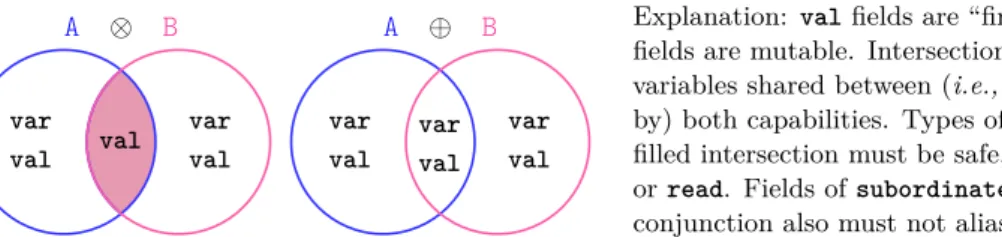
constructs classes by composing traits, or rather capabilities. There are two forms of composition: disjunction (⊕) and conjunction (⊗). IfA andBare capabilities, their disjunctionA⊕Bprovides the union of the methods ofAandB and requires the union of their field requirements. Their conjunctionA⊗Bdoes the same, but is only well-formed if A andB do not share mutable state which is not protected by concurrency control. This means thatA⊗BallowsAandBto be used in parallel. Figure 2 shows the composition constraints of disjunction and conjunction pictorially.We use the termflat compositionto mean disjunction or conjunction. When employing parametric polymorphism a form ofnested composition appears. The nested capabilityA<B> exposes thatAcontains zero or moreB’s at the type level, allowing type-level operations on
dominating subordinate permitted reference unpermitted reference A a. b. c. d. B B C
a. Disallowed ifAislinear. IfAisthread, aliases must come from same thread.
b. References from outside an aggregate to its inside are not permitted.
c. References from inside an aggregate to its outside are permitted if the target is a dominating capability. d. References inside an aggregate are allowed.
The box encloses the subordinate capabilities ofA. Note thatB is a composition of a subordinateanda dominating capability (cf.Section 3.3), denoted by the two circles. All dominating capabilities have their own boxes (as shown forA),e.g.,Bhas a box nested inside ofA’s box, inaccessible toA(cf.,b.). Figure 1Encapsulation: dominating and subordinate capabilities.
var val var val A ⊗ B val var val var val A ⊕ B var val
Explanation: valfields are “final”,var fields are mutable. Intersections denote variables shared between (i.e.,require’d by) both capabilities. Types of fields in the filled intersection must be safe,i.e.,locked orread. Fields ofsubordinatetype in a conjunction also must not alias.
Figure 2Permitted sharing of fields and state across two capabilitiesAandBin a composite.
the composite capability. (This presentation uses a “dumbed down” version of parametric polymorphism using concrete types in place of polymorphic parameters for simplicity.)
A composite capability inherits all properties and constraints of its sub-capabilities. Linear capabilities must not be aliased at all. Subordinate capabilities must not leak outside their dominator. Consequently, a type which is bothsubordinateandlinearis both a dominator (may encapsulate state) and a subordinate (is encapsulated), may not escape its enclosing
aggregate and has transfer semantics when assigned (cf.,Bin Figure 1).
Composition affects locking. A disjunction of two locked capabilities A ⊕ B will be protected by a single lock. A conjunctionA⊗Bof locked capabilities can use different locks forAandB, allowing each disjoint part to be locked separately. Furthermore, compositions ofreadandlocked capabilities can be mapped to readers–writer locks.
An important invariant in
κ
is that all aliases are safe with respect to data-races or interference and can be used to the full extent of their types. If an alias can be created, any use of it will not lead to a bad race, either because it employs some kind of locking, because all aliases are read-only, or because the referenced object is exclusive to a particular thread.4
Creating and Destroying Aliases = Concurrency Control
As aliasing is a prerequisite to sharing objects across possibly parallel computations, creating and destroying aliases is key to enabling parallelism while still guaranteeing race freedom in
κ
. Alias restrictions allows statically checkable non-interference,i.e.,without dynamic concurrency control (e.g.,locking). Programs that require objects that are aliased across threads must employ locks or avoid mutation.Subordinate and thread-local capabilities may only be aliased from within certain contexts. Read, locked and unsafe capabilities have no alias restrictions. Finally, linear capabilities are
[A⊗B]n (A)n+ (B)n [A⊗B]m+ [A⊗B]m0 (A)m+ (B)m+ (A)m0+ (B)m0 flat nested nested flat
Figure 3Flat and nested unpacking, using arrays as an analogy. [A⊗B]n, an array of length n
containing composite capabilitiesA⊗Bcan be thought of as a matrix with rows as elements and whose columns are the elements’ subparts,AandB. The matrix can be unpacked by rows (flat) or by columns (nested). Flat unpacking splits the array into subarrays of lengthmandm0 such thatn=m+m0. Nested unpacking requires that the containing object is not mutable, denoted by turning arrays into tuples,(A)m. These compose in any order producing the same result.
alias-free. The following sections explore how linear types can be manipulated to create and destroy aliases (granting and revoking capabilities) while enjoying non-interference.
4.1
Packing and Unpacking
Conjunctions describe objects constructed from parts that can be manipulated in parallel without internal races. Unpacking breaks an object up into its sub-parts. A variablecwith a handle to an instance of a classC, whereclass C = A⊗B, can be unpacked into two handles with typesAandBusing the+operator: var a:A + b:B = c, nullifyingcin the process.
Unpacking a disjunction is unsafe (and therefore disallowed) since its building blocks can share mutable state not mediated by concurrency control. The dual of unpacking is packing, which re-assembles an object by revoking (nullifying) its sub-capabilities: var c:C = a + b.
The packing and unpacking above isflat. Using an array as analogy, flat unpacking takes an array[A]n with indexes [0, n) and turns it into two disjoint equi-typed sub-arrays with
indexes [0, m) and [m, n) wherem≤n.
κ
also allowsnested unpacking, which in the array analogy means that[A⊗B]n can be unpacked into two tuples(A)n and(B)n with the samelength and indexes. Turning the array into tuples,i.e.,immutable arrays of mutable values, is necessary as the aliases could otherwise be used to perform conflicting operations,e.g., updating theB-part of elementiin one thread and nullifying elementiin another thread.
While safe capabilities can always be shared, unpacking allows a linear capability to be split into several aliases that can safely be used concurrently. When restoring the original capability through packing, there may be no residual aliases. We implement this here by preserving linearity in the unpacked capabilities. Figure 3 shows flat and nested unpacking and how they combine and commute. Section 5 shows how unpacking can be used to implement both data parallelism and task parallelism.
In this paper, we only consider packing and unpacking as operations at the level of types: their purpose is to statically guarantee non-interference, not construct new objects from other parts. Thus, packing can be efficiently compiled into an identity check or removed by a compiler provided that handles do not escape the scope in which they were unpacked.
4.2
Bounding Capabilities to the Stack
Linearity is often overly restrictive since it prevents even short-lived aliases that do not break any invariants. To remedy this,
κ
employs borrowing [8]: temporarily relaxing linearity as long as the original capability is not accessible in the same scope, and all aliases are destroyed at the end of the scope. Borrowed capabilities inκ
arestack-bound, denoted by aclass Pair = (linear Fst ⊗ linear Snd) ⊕ linear Swap { var fst:int; var snd:int; } trait Fst {
require var fst:int; def setFst(i:int) :void {
this.fst = i; }
def getFst() : int { this.fst;
} }
trait Snd {
require var snd:int; def setSnd(i:int) :void {
this.snd = i; }
def getSnd() : int { this.snd;
} }
trait Swap {
require var fst:int; require var snd:int; def swap() : void {
var tmp:int = this.fst; this.fst = this.snd; this.snd = tmp; } }
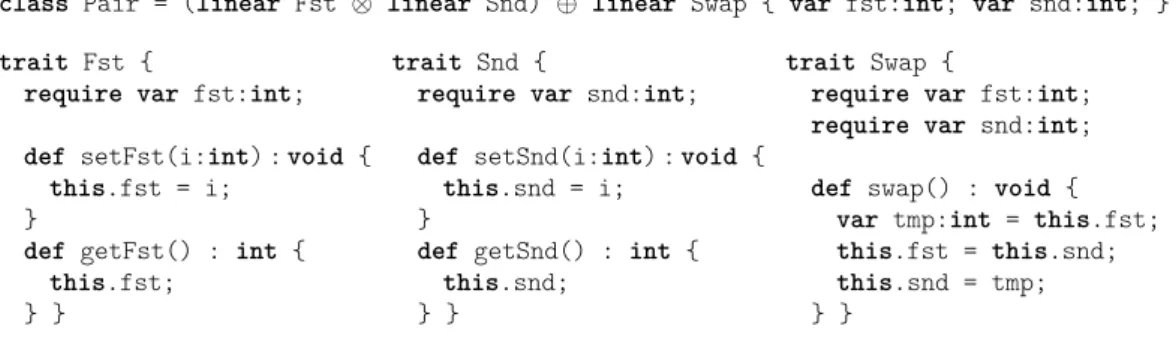
Figure 4A pair class constructed from capabilities,Fst,SndandSwap.
type wrapperS(). For example,S(linear Cell) denotes a capability which is identical to thelinear Cellcapability except that it may not be stored in a field, and thus is revoked once the scope exits.
κ
supports two forms of borrowing:Forward Borrowing A linearcapability in a stack variable can be converted into a stack-bound capability for a certain scope, destructively read and then safely reinstated at the end of the scope. This allows e.g.,passing a linear capability as an argument to a method, reinstating it on return. In conjunction with the borrowing it may optionally be converted to a thread, allowing it to be freely aliased until reinstated.
Reverse Borrowing A method of alinearcapability may non-destructively read and return a stack-bound alias of a field of linear type. This allows linear elements of a data structure to be accessed without removing them, which is safe as long as the capability holding the field is not accessed during borrowing. To prevent multiple reverse borrowings of the same value (which would break linearity), the returned value may not be stored in fields or local variables but must be used immediately,e.g.,as an argument to a method call.
Borrowing simplifies programming with linear capabilities as it removes the need to explicitly consume and reinstate values when aliasing is benign, avoiding unnecessary memory writes. See Section 5 for an example of both forward and reverse borrowing in action.
4.3
Forgetting and Recovering Sub-Capabilities
Unpacking a disjunction is unsafe as its building blocks may have direct access to the same state without any concurrency control. As an example, consider the simplePairclass created from the capabilitiesFst, SndandSwapshown in Figure 4.
If we could unpack the pair, it would allow fst andsndto be updated independently. However, this is unsafe in the presence of theSwapcapability, which accesses both fields. For example, the result of callingswap()concurrently withsetFst()depends on the timing of the threads. A crude solution is simply upcasting Pairto linearFst ⊗linear Snd. This forgetsthe Swapcapability and enables unpacking—but as a consequenceSwap is lost forever.
To facilitate recovering a more specific type,
κ
provides a means to temporarily stash capabilities inside ajail which precludes their use except for recovering a composite type:var p:Pair = ...;
var j:J(Pair|Fst ⊗ Snd) + k:(Fst ⊗ Snd) = p; // (1)
var f:Fst + s:Snd = k; // flat unpacking
... // use f and s freely
At (1), the type ofj,J(Pair|Fst⊗Snd), denotes a jail storing aPair which is unusable (the interface of a jailed capability is empty) until it is unlocked by providing theFst⊗Snd capability of the corresponding resource as key. Thusj serves as a witness to the existence of the fullPaircapability, includingSwap. At (2), we recoverkfromfands, nullifying both variables. We use the resulting value to open the jail j and store the result in p. As for packing, checking whether a key “fits” at run-time (i.e.,iffandsare aliases of the jail) is a simple pointer identity check, which could often be optimised away using escape analysis.
5
Applying Capabilities to the Case Studies in Section 2.1–2.3
Simple Counters. This example demonstrated the problem of distinguishing objects shared across threads from thread-local or unaliased objects objects, and pointed at the trickiness of locking correctly. In
κ
, a counter might be described as a simple traitCounter:trait Counter {
require var cnt : int;
def inc() : void { this.cnt = this.cnt + 1; } def value() : int { return this.cnt; } }
To get a capability from the trait, what is missing is to add the mode declaration, which controls aliasing and sharing across threads. Out of the six possible mode annotations, five are allowed for theCounter trait:
linear A globally unaliased counter.
thread A thread-local counter. It can be aliased, but aliases cannot cross into other threads.
locked A counter protected by a lock, sharable across threads.
subordinate This type denotes a counter nested inside another object from which it cannot escape. It thus inherits data-race freedom or non-interference of the enclosing object.
unsafe A sharable, unprotected counter that requires the client to perform synchronisation at use-site: c.inc()will not compile unless wrapped inside a synchronisation block, which changes the type ofcfromunsafeto locked.
Using the modereadwould denote a read-only counter, sharable across threads. Assigning this mode to the trait is rejected by the compiler because of the mutablecntfield.
Modes communicate how counters may be aliased: not at all, by a single thread, or across threads. In the latter case modes also communicate how concurrent accesses are made safe: by locks, by only allowing reads (not applicable here), by relying on some containing object or by delegating responsibility to the client.
Differently synchronised counters can be defined almost without code duplication,e.g.: class LocalCounter = thread Counter { var cnt:int; }
class SharedCounter = locked Counter { var cnt:int; }
Data/Task Parallelism. This example demonstrated the need for reasoning about aliasing in order to determine what parts of an interface can be safely accessed concurrently.
A binary tree can be constructed as the conjunction of capabilities giving access to the left and right subtrees and the current element (full code in the technical report [15]).
class Tree<T> = linear Left<T> ⊗ linear Right<T> ⊗ linear Element<T>
We employ nesting to show that the tree contains capabilities of typeT, the type of the element value held by theElement capability. The conjunction allows parallel operations on subparts of a tree and requires that parts do not overlap, modulo safe capabilities. Since the
tree type must be treated linearly, the fact that theLeftandRightsubtrees do not overlap follows from the requirement thatLeftandRightmanipulate fields of different names.
To perform data-parallel operations on a tree, we can construct a recursive procedure that takes a tree, splits it into its separate components and operates on them in parallel.
def foreach(t:S(Tree<T>), f:T → T) : void {
var l:S(linear Left<T>) + r:S(linear Right<T>) + e:S(linear Element<T>) = t; // 0
finish {
async { foreach(l.getLeft(), f); } // 1
async { foreach(r.getRight(), f); } // 1
e.apply(f); } } // 2
At (0) the splitting implicitly consumes the original tree capability. At (1) we recurse on the left and right subtrees. At (2) we pass the function argumentfto the element capability to be performed on itsT-typed value. For simplicity, we omit the check for whetherlorris null. The implementation requires a tree to be constructed from linear building blocks to guarantee that no parts of the tree are ever shared across multiple threads. Tdoes not need to be linear.
This code illustrates both forward and reverse borrowing. The tree argument toforeach() is forward borrowed and stack-bound, which is why there is no need to packl,randeto recovert—tis still accessible at the call-site, where it was buried [8] during the call.
Calls to getLeft()and getRight()return two reversely borrowed linear values (of type S(Tree<T>)) which we can pass as arguments to the recursive calls. Hence, all trees manipu-lated by this code will be stack-bound. If we remove the stack-boundedness,foreach()may not update the subtrees in-place, and must recover and returntat the end, reminiscent of functional programming. This would cause lines marked (1) to change thus:
async { l.setLeft( foreach( l.getLeft(), f ) ); } async { l.setRight( foreach( l.getRight(), f ) ); }
which allowsreplacing the tree as opposed to updating it, plus a return: return l + r + e. We may extend the Treetype with a disjunction on a capabilityVisitwhich provides a read-only view of the entire tree. Elements may not be swapped for other elements, but modified if T allows it. This allows multiple threads to access the same tree in parallel provided thatLeft,Right andElementare temporarily forgotten.
class Tree<T> = readVisit<T>⊕(linearLeft<T>⊗linearRight<T>⊗linearElement<T>) Let the type of our tree beTree<A⊗B>for linear capabilitiesAandB. Turning this capability intoVisit<A ⊗B> is possible by forgetting every other capability in the tree type. While read-only capabilities can be aliased freely, creating multiple aliases typed Visit<A ⊗ B> would provide multiple paths to supposedly linearA⊗ Bcapabilities. Composition must thus adhere to all alias restrictions in the composite capability, just like flat composition. Therefore,Visit<A⊗B>is a linear capability. Unpacking however allows us to turnVisit<A ⊗B>into two handles typedVisit<A>andVisit<B>, which preserves linearity across all paths. This allows us to specify a task-parallel operation which implements column-based access:
def map(t:S(Tree<A⊗B>), f:S(A)→void, g:S(B)→void) : void{ var ta:S(read Visit<A>) + tb:S(read Visit<B>) = t; // 3
finish {
async { ta.preorder(f); } // 4
async { tb.preorder(g); } } }// 4
In this code we create two immutable views of the spine of the tree using Visit and then proceed to applyfand gto all elements of the tree in parallel. At (3) the rest of the capabilities ofTree are forgotten. If we wanted to restore them after the parallel operations we would jail them at (3) and restore them after (4).
While the data-parallel version is more scalable than the task-parallel version, there may be cases when the latter is preferred. Further, their combination is possible in either order—applyfandgin parallel to each element at (2) above, or start by unpacking the tree into multiple immutable trees and then process the sub-elements in parallel in each tree, equivalent to calling a version offoreach instead ofpreorder at (4) (cf.,Figure 3).
Vector vs. ArrayList in Java. This example demonstrated that building synchronisation into a data structure can cause too much overhead and destroy parallelism. In
κ
, a list might be described using capabilities (full code in technical report, [15]):Add_Delfor adding and removing elements Getfor looking up elements
Add_Delmight be split into two capabilities allowing for more flexibility, for example granting a client only the ability to add elements but not delete them. As the two capabilities operate on some shared state (the links), their combination must be a disjunction: Add_Del⊕Get.
To express the difference between the array list and vector, we would write
class ArrayList = unsafe Add_Del ⊕ unsafe Get // Needs external synchronisation
class Vector = locked Add_Del ⊕ locked Get // Has synchronisation built in
Specifying use of readers–writer locks to access an object is straightforward and allows sharing a list across threads for reading, causing concurrent write operations to block:
class ArrayList = unsafe Add_Del ⊕ read Get class Vector = locked Add_Del ⊕ read Get
The use ofunsafe in the definition of the array list class pushes the synchronisation from within the called methods to the outside,e.g., callinglist.add(element)we must first take a (write-)lock onlist. Requiring external synchronisation also allows acquiring, holding and releasing a lock once to perform several operations, like an iteration, without fear of interleaving accesses from elsewhere.
The typethread Add_Del⊕read Getdenotes a list confined to its creating thread. The typelinear Add_Del⊕read Getdenotes a list that can mediate between being mutated from one alias or read-only from several aliases. This type is similar to a readers–writer lock, except relying on alias restrictions instead of locks (cf.,[9]), removing locking overhead. The ability to reuse traits for different concurrency scenarios is an important contribution of
κ
.Concluding Remarks for Section 3–5
Linear and thread-local capabilities givenon-interference by restricting aliases to a single thread. Locked and unsafe capabilities can be shared across threads and employ locks at declaration-site or at use-site toavoid data-races. Read capabilities can be shared across threads and do not allow causing or directly witnessing mutation. When a read capability is extracted from a linear composite, no mutating aliases exist, guaranteeingnon-interference. When extracted from a locked composite, locks are used to guaranteedata-race freedom.
The assignment of modes to traits at inclusion site allow a single definition to be reused across multiple concurrency scenarios. Composition captures how different parts of an object’s interface interact and defines the safe aliasing of an object.
Subordinate capabilities inherit the protection of their enclosing dominating capabilities. Thus, operations on encapsulated objects are atomic in
κ
, in the sense that all side-effects of a method call on an aggregate are made visible to other threads atomically. Operating atomically on several objects which are not encapsulated in the same aggregate is possible byP ::= CdsTds e (Program)
Cd ::= class C=K {Fds} (Class definition)
Fd ::= modf :t (Field definition)
mod ::= var|val (Mutable and immutable fields)
K ::= kT|kI|KhKi |(KK) (Capabilities and composition)
::= ⊗ | ⊕ (Conjunction and disjunction)
Td ::= ktraitThti{RsMds}|traitThti{RsMds} (Trait definition)
R ::= requireFd (Field requirement)
Md ::= defm(x:t): t{e} (Method definition)
e ::= v|letx=eine|packx=y + z ine|unpackx + y=z ine|x.m(e)|x|x.f
| x.f =e|new C|consumex|consumex.f |(t)e|syncxasy{e};e
| boundx{e};e|finish{async{e}async{e} };e (Expression)
v ::= null (Literal)
t ::= K|C|B(K) (Type)
B ::= JK|S (“Boxed” types,i.e.,jailed or stack-bound)
k ::= linear|locked|read|safe|subordinate|thread|unsafe (Modes) Figure 5 Syntax of
κ
. T is a trait name; I is the incapability; C is a class name; m is a method name;f is a field name;x, y are variable names, includingthis. Ds::=D1, . . . , Dn for D∈ {Cd,Td,Fd,R,Md}.locking them together using nested synchronisation (forunsafecapabilities) or by structuring a call-chain onlockedcapabilities.
Invariantly, all well-typed aliases can coexist without risking data-races. The type system guarantees that all accesses to an object will either be exclusive or only perform operations that cannot clash with any other possible concurrent operations to the same object.
6
Formalising
κ
We formalise the static semantics of
κ
. We define a flattening translation into a language without traits,κF
, whose static and dynamic semantics is found in the accompanying technical report [15].κF
is a simple object-oriented language with structured parallelism and locking, that uses classes and interfaces which are oblivious to the existence ofκ
capabilities. The translation fromκ
toκF
inserts locking and unlocking operations when translating lockedcapabilities and conjunctions of lockedandread capabilities. The locks are reentrant readers–writer locks controlling access to parts of objects. Other locking schemes are possible. The syntax ofκ
is shown in Figure 5. We make a few simplifications, none of which are critical for the soundness of the approach:1. We use let-bindings and explicit pack/unpack constructs. Targets of method calls must be stack variables. Aliasing stack-bounds requires a method-call indirection.
2. We consider finish/async parallelism rather than unstructured creation of threads.
3. Classes only contain fields and no methods.
4. We omit the treatment of constructors. Fields are initialised with nullon instantiation.
5. We use objects to model higher-order functions and omit these from the formalism.
6. Only a single method parameter and a single nested type are supported.
We introduce a safecapability, which abstractsread andlockedto allow mode subtyping. Thesafemode is only allowed in types, not in declarations. TheincapabilitytypeIdoes not contain any fields or methods and simply allows holding a reference to an object.
`P :t `Td Γ`Td `Cd (Well-formedness top-level declarations) wf-program ∀Cd∈Cds . `Cd ∀Td∈Tds . `Td `e:t `Cds Tds e:t wf-t-trait `subord traitThti{Rs Mds} `traitThti{Rs Mds} wf-t-trait-mfst ρ:t`ktraitT {Rs Mds} `ktraitThti{Rs Mds} wf-t-innards k6=safe Γ,this:kT`Rs Γ,this:kT`Mds Γ`ktraitT {Rs Mds} wf-class `K ∀ Fd∈Fds.this:K`Fd
∀varf :t1∈fields(K).∃varf :t2∈Fds.t2≡t1 ∀valf :t1∈fields(K).∃varf :t2∈Fds. t2<:t1
`classC=K {Fds}
Γ`R,Rs Γ`Mds,Md Γ`Fd `Γ (Well-formed body parts)
wf-req-fd Γ`Fd Γ`requireFd wf-req-fds Γ`R Γ`Rs Γ`Rs,R wf-mds Γ`Md Γ`Mds Γ`Mds,Md wf-m-trait Γ,x:t1`e:t2 Γ`defm(x:t1) :t2{e} wf-fd-nst `Γ Γ(ρ) =K Γ`valf :K wf-fd Γ(this) =K `t t 6=S(_) `K thread(t)⇒thread(K) read(K)⇒(mod≡val∧safe(t))
Γ`mod f :t env-e ` env-var `Γ `t x6∈dom(Γ) `Γ,x:t Figure 6Well-formed declarations. Γ ::=|Γ, x:t, (xincl. ρ).
Our main technical result is the proof that a
κF
program translated from a well-typedκ
program enjoys safe aliasing and strong encapsulation (cf.Section 7.2) in a way that implies thread-safety (cf.Section 7.3). We verify our definition of thread-safety by proving that it implies data-race freedom and, when certain capabilities are excluded, also non-interference (cf.Section 7.3).Helper Predicates and Functions. The functionsfields,vals,varsandmsigsreturn a map from names to types or method signatures. We use helper predicates of the formk(K) to assess whether a capabilityKhas modek. The predicates linear,subord(inate) andunsafe hold if there existsat least onesub-capability inKof that mode. The predicatesread(K)and encaps(K)hold if all sub-capabilities inKare read orsubordinate, respectively. locked(K) holds if one or more sub-capabilities are locked, and the remaindersafe.
6.1
Well-Formed
κ
Programs
(Figure 6)A well-formed program consists of classes, traits, and an initial expression( W F - P RO G R A M ). Traits without manifest mode are type-checked as if they were subordinate( W F - T - T R A I T ). To reduce the number of rules, we require all traits to have exactly one nested capability (a concrete type “parameter”), and useTas shorthand forT<I>, whereIis the empty capability. A trait is well-formed if its field requirements and methods are well-typed given the self-type of the current trait and the nested type. The latter is tracked by the special variableρwhich
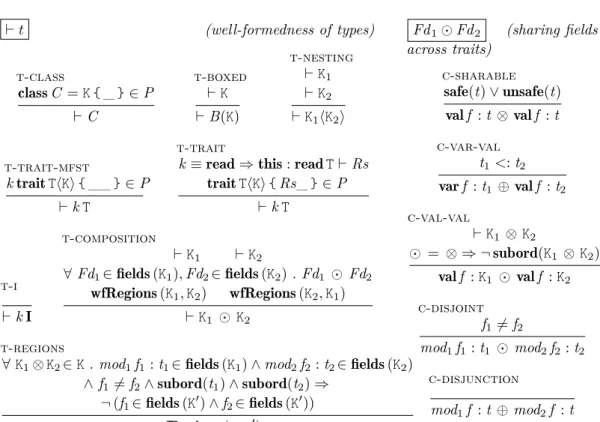
`t (well-formedness of types) t-class classC =K {_}∈P `C t-boxed `K `B(K) t-nesting `K1 `K2 `K1hK2i t-trait-mfst ktraitThKi{__}∈P `kT t-trait
k ≡read⇒this:readT`Rs traitThKi{Rs_}∈P `kT t-i `kI t-composition `K1 `K2 ∀ Fd1∈fields(K1),Fd2∈fields(K2).Fd1 Fd2 wfRegions(K1,K2) wfRegions(K2,K1) `K1 K2 t-regions
∀K1⊗K2∈K. mod1f1:t1∈fields(K1)∧mod2f2:t2∈fields(K2) ∧f16=f2∧subord(t1)∧subord(t2)⇒ ¬(f1∈fields(K0)∧f2∈fields(K0)) wfRegions(K,K0) Fd1Fd2 (sharing fields across traits) c-sharable safe(t)∨unsafe(t) valf :t ⊗valf :t c-var-val t1<:t2 varf :t1 ⊕valf :t2 c-val-val `K1 ⊗K2 = ⊗ ⇒ ¬subord(K1⊗K2) valf :K1 valf :K2 c-disjoint f16=f2 mod1f1:t1 mod2f2:t2 c-disjunction mod1f :t ⊕mod2f :t
Figure 7Well-formed types. Conjunctions and disjunctions of traits are governed by the rules for overlapping fields. For simplicity, we omit( C - VA L - VA R )which is isomorphic with( C - VA R - VA L ).
may not appear anywhere in the program source( W F - T - T R A I T - M F S T ). Fields are either mutable (var) or stable (val). We assume that names of classes and traits are unique in a program and the names of fields and methods are unique in classes and traits.
A well-formed class consists of well-typedvarfields that satisfy the requirements from its traits, and a defined equivalence to a well-formed composite capability. We allow covariance for valfields( W F - C L A S S ). Only immutable fields holdingsafe capabilities are allowed in readcapabilities( W F - R E Q - * , W F - F D ), unless the type of the field is exposed through nesting ( W F - F D - N S T ). Fields may not store stack-bound capabilities and fields holding thread-local values are only allowed if the containing object is also thread-local( W F - F D ).
6.2
Well-Formed Types
(Figure 7)Capabilities corresponding to traits with manifest modes are trivially well-formed( T T R A I T -M F S T ). Traits without a manifest mode can be given any mode ( T - T R A I T ). Well-formed readcapabilities may only containsafeval fields. The empty capabilityIcan be given any mode ( T - I ). Composing capabilities withIthus affects the mode of the composite, but not the interface (cf.,Section 6.3).
Two well-formed capabilities can form a nested capability type( T - N E S T I N G ). A composite capability is well-formed if its sub-capabilities are well-formed and their shared fields are composable( T - C O M P O S I T I O N ). We also require that two subordinate fields appearing on opposing sides of a conjunctionK1⊗K2are not both accessible from some other traitK0 in the same composite( T - R E G I O N S ). Such a field would act as a channel that could be used to share subordinate state across the supposedly disjoint representations ofK1and K2.
The rules of the formF d1F d2govern field overlaps between capabilities in a composite, where ∈ {⊗,⊕} denotes the composition of the capabilities containing the fields (cf., Figure 2). Disjunctions may overlap freely( C - D I S J U N C T I O N ). Disjoint fields do not overlap ( C - D I S J O I N T ). If a field appearing on both sides of a composition is mutable on one side and immutable on the other, the mutable field’s type must be more precise( C - VA R - VA L ). An immutable field may appear on both sides of a composition only if its type is safe or unsafe ( C - S H A R A B L E )or if the fields have types whose conjunction is well-formed( C - VA L - VA L ). If
the sharing capabilities are conjunctive, the field must not be subordinate.
6.3
Type Equivalence, Packing and Subtyping
(Figure 8)Class names are aliases for composite capabilities( T - E Q - C L A S S - T R A I T ). The order of the operands in composition of a single kind does not matter ( T - E Q - C O M M U TAT I V E ) and ( T - E Q - A S S O C I AT I V E ). Equivalent types in jail or bound to the stack are still equivalent ( T - E Q - B OX E D ). Areadwith a nested conjunction can be unpacked into tworeadcapabilities with nested capabilities from the unpacked conjunction( T - E Q - N E S T I N G ). Incapabilities can be added and removed from a type as long as modes are preserved( T - E Q - I ).
Jailing allows creating a conjunction from a disjunction( T - J A I L ). The full capability that can be unlocked from the jail is written as a subscriptK. Jailing requires that all modes on the composite are preserved by the extracted capability, modulo the rulesk<: for unpacking to be sound. For example,locked A⊕subord Bdenotes a (partially) subordinate capability that is strongly encapsulated inside an aggregate. If we are allowed to forget the subordinate mode of the type, the locked sub-capability could be leaked. We employ( T - E Q - I )to this end. For example, we can composesubord Iwithlocked A⊕subordB and then apply( T - J A I L ) to extractlocked A⊕subordIwhich satisfies mode preservation.
Subtyping is structural on capabilities. Subtyping must preserve modes, or encapsulation, domination or exclusivity could be lost. The rules( T - S U B - * )allow lockedandreadto be abstracted by thesafemode.
6.4
Well-Typed Expressions
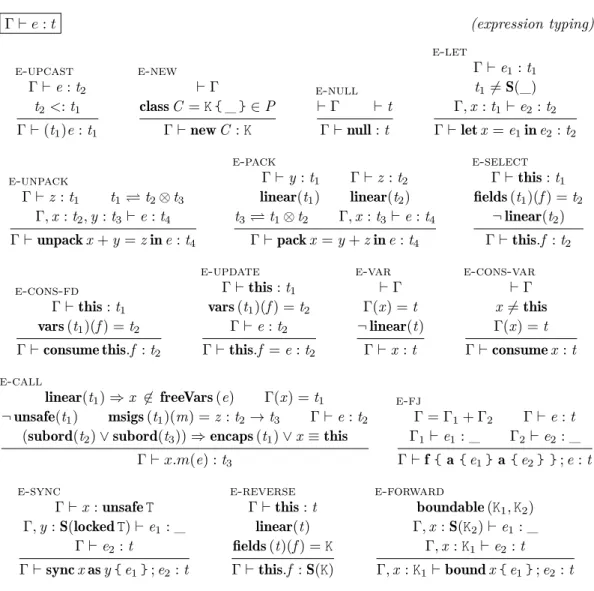
(Figure 9)Packing & Unpacking. The rules ( E - PAC K ) and ( E - U N PAC K ) govern the packing and unpacking of capabilities. They rely on the rules( T - J A I L )and( T - PAC K ) in Figure 8 which allow introducing aliases to discrete capabilities of a conjunction and turning a disjunction into a conjunction by jailing the overlapping parts.
Linearity. linear capabilities are destructively read to maintain alias freedom and allow ownership transfer( E - C O N S - VA R , E - C O N S - F D ). Method calls do not destroylinearreceivers as an object’sthiscannot be consumed. Thus, linear capabilities are externally unique [17]. Finish–Async and Sync. Parallelism in
κ
is modelled using a scoped finish/async construct (abbreviated asf andarespectively) ( E - F J ). A finish–async forks two parallel computations and waits until they have both completed. Forking a larger number of threads can be simulated using nested finish/async blocks. For simplicity we do not allow async blocks outside of a finish block, but extending the system to support unstructured parallelism or active objects is possible. We employ a frame rule that guarantees that no variable is visible in both asyncs, and that subordinate objects are only accessible to the first of the asyncs, ( F R A M E ). This models the current thread running the first async (with access to the currentt1≡t2 (type equivalence) t-eq-class-trait classC=K {_}∈P C≡K t-eq-commutative K1 K2≡K2 K1 t-eq-associative (K1 K2) K3≡K1 (K2 K3) t-eq-boxed K1≡K2 B(K1)≡B(K2) t-eq-nesting read(K1) K1hK2 ⊗K3i ≡K1hK2i ⊗K1hK3i t-eq-i k(K) K kI≡K t-eq-trans K1≡K2 K2≡K3 K1≡K3
t1t2⊗t3 (packing and unpacking)
t-pack K1≡K2 ⊗K3 subord(K2)⇔subord(K3) K1K2⊗K3 t-jail K1 ≡K2 ⊕K3 ∀k .k(K1)⇒k(K3) K1JK1(K2)⊗K3 t-pack-bound K1K2⊗K3 S(K1)S(K2)⊗S(K3)
t1<:t2 k<:(K) (subtyping and “submoding”)
t-sub-structural ∀k .k(K1 K2)⇒k<:(K1) K1 K2<:K1 t-sub-boxed K1<:K2 B(K1)<:B(K2) t-sub-eq t1 ≡t2 t2<:t3 t1<:t3 t-sub-id t<:t t-sub-k k(K) k<:(K) t-sub-rd safe(K) read<:(K) t-sub-lock safe(K) locked<:(K) Figure 8Type equivalence, packing/unpacking, subtyping.
frame
dom(Γ2)∩dom(Γ3) ≡ ∅ 6 ∃x :t∈Γ3 .(subord(t)∨thread(t)) ∀ x .(Γ2(x) =t ⇒Γ1(x) =t)∧(Γ3(x) =t⇒Γ1(x) =t)
Γ1= Γ2+ Γ3
The sync keyword temporarily converts anunsafe (and therefore unusable) capability into alockedcapability, acquiring and releasing locks at the entry and exit ofe1 ( E - S Y N C ). Borrowing. Forward borrowing allows turning capabilities into stack-bound capabilities non-destructively, possibly relaxing alinearto athreadand allows splitting reads( E - FO RWA R D ). The helper predicateboundable(K1,K2) holds in either of three cases:
1. K1=K2
2. K1[linear7→thread] =K2 (relaxing linearity to thread-affinity)
3. K1=K2 K3s.t. K3 is neithersubordinatenorthread, and all capabilities inK2areread. The last case allows relaxing alias restrictions for stack-boundreadcapabilities which enables mediating from single writer to multiple readers across multiple threads without dynamic concurrency control for a clearly defined scope.
Reverse borrowing allows non-destructively reading alinearcapability into a stack-bound value( E - R E V E R S E ). Since only one value can be returned by a method, multiple reverse borrowing of the same field in the same method is innocuous. Non-linear capabilities never need to be reverse borrowed as they can always be returned normally without consuming. Self Typing. Modulo traits with manifest modes,thisinside a trait is always subordinate ( W F - T - T R A I T ). This reflects the fact that on the inside of a capability, exclusive access of a
Γ`e:t (expression typing) e-upcast Γ`e:t2 t2<:t1 Γ`(t1)e:t1 e-new `Γ classC =K {_}∈P Γ`newC :K e-null `Γ `t Γ`null:t e-let Γ`e1:t1 t16=S(_) Γ,x :t1`e2:t2 Γ`letx=e1ine2:t2 e-unpack Γ`z:t1 t1t2⊗t3 Γ,x :t2,y :t3`e:t4 Γ`unpackx+y =zine:t4 e-pack Γ`y:t1 Γ`z:t2 linear(t1) linear(t2) t3t1⊗t2 Γ,x :t3`e:t4 Γ`packx=y+zine:t4 e-select Γ`this:t1 fields(t1)(f) =t2 ¬linear(t2) Γ`this.f :t2 e-cons-fd Γ`this:t1 vars(t1)(f) =t2 Γ`consume this.f :t2 e-update Γ`this:t1 vars(t1)(f) =t2 Γ`e:t2 Γ`this.f =e:t2 e-var `Γ Γ(x) =t ¬linear(t) Γ`x :t e-cons-var `Γ x6=this Γ(x) =t Γ`consumex :t e-call linear(t1)⇒x 6∈ freeVars(e) Γ(x) =t1 ¬unsafe(t1) msigs(t1)(m) =z :t2→t3 Γ`e:t2
(subord(t2)∨subord(t3))⇒encaps(t1)∨x≡this Γ`x.m(e) :t3 e-fj Γ = Γ1+ Γ2 Γ`e:t Γ1`e1: _ Γ2`e2: _ Γ`f{a {e1}a{e2} };e:t e-sync Γ`x:unsafeT Γ,y:S(lockedT)`e1: _ Γ`e2:t Γ`syncxasy{e1};e2:t e-reverse Γ`this:t linear(t) fields(t)(f) =K Γ`this.f :S(K) e-forward boundable(K1,K2) Γ,x:S(K2)`e1: _ Γ,x:K1`e2:t Γ,x:K1`boundx{e1};e2:t
Figure 9Typing of expressions. Note that all fields are “private”.
single thread is already guaranteed (e.g.,because the accessing thread was forced to acquire a lock to enter the object, or place a linear entry point in a stack variable, which is analogous).
Viewingthis as subordinate allows an object to be aliased freely frominside its own enclosure, including objects of linear capabilities. Thus, linear capabilities in
κ
are externally unique [17]. Traits with manifest modes have more information about themselves internally.7
Meta-Theoretic Evaluation
In this section, we describe the key invariants of our capabilities in a well-typed
κ
program. Due to lack of space, proofs have been relegated to a technical report [15]. This section aims to explain the key properties, and sketching why they hold.7.1
κ
Fand the Dynamic Semantics of
κ
Programs
To execute
κ
programs, they are translated into a simpler language,κF
, with classes and interfaces without traits or capabilities. The semantics ofκF
is straightforward, and only the most relevant details are presented here.Flattening of traits [39] is performed similar to other trait-based languages: A class is translated by copying the methods from its traits, traits are translated into interfaces with the equivalent signature. For each compositionK1K2, an interface is created extending the interfaces corresponding toK1andK2. This preserves the same subtyping rules as in
κ
. For eachκ
-capability in a translated program, there is a single corresponding interface. Because of this one-to-one mapping, we can easily recoverκ
types from aκF
program, which we use extensively in our proofs.From field overlaps, we infer a set of regions for each class, and insert lock and unlock instructions at the start and end of methods to acquire and release the lock for the region touched by the method. Read locks are acquired in methods in read capabilities if they overlap with a locked or unsafe capability. Methods in locked capabilities acquire write locks. All locks are reentrant. Well-formedness of
κF
configurations requires that no two threads can hold the same writer lock, and that all locks held by a thread are also taken in the objects themselves. This assures mutual exclusion in all parts of a program that use locks.A well-formed
κ
program will always translate into a well-formedκF
program. This is easy to prove as most type rules forκF
are subsumed by theκ
type rules. Thus, by proving type soundness (progress and preservation) ofκF
, we show that a translatedκ
program will never get stuck (modulo deadlocks, which we distinguish from unsound stuck states).κF
imposes no restrictions on aliasing nor does it provide any guarantees about race freedom. However,κF
programs translated from well-formedκ
programs will always be data-race free. AsκF
itself provides no data-race guarantees, the invariants given byκ
are defined independent of well-formed configurations ofκF
(see Section 7.2 and Section 7.3).We have a fully mechanised specification of
κF
in Coq, including a proof of type soundness, but not data-race freedom. In our hand-written proof of data-race freedom we also extendκF
with means of tracking types and stack-boundedness of values. This has no effect on the execution or typechecking ofκF
programs and is thus excluded from the mechanised version [15]. Specifying all ofκ
in Coq is future work.7.2
Aliasing and Encapsulation
This section details the invariants on aliasing and encapsulation in well-typed
κ
programs.Safe Aliasing. One of the main technical results of this work is the proof that
κ
programs enjoysafe aliasing,i.e.,two paths to the same mutable field are local to the same thread, or protected by the same lock which must be acquired before access. Informally, aliasing is safe if the following is true for all aliasesx,y on the stack or heap:xandy have composable types, meaning they point to different parts of the same object, modulo safe valfields, corresponding to`tx⊗ty in
κ
(cf.,Figure 7).xandy are protected,i.e.,read-only aliases, or safe aliases that use locks internally, or unsafe aliases whose accesses must be wrapped in locks.
xandy are both local to the same thread, corresponding to thethread capabilities of
κ
. x andy both have subordinate types, meaning that any thread accessing them must currently have exclusive access to their dominator.Ifxory islinear, at least one of the aliases must be stack-bound to prevent introducing aliases of linear values on the heap.
If one of the aliases is stack-bound, the origins of the borrowed value must be buried, to prevent multiple accessible references to the same linear value.
Proof. Part of the proof of thread-safety [15].
Strong Encapsulation of Subordinate Capabilities. Another invariant preserved by
κ
programs is that references in fields of subordinate type point to objects dominated by the dominator of the current enclosure. This is what grants subordinate capabilities strong encapsulation, similar to ownership types [16] and external uniqueness [17].At run-time in
κF
, instances know the identity of their dominator. This identity is invariant, even under ownership transfer, because transfer operates on linear capabilities and instances of classes without a subordinate capability are their own dominators.Let→denote “refers to” andι.domdenote the dominator for an object with idιin the heapH. Now,∀ι, ι0∈dom(H),ι→ι0 s.t. ι6=ι0, either one of the following holds:
1. ι0.dom=ι.dom(a pointer between subordinates in the same enclosure)
2. ι0.dom=ι(a dominator pointing to one of its subordinates)
3. ι.dom=ι0 (a subordinate pointing to its dominator) orι0 is a top-level object,i.e.,ι0.dom=ι0.
Proof. Part of the proof of thread-safety [15].
7.3
Data-Race Freedom and Non-Interference.
This section describes the invariants of
κ
for concurrent and parallel programming.Thread-Safety. Safe aliasing and the encapsulation guarantees mentioned above are both part of a bigger notion of athread-safe(TS) configuration. A configuration is thread-safe if no two possible reductions can cause interference—if a possible reduction of a configuration has one thread writing to a field, there cannot be another reduction of the same configuration where the same field is read or written to by another thread.
In addition to safe aliasing, a number of constraints apply to the elements of thread-safe configurations that deal specifically with aliasing across threads:
references in fields of subordinate type point to objects dominated by the dominator of the current enclosure;
values of typethreadwere created by the thread that can access them;
all local variables of subordinatetype are dominated by the closest dominatingthison the current stack;
if a stack-bound linear value aliases a value on the heap, the value on the heap is effectively buried,i.e., the only path to it is rooted on the stack;
all accesses to values not wrapped in locks arelinear,thread,subord orread.
Having defined thread-safety, we then prove that the initial configuration isTSand that evaluation preserves this property in a program translated from
κ
toκF
.IPreservation of Thread-Safety. In a well-formed program translated from
κ
, if a thread-safe configurationcfg can step to cfg0, thencfg0 is also thread-safe.∀Γ, cfg, cfg0.
![Figure 3 Flat and nested unpacking, using arrays as an analogy. [A ⊗ B] n , an array of length n containing composite capabilities A ⊗ B can be thought of as a matrix with rows as elements and whose columns are the elements’ subparts, A and B](https://thumb-us.123doks.com/thumbv2/123dok_us/9320552.2810641/8.892.256.666.155.260/figure-unpacking-containing-composite-capabilities-elements-elements-subparts.webp)