PART 1
CORPORATE
DEFENCE MISSION
The most fundamental responsibility of the Government is to provide for the security of Australia, its people and its interests. This fundamental responsibility is reflected in the Defence mission:
To prevent or defeat the use of armed force against our country or its interests. This statement of the enduring reason for the existence of the Defence organisation guides the development of defence policy, planning, programs and activities. The core defence business is to ensure, should it be necessary, that the ADF is able to operate effectively in conflict, and to contribute to managing Australia’s national security interests in such a way that conflict does not occur. The mission involves, therefore, two key dimensions. The first is the development and maintenance of the capacity to defeat any use or threat of armed force against Australia or its interests. The second dimension involves the promotion of a regional and global security environment that enhances Australia’s security by reducing the likelihood of armed attack against Australia or its interests.
Australia is geographically positioned within a region of rapidly-changing economic, political and social circumstances. The challenge for Defence is not only to provide a force with the capabilities necessary to carry out its mission, but also a force that provides the Government with options with which to respond to given circumstances or threats. It is a force structured for war but adapted for peace, able to anticipate change and react effectively to emerging contingencies, and offering a viable defence of Australia while also capable of operating in conjunction with allies and neighbours.
As a corollary to our combat forces, Defence actively promotes effective strategic relationships with our regional neighbours and strives to maintain strong alliances. Defence also offers active support for the United Nations and engages in a range of regional endeavours that promote Australian and global security.
Ultimately, the goal of the Government and of Defence is to ensure that Australia is, and remains, a secure country in a stable global and regional environment.
THE YEAR IN REVIEW
The delivery and enhancement of forces capable of meeting the challenges facing Australia has been the primary focus of Defence activities throughout the last year. This imperative has been given added impetus through deterioration in our strategic circumstances, while the activities of the Defence Reform Program are driving the internal reform process for the Defence organisation. A structure for meeting the challenges facing Defence in delivering and enhancing our forces was set out by the Defence Executive in November 1998 with the release of the document Defence Our Priorities.
Defence Our Priorities recognises that Defence is facing difficult decisions in balancing the maintenance of the current force and the requirements of future capabilities within the limitations of available resources. In February 1999, the entire Defence senior management team met at Wollongong in New South Wales to reinforce the responsibilities of the team in meeting the challenges of Defence Our Priorities and to provide the leadership necessary to ensure that Defence remains a high performing organisation.
More CombatReady Capability
The ADF has undertaken a wide range of operational and unforeseen assistance tasks that have rigorously tested present capabilities and personnel readiness and have demonstrated that appropriate levels of preparedness/readiness are being maintained. These include:
•
t
he deployment of the guided missile frigate, HMAS Melbourne, to the Persian Gulf in May 1999 in support of United Nations sanctions against Iraq (the Melbourne returned to Australia on 3 September 1999);•
peacekeeping on Bougainville, with approximately 250 Defence personnel participating in the Peace Monitoring Group which is monitoring and reporting on the maintenance of the permanent ceasefire agreed in April 1998, and logistic support from the ADF for the entire operation;•
assistance to the United Nations Assistance Mission to East Timor through the provision of personnel and other support. (Australian troops have subsequently been committed to the International Force in East Timor - Interfet);•
disaster relief to Papua New Guinea following the tidal wave in July 1998, with airlift support and medical personnel playing a major role in the disaster relief effort;•
numerous search and rescue missions, most notably during the catastrophic weather conditions that beset the Sydney to Hobart fleet on 27 to 29 December 1998. Navy personnel have received recognition for their courage and professionalism during this mission;•
disaster relief in the wake of cyclone Vance in Western Australia in March 1999;•
surveillance and interdiction support in our maritime approaches, with the Navy being involved in 22 incidents related to vessels suspected of carrying illegal immigrants; and•
ongoing support for refugees from Kosovo through Operation Safe Haven.More detailed information on ADF force elements and units, ship and aircraft availability, peacekeeping and other humanitarian operations, the ADF exercise program and Defence Cooperation activities can be found in the appendices at the end of Part One of this report.
Year In Review
Much work was done during the year to ensure that our forces have the military capabilities required to successfully undertake operations that the Government deems necessary. Many capabilities, and their vital supporting elements, are being enhanced and refined to ensure that any military operations undertaken will be both successful and sustainable.
Defence has chartered a high-speed catamaran, now named HMAS Jervis Bay, from a Tasmanian company, International Catamarans Australia, to provide a sea-transport capability from which to deploy personnel, vehicles and related support equipment. The vessel also has the potential to undertake evacuations and to assist in disaster relief. HMAS Jervis Bay provides a valuable addition to Defence amphibious capabilities while modification and refit work on the two amphibious transport ships, HMA Ships Manoora and Kanimbla, is completed. Work on these ships will provide an enhanced amphibious and helicopter capability and sea-training facilities for the ADF.
Progress has also been made in enhancing other naval capabilities. HMAS Huon, the first of six new minehunters with low acoustic and magnetic signatures, was commissioned in May 1999. A deployable aerial target system used for both Air Force and Navy training has also commenced operations. HMAS Westralia is expected to return to service early in 2000 following the onboard fire in May 1998 and subsequent refit to augment the afloat support provided by HMAS Success.
To ensure that the Collins-class submarines are brought into operational service as early as possible, the Government appointed Dr Malcolm McIntosh and Mr John Prescott, in February 1999, to conduct a full and independent review of the submarine project. While their report, which was released in June 1999, makes it clear that the submarines are well-suited to Australian conditions, it also highlighted a number of serious problems in relation to the combat system, noise signature and engine reliability.
In response, Defence has established a team to critically examine all facets of submarine capability and make a full report to the Government, including recommendations on options to achieve a fully operational and sustainable submarine force, complete with schedules and likely extra costs. Defence has targeted December 2000 as an achievable date for having two Collins-class submarines at a minimum level of operational capability. HMAS Otama, the last of the Oberon-class submarines, is currently the only submarine in operational service. Along with the hardware necessary to ensure that our forces are combat ready, Defence has also been working to ensure that we have the right people to operate these capabilities and the facilities to support them. A number of initiatives commenced in 1998-99 to correct shortfalls in particular personnel categories. Navy instituted retention incentives for some technical sailors, but also experienced high separation rates for officers and sailors in the latter half of the year which may create capability gaps in later years if not corrected. The Air Force instituted the fighter-pilot recovery program that includes initiatives to improve recruiting and selection processes. The aim of this program is to increase the percentage of pilots graduating from initial pilot training that will be suitable for fast-jet training.
The Army has implemented the Government’s decision to expand, by 30 June 1999, the Ready Deployment Force, with associated Navy and Air Force support elements, to improve the ability of the ADF to respond to short-notice contingencies. The force maintains designated force elements at specified readiness levels in Darwin and Townsville. The force has been expanded to include a light mechanised brigade-size organisation that not only enhances the existing Ready Deployment Force capability but also improves the flexibility of the ADF to deal with concurrent operational requirements that may arise at short notice.
The Army continued work on enhancing its structure and mobility. The first phase of Restructuring the Army trials concluded in 1998-1999 and informed decisions about the capability to defend Australia. The second phase of the trials are planned to commence later in 1999-2000 and will be focused on force modelling and simulation. The Army is also set to receive more light armoured vehicles and, in June 1999, Australian Defence Industries was named as the preferred tenderer for the supply of 360 Bushmaster infantry mobility vehicles at a cost of more than $180m. These projects are significantly improving the Army’s mobility and warfighting capabilities.
RAAF Scherger, near Weipa in north Queensland, was opened during the year, thus completing the chain of strategic airfields in northern Australia. Other facilities projects are providing improved facilities at RAAF bases Amberley, Townsville, Darwin Tindal and Learmonth, Army facilities in Townsville and Darwin, and Navy facilities in Darwin and Perth.
Defence also made substantial progress during the year towards ensuring that all computer systems are Year 2000 (Y2K) compliant and support ADF capability. The 8th Commonwealth Year 2000 Quarterly Progress Report shows that Defence has 99.9% of business-critical functions that are ‘fit for purpose’. The achievement of mission-critical Y2K clearance during 1998-99 does not mean the end of activity within Defence. Defence will continue to work on the many non-critical items identified as requiring cost-beneficial action to ensure that they continue to meet to Defence needs. The total cost to Defence of achieving Y2K compliance has been $255m.
Stronger Future Capability
Defence is facing a significant challenge in the coming years in replacing a range of weapons platforms and systems that are approaching the end of their military life. Block obsolescence will require the careful management of Defence resources and the careful evaluation of our strategic and military priorities. Over the last year, substantial progress was made on improving the capability development process. The focus has been on a balanced ‘whole-of-capability’ approach to future capabilities. The improvements are intended to focus more sharply on defining the capability required and to providing an increased level of stakeholder involvement and endorsement. This will ensure that all aspects of a capability are thoroughly considered during the development process.
The development of integrated all-source surveillance of our air and maritime approaches is a cornerstone of planning for the defence of Australia. A project is awaiting approval to provide command and control for the air approaches, which will integrate the air picture from a variety of sources, including air defence radar, military and civilian air traffic control radar, and the Jindalee operational radar network. Boeing has been announced as the preferred tenderer for the delivery of seven airborne early warning and control aircraft that will further enhance the surveillance capability of the ADF. Command, control and communications will also be enhanced, which will allow greater interoperability between the Services, as well as with allied forces.
A range of electronic warfare self-protection equipment will be fitted to ADF aircraft to enhance their survivability in the air battlefield. The F-111 and C-130H aircraft will be the first aircraft fitted with such equipment. For the F/A-18, fitment of new electronic warfare self-protection equipment is complemented by a range of approved or planned capability upgrades to the F/A-18 avionics that will enhance their offensive and defensive capabilities as well as their interoperability with allied forces. Defence is also proceeding with a major program to strengthen F/A-18 and F-111 offensive capabilities through the acquisition of both short and long-range precision guided munitions. The lead-in-fighter project, which will deliver the
Year In Review
new generation of jet training aircraft for our pilots, had design work completed during 1998-99, with the first aircraft to be delivered in mid-2000. Commensurate with these technology upgrades and new capabilities are improvements to supporting facilities and training. The combat power of the FFG and Anzac-class frigates is being enhanced. A project is currently under way to ensure the effectiveness of FFG self-defence and offensive systems against regional capabilities until at least 2010. A project definition study has been completed, with approval to proceed to detailed design and equipment acquisition stages and installation into the ships. The contract was signed with Australian Defence Industries in June 1999.
A shortlist of tenderers has been announced to provide armed reconnaissance helicopters to the Army. This project will deliver a day/night capable helicopter, designed for operations in the environmental conditions prevalent in the north of Australia, that will enhance Land Force operations through their ability to conduct aerial reconnaissance and fire support tasks. Further details relating to the acquisition of a range of new capabilities and capability enhancements are included in the Acquisition Group’s report in Part Two of this report.
Closer Alliances and International Strategic Relationships
Defence has continued to develop strategic policy and maintain a network of high-level bilateral contacts to ensure that our alliances and regional defence relationships remain robust and contribute to the maintenance of a stable regional and global environment. Defence has enhanced its position as a credible and constructive regional defence partner and worked to engender a sense of confidence among regional defence forces so that they can remain effective contributors to regional strategic stability.
Our relationship with Indonesia is central to Australia’s long-term security outlook. While the events in East Timor have not affected the strategic importance to Australia of Indonesia, the environment has been sufficiently altered to make maintaining the bilateral relationship at previous levels unlikely in the short to medium term. Indonesia’s abrogation of the Agreement on Mutual Security is an indicator of the challenges ahead.
The past year in Papua New Guinea has been a period of political instability and economic difficulties. Despite this, past difficulties in our important relationship have been largely resolved. Papua New Guinea has produced a new defence white paper and the program of activities under the New Defence Partnership, including strategic planning and force development assistance and aid for the provision of Papua New Guinea’s maritime security, is continuing. High-level strategic dialogue, temporarily delayed by the change of government in Papua New Guinea, is planned for later in 1999. Australia has provided $12m in defence cooperation funding to Papua New Guinea, which reinforces our commitment to the relationship. Defence has also made a substantial commitment to ensuring the success of the Bougainville peace process through the provision of a large contingent of personnel and logistics support to the operation.
Australia has recently facilitated strategic security reviews for the Solomon Islands and Vanuatu, with further assessments planned for other Pacific Island countries. This has enhanced the recognition of Australia as a valuable strategic partner within the South West Pacific. The 22 boats supplied under the Pacific Patrol Boat project continue to undergo half-life refits, with three boats refitted during 1998-99. Fisheries-related assistance, infrastructure projects, and training assistance are all contributing to closer relations across the South West Pacific region. Defence has continued the suspension of cost-sharing arrangements for many activities conducted with bilateral partners in South East Asia hit hard by the economic crisis, and so has maintained the level, quality and depth of these activities. This has made a significant
contribution to strengthening the ability of the region to manage security issues. Recently under the Five Power Defence Arrangements, Malaysia has argued for limitations to be placed on some elements of the exercise program, which would reduce the benefits for the ADF. Strained relations between Malaysia and Singapore are also impacting on the arrangements. Defence is actively pursuing negotiations on the exercise program with all member nations to ensure maximum value is gained from exercises. To assist regional military organisations, Defence has also conducted seminars, conferences and workshops on defence reform, strategic planning and change management. Assistance has also been provided to regional defence forces to overcome potential Year 2000 threats to their systems.
Our bilateral defence relationships with Japan, China and South Korea deepened significantly in 1998-99. In May 1999, Minister Moore became the first Defence Minister to visit China and South Korea, while his visit to Japan continued the pattern of regular ministerial contacts. The first visit to Australia by the Chief of the General Staff of the Chinese People’s Liberation Army, General Fu Quanyou, took place in January 1999. Chinese, Japanese and South Korean students are attending the Australian Defence College, which will assist the continued development of our relationship with these countries into the future.
Existing mechanisms for strategic and operational-level coordination with United States authorities have proven effective. New liaison and exchange arrangements with Pacific and Atlantic Commands are expected to bring further improvement. Effective arrangements are being put in place that will strengthen the already close and rewarding partnerships with the United States in the surveillance and intelligence fields and a new high-level committee, the Ausmin Defence Acquisition Committee, is expected to facilitate the release to Australia of key United States technologies.
Enhanced National Support
To deliver effective national support, Defence has developed a national support agenda to help harness the nation’s wider economic, industrial and societal strength. The agenda treats industry and the wider civil infrastructure as integral to the nation’s defence. Defence’s reliance on civil support capabilities is becoming greater, requiring industry to have a more involved and defined role in the development of ADF capability, potentially in direct support of combat forces. Defence has incorporated national support considerations in its strategic planning processes, including mobilisation planning for the national support base. Defence is also participating in a wide range of forums to ensure that national support considerations are incorporated into legislative and policy processes.
As an example of this, Defence has continued to build relationships with the national airlines to provide an augmented capability for strategic airlift. Such relationships in peace will facilitate joint planning and response options when contingencies arise. Defence has investigated the use of reciprocal arrangements with airlines to facilitate these arrangements. Arrangements aimed at facilitating the operation and contracting of support under memorandums of understanding first signed in 1997, particularly for short-notice requirements, are also being developed with Qantas and Ansett.
Defence has worked to enhance industry’s support for the ADF and to ensure that Australian industry has the best opportunity to participate in Defence contracts. By the end of June 1999, nearly all the recommendations of the Defence and Industry Strategic Policy Statement, released in June 1998, had been implemented or had progressed significantly. Three major forums that will be used to facilitate Defence’s direct engagement with industry are the Defence Industry and Advisory Council, the Capability Development Advisory Forum and the Industry Policy Consultative Forum. These groups will have significant input into the development of a strategic
Year In Review
industry framework, into defence capability and into Defence policy for industry. They will also complement the activities of the Exports, Contracting and Commercial Support Program forums. Defence is also working to ensure that industry is well informed on procurement plans, future requirements and Australian industry involvement policy through a series of conferences, workshops and briefing programs, as well as a suite of documents available on the Acquisition Group web site.
In December 1997, the Government announced its decision to sell Australian Defence Industries through an open-tender trade sale. Bids were received on 30 June 1999 and the sale is expected to be completed in the latter half of 1999.
The final plank in the national support framework is the use of the Commercial Support Program to maximise the use of civilian infrastructure and private industry. This also provides a major contribution to the achievement of Defence Reform Program targets and reinvestment in ADF capabilities. This is achieved by market testing support services where it is operationally feasible, where a viable market exists and where industry can demonstrate that Defence will receive an efficiency dividend from the process.
Growing Skills and Knowledge
In June 1999, the Defence Executive released Defence Our People and How We Work, to set out a blueprint for the development and growth of a committed, skilled and enthusiastic workforce. Defence explicitly acknowledges that the skills and knowledge of its people are critical to military capability. Defence Our People sets out the approach Defence intends to take in managing its people and the core values that are expected of Defence staff.
Underpinning the integrated human resource strategy that Defence Our People articulates is a range of personnel management initiatives, including:
•
the introduction of a personnel management system with the Personnel Management Key Solution project providing a single source of accurate and timely personnel data;•
an employment system based on competencies;•
a flexible career-management system and common career-management policies and practices;•
succession planning for key appointments; and•
the introduction of common appraisal instruments for the ADF and a single appraisal system for all civilians.Performance management arrangements for civilians were developed by the end of 1998, and trialed from January to June 1999 to enable employees to become familiar with, and receive training on, the civilian performance management scheme. The arrangements were implemented throughout the organisation from 1 July 1999.
As a step in ensuring that critical staff have access to the best education available, the Australian Defence College at Weston Creek in Canberra was officially opened on 18 January 1999. The college provides senior officers of the ADF and civilians within Defence, as well as overseas participants with the opportunity to gain the knowledge and skills required by senior leaders and managers. A range of other reviews and studies is presently under way to ensure that education and training within Defence is delivered effectively and efficiently and that it provides the opportunity to all Defence staff to improve their skills and knowledge and make a real contribution to the Defence organisation. At the Australian Defence Force Academy, the leading training institution for our future military leaders, most of the recommendations of the report into the handling of unacceptable behaviour at the academy have been implemented.
Defence has been planning for the establishment of the Australian Strategic Policy Institute, as a centre for policy-relevant research and independent advice. The institute will be located in Canberra and will commence operations in early 2000. It will be overseen by a Board appointed by the Minister for Defence and will include high-level ADF and Defence civilian representatives.
Reserve personnel are playing an increasingly important role in the structure and capability of the ADF while, at the same time, the recruitment of reserves is becoming more competitive. Defence is working to ensure that reservists are given access to the quality of training that is necessary for them to contribute to Defence operational capabilities. Defence is also working with employers to ensure that reservists have the opportunity to participate in ADF activities. Training requirements are being reviewed and streamlined to meet the requirements of reservists who need leave from their civilian employers to undertake their duties.
In May 1998, the Government appointed Mr Noel Tanzer AC to conduct a broad review of existing military compensation arrangements to ensure that military personnel have access to a fair military compensation scheme that recognises the different nature of military service. In December 1998, a discussion paper on issues and options being considered by the review was widely circulated to interested parties. Mr Tanzer has now handed his report to the Minister Assisting the Minister for Defence. The report is currently under consideration by the Government.
Stronger Leadership and Better Management
Since its inception in July 1998, the Defence Executive, which replaced the Defence Management Committee, has focused on providing high-level leadership and direction for the Defence organisation. The Defence Executive brings together the organisation’s most senior managers, with two external advisers providing a wider industry and professional perspective to deliberations.
In response to whole-of-government reforms to the public sector, and as a major step in ensuring that Defence maintains an effective and efficient stewardship of its resources, Defence implemented a new accrual-based outcome and output management framework on 1 July 1999. Considerable effort was expended during 1998-99 to position Defence to meet this requirement. Defence is continuing to work to ensure that sustainable management improvements flow from these reforms and that accrual budgeting is established as an effective tool to better management and produces the outputs, primarily military capabilities, required by government.
Military strategy and response options planning is being developed. The first cycle of development of the Australian military strategy has been completed and approved by the Chiefs of Staff Committee for further planning and development purposes. The Australian military strategy provides military response options to be put to Government and provides military strategic planning guidance to the Defence organisation. The Australian military strategy, and in particular, the military response options, will become the framework against which the ADF determines capability priorities and preparedness requirements.
Defence is developing its preparedness methodology to link more effectively strategic assessments, force requirements, resource allocations and the reporting of achievement. The Chief of Defence Force’s Preparedness Directive for 1998-99 was completed. Its release initiated the production of the subsidiary directives that will stipulate the levels of preparedness that forces are to maintain in order to ensure that the ADF is able to respond effectively and
Year In Review
efficiently to contingencies directed by government. The current plan is for all new preparedness directives to be effective from December 1999. Work has also been undertaken to examine the transition of forces from existing to increased levels of readiness.
As part of the Defence Reform Program, Defence undertook to ensure that new major capital equipment meets performance requirements, is acquired efficiently, optimises Australian industry involvement, and is introduced into service on schedule and within cost estimates. To this end, Defence has established the Defence Acquisition Review Board. The board reviews each of the more important major capital equipment projects on an annual basis and monitors the performance of the major capital equipment program as a whole. The board also ensures continuous improvement in the acquisition process and considers important policy and procedural issues.
Finally, Defence has identified that its management of the information environment can provide an important competitive edge in ADF operations and in Defence business generally. The Defence Information Environment Board was formed in late 1998 to provide strategic direction for the development of the information environment and a strategic plan has been formulated to address a wide range of technical, organisational, personnel and process-related factors that contribute to superior decision making.
DEFENCE REFORM PROGRAM
In April 1997, the Defence Reform Program was instituted to ensure that the Defence organisation focused clearly on the achievement of its mission. The Defence Reform Program is making a direct contribution to the enhancement of Defence’s capability outputs through the reinvestment of realised efficiencies in both new and existing capabilities. Key deliverables of the Defence Reform Program include:
•
more resources for combat-ready units including improved logistic support and more combat trained personnel;•
stronger future capabilities through increased resources for new capital equipment and for the personnel and operating costs of certain new items of equipment being brought into service;•
enhanced national support by utilising the skills and abilities of Australian industry and increasing opportunities for industry to support the Defence effort;•
improving Defence’s skills and knowledge base by streamlining the provision of education and training; and•
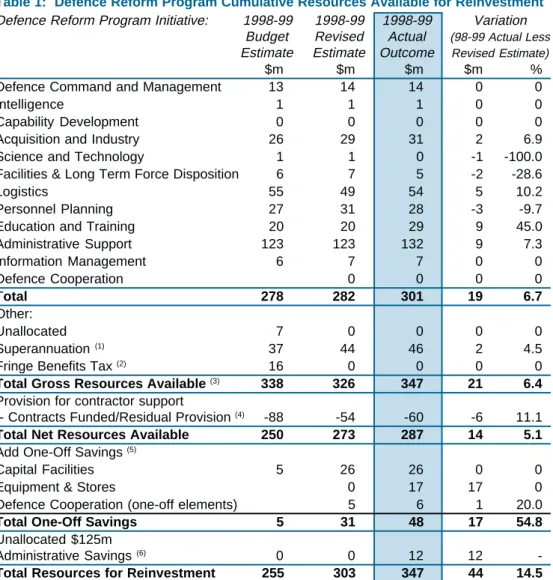
improving management through streamlining processes, improving structures and making improvements to the committee structure and long-term planning processes. The implementation of the Defence Reform Program remains ahead of its initial schedule. By the end of 1998-99, cumulative achieved on-going gains were $287m per annum, compared with an initial estimate of $250m per annum ($39m or 16% ahead of schedule). The major activities in the market testing schedule over the past year covered regional garrison support (security, firefighting, catering etc), logistics support, vehicle management and testing support functions. Industry demonstrated its expertise in regional garrison support activities by winning the six evaluations decided in 1998-99. The contracts, with a total value of $60m in 1998-99, will add significantly to the national support base.Despite this record of achievement, Defence recognises that, as a long-term program of reform, there remain risks to the full achievement of the Defence Reform Program and related savings. These include the capacity of both industry and Defence to manage the increase in the scale of Defence market testing, as well as the possibility of ‘reform fatigue’. Furthermore many of the gains will depend on market forces and the capacity of industry to perform tasks substantially more efficiently than those conducted in-house. To address these risks, the Government established the Defence Reform Program Strategic Management and Reporting Team in April 1999, which reports directly to the Secretary. This team was tasked with reviewing progress on each major category of reform, reporting to the Defence Executive on any area of difficulty or risk, and undertaking associated change management and internal communications strategies. The implementation of the Defence Reform Program is being measured and reported against the following major categories of reform, which together include some 150 individual initiatives.
Defence Command and Management Arrangements
Reform has continued through the clarification of the functions of senior commanders and executives within Defence and their roles and responsibilities. Savings have resulted from the collocation and integration of staff at the strategic level, the elimination of duplication and the streamlining of command arrangements and the rationalisation of headquarters elements. These reforms are now substantially complete, with the exception of the substantial efficiency gains that will flow from the establishment of a collocated headquarters for the Commander Australian Theatre.
Defence Reform Program
Capability Development
Gains from the rationalisation of the former Forces Executive and Strategy & Intelligence Programs have been used to almost fully offset the cost of the reform program-endorsed initiative to provide additional strategic guidance within the Australian Defence Headquarters.
Acquisition and Industry
Reform initiatives have included business process re-engineering, which is now being implemented in Defence Acquisition. The benefits will include shorter acquisition cycle times and more efficient and effective acquisition processes. Gains to date have been achieved through the civilianisation of some military staff in Acquisition, although there has been a slowing in the rate of civilianisation. Efficiencies have been generated through the collocation of staff in new premises at Russell.
The rationalisation of industry functions has seen the wind back of the Acquisition presence in the regions to small, streamlined ‘shop-fronts’, the restructuring of the quality assurance area and other initiatives.
Science and Technology
Specific savings have been made through general administrative efficiencies.
Facilities and Long Term Force Disposition
Facilities gains include a series of one-off savings related to a program of base rationalisation and closures including RAAF Fairbairn in Canberra ($21.5m), Tighnabruaich in Brisbane ($2.0m), and Jenner House in Sydney ($2.3m).
Logistics
Logistic initiatives have seen the commencement in 1998-99 of a number of projects to improve the efficiency and effectiveness of ADF logistic business processes and their supporting information technology systems. Market testing has been completed for commercial vehicle management and PC9 Air Trainer Logistics Support, and a civilianisation program has begun. A one-off gain of almost $17m in equipment and stores in the Defence Corporate Support Group was due to the slowing of purchasing activity and the run down of stocks in advance of contracting arrangements.
Personnel Planning
Personnel savings include the integration of civilian and military personnel functions. The Personnel Management Key Solution project will enable achievement of efficiencies in personnel management by ensuring that Defence has a single source of accurate and timely personnel data. During 1998-99, the project team finalised a plan for the phased implementation of the system across Defence. The project will enable, and assist with, the achievement of significant savings, especially those associated with the establishment of the Defence Service Centre (the location of which is in the process of being finalised).
Education and Training
Reform aimed at developing common joint training for the ADF has continued during 1998-99 with ongoing planning for, and implementation of, the rationalisation of education and training schools and courses. A number of tri-Service initiatives came to fruition this year including the opening of the Australian Defence College in January 1999, as the senior institution in Defence’s system of professional military education. A common Basic Medical Assistant course commenced, and the ADF School of Catering opened at HMAS Cerberus. An interim
Administrative Support
These initiatives relate to the rationalisation and market testing of support functions at Defence bases across Australia. Market testing of garrison support activities progressed, with decisions in north and south Queensland, South Australia and Western Australia. The total value of contracts awarded in 1998-99 was $347m for services spanning the next five years. The market testing of clerical and administrative services has begun, with the issue of a request for quotation in April 1999 for the supply of clerical and administrative services to the South Australian region.
Information Management
Information management initiatives have seen the establishment of a single provider of corporate information management services, and a rationalisation of information management support. A new desktop operating environment completed the roll-out to Russell, while the implementation on schedule of the Resource and Output Management Project, the new corporate financial management information system, will provide additional savings across the Defence portfolio upon completion.
Table 1: Defence Reform Program Cumulative Resources Available for Reinvestment Defence Reform Program Initiative: 1998-99 1998-99 1998-99 Variation
Budget Revised Actual (98-99 Actual Less Estimate Estimate Outcome Revised Estimate)
$m $m $m $m %
Defence Command and Management 13 14 14 0 0
Intelligence 1 1 1 0 0
Capability Development 0 0 0 0 0
Acquisition and Industry 26 29 31 2 6.9
Science and Technology 1 1 0 -1 -100.0
Facilities & Long Term Force Disposition 6 7 5 -2 -28.6
Logistics 55 49 54 5 10.2
Personnel Planning 27 31 28 -3 -9.7
Education and Training 20 20 29 9 45.0
Administrative Support 123 123 132 9 7.3 Information Management 6 7 7 0 0 Defence Cooperation 0 0 0 0 Total 278 282 301 19 6.7 Other: Unallocated 7 0 0 0 0 Superannuation (1) 37 44 46 2 4.5
Fringe Benefits Tax (2) 16 0 0 0 0
Total Gross Resources Available (3) 338 326 347 21 6.4 Provision for contractor support
- Contracts Funded/Residual Provision (4) -88 -54 -60 -6 11.1
Total Net Resources Available 250 273 287 14 5.1
Add One-Off Savings (5)
Capital Facilities 5 26 26 0 0
Equipment & Stores 0 17 17 0
Defence Cooperation (one-off elements) 5 6 1 20.0
Total One-Off Savings 5 31 48 17 54.8
Unallocated $125m
Administrative Savings (6) 0 0 12 12
Defence Reform Program
Notes to Table 1:
1. The planned savings in superannuation have been calculated on the basis of the anticipated reduction in personnel numbers.
2. Due to the increased cost of Defence housing in 1998-99, the consequential Fringe Benefits Tax gains in 1998-99 could not be realised and have been slipped to 1999-2000 (see p.14 of Portfolio Budget Statements 1999-2000).
3. The resource reallocations listed in the table are the gross resource reallocations to be achieved, including the salary and operating costs of support areas to be market tested.
4. This line represents the cost of contracts for service delivered by external providers as a result of Defence Reform Program initiatives.
5. One-off gains relate to the facilities sales program, Defence Cooperation gains, some reduced inventory levels recommended by the Defence Efficiency Review and Defence Reform Program and other one-off reform program related gains achieved by Groups.
6. In the 1996-97 Budget, the Department of Defence made a reduction in administrative expenditure totalling $125m per annum (which was subsequently increased to $136m per annum), which has been reallocated to a range of capability-related expenditure initiatives. Reinvestment of the unallocated savings from 1998-99 onwards has been combined with the Defence Reform Program reinvestment for reporting purposes. Reinvestment details for the $125m administrative savings are as follows:
1998-99 1998-99 1998-99 Variation Budget Revised Actual (98-99 Actual Less Estimate Estimate Outcome Revised Estimate)
$m $m $m $m %
Programmed Savings 136 136 136 0
Land Force Capabilities 73 72 17 -55 -76.3
Strike 82 45 60 15 33.3
Maritime and Air Defence 29 25 26 1 4.0
C3I 6 6 4 -2 -33.3
Personnel Initiatives 19 18 15 -3 -16.7
Other Government Initiatives 1 2 1 -1 -50.0
Total Reinvestment 211 168 123 -45 -26.8
Unallocated Savings -75 -32 12 44 -137.5
The budget allocation of $211m was reduced to an actual outcome of $123m. Major expenditure activities comprised personnel retention initiatives including the pilot retention bonus; and a range of combat-capability enhancements, including the acquisition of night fighting equipment; additional Harpoon missiles, and air-to-air and air-to-surface weapons. Achieved reinvestment was less than that anticipated due to slippage in a number of projects including the purchase of additional CH-47 Chinook helicopters, specialised surveillance ASLAV vehicles, and military satellite communications equipment for Anzac ships and Collins submarines.
Table 2: Cumulative Defence Reform Program Military Personnel Reductions (1) ( 2) ( 3) Defence Reform Program Initiative 1998-99 1998-99 1998-99 Variation
Budget Revised Actual (98-99 Actual less Estimate Estimate Outcome Revised Estimate)
%
Defence Command & Management 141 149 133 -16 -10.7
Intelligence 16 16 14 -2 -12.5
Capability Development 0 0 -1 -1
-Acquisition and Industry 150 150 118 -32 -21.3
Science and Technology (4) 20 20 1 -19 -95.0
Facilities & Long Term Force Disposition 40 40 40 0 0
Logistics 617 617 604 -13 2.1
Personnel Planning 425 425 425 0 0
Education and Training 317 315 492 177 56.2
Administrative Support 1,587 1,577 1,577 0 0
Information Management 13 13 13 0 0
Table 3: Cumulative Defence Reform Program Civilian Personnel Reductions (1) (2) (3) Defence Reform Program Initiative 1998-99 1998-99 1998-99 Variation
Budget Revised Actual (98-99 Actual less Estimate Estimate Outcome Revised Estimate) %
Defence Command & Management 92 142 151 9 6.3
Intelligence 24 24 24 0 0
Capability Development 0 0 0 0 0
Acquisition and Industry 267 265 265 0 0
Science and Technology (4) 101 0 1 1
-Facilities & Long Term Force Disposition 91 101 85 -16 -15.8
Logistics 498 686 705 19 2.8
Personnel Planning 402 110 110 0 0
Education and Training 70 78 92 15 19.2
Administrative Support 884 959 1,116 157 16.4
Information Management 57 116 76 -40 -34.5
Total Civilian Reductions 2,486 2,481 2,625 144 5.8
Notes to Tables 2 & 3:
1. These savings represent cumulative ongoing totals of actual personnel numbers to be reduced or redirected to priority combat positions in any given year as a result of rationalisation, streamlining or market testing activities carried out as part of the Defence Reform Program. They do not represent average strength figures because of uncertainties due to the market testing program. 2. Figures represent both the positions to be abolished and an assumed 90% reduction of military
positions (25% for civilians positions) in those functions to be market tested (market-test assumptions are based broadly on historical experience).
3. These figures do not include the reinvestment of Defence Reform Program resources in ADF or APS personnel (see Table 4).
4. This category relates to Science and Technology initiatives across Defence.
Defence Reform Program Reinvestment
The Defence Reform Program has reinvested a total of $372m in Defence capability in 1998-99. The focus of this reinvestment has changed to reflect a greater emphasis on support for current capability (reflecting deteriorating regional strategic circumstances) and the decision to sustain the ADF’s full-time strength at no lower than 50,000. In terms of investment in current capability, the most significant contribution of the Defence Reform Program has been the provision of most of the funding for the increased readiness of 1 Brigade and related units in 1998-99. The ADF is now at its highest state of readiness since the Vietnam War.
New Capital Investment
Funding for new capital investment projects will commence in 1999-2000, due to the lead times involved in project development. At maturity, annual major investment expenditure is planned to increase by $139m or 5% of the $2,750m major capital equipment program.
Capability Related Logistics
Logistics reinvestment represents a partial offset for the increasing real costs involved in maintaining current capability, as well as increased logistic costs resulting from supporting a higher operational tempo associated with increased levels of ADF readiness and operations. A total of $104m has been invested in additional logistic support in 1998-99. Funding has supported priority areas such as the increased level of preparedness for 1 Brigade and related units and increased maintenance and logistics support to Navy platforms.
Defence Reform Program
New Capabilities - Net Personnel and Operating Costs
Defence Reform Program funding also supports the through-life personnel and operating costs of new capabilities being introduced into service. Reinvestment of Defence Reform Program funds of about $65m has supported new capabilities including in-service support for the Anzac-class ships and the Collins-Anzac-class submarines, Anzac ship helicopters, minehunter coastal, hydrographic ship, the Bradshaw Field Training Area and the lead-in fighter projects.
Amphibious Capability
Reinvestment in this category enables the transportation, lodgement and support of a heavy battalion group (approximately 1,100 personnel) and its associated vehicles and equipment. Total reinvestment is $28m for 1998-99, which related primarily to the retention of HMAS Tobruk.
Army Program Reinvestment
This funding ($43m) has facilitated the movement of Army personnel into the combat force consistent with the objectives of Restructuring the Army initiative and the 50,000 ADF.
50,000 Permanent Force ADF
Maintaining the ADF at about 50,000 and increasing the number of personnel in the combat force to 65% will represent by far the largest reinvestment of savings with $11m invested in 1998-99 rising to $632m at maturity. Although the ADF will be smaller in size than the 56,600 in 1996-97, it will be far more capable. Additional costs result from the retention of substantially higher numbers of ADF personnel in combat roles, while still meeting the civilian staff and contractors costs to undertake the support tasks previously undertaken by many ADF personnel.
Defence Science - Capability Related Projects
Funding has continued to facilitate priority science and technology research projects in support of land operations, command and control, information warfare, weapons systems, defence against biological weapons and other projects to assist in achieving the most efficient and effective operation of our capabilities. Reinvestment of $15m was made in 1998-99.
Pilot Training
This reinvestment of $4m in 1998-99 addresses the fast-jet pilot shortfall, and seeks to improve pilot training. Improved pre-recruitment screening, and a contracted tri-Service basic pilot training course commenced this year, aimed at increasing the number and quality of pilot graduates.
Transition Costs
Transition costs of $102m have been expended to facilitate the implementation of the Defence Reform Program. The major component is the funding of voluntary redundancies arising from changes to the workforce, through market testing, civilianisation of military positions and workforce rationalisations. Other costs are incurred in the market testing process.
Table 4: Reinvestment of Available Defence Reform Program Resources Table 4: Reinvestment of Available Defence Reform Program Resources Table 4: Reinvestment of Available Defence Reform Program Resources Table 4: Reinvestment of Available Defence Reform Program Resources Table 4: Reinvestment of Available Defence Reform Program Resources Defence Reform Program Initiative 1998-99 1998-99 1998-99 Variation
Budget Revised Actual (98-99 Actual less Estimate Estimate Outcome Revised Estimate)
$m $m $m $m %
Net Ongoing Resources Available 250 273 287 14 5.1
Defence Reform Program
One-Off Savings 5 31 48 17 54.8
Unallocated $125m Administrative Savings 0 0 12 12 0
Total Resources Available for Total Resources Available for Total Resources Available for Total Resources Available for Total Resources Available for Reinvestment
Reinvestment Reinvestment Reinvestment
Reinvestment 255255255255255 303303303303303 347347347347347 4444444444 14.514.514.514.514.5 Reinvestment Initiative Details
-New Capital Investment (1) 0 0 0 0 0
-Amphibious Capabilities(2) 32 28 28 0 0
-Capability - Related Logistics Costs (3) 107 104 104 0 0
-New Capabilities – Net Personnel
& Operating Costs (4) 67 64 65 1 1.6
-Defence Science – Capability Projects 15 15 15 0 0
-Army Program Reinvestment 43 43 43 0 0
-Provision for 50,000 ADF (5) 11 11 11 0 0
-Pilot Training 4 4 4 0 0 -DRP Transition Costs 60 145 102 -43 -29.7 Total Reinvestment Total Reinvestment Total Reinvestment Total Reinvestment Total Reinvestment (6)(6)(6)(6)(6) 339339339339339 414414414414414 372372372372372 -42-42-42-42-42 -10.1-10.1-10.1-10.1-10.1 Notes: Notes: Notes: Notes: Notes:
1. Expenditure on new capital investment is planned to commence in 1999-2000.
2. Operational requirements relating to Operation Belisi have resulted in the slippage of the planned refit of
the HMAS Tobruk toearly in 1999-2000.
3. The installation of the diesel generators in the FFGs has been reprogrammed to accord with the upgrade
program.
4. The increase relates to price increases associated with net personnel and operating costs activities.
5. The 50,000 ADF provision for 1998-99 includes reinvestment and crew associated with the retention of
the HMAS Tobruk.
6. Projected gross expenditure levels for these initiatives was in excess of the savings to be achieved through
the Defence Reform Program. This strategy has been adopted due to the uncertainty related to some lead times and achievable expenditure spreads, particularly in logistic items. This over-programming ensures that overall expenditure on the package will exceed savings. Expenditure in 1998-99 was matched to the funds available by cash management techniques, review of priorities or provision of extra funds from the Defence outlay.
FINANCIAL RESOURCES
Summary of 1998-99 Outlays
The actual 1998-99 Defence function outlay of $11,182.9m was $156m higher than the 1998-99 revised estimate of $11,026.9m and $179.4m more than the final adjusted 1998-99 allocation of $11,003.5m. This was a managed overspend consisting of an advance of $99m from the Department of Finance and Administration for the early payment of claims and an advance of $80m that was provided by the Government on 30 June 1999, in response to the McIntosh report, for the Collins-class submarines. The early payment of claims was action taken as a risk mitigation measure to ensure a smooth transition to a new financial information management system and the new agency banking arrangements. In line with current Defence budgetary arrangements, this overspend will be repaid in the 1999-2000 additional estimates. It should be noted that Defence manages and presents its resources on an outlay basis and that the 1998-99 outlays comprised expenditure of $11,686.1m and receipts of $503.2m. As a proportion of gross domestic product, the Defence function outlay was 1.9 % in 1998-99. The following table provides a summary of the actual and estimated total Defence function outlays from the 1997-98 actual through 1998-99. The difference between the 1997-98 actual and the growth during 1998-99 is due to movements in below-the-line items. Below-the-line items relate to specific activities whose funding is included in total Defence outlays, but for which Defence is supplemented on a ‘no win-no loss’ basis.
Table 5: Summary of Defence Budgets
1997-98 1998-99 1998-99 1998-99 Variation Actual Budget Revised Actual (98-99 Actual less Outcome Estimate Estimate Outcome Revised Estimate)
$m $m $m $m $m %
Appropriations 10,908 11,526 11,585 11,686 101 0.9
Receipts and Trust Accounts -495 -580 -558 -503 55 9.8
Defence Function Outlay 10,415 10,946 11,027 11,183 156 1.4
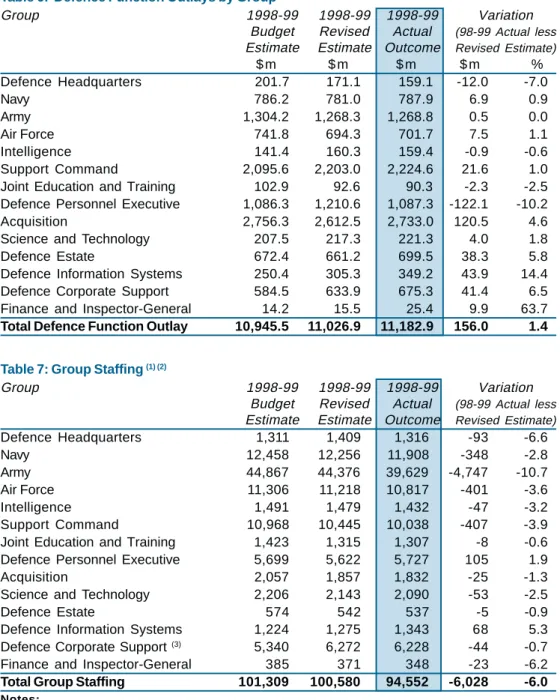
The following tables provide a summary of achievement by Group for both outlays and staffing in 1998-99 and a comparison with the 1998-99 budget and revised estimates. More detail and explanations for the variation between the 1998-99 actual outcome and the 1998-99 revised estimate can be found in the individual Group sections in Part Two of this report.
Table 6: Defence Function Outlays by Group
Group 1998-99 1998-99 1998-99 Variation
Budget Revised Actual (98-99 Actual less Estimate Estimate Outcome Revised Estimate)
$ m $ m $ m $ m % Defence Headquarters 201.7 171.1 159.1 -12.0 -7.0 Navy 786.2 781.0 787.9 6.9 0.9 Army 1,304.2 1,268.3 1,268.8 0.5 0.0 Air Force 741.8 694.3 701.7 7.5 1.1 Intelligence 141.4 160.3 159.4 -0.9 -0.6 Support Command 2,095.6 2,203.0 2,224.6 21.6 1.0
Joint Education and Training 102.9 92.6 90.3 -2.3 -2.5
Defence Personnel Executive 1,086.3 1,210.6 1,087.3 -122.1 -10.2
Acquisition 2,756.3 2,612.5 2,733.0 120.5 4.6
Science and Technology 207.5 217.3 221.3 4.0 1.8
Defence Estate 672.4 661.2 699.5 38.3 5.8
Defence Information Systems 250.4 305.3 349.2 43.9 14.4
Defence Corporate Support 584.5 633.9 675.3 41.4 6.5
Finance and Inspector-General 14.2 15.5 25.4 9.9 63.7
Total Defence Function Outlay 10,945.5 11,026.9 11,182.9 156.0 1.4
Table 7: Group Staffing (1) (2)
Group 1998-99 1998-99 1998-99 Variation
Budget Revised Actual (98-99 Actual less Estimate Estimate Outcome Revised Estimate)
Defence Headquarters 1,311 1,409 1,316 -93 -6.6 Navy 12,458 12,256 11,908 -348 -2.8 Army 44,867 44,376 39,629 -4,747 -10.7 Air Force 11,306 11,218 10,817 -401 -3.6 Intelligence 1,491 1,479 1,432 -47 -3.2 Support Command 10,968 10,445 10,038 -407 -3.9
Joint Education and Training 1,423 1,315 1,307 -8 -0.6
Defence Personnel Executive 5,699 5,622 5,727 105 1.9
Acquisition 2,057 1,857 1,832 -25 -1.3
Science and Technology 2,206 2,143 2,090 -53 -2.5
Defence Estate 574 542 537 -5 -0.9
Defence Information Systems 1,224 1,275 1,343 68 5.3
Defence Corporate Support (3) 5,340 6,272 6,228 -44 -0.7
Finance and Inspector-General 385 371 348 -23 -6.2
Total Group Staffing 101,309 100,580 94,552 -6,028 -6.0 Notes:
1. For further information see Appendix I to Part One of this report.
2. Staffing numbers are average funded strengths. The figures for reserves represent the average number of personnel funded, rather than full-time staff-year equivalents.
Financial Resources
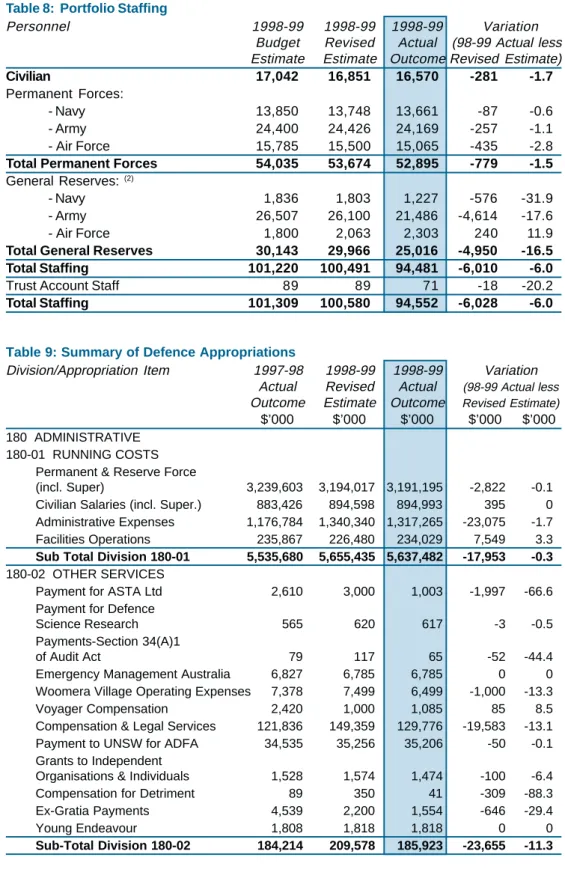
Table 8: Portfolio Staffing
Personnel 1998-99 1998-99 1998-99 Variation
Budget Revised Actual (98-99 Actual less Estimate Estimate Outcome Revised Estimate)
Civilian 17,042 16,851 16,570 -281 -1.7
Permanent Forces:
- Navy 13,850 13,748 13,661 -87 -0.6
- Army 24,400 24,426 24,169 -257 -1.1
- Air Force 15,785 15,500 15,065 -435 -2.8
Total Permanent Forces 54,035 53,674 52,895 -779 -1.5 General Reserves: (2)
- Navy 1,836 1,803 1,227 -576 -31.9
- Army 26,507 26,100 21,486 -4,614 -17.6
- Air Force 1,800 2,063 2,303 240 11.9
Total General Reserves 30,143 29,966 25,016 -4,950 -16.5
Total Staffing 101,220 100,491 94,481 -6,010 -6.0
Trust Account Staff 89 89 71 -18 -20.2
Total Staffing 101,309 100,580 94,552 -6,028 -6.0
Table 9: Summary of Defence Appropriations
Division/Appropriation Item 1997-98 1998-99 1998-99 Variation Actual Revised Actual (98-99 Actual less Outcome Estimate Outcome Revised Estimate)
$’000 $’000 $’000 $’000 $’000
180 ADMINISTRATIVE 180-01 RUNNING COSTS
Permanent & Reserve Force
(incl. Super) 3,239,603 3,194,017 3,191,195 -2,822 -0.1 Civilian Salaries (incl. Super.) 883,426 894,598 894,993 395 0 Administrative Expenses 1,176,784 1,340,340 1,317,265 -23,075 -1.7 Facilities Operations 235,867 226,480 234,029 7,549 3.3
Sub Total Division 180-01 5,535,680 5,655,435 5,637,482 -17,953 -0.3
180-02 OTHER SERVICES
Payment for ASTA Ltd 2,610 3,000 1,003 -1,997 -66.6
Payment for Defence
Science Research 565 620 617 -3 -0.5
Payments-Section 34(A)1
of Audit Act 79 117 65 -52 -44.4
Emergency Management Australia 6,827 6,785 6,785 0 0
Woomera Village Operating Expenses 7,378 7,499 6,499 -1,000 -13.3
Voyager Compensation 2,420 1,000 1,085 85 8.5
Compensation & Legal Services 121,836 149,359 129,776 -19,583 -13.1
Payment to UNSW for ADFA 34,535 35,256 35,206 -50 -0.1
Grants to Independent
Organisations & Individuals 1,528 1,574 1,474 -100 -6.4
Compensation for Detriment 89 350 41 -309 -88.3
Ex-Gratia Payments 4,539 2,200 1,554 -646 -29.4
Young Endeavour 1,808 1,818 1,818 0 0
Division/Appropriation Item 1997-98 1998-99 1998-99 Variation Actual Revised Actual (98-99 Actual less Outcome Estimate Outcome Revised Estimate)
$’000 $’000 $’000 $’000 $’000
181 EQUIPMENT & STORES 4,337,088 4,823,727 4,973,792 150,065 3.1
182 DEFENCE COOPERATION 63,436 65,696 62,732 -2,964 -4.5 183 DEFENCE PRODUCTION 17,739 25,787 24,096 -1,691 -6.6 184 PAYMENTS TO ADI 0 50 0 -50 -100.0 185 CAPITAL FACILITIES 502,340 495,054 494,740 -314 -0.1 186 DEFENCE HOUSING 253,590 291,300 289,869 -1,431 -0.5 (A) Sub-Total 10,894,087 11,566,627 11,668,634 102,007 0.9 SPECIAL APPROPRIATIONS MSBS – Retention Benefit 15,201 16,043 15,650 -393 -2.4 Housing Loan Assistance
Scheme 2,921 4,000 3,642 -358 -9.0
DETYA Subsidies 0 150 0 -150 -100
DFRDB Payments 952,315 971,280 987,103 15,823 1.6
MSBS Payments 177,765 178,901 178,093 -808 -0.5
(B) Sub-Total 1,148,202 1,170,374 1,184,488 14,114 1.2
(C) Total Defence Portfolio
Appropriations (A+B) 12,042,289 12,737,001 12,853,122 116,121 0.9
(D) Total Defence Portfolio Receipts
(Offset Within Outlays) (2) -578,257 -646,190 -583,427 62,763 -9.7
(E) Total Defence Portfolio
Outlay (C+D) 11,464,032 12,090,811 12,269,695 178,884 1.5
Less Non-Defence Function Appropriations (3)
180-02-09 Young Endeavour 1,808 1,818 1,818 0 0
DFRDB Payments 952,315 971,280 987,103 15,823 1.6
MSBS Payments 177,765 178,901 178,093 -808 -0.5
(F) Sub Total 1,131,888 1,151,999 1,167,014 15,015 1.3
Less Non-Defence Function Receipts
DFRDB Contributions -45,541 -43,564 -42,034 1,530 -3.5
MSBS Contributions -39,834 -47,372 -57,249 -9,877 20.9
Sale of AAG 120 0 0 0 0
(G) Sub Total -85,255 -90,936 -99,283 -8,347 -9.2
Add Other Portfolio Receipts
Advance to States under
Commonwealth-State Housing Agreement -2,029 -2,816 -19,043 -16,227 576.2
(H) Sub Total -2,029 -2,816 -19,043 -16,227 576.2
Total Defence Function
Outlays (E-F-G+H) 10,415,370 11,026,932 11,182,921 155,989 1.4
Notes:
1. Defence portfolio appropriations are composed of funds listed within Appropriation Bills No. 1 and 3 and the Statement of Savings, as appropriated to the Department of Defence. They include special appropriations for Defence Force Retirement and Death Benefits, the Military Superannuation and Benefits Scheme and the Home Loan Assistance Scheme, and a proportion of Department of Employment, Training and Youth Affairs funds for employment subsidies for trainees.
2. Defence portfolio receipts shown in the table represent only those Department of Defence receipts which are offset within outlays. Other receipts (eg. Defence Housing Authority and Australian Defence Industries dividends to the Commonwealth) are not included as they are credited to the Consolidated Revenue Fund and are not offset within Defence outlays.
3. The non-Defence function appropriations and receipts are composed of Defence superannuation payments and contributions and the Young Endeavour Youth Scheme. While these outlays lie within the Defence portfolio, they are not classified as part of the Defence function.
Financial Resources
Defence Outlay by Major Item
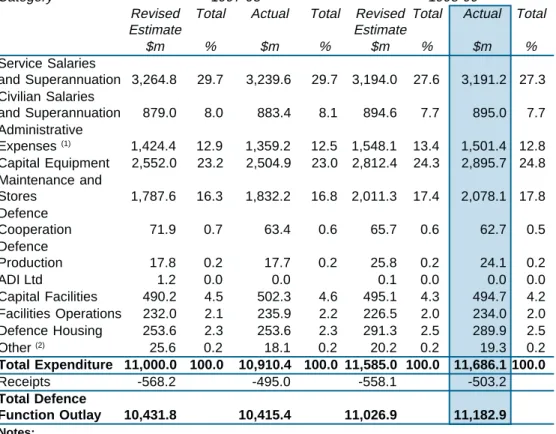
The following table provides a breakdown of the expenditure of Defence outlays. Table 10: Defence Function Outlay: 1997-98 and 1998-99
Category 1997-98 1998-99
Revised Total Actual Total Revised Total Actual Total
Estimate Estimate $m % $m % $m % $m % Service Salaries and Superannuation 3,264.8 29.7 3,239.6 29.7 3,194.0 27.6 3,191.2 27.3 Civilian Salaries and Superannuation 879.0 8.0 883.4 8.1 894.6 7.7 895.0 7.7 Administrative Expenses (1) 1,424.4 12.9 1,359.2 12.5 1,548.1 13.4 1,501.4 12.8 Capital Equipment 2,552.0 23.2 2,504.9 23.0 2,812.4 24.3 2,895.7 24.8 Maintenance and Stores 1,787.6 16.3 1,832.2 16.8 2,011.3 17.4 2,078.1 17.8 Defence Cooperation 71.9 0.7 63.4 0.6 65.7 0.6 62.7 0.5 Defence Production 17.8 0.2 17.7 0.2 25.8 0.2 24.1 0.2 ADI Ltd 1.2 0.0 0.0 0.1 0.0 0.0 0.0 Capital Facilities 490.2 4.5 502.3 4.6 495.1 4.3 494.7 4.2 Facilities Operations 232.0 2.1 235.9 2.2 226.5 2.0 234.0 2.0 Defence Housing 253.6 2.3 253.6 2.3 291.3 2.5 289.9 2.5 Other (2) 25.6 0.2 18.1 0.2 20.2 0.2 19.3 0.2 Total Expenditure 11,000.0 100.0 10,910.4 100.0 11,585.0 100.0 11,686.1 100.0 Receipts -568.2 -495.0 -558.1 -503.2 Total Defence Function Outlay 10,431.8 10,415.4 11,026.9 11,182.9 Notes:
1. Includes Division 180-02: Other Services.
2. Other includes MSBS Retention Benefit, Australian Trainee Scheme/Career Start Traineeships and Housing Loan Subsidies.
Capital Equipment
In 1998-99, development activity continued on some 230 approved major capital equipment projects, including a number approved in previous years but not yet to contract. Total approved funding for these projects is $42,700m, of which $26,000m has already been spent, including the $2,614m spent in 1998-99. Major developments and outcomes are detailed in Part Two of this report in the Acquisition Group performance report.
Capital Facilities
Significant progress was made on numerous capital facilities projects during 1998-99, with a number of projects completed, including facilities at RAAF Townsville for 5 Aviation Regiment, RAAF Scherger near Weipa, and facilities for 6 Squadron at RAAF Amberley. Significant project outcomes and property sales are detailed in Part Two in the Defence Estate Group performance report.
Personnel
As detailed in Table 8, the average permanent ADF strength for 1998-99 was 779 lower than the 1998-99 revised estimate, an outcome which reflected higher than forecast separation rates and lower than forecast recruiting achievement across all three Services. The overall reduction
of $2.8m in Service salaries and superannuation was the net effect of the lower than forecast average strength, offset by higher than anticipated payments to employees on separation.
Administrative Expenses
Actual outlays on administrative expenses were $46.7m lower than the revised estimate due mainly to lower than anticipated expenditure in travel and subsistence and to compensation and legal services.
Maintenance and Stores
Actual outlays in 1998-99 were $66.8m higher than the 1998-99 revised estimate of $2,011.3m. This was due primarily to increased expenditure on the repair and overhaul of equipment and stores, and an increase in the expenditure on weapons, armaments and ammunition.
Facilities Operations
Expenditure on facilities operations was $7.5m or 3.3% more than the revised estimate. This is due primarily to increased maintenance activities, including the dredging of the Captain Cook Dock at Garden Island, and the upgrading of facilities to provide temporary accommodation for the Kosovo refugees as part of Operation Safe Haven.
Housing
In 1998-99, the Defence Housing Authority provided 90% of the Defence housing requirement for married members at a cost of $269.6m. This amount was offset by member contributions of $101.5m. The balance of the housing requirement for married members was met by the private rental market, at a cost to Defence in 1998-99 of $20.8m. Defence also incurred a fringe benefits liability for housing for married members totalling $77.9m.
Defence Cooperation
Expenditure for Defence Cooperation was $62.7m in 1998-99 as outlined in Appendix E to Part One of this report. Key activities in 1998-99 included the conduct of combined activities with elements of the Indonesian, Malaysian, Philippines, Singaporean and Thai armed forces and the provision of additional movement support to Indonesia, Malaysia and Thailand to enable their continued participation in high-priority training and personnel exchange programs. Assistance was provided to the Solomon Islands in the conduct of a national strategic review and the program of half-life refits for Pacific patrol boats continued. Provision of in-country training advisers to Papua New Guinea continued.
Peacekeeping and Other Humanitarian Operations
Defence outlays for peacekeeping and other operations during 1998-99 were $31.2m as outlined in Appendix C to Part One of this report. Major activities in 1998-99 included Defence involvement in the Bougainville Peace Monitoring Group; the deployment of a Navy guided missile frigate as a contribution to the Multinational Interception Force enforcing United Nation sanctions against Iraq; Defence participation in the Multinational Observer Force in the Sinai; drought aid in Papua New Guinea and Irian Jaya; and a Defence contribution to the United Nations Truce and Supervisory Organisation to monitor ceasefire agreements, truces and peace treaties negotiated between Israel and Arab nations.
Receipts
Defence portfolio receipts in 1998-99 were $503.2m, which was $54.9m lower than the revised estimate of $558.1m. Receipts that dropped significantly were for rations and quarters (reduced by $16.7) and Defence property disposals ($28.0m).
Financial Resources
SUMMARY OF THE 1998-99 FINANCIAL STATEMENTS
This is the fifth year in which Defence has prepared a set of accrual financial statements. The statements have been compiled to meet the requirements of the Financial Management and Accountability Act 1997, the Finance Minister’s Orders and Australian Accounting Standards. The 1998-99 Financial Statements are set out in Appendix F to Part One.
As has been the case in past years, resources were budgeted and managed on a cash basis but reported on an accrual basis. 1998-99 is the last year that this will occur. On 1 July 1999, an accrual-based output budgeting and accounting framework was introduced.
The statement of revenues and expenses, or operating statement, for 1998-99 indicates that the net cost of services fell from $11,070m in 1997-98 to $10,837m in 1998-99. Total expenses fell by $102m in 1998-99 compared to the 1997-98 result while revenues from independent sources increased by $130m. Accumulated results increased from $33,404m in 1997-98 to $34,905m in 1998-99.
The statement of assets and liabilities, or balance sheet, indicates that the total assets of Defence increased from $37,327m in 1997-98 to $40,065m in 1998-99. During 1998-99, a major revaluation was undertaken of the Defence estate and this, together with purchases of specialist military equipment, was the major cause of the increase in assets. The increase in the asset revaluation reserve of $818m was due principally to the revaluation of the Defence estate. Provisions for employees rose by $311m due to a higher level of accrued salaries, superannuation and annual leave as well as an increase in the provision for military workers compensation.