
Abstract--This paper presents the AntWeb system, developed under the research area of Web Intelligence (WI). Our approach to AntWeb application is inspired by the ant colonies foraging behavior, to adaptively mark the most significant links, by means of the shortest route to arrive to target pages. In our approach, we consider the web users as artificial ants, and use the ant theory as a metaphor to guide user’s activity in the Web site. In this paper, we describe the ant’s theory in which AntWeb is based. We also present the AntWeb system, its implementation and a case study with some experiments. The database in AntWeb stores a vast amount of information related to the users’ visit to Web sites, which can be useful for further Web mining.
Index Terms--AntWeb system, adaptive Web server, ant’s behavior, pheromone, Web Intelligence.
I. INTRODUCTION
HE process of surfing in Web is similar to the ant colonies foraging. Ants are social insects that work more to the survival of the colony as a whole, than to a single individual component of the colony ([1]-[4]). Their physical characteristics do not allow them to have a global vision of the environment, but an important and interesting behavior of them is their foraging behavior, and in particular, how they can find shortest paths between food sources and their nest. With this insight, we see users visiting the Web as a metaphor to the ant colonies foraging process. Sometimes, they may lose their way in the immense cyberspace, without knowing where the information sources are.
To assist navigation in Web, intelligent searching mechanisms have been developed and implemented ([6]-[8]) as WebWatcher [9], a learning apprentice system based on adaptive hypermedia technology ([10],[11]). On the other hand, mechanisms like Altavista, Google and Northernlight are reasonable, heuristically speaking, but not so efficient taking into consideration the pace that the cyberspace grows. Who had never came across a stack of around 1000 links when
This work was partially supported by CNPq, under Grant No. 303378/02-6 and CAPES, under contract with CIC/UnB, both of them are financial agencies of Brazilian Government.
W. M. Teles, L. Weigang and C. G. Ralha are with the University of Brasilia (telephone: 55-61-3072702, e-mail: {wesley, weigang, [email protected]).
typing ‘key words’ in some search engine tool? To improve this scene, this research proposes a system for adaptive sites inspired by the ant’s foraging behavior. Despite the fact that ants have the already cited limitations, they are efficient foraging and very good finding the shortest route. Also, it is know by the biological community that the ants deposit on the ground, a substance called pheromone, while walking from food sources to the nest and vice versa, forming a pheromone trail. Ants can smell the pheromone left in pheromone trails and when choosing their way they tend to choose paths marked by strong pheromone concentrations. Thus, the pheromone trail following behavior can give rise to the emergence of shortest paths res ulting on the higher concentration of pheromone, which will direct their nest-mates on their way back to the food source or to the nest. This process demonstrates a successful teamwork that benefits the whole colony.
Different from ants, visitor of Web does not have any way of communication among them. Each one obtains their own route to find their objective without having the support of other users that may have previously passed through the same path. The idea of this research is to change this scene allo wing people to act as artificial ants. Thus, AntWeb implement an extended Web server, in such a way that visitor can count on teamwork to direct them establishing an indirect communication among them. Thus, using the ant searching mechanism, single users can find the objective node easier and increase the possibility to surf faster having available to them the best path.
In our research, we found out at least two main utilities for AntWeb’s approach. The first one is to use it to evaluate the structure of Web sites [12], and the second one is to extend web sites to have an adaptive capacity. When using for evaluation, AntWeb is able to simulate the sequence followed by visitors while visiting the Web site, allowing measuring the efficiency of the web structure. This paper deals with the second application related to adaptive navigation. AntWeb is being used to direct visitors to find the shortest or better way during their visit.
AntWeb as an adaptive Web system works as a metaphor of ant’s foraging behavior in the following way. When the user visits a Web site, the system records some information of his route as a pheromone trail left by ants. Other users with common objective may be attracted by the pheromone trail. The system is developed with a simple ant-searching
AntWeb – The Adaptive Web Server Based on
the Ants’ Behavior
Wesley Martins TELES, Li WEIGANG, and
Célia Ghedini RALHA
algorithm, not altering the flexibility of Web pages as it only marks the links. Thus, using AntWeb the user has not to give any additional information, what makes harder the usability of many adaptive Web systems.
AntWeb is developed as an extended Web server that communicates with any Web server. To simulate the pheromone track, the visiting information is stored in a database. Users are attracted by the pheromone using technique from adaptive hypermedia technology ([11],[10]).
The rest of the paper is organized as follows. In Section II, we describe the basic approach of AntWeb. Section III, we present the AntWeb system, its implementation. In Section IV, we report the results of a case study. Finally, in Section V we discuss our conclusions and comments for further work.
II. THE ANTWEB’S APPROACH
Real ants are capable of finding the shortest path from a food source to their nest[1] without using visual cues. They are also capable of adapting to environment changes, for example, finding a new shortest path once the old one is no longer feasible due to a new obstacle. While walking from the food sources to nest and vice versa, ants deposit on the ground pheromone, forming a pheromone trail. Ants choose their way by the strong pheromone concentrations left on pheromone trails [5].
The approach used in AntWeb is a metaphor to the presented biological model. The developed system records information about every visit, such as the sequence of pages of Web users, and the ants depositing pheromone in their trails. The amount of deposited pheromone available is used for formatting the visual presentation of links in Web pages. As many users visited the page, more pheromone is deposited at the link. The strongest links, in terms of pheromone concentration, may help other users to visit common objective pages. Also the pheromone evaporation on links is considered in our approach. This section describes the combination of ant theory to Web technology to develop AntWeb.
A. Basic theory of AntWeb model
Our model is adapted from the Ant System presented in [2]. In the Ant System, the amount of pheromone τij(p) associated to a link (i,j) is intended to represent the learned desirability of the choosing node j when in node i [12]. Ants deposit an amount of pheromone proportional to the quality of the solutions they produced: the less number of links visited, in the tour by the artificial ant, the greater the amount of pheromone is deposited on the links. The initial amount of pheromone τij(0), at iteration p= 0, is set to a small positive constant value or zero for all links. In our case, the initial probability with which an ant(k) chooses to go from page i to page j ∈ Ni.
In the routing table, a probability value pij d
which expresses the goodness of choosing j as next page when the target page is d, has the constraint:
∑ pij d
= 1, j ∈ Ni, Ni = {neighbors(i)} (1) The modification of the routing table Ai = [aij
d
(p)]|Ni| of the page i is obtained by the composition of the local pheromone trail values with the local heuristic values as follows:
aij d (p) = [τj d (p)]α [ηj(p)]β / ∑{[τl d (p)]α [ηl(p)]β}, j ∈ Ni, l ∈ Ni (2) Where τj d
(p) is the amount of pheromone trail on the page j at iteration p for destination d. Ni is the set of neighbors of pages i, α and β with both parameters that control the relative weight of pheromone trail and heuristic value. ηj = 1/wtj is the heuristic value of moving to page j:
wtj = ltj + vtj (3)
Where, wtj is the estimated time at the page j; it includes ltj the estimated time to get all of information of the page j to the browser at some velocity of the process; and vtj is the estimated time to visit the page j.
The probability with which any ant chooses to go from the page i to page j ∈ Ni considering destination d while building its route at the p-th algorithm iteration is:
pij d = aij d (p) / ∑ ail d (p), l ∈ Ni (4)
Where Ni is the set of pages in the neighborhood of the page i.
After an ant has completed his tour, pheromone evaporation on all links is triggered, and then the ant(k) deposits a quantity of pheromone ∆τi d,k (p) on each page: 1/[(nli d,k (p) + 1)σ] if i ∈ Td,k (p) ∆τi d,k (p) = { (5) 0 if i ∉ Td,k (p)
Where Td,k (p) is the tour done by ant(k) at iteration p to get to destiny d, and nli
d,k
(p) is the distance of i from d in the Td,k(p). σ is a parameter that represents how the dis tance of the page i until d in a Td,k (p) affects in the decrease of ∆τi
d,k (p). ∆τi d (p) = ∑∆τi d,k (p) for k = 1, …, m, i ∈ T d,k (p) (6) The addition of the new pheromone by ants and pheromone evaporation is implemented by the following rule applied to all links. τi d (p) ← (1-ρ) τi d (p) + ρ∆τi d (p) (7)
B. Model to search more than one target page
In the previous AntWeb model, users are limited to visit only one destination per time. Users when looking for the target page they can feel a special smell. In this research study, AntWeb is designed for the user to visit two or more destinations. Thus, the target pages are also exhaling the same special smell simultaneously. As the target pages are with the same smell, the page of these destinations with the short distance to the users will get priority.
The probability of visiting these pages is calculated as: pij D = ∑[aij d (p) gd] / ∑[ ail d (p) gd], l ∈ Ni , d ∈ D (8) Where D is the set of user’s target pages; gd is a coefficient that indicates the interesting level of page d for users. The higher the value of gd, the stronger the smell of that page comparing to other pages.
C. Identification of the target pages
To identify the target page of visitor, in AntWeb, the method from [13] is used. For some Web sites there is a clear separation between content and index pages; product pages on these websites are content pages, and category pages are index or navigation pages. In such cases, the target pages for a visitor are considered to be exactly the set of content pages requested. Other Web sites, such as information portals, or corporate Web sites may not have a clear separation between content and index pages. In this case, a time threshold is used to distinguish whether or not a page is a target page. Thus, pages where the visitor spent more time than the threshold are considered target pages.
D. The algorithm for updating pheromone
To update the pheromone, a table of log is used to analyze the visitor’s behavior and get the related information. In this table, the visitor’s information is stored as the address of the accessed page, ID of the user and the time that the page was accessed. The algorithm for this procedure is the following [13]:
1. Partition Web log by visitor:
- Sort the log by visitor ID, as the primary key, and time, as the secondary key;
- Partition the log by hashing on visitor ID and sort each partition separately;
- Scan web log and extract sequence of pages for each visitor ID, passing them to step 2.
2. Sort each partition for the hour where each page was accessed.
3. For each visitor, partition the log in a way that each partition finishes with a target page.
4. For each partition created by step 3, update the pheromone of the pages using equations 5, 6, and 7.
For example, considering σ = 1. If a visitor makes the following trajectory to arrive to his target page 9: 1A, 2A, 3A,
2C, 9, the pheromone deposited by the visitor along the links (pages) are: 1/5 unity of pheromone in page 1A, 1/4 in 2A, 1/3 in 3A, 1/2 in 2C, 1 in 9 Note that the highest value of the unity of pheromone is the closest one to his objective.
E. The adaptive process to present the pages
The adaptive AntWeb system considers that ants are influenced to follow paths that have significant amount of pheromone through the techniques of adaptive navigation support. These techniques consist of adapting the page at link level[10]. The following is a generic algorithm using for this purpose:
1. For each page i to be adapted:
1.1 Calculate the probability of each neighboring page of i to be good to help the user considering the set of target pages.
1.2 Use technique of adaptive navigation support to guide the user to the page(s) with the highest probability value.
III. THE ANTWEB IMPLEMENTATION
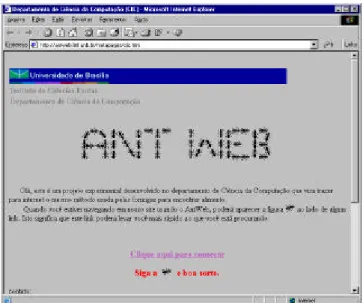
The AntWeb system is implemented in PHP language using MySQL database. Fig. 1 shows the AntWeb´s homepage from which the users access the system to surf. In this article, we used as an example, the site of the Department of Computer Science (CIC) of the University of Brasília (UnB). When the users access this page he must click the "Clique aqui para começar" (“click here to start”) to initiate the navigation. This initial address is only one starting point for the user’s navigation, since he can surf to any other link just normally clicking the links of his interest.
Fig. 1. AntWeb Page
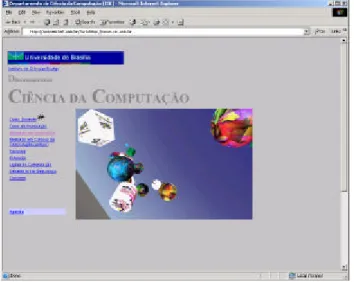
When clicking any link, the user will visualize the same page as if he had typed the URL address in the field of address of his browser. In Fig. 2, we can see what happens when the user enter the AntWeb system. Presuming the user’s objective, the system will mark with an ant the link with greater probability to lead him faster to his aim. Note that the address that is show in
the browser is the AntWeb’s URL (http://antweb.linf.unb.br/?url=http://www.cic.unb.br) as a metaphor page for any Web page accessed, here in our example, the CIC site: “http://www.cic.unb.br”. This happens because the AntWeb system works as a upper level to Web, using the URL as a parameter to the system.
Notice that in Fig. 2, the link “Corpo Docente” is marked with an ant meaning that AntWeb has intercept a pheromone track allied to this link. When clicking this link, the user will be able to follow a pheromone track left by other users. If the user accepts AntWeb’s suggestion he will click the indicated link, what will take him to the new URL (http:// www.cic.unb.br/docentes/docentes.html). Note that this change will change only the parameter to AntWEb address to “http://antweb.linf.unb.br/?url=http://www.cic.unb.br/docentes /docentes.html”. Thus, the user can keep on surfing the Web using the AntWeb system, till he wants to leave it. In this case, he can type any address directly in the address space of the browser.
Fig. 2. CIC Page using AntWeb
To understand better the process used in AntWeb lets take a look at Fig. 3. Normally, the process of accessing any page through a browser is done when the user solicits a page to the Web server allied to the URL address given in the browser. Then, the Web server sends the HTML code of the ordered page to the browser to be shown to the user. Fig. 3 shows what happens when the user solicits a page using AntWeb. First, our user has to access the AntWeb page and do the solicitation of a URL address through it (1). Then, the AntWeb server searches the page requested (2,3) in the allied Web server, verifies the amount of pheromone foreach link of the page, and other data in the data base (4), to know which link will be marked with the ants. After marking the links the system alters the URL of all the links in the page so that they point to the AntWeb server. Then, the system saves a log of the database that will help in the process of updating the pheromone (5). Finally, the AntWeb server gives the modified
version of the HTML page (with the ants in the links), back to the browser, to be shown to the user. This cycle is repeated each time the user clicks a new link.
A. Relating our Model and AntWeb
Related to adaptive hypermedia systems, our approach to AntWeb’s implementation can be classified as a direct indication technique to the users [11]. Following this approach, the links can be either marked, or not marked, with little ants. Thus, the influence over the user is discreet. Also, using this approach, we do not modify the layout of the pages and we can use this with almost all HTML pages.
User
Web server CIC UnB 6-page adapted 1-request of the page to AntWeb Web server AntWeb Data base server 4-pheromone 2-request of the page 3-page 5-log
Fig. 3. How AntWeb works
Consider that all content pages of the site are included in the set of target pages represented by D. Then, we adopted the medium of access to each page to set gd as show bellow:
gd = medium of access to page d
By doing that, AntWeb is able to take the user to the most popular pages of the site though the shortest path. Our objective in this case study is to take the user, to the page with highest probability to be the one that he is looking for, without having asked him any information.
The algorithm used to each Web page of the studied site, solicited through the AntWeb system, has to decide which links to mark with the ants:
equation (8),
2. Highlight the link(s) that have greater probability of being chosen.
The number of links to be saved depends on a configurable parameter of the system. Initially, we will mark one link.
B. The AntWeb Data Base
We now turn to the problem of storing the data used in AntWeb. Four tables form the database:
Log: keeps tracking of the access data in the AntWeb. Each time that a user makes a request to AntWeb it is included a register in this table. Here we have recorded, the IP address of the user, the requested URL, the date and hour that the request was made, and the value of the parameter, “maximum of marked links”, used to adapt the page. If the AntWeb suggest some link(s) to the user, the AntWeb also records the URL and the pheromone amounts allied to them. All this data serves of base for the calculation of the addition of pheromone. While doing the project of this table, we included the maximum data so we could be using it for web-mining in the future.
Pages: This table serves to keep information of the site pages where AntWeb is being used. Information such as the time of visit, the type of page (content or index), and if necessary the corresponding gd value.
Pheromone: This table is responsible for keeping the amounts of pheromone of each page. If a page does not have its URL here it means that the amount of pheromone in this page is equal zero.
Updates: In this table we store data corresponding to the updates of pheromone in the Pheromone table. In this table it is stored the date and hour of the updating, the values of the used parameters, such as the coefficient of evaporation and time of iteration. The main function of this table is to register the alterations of parameters during the cycle of the system (as show in Fig. 3).
C. The Two Modules of AntWeb
The AntWeb was developed in two modules: The first one updates the pheromone and the second one is responsible for the adaptation of the pages. The first module works separately from the second, so the latter can give a faster reply to the user.
1) The Pheromone Updating Module
The pheromone updating module is being executed in second plan in the server and is responsible for keeping the taxes of pheromone of the pages brought up to date. The system follows an object-oriented approach and the defined classes are:
Configuration
:
class responsible for controlling the used parameters in the update of pheromone, such as the coefficient of evaporation and the time of iteration.MySqlConection: class responsible for managing the connection between the application and the Data base server.
PheromoneIncreaser
:
class responsible for the addingfunction of pheromone. Thus, we can only change this class to change the pheromone addition functionwithout causing any change to the system.
PheromoneUpdater
:
class responsible for the update of the pheromone. The update process corresponds the verification if some user have arrived to his destination. If he arrived it is added the pheromone of this user in the pages.PheromoneUpdaterTrigger
:
class responsible for starting all the update process, which keeps being executed in a loop style, pausing before restarting each system cycle.QueryManager: class responsible for managing the transactions made in the database.
UpdateRecorder: class responsible for recording, in the Updates table, the corresponding data of each update.
2) The Adaptation Page Module
The adaptation page module is executed each time the user makes a request to AntWeb and it is responsible for presenting the page with links marked with ants. This module is also developed using an object-oriented approach and a description of the main classes is given bellow.
InternalLinksProcessor: Responsible for transforming the relative paths of links into absolute ones.
LinksGuider: Responsible for altering all the links of the page making them point to AntWeb and adding a parameter to the corresponding URL.
LinksHighlighter: Responsible for marking selected links. LinksSelector: Responsible for selecting links that will be marked based on the tax of pheromone of each one of them and in the gotten parameters of configuration.
Log
:
Responsible for making the register of log in the corresponding table logs.PageLoader
:
Responsible for getting the HTML code of the page to be adapted.PheromoneSetter: Responsible for getting the tax of pheromone of all links of the page.
Sender
:
Responsible for sending the HTML code of the adapted page to the user's browser.TagExtractor: Responsible for extracting the HTML code tag.
Url: Responsible for dealing with the URL of the page to be adapted.
There are some more classes as the Decorator, DecoratorEnd [14], and some others that are the same ones presented in the description of the pheromone-updating module.
IV. CASE STUDY
In this section, we present a cas e study with some experiments using our approach to AntWeb. In our experiments, the parameters to update the pheromone are defined as: coefficient of evaporation (ρ) = 0.3; parameter σ = 1 (see equation 5); and the control constants α = 1 and β = 0, as show in equation 2. Initially, the experiment was done based on simulation of users visiting an artificial site. Every time, the
system generates a user visiting a site, it randomly set a value to the link where the user is to make possible to choose the next link to go. This choice is done according to the value randomly set the present link and the probabilities allied to each optional link to be taken. The initial amount of pheromone is set at 0. The duration of each simulation is 80 seconds, and the interval to generate a visitor every 5 seconds (∆t = 5). Thus, 16 iterations take place for each simulation.
1A
0.3 0.7
2A 2B 2C
0.5 0.5
3A 3B 5 6 9 10
Page 9 is the objective 1 2 3 4
Fig. 4. The structure of a simple Web site considering the wrong trajectory.
A. Reduction of errors in the user’s trajectory
One problem, related to the navigation of a not well-structured site, is the great amount of pages to be accessed during a session to get to the target page. In many cases, users take a wrong trajectory and spend a lot of time to find the target page. When the site is structured as a tree, users tend to click a link with the intention to be taken to the target page. When the user notes that he has lost his way, he usually goes back to the point where he thinks he has gotten lost to try to get the correct path.
Fig. 4 shows an example of a site presented in [12]. Every 5 seconds, a user arrives to visit the site with the target page 9. Suppose that we have obtained the following results of a Web usage from Web Mining: 70% of users take page 2C to 9 and 30% take 2A.
In Fig. 4, consider the starting point 1A, the user needs to decide the next link to go, 2A or 2C, to arrive to target page 9. Applying equations 1 to 7 during our experiment, 16 iterations take place for each simulation. The pheromone is increased 5 times at page 2A and 12 times at page 2C accordingly to the users visiting. Thus, within every updating of page 2A, the quantity of pheromone added is ∆τ2A
9
= 0.2 and finally stay at the 16th interaction with τ2A
9
(16)= 0.17. For page 2C, every needed interaction the quantity of pheromone added is ∆τ2C
9 = 0.5 and finally stay at the 16th interaction with τ2C
9
(16) = 0.49. At the same time, the probability to links 2A and 2C also change to p1A,2A
9
= 0.26 and p1A,2C 9
= 0.74. In this case, the
system indicates that the best route from 1A to target page 9 is to take 2C.
B. Indicating the shortest route
Consider the situation shown in Fig. 5. There are two routes to arrive the page 1, where one route is shorter than other. In this example, 50% of users used the shortest route and 50% the longest one. AntWeb in this case must indicate the shortest route to be taken. Here we did not take into account the fact that the user can choose the wrong path, since we have just considered that in the experiment of Fig. 4.
In Fig. 5, consider the starting point 1A, the user needs to decide the next page to go, 2A or 2B, to arrive to target page 1. During the simulation, the pheromone is increased 7 times at page 2A and 6 times at page 2B. Thus, every needed interaction the quantity of pheromone added is ∆τ2A
1
= 0.3 and finally stay at the 16th interaction with τ2A
1
(16)= 0.28. And within every updating of page 2B, the quantity of pheromone added is ∆τ2B
1
= 0.5 and finally stay at the 16th interaction with
τ2B 1 (16) = 0.49. 1A 0.5 0,5 2A 2B (other pages) 3A 3B
1 Page 1 is the objective
Fig. 5. The structure of a simple Web site with two paths for the same target page.
1A 0,67 0,33 2A 2B 3A 3 0,5 0,5 1 2
Fig. 6. The structure of a simple Web site with more than one target page.
Considering, page 3A it receives 5 increases for the target page 1. Every needed interaction the quantity of pheromone is
∆τ3A 1
= 0.5 and finally at the 16th interaction the pheromone amount is τ3A
1
(16)=0.42. For target page 2, the page 2A received 4 increases. Every needed interaction the quantity of pheromone added is ∆τ3A
2
= 0.5 and at the 16th interaction the pheromone amount is τ3A
2
(16) = 0.38.
Considering page 2B it receives 5 increases for the target page 3. Every interaction the quantity of pheromone added is
∆τ2B 3
= 0.5 and at the 16th interaction the pheromone amount is
τ2B 3
(16)= 0.42.
Finally, target page 1 receives 5 increases and the quantity of pheromone added is ∆τ1
1
= 1 and at the 16th interaction the pheromone amount is τ1
1
(16) = 0.83. While page 2 receives 4 increases and the quantity of pheromone added is ∆τ2
2 =1 and at the 16th interaction the pheromone amount is τ2
2
(16) = 0.76. For page 3 it receives 4 increases and the quantity of pheromone added is ∆τ3
3
= 1 and at the 16th interaction with
τ3 3
(16) = 0.83.
To test the heuristic with more than one target page, the following two cases are studied:
1) First case
Consider guiding users to two pages that equally satisfy his needs (see g in equation 8), but have different path size AntWeb system has to give priority to the shortest path. In this case, consider the set of target pages D = {1, 3} with g1 = 1 and g3 = 1. When the user is in 1A, the probability of the user from 1A to 2A: pD1A,2A= 0.4 and the probability of the user from 1A to 2B: pD1A,2B= 0.6. Thus, p
D 1A,2A < p
D
1A,2B what means that while in page 1A it is best to go to 2B since this is the shortest path.
When the user is in 3A, the probability to go to page 1 is pD3A,1 = 1 and the probability to go to page 2 is p
D
3A,2 = 0. Thus, the heuris tic used guide user to page 1 since 1 ∈ D.
2) Second case
Now, consider that we have different values for g. Our heuristic now considers that our user has two pages with the same size path from the home page, but one of them has double importance to the user. In this case, the set of target pages is D = {1, 2} with g1 = 1 and g2 = 2. When the user is in 1A, the probability of the user from 1A to 2A is pD1A,2A = 1, and the probability of the user from 1A to 2B is pD1A,2B = 0.
When user is in 3A, the probability to go to page 1 is pD3A,1= 0.35 and to go to page 2 is pD3A,2= 0.65. This reflects that the initial parameters g2 is bigger than g1.
V. CONCLUSION
The AntWeb presented combined the ant theory to adaptive Web technology as a new approach under the scientific research of WI. Our contribution is related to different topics of research in WI such as Web agents through navigation guides and recommended systems, Intelligent Human-Web interaction through adaptive Web interfaces and Web mining. As an application, the approach used in AntWeb, can be used
to develop Web-empowered products.
In this paper, we used as an example of application to AntWeb, and also for evaluation, the Web site of the Department of Computer Science in the University of Brasilia. In some sense, this paper presents the state of art of development of the adaptive AntWeb system. Compared to other existing approaches to adaptive Web, we consider that AntWeb complete its functions connecting to the target pages with optimized routes, by means of finding the shortest distance.
During our experiments we noticed some points to be considered for further work:
• The AntWeb’s database stores a rich source of information of visitors that goes beyond a simple log. This information is a rich source for Web mining usage.
• The evaluation of the distribution of pheromone, calculated by AntWeb, is also a good Web mining resource to understand visitor’s behavior.
• The heuristic used for pheromone in AntWeb, can be helpful to guide robots in searching tasks such as Altavista, Google and Northernlight.
• The use of the heuristic of pheromone in AntWeb can be applied to improve Web structures.
Finally, AntWeb is still under evaluation. Clearly, much more implementation work can be done to improve the system. But for the moment, we are convinced that this research deserves a closer look from the research community, specially the ant system and adaptive Web, to give feedback for further applications and even criticism to improve the developed model.
REFERENCES
[1] R. Beckers, J. L. Deneubourg and S. Goss, “Trails and U-turns in the selection of the shortest path by the ant Lasius niger”, Journal of theoretical biology, 159, 397-415, 1992.
[2] M. Dorigo, V. Maniezzo and A. Colorni, “The Ant System: Optimization by a Colony of Cooperating Agents”, IEEE Transactions on Systems, Man, and Cybernetics-Part B, 26(1), 29-41, 1996.
[3] M. Dorigo, G. Di Caro and L. M. Gambardella, “Ant Algorithms for Discrete Optimization. Artificial Life”, 5(2),137-172, 1999. [4] M. Dorigo , G. D. Caro, M. Sampels (Eds.), "Ant Algorithms",
Third International Workshop, ANTS 2002, Brussels, Belgium, September 12-14, 2002, Proceedings. Lecture Notes in Computer Science 2463 Springer 2002.
[5] M. Dorigo, G. Di Caro & L. M. Gambardella (1999), "Ant Algorithms for Discrete Optimization". Artificial Life, 5(2):137-172. Also available as Tech.Rep.IRIDIA/98-10, Université Libre de Bruxelles, Belgium.
[6] J. Liu, Y. Yao and N. Zhong, “In Search of the Wisdom Web”, IEEE Web Intelligence, vol. 35, no. 11, 2002, pp. 27-31.
[7] D. Fensel, “Ontology -Based Knowledge Management”, IEEE Web Intelligence, vol. 35, no. 11, 2002, pp. 56-59.
[8] J. Han and K. Chang, “Data Mining for Web Intelligence”, IEEE Web Intelligence, vol. 35, no. 11, 2002, pp. 64-70.
[9] T. Joachims, D. Freitag, T. Mitchell, "WebWatcher: A Tour Guide for the World Wide Web" , Proceedings of IJCAI97, August 1997 (longer version internal CMU technical report September 1996).
[10] P. Brusilovsky, "Methods and Techniques of adaptive Hyermedia". User Modeling and User Adapted Interaction. V.6, n.2-3, pp.87-129. Special issue on adaptive hipertext and hypermedia, 1996. [11] L. A. M. Palazzo, “Sistemas de Hipermídia Adaptativa”,
Universidade Católica de Pelotas, Escola de Informática.
[12] L. Weigang, M. V. P. Dib, W. M. Teles, V. M. de Andrade, A. C. M. Alves de Melo, J. T. Cariolano, "Using ants’ behavior based simulation model AntWeb to improve website organization", in Proc. SPIE's Aerospace/Defense Sensing and Controls Symposium: Data Mining, Vol. 4730, pp. 229-240, Orlando , USA, April 2002. [13] R. Srikant and Y. Yang, “Mining Web Logs to Improve Website
Organization”, In Proc. of the Tenth International World Wide Web Conference, Hong Kong, May 2001.
[14] E. Gamma, R. Helm, J. Vlissides, R. Johnson, "Design Patterns", Designed by Grady Booch / Hardcover / Addison Wesley Longman, Inc. / October 1994 ISBN 0201633612.
![Fig. 4 shows an example of a site presented in [12]. Every 5 seconds, a user arrives to visit the site with the target page 9](https://thumb-us.123doks.com/thumbv2/123dok_us/9903106.2882161/6.918.496.739.466.990/fig-shows-example-presented-seconds-arrives-visit-target.webp)
