ROCChe: Moving EHRs Upstream Meeting – June 18, 2015
AAMC Health Equity Research and Policy
Introduction
The Health Information Technology for Economic and Clinical Health (HITECH) Act was signed into law in 2009 to promote the adoption and meaningful use of health information technology. The Centers for Medicare and Medicaid Services (CMS) along with the Office of the National Coordinator for Health IT (ONC) define meaningful use criteria and provide incentives for their adoption.
At the request of organizations such as the National Institutes of Health (NIH), the Office of Behavioral and Social Science Research and CMS, the Institute of Medicine (IOM) convened a multidisciplinary committee in 2014 to investigate domains and measures that should be considered by ONC for inclusion in electronic health records (EHR) certified for the meaningful use program. The resulting pair of reports detailed social, behavioral, and psychological (SBP) domains and their respective measures
recommended for inclusion in EHRs for Meaningful Use Stage 3. (Institute of Medicine, 2014).
In 2015, ONC released the 2015 Edition Health IT Certification Criteria. The draft rule builds on the IOM reports’ proposed inclusion of SBP data in EHR certification requirements for meaningful use Stage 3. While there is currently no timeline for the final rule, the collection, integration, and utilization of SPB data could present many opportunities and obstacles.
On June 18th, 2015 members of the health equity subgroup of the Association of American Medical College’s Research on Care Community (ROCChe) convened to discuss these potential rule changes. The meeting aimed to address the following question:
Before a social, behavioral, and psychological (SBP) panel “goes live,” are there research questions ROCChe can address that would lay the foundation for valid collection and optimal utilization of SBP data?
In order to prime ROCChe’s afternoon discussion and action planning, morning presentations included:
Patricia Flatley Brennan, RN, PhD, who provided an overview of the IOM reports on capturing
SBP domains in EHR data and implementation considerations of the incorporation of such data.
Earle C. Chambers, PhD and Samantha Morton, JD who discussed how their respective
institutions were able to incorporate select SBP data in their EHRs for community health improvement programs.
Videos and slides of these presentations can be found on the AAMC Health Equity Research and Policy home page, www.aamc.org/healthequity.
Meaningful use involves three stages of specific requirements that hospitals and eligible professionals must meet in the use of electronic
health record technology before they are eligible for CMS Incentive Programs. Requirements include, improving quality, safety, efficiency,
and reducing health disparities; engaging patients and family; improving care coordination, and population and public health; and
IOM Report on Capturing Social and Behavioral Domains and Measures in EHRs;
implementation Considerations – Patricia Flatley Brennan
In 2014, the IOM released its report on capturing SBP domains and measures EHRs. The report utilizes public health models such as the Kaplan (2000) and Ansari (2003) models in order to select social and behavioral domains that should receive further consideration to be added into EHRs. The IOM selected the domains using the criteria of:
Strength of the evidence for the direct association of the domain with health outcomes. Usefulness of the domain, as measured for
o The individual patient for decision making between the clinician and patient for management and treatment
o The population to describe and monitor population health and making health care– related policy decisions that affect the population cared for by the particular health system or as a whole
o Research to conduct clinical and population health research to learn about the causes of health, the predictors of outcomes of care, and the impact of interventions at multiple levels.
Availability and standard representation of a reliable and valid measure(s) of the domain. Feasibility, that is, whether a burden is placed on the patient and the clinician and the
administrative time and cost of interfaces and storage.
Sensitivity, that is, if patient discomfort regarding revealing personal information is high and there are increased legal or privacy risks.
Accessibility of data from another source. (If information is available from external sources to meet the needs of patient care, population health, and research, then the domains would have less priority).
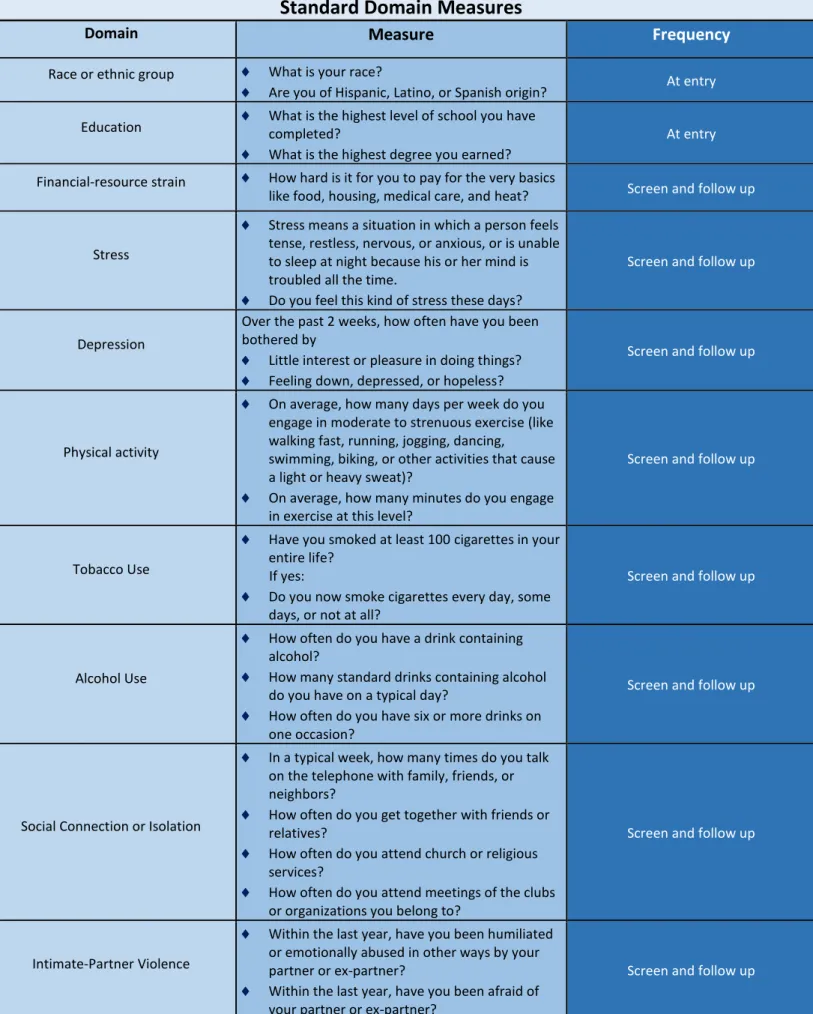
Table 1: Adler & Stead – EHR Capture of Social and Behavioral Determinants of Health
Standard Domain Measures
Domain
Measure
Frequency
Race or ethnic group What is your race?
Are you of Hispanic, Latino, or Spanish origin? At entry Education What is the highest level of school you have completed?
What is the highest degree you earned?
At entry
Financial-resource strain How hard is it for you to pay for the very basics
like food, housing, medical care, and heat? Screen and follow up
Stress
Stress means a situation in which a person feels tense, restless, nervous, or anxious, or is unable to sleep at night because his or her mind is troubled all the time.
Do you feel this kind of stress these days?
Screen and follow up
Depression
Over the past 2 weeks, how often have you been bothered by
Little interest or pleasure in doing things? Feeling down, depressed, or hopeless?
Screen and follow up
Physical activity
On average, how many days per week do you engage in moderate to strenuous exercise (like walking fast, running, jogging, dancing, swimming, biking, or other activities that cause a light or heavy sweat)?
On average, how many minutes do you engage in exercise at this level?
Screen and follow up
Tobacco Use
Have you smoked at least 100 cigarettes in your entire life?
If yes:
Do you now smoke cigarettes every day, some days, or not at all?
Screen and follow up
Alcohol Use
How often do you have a drink containing alcohol?
How many standard drinks containing alcohol do you have on a typical day?
How often do you have six or more drinks on one occasion?
Screen and follow up
Social Connection or Isolation
In a typical week, how many times do you talk on the telephone with family, friends, or neighbors?
How often do you get together with friends or relatives?
How often do you attend church or religious services?
How often do you attend meetings of the clubs or organizations you belong to?
Screen and follow up
Intimate-Partner Violence
Within the last year, have you been humiliated or emotionally abused in other ways by your partner or ex-partner?
Within the last year, have you been afraid of your partner or ex-partner?
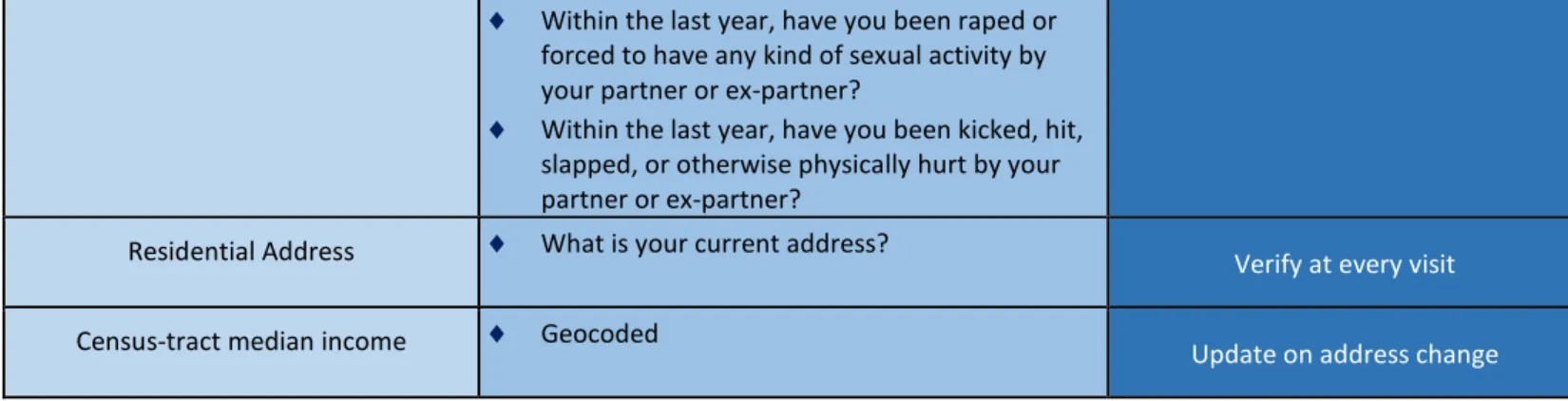
Within the last year, have you been raped or forced to have any kind of sexual activity by your partner or ex-partner?
Within the last year, have you been kicked, hit, slapped, or otherwise physically hurt by your partner or ex-partner?
Residential Address What is your current address? Verify at every visit
Census-tract median income Geocoded Update on address change
The report addresses barriers to including these questions in EHRs.
Table 2: Barriers to SBP Data Inclusion in EHR
Accuracy of self-reported data
Modifications to technologies
Who asks the questions?
Required changes to Workflow
Resources required to collect these data
Community Health Improvement Perspective, Lessons Learned, and Evaluation
Montefiore Medical Center and Albert Einstein College of Medicine Bronx-CATCH
The Bronx-CATCH (Collective Action to Transform Community Health) program was designed to create partnerships between health care, public health, community-based organizations, and other
stakeholders, with the goal of improving the health of local communities throughout the Bronx. The Bronx-CATCH focuses on addressing obesity/diabetes, hypertension, and cancer through food access, fitness, and smoking cessation/prevention interventions.
Interaction with EHR
The CATCH program utilizes data currently available in the EHR such as race, tobacco use, preferred language, and residential address. In addition, physical activity and dietary patterns from New York City’s community health survey (CHS) were added to the EHR.
Successes
• Partnership with local organizations/stakeholders • Incorporation of CHS questions into EHR + trainings • Extraction of EHR data + comparison to
neighborhood level data
• Implementation of interventions with preliminary evaluations underway
Challenges
• Provider fatigue regarding questionnaire • Developing useful feedback to clinicians • Developing tracking mechanisms within EHR • Evaluation of the workflow in collecting the
EHR data
• Limited staff to oversee data collection, management, analysis, and feedback collection, management, analysis, and feedback
• Change in hospital priorities over time + no extra funding
• Change in EHR system (EPIC)
1. Partnership with local
organizations/stakeho lders
•Getting buy-in from health department and medical directors at clinic sites helps convey the importance of measures to hospital
management.
•Department of Health runs CHS training sessions at clinics
2. Incorporation of CHS questions into
EHR + trainings
•Communication with IT Department regarding design of data collection within the EHR (when to administer, how to bypass if necessary, etc)
•Consistent testing of validity of data to ensure that accurate data is being collected (drop down menu vs. write-in fields)
•Identifying who will ask questions and training of those staff in how to access questions in EHR and ask them correctly to patients
Extraction of EHR data + comparison to
neighborhood level data
•Are we able to get data out on the back end in a format that is easily analyzed using our statistical software packages?
•What are neighborhoods?
Steps to Implementation
Outcomes and Findings
As a result from these efforts, the Bronx-CATCH program was able to gather and analyze determinants of health in neighborhoods using both clinical and population level data. The data was also geocoded to create visual profiles of neighborhood demographics and behaviors. A study comparing CHS and EHR data found higher proportions of unhealthy behaviors in patients (EHR) than baseline neighborhood data (CHS) (Chambers, 2015). The ability to combine clinical and population-level data provided many insights on the health of neighborhood and the impact of different environmental factors on patient and neighborhood health.
Boston Medical Center Department of Pediatrics’ Utility Shut-Off Protection Campaign
The state of Massachusetts offers utility shut-off protection, which is a guarantee of uninterrupted utility access for vulnerable individuals and families. As shut-off protection requires a doctor’s letter, the Boston Medical-Legal Partnership (MLP) partnered with Boston Medical center to develop anintervention that included:
Providing training for physicians regarding utility shut-off protection
Developing a template for utility shut-off protection letters
Integrating of shut-off protection letter templates and related guidance in EHR
Referring the more complex cases to the MLP to MLP for more complex cases
Interaction with EHR
The Boston MLP created a template and related forms for shut-off protection letters that physicians can generate for their patient through the EHR. Rather than drafting an entire letter, the template included paragraphs and text-boxes for physicians to fill in data such as utility provider and pertinent medical information. In addition, the EHR data can be accessed across databases.
Impact
676 shut-off protection letters signed from 2008-09, a 350% increase from
baseline (193 in 2005-06)
Better understanding of context in which patients
make theseletter
requests, and the role providers are expected to
play under current public policy
Improved work flow – centralized access to templates and related
forms on EHR
Data-driven engagement with the issue, including ability
to track letter generation via EHR
Helped guide advocacy for policy change by the MA Department of Public
Utilities in its review of policies
Discussion: Research questions ROCChe can address that would lay the
foundation for valid collection and optimal utilization of SBP data
Following the morning presentations, ROCChe members reconvened for an afternoon discussion about the benefits and challenges of SBP data inclusion in EHRs. The goal of the conversation was to develop a list of research questions – the answers to which would lay the foundation for the collection and utilization of SBP data that would maximally benefit patients and
communities.
Community members, patients, and health systems were identified as the main stakeholders who would be directly involved with the potential implementation and evaluation of inclusion of SBP data in EHRs. Active input and engagement from each group are valuable for addressing not only process-oriented questions (e.g. How to collect SBP data in the most valid way?), but also to address the overall utility of collecting SBP data in EHRs (e.g. What would a care team do with SBP data once available?)
Table 3 delineates the process and utility-focused research questions ROCChe identified for the community, patients, and the health system.
Table 3: Process and Utility Focused Research Questions for Inclusion of SBP data in EHRs
Process Utility
Community
What are effective processes in engaging the community? (in terms of buy in, participation, learning effective ways to collect data)
Who are the relevant community stakeholders? How do we bridge stakeholders on SBP?
How can we frame EHR data and its use in a way that appears relevant to stakeholders such on a community level? (e.g. using the EHR data to guide community health needs assessments (CHNA))
What are the community perceptions of IOM recommendations?
How to align these data streams to expand care beyond clinical care (ex. CHNAs)? What is the impact of certain domains on
health outcomes and how can it be used to address community health disparities?
Patients
How would patients feel if they were asked these SBP questions?
What is the best process to gather valid data?
How can patient SBP data be shared between institutions who might use different EHR vendors?
How would patients prefer to be asked these SBP questions? By whom? Do patients see the relevance of SBP
domains to their health care?
What is the impact of certain domains on health outcomes and how can it be used to improve patient treatment?
How can patient SBP data be used in conjunction with corresponding
neighborhood or population level data in identifying the best treatments.
Health Systems
Who is going to ask the questions? Whose workflow is this going to fall under?
How can physicians be educated to understand the relevant background and relevance of metrics/domains? How do we get the provider and
physician community to engage with this project beyond what is required? Is it important to standardize the
collection process across systems or will different processes work best in
different systems? Could we study this via comparative effectiveness research?
How does a health system take this information and report it back to patients? How does a health care team use this
information to improve care for patients? Who would this team be composed of?
Next Steps
Funding
In order to answer research questions in the patient/process domain, ROCChe agreed that exploring funding for cross-site research opportunities is an important next step. Three funding opportunities were presented:
1.
The Kresge Foundation
One of the aims of the Accelerating Community-Centered Approaches in Health grants is to improve health at the community level. The ultimate goal is a comprehensive health system that improves health outcomes and promotes health equity. The foundation invests in:
1. Community-based collaborations -roots organizations.
2. Leadership development to strengthen public health organizations and practices
3. Programs and policy efforts that spread successful program models and policies that link clinic and community to improve the health of vulnerable populations
Applications are accepted on a rolling basis.
2.
Robert Wood Johnson Foundation (RWJF)
Evidence for Action: Investigator-Initiated Research to Build a Culture of Health funds research projects across four action areas defined by the Culture of Health Action Framework. The integration of SBP data into EHRs falls under Action Area 4: Strengthening integration of Health Services and Systems:
• Strengthen a system of coordinated care
• Support data sharing among clinicians and health systems
• Partnerships with communities to address needs of residents
Applications are accepted on a rolling basis. An informational webinar will take place on July 22nd
to provide an overview, as well as answer questions about this opportunity.
3.
Patient Centered Outcomes Research Institute (PCORI)
PCORI is seeking applications for comparing health system-level approaches to improving access, supporting patient self-care, innovative uses of health information technology, coordinating care or complex conditions, and deploying the workforce effectively. The LOI for cycle 3 is due by November 12th.
The meeting members expressed interest in submitting a funding proposal by November 2015. For subsequent ROCChe meetings, we aim to discuss the next steps of applying for funding, including:
Collaboration across institutions o Cross-site proposal submission
Specific research questions to investigate
Aligning research questions to the aim of grant opportunities.
References
Ansari, Z., N. J. Carson, M. J. Ackland, L. Vaughan, and A. Serraglio. 2003. A public health model of the social determinants of health. Soz Präventivmed 48(4):242–251.
HealthIT.gov. (2015, March 13). Health IT Certification and EHR Incentives. Retrieved June 29, 2015, from http://www.healthit.gov/policy-researchers-implementers/certification-and-ehr-incentives Kaplan GA, Everson SA, Lynch JK. Promoting Health Strategies from Social and Behavioral Research (see Appendix A) Washington, DC: National Academy Press; 2000. (The contribution of social and behavioral research to an understanding of the distribution of disease: A multilevel approach. Paper commissioned by the Committee on Capitalizing on Social Science and Behavioral Research to Improve the Public's Health).
Human and Health Services Department. (2015, March 30). 2015 Edition Health Information Technology (Health IT) Certification Criteria, 2015 Edition Base Electronic Health Record (EHR) Definition, and ONC Health IT Certification Program Modifications. Retrieved June 29, 2015, from
https://federalregister.gov/a/2015-06612
Institute of Medicine. (2014). Capturing social and behavioral domains and measures in electronic health records: Phase 2. National Academy of Sciences.
Adler, N., Stead, W. Patients in Context – EHR Capture of Social and Behavioral Determinants of Health. N Engl J Med. 2015; 372(8): 698-701. DOI: 10.1056/NEJMp1413945.