Ken Bogart
Dept. of Mathematics Dartmouth College
Scot Drysdale
Dept. of Computer Science Dartmouth College
Cliff Stein
Dept. of Industrial Engineering and Operations Research Columbia University
c
Contents
1 Counting 1
1.1 Basic Counting . . . 1
The Sum Principle . . . 1
Abstraction . . . 2
Summing Consecutive Integers . . . 3
The Product Principle . . . 3
Two element subsets . . . 5
Important Concepts, Formulas, and Theorems . . . 6
Problems . . . 7
1.2 Counting Lists, Permutations, and Subsets. . . 9
Using the Sum and Product Principles . . . 9
Lists and functions . . . 10
The Bijection Principle . . . 12
k-element permutations of a set . . . 13
Counting subsets of a set . . . 13
Important Concepts, Formulas, and Theorems . . . 15
Problems . . . 16
1.3 Binomial Coefficients . . . 19
Pascal’s Triangle . . . 19
A proof using the Sum Principle . . . 20
The Binomial Theorem . . . 22
Labeling and trinomial coefficients . . . 23
Important Concepts, Formulas, and Theorems . . . 24
Problems . . . 25
1.4 Equivalence Relations and Counting (Optional) . . . 27
The Symmetry Principle . . . 27 iii
Equivalence Relations . . . 28
The Quotient Principle . . . 29
Equivalence class counting . . . 30
Multisets . . . 31
The bookcase arrangement problem. . . 32
The number of k-element multisets of ann-element set. . . 33
Using the quotient principle to explain a quotient . . . 34
Important Concepts, Formulas, and Theorems . . . 34
Problems . . . 35
2 Cryptography and Number Theory 39 2.1 Cryptography and Modular Arithmetic . . . 39
Introduction to Cryptography . . . 39
Private Key Cryptography . . . 40
Public-key Cryptosystems . . . 42
Arithmetic modulo n . . . 43
Cryptography using multiplication mod n . . . 47
Important Concepts, Formulas, and Theorems . . . 48
Problems . . . 49
2.2 Inverses and GCDs . . . 52
Solutions to Equations and Inverses mod n . . . 52
Inverses mod n . . . 53
Converting Modular Equations to Normal Equations . . . 55
Greatest Common Divisors (GCD) . . . 55
Euclid’s Division Theorem . . . 56
The GCD Algorithm . . . 58
Extended GCD algorithm . . . 59
Computing Inverses . . . 61
Important Concepts, Formulas, and Theorems . . . 62
Problems . . . 63
2.3 The RSA Cryptosystem . . . 66
Exponentiation modn . . . 66
The Rules of Exponents . . . 66
The RSA Cryptosystem . . . 69
The Chinese Remainder Theorem . . . 72
Important Concepts, Formulas, and Theorems . . . 73
Problems . . . 74
2.4 Details of the RSA Cryptosystem . . . 76
Practical Aspects of Exponentiation modn . . . 76
How long does it take to use the RSA Algorithm? . . . 77
How hard is factoring? . . . 78
Finding large primes . . . 78
Important Concepts, Formulas, and Theorems . . . 81
Problems . . . 81
3 Reflections on Logic and Proof 83 3.1 Equivalence and Implication . . . 83
Equivalence of statements . . . 83
Truth tables . . . 85
DeMorgan’s Laws . . . 88
Implication . . . 89
Important Concepts, Formulas, and Theorems . . . 92
Problems . . . 94
3.2 Variables and Quantifiers . . . 96
Variables and universes . . . 96
Quantifiers . . . 97
Standard notation for quantification . . . 98
Statements about variables . . . 99
Rewriting statements to encompass larger universes . . . 100
Proving quantified statements true or false . . . 101
Negation of quantified statements . . . 101
Implicit quantification . . . 103
Proof of quantified statements . . . 104
Important Concepts, Formulas, and Theorems . . . 105
Problems . . . 106
3.3 Inference . . . 108
Rules of inference for direct proofs . . . 109
Contrapositive rule of inference. . . 110
Proof by contradiction . . . 112
Important Concepts, Formulas, and Theorems . . . 114
Problems . . . 115
4 Induction, Recursion, and Recurrences 117 4.1 Mathematical Induction . . . 117
Smallest Counter-Examples . . . 117
The Principle of Mathematical Induction . . . 120
Strong Induction . . . 123
Induction in general . . . 124
Important Concepts, Formulas, and Theorems . . . 125
Problems . . . 126
4.2 Recursion, Recurrences and Induction . . . 128
Recursion . . . 128
First order linear recurrences . . . 129
Iterating a recurrence . . . 130
Geometric series . . . 131
First order linear recurrences . . . 133
Important Concepts, Formulas, and Theorems . . . 136
Problems . . . 137
4.3 Growth Rates of Solutions to Recurrences . . . 139
Divide and Conquer Algorithms . . . 139
Recursion Trees . . . 140
Three Different Behaviors . . . 146
Important Concepts, Formulas, and Theorems . . . 148
Problems . . . 148
4.4 The Master Theorem . . . 150
Master Theorem . . . 150
Solving More General Kinds of Recurrences . . . 152
More realistic recurrences (Optional) . . . 154
Recurrences for general n(Optional) . . . 155
Important Concepts, Formulas, and Theorems . . . 159
Problems . . . 161
4.5 More general kinds of recurrences . . . 163
Recurrence Inequalities . . . 163
A Wrinkle with Induction . . . 164
Further Wrinkles in Induction Proofs . . . 165
Dealing with Functions Other Than nc . . . 167
Important Concepts, Formulas, and Theorems . . . 171
Problems . . . 172
4.6 Recurrences and Selection . . . 174
The idea of selection . . . 174
A recursive selection algorithm . . . 174
Selection without knowing the median in advance . . . 175
An algorithm to find an element in the middle half . . . 177
An analysis of the revised selection algorithm . . . 179
Uneven Divisions . . . 180
Important Concepts, Formulas, and Theorems . . . 182
Problems . . . 182
5 Probability 185 5.1 Introduction to Probability . . . 185
Why do we study probability? . . . 185
Some examples of probability computations . . . 186
Complementary probabilities . . . 187
Probability and hashing . . . 188
The Uniform Probability Distribution . . . 188
Important Concepts, Formulas, and Theorems . . . 191
Problems . . . 192
5.2 Unions and Intersections . . . 194
The probability of a union of events . . . 194
Principle of inclusion and exclusion for probability . . . 196
The principle of inclusion and exclusion for counting . . . 200
Important Concepts, Formulas, and Theorems . . . 201
5.3 Conditional Probability and Independence . . . 204
Conditional Probability . . . 204
Independence . . . 206
Independent Trials Processes . . . 208
Tree diagrams . . . 209
Important Concepts, Formulas, and Theorems . . . 212
Problems . . . 213
5.4 Random Variables . . . 215
What are Random Variables? . . . 215
Binomial Probabilities . . . 215
Expected Value . . . 218
Expected Values of Sums and Numerical Multiples . . . 220
The Number of Trials until the First Success . . . 222
Important Concepts, Formulas, and Theorems . . . 224
Problems . . . 225
5.5 Probability Calculations in Hashing . . . 227
Expected Number of Items per Location . . . 227
Expected Number of Empty Locations . . . 228
Expected Number of Collisions . . . 228
Expected maximum number of elements in a slot of a hash table (Optional) . . . 230
Important Concepts, Formulas, and Theorems . . . 234
Problems . . . 235
5.6 Conditional Expectations, Recurrences and Algorithms . . . 237
When Running Times Depend on more than Size of Inputs . . . 237
Conditional Expected Values . . . 238
Randomized algorithms . . . 240
A more exact analysis of RandomSelect . . . 245
Important Concepts, Formulas, and Theorems . . . 247
Problems . . . 248
5.7 Probability Distributions and Variance . . . 251
Distributions of random variables . . . 251
Variance . . . 253
Important Concepts, Formulas, and Theorems . . . 258
6 Graphs 263
6.1 Graphs . . . 263
The degree of a vertex . . . 265
Connectivity . . . 267
Cycles . . . 269
Trees . . . 269
Other Properties of Trees . . . 270
Important Concepts, Formulas, and Theorems . . . 272
Problems . . . 274
6.2 Spanning Trees and Rooted Trees . . . 276
Spanning Trees . . . 276
Breadth First Search . . . 278
Rooted Trees . . . 281
Important Concepts, Formulas, and Theorems . . . 283
Problems . . . 285
6.3 Eulerian and Hamiltonian Paths and Tours . . . 288
Eulerian Tours and Trails . . . 288
Hamiltonian Paths and Cycles . . . 291
NP-Complete Problems . . . . 295
Important Concepts, Formulas, and Theorems . . . 297
Problems . . . 298
6.4 Matching Theory . . . 300
The idea of a matching . . . 300
Making matchings bigger . . . 303
Matching in Bipartite Graphs . . . 305
Searching for Augmenting Paths in Bipartite Graphs . . . 306
The Augmentation-Cover algorithm . . . 307
Good Algorithms . . . 309
Important Concepts, Formulas, and Theorems . . . 310
Problems . . . 311
6.5 Coloring and planarity . . . 313
The idea of coloring . . . 313
Interval Graphs . . . 315
The Faces of a Planar Drawing . . . 318
The Five Color Theorem . . . 321
Important Concepts, Formulas, and Theorems . . . 323
Counting
1.1
Basic Counting
The Sum Principle
We begin with an example that illustrates a fundamental principle.
Exercise 1.1-1 The loop below is part of an implementation of selection sort, which sorts a list of items chosen from an ordered set (numbers, alphabet characters, words, etc.) into non-decreasing order.
(1) for i= 1 to n−1
(2) for j=i+ 1 to n
(3) if (A[i]> A[j])
(4) exchange A[i] and A[j]
How many times is the comparisonA[i]> A[j] made in Line 3?
In Exercise 1.1-1, the segment of code from lines 2 through 4 is executed n−1 times, once for each value of i between 1 and n−1 inclusive. The first time, it makes n−1 comparisons. The second time, it makesn−2 comparisons. The ith time, it makes n−icomparisons. Thus the total number of comparisons is
(n−1) + (n−2) +· · ·+ 1. (1.1)
This formula is not as important as the reasoning that lead us to it. In order to put the reasoning into a broadly applicable format, we will describe what we were doing in the language of sets. Think about the setS containing all comparisons the algorithm in Exercise 1.1-1 makes. We divided setS inton−1 pieces (i.e. smaller sets), the setS1 of comparisons made wheni= 1,
the setS2 of comparisons made wheni= 2, and so on through the setSn−1of comparisons made
wheni=n−1. We were able to figure out the number of comparisons in each of these pieces by observation, and added together the sizes of all the pieces in order to get the size of the set of all comparisons.
in order to describe a general version of the process we used, we introduce some set-theoretic terminology. Two sets are called disjoint when they have no elements in common. Each of the setsSi we described above is disjoint from each of the others, because the comparisons we make for one value of i are different from those we make with another value of i. We say the set of sets{S1, . . . , Sm} (above, m was n−1) is a family of mutually disjoint sets, meaning that it is a family (set) of sets, any two of which are disjoint. With this language, we can state a general principle that explains what we were doing without making any specific reference to the problem we were solving.
Principle 1.1 (Sum Principle) The size of a union of a family of mutually disjoint finite sets is the sum of the sizes of the sets.
Thus we were, in effect, using the sum principle to solve Exercise 1.1-1. We can describe the sum principle using an algebraic notation. Let |S| denote the size of the set S. For example,
|{a, b, c}|= 3 and |{a, b, a}|= 2.1 Using this notation, we can state the sum principle as: if S 1,
S2, . . .Sm are disjoint sets, then
|S1∪S2∪ · · · ∪Sm|=|S1|+|S2|+· · ·+|Sm|. (1.2) To write this without the “dots” that indicate left-out material, we write
| m i=1 Si|= m i=1 |Si|.
When we can write a set S as a union of disjoint sets S1, S2, . . . , Sk we say that we have
partitionedS into the setsS1,S2, . . . ,Sk, and we say that the setsS1,S2, . . . ,Skform apartition ofS. Thus{{1},{3,5},{2,4}}is a partition of the set{1,2,3,4,5}and the set{1,2,3,4,5}can be partitioned into the sets{1},{3,5},{2,4}. It is clumsy to say we are partitioning a set into sets, so instead we call the sets Si into which we partition a set S the blocks of the partition. Thus the sets {1}, {3,5}, {2,4} are the blocks of a partition of {1,2,3,4,5}. In this language, we can restate the sum principle as follows.
Principle 1.2 (Sum Principle) If a finite set S has been partitioned into blocks, then the size of S is the sum of the sizes of the blocks.
Abstraction
The process of figuring out a general principle that explains why a certain computation makes sense is an example of the mathematical process of abstraction. We won’t try to give a precise definition of abstraction but rather point out examples of the process as we proceed. In a course in set theory, we would further abstract our work and derive the sum principle from the axioms of
1It may look strange to have|{a, b, a}|= 2, but an element either is or is not in a set. It cannot be in a set
multiple times. (This situation leads to the idea of multisets that will be introduced later on in this section.) We
gave this example to emphasize that the notation{a, b, a}means the same thing as{a, b}. Why would someone
even contemplate the notation {a, b, a}. Suppose we wrote S = {x|xis the first letter of Ann, Bob, or Alice}.
set theory. In a course in discrete mathematics, this level of abstraction is unnecessary, so we will simply use the sum principle as the basis of computations when it is convenient to do so. If our goal were only to solve this one exercise, then our abstraction would have been almost a mindless exercise that complicated what was an “obvious” solution to Exercise 1.1-1. However the sum principle will prove to be useful in a wide variety of problems. Thus we observe the value of abstraction—when you can recognize the abstract elements of a problem, then abstraction often helps you solve subsequent problems as well.
Summing Consecutive Integers
Returning to the problem in Exercise 1.1-1, it would be nice to find a simpler form for the sum given in Equation 1.1. We may also write this sum as
n−1
i=1
n−i.
Now, if we don’t like to deal with summing the values of (n−i), we can observe that the values we are summing aren−1, n−2, . . . ,1, so we may write that
n−1 i=1 n−i= n−1 i=1 i.
A clever trick, usually attributed to Gauss, gives us a shorter formula for this sum. We write
1 + 2 + · · · + n−2 + n−1
+ n−1 + n−2 + · · · + 2 + 1
n + n + · · · + n + n
The sum below the horizontal line hasn−1 terms each equal ton, and thus it isn(n−1). It is the sum of the two sums above the line, and since these sums are equal (being identical except for being in reverse order), the sum below the line must be twice either sum above, so either of the sums above must ben(n−1)/2. In other words, we may write
n−1 i=1 n−i= n−1 i=1 i= n(n−1) 2 .
This lovely trick gives us little or no real mathematical skill; learning how to think about things to discover answers ourselves is much more useful. After we analyze Exercise 1.1-2 and abstract the process we are using there, we will be able to come back to this problem at the end of this section and see a way that we could have discovered this formula for ourselves without any tricks.
The Product Principle
Exercise 1.1-2 The loop below is part of a program which computes the product of two matrices. (You don’t need to know what the product of two matrices is to answer this question.)
(1) for i= 1 to r (2) for j= 1 to m (3) S= 0 (4) for k= 1 to n (5) S =S+A[i, k]∗B[k, j] (6) C[i, j] =S
How many multiplications (expressed in terms of r, m, and n) does this code carry out in line 5?
Exercise 1.1-3 Consider the following longer piece of pseudocode that sorts a list of num-bers and then counts “big gaps” in the list (for this problem, a big gap in the list is a place where a number in the list is more than twice the previous number:
(1) for i= 1 to n−1 (2) minval =A[i] (3) minindex =i (4) for j=i to n (5) if (A[j]<minval) (6) minval =A[j] (7) minindex =j
(8) exchange A[i] and A[minindex]
(9)
(10) for i= 2 to n
(11) if (A[i]>2∗A[i−1])
(12) bigjump = bigjump +1
How many comparisons does the above code make in lines 5 and 11 ?
In Exercise 1.1-2, the program segment in lines 4 through 5, which we call the “inner loop,” takes exactlynsteps, and thus makesnmultiplications, regardless of what the variablesiand j are. The program segment in lines 2 through 5 repeats the inner loop exactlymtimes, regardless of what i is. Thus this program segment makes n multiplications m times, so it makes nm multiplications.
Why did we add in Exercise 1.1-1, but multiply here? We can answer this question using the abstract point of view we adopted in discussing Exercise 1.1-1. Our algorithm performs a certain set of multiplications. For any given i, the set of multiplications performed in lines 2 through 5 can be divided into the set S1 of multiplications performed when j = 1, the set S2 of
multiplications performed when j = 2, and, in general, the setSj of multiplications performed for any given j value. Each set Sj consists of those multiplications the inner loop carries out for a particular value of j, and there are exactly n multiplications in this set. Let Ti be the set of multiplications that our program segment carries out for a certain i value. The setTi is the union of the setsSj; restating this as an equation, we get
Ti= m j=1
Then, by the sum principle, the size of the setTi is the sum of the sizes of the setsSj, and a sum ofm numbers, each equal to n, ismn. Stated as an equation,
|Ti|=| m j=1 Sj|= m j=1 |Sj|= m j=1 n=mn. (1.3)
Thus we are multiplying because multiplication is repeated addition!
From our solution we can extract a second principle that simply shortcuts the use of the sum principle.
Principle 1.3 (Product Principle) The size of a union of m disjoint sets, each of size n, is
mn.
We now complete our discussion of Exercise 1.1-2. Lines 2 through 5 are executed once for each value ofifrom 1 tor. Each time those lines are executed, they are executed with a different i value, so the set of multiplications in one execution is disjoint from the set of multiplications in any other execution. Thus the set of all multiplications our program carries out is a union of r disjoint sets Ti of mn multiplications each. Then by the product principle, the set of all multiplications has sizermn, so our program carries out rmn multiplications.
Exercise 1.1-3 demonstrates that thinking about whether the sum or product principle is appropriate for a problem can help to decompose the problem into easily-solvable pieces. If you can decompose the problem into smaller pieces and solve the smaller pieces, then you either add or multiply solutions to solve the larger problem. In this exercise, it is clear that the number of comparisons in the program fragment is the sum of the number of comparisons in the first loop in lines 1 through 8 with the number of comparisons in the second loop in lines 10 through 12 (what two disjoint sets are we talking about here?). Further, the first loop makes n(n+ 1)/2−1 comparisons2, and that the second loop has n−1 comparisons, so the fragment makesn(n+ 1)/2−1 +n−1 =n(n+ 1)/2 +n−2 comparisons.
Two element subsets
Often, there are several ways to solve a problem. We originally solved Exercise 1.1-1 by using the sum principal, but it is also possible to solve it using the product principal. Solving a problem two ways not only increases our confidence that we have found the correct solution, but it also allows us to make new connections and can yield valuable insight.
Consider the set of comparisons made by the entire execution of the code in this exercise. When i= 1, j takes on every value from 2 to n. When i= 2,j takes on every value from 3 to n. Thus, for each two numbersiandj, we compareA[i] andA[j] exactly once in our loop. (The order in which we compare them depends on whether i or j is smaller.) Thus the number of comparisons we make is the same as the number of two element subsets of the set{1,2, . . . , n}3. In how many ways can we choose two elements from this set? If we choose a first and second element, there arenways to choose a first element, and for each choice of the first element, there aren−1 ways to choose a second element. Thus the set of all such choices is the union ofnsets
2To see why this is true, ask yourself first where then(n+ 1)/2 comes from, and then why we subtracted one.
3The relationship between the set of comparisons and the set of two-element subsets of {1,2, . . . , n} is an
of sizen−1, one set for each first element. Thus it might appear that, by the product principle, there are n(n−1) ways to choose two elements from our set. However, what we have chosen is anordered pair, namely a pair of elements in which one comes first and the other comes second. For example, we could choose 2 first and 5 second to get the ordered pair (2,5), or we could choose 5 first and 2 second to get the ordered pair (5,2). Since each pair of distinct elements of {1,2, . . . , n} can be ordered in two ways, we get twice as many ordered pairs as two element sets. Thus, since the number of ordered pairs is n(n−1), the number of two element subsets of
{1,2, . . . , n} is n(n−1)/2. Therefore the answer to Exercise 1.1-1 is n(n−1)/2. This number comes up so often that it has its own name and notation. We call this number “n choose 2” and denote it by n2. To summarize, n2 stands for the number of two element subsets of an n element set and equalsn(n−1)/2. Since one answer to Exercise 1.1-1 is 1 + 2 +· · ·+n−1 and a second answer to Exercise 1.1-1 isn2, this shows that
1 + 2 +· · ·+n−1 = n 2 = n(n−1) 2 .
Important Concepts, Formulas, and Theorems
1. Set. Asetis a collection of objects. In a set order is not important. Thus the set{A, B, C} is the same as the set{A, C, B}. An element either is or is not in a set; it cannot be in a set more than once, even if we have a description of a set which names that element more than once.
2. Disjoint. Two sets are called disjointwhen they have no elements in common.
3. Mutually disjoint sets. A set of sets {S1, . . . , Sn} is a family of mutually disjoint sets, if each two of the setsSi are disjoint.
4. Size of a set. Given a setS, the size ofS, denoted |S|, is the number of distinct elements inS.
5. Sum Principle. The size of a union of a family of mutually disjoint sets is the sum of the sizes of the sets. In other words, ifS1,S2, . . .Sn are disjoint sets, then
|S1∪S2∪ · · · ∪Sn|=|S1|+|S2|+· · ·+|Sn|. To write this without the “dots” that indicate left-out material, we write
| n i=1 Si|= n i=1 |Si|.
6. Partition of a set. A partition of a set S is a set of mutually disjoint subsets (sometimes called blocks) ofS whose union isS.
7. Sum of firstn−1 numbers. n i=1 n−i= n−1 i=1 i= n(n−1) 2 .
8. Product Principle. The size of a union ofm disjoint sets, each of size n, is mn.
9. Two element subsets. n2stands for the number of two element subsets of annelement set and equalsn(n−1)/2. n2 is read as “nchoose 2.”
Problems
1. The segment of code below is part of a program that uses insertion sort to sort a listA
for i= 2 to n
j=i
while j≥2 and A[j]< A[j−1]
exchange A[j] and A[j−1] j− −
What is the maximum number of times (considering all lists ofnitems you could be asked to sort) the program makes the comparisonA[j]< A[j−1]? Describe as succinctly as you can those lists that require this number of comparisons.
2. Five schools are going to send their baseball teams to a tournament, in which each team must play each other team exactly once. How many games are required?
3. Use notation similar to that in Equations 1.2 and 1.3 to rewrite the solution to Exercise 1.1-3 more algebraically.
4. In how many ways can you draw a first card and then a second card from a deck of 52 cards?
5. In how many ways can you draw two cards from a deck of 52 cards.
6. In how many ways may you draw a first, second, and third card from a deck of 52 cards? 7. In how many ways may a ten person club select a president and a secretary-treasurer from
among its members?
8. In how many ways may a ten person club select a two person executive committee from among its members?
9. In how many ways may a ten person club select a president and a two person executive advisory board from among its members (assuming that the president is not on the advisory board)?
10. By using the formula forn2is is straightforward to show that n n−1 2 = n 2 (n−2).
However this proof just uses blind substitution and simplification. Find a more conceptual explanation of why this formula is true.
11. If M is an m element set and N is an n-element set, how many ordered pairs are there whose first member is inM and whose second member is inN?
12. In the local ice cream shop, there are 10 different flavors. How many different two-scoop cones are there? (Following your mother’s rule that it all goes to the same stomach, a cone with a vanilla scoop on top of a chocolate scoop is considered the same as a cone with a a chocolate scoop on top of a vanilla scoop.)
13. Now suppose that you decide to disagree with your mother in Exercise 12 and say that the order of the scoops does matter. How many different possible two-scoop cones are there? 14. Suppose that on day 1 you receive 1 penny, and, fori > 1, on day i you receive twice as
many pennies as you did on dayi−1. How many pennies will you have on day 20? How many will you have on dayn? Did you use the sum or product principal?
15. The “Pile High Deli” offers a “simple sandwich” consisting of your choice of one of five different kinds of bread with your choice of butter or mayonnaise or no spread, one of three different kinds of meat, and one of three different kinds of cheese, with the meat and cheese “piled high” on the bread. In how many ways may you choose a simple sandwich?
1.2
Counting Lists, Permutations, and Subsets.
Using the Sum and Product Principles
Exercise 1.2-1 A password for a certain computer system is supposed to be between 4 and 8 characters long and composed of lower and/or upper case letters. How many passwords are possible? What counting principles did you use? Estimate the percentage of the possible passwords that have exactly four characters.
A good way to attack a counting problem is to ask if we could use either the sum principle or the product principle to simplify or completely solve it. Here that question might lead us to think about the fact that a password can have 4, 5, 6, 7 or 8 characters. The set of all passwords is the union of those with 4, 5, 6, 7, and 8 letters so the sum principle might help us. To write the problem algebraically, letPi be the set ofi-letter passwords andP be the set of all possible passwords. Clearly,
P =P4∪P5∪P6∪P7∪P8 .
ThePi are mutually disjoint, and thus we can apply the sum principal to obtain
|P|=
8
i=4
|Pi|.
We still need to compute|Pi|. For ani-letter password, there are 52 choices for the first letter, 52 choices for the second and so on. Thus by the product principle,|Pi|, the number of passwords withiletters is 52i. Therefore the total number of passwords is
524+ 525+ 526+ 527+ 528. Of these, 524 have four letters, so the percentage with 54 letters is
100·524
524+ 525+ 526+ 527+ 528.
Although this is a nasty formula to evaluate by hand, we can get a quite good estimate as follows. Notice that 528 is 52 times as big as 527, and even more dramatically larger than any other term in the sum in the denominator. Thus the ratio thus just a bit less than
100·524
528,
which is 100/524, or approximately .000014. Thus to five decimal places, only .00001% of the
passwords have four letters. It is therefore much easier guess a password that we know has four letters than it is to guess one that has between 4 and 8 letters—roughly 7 million times easier!
In our solution to Exercise 1.2-1, we casually referred to the use of the product principle in computing the number of passwords withi letters. We didn’t write any set as a union of sets of equal size. We could have, but it would have been clumsy and repetitive. For this reason we will state a second version of the product principle that we can derive from the version for unions of sets by using the idea of mathematical induction that we study in Chapter 4.
Principle 1.4 (Product Principle, Version 2) If a setS of lists of length mhas the proper-ties that
1. There are i1 different first elements of lists in S, and
2. For eachj >1 and each choice of the firstj−1 elements of a list inS there are ij choices
of elements in position j of those lists, then there are i1i2· · ·im =mk=1ik lists in S.
Let’s apply this version of the product principle to compute the number ofm-letter passwords. Since anm-letter password is just a list ofmletters, and since there are 52 different first elements of the password and 52 choices for each other position of the password, we have thati1= 52, i2 =
52, . . . , im = 52. Thus, this version of the product principle tells us immediately that the number of passwords of lengthm isi1i2· · ·im = 52m.
In our statement of version 2 of the Product Principle, we have introduced a new notation, the use of Π to stand for product. This notation is called the product notation, and it is used just like summation notation. In particular,mk=1ik is read as “The product fromk= 1 tomof ik.” Thus mk=1ik means the same thing asi1·i2· · ·im.
Lists and functions
We have left a term undefined in our discussion of version 2 of the product principle, namely the word “list.” A list of 3 things chosen from a set T consists of a first member t1 of T, a
second membert2 of T, and a third member t3 of T. If we rewrite the list in a different order,
we get a different list. A list of kthings chosen from T consists of a first member of T through akth member ofT. We can use the word “function,” which you probably recall from algebra or calculus, to be more precise.
Recall that a function from a set S (called the domain of the function) to a set T (called the range of the function) is a relationship between the elements of S and the elements of T that relates exactly one element ofT to each element ofS. We use a letter like f to stand for a function and usef(x) to stand for the one and only one element of T that the function relates to the elementx of S. You are probably used to thinking of functions in terms of formulas like f(x) =x2. We need to use formulas like this in algebra and calculus because the functions that you study in algebra and calculus have infinite sets of numbers as their domains and ranges. In discrete mathematics, functions often have finite sets as their domains and ranges, and so it is possible to describe a function by saying exactly what it is. For example
f(1) = Sam, f(2) = Mary, f(3) = Sarah
is a function that describes a list of three people. This suggests a precise definition of a list of k elements from a set T: A list ofk elements from a set T is a function from {1,2, . . . , k} toT. Exercise 1.2-2 Write down all the functions from the two-element set {1,2} to the
two-element set{a, b}.
Exercise 1.2-3 How many functions are there from a two-element set to a three element set?
Exercise 1.2-4 How many functions are there from a three-element set to a two-element set?
In Exercise 1.2-2 one thing that is difficult is to choose a notation for writing the functions down. We will usef1,f2, etc., to stand for the various functions we find. To describe a function
fi from {1,2}to{a, b}we have to specifyfi(1) andfi(2). We can write f1(1) =a f1(2) =b
f2(1) =b f2(2) =a
f3(1) =a f3(2) =a
f4(1) =b f4(2) =b
We have simply written down the functions as they occurred to us. How do we know we have all of them? The set of all functions from{1,2} to{a, b} is the union of the functionsfi that have fi(1) =a and those that have fi(1) =b. The set of functions with fi(1) =a has two elements, one for each choice offi(2). Therefore by the product principle the set of all functions from{1,2} to{a, b} has size 2·2 = 4.
To compute the number of functions from a two element set (say {1,2}) to a three element set, we can again think of usingfi to stand for a typical function. Then the set of all functions is the union of three sets, one for each choice offi(1). Each of these sets has three elements, one for each choice of fi(2). Thus by the product principle we have 3·3 = 9 functions from a two element set to a three element set.
To compute the number of functions from a three element set (say{1,2,3}) to a two element set, we observe that the set of functions is a union of four sets, one for each choice of fi(1) and fi(2) (as we saw in our solution to Exercise 1.2-2). But each of these sets has two functions in it, one for each choice offi(3). Then by the product principle, we have 4·2 = 8 functions from a three element set to a two element set.
A functionf is called one-to-oneor an injectionif whenever x=y,f(x)=f(y). Notice that the two functions f1 and f2 we gave in our solution of Exercise 1.2-2 are one-to-one, but f3 and
f4 are not.
A function f is called onto or a surjection if every element y in the range is f(x) for some x in the domain. Notice that the functions f1 and f2 in our solution of Exercise 1.2-2 are onto
functions butf3 and f4 are not.
Exercise 1.2-5 Using two-element sets or three-element sets as domains and ranges, find an example of a one-to-one function that is not onto.
Exercise 1.2-6 Using two-element sets or three-element sets as domains and ranges, find an example of an onto function that is not one-to-one.
Notice that the function given byf(1) =c,f(2) =a is an example of a function from{1,2} to{a, b, c} that is one-to one but not onto.
Also, notice that the function given by f(1) = a, f(2) = b, f(3) = a is an example of a function from {1,2,3}to{a, b}that is onto but not one to one.
The Bijection Principle
Exercise 1.2-7 The loop below is part of a program to determine the number of triangles formed byn points in the plane.
(1) trianglecount = 0
(2) for i= 1 to n
(3) for j=i+ 1 to n
(4) for k=j+ 1 to n
(5) if points i, j, and k are not collinear
(6) trianglecount = trianglecount +1
How many times does the above code check three points to see if they are collinear in line 5?
In Exercise 1.2-7, we have a loop embedded in a loop that is embedded in another loop. Because the second loop, starting in line 3, begins with j = i+ 1 and j increase up to n, and because the third loop, starting in line 4, begins withk=j+ 1 and increases up ton, our code examines each triple of values i, j, k with i < j < k exactly once. For example, if n is 4, then the triples (i, j, k) used by the algorithm, in order, are (1,2,3), (1,2,4), (1,3,4), and (2,3,4). Thus one way in which we might have solved Exercise 1.2-7 would be to compute the number of such triples, which we will call increasing triples. As with the case of two-element subsets earlier, the number of such triples is the number of three-element subsets of an n-element set. This is the second time that we have proposed counting the elements of one set (in this case the set of increasing triples chosen from an n-element set) by saying that it is equal to the number of elements of some other set (in this case the set of three element subsets of an n-element set). When are we justified in making such an assertion that two sets have the same size? There is another fundamental principle that abstracts our concept of what it means for two sets to have the same size. Intuitively two sets have the same size if we can match up their elements in such a way that each element of one set corresponds to exactly one element of the other set. This description carries with it some of the same words that appeared in the definitions of functions, one-to-one, and onto. Thus it should be no surprise that one-to-one and onto functions are part of our abstract principle.
Principle 1.5 (Bijection Principle) Two sets have the same size if and only if there is a one-to-one function from one set onto the other.
Our principle is called thebijection principlebecause a one-to-one and onto function is called abijection. Another name for a bijection is a one-to-one correspondence. A bijection from a set to itself is called apermutationof that set.
What is the bijection that is behind our assertion that the number of increasing triples equals the number of three-element subsets? We define the function f to be the one that takes the increasing triple (i, j, k) to the subset {i, j, k}. Since the three elements of an increasing triple are different, the subset is a three element set, so we have a function from increasing triples to three element sets. Two different triples can’t be the same set in two different orders, so different triples have to be associated with different sets. Thusf is one-to-one. Each set of three integers can be listed in increasing order, so it is the image underf of an increasing triple. Therefore f is onto. Thus we have a one-to-one correspondence, or bijection, between the set of increasing triples and the set of three element sets.
k-element permutations of a set
Since counting increasing triples is equivalent to counting three-element subsets, we can count increasing triples by counting three-element subsets instead. We use a method similar to the one we used to compute the number of two-element subsets of a set. Recall that the first step was to compute the number of ordered pairs of distinct elements we could chose from the set
{1,2, . . . , n}. So we now ask in how many ways may we choose an ordered triple of distinct elements from {1,2, . . . , n}, or more generally, in how many ways may we choose a list of k distinct elements from{1,2, . . . , n}. A list of k-distinct elements chosen from a setN is called a k-element permutation ofN.4
How many 3-element permutations of {1,2, . . . , n} can we make? Recall that a k-element permutation is a list of kdistinct elements. There are n choices for the first number in the list. For each way of choosing the first element, there aren−1 choices for the second. For each choice of the first two elements, there aren−2 ways to choose a third (distinct) number, so by version 2 of the product principle, there are n(n−1)(n−2) ways to choose the list of numbers. For example, ifn is 4, the three-element permutations of {1,2,3,4} are
L = {123,124,132,134,142,143,213,214,231,234,241,243,
312,314,321,324,341,342,412,413,421,423,431,432}. (1.4) There are indeed 4·3·2 = 24 lists in this set. Notice that we have listed the lists in the order that they would appear in a dictionary (assuming we treated numbers as we treat letters). This ordering of lists is called thelexicographic ordering.
A general pattern is emerging. To compute the number ofk-element permutations of the set
{1,2, . . . , n}, we recall that they are lists and note that we havenchoices for the first element of the list, and regardless of which choice we make, we haven−1 choices for the second element of the list, and more generally, given the firsti−1 elements of a list we have n−(i−1) =n−i+ 1 choices for the ith element of the list. Thus by version 2 of the product principle, we have n(n−1)· · ·(n−k+ 1) (which is the firstkterms of n!) ways to choose ak-element permutation of {1,2, . . . , n}. There is a very handy notation for this product first suggested by Don Knuth. We usenk to stand forn(n−1)· · ·(n−k+ 1) =k−1
i=0 n−i, and call it thekth falling factorial power of n. We can summarize our observations in a theorem.
Theorem 1.1 The number k-element permutations of ann-element set is
nk= k−1
i=0
n−i=n(n−1)· · ·(n−k+ 1) =n!/(n−k)! .
Counting subsets of a set
We now return to the question of counting the number of three element subsets of a{1,2, . . . , n}. We use n3, which we read as “nchoose 3” to stand for the number of three element subsets of
4In particular ak-element permutation of {1,2, . . . k} is a list of k distinct elements of {1,2, . . . , k}, which, by our definition of a list is a function from{1,2, . . . , k}to{1,2, . . . , k}. This function must be one-to-one since the elements of the list are distinct. Since there arekdistinct elements of the list, every element of {1,2, . . . , k}
appears in the list, so the function is onto. Therefore it is a bijection. Thus our definition of a permutation of a set is consistent with our definition of ak-element permutation in the case where the set is{1,2, . . . , k}.
{1,2, . . . , n}, or more generally of any n-element set. We have just carried out the first step of computing n3 by counting the number of three-element permutations of{1,2, . . . , n}.
Exercise 1.2-8 Let L be the set of all three-element permutations of {1,2,3,4}, as in Equation 1.4. How many of the lists (permutations) in L are lists of the 3 element set{1,3,4}? What are these lists?
We see that this set appears in L as 6 different lists: 134, 143, 314, 341, 413, and 431. In general given three different numbers with which to create a list, there are three ways to choose the first number in the list, given the first there are two ways to choose the second, and given the first two there is only one way to choose the third element of the list. Thus by version 2 of the product principle once again, there are 3·2·1 = 6 ways to make the list.
Since there are n(n−1)(n−2) permutations of an n-element set, and each three-element subset appears in exactly 6 of these lists, the number of three-element permutations is six times the number of three element subsets. That is, n(n−1)(n−2) = n3·6. Whenever we see that one number that counts something is the product of two other numbers that count something, we should expect that there is an argument using the product principle that explains why. Thus we should be able to see how to break the set of all 3-element permutations of {1,2, . . . , n} into either 6 disjoint sets of size n3 or into n3 subsets of size six. Since we argued that each three element subset corresponds to six lists, we have described how to get a set of six lists from one three-element set. Two different subsets could never give us the same lists, so our sets of three-element lists are disjoint. In other words, we have divided the set of all three-element permutations into n3 mutually sets of size six. In this way the product principle does explain whyn(n−1)(n−2) =n3·6. By division we get that we have
n 3
=n(n−1)(n−2)/6
three-element subsets of {1,2, . . . , n}. For n = 4, the number is 4(3)(2)/6 = 4. These sets are
{1,2,3}, {1,2,4}, {1,3,4}, and {2,3,4}. It is straightforward to verify that each of these sets appears 6 times inL, as 6 different lists.
Essentially the same argument gives us the number ofk-element subsets of {1,2, . . . , n}. We denote this number by nk, and read it as “n choose k.” Here is the argument: the set of all k-element permutations of {1,2, . . . , n} can be partitioned into nk disjoint blocks5, each block
consisting of all k-element permutations of a k-element subset of {1,2, . . . , n}. But the number ofk-element permutations of ak-element set is k!, either by version 2 of the product principle or by Theorem 1.1. Thus by version 1 of the product principle we get the equation
nk= n k k!. Division byk! gives us our next theorem.
Theorem 1.2 For integers n and k with 0 ≤ k ≤n, the number of k element subsets of an n
element set is
nk k! =
n! k!(n−k)!
Proof: The proof is given above, except in the case that kis 0; however the only subset of our n-element set of size zero is the empty set, so we have exactly one such subset. This is exactly what the formula gives us as well. (Note that the casesk= 0 and k=nboth use the fact that 0! = 1.6) The equality in the theorem comes from the definition ofnk.
Another notation for the numbers nkisC(n, k). Thus we have that C(n, k) = n k = n! k!(n−k)!. (1.5)
These numbers are calledbinomial coefficients for reasons that will become clear later.
Important Concepts, Formulas, and Theorems
1. List. A list of k items chosen from a set X is a function from {1,2, . . . k}toX.
2. Lists versus sets. In a list, the order in which elements appear in the list matters, and an element may appear more than once. In a set, the order in which we write down the elements of the set does not matter, and an element can appear at most once.
3. Product Principle, Version 2. If a set S of lists of lengthm has the properties that (a) There arei1 different first elements of lists in S, and
(b) For eachj > 1 and each choice of the first j−1 elements of a list in S there areij choices of elements in positionj of those lists,
then there arei1i2· · ·im lists in S.
4. Product Notaton. We use the Greek letter Π to stand for product just as we use the Greek letter Σ to stand for sum. This notation is called theproduct notation, and it is used just like summation notation. In particular, mk=1ik is read as “The product fromk= 1 to m ofik.” Thusmk=1ik means the same thing asi1·i2· · ·im.
5. Function. A function f from a set S to a set T is a relationship between S and T that relates exactly one element ofT to each element of S. We write f(x) for the one and only one element ofT that the functionf relates to the element xof S. The same element ofT may be related to different members ofS.
6. Onto, SurjectionA function f from a set S to a set T is onto if for each element y ∈ T, there is at least onex∈S such thatf(x) =y. An onto function is also called asurjection. 7. One-to-one, Injection. A functionf from a setS to a setT isone-to-oneif, for eachx∈S
andy ∈S withx=y,f(x)=f(y). A one-to-one function is also called aninjection. 8. Bijection, One-to-one correspondence. A function from a set S to a setT is abijectionif it
is both one-to-one and onto. A bijection is sometimes called aone-to-one correspondence. 9. Permutation. A one-to-one function from a set S toS is called apermutation ofS.
6There are many reasons why 0! is defined to be one; making the formula forn
k
10. k-element permutation. A k-element permutationof a setS is a list ofk distinct elements ofS.
11. k-element subsets. nchoosek. Binomial Coefficients. For integersnandkwith 0≤k≤n, the number of k element subsets of an n element set is n!/k!(n−k)!. The number of k -element subsets of ann-element set is usually denoted bynkorC(n, k), both of which are read as “n choose k.” These numbers are calledbinomial coefficients.
12. The number ofk-element permutations of ann-element set is nk=n(n−1)· · ·(n−k+ 1) =n!/(n−k)!.
13. When we have a formula to count something and the formula expresses the result as a product, it is useful to try to understand whether and how we could use the product principle to prove the formula.
Problems
1. The “Pile High Deli” offers a “simple sandwich” consisting of your choice of one of five different kinds of bread with your choice of butter or mayonnaise or no spread, one of three different kinds of meat, and one of three different kinds of cheese, with the meat and cheese “piled high” on the bread. In how many ways may you choose a simple sandwich?
2. In how many ways can we pass outkdistinct pieces of fruit tonchildren (with no restriction on how many pieces of fruit a child may get)?
3. Write down all the functions from the three-element set{1,2,3} to the set{a, b}. Indicate which functions, if any, are one-to-one. Indicate which functions, if any, are onto.
4. Write down all the functions form the two element set{1,2}to the three element set{a, b, c} Indicate which functions, if any, are one-to-one. Indicate which functions, if any, are onto. 5. There are more functions from the real numbers to the real numbers than most of us can
imagine. However in discrete mathematics we often work with functions from a finite set S withselements to a finite setT withtelements. Then there are only a finite number of functions fromS toT. How many functions are there fromS toT in this case?
6. Assumingk≤n, in how many ways can we pass outkdistinct pieces of fruit tonchildren if each child may get at most one? What is the number ifk > n? Assume for both questions that we pass out all the fruit.
7. Assumek≤n, in how many ways can we pass out kidentical pieces of fruit tonchildren if each child may get at most one? What is the number ifk > n? Assume for both questions that we pass out all the fruit.
8. What is the number of five digit (base ten) numbers? What is the number of five digit numbers that have no two consecutive digits equal? What is the number that have at least one pair of consecutive digits equal?
9. We are making a list of participants in a panel discussion on allowing alcohol on campus. They will be sitting behind a table in the order in which we list them. There will be four administrators and four students. In how many ways may we list them if the administrators must sit together in a group and the students must sit together in a group? In how many ways may we list them if we must alternate students and administrators?
10. (This problem is for students who are working on the relationship betweenk-element per-mutations andk-element subsets.) Write down all three element permutations of the five element set{1,2,3,4,5}in lexicographic order. Underline those that correspond to the set
{1,3,5}. Draw a rectangle around those that correspond to the set {2,4,5}. How many three-element permutations of{1,2,3,4,5}correspond to a given 3-element set? How many three-element subsets does the set{1,2,3,4,5} have?
11. In how many ways may a class of twenty students choose a group of three students from among themselves to go to the professor and explain that the three-hour labs are actually taking ten hours?
12. We are choosing participants for a panel discussion allowing on allowing alcohol on campus. We have to choose four administrators from a group of ten administrators and four students from a group of twenty students. In how many ways may we do this?
13. We are making a list of participants in a panel discussion on allowing alcohol on campus. They will be sitting behind a table in the order in which we list them. There will be four administrators chosen from a group of ten administrators and four students chosen from a group of twenty students. In how many ways may we choose and list them if the administrators must sit together in a group and the students must sit together in a group? In how many ways may we choose and list them if we must alternate students and administrators?
14. In the local ice cream shop, you may get a sundae with two scoops of ice cream from 10 flavors (in accordance with your mother’s rules from Problem 12 in Section 1.1, the way the scoops sit in the dish does not matter), any one of three flavors of topping, and any (or all or none) of whipped cream, nuts and a cherry. How many different sundaes are possible? 15. In the local ice cream shop, you may get a three-way sundae with three of the ten flavors
of ice cream, any one of three flavors of topping, and any (or all or none) of whipped cream, nuts and a cherry. How many different sundaes are possible(in accordance with your mother’s rules from Problem 12 in Section 1.1, the way the scoops sit in the dish does not matter) ?
16. A tennis club has 2n members. We want to pair up the members by twos for singles matches. In how many ways may we pair up all the members of the club? Suppose that in addition to specifying who plays whom, for each pairing we say who serves first. Now in how many ways may we specify our pairs?
17. A basketball team has 12 players. However, only five players play at any given time during a game. In how may ways may the coach choose the five players? To be more realistic, the five players playing a game normally consist of two guards, two forwards, and one center. If there are five guards, four forwards, and three centers on the team, in how many ways can the coach choose two guards, two forwards, and one center? What if one of the centers is equally skilled at playing forward?
18. Explain why a function from ann-element set to ann-element set is one-to-one if and only if it is onto.
19. The functiongis called aninverse to the functionf if the domain ofg is the range off, if g(f(x)) =x for everyx in the domain of f and if f(g(y)) =y for eachy in the range off.
(a) Explain why a function is a bijection if and only if it has an inverse function. (b) Explain why a function that has an inverse function has only one inverse function.
1.3
Binomial Coefficients
In this section, we will explore various properties of binomial coefficients. Remember that we defined the quantitumkto be the number of k-element subsets of an n-element set.
Pascal’s Triangle
Table 1 contains the values of the binomial coefficients nk for n = 0 to 6 and all relevant k values. The table begins with a 1 for n = 0 and k = 0, because the empty set, the set with no elements, has exactly one 0-element subset, namely itself. We have not put any value into the table for a value ofk larger than n, because we haven’t directly said what we mean by the binomial coefficientnkin that case. However, since there are no subsets of ann-element set that have size larger thann, it is natural to say that nk is zero whenk > n. Therefore we definenk to be zero7 when k > n. Thus we could could fill in the empty places in the table with zeros. The table is easier to read if we don’t fill in the empty spaces, so we just remember that they are zero.
Table 1.1: A table of binomial coefficients n\k 0 1 2 3 4 5 6 0 1 1 1 1 2 1 2 1 3 1 3 3 1 4 1 4 6 4 1 5 1 5 10 10 5 1 6 1 6 15 20 15 6 1
Exercise 1.3-1 What general properties of binomial coefficients do you see in Table 1.1 Exercise 1.3-2 What is the next row of the table of binomial coefficients?
Several properties of binomial coefficients are apparent in Table 1.1. Each row begins with a 1, becausen0is always 1. This is the case because there is just one subset of ann-element set with 0 elements, namely the empty set. Similarly, each row ends with a 1, because ann-element set S has just one n-element subset, namely S itself. Each row increases at first, and then decreases. Further the second half of each row is the reverse of the first half. The array of numbers called
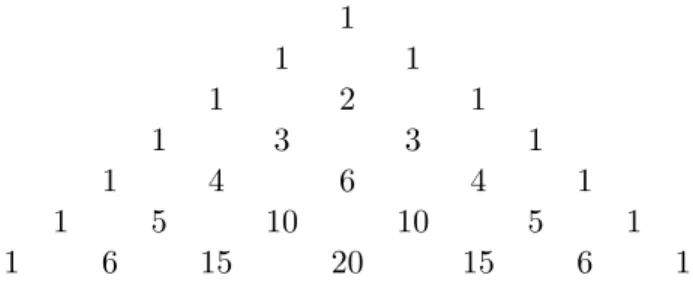
Pascal’s Triangle emphasizes that symmetry by rearranging the rows of the table so that they line up at their centers. We show this array in Table 2. When we write down Pascal’s triangle, we leave out the values ofnand k.
You may know a method for creating Pascal’s triangle that does not involve computing binomial coefficients, but rather creates each row from the row above. Each entry in Table 1.2, except for the ones, is the sum of the entry directly above it to the left and the entry directly
7If you are thinking “But we did definen
k
to be zero whenk > nby saying that it is the number ofkelement
Table 1.2: Pascal’s Triangle 1 1 1 1 2 1 1 3 3 1 1 4 6 4 1 1 5 10 10 5 1 1 6 15 20 15 6 1
above it to the right. We call this thePascal Relationship, and it gives another way to compute binomial coefficients without doing the multiplying and dividing in Equation 1.5. If we wish to compute many binomial coefficients, the Pascal relationship often yields a more efficient way to do so. Once the coefficients in a row have been computed, the coefficients in the next row can be computed using only one addition per entry.
We now verify that the two methods for computing Pascal’s triangle always yield the same result. In order to do so, we need an algebraic statement of the Pascal Relationship. In Table 1.1, each entry is the sum of the one above it and the one above it and to the left. In algebraic terms, then, the Pascal Relationship says
n k = n−1 k−1 + n−1 k , (1.6)
whenever n > 0 and 0 < k < n. It is possible to give a purely algebraic (and rather dreary) proof of this formula by plugging in our earlier formula for binomial coefficients into all three terms and verifying that we get an equality. A guiding principle of discrete mathematics is that when we have a formula that relates the numbers of elements of several sets, we should find an explanation that involves a relationship among the sets.
A proof using the Sum Principle
From Theorem 1.2 and Equation 1.5, we know that the expressionnkis the number ofk-element subsets of an n element set. Each of the three terms in Equation 1.6 therefore represents the number of subsets of a particular size chosen from an appropriately sized set. In particular, the three terms are the number ofk-element subsets of ann-element set, the number of (k−1)-element subsets of an (n−1)-element set, and the number of k-element subsets of an (n−1)-element set. We should, therefore, be able to explain the relationship among these three quantities using the sum principle. This explanation will provide a proof, just as valid a proof as an algebraic derivation. Often, a proof using the sum principle will be less tedious, and will yield more insight into the problem at hand.
Before giving such a proof in Theorem 1.3 below, we work out a special case. Supposen= 5, k= 2. Equation 1.6 says that
5 2 = 4 1 + 4 2 . (1.7)
Because the numbers are small, it is simple to verify this by using the formula for binomial coefficients, but let us instead consider subsets of a 5-element set. Equation 1.7 says that the number of 2 element subsets of a 5 element set is equal to the number of 1 element subsets of a 4 element set plus the number of 2 element subsets of a 4 element set. But to apply the sum principle, we would need to say something stronger. To apply the sum principle, we should be able to partition the set of 2 element subsets of a 5 element set into 2 disjoint sets, one of which has the same size as the number of 1 element subsets of a 4 element set and one of which has the same size as the number of 2 element subsets of a 4 element set. Such a partition provides a proof of Equation 1.7. Consider now the setS={A, B, C, D, E}. The set of two element subsets is
S1 ={{A, B},{AC},{A, D},{A, E},{B, C},{B, D},{B, E},{C, D},{C, E},{D, E}}.
We now partition S1 into 2 blocks, S2 and S3. S2 contains all sets in S1 that do contain the
elementE, while S3 contains all sets inS1 that do not contain the element E. Thus,
S2={{AE},{BE},{CE},{DE}}
and
S3 ={{AB},{AC},{AD},{BC},{BD},{CD}}.
Each set in S2 must contain E and thus contains one other element from S. Since there are 4
other elements inS that we can choose along withE, we have|S2|=41. Each set inS3 contains
2 elements from the set{A, B, C, D}. There are42ways to choose such a two-element subset of
{A < B < C < D}. But S1 =S2∪S3 and S2 and S3 are disjoint, and so, by the sum principle,
Equation 1.7 must hold.
We now give a proof for general nand k.
Theorem 1.3 If n and kare integers with n >0 and 0< k < n, then
n k = n−1 k−1 + n−1 k .
Proof: The formula says that the number of k-element subsets of an n-element set is the sum of two numbers. As in our example, we will apply the sum principle. To apply it, we need to represent the set of k-element subsets of an n-element set as a union of two other disjoint sets. Suppose our n-element set isS ={x1, x2, . . . xn}. Then we wish to take S1, say, to be the
n k
-element set of all k-element subsets ofS and partition it into two disjoint sets of k-element subsets,S2 and S3, where the sizes ofS2 andS3 are
n−1 k−1
andn−k1respectively. We can do this as follows. Note thatn−k1stands for the number ofkelement subsets of the firstn−1 elements x1, x2, . . . , xn−1 ofS. Thus we can letS3 be the set of k-element subsets ofS that don’t contain
xn. Then the only possibility forS2 is the set ofk-element subsets ofS thatdocontainxn. How
can we see that the number of elements of this set S2 is
n−1 k−1
? By observing that removing xn from each of the elements ofS2 gives a (k−1)-element subset ofS ={x1, x2, . . . xn−1}. Further each (k−1)-element subset of S arises in this way from one and only one k-element subset of S containing xn. Thus the number of elements of S2 is the number of (k−1)-element subsets