Black plate (1,1)
JULY 2010 . VOLUME 3 . NUMBER 2 . ISSN: 1754-1662
Journal of
Telecommunications
Journal of
Telecommunications Management
VOLUME 3, NUMBER 2Contents
Editorial 104 Daryn Moody Practice papersThe effects of vectored DSL on network operations
George Ginis, Marc Goldburg and John Cioffi 107 Real-time communications, presence and instant messaging: SIP versus XMPP,
or SIP and XMPP
Enrico Marocco and Gianni Canal 118 Misconnected nation: High-speed upstream bandwidth as a green growth stimulus
Mahesh P. Bhave 123
Mobile telephony diffusion in Indonesia: Case study of the big three operators
Muhammad Suryanegara and Kumiko Miyazaki 130 Entry of Mobile Virtual Network Operators (MVNOs) in India: A strategic analysis
M. Praveen Kumar and Mahim Sagar 148 Autonomic clouds of components for self-managed service ecosystems
Antonio Manzalini, Roberto Minerva and Corrado Moiso 164 The role of the Universal Service Obligation Fund in rural telecommunications services: Lessons from the Indian experience
Rekha Jain and G. Raghuram 181
Henry Stewart Publications Henry Stewart Publications
Russell House Subscription Office
28/30 Little Russell Street PO Box 361
London WC1A 2HN Birmingham
Management
July 2010 Volume 3 Number 2 Journal of Telecommunica tions Manage mentJournal of
Telecommunications
Management
Henry Stewart Publications
Russell House, 28/30 Little Russell Street, London, WC1A 2HN, UK
Tel: +44 (0)20 7404 3040 Fax: +44 (0)20 7404 2081 www.henrystewart.com Henry Stewart Publications Subscription Office PO Box 361 Birmingham, AL 35201-0361, USA Tel: 800 633 4931 Fax: 205 995 1588 E-mail: [email protected]
#Henry Stewart Publications 2010
All Rights Reserved.
No part of this paper may be reproduced or transmitted
in any form or by any means, including photography and recording, without the written permission of the publishers. Such written permission must also be obtained before any part of this publication is stored in a retrieval system of any nature.
The effects of vectored DSL on network
operations
Received (in revised form): 19th May, 2010
George Ginis*
is currently Vice President of Expresse Engineering with ASSIA, Inc., overseeing development and deployment of the digital subscriber line (DSL) Expresse management product, and helping service providers maximise the profit and performance of their DSL networks. Between 2002 and 2005 he was a systems engineer with the Broadband Communications Group of Texas Instruments, where he was involved in the design of DSL chipsets for central office equipment and residential gateways. He holds a diploma in electrical and computer engineering from the National Technical University of Athens, and MS and PhD degrees in electrical engineering from Stanford University.
Marc Goldburg
is a veteran of the telecommunications industry with extensive experience in technology development and partnerships, intellectual property management, standards and regulatory matters. Dr Goldburg is a technical founder and former CTO of ArrayComm, LLC, whose spatial processing technology is deployed worldwide in more than 275,000 wireless base stations. Dr Goldburg holds a PhD from Stanford, an MSEE from the University of Washington and a BSE from Princeton University, all in electrical engineering. He is a Fellow of IEEE and was recognised by Scientific American as its Communications Researcher of the Year in 2002. Dr Goldburg is ASSIA’s Chief Technical Officer and Executive Vice President.
John Cioffi
is a 30-year veteran of the DSL industry and sports numerous prestigious awards for his contributions to technology and industry. Dr Cioffi is a member of the US National Academy of Engineering and an International Fellow of the UK Royal Society of Engineering. He is a winner of the IEEE Alexander Graham Bell Medal (2010), the IEEE Kobayashi Award (2001) and the Marconi Society’s Marconi Prize (2006). He currently serves on the boards of Teranetics, ClariPhy, Vector Silicon and Alto Beam. Dr Cioffi holds a BSEE from the University of Illinois and a PhD in electrical engineering from Stanford University. Dr Cioffi is ASSIA’s CEO and Chair, as well as a professor emeritus at Stanford.
*ASSIA US Headquarters, 333 Twin Dolphin Drive, Redwood City, CA 94065, USA Tel: +1 (650) 654 3400; Fax: +1 (650) 654 3404; website: http://www.assia-inc.com
Abstract The well-known benefit of vectored digital subscriber line (vectored DSL) is that it achieves data rates approaching 100 megabits per second (Mbps) by eliminating crosstalk noise, thus enabling the offering of high-end services on copper pairs. Such data rates compare favour-ably with the end-user data rates practically achievable in fibre-to-the-home (FTTH) or cable deployments, but with a substantially more modest capital investment as vectored DSL services are delivered over existing copper infrastructure. This paper studies the effects of deploying vec-tored DSL, and identifies benefits to the network operations processes of DSL service providers including line diagnostics and automatic line repair. It explains that properly deployed vectored DSL improves the accuracy of estimating the locations of cable faults and predicting data-rate performance through improved line diagnostic functions. It also shows how an automatic line repair function can prevent customer calls and technician dispatches by properly mitigating the effects of both impulsive and stationary noise sources. Automatic line repair can also achieve co-existence of vectored DSL with older DSL types sharing the same binder. The paper proceeds to discuss certain deployment issues such as the differences between deploying from a small node (ie DSL access multiplexer (DSLAM)) versus a large node of 100 pairs or more. The latter case can be more cost-effective, but requires additional functionality for ensuring that crosstalk among all pairs can be effectively cancelled. Finally, the choices for deploying vectored DSL in an
unbundled environment are presented. It is explained that, in such cases, the benefits of vectored DSL are maximised when certain management functions are shared by all service providers with access to the node.
KEYWORDS: DSL, network operations, diagnostics, automatic line repair, unbundling
PRINCIPAL MANAGEMENT
IMPLICATIONS
. Vectored digital subscriber line (vectored DSL) is a new DSL technology that delivers data rates approaching 100 megabits per second (Mbps).
. Deploying vectored DSL affects network operations functions, including line diagnostics and automatic line repair.
. Line diagnostics with vectored DSL improve fault location and performance prediction.
. Automatic line repair for vectored DSL mitigates the effects of noise in the DSL network.
. Automatic line repair for vectored DSL achieves co-existence of vectored DSL and older DSL types.
. Deploying vectored DSL from a large node (100 ports or more) requires additional functionality compared to deploying from a small node.
. Deploying vectored DSL in an unbundled environment favours the use of certain common management functions among all service providers.
INTRODUCTION
Vectored DSL systems are able to reduce the crosstalk effects that form the most serious performance bottleneck for dense deployments of DSLs operating in the very high-speed region (above 15 Mbps).1Major DSL chipset vendors have recently presented results from vectored DSL system prototypes and
introduced their first vectored DSL products, which realise the very substantial performance gains that were predicted by earlier theory.2 The standard for vectored DSL has now been published,3and field trials and initial
deployments are expected to materialise in the next two years. Vectored DSL pushes the data
rates achievable on a single copper twisted pair to the region of 100 Mbps. This is dedicated bandwidth for each customer, as opposed to the data rates quoted by other broadband access systems that employ shared access media such as coaxial cable or passive optical networks (PON). Such dedicated data rates make it realistic to offer end services beyond high-speed internet and standard-definition
television, eg multiple streams of high-definition television (HDTV), 3D television, real-time backup and video instant messaging.
Deployment of vectored DSL requires dramatically lower capital expenditure compared to optical network technologies. Many experts estimate the relative capital cost of fibre-to-the-home (FTTH) to be four to five times higher than that of offering very high-speed DSL (VDSL) services from a remote terminal (eg fibre-to-the-node, FTTN), with the main factor accounting for this cost difference being construction costs. For
example, AT&T’s capital cost to deploy FTTN to 18 million homes in the USA is estimated at US$5bn, while Verizon’s capital cost to deploy FTTH to 19 million homes in the USA is estimated at US$23bn.4,5The cost estimate for connecting every home in the USA to
fibreoptic cable is US$350bn and such a magnitude of infrastructure spending is viewed as improbable to happen in the foreseeable future.6Finally, the regulatory advisors for the UK’s Oftel regulator estimate a five-time premium for FTTH over FTTN.7In conclusion, vectored DSL, provided over existing copper from a remote terminal, offers a cost-effective approach for offering high-end broadband services.
The deployment of vectored DSL has several implications in network operations, especially for line diagnostics and automatic
line repair functions. The underlying
technology has important differences compared to previous DSL systems, and operation practices must adapt to take these differences into account. Properly designing the operations functions maximises the performance benefits of vectored DSL, while neglecting these functions leads to smaller gains. The best practices for management of vectored DSL crosstalk are referred to as dynamic spectrum management (DSM) Level 3, which, when combined with DSM Level 1 (management of exogenous noises) and DSM Level 2
(management of crosstalk associated with non-vectored DSL systems), leads to the highest level of vectored DSL performance.
Management interfaces required to apply these practices have been documented by the Alliance for Telecommunications Industry Solutions (ATIS) Standards Committee in the DSM Technical Report.8
This paper starts with a review of the performance benefits of vectored DSL. It proceeds to explain the best management practices for vectored DSL, and finds that when those are applied, the benefits of vectored DSL extend beyond higher data rates to improved fault identification and fewer trouble tickets. It also explains important differences for operations between deploying vectored DSL from a large node with more than 100 ports compared to a smaller node. Finally, it presents the possible scenarios for deployment of vectored DSL in an unbundled environment, and compares the corresponding management approaches.
PERFORMANCE BENEFITS OF
VECTORED DSL
Crosstalk can be a significant noise source in multi-pair copper cables used by DSL systems. Crosstalk often becomes adominantnoise source in DSL systems that make use of higher
frequencies and that operate over short loop lengths (shorter than 1,800m), such as VDSL.9 This means that, in practical deployments, where multiple pairs are sharing the same cable and are thus causing crosstalk into each other, VDSL data rates over a single pair are limited
to approximately 70 Mbps for downstream and 40 Mbps for upstream, even with loops as short as 150m and with no other sources of noise and interference.
Vectored DSL uses advanced signal processing techniques to mitigate or even completely eliminate crosstalk between vectored DSLs. Although the techniques used for downstream transmission differ from those used for upstream transmission, in both cases, signal processing functions are no longer performed on a line-by-line basis, but are performedjointlyamong a group of lines at the DSL access multiplexer (DSLAM).
One important observation is that the effect of crosstalk is not uniform across DSLs, and depends on a large number of factors such as loop length, frequencies used, cable geometry and the density of DSLs in a cable binder. As a result, the data rate performance of non-vectored DSL can have a very wide variation in the field, especially for the shorter loops, where crosstalk dominates. Vectored DSL significantlyreducesthis variation, and makes it possible to offer the higher rates to a larger percentage of installed lines.
Figure 1 compares the downstream data-rate performance for single-pair vectored and non-vectored DSL for loop lengths between 300m and 1,200m. These rates were obtained by simulation and assume the proper application of DSM Level 1 (for a fully detailed
explanation of the simulation assumptions see ASSIA, Actelis,10which is the original source of these results). It was assumed that two binders are used, each with 25 pairs. Of the total 50 pairs, 24 are used for DSL service. In order to capture the effect of different pair positions within the binders, results were derived for a large number of random pair selections, so that quantities could be derived for both a 1 per cent worst case situation and for a 50 per cent worst case (median) situation.
Two important conclusions can be drawn from Figure 1:
. The use of vectored DSLreducesthe data rate variation among pairs in a binder affected by
crosstalk. This makes data rate performance of pairs more predictable, and thus greatly simplifies a number of management functions, ranging from qualification to maintenance. Paradoxically, this reduced variability also enables DSL providers to advertise higher data rates while maintaining ‘truth in advertising’.
. Vectored DSL increases data rates to nearly
100 Mbps. (Note that the results shown here assume use of only 8 MHz for VDSL transmission; extension to 17 MHz or even 30 MHz (as allowed by the standards) further increases the achievable data rates or extends the corresponding loop length.) Unlike other broadband access technologies that share access bandwidth among multiple customers, this is dedicated bandwidth that is available to each customer individually. Such rates become practical on a single twisted pair with architectures where the line length is up to 300m, or over two twisted pairs (using DSL bonding) with architectures where the line length is up to 900m.
BEST MANAGEMENT PRACTICES
FOR VECTORED DSL
The deployment of vectored DSL systems has important implications for management
practices. The benefits shown previously are maximised when existing practices are enhanced to account for the new effects and capabilities introduced by vectored DSL. It is important to first describe the essential elements of a DSL management system, and then
explain the differences introduced by vectored DSL. A DSL management system must support anefficientandautomatedway to apply the following process across all lines in a DSL network:
. Collectingoperational and performance parameters from the DSL equipment on a daily basis, and storing these parameters for long periods of time (days to weeks).
. Analysingthe stored parameters to either diagnose faults (eg copper impairment, DSL equipment fault etc), or to obtain
performance projections, such as identifying lines that are eligible for upgrade. These analyses can then be provided to other operations support systems (OSS), or to customer care agents requiring such information.
. Reconfiguringthe DSLs (also known as ‘reprofiling’) to meet quality of service (QoS) requirements for each line and to maximise the data rate based on the line’s
300m 600m 900m 1200m
Figure 1: Downstream data rates (in Mbps) for non-vectored and vectored DSL (data rates are shown for 1 per cent worst case and 50 per cent worst case (median) situations)
service requirements. Only those lines that are not meeting the service objectives — usually defined in terms of rate and stability — are reprofiled.
Meaningful operational benefits are obtained only when the steps above are performed regularly on all lines in the network. This process is graphically depicted in Figure 2 in the form of two loops. The step of daily collection of management data from the DSL access network is followed by thediagnostics loopon the right, which is performed for all lines, and by thereprofiling loopon the left, which is performed only for those lines that do not meet their service objectives.
The DSL standards, in particular ITU-T G.997.1,11require all standards-compliant DSLAMs to make certain DSL management data available for diagnostics and reprofiling. The use of these data for diagnostics and reprofiling is generally referred to as dynamic spectrum management (DSM), which is further divided into three levels, depending on the
available management parameters and the sophistication of the algorithms.DSM Level 3
is associated with management of vectored DSL and is explained next.
Improved diagnostics with vectored DSL Vectored DSL systems can report through the management interface the crosstalk coupling among pairs.12The availability of this quantity (also known as XLOG) expands the capabilities of the diagnostics loop in the following ways:
. Copper diagnostics.The XLOG quantity makes it possible to identify lines that create excessive crosstalk, for example, as a result of copper degradation or improper maintenance. It also makes it possible to separate the noise on a line into
contributions from crosstalk and contributions from external sources. A summary of the diagnostic benefits with vectored DSL is presented in Table 1. These benefits can substantially reduce the time spent by technicians to identify an offensive
Figure 2: Process followed by a DSL management system
noisy line that is degrading all its neighbours by identifying which exact line is the most likely culprit. By identifying such extreme crosstalk ‘polluters’, and then taking action based on such information, the copper network can be improved over time.
. Upgrade identification. The knowledge of the XLOG quantity also allows for more accurate data rate performance prediction. This performance prediction provides guidance for choosing the line priorities (see next sub-section), and for determining if a service upgrade is feasible. This allows the DSLs to be tuned to demand for data rate and services among customers.
Improved reprofiling with vectored DSL Vectored DSL also expands the capabilities of the reprofiling loop and is therefore able to reduce maintenance costs. This occurs when a DSL management system takes advantage of these capabilities, automatically mitigating problems encountered on lines and
automatically directing the available resources to customers with the most demanding service requirements (but always subject to each subscriber’s purchased grade of service). These capabilities are explained next:
. Line prioritisation.It becomes possible with vectored DSL to direct the performance benefits towards certain lines. The
management interface13allows the service provider to have indirect control of the
computational resourcesand the signal processing operations of vectoring, for
example, to favour a line that is being offered a higher-end service. The best practice is to configure the control
parameters of each line, based on both the line’s capabilities and the customer’s service requirements.
. Coexistence among vectored DSL and non-vectored DSL.It is possible that non-vectored and vectored lines share the same binder. This is expected to happen, at least in the early phases of deployment of vectored DSL, given that it is not economical to replace legacy DSLAMs as soon as newer vectored DSLAMs are installed. In such cases, the crosstalk generated from the non-vectored lines to the non-vectored lines cannot be cancelled.If left unmanaged, such crosstalk will greatly reduce the benefits of crosstalk cancellation performed among the vectored lines. In the worst cases of unmanaged vectored DSL, the data rate performance of the vectored lines is reduced to the data rate performance of non-vectored lines. The proper management practice is then to reduce the transmitted power levels of the non-vectored lines to a level no higher than the minimum required to maintain their service requirements, a DSM Level 2 technique. Any such
adjustment of the transmitted power levels must be made on a line-by-line basis by the management system, after taking into account the conditions under which each line operates.
. Management of non-crosstalk noise sources.
Non-crosstalk noise sources can be of two types, where each type has a different effect
Table 1: Improved diagnostics with vectored DSL Diagnostics category Benefit from XLOG Wiring/grounding fault
detection
XLOG can be used to increase the detection confidence of lines with poor balance or poor grounding
Crosstalk source identification
XLOG can be used to very accurately identify the disturber(s) of the line. Such disturber(s) are typically correlated with wiring faults
External noise source identification
XLOG allows accurate separation of noise sources affecting a line into crosstalk from known lines and noise from external sources, such as AM/HAM transmitters
Causes of line instability Instability such as retrains and errors caused by varying crosstalk can be traced through XLOG
on vectored DSL systems. These are described next, together with a short explanation of the proper management actions:
— Noise sources that become dominant after crosstalk is removed.One example of such a source is impulsive noise that is normally masked by crosstalk, and begins to affect performance only after vectoring is enabled. A second example is shifting background noise that may lead to line re-initialisation. The prevention of such disruptions requires management algorithms that
appropriately configure each line for impulse noise protection, or for coping with abrupt noise changes, a DSM Level 1 technique.
— Noise sources that cannot be mitigated through vectoring.In some cases of downstream transmission it is impossible to cancel certain noise sources through vectoring. Such noise sources may include AM radio noise, various types of radio frequency interference (RFI) or crosstalk from legacy DSL systems. Typically, such sources affect a specific set of frequencies. If such a set of frequencies is found to be affected from this kind of interference, the proper management action is to instruct the vectored DSL system to disable vectoring over those frequencies,14so that vectoring computational resources are directed to more productive uses. The previously mentioned practices for reprofiling lead to improved overall network operation and a reduction of line instability issues, which could otherwise generate customer calls and consequent technician dispatches.
DEPLOYMENT ARCHITECTURE OF
VECTORED DSL
Vectored DSL can be deployed from different points in the network. Vectored DSL DSLAMs can be installed at various locations, with
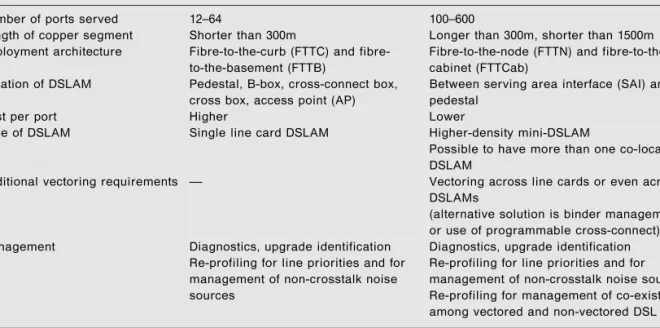
consideration for the fact that the performance benefits are highest for loops shorter than 1,500m. The DSLAM port count can also vary depending on the deployment scenario. In this paper, a distinction is made between two categories of port count at the DSLAM (also known as an access node), the first referring to asmall nodewith 12–64 ports, and the second referring to alarge node with 100–600 ports. The differences between the two categories are summarised in Table 2, and further explained in this section of the paper.
Deployment from a small node is typically associated with short copper pairs. In such cases the DSLAM would be installed within 300m of the customer. Such deployment architectures are often described as fibre-to-the-curb (when the DSLAM is serving a suburban
neighbourhood), or fibre-to-the-basement (when the DSLAM is serving a group of apartments inside a building). The location of the DSLAM may coincide with the final cross-connect point in the copper plant, which has a number of names depending on the country, such as pedestal, B-box, cross-connect box, cross box or access point (AP). Deployment from a large node typically occurs with longer copper pairs, where the DSLAM is installed between 300–1,500m away from the customer. These architecture models are defined as fibre-to-the-cabinet (when the DSLAM is within a sizable cabinet) or fibre-to-the-node. The location of the DSLAM would be somewhere between the service area interface (SAI) and the pedestal.
It is obvious that a deployment based on small nodes hashigher capital costs per subscriber, mainly because of much higher construction costs resulting from the fact that more sites are required to serve a given area. But an
important benefit is the higher data-carrying capacity that comes with the shorter loop lengths and smaller number of subscribers per node (assuming similar backhaul capacity in the small-node and large-node deployments), which can extend the life span of the investment. On the other hand, deployment from a large node isless capital intensive per
subscriber, and may be only an incremental step in achieving the full performance of vectored DSL. The DSLAM type at a small node can be physically small, and may consist of a single DSL card supporting all ports. For a large node, the DSLAM is likely to contain more than four DSL cards, and there even may be multiple DSLAMs installed in the same location.
When vectored DSL is deployed from a large node,additional equipment requirementsare imperative. The DSLAM equipment must be able to apply crosstalk cancellation across all line cards — referred to as ‘node-scale vectoring’ — or even across DSLAMs,
otherwise the performance benefits are limited. Alternative solutions that do not require extra DSLAM functionality would be to perform careful binder management, such that neighbouring DSL pairs are always served from the same line cards, or to use a
programmable cross-connect switch in front of the DSLAM(s) so that neighbouring DSL pairs are routed to the same line cards. These solutions can be expensive and/or labour intensive, and are thus less desirable for
operators. Deployment from a small node does not have such requirements, given that
crosstalk cancellation within a single line card is much simpler.
Finally, deploying vectored DSL from a large node has implications for management functions. In a large node, it will be more often the case that there will be a mixture of
vectored DSL and pre-existing older DSL technologies. As a result, the previously mentioned capability of achievingcoexistence
among these types is necessary as part of the reprofiling loop. This need does not exist in greenfield deployments of small nodes, from which only vectored DSL will be deployed. Still, other management functions such as diagnostics, upgrade identification, line
prioritisation and management of non-crosstalk noise sources are required for both small and large nodes.
DEPLOYMENT OF VECTORED DSL
WITH UNBUNDLING
REQUIREMENTS
At the time of writing this paper (May 2010), the authors are not aware of any regulations in the USA or the EU that have considered the effects of vectored DSL. A regulatory body that has shown significant interest in DSM and vectored DSL is Ofcom in the UK. Specifically,
Table 2: Comparison of node sizes for vectored DSL
Small node Large node
Number of ports served 12–64 100–600
Length of copper segment Shorter than 300m Longer than 300m, shorter than 1500m Deployment architecture Fibre-to-the-curb (FTTC) and
fibre-to-the-basement (FTTB)
Fibre-to-the-node (FTTN) and fibre-to-the-cabinet (FTTCab)
Location of DSLAM Pedestal, B-box, cross-connect box, cross box, access point (AP)
Between serving area interface (SAI) and pedestal
Cost per port Higher Lower
Type of DSLAM Single line card DSLAM Higher-density mini-DSLAM
Possible to have more than one co-located DSLAM
Additional vectoring requirements — Vectoring across line cards or even across DSLAMs
(alternative solution is binder management or use of programmable cross-connect)
Management Diagnostics, upgrade identification
Re-profiling for line priorities and for management of non-crosstalk noise sources
Diagnostics, upgrade identification Re-profiling for line priorities and for management of non-crosstalk noise sources Re-profiling for management of co-existence among vectored and non-vectored DSL
the Network Interoperability Consultative Committee’s (NICC) DSL Working Group has recently produced a report on DSM methods in the UK access network.15This document describes the benefits of DSM Level 1
techniques, by showing simulation results for a number of different scenarios. Although the report states that ‘[DSM Level 2 and DSM Level 3] promise even greater improvement in DSL footprint and larger benefit in operations profitability’, it leaves a detailed analysis for further study.16In the absence of regulations specific to the deployment of vectored DSL, the authors provide their assessment of how
architectures for deploying vectored DSL may evolve with a number of potential regulatory scenarios. In light of the wide range of conditions encountered in different countries and different markets, several simple, but representative, conceptual scenarios are presented, which offer insights into the implications for vectored DSL management functions in unbundled environments.
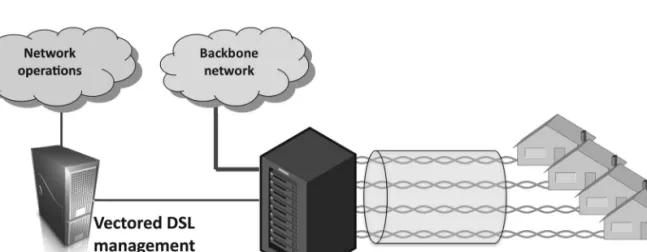
The first case is when a single provider is exclusively responsible for the use of copper twisted pairs within an area, as shown in Figure 3 (this is the case of no unbundling). This can occur either because the provider has a geographical monopoly, or because the provider may only need to resell services to other providers as a bitstream, instead of providing full access to the copper plant. This
is a situation that is most common in North America. In this case, all lines are controlled by a single entity, and the vectored DSL access infrastructure is owned by the same entity. The management system for vectored DSL is also under the full control of the single service provider, and the implemented management functions are as described previously.
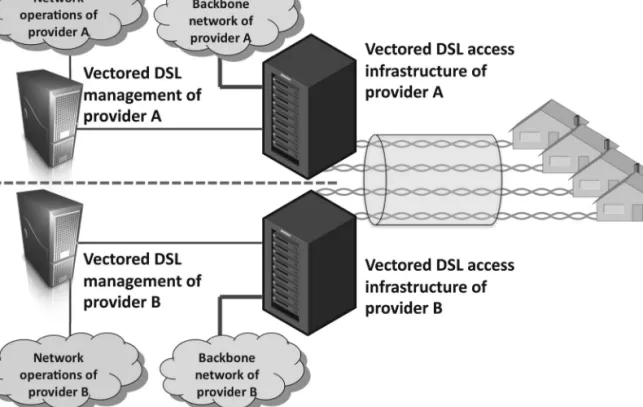
A first architecture with requirements for unbundling is outlined in Figure 4. In this case, two service providers must share the copper twisted pairs, and choose to use separate DSLAMs and separate management systems. The separate management systems do not have a full view of the entirety of twisted pairs in the network, and thus have more limited diagnostics and reprofiling capabilities
compared to those of the management system in Figure 3 (for example, certain types of advanced diagnostics processing consider multiple pairs at once in their calculations). As a result, some performance loss is expected for vectored DSL in this case, because of a reduced ability to coordinate the vectored DSL systems of provider A and non-vectored DSL systems of provider B. Still, the respective management systems can be very effective with ‘policing’ actions, such as detecting whether the systems of provider A are inadvertently causing disruption to the systems of provider B. Such reporting allows provider B to notify provider A to correct the situation.
Figure 3: Vectored DSL access infrastructure and management owned by a single provider
A second unbundled architecture that achieves competition in the local loop with vectored DSL, but which results in better efficiencies than in the previous example, is
shown in Figure 5. In this case, the vectored DSL access infrastructure is shared among the providers, and is managed by a single
management system that has a full view of all
Figure 4: Vectored DSL access infrastructure and management separately owned by multiple providers
vectored DSLs. Each of the providers still has access to the management functions but with appropriate restrictions to prevent disclosure of proprietary information of other providers. The benefits from diagnostics and reprofiling can be maximised to the same extent as with only a single provider, while allowing each provider to define and manage its services independently.
CONCLUSION
Deployment of vectored DSL makes it possible to offer high-end services with data rate
requirements approaching 100 Mbps, and with low incremental capital costs compared to other very high-speed broadband access technologies. In addition, vectored DSL offers benefits for network operations, in the form of enhanced diagnostics and automatic line repair. Management systems for vectored DSL have improved abilities for fault identification, and for mitigating the impact of external noise sources. Vectored DSL can be deployed either from small nodes close to the customer, or from larger nodes of 100 or more ports. Finally, vectored DSL can be deployed in an unbundled environment, in which case a management system shared among service providers maximises the performance gains while supporting the delivery of differentiated services.
References
1 Ginis, G. and Cioffi, J. M. (2002) ‘Vectored transmission for digital subscriber line systems’,IEEE Journal on Selected Areas of Communications, Vol. 20, No. 5, June, pp. 1085–1104. 2 Cioffi, J. M., Fisher, K., Clausen, A., Peeters, M., Eriksson,
P.-E. and Ginis, G. (2009) ‘The path to 100 Mbps DSL services’, IEEE Globecom 2009, Access Forum, Session 203, Honolulu, Hawaii, 1st-4th December.
3 ITU-T commitee (2010) ‘Self-FEXT Cancellation (Vectoring) for Use with VDSL2 Transceivers’, ITU-T Recommendation G.993.5 (g.vector), International Telecommunications Union (ITU), Geneva, June. 4 Maxon, T. (2006) ‘AT&T to include lower-income
households in fiber-optic rollout’,Government Technology, 9th May, available at: http://www.govtech.com/gt/articles/ 99464 (accessed 11th June, 2010).
5 Duffy, J. (2006) ‘Verizon provides FiOS update’,Network World, 27th September, available at: http://
www.networkworld.com/news/2006/092706-verizon-fios.html (accessed 11th June, 2010).
6 Rosston, G. L. (2010) ‘The national broadband plan’, Stanford Institute for Economic Policy Research, Policy Brief, February, available at: http://siepr.stanford.edu/ publicationsprofile/2105 (accessed 11th June, 2010.
7 Analysys Mason (2008) ‘The Costs of Deploying Fibre-based Next-generation Broadband Infrastructure’, final report for the Broadband Stakeholder Group, Ref: 12726-371, Analysys Mason, London, 8th September.
8 Network Interface, Power and Protection committee (2007) ‘Dynamic Spectrum Management’, Technical Report, ATIS-PP-0600007, Alliance for Telecommunications Industry Solutions (ATIS), Washington, DC, May.
9 ITU-T committee (2010) ‘Very High Speed Digital Subscriber Line Transceivers 2’, ITU-T Recommendation G.993.2, International Telecommunications Union (ITU), Geneva, January.
10 ASSIA, Actelis (2007) ‘VDSL2 FEXT Cancellation Performance Evaluation in Remote Deployments’, ITU-T Contribution B07-05-37, Geneva, June.
11 ITU-T committee (2010) ‘Physical Layer Management for Digital Subscriber Line (DSL) Transceivers’, ITU-T Recommendation G.997.1, International
Telecommunications Union (ITU), Geneva, January. 12 Ibid.
13 Ibid. 14 Ibid.
15 Network Interoperability Consultative Committee (NICC) (2010) ‘Report on Dynamic Spectrum Management (DSM) Methods in the UK Access Network’, NICC ND 1513, Network Interoperability Consultative Committee Standards Limited, Hertfordshire, January.
16 Ibid.