Title
Modeling multivariate ocean data using asymmetric copulas
Author(s)
Zhang, Yi; Kim, Chul-Woo; Beer, Michael; Dai, Huliang;
Soares, Carlos Guedes
Citation
Coastal Engineering (2018), 135: 91-111
Issue Date
2018-05
URL
http://hdl.handle.net/2433/235494
Right
© 2018. This manuscript version is made available under the
CC-BY-NC-ND 4.0 license
http://creativecommons.org/licenses/by-nc-nd/4.0/; The
full-text file will be made open to the public on 01 May 2020 in
accordance with publisher's 'Terms and Conditions for
Self-Archiving'.; This is not the published version. Please cite only
the published version. この論文は出版社版でありません。
引用の際には出版社版をご確認ご利用ください。
Type
Journal Article
Textversion
author
1
Modeling multivariate ocean data using asymmetric copulas
12
Yi Zhanga,*, Chul-Woo Kima, Michael Beerb, Huliang Daic, Carlos Guedes Soaresd 3
a Department of Civil and Earth Resources Engineering, Graduate School of Engineering, Kyoto
4
University, Japan
5
b Institute for Risk and Reliability, Leibniz Universität Hannover, Germany / Institute for Risk and
6
Uncertainty, University of Liverpool, UK / Shanghai Institute of Disaster Prevention and Relief, Tongji
7
University, China
8
c School of Civil Engineering and Mechanics, Huazhong University of Science and Technology,
9
China
10
dCentre for Marine Technology and Ocean Engineering (CENTEC), Instituto Superior Técnico,
11
Universidade de Lisboa, Portugal
12
Abstract 13
Multivariate descriptions of ocean parameters are quite important for the design and risk assessment of
14
offshore engineering applications. A reliable and realistic statistical multivariate model is essential to
15
produce a representative estimate of the sea state for understanding the ocean conditions. Therefore, an
16
advanced modeling of ocean parameters helps towards improving ocean and coastal engineering practices.
17
In this paper, we introduce the concepts of asymmetric copulas for the modeling of multivariate ocean data.
18
In contrast to extensive previous research on the modeling of symmetric ocean data, this study is focused
19
on capturing asymmetric dependencies among the environmental parameters, which are critical for a
20
realistic description of ocean conditions. This involves particular attention to both nonlinear and
21
asymmetrically dependent variates, which are quite common for the ocean variables. Several asymmetric
22
copula functions, capable of modeling both linear and nonlinear asymmetric dependence structures, are
23
examined in detail. Information on tail dependencies and measures of asymmetric dependencies are
24
* Corresponding author. Tel.: +81-075-383-3421 E-mail address: [email protected]; (Y. Zhang).
Coastal Engineering 135 (2018) 91–111 https://doi.org/10.1016/j.coastaleng.2018.01.008
2
exploited. To demonstrate the advantages of asymmetric copulas, the asymmetric copula concept is
25
compared with the traditional copula approaches from the literature using actual environmental data. Each
26
of the introduced copula models is fitted to a set of ocean data collected from a buoy at the US coast. The
27
performance of these asymmetric copulas is discussed and compared based on data fitting and tail
28
dependency characterizations. The accuracy of asymmetric copulas in predicting the extreme value contours
29
is discussed.
30
Keywords: ocean engineering, joint distribution, multivariate analysis, asymmetric copula
31
32
1. Introduction 33
Offshore and coastal structures facilitate the exploitation of the vast ocean resource, which contributes
34
significantly to technological and economic development. Compared with normal structures on land,
35
offshore structures are bulky, expensive and in most cases constructed in a complex marine environment.
36
The marine environment for offshore structures can be severe, adverse, varying and uncertain. It covers a
37
broad area of climatic factors, which generally include tide, current, wind, waves, ice and other sometimes
38
devastating events such as hurricanes. When addressing different environmental risks for the offshore
39
engineering applications designers are usually required to estimate the environmental conditions at the
40
ocean site, and usually a multivariate analysis is performed (Zhang and Cheng, 2016). For example, the
41
environmental contour method developed by Winterstein et al. (1993) is popular for this purpose. As a basis
42
to produce realistic results it requires a reliable multivariate environmental model for finding the maximum
43
system response associated with a given exceedance probability. In this context the interaction among
44
various environmental influences plays an important role. In practical applications, offshore and coastal
45
structures can suffer from severe damages because of the occurrence of critical combinations of the ocean
46
environmental variables which coexist in extreme weather events such as sea storms (Zhang and Lam, 2014;
47
2015). In turn, deficiencies in modeling their joint statistics may severely overestimate the safety and
48
effectiveness of coastal and offshore structures, hence lead to unsafe design and consequently lead to
49
expensive and unexpected catastrophes (Bitner-Gregersen, 2015; Zhang et al. 2017a,b). Particularly, the
3
modeling of the joint distribution of wave height and wave period is normally a must in marine engineering
51
applications since the sea state at a specific location primarily depends on these two ocean parameters
52
simultaneously (DNV, 2014). However, the ocean climate system is an extremely complex system that
53
contains many more natural factors from both the ocean and the atmosphere. There are various sources of
54
uncertainties and potential biases that influence the ocean conditions (Zhang and Cao, 2015). Specifically,
55
the uncertainties related to the parameter dependencies are one of the most influencing factors. It was
56
recognized that the understanding of the nonlinear dependency between ocean parameters remains one of
57
the most difficult tasks, and the statistical modeling of the multivariate ocean data remains challenging due
58
to their complicated relationships (Ewans and Jonathan, 2014).
59
Lots of attempts to cope with multivariate statistical analysis can be found in the literature, involving
60
the use of a conditional distribution model (Lucas and Guedes Soares, 2015), a bivariate logistic model
61
(Morton and Bowers, 1996), a Pareto distribution model (Muraleedharan et al., 2015) and so on. Clearly,
62
the traditional conditional joint distribution model is only applicable to the multivariate problem to a certain
63
extent. If the variables contain slightly more complex relationships such as non-constant correlation between
64
pairs of random variables (e.g. the correlation coefficient value may change at extremes), the traditional
65
joint statistical model is not appropriate any more. Therefore, many more advanced techniques have been
66
employed in the multivariate analysis. Among all the developments, the application of copulas has been
67
increasingly popular in recent years. Many initial studies have illustrated that application of copula theory
68
can produce more realistic joint models for the ocean multivariate data. De Michele et al. (2007) have
69
utilized copulas to characterize sea storms in terms of significant wave height, sea storm duration, sea storm
70
inter-arrival (waiting) time, and sea storm direction. Antào and Guedes Soares (2014) have established
71
copula based bivariate models for individual wave steepness and wave height. A similar copula model for
72
description of water levels and waves are also presented by Masina et al. (2015). Montes-Iturrizaga and
73
Heredia-Zavoni (2015) have proposed a formulation for expressing the environmental contours as functions
74
of copulas and show that the dependence structure of sea state parameters can be well presented in this
75
manner. Until recently, Jane et al. (2016) have employed the copula model to predict the wave height at a
4
given location by considering the spatial dependence of the wave height at nearby locations. In contrast to
77
the traditional joint model, a copula approach has the advantage that the dependency structure between the
78
variables can be defined independently of the choice of the marginal distribution. This flexibility is highly
79
desirable in modeling the environmental parameters as the natural factors often exhibit non-obvious
80
dependencies. Moreover, it was also found that the copula model can save numerical effort when it is utilized
81
to characterize the environmental loading in the offshore structural analysis. For instance, Zhang et al. (2015)
82
have demonstrated an approach of using a copula model to characterize the sea load for the reliability
83
analysis of a real jacket structure, which reduces the numerical effort by a factor of five. A practical guideline
84
for using a copula in the design of coastal and offshore engineering applications can be found in Salvadori
85
et al. (2014). Thorough guidelines involving the use of copulas in a structural approach are given in
86
Salvadori et al. (2015). In general, from the recent advances in coastal engineering, it is now widely
87
recognized that a copula approach is very efficient and powerful to model the statistical behavior of ocean
88
dependent variables.
89
As exciting as the copula approach is, there are some obvious issues, which need to be addressed
90
for a successful application. In former studies it was criticized that most families of parametric copulas can
91
only model data having symmetric dependency (Genest and Favre, 2007). For example, the well established
92
Archimedean copula families are all symmetric. If the data dependencies exhibit asymmetric behavior, the
93
traditional copula model may no longer be adequate. Asymmetric Archimedean copulas are discussed in
94
Grimaldi and Serinaldi (2006). Unfortunately, ocean data, fall into this category; they have been found as
95
asymmetrically dependent in various previous studies. This is especially obvious for the sea state parameters,
96
which are important for in engineering design (deWaal and van Gelder, 2005). Ignoring the asymmetric
97
effects in the modeling of ocean data can be quite critical as it affects the estimates of the response statistics
98
and eventually compromises the quality of the structural reliability assessment. A reason explaining the
99
frequent (possibly unjustified) usage of symmetric (Archimedean) copulas might be that these are the ones
100
provided by the Matlab package, the one traditionally used by maritime engineers. However,, asymmetric
101
copulas can remedy this problem. Asymmetric copulas can be constructed based on the families of
5
symmetric copulas. This compounded procedure can significantly improve the fit (Jondeau, 2016). The
103
modeling of the ocean data utilizing the asymmetric copulas has received much attention recently (Vanem,
104
2016). The well known Khoudraji-Liebscher family, introduced in (Durante and Salvadori, 2010; Salvadori
105
and De Michele, 2010), gives the possibility to construct asymmetric copulas. The application of this family
106
in a maritime context has been mentioned in Salvadori et al. (2014, 2015). De Michele et al. (2013) have
107
also used it for the modeling of drought. Besides, the conditional mixture construction (Vine copulas), first
108
introduced in maritime engineering by De Michele et al. (2007), also provides the possibility to construct
109
asymmetric copulas starting from symmetric ones. However, the theoretical concepts and procedures of
110
constructing an asymmetric copula have not yet been studied in detail. Despite this, it is recognized that
111
there are many candidate asymmetric copulas in theory. These choices provide potent features and practical
112
meaning in ocean and coastal engineering applications. This potential can readily be utilized once the
113
applicability of asymmetric copulas for the modeling of ocean data has been verified and demonstrated. We
114
aim to contribute to this development with the present real case study for demonstrating and highlighting
115
the features, merits as well as limitations associated with asymmetric copulas.
116
The remainder of this paper is organized as follows. Section 2 presents a general literature review
117
of the existing techniques in modeling multivariate ocean data. Section 3 presents the fundamental
118
knowledge of copula theory and the basic dependence measure concepts. Basic concepts of asymmetry
119
measure as well as the procedures of constructing asymmetric copula models are explained in detail in
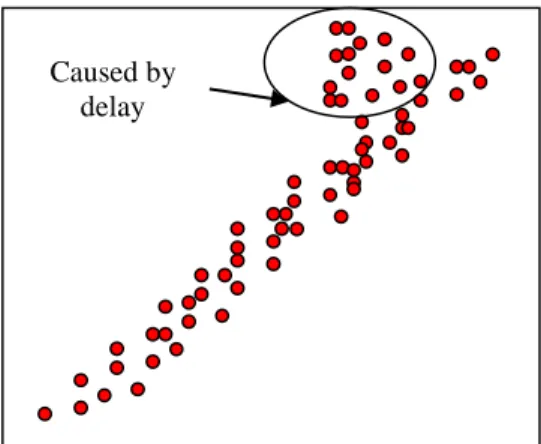
120
Section 4. Specific asymmetric copula models for ocean data are developed in Section 5 and compared
121
against traditional parametric copula models based on collected, preconditioned ocean data. To understand
122
the features of using asymmetric copulas in the ocean data modeling, a comparative study between
123
symmetric and asymmetric copula models is presented in Section 6. The concluding remarks of this paper
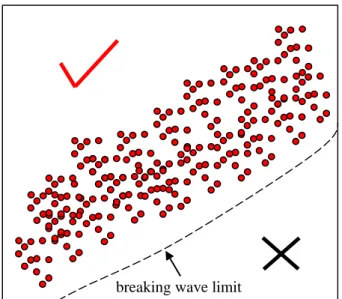
124
form Section 7.
125
2.Joint statistical models for ocean data 126
Among the probabilistic models available in the literature, the most commonly recommended model
127
adopted in offshore engineering design codes is the conditional joint distribution model, which is widely
6
applied to various kinds of ocean data (Burton et al. 2001; Jonathan and Ewns et al. 2011; Ernst and Seume
129
2012). The most pertinent joint distribution model that is applied in ocean engineering is for the significant
130
wave height and peak period, which characterize the spectrum of a sea state. For instance, Guedes Soares
131
et al. (1988)and Bitner-Gregersen and Haver (1989) have demonstrated the use of a joint environmental
132
model, which was constructed based on the combination of the marginal distribution of wave height and
133
conditional distribution of the wave period. Later on, Ochi (1992) introduced a bivariate log-normal
134
distribution in the modeling of the significant wave height and peak period. Generally, these conditional
135
bivariate distribution models assume significant wave height follows a Weibull distribution while wave peak
136
period follows a log-normal distribution whose model parameters are conditional on significant wave height.
137
The primary reason for using such conditional distribution model is generally that the significant wave
138
height is the most important parameter, which affects design conditions of ocean structures whereas other
139
parameters have less influence. This also agrees well with the practice design code (DNV 2010), which
140
utilizes a bivariate conditional model for the wave height and wave period. This concept of conditional
141
distribution models can also be extended to modeling other ocean parameters.
142
Beyond these fundamental developments, many of the current studies demonstrate that the joint
143
models could be further developed. Prince-Wright (1995)showed that a multivariate model using the Box
144
and Cox transformation can model the collected ocean data well, especially under the presence of
non-145
stationarities. This has been proven through a comparative study done by Bitner-Gregersen et al. (1998), in
146
which the analysis has been applied to a dataset containing both wave and wind. Repko et al. (2004)
147
developed a bivariate model of significant wave height and peak period based on a given independent value
148
of wave steepness. A comparison of several of these approaches with maximum entropy principle, including
149
clarifying the differences and performance in estimating a return value, by utilizing a specific data set can
150
also be found in (Dong et al. 2013). Ewans and Jonathan (2014) have incorporated the offshore structural
151
response properties in the multivariate sea state parameter modeling and utilized the reliability concepts to
152
derive the response based environment contours. The conditional multivariate extreme models for ocean
153
parameters considering covariate effects in directionalities are also discussed in Jones et al. (2016). An
7
overview of different methods for multivariate modeling of ocean data such as the conditional modeling
155
approach can be found from Ferreira and Guedes Soares (2002) and Jonathan et al. (2010). Although the
156
use of a conditional joint distribution model is quite convenient, its drawback is also very obvious. That is,
157
the marginal distributions and the dependence structure are both defined within one bivariate model, which
158
reduces the degree of freedom of the model. In fact, it should be noticed that conditional models are simple
159
special cases of copula models. As explained later via the Sklar’s Theorem representation (see Section 3.1
160
and Eq. (3)), the bivariate joint density fXY is simply given by
161
( )
( )
(
)
( )
( )
( , ) , XY XY X Y X Y f x y =c F x F y ⋅ f x ⋅f y , (1) 162where cXY (.) is the copula density, FX, FY are the univariate distribution functions, and fX, fY are the univariate
163
marginal densities. In turn, the conditional density used in conditional bivariate models is a function of the
164
copula at play, i.e.
165
( )
(
( )
( )
)
( )
| ( , ) ( | ) XY , X Y XY X Y X Y f x y f x y c F x F y f x f y = = ⋅ . (2) 166Here, the point is that, in general, it is easier to identify/construct a bivariate copula model than a conditional
167
model, especially when the sample size is scarce. In addition, changing the marginals in a copula model is
168
easy, whereas it may be awkward in a conditional model. This point has also been mentioned by many other
169
studies, which also suggested further development of the conditional bivariate models.
170
Besides the traditional joint models, some researchers have dedicated their efforts to the study of
171
establishing multivariate models using transformation approaches. Quite popular is the Nataf transformation
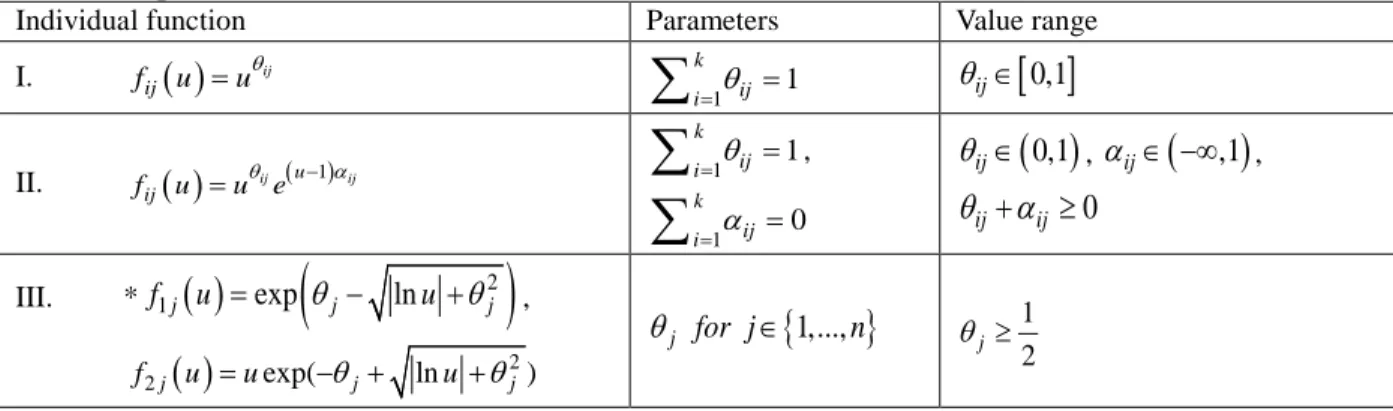
172
approach to construct joint probability models in offshore engineering applications (Nataf, 1962). Wist et
173
al. (2004) have applied a Nataf model to capture successive wave heights and found that they can be well
174
approximated by this joint bivariate model. A more complicated methodology has been presented by Sagrilo
175
et al. (2011) for creating a Nataf model which includes the wave, wind and water current parameters. It is
176
also applied in a structural reliability analysis where an environmental contour is estimated from the Nataf
177
model (Silva-González et al. 2013). More recently, the maximum entropy distributions, which are developed
178
based on Nataf transformation, have been utilized in the modeling of wave height and wind speed (Dong et
8
al. 2015). The features of the approximation for the distribution of the physical variables depend on whether
180
the vector of the transformed standard normal variables is close to being multi-normal. Otherwise, it is
181
criticized that certain transformation procedures might not be necessary (Huseby et al., 2013). For
182
comparison, a 4-dimensional model was easily constructed in De Michele et al. (2007) via conditional
183
mixtures of copulas (now generalized by the so-called Vine copulas).
184
Generally, under certain conditions each of the provided models has its own advantages. Quite a
185
few of these models are flexible enough to provide a realistic characterization of ocean parameter
186
dependencies under various conditions. With the aim of advancing the field of offshore reliability
187
engineering, there is a strong need for establishing a multivariate model that can handle nonlinear
188
dependencies. We found that only little attention has been devoted to the research of non-symmetric
189
multivariate models for ocean parameters. Studies in this direction with greater depth seem useful in order
190
to improve the modeling of dependencies in ocean data.
191
192
3.Copula theory and dependence measures 193
An alternative modeling approach to the multivariate ocean data is to use copulas for constructing
194
multivariate data. Copulas provide a powerful tool for modeling multivariate data, and are widely used in
195
Finance and Economics (see, e.g., Cherubini et al. 2004; McNeil et al. 2005), as well as in Hydrology and
196
Environmental Sciences. In this latter instance, as seminal references, the following ones provide a thorough
197
survey: for a theoretical introduction see Nelsen (2006); Joe (2014); Durante and Sempi (2015), for a
198
practical engineering approach see Genest and Favre (2007); Salvadori et al. (2007); Salvadori and De
199
Michele (2007).
200
3.1 Definition and basic properties
201 202
Copula is a model, which “couples” univariate marginal distributions to form a multivariate distribution. In
203
theory, a copula model is constructed by combining the marginal distributions of variables and a specific
204
dependence structure. The formal definition of a copula as a multivariate distribution with specified
205
marginal distributions is originally introduced in Sklar’s theorem (Sklar, 1959):
9
Sklar’s Theorem: Let F be an n-dimensional distribution function with marginal distributions F1, …, Fn.
207
There exists an n-dimensional copula C such that for all x∈Rn
208
(
1, , n)
(
1( )
1 , , n( )
n)
F x K x =C F x K F x (3)
209
If F1, …, Fn are all continuous, then C is unique. Conversely, if C is a copula and F1, …, Fn are distribution
210
functions, then the function defined in Eq. (3) is a multivariate distribution function with marginal
211
distributions F1, …, Fn.
212
On account of Sklar’s theorem, it is easy to see that the copula model does not need to consider the
213
characteristics of the individual random variables in the multivariate problem. This results from the
214
probability integral transform which states that the random variables Ui=Fi(Xi) are uniformly distributed on
215
[0, 1]. Note that the probability integral transform works for continuous random variables, since Fishould
216
be invertible. In other words, the copula model is a multivariate model for all the variables after their
217
transformation through the cumulative distribution function. Copula is a multivariate cumulative
218
distribution function with uniform marginals. Hence, the domain and the range values for an n-dimensional
219
copula function are
220
[ ]
[ ]
: 0,1n 0,1
C → .
221
Compared to the other joint distribution models, the copula approach has the advantage that the
222
dependency structure between the variables can be defined independently of the choice of the marginal
223
distributions. The freedom of selecting any marginal distributions for the variables in a copula makes this
224
approach quite flexible in characterizing individual variable’s behaviors. This flexibility is highly desirable
225
in the modeling of ocean parameters as the environmental factors often show non-obvious dependencies.
226
Various kinds of parametric copula families and classes can be found in the literature, see e.g. (Hutchinson
227
and Lai 1990; Nelsen 2006; Salvadori et al. 2007; Joe 2014). Each family or class of copulas can characterize
228
a certain kind of dependence in multivariate data. Most of these copulas are used for bivariate data. However,
229
they can be expanded to a multivariate model through straightforward transformations. Examples of copulas,
230
like Archimedean copulas, are presented in Appendix B.
10 232 3.2 Dependence measures 233 234 235
To highlight the significance of the copula approach in offshore engineering applications, a detailed
236
interpretation of dependence concepts is provided herein. The dependence structure is generally the most
237
important characteristic in a copula model. The most common and convenient way for measuring the data
238
dependence is using the Pearson’s correlation coefficient ρ. It is widely applied in many statistical
239
approaches because of its simplicity and ease of handling. However, the weakness of ρ is also obvious as it
240
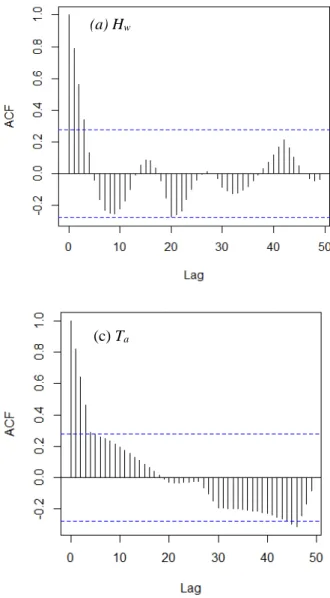
can only represent linear dependencies. Therefore, other concepts of dependencies such as Kendall’s τk and
241
Spearman’s ρs were introduced in the literature (Joe, 2014). Compared to Pearson’s coefficients, these two
242
dependency measure concepts are much more robust. Kendall’s τk measures the possible excess of
243
concordance/discordance in the sample, while Spearman’s ρs is a measure of the “distance” (in the L1
244
integral sense) between the chosen copula and the one modeling independent variables (see Salvadori et al.
245
(2007)). Pearson coefficient requires the existence of the second order moments, and may depend on the
246
marginals, whereas Kendall and Spearman ones are nonparametric measures of association and do always
247
exist. Furthermore, the influence of unequal variances, outliers and non-linearity, which could cause
248
distortions in Pearson’s correlation coefficient, are greatly minimized in Kendall’s τk and Spearman’s ρs. In
249
other words, from engineering point of view, Kendall’s and Spearman’s dependencies are more focusing on
250
the concordance of the ranking whereas Pearson’s dependence is focusing on the value. Copula model can
251
describe various kinds of dependencies which include association concepts such as concordance, linear
252
correlation and other related measures. A copula is thus much more flexible than traditional concepts for
253
characterizing dependencies and includes these concepts. However, there are a few issues associated with
254
traditional copulas (e.g. Archimedean copulas) when they are applied to ocean data. A key drawback is that
255
some copulas are symmetric while most ocean data display non-symmetric dependencies. The reason for
256
these asymmetric dependencies can be summarized as follows:
11
• Different ocean variables respond differently to the same environment conditions. For example, when
258
there is a hurricane, the wind speed is the most directly affected variable. A sudden increase of wind
259
speed is expected to be observed. The value of wind speed has a very quick response to the hurricane.
260
However, this effect may not be reflected in the wave height values instantaneously. There is normally
261
a delay in the observed wave height due to the change of wind speed. Such a delay causes some
262
deviations in the co-movement of wave height and wind speed time series data. Thus, a nonlinear
263
dependency is observed in the data and asymmetric dependencies evolve. This effect can be illustrated
264
by means of scatter plots as shown in Fig. 1.
265
266
Figure 1 Asymmetric dependency of ocean data caused by delay.
267 268
• The feasible domain of parameters restricted by the physical phenomenon is another significant reason
269
for asymmetric dependencies. For example, a large value of wave height is unlikely to be accompanied
270
by a small wave period because of the breaking wave limit. In other words, the observation of some
271
variable combinations is physically impossible. This effect is illustrated in Fig. 2. As can be seen, there
272
is no observation in the right-lower region (marked with a cross), while observations can be seen in the
273
left-upper region (marked with a tick). That is, implicit physical phenomena can limit the possibility of
274
occurrence for some data combinations. The feasible domain is therefore reduced and becomes
275 Wave height Wind speed Wave height Wind speed
Perfect linear relationship Nonlinear relationship and asymmetric dependency Caused by delay
•
•
•
• ••
•
..
•
...
.
-·
••
•
•
··'
.;. ':f •
-·
••
•
-~
..
•
.
....
-··
•••
•
•
•
••
•
-·
••
12
asymmetric.Implementing such physical feature in the copula model is not straightforward and is still
276
in its infancy stage of development.
277
278
Figure 2 Asymmetric domain of wave data caused by physical phenomenon.
279
These effects can be commonly observed in most collected ocean datasets. The ignorance of such
280
asymmetric dependencies would lead to unreliable multivariate models and associated estimates, for
281
example, of long term return values. However, the traditional copula approach is not capable of handling
282
these effects efficiently. A more advanced statistical approach is therefore required.
283
4.Asymmetric copulas 284
In general, as discussed in the above, the most commonly used copulas cannot meet the current needs for
285
modeling ocean data. An accurate modeling of the asymmetric dependencies is highly demanded. To remedy
286
this problem, we introduce several groups of asymmetric copulas as well as the basic concepts in measuring
287
the asymmetry of a copula.
288
4.1 Measure of asymmetry and tail dependency
289 290
First of all, it is necessary to introduce the basic definition of symmetry for the copula model. For a given
291
copula 𝐶𝐶(𝑢𝑢1, … ,𝑢𝑢𝑛𝑛), if
292
Wave height Wave period
breaking wave limit
✓
••••••
·-·
••••
···-·-=-·
....
·.--.
:.-•
· - · •• !JI
.
.
·-·
••
.
•••• • •
•••• ••
·-·
·•
-
•·-·
..
/... ..
.
-
..
/.
.
~·--·
.
/ ... • - · !a • • • ,,,,,,.
..
-..
.
.
,,,,.
.
.
..
--
.
.-
. .
.
..
/ /•• , .-...
.
.
__
·
...
-=-- •
/,,,,,,
··--=-·--··· •...
,,,,,,
. ,~-·
·~
.-..
..
,,,,,,
/,
__...
..
,,,.,,,.
...
.
.-.
.
, /,,,.,
.
..
-
..
.
.
.,,..,,. ,,,.,,,. ,,,..,,.X
, /13
(
1,..., i,..., j,..., n)
( ,...,1 j,..., i,..., n)C u u u u =C u u u u is true for any pair 𝑢𝑢𝑖𝑖,𝑢𝑢𝑗𝑗∈ 𝐈𝐈, 293
then ui and uj are said to be exchangeable and the copula 𝐶𝐶(𝑢𝑢1, … ,𝑢𝑢𝑛𝑛) is said to be symmetric (Genest and
294
Nešlehová, 2013). On the other hand, if a copula function does not satisfy the above condition, it is
295
considered to be asymmetric. Based on this idea, a measure of asymmetry in a copula was developed by
296
Klement and Mesiar (2006).
297
For instance, a natural measure of asymmetry for a 2-dimensional copula can be calculated by the
298
following equation Klement and Mesiar (2006)
299
( )
{
1 1(
)
(
)
}
1/ 1 2 2 1 1 2 0 0 , , p p p C C u u C u u du du η =∫ ∫
− (4) 300where p can be set at any value that is greater than or equal to 1, 𝑝𝑝 ≥1. In other words, the measure of
301
asymmetry is represented as the distance between C and its transpose CT, like the norm. Moreover, it is
302
usually more convenient to compute the value when p approaches infinity, which leads to
303
( )
( ) [ ]2(
)
(
)
1 2 1 2 2 1 , 0,1 sup , , u u C C u u C u u η∞ ∈ = − . (5) 304Thus, when this measure goes up to a certain value, the copula is considered as non-exchangeable and is
305
understood to be asymmetric. In the observation of bivariate ocean data, the measure of asymmetry as
306
calculated by Eq. (5) could serve as a measure of exchangeability for the data. An extension of Eq. (4) and
307
Eq. (5) for measuring the asymmetry of two variables in high dimensional copula can also be derived as
308 following 309
( )
( , ) [ ]0,1( )
( )
sup n C C C π π η∞ ∈ = − u u u u , (6) 310where u=(u1,…,un) and uπ=(uπ(1),…,uπ(n)), 𝜋𝜋 ∈ 𝑆𝑆𝑛𝑛 is a permutation of {1,…,n}. Generally, it calculates the
311
maximal distance between a copula and a version of it where the arguments are permuted (Harder and
312
Stadtmüller, 2013).
313
Besides the measure of asymmetry, the asymmetric characteristics can also be observed from the
314
differences in the tail dependencies. According to the coefficient of tail dependence proposed by Joe (2014),
14
there are four coefficients that can be used to describe the tail dependence for bivariate data, namely, lower-316
lower, lower-upper, upper-lower, upper-upper tail dependence coefficients. For example, if an n
-317
dimensional copula 𝐶𝐶(𝑢𝑢1, … ,𝑢𝑢𝑛𝑛) is given, these tail coefficients can be calculated as follows:
318
( )
(
( )
( )
( )
( )
)
, 1 1 1 1 | 1 1 0 lim ,..., ,..., | l l i j i i n n j j u C P x F u x F u x F u x F u λ − − − − → + = ≤ ≤ ≤ ≤ , (7) 319( )
(
( )
(
)
( )
( )
)
, 1 1 1 1 | 1 1 0 lim ,..., 1 ,..., | l u i j i i n n j j u C P x F u x F u x F u x F u λ − − − − → + = ≤ ≥ − ≤ ≤ , (8) 320( )
(
( )
( )
( )
(
)
)
, 1 1 1 1 | 1 1 0 lim ,..., ,..., | 1 u l i j i i n n j j u C P x F u x F u x F u x F u λ − − − − → + = ≤ ≤ ≤ ≥ − , (9) 321( )
(
( )
(
)
( )
(
)
)
, 1 1 1 1 | 1 1 0 lim ,..., 1 ,..., | 1 u u i j i i n n j j u C P x F u x F u x F u x F u λ − − − − → + = ≤ ≥ − ≤ ≥ − ,(10) 322where 𝐹𝐹1−1(. ),…,𝐹𝐹𝑛𝑛−1(. ) are inverse marginal distribution functions for the variables x1,…,xn. Therefore,
323
these four equations provide measures of the dependence in four different tails of two variables in a
324
multivariate setting. More commonly, if a bivariate copula 𝐶𝐶(𝑢𝑢1,𝑢𝑢2) is analyzed, the tail dependence can
325 be derived as (Nelsen (2006)) 326
( )
(
( )
( )
)
( )
, 1 1 1|2 1 1 2 2 0 0 , lim | lim l l u u C u u C P x F u x F u u λ − − → + → + = ≤ ≤ = , (11) 327( )
(
(
)
( )
)
(
)
, 1 1 1|2 1 1 2 2 0 0 ,1 lim 1 | 1 lim l u u u C u u C P x F u x F u u λ − − → + → + − = ≥ − ≤ = − , (12) 328( )
(
( )
(
)
)
(
)
, 1 1 1|2 1 1 2 2 0 0 1 , lim | 1 1 lim u l u u C u u C P x F u x F u u λ − − → + → + − = ≤ ≥ − = − , (13) 329( )
(
(
)
(
)
)
(
)
, 1 1 1|2 1 1 2 2 0 0 1 1 ,1 lim 1 | 1 2 lim u u u u C u u C P x F u x F u u λ − − → + → + − − − = ≥ − ≥ − = − . (14) 330The value range of these four coefficients is [0, 1], i.e. 𝜆𝜆𝑙𝑙,𝑙𝑙,𝜆𝜆𝑙𝑙,𝑢𝑢,𝜆𝜆𝑢𝑢,𝑙𝑙,𝜆𝜆𝑢𝑢,𝑢𝑢∈[0,1] where a value of 0
331
indicates asymptotical independence. Equations (11) and (14) are also known as coefficients of upper and
332
lower tail dependence. For multivariate case, if the copula function is known, Eqs. (7) to (10) can be further
333 expressed as follows 334
( )
(
)
, | 0 ,..., lim l l i j u C u u C u λ → + = , (15) 33515
( )
(
)
, | 0 ,..., lim i l u i j u C u u C u λ → + = , (16) 336( )
(
)
, | 0 ,..., lim j u l i j u C u u C u λ → + = , (17) 337( )
,(
)
, | 0 ,..., lim j i u u i j u C u u C u λ → + = , (18) 338where 𝐶𝐶̆𝑖𝑖(. ) and 𝐶𝐶̆𝑗𝑗(. ) are copulas modified from the base copula 𝐶𝐶(. ) which can be shown by the following
339
relationship
340
C uk
(
1,...,un)
=C u(
1,...,uk−1,1,uk+1,...,un)
−C u(
1,...,uk−1,1−u uk, k+1,...,un)
, (19)341
and 𝐶𝐶̆𝑗𝑗,𝑖𝑖(. ) can be expressed by
342
(
)
(
)
(
)
, 1,..., 1,..., 1,1, 1,..., 1,..., 1,1 , 1,..., j i n j i i n j i i i n C u u =C u u− u+ u −C u u− −u u+ u . (20) 343Tail dependencies can help to understand differences in the dependence structure for different tails.
344
This provides useful information about the properties of extreme values from the intrinsic dependencies. In
345
other words, tail dependencies provide a measure for relating one margin exceeding a certain quantile
346
threshold while the other has already exceeded that quantile threshold. When assessing the asymmetry of a
347
copula, the lower-upper and upper-lower tail coefficients can be utilized. The special case of a symmetric
348
copula is included in this model. A symmetric copula can have its variables exchanged, the copula function
349
values 𝐶𝐶(𝑢𝑢, 1− 𝑢𝑢) in Eq. (12) and 𝐶𝐶(1− 𝑢𝑢,𝑢𝑢) in Eq. (13) are identical. Further, for the symmetric case,
350
the value of the lower-upper tail coefficient equals the upper-lower tail coefficient. If these coefficients are
351
different, the copula is asymmetric. However, it should be noticed that the number of coefficients will grow
352
exponentially as the dimension increases, and the interpretation of each coefficient becomes more difficult
353
and indeterminate/vague. More detailed explanations are required when tail dependences are calculated for
354
high dimensional data.
355
4.2 Asymmetric copulas constructed by products
356 357
The construction of asymmetric copulas can be pursued in various ways. In recent years, many methods
358
have been developed in this direction (Grimaldi and Serinaldi, 2006; Mesiar and Najjari, 2014; Mazo et al.,
16
2015). These include plenty of techniques that are utilized to capture the asymmetric dependencies in the
360
multivariate data (Patton, 2006). However, not all of the asymmetric copulas can be practically applied. The
361
application of some asymmetric copulas may need extra functions to characterize the complex dependencies.
362
For instance, the well known Archimax copula, which is proposed by Capéraà et al. (2014), needs to have
363
the Pickands dependence function for its construction. The construction of Pickands dependence is quite
364
difficult and sometimes required complex statistical derivations (Pickands, 1981). Therefore, from a
365
practical point of view, the most popular and practical alternatives among these asymmetric copulas are
366
reviewed in this study. We choose to focus on the asymmetric copula families that can be easily constructed
367
from various base copulas, e.g. Archimedean copulas. Asymmetric copulas with a very complicated way of
368
construction are not explored in the present study.
369
One popular construction principle for asymmetric copulas is to formulate a product of copulas (see
370
Liebscher, (2008)). A general form to obtain an asymmetric copula is
371
(
1)
(
1( )
1( )
)
1 ,..., ,..., k product n i i in n i C u u C f u f u = =∏
, (21) 372where 𝐶𝐶1, … ,𝐶𝐶𝑘𝑘: [0,1]𝑑𝑑 →[0,1] are all n-dimensional copulas, 𝑓𝑓𝑖𝑖𝑗𝑗: [0,1]→[0,1] for i=1,…,k, j=1,…,n are
373
functions that are strictly increasing or identically equal to 1. To ensure this product of copulas is also a
374
copula, the functions 𝑓𝑓𝑖𝑖𝑗𝑗 have to satisfy the following additional properties:
375
1. 𝑓𝑓𝑖𝑖𝑗𝑗(1) = 1 and 𝑓𝑓𝑖𝑖𝑗𝑗(0) = 0,
376
2. 𝑓𝑓𝑖𝑖𝑗𝑗 is continuous on (0,1],
377
3. If there are at least two functions 𝑓𝑓𝑖𝑖1𝑗𝑗,𝑓𝑓𝑖𝑖2𝑗𝑗 with 1≤ 𝑖𝑖1,𝑖𝑖2≤ 𝑘𝑘 which are not identically equal to 1, then
378
𝑓𝑓𝑖𝑖𝑗𝑗(𝑥𝑥) >𝑥𝑥 holds for 𝑥𝑥 ∈(0,1), i=1,…,k.
379
From the above it is easy to see that the constructed copula is generally an asymmetric copula. The
380
properties of these asymmetric copulas are derived from the fundamental properties of copula model. All
381
the functions 𝑓𝑓𝑖𝑖𝑗𝑗 play a role in the asymmetric dependence modeling. This technique is also known as an
17
extension of Khoudraji’s device (1995). For example, by utilizing type I individual function (see Table 1)
383
and set k, n=2, Eq. (21) becomes exactly the Khoudraji copula. The n-dimensional copulas 𝐶𝐶1, … ,𝐶𝐶𝑘𝑘 can be
384
selected from various groups of parametric copulas, e.g. the Gumbel, the Clayton, the Frank, the Gaussian and 385
etc. It is also possible to use independent or Fréchet-Hoeffding bounds for the individual copulas. As for the 386
individual functions 𝑓𝑓𝑖𝑖𝑗𝑗, Liebscher (2008) has provided a list of candidate functions which are suitable for the 387
application. The most applicable individual functions are presented in Table 1. This flexibility can allow this 388
asymmetric copula to be extended to much more complex multivariate models. However, even with these 389
individual functions provided, the number and type of individual copulas are still unknown and need to be decided. 390
Moreover, more advanced numerical methods are required for the simulation and use of this type of copula. 391
Fortunately, certain simulation techniques have already been developed and utilized in the statistical analysis 392
software. For example, the simulation of Khoudraji copula can be easily done by using a package named “copula” 393
in R(Hofert et al., 2016). The use of Khoudraji-Liebscher copulas has already been very popular in the
394
hydrology community, for example, both in terrestrial hydrology (e.g., Durante and Salvadori (2010); De
395
Michele et al. (2013)) and in maritime hydrology (e.g., Salvadori et al. (2013, 2014, 2015)).
396
Table 1 Examples of individual functions 397
Individual function Parameters Value range
I.
( )
ij ij f u =uθ 1 1 k ij i=θ =∑
θij∈[ ]
0,1 II.( )
ij (u 1) ij ij f u =u eθ − α 1 1 k ij i=θ =∑
, 1 0 k ij i=α =∑
( )
0,1 ij θ ∈ , αij∈ −∞(
,1)
, 0 ij ij θ α+ ≥ III. * f1j( )
u =exp(
θj− lnu +θj2)
,( )
2 2j exp( j ln j) f u =u − +θ u +θ{
1,...,}
j for j n θ ∈ 1 2 j θ ≥*Note: type III individual functions can only be used for the asymmetric copula having two individual copulas 398
(e.g. k=2). 399
400
4.3 Asymmetric copulas constructed by linear convex combinations 401
402
Another way of an algebraic construction of an asymmetric copula is by linear convex combinations of
403
copulas. However, the direct linear convex combination of copulas is not suitable to create asymmetric
404
copulas. Since most fundamental copulas are symmetric, the linear convex combination of these copulas
405
✓I
I
-✓I
I
18
would also only produce symmetric copulas. Wu (2014) has proposed a way to modify the fundamental
406
copulas in order to account for asymmetric properties. In his theorem, a new kind of copula is proposed as
407
(
1,...,)
(
1,..., 1,1, 1,...,)
(
1,..., 1,1 , 1,...,)
h n h h n h h h n
C u u =C u u − u + u −C u u − −u u + u (22)
408
where C(.) is the original n-dimensional base copula. It can be seen that the variable uh is not exchangeable
409
with other variables in the developed copula. This type of copula is also known as flipped copula as specified
410
by Salvadori et al. (2007). Such copulas which have flipped dependence structures are already available in
411
the R package “copula” (e.g. rotCopula()).
412
Therefore, with such amendment, 𝐶𝐶̆ℎ(. ) can be used to fit data exhibiting unequal tail dependencies
413
along the hth variable. Furthermore, in order to model asymmetric properties in multiple variables, one may
414
use the following equation to construct the copulas:
415
(
1)
(
1)
0 ,..., n ,..., addition n h h h n C u u =∑
= p C u u (23) 416where 𝑝𝑝ℎ is a weighting factor satisfying the conditions 0≤ 𝑝𝑝ℎ≤1 and ∑𝑛𝑛ℎ=0𝑝𝑝ℎ= 1 . When h=0,
417
𝐶𝐶̆0(𝑢𝑢1, … ,𝑢𝑢𝑛𝑛) =𝐶𝐶(𝑢𝑢1, … ,𝑢𝑢𝑛𝑛). That is, an asymmetric copula is obtained by linear convex combinations of
418
copulas. The compound copula is now a combination of various base copulas with different individual tail
419
dependencies. As in the approach in Section 4.2, a large group of copula families can be selected for the
420
base copula 𝐶𝐶(𝑢𝑢1, … ,𝑢𝑢𝑛𝑛). For the case of a bivariate copula 𝐶𝐶(𝑢𝑢1,𝑢𝑢2), Eq. (22) can be further expressed as
421
(
)
(
)
1 1, 2 2 1 1, 2 C u u =u −C −u u , (24) 422(
)
(
)
2 1, 2 1 1,1 2 C u u = −u C u −u , (25) 423which can also be called the horizontal- and vertical-flipped copulas (Salvadori et al. 2007). Therefore, the
424
constructed asymmetric copula can be generally written as
425
(
1, 2)
0(
1, 2)
1 1(
1, 2)
2 2(
1, 2)
additionC u u = p C u u + p C u u + p C u u (26)
426
where 𝑝𝑝0,𝑝𝑝1,𝑝𝑝2≥0 and 𝑝𝑝0+𝑝𝑝1+𝑝𝑝2= 1. Using this formula, we can easily adjust the values of weight
427
factors assigned to each base copula in order to characterize the asymmetry properties of bivariate data along
428
different variables. In other words, the individual copula 𝐶𝐶̆1(𝑢𝑢1,𝑢𝑢2) or 𝐶𝐶̆2(𝑢𝑢1,𝑢𝑢2) can only capture the
19
asymmetry in one variable. As such, we can also point out the differences between the current construction
430
method and Liebscher’s method. That is, the current method constructs asymmetric copulas that present the
431
asymmetric property in one variable each at a time, whereas Liebscher’s method constructs the copulas for
432
variables having asymmetric properties all at a time.
433
4.4 Skewed copula
434 435
Besides the algebraic construction methods, another way of modeling asymmetrically dependent data is
436
utilizing skewed copulas. This approach originated from skewed multivariate distributions and generalizes
437
the original distribution to allow non-zero skewness. The idea is to transform a multivariate distribution to
438
an asymmetric one by introducing a parameter, which can regulate the skewness (Koll et al., 2013). However,
439
there are only few skewed copulas available in the literature. The most popular one is the skew Gaussian 440
copula.
441
Before introducing the skew Gaussian copula, we recall some basics about the Gaussian copula. An
442
n-dimensional Gaussian copula is defined by
443
(
)
(
1( )
1( )
)
1,..., 1 ,..., ; Gaussian n n n C u u = Φ Φ− u Φ− u Σ (27) 444where Φ-1(.) denotes the inverse of the standard normal distribution function, Φ
n(.) represents the n
-445
dimensional normal distribution function, and ∑ stands for the covariance matrix. The Gaussian copula is a
446
member of the elliptical copula family. The function is very like a multivariate normal distribution function
447
and therefore can only be used to model variables having symmetric dependencies. To overcome this
448
limitation, the basic formula is modified to account for asymmetries based on skew Gaussian distribution
449
functions. A general n-dimensional skew Gaussian copula is given by
450
(
)
(
1,(
)
1,(
)
)
1 1
1,..., ; , , , skew 1; 1,1, 1 ,..., skew ; ,1, ; , ,
skew Gaussian n n skew n n n
C − u u µ Σ β =F F− u µ β F− u µ β µ Σ β (28)
451
where 𝐹𝐹1−1,𝑠𝑠𝑘𝑘𝑠𝑠𝑠𝑠(. ) is the inverse of the univariare skew normal distribution SN(μi, 1, βi), 𝐹𝐹𝑛𝑛,𝑠𝑠𝑘𝑘𝑠𝑠𝑠𝑠(. ) is the n
-452
dimensional skew normal distribution with mean parameter μ, shape parameters β and covariance matrix ∑.
453
The density function of a multivariate skew normal distribution for n-dimensional random variables
20 X(x1,…,xn) is given by 455
(
; ,)
2(
; ,)
(
T ; ,)
n n n f X µ Σ,β = φ X µ Σ Φ β X µ Σ (29) 456where 𝜙𝜙𝑛𝑛(∙;𝜇𝜇,∑) and 𝛷𝛷𝑛𝑛(∙;𝜇𝜇,∑) represent the probability density function and cumulative distribution
457
function of n-dimensional normal distribution with mean μ and covariance ∑ (Azzalini and Dalla Valle,
458
1996). Usually, for the ease of modeling, the mean values are all set at zero. The asymmetric property thus
459
only results from the shape parameters. When β=0, the copula becomes the standard Gaussian copula with
460
no skewness. If β increases, the skewness of the distribution increases. Once β changes its sign, the skewness
461
is reflected in the opposite side of the axis. The asymmetric properties can be characterized by the shape
462
parameters either for the marginals or for the multivariate distribution.
463
From the comparison between Eq. (28) and Eq. (21), it can be seen that the skew copula is in fact a
464
special case of the constructed copulas as given in Section 4.2. Compared to the general form, the skew
465
copula has only one individual copula (k=1) and this individual copula (Ci) and the individual function (fij)
466
are coming from the same family (skew Gaussian distribution). However, it is still interesting to discuss the
467
use of skew copulas since no previous work has been done on its application in the modeling of ocean data.
468
5.Data analysis 469
To demonstrate the advantages of asymmetric copulas over the other models in a real case application, a
470
comparative study is performed based on ocean data from the National Data Buoy Center, US (NDBC,
471
2016). The data were collected at a site in the Aleutian Trench, off the south coast of Alaska (52.785˚N
472
155.047˚W Buoy No. 46066) which has a water depth of 4545 m. The hourly recorded ocean data from the
473
years 2014 and 2015 are extracted for the investigation (2014/1/1 01:00-2015/12/31 23:00). We choose to
474
study three ocean parameters: significant wave height (Hw), average wave period (Ta) and wind speed (Vw).
475
The unit of the measured wave height is in meters, while the units of wave periods and wind speed are
476
second and meter per second, respectively. Here, only non-braked waves are recorded. The record of the
477
ocean data shows a clear seasonal variation as depicted in Fig. 3. The data indicate more severe conditions
478
in winter compared to summer.
21
As the time varying feature of the data record is very obvious, it is not reasonable to consider a
480
simple statistical analysis to all the multivariate data at one time. A data partitioning is necessary to separate
481
different groups of data for the analysis. To simplify the problem, we analyze a specific period of data which
482
are critical and short. On this basis we can assume that all ocean data are quasi stationary for the statistical
483
analysis. In this study, the ocean data covering the most severe period from November to February are
484
chosen for the investigation. Figure 3 shows the variations of the mean and standard deviation of Hw, Ta and
485
Vw over this period. However, the statistical testes are required to check whether the data are significantly
486
different from each other in different months. Here, t-tests are applied to test whether the data of Hw, Ta and
487
Vw are significantly different in different months. The highest p-values for Hw, Ta and Vw are 0.324, 0.187
488
and 0.443 which imply that the hypothesis of data from different months show statistically different means
489
is rejected. Therefore, it is believed that the data within the period from November to February may
490
approximately be represented by the same statistical model. Although the data within this period might not
491
be perfectly homogeneous, the time varying effects associated with Hw, Vw and Ta can be neglected.
492
Therefore, the data set (Hw, Vw, Ta) from the four months winter season in 2014 and 2015 are used for the
493
subsequent statistical analysis. However, it should be pointed out the ocean data at this ocean site for the
494
whole period is not completely collected. It has an amount of missing data in the hourly record. Only 3910
495
out of 5952 observations are collected. The detailed information and a general statistical summary of Hw,
496
Vw and Ta is provided in Table 2. The differences in statistical properties between different ocean data are
497
large. Individual characteristics of the ocean parameters Hw, Vw and Ta have to be investigated separately.
498
499 Jan Feb Mar Apr May Jun Jul Aug Sep Oct Nov Dec
8 7 6 5 4 3 2 1 0 H w ( m ) Dec Nov Oct Sep Aug Jul Jun May Apr Mar Feb Jan 20 15 10 5 0 V w ( m /s )
22 500
501
Figure 3 Monthly box plot of Hw, Vw and Ta over one year
502 503
Table 2 Basic statistics of Hw, Vw and Ta.
504
Dataset Number of data Mean Std. Deviation Skewness Kurtosis
Hw 3910 3.509 1.276 1.041 1.802
Vw 3910 7.687 3.726 0.324 -0.318
Ta 3910 7.814 1.073 0.277 0.248
505
Another issue that needs to be considered before the statistical modeling is the serial correlation. To
506
observe the serial dependence, the autocorrelation functions for Hw, Vw and Ta are plotted in Fig. 4. The
507
figure shows the autocorrelation function values of the time series are not very strong when time lag is about
508
3 hours. In fact, the dependence between the observation and the one 3 hours later can be negligible (e.g.
509
autocorrelation function value is within the rejection region for test of individual autocorrelations, see Fig.
510
4). Therefore, in this study, we generally assume the serial dependence is weak and the collected data can
511
be directly used for statistical analysis. However, it should be realized the time series data need to be
pre-512
processed when serial correlation is very strong. The current analysis only adopts a relaxed assumption in
513
this data pre-processing. Typical steps about how to remove the serial correlations contained in time series
514
data can be found in Vanem (2016).
515 Dec Nov Oct Sep Aug Jul Jun May Apr Mar Feb Jan 11 10 9 8 7 6 5 4 T a ( s )
23 516
517
Figure 4 Autocorrelation function of Hw, Vw and Ta for the selected period
518
As a first step, like in all the copula approaches, marginal distributions are determined for the
519
variables to put up an asymmetric copula. In order to make a fair judgment, a group of distributions are
520
utilized to fit the individual ocean data. These include Weibull, Normal, Lognormal, Rayleigh, Extreme
521
value, Exponential and Gamma distributions. Maximum likelihood method is used to estimate the model
522
parameters for each variable. The Akaike Information Criterion (AIC) is used to select the best models.
523
Table 3 summarizes the calculated statistics for each model. It indicates the best models are Lognormal
524
distribution for Hw, Weibull distribution for Vw and Gamma distribution for Ta. The goodness of fitting of
525
these models to the variables can be seen from Fig. 5. The 95% bounds of the empirical cumulative
526 (a) Hw (b) Vw (c) Ta 0 0 co 0 (D 0 <D (() 0 0 '<I: LL '<I: (_) 0 <( N LL 0 0 <( N ci 0 0 0 0 0 N c:;> 0 10 20 30 40 50 0 10 20 30 40 50 Lag Lag q ID 0 (() 0 LL ~ 0 0 <( N 0 q 0 N ci I 0 10 20 30 40 50 Lag
24
distribution function are also included. The p-value in the Kolmogorov-Smirnov test shows that the fitted
527
model is a valid option at a significant level of 1% for each of the ocean variables.
528
529
530 531
Figure 5 Distribution fitting to the collected ocean data 532
533
Table 3 Calculated AIC statistics for the marginal distribution model fitting 534
Weibull Normal Lognormal Rayleigh Extreme
value
Exponential Gamma
Hw 125814 128922 119792* 127976 149104 156506 121004
Vw 139494* 151950 151300 187970 162430 228980 151000
Ta 186032 187578 188190 189672 198086 218644 186006*
*The lowest AIC value indicates the best model. 535
536
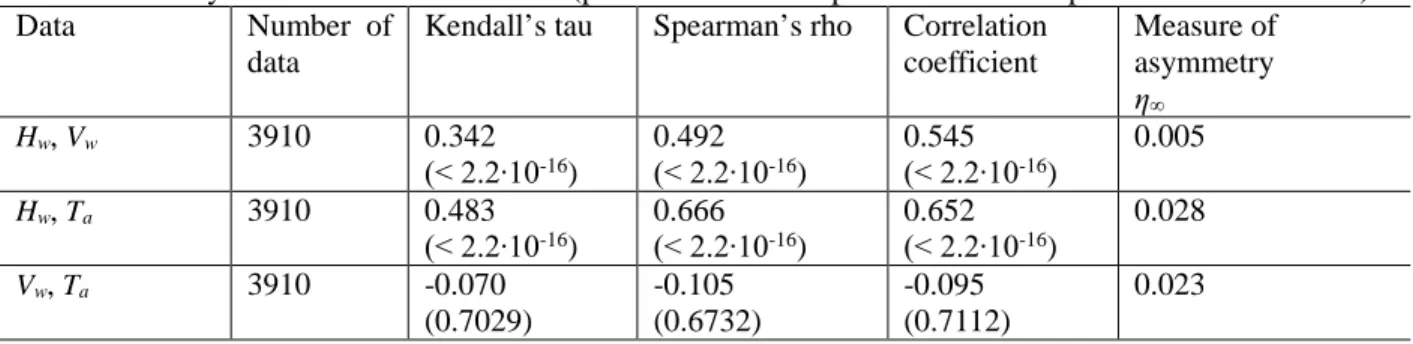
Despite the differences in the individual characteristics, the multivariate statistical properties in
537
between the ocean variables are studied. The dependence measure concepts including Kendall’s tau,
538
Spearman’s rho and correlation coefficient are calculated for each pair of the dataset as summarized in Table
539 p-value=0.0336 p-value=0.0174 p-value=0.0238 0.9 0.8
£0
_7
E 1 o.6 0 5. ., 0.5 .::: .'@ 0.4 E 8 0.3 0.2 0.1 0.9 0.8 £0.1 E " 0.6 -" 2 c.. ., 0.5 -E " 0.4 ,; E 8 0.3 0.2 0.1 0 2 3 4 5 6 7 - -Empirical CDF··· confidence bounds (95%)
- -Lognonnal 5 6 7 H w 8 9 10 - -Empirical CDF
"""""Confidence bounds (95%)
- -Gamma 8 9 10 II 12 T a 0.9 0.8
£0_
7
E 1 o.6 2 ;o.s .::: ] 0 4 ::, . E 8 0.3 0.2 0.1 - -Empirical CDF... confidence bounds (95%)
- -Weibull 0"""'~- - - ~ - - - - ~ - - - ~ - - - - ~ 0 5
I
I
10 V w 15 2025
4. Furthermore, the measure of the asymmetry is computed for the paired data and presented in the table.
540
Here, the calculation of the measure of asymmetry adopts an infinity value for p as following Eq. (5). As
541
can be seen from this table, the dependence measure concepts show similar values. The dependence in (Hw,
542
Vw) and (Hw, Ta) is relatively stronger than that in (Vw, Ta) (as indicated by the value and independence tests).
543
On the other hand, the results of asymmetric measures for (Hw, Ta) and (Vw, Ta) are slightly higher than (Hw,
544
Vw). A test of exchangeability is also conducted for the bivariate data based on pseudo observations. The
545
calculated p-values for (Hw, Ta), (Vw, Ta) and (Hw, Vw) are 0.001, 0.003 and 0.008 according to the method
546
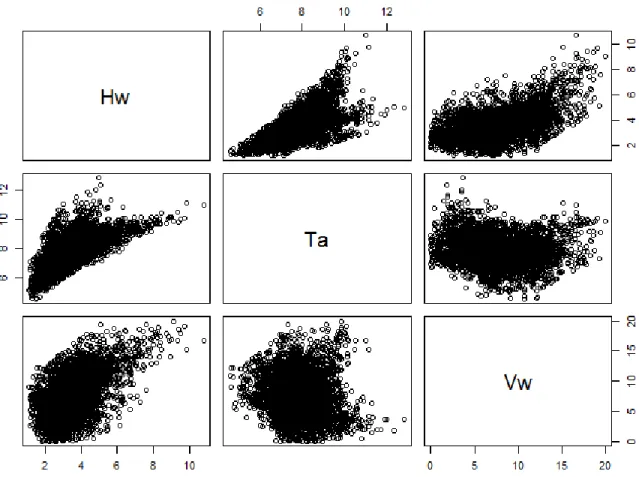
given by Genest et al. (2012). This indicates all the bivariate data show obvious asymmetric dependency. A
547
general feeling of these complicated dependencies can be developed using the scatter plot in Fig. 6. It can
548
be seen that all the dependencies between the ocean variables are not perfectly linear. For example, (Hw, Ta)
549
data points are only available in the left upper domain in the scatter plot. Moreover, it should be noticed that
550
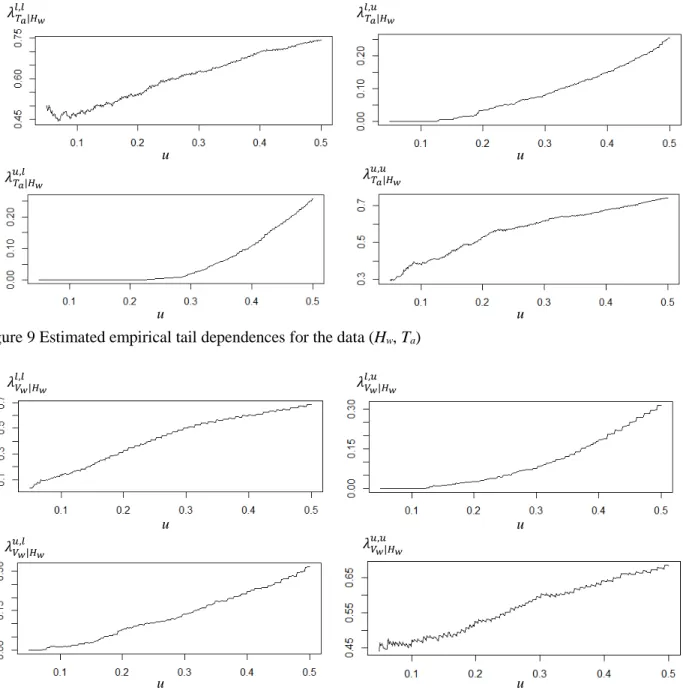
the tail dependency of these bivariate data is quite different. (Hw, Ta) data has a very strong tail dependency
551
in the maxima extremes whereas (Hw, Vw) data has a weak tail dependency in the maxima extremes (can be
552
seen as the linearity). The characteristics of tail dependency must also be accounted for in the multivariate
553
data modeling.
554
555
Table 4 Summary of the ocean bivariate data (p-values of the independence tests are provided in the bracket) 556
Data Number of data
Kendall’s tau Spearman’s rho Correlation coefficient Measure of asymmetry η∞ Hw, Vw 3910 0.342 (< 2.2∙10-16) 0.492 (< 2.2∙10-16) 0.545 (< 2.2∙10-16) 0.005 Hw, Ta 3910 0.483 (< 2.2∙10-16) 0.666 (< 2.2∙10-16) 0.652 (< 2.2∙10-16) 0.028 Vw, Ta 3910 -0.070 (0.7029) -0.105 (0.6732) -0.095 (0.7112) 0.023