A Joint Tensor Completion and Prediction
Scheme for Multi-Dimensional Spectrum
Map Construction
MENGYUN TANG1, GUORU DING1,2, (Senior Member, IEEE), QIHUI WU3, (Senior Member, IEEE), ZHEN XUE1,
AND THEODOROS A. TSIFTSIS4, (Senior Member, IEEE)
1College of Communications Engineering, PLA University of Science and Technology, Nanjing 210007, China 2National Mobile Communications Laboratory, Southeast University, Nanjing 210018, China
3College of Electronic and Information Engineering, Nanjing University of Aeronautics and Astronautics, Nanjing 210016, China 4School of Engineering, Nazarbayev University, Astana 010000, Kazakhstan
Corresponding author: G. Ding ([email protected]) and Q. Wu ([email protected])
This work was supported in part by the National Natural Science Foundation of China under Grant61631020, Grant 61501510, and Grant 61301160, in part by the Natural Science Foundation of Jiangsu Province under Grant BK20150717, in part by the China Postdoctoral Science Foundation Funded Project, and in part by the Jiangsu Planned Projects for Postdoctoral Research Funds.
ABSTRACT Spectrum data, which are usually characterized by many dimensions, such as location, frequency, time, and signal strength, present formidable challenges in terms of acquisition, processing, and visualization. In practice, a portion of spectrum data entries may be unavailable due to the interference during the acquisition process or compression during the sensing process. Nevertheless, the completion work in multi-dimensional spectrum data has drawn few attention to the researchers working in the field. In this paper, we first put forward the concept of spectrum tensor to depict the multi-dimensional spectrum data. Then, we develop a joint tensor completion and prediction scheme, which combines an improved tensor completion algorithm with prediction models to retrieve the incomplete measurements. Moreover, we build an experimental platform using Universal Software Radio Peripheral to collect real-world spectrum tensor data. Experimental results demonstrate that the effectiveness of the proposed joint tensor processing scheme is superior than relying on the completion or prediction scheme only.
INDEX TERMS Spectrum tensor, tensor completion, tensor prediction, cognitive radio. I. INTRODUCTION
A. BACKGROUND AND MOTIVATION
With the skyrocketing development of the mobile internet, the shortage of spectrum resource is critical to be tackled [1], [2]. Several approaches have been suggested to meet the traf-fic growth [3], e.g., spectrum refarming, spectrum sharing and network densification, etc. Among these approaches, cognitive radio (CR) is considered as a promising way to improve the utilization of radio spectrum [4]. Specifically, the CR technology [5] allows the unlicensed secondary users to access the spectrum holes unoccupied by the licensed primary users opportunistically [6]. However, it’s doubtful that unli-censed users would not interfere with the incumbents without the knowledge of temporal and spatial information of these bands. Therefore, it is well recognized that it’s necessary to construct and manage a spectrum database to obtain the temporal and spatial spectrum availability information [7].
B. RELATED WORK
Relying on the sensors collecting the spectrum measure-ments, spectrum map can obtain the distribution of signal strength and estimate the spectrum utilization in a particular region, it can be seen as a visible cartography according to the geo-location database. For example, the TV white space coverage map, which combines terrain data and propagation models together to determine the max transmission power of each channel [8], enables opportunistic transmission across the available channels. The author in [9] presents sensing approaches to learn the power spectrum density (PSD) maps of spatial fields, and minimized communication overhead via measurement compression and quantization. In addition, many schemes are focused on the application of the spec-trum map. In [10], the author constructs specspec-trum map from real-world data and estimates different radio and network per-formance metrics. The author in [11] proposes a joint indoor
localization and spectrum map construction scheme that can be directly deployed with limited calibration load in indoor environments. DARPA has also launched its Advanced RF Mapping program, known as Radio Map, which aims to provide real-time awareness of radio spectrum use across fre-quency, geography and time [12]. Radio Map is a developing technology that visually overlays spectrum information on a map enabling rapid frequency deconfliction and maximizing use of available spectrum. However, most of the existing studies on the spectrum map construction solely describe the distribution of the signal strength in space, while the frequency and time information are overlooked. Moreover, if we take the indirect spectrum data into consideration, more factors such as the user data, terrain data, and meteoro-logical and hydrographic data [13] would lead to different result.
In our previous work, we consider two dimensional spec-trum map as the first step, which is presented in [14]. The goal of that work is to construct a TV white space database which collects the spectrum signal strengths from white space devices. In this paper, we extend our work to model the multi-dimensional spectrum data from the perspective of ten-sor [15]. We design and conduct an experiment to collect the real-world signal strength measurements, and compare the effectiveness of the introduced spectrum tensor processing scheme to the matrix completion algorithm.
C. CONTRIBUTIONS
In order to depict the multi-dimensional characteristics of the spectrum data, in this paper tensor pattern is introduced to represent the extending work from a 2D spectrum map to 3D or higher dimensional spectrum map. A tensor can be represented as an organized multi-dimensional array of numerical values, which has been widely applied in computer vision and graphics field [16], [17], [18]. Different from the prior studies, we propose the concept of the ‘‘spectrum tensor’’ and model the spectral manifold information in a novel way. The integration of the tensor into spectrum data is a promising paradigm to extend the study of spectrum map in depth. Specifically, it makes sense to estimate the spectrum tensor with low-cost sensors distributed across a particular domain since only signal strength is required. In order to facilitate practical implementations with sensor networks, where the number of communication devices is limited, two methods are proposed to reduce the overhead. One is to decrease the number of sensing sensors, and com-pletion scheme is required to reconstruct the unknown mea-surements. The other is to incorporate prediction models to capture the relevance among the frequency or time domains via mining available prior information.
Briefly, in this paper, we conduct an experiment using Universal Software Radio Peripheral (USRP) to collect real-world spectrum tensor data, and propose a joint tensor completion and prediction scheme to retrieve the incomplete measurements. The main contributions throughout this paper are summarized as follows:
• Model the multi-dimensional spectrum data from the perspective of a spectrum tensor. To our best knowledge, this is the first work to put forward the concept of the spectrum tensor.
• Formulate the problem of spectrum tensor completion and present data analysis of real-world spectrum measure-ments to reveal the low rank characteristic of the spectrum data.
•Improve the low rank tensor completion algorithm, and evaluate it by comparing the improved spectrum tensor com-pletion, the original one, and the spectrum matrix completion scheme.
•Propose a joint tensor completion and prediction scheme, and obtain an advanced performance than the state-of-the-art schemes.
D. ORIGINATION AND NOTATION
The remainder of the paper is organized as follows. Section II presents the tensor model and the algebraic formulation. The joint tensor completion and prediction scheme is proposed in Section III. The designed experiment and the experimental performance are provided in section IV. The conclusions are drawn in Section V.
We use upper case letters for matrices, e.g.,M, and lower case letters for the entries, e.g.,xt,l,f. The Frobenius norm of the matrixM is defined ask MkF = (P
i,j xij 2 )12. For a
tensor, letχ ∈RI1×I2×...×IN denote an-order spectrum tensor with its (i1,i2, . . . ,iN)-th element denoted byxi1,i2,...,in. Here,
the modeNof a tensor is the number of dimensions. Unfold-ing is an operation that transforms a spectrum tensor into a series of matrices. Specifically, a tensorχ can be unfolded alongi−thmode, denoted asχ(i).
II. MODEL FOR SPECTRUM TENSOR
An n-order spectrum tensor can be defined as χ ∈
RI1×I2×...×IN, with x
i1,i2,...,in denoting its (i1,i2, . . . ,iN)-th
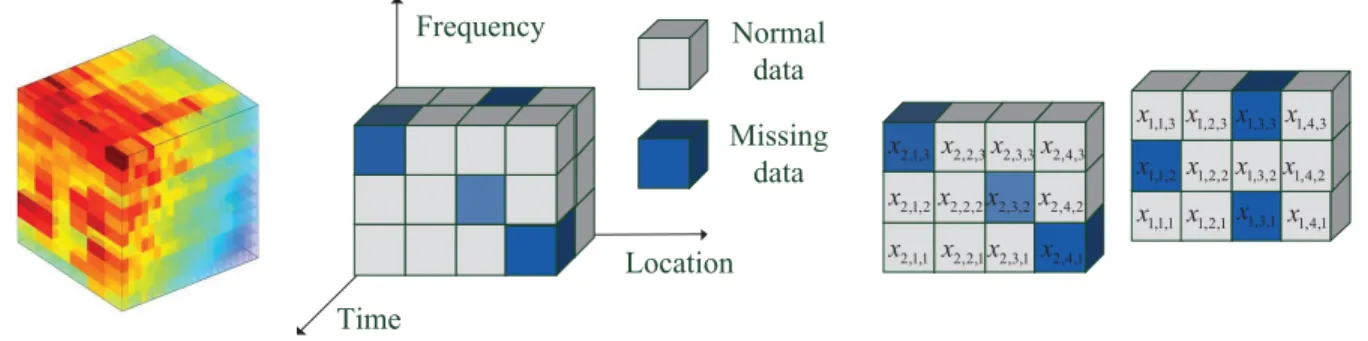
element. Generally speaking, the location is a two- dimen-sional parameter in the plane view, and the location is spatially viewed as a three-dimensional parameter [19]. How-ever, in order to simplify the dimensions of multi-dimensional spectrum map, we assume only one-dimensional parameter to represent the information of the location, and take other factors like frequency and time into account. In Fig. 1(a), we show the real-world spectrum tensor collected in our experiment. It can be modeled as a 3-order spectrum tensor χ∈RI1×I2×I3in Fig. 1(b), whose x-axis is the indices of time
slots, y-axis is the indices of continuous locations, and z-axis is the indices of frequency bands. Each tensor elementxt,l,f denotes the received signal strength in thet-th time slot, the l-th location and the f-th frequency band. As a general-ization of a two-dimensional matrix to higher dimensions, also known as ways or modes, a tensor can be unfolded as matrices along each mode. As an example, the 3-order spectrum tensorχcan be unfolded as follows (1), (2), and (3) are shown at the bottom of the next page, whereχ(f),χ(t),χ(l)
FIGURE 1. Modeling for spectrum tensor.
and location-mode, respectively. The unfolded matrices contain all the entries inside the original tensor.
In practice, a portion of spectrum data entries may be unavailable due to the interference in the acquisition process, or the compression strategies in the sensing process would make the data incomplete [20]. Moreover, when map-ping a spectrum tensor requires a large amount of measure-ments with sensor networks, the overhead of time or energy resources can be narrowed down by means of sampling. In this context, an effective tensor reconstruction method would be essential for recovering incomplete spectrum tensor from a few known samples.
As shown in Fig. 1(c), the white entries denote the normal entries, while the entries in dark color denote the incomplete or unavailable entries. Given a subset, data in the subset indicate the observed entries in χ, the other ‘‘unknown’’ entries would set to be ‘‘0.’’ The subset tensor χ can be defined as
χ=
(
χ, (i1,i2, . . . ,in)∈
0, otherwise. (4)
Then, the spectrum tensor completion for the ‘‘unknown’’ value can be modeled as an optimization problem which com-pletes the tensor data using the known subset, implemented as the following problem
min
χ kχk∗
s.t. χ=0, (5)
wherek.k∗originally denotes the tightest convex envelop for the rank of matrices,χ,0are n-mode spectrum tensors with the same size in each mode, entries of0from the set are given while the remaining entries are missing andχis the incomplete spectrum tensor to be completed. The tensor can be seen as the expansion from the matrix perspective. Generally, low rank matrix completion issue can be solved by defining of the norm to approximate the rank of the matrix, but computing the rank of a tensor (mode number>2) is an NP hard problem [21]. Thus, we introduce the following definition for the tensor trace norm [24]
kχk∗:=
n
X
i=1
αikχ(i)k∗, (6)
whereαi≥0 andPni=1αi =1,||χ(i)||∗denotes the norm of
unfolded matrixχ(i). The trace norm of a tensor is consistent
with all the matrices unfolded along each mode. Under this definition, the optimization problem can be rewritten as
min χ n X i=1 αikχ(i)k∗ s.t. χ=0. (7) III. JOINT TENSOR COMPLETION AND PREDICTION In this section, we propose a novel joint scheme which combines a prediction scheme with the tensor completion algorithm together. As a spectrum tensor can be seen as a
χ(f)= x1,1,3,x1,2,3,x1,3,3,x1,4,3 x1,1,2,x1,2,2,x1,3,2,x1,4,2 x1,1,1,x1,2,1,x1,3,1,x1,4,1 x2,1,3,x2,2,3,x2,3,3,x2,4,3 x2,1,2,x2,2,2,x2,3,2,x2,4,2 x2,1,1,x2,2,1,x2,3,1,x2,4,1 , (1) χ(t)= x1,1,1,x1,2,1,x1,3,1,x1,4,1 x2,1,1,x2,2,1,x2,3,1,x2,4,1 x1,1,2,x1,2,2,x1,3,2,x1,4,2 x2,1,2,x2,2,2,x2,3,2,x2,4,2 x1,1,3,x1,2,3,x1,3,3,x1,4,3 x2,1,3,x2,2,2,x2,3,3,x2,4,3 , (2) χ(l)= x1,1,1,x1,1,2,x1,1,3 x1,2,1,x1,2,2,x1,2,3 x1,3,1,x1,3,2,x1,3,3 x1,4,1,x1,4,2,x1,4,3 x2,1,1,x2,1,2,x2,1,3 x2,2,1,x2,2,2,x2,2,3 x2,3,1,x2,3,2,x2,3,3 x2,4,1,x2,4,2,x2,4,3 , (3)
composition of many spectrum maps, this trial can take the advantage of the correlation between the inherent regularity of these spectrum maps and the completed tensor measure-ments.
A. IMPROVED TENSOR COMPLETION ALGORITHM So far, a lot of algorithms have been proposed to complete the tensor data. The authors in [22] provide a new compres-sive sensing reconstruction formula for multi-dimensional measurements. A fully Bayesian CP factorization which can naturally handle incomplete and noisy tensor data is presented in [23]. In this paper, we propose an improved tensor completion algorithm of an efficient algorithm pre-sented in [24]. The algorithm can work even with a small amount of samples and estimate larger missing regions of the spectrum data.
Because of the interdependence among the matrix trace norm terms, the problem in (7) is difficult to be tackled. In order to simplify the original problem, addi-tional matrices M1, . . . ,Mn are introduced to split these interdependent terms, so that they can be solved inde-pendently. Hence, we can obtain the following equivalent formulation min χ,Mi n X i=1 αikMik∗ s.t. χ(i)=Mi fori=1, . . . ,n χ=0. (8)
The algorithm HaLRTC (high accuracy low rank tensor completion) applies the alternating direction method of mul-tipliers (ADMM) to solve the convex optimization problem by breaking them into smaller pieces [25], and each of them becomes easier to handle. Firstly, let the matrices Mis be replaced with their tensor versionsϕi
min χ,ϕ1,...,ϕn n X i=1 αikϕi(i)k∗ s.t. χ =ϕi, fori=1, . . . ,n χ=0. (9)
Based on this formulation, we can observe thatαis a scale vector. In this sense, in order to tackle this problem, it is equivalent to figure out which i−thdimensional unfolded matrix would have the minimum k ϕik∗. Thus, we
intro-duce the following liner convex optimization problem forα independently min n X i=1 αikϕik∗ s.t. χ =ϕi, i=1, . . . ,n n X i=1 αi=1. (10)
Then, the augmented Lagrangian function is defined as follows Lp(χ, ϕi, γi, αi) = n X i=1 αikϕi(i)k∗+ hχ−ϕi, γii + ρ1 2 kχ−ϕik 2 F +µ( n X i=1 αi−1)+ρ 2 2 k n X i=1 αi−1k2F, (11)
whereρ1,ρ2 are the penalty parameters of the two penalty
functions, respectively. According to the framework of ADMM, the augmented Lagrangian function is applied to updateϕi,χ,γiandαiiteratively
n ϕk+1 1 , . . . , ϕk +1 n o =arg min M1,...,Mn Lρ(χk, ϕ1, . . . , ϕn,y1k+1, . . . ,ykn+1), (12) χk+1 =arg min χ∈QLρ χ, ϕk+1 1 , . . . ϕk +1 n ,yk1, . . . ,yk +1 n , (13) yki+1 =yki −ρ1(ϕik+1−χk+1), (14) µk+1 i =µki −ρ2( n X i=1 αk+1 i −1). (15)
This algorithm can also be accelerated with an increasing value ofρ1, andρ2. Although the convergence rate is not the
fastest, the convergence of the general ADMM algorithm is guaranteed [25]. When the optimization is finished, we can obtain the optimizedα vector that satisfies the constraints from the default value, which means the weight of the best completion performance of the unfolded matrix is 1, while the others are 0. The optimized algorithm is summarized in the Algorithm I. The shrinkage operator Dτ(X) indicates Dτ(X) = UP
τVT, and lines 5, 7, 8, 9 mentioned herein
correspond to the optimized augmented Lagrangian function. B. A JOINT TENSOR COMPLETION AND
PREDICTION SCHEME
Spectrum prediction can forecast future unknown spectrum maps from previous collected spectrum data by exploiting the correlation among them, and provide forecast views of the spectrum utilization of various wireless applications. For a linear dynamic systems with Gaussian noise, the Kalman filter is the minimum-variance state estimator. Even if the noise is non-Gaussian, the Kalman filter can also derive the optimal state estimator in closed form. Since the signal strength measurements change with the radiation source, we can assume that in a short time, the evolution of spectrum maps can be seen as a linear dynamic system.
1) DESIGN RATIONALE
Reviewing the existing studies, prediction schemes have numerous applications for technologies as it can infer the
Algorithm 1αOptimized HaLRTC
1: Initialize:Set K as the number of iterations,N as the dimensions of the spectrum tensor, andθas a scale vector parameter. The parameterρis set to be 1×10⁻⁶, and the temporally used variables are set asϕ =0, γ =0, µ=
0.
2: Input:χwithχ=0,K andα.
3: fork=1,2, . . .Kdo 4: fori=1, . . . ,N do 5: ϕi=foldi h Dαi ρ χi+ρ1γi(i) i . 6: end for 7: χ= 1 n n P i=1 ϕi−1ργi ˜ ; 8: γi=γi−ρ1(ϕi−χ); 9: µi=µi−ρ2( n P i=1 αi−1). 10: end for
11: Output:The completed spectrum dataχčand the scale vectorα.
state evolution. Kalman filter is one of these common predic-tion schemes, which is an iterative algorithm that obtain the results from the consecutive cycles of prediction and filter-ing [26]. It is a widely applied concept in time series analysis used in fields such as signal processing and econometrics, and it is also one of the main topics in robotic motion planning and control [27] and positioning systems [28].
Prediction and iteration are the two key steps of Kalman fil-tering. The spectrum tensor calculated by the improved tensor completion algorithm can be seen as observation value, while a linear prediction model also produces a prediction tensor. The iteration of Kalman gain would adapt the weighted aver-age more and more accurate from the observation and pre-diction results. This joint prepre-diction and completion scheme does not take any assumption errors into account, due to the inaccuracy of the tensor completion algorithm.
2) SCHEME DESIGN
In this paper, we apply the core idea of Kalman filtering to establish a connection between the estimate measurements from the tensor completion algorithm and the prediction results. This connection endows the completion scheme with the universality of Kalman prediction and provides a new solution to figure the optimized problem.
Firstly, a linear prediction model should be provided for making estimates of the incomplete current spectrum state, since the spectrum tensor can be decomposed into many maps. We retain a complete spectrum map as the prior knowl-edge of state, and then divide the incomplete spectrum tensor into two categories. One is a training dataset for building the prediction model, while the other is the input dataset. In the training step, the remaining entries of the training dataset are compared with the reference spectrum map, and the statistical learning tool is adopted to obtain a linear fitting curve as a
prediction model
η¯(k/k)=Aη¯(k/k−1)+B, (16)
whereη is the predicted spectrum tensor. The incomplete entries, which are not included inwould be retrieved via this prediction model. The currentη¯(k/k) can be forecast
by the previous spectrum mapsη¯(k/k −1). AandB are
the state vector parameters, which is acquired by training the input dataset with a curve fitting tool. In this experiment,Ais set to be 1.027, andBis 2.224. Then in the prediction step, we retain the existing entries in, and calculate the estimations of the incomplete current spectrum map by a curve fitting tool based on the input dataset.
With the finished complete predicted tensor, the spectrum tensor would be updated using the Kalman gain to return a balance between the completed spectrum tensor and the predicted spectrum tensor.
η(k/k)=η(k/k−1)+kg(k)(χ(k)−η(k/k−1)). (17) Once the outcome of the measurements from the ten-sor completion schemeχ(k) is observed, a dynamic weight kgčwhich is also referred to Kalman gain, would be assigned to achieve the final integrated spectrum tensorη(k/k). The gain is determined by comparing the observation error of the completion scheme with the prediction scheme.
kg(k)= 1(η(k/k))
1(η(k/k))+1(χ(k)), (18) where 0 ≤ kg ≤ 1, 1 refers to the error of observation and prediction value. Due to the collected original complete spectrum tensor, we can calculate the error of the completed and predicted tensor, respectively. However, in actual fact, the observation error is usually unknown in the real-world exper-iment, and it can be set at random with Gaussian distribution.
3) IMPLEMENTATION
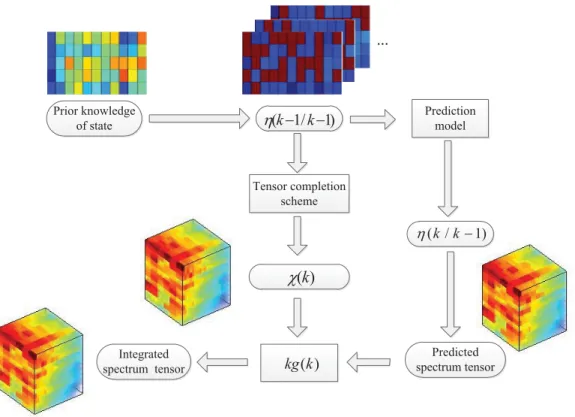
By employing the core idea of the Kalman prediction algo-rithm, the joint completion and prediction scheme include two flow paths, which we can observe from Fig. 2. one is the advanced tensor completion algorithm, and the other is Kalman filtering prediction process. Both of the two paths can produce a reconstructed spectrum tensor, respectively. Since A 3-D spectrum tensor can be seen as a composer of many 2-D spectrum maps, a prior knowledge of state is necessary for building a prediction model, which means we should collect a complete spectrum map, before monitoring envi-ronmental signal strength measurements with several sen-sors. When the incomplete dataset is captured, some of the spectrum maps would be compared with the prior spectrum map, to train a fitting model for the next input dataset. Mean-while, the incomplete spectrum tensor would be processed by the advanced tensor completion algorithm, and produce a complete spectrum tensor. It can run in an online mode, when we collect the signal strength measurements, the joint
FIGURE 2. The flow chart of the joint tensor completion and prediction scheme.
scheme can take these current entries as new input datasets, and process these maps in real-time.
The dynamic weight is an important parameter that winds these two states together. It reveals that which scheme the final integrated result tends to believe more. For example, when the amount of remaining entries of a spectrum tensor is small, tensor completion scheme can hardly play an excellent role, but the prediction model learning from the previous tensor measurements may lead to a more accurate result. On the contrary, when the weight is large, it means the final state estimates trust the prediction results more than tensor completion results.
IV. PERFORMANCE EVALUATION
In the section, we design and conduct an experiment to collect the real-world signal strength measurements, and experimen-tal results demonstrate the effectiveness of the introduced spectrum tensor processing scheme over the state-of-the-art spectrum matrix processing scheme.
A. EXPERIMENT SETUP
In this experiment, we used five USRPs (Universal Software Radio Peripheral), equipped with an antenna for each, to collect the real-world signal strength measurements. The experiment utilizes one USRP as the signal transmitter and the other four USRPs as the receivers, and the table lists the parameters of the transmitter and the receivers. Firstly, we sweep the frequency and find out that the band between 580 MHz-690 MHz is relatively idle. This band is included in
TABLE 1.Transmitting and receiving parameters
the TV white space [7]. Then, we choose 660 MHz to be the central frequency to transmit the sine wave patten. In order to acquire the real-world multi-dimensional spectrum tensor, we divide the lab room into 6×12 grids and measure the received signal strength of these grids.
The experiment performed considers 100 channels of bandwidth 10 kHz each in the TV white space band, and we change the transmitting power by adjusting the gain param-eter. The signal strength at different locations received from the transmitter is ranged from -80dB to -30dB, and the size of the collected spectrum tensor in our experiment is 6×12×21. B. RANK ANALYSIS
In order to characterize the rank of the spectrum tensor data, we first make a preprocessing by unfolding the tensor into matrices along each mode. Then, we apply singular value decomposition (SVD) [29] to analyze the rank distribution of all unfolded spectrum matrices.
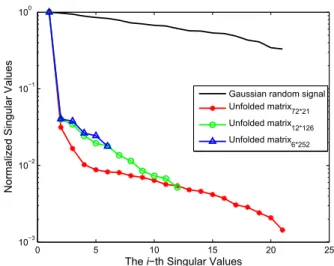
In Fig. 4, we plot the normalized singular values in a descending order for the unfolded matrices along various
FIGURE 3. Visualization for the completion process of the real-world measurements. (a) A three-dimensional tensor collected by USRPs. (b) We randomly remove 50% entries from the original spectrum tensor measurements. (c) The reconstruction result by the tensor completion algorithm.
locations (x-axis and y-axis) and transmitting powers, respec-tively. For comparison, an independent and identically dis-tributed (i.i.d.) Gaussian random signal dataset of the same size is also analyzed. It is suggested that, the distribution of the signal strength is always concentrated on the top several singular values in the measured real-world spectrum tensor, which is quite different from the Gaussian random signal dataset. This phenomenon reveals that practical spectrum tensor exhibits approximate low-rank structure.
C. EXPERIMENTAL RESULTS
We perform simulations to evaluate the tensor completion algorithm we introduced above. Suppose that we sample the spectrum tensor data at random with the sampling ratesr, wheresrindicates the percentage of the observed elements in the tensor.
Under the representative simulation, Fig. 3 presents the completion process of the tensor completion scheme.
The real-world tensor data is shown in Fig. 3(a), where the three-dimensional axis denote the different mode of the tensor, and different colors of the grids denote different signal strength. Then, we do the sampling randomly that only 50% entries are retained in the spectrum tensor mea-surements (see Fig. 3(b). The reconstruction performance of the tensor completion algorithm is shown in Fig. 3(c)), which verifies the effectiveness of the incomplete data estimation.
In order to measure the recovery performance of the tensor completion algorithm, we define the root square error (RSE) in dB as follows
RSE[dB]=10log10||
∼
χ−χ||2
||χ||2 , (19)
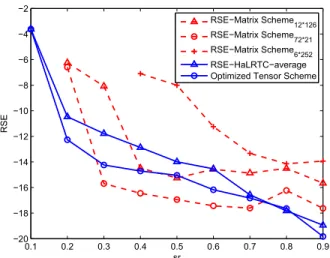
whereχ∼ is the reconstructed tensor and χ is the original real-world spectrum tensor. Fig. 5 compares the RSE of the tensor completion scheme with the matrix completion scheme against various sampling rates. Here we select a fast and robust matrix completion algorithm in widely use [30], which can solve large matrix rank minimization problems. Three dashed lines indicate the RSEs of the matrix com-pletion scheme for the unfolded matrix by different mode, while the two lines indicate the performance of the two tensor completion scheme. We can observe that the performance of thealphaoptimized scheme has about 2 dB better than the average weight for the original tensor completion algorithm. It is also observed that, when sampling rate is less than 0.3 or larger than 0.7, the RSE of the tensor completion scheme has better performance than the matrix completion scheme, while on the contrary, the RSE is not always better than all the unfolded matrix completion results.
It has to be mentioned that in Fig. 5, the matrix completion scheme cannot reconstruct the incomplete data because the sampling rate is too low, according to [30]. Given the rank of the matrixm×nisr, we sample a subset ofpentries and list FR=r(m+n−r)/p, and ifFR>1, then there is always an infinite number of matrices with rankrwith the given entries,
FIGURE 5. RSE performance of the two tensor completion scheme and the unfolded matrix scheme completion.
FIGURE 6. RSE performance of the online joint tensor completion and prediction scheme.
and we can hardly recover the incomplete data successfully in this situation.
Fig. 6 shows the comparison of the joint tensor completion and prediction scheme. The two dashed lines indicate the RSE of the tensor completion, and relying on the prediction scheme only. It is obvious that whensris low, which means the amount of valid observed measurements is small, and the prediction model is relative accurate and stable. Whensr is high, tensor completion scheme has a better RSE perfor-mance than the prediction model. The joint scheme is repre-sented as the line in Fig. 6, which combines the advantage of the reliability of the prediction model whensris low, and the accuracy of the tensor completion whensris relatively high. The performance of the joint scheme is superior whensris below 0.5, and is close to the tensor completion line when over 0.5.
V. CONCLUSION
In this paper, a novel spectrum tensor concept is coined to depict the multi-dimensional spectrum data and a joint tensor
completion and prediction scheme is proposed to interpolate the incomplete or unknown spectrum measurements. The experimental results with real-world spectrum measurements show that the superiority of the joint scheme is over the state-of-the-art studies. For the future work, we would take more factors such as the user data, terrain data, and meteorological and hydrographic data into account, and improve the accuracy of the spectrum tensor.
ACKNOWLEDGMENT
The authors would like to thank the Editor and Reviewers for their precious time and efforts in reviewing our paper. They also thank Prof. Xiaofei Zhang for his helpful discussions. REFERENCES
[1] R. Liu, G. Yu, F. Qu, and Z. Zhang, ‘‘Device-to-device communications in unlicensed spectrum: Mode selection and resource allocation,’’IEEE Access, vol. 4, pp. 4720–4729, 2016.
[2] Y. Wu, R. Schober, D. W. K. Ng, C. Xiao, and G. Caire, ‘‘Secure mas-sive MIMO transmission with an active eavesdropper,’’IEEE Trans. Inf. Theory, vol. 62, no. 7, pp. 3880–3900, Jul. 2016.
[3] Q. C. Li, H. Niu, A. T. Papathanassiou, and G. Wu, ‘‘5G network capacity: Key elements and technologies,’’IEEE Veh. Technol. Mag., vol. 9, no. 1, pp. 71–78, Mar. 2014.
[4] X. L. Huang, F. Hu, J. Wu, H. H. Chen, G. Wang, and T. Jiang, ‘‘Intel-ligent cooperative spectrum sensing via hierarchical Dirichlet process in cognitive radio networks,’’IEEE J. Sel. Areas Commun., vol. 33, no. 5, pp. 771–787, May 2015.
[5] J. Mitola and G. Q. Maguire, Jr., ‘‘Cognitive radio: Making software radios more personal,’’IEEE Pers. Commun., vol. 6, no. 4, pp. 13–18, Apr. 1999. [6] G. Ding, Q. Wu, Y.-D. Yao, J. Wang, and Y. Chen, ‘‘Kernel-based learning for statistical signal processing in cognitive radio networks: Theoretical foundations, example applications, and future directions,’’IEEE Signal Process. Mag., vol. 30, no. 4, pp. 126–136, Jul. 2013.
[7] G. Ding, J. Wang, Q. Wu, Y.-D. Yao, F. Song, and T. A. Tsiftsis, ‘‘Cellular-base-station-assisted device-to-device communications in TV white space,’’IEEE J. Sel. Areas Commun., vol. 34, no. 1, pp. 107–121, Jan. 2016.
[8] R. Murty, R. Chandra, T. Moscibroda, and P. Bahl, ‘‘SenseLess: A database-driven white spaces network,’’IEEE Trans. Mobile Comput., vol. 11, no. 2, pp. 189–203, Feb. 2012.
[9] D. Romero, S.-J. Kim, G. B. Giannakis, and R. Lopez-Valcarce. (2016). ‘‘Learning power spectrum maps from quantized power measurements.’’ [Online]. Available: http://arxiv.org/abs/1606.02679
[10] S. Debroy, S. Bhattacharjee, and M. Chatterjee, ‘‘Spectrum map and its application in resource management in cognitive radio networks,’’IEEE Trans. Cognit. Commun. Netw., vol. 1, no. 4, pp. 406–419, Dec. 2015. [11] S. Sorour, Y. Lostanlen, S. Valaee, and K. Majeed, ‘‘Joint indoor
local-ization and radio map construction with limited deployment load,’’IEEE Trans. Mobile Comput., vol. 14, no. 5, pp. 1031–1043, May 2015. [12] Advanced RF Mapping (Radio Map), accessed on Dec. 11, 2016. [Online].
Available: http://www.darpa.mil/program/advance-rf-mapping
[13] Q, Wu, G, Ding, Z, Du, Y, Sun, M, Jo, and A. V. Vasilakos, ‘‘A cloud-based architecture for the Internet of spectrum devices over future wireless networks,’’IEEE Access, vol. 4, pp. 2854–2862, 2016.
[14] M. Tang, Z. Zheng, G. Ding, and Z. Xue, ‘‘Efficient TV white space database construction via spectrum sensing and spatial inference,’’ inProc. IEEE Int. Perform. Comput. Commun. Conf., Dec. 2015, pp. 1–5. [15] M. Tang, G. Ding, Z. Xue, J. Zhang, and H. Zhou, ‘‘Multi-dimensional
spectrum map construction: A tensor perspective,’’ inProc. IEEE Int. Conf. Wireless Commun. Signal Process., Oct. 2016, pp. 1–5.
[16] P. J. Basser, J. Mattiello, and D. LeBihan, ‘‘MR diffusion tensor spec-troscopy and imaging,’’Biophys. J., vol. 66, no. 1, pp. 259–267, 1994. [17] D. Le Bihanet al., ‘‘Diffusion tensor imaging: Concepts and applications,’’
J. Magn. Reson. Imag., vol. 13, no. 4, pp. 534–546, 2001.
[18] E. Acar, D. M. Dunlavy, T. G. Kolda, and M. Mørup, ‘‘Scalable tensor fac-torizations for incomplete data,’’Chemometrics Intell. Lab. Syst., vol. 106, no. 1, pp. 41–56, 2011.
[19] N. Wu, Y. Xiong, H. Wang, and J. Kuang, ‘‘A performance limit of TOA-based location-aware wireless networks with ranging outliers,’’IEEE Commun. Lett., vol. 19, no. 8, pp. 1414–1417, Aug. 2015.
[20] G. Tsagkatakis, B. Beferull-Lozano, and P. Tsakalides, ‘‘Singular spectrum-based matrix completion for time series recovery and predic-tion,’’EURASIP J. Adv. Signal Process., vol. 2016, no. 1, p. 1, 2016. [21] C. J. Hillar and L.-H. Lim, ‘‘Most tensor problems are NP hard,’’Comput.
Res. Repository, 2009. [Online]. Available: http://arxiv.org/abs/0911.1393 [22] C. F. Caiafa and A. Cichocki, ‘‘Stable, robust, and super fast reconstruction of tensors using multi-way projections,’’IEEE Trans. Signal Process., vol. 63, no. 3, pp. 780–793, Feb. 2015.
[23] Q. Zhao, L. Zhang, and A. Cichocki, ‘‘Bayesian CP factorization of incom-plete tensors with automatic rank determination,’’IEEE Trans. Pattern Anal. Mach. Intell., vol. 37, no. 9, pp. 1751–1763, Sep. 2015.
[24] J. Liu, P. Musialski, P. Wonka, and J. Ye, ‘‘Tensor completion for estimating missing values in visual data,’’IEEE Trans. Pattern Anal. Mach. Intell., vol. 35, no. 1, pp. 208–220, Jan. 2013.
[25] M. Fazel, H. Hindi, and S. Boyd, ‘‘A rank minimization heuristic with application to minimum order system approximation,’’ inProc. Amer. Control Conf., vol. 6. 2001, pp. 4734–4739.
[26] M. I. Ribeiro, ‘‘Kalman and extended Kalman filters: Concept, derivation and properties,’’Inst. Syst. Robot., 2004.
[27] S. Y. Chen, ‘‘Kalman filter for robot vision: A survey,’’IEEE Trans. Ind. Electron., vol. 59, no. 11, pp. 4409–4420, Nov. 2012.
[28] H. S. Ahn and K. H. Ko, ‘‘Simple pedestrian localization algorithms based on distributed wireless sensor networks,’’IEEE Trans. Ind. Electron., vol. 56, no. 10, pp. 4296–4302, Oct. 2009.
[29] M. Aharon, M. Elad, and A. Bruckstein, ‘‘K-SVD: An Algorithm for designing overcomplete dictionaries for sparse representation,’’IEEE Trans. Signal Process., vol. 54, no. 11, pp. 4311–4322, Nov. 2006. [30] S. Ma, D. Goldfarb, and L. Chen, ‘‘Fixed point and Bregman
itera-tive methods for matrix rank minimization,’’Math. Program., vol. 128, nos. 1–2, pp. 321–353, 2011.
MENGYUN TANG received the B.S. degree in electronic and information engineering from the Nanjing University of Post and Telecommuni-cations, Nanjing, China, in 2014. She is cur-rently pursuing the M.S. degree in information and communication engineering with the College of Communications Engineering, PLA University of Science and Technology. Her research interests focus on cognitive radio networks, machine learn-ing, and big spectrum data analytics for future wireless networks.
GUORU DING(S’10–M’14–SM’16) received the B.S. degree (Hons.) in electrical engineering from Xidian University, Xi’an, China, in 2008, and the Ph.D. degree (Hons.) in communications and information systems from the College of Commu-nications Engineering, Nanjing, China, in 2014. Since 2014, he has been an Assistant Professor with the College of Communications Engineering and a Research Fellow with the National High Fre-quency Communications Research Center, China. Since 2015, he has been a Post-Doctoral Research Associate with the National Mobile Communications Research Laboratory, Southeast Univer-sity, Nanjing, China. His research interests include cognitive radio networks, massive MIMO, machine learning, and big data analytics over wireless networks.
Dr. Ding has acted as a Technical Program Committees member for a number of international conferences, including the IEEE Global Communi-cations Conference, the IEEE International Conference on CommuniCommuni-cations, and the IEEE Vehicular Technology Conference (VTC). He is a Voting Member of the IEEE 1900.6 Standard Association Working Group. He was a recipient of the Best Paper Awards from the EAI MLICOM 2016, the IEEE VTC 2014-Fall, and the IEEE WCSP 2009. He currently serves as a Guest Editor of the IEEE JOURNAL ONSELECTEDAREAS INCOMMUNICATIONSand an Associate Editor of theKSII Transactions on Internet and Information Systems.
QIHUI WU (SM’13) received the B.S. degree in communications engineering and the M.S. and Ph.D. degrees in communications and informa-tion systems from the Institute of Communicainforma-tions Engineering, Nanjing, China, in 1994, 1997, and 2000, respectively. From 2003 to 2005, he was a Post-doctoral Research Associate with South-east University, Nanjing. From 2005 to 2007, he was an Associate Professor with CCE, PLA UST, Nanjing, where he served as a Full Professor from 2008 to 2016. Since 2016, he has been a Full Professor with the College of Electronic and Information Engineering, Nanjing University of Aero-nautics and AstroAero-nautics, Nanjing. In 2011, he was an Advanced Visiting Scholar with the Stevens Institute of Technology, Hoboken, USA. His current research interests span the areas of wireless communications and statistical signal processing, with emphasis on system design of software defined radio, cognitive radio, and smart radio.
ZHEN XUEreceived the B.S. degree in electrical engineering from Xidian University, Xi’an, China, in 2012, and the M.S. degree in information and communication engineering from the College of Communications Engineering, PLA University of Science and Technology (CCE, PLA UST), in 2015. He is currently pursuing the Ph.D. degree with CCE, PLA UST. His research interests focus on wireless resource optimization, machine learn-ing, and big spectrum data analytics for future wireless networks.
THEODOROS A. TSIFTSIS(S’02–M’04–SM’10) was born in Lamia, Greece, in 1970. He received the B.Sc. degree in physics from the Aristotle University of Thessaloniki, Greece, in 1993, the M.Sc. degree in digital systems engineering from Heriot-Watt University, Edinburgh, U.K., in 1995, the M.Sc. degree in decision sciences from the Athens University of Economics and Business, Greece, in 2000, and the Ph.D. degree in electrical engineering from the University of Patras, Greece, in 2006. He joined the Department of Electrical Engineering, Technological Educational Institute of Central Greece, in 2010. He is currently an Associate Professor of Communication Technologies with the Department of Electrical and Electronic Engineering, School of Engineering, Nazarbayev University, Astana, Kazakhstan. He has authored or co-authored over 100 technical papers in scientific journals and international conferences. His research interests include the broad areas of cooperative communications, communi-cation theory, wireless communicommuni-cations, and optical wireless communicommuni-cation systems.
Dr. Tsiftsis acts as a Reviewer for several international journals. He was a member of the Editorial Board of the IEEE TRANSACTIONS ONVEHICULAR TECHNOLOGYand the IEEE COMMUNICATIONSLETTERS. He is currently an Area Editor of the Wireless Communications II of the IEEE TRANSACTIONS ON COMMUNICATIONS.