Elsevier required licence: © 2018. This manuscript version is made available under the CC-BY-NC-ND 4.0 license
http://creativecommons.org/licenses/by-nc-nd/4.0/
1
A New Method Based on Type-2 Fuzzy Neural Network
1
for Accurate Wind Power Forecasting under Uncertain
2
Data
3
4
Amir Sharifian*,M. Jabbari Ghadi#, Sahand Ghavidel#, Li Li#, Jiangfeng Zhang#
5
*Department of Electrical Engineering, Ahrar Institute of Technology and Higher Education, P.O.Box
6
41931-63584, Rasht, Iran.
7
#
Faculty of Engineering and Information Technology, University of Technology Sydney, PO Box 123,
8
Broadway, NSW 2007, Australia
9
*Email: [email protected]
10
#
Email: {mojtaba.jabbarighadi, sahand.ghavideljirsaraie}@student.uts.edu.au, {li.li,
11
Jiangfeng.Zhang}@uts.edu.au
12
13
Abstract
14
Nowadays, due to some environmental restrictions and decrease of fossil fuel sources, renewable energy
15
sources and specifically wind power plants have a major part of energy generation in the industrial16
countries. To this end, the accurate forecasting of wind power is considered as an important and influential17
factor for the management and planning of power systems.
18
In this paper, a novel intelligent method is proposed to provide an accurate forecast of the medium-term
19
and long-term wind power by using the uncertain data from an online supervisory control and data20
acquisition(
SCADA) system and the numerical weather prediction (NWP). This new method is based on21
the particle swarm optimization (PSO) algorithm and applied to train the Type-2 fuzzy neural network22
(T2FNN) which is called T2FNN-PSO. The presented method combines both of fuzzy system’s expert23
knowledge and the neural network’s learning capability for accurate forecasting of the wind power. In24
addition, the T2FNN-PSO can appropriately handle the uncertainties associated with the measured25
2
parameters from SCADA system, the numerical weather prediction and measuring tools.
1
The proposed method is applied on a case study of a real wind farm. The obtained simulation results2
validate effectiveness and applicability of the proposed method for a practical solution to an accurate wind3
power forecasting in a power system control center.
4
Index Terms
5
Type-2 fuzzy neural network, PSO algorithm, Medium-term and long-term wind power forecasting,
6
uncertain information.
7
*Corresponding Author: Amir Sharifian; Postal address: Department of Electrical Engineering, Ahrar
8
Institute of Technology and Higher Education, P.O. Box 41931-63584, Rasht, Iran.9
Phone: +98-13-33424373, Fax: +98-13-33424256, E-mail: [email protected]10
11
1. I
NTRODUCTION12
Nowadays, the utilization of thermal power plants has faced lots of limitations due to some
13
environmental restrictions and deep concerns about the air pollution as well as depletion of fossil fuel14
resources. That is why in recent years, the development of renewable energy resources particularly wind15
power plants has played a key role in the electricity energy production in many counties [1]. Wind power16
plants have many advantages because of their relatively little impact to environment, lack of pollution, and17
being renewable.
18
However, one major problem about high penetration of wind power plants into power grids is the
19
uncertainties associated with the forecasting of wind power in different time horizons. Considering high20
fluctuations of these parameters during different hours, accurate forecasting of wind power is considerably21
complicated. Based on power system operation requirements, the forecasting can be divided into three time22
horizons: short-term (few seconds to 30 min), medium-term (30 min to 24 h) and long-term (1 to 7 days).23
The wind power forecasting in different time periods has an important role in the planning, management24
and operation of power systems [1].
25
Recently, a large number of methods have been presented to forecast the wind power. These methods
26
are divided into three parts including physical forecasting methods, statistical forecasting methods and27
3
combined forecasting methods. A comprehensive explanation of these methods is provided in [1], where it
1
is mentioned that advantage of each of these presented methods depends on the wind farm conditions.2
However, among these methods, combined forecasting methods are more useful and also have higher3
accuracy than others. In [2], the authors present a method for medium-term and long-term output power4
forecasting of wind turbines as a function of measured parameters by the SCADA system, and the5
forecasted parameters are obtained from the numerical weather prediction (NWP) (i.e. air pressure,6
humidity, wind speed and direction, and temperature). The recently applied methods for wind power7
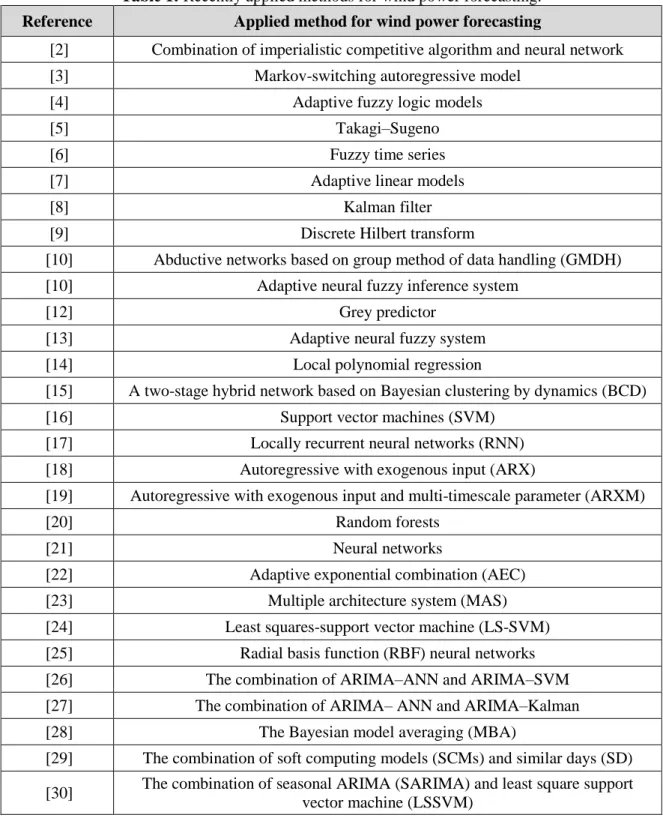
forecasting are summarized in Table 1.
8
As it can be seen in Table 1, no research has been done for wind power forecast which considers
9
simultaneously uncertainties associated with measured parameters from the SCADA system, the forecasted10
parameters and measuring tools.
11
An innovative method based on the artificial intelligence is employed for solving many different
12
problems in power systems instead of performing heavy and time-consuming calculations. These13
techniques are more practical and suitable for online applications. One of the most popular and practical14
artificial intelligence techniques is the Type-2 fuzzy neural network (T2FNN) which combines the15
linguistic interception feature of the Type-2 fuzzy set and the learning capacity of the neural network16
[31,34-35]. Moreover, this network can handle the uncertainty associated with input parameters.17
In this paper, a novel intelligent method based on T2FNN estimation and the particle swarm18
optimization (PSO) algorithm is proposed for the medium-term and the long-term wind power forecasting19
under the uncertain data. The presented approach combines the Fuzzy system’s export knowledge and20
neural network’s learning capability to forecast the wind power, thus termed T2FNN-PSO. In addition, the21
T2FNN-PSO can appropriately handle the uncertainties that are associated with input parameters and22
measuring tools. The performance of proposed method is evaluated by using the obtained data from a real23
wind farm. This method is implemented for two periods of time (medium-term and long-term). The24
simulation results demonstrate that the suggested method is accurate and practical for wind power25
forecasting.
26
4
Table 1: Recently applied methods for wind power forecasting. Reference Applied method for wind power forecasting
[2] Combination of imperialistic competitive algorithm and neural network [3] Markov-switching autoregressive model
[4] Adaptive fuzzy logic models
[5] Takagi–Sugeno
[6] Fuzzy time series
[7] Adaptive linear models
[8] Kalman filter
[9] Discrete Hilbert transform
[10] Abductive networks based on group method of data handling (GMDH) [10] Adaptive neural fuzzy inference system
[12] Grey predictor
[13] Adaptive neural fuzzy system
[14] Local polynomial regression
[15] A two-stage hybrid network based on Bayesian clustering by dynamics (BCD)
[16] Support vector machines (SVM)
[17] Locally recurrent neural networks (RNN) [18] Autoregressive with exogenous input (ARX)
[19] Autoregressive with exogenous input and multi-timescale parameter (ARXM)
[20] Random forests
[21] Neural networks
[22] Adaptive exponential combination (AEC) [23] Multiple architecture system (MAS) [24] Least squares-support vector machine (LS-SVM) [25] Radial basis function (RBF) neural networks [26] The combination of ARIMA–ANN and ARIMA–SVM [27] The combination of ARIMA– ANN and ARIMA–Kalman [28] The Bayesian model averaging (MBA)
[29] The combination of soft computing models (SCMs) and similar days (SD) [30] The combination of seasonal ARIMA (SARIMA) and least square support
vector machine (LSSVM)
1
In summary, the contributions of this paper can be listed as follows:2
1- To present a novel intelligent method based on the T2FNN estimation and PSO algorithm for3
accurate wind power forecasting.
4
2- To effectively handle the uncertainty of measured parameters of the SCADA system and the
5
forecasted parameters from NWP and measuring tools by T2FNN.6
5
3- To apply a new training method based on PSO algorithm for tuning parameters of the T2FNN.
1
The rest of paper is presented as follows:
2
Section 2 describes the methodology of the T2FNN-PSO for the wind power forecasting. Section 3
3
introduces the structure and training approach of the proposed T2FNN-PSO. Section 4 explains simulation4
results and the discussion; and finally, the conclusion is presented in Section 5.5
2.
M
ETHODOLOGY FOR WIND POWER FORECASTING6
Environmental restrictions besides the increase of fossil fuels price have encouraged power system
7
operators to employ renewable energies and specifically wind power during the last decade. On the other8
hand, an accurate wind power forecasting can play an influential role in both of the operation and planning9
of power systems. According to [2], the power forecasting of a wind farm can be obtained based on the10
data obtained from the SCADA system and the NWP (i.e. air pressure, humidity, wind speed and direction,11
temperature). Duo to the chaotic feature of these parameters, the accurate forecasting of generating power12
of a wind turbine in a practical case is a complex obligation. In addition, this subject becomes more13
complex when the uncertainties with these parameters are considered in the system model. In our previous14
work [31], we compared the efficiency and performance of the proposed T2FNN with a multi-layer15
perceptron (MLP) and radial basis function (RBF) neural networks. The obtained results show a better16
performance of the proposed T2FNN in terms of accuracy, handling uncertainty and computational costs.17
Therefore, in this paper, the proposed T2FNN is used to forecast the generated wind power.18
In this section, details of our new method based on T2FNN-PSO estimation for forecasting of the19
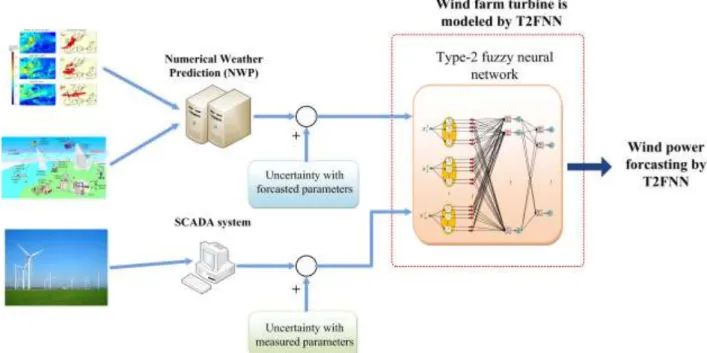
generated wind power are designated. The structure of the proposed approach is illustrated in Fig. 1. As it20
can be seen, each turbine in the wind farm is modeled by using the T2FNN-PSO. The T2FNN-PSO is able21
to estimate the value of the wind power by using its input parameter. The values of measured parameters by22
the SCADA system and the NWP are selected as inputs of T2FNN [2]. It’s obvious that due to the natural23
noise and uncertainties with measured and forecasting tools, the obtained values from the NWP and the24
SCADA system are associated with uncertainties. Therefore, it is necessary to apply a T2FNN-PSO in25
6
Figure 1: Block Diagram of the proposed method based on T2FNN-PSO.
In order to reach a promising estimate for the value of wind power, it is essential to utilize a correct and
1
accurate training algorithm for tuning T2FNN parameters. In this paper, a new method based on the PSO2
algorithm is applied to train the T2FNN.
3
2.1.
N
UMERICAL WIND PREDICTION MODEL4
Nowadays, the weather forecast has a non-negligible impact on the medium-term (i.e. less than 1
5
hour~24 hours) and long-term (i.e. more than 24 hours) wind power forecasting. NWP focuses on6
collecting current weather observations and processing these data with supercomputers for forecasting the7
future status of weather. Therefore, having the accurate status of the current weather is as vital as the8
numerical models processing the data. Current weather observations serve as input to the numerical models9
through a process known as data assimilation to produce the outputs of temperature, wind speed, and10
hundreds of other meteorological elements from the oceans to the top of the atmosphere. The NWP models11
use physical conversion of energy equations and this allows more realistic downscaling of the data. In fact,12
high-resolution NWP plays the key role for the wind power forecast [2].13
Recently, based on available computational systems, NWP models become more popular in many wind14
power estimation studies; where several NWP models such as the weather research and forecasting (WRF),15
conductor-like screening model (COSMO), fifth-generation Penn State/NCAR Mesoscale model (MM5),16
7
and RAMS (i.e. reliability, availability, maintainability, and safety) are applied [1]. Also, various methods
1
of extrapolation such as the logarithmic law and the wind shear power law have been proposed by other2
researchers to provide appropriate wind information at the height of wind turbine hub (i.e. approximately3
50 m) using the meteorological data that are gathered at 10 m above the ground (according to the world4
meteorological organization (WMO) approval) [32]. Needless to say, the usage of extrapolation laws may5
create considerable deviations in accurate assessment of the wind power forecasting, specifically for long-6
term timescales [33].
7
In this paper, the forecast data obtained from NWP are utilized as a part of input patterns for the
8
proposed model to forecast wind power in medium-term and long-term timescales. In other words, our9
model is basically a post-processing neural network model for NWP. The reason lies in the fact that the10
validated data related to the NWP is only available for a certain period of time ahead, and NWP models do11
not have high accuracy for long period of times. Therefore, it is not possible to solely rely on the NWP12
model for the long-term forecast of the wind power. To this end, the SCADA and the historical data play a13
supplementary role for the NWP data. This structure of input data can improve the accuracy of NWP data14
for the medium-term power forecasting and also compensate the low efficiency of NWP data during the15
long-term forecasting.
16
3.
P
ROPOSEDT
YPE-2
F
UZZYN
EURALN
ETWORK17
The neural networks have a desirable performance in terms of recognizing input patterns; however they18
are weak for explaining how they make their decisions. On the other hand, the Type-2 fuzzy systems can19
explain the rules of complex systems and imprecise information, and can handle the uncertainties20
associated with system structure, process and measured variables. However, they are unable to21
automatically acquire the rules which they apply to make these decisions. Therefore, in this paper, these22
two intelligent techniques are combined to overcome limitations of individual techniques. The combined23
system is named the T2FNN system. The T2FNN has been applied successfully in many applications24
including cognitive simulation, process control, medical diagnosis, financial trading, and engineering25
design [31]. The structure of a Type-2 fuzzy Gaussian membership function is shown in Fig. 2.26
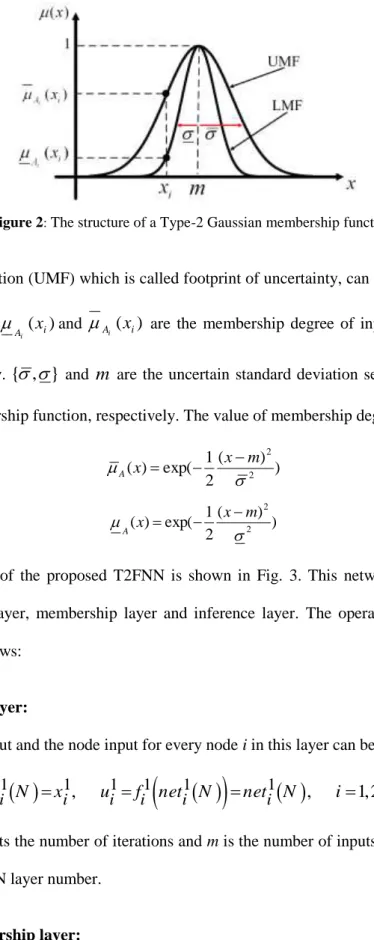
As shown in Fig. 2, the bounded region between lower membership function (LMF) and upper27
8
Figure 2: The structure of a Type-2 Gaussian membership function.
1
membership function (UMF) which is called footprint of uncertainty, can handle the uncertainty associated2
with the system. A (xi) i
and A(
x
i)
i
are the membership degree of input variablex
i to the UMF and3
LMF respectively.
{
,
}
andm
are the uncertain standard deviation set and the mean of Type-2 fuzzy4
Gaussian membership function, respectively. The value of membership degree can be written as follows:5
) ) ( 2 1 exp( ) ( 2 2 A x xm (1) ) ) ( 2 1 exp( ) ( 2 2 x x m A (2)
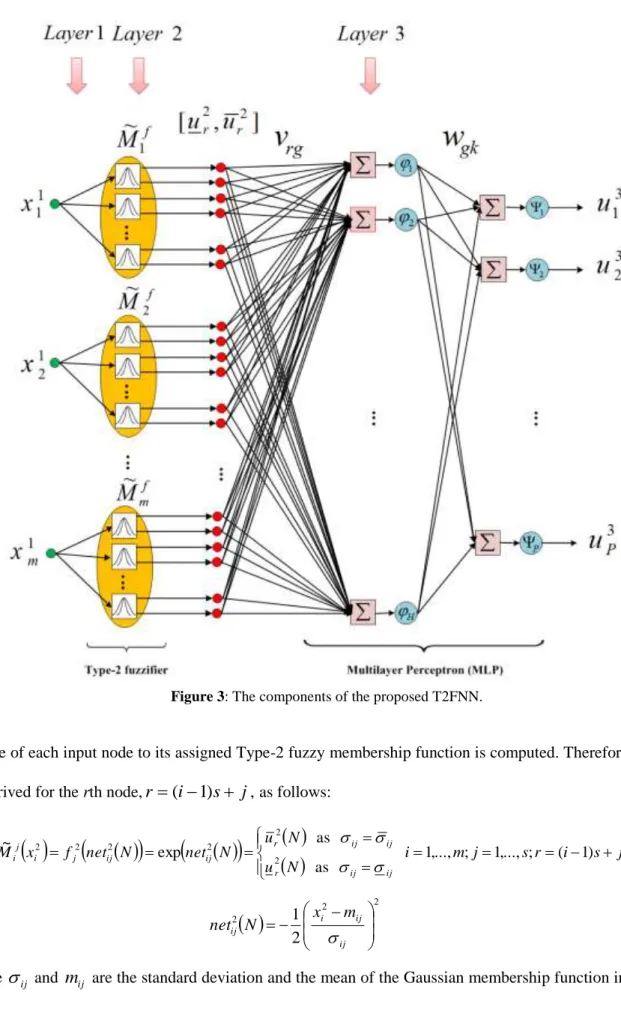
The structure of the proposed T2FNN is shown in Fig. 3. This network is composed of three layers
6
including input layer, membership layer and inference layer. The operation of each layer of T2FNN is7
described as follows:
8
Layer 1-Input layer:
9
The node output and the node input for every node i in this layer can be described as follows:
10
1 1
,
1 1 1 1,
1,2,...,
i i i i i i
net
N
x
u
f
net
N
net
N
i
m
(3)where N represents the number of iterations and m is the number of inputs. The superscripts of all symbols
11
denote the T2FNN layer number.
12
Layer 2- membership layer:
13
In this layer, each node performs a Type-2 fuzzy membership function. Outputs of this layer are
14
fuzzified input nodes which are called linguistic variables. On the other hand, the value of membership15
9
Figure 3: The components of the proposed T2FNN.
1
degree of each input node to its assigned Type-2 fuzzy membership function is computed. Therefore, it can2
be derived for the rth node,r (i1)s j,as follows:3
N i m j s r i s j u N u N net N net f x M u ij ij r ij ij r ij ij j i j i r 1,..., ; 1,..., ; ( 1) as as exp ~ 2 2 2 2 2 2 2
2 2 2 2 1 ij ij i ij m x N net (4)where
ij andm
ij are the standard deviation and the mean of the Gaussian membership function in the jth4
10
Layer 3- inference layer:
1
This layer is the main part of T2FNN which gives a mapping from input nodes (linguistic variable) to
2
the output (crisp values). The output of kth node can be written as follows:3
p k u v v w w u r s m r rg g g H g gk k k k , 1, , 2 1 0 1 0 3
(5)4
whereu
r2,
r
1
,
2
,...,
m
s
is the rth output node in the layer 2. H is the number of neurons in the hidden5
layer of neural network. The number of neurons in the hidden layer is carefully chosen to provide best6
results in training phase of the system. Also,
g and
k are the activation functions for hidden and output7
layers respectively. v0g and w0kare the bias on the hidden unit g and bias on the output unit k. vrg is the8
weight connecting the input neuron r to hidden neuron g.wgkis the weight connecting the hidden neuron g9
to output neuron k.
10
The T2FNN requires the adjustment of its parameters in all the layers such that the desired output can
11
be obtained. These parameters consist of
ij
{
ij,
ij}
,m
ij,v
rgandw
gk which are adjusted by using the12
training algorithm. There are several algorithms such as gradient descent, Levenberg Marquardt and13
resilient back-propagation for training intelligent systems. Selecting an efficient training algorithm is14
essential for a desirable performance of the T2FNN. In this paper, a new training method is used based on15
PSO algorithm to obtain a better training of the T2FNN. Details of the proposed method are described in16
the next sections.
17
3.1.
S
ETTING OF CONTROLLING PARAMETERS FOR PROPOSED ALGORITHM18
As aforementioned, the proposed model is composed of two parts: a Type-2 fuzzifier and a MLP neural
19
network. Controlling parameters should be determined for the proposed model are including the number20
and the type of the fuzzy membership function for input variables and their corresponding average (m) and21
standard variance (σ) values in case of Type-2 fuzzifier; and weights of neurons in case of the MLP neural22
network.
23
To this end, the number and the type of the fuzzy membership function (FMF) for input variables are
24
determined based on the knowledge of an expert person. In order to reach optimized values for these25
11
parameters, considering the small scale of the search space, the trial and error approach and the extensive
1
search have been employed. Authors have tested different types of membership function (e.g. triangular,2
trapezoidal, piecewise linear, Gaussian, etc.) to reach the best type of FMF. Such the approach has been3
applied for the number of FMFs. Finally, the value 3 has been determined as the best value for this4
parameter. It should be mentioned that having more than three membership functions can provide a higher5
level of accuracy; however, it causes exponential development of the system and subsequently a more6
complicated network; on the other hand, having values less than three results in loose of accuracy. In fact, a7
tradeoff has been settled by authors to reach a high quality result with a reasonable computational cost.8
In case of neurons weight for the structure of the MLP neural network, average (m) and standard9
variance (σ) values for membership functions, the PSO algorithm is utilized to reach optimized values for10
these parameters. Obviously, classical methods like gradient descent, Levenberg Marquardt and resilient11
back-propagation could not offer a high quality performance when the number of variables in each pattern12
of the input data is large (i.e. 486 for the presented network).13
14
3.2.
A
PPLICATION OFPSO
ALGORITHM FOR TRAINING THE PROPOSEDT2FNN
15
PSO is an optimization algorithm that was first developed in 1995 by Eberhart and Kennedy [36]. The16
results obtained in [37] shows that the training method based on the PSO algorithm has better performance17
than other training algorithms because of using less computational
time to get higher training accuracy.18
Therefore, in this paper, the PSO algorithm is applied to train the proposed T2FNN.19
According to the previous section, the parameters of proposed T2FNN that should be adjusted by using20
the PSO algorithm in the training phase include
ij
{
ij,
ij}
,m
ij ,v
rgandw
gk. The optimization21
problem proposed in training phase is to search the optimal values of T2FNN parameters by using the PSO22
algorithm. This results in minimization of the sum of the squared differences between the desired output23
and actual output. Hence, the objective function can be written as:24
2 1 ) , , , (
n i i e i d gk rg ij ij m v w y y J
(6)where n is the total number of training patterns and i represents the pattern index.
y
dand yeare the desired25
output and the actual output, respectively. This objective function needs to be optimized (minimized).26
12
During the training process, in each of iterations, the value of objective functionis reduced. This iterative
1
process is ended when a given number of iterations are reached or the value of objective function reaches a2
predetermined value.
3
3.3.
T
RAINING OFT2FNN
TO PREDICT THE WIND POWER4
In this section, the training process of proposed T2FNN-PSO is explained. In order for the proposed
5
T2FNN-PSO to be applied for estimating the wind power, a correct training procedure of the network is6
necessary by employing an accurate training data. In this paper, same as [2], the obtained data from7
Summerside wind farm in Prince Edward, Canada (i.e. detailed in Section 3.4) is used for training and8
testing the proposed T2FNN-PSO [38, 39]. 81 obtained parameters from the NWP and SCADA system are9
selected as inputs of T2FNN-PSO. These parameters are described as follows:10
24 parameters for the wind speed forecasting of the next 24 hours.
11
48 parameters for the wind speed of the previous 48 hours.12
3 parameters for the average forecasted values of humidity, temperature and air pressure of the next13
24 hours.
14
6 parameters for the average forecasted values of humidity, temperature and air pressure of the
15
previous 48 hours.
16
13
The output of T2FNN-PSO is the forecasted value of the wind power for a specified time period. These
1
parameters are used for training and testing the proposed T2FNN-PSO. Fig. 4 illustrates the training2
diagram of the T2FNN-PSO.
3
3.4.
S
UMMERSIDE WIND FARM:
LOCATION,
SPECIFICATIONS,
WIND PATTERN4
The Summerside Wind Farm is located in the St. Eleanor neighborhood of Summerside, Prince Edward5
Island, Canada. Location of wind farm is shown on the map of Canada and Prince Edward Island in Fig .5.6
7
Figure 5: Location of Summerside wind farm on maps of (a) Canada, (b) Prince Edward Island [41].8
14
Isolated ridges and the nearby Atlantic Ocean provide this region with a wealth of wind energy
1
resources. Prince Edward Island has a world-class wind regime, at the northwest tip of the province where2
wind speeds have been measured for three decades, the average wind speed is 8.0 meters per second at 503
meters height. At the eastern tip of Prince Edward Island, the wind is proved to be almost the strongest.4
Wind map for the location of wind farm on hub-height of turbine is depicted in Fig. 6. In fact, a glance at5
the color-coded Wind atlas of Prince Edward Island shows that many areas of the province boast a wind6
regime that is unparalleled in much of North America.
7
This wind farm consists of 4 Vestas V90/3000 wind turbines with a combined nominal capacity of 12
8
MW. The wind farm coordinates are 46°26'15"N & 63°47'59"W. Summerside's $30 million dollar wind9
farm became operational in December 2009 and has been a valuable asset to the city since then.10
Over the course of the year, the temperature typically varies from -11 °C to 23°C and is rarely below -
11
19°C or above 27°C. The warm season lasts for 3.4 months, from June 9 to September 20, with an average12
13
Figure 6: Wind resource map of the Prince Edward Island on hub-height of Vestas V90/3000 [42]14
15
daily high temperature above 17°C. The hottest day of the year is August 1, with an average high of 23°C
1
and low of 17°C. The cold season lasts for 3.4 months, from December 7 to March 20, with an average2
daily high temperature below 2°C. The coldest day of the year is January 30, with an average low of -11°C3
and high of -4°C. Moreover, Fig. 7 shows wind, wave and weather statistics of the wind farm.4
5
Figure 7: Report from local weather station at East Point/PEI in Prince Edward Island [40]6
16
The predominant average hourly wind direction at Summerside Automatic Weather Reporting System
1
varies throughout the year. The wind is most often from the north for 4.0 weeks, from April 6 to May 4,2
with a peak percentage of 31% on March 20. The wind is most often from the south for 3.4 months, from3
May 4 to August 17, with a peak percentage of 44% on July 15. The wind is most often from the west for4
7.6 months, from August 17 to April 6, with a peak percentage of 54% on January 11 [42].5
It should be stated that Fig. 7 shows the percentage of hours in which the mean wind direction is from6
each of the four cardinal wind directions (north, east, south, and west), excluding hours in which the mean7
wind speed is less than 1 mph. The lightly tinted areas at the boundaries are the percentage of hours spent8
in the implied intermediate directions (northeast, southeast, southwest, and northwest).9
4.
R
ESULTS ANDD
ISCUSSION10
In this section, the proposed approach based on T2FNN-PSO algorithm for wind power forecasting
11
which has been simulated in the MATLAB software is presented. The proposed method has been applied to12
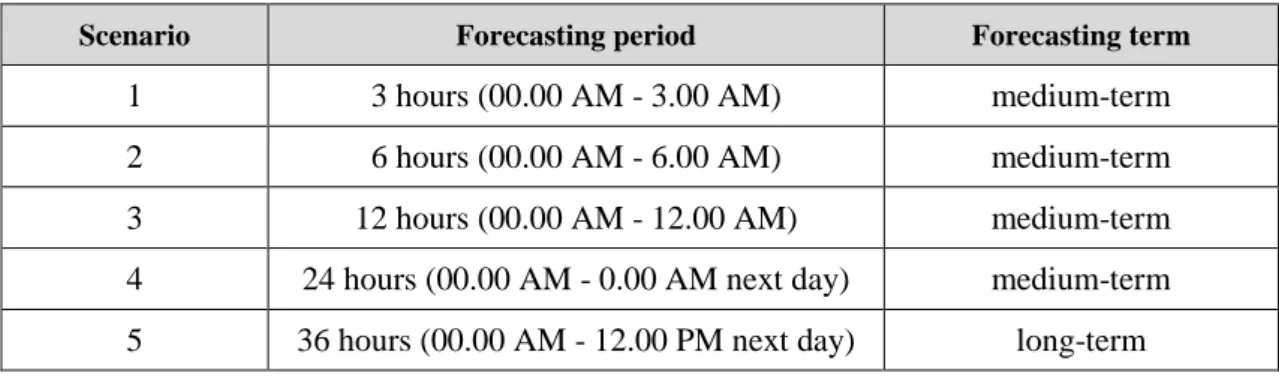
five different case studies (four case studies for medium-term forecasting and one case study for long-term13
forecasting). The selected five case studies are detailed in Table 2.14
As described in the previous section, there are 81 parameters in the T2FNN-PSO input data that are15
obtained from the NWP and SCADA system. In this section, firstly, a T2FNN-PSO network should be16
designed, and then this network is trained by input patterns including 81 parameters.17
The design and training approach of the proposed T2FNN-PSO are explained in the following steps:18
Step 1: The minimum and maximum variations of 81 input operating parameters are determined.
19
Step 2: For each of the 81 input parameters, three sets of Type-2 fuzzy are specified as “S”, “M” and
20
“L”. Here, Gaussian membership functions are selected for input parameters as shown in Fig. 8. It should21
Table 2. The selected five different case studies for wind power forecasting
Scenario Forecasting period Forecasting term
1 3 hours (00.00 AM - 3.00 AM) medium-term
2 6 hours (00.00 AM - 6.00 AM) medium-term
3 12 hours (00.00 AM - 12.00 AM) medium-term 4 24 hours (00.00 AM - 0.00 AM next day) medium-term 5 36 hours (00.00 AM - 12.00 PM next day) long-term
17
Figure 8: Membership functions of the input parameters.
be noted that, the number of membership functions and UMF and LMF variances are specified using expert
1
knowledge.
2
Step 3: In this step, after designing the Type-2 fuzzifier, the neural network is designed. Here, a single
3
layer perceptron neural network is applied and trained by using the proposed PSO based training method.4
Noteworthy that in case of utilizing a sole neural network, there is no option to consider uncertainties5
associated with the input data. Moreover, the MLP neural network with several hidden layers should be6
used because of the non-linear feature of the wind power forecasting problem. Needless to say, a single7
layer MLP neural network is only capable of offering an acceptable performance for linear problems.8
However, as one of the novelties of the paper, authors applied a Type-2 fuzzifier to the initial data before9
entering to the neural network as input patterns. In fact, algorithm makes the initial input data fuzzy and10
then the fuzzified data are applied to the neural network. This obligation provides several advantages for11
the proposed method.
12
First, Type-2 fuzzifier performs as a mapping and therefore it converts the non-linear problem of the
13
wind power forecasting to a completely linear one. Therefore, it is possible to solve the linearized problem14
using a MLP neural network without adding hidden layers. Second, it is capable of considering15
uncertainties associated with the input data by employing Type-2 fuzzifier. Third, it greatly reduces the16
computational cost by applying the proposed method to the given problem because of the high-speed and17
efficient performance of single layer MLP neural networks without any hidden layers.18
The proposed neural network has 486 neurons in its input layer; while number of output neurons is as19
same as the number of scheduling hours for each case study. In the proposed structure, the outputs of Type-20
2 fuzzifier are as inputs of the MLP neural network, and there are three Type-2 fuzzy membership21
functions for each of parameters in the input patterns of the neural network. Considering the fact that Type-22
18
2 fuzzifier has been utilized in this paper, there are two membership values (i.e. upper function and lower
1
function) corresponding to each of these three functions. Therefore, number of the fuzzified input values2
corresponding to each parameter of input patterns will be 2×3=6.3
As it has been mentioned, 81 parameters have been considered as the input variables of the neural4
network. Accordingly, the number of neurons for the input layer of MLP neural networks can be calculated5
as 81×6=486. Further details and mathematical expression of the number of neurons for the neural network6
are provided in [31]. The time series of the wind farm are recorded from August 01 to August 31 for three7
consecutive years from year 2013 to 2015 with one-hour interval [39, 40]. Therefore, the input data8
includes 2232 patterns (i.e. for 24 hours × 31 days × 3 years). The forecasting data is given for up to 369
hours ahead at one-hour interval in cases of short-term and long-term forecasting. As mentioned, 75% of10
the data set has been allocated to the learning procedure and the rest of patterns are used to evaluate the11
performance of the fuzzy-neural network during the test procedure. Case studies related to 14-15th August,12
2015 are shown in this paper to demonstrate the effectiveness of proposed method. Although it is possible13
to consider the data recorded from one or several complete years as the input, the pattern related to a14
specific month from several consecutive years has been employed to train fuzzy-neural network. This issue15
prevents the problem of overtraining during training procedure of fuzzy-neural network due to a large16
number of input data. However, because the diverse patterns of meteorological data in the location of wind-17
farm during different seasons or even months, the trained network could not provide acceptable18
performance with high accuracy.
19
A linear transfer function is used for the neurons in the output layer. The T2FNN-PSO training is
20
completed around 32s and the final root-mean-square error (RMSE) is completed about 0.015. It should be21
noted that the simulation is performed on a personal computer with 2.93 GHz Pentium Dual-Core processor22
and 2GB of random-access memory (RAM), running on MATLAB 7.10 software.23
In order to evaluate the efficiency of trained T2FNN-PSO for the different case studies, it has been24
verified by the testing sets of patterns. Performance of the proposed T2FNN-PSO is evaluated by values of25
the mean absolute percentage error(
MAPE) and the RMSE. These indexes can be computed as follows:26
27
19
Table 3:The values of the MAPE and the RMSE for five case studies.
Number of case study Value of RMSE Value of MAPE
1 3.38 % 0.88 % 2 5.87 % 1.46 % 3 9.14 % 2.34 % 4 12.04 % 2.71 % 5 13.75 % 3.55 %
1
2 1 1RMSE (actual Target(p) estimated Target(p))
N p
N
(6)1
1 actual Target(p) estimated Target(p) MAPE 100 actual Target(p) N p N
(7)where N is the number of testing patterns. Table 3 shows the values of MAPE and RMSE (percentage of
2
full capacity) for five case studies. The obtained results confirm the accuracy of trained T2FNN-PSO for3
five case studies. The scatter diagram for the wind power for five case studies is illustrated in Fig. 9. Each4
point in this diagram is shown by (x, y) = (actual wind power, forecasted wind power). As it can be seen,5
scattering level of the points in the proximity to “Exact fit line” illustrates T2FNN-PSO’s accuracy for6
wind power estimation. Moreover, it can be observed that this accuracy has been maintained acceptable for7
20
Figure 9: The scatter diagram for five case studies.
1
2
The cumulative distribution functions (CDF) of absolute percentage error (APE) for values of wind3
power predictions are illustrated in Fig. 10.
4
21
Figure 10: CDF of APE curve for five case studies.
1
As can be seen in Fig. 10, about 99% of the total test patterns have APE of less than 5% in the case
2
study 1(i.e. 3h forecasting). Moreover, in the case study 2, about 97% of the total test patterns have APE of3
less than 5%. This value for the other case studies is 90.6%, 88.2%, 81.5% of the total test patterns.4
5
22
Figure 11: Comparison between the estimated and actual wind power for all case studies.
1
2
As shown in Fig. 10, it can be concluded that for all the case studies, small values of APEs (i.e. less than3
5%) are more frequent (about 85%) than large APEs. The obtained results from simulations show that the4
proposed T2FNN-PSO gives satisfactory estimation of wind power for all case studies. In order to evaluate5
the sensitivity of algorithm to input parameters, the estimation of wind power for same scenarios has been6
done when only the wind speed from the NWP model is used. In fact, nine other input variables of neural7
network has been omitted. Results for considered scenarios are shown in Table 4.8
Table 4:The values of the MAPE and the RMSE for five case studies NWP without auxiliary
parameters.
Number of case study Value of RMSE Value of MAPE
1 3.43 % 0.89 % 2 6.44 % 1.52 % 3 10.01 % 2.55 % 4 12.62 % 2.92 % 5 14.85 % 3.89 %
9
23
Obviously, the quality of obtained solutions are degraded without using auxiliary parameters. In this
1
regard, it should be mentioned that most of wind power prediction approaches use scaling curves to transfer2
data obtained by NWP (i.e. measured at the height of 10 meters from ground) to the hub axis of wind3
turbine. Utilizing these curves for wind speed, air pressure, humidity and other factures cause significant4
error in estimating wind power. However, our approach compensate this deficiency by simultaneous using5
of NWP data and SCADA system. Moreover, comparing to large number of previous researches in6
literature which use only wind speed for power prediction, using several meteorological data can provide7
more accurate predictions.
8
9
5.
C
ONCLUSION10
In this paper, a novel intelligent method based on a hybrid T2FNN-PSO algorithm is presented for the
11
medium-term and long-term wind power forecasting under uncertain data. The proposed method can12
effectively handle the uncertainties associated with the initial data obtained from the SCADA system, NWP13
and measuring tools by using Type-2 fuzzy sets as Type-2 fuzzifier. The Type-2 fuzzifier layer transforms14
noisy and uncertain input parameters to reliable linguistic variables. A new training method employing15
PSO algorithm has been proposed for a fast and accurate offline training of the T2FNN-PSO.16
The reliability and performance of the proposed approach have been verified by using the data of a real17
wind farm. The simulation results show that the proposed T2FNN-PSO method can estimate the wind18
power for all case studies with a reasonable accuracy. Moreover, the very simple structure of the proposed19
method leads to reducing the computational time for training phase in online systems. Hence, this method20
is a practical solution and can be applied for accurate wind power forecasting in power system control21
centers.
22
24
References
1
[1] J. Jung, R.P. Broadwater, Current status and future advances for wind speed and power
2
forecasting, Renewable and Sustainable Energy Reviews, 31 (2014) 762–777.3
[2] M. Jabbari, S. Hakimi, H. Afrakhte, A. Baghramian, A novel heuristic method for wind farm power4
prediction: A case study, Electrical Power and Energy Systems, 63 (2014) 962–970.5
[3] Pinson P, Christensen LEA, Madsen H, Sørensen P, Donovan MH, Jensen LE. Regime-switching6
modelling of the fluctuations of offshore wind generation. J Wind Eng Ind Aerodyn 2008;7
96(12):2327–47.
8
[4] Kariniotakis G, Nogaret E, Stavrakakis G. Advanced short-term forecasting of wind power
9
production. In: European wind energy conference EWEC’97, Ireland; 1997.10
[5] Damousis IG, Dokopoulos P. A fuzzy model expert system for the forecasting of wind speed and11
power generation in wind farms. In: 22nd IEEE international conference on power industry12
computer applications (PICA), Sydney, NSW; 2001.13
[6] Ramírez-Rosado IJ, Fernández-Jiménez LA. Next-day wind farm electric energy generation14
forecasting using fuzzy time-series. In: International conference on modeling, identification, and15
control, Innsbruck, Austria; 2003.16
[7] Kariniotakis G, Nogaret E, Dutton AG, Halliday JA, Androutsos A. Evaluation of advanced wind17
power and load forecasting methods for the optimal management of isolated power systems. In:18
European wind energy conference EWEC’99, Nice, France; 1999.19
[8] Bossanyi EA. Short-term wind prediction using Kalman filters. Wind Eng 1985; 9(1):1–8.20
[9] Alpay S, Bilir L, Ozdemirny S, Ozerdem B. Wind speed time series characterization by Hilbert21
transform. Int J Energy Res 2006;30(5):359–64.22
[10] Abdel-Aal RE, Elhadidy MA, Shaahid SM. Modeling and forecasting the mean hourly wind speed23
time series using GMDH-based abductive networks. Renew Energy 2009; 34(7):1686–99.24
[11] Potter CW, Negnevistky M. Very short-term wind forecasting for Tasmanian power generation.25
IEEE Trans Power Syst 2006;21(2):965–72.26
[12] El-Fouly THM, El-Saadany EF, Salama MMA. Grey predictor for wind energy conversion systems27
output power prediction. IEEE Trans Power Syst 2006; 21(3):1450–2.28
[13] Negnevitsky M, Johnson P, Santoso S. Short term wind power forecasting using hybrid intelligent29
systems. In: IEEE power engineering society general meeting, Tampa, FL; 2007.30
[14] Sanchez Ismael. Short-term prediction of wind energy production. Int J Forecast 2006;31
25
[15] Fan Shu, Liao JR, Yokoyama R, Chen Luonan, Lee Wei-Jen. Forecasting the wind generation using
1
a two-stage hybrid network based on meteorological information. IEEE Trans Energy Convers2
2009;24(2):474–82.
3
[16] Jursa R. Wind power prediction with different artificial intelligence models. In: European wind
4
energy conference EWEC’07, Milan, Italy; 2007.5
[17] Barbounis TG, Theocharis JB, Alexiadis MC, Dokopoulos PS. Long-term wind speed and power6
forecasting using local recurrent neural network models. IEEE Trans Energy Convers7
2006;21(1):273–84.
8
[18] Mario JD, Cros D, Riquelme J. Short-term wind power forecast based on ARX models. J Energy
9
Eng 2007; 133(3):172–80.10
[19] Yamaguchi A, Ishihara T, Sakai K, Ogawa T, Fujino Y. A physical–statistical approach for the11
regional wind power forecasting. In: European wind energy conference EWEC’07, Milan, Italy; 2007.12
[20] Fugon Lionel, Juban Jérémie, Kariniotakis G. Data mining for wind power forecasting. In:13
European wind energy conference EWEC’08, Brussels, Belgium; 2008.14
[21] Kusiak A, Zheng H-Y, Song Z. Wind farm power prediction: a data-mining approach. Wind Energy15
2009; 12(3):275–93.
16
[22] Marti I, Kariniotakis G, Pinson P, Sanchez I, Nielsen TS, Madsen H., et al. Evaluation of advanced
17
wind power forecasting models – results of the Anemos Project. In: Proceedings of the 200618
european wind energy conference and exhibition; 2006.19
[23] Bouzgou H, Benoudjit N. Multiple architecture system for wind speed prediction. Appl Energy20
2011;88:2463–71.
21
[24] Qian Z, Kin Keung L, Dongxiao N, Qiang W. Wind park power forecasting models and
22
comparison. In: Proceedings of the 2012 fifth international joint conference on computational23
sciences and optimization (CSO); 2012. p. 27–31.24
[25] Xiao Q, Cong J, Jun W. Online clustering for wind speed forecasting based on combination of RBF25
neural network and persistence method. In: Proceedings of the 2011 chinese control and decision26
conference (CCDC); 2011. p. 2798–802.27
[26] Shi J, Guo J, Zheng S. Evaluation of hybrid forecasting approaches for wind speed and power28
generation time series. Renew Sustain Energy Rev 2012; 16:3471–80.29
[27] Liu H, Tian H-q, Li Y-f. Comparison of two new ARIMA–ANN and ARIMA–Kalman hybrid30
methods for wind speed prediction. Appl Energy 2012; 98:415–24.31
[28] Li G, Shi J, Zhou J. Bayesian adaptive combination of short-term wind speed forecasts from32
neural network models. Renew Energy 2011; 36:352–9.33
26
[29] Haque AU, Mandal P, Kaye ME, Meng J, Chang L, Senjyu T. A new strategy for predicting short-
1
term wind speed using soft computing models. Renew Sustain Energy Rev 2012; 16:4563–73.2
[30] Guo Z, Zhao J, Zhang W, Wang J. A corrected hybrid approach for wind speed prediction in Hexi3
Corridor of China. Energy 2011; 36:1668–79.4
[31] Sharifian A, Sharifian S. A new power system transient stability assessment method based on5
Type-2 fuzzy neural network estimation. Int J Electr Power Energy Syst 2015; 64:71–87.6
[32] Charabi Y.Arabian summer monsoon variability: teleconexion to ENSO and IOD. Atmospheric7
Research 2009; 105–117.
8
[33] Kariniotakis GN, Pinson P. Uncertainty of short-term wind power forecasts a methodology for
9
on-line assessment. In: International Conference on Probabilistic Methods Applied to Power Systems,10
Ames, IA 2004.
11
[34] Mohammadzadeh A, Ghaemi S. Synchronization of chaotic systems and identification of
12
nonlinear systems by using recurrent hierarchical type-2 fuzzy neural networks. ISA Transactions13
2015; 58:318–329.
14
[35] Lou C.W, Dong M.C. A novel random fuzzy neural networks for tackling uncertainties of electric


![Figure 6: Wind resource map of the Prince Edward Island on hub-height of Vestas V90/3000 [42] 14](https://thumb-us.123doks.com/thumbv2/123dok_us/9017866.2799585/15.892.90.796.560.1129/figure-wind-resource-prince-edward-island-height-vestas.webp)
![Figure 7: Report from local weather station at East Point/PEI in Prince Edward Island [40] 6](https://thumb-us.123doks.com/thumbv2/123dok_us/9017866.2799585/16.892.104.803.318.598/figure-report-weather-station-point-prince-edward-island.webp)