Factorization with Application
on Data Clustering
Submitted by
Jing Wang
for the degree of Doctor of Philosophy
of the
Bournemouth University
Abstract
Clustering is an important direction in many fields, e.g., machine learning, data mining and computer vision. It aims to divide data into groups (clusters) for the purposes of summarization or improved understanding. With the rapid develop-ment of new technology, high-dimensional data become very common in many real world applications, such as satellite returned large number of images, robot received real-time video streaming, large-scale text database and the mass of in-formation on the social networks (i.e., Facebook, twitter), etc, however, most existing clustering approaches are heavily restricted by the large number of fea-tures, and tend to be inefficient and even infeasible. In this thesis, we focus on finding an optimal low dimensional representation of high-dimensional data, based nonnegative matrix factorization (NMF) framework, for better clustering. Specifically, there are three methods as follows:
• Multiple Components Based Representation Learning
Real data are usually complex and contain various components. For exam-ple, face images have expressions and genders. Each component mainly reflects one aspect of data and provides information others do not have. Therefore, ex-ploring the semantic information of multiple components as well as the diversity among them is of great benefit to understand data comprehensively and in-depth. To this end, we propose a novel multi-component nonnegative matrix factoriza-tion. Instead of seeking for only one representation of data, our approach learns multiple representations simultaneously, with the help of the Hilbert Schmidt Independence Criterion (HSIC) as a diversity term. HSIC explores the diverse information among the representations, where each representation corresponds to a component. By integrating the multiple representations, a more comprehensive representation is then established. Extensive experimental results on real-world datasets have shown that MCNMF not only achieves more accurate performance over the state-of-the-arts using the aggregated representation, but also interprets data from different aspects with the multiple representations, which is beyond what current NMFs can offer.
ples are very likely share similar features unless a sudden change occurs. There-fore, traditional NMF assumes the data samples and features to be independently distributed, making it not proper for the analysis of such data. To overcome this limitation, a novel NMF approach is proposed to take full advantage of the or-dered nature embedded in the sequential data to improve the accuracy of data representation. With a L2,1-norm based neighbour penalty term, ORNMF
en-forces the similarity of neighbouring data. ORNMF also adopts the L2,1-norm based loss function to improve its robustness against noises and outliers. More-over, ORNMF can find the cluster boundaries and get the number of clusters without the number of clusters to be given beforehand. A new iterative up-dating optimization algorithm is derived to solve ORNMF’s objective function. The proofs of the convergence and correctness of the scheme are also presented. Experiments on both synthetic and real-world datasets have demonstrated the effectiveness of ORNMF.
• Diversity Enhanced Multi-view Representation Learning
Multi-view learning aims to explore the correlations of different information, such as different features or modalities to boost the performance of data analysis. Multi-view data are very common in many real world applications because data is often collected from diverse domains or obtained from different feature extrac-tors. For example, color and texture information can be utilized as different kinds of features in images and videos. Web pages are also able to be represented using the multi-view features based on text and hyperlinks. Taken alone, these views will often be deficient or incomplete because different views describe distinct per-spectives of data. Therefore, we propose a Diverse Multi-view NMF approach to explore diverse information among multi-view representations for more compre-hensive learning. With a novel diversity regularization term, DiNMF explicitly enforces the orthogonality of different data representations. Importantly, DiNMF converges linearly and scales well with large-scale data. By taking into account the manifold structures, we further extend the approach under a graph-based model to preserve the locally geometrical structure of the manifolds for multi-view
both approaches reduce the redundancy between the multi-view representations, and improve the accuracy of the clustering results.
• Constrained Multi-View Representation Learning
To incorporate prior information for learning accurately, we propose a novel semi-supervised multi-view NMF approach, which considers both the label constraints as well as the multi-view consistence simultaneously. In particular, the approach guarantees that data sharing the same label will have the same new representa-tion and be mapped into the same class in the low-dimensional space regardless whether they come from the same view. Moreover, different from current NMF-based multi-view clustering methods that require the weight factor of each view to be specified individually, we introduce a single parameter to control the distri-bution of weighting factors for NMF-based multi-view clustering. Consequently, the weight factor of each view can be assigned automatically depending on the dissimilarity between each new representation matrix and the consensus matrix. Besides, Using the structured sparsity-inducing, L2,1-norm, our method is robust
against noises and hence can achieve more stable clustering results.
Keywords: Nonnegative matrix factorization, representation learning, low
Declaration
I, Jing Wang, declare that the work contained in this thesis has not been sub-mitted for any other award and that it is all my own work. I also confirm that this work fully acknowledges opinions, ideas and contributions from the work of others.
Jing Wang 15, September, 2017
The doctoral research is coming to an end. Looking back over the last three years, my greatest achievement is not limited to the experience of scientific re-search and academic outcomes, more importantly, the good friendship with my supervisors and classmates becomes a beautiful unforgettable experience in my life. Your excellence and hard working makes me deeply aware of my own short-comings and inspires me never slack off. Your kindness and sincerity gives me endless support and power, making me feel fearless and courageous. I would like to take this opportunity to express my great thanks to all those who have helped for me.
First of all, I would like to thank my first supervisor Prof. Feng Tian, who showed me the path to the research area of computer vision and machine learning. Prof. Tian’s rigorous research attitude and profound knowledge gives me great help, so that I can participate in high-level scientific research work. He also provides me a good research platform and environment, so that I can publish papers and complete the doctoral thesis successfully. Moreover, he has always been providing me insightful advises and valuable ideas, and shaping me to be a qualified researcher.
I would like to thank my second supervisor Prof. Changhong Liu and third supervisor Dr. Hongchuan Yu. Their supports and advices have guided me through the most difficult moments of my research. Prof. Liu has given a lot of valuable suggestions on my research and helped me correcting my paper over and over again even for the details of changes. His serious attitude of research inspires my enthusiasm for my future research. Dr. Yu has a keen insight and a profound understanding of research, which pointed out the direction of my future research. He also encourages me to communicate with peers, which not only establish my research self-confidence, but also greatly enriches my vision.
I would like to thank Dr. Xiao Wang for collaboration. We have always communicated, discussed and exchanged ideas in matrix factorization issues for three years. He have given me a very patient and detailed guidance for my research, so that I can get deeper understanding of the research topics and propose more novel research methods. We have conquered several research problems together.
I would like to thank my classmate Chi Zhang. We always have discussion, inspire each other and progress together. Her high motivated research attitude influences me greatly. Thank all my friends in BU, we often have meals, do excises and chat together. Thanks for their accompanies, my life beyond the research is more joyful and colorful.
I would also like to thank Dr. Changqing Zhang, Dr. Kun Zhan and Dr. Liang Yang for their kind academic guidance during my doctoral study.
Finally, I would like to thank my parents. Thanks to their unconditional support and constant encouragement, so that I have passion and motivation to continue my doctoral study. Thanks to my grandfather, as an older generation of educator, his diligence, honesty and integrity has a tremendous impact on me.
A. Conference paper
• Jing Wang, Feng Tian, Xiao Wang, Chang Hong Liu, Hongchuan Yu,
Liang Yang. Multi-component Nonnegative Matrix Factorization[C]. The 26th International Joint Conference on Artificial Intelligence (IJCAI) 2017.
• Jing Wang, Feng Tian, Xiao Wang, Chang Hong Liu, Hongchuan Yu,
Xianchao Tang. Robust Nonnegative Matrix Factorization with Ordered Structure Constraints[C]. The 30th International Joint Conference on Neu-ral Networks (IJCNN) 2017.
• Jing Wang, Xiao Wang, Feng Tian, Chang Hong Liu, Hongchuan Yu,
Yanbei Liu. Adaptive Multi-View Semi-Supervised Nonnegative Matrix Factorization[C]. The 23rd International Conference on Neural Information Processing (ICONIP) 2016.
• Jing Wang, Feng Tian, Changhong Liu, Xiao Wang. Robust Semi-supervised
Nonnegative Matrix Factorization[C]. The 28th International Joint Confer-ence on Neural Networks (IJCNN) 2015.
• Xiao Wang, Peng Cui, Jing Wang, Jian Pei, Wenwu Zhu, Shiqiang Yang. Community Preserving Network Embedding[C]. The 31st AAAI Conference on Artificial Intelligence (AAAI) 2017.
B. Journal paper
• Jing Wang, Feng Tian, Hongchuan Yu, Chang Hong Liu, Kun Zhan, Xiao
Wang. Diverse Nonnegative Matrix Factorization for Multi-view Data Rep-resentation[J]. IEEE Transactions on Cybernetics (TCYB) 2017.
• Jing Wang, Xiao Wang, Feng Tian, Chang Hong Liu, Hongchuan Yu.
Constrained Low-Rank Representation for Robust Subspace Clustering[J]. IEEE Transactions on Cybernetics (TCYB) 2016.
• Kun Zhan, Jinhui Shi, Jing Wang*, Feng Tian. Graph-regularized con-cept factorization for multi-view document clustering[J]. Journal of Visual
• Yanbei Liu, Kaihua Liu, Changqing Zhang, Jing Wang, Xiao Wang. Un-supervised Feature Selection via Diversity-induced Self-representation[J]. Neurocomputing 2016.
• Xianchao Tang, Tao Xu, Xia Feng, Guoqing Yang, Jing Wang, Qiannan Li, Yanbei Liu, Xiao Wang. Learning Community Structures: Global and Local Perspectives[J]. Neurocomputing 2017.
• Liang Yang, Meng Ge, Di Jin, Dongxiao He, Huazhu Fu,Jing Wang, Xi-aochun Cao, Advertisement Exploring the roles of cannot-link constraint in community detection via Multi-variance Mixed Gaussian Generative Model[J]. PloS One 2017.
1 Introduction 18
1.1 Research Background . . . 18
1.2 Contributions of the Thesis . . . 20
1.3 Thesis Outline . . . 23
2 Nonnegative Matrix Factorization 25 2.1 Introduction . . . 25
2.2 Multiplicative update algorithms . . . 26
2.3 Existing NMF-based approaches . . . 27
2.3.1 Single-view NMF . . . 27
2.3.2 Multi-view NMF . . . 30
2.4 Evaluation metrics . . . 33
3 Multi-Component Nonnegative Matrix Factorization 35 3.1 Introduction . . . 35 3.2 Single-Component NMF . . . 36 3.3 Multi-Component NMF . . . 37 3.3.1 Objective function . . . 37 3.3.2 Optimization . . . 40 3.3.3 Complexity analysis . . . 44 3.4 Experiments . . . 45 3.4.1 Description of datasets . . . 45 3.4.2 Experimental setup . . . 45 3.4.3 Performance analysis . . . 47 3.5 Conclusion . . . 50
4 Ordered Structured Preserved Nonnegative Matrix
Factoriza-tion 51
4.1 Introduction . . . 51
4.2 Ordered Robust NMF (ORNMF) . . . 52
4.2.1 Optimization . . . 54
4.2.2 Complexity analysis . . . 58
4.3 Experiments . . . 59
4.3.1 Methods to compare . . . 59
4.3.2 Experiment on synthetic dataset. . . 60
4.3.3 Face clustering . . . 62
4.3.4 Video scene segmentation . . . 64
4.3.5 Human activity segmentation . . . 66
4.4 Conclusion . . . 67
5 Diverse Multi-View Nonnegative Matrix Factorization 68 5.1 Introduction . . . 68
5.2 Diverse NMF (DiNMF). . . 70
5.2.1 Objective function . . . 71
5.2.2 Optimization . . . 73
5.2.3 Convergence of DiNMF. . . 75
5.3 Locality Preserved DiNMF (LP-DiNMF) . . . 78
5.3.1 Objective function . . . 78 5.3.2 Optimization . . . 79 5.3.3 Convergence of LP-DiNMF . . . 81 5.4 Complexity Analysis . . . 82 5.5 Experiments . . . 83 5.5.1 Description of datasets . . . 83 5.5.2 Methods to compare . . . 85 5.5.3 Experimental setup . . . 87 5.5.4 Clustering results . . . 87
5.5.5 Analysis of redundancy rate . . . 88
5.5.6 Parameter study . . . 89
5.5.7 Study of computational speed . . . 91
6.2 Review of Constrained NMF . . . 95
6.3 Aaptive Multi-View NMF(AMVNMF) . . . 97
6.3.1 Objective function . . . 97 6.3.2 Optimization . . . 100 6.4 Experiments . . . 105 6.4.1 Description of datasets . . . 105 6.4.2 Methods to compare . . . 105 6.4.3 Experimental setup . . . 106 6.4.4 Results analysis . . . 106 6.4.5 Parameter analysis . . . 107 6.4.6 Study of convergence . . . 108
6.4.7 Effect of labeled data . . . 108
6.5 Conclusion . . . 109
7 Conclusion and Future Work 110 7.1 Conclusion . . . 110
7.2 Future Work . . . 112
List of Figures
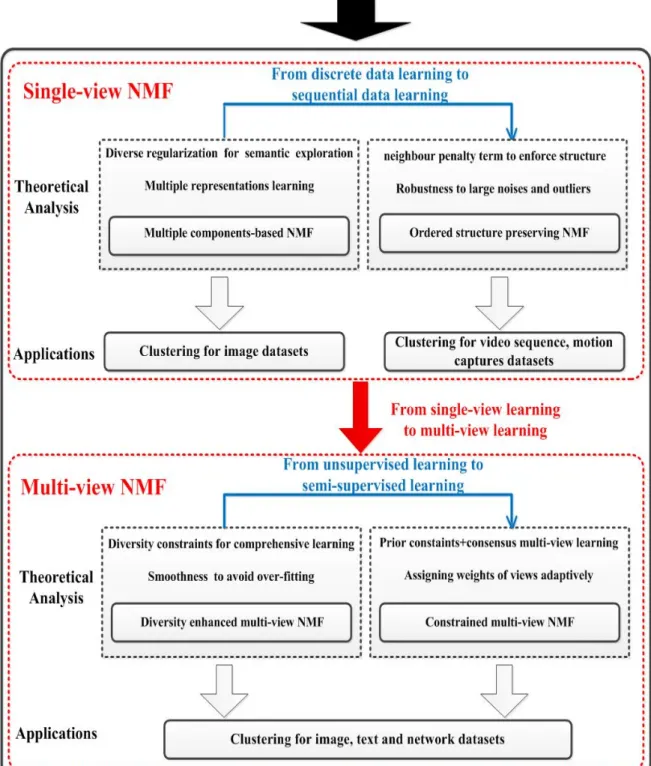
1.1 The framework of the thesis. . . 21
2.1 Multi-view data: a) a web document represented by its URL and words on the page, b) a web image depicted by its surrounding text separate to the visual information, c) images of a 3D object taken from different viewpoints, d) video clips combined with audio signals and visual frames, e) multilingual documents with one view in each language [109]. . . 31
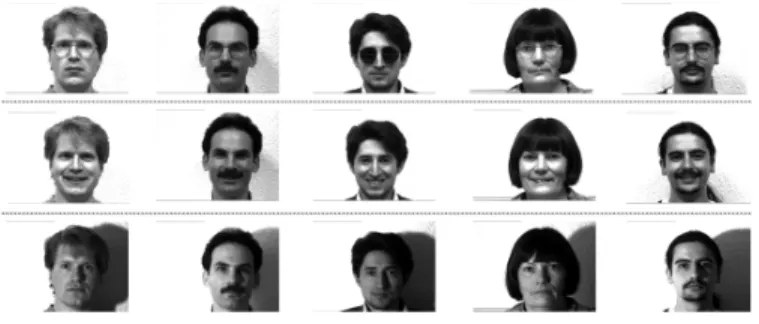
3.1 Sample images of the Yale dataset. Each column shows one sub-ject’s faces. Images in the same rows contain same components, such as faces with glasses and a neutral expression in row 1; faces without glasses and a happy expression in row 2; faces lit from left and with a neutral expression in row 3. . . 36
3.2 The comparison of traditional NMFs and MCNMF, where circles in different colors represent different clusters. . . 38
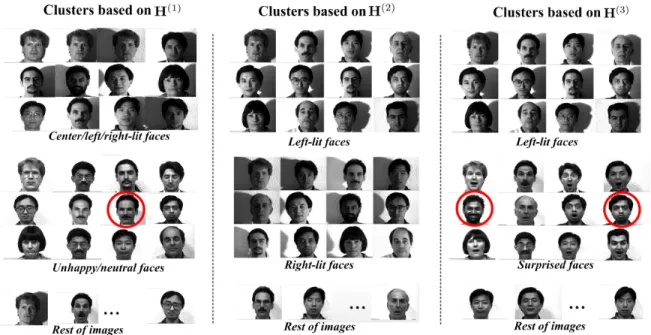
3.3 Sample clustering results of the Yale dataset based on each repre-sentationH(i). Images circled in red are outliers. . . 46
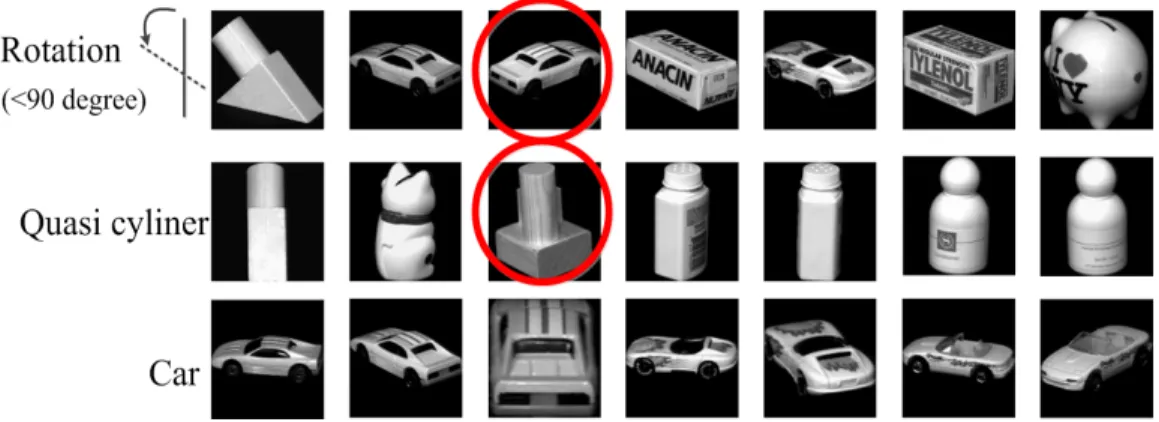
3.4 Sample clustering results of the COIL20 dataset. Each row, from top to bottom, represents a cluster based on the representations H(1) , H(2) and H(3) , respectively. Images circled in red are out-liers. . . 47
3.5 The effect of the parameter α. . . 48
3.6 The effect of the number of components V. . . 49
3.7 Convergence curves. . . 50
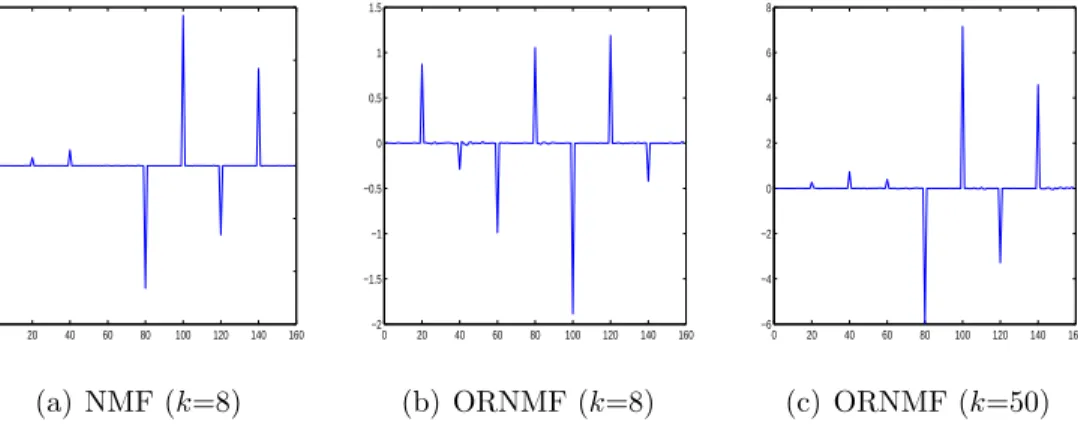
the reduced dimensionality of each data, k. Every consecutive 20 data belong to one subject. Each bottom figure displays the clus-tering results, where different colors represent different clusters.
. . . 61
4.3 Samples of Yale Dataset. Different color indicates different
clus-ters. . . 62
4.4 Left: Comparison of AC w.r.t α. Right: Comparison of NMI
w.r.tα. . . 64
4.5 A sequence with three scenes from the video 1 marked by coloured
borders. . . 65
4.6 Comparison on convergence speed. . . 66
5.1 Comparison of existing NMF-based Multi-view approaches and the
proposed DiNMF. A multi-view dataset X contains two equally
important views, i.e., X(1) and X(2). H(1) and H(2) are the
cor-responding learned representation matrices. H∗ is the final
repre-sentation. For all matrices, the data vectors are column-wise and the features are row-wise. The ground-truth is shown as group-1
in purple and group-2 in green. By enforcingH(1) and H(2) to be
close toH∗, the existing approaches learn the data representations
of two views jointly to capture the shared underlying common in-formation but cannot ensure their diversity. In contrast, DiNMF is based on a diversity term (DIVE), which captures diverse
informa-tion among data representainforma-tions. This ensures that H∗ not only
contains common information captured by existing approaches but also preserves some distinct information from each view, thus more
comprehensive and accurate. . . 69
5.2 Comparison of redundancy rate on Reuters-1 and Digit dataset . 89
5.3 The effect of parameter α and β in DiNMF and α and γ in
LP-DiNMF. Different colors means different accuracies and the color
5.4 Comparison of convergence speed (Note that different scales of
axes are used for clearer illustration) . . . 91
5.5 Running time of DiNMF v.s. MMNMF on Synthetic dataset. . . . 92
6.1 The framework of AMVNMF. . . 97
6.2 Performance of AMVNMF w.r.t. parameter γ. . . 107
6.3 Convergence and corresponding performance curve. . . 108
3.1 Clustering results ((mean ± standard deviation)%) on the four
datasets (bold numbers represent the best results) . . . 46
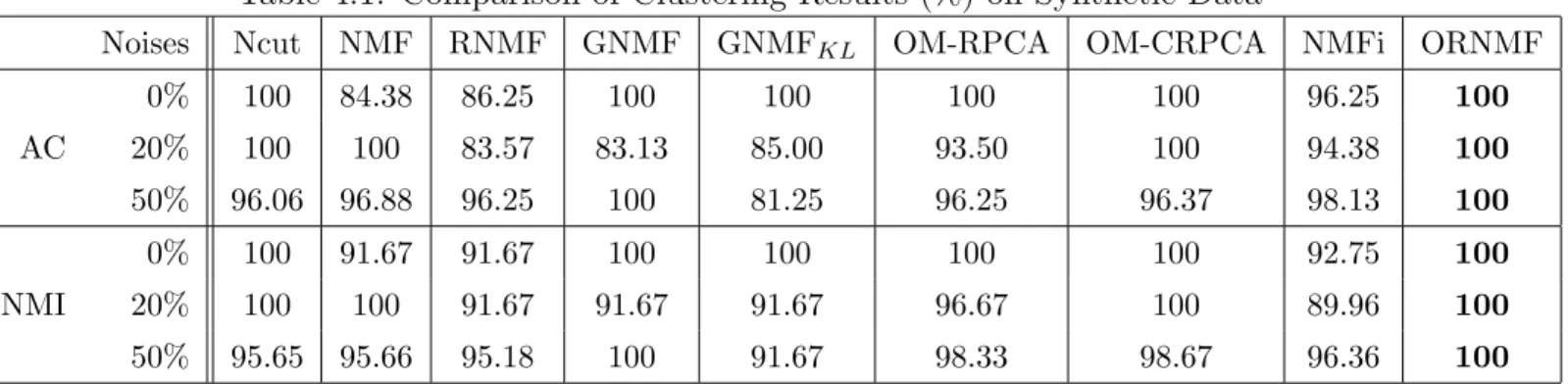
4.1 Comparison of Clustering Results (%) on Synthetic Data . . . 58
4.2 Comparison of Clustering Results (%) on Yale Dataset . . . 63
4.3 Comparison of Clustering Results (%) on Video Sequences Dataset 65
4.4 Comparison of Clustering Results (%) on HDM05 dataset. . . 66
5.1 Descriptions of the datasets . . . 83
5.2 Comparison of clustering results ((mean ± standard deviation)%)
on the datasets . . . 86
5.3 Comparison of redundancy rate . . . 88
List of Notation
X, xi input data matrix, data vector
X(v),x(v)
i input data matrix, data vector ofvth view
W basis matrix
H representation matrix
A label constraint matrix
R ordered constraint matrix
tr trace form
η Lagrange multiplier matrix
α,β,γ tradeoff parameter
m, n dimensionality, number of samples
k number of clusters
∥ · ∥F,∥ · ∥2,1 Frobenius norm,L2,1-norm
◦ Kronecker (element-wise) product
⊙ dot product
J objective function
Introduction
1.1
Research Background
In the past decade, we have witnessed the explosion and the messiness of data across numerous fields of pattern recognition, computer vision and machine learn-ing. With the fast-growing amount of data, partitioning them into different groups or clusters is of great practical importance to understand data in-depth. For relatively small collections, it may be possible to partition them manually. But given large volumes of data, it would be extremely time consuming and dif-ficult to partition them into different meaningful groups. Thus, clustering which aims to group data automatically so that data in the same group are with high similarity, is becoming one of the most important techniques in data analysis [26, 1]. As an unsupervised technique, clustering which needs no annotation of training data but considers nature of data only has been widely used in a wide range of applications [52, 89, 104]. For example, in business analysis, clustering customers can characterize features of different groups for targeted marketing; in text mining, clustering documents into specific categories can form semantic top-ics. In genomic analysis and cancer study, clustering can find common patterns in the patients’ gene expression profiles that correspond to cancer subtypes and offer personalized treatments. Besides, clustering can be used as a foundation for many directions in computer science. Such as in anomaly detection, clus-tering can find the exception points that are not related to each category [57]; in dictionary-based expression learning, clustering can find class centers to build
CHAPTER 1. INTRODUCTION
machine learning, pattern recognition, computer vision, etc.
In reality, high dimensional data has become very common. For example, an image dataset may contain a huge number of pixels that correspond to dimen-sions; a document consists of a sequence of words, each of which can be regarded as a dimension; a gene expression microarray may have thousands of dimensions and each of them corresponds to an experimental condition, etc. Traditional clus-tering approaches which calculate similarity between high-dimensional data sam-ples directly to perform results, tend to be inefficient and even infeasible, because the results are greatly affected by noises and may not be robust [23]. Therefore, it is more reasonable and effective to reduce the dimensions of original data for clustering, so that noisy data and redundancy of data can be alleviated. To do so, quite a few matrix factorization techniques [23, 30, 44, 90, 64, 62, 108, 17] have been proposed to factorize data from the input space to several low-dimensional matrices. The most popular methods include Principal Component Analysis (PCA) [45], Singular Value Decomposition (SVD) [23] and Vector Quantiza-tion [31]. However, the factorizing matrices in these methods can have nega-tive entries, which makes it hard or impossible to obtain physical interpretations from the factorizing results. This is because many real-world data (e.g. images and texts) are nonnegative and the corresponding hidden parts convey physical meanings only when the nonnegative condition holds. These methods are there-fore called “holistic” approaches. In contrast, Nonnegative Matrix Factorization (NMF) [55] as a “parts-based” approach, has been receiving more and more at-tention. It imposes the nonnegativity constraint on all the factorizing matrices, allowing only additive but not subtractive combinations during the factorization. Such nature can exactly discover the hidden parts that have specific structures and physical meanings, such as each original face image can be approximately represented by additively combining several “parts” (eyes, noses, lips, etc.).
To summarize, finding a useful low-dimensional representation to achieve sat-isfactory clustering performance based on the NMF framework is of great sig-nificance. Based on previous works, this dissertation improves NMF from three aspects, i.e., extraction of semantic information, exploration of diverse feature in-formation, as well as constraints fusion, and conducts clustering on the proposed methods with a wide range of real-world datasets including images, network, texts and video sequences.
1.2
Contributions of the Thesis
This thesis studies NMF from both theoretical analysis and application aspects, as shown in figure 3.2. In theory, different from existing single-view NMFs that find a single representation based on global feature only, we explore embedded multiple components of data with capturing more comprehensive information and interpreting data from different perspectives at a sematic level. Considering that sequential data contain ordered nature, we also incorporate such nature to enhance clustering performance. Since data often consist of multiple features which describe data from different perspectives, we further study NMF in multi-view setting by feature fusion. Instead of learning a consensus representation across different views as existing multi-view NMFs, we emphasize the diversity of each view so as to capture more comprehensive information among views. Finally, we incorporate prior information in multi-view clustering effectively to guide the clustering process. From application perspectives, the study of single-view NMF is based on image or video sequence clustering, while we explored multi-view NMF on a wider range of data, including images, texts and networks. In more details, my main research work include the following three works:
1. Multiple Components-based NMF
Given that data contain different subsets of features, namely components, we obtain corresponding representations and achieve multiple clustering results. A diversity regularization is introduced to enhance the independency between dif-ferent representations. By integrating different representations, a comprehensive representation with diverse information is established. The main contributions are
• This work is the first to explore components of data and achieve multiple representations where each representation corresponds to a component.
• A diverse term is introduced to explore the diverse information among the representations so as to capture comprehensive information.
• A novel multiplicative updating rule is derived to solve the objective func-tion, along with its convergence proof correctness analysis.
CHAPTER 1. INTRODUCTION
data by interpreting data from different aspects with the multiple represen-tations, which is beyond what current NMFs can offer.
2. Ordered Structure Preserved NMF
Different from existing NMFs assume the data samples and features to be independently distributed, the approach captures ordered nature embedded in the sequential data, such as video sequences. Based on a novel neighbour penalty term, it enforces the similarity of neighbouring data to improve the discriminating power of the data representations. The main contributions are
• With a novel neighbour penalty term, it enforce the similarity of the con-secutive data representations by incorporating the ordered structure as ad-ditional constraints.
• In ideal cases, it can correctly find the cluster boundaries and get the num-ber of clusters without needing the numnum-ber of clusters beforehand.
• AL2,1-norm based loss function is adopted to improve its robustness against noises and outliers.
• A new iterative updating optimization scheme is derived to solve ORNMF’s objective function, along with its convergence and correctness proofs.
3. Diversity Enhanced Multi-View NMF
With a novel penalty term, the information among different views are con-strained to be diverse enough to each other, thus the mutually redundant infor-mation among views are reduced. The proposed approach can scales well with large-scale data due to its linear computational time. The main contributions are
• A novel diversity regularization term is proposed to enforce the orthogonal-ity of different data representations, so that the diversorthogonal-ity among views are enhanced and mutually redundancy are reduced.
• The proposed approach is computationally linear thus has good scalability to large-scale datasets.
• By taking into account manifold structures of data in each view, we further extend the proposed approach by incorporating local geometry information
CHAPTER 1. INTRODUCTION
4. Constrained Multi-View NMF
The approach takes both prior information and the consistency of multiple views into account. It learns a consensus representation across multiple views jointly with a constrained label matrix. Moreover, the weights of representations which reflect the importance of different views are learnt adaptively. The main contributions are
• Incorporating label information as hard constraints to enhance the discrim-inating power of new representations so that all data with the same label are clustered together regardless of their views.
• A single parameter is introduced to learn the weight of each view adaptively. Each weight is assigned automatically depending on the dissimilarity be-tween each new representation matrix and the consensus matrix.
• Using L2,1-norm to measure the approximation errors, it is robust against noises and hence can achieve more stable clustering results.
• The clustering experiments are conducted in well-known real-world datasets, which have demonstrated its effectiveness and robustness in comparison to the state-of-the-arts.
1.3
Thesis Outline
• Chapter 1 introduces the research background and the main contributions of this thesis.
• Chapter 2 focuses on unsupervised single-view representation learning. We present a novel multi-component nonnegative matrix factorization approach, which interprets data from different aspects through seeking for multiple representations simultaneously.
• Chapter 3 focuses on unsupervised single-view representation learning for sequential data. A novel ordered structure preserved nonnegative matrix factorization approach is proposed to enforce the similarity of data presen-tations.
• Chapter 4 focuses on unsupervised multi-view representation learning. We propose a diversity enhanced approach to enhance diverse information and reduce the redundancy among multi-view representations for more compre-hensive learning.
• Chapter 5 focuses on semi-supervised multi-view representation learning. We propose a constrained approach, which considers both the label infor-mation as well as the multi-view consistence simultaneously.
• Chapter 6 summarizes the work of this thesis and discusses future works of nonnegative representation learning.
Chapter 2
Nonnegative Matrix
Factorization
Nonnegative Matrix Factorization (NMF) is a popular matrix decomposition method with various applications in e.g. machine learning, data mining, pat-tern recognition, and signal processing. The nonnegativity constraints have been shown to result in parts-based representation of the data, and such additive prop-erty can lead to the discovery of datas hidden structures that have meaningful interpretations. In this chapter, we will first give a brief introduction to NMF before reviewing NMF-based approaches.
2.1
Introduction
Nonnegative Matrix Factorization was first introduced by Paatero and Tapper [81], and gained popularity by the works of Lee and Seung [55] published in Nature in 1999. Mathematically, given a n data matrix X = [x1,x2, ...,xn] ∈ Rm+×n where each column is a m-dimensional data vector, NMF [55] aims to find two nonnegative matrices W ∈ Rm+×k and H ∈ Rk+×n, where the product of the two matrices can well approximate the original matrix, represented as
X≈WH. (2.1)
HereR+ denotes the set of nonnegative real numbers. The columns ofW form a basis of a latent space and are called basis vectors. The representation matrix H
contains coefficients that reconstruct the input matrixX by linear combinations of the basis vectors, and the product termWHis called the compressed version of the X or the approximating matrix of X. Typically we have k ≪ min(m, n), i.e., the original data points in the m-dimensional space are reduced to a much lower-dimensional space of dimensionk. An appropriate selection of the value k
is critical in practice, but its choice is usually problem dependent.
There are several ways to quantify the difference between the data matrix X
and WH. But the most used measure is the Frobenius norm, and the objective function of NMF is
minDF(X,WH) = min
W,H≥0∥X−WH∥ 2
F (2.2)
where ∥ · ∥F denotes the Frobenius norm and “≥0” indicates entrywise
nonneg-ativity.
2.2
Multiplicative update algorithms
A wide range of numerical optimization algorithms [93,15,16] have been proposed for solving (2.2) . Since (2.2) is nonconvex, in general we cannot expect an algorithm to reach the global minimum but local minimum. This can be found by an iterative procedure alternating between updating one matrix while keeping the other one fixed. The pseudo code to do so is given in Algorithm2.1. Among
Algorithm 2.1 Pseudo code for the algorithm NMF
Initialize W≥0 and H≥0
repeat
UpdatingHwith fixingW(v),D
F(X,WHnew)≤DF(X,WHold) andHnew≥
0
Updating W with fixing H(v), DF(X,WnewH) ≤ DF(X,WoldH) and
Wnew ≥0
until converges or the maximum number of iterations is reached.
the optimization algorithms, the most popular one is the following multiplicative update rules [55] as it consists of basic matrix computations and thus is very simple to implement.
CHAPTER 2. NONNEGATIVE MATRIX FACTORIZATION
W←W⊙ XH
T
WHHT (2.4)
The multiplicative update algorithm is obtained via the gradient descent by choosing a smart step size. Thus, for the purpose of implementation (e.g, us-ing Matlab), a small constant in each update rule is added to the denominator to avoid division by zero. Besides, since the algorithm suffers from getting stuck in local minimum, it is recommended to run the algorithm several times using different initializations. To prove the convergence property of the algorithm, a common strategy is to measure the decrease of the cost function between succes-sive iterations, and the algorithm stops if the decrease falls below a predefined threshold.
2.3
Existing NMF-based approaches
There has been several papers [41, 19, 27, 43, 21, 34, 20, 65, 46] extending and improving the original NMF in the past decade and NMF has been successfully applied to many areas such as image processing, face recognition [61], community detection [112]and document clustering [84], [111]. An elaborate review of NM-based approaches can be found in [105]. According to the types of features of data (to be dealt with), current NMFs could be classified into two categories, single-view NMF and multi-view NMF.
2.3.1
Single-view NMF
Single-view NMF means that the approaches can deal with one type of features of data only, such as pixels of images or distributions of words in a documents. Various single-view NMFs [67, 115, 6, 27, 51, 64, 48, 54] have been proposed to find an proper low-dimensional representation. These approaches modify the traditional NMF objective function by either using different norms to measure approximation errors or incorporating auxiliary constraints. Though the forms of constraints are application dependent, they can be characterized by (2.2) as follows:
min
where D(X,WH) represents the approximation errors. J1(W) and J2(H) are penalty terms regarded as auxiliary constraints. The regularization parameters
α and β balance the trade-off between the approximation errors and the added constraints.
Sparsity is one of important characters of data, that is, all the features or data show the positive effect on the final results but only a few provide meaningful and useful information. Usually, adding sparsity regularization to select the most useful features [41] can improve the generalization of a method, thus avoiding the over-fitting problem [113]. Several approaches are proposed to modify NMF algorithms [40, 24, 41, 47] by penalizing H or W which aims to yield a sparse representation [94]. For example, Hoyer[40] proposed a sparseness criterion by leveraging the relationship between the L1 and L2 norm:
sparseness(x) = √ n−(∑|xi|)/ √∑ x2 i √ n−1 , (2.6) where x denotes a given vector with dimension n. For instance, the sparseness criterion imposed on am×kmatrixWcan be formulated as the following penalty term:
J1(W) = (α∥vec(W)∥2− ∥vec(W)∥1) (2.7) whereα =√mk−(√mk−1)αandvec(·) is an operator that transforms a matrix into a vector by stacking its columns. The sparseness inWis specified by setting
α to a value between 0 and 1.
Often, the input X contains large noises and outliers, which may greatly in-fluence performances. To alleviate this issue, some more robust methods were proposed. For example, Kong et al.[50] adopted L2,1-norm based objective func-tion to weaken the influence of data outliers:
D(X,WH) = ∥X−WH∥2,1. (2.8) Since the error for each data point is not squared as standard NMF , and thus the large errors due to outliers do not dominate the objective function. Later, Du et al. [22] proposed using the correntropy induced metric to make it insensitive to outliers. Hamza et al. [37] adopted a hypersurface cost function to make the NMF robust to the outliers. Zhang et al. [115] proposed to subtract a sparse
CHAPTER 2. NONNEGATIVE MATRIX FACTORIZATION
outlier matrix from the data matrix to reduce the effect of the outliers. Recent research has shown that data are found to lie on a nonlinear low dimensional manifold embedded in a high dimensional ambient space [2, 85, 60]. However, the standard NMF fails to discover such intrinsic geometrical structure of the data space [6]. To this end, Cai et al. [6] proposed a graph regularized NMF (GNMF) to preserve the local manifold structure with regarding that the data points nearby have more similar data representations than those far away. By constructing a weight matrix U, GNMNF is to solve
J1(H) =tr(HLHT), (2.9)
whereL=D -U,D is a diagonal matrix whose entriesDjj = ∑
lUjl. Based on
GNMF, Huang et al. [42] then proposed a robust manifold NMF which simul-taneously alleviates noises and preserves geometrical structure. Since the per-formance of GNMF is known to hinge heavily on the choice of nearest neighbor graph and it is difficult and time consuming to choose a suitable graph. To over-come this limitation, Wang et. al. [100] proposed a multiple graph regularized NMF (MultiGNMF) to approximate intrinsic manifold approximation automat-ically. Similarly, a relational multi-manifold co-clustering (RMC) approach [58] is proposed to maximally approximate the true intrinsic manifolds of both the sample and feature spaces simultaneously. Later, Wang et al., [102] proposed two GNMF-based methods to learn the graph that is adaptive to the selected features and learned multiple kernels, respectively. In the real world applications, there is certain amount of prior knowledge such as label information, which could be used to improve the performance. NMF-α [14] makes a good combination of NMF and SVM, which utilizes limited labeled samples to achieve the support vectors of large-margin classifiers. Later, Liu et al. [64] proposed a constrained NMF (CNMF),
D(X,WH) =∥X−WZAT∥2F. (2.10) HereH=ZAT,Z is an auxiliary matrix andA is label constraint matrix which forces data samples with identical class label to have the same representation so that the samples are more discriminative. Li et al. [59] proposed a Locally Con-strained A-optimal nonnegative projection method which not only preserves the locally geometrical structure of the data but also incorporates label information
as constraints to enhance the discriminating power. Under the assumption that data samples from different domains have different distributions, but share same feature and class label spaces, Wang et al. [101] proposed a novel NMF-based approach for multiple-domain learning.
Generally, all the existing MMFs which either incorporate regularization terms or prior information for more accurate learning, all tend to obtain a single rep-resentation. However, it is well recognized that real data are usually complex and contain various components. For example, face images have expressions and genders. Each component mainly reflects one aspect of data only and provides information others do not have. Therefore, exploring the semantic information of multiple components as well as the diversity among them is of great benefit to understand data comprehensively and in-depth. Besides, real data such as video sequences contain ordered structure, i.e., consecutive neighbouring data samples are very likely share similar features unless a sudden change occurs. Since this ordered structure provides valuable information about the relationship between data, exploiting the ordered structure with NMF holds a great potential for seek-ing for optimal representations.
2.3.2
Multi-view NMF
All the NMF methods mentioned above are developed to handle a single view (feature) for finding explicit data representations. In fact, data collected from various sources or represented by different feature extractors are available in many real-world applications [109, 4, 28, 9, 97, 107]. For example, a web page that shown in the figure2.1, may be represented by multiple contents and hyperlinks; one document may be translated into different languages; an image or video can be represented by different visual descriptors, such as SIFT [71], HOG [18] and GIST [79]; research communities are formed according to research topics as well as co-authorship links and so on. These heterogeneous features that are represented by different perspectives of data are referred as multiple views [74, 110]. Taken alone, each of these views will often be deficient or incomplete because different views describe distinct perspectives of data. Therefore, a key problem for data analysis is how to integrate the multiple views and discover the underlying structures.
CHAPTER 2. NONNEGATIVE MATRIX FACTORIZATION
Figure 2.1: Multi-view data: a) a web document represented by its URL and words on the page, b) a web image depicted by its surrounding text separate to the visual information, c) images of a 3D object taken from different viewpoints, d) video clips combined with audio signals and visual frames, e) multilingual documents with one view in each language [109].
Recently, some NMF-based approaches on learning from multi-view data have been proposed. With the increasing amount of multi-view data, the approaches employing NMF-based multi-view learning have attracted attention. Assuming that a dataset comes with V views, the objective function of multi-view NMF can be written as min W(i),H(i)≥0 V ∑ i=1 D(X(i),W(i)H(i)) +α V ∑ i=1 J1(W(i)) +β V ∑ i=1 J2(H(i)) (2.11)
. For example, MultiNMF [65] formulates a joint multi-view NMF learning pro-cess with the constraint that encourages representation of each view towards a
common consensus. J2(H(i)) =∥H(i)Q(i)−H∗∥2F, (2.12) where Qi = Diag(∑m j=1W (i) j,1, ∑m j=1W (i) j,2, . . . , ∑m j=1W (i)
j,k) to ensure the
repre-sentations of different views are comparable and H∗ is the common consensus matrix.
Subsequently, several approaches [116, 46, 80, 99] were proposed based on MultiNMF. Specifically, Zhang et al. [116] developed a multi-manifold NMF (MMNMF) by incorporating the locally geometrical structure of data across mul-tiple views. It regards each view as one manifold and the intrinsic manifold of a dataset as a mixture of the manifolds. Kalayeh et al. [46] proposed a weighted extension of MultiNMF [65] for image annotation, in which two weight matrices are introduced to alleviate the issue of dataset imbalance in real applications. Ou et al. [80] explored the local geometric structure for each view under the patch alignment framework and adopted correntropy-induced metric to measure the reconstruction error of each view to improve the robustness. Though exist-ing approaches have shown superior results, some limitations remain to be dealt with. Firstly, existing approaches are unable to exploit the distinct information embedded of each view, so that the learned data representations from existing approaches contain mutually redundant information and lack diverse informa-tion. Secondly, given that utilizing a small amount of prior information can pro-duce considerable improvements in learning accuracy [2], [119], it is potentially beneficial to incorporate such information to improve the discriminability of rep-resentations. This has not yet been attempted in existing approaches. Finally, since each view often contributes to final performance unequally, the selection of a weight for each view could result in a substantial effect on the results. However, the current methods only determine weights empirically using the labeled data or the same weight for all views, which restricts their applications in practice. Therefore, it is necessary and important to address these limitations and explores correlations among different views more effectively.
CHAPTER 2. NONNEGATIVE MATRIX FACTORIZATION
2.4
Evaluation metrics
To evaluate NMF-based approaches for data clustering, the accuracy (AC) [64], the normalized mutual information (NMI) [64] and the purity [21] are three widely used evaluation metrics to assess the quality of the results. For all the three met-rics, the higher value indicates better clustering quality. These measurements are widely used by comparing the obtained label of each sample with that provided by the data set in different clustering approaches.
Clustering accuracy (AC) is used to measure the percentage of correct
labels obtained. Given a data set containing n images, let li and ri be the the
obtained cluster label and label provided from each sample images, respectively. The AC is defined as follows,
AC =
∑n
i=1δ(ri, map(li))
n (2.13)
where δ(x, y) is the delta function that equals one if x = y and equals zero otherwise, and map(li) is the permutation mapping function that maps each
cluster label li to the equivalent label ri from the data set. The best mapping
can be found by using the Kuhn-Munkres algorithm [82].
Normalized mutual information (NMI) is used to measure the
similar-ity between the cluster assignments and the pre-existing input labeling of the classes. Let C and C′ denote the set of clusters obtained from the ground truth and obtained from our algorithm, respectively, their mutual information metric
M I(C, C′) is defined as follows, M I(C, C′) = ∑ ci∈C,cj′∈C′ p(ci, cj′)·log p(ci, cj′) p(ci)·p(cj′) , (2.14)
wherep(ci),p(cj′) are the probabilities that an image randomly selected from the
data set belongs to the clusters ci and cj, respectively, and p(ci, cj′) denotes the
joint probability that this randomly selected image belongs to the cluster ci as
well as cj at the same time. In our experiment, we used the normalized metric
N M I(C, C′) as follows,
N M I(C, C′) = M I(C, C ′)
where H(C) and H(C′) are the entropies of C and C′, respectively. It is easy to check that N M I(C, C′) ranges from 0 to 1. N M I = 1 when the two sets of image clusters are identical, and it becomes zero when the two sets are completely independent.
Puritymeasures the extent to which each cluster contained data points from
primarily one class. The purity of a clustering solution is obtained as a weighted sum of individual cluster purity values and is given by
P urity = K ∑ i=1 ni nP(Si), P(Si) = 1 ni max j (n j i) (2.16)
where Si is a particular cluster of size ni, nji is the number of documents of
the i-th input class that were assigned to the j-th cluster, K is the number of clusters and n is the total number of points.
Chapter 3
Multi-Component Nonnegative
Matrix Factorization
3.1
Introduction
This chapter mainly explores semantic information of embedded multiple com-ponents of data and diverse information among them. In reality, data are usually complex and contain various components. Taken the Yale dataset1 (Figure 3.1 ) as an example, the face images consist of multiple components including gender, facial expressions, ethnicity, and lighting direction (under which the images were taken), etc. Since each component mainly represents one subset of features and contains the specific information of the data, it is important to explore diverse information from multiple components in order to represent data more compre-hensively and accurately. Besides, when clustering the dataset with exploring latent multiple components, multiple clustering solutions can be obtained such as one cluster of images can be faces with glasses and another can be faces with a happy expression. This will also enables us to understand data at a semantic level.
To this end, a novel NMF based approach is proposed for multi-component learning. It captures more comprehensive information and interprets data from different perspectives, by leveraging the multiple components. Specifically, dif-ferent from existing NMF-based approaches that seek for a single representation
Figure 3.1: Sample images of the Yale dataset. Each column shows one subject’s faces. Images in the same rows contain same components, such as faces with glasses and a neutral expression in row 1; faces without glasses and a happy expression in row 2; faces lit from left and with a neutral expression in row 3.
matrix, the proposed approach learns multiple representations simultaneously. By utilizing the Hilbert Schmidt Independence Criterion (HSIC) as a diversity term, the proposed approach explores the diverse information among the repre-sentations, where each representation corresponds to a component.
3.2
Single-Component NMF
The previous chapter has briefly introduced NMF. That is, given andata matrix
X = [x1,x2, ...,xn] ∈ Rm+×n where each column is a m-dimensional data vector, NMF [55] aims to minimize the following nmf22ective function:
min
W,H≥0∥X−WH∥ 2
F, (3.1)
In essence, current single-view NMF-based approaches are all based on this stan-dard NMF with regarding the features of data as a whole and seeking for a single representation matrix. Obviously, they are unable to distinguish these embedded components and can be considered as single-component approaches.
CHAPTER 3. MULTI-COMPONENT NONNEGATIVE MATRIX FACTORIZATION
3.3
Multi-Component NMF
Real data often contains multiple latent components, since each component pro-vides distinct information to each other, it is of paramount importance to explore diversity from multiple latent components for comprehensive and accurate data representations. Also, it is arguable that the semantic information of data is much richer than what a single component can capture. Hence, we propose a multi-component NMF (MCNMF) approach to seek for more accurate learning and exploit semantic meaning of data simultaneously. Different from current NMF-based approaches that seek for a single representation matrix, MCNMF learns multiple representations simultaneously, where each representation corresponds to each component. Figure3.2 shows the differences between current NMFs and MCNMF with application on clustering. We can see that current NMFs get only one clustering solution (i.e., all face images of a subject being grouped into one cluster) based on global features of a single representation matrix. However, based on learning representations of multiple components, MCNMF can achieve multiple clustering solutions. For example, one cluster of images can be faces with glasses and another can be faces with a happy expression. In the following subsection, we will introduce our MCNMF model.
3.3.1
Objective function
Assuming X comes with V components, we use H(i) ∈ Rk(i)×n to denote the representation with k(i)-dimensional features that corresponds to the i-th (i ∈ {1,2, . . . , V}) components, andW(i) be the corresponding representation matrix ofH(i). Then the product of eachW(i)H(i)should well approximateX, i.e.,X≈
W(i)H(i), from each perspective. To seek for multiple optimal representations
{H(i)∗}V
i=1, we have the following function:
min W(i)≥0,H(i)≥0 V ∑ i=1 ∥X−W(i)H(i)∥2F. (3.2) This will allow us to factorizeXstraightforwardly. However, it may fail to explore the diverse information of multiple components effectively as each H(i) could be very close to or even same as each other.
Figure 3.2: The comparison of traditional NMFs and MCNMF, where circles in different colors represent different clusters.
For any data, xf, it comes with a pair of components, i and j. xf’s
la-tent distinct information of each component cannot be fully explored unless its representations of two components, i.e., h(fi) and h(fj), are enforced to be inde-pendent to each other. Given n data vectors, we assume that each ith com-ponent is drawn from X space and the jth component from Y space. Then, in essence, we aim to learn a mapping function G of their representations from
S :={(h(1i),h1(j)),(h(2i),h2(j)), . . . ,(h(ni),h(nj))} ⊆ X × Y, i.e., G: X → Y, to
mini-mize the dependence between data representations in theX and Y.
To do so, we employ the Hilbert-Schmidt Independence Criterion (HSIC)[32] due to its several advantages. First, HSIC measures dependence by mapping variables into a reproducing kernel Hilbert space (RKHS) such that correlations measured in that space correspond to high-order joint moments between the original distributions and more complicated (such as nonlinear) dependence can be addressed. Second, it is able to estimate dependence between variables without
CHAPTER 3. MULTI-COMPONENT NONNEGATIVE MATRIX FACTORIZATION
of high computational efficiency. Last but not least, the empirical HSIC turns out to be equal to the trace of product of the data matrix, which makes our problem solvable. HSIC computes the square of the norm of the cross-covariance operator over the domain X × Y in Hilbert Space. As an effective measure of dependence, the HSIC has been applied to several machine learning tasks recently [88,117,78]. Mathmatically, an empirical estimate of the HSIC [32] is defined as
HSIC(H(i),H(j)) = (n−1)−2tr(RK(i)RK(j)), (3.3) whereK(i) andK(j) are the centered Gram matrices2 of kernel functions defined over H(i) and H(j). R = I− n1eeT, where I is an identity matrix and e is an all-one column vector.
Thus, to explore the diverse information from more components, we extend (3.3) and combine it with (3.2) to produce the following function:
min W(i)≥0,H(i)≥0 V ∑ i=1 ∥X−W(i)H(i)∥2F +α∑ j̸=i HSIC(H(i),H(j)), (3.4)
where α is the parameter of the diversity regularization term. The first term represents the error between X and the product of the basis and representation matrices in different components. The second term ensures that any two of V
representations be diverse to each other.
Here, we use the inner product kernel for HSIC, i.e., K(i) = H(i)TH(i). For notational convenience, we ignore the scaling factor (n−1)−2 of HSIC, and rewrite (3.4) to form the final objective function as
min W(i)≥0,H(i)≥0 V ∑ i=1 ∥X−W(i)H(i)∥2F+α∑ j̸=i tr(RK(i)RK(j)). (3.5)
After obtaining the optimal representation H(i)∗ of each component, the final aggregated representationH∗ can be obtained by combining allH(i)∗, i.e., H∗ = [H(1)∗,H(2)∗, . . . ,H(V)∗]∈R∑Vi=1k(i)×n.
Remarks: WhenV = 1, (3.1) is exact that of NMF. Moreover, Our method is
not limited to one specific NMF method. Our method is based on standard NMF,
2Given a setV ofm vectors∈Rn ), the Gram matrixGis the matrix of all possible inner
since it is clearer to demonstrate the effectiveness of latent components without the help of other regularization. Nevertheless, other state-of-the-art NMF-based approaches, such as GNMF [6], RNMF [50] can also be implemented into our method and better results can be expected.
3.3.2
Optimization
The optimization problem in (3.5) is not convex in both variables W(i) and
H(i), so it is infeasible to find the global minimum. In addition, as the matrix
R contains negative values, it is technically challenging to solve (3.5) directly. Here we propose an algorithm that separates the optimization of (3.5) to two subproblems and optimizes them iteratively, which guarantees each subproblem converges to the local minima.
W(i)-subproblem: UpdatingW(i)withH(i)fixed in (3.5) leads to a standard
NMF formulation [56], so the updating rule for W(i) is
W(i) ←W(i)⊙ (XH
(i)T)
(W(i)H(i)H(i)T). (3.6)
H(i)-subproblem: When updating H(i) with W(i) in (3.5) fixed, we need to
solve the following function:
min H(i)≥0J(H (i)) =∥X−W(i)H(i)∥2 F +α V ∑ j=1,j̸=i tr(RK(i)RK(j)) (3.7)
In general, the method of Lagrange Multipliers is used to find the solution for optimization problems constrained to one or more equalities. Since the con-straints of (3.7) also have inequalities, we need to extend the method to the KKT conditions.
Definition 1 The KKT conditions is when given a problem
x∗= arg min
x f(x)
s.t. hi(x) = 0,∀i= 1, . . . , m
CHAPTER 3. MULTI-COMPONENT NONNEGATIVE MATRIX FACTORIZATION
The expression for the optimization problem becomes:
x∗= arg minL(x, λ, µ) = arg min
x f(x) + m ∑ i=1 λihi(x) + n ∑ i=1 µigi(x),
here arg minL(x, λ, µ) is the Lagrangian and depends also on λ andµ, which are vectors of the multipliers.
According to the Definition 1, we then introduce a Lagrange multiplier matrix η = [ηpq] ∈ Rk×n for the nonnegative constraint on H(i). Utilizing
∥A∥2
F =tr(ATA), we obtain the following function:
min H(i)≥0J ′(H(i)) =tr(XXT)−2tr(XH(i)TW(i)T) +tr(W(i)H(i)H(i)TW(i)T) +α V ∑ j=1,j̸=i tr(RH(i)TH(i)RK(j)) +tr(ηH(i)). (3.8)
Setting the derivative of J′(H(i)) to be 0 with respect to H(i), we have
η =W(i)TX−W(i)TW(i)H(i)−αH(i)R
V ∑ j=1,j̸=i
K(j)R. (3.9)
Following the Karush-Kuhn-Tucker (KKT) condition [5] for the nonnegativity of
H(i), we have the following equation:
(W(i)TX−W(i)TW(i)H(i)−αH(i)R
V ∑ j=1,j̸=i
K(j)R)pqHpq(i) = 0. (3.10)
BecauseRcontains negative values, we decomposeRinto two nonnegative parts for ensuring H(i) ≥0 in each iteration:
R=R+−R−, (3.11) whereR+
(3.10), we obtain (W(i)TX−W(i)TW(i)H(i)+αH(i)(R+ V ∑ j=1,j̸=i K(j)R−+R− V ∑ j=1,j̸=i K(j)R+) −αH(i)(R− V ∑ j=1,j̸=i K(j)R−+R+ V ∑ j=1,j̸=i K(j)R+))pqHpq(i)= 0. (3.12)
This is the fixed point equation whose solution must satisfy at convergence. De-noteRa=R+ ∑V j=1,j̸=iK(j)R−,Rb =R− ∑V j=1,j̸=iK(j)R+,Rc=R− ∑V j=1,j̸=iK(j)R−, Rd=R+ ∑V
j=1,j̸=iK(j)R+, then given an initial value ofH(i), the successive
up-date of H(i) is: H(i) ←H(i)⊙ √ W(i)TX+αH(i)(R a+Rb) W(i)TW(i)H+αH(i)(R c+Rd) . (3.13)
The correctness of the updating rule (3.13) can be guaranteed by the following theorem.
Theorem 1. If the updating rule of H(i) converges, then the final solution
satisfies the KKT optimality condition.
Proof of Theorem 1. At convergence, H∞ = Ht+1 = Ht = H, where t
denotes the t-th iteration, i.e.,
H(i) =H(i)⊙ √ W(i)TX+αH(i)(R a+Rb) W(i)TW(i)H+αH(i)(R c+Rd) (3.14)
Then for each Hpq(i) , we have
(W(i)TX−W(i)TW(i)H(i)+αH(i)(Ra+Rb)
−αH(i)(Rc+Rd))pq(H(i))2pq = 0.
(3.15)
which is equivalent to (3.12).
We can now prove the convergence of the updating rule, by making use of an auxiliary function as in [56]. The definition of the auxiliary function is as follows:
Definition 2. A function G(Q,Q′) is an auxiliary function of the function
J(Q) if G(Q,Q′)≥J(Q) and G(Q,Q) =J(Q) for any Q, Q′. The auxiliary function gives rise to the following lemma [56]:
CHAPTER 3. MULTI-COMPONENT NONNEGATIVE MATRIX FACTORIZATION
Lemma 1. If Gis an auxiliary function of J, thenJ is non-increasing under
the update ruleQt+1 = arg min
QG(Q,Qt).
Under the constraint in (3.11), we now have the specific form of the auxiliary functionG(H(i),H(i)′) for the objective functionJ(H(i)) in (3.7) based on Lemma 2.
Lemma 2. The function
G(H(i),H(i)′) =−2∑ pq (W(i)TX)pqH(i) ′ pq(1 + log H(pqi) H(pqi) ′ ) +∑ pq (W(i)TW(i)H(i)′) pqH (i) pq 2 H(pqi) ′ −∑ pqk (Ra+Rb)jkH(i) ′ pqH (i)′ pk(1 + log H(pqi)H(i)pk H(i)′ pqH(i) ′ pk ) +∑ pq (H(i)′(Rc+Rd))pqH(pqi) 2 H(pqi) ′ (3.16)
is an auxiliary function for J(H(i)) in (3.7).
Proof of Lemma 2. We find upper bounds for each of the two positive
terms by the following lemma [20],
Lemma 3. For any nonnegative matricesS∈Rn×n,B∈Rg×g,F∈Rn×g and
F′ ∈Rn×g, with S and B being symmetric, then the following inequality holds
tr(FTSFB)≤ n ∑ i=1 g ∑ p=1 (SF′B)F 2 ip F′ip . (3.17)
Then, we have following inequations:
tr(W(i)TW(i)H(i)H(i)T)≤∑ pq (W(i)TW(i)H′i)pq(H(i))2pq (H′i)pq , (3.18) tr(H(Rc+Rd)HT)≤ ∑ pq (H′(Rc+Rd))pqH2pq H′pq . (3.19)