Efficient Frequent Subtree Mining
Beyond Forests
Dissertation
zur
Erlangung des Doktorgrades (Dr. rer. nat.)
der
Mathematisch-Naturwissenschaftlichen Fakultät
der
Rheinischen Friedrich-Wilhelms-Universität Bonn
vorgelegt
von
Pascal Welke
aus
Bonn
Bonn, 2018
Diese Arbeit wurde von Dr. Tamás Horváth und Prof. Dr. Stefan Wrobel betreut
1. Gutachter: Prof. Dr. Stefan Wrobel 2. Gutachter: Prof. Dr. Christian Bauckhage
Tag der Promotion: 20.3.2019 Erscheinungsjahr: 2019
Pascal Welke
Department of Computer Science III [email protected]
Declaration
I, Pascal Welke, confirm that this work is my own and is expressed in my own words. Any uses made within it of the works of other authors in any form (e.g. ideas, equations, fig-ures, text, tables, programs) are properly acknowledged at the point of their use. A full list of the references employed has been included.
Acknowledgments
This thesis would not have been possible without the support of many people. In partic-ular, I would like to thank my supervisors Tamás Horváth and Stefan Wrobel. Without them, this thesis would not exist. I don’t know many people that have the opportunity to talk to their supervisor as frequently as I did with Tamás. I know even less1, who ad-ditionally got invited to several intense weeks of discussions, writing, no Internet, and great food and wine in Nemesvita. I’d like to thank Stefan for the freedom, the generous support of my work, and for creating our motivating working environment.
During the course of my work on this thesis I was surrounded by a great group of peo-ple. CAML became KDML, countless coffees were imbibed, discussions were had and slowly an idea for this thesis manifested. Thank you, Krisztian Buza, Thomas Gärtner, Laurentiu Ilici, Michael Kamp, Olana Missura, Daniel Paurat, Till Schulz, Florian Seif-farth, Katrin Ullrich, and all the great people at Fraunhofer IAIS. A special thank you also goes to Ionut Andone, Konrad Błaszkiewicz, and Alexander Markowetz for the fruitful distractions.
I’d like to thank Lars Borutzky, Moritz Fürneisen, Tamás Horváth, Michael Kamp, Ra-jkumar Ramamurthy, Florian Seiffarth, Till Schulz, and Stefan Welke, who have read var-ious draft versions of my thesis and gave valuable feedback, pointed out errors, and asked nasty helpful questions. All remaining mistakes are of course my own responsibility.
Last but not least, I want to thank my parents Daniela and Stefan Welke and my girl-friend Hanna Hünert for everything. You are the best!
Abstract
A common paradigm in distance-based learning is to embed the instance space into some appropriately chosen feature space equipped with a metric and to define the dissimilar-ity between instances by the distance of their images in the feature space. If the instances are graphs, then frequent connected subgraphs are a well-suited pattern language to de-fine such feature spaces. Identifying the set of frequent connected subgraphs and sub-sequently computing embeddings for graph instances, however, is computationally in-tractable. As a result, existing frequent subgraph mining algorithms either restrict the structural complexity of the instance graphs or require exponential delay between the output of subsequent patterns. Hence distance-based learners lack an efficient way to op-erate on arbitrary graph data. To resolve this problem, in this thesis we present a mining system that gives up the demand on the completeness of the pattern set to instead guar-antee a polynomial delay between subsequent patterns. Complementing this, we devise efficient methods to compute the embedding of arbitrary graphs into the Hamming space spanned by our pattern set. As a result, we present a system that allows to efficiently ap-ply distance-based learning methods to arbitrary graph databases.
To overcome the computational intractability of the mining step, we consider only fre-quentsubtreesfor arbitrary graph databases. This restriction alone, however, does not suf-fice to make the problem tractable. We reduce the mining problem from arbitrary graphs to forests by replacing each graph by a polynomially sized forest obtained from a random sample of its spanning trees. This results in an incomplete mining algorithm. However, we prove that the probability of missing a frequent subtree pattern is low. We show em-pirically that this is true in practice even for very small sized forests. As a result, our algorithm is able to mine frequent subtrees in a range of graph databases where state-of-the-art exact frequent subgraph mining systems fail to produce patterns in reasonable time or even at all. Furthermore, the predictive performance of our patterns is compara-ble to that of exact frequent connected subgraphs, where availacompara-ble.
The above method considers polynomially many spanning trees for the forest, while many graphs have exponentially many spanning trees. The number of patterns found by our mining algorithm can be negatively influenced by this exponential gap. We hence propose a method that can (implicitly) consider forests of exponential size, while remain-ing computationally tractable. This results in a higher recall for our incomplete minremain-ing algorithm. Furthermore, the methods extend the known positive results on the tractabil-ity ofexactfrequent subtree mining to a novel class of transaction graphs. We conjecture that the next natural extension of our results to a larger transaction graph class is at least as difficult as proving whetherP=NP, or not.
Regarding the graph embedding step, we apply a similar strategy as in the mining step. We represent a novel graph by a forest of its spanning trees and decide whether the fre-quent trees from the mining step are subgraph isomorphic to this forest. As a result, the embedding computation has one-sided error with respect to the exact subgraph isomor-phism test but is computationally tractable. Furthermore, we show that we can leverage a partial order on the pattern set. This structure can be used to reduce the runtime of the embedding computation dramatically. For the special case of Jaccard-similarity between graph embeddings, a further substantial reduction of runtime can be achieved using
min-Die Welt geht nicht unter, wenn wir nicht vollständig aufzählen.
1. Introduction 1
1.1. A Motivating Experiment . . . 4
1.2. Contributions . . . 6
1.2.1. Efficient Frequent Subtree Mining . . . 7
1.2.2. Fast Computation in Probabilistic Subtree Feature Spaces . . . 10
1.3. Outline . . . 11
1.4. Previously Published Work . . . 12
2. Preliminaries 13 2.1. Notions and Notation . . . 13
2.2. Frequent Connected Subgraph Mining . . . 18
2.2.1. A Generic Levelwise Mining Algorithm . . . 20
2.2.2. The Computational Complexity of Frequent Subtree Mining . . . . 23
2.3. Embedding Computation . . . 27
2.4. Datasets . . . 28
3. Related Work 33 3.1. Algorithms for the SubgraphIsomorphism Problem . . . 35
3.1.1. Embedding Lists and Exponential Algorithms . . . 37
3.2. Algorithms for the FCSM Problem . . . 39
3.2.1. Frequent Tree Mining Algorithms . . . 39
3.2.2. Frequent Subgraph Mining Algorithms . . . 42
3.2.3. Algorithms for Relaxed Problems . . . 44
4. Probabilistic Frequent Subtrees 49 4.1. Mining Probabilistic Frequent Subtrees . . . 51
4.1.1. The Relaxed Frequent Subtree Mining Problem . . . 51
4.1.2. Probabilistic Bounds and the Importance of Subtrees . . . 56
4.1.3. Implementation Issues and Runtime Analysis . . . 58
4.2. Experimental Evaluation . . . 60
4.2.1. Runtime . . . 61
4.2.2. Recall . . . 65
4.2.3. Stability of Probabilistic Subtree Patterns . . . 67
4.2.4. Predictive Performance . . . 69
4.3. Summary . . . 72
5. Boosted Probabilistic Frequent Subtrees 73 5.1. An Efficient Embedding Operator for Trees . . . 75
Contents
5.2. Mining Boosted Probabilistic Frequent Subtrees . . . 82
5.2.1. Implementation Issues . . . 85
5.2.2. Experimental Evaluation . . . 86
5.3. Exact Frequent Subtree Mining on Locally Easy Graphs . . . 90
5.4. Summary and Open Questions . . . 93
6. Fast Computation in Probabilistic Subtree Feature Spaces 95 6.1. Complete Embeddings into Subtree Feature Spaces . . . 97
6.2. Min-Hashing in Subtree Feature Spaces . . . 101
6.3. Experimental Evaluation . . . 104
6.3.1. Efficiency Gains . . . 105
6.3.2. Predictive and Retrieval Performance . . . 107
6.4. Summary and Open Questions . . . 110
7. Conclusion 113 7.1. Discussion . . . 113
7.2. Outlook . . . 114
A. The HamiltonianPath Problem for Cactus Graphs 117 A.1. Three Necessary Conditions . . . 118
A.2. A Linear Time Algorithm for Cactus Graphs . . . 120
A.3. Some Statistics for Real-World Datasets . . . 121
A.4. Summary . . . 123
B. Poissons Binomial Distribution 125
1. Introduction
Since the advent of the first digital computers in the second half of the twentieth century there has been a gap between the data analysis tasks one would like to solve and the capa-bilities of existing systems. The amount of data available to computers always exceeded the processing power of even the most advanced computers. Progress in the development of hardware and software did little to solve this issue.1That is, despite the ongoing digital-ization of our society today and the resulting simplification of the data collection process, it is more and more difficult to analyze the data automatically to derive knowledge from it. In particular, this data comes in various forms, such as discrete or real valued vectors (sales transactions, sensor measurements), text, audio, video (communication content), or relations among entities (communication metadata, access patterns, similarities be-tween objects). Due to this variability and volume of data it gets increasingly difficult to derive valuable insights from it.
In the 1990s the field of data mining and knowledge discovery developed. One of its goals is to devise algorithms to identify interesting patterns in data and tolearn from data, i.e., to automatically synthesize programs (called models) that capture some rela-tions among data.2 The models can then be applied to novel data, for example to predict whether some access pattern is fraudulent, or not. One quite general class of such meth-ods works on data viewed as a collection of examples, ortransactions(like sales transac-tions in a store) from a (usually unknown and possibly infinite) set equipped with some measure of similarity and tries to infer an unknown target variable. Thesedistance-based learning methods assume that the target variables of similar examples behave similarly as well (i.e., that we can learn from the behavior of close-by instances).
If the data can be represented as discrete or real valued vectors of fixed length, vari-ous similarity measures (such as, for example, the Euclidean distance) are available. If, however, the data is text, video, or of multi-relational nature, defining a suitable simi-larity measure for a given learning task is a difficult problem on its own. A common ap-proach is to embed such structured data into a space spanned by some feature set that is equipped with an easy-to-compute similarity function. It is of course crucial and nontriv-ial to choose a suitable feature set and corresponding similarity function for a given learn-ing task. Indeed, the quality of this method applied to some particular problem strongly depends on the semantic relevance of the features considered, implying that one might be interested in feature languages of high expressive power.
1 This is of course partly due to human nature: If technical advances have solved certain issues, people im-mediately strive to address even larger problems.
2 Some authors consider both steps to be equivalent (e.g.Shawe-Taylor and Cristianini,2004) and do not distinguish between patterns and models.
In this thesis, we focus on the case that the data at hand consists of relational struc-tures. More precisely, we consider graphs, i.e., each object in the data represents a set of entities and there are some binary relations among the entities. Graphs are a power-ful representation language; communication among people or distributed systems, so-cial networks, or protein-protein interactions are some examples of using graphs as data model. In particular, we will pay special attention to chemical molecules, which can also be represented as graphs. Here the entities are atoms and the binary relations correspond to bonds between atoms. Many other applications are possible, e.g., we can view the web browsing of a user as a walk in a graph where entities are web pages and relations corre-spond to links, etc. In fact, even text, pictures, or videos can be represented as graphs.
While graphs easily model many real world applications, working with graphs poses a unique set of challenges. With the great expressive power of graphs comes great com-putational complexity: Many questions that are trivial to answer for data which is rep-resented in a different form are not known to be answerable efficiently for graphs. It is not even known whether graph isomorphism, i.e., if two graphs are equal except for re-ordering their vertices, can be decided in polynomial time. As a result, defining a suitable similarity measure for a given set of graphs is a nontrivial task.3Furthermore, regarding the embedding idea described above, there is no straightforward fixed set of features for arbitrary graphs that is semantically meaningful. A common way to define such features is to choose a set of (semantically relevant) graph patterns to span the feature space and to check whether these features “appear” in the transaction graphs, or not. After this step we are in the world of fixed length (binary) vectors and can apply any similarity function available, such as the Euclidean, Hamming, or Jaccard distances.
The most natural and practically relevant definition of one graph appearing in another is that of subgraph isomorphism. This problem, however, isNP-complete. As a result, we cannot expect to be able to compute the embedding of a given arbitrary transaction graph in feasible time. Regarding the choice of the pattern set, a common approach is to find the set of graph patterns that appear frequently in a given (training) database of graphs. Since the first application of these so calledfrequent subgraphsas features to molecule clas-sification (Deshpande et al,2005), many further studies have empirically demonstrated a remarkable predictive performance of frequent patterns on real-world datasets. In fact, as shown for instance byBringmann et al(2006) in the context of correlated pattern min-ing, even verysimplepatterns, such as paths or trees often suffice to obtain considerable predictive accuracy. However, despite the structural simplicity of trees, even frequent subtreescannotbe generated in output polynomial time forarbitrarytransaction graphs (unlessP=NP) (Horváth and Ramon,2010). Furthermore, the subgraph isomorphism problem from a tree into a graph and hence the embedding computation remains NP-complete.
This complexity limitation prohibits frequent pattern mining in practically feasible time even for relatively simple transaction graph databases. In fact, all previous works re-garding frequent subgraph mining that we are aware of focus on tree databases (Chi et al, 2003,2004a) or on the domain of chemical graphs (Borgelt and Berthold,2002;Borgelt 3 A metric that respects graph isomorphism is at least as difficult to compute as graph isomorphism itself.
et al,2005;Nijssen and Kok,2005;Rückert and Kramer,2004;Yan and Han,2002;Zhao and Yu,2008), where the transactions are quite restricted in their structural complexity. This is not surprising: For tree transactions, frequent subgraphs (trees in this case) can be generated efficiently (Chi et al,2005) and the embedding computation can be done in polynomial time (Matula, 1968). Chemical graphs, on the other hand, have several structural properties that practically result in good performance of the state-of-the-art mining algorithms. Once we leave the domain of trees or chemical graphs, however, our experiments indicate that to the best of our knowledge there exists no system that can generate frequent subgraphs in practically feasible time and space. We experimented, e.g., with neighborhood graphs extracted from social networks or with certain artificially generated graphs. That is, for no apparent4reason the memory requirements of the min-ing algorithms blow up exponentially, or the algorithms spend more than a day without outputting any patterns on a dataset of 50 small random graphs to identify the frequent patterns (cf. Section 4.2) while databases of over 30 000 similarly sized chemical graphs can be processed in a matter of minutes (Nijssen and Kok,2005).
However, robust mining and embedding algorithms whose runtimes donotdepend on certain, typically unknown implicit characteristics of the data, but on some user specified parameters, are of high value. That is, in many applications the transaction graphs have no (known) specific structural properties that could be utilized by the mining algorithm. In contrast, all frequent subgraph mining tools we are aware of are explicitly or implicitly engineered towards certain structural properties of the input graph databases. They are therefore either not applicable for general graph databases, or cannot guarantee worst-case runtimes.
In light of these difficulties and requirements, this thesis is dedicated to the identifi-cation of a set of pattern graphs that is of high practical relevance and can at the same time beefficientlycomputed forarbitrarytransaction graph databases. We also discuss the efficient embedding computation for a (novel) transaction graph class given such a set of patterns. With these two steps, we present a system to define a suitable feature space given a sample of some graph distribution and then to compute the embeddings for un-seen graphs. This allows to train and apply distance-based models on graph transactions. To overcome the computational complexity of the above two problems, we propose to focus ontree patternsand generate only arandomsubset of frequent subtrees, called prob-abilisticfrequent subtrees that can be generated with polynomial delay. To compute the embeddings of transaction graphs in the feature space spanned by these probabilistic fre-quent subtrees, we employ a similar technique for the subgraph isomorphism problem. This results in a computationally efficient algorithm that computes a sound but incom-plete random embedding vector for arbitrary graphs. As a side-effect of our technique, we extend the positive results on efficientexactfrequent subtree mining to a novel graph class. Before discussing the contributions of this thesis in more detail in Section 1.2, let us quickly demonstrate the suitability of our proposed approach on chemical data below.
0 5 10 15 20 0.5
0.6 0.7 0.8
Pattern Size (# Edges)
Classifica
tion
AUC
NCI109, frequency threshold: 10%
0 5 10 15 20
0.5 0.6 0.7 0.8
Pattern Size (# Edges) NCI1, frequency threshold: 10%
Frequent Graph Patterns Frequent Tree Patterns Prob. Tree Patterns,l=10
Prob. Tree Patterns,l=5
Prob. Tree Patterns,l=2
Prob. Tree Patterns,l=1
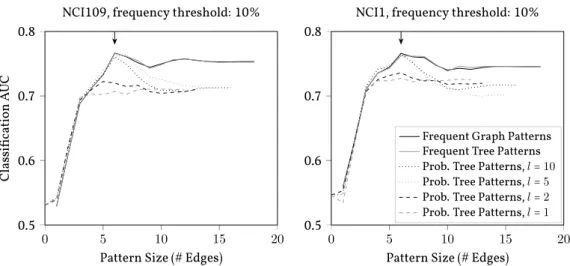
Figure 1.1.: Predictive performance of a SVM trained and evaluated on different feature sets. The two plots show the AUC values (y-axis) that are achieved for fea-tures corresponding to frequent (probabilistic) subgraph patterns up to a cer-tain number of vertices (x-axis). Each line corresponds to a cercer-tain type of pat-terns. The arrows from the top of the plot indicate the best performance of the frequent subgraph pattern based classificators.
1.1. A Motivating Experiment
As a motivation for our probabilistic frequent subtree techniques we investigate a predic-tive chemistry task for molecular databases. On the one hand, this may seem contradic-tory to our claim above that traditional frequent subgraph mining systems work well on such graphs and that we develop a method to go beyond this application scenario. On the other hand, we wish to compare our method against the “ground-truth” of exact frequent subgraph and frequent subtree based learning methods. Hence we naturally have to re-strict our comparison to domains where these two feature sets can be computed within feasible time and memory constraints.
Recall that we want to represent data that consists of multiple graphs in a feature space that is spanned by some set of graph patternsP. More exactly, we represent each graph
Gby a subset of the patterns inPthat matchG(i.e., that are subgraph isomorphic toG);
this representation can be stored as a binary vector of fixed length. To do this, we fix a set of graphs (calleddatabase) and compute the sets of
• all frequent subgraphs, • all frequent subtrees, and
1.1. A Motivating Experiment in the database for a fixed frequency threshold of 10%. We have observed similar qualita-tive behavior for other frequency thresholds and do not want to convolute this motivation by showing multiple similar plots. We then consider the feature representations of the graphs in the database with respect to the three pattern sets above.
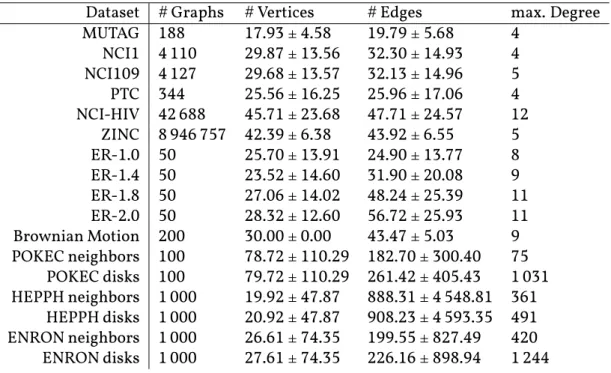
Figure 1.1 shows the results on NCI1 and NCI109. Both datasets consist of chemical molecules and the task is to predict whether they are active against certain types of cancer cells. See Section 2.4 for a more detailed description of these datasets. We report the pre-dictive performances of support vector machines (SVM) (Cortes and Vapnik,1995) which we measure by the area under the ROC curve (AUC) averaged over a three-fold cross vali-dation.5Furthermore, we defer the discussion of the various pattern sets to the technical part of this thesis. For now, it suffices to know that our method has a parameterlthat
influences its error and runtime in both the pattern mining and graph embedding steps. Figure 1.1 shows plots for our method with parameterl ∈ {1,2,5,10}. It contains a plot for each dataset and a line in each such plot for each generated pattern set. A point on such a line corresponds to the AUC value (y-axis) of an SVM classifier trained on feature representations based on patterns up to and including a certain number of edges (x-axis).
The predictive performance of frequent tree patterns (green) and frequent subgraph patterns (blue) is almost identical over both datasets and all pattern sizes. This moti-vates and justifies our initial simplification of the frequent subgraph mining problem (FCSM) to the frequent subtree mining problem (FTM). Furthermore, the predictive per-formance of the patterns first increases with the pattern size, reaching its optimum for maximum pattern sizes between 5 and 9 edges, and then decreases. This behavior is consistent through both datasets and we observed it consistently on a number of other datasets and across various frequency thresholds. The predictive performance of our probabilistic subtree patterns shows a similar behavior as a function of the pattern size. Increasing the sampling parameterlgenerally increases the predictive performance. In
fact, forl=10the best AUC score of the frequent subgraph pattern based classifier can be matched by our method.
We draw three main conclusions from this experiment that motivate us6 to pursue probabilistic frequent subtree patterns:
1. Our probabilistic patterns are well-suited as a basis for predictive tasks in the con-text of chemical graph databases.
2. Frequent pattern based classifiers do not seem to benefit from patterns that are too large. On chemical graphs, pattern sizes up to 9 edges per pattern give good pre-dictive performance and larger patterns tend to decrease speed as well as accuracy. This seems to be a general (although not systematically investigated) trend in graph mining, extending beyond frequent pattern mining and classification, e.g. also to cyclic patterns (Horváth et al,2004) or Weisfeiler-Lehman features (Shervashidze et al,2011) in a regression setting (Ullrich et al,2016).
5 We used libSVM (Chang and Lin,2011) with a linear kernel function. We did not optimize the soft margin parameter for each feature representation, but kept it in its default setting to speed up the computation and to avoid overfitting by chance.
3. Our method works well in practical scenarios even for relatively small values of the parameterl. This indicates that it can be applied in practically reasonable time and
space to distance-based learning problems that were not feasible before.
1.2. Contributions
As already mentioned, to use distance-based learning methods on graphs, a common paradigm also followed in this thesis is to embed the instance space (of graphs) into some appropriately chosen feature space equipped with a metric. In particular, we focus on embedding (labeled) graphs into thed-dimensionalHamming space(i.e.,{0,1}d) spanned by the elements of a pattern set of cardinalitydfor somed>0. This thesis presents meth-ods to usefrequent subgraphsas features,withoutany structural restriction on the transac-tion graph class defining the instance space.7 This is motivated, among others, by the observation that frequent subgraph based learners (see, e.g.,Deshpande et al,2005) are of remarkable predictive performance for example on the ligand-based virtual screening problem (Geppert et al,2008).
Our goal involves two steps solving the following computational problems:
(i) Pattern mining:Givena (training) database of arbitrary graphs,computethe setF
of all frequent subgraphs with respect to some user specified frequency threshold. (ii) Graph embedding: Given an unseen graph (usually drawn from the same
dis-tribution as the training data set),computeits embedding into the Hamming space spanned by the elements ofF.
For the case that the embedding operator is defined by subgraph isomorphism and that there is no restriction on the transaction and query graphs, both steps are computation-ally intractable. Nevertheless the pattern mining problem (i) has gained lots of attention (see Chapter 3), resulting in several practical systems for graph databases restricted in different ways. The graph embedding problem (ii) is, however, often neglected in the literature, though it is crucial to the ability of applying the pattern set generated in the mining step (i) to unseen graphs. We describe our technical contributions to address both computational problems below.
The overall contribution of this thesis is a robust system to map arbitrary graphs to a (learned) Hamming space of fixed dimension, therefore allowing to easily apply distance-based learning methods on graph datasets. Byrobustwe mean that the runtime of our sys-tem dependsnoton certain, typically unknown implicit characteristics of the data, but that it is polynomial in some user specified parameters, the size of the data, and the size of the output. Such a system is of high value for practical problems: Often the transaction graphs have no (known) specific structural properties that could be utilized by the mining or embedding algorithm. Our algorithm is robust because its delay is bounded by a poly-nomial which depends only on the number and size of the input graphs and on a sampling 7 In fact, we restrict our description to connected transaction graphs. This, however, is only done for ease
1.2. Contributions parameter. The sampling parameter can be used to control the trade-off between recall and time complexity. In contrast, all frequent subgraph mining tools from other groups are explicitly or implicitly engineered towards certain structural properties of the trans-action graphs and have exponential delay in the worst case. Furthermore, they usually neglect the graph embedding step (ii). As a result, these systems are not applicable in such a general scenario. Their runtime or memory requirements might explode for cer-tain datasets and novel graphs cannot be embedded in the feature space spanned by the frequent patterns in feasible time.
1.2.1. Efficient Frequent Subtree Mining
To arrive at a theoretically efficient and practically fast algorithm for the pattern min-ing problem (i), we restrict the pattern language totrees. This restriction alone, however, does not resolve the complexity problems above. Mining frequent subtrees from arbi-trary graphs isnotpossible in output polynomial time (unlessP=NP,Horváth et al,2007). To overcome this limitation, we give up the demand on the completeness of the mining algorithm. Instead, we propose to efficiently compute a subset of all frequent subtrees, which we callprobabilistic frequent subtrees.
As a first theoretical contribution, we formalize a relaxed frequent subtree mining problem and give sufficient conditions for the existence of an efficient mining algorithm. To this end, we extend the generic algorithm in (Horváth and Ramon,2010) to the case that (i) pattern and transaction graphs have different characteristics and (ii) only a well defined subset of all frequent patterns shall be enumerated. In particular, we consider the case that the transactions arearbitrarygraphs and the patterns are trees. Subsequently we propose two novel mining algorithms that are based on sampling spanning trees of the transaction graphs.
Probabilistic Frequent Subtrees
The basic insight leveraged by our techniques is the following: A tree is subgraph isomor-phic to a graph if and only if it is subtree isomorisomor-phic to one of the graph’s spanning trees. Our first algorithm therefore generates probabilistic frequent subtrees in the following simple way: It replaces each transaction graph in the input database by a forest formed by the vertex disjoint union of arandomsubset of its spanning trees. Using, e.g., the level-wise search algorithm (Mannila and Toivonen,1997), our algorithm generates the set of frequent connected subgraphs (i.e., subtrees) for the forest database obtained. Spanning trees can uniformly be sampled in polynomial time (Wilson,1996) and subgraph isomor-phism from a tree into a forest can be decided in polynomial time (Matula,1968). Hence the extended generic algorithm of (Horváth and Ramon,2010) can enumerate probabilis-tic frequent subtrees with polynomial delay in this way if for each transaction graph, the number of spanning trees in the sample is bounded by a polynomial of the graph’s size.
The output of our method is sound (that is, all patterns printed are frequent subtrees), but not necessarily complete (i.e., some frequent subtrees may not be enumerated). Re-garding the recall of our method (that is, the fraction of frequent subtrees retrieved by our
algorithm), we show that the set of frequent subtrees is well approximated if the number of sampled spanning trees is chosen appropriately. We prove that the probability for a frequent patternHto be among the probabilistic frequent subtrees is high if the pattern
isimportant. That is, ifHis frequent in the spanning trees of sufficiently many transaction
graphs.
Our extensive empirical evaluation demonstrates that the above idea results in a prac-tically feasible mining algorithm. We show that probabilistic frequent subtrees can be enumerated for social and random graph databases where state-of-the-art exact frequent subgraph mining systems are not able to produce results in practically feasible time. Fur-thermore, we demonstrate that therecallof our probabilistic mining technique is high even for small numbers of sampled spanning trees and that the retrieved set of patterns is very stable. (Notice thatprecisionis always 100% for the soundness of the algorithm.) Furthermore, we show that the predictive performance of probabilistic frequent subtrees is comparable to that of the full set of frequent subgraphs and frequent subtrees on chem-ical datasets.
Boosted Probabilistic Frequent Subtrees
As a next step, we go beyond the limitation of processing polynomially many spanning trees per graph only. We present an algorithm able to generate probabilistic frequent subtrees from arbitrary graphs with polynomial delay by considering a potentially expo-nentiallylarge implicit subset of the spanning trees for each graph in the database. Our boosted mining algorithm is based on a novel pattern matching algorithm. For a tree pat-ternHandatransactiongraphG, it(i)partitionsGintoacertainsetofinducedsubgraphs,
(ii) considers a (random) subset oflocalspanning trees for each induced graph, and (iii) de-cides whetherHis subtree isomorphic to one of theglobalspanning trees ofGobtained
by combining its local spanning trees in an appropriate way.
Our pattern matching algorithm traverses a rooted tree generated forGin a
bottom-up manner and computes the final solution from partial solutions calculated before. The nodes of the rooted tree controlling the evaluation are constructed from the articulation vertices ofG. Each nodevof such a tree is associated with a set of spanning trees of a
certain induced subgraph containingv. Our technique requires an efficient combination
of these local spanning trees, as well as a careful assembly of certain partial subtree iso-morphisms which can be computed efficiently. We prove that our algorithm decides sub-graph isomorphism from a tree patternHtoScorrectly, whereSis the set of spanning
trees ofGthat can be obtained from combinations of the local spanning trees. Our
algo-rithm runs in timepolynomialin the combined size ofH,G, and the number of local
span-ning trees that it considers. The significance of this result is that the number of global spanning trees inScan beexponentialin the number of local spanning trees. This
prop-erty has immediate consequences to probabilistic frequent subtree mining.
By considering exponentially many (implicit) global spanning trees instead of poly-nomially many ones, our technique has an improved performance in terms ofrecallover the simple algorithm described above. This improvement is only marginal on molecu-lar graph datasets, due to the relatively simple graph structure of pharmacological
com-1.2. Contributions pounds (cf.Horváth and Ramon,2010;Horváth et al,2010). Onthreshold graphs, however, which have applications among others inspectral clustering(see, e.g.,von Luxburg,2007), the boosted mining algorithm results in a much higher recall compared to the simple one. This also results in practical speedups, as it increases the number of patterns that are found in a given time budget with respect to the simple algorithm.
Exact Frequent Subtree Mining
The boosting technique mentioned above has implications for exact frequent subtree min-ing as well. We first note that despite more than two decades of research there are only a few non-trivial theoretical results concerning the complexity of frequent subgraph min-ing. In particular, if the transaction graphs are restricted to forests then frequent con-nected subgraphs (i.e., trees) can be generated with polynomial delay (see, e.g.,Chi et al, 2005). Using the positive result ofMatoušek and Thomas(1992), one can show that for graphs of bounded tree-width (Robertson and Seymour,1986a) and bounded degree, fre-quent connected subgraphs can be generated with polynomial delay. In fact, frefre-quent connected subgraphs can be listed in incremental polynomial time for graphs of bounded tree-width without restricting the vertex degree of the patterns (Horváth and Ramon, 2010). As a byproduct of our approach, we extend the known positive complexity results on frequent subgraph mining by a new one formulated for a graph class that is of theoret-ical as well as practtheoret-ical interest.
Our probabilistic frequent subtree mining algorithms solve theexactfrequent subtree mining problem correctly (i.e., soundly and completely) ifallspanning trees are consid-ered for each database graph. As a result, frequent trees can be mined with polynomial delay if the number of spanning trees of the transaction graphs is bounded by a polyno-mial of their size by using the frequent subtree mining algorithm described above. The efficiency follows from the fact that all spanning trees of a graph can be listed with poly-nomial delay (Read and Tarjan,1975) together with the positive result on frequent subtree mining in forest transaction databases.
The second (boosted) mining algorithm presented in this thesis extends this positive result to databases where transaction graphs may have exponentially many spanning trees. In particular, our boosted frequent pattern mining algorithm is correct and effi-cient (i.e., it has polynomial delay) if the transaction graphs have polynomially manylocal spanning trees. We call such graphslocally easy. The number of global spanning trees of a graphGmight be exponential in the number of local spanning trees ofG. As a result, the
work in this thesis substantially extends the known positive results on efficient frequent subtree mining.
The class of locally easy graphs has some interesting properties that are both of theo-retical and practical relevance. First, it isorthogonalto all graph classes that are defined by a constant upper bound on somemonotonegraph property (e.g., graphs of bounded tree-width); a graph property is calledmonotoneif it is closed under taking subgraphs. By “or-thogonality” we mean that the class always contains an infinite number of graphs that are not contained in the other graph class. The previously known positive results on efficient frequent subgraph mining, however, require the transaction graph class to be monotone.
Second, the class of locally easy graphs includes a number of interesting and practi-cally relevant graph classes.Forestsandpseudoforestsin which every connected component has at most one cycle constitute two subclasses of locally easy graphs. Further subclasses can be defined by bounding the maximum number of biconnected blocks sharing a vertex by a constant. For example,cactusgraphs (i.e., in which all edges belong to at most one simple cycle) of bounded block degree are locally easy. Note that even for cactus graph transactions (without bounding the block degree by a constant) frequent subtrees can be mined in incremental polynomial time (Horváth and Ramon,2010). However, it is un-known whether this is possible with polynomial delay. We conjecture that generalizing our positive result on polynomial delay mining of frequent subtrees to the first natural graph class beyond locally easy graphs is at least as difficult as solving thePvs.NP prob-lem. Our positive result on mining locally easy graphs is thus another step towards ex-ploring the border between tractable and intractable fragments of the frequent pattern mining problem.
1.2.2. Fast Computation in Probabilistic Subtree Feature Spaces
We follow a similar strategy for the pattern matching operator used in the embedding step (ii) (see page 6): For an unseen graphGand a setFof tree patterns enumerated in the
min-ing step, we generate a setS(G)of (random) spanning trees ofGand compute the set of
allH∈Fthat are subgraph isomorphic toS(G). The incidence vector of this set defines
the embedding (vector) ofGinto the Hamming space spanned byF. On the one hand,
in this way we decide subgraph isomorphism from a tree into a graph with one-sided er-ror, as only a negative answer may be erroneous, i.e., whenHis subgraph isomorphic
toG, but not toS(G). On the other hand, this probabilistic pattern matching test can
be performed in polynomial time while correct pattern evaluation is computationally in-tractable (that is,NP-complete). We prove that our probabilistic algorithm decides sub-graph isomorphism fromHintoGcorrectly with high probability ifHis frequent inG
and the number of sampled spanning trees is chosen appropriately.
Using our probabilistic technique, we can compute the embedding vector of a graph in polynomial time by deciding subgraph isomorphism (with one-sided error) foralltrees in the pattern set. This brute-force algorithm can be accelerated by reducing the number of subgraph isomorphism tests. Utilizing that subgraph isomorphism induces a partial order on the pattern set and that it is anti-monotone with respect to this order, we can infer for certain patterns whether or not they match a graph from the evaluations already performed for other patterns. We propose two such strategies. One is based on a greedy depth-first searchtraversal, the other usesbinary searchon paths in the partially ordered set of patterns. We show empirically that both algorithms drastically reduce the number of embedding operator evaluations compared to the baseline obtained by levelwise search. In a last step, we improve the speed and space consumption of the above method by applying min-hashing (Broder,1997). Each graph is represented by a small sketch vector that can be used to approximate Jaccard-distances. We show that the min-hash sketch of a given graph with respect to a set of tree patterns can be computed without calculating the embedding explicitly. We utilize the fact that we are interested in the first occurrence
1.3. Outline of a pattern in some permutation of the pattern set; once we have found it, we can stop the calculation, as all patterns after this first one are irrelevant for min-hashing. Beside this straightforward speed-up of the algorithm, the computation of the min-hash sketch can further be accelerated by utilizing once more the anti-monotonicity of subgraph iso-morphism on the pattern set. These facts allow us to define a linear order on the patterns to be evaluated and to avoid redundant subtree isomorphism tests.
Our experimental results demonstrate that the proposed technique can dramatically reduce the number of subtree isomorphism tests, compared to an algorithm performing the embedding explicitly. We also show that even for a few random spanning trees per chemical compound, remarkable precisions of the active molecules can be obtained in a highly imbalanced chemical dataset by taking theinearest neighbors of an active
com-pound. Finally, we show that the predictive power of support vector machines using our approximate similarities compares favorably to that of state-of-the-art related methods. The stability of our incomplete probabilistic technique is explained by the fact that a subtree generated by our method is frequent not only with respect to the training set, but, with high probability, also with respect to the set of spanning trees of a graph. While the presented embedding techniques are applied to probabilistic frequent subtree patterns in this thesis, they can be employed in other partially ordered pattern sets and monotone embedding operators.
1.3. Outline
The remainder of this thesis is structured as follows:
In Chapter 2 we introduce the necessary notions and notation. Among them, we define a quite general frequent subgraph mining problem and discuss its computational com-plexity in Section 2.2. It turns out that this comcom-plexity is related to the comcom-plexity of the HamiltonianPath problem. We discuss its complexity for an important special case in Appendix A. Chapter 3 presents related approaches for frequent subgraph mining and for the subgraph isomorphism problem.
The main contributions of this thesis are presented in the next three chapters. In Chap-ter 4 we introduce our relaxation of frequent subtree mining and show that it gives rise to an efficient algorithm for arbitrary graph transaction databases in theory and practice. Next, we investigate a more intricate algorithm that is able to decrease the error of our method with respect to the full set of frequent patterns for some types of graph databases in Chapter 5. In Chapter 6, we show how to efficiently compute the embedding vector for a graph, given a set of tree patterns. While our methods developed in the previous chap-ters can be used to do this in polynomial time using a brute-force approach, we propose several methods that speed up this computation by using a natural partial order on the pattern set. Finally, Chapter 7 concludes the thesis.
1.4. Previously Published Work
This thesis is based on joint work with Tamás Horváth and Stefan Wrobel which has al-ready been published elsewhere. These publications are, in detail:
Pascal Welke, Tamás Horváth, Stefan Wrobel (2015) On the complexity of frequent sub-tree mining in very simple structures. In: Jesse Davis, Jan Ramon (eds) Inductive Logic Programming (ILP) Revised Selected Papers, Springer, Lecture Notes in Computer Sci-ence, vol 9046, pp 194–209, DOI10.1007/978-3-319-23708-4_14
Pascal Welke, Tamás Horváth, Stefan Wrobel (2016a) Min-hashing for probabilistic fre-quent subtree feature spaces. In: Toon Calders, Michelangelo Ceci, Donato Malerba (eds) Discovery Science (DS) Proceedings, Lecture Notes in Computer Science, vol 9956, pp 67–82, DOI10.1007/978-3-319-46307-0_5
Pascal Welke, Tamás Horváth, Stefan Wrobel (2016b) Probabilistic frequent subtree ker-nels. In: Michelangelo Ceci, Corrado Loglisci, Giuseppe Manco, Elio Masciari, Zbig-niew Ras (eds) New Frontiers in Mining Complex Patterns (NFMCP) Revised Selected Papers, Springer, Lecture Notes in Computer Science, vol 9607, pp 179–193, DOI
10.1007/978-3-319-39315-5_12
Pascal Welke (2017) Simple necessary conditions for the existence of a Hamiltonian path with applications to cactus graphs. CoRR abs/1709.01367, URL http://arxiv.org/ abs/1709.01367
Pascal Welke, Tamás Horváth, Stefan Wrobel (2018) Probabilistic frequent subtrees for efficient graph classification and retrieval. Machine Learning 107(11):1847–1873, DOI
10.1007/s10994-017-5688-7
Pascal Welke, Tamás Horváth, Stefan Wrobel (2019) Probabilistic and exact fre-quent subtree mining in graphs beyond forests. Machine Learning DOI 10.1007/ s10994-019-05779-1, (online)
2. Preliminaries
In this chapter we collect all necessary terminology and notation used in this thesis. We assume that the reader is aware of standard mathematical concepts like sets, vectors, functions, et cetera. We also require knowledge of complexity theory, in particular famil-iarity with theO-notation and the complexity classesPandNP. For the sake of clarity,
however, we introduce our notation and recall some basic notions from graph theory (see, e.g.,Diestel,2012;Korte and Vygen,2012) in Section 2.1. Subsequently, we formally define the pattern mining problem considered in this work in Section 2.2. As this prob-lem is a listing probprob-lem, we define complexity classes for such probprob-lems, as they are less standard. We provide a generic algorithm and efficiency conditions in Section 2.2.1 and discuss the complexity of the pattern mining problem in Section 2.2.2. Finally, we describe the datasets used throughout this thesis in Section 2.4.
2.1. Notions and Notation
Sets and Lists
LetS = {s1, s2, . . .}be a set. We denote the cardinality ofSby∣S∣and the empty set by ∅. Given some fixed encoding of the elements ofS, thesize(S)denotes the sum of the
sizes of its elements in that encoding.1 A subsetXofSis indicated asX ⊆ S. IfX ⊆ S andX ≠ S, we writeX ⊂ S. We denote the set of natural numbers{1,2, . . .}byNand
the set of real numbers byR. The finite set{1, . . . , n} ⊂ Nwill be denoted by[n]for all n∈ N. Given a finite setΣ, calledalphabet, asequence, also calledlist, orstringof elements ofΣis written as[s1, . . . , sn]. In contrast to a set, the order of elements in a sequence is
important. The length of a listL, i.e., the number of elements it contains, is denoted by∣L∣
and theith element ofLis denoted byL[i]. The set of all finite sequences overΣis then denoted byΣ∗. Note that in a sequence a certain elementsmight occur multiple times.
ApermutationofΣis a sequence that contains each element ofΣexactly once. There are exactly∣Σ∣!= ∏∣iΣ=1∣ipermutations ofΣ.
Graphs
Anundirected(resp. directed)graphG=(V, E)consists of a finite setV of vertices and a set E ⊆ {X ⊆ V ∶∣X∣= 2}(resp. E ⊂ V ×V) of edges. WhenGis clear from the context,n
denotes∣V∣andmdenotes∣E∣. GivenG=(V, E)we will often use the notationV(G)∶=V
andE(G) ∶= E to refer to the vertex or edge set ofG. We consider only simple graphs,
i.e., loops and parallel edges are not permitted.2 Unless otherwise stated, bygraphswe mean undirected graphs. An edge{u, v} ∈ E(G)will be denoted byuv. The setN(v) ∶=
{w∈V(G) ∶ vw∈E(G)}is the set ofneighborsofv. The cardinality ofN(v)is calleddegree
ofvand denoted byδ(v). Aleafis a vertex that has exactly one neighbor.
Alabeledgraph is a graphGtogether with a functionl∶E(G)∪V(G)→Σthat assigns a label from some finite setΣto each vertex and each edge. Labeled graphs can model chemical molecules, protein-protein interactions, social networks, the Web graph and other phenomena. To keep the notation and description concise, we will state all results forunlabeledgraphs. All our arguments naturally apply to labeled graphs as well.
AsubgraphofGis a graphG′withV(G′)⊆V(G)andE(G′)⊆E(G).G′is a subgraph
ofGinducedby a subsetV′⊆V(G)ifV(G′)=V′anduv∈E(G′)if and only ifuv∈E(G)
for allu, v∈V′. Such an induced subgraph is denoted byG[V′].
A graph isconnectedif for anyv, w ∈ V(G)vcan be reached fromwby traveling over
a sequence of edges[vv1, v1v2, v2v3, . . . , viw]. Gisk-connectedifGis connected and the
removal of any set ofk−1vertices does not destroy this property. We call a 2-connected graphbiconnected. Acycleis a minimal biconnected graph with at least three vertices, i.e., the removal of any edge or vertex results in a path. Ablockis a maximal subgraph ofGwith
at least three vertices that is biconnected and abridgeis an edge that does not lie on any cycle. Abiconnected componentis a maximal subgraph that is biconnected, i.e., it is either a block, or a bridge, or an isolated vertex. Finally, aarticulation vertexis a vertex whose removal increases the number of connected components ofG.
Aforestis a graph that contains no cycle; a tree is a connected forest. Apathis a tree where at most two vertices are leaves3. Note that several works in the graph mining lit-erature refer to trees asunrooted unordered treesorfree trees. In this work, a tree is always undirected, unless we explicitly say that it is rooted: Arooted treeT′can be obtained from
a treeTby choosing a rootr ∈V(T)and by directing every edgee∈E(T)towardsr. For
eachr ∈V(T)this definition results in a unique orientation of the edges. Aspanning tree Tof a connected graphGis a subgraph ofGwithV(T)=V(G)that is a tree.
A common generalization of trees are graphs of boundedtree-width(Robertson and Seymour,1986b). This property – in some sense – measures how tree-like a graphGis
by defining a tree structure on certain induced subgraphs ofG. Atree decompositionof a
graphGis a treeTtogether with a mappingbag∶V(T)→2V(G)such that • ⋃
i∈V(T)
bag(i)=V(G),
• e⊆bag(i)for somei∈V(T)for alle∈E(G), and
• the subgraphT[{i∈V(T) ∶ v∈bag(i)}]of T induced by all vertices whose bags
containvis connected for allv∈V(G).
2 Aloopis an edge from a vertex to itself. Note that according to our definitions this can not happen in an undirected graph.
2.1. Notions and Notation The width of a tree decomposition is the cardinality of its largest bag,maxi∈V(T)∣bag(i)∣.
The tree-width ofGis the minimum width of all tree decompositions ofG. Note that the
tree-width of any graph containing at least one edge is at least one. In fact, the tree-width of a graphGis one if and only ifGis a forest.
Another generalization of trees are outerplanar graphs. A graph isouterplanar, if (i) it can be drawn in the plane in such a way that edges do not cross each other except maybe in their endpoints and (ii) every vertex lies on the outer face. That is, each vertex can be reached from outside without crossing any edge. A graphGis outerplanar if and only
if all its biconnected components are outerplanar (Harary,1994). A biconnected compo-nentBof an outerplanar graph is either bridge, or it is a maximal induced subgraph ofG
composed of a single Hamiltonian cycle and possibly some non-crossing diagonal edges (Harary,1994). Ad-tenuousouterplanar graph is an outerplanar graph in which each block
has at mostddiagonals. Notice that forests are special outerplanar graphs. Furthermore,
outerplanar graphs have tree-width at most two.
Isomorphism and Subgraph Isomorphism
LetG1 = (V1, E1)andG2 =(V2, E2)be graphs. They areisomorphic, denotedG1 ≅ G2if
there exists a bijectionφ∶V1→V2withuv∈E1if and only ifφ(u)φ(v)∈E2for allu, v∈V1.
In this caseφis called anisomorphismbetweenG1 andG2. G1 issubgraph isomorphicto
G2, denotedG1 ≼G2, ifG2has a subgraph that is isomorphic toG1. The corresponding
functionφ∶V(G1)→V(G2)is calledsubgraph isomorphism.G1≺G2denotes thatG1≼G2
andG1is not isomorphic toG2.
As already mentioned in the beginning of this section, we will state all our results for unlabeled graphs. Nonetheless, we will shortly mention how the subgraph isomorphism is defined in the labeled case, as many datasets considered in this work consist of labeled graphs (cf. Section 2.4). LetG1andG2be two graphs with label functionsl1andl2over the
same label setΣ. ThenG1andG2are isomorphic if there exists a subgraph isomorphism
φsuch that
• l2(φ(v))=l1(v)for allv∈V(G1)
• l2(φ(v)φ(w))=l1(vw)for allvw∈E(G1).
Checking whether the label of an edge or vertex matches the label of its image can be done in constant time assuming that a suitable encoding is chosen for the elements in thefinite label setΣ. Hence the algorithms considered in this work can be easily extended to the labeled case.
The SubgraphIsomorphism problem, that is, deciding whetherH ≼ Gfor two
graphsHandG, is one of the classicalNP-complete problems (Garey and Johnson,1979,
Sec. 3.2.1). This negative result holds even for the case that the patternHis restricted to
trees. We will refer to this latter problem as the SubtreeIsomorphism problem. Its NP-completeness follows e.g. from the restriction to the problem of deciding whether there exists a Hamiltonian path inG, i.e., a path that contains all vertices ofG(Garey and
Johnson,1979, Sec. 4.2.2). In case thatGandHare both trees, the
SubtreeIsomorph-ism problem can be solved in polynomial time (Matula,1968). Several algorithms were developed for this problem and are discussed in Section 3.1.
The GraphIsomorphism problem, that is, deciding whether two graphsGandH
areisomorphic, is neither known to be solvable in polynomial time, nor known to be NP-complete. Recent work byBabai(2015), claims that there is a quasi-polynomial time al-gorithm for the GraphIsomorphism problem. In case bothGandH are trees, the
GraphIsomorphism problem becomes much simpler and can be decided in linear time (this follows, e.g., fromHopcroft and Wong, 1974).4 One way of solving the GraphI-somorphism problem is to compute and compare canonical strings, which we will de-scribe below. First, however, we need additional notation.
Isomorphism is an equivalence relation. That is, for all graphsG1, G2, G3, it holds
Reflexivity G1≅G1,
Symmetry G1≅G2if and only ifG2≅G1, and
Transitivity ifG1≅G2andG2≅G3thenG1 ≅G3.
Agraph classGis a set of graphs. We will often define graph classes by some common prop-erty of the graphs, e.g. the class of all trees, connected graphs, etc. Arepresentative ofGis a set that contains exactly one graph from each equivalence classG¯∶={H∈G ∶ H≅G}⊆G. That is, the elements in the representative ofGare unique up to isomorphism.
Posets
Apartially ordered set, orposet(S,<)is a setStogether with a binary relation<such that for
allx, y, z∈Sthe following conditions hold:
Reflexivity x<x,
Antisymmetry ifx<yandy<xthenx=y, and
Transitivity ifx<yandy<zthenx<z.
For any graph classFthe pair(F,≼)is a poset. IfFis finite, we can represent(F,≼)by a
directed graph(F, E)with(T1, T2)∈Eif and only ifT1 ≺T2and there is noT ∈F with
T1 ≺T ≺T2for allT1, T2 ∈F. In this way,x<yif and only if there exists a directed path
fromxtoyin the graph(F, E).
Atotal orderis a poset(S,<)where for allx, y∈Seitherx<yory<x. A total order on Scan be represented as a sequence of elements ofS. In particular, each permutation ofS
defines a total order onS. Atopological orderon(F, E)(resp. (F,≼)) is a sequence (i.e., a
total order)F =[T1, T2, . . . , Tn]satisfyingi<jfor all(Ti, Tj)∈E. A directed graph has
a topological order if and only if it is acyclic, i.e., if it corresponds to a partial order (see, e.g.Korte and Vygen,2012).
4 This result also holds in case at least one of the graphs is a tree: Whether a graph is a tree can be decided in linear time and a tree can never be isomorphic to a graph that is not a tree.
2.1. Notions and Notation Let(Σ,<)be a total order. Thelexicographical orderinduced by(Σ,<)is a total order
(Σ∗,<′)of strings overΣdefined as follows: LetSandS′be two strings with∣S∣=∣S′∣. If S≠S′letibethefirstpositionwherethetwostringsdiffer. ThenS <′S′⇔S[i]<S′[i]. If
two strings have different length, we obtain their relation (with respect to<′) by padding
the shorter string by a novel element not contained inΣthat is larger than all elements inΣ(with respect to<). The lexicographical order on canonical strings of trees (described below) is an important part of efficiently removing isomorphic graphs efficiently from a graph class, i.e., computing a representative of the graph class.
Canonical Forms and Canonical Strings of Trees
Given a graph classG, acanonical string functionis a functionf ∶ G→Σ∗such that
f(G)=f(H) ⇐⇒ G≅H
for allG, H ∈Gfor a suitable finite alphabetΣ. For someG∈G, we callf(G)itscanonical
string.
Canonical strings allow to decide if two graphs are isomorphic by just testing the equal-ity of their canonical strings. This operation can be done in linear time in the length of the shorter string (assuming that the size ofΣis a constant and that comparing elements inΣcan be done in constant time). Canonical strings also enable testing if a graphG
is isomorphic to some graph in a setS of graphs in an efficient way: Using prefix trees
(Fredkin,1960), this can be done in linear time in∣f(G)∣; in particular, the runtime does
not depend on∣S∣. The generic graph mining algorithm described in Section 2.2.1 below
requires a way to filter out redundant patterns, i.e., patterns such that some isomorphic pattern has been evaluated before. This test can be easily implemented using canonical strings stored in a prefix tree.
A canonical string function that can be computed in polynomial time for all graphs is unlikely to exist as this would imply a polynomial time algorithm for the Subgraph-Isomorphism problem. Polynomial time computable canonical string functions are known, however, for restricted graph classes. IfGis the class of all trees (Asai et al,2003; Chi et al,2003;Nijssen and Kok,2003), the class of all outerplanar graphs (Horváth et al, 2010), or the class of all planar graphs (Hopcroft and Wong,1974). In fact, there exist sev-eral canonical string functions for trees that can be computed in linear time (e.g.Hopcroft and Wong,1974).
Although our system does not require any specific canonical string function, we now briefly describe the method we have used. It is based on the ideas presented byChi et al (2003). To obtain a canonical string of a treeG, we first transformGto a rooted tree. To
select a root, we repeatedly remove all leaves together with their incident edges fromG
until one or two vertices remain. These vertices are called thecenter(respectively the bi-center) ofGand are well defined. The method to obtain the center or bi-center ofGcan be
implemented inO(∣V(G)∣)(see, e.g.,Harary,1994, Chapter 4). We define the canonical
string forGto be the canonical string of the tree rooted at the center ofGifGhas a center.
IfGhas a bi-center then the canonical string ofGis defined to be the lexicographically
C B A X X A 1 1 2 1 1 X(1X(1A))(2A(1B)(1C))
Figure 2.1.: A small tree (left) with its canonical string (right). The vertex shown in gray is the center of the tree.
To obtain a canonical string for a rooted tree labeled by elements fromΣ, we start with an arbitrary but fixed total order on the label setΣ ˙∪{(,)}and employ a bottom up method.
The canonical string of a leaf vertexvis simply its labell(v). For some vertexvthat is not
a leaf ofGwe first recursively compute the canonical stringcwfor each childwofv. We
add the “(” symbol andl(vw)at the beginning ofcwand the “)” symbol at the end ofcw.
Then we sort all modifiedcws according to the lexicographical order on the modifiedΣ∗.
This results in a canonical string function for trees that can be computed in polynomial time (Chi et al,2003). Figure 2.1 shows a small example.
2.2. Frequent Connected Subgraph Mining
Frequent connected subgraph mininghas been an area of active research for the last twenty years. It is a natural generalization of the frequent itemset mining problem (Agrawal et al, 1996) to transaction databases consisting of graphs. We will review related work in Chap-ter 3 and will now formally define the exact computational problem considered in this thesis. In its most general form, it can be formulated as follows:
FrequentConnectedSubgraphMining (FCSM) problem:Givena finite listD⊆G
(calledgraph database) for some graph classGand an integer thresholdt∈[∣D∣],list
all graphsP ∈ Pfor some graph classP, called thepattern class, that are subgraph
isomorphic to at leasttgraphs inD. The patterns in the output must be pairwise
non-isomorphic.
An equivalent definition of this problem uses a relative(instead of an absolute) fre-quency threshold. For a given databaseDand a thresholdt∈[∣D∣]the relative frequency θis defined asθ∶= ∣Dt∣. We will use the relative and absolute thresholds interchangeably
when clear from the context. For some patternH ∈ P, and databaseD, we say thatH
ist-frequent(respectivelyθ-frequent) ifHis subgraph isomorphic to at leastt(respectively θ⋅∣D∣) graphs inD. Note that for some fixed inputDandt, the output of the FCSM problem
2.2. Frequent Connected Subgraph Mining graph classF⊆P. We will often refer to the output of the FCSM problem as the frequent subgraphs ofD, omitting the thresholdt(resp.θ) when clear from the context. Note also
that our notation explicitly allows multiple instances of the same graph inD.
Other authors considered variants of the FCSM problem that are parametrized by the transaction class only (see, e.g.,Horváth and Ramon,2010). In contrast, we regard a prob-lem that is parameterized by the transaction classand the pattern class. The reason is that we are interested in mining frequent trees in graph databases that contain more complex graphs. A formalization that does not distinguish between pattern class and transaction class would always require to list the frequent patterns that are not trees as well, if there are any.
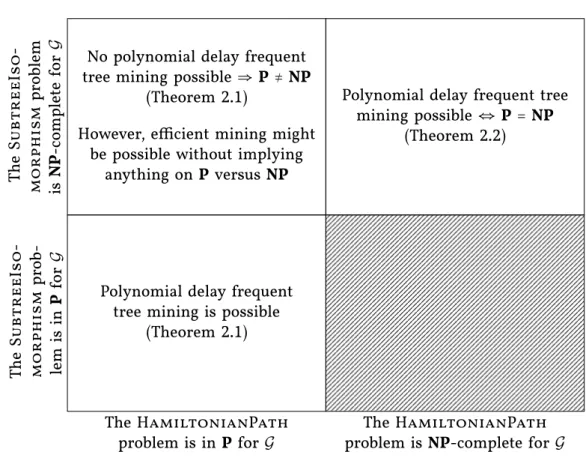
In Section 2.2.1 we give an algorithm for the FCSM problem and formulate sufficient conditions forGandP that guarantee the algorithm to generate frequent patterns effi-ciently. These conditions may be of some independent interest for the study of other special cases of the FCSM problem. Furthermore, in Section 2.2.2 we characterize a rela-tionship between the computational complexity of the FCSM problem and the question whetherP=NP. To this end, we first review efficiency notions for listing problems like the FCSM problem.
Starting from Chapter 3, we focus on the special case of the FCSM problem where
P is the class of trees. This special case will be referred to as FrequentSubtreeMi-ning (FTM) problem. In Chapter 4 and Chapter 5 we will use the generic algorithm to obtain positive complexity results for the FTM problem without restricting the transac-tion graph class.
Computational Complexity of Enumeration Problems
We will now define notions of efficiency for problems like the FCSM problem. Alisting problemis a pair(X,{O(x) ∶ x∈X}), whereXis a set of valid input instances andO(x)
is the set of allacceptable solutionsfor eachx∈X. An acceptable solutiono∈O(x)is a finite
set; an algorithmsolvinga particular listing problem(X,{O(x) ∶ x∈X})is an algorithm
that outputs for eachx∈Xall elements in someo∈O(x)exactly once in some arbitrary
order. We assume that the listing problems arepolynomially balanced. That is: size(G) ≤ p(size(x))for allx∈X, for allo∈O(x), and for allG∈ofor some fixed polynomialp(see,
e.g.Boley,2011, Chap. 2.2).
Consider the FCSM problem for transaction classGand pattern classP: A valid input instancex∈Xconsists of a graph databaseD⊆Gand an integer thresholdt∈[∣D∣]. Note
that the definition above allows formultiple correct solutionso∈O(x): An acceptable
solu-tion forxis a maximal set of pairwise nonisomorphic graphso⊆Psuch that each graph G ∈ oist-frequent inD. There are many such sets, as one can freely choose to replace
a pattern with an isomorphic graph that is not identical. However, each acceptable so-lution is a representative of the same graph class, that is, the elements inoare pairwise
nonisomorphic and represent theclass of all graphs that aret-frequent inD. As a subgraph
can have at most as many vertices and edges as its supergraph, the size of eacht-frequent
subgraph is smaller or equal to the size of the largest graph(s) in the input database; hence this listing problem is polynomially balanced.