THE MAINTENANCE OF SINGLE GENERALIZATION INFERENCES HELD IN WORKING MEMORY
A THESIS
SUBMITTED TO THE GRADUATE SCHOOL IN PARTIAL FULFILLMENT OF THE REQUIREMENTS
FOR THE DEGREE MATER OF ARTS
BY KYLE OLSON
DR. KRISTIN RITCHEY - ADVISOR
BALL STATE UNIVERSITY MUNCIE, INDIANA
The Maintenance of Single Generalization Inferences held in Working Memory We know through various models of text comprehension that reading is a complex process involving many different cognitive mechanisms (Kintsch & van Dijk, 1978; Kintsch, 1988; Cook, Gueraud, Was, & O’Brien, 2007). Many of these mechanisms involve drawing inferences about events or characteristics that are not explicitly provided within a text, and generalization inferences are one type of inference that are critical for organizing the major concepts or ideas experienced by the reader. Generalization inferences help to organize propositions, or textual examples used in discourse, by relating their common, structural elements under a single categorical theme; readers form these themes, or generalizations, even when they are not explicitly provided by the text (Guindon & Kintsch, 1984; Maltese, Pepi, & Scifo, 2012).
Previous studies have found that readers are capable of drawing a single generalization inference about a single topic from five consecutive sentences of text (Ritchey, 2011; Ritchey, Barnes, Suryanarayan, & Donaldson, 2013; Ritchey & Suryanarayan, 2015). However, many texts are longer than five sentences. In addition, some texts may allow a reader to infer just one generalization, such as a persuasion piece that continues to elaborate on the same categories or themes using many related examples. But at some point, most texts will introduce a new set of propositions that are better related to differently themed generalization inferences, and readers will likely need to infer additional generalizations to accommodate new and incoming
information. When reading a fairy tale, for example, readers may need to draw one
generalization inference about the bravery of a prince, one about the evil nature of the dragon, and one about the necessity of saving the princess for the overall plot to be meaningful. Therefore, the current study extends previous research on generalization inferencing by
examining how a single generalization inference is processed further as readers are presented with subsequent demands for generalization inferencing.
Generalization Inferences
By definition, a generalization inference must be abstracted from multiple propositions within a text, each related by common structural elements sharing the same categorical theme. For example, “Turquoise is a blue-green stone that can be found in some areas of Arizona,” “San Diego is known for its source of pink tourmaline, another type of gem,” and “Topaz stones are found all over Colorado” are related by the categorical similarities of gemstone type and geographical location. While each of these example sentences provide differing information to the reader, each sentence also instantiates shared conceptual elements. Generalization inferences abstract categorical similarities from propositions each sharing a similar theme and relate them under a single, unifying statement. For example, “Gemstones are found in many different geographical locations across the United States” demonstrates one such inference that might be drawn (Ritchey et al., 2013).
More formally, Van Dijk (1980) provided five criteria that are necessary for distinguishing generalization inferences from other types of cognitive mechanisms. First, generalization inferences are distinct because no proposition used in the construction of a generalization inference can be outright deleted, which sometimes occurs when a reader encounters a fact they do not consider important. This differentiates generalization inferencing from similar strategies that also reduce the complexity of multiple propositions into simpler terms, by allowing the reader to delete, or disregard, some pieces of information. Second, a consequence of the first rule is that generalization inferences must be drawn from multiple (at least two) propositions within a text. That is, generalization inferences cannot be inferred from
any one particular proposition. For example, readers would not construct the generalization inference that “Multiple types of gemstones can be found all over the United States” after reading only one example illustrating this point. Third, generalization inferences must consider each individual proposition equally. That is, no one proposition can weigh heavier than another in drawing a generalization inference. In the previous example, turquoise, pink tourmaline and topaz each receive the same weight in drawing a generalization inference due to their high degree of categorical similarity. Fourth, a generalization inference lacks the temporal and causal structure that some other types of inferences depend on. In other words, generalization inferences can be constructed even when the text does not provide a causal or temporal connection between events. Fifth, readers can abstract generalization inferences about topics in which they have quite limited knowledge. That is, readers do not require previous knowledge of a topic to draw a proper generalization inference.
Although generalization inferences play an important role in the reading comprehension process, relatively few studies have been performed on how these inferences are constructed. It has already been shown that generalization inferences can be drawn online, or as a spontaneous part of the reading experience, and are instantiated under various reading goals (Ritchey, 2011). They can also be encouraged by deductive reasoning training, so they are drawn more readily when deductive logic is temporarily strengthened (Ritchey & Suryanarayan, 2015).
Generalization inference construction can be affected by genre, depending on whether the discourse is an expository, fiction, fairy-tale, or some other type of narrative (Ritchey et al., 2013; Ritchey & Suryanarayan, 2015). Interestingly, the question of what happens to a prior generalization inference after it has initially been drawn in working memory has not yet been explored, and the purpose of the current study was to explore how single generalization
inferences were either maintained or replaced in working memory by continued demands on coherence. One way of approaching this query was to consider theories from the memory-based comprehension literature, which largely examine how working memory draws on knowledge from long term memory to better prepare the reader for understanding new and related text. Memory-Based Reading Theory
Memory-based reading theories were developed from literature concerning how readers construct inferences and under what conditions readers typically rely upon these inferences for maintaining both local and global coherence. They are built around the conceptual idea of resonance, which states that knowledge in long term memory becomes increasingly available as readers match semantic features of previously encoded information to new information they encounter as they read (Myers & O’Brien, 1998; O’Brien, Albrecht, Hakala, & Rizzella, 1995). Resonance can be conceptualized as part of a readiness process, where readers’ best utilize the information in long term memory to facilitate a greater understanding of what is currently being read (Gerrig & McKoon, 1998). It posits that the contents of working memory (presumably, what a person is currently reading) send out a passive and automatic signal that resonates with backgrounded memory traces (i.e., Propositions in long term memory) based on common semantic features or characteristics.
For example, when a protagonist acts out some behavior that is inconsistent with their previously stated preference, readers take longer to comprehend sentences that are inconsistent with their previously stated preferences than to comprehend consistent information (Myers, O’Brien, Albrecht, & Mason, 1994). One classic example of this inconsistency effect elaborates on how a protagonist (I.e., Mary) loves health food and has been a strict vegetarian for ten years, and then introduces the target sentence, “Mary ordered a cheeseburger.” The fact that Mary
ordered a cheeseburger when she was a strict vegetarian is inconsistent with the previous characteristics stated about Mary (I.e. That she is a vegetarian and does not eat meat), and readers have greater difficulty comprehending target sentences where Mary orders a
cheeseburger than target sentences remaining consistent with a strict vegetarian diet (O’Brien, Rizzella, Albrecht, & Halleran, 1998). Because readers remember information about how Mary is a vegetarian to realize the inconsistency of her cheeseburger order, resonance predicts that readers should have greater comprehension difficulty when accessing backgrounded memory traces that are inconsistent with what they are currently reading in the text. In other words, readers are far more likely to retrieve information from long term memory that supports the understanding of new information, where readers have relatively greater difficulty
comprehending inconsistent target sentences that are not well supported by already encoded knowledge.
In contrast to the resonance view, the here-and-now processing view predicts that readers should keep a completely updated model of the protagonist in active working memory at all times, and should continue to map current information onto what they have already read
(O’Brien et al., 1998). An up-to-date model of the protagonist, where the inconsistent elaboration on Mary being a strict vegetarian is replaced by updated information of her ordering a
cheeseburger, does not predict that readers should recognize the inconsistency of ordering a cheeseburger; rather, it predicts that readers would simply replace the old information with new information, so as long as the text remains locally coherent (I.e., Each sentence makes sense in light of whatever information immediately preceded it). Therefore, according to the here-and-now view, readers should not slow down when encountering this inconsistency. They should simply update the model of the protagonist, and reading times should remain equivalent
regardless of whether readers are introduced to consistent or inconsistent target sentences. Instead, resonance predicts that readers send out an automatic, uninhibited signal from the contents of working memory to non-active concepts in long term memory sharing common semantic features. It predicts information about Mary’s eating habits stated earlier should be the most available when reading about her eating habits in the future. Recalled portions of the text about Mary’s vegetarianism produce a coherence break, which is reflected in significantly longer reading times and greater comprehension difficulty for similar but inconsistent elaborations of the text.
This inconsistency effect is just one illustration of how readers try to maintain global coherence as they read. It has also been used in memory-based literature to demonstrate how backgrounded memory traces for objects associated with the protagonist can be made more accessible in long term memory by their mentioning (Cook, Gueraud, Was, & O’Brien, 2007). In support of resonance processes, a follow up experiment within the same study demonstrated how this effect was due to an increase in concept accessibility for protagonist associated objects, rather than a persistent availability of these same objects in working memory. This signifies that resonance is a process intending to increase readers’ ability to access knowledge sharing
common semantic features; hence, it better prepares the reader for the information they are about to encounter.
There are several factors known to influence the resonance process. The amount of attention given to the contents of working memory subsequently influences the accuracy of the resonance signal sent to long term memory. When readers cannot allocate attentional resources to working memory, resonance may be temporarily reduced and comprehension difficulty will likely occur (Just & Carpenter, 1992). The current experiment will attempt to minimize
differences in working memory allocation by providing participants with the same directions for reading the texts and testing participants within the same environment.
The amount of elaboration that an earlier proposition received during its initial encoding also influences the momentary likelihood of its foregrounding, or being made available in working memory through a passive, resonance process (McKoon & Ratcliff, 1989). Bradshaw and Anderson (1982) demonstrated long before the most recent studies on memory-based resonance how elaborated memory traces are recalled more readily than unelaborated or poorly integrated memory traces; more specifically, this effect also extends to many types of anaphora referring back to some previously encoded propositions within a text (O’Brien, Plewes, & Albrecht, 1990). In the context of the current design, this signifies the likelihood of recalling a previously backgrounded proposition in long term memory, which supports the implied generalization inference, depends on its relative degree of semantic overlap with the current contents of working memory (Kintsch, 1994). Thus, the current experiment studies the effect of elaboration by presenting information that should result in a generalization inference, then providing subsequent propositions that either continue to elaborate on the same generalization theme or introduce a new theme, and finally a critical target sentence that alludes to the former generalization inference. Preexisting semantic associations between concepts illustrated through text and concepts already in long term memory can also influence the likelihood of
foregrounding (Meyers & O’Brien, 1998; Cook et al., 2007). The best way to account for this in the current research is to present texts that discuss common topics for which most readers will have some associations.
Previously backgrounded propositions appearing in closer proximity to the critical target sentence are reinstated into working memory more quickly than relatively distant propositions
(O’Brien, Plewes, & Albrecht, 1990). In accordance, this research manipulates the amount of distance in between the original generalization inference and the number of additional
propositions encountered before reading the critical target sentence, where a greater number of examples in-between target sentences are represented by later placements of the target sentence. The amount of feature overlap among what is currently being read and propositions in long-term memory can also influence the resonance process (Cook, 2014). In some ways, this factor is most critical for determining which information is made available in working memory. For example, if readers are expected to draw a generalization inference about gemstones, but there is also
information about gemstones included in the same text that is not relevant to drawing the
intended generalization inference, the semantic-overlap between gemstones and the inconsistent information could cause the reader to unintentionally pull irrelevant propositions from long term memory. Luckily, this can be controlled in part by writing texts that follow a predetermined structure, minimizing unnecessary and obvious examples of repetitious semantic content. One last factor known to affect resonance is the causality, where one proposition within the text is perceived as causing another, and this appears to influence reading comprehension by limiting the number of semantic features that resonate in response to the current contents of working memory (O’Brien & Myers, 1987; Kendeou, Smith, & O’Brien, 2013). Luckily, the texts used in this experiment were expository and merely provided readers with general information about selected topics, so causality was not expected to affect to the current experimental design. Current Study
The present study investigated the extent to which readers kept a generalization inference active in a 2 (Elaboration: new theme vs. same theme) x 2 (Placement: early vs. late) x 2
participant received a counter-balanced combination of variable levels for each story, but received just one variable level per each of the eight stories they read (E.g., Received a
consistent/same/early target sentence for one story and inconsistent/same/late target sentence for the next). The factors of elaboration and placement, and the predictions made about them, were derived from memory-based reading theory. But before elaboration and placement were
manipulated, it was first necessary to verify that participants inferred the intended generalization inference in working memory. To that end, participants read five-sentence paragraphs within each story that implied a generalization inference (See Appendix A for a sample text.). To test whether readers actually inferred the generalization theme, they were presented a target sentence that was either consistent or inconsistent with the generalization. For example, if the paragraph included four sentences, each with examples of how gemstones can be found in certain U.S. states, a consistent sentence gave one more example of how gemstones can be found in a certain U.S. states. The inconsistent sentence also stated a fact related to gemstones but did not continue to elaborate on the same theme of gemstones being found throughout various states. Consistent with previous literature, if readers inferred the intended generalization theme, reading times for consistent target sentences should be significantly quicker than reading times for inconsistent target sentences (Ritchey, 2011; Ritchey et al., 2013).
Further, data for participants who received inconsistent target sentences at the end of this first paragraph were not used to analyze the effect of elaboration and placement determined in the following paragraph of text, because the presentation of inconsistent information potentially altered the development of the generalization inference drawn in working memory. In other words, because the purpose of this study was to examine how long readers keep the same generalization inference active in working memory, once readers were presented with
inconsistent information, it was no longer certain what generalization they constructed.
Therefore, the purpose of presenting the inconsistent target sentence was to verify that readers drew the intended generalization inference by contrasting those reading times with consistent reading times. (See Appendix B for flowchart of research design.)
Regardless of participants’ individually assigned conditions, the text continued by presenting a second, five-sentence paragraph that either continued on the same generalization theme as the first paragraph (E.g., Gemstones can be located in many different U.S. states), which was represented by the same theme condition, or introduced a new theme (E.g., Gemstones can often represent symbols of good fortune), which was represented by the new theme condition. This manipulation addresses the research showing that elaboration is one factor that could affect the resonance of propositions in long term memory (Bradshaw & Anderson, 1982; O’Brien, Plewes, & Albrecht, 1990), and therefore may affect readers’ ability to keep a generalization inference active in working memory.
For each theme condition, a second target sentence that was exclusively consistent with the former generalization inference was placed after the first two sentences in the second paragraph, which is the early placement condition, or was placed after the first four sentences, which is the late placement condition. This manipulation addressed research showing target sentence placement affects the resonance of propositions in long term memory (O’Brien, Plewes, & Albrecht, 1990; Lea, Mulligan, & Walton, 2005), and this may be a factor that affects readers’ ability to keep a generalization inference active in working memory.
Expected Results
Consistent with memory-based reading theory, the following research questions were derived from two factors known to affect resonance, elaboration and distance. The first research
question, which tested elaboration, addressed whether elaborating on a same or new theme increases the likelihood of backgrounding a generalization inference held in working memory. In other words, does elaborating on a new generalization theme influence the maintenance of a formerly drawn generalization inference? After introducing a second paragraph describing either a same or new theme, readers in the same theme condition should more easily maintain the implied generalization inference held in working memory than when introduced to examples illustrating a new generalization theme. In contrast, readers in the new theme condition could potentially draw an additional generalization inference (perhaps, more closely favoring the new theme) by backgrounding the previous inference.
If readers continue to receive propositions supporting the same generalization inference, it is likely to remain active in working memory, so long as it continues to receive support.
Participants should take longer to read target sentences in the new theme condition than the same theme condition when compared at the same level of placements. The amount of elaboration a new generalization theme receives has a direct effect on the availability of semantically related, backgrounded memory traces, where greater amounts of elaboration on a new theme decreases the relative strength of retrieval for a previously encountered generalization theme. The effect of elaborating on a new generalization theme should be a reduction in concept availability for information related to the first paragraph, generalization inference. As a passage continues to elaborate on a new theme, the likelihood of maintaining the formerly drawn generalization inference in working memory decreases, and decreases in concept availability for maintained generalization inferences require more time to be validated against the contents of working memory; this was indicated by relatively longer reading times in the current study.
An additional research question addressed the effect of target sentence placement and examined whether readers in the same theme condition (I.e., those who receive additional propositions supporting the same generalization theme implied in the first paragraph)
comprehend later target sentence placements more quickly than earlier ones. Comparing early and late target sentence placement for reading times across multiple same and new theme
conditions allowed for examining how long readers maintained the same generalization inference in working memory. For example, if readers took significantly longer to comprehend target sentences in the new theme condition with early placement than early placement for the same theme condition; this signifies readers with longer reading times were experiencing a relatively greater amount of inconsistency between the current contents of working memory and the formerly drawn generalization inference while trying to validate its content.
A comparison of same and new theme conditions sharing late target sentence placement follows a similar line of reasoning. Because the formerly drawn generalization inference held in working memory resonates with propositions in long term memory made active while continuing to receive additional examples supporting the generalization theme, the difference in reading times for late target sentences between same and new theme conditions should be even more pronounced than the same comparison made with early placements. In other words, it was expected that placement would have a larger effect on reading times in the new theme condition than same theme condition. In fact, placement was expected to qualify the effect of elaboration on target sentence reading times, where later placements showed the slowest reading times under the new elaboration condition and later placements under the same theme condition showed the fastest reading times. It was expected that reading times for early placements would differ less among same and new elaborations than this comparison made with later placements. Because
concept availability continues to increase for the implied generalization theme with additional examples, later placements under the new theme condition should have received the least benefit in terms of maintaining the generalization inference in working memory.
Method Participants
One hundred and thirty-two participants were selected from a general research pool of undergraduate Marketing and Psychology students at Ball State University. They were
comprised of fifty-four males (40.9%) and seventy-eight females (59.1%), and ranged in age between eighteen to forty-nine years old. Participants were exposed to all conditions of all variables in a fully within-subjects design. One-hundred four White/American
European/Caucasian (78.8%), fifteen participants identified as Black/African American (11.4%), seven Asian/Pacific Islander (5.3%), four multiracial (3.0%), and two Hispanic/Latino/a (1.5%). All participants received equivalent course credit for participating in the experiment. Of these participants, there were forty-four freshman (33.3%), forty-five sophomores (34.1%), thirty-two juniors (24.2%) and eleven seniors (8.3%).
Materials
Demographic information was collected from participants, including: age, gender, ethnicity, and current year in school (See Appendix C). Participants also completed an Author Recognition Test (Stanovich & West, 1989; See Appendix D) after completing the reading portion of the experiment, which provided a reliable estimate of individual reading ability. This information was collected to account for individual differences in reading ability, which served as a covariate.
The eight narrative texts constructed for this experiment were adapted from previous texts used to examine generalization inferencing (Ritchey, 2011). Each of the stories pertained to an expository topic that readers should have some general knowledge about, but were unlikely to have enough knowledge about any one topic in particular to influence their overall rate of
reading. Each narrative text included: two to three initial sentences introducing the topic; a five to seven sentence filler paragraph that remained on the same general topic of the narrative; a first target paragraph, containing five example sentences from which readers were expected to draw the original generalization inference; and a second target paragraph, manipulated in terms of its critical target sentence placement (early vs. late placement) and consistency of theme (new theme vs. same theme). The first target paragraph ended with a target sentence, which was either consistent with the previous sentences or inconsistent with those sentences. Consistent and inconsistent target sentences were matched on their number of words and syllables to control for participant reading time.
The second target paragraph continued either discussing the same theme as the first target paragraph or a new theme, and contained two target sentences. In all conditions the target
sentences were the same sentences for each story, and they were each consistent with the
generalization readers inferred from the first target paragraph. In half of the conditions the target sentence was positioned as the third sentence in the paragraph, after one introductory sentence and one supporting sentence. In the other half of the conditions the target sentence was
positioned as the fifth sentence in the paragraph, after one introductory sentence and four supporting sentences. In both conditions, a seventh sentence was also included directly after the second target sentence to measure any delayed effects of readers noticing the target sentence’s
inconsistency in the context of the new theme paragraph. This potential “spill-over” effect has been documented in prior studies of memory-based reading theory (Cook, 2014).
Procedure
Data was collected in a quiet, university lab setting and used a table, chair, laptop computer, and paper study materials over the course of the 2016 spring semester. The total experimental procedure lasted on average 25 minutes. As participants entered the lab, they were greeted and completed a short form containing demographic information. They were also reassured through the instructions they were not being evaluated on the amount of time it took them to read the entire length of a story.
The texts were presented using a computer software program called E-Prime that
generates text to readers, one screen at a time. Participants were given an opportunity to practice reading in this way prior to recording any reading times. They advanced from sentence to sentence on the computer by pressing the spacebar, which was intended to indicate they had comprehended the previous proposition and were ready to move onto the next. The computer automatically recorded the amount of time it took participants to advance from one screen to the next, and this allowed for the measurement of reading times for individual target sentences. Finally, after each participant completed the reading portion of the experiment, they also completed an Author Recognition Test (Stanovich & West, 1989), indirectly measuring their reading ability.
Results First Paragraph: Consistency
It was predicted that consistent target sentence reading times in the first paragraph would be significantly different from reading times for inconsistent target sentences. In past research,
significant differences among reading times for consistent and inconsistent target sentences indicated the extent to which a previously drawn generalization inference facilitated quicker reading times and comprehension of the text (Ritchey, 2011).
Consistency was assessed by examining the difference in mean-scores between
participants who received target sentences consistent with the implied generalization inference; all reading times were provided in milliseconds. Quicker reading times indicated less difficulty comprehending consistent or inconsistent target sentences that were otherwise matched on sentence length. A repeated-measures analysis of variance was performed with consistency as a two-level factor and the Author Recognition Test (an indicator of general reading ability) as a covariate. Across all eight stories, participants in the consistent sentence condition took
significantly less time to read the first target sentence (M=2852, SD=1043) than participants in the inconsistent sentence condition (M= 3050, SD= 1119), F(1, 130)=9.63, p<.01. This finding signified that readers took significantly less time to read consistent than inconsistent target sentences, due to the facilitating effect of a single generalization inference maintained in working memory. There was also a significant interaction between consistency and ART scores, F(1, 130)=3.87, p=.05, where upon follow-up analyses it was determined that ART scores explained a significant amount of variance in consistent target sentence reading times, t(131)=1.956, p=.05; although, this was not the case for inconsistent target sentences, t(131)=.351, p=.73.
Second Paragraph: Elaboration and Placement
The purpose of analyzing data from the second paragraph of text where participants received a consistent target sentences in conjunction with manipulating elaboration and placement (as predicted by resonance) was to help ensure any potential effects of these factors were not influenced by providing participants with inconsistent target sentences in the first paragraph. This allowed for any potential effects of elaboration and placement to be interpreted in light of how introducing additional, consistent target sentences influence holding a
generalization inference in working memory. This also helped to verify that readers drew and at least initially held the intended generalization inference in working memory before manipulating elaboration and placement.
The effect of manipulating these variables on a second and additional (third) target sentence were analyzed using separate, between-subjects analyses of variance, with elaboration and placement as two-level factors and the ART as a covariate. Readers in the same theme condition had a mean reading time of 4167 milliseconds and a standard deviation of 2540
2852 3055 2750 2800 2850 2900 2950 3000 3050 3100 Consistent Inconsistent R e ad in g Ti m e ( m s) Consistency
Mean Reading Times for Target Sentence 1
(TS1)
milliseconds, while readers in the new theme condition had a mean reading time of 4224 milliseconds and a standard deviation of 2896. Reading times ranged from 129 to 19,863 milliseconds on the second target sentence. Overall, elaboration, placement, and ART scores were each, non-significant predictors of target sentence reading times (p >.05). But, there was a significant interaction among levels of elaboration and placement, F(1, 523)=4.23, p=.04.
Regarding the interaction, sixty-seven participants received the same generalization theme as in the first paragraph and had late placement of the target sentence. These readers had significantly faster reading times (M=3872, SD=2209) than readers who received the same target sentence with early placement (M=4471, SD= 2817), t(267)=1.93, p=.003. But in contrast, sixty-five readers who received an elaboration on a new generalization theme with early placement of the target sentence had non-significantly faster reading times (M=4044, SD=2821) than
participants who received late placements (M=4410, SD=2971), t(267)=-1.018, p=.72. This demonstrated that placement had a different effect at both levels of the elaboration condition, and follow-up tests indicated there was a main effect for placement within elaborations of the same theme.
Additional target sentence. Likewise, an additional, consistent target sentence was measured immediately following the placement of the second target sentence, regardless of whether it was early or late placement. The purpose was to catch any potential “spill-over” effects observed in similar comprehension and reading time literature (E.g., Cook, 2014). Again, a univariate analysis of variance was conducted using elaboration and placement as two-level factors and the ART as a covariate. Readers in the same theme condition had a mean reading time of 4340 milliseconds and a standard deviation of 2500 milliseconds, while readers in the new theme condition had a mean reading time of 4224 milliseconds and a standard deviation of 2405 milliseconds. Reading times ranged from 79 to 17120 milliseconds. There was a significant main-effect for placement level, F(1, 522)=5.92, p=.015, and this main effect was qualified by an overall interaction between elaboration and placement, F(1, 522)=18.05, p<.001. Elaboration and ART scores did not significant predict reading times on the additional target sentence.
Regarding the additional target sentence interaction, sixty-seven participants received the same generalization theme for the additional target sentence and had late placement who had
4470 4043 3872 4409 3700 3800 3900 4000 4100 4200 4300 4400 4500 4600 Same New R e ad in g Ti m e ( m s) Elaboration
Mean Reading Time for Target Sentence 2
(TS2)
Early Late
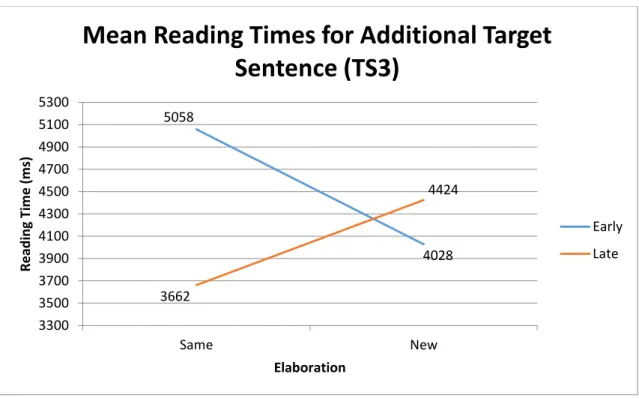
significantly faster reading times (M=3672, SD=2074.) than readers who received the same target sentence with early placement (M=5058, SD= 2704), t(267)=4.73, p=.001. But in contrast, the sixty-five readers who received an elaboration on a new generalization theme with early placement of the target sentence had non-significantly faster reading times (M=4028, SD=2421) than participants who received late placements (M=4425, SD=2381), t(267)=-1.329, p=.42. The additional target sentence displayed the same pattern of interaction as for the second target sentence with just slightly more separation between the early and late placement reading times under the same theme condition. More importantly, the measuring of this additional target sentence served as a confirmation of the same pattern of interaction observed for the second target sentence.
Figure 3. Mean reading times for additional (third) target sentence by elaboration and placement.
5058 4028 3662 4424 3300 3500 3700 3900 4100 4300 4500 4700 4900 5100 5300 Same New R e ad in g Ti m e ( m s) Elaboration
Mean Reading Times for Additional Target
Sentence (TS3)
Early Late
Discussion
The purpose of the current study was to verify readers drew a generalization inference from five supporting examples of text and then examine how factors associated with a resonance process influence the maintenance of a generalization inference held in working memory. One research question was whether or not readers maintain a previously drawn generalization
inference when faced with additional sentences implying a different theme. This was explored by introducing readers to sentences that supported either a same or new generalization theme, after it was verified they also held a consistent generalization inference in working memory. A
second, follow-up research question was whether readers were quicker to comprehend consistent target sentences with a greater number of propositions preceding them when compared to target sentences with a fewer number of propositions proceeding them; specifically, only within the same theme condition. This was explored, specifically, by examining whether there were significant differences in reading times for early and late target sentence placements within the same theme condition.
The hypotheses following these research questions were mostly confirmed by the findings. It was expected that readers should draw the intended generalization inference in the first paragraph; reading times in the same theme condition should continue to decrease with late placement, as more examples supporting the same generalization theme were introduced. The results showed that readers drew the intended generalization inference in the first paragraph, as was demonstrated by significantly quicker reading times for target sentences consistent with the implied generalization theme. Regarding the other predictions, although there was no main effect for elaboration and placement on reading times for the second or additional target sentences, there was confirmation of the significant interaction following from the hypotheses.
Regarding the separate interactions of elaboration and placement for the second and additional target sentence, participants had the longest reading times for early placements of target sentences with a same generalization theme, but had the shortest reading times for late placements with a same generalization theme. As predicted, reading times for target sentences where a story elaborated on a new generalization theme with late placement were on average quicker than a new generalization theme with early placements, but were not statistically different from each other. In fact, the only main effect found for individual conditions was for placement in the same theme condition.
Overall, these results support an interpretation founded in memory based processing theory, which predicts that readers should benefit from greater concept availability (as shown by faster reading times) while continuing to receive propositions supporting the same generalization theme. These ideas are supported by literature showing that readers gain accessibility to
semantically related concepts when similar concepts are mentioned in a text (Myers & O’Brien, 1998; O’Brien, Albrecht, Hakala, & Rizzella, 1995). By allowing readers to draw single
generalization inferences and then providing them with target sentences consistent to the same theme implied before the change, it was possible to see whether the coherence break produced by reintroducing the original theme was affected by factors known to be associated with resonance.
According to previous literature, stronger memory traces are encoded with less effort when there is a common theme that can be elaborated on through various, textual examples (Bradshaw, 1984). The memory based concept of resonance predicts that concepts should become increasingly available in working memory with additional propositions that continue to elaborate on semantically related themes, and increasingly more so for semantic themes closely related to one another. Elaborating on the same theme with early placement produced
significantly quicker reading times than the same theme with late placement. Besides a main effect for placement in the same theme condition, the average reading times for the second and additional target sentence did not show any main effects, but there was one significant
interaction among elaboration and placement for each target sentence.
Because readers had already drawn single generalization inferences before they were introduced to propositions elaborating on a same or new theme, this suggests readers continued to benefit from holding single generalization inferences in working memory, as additional propositions were provided and concept accessibility for the same theme increased. Likewise, readers who received a new theme likely benefited from the generalization inference as well, since reading times for the remaining three conditions were not different from each other. But because the only statistically different condition in terms of its main effect was late placement under the same theme condition, elaborating on a new theme may have still decreased concept availability for the original semantic theme, but it was not observed in the current design. To the contrary, reading times for new theme placements did not significantly differ.
This suggests the benefit of elaboration on examples supporting the same generalization theme continues to facilitate quicker reading times for up to ten semantically related propositions through greater availability for related concepts in working memory. While previous literature has found that target sentences with later placement (I.e., More distant from propositions elaborating on the original theme) tend to produce longer reading times in the context of
resonance, this was contrary to the pattern observed in the current study. But previous literature has also tended to focus on situations most analogous to switching to a new theme condition, for example, where Mary’s ordering of a cheeseburger becomes inconsistent with her previously stated eating habits (Myers, O’Brien, Albrecht, & Mason, 1994). Instead, the current design
introduced an inconsistent theme in one condition and then continued by measuring the effect of target sentences remaining consistent to the original theme. Perhaps one reason why continued elaboration on the same theme continued to facilitate quicker reading times here was because concepts related to the same theme never left working memory in the first place. This suggested the drawing of single generalization inferences are sensitive enough to switching themes that reading times were influenced separately by the elaborated theme and the number of intervening propositions.
There were two important limitations that may have influenced the results. The first was that all of the data (including outliers) were used in the analyses, where the range and variability of this data were far greater than previous research on generalization inferencing. Interestingly, reading times that would have been usually considered outliers in previous research appeared to be an important part of this dataset; the same, positively skewed pattern of outliers was observed in each condition. The second limitation was methodological and pertains to how the conditions were counterbalanced and subsequently analyzed for the second and additional target sentences. The intention of the design was to create a fully within-subjects organization, where each
participant received one of eight text versions with a counterbalanced ordering and each story. In effect, the data were collected in this way, but due to how the design was counter-balanced half of the data were lost when the secondary analyses on elaboration and placement were performed. Thus, the follow-up analyses were performed using between-subjects analyses of variance, instead of repeated measures as the design intended. But because between subjects analyses of variance require a between subjects design, the results pertaining to elaboration and placement should be interpreted with caution.
The current study also does not compare how quickly participants read target sentences in the second paragraph to the first; future research on generalization inferencing should more closely examine the effects of placement while continuing to elaborate on a new generalization theme. This can be accomplished in part by more strictly controlling for the number of words and semantic associations between first and second paragraph target sentences, while either increasing or decreasing the number and relatedness of new generalization. It may also be prudent to examine additional factors known to influence the resonance process, such as writing more targeted stories with less semantic overlap, or writing stories within genres that go beyond expository and factual-driven language to incorporate more causal or narrative-driven language.
Practically speaking, these results encourage the use of multiple, text propositions that continue to elaborate on a same generalization theme and introduce new, semantically related text. It appears that readers use generalization inferences to help facilitate concept availability within working memory, as was shown by significantly quicker reading times for late placements within the same theme condition. Because readers used the increasingly available information from long term memory to make sense of each additional example they received, they were better capable of understanding propositions illustrating the same theme concepts more quickly for up to five additional, consistent examples immediately following.
Should these results replicate, it suggests the potential benefits of elaborating on a same generalization theme is limited in the methodological sense only when later placements of the same theme target sentence are not significantly longer than earlier placements, but this pattern of results was not observed in the current study. These findings should also be encouraging to adult readers who might continue to benefit from even more examples elaborating on a same generalization theme. At least for the several propositions immediately following the drawing of
single generalization inferences, elaborations on the same theme continue to facilitate quicker reading times by helping to maintain single generalization inferences held in working memory.
References
Bradshaw, G. L., & Anderson, J. R. (1982). Elaborative encoding as an explanation of levels of processing. Journal of Verbal Learning and Verbal Behavior, 21, 165-174.
Cook, A. E., Guéraud, S., Was, C., & O’Brien, E. J. (2007). Foregrounding effects during reading, revisited. Discourse Processes, 44, 91-111.
Cook, A. E. (2014). Processing anomalous anaphors. Memory and Cognition, 42, 1171-1185. Gerrig, R., & McKoon, G. (1998). The readiness is all: The functionality of memory-based text
processing. Discourse Processes, 26, 67-86.
Graesser, A. C., Singer, M., & Trabasso, T. (1994). Constructing inferences during narrative text comprehension. Psychological Review, 101, 371-395.
Guindon, R., & Kintsch, W. (1984). Priming macropropositions: Evidence for the primacy of macropropositions in the memory of text. Journal of Verbal Learning and Verbal Behavior, 23, 508-518.
Just, M. A., & Carpenter, P. (1992). A capacity theory of comprehension: Individual differences in working memory. Psychological Review, 99, 122-149.
Kendeou, P., Smith, E. R., & O’Brien, E. (2013). Updating during reading comprehension: Why causality matters. Journal of Experimental Psychology, 39, 854-865.
Kintsch, W., & van Dijk, T. A. (1978). Toward a model of text comprehension and production. Psychological Review, 85, 363-394.
Kintsch, W. (1988). The role of knowledge in discourse comprehension: A construction-integration model. Psychological Review, 95, 163-182.
Kintsch, W. (1994). Text comprehension, memory, and learning. American Psychologist, 49, 294-303.
Lea, R. B., Mulligan, E. J., & Walton, J. L. (2005). Accessing distant premise information: How memory feeds reasoning. Journal of Experimental Psychology, 31, 387-395.
Maltese, A., Pepi, A., & Scifo, L. (2012). The relationship between inferential processing and text processing: A developmental study. Problems of Psychology in the 21st Century, 2, 21-29.
McKoon, G., & Ratcliff, R. (1989). Semantic Associations and Elaborative Inference. Journal of Experimental Psychology, 15, 326-338.
Myers, J. L., O’Brien, E. J., Albrecht, J. E., & Mason, R. A. (1994). Maintaining global coherence during reading. Journal of Experimental Psychology, 20, 876-886.
Myers, J. L., & O’Brien, E. J. (1998). Accessing the discourse representation during reading. Discourse Processes, 26, 131-157.
O’Brien, E. J., & Myers, J. L. (1987). The role of causal connections in the retrieval of text. Memory & Cognition, 15, 419-427.
O’Brien, E. J., Plewes, P. S., & Albrecht, J. E. (1990). Antecedent retrieval process. Journal of Experimental Psychology, 16, 241-249.
O’Brien, E. J., Albrecht, J. E., Hakala, C. M., & Rizzella, M. L. (1995). Activation and suppression of antecedents during reinstatement. Journal of Experimental Psychology, 21, 626-634.
O’Brien, E. J., Rizzella, M. L., Albrecht, J. E., & Halleran, J. G. (1998). Updating a situation model: A memory-based text processing view. Journal of Experimental Psychology, 24, 1200-1210.
Ritchey, K. A. (2011). How generalization inferences are constructed in expository text comprehension. Contemporary Educational Psychology, 36, 280-288.
Ritchey, K.A., Barnes, Z., Suryanaryan, A., & Donaldson, L. (2013). The effects of text genre on drawing inferences. Poster presented at the annual meeting of the Midwestern
Psychological Association, Chicago, IL.
Ritchey, K.A., & Suryanarayan, A. (2015). Using a deductive reasoning task to facilitate generalization inference construction.Paper presented at the annual meeting of the Society for Text and Discourse, Minneapolis, MN.
Stanovich, K. E., & West, R. F. (1989). Exposure to print and orthographic processing. Reading Research Quarterly, 24, 402-433.
van Dijk, T. A. (1980). Macrostructures: An interdisciplinary study of global structures in discourse, interaction, and cognition. Hillsdale, NJ: Lawrence Erlbaum Associates
Appendix A - “Precious Gems”
Introductory and Filler Paragraph:
Whether they just admire the gems or are serious collectors, most people know something about precious gems. Some people become so interested in precious gems they study
metalworking and design their own jewelry. More people than just jewelers can be
knowledgeable about gemstones. Finding and appraising gems can be easy once one is taught what to look for. One aspect of identifying a quality gemstone is the clarity of the stone. Clarity refers to how clear the stone is, and whether it is free of cloudy spots. The cut of a stone also helps determine its value; with unusual cuts such as heart or star shapes increasing a stone’s value over more common cuts such as round or square.
First Paragraph:
Turquoise is a blue-green stone that can be found in some areas of Arizona. San Diego is known for its source of pink tourmaline, another type of gemstone. Topaz stones are found all over Colorado. Tennessee is one of the country’s best sources of pearls, mined from the freshwater mussels found there. Malachite is a shiny black or gray stone that is common in Alaska. TS1: Dark rubies are mined on Washington’s western shore (Inconsistent: Ruby is the birthstone for the month of July).
(Example) - Same Theme Second Paragraph:
There is still a lot to be learned about precious gems. Aquamarine is a sea-blue stone that can be found in various locations throughout the state of Maine. Coal mines in Arkansas produce a mixture of clear and opaque diamonds. Amethyst is a brilliant gemstone commonly discovered in North Carolina. Colorado contains one of the largest reserves of lapis lazuli in the world. TS2: One of Montana’s most elegant stones is a blue-violet colored sapphire. AS2: Black garnet
feels smooth to the touch and is found in California. (Example) - New Theme Second Paragraph:
There is still a lot to be learned about precious gems. Aquamarine is a sea-blue stone said to be a symbol of youth, hope, and fidelity. Jasper stones are known to stir inner-feelings of passion and warmth. Some believe the soul can be made pure by lapis lazuli stones that ward off bad spirits. Diamonds are opaque white or clear stones that often signify eternal love when given to other people. TS2: One of Montana’s most elegant stones is a blue-violet colored sapphire. AS2: Black garnet feels smooth to the touch and is found in California.
Appendix C - Demographic Questions
1. What is your gender?
___ Male ___ Female ___ Transgender ___ Other
2. What is your age? ___________
3. What is your class standing?
___ Freshman ___ Sophomore ___ Junior ___ Senior ___ Other
4. Which racial or ethnic category do you most closely identify yourself as?
___ Black/African American ____ Hispanic/Latino/a ___ Native/Indigenous American
___ Asian/Pacific Islander ___ White/American European/Caucasian
___Multiracial ___ Other (Please specify) ________________
5. Is English your first language? ___ Yes ___ No
Appendix D - Author Recognition Test
Below is a list of 150 names. Some of the names are names of real authors, and some of the names are made-up; they are not real people. Please circle each name that you believe is a real author. Try to identify as many real authors as possible while avoiding the fake ones.
V.C. Andrews Carter Anvari Isaac Asimov Margaret Atwood Jean M. Auel Margaret Azmitia Russell Banks David Baldacci Oscar Barbarian Reuben Baron Christopher Barr Gary Beauchamp Lauren Benjamin Carol Berg Pierre Berton Thomas Bever Brian Bigelow Maeve Binchy Elliot Blass Judy Blume Dale Blyth Harrison Boldt Hilda Borko Dan Brown Jennifer Butterworth Katherine Carpenter Barbara Cartland Devon Chang Agatha Christie Noam Chomsky Naomi Choy Wayson Choy Tom Clancy Arthur C. Clarke Suzanne Clarkson James Clavell Jackie Collins Charles Condie Julia Connerty John Condry Stephen Coonts Edward Cornell Patricia Cornwell Carl Corter Diane Cuneo Denise Daniels Geraldine Dawson Robertson Davies Aimee Dorr W. Patrick Dickson Robert Emergy Jeffery Eugenides Janet Evanovich Frances Fincham Timothy Findley Martin Ford Robert Fulghum
Diana Gabaldon Hank Gardner Elizabeth George Ryan Gilbertson Stephen J. Gould Sue Grafton Sheryl Green Andrew Greeley Frank Gresham Carla Grinton John Grisham Alex Haley Frank Herbert S.E. Hinton Lilly Jack John Jakes Lena Johns Erica Jong Wayne Johnston Robert Jordan Kirby Kavanaugh Frank Kiel Laurie King Stephen King Stirling King Naomi Klein Sophie Kinsella Dean Koontz Susan Kormer Judith Krantz Louis L’Amour Reed Larson Margaret Laurence Ursula LeGuin Pricilla Levy C.S. Lewis Lynn Liben Caleb Lim Robert Ludlum Alex Lumsden Hugh Lytton Frank Manis George R.R. Martin Sophia Martin Jennifer Marshal Morton Mendelson Rohinton Mistry Anne Marie McDonald James Michener Christopher Moore Michael Moore James Morgan Ryan Morris Ryan Morris Alice Munro Samuel Paige Scott Paris Richard Passman M. Scott Peck David Perry Kate Pullinger Daniel Quinn Anne Rice Mordecai Richler Peter Rigg Robert J. Sawyer K. Warner Schaie Miriam Sexton Carol Shields
Sidney Sheldon Bobby Siegler David Singer Danielle Steel Mark Strauss Amy Tan Janice Taught Miram Toews Tracy Tomes Alvin Toffler J.R.R. Tolkien Penny Vincenzi Alice Walker Joseph Wambaugh Nicole Waugh Noah Whittington Ava Wight Bob Woodward Allister Younger Steve Yussen Paul Zindel