R E S E A R C H
Open Access
A context-aware framework for dynamic
composition of process fragments in the
internet of services
Antonio Bucchiarone
*, Annapaola Marconi, Marco Pistore and Heorhi Raik
Abstract
In the last decade, many approaches to automated service composition have been proposed. However, most of them do not fully exploit the opportunities offered by the Internet of Services (IoS). In this article, we focus on the dynamicity of the execution environment, that is, any change occurring at run-time that might affect the system, such as changes in service availability, service behavior, or characteristics of the execution context. We indicate that any IoS-based application strongly requires a composition framework that supports for the automation of all the phases of the composition life cycle, from requirements derivation, to synthesis, deployment and execution. Our solution to this ambitious problem is an AI planning-based composition framework that features abstract composition requirements and context-awareness. In the proposed approach most human-dependent tasks can be accomplished at design time and the few human intervention required at run time do not affect the system execution. To demonstrate our approach in action and evaluate it, we exploit the ASTRO-CAptEvo framework, simulating the operation of a fully automated IoS-based car logistics scenario in the Bremerhaven harbor.
Keywords: Internet of services, Dynamic service composition, Process fragment, Context-aware, AI planning
1 Introduction
Service composition is one of the cornerstone technolo-gies within service-oriented computing. It consists in reusing existing services as building blocks for new ser-vices (applications) with higher-level functionality. Ser-vice composition allows for extremely rapid software development and high re-usability of development results. Despite all the advantages service composition brings to software engineers, when performed manually, it is still a very complex, time-consuming and error-prone task. The point is that composition requirements and service speci-fications usually contain numerous easy-to-miss technical details that have to be properly reflected in the compo-sition. This becomes critical when composition has to be exploited incomplex and dynamicapplication domains, requiring frequent revision of providers (i.e., component services), changes in existing offered functionalities (i.e. component services behavior), and adjustment of business policies and objectives (i.e., composition requirements).
*Correspondence: [email protected]
Fondazione Bruno Kessler, Via Sommarive, 18, 38123 Trento, Italy
This is the case for IoS-based application domains, where the execution environment is so dynamic, that service composition is considered to be a kind of every-minute routine activity.
We can mention at least two important examples of such IoS-based domains. The first one are pervasive systems, which are mobile systems operating in close connection with their context. Once service composition is exploited in this setting, it has to be flexibly and quickly adapted to the rapidly changing environment. For instance, let us imagine there is a car that has to regularly perform some activity implemented through composition of surround-ing near-field communication services (e.g., car parksurround-ing assisted by various parking services). Depending on the current surrounding environment (i.e., on the set of avail-able services and on the context state) the solution compo-sition, though targeting conceptually the same objective, will always be different. If the procedure is repeated fre-quently at different locations, we have to produce new compositions again and again. Another example are user-centric systems, whose operation evolves around the needs and constraints of a specific user. For instance, it could
be a mobile application that allows the user to inte-grate (compose) multiple mobile services (local phone services, Internet services, near-field communication ser-vices, etc..) and execute them consistently. In this case, the choice of services and composition objectives are determined by user’s environment and personal prefer-ences/constraints/goals.
It is quite clear that predefined solutions are not going to work in these IoS-based systems. Indeed, each compo-sition heavily depends on the run-time parameters of the execution environment, namely, current execution con-text, set of available services, concrete user’s needs, etc. Since these parameters are not predictable at design time (sometimes we may not even know which services will be available at the time of composition), it is impossible to produce reliable solutions a priori. In order to address this problem we need adynamic composition frameworkthat would automate the whole service composition life-cycle, from requirements derivation, to composition generation, to deployment and execution [1, 2].
Another important aspect that directly follows from system dynamicity iscontext-aware composition and exe-cution. Services are often closely connected to the context in which they are executed (e.g., a parking web service exe-cution may depend on the type of a car to be parked, on space availability, weather, etc.). In turn, the context tends to be volatile, i.e. exogenous events may change the con-text state and thus affect composition execution. In this setting, to be able to produce compositions that are con-sistent with the surrounding context it is important to have a context-aware service model that reflects contex-tual characteristics of services. This information has to be taken into account in service composition, thus enabling more robust solutions. It is worth to notice that the prob-lem of context-awareness of service composition has not yet received enough attention from the scientific com-munity and only very few works are currently available on the topic [3–5]. Many existing approaches to service composition suffer from over simplification, both for what concerns the service model (e.g., services are often con-sidered as atomic synchronous operations) and compo-sition requirements (e.g., requirements languages do not reflect real-world composition needs). As a result, these solutions can only be applied to very limited set of com-position problems. At the same time, a few approaches demonstrate more maturity in addressing these aspects.
In this article, for the first time, we present a com-prehensive framework, and its implementation, for auto-mated service composition that is specifically designed to be used in dynamic execution environments and allows for context-aware service composition and execution.
In very general terms, the idea consists in organizing the composition life cycle in a such a way that most human activities can be accomplished at design time.
As a consequence, run-time composition management, from the derivation of composition requirements to the composition synthesis to the deployment of executable processes, is completely automated. Moreover, when-ever human involvement is required at run-time (e.g., plugging-in a new service into the system), the change is automatically dealt by the framework, without affect-ing the system execution. In addition to that, our com-position framework features explicit context model that is used to express various contextual characteristics of services. Later, these characteristics can be taken into account in automated reasoning so that context-aware ser-vice compositions are produced. The approach exploits AI planning techniques that can deal with realistic service models (asynchronous, stateful and nondeterministic ser-vices) and allows for rich control- and data-flow require-ments1. This makes it powerful enough to be used in real service-based systems, including those mentioned above. The demonstration is given also by its usage, as a core component, in different previous works to support the incremental refinement and adaptation of context-aware service based systems [6–8].
In the article, as composable components we useprocess fragments(or simply fragments). Fragments [9] are a way to represent reusable process knowledge in service com-positions and encode elementary subprocesses that can be used as constructing blocks for more complex processes. Process fragments are also a very effective mean to model stateful and asynchronous services [10].
The rest of the article is structured as follows. In Section 2, we present the Car Logistics scenario used as a reference throughout the article and explain the challenges it poses to service composition. In Section 3, we present our composition framework, formally defin-ing all the concepts and models used for context-aware dynamic service composition and show how the compo-sition problem is solved through AI planning techniques. The experimental validation of the approach can be found in Section 4 where we have used the implementation of the Car Logistics scenario to demonstrate our approach in action and evaluate its performance and scalability. Finally, we conclude the article with related work survey (Section 5) and conclusions (Section 7).
2 Motivating scenario and research challenges
In this Section we introduce the car logistics scenario that helps understanding the problem we want to solve and the research challenges that it poses.
2.1 Car logistics scenario
by ships in order to further deliver them to retailers. The delivery process for each car (see Fig. 1) includes a number of steps to be accomplished. Cars arrive by ship and each ship is able to approach and leave a gate interacting with the landing manager, which is in charge of coordinating and controlling the landing procedure for all the ships in the port. Then cars are unloaded and unpacked at one of the terminals. Once a car is unpacked, it has to be moved to one of the storage areas: the chosen area depends on the car type/brand and on the availability of parking spaces; different storage areas have different parking procedures that need to be followed. The car remains at the storage area until it is ordered by a retailer. Once a car stored is ordered, it continues its way towards the delivery. In par-ticular, the car is treated at dedicated treatment areas (e. g., washing, painting, equipment) according to the details of the order and the car brand/model. When a car is ready to be delivered it is moved to the assigned delivery gate, where it is loaded onto a truck and eventually delivered to the retailer. It is important that every step in the chain is customizable according to the car brand, model, retailer requirements, etc. This means different cars may utilize different procedures to accomplish the same task.
These procedures are partially automated and exploit digital services as well as sensors and smart manufac-turing equipment [11]. We tried to move this scenario a little further to fully capture the opportunities offered by paradigms such as IoS and IoT, yet keeping its current needs, regulations and practices. Our goal was to develop a service-based system that supports the synergistic coop-eration of the numerous actors (i. e., cars, ships, trucks, treatment areas, parking facilities, drivers, etc.) allow-ing them to follow their current procedures and business policies. The CLS scenario presents several example of dinamicity that we list in the following.
• Customization. The system should consider the customization of each car procedure. It means that different brands and models of cars in a similar but customizable way according to the specific order and context (e.g., facility in which they are treated). • Openness. The system should be able to easily
integrate new actors and services at run-time. This
happens, for example, when new car models, having specific requirements and procedures, is handled at the seaport, when a new truck/ship company comes into play, as well as whenever there is a new functionality provided by the sensors and machineries used in the different port facilities. • Flexibility. The system needs to flexibly deal with
changes in the procedures and business policies of all the actors such as ships (e.g., changes in approaching procedure), trucks (e.g., changes in delivery
procedure), port facilities (e.g., update in a parking service or in a certain procedure supported by a machinery in a treatment facility).
• Context-awareness. The system needs to deal with situations where contextual changes invalidate some choices made before. For example, if a car books a space at some storage area and upon arrival realizes that the facility is not available, it needs to rearrange the things so that it can be stored at a different facility.
2.2 Research challenges
In the previous section, we gave an example of a sys-tem where dynamic composition techniques are strongly required. As a result, it is hardly affordable to involve human experts to participate in resolving composition problems on-line. This essentially means that all the com-position steps, from abstract requirements’ specification, to service discovery and composition, to service deploy-ment, must be automated.
This challenge is hardly coped with by the existing position techniques. In general, every automated com-position engine follows the scheme shown in Fig. 2. As input, it takes specifications ofsoftware componentsand composition requirementsand, as output, it produces an executable process.
The major problem of most existing composition tools is that they assume that the set of services to be com-posed is always known to the designer at the moment of specifying composition requirements. Consequently, it is assumed that composition requirements may include implementation-specific details of services that they are supposed to be used with. As such, requirements become linked to particular service implementation and cannot
Fig. 2State of the art on automated behavior-oriented composition framework. General scheme for automated service composition engine
further be used with conceptually similar services that are implemented differently (e.g., when we would like to use a new ticket booking service in place of the one for which the requirements were originally created). In dynamic sys-tems this causes an important problem: while the list of available service is dynamic and can only be discovered at run time, the composition requirements are fixed at design time. Consequently, we need to understand how to create a composition architecture that allows design-time requirements to be consistently used with an arbitrary set of services discovered at run time with no human intervention(Challenge 1).
Another problem concerns context-awareness. In sev-eral cases, process execution is tightly connected to the context. When numerous services are available,it is crit-ical to select correct services and produce a composition that is valid for the given context model and for the current state of this model(Challenge 2).
Finally, we need to recall that composable components may be quite complex and may feature 1) statefulness (complex protocol), 2) non-determinism and 3) asyn-chronous communication. As a result, the composition architecture has to rely on a service model that reflects these properties of real services(Challenge 3).
3 Dynamic service composition framework
In this section we present our framework for modeling dynamic context-aware systems such as the CLS scenario described in Section 2.
3.1 System model
The system operation is modeled through a set ofentities (e.g., cars, ships, storage managers, etc..), each specify-ing its behavior through a process, as depicted in Fig. 3. Unlike traditional system specifications, where processes are static descriptions of the expected run-time operation,
our approach allows to define dynamic processes that are refined at run time according to the features offered by the system.
Processes are designed in Adaptable Pervasive Flows Language, (APFL) [12, 13], an extension of traditional workflow languages (e.g., BPEL [14]2), which makes them suitable for adaptation and execution in dynamic environ-ments. Unlike traditional processes, where their behaviors are completely specified, our approach allows the partial specification throughabstract activitiesthat can be spe-cialized at run-time according to the services offered by the other entites in the system.
Abstract activities (e.g.,Storeof theCarentity process in Fig. 3) corresponds to tasks that are hard to imple-ment at design time, since they strongly depend on the concrete run-time state (context configuration, availabil-ity of services provided by other entities etc.). In our approach, each abstract activity is dynamically replaced (refined) with a fragment composition realizing the corre-sponding task. As a result, a design-time specification of a process can be quite abstract, with many concrete details being refined only at run time, when the actual execution context is clear.
In addition to the classical workflow language con-structs (e.g., input, output, data manipulation activities, complex control flow constructs), APFL adds the possibil-ity to relate the process execution to the system context by annotating activities with preconditions and effects. Preconditions constrain the activity execution to specific context configurations, and in our framework are used to catch violations in the expected behavior and trigger run-time adaptation.
The underline idea is that entities can join the system dynamically, publish their functionalities through a set of process fragments that can be used by other entities to interoperate, discover fragments offered by the other entities, and use them to automatically refine their own processes.
For instance, within the CLS, whenever acarmust be stored, it discovers the fragments provided by theStorage Managerand by the associatedStorage Area(A, B, or C in Fig. 3). These fragments model the harbor-specific proce-dures and regulations that the car should execute for the storing. Different fragments may be provided by the stor-age manstor-ager and by the different storstor-age areas to be used by certain types of car.
In our framework, we use a unified model for both frag-ments and fragment-based processes, and uniformly use the term offragmentfor both of them. We model frag-ments as labelled transition systems (LTS) (as depicted in Figs. 5 and 6) where transitions are labelled with two dif-ferent types of actions : controllableanduncontrollable. Controllable actions are used to model process activities that can be triggered by the process itself (e. g., variable
assignment, message send). Uncontrollable actions model activities whose execution depends on external actors (e. g., message receive, event notification). The distinction between controllable and uncontrollable actions is cru-cial for proper handling of the asynchronicity of fragment behaviour in composition. Here and later in the text we denote with ‘!’ and ‘?’ controllable and uncontrollable frag-ment actions respectively. The fragfrag-ment LTS is formally defined as follows:
Definition 1(Fragment)A fragment is a deterministic state transition system f = S,s0,I,O,R, where
• Sis the set of states ands0⊆Sis the initial state;
• IandOare sets of controllable and uncontrollable actions such thatI∩O= ∅;
• R⊆S× {I∪O} ×Sis a transition relation.
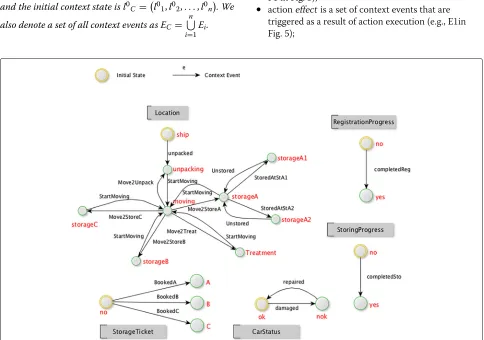
Another important feature of the proposed framework is the possibility of leaving the handling of extraordi-nary/improbable situations to run time instead of ana-lyzing all the extraordinary situations at design time and embedding the corresponding recovery activities in the process. This kind of modeling extremely simplifies the specification of processes that have to operate in dynamic environments, since the developer does not need to think about and specify all the possible alternatives to deal with specific situations (e.g., context changes, availabil-ity of functionalities, improbable events). These dynamic features offered by the framework rely on a shared con-text model, describing the operational environment of the system. The context is defined through a set of context properties, each describing a particular aspect of the sys-tem domain (e.g., current location of a car, status of a car, availability of a storage area). A context property may evolve as an effect of the execution of a fragment activity, which corresponds to the normal behavior of the domain (e.g., current location of car is storage area A), but also as a result of exogenous changes (e.g., car status is damaged, storage area unavailable).
The aim of context properties is to model those aspects of the context that are relevant for dynamic fragments’ composition. Their intent is not to provide a comprehen-sive and detailed representation of the properties and state of the execution environment. Rather, they are an abstrac-tion of the context, capturing only key domain concepts (e.g., car, ship, storage area) and their evolution. These information are used to reason on how fragments execu-tion (precondiexecu-tions/effects) is related to and affects the context state.
Definition 2(Context Property) A context property is a state transition system p= L,l0,E,T, where:
• Lis a set of context states andl0∈Lis the initial state; • Eis a set of context property events;
• T ⊆L×E×Lis a transition relation.
Examples of context properties (of a car) are shown in Fig. 4. It includes a complexLocationproperty reflect-ing current car location and, two of progress trackreflect-ing properties (RegistrationProgress,StoringProgress).
Considering a context model containing more than one context property, we require that such context proper-ties feature mutually disjoint sets of context events, so that evolutions of different context properties within the same context do not correlate explicitly. Formally,context is defined as follows:
Definition 3(Context)A context is a set of context prop-erties C = {p1,p2,. . .,pn}such that if pi =
Li,l0i,Ei,Ti
for all i ∈[1,n]then for any two constituent context prop-erties pi,pj∈C sets of events do not intersect (i.e., Ei∩Ej= ∅). The set of all context states is defined as LC =
n i=1
Li
and the initial context state is l0C =
l01,l02,. . .,l0n
. We
also denote a set of all context events as EC = n i=1
Ei.
In order to be able to succinctly specify groups of con-text states we usecontext formulaswhich are disjunctions of conjunctions over states of context properties:
Definition 4(Context Formula) Let C={p1,p2,. . .,pn} be a context such that pk=Lk,l0
k,Ek,Tk
for all k∈[1,n]. A state formula for C is a propositional formula
i j lij,
where lij ∈ n k=1
Lk and for any two constituent context
properties pi,pj ∈ C sets of states do not intersect (i.e., Li∩Lj= ∅).
The space of all context formulas of contextCis denoted asRC.
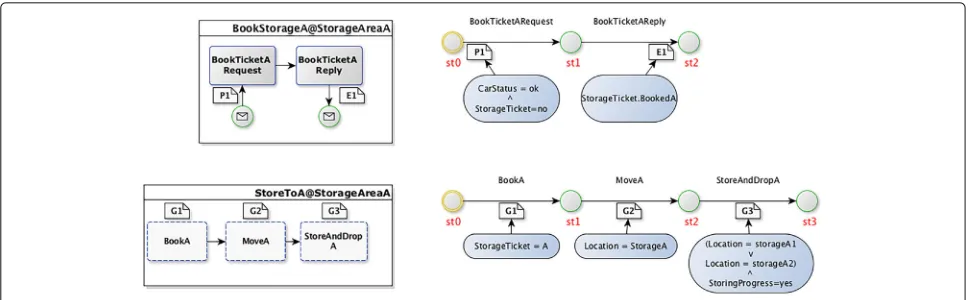
In order to make fragments context-aware, we introduce context annotations of actions in fragments. Annotations intensively exploit the notion of context formulas, and can be of three types:
• actionprecondition is a context formula indicating in which context states action execution is allowed (e.g., P1 in Fig. 5);
• actioneffect is a set of context events that are triggered as a result of action execution (e.g., E1in Fig. 5);
Fig. 5Fragment annotations. Example of fragment annotations (goals, preconditions and effects)
• actiongoal is a context formula specifying the condition that must hold after the action is executed (e.g., G1, G2 and G3 in Fig. 5).
Any process action can be annotated with a precondi-tion. Since both effects and goals express the contextual intention of an action, we explicitly require that an action can be annotated either with a goal (if it is an abstract activity) or with an effect (for all other activities). Formally, fragment annotationis defined as follows:
Definition 5(Fragment Annotation) Let f=S,s0,I,O,R be a fragment and let C be a context. An annotation of fragment f over context C is a tupleω= P,E,G, where:
• P:{I∪O} →RCis the precondition labeling function;
• E:{I∪O} →ECis the effect labeling function. • Any action effectE(a)may contain no more than one
event per context property; For any context property p= L,l0,E,T ∈Cthe following holds:
∃e1,e2∈E(a):e1,e2∈E.
• IfE(a)= ∅thenG(a)= ∅(i.e., an action can be annotated either with a goal or with an effect); • G:{I∪O} →RC is the goal labeling function, such
thatG(a)= ∅only ifE(a)= ∅(i.e., an action can be annotated either with a goal or with an effect).
In Fig. 5 we show two fragments (e.g.,BookStorageAand StoreToA), both provided by Storage Area Aentity. The examples include all types of annotations. The annota-tions, in turn, are related to the context property exam-ples in Fig. 4. For instance, BookStorageA includes two activities (request and reply). The request activity is annotated with a precondition that guards that ticket booking is executed only in the absence of a ticket. The effect of the reply activity indicates that this fragment eventually brings a ticket object to state A, thus pro-viding ticket booking.StoreToAfragment specifies the
storing procedure for storage area A. This includes three abstract activities annotated with goals in terms of context model.
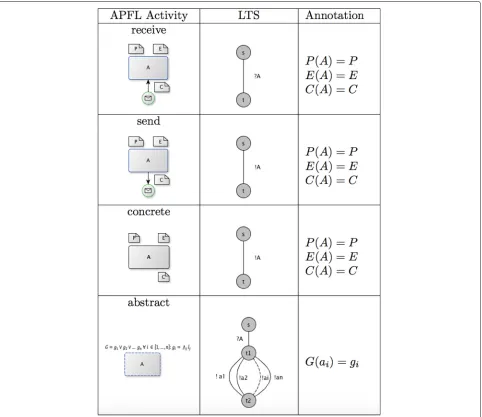
In the following we present the synopsis of our APFL language with annotations and the details of how an annotated APFL process can be transformed into an anno-tated LTS as defined in Def. 5. Since both fragments and processes are defined in the same language, the trans-lations below are valid for both of them. In Fig. 6 the translation for basic activities is shown. Specifically,SEND
and CONCRETE are represented with a single control-lable transition, whileRECEIVEis a single uncontrollable transition.
ABSTRACTactivities are way more complex since at the moment of creating a new process they are not refined to a concrete process and the only thing we know about them is their abstract goals. We treat an abstract activity as a "black box" that performs a task as defined by its goal. In this regard, an abstract activity combines the properties of controllable and uncontrollable actions. On the one hand, the initiation of an abstract activity is controllable (within a process we can decide if to execute it and when). On the other hand, it is not possible to predict a priori the ter-minal context configuration. In LTS, such behaviour can be modeled as a controllable action followed by a num-ber of uncontrollable actions corresponding to all possible terminal context states. We actually reduce the number of terminal states to the number of conjunctive clauses in the goal formula4.
3.2 Fragment composition model
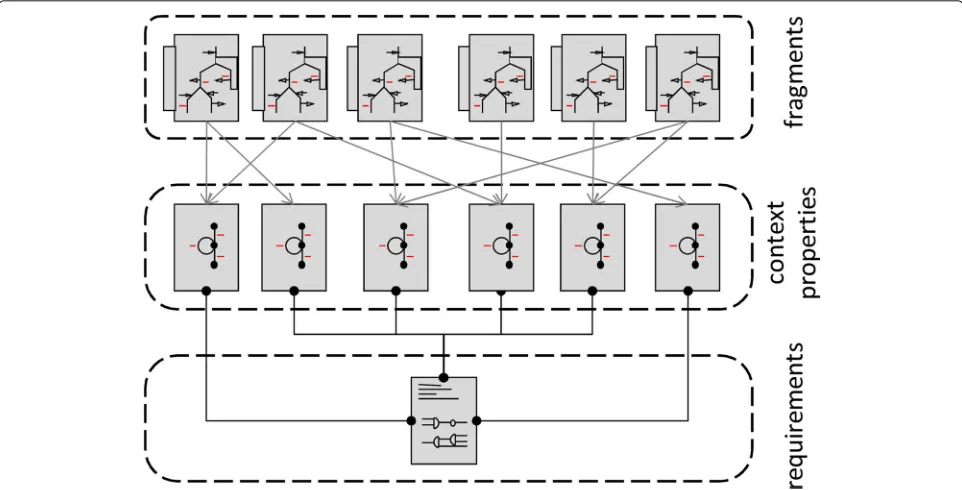
The central idea of our framework for fragment composi-tion can be captured from Fig. 7. The explicit model of the execution context in the center of the figure, is a collection ofcontext properties.
Fig. 6Translation of basic APFL activities into LTSs. Synopsis of our APFL language with annotations and the details of how an annotated APFL process can be transformed into an annotated LTS
To link fragments to context properties, we annotate the former with context-related information (as Defined in Def. 5 and depicted in Fig. 8). In this way, we explicitly connect the execution of fragment activities to states and transitions of context properties. In particular, a fragment activity may be annotated with effect and precondition. The effect shows which events this activity triggers once executed, while the precondition shows in which contex-tual states the execution of the activity is allowed.
Moreover, every abstract activity has agoalassociated. Such goal specifies a context state(s) to be reached as a result of activity refinement and execution (e.g., if the StorageTicket is initially in stateno, the goal ofBookA
activity in Fig. 3 may be to have this context property in stateA).
Fig. 7Fragment composition model. Elements and their relations of the fragment composition approach proposed
The ability to specify composition requirements on context properties makes it possible to efficiently use our approach in extremely dynamic environments, where both the set of available fragments and the execution con-text are constantly changing. At design time, the require-ments are defined only conceptually (with no adherence to any particular set of fragments). Despite we do not know a priori the set of fragment, through annotation-based grounding, the conceptual requirements can always be restated for the actual (dynamically discovered) set of fragments. As such, we automate one of the most criti-cal steps in service composition: run-time derivation of composition requirements.
It is worth to notice that in this way it becomes much easier to introduce new fragments to a scenario at run time: it is enough that new fragments are properly anno-tated, while it is not necessary to change the context model
nor composition requirements5. As we will show in the next Section, once context properties and composition requirements are specified and component fragments are properly annotated, the whole set of specifications can be converted into a planning problem which is then resolved using planning algorithms. The obtained plan encodes a process that, if executed from the current context state, brings the system to one of the goal context configura-tions. The plan is further translated into an executable APFL process.
3.3 Fragment composition via planning
The overview of our fragment composition approach is given in Fig. 9. The composition engine accepts as input a context C represented by context properties p1,p2,. . .,pm, a set of fragmentsF+ =
f1+,f2+,. . .,fn+ annotated over C (together C and F+ form a
Fig. 9Fragment composition approach. Overview of our fragment composition approach
aware system = F+,C) and composition require-ments ρ expressed as a context formula over C. The output is an executor E that is a consistent solution executor forandρ.
The focus of this article is to extensively present the ser-vice composition approach under the assumption that the set of eligible fragments for a specific composition prob-lem has been already identified at the time of the compo-sition. The selection of relevant fragments but also their reuse in similar composition problems is a very relevant aspect to make the composition approach more scalable.
Our implementation includes this optimization compo-nent and the complete formalization has been already presented in [8]. In it, we have defined a way to reduce the complexity of a planning problem (for a specific com-position) by minimizing the search space according to the specific execution context, and reusing solutions (i.e., selected fragments) by learning from past executions. To select the relevant fragments in a specific context, QoS-aware service selection approaches as [15] can be also used. Another important aspect to highlight is that the composition approach proposed can be used not only
to reach a specific goal of a certainabstract activity but also to repair or recompose broken service compositions [16, 17], as a reaction to context changes (i.e., precondition violations or service unavailability).
The very general idea of the approach consists in build-ing a plannbuild-ing domain CF, that together with goal ρ form a planing problem. While, the resolution of a specific planning problem is carried out by an existing algorithm planning [18], the novel part of this article is the defini-tion and the formalizadefini-tion of a composidefini-tion problem that takes into account the system context at a specific exe-cution time. To make it possible, the execution domain F is built as asynchronous product of fragments F+. We assume that fragments within a single context-aware system have uncorrelated actions, i.e., such fragments have mutually disjoint sets of actions. In order to encode all possible parallel executions of fragments for some context-aware system we introduce the notion of execu-tion domain, which is a parallel (asynchronous) product of fragments:
Definition 6(Execution Domain)Let f1 = S1,s01,I1,
O1,R1and f2=
S2,s02,I2,O2,R2
be two observable state transition systems such that(I1∪O1)∩(I2∪O2) = ∅.
An execution domainF for fragments F = {f1,f2}is an
asynchronous product of two fragments:
F =
S1×S2,
s01,s02
,I1∪I2,O1∪O2,RF
where:
(s1,s2),a,
s1,s2
∈RF,if
s1,a,s1
∈R1
(s1,s2),a,
s1,s2
∈RF,if
s2,a,s2
∈R2
RF = {R1||R2}
Using fragment annotations (ω1,ω2,. . .,ωn) extracted
byA-EXTRACTOR, context properties are grounded on
fragment actions by GROUNDER so that the grounded context propertiesp1,p2,. . .,pmare produced.
The grounding procedure, consists in replacing event-labeled transitions in context properties with action-labeled transition, which allows us to reflect the impact of fragment actions on the property state. Additionally, we use transition guards to reflect the executability of actions. As a result, the grounded context property features the same set of states as the orginal context property, but has different transition relation:
Definition 7 (Grounded Context Property)Let = F+,Cbe a context-aware system and let RC be a space of context formulas of context C. A grounded context prop-erty for context propprop-erty p= L,l0,E,Tis a tuplep = L,l0,AF,Tg, where:
• Lis a set of states andl0∈Lis the initial state;
• AFis a set of all fragment actions of fragmentsF+; • Tg⊆L×RC×AF×Lis a guarded transition relation.
The grounding procedure consists in defining a grounded context propertyp on top of a context prop-ertyp. While the sets of states inpandpare the same, inp the event-based transitions ofpare replaced with action-based transitions as indicated by annotations. For each transition of p labelled with event e and for each action awhose effect contains e, we define a transition in p with the same initial and final state and labelled witha. For each goal-labeled actionaabs, if an action goal (which is a conjunctive clause) requires that this property has to be in a particular statel(i.e., a proposition corre-sponding tolappears in the conjunctive clause expressing the goal ofaabs), for every state in p we add a transi-tion that starts in this state, terminates inland is labelled withaabs. Finally, for each actionalessthat has no impact on the property and for each state inpwe define a tran-sition that starts and finishes in this state and is labelled with aless. As such, we reflect the impact of all actions with respect to context propertyp. In order to take into account action preconditions, for each transition we intro-duce the guard, which is a precondition formula of its labelling action. A transition guard must be interpreted as a condition on the state of the whole context for which the transition is enabled. Formally:
Definition 8 (Grounding)Let = F+,C be a context-aware system. A grounding of a context property p = L,l0,E,T ∈ C is a grounded context property p= L,l0,AF,Tgsuch that for every action a∈AF:
1. if∃e∈E(a):e∈Ethen for every transition
(l,e,l)∈Tthere exists transition(l,P(a),a,l)∈Tg; 2. if statelg ∈Lappears in conjunctive clauseG(a)
then for every statel∈T there exists transition (l,P(a),a,lg)∈Tg;
3. ifE(a)= ∅∧G(a)= ∅or(E(a)= ∅)∧(E(a)∩E= ∅) or(G(a)= ∅)∧( ∃lg∈L:lg∈G(a))then for every statel∈Lthere exists a transition(l,P(a),a,l)∈Tg; 4. no other states and transitions belong top.
Since action effect contains no more than one event per context property, and since a goal conjunctive clause can-not contain more than one state per context property, the grounded context property is a deterministic LTS (only one transition with the same label is possible from each state).
properties. We remark that the guards in the synchronous product can be removed. Indeed, for any guarded transi-tion we can unambiguously figure out if the initial state of a transition satisfies the guard. Consequently, if the ini-tial state satisfies the guard it is always ’unlocked’ and we can replace it with the unguarded transition with the same properties, and if the initial state does not satisfy the guard it is always ‘locked’ and can be removed from the transition relation. Formally:
Definition 9(Grounded Context) Let = F+,Cbe a context-aware system with context C = {p1,p2,. . .,pn} and letp1,p2,. . .,pnbe the respective grounded
con-text properties such that pi =
Li,l0i,AF,Ti
for all
i ∈[1,n]. Grounded context for is an LTS C =
LC,l0C,AF,TC
which is defined as follows:
C =
L1×. . .×Ln,
l01,. . .l0n
,AF,TC
where:
(l1,. . .,ln),a,
l1,. . .ln∈TC, (1) ifli,P(a),a,li
∈Tifor all i∈[1,n] (2)
and(l1,. . .,ln)|=P(a) (3)
In turn, the context-aware execution domain can be constructed as a synchronous product of grounded con-text and execution domain.
Composition requirements ρ are compliant with the context-aware execution domain. By directly applying the planning algorithm to planning domainCFand planning goal ρ, we obtain the plan that is a consistent solution executor for a composition problem of andρ. More-over, if such plan is not found, then a consistent solution executor for a given composition problem does not exist.
3.3.1 Algorithm
For our convenience in this section we will omit the indices and denote the domain as follows: D = S,s0,I,O,R. The initial state ofD becomes the initial state of the planning problemI = s0, and the goal states are all states of the domain that satisfyρ, that isG= {s∈ S : s |= ρ}. As such, we obtain a conventional planning problem{D,I,G}.
Once a planning problem is obtained, a consistent solu-tion executor is derived by the algorithm for strong plan-ning in asynchronous domain presented in [18]. In the following, we briefly recap the description of this algo-rithm and definitions of theorems proving its termination, correctness and completeness.
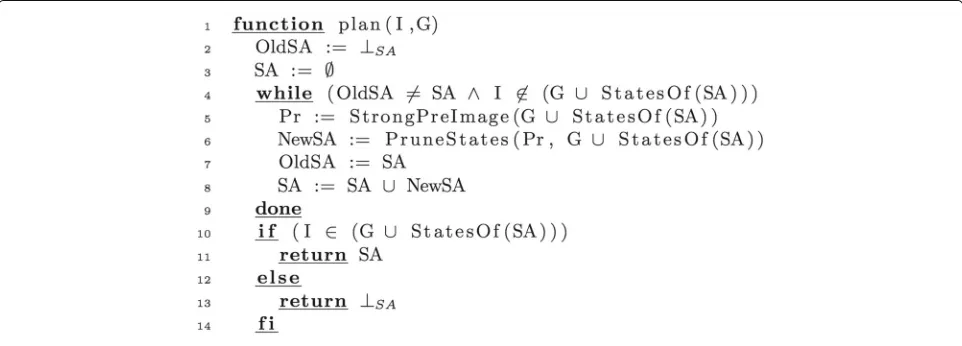
The routine for searching a consistent solution executor is presented in Fig. 10. In this routine, we assume that the domainDis globally available, while we explicitly pass its initial statesIand goal statesG. The algorithm is a great-est fixed point iteration that incrementally constructs a
state-action tableSA, which indicates which action has to be executed in certain state ofDin order to reach a goal state. As such,SAencodes all transitions of the domain that can potentially be presented in the consistent solution executor.SAis initially empty and grows at each iteration by adding state-actions which unconditionally lead to the states that are already covered by SAor goal states (i.e., states STATESOF(SA)∪G). The termination of the algo-rithm is caused by either the situation when 1) no new states are included in the next iteration or 2) the current state-action table already contains all initial statesI, which actually means that the solution for the initial states is already found.
The algorithm is defined such that it explicitly deals with the constraints imposed by a consistent solution execu-tor. This logic is essentially realized by the key primitives STRONGPREIMAGEand PRUNESTATES.
STRONGPREIMAGEis the basis of the backward search. For a subsetSof states ofCF, STRONGPREIMAGEreturns a set of state-action pairs{s,a}that encode all transitions ofCF that immediately lead toS. It takes into account that uncontrollable actions can be neither controlled nor predicted. So the function guarantees that ones a state-actions,ais included in the table, states ofScan always be reached fromsdespite non-determinism.
The primitive is defined as follows:
STRONGPREIMAGE(S)=
{s,a:(a∈I)∧(∃(s,a,s)∈R:s∈S)∧ (4) ( ∃(s,a,s)∈R):a∈O)} (5)
{(s,a):(a∈O)∧(∃(s,a,s)∈R:s∈S)∧ (6) ∀(s,a,s)∈R:(a∈O)→(s∈S))} . (7)
In order to properly reflect the requirements imposed by the definition of consistent solution executor, control-lable and uncontrolcontrol-lable actions are treated differently. For example, when we include controllable state-action, not only do we check that it leads to the states that are already in the state-action table but also make sure that uncon-trollable actions are not available from the same state. Similarly, the way we treat uncontrollable actions guar-antees that none of the uncontrollable actions originating from the same state are disregarded. Consequently, the strong pre-imaging function significantly contributes to the satisfaction of condition 1 (executor is runnable) of of consistent solution executor. We remark that this planning algorithm is significantly different from the conventional strong planning algorithms (e.g., [19]) that treat all the actions of the planning domain uniformly.
solution is already available (i.e., those that are already included in the state-action table). It is defined as follows:
PRUNESTATES(γ,S)= {s,a ∈γ :s∈S}.
We remark that the purpose of the pruning goes beyond avoiding the duplication of the same state-actions in the resulting table. The pruning ensures that for each state no more than one controllable state-action is included which closely relates to condition 1 of consistent solution execu-tor. It also guarantees that the state-action table does not contain loops (conditions 3). Another property of the pruning that has nothing to do with the definition of con-sistent solution executor is that only the shortest solution from any state appears in the state-action table.
The resulting state-action table (a collection of state-action pairs) shows how the resulting executable process should behave in different states. Uncontrollable state-actions indicate which uncontrollable state-actions have to be expected in the respective state. Similarly, controllable state-actions indicate which controllable action has to be executed from the respective state. The consistent solution executorSA can be directly derived from the state-action table using forward analysis.
For the given algorithms the following theorems can be proved (the respective proofs can be found in [18]).
Theorem 1(Termination)Let D = S,s0,I,O,Rbe a context-aware execution domain, let I = s0be its initial
state and let G⊆S be a set of goal states. The execution of
PL AN(I,G)on D terminates.
Theorem 2 (Correctness and Completeness)If
PL AN(I,G) returns state-action table SA, then SA is a consistent solution executor for the respective composition problem. If PL AN(I,G) returns FAIL, then no consistent solution executor to the respective composition problem exists.
3.4 Framework implementation
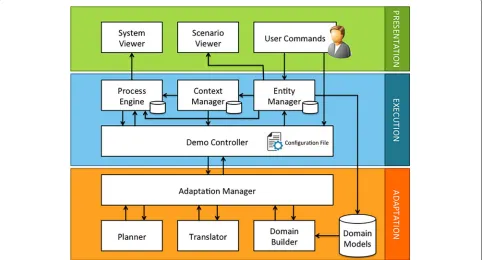
The framework introduced in the previous sections has been implemented and is part of an extended version6of the ASTRO-CAptEvo framework [20, 21]. Its architecture is depicted in Fig. 11 and is composed by three lay-ers, namely the Presentation, Execution and Adaptation layers.
The Adaptation layer is where the composition approach proposed in this paper has been implemented. The operation in this layer is regulated by the Adap-tation Manager. It is notified about the need to refine an abstract activity with its respective goal, together with the information on the current context. All these information are passed to the Domain Builder. The Domain Builder builds an initial version of the com-position problem, which is made of a context model, a set of available annotated fragments, the current con-text configuration (current states of concon-text properties), and a set of goal context configurations. The Domain
Builder extracts all necessary specification from the repository of Domain Models. Taking into account the current context and the composition goal, the Domain
Builder simplifies the context model by pruning all
unreachable configurations and removing all fragments that are useless for the goal specified (see [8] for details on this pruning step). Thanks to this optimization phase, the size of the planning domain is reduced and the computa-tion time for the planning phase is significantly reduced.
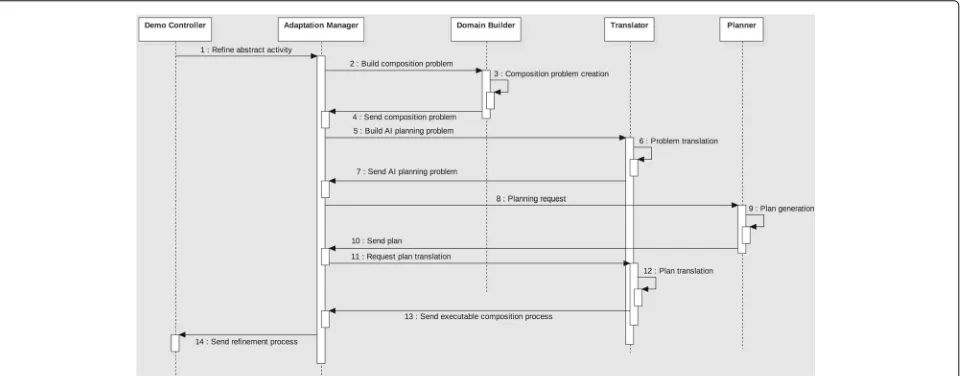
TheTranslatortranslates a composition problem into a planning problem such that it can be resolved by the Plan-ner. It is also responsible for interpreting the results of the Planner. The back translation transforms a plan obtained into an executable process. Finally, the executable pro-cess is sent to theDemo Controllerthat injects it into the current process instance. All these steps are implemented in our framework and are graphically represented in the sequence diagram depicted in Fig. 12.
The Execution layer is in charge of 1) simulating the application domain, 2) executing process instances, 3) detecting when to call the Adaptation Layer to realize fragments composition, and 4) refining a process instance according to the solution received from the Adaptation layer.
The Entity Managermanages all active entities within the scenario (e.g., ships, cars, tracks, storage managers, etc.) and it simulates their behaviour. When the Entity Managercreates a new entity (either within the initializa-tion phase, or in response to a user command), it deploys the entity process to theProcess Engine, it adds the cor-responding context properties to the context model in the Context Manager and it puts all the entity-related specifications (such as fragment models and the context property diagrams provided by the entity) to theDomain
Models Repository. When the entity “exits” the scenario, contrary actions are performed. In between, the Entity Manager simulates the entity behaviour, which is syn-chronized with the execution of the entity process, and updates the Context Manager and the Scenario Viewer with the current status. Finally, theEntity Manager pro-cesses all the user commands bringing changes to the domain (e.g., creation of new ships and orders, damage of a car, unavailability of fragments, etc..).
The Context Manager stores the system context (i.e., a set of context properties of all active entities) and it constantly synchronizes its current configuration with the application domain by monitoring the simulation going on in theEntity Manager.
The Process Engineexecutes the entity processes and suspends them every time that an abstract activity is reached and need to be refined. When it happens, the need is reported to theDemo Controller.
The Demo Controller aggregates all the data that is needed by the Adaptation layer to manage an abstract activity refinement (i.e., composition). This includes the current context provided by the Context Manager and the description of the need (process instance affected, its execution status, type of need) provided by the Process Engine. After the data is sent to theAdaptation layerand the solution is returned back, theDemo Controlleradapts the process instance.
Finally, the adapted process instance is redeployed and restarted by theProcess Engine.
The Presentation layer provides a detailed live view of the simulation taking place in the Execution layer. It also gives some control over the simulation and lets the user affect the application domain to model different situations.
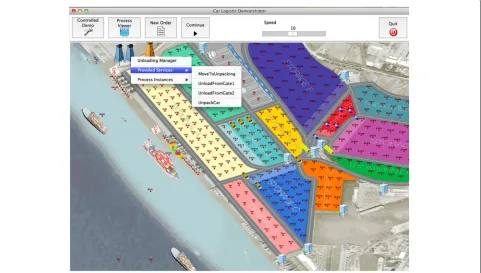
In particular, TheScenario Viewerprovides a graphical representation of the application domain through a map containing all the facilities (landing gates, storage areas, roads etc.) and showing all the entities of the domain (cars, ships, managers, etc.) in action (see Fig. 13).
For each active entity, theSystem Viewergives access to 1) the list of provided fragments and 2) the list of process instances. In turn, each process instance can be examined in aProcess Viewerwindow (Fig. 14). Here the user can find:
• the process context information including all context properties and their current values;
• the process model with the execution progress; • the execution history including all the applied
compositions;
If the user is interested in how a certain abstract activity has been refined, theComposition Inspector(Fig. 15 pro-vides full report from composition goals and fragments selection, to the details of the planning phase (planning domain, a resulting process, etc.).
The User Commands are used to control the
simula-tion running in the Execution layer and bring changes to the running scenario. The user can affect the sce-nario by triggering exogenous events (e.g., unavailability of entities and fragments) and creating new entities. To
replicate the usage of the framework, in other applica-tion domains it is enough to: (1) define all the scenario models (entities, processes, fragments and context prop-erties) that will be saved in theDomain Modelsrepository; (2) define a configuration file that includes the specifi-cation of which types of entity must be instantiated and executed at simulation time. While all the other compo-nents of Fig. 11 can be executed without domain-specific extensions, the Scenario Viewer must be implemented from scratch, since it should provide a graphical represen-tation of the application domain (e.g., as the harbour map in the Car Logistics).
4 Experiments and results
To demonstrate our approach in action and evaluate its performance and scalability, we have used the implemen-tation presented in Section 3.4 to model and run the Car Logistics scenario introduced in Section 2. In the following sections we present the outcome of the set of experiments done.
4.1 Experimental evaluation
We ran the ASTRO-CAptEvo framework in continu-ous mode for around an hour and collected information on 1060 compositions performed within this time. The run was performed on a Windows laptop with dual-core 2.8GHz CPU with 8Gb of RAM (we remark, however, that
Fig. 14Process Viewer. Process Viewer component of the ASTRO-CAptEvo framework
the planner implementation is single-threaded). For each composition, we measured a number of indicators that characterized the complexity of the problem and the tim-ing. Then we tried to organize them into charts to make conclusion about the applicability of the approach.
While conducting the measurements, we took into account the general conclusion about the performance of the planning algorithm given in [18]. In particular the authors stated that “the performance of synthesis appears to degrade sub-exponentially with the size of the components; and in vast majority of cases, it degrades polynomially with the number of components”.
However, when working with bigger domains the per-formance may degrade to exponential. The most reason-able explanation for that is based on the implementation details of the BDD (binary decision diagram) library used: big domains are much more memory demanding and for them the garbage collection and data re-arrangement mechanisms may take considerable time to keep the mem-ory consumption within certain limits.
In the chart in Fig. 16 we show the dependency between the number of fragments passed to the planner and the time it takes to produce a plan (in logarithmic scale). It can be seen that it shows exponential scalability. In general, this result corresponds to that of [18]. The performance degradation to exponential even for small numbers of fragments (that was not present in [18]) can be explained by the fact that, in addition to fragments, the plan-ning domain in context-aware composition also contains
context-related LTSs. As a result, even for small num-ber of fragments, the domain becomes relatively large and results in exponential scalability.
Alternatively, we propose our own indicator of domain complexity that is the total number of transitions in frag-ments and context properties making up the domain:
Complexity=NumContextTrans+NumFragTrans.
We find this indicator more precise compared to the number of fragments. It also allows us to see a more fine-grained distribution of all composition problems with respect to complexity. The performance scalability with respect to composition complexity is represented by the chart in Fig. 17. It can be observed that it generally cor-responds to the chart in Fig. 16 and features exponential growth. However, it makes sense to consider this chart along with the complexity distribution of all composi-tion problems analyzed in Fig. 17. It can be observed that most composition cases reside in the region with low or moderate complexity, while the cases with high com-plexity are quite few. We remark that such distribution also affects the precision of the scalability chart in the region of high complexity (less experiments are carried out there).
n, sec compositions resolved within n sec, %
0.1 19.07
1 91.12
3 96.51
10 99.62
30 100.00
From the table it can be observed that the vast major-ity of adaptation-related compositions actually take less than 10 seconds. This is the first evidence of practical applicability of our composition technique: although the performance of context-aware composition degrades exponentially with growing complexity of a composition problem, it is still enough to be used for the actual prob-lem of process adaptation. This becomes especially true when we notice that in many application domain there are no severe restrictions on the performance of composition
related tasks. For example, in the CLS scenario, the typical life cycle of a car may have duration up to several weeks and usually it is affordable for a user-centric system to take up to half a minute to produce a solution.
The last important observation is that for each particular composition problem we build a planning domain that includes only the information that is relevant for this problem, namely: 1) the subset of context prop-erties that are relevant for entities under consideration, which is normally a small portion of the overall context of the scenario and 2) the subset of all fragments that may be useful within the current composition problem, which is, again, only a small portion of all fragments currently available in the system. The idea of fragments and con-text pre-selection is quite natural: if the system resolves a problem for a particular car it needs only the part of con-text that are relevant for this car (and not for dozens of other cars and ships in the system), and fragments that
Fig. 16Dependency between performance and number of fragments composed. Dependency between the number of fragments passed to the planner and the time it takes to produce a plan
are relevant for car only (e.g., it does not make sense to consider a fragment for ship landing). We expect this pre-selection to allow us to preserve the same average size of the planning problem even for much larger (with respect to the number of entities) domains. Indeed, if within the scenario we operate thousands of cars instead of dozens, the complexity of an average composition problem for a particular car would not grow and remain the same: the proper selection will always come up with more or less the same amount of relevant fragments and context. The increase in the amount of cars in the harbour does not functionally affect the way a car procedure should be planned and executed. As such, we expect our approach to be easily scalable in this regard.
5 Related work
In last years, different approaches have been proposed for the modeling of services in a suitable way for making effi-cient dynamic service composition. From the scenario and the challenges discussed in this paper, a specific need has emerged: being able to define services in such a way that they can dynamically be specialized to the context, when this is discovered or when it changes. Where the context is characterized by the state of the execution environ-ment and by the available services at a specific time and location.
An approach targeting this problem is presented by Hull et al. [22] in their work aboutBusiness Artifacts. It con-sists in the definition of a formal/theoretical framework for defining conceptual entities, the artifacts, related to the execution of services whose operations influence the entities evolution, as they move through the business’s operations. However, this approach mostly focuses on ser-vice modeling aspects and does not deal with dynamic service composition. Yu et al. propose MoDAR [23], an approach on how to design dynamically adaptive service-based systems. Essentially they propose a method to simplify business processes by using rules to abstract their complex structure and to capture their variable behavior. However, in dynamic context, revising rules to manage frequent and unpredictable changes might turn out to be very expensive and complex. In [24], the authors tackle the problem of unpredictable execution of service-based applications. In particular, they focused on how to evolve a running service composition and propose a way for mod-eling artifacts corresponding to composite services that can change at runtime. However, software engineer inter-vention is needed to manipulate the runtime model of services. Moreover, the adaptation and application logics are mixed making the model not very flexible. In [25] the authors present DAMASCo, a framework managing the discovery, composition, adaptation and monitoring of ser-vices in a context-aware fashion by taking into account semantic information rather than only the syntactic one.
Since they address the problem of making the reuse of software entities more agile and easy to model, they focus especially on the adaptation of pre-existing software enti-ties that are used during the developing of service-based applications. Also the approach presented in [26] focuses on the need of explicitly manage the context in the compo-sition of web services, to address the problem of semantic heterogeneities between services. The authors present a context-based mediation approach that allows services both to share a common meaning of exchanged data and to automatically resolve conflicts related to the semantic of the data, by using context-based annotations which offer an optimized handling of the data flow. It would be interesting to use the approaches [25, 26] in the management of the composition of fragments coming from the different entities and the definition of the data flow between them. In [27] the concepts of goals and plans are introduced in the business processes model-ing with the purpose of extendmodel-ing the standard BPMN to make the BPM more flexible and responsive to change. However, even if plans are selected and executed at run-time, they are defined at design time together with the relations with the goals they can satisfy. Göser et al. [28] is a framework for, among other things, the man-agement of the integration of services in the business processes implementation’s process to speed the imple-mentation and deployment phases. Services’ integration is realized in a plug-and-play manner in which activities are selected from a repository and then dropped into a process. However, as regards the runtime adaptation of processes, in this approach only ad-hoc modifications are managed.
Hermosillo et al. [29] is a framework that combines complex event processing and dynamic business process adaptation, which allows to respond to the needs of the rapidity changing environment, and its adaptation lan-guage called SBPL, and extension to BPEL which adds flexibility to business processes. As in the previous frame-work, only ad-hoc adaptation processes are defined ad design-time together with the definition of specific adap-tation points for the business process and the events that will trigger that adaptation.
project [32] proposes a dynamic development process, and associated methods, tools and middleware, to sus-tain the composition of services in the Future Internet. It proposes a synthesis approach able to automatically generate, out of a BPMN2 choreography specification, the needed adaptation and coordination logic, and dis-tribute it between the participants so to enforce the choreography. Finally, in [16], authors propose service composition repair as an alternative solution that goes beyond the limits of service replacement while avoiding recomposition.
6 Discussion
We conclude this section with a discussion (summarized in Table 1) in which we try to point out the advantages of the proposed approach respect to related works. As regards to the standard approaches of service composi-tion, such as those of orchestration and choreography, they have have some crucial limitations. A major prob-lem of these approaches is that most of them are based on the assumption that during the specification of com-position requirements, the application designer knows the services to be composed. Besides, some of them, such as [14, 33], remain focused on the syntax level without con-sidering the semantic aspects of composition, which are, instead, necessary in context-based applications. Other approaches like [31, 34–38], have introduced the manage-ment of semantic knowledge in their models to drive the services’ composition and interoperation but, despite this, they do not allow processes to be specialized at runtime, through dynamic service composition. Cubo and Pimentel [25], Mrissa et al. [26], Greenwood [27] allow for very efficient management of service compositions at runtime, while [16, 32] supports composition evolution through adaptation to possible changes in the discovered services. The adaptation strategies applied in these approaches in some cases are defined at design-time or are strongly
related to a prescribed coordination model (i.e., BPMN2 model in [32] does not open to runtime and context-aware refinements).
The approach proposed in this paper, instead, offers a lightweight-model, with respect to the existing languages for service composition. It is more flexible and able to define both orchestrations and choreographies thanks to its dynamic collaboration among entities. Moreover, the model explicitly handles the context by managing the dynamicity of services, which can enter or leave the system in any moment, with a flexible connection strategy between entities that exploit thepublish-subscribe paradigm. Unlike specifications of traditional systems, where the behaviors are static descriptions of the expected run-time operation, our approach allows the application to define dynamic behaviors. This is realized thanks to the usage of abstract activities representing opening points in the definition of processes, which allow services being refined when the context is known or discovered. The bottom-up approach for the activities’ refinement allows fragments, once they are selected for the composition, to climb the entities’s relations to be embedded in the running process. Besides, the composition is defined at runtime, so that exactly the currently available services are considered for the composition. This feature, on the one hand enables a smooth exploitation of proximity ser-vices, and on the other hand makes the impact of run-time changes to services (modification of behavior, entrance or exit of services from the system) transparent to the system execution.
7 Conclusion
In this article, we presented a service composition frame-work that overcomes many limitations of the existing approaches. Our approach uses an AI planning algorithm as a reasoning mechanism, and can be used to solve com-position problems of real-world complexity in dynamic
Table 1Service composition approaches comparison
Approaches Customization and
context-awareness
Openness Flexibility
Our approach Runtimeservice composition in a dynamic context
Transparent handling of new services available atruntime
Structural changes in services functionalities and services unavailability
[22–29] Context-aware selection of services using semantic information, or context events to identify adaptation situations
Not addressed Adaptation plans defined at design-timetogether with the relations with the goals they can satisfy or predefined adaptation points.
[14, 33] Not addressed Syntax level service selection and
composition atdesign-time
Not addressed
[16, 31, 32, 34–38], Semantic Knowledge to drive the service composition
Design-timeservices selection, binding and composition
and pervasive setting like Logistics [8] or Smart Urban Mobility [7] domains.
The proposed framework uses an innovative service model in which services are considered to be stateful, non deterministic and asynchronous. The composition requirements model is based on the idea of abstracting composition requirements from implementation details of services. This allows for deep automation of the com-position process. Even though in the article we only consider reachability goals as control-flow requirements, we emphasize that our approach can be easily adapted to use any advanced control-flow language used in plan-ning (e.g., [39]). We also remark that our approach is compatible with data-flow requirements technique intro-duced in [40]. All this makes the new composition engine applicable to a wide range of real service composition problems.
Thanks to the abstraction of composition requirements from implementation of components we organized the composition life-cycle in such a way that almost all the human time-demanding operations can be accomplished at design time so that the composition run-time is fully automated. Moreover, the availability of a tool with such essential property brings new possibilities to composition dependent systems.
We generally consider two main future steps in the development of the ideas presented. One of them nat-urally consists in adopting the advanced compatible techniques for specifying complex control- and data-flow requirements. Another one concerns conducting experiments on using our approach in user-centric systems.
Endnotes
1In this article, we focus only on control-flow aspect of
composition. Data-flow aspect can be handled using the technique presented in [40], which is compatible with the formal framework introduced.
2Although the proposed approach works with processes
modeled using APFL, it can be also used extending other process-based languages like BPMN [41] or CMMN [42].
3We remark that in order to avoid state explosion and
to keep a planning problem tractable, it is strictly required that the number of states of each context property is finite and reasonably small. One technique for dealing with con-text properties with large or infinite number of states in planning can be found in [43].
4In this article, as context formulas we use
reacha-bility goals over context states (i. e., a goal consists in achieving certain context states, known as goal states). At the same time, we emphasize that used AI planning
techniques support for more sophisticated constructs including procedural goals, reactive goals and goals with preferences (more details can be found in [39]).
5In our approach, the need to annotate newly
cre-ated fragments to integrate them into the running sys-tem is the only human-dependent task that needs to be accomplished at run time. We do not see it as a signifi-cant limitation since 1) the annotation of new fragments is normally far less urgent task than resolving an ongoing failure and can hardly interrupt the normal operation of the system, and 2) the annotation effort can be distributed among multiple partners (each provider annotates its fragments).
6http://das.fbk.eu/astro-captevo
Abbreviations
APFL: Adaptable pervasive flows language (Section 4.1); BDD: Binary decision diagram (Section 5.2); CLS: Car logistics scenario (Section 3.1); IoS: Internet of services (Abstract); LTS: Labelled transition system (Section 3.1)
Availability of data and materials
The implementation of the ASTRO-CAptEvo framework is available at http://das.fbk.eu/astro-captevo together with a video showing its live demonstration.
Authors’ contributions
All authors are equal contributors. All authors read and approved the final manuscript.
Authors’ information
Dr. Antonio Bucchiarone (PhD) is a senior researcher in the FBK-DAS research unit of FBK. He received his PhD in Computer Science and Engineering, from IMT of Lucca (Italy) in July 2008. His main research interests are: self-adaptive (collective) systems, applied formal methods, run-time service composition and adaptation, specification and verification of component-based systems, dynamic software architectures. He has been actively involved in various research projects in the context of self-adaptive systems.
Dr. Annapaola Marconi (PhD) is a senior researcher at FBK, where she directs the FBK-DAS research unit. She received her PhD in Computer Science in 2008, from the ICT International Doctoral School of the University of Trento. Her research interests include distributed systems, collective adaptive systems, and automated composition of service-based applications. She has been actively involved in various local and European research projects in the area of Smart Mobility.
Dr. Marco Pistore (PhD), is currently head of the FBK-SC unit. He received a PhD in Computer Science from the University of Pisa (Italy) in 1998. He has an h-index of 46 and more than 200 publications in international journals, conferences, and symposia. He has 12 years of experience in the management of research teams and projects: he has been responsible of research groups and project teams (up to more than 30 persons); he has been scientific coordinator and partner coordinator of regional, national and EU research and innovation projects; he has been responsible of technology transfer projects with National and International companies.
Dr. Heorhi Raik (PhD), is a junior researcher at FBK. He received his PhD in Computer Science in 2012, from the ICT International Doctoral School of the University of Trento, with a thesis titled: “Service Composition in Dynamic Environments: From Theory to Practice”. His research interests include service composition, dynamic process adaptation, user-centric services, AI planning, collective adaptive systems.
Competing interests